



Abstract
Since its first appearance in the late 1950s, the neoclassical economic theory of fertility, particularly as exemplified by Gary Becker’s model of household production function that assumes a unitary utility function of the household, has become one of the most popular paradigms with which to examine fertility changes. Recently, the bargaining model that assumes separate utility functions has emerged as a strong opponent to the original paradigm. This article provides network foundation to reconcile two competing economic paradigms. Our formal model predicts that the way in which separate utilities of couples are treated in their joint childbearing decisions depends on the network embeddedness of spouses (i.e. the intra-household network). If spouses are not embedded into each other’s networks, the assumption of the unitary utility function is no longer warranted, and their decision process follows the bargaining model. However, strongly embedded couples behave as if they share the common utility function, predicted by the Becker model. Our model prediction is supported by analysis of three waves of panel data, Korean Longitudinal Survey of Women and Families, collected in South Korea where a dramatic drop in the fertility rate is reported. We find that the wife’s bargaining power, measured by the income difference between couples, can exert its influence on having a new-born child only when couples’ intra-household networks are weakly embedded, whereas strongly embedded couples consistently maintain high fertility rates regardless of how much the wife earns. We conclude that social networks play a significant role in shaping how neoclassical economic models of fertility work and discuss its implication to the efforts enhancing the fertility rate.
Introduction
Economic modeling of fertility can be traced to Harvey Leibenstein’s (1957) seminal work, where he formulated an economic model in which families balance utilities against disutilities with regard to an nth child to explicate his observation of a fertility decline. Based on a series of works following the 1957 paper, Becker greatly elaborated upon this economic model, conceptualizing a family as a factory that produces household products—in this case, housework and children (Becker, 1960, 1991; Becker and Barro, 1988; Becker and Lewis, 1973). He proposed a household production function in which all familiar neoclassical assumptions pertaining to maximizing behavior and equilibrium solutions are applied. Specifically, he sought to answer one of the most salient questions about fertility at that time: Why did fertility fall when income increased? Common sense held that as income increases, fertility would increase, too, unless the child-service is an inferior good with negative income-elasticity of demand, which seemed unreasonable (Robinson, 1997). He formulated the concept of “quality” of children and created a model in which total child-services equals the number of children × an average quality per child; in this manner, he showed successfully that as income increases, people maximize their utilities by increasing the average quality rather than the quantity of children (Becker and Lewis, 1973). This concept became a dominating theory of fertility within the social sciences owing to its simplicity and rigor (Doepke, 2015).
Until the early 1990s, following Becker’s model, most economic models treated the household as one economic unit in which family members behave as if they share a common utility or at least agree on every economic activity. The notion of “common preference” (or unitary utility function) was presumed by consensus (Samuelson, 1956) or altruism (Becker, 1991). Different terms are used to describe this approach: the “neoclassical model” (McElroy and Horney, 1981; Schultz, 1990), the “common preference model” (Thomas, 1990), the “unitary model” (Alderman et al., 1995), or the “consensus model” (Behrman, 1997).
One of the major reasons this approach gained popularity was, at that time, that economic consumption data were typically reported only at the level of the household. Economists analyze household data with relative ease by avoiding the theoretical task of showing how individual preferences are collectively aggregated to the household level (the so-called “preference aggregation problem”). Becker provided the seminal theoretical basis for this analytical convenience in studies of the family. As a potential mechanism to ensure the unitary utility of the household, Becker paid attention to “care.” In his well-known “rotten-kid” theorem, he proved that even if only one member cares for others such that his or her preference depends on the other’s utility function, every family member (including a rotten kid) will try to maximize the joint family utility or dynastic utility (Becker, 1991). This provides a theoretical justification for studying family behavior as if its members share one utility despite the fact that they actually have separate utilities in reality.
Although Becker avoided the preference aggregation problem by assuming “care” (or “altruism”), the issue over who has the last word (or ultimate power) in the household is unresolved (Ben-Porath, 1982). A person who cares (e.g. a parent) must have the ultimate power in the household in order for the rotten-kid theorem to be valid. This theorem disregards the fact that the family is often a place of conflict and struggle.
Against this backdrop, the field of economics has seen the development of many different approaches, denoted “collective models” (Alderman et al., 1995; Behrman, 1997; Bourguignon and Chiappori, 1992) or “bargaining models” (Lundberg and Pollak, 1993, 1994, 1996; Stark, 1984), that treat the family as a collection of individuals with separate utilities and that show how an aggregated outcome emerges from different and even conflicting utilities. A class of bargaining models assume a cooperative game between two persons with separate utility functions who bargain over the allocation of intra-household resources (Hener, 2015; Manser and Brown, 1980; McElroy and Horney, 1981; Vierling-Claassen, 2013). As a consequence, based on the Nash bargaining model, they can explain intra-household decisions without relying on the assumption of a single household utility function.
Many empirical results have challenged the unitary utility argument, especially by showing that family members do not appear as though they pool their income (Lundberg et al., 1997; Schultz, 1990; Thomas, 1990; especially Alderman et al., 1995 for a summary), and many believe that the burden of proof has shifted to those who argue for the unitary utility of the family (Alderman et al., 1995; Lundberg et al., 1997). 1 In addition, couples disagree on whether to have children, on how many children to have, and on when to have them (Doepke and Kindermann, 2016). The joint utility of both partners play pivotal roles in their fertility decision (Bauer and Kneip, 2013), although the conflicting child preferences provide a necessary condition on which bargaining power affects fertility choices (Hener, 2015).
An important lesson to be drawn from the discussion on the two competing economic paradigms is that we must conceptualize the family as the place where both love and conflicts (or care and bargaining) coexist (Stark, 1984). We must identify the conditions under which reciprocity and altruism emerge, rather than assume that they always or never characterize families (Ferree, 1990: 879). Following this dictum, we propose structural embeddedness of the couple as a contingent factor in predicting the fertility behavior of the family. 2 We develop a bargaining model where, at the beginning, a spouse has his or her own distinctive utility function, and the magnitude of a couple’s network embeddedness is incorporated as a deciding factor of transfer between spouses. Contingent on the level of the structural embeddedness of the couple, two distinctive equilibrium emerge. Among weakly embedded couples, the model predicts that fertility behavior is the result of bargaining between partners with separate and conflicting utilities. In contrast to this pure bargaining situation, strongly embedded couples behave as if they share a unitary utility in deciding upon fertility, as presumed in Becker’s model.
Intra-household network embeddedness as a contingent factor
The following five assumptions are necessary to develop a bargaining model in which the couple’s network embeddedness emerges as a contingent factor that predicts the divergence of fertility behaviors.
Assumption 1 (utility function of the spouse)
The household consists of a husband and a wife, and they decide upon the number of children to be born. The utilities of the spouses are separate and dependent on (1) the divisible private goods (x) and (2) a public good (B) (i.e. the flow of child-services from the births)


Assumption 2 (cost for the child)
In order to produce a child, both the wife and husband bear some costs, but we assume that the wife’s cost is higher than the husband’s. Some examples include the (mental and physical) costs of bearing and rearing children and the cost of career cessation. We simplify the model by assigning this cost only for the wife. This will not change the major conclusions of the model. We denote this cost as C(B).
Assumption 3 (transfer function)
We also assume that because children are a public good of the household, there should be some amount of transfer of utility from the husband to the wife in order to produce them. For example, the wife wants the fair reward for bearing and rearing a child from the husband later even when she cannot rejoin the workforce after a certain period of career interruption. The maximum amount of the transfer from the husband to the wife is determined by the traditional bargaining model based on each spouse’s bargaining power (Lundberg and Pollak, 1996; Rasul, 2008; Suen and Chan, 2003). We denote the transfer as T and the husband’s bargaining power as α (0 < α < 1)

Assumption 4 (network-contingent transfer)
However, the wife cannot always be certain that there will be a fair transfer; there can sometimes be an unfair transfer or a betrayal by the husband. When the husband betrays, he must pay the cost—that is, the value of the emotional strain, loss of love, loss of companionship, and damage to his reputation. We assume that this cost borne by the husband is systematically dependent on the strength of the couple’s network embeddedness. The stronger the husband’s embeddedness into the wife’s social networks, the more expensive is the cost arising from the betrayal. 3 Thus, we denote β as the level of the husband’s embeddedness into the wife’s social networks (0 ⩽ β ⩽ 1). Then, the expected transfer amount from the husband to the wife will be a fraction of the maximum amount, β*T.
Now, the wife will maximize the following with respect to the number of children (B) while taking account of the transfer she receives

If we substitute equation (3) into equation (4), we obtain the following

Once equation (1) and equation (2) are substituted into equation (5), then the first-order condition for maximization from the wife’s point of view would be

From equation (6), we can show that depending on the embeddedness level, the fertility behaviors diverge.
When the husband is embedded into the wife’s networks so strongly that maximum transfer from the husband to the wife is expected (when β = 1), the number of children at equilibrium will be determined regardless of the bargaining power of the husband (α disappears in equation (6)). Furthermore, the wife will behave as if she maximizes the unitary utility function of the couple, that is, the sum of the two spouses’ utilities, the left hand side (LHS) of equation (6). Thus, the predicted fertility behavior will be identical to that predicted by Becker’s model. In their decision process, the bargaining power of each spouse must be insignificant. They will behave as if they share one utility function without bargaining.
Assumption 5 (Nash product solution)
When the husband is embedded into the wife’s social networks so weakly that the wife cannot expect a fair reward from the husband, the couple is in what is known as the bargaining situation. The wife will maximize her own utility based on equation (6), while the husband will do the same based on the corresponding utility structure and constraints. 4 We do not have a universal economic model to predict the result of bargaining at this point. A series of different economic bargaining models of intra-household resource allocation were developed, showing differences in the assumptions of essential parameters such as utility functions, transfer rules, and equilibrium concepts. However, all models agree on one thing: the final equilibrium must be a result of maximizing the weighted average of each spouse’s utility. For example, the Nash solution, one of the most popular bargaining solution concepts, predicts that the bargaining equilibrium must be a geometric mean of each spouse’s utility maximization weighted by his or her individual threat points. 5
Thus, when the couples are not quite embedded into each other’s social networks and thus the low cost of betrayal leads to only a small fraction of the maximum transfer (when β is close to zero), the equilibrium is determined by bargaining power, as predicted in many bargaining models. In such a case, each spouse’s threat point, usually measured by wage or educational level, must be crucial in determining the couple’s fertility behavior. In a nutshell, for illustration we dichotomize the amount of network embeddedness despite the fact that it is actually continuous. When couples are strongly embedded (when β becomes closer to one), we can expect that they will behave as though they share one utility function of the household, as Becker assumed. When couples are only weakly embedded (when β becomes far from one), however, spouses will be in a bargaining situation where the final fertility behavior is a product of maximizing the average of each spouse’s utility weighted by their individual threat points and bargaining powers. 6
An empirical illustration
As discussed, various economic models have proven to be effective in understanding fertility behaviors in general over the last 50 years, but these remain elusive in some respects and have not lived up to early expectations (Robinson, 1997: 63). It is well exemplified by Japan and South Korea, which have shown extremely low fertility rates for nearly a decade. A total fertility rate (TFR) of 2.1 is believed to be necessary to maintain the current population size (the replacement rate), and some scholars coined the term “lowest-low fertility rate” to refer to a TFR of 1.3. The rate of 1.3 implies a reduction of the birth cohort by 50% and a halving of the stable population size every 45 years (Kohler et al., 2001). Figure 1 shows that starting in 2001, the TFRs in Korea dropped below 1.3, not recovering until 2013, whereas in Japan the TFRs continued to be low around 1.3 once dropped below 1.5 in 1992.
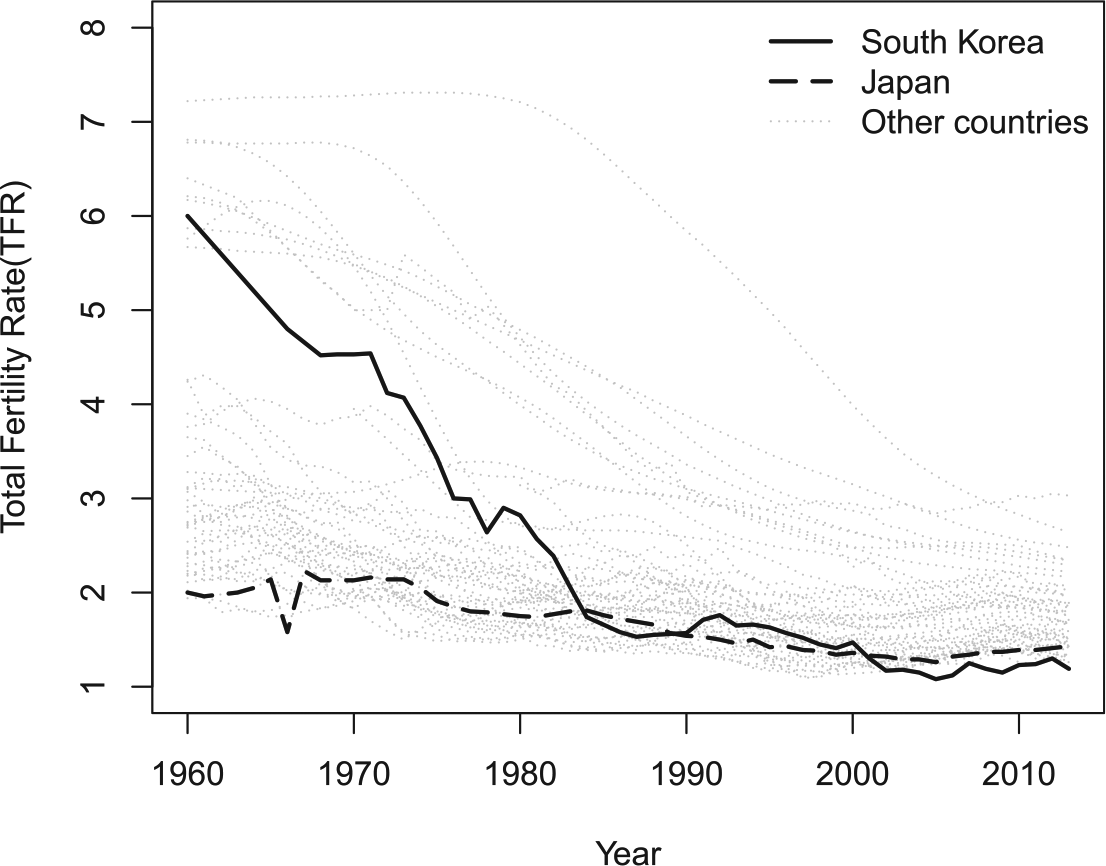
Total fertility rates of Japan and South Korea among Organisation for Economic Co-operation and Development (OECD) countries from 1960 to 2013.
The quite dramatic change in South Korea’s fertility rate is of particular interest. Shortly after South Korea’s TFR reached 6.0 in 1960, the Korean government established the Family Planning Association of Korea (in 1962) as an extremely strong and persistent government-initiated family planning policy. The policy became one of the most successful cases of family planning in the world (Freedman and Berelson, 1976; Lapham and Mauldin, 1972). During a period of only 4 years, between 1966 and 1970, the fertility rate dropped by half among women aged 15–19, while those aged 20–24 showed a reduction of nearly 25% (Lapham and Mauldin, 1972). This type of strong, government-driven family planning policy to reduce fertility continued until 1996; only several years later, South Korea observed one of the lowest fertility rates in the world.
At present, the South Korean government has initiated another strong, though opposite, policy to increase the fertility rate. In 2012, it enacted a new law titled Basic Regulations for an Aging Society with a Low Fertility Rate, and it has implemented a series of government programs (Korean Ministry of Health & Welfare, 2012). Unlike South Korea in the 1960s, when the government could with little resistance implement strong nationwide policies across virtually any societal domain, including firms, families, and communities, South Korea now is a relatively well-modernized, individualized, and decentralized society. So far, as a result, South Korean government’s serious efforts to increase the fertility rate could not complete its mission.
One of crucial features of the Korean Society is the greater burden of childbearing cost for women compared to other developed countries. Numerous statistics show harsher job market conditions for Korean women, 7 and also Korean couples were under stronger pressure from conflicts between the wife’s labor force participation and the traditional division of labor compared to other Confucian countries such as Japan and China (Oshio et al., 2012). In this regard, the case study of South Korea provides an important test-bed for examining the contingency of bargaining model on the fertility when women face bigger constraints and have severer conflicts in the society with high resistance against nationwide policies.
We introduce a social network approach that works in harmony with two competing economic paradigms by incorporating the network structure of couples into traditional economic models of decision making. In order to carry out empirical studies based on the frameworks proposed above, we need to consider the following issues on data availability and measurement. With regard to data availability, intra-household network data are readily available at the level of the household. However, measuring the network embeddedness of spouses is not quite straightforward. Among few network studies that focus on the network embeddedness of couples, we do not have a set of universal measurements. One study successfully utilized two dimensions of couples’ networks so as to measure the strength of embeddedness in explaining the division of household labor (Youm and Laumann, 2003) – the number of mutual friends (triadic embeddedness), and shared time (dyadic embeddedness). Following their guidance, we examine two types of intra-household network embeddedness: dyadic and triadic measures. We will explain our measurement strategy shortly after describing the data we use. And, then we will present our hypothesis and results.
Data
In this article, we provide an empirical illustration in which an intra-household network serves as a key contingent factor for predicting patterns of fertility behavior. The Korean Longitudinal Survey of Women and Families (KLoWF) data provide one of the best available sources of empirical data pertaining to the Korean society with which to examine the hypothesis. 8 KLoWF is a longitudinal and nationally representative study with focus on women as the study population in South Korea, which is designed to capture various relationships and material conditions women face in the areas of work and family. Face-to-face interviews using Computer-Assisted Personal Interviewing (CAPI) method were employed to collect the household information in addition to individual information. It is important to note that KLoWF provides both couple’s income and birth experiences as well as the degree to which they interact within their extended families (e.g. husband’s family and wife’s family). The data first collected a representative sample (through stratified random sampling) of 9997 households where at least one woman aged from 19 to 64 lived from September 2007 to February 2008 in South Korea. The second and third waves were collected in 2009 and 2011 for 7209 households among those who participated in the first wave (20% attrition rate). For the analysis, we selected married women aged 20–40 who were believed to be fertile, and therefore, 2997 women were included in the final analytic sample as a result of this selection. 9
Yet, it is worth mentioning several data limitations. (1) Measures about couples’ social networks in the data cannot be elaborated as much as the measures we can produce using egocentric network data. Thus, available social network measures are limited. (2) Match-paired data were not collected. Only women were interviewed, meaning that all of the variables describing the partners, including their wages and social networking patterns, must be estimated from the women’s report about their husbands, which raises a concern for response bias. (3) Although it is designed as panel study, the current data set contained only three waves. Since our model predicts the future birth (i.e. lagged outcomes), only two waves of data pertain to the analysis. Thus, it does not provide a sufficient number of waves across a long enough periods to fully capture fertility dynamics. For aforementioned reasons, the following empirical analysis should be taken only as an illustration of an empirical examination of the model’s implications.
Measures
The number of respondents who actually gave birth within 4 years was 467 in the analytic sample. We adopted logistic regression models to predict giving an actual birth. All independent variables were measured in the first wave in 2007. The set of control variables includes respondents’ age, educational level, partner’s age and education level as well as the logarithm of total household assets and household income.
The embeddedness of couples was measured in two dimensions: dyadic and triadic. A set of measures for dyadic embeddedness was tested. We found that one item was crucial, that is, the amount of shared activity, which was shown to be a good measure for dyadic embeddedness in the earlier study (Youm and Laumann, 2003). It was measured by the frequency of the joint free-time activities of couples, such as movie watching, jogging, or climbing per month. Triadic embeddedness was measured based on two questionnaire items. In South Korea, if the husband lives with his parents-in-law, it is the case that he is strongly embedded into his wife’s family network. 10 Because only few husbands lived with their parents-in-law (only 59 people out of 2997 cases), we also used a questionnaire which asked whether the couple met the parents or siblings of the wife at least once a month. The combined measure can be considered to be a good indicator of the amount of the husband’s embeddedness into the wife’s family social networks, particularly in a patriarchal society such as South Korea. Unlike dyadic embeddedness measure, this type of embeddedness in the spouse’s family can be labeled triadic embeddedness. Based on these dyadic and triadic embeddedness measures, we dichotomized them into “strong” and “weak” to probe the divergent equilibrium positions following the strategy of Youm and Laumann (2003). Strongly embedded couples are those who do joint activities together at least three times a week or visit wife’s families at least once a month or live together with wife’s parents; others are considered as weakly embedded couples.
We used the relative income level of husband and wife as a proxy for bargaining power (Hener, 2015), which is calculated as [log(wage of the wife + 1) − log(wage of the husband + 1)]. We added one to avoid log(0). Because many wives were not working at the time of the interview, first we ran a regression to predict the wages of non-working women based on their educational levels (dummies), age, interactions between the two in addition to women’s career history, which is measured by working years of their last job, and then impute the missing wage with the predicted values. However, we also present the results from estimating its effects only among those who are currently working using non-imputed log wage ratio. A higher logarithm of the wage ratio captures a greater bargaining power for the wife.
Hypothesis
H1. Considering that the husband’s embeddedness is the key contingent factor on which the couple’s fertility behavior follows either Becker’s unitary utility model or bargaining models with conflicting utilities, we will predict that there exists the interaction effect between the strength of network embeddedness and women’s bargaining power. Specifically, in the empirical analysis below, the interaction term between the strength of network embeddedness and the logarithm of the wage ratio of the wife (compared to that of the husband) will be significant.
H2. When embeddedness is strong, couples would behave as though they share one utility function; thus, the wife’s bargaining power measured by the wage ratio will lose its significance in predicting fertility. Therefore, among the wives whose husbands were strongly embedded, the effect of the logarithm of the wage ratio will be statistically insignificant.
H3. When embeddedness is weak, the logarithm of the wage ratio will show significant effects because the couple is now bargaining to maximize their independent utility function. Given that the wife would prefer fewer children than the husband due to the gender-specific cost, 11 a higher logarithm of the wage ratio of the wife (compared to that of the husband) will lead to lower odds that the couple gives a birth.
Results
Table 1 summarizes all variables used in the logistic regression models across strong and weak embeddedness samples. It shows that the fertility rate of strongly embedded couples from 2008 to 2011 (= 20.5%) is higher than weakly embedded couples (= 13.4%), although the difference itself is not statistically significant in logistic regression analysis in model 1 and 5 in Table 2 once several confounders are adjusted. Strongly embedded couples are richer in terms of household income and asset and have more babies than weakly embedded couples, although respondents’ age, years of education and partners’ age, and years of education do not seem largely different. Also, both wife and husband earn bigger wages in strongly embedded couples, whereas wife’s bargaining power measured by log wage ratio is higher in strongly embedded couples (= −1.16) than in weakly embedded couples (= −1.56). However, we cannot identify the direction of the relationship; whether stronger network embeddedness of couples makes couples richer and wives have higher bargaining power or vice versa.
Descriptive statistics of analytic samples by network embeddedness.

SD: standard deviation.
Means of variables are computed with survey weights adjusted. (*1$ = 1000 won).
Logistic regression analysis of interaction effects of network embeddedness and log wage ratio on new childbearing among women aged 19–40 in the KLoWF data from 2007 to 2011.
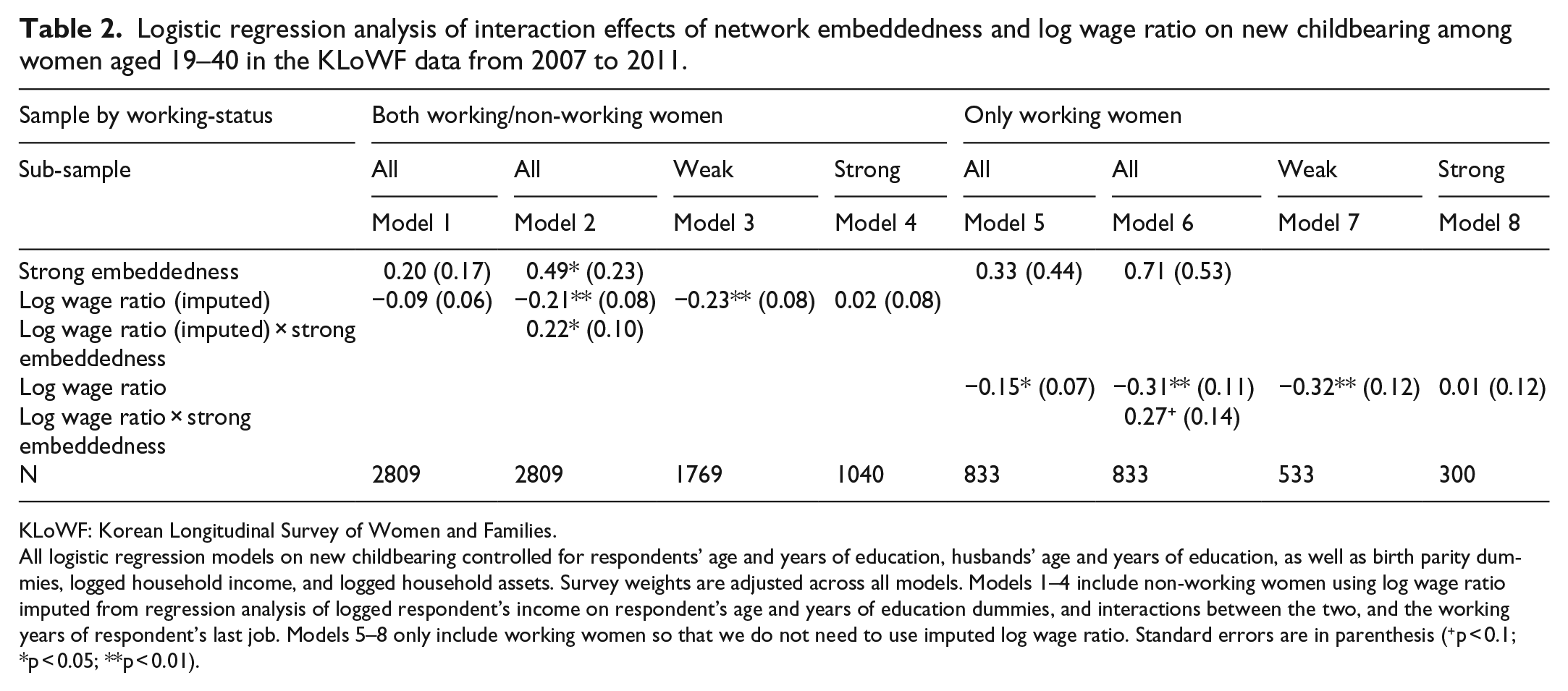
KLoWF: Korean Longitudinal Survey of Women and Families.
All logistic regression models on new childbearing controlled for respondents’ age and years of education, husbands’ age and years of education, as well as birth parity dummies, logged household income, and logged household assets. Survey weights are adjusted across all models. Models 1–4 include non-working women using log wage ratio imputed from regression analysis of logged respondent’s income on respondent’s age and years of education dummies, and interactions between the two, and the working years of respondent’s last job. Models 5–8 only include working women so that we do not need to use imputed log wage ratio. Standard errors are in parenthesis (+p < 0.1; *p < 0.05; **p < 0.01).
Figure 2 shows the baseline fertility rate differences across different levels of bargaining power among strongly and weakly embedded couples. Given women who do not work have the lowest bargaining power, the picture is clear; increasing bargaining power of women lowers the fertility rate among weakly embedded couples, but not among strongly embedded couples. The effect is quite dramatic; women who earn more money than her husbands (log wage ratio ⩾0) show approximately 10% lower fertility rate compared to non-working women among weakly embedded couples. We examine whether the seemingly substantial difference by network embeddedness is robust against several confounders including respondents’ age, years of education, and partner’s age and years of education, and birth parity, household income, and household asset in Table 2.

Differences of fertility rates by network embeddedness among women aged 19–40 in the KLoWF data from 2007 to 2011.
Table 2 provides the results from estimating logistic regression models of new births within 4 years since 2008. Model 1 shows that strongly embedded couples are more likely to give birth and the wife’s bargaining power lowers the probability of having a child. However, these effects are not statistically significant, precisely because of the contingent role of network embeddedness in the wife’s bargaining power, as our theory predicts. Combined with descriptive results from Figure 2, it clearly supports the idea that we should examine the effect of women’s bargaining power depending upon network embeddedness.
Model 2 adds an interaction term between the logarithm of the wage ratio of the wife and the husband’s embeddedness. We find the strong presence of the interaction effect; the coefficient is 0.22 and statistically significant at p-value of 0.05. As we proposed in H1, the logistic regression confirms that the effect of the log wage ratio is contingent on the strength of the network embeddedness. For easier interpretation, we plot the interaction effect. In Figure 3, the predicted probability is calculated while other variables are fixed at means. The black solid line shows that when the husband’s embeddedness is weak, higher bargaining power for the wife as measured by the logarithm of the wage ratio leads to higher chances of giving a birth. However, as gray dotted line shows, when the husband is strongly embedded with the wife’s family, the wife’s bargaining power does not make a difference in their childbearing behaviors, which also was supported by its insignificant interaction effect in Model 4.
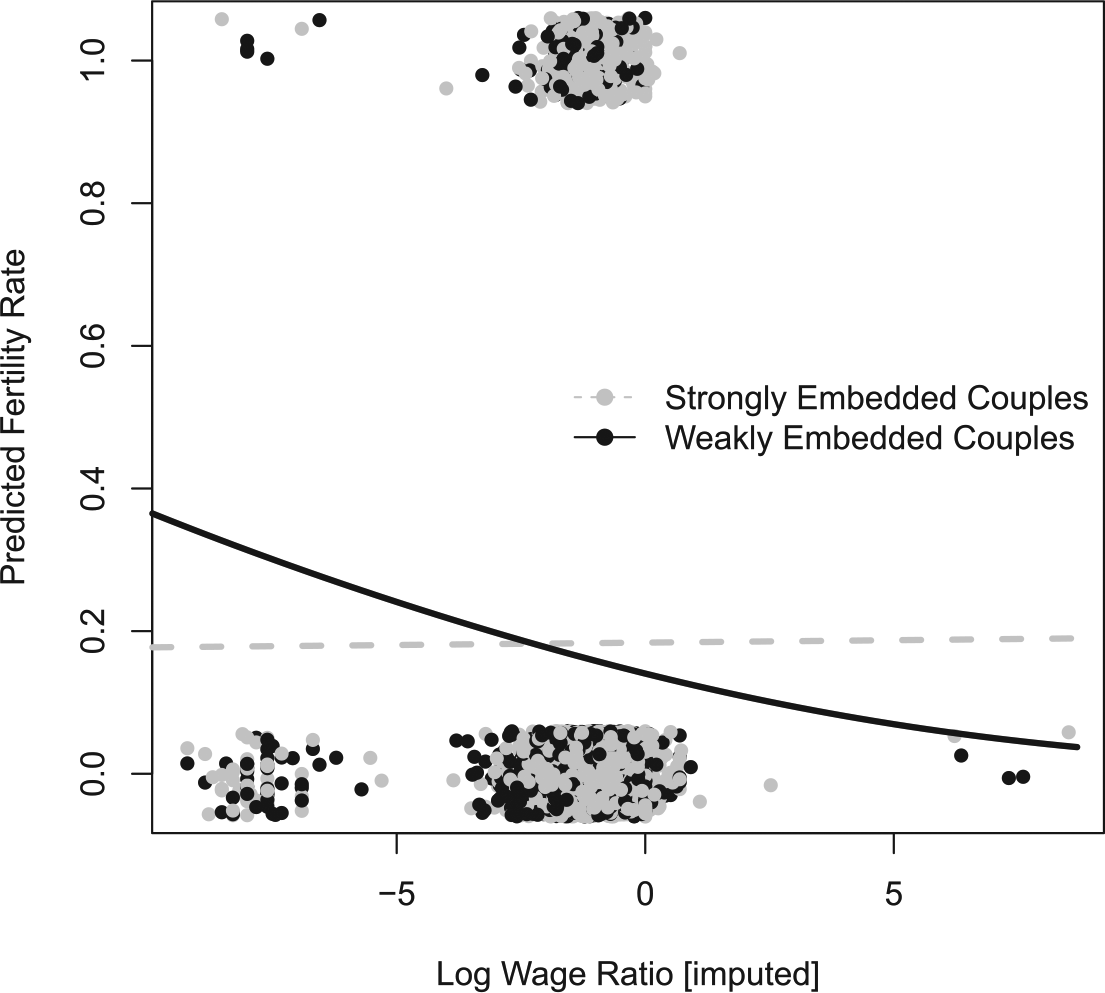
The interaction effect of network embeddedness and log wage ratio on new childbearing.
H2 and H3 are also confirmed in Model 3 and Model 4, respectively. The logistic regression only among the women whose husbands were weakly embedded shows a statistically significant effect of the log wage ratio, while strongly embedded couples do not exhibit the statistical significant effects. Namely, when the husband is strongly embedded, couples would behave as if they share unitary utility and thus there is no statistical significance of the wage ratio; the coefficient is 0.02 with a standard error of 0.08 in Model 4. This result is consistent with H2. In contrast, Model 3 reveals that when the husband is weakly embedded, couples would behave as if they are in a bargaining situation with separate utility functions; thus, the higher logarithm of the wife’s wage ratio, the lower the odds of giving a newborn child.
We also run the logistic regression analysis without relying on the imputed measure of the log wage ratio only among working women (Model 5–8). Model 5 shows that the main effect of the log wage ratio becomes stronger (−0.09 versus −0.15) and statistically significant at a p-value of 0.05. Additionally, Models 6–8 provide even stronger supports for our hypotheses; the coefficient estimates from the estimating regression model among working women gets bigger despite the reduction in sample sizes.
Discussion
This study seeks to reconcile two dominant-but-conflicting economic models based on separate or joint utility maximization by incorporating intra-household network structures into the original neoclassical economics model. The empirical illustration based on three waves of KLoWF data from 2007 to 2011, a representative longitudinal survey in South Korea, confirms that the influence of the wife’s bargaining power on couples’ fertility choices depends on the degree to which their dyadic and triadic networks within households are embedded. 12 Strongly embedded couples behave in a way to maximize their joint utility function, thereby leading to the insignificant effect of the wife’s bargaining power, whereas the increase in the wife’s bargaining power reduces the fertility rate among weakly embedded couples. These results confirm the idea that network embeddedness shapes how couples think of their utility function either collectively or separately, thereby affecting couple’s decision to give a birth.
Despite the importance of intra-household networks shown in this article, the role of inter-household networks in childbearing should be taken into consideration in the development of the formal model as well as its empirical assessment. By inter-household networks, we mean social ties between family units including friendship, co-worker ties, or neighborhood ties, unlike intra-household networks consisting of (extended) kinship ties. Unless each household determines its fertility in an independent way without interacting with other households, the ways in which households interact with each other must be crucial in fertility change dynamics (Balbo et al., 2013; Komura, 2012). An increasing number of studies have paid close attention to the diffusion processes of knowledge, information, attitudes, and norms to explain fertility changes to a fuller extent (Balbo and Barban, 2014; Bongaarts and Watkins, 1996; Buhler and Philipov, 2005; Ciliberto et al., 2013; Coale and Watkins, 1986; Dahl et al., 2014; Easterlin, 1978; Kohler, 2000).
Inter-household networks can provide two related but distinctive mechanisms through which fertility change can be accelerated or deterred: information and norms. First, households need to know fertility intentions of other households, as their own optimum fertility behavior itself is dependent on the behaviors of others (Kohler, 2000; Komura, 2012). As illustrated in Kohler’s (2000) paper, a multi-equilibria situation constitutes a coordination problem: the limitation of fertility is not a rational decision, given (expectations about) a prevailing high fertility level in the population (p. 241). Here, we take an opposite example. If a substantial proportion of households decide to invest a considerable amount of money and effort in the education of their children and thus focus on quality over quantity (as in South Korea), other households will also want to change their focus from quantity to quality, with a sharp increase in the expected cost of education per child. Jones et al. (2008) show that these taste-based theories, for the trade-off between quantity and quality, are more robust.
Another mechanism that could be responsible for fertility change is social influence or social learning through inter-household networks (Balbo and Barban, 2014; Ciliberto et al., 2013; Dahl et al., 2014; Lyngstad and Prskawetz, 2010). Networks convey attitudes, beliefs, and norms in addition to information; thus, they must be responsible for changing preferences, beliefs, and attitudes. Numerous social network studies have shown that strong and intensive ties are believed to produce greater mutual commitment and social influences and pressures, while weak ties provide more information than control (Burt, 1992; Kincaid, 2000; Sandefur and Laumann, 1998). The speed and robustness of diffusion are also contingent on the level of homogeneity of social networks (Centola, 2015; DiMaggio and Garip, 2012). If social networks are strongly assortative, with people interacting mainly with people of similar backgrounds, the diffusion will be slow but also robust in the sense that it will not die out easily. However, if social ties are formed in a very dissortative way, with people becoming acquainted with many others of different backgrounds, the diffusion will be fast but not robust. In order to understand the full picture of fertility change, we need to turn our attention to the way in which households interact, especially with regard to different regions and social classes in a country.
Several major limitations of this empirical examination must be discussed. First, as we noted above, we would like to consider the result as an empirical illustration because the data are incomplete in two senses. Three-wave data 2 years apart are not sufficient for examining the change of fertility behaviors while ruling out unobserved heterogeneities for causal identification by employing panel fixed effect models. Also, given that the data were not compiled for a network analysis, many possible measures of embeddedness could not be utilized including whether the spouses maintain their own bank accounts which was shown to be a good measure of the trust within households in the United States (Heimdal and Houseknecht, 2003; Treas, 1993). Moreover, the current model of network embeddedness was not elaborated or developed to its full extent. A fuller model could incorporate couples’ degrees of embeddedness into even bargaining processes so as to predict the effects of social embeddedness on the bargaining equilibrium. However, we believe that the current empirical results suffice as an illustrative example for our model.
This article also has policy implications for the improvement of fertility rates in a society, given that the nationwide coercive policy is not readily available in most democratic countries. 13 Our results provide one policy direction—to increase the degree of husbands’ embeddedness into their wives’ social lives. To achieve it, we can consider longer paternity leave at work or even the obligatory observation of paternity leave (see the Norway case in Dahl et al., 2014). This will increase the actual (and expected) transfer amount from the husband to the wife. A reduction of working hours in general may also be helpful. Although these types of suggestions are consistent with the work–family balance approach (Brewster and Rindfuss, 2000; MacInnes, 2006; Shreffler et al., 2010), we argue that these types of policies will help to improve the fertility rates above and beyond the work–life balance through different mechanisms. The current theoretical model also implies that this effect will be maintained regardless of the levels of employment and education of women; under strong embeddedness, the wage ratio has no effect. This could be specifically important for developed countries such as Korea, which have observed extremely high levels of employment and college education among women. Our suggestions to enhance couple’s embeddedness may be speculative. We expect follow-up studies to propose and test the way in which couple’s network embeddedness can be solidified.
Note that none of the above points are intended to disregard other economic approaches to fertility behavior. We believe, in fact, that economic models are useful for understanding the processes of fertility decision making. However, what they missed is consideration of social contexts where couples share or divide their utility function. Along the way, we show that network matters.
Footnotes
Acknowledgements
The authors would like to thank Mitsuhide Hoshino, Masayuki Morikawa, Atsushi Nakajima, Kazuo Yamaguchi, and other participants of the Research Institute of Economy, Trade, and Industry (RIETI) seminar for their helpful comments. They were crucial in improving the draft. Particularly, Kazuo Yamaguchi pushed us to develop a series of elaborated hypotheses. This paper was among the discussion paper series published on the RIETI website. Statistical programming codes and sample data to replicate all figures and tables are available at  .
.
Funding
The author(s) disclosed receipt of the following financial support for the research, authorship, and/or publication of this article: This research was carried out with financial support from the RIETI and from the National Research Foundation of Korea (NRF-2014S1A3A2044496).