



Abstract
This article proposes a general model of partisan political dealignment based on the theory of expressive voting. It is based on the Riker and Odershook equation. Voters cast a ballot for a political party if the utility associated with expressing their support for it is more than their expressive costs. Expressive utility is modeled here as a certain utility model. Then, the model is applied to the rise of voting support in favor of French right-wing populists, the National Front (FN). We show that the fall of justification costs of FN ideology along with the decline in stigmatization costs of voting in favor of the extreme right has fostered the popularity of this party. Political dealignment here is only a particular case of a general process of political norms transgression inherited by each voter.
Introduction
For a long time, populism was associated with extreme right-wing movements (Mudde, 2007). Mudde (2004: 543) defines populism as an ideology that considers society as consisting of two groups: the people and the elites. Populists still claim that they represent the ordinary people against the elites (Canovan, 1999; Taggart, 2000). This opposition between the top and the bottom would not be the consequence of a principle of delegation—the people delegating to the elites the management of economic and social problems—but of an illegitimate capture of a small group that would transform democracy, in other words, the government of the people, by the people, for the people into a more or less assumed form of aristocracy. The few would govern and serve its interests. It is against this government of the few that populists are rising up. This antagonism between top and bottom is the common matrix of left wing and right wing populisms. Left wing populism returns to one of the foundations of its semantic field, namely, egalitarianism. Right wing populism, on the other hand, exhibits cultural views based on ethno-nationalism (the people as a nation) and refers to a corrupt political-media-financial system. The French National Front (FN) develops this type of discourse. 1 The political class in the speech of the FN is identified with a group of parties that uses its positions to defend the status quo against the interests of nationals. This political class is referred to by right-wing populism as the UMPS, which combines the acronyms of the UMP (right-wing party) and the PS (socialist party). Here, there is an association between the political elite of the major government parties and the globalist elite that has only one interest: the dismantling of nation-states and the construction of a large market. Right-wing populism thus joins left-wing populism. This explains the porosity of the two electorates and the reason why many scholars treat populism as movements with “thin ideologies” (Mudde et al., 2013).
Recently, right-wing populist parties competed in most electoral contests that took place in Europe in 2017. Elections in France, the Netherlands, Austria, Germany, and the Czech Republic were all characterized by an increase in the support for such parties. The FN progressed to the second round of the French Presidential election for the first time since 2002; the Austrian Freedom Party (FPÖ) gained access to office after forming a governing coalition with the Center right People’s Party (OVP); and the Alternative for Germany (AfD) entered parliament for the first time after substantially increasing its vote share from the previous legislative election of 2013. These results attracted extensive media attention, generating talk of a “populist revolution” that is seen as part of a continuing trend that follows Brexit and the election of Donald Trump.
For the time being, the success of right-wing populism is relative, because for the moment right-wing populists do not rule in any major country of the European Union. The FN scored higher in the first round, but was far from having a majority in the second round (presidential elections 2002 and 2017). To address this question, we rely on a rational choice model of voter turnout. Briefly, voters stay away from traditional parties and cast their vote for right-wing populist parties such as the FN, because the benefits of voting for this party have increased while its costs have decreased. To go further, it is necessary to take up the voting equation of Riker and Odershook (1968), and enrich it with recent developments around the notions of expressive utility and justification costs of ideology (Facchini and Jaeck, 2019).
However, a large amount of literature has attempted to explain the rise of populism, without using the economics of voting, and its contribution to the theory of ideological dealignment. As highlighted by Margalit (2019), a significant number of contributions have focused on economic globalization and its resulting insecurities. One prominent account holds that the rise in imports from mid and low wage countries has hurt domestic workers employed in import-competing industries, mostly those of manufacturing industries. (Colantone and Stanig 2018a, 2018b). A second, and related, argument holds that the populist vote is a response to a combination of technological advances and deindustrialization. Technology has contributed to a shift from manufacturing to service sector jobs, and has accentuated the gaps between low and high skilled jobs (Frey et al., 2018). A third claim is that financial crisis, and how governments respond to them, can foster populism. Crisis tend to make tensions between debtors and creditors salient, and gives rise to a popular sentiment that the “little man” is made to pay for the mistakes and corruption of the economic and political leadership (Mian et al., 2014). Pirro and Van Kessel (2017) discuss the 2008 financial crisis and its negative consequences on the European Union and the budget of the southern countries. Similarly, Rico et al. (2017) focus on the role played by emotions during economic hardship. The main finding that emerged from a three wave panel survey of Spanish citizens is that anger over the economic crisis is positively related to support for populism. Finally, it is claimed that economic repercussions of immigration explain rising populism. This argument holds that competition posed by foreign workers has threatened the jobs and wages of native workers. Furthermore, immigration’s fiscal costs increased concerns about its impact on the welfare state. Such concerns have contributed to the appeal of right-wing populist parties, particularly in areas with high settlement rates of immigrants (Dustmann et al., 2018; Halla et al., 2017).
Although these studies have provided some support for the view that economic globalization fuels populism, Bergh and Karna (2020) recently found that such evidence is not conclusive. Using data on vote shares for 267 right-wing and left-wing populist parties in 33 European countries during 1980–2017, as well as globalization data from the KOF institute, they find no evidence of a positive association between economic globalization and populism. Interestingly, they also find that EU membership is associated with a four to six percentage point larger vote share for right-wing populist parties lending support for the role played by loss of national sovereignty. This result echoes previous studies linking populism with Euroscepticism (Rodrik, 2018; Salgado and Stavrakakis, 2019). For instance, Rodrik (2018) argues that the EU and the elites in Brussels are discredited because the outcome of globalization is far from what governments and their experts have portrayed to citizens. Apart from economic globalization, other factors are intertwined with globalization but remain outside the economic insecurity channel. Globalization could, for example, increase the salience of cultural threats and immigration (Halikiopoulou and Vlandas, 2020; Lucassen and Lubbers, 2011), which would lead to more support for right-wing populist parties.
In summary, the populist vote is only an instrumental vote of a sociotropic or egotropic nature (Mueller, 2003). It is self-serving if globalization has lowered voters’ income, thus enhancing voters to sanction the free trade movement and financial deregulation policies of outgoing governments. It is sociotropic if globalization has fueled deterioration of the country’s macroeconomic situation. Prato and Wolton (2018) develop the same instrumental model. Populists are more popular because policy reforms of recent years have not generated the predicted effects. Here again, there is no identity dimension within the populist vote. Electoral volatility is the consequence of public policy failures implemented thus far. The vote is retrospective. It sanctions policy outcomes. It is by no means ideological. For Seghezza and Pittaluga (2018), the success of populism is based on a well-known principle of the Roman emperors; games and bread. In Bolivia, Ecuador, and Venezuela, populism is the result of incumbent governments’ behavior that distribute the rent from natural resources extraction to special interests. Populism is thus a natural drift of democracy whereby its founding principle, “one man one vote,” can turn into demagogy. It is the egotropic and prospective model of voting which is at play here. Populism is the consequence of a calculus based on pure instrumental rationality. Such explanations, however, neglect the analytical consequences of the paradoxical nature of voting. Indeed, it is not rational to cast a vote as a mean of obtaining policies in one’s favor. The voter knows that the probability of obtaining a policy favorable to his interests is almost nil (Riker and Odershook, 1968). The question that arises under these conditions is not what will the voter gain from the application of populist policies, but what is gained from speaking out in favor of a populist party. Populist parties such as the FN in France or the Northern League in Italy defend the state against the market (Kitschelt, 1994), the disintegration of their country into the European Union and indigenous or native people (Mudde, 2007) against what they call mass immigration (Ivaldi et al., 2017).
After discussing the difficulties associated with an instrumental explanation of populist voting (Section 1), this article proposes a general model of partisan political dealignment based on the theory of expressive voting (Section 2) as per Riker and Odershook’s equation. The central argument is that voters cast a ballot for a political party if the benefits associated with expressing their support for such party is greater than their costs. The partisan choice is modeled as a certain utility model (or, alternatively, as a non-expected utility model). Then, the model is applied to the rise of voting support in favor of the French right-wing populist, FN (Section 3). We show that the fall of the justification costs of the FN’s ideology, coupled with the declining costs of expression for such ideology, have fostered the popularity of this party. Section 4 provides concluding remarks.
The rationality of partisan choice
Recall that the expected utility model (EUM) of voter turnout (Riker and Ordeshook, 1968) has been insightful to address electoral abstention. Within the framework of instrumental rationality, an action has value only if it affects outcomes (Downs, 1957). Based on this behavioral assumption, the expected utility model of voter turnout states that a voter, in deciding whether to vote or abstain, calculates the expected utility of both action and votes if benefits exceed costs, or alternatively if:

In equation (1), (R) represents the net expected utility of voting. The benefits from voting (PB) have two elements. (B) stands for the benefit a person thinks will accrue from having his or her preferred candidate win. These benefits have to be weighed with the probability (P) that one’s vote influences the outcome. Citizens may also vote to see democracy continue and derive a “consumption” benefit of voting equal to the value of the increased chance of the survival of democracy. Therefore, (D) stands for the intrinsic benefit from expressing oneself through the act of voting. Finally, (C) refers to the costs of voting. The literature has shown that (PB) is likely to be close to zero, since (P) is low to non-existent (Mulligan and Hunter, 2003) and the benefits of political action (B) are collective goods (Aldrich, 1993; Whiteley and Seyd, 1996). Thus, the remaining variables that explain voter turnout are (D) and (C) and equation (1) can be reduced to:

The extended Riker and Ordeshook’s equation of voter turnout as displayed in equation (2) can also be applied to describe partisan choice as follows:

In equation (3),
Benefits of electoral choice and self-esteem
The benefits of voting for party (i) is captured by variable (D) which refers to the gain that an individual receives when he expresses himself (Brennan and Buchanan, 1984; Brennan and Hamlin, 1998; Glazer, 2008; Hillman, 2010). The expressive utility is not produced by the act, but rather by its meaning (Hamlin and Jennings, 2011: 645). Holding a preference generates a utility itself. The act of voting, or a partisan vote, is defined as the expression of a preference. It is a source of utility because it is a way for the voter to defend his self-esteem. Voting increases self-esteem because it allows one to carry out one’s civic duty, to show that he is a good citizen, and to be able to express it publicly. The vote is mainly a mean to secure a positive self-image (Goffman, 1988: 69). Anything that undermines this image is costly for the individual. (Braud, 1996: 152). The sources of self-esteem refer to the answers to the following questions: What is a good behavior? Do others think I am a good person? Do others like me? Do others love me? Self-esteem is related to what each individual perceives of himself through his own judgment as well as through the eyes of others. Such a glance is the social mirror through which the individual succeeds in appreciating himself or not. The individual’s choices, and more particularly his electoral attitudes, are serving his self-esteem. The voter seeks to act in a good manner in order to be in line with what he considers being a good person (individual norm) as well as with the way others define a good person (social norm). The act of voting is thus constrained by the voter’s own judgment (his norm) and others’ judgment (social norm). Hence, the voter casts a vote for party (i) in order to maximize his self-esteem.
Self-esteem and civism
Self-esteem refers to what makes each individual think of himself positively. Civism generates self-esteem. If the voter believes that a good citizen is a good person, and that a good citizen votes, then he increases his self-esteem by fulfilling his civic duty (C). Voting is an expression of a civic norm (Blais, 2000). A good citizen sticks to such a norm. If an individual wishes to be a good person, a good citizen, then he must vote, because abstaining from voting is not doing the right thing. The voter cannot have a positive self-image if he does not do what is right. The decline of such “civic morality” contributes to the growth of electoral abstention.
Self-esteem and ideological identity
Civism generates self-esteem throughout the individual norm, that is, “a good citizen vote.” Similarly, ideology generates self-esteem throughout the social norm: a good person votes for the ideology (i). For instance, if ideology (i) is associated with left-wing political platforms such as redistributive policies, then, supporting such ideology is to stand on the side of the good, the justice, and the truth. Conversely, voting against redistribution means supporting social injustice and being perceived as a bad person. By casting a vote for party (i), the voter develops a positive image of himself (
Interestingly, the degree of ideological differentiation between political parties affects voters’ ability to discriminate between parties that stand on the side of “the Good” to those standing on the side of “the Bad.” For instance, if all parties defend the idea that it is right to defend the welfare state, the voter will not get any benefit by providing support for one party over another one. Therefore, in order to attract voters, parties need to differentiate their political views and shift the nature of political cleavages. They must be divided, for instance, on environmental issues—being in favor of or against the climate convention—or on identity issues—being in favor of or against multicultural societies. When political parties display a clear ideological divide, voters are subjectively able to assess which party belongs to the side of the Good and get a benefit of expression by supporting it.
Self-esteem and public expression of ideological identity
Self-esteem is also related to how each individual perceives himself in the eyes of others. 3 When an individual claims publicly he voted for party (i), he will be congratulated and judged as a good person by those who also support party (i). He will get a benefit of expression per se when voting for party (i). Interestingly, Schuessler (2000) has shown that expressive utility of voting is, initially, positively related to the number of other voters for the same candidate because of the “herding” or “contagion” effect to voting (Schuessler, 2000: 101). Hence, not only do voters cast a partisan vote in order to develop a positive self-image, but also to obtain others’ approval.
The voting costs
Along with the benefits of expression, the partisan vote includes voting costs. First, registration costs and the opportunity costs of time to vote are fixed costs (T) (Meynaud and Lancelot, 1965). Registration procedures, if fulfilled by voters, may involve significant costs (Brians and Carter, 1999; Highton, 2004). In addition, there are costs that the voter incurs on Election Day. These comprise “shoe leather” costs to get to the polling station and opportunity costs from the time spent in casting a vote. Several authors have claimed these costs to be small (Aldrich, 1993; Palfrey and Rosenthal, 1985) and unrelated to the partisan nature of the voting choice. Second, voting costs encompass the voter costs of justifying his ideological identity (Ii) and the costs of expressing it publicly by displaying his vote. These costs are likely to be high and to vary from one party to another.
Justification costs and ideological identity
Each voter inherits from an ideological identity. Ideology highlights the “dark side” of political choices. For instance, it commands us either to think that it is wrong to vote for the right or to think that voting for the left is good. Voters rely on these political norms to minimize the costs of acquiring political education. Indeed, being politically well informed is costly. Literature has shown that the costs of gathering information about the candidates and their policy proposals may be significant due to voters’ limited capabilities of understanding political debates (Converse, 1964, 2000; Deli et al., 1996; Facchini, 2017; Hardin, 2006). 4 Hence, ordinary citizens display a low level of political competence and remain rationally ignorant of contemporary political issues because of high costs of political information. However, reducing those costs is possible through the reliance on private conversations, political ideology, and low cost mass media. First, voters are more likely to be influenced by their immediate family, friends, and neighbors (MacKuen and Brown, 1987; Tarde, 1989: 122) because exchanging information occurs at no cost. Second, they select a candidate based on his ideology rather than on a sound cost-benefit analysis of his policy proposal. Political ideology acts as a cognitive shortcut in order to understand policy debates and help voters form their political opinion (Downs, 1961; North, 1992). Third, voters prefer being informed through low cost mass media since they are exposed to the most popular information source at low prices. For instance, in countries such as France or the U.S., television represents the major source of information about electoral debates among adults. 5
Everything else equal, each of these three factors has an impact on the decline of political information costs. However, when they interact each other, their cognitive properties depend on the level of competition on the market for news information. This is particularly true for the interaction between ideology and mass media. Indeed, when the supply of news information is monopolistic, such as in autocratic regimes where governments control mass media, ideology cannot act as a cognitive shortcut anymore. In autocracies, which exhibit a dominant State media ideology, justification costs of competing ideologies are prohibitive. Information that would discredit the dominant ideology would be too costly to acquire. For instance, no one wishing to support and defend liberalism under the former USSR could rely on liberal discourse as a substitute for promoting liberal policies. Search costs to establish the superiority of liberalism over communism would be immense under such media control. Conversely, after the collapse of communism, information about the failure of the Soviet Union, the gulag, and the Stalinist purges, is free and open access. Inevitably, the justification costs of supporting liberalism over communism go down. In the same vein, justification costs of revisionist ideologies are extremely high, if not infinite, as Holocaust denial goes against thousands of testimonies, archives and documents (Facchini, 2016).
On the contrary, in a world of competitive markets for news information, as it is the case in modern democracies, citizens are able to access to various media at low cost. Thus, ideology fully plays its role of cognitive shortcut. The reason lies with the complexity and overabundance of information available on the market place. When everyone can express his own opinion and share it, all displayed opinions are perceived to be equal and compete with each other. Hence, scientists, professors, journalists, family authorities can no longer filter information by relying on authoritative arguments. In such a context, rational individuals tend to stay away from politics and public debates since processing information becomes increasingly costly. As a result, any political discourse which is not ideologically focused will exacerbate this tendency.
It has been shown that ideological indistinctiveness would fuel disinterest in politics, and ultimately, electoral abstention (Facchini and Jaeck, 2019). However, in such cognitive contexts whereby the costs of gathering and processing political information become prohibitive, behavioral economics teaches us that in order to reduce these costs, individuals rely on the heuristic of availability to form their opinions (Kuran and Sunstein, 1999; Tversky and Kahneman, 1974). Agents tend to pay serious attention only to those options that have previously been tried out, because information on those options is readily available in their minds. Any ideological political discourse would generate the same effect. Indeed, it would enhance voters to understand public debates at lower costs. For instance, the justification costs of advancing and supporting liberal policies through ideological discourses are rather small within a context of freedom of speech and competition among different type of media. The institutional and communication channel is there to enhance ideology to express its cognitive properties. Interestingly, Leeson et al. (2012) find empirical evidence that state-based, free market think tanks are associated with more “pro-market” citizen attitudes about the role of government versus markets in economic policy. Think tanks are non-profit, research, and educational organizations with the explicit goal of affecting economic policy. Since fiscally conservative/libertarian organizations dominate the state-based think tank phenomenon in the U.S. (Callahan, 1999), Leeson et al. (2012)’s results suggest that the dynamism of U.S. civil society and think tanks’ ideological narratives help shape people’s political view at low cost.
Thus, the greater the competition on the market for news information, the lower the justification costs of emerging competing ideologies. As a result, the stronger the ideological cleavage in a world of overabundance of information and complexity, the cheaper the defense of an ideological identity.
The expressive costs per se
To the benefits of public expression (
The risks of social stigma and discrimination
Publicly expressing one’s electoral and political choices exposes the individual to the risk of being stigmatized and discriminated. Indeed, in addition to visible characteristics that give rise to stigmatization such as race and gender, unobservable attributes including values and beliefs, sexual orientation, religious affiliation, and personal experiences can also be stigmatized (Goffman, 1963). An individual who claims to be racist in a non-racist group bears the risk of being judged negatively and to potentially lose his job if his hierarchy does not support the same view. Similar mechanisms exist when people express publicly their political preferences. For this reason, individuals tend not to express them publicly if the costs of speaking up are prohibitive. They prefer to stay quiet or lie. Indeed, scholars have shown that reputational effects and social sanctions fuel uniform behaviors amongst the public (Akerlof, 1980; Kuran, 1989).
The silence
When one talks about politics, one exposes ourselves to the risk of having a bad image, because one does not know to whom one is dealing with. The private sphere is, for this reason, the traditional place for political conservations. In politics, the strategy of silence remains the dominant attitude (Mayer, 2013: 257). One does not talk about politics with strangers, because what is at stake is our own identity, our own self-esteem. Deteriorating self-esteem means putting oneself in danger, it means taking the risk of conflict, of verbal aggression. In such a context, the voter will have a stronger propensity to adopt the strategy of silence, especially if he knows that many voters do not share what he thinks, and that there is a low probability of getting social approval.
The lie
The strategy of silence is not the only option available. It can also be strategic not to be sincere, to falsify one’s public discourse. Revealed preference theory suggests that individuals’ preferences may be deduced from the observation of their action. Nevertheless, Kuran (1990) argued that an individual who joins a riot against a government does not necessarily support a change in the political regime. It might be costly for him if he does not participate. According to Kuran (1990), there are contexts where individuals can be punished or rewarded according to the preferences they express through their actions. In Kuran (1990)’s framework, individual utility has three dimensions: the social choice, social sanctions associated with individual choice, and the autonomy of individual decision. These three conflicting factors of utility generate, for each individual, a private preference and a public preference, the latter being the one he reveals to others through his actions. The divergence between these two types of preferences is at the heart of his preference falsification theory (Kuran, 1995). Falsifying one’s public discourse consists of distorting what one thinks privately in order to conform to what one believes about others people’s thoughts. Such a phenomenon occurs because expressing oneself in favor of liberalism in a communist group, for instance, will not have the same effects as if one lies. One does not want to bear the costs of expressing a belief that one knows to be true, but that one knows others would consider infamous. To be perceived as a good person, citizens create the difference between what belongs to public discourse and what refers to their political intimacy.
The psychological mechanism at work is similar to the one referring to expressive utility. The individual falsifies his speech because he gains a utility from being approved by the dominant community in the society (Kuran, 1989, 1990). He would rather behave in accordance with the dominant social norm rather than fueling a debate and bearing the risk of being stigmatized. The benefit of the strategy of lying is to avoid stigmatization and discrimination associated with standing firm for our own values and opinions. This is due to reputational concerns that may play out differently in different institutional settings. In autocratic regimes and dictatorships, citizens often have a straightforward incentive to conceal their true preferences. However, as Noelle-Neumann (1984, 1991) has shown, a “spiral of silence,” where individuals do not voice minority opinions in fear of social isolation, can be observed in democracies as well. Testing the Noelle-Neumann’s theory, Neuwirth et al. (2007) find evidence suggesting that conformity processes are operating based on fear of isolation.
The costs of silence and lies
The strategy of silence and falsification of public discourse has an opportunity cost and a direct cost. The opportunity cost is the expressive utility of the public claim of our sincere political preferences. The direct cost of silence and lies is the psychological frustration created by these strategies. Indeed, the individual does not stand for his political identity in public. He can never be appreciated for who he really is even if he firmly believes in socialist utopia, racist theories, or in the side effects of multicultural societies. This situation creates a sort of political frustration. He is thus trapped in the eyes of others and is never rewarded for what he truly is. This situation undermines his self-esteem, because he can tell himself that he is a coward who does not have the courage, the guts, to be loved for who he really is and not for what others want him to be. He experiences a phenomenon of cognitive dissonance (Festinger, 1957). However, some individuals seek to be authentic in their social interactions in order to maintain and verify their sense of self (Friskopp and Silverstein, 1996). To that end, they may decide to break the silence and bear the costs of discrimination. Indeed, the likelihood of experiencing discrimination tends to increase when a stigmatized identity is confirmed (King and Botsford, 2009).
The hidden consequence of silence and lies
Silence and lies generate one lasting effect: they increase the price of available information about the existence and popularity of political beliefs that are not publicly expressed. Political discrimination hinders the spread of specific ideas in the public sphere, as it promotes silence and lies. For these reasons, various political preferences cannot be expressed. An idea that is never expressed publicly will never be debated. It is as if it does not exist. Interestingly, such hidden consequence of stigmatization mechanisms of deviant individuals may be the result of a strategy to discredit competing ideas by political correctness’ supporters (Morris, 2001). Hence, information necessary to justify hidden ideas and political beliefs will become scarce and expensive.
The evolution of partisan choices is thus a result of change in the incentive structure of the voting process that has been described above. The rise of the populist vote is the consequence of such distortion. The underlying question is not what the voter will gain from the implementation of populist policies, but rather what his net gain will be from speaking out in favor of a populist party.
The rationality of the vote in favor of the FN
The FN (as one of the most established representatives of the radical right in Europe (Kestilä and Söderlund, 2007: 776), was founded in 1972 under the auspices of “Ordre Nouveau.” After some partial successes, the national electoral breakthrough of the FN happened in the 1984 elections to the European Parliament, when the party won 10.95% of the votes and 10 seats in the European Parliament (Le Bohec, 2005: 27). The FN performance has fluctuated significantly since the 1980s and has varied across election type. Concerning parliamentary elections since 1993: the highest percentage the party has received in the first round is 15.25% in 1997; the lowest is 4.9% in 2007. In the second round, percentages are slightly lower in all years, the highest being 8.75% the party received in 2017. Concerning presidential elections, since 1995, the party has progressed to the second round twice: in 2002 and in 2017. In the first round, the lowest percentage the party received was 10.44% in 2007; and the highest was 21.3% in 2017. In the second round, the party received 17.79% of the votes cast in 2002 and 33.9% in 2017. This is the highest percentage the party has ever received and it is notable that it was able to retain a high percentage in the second round. Since Marine Le Pen’s election to the presidency of the FN in January 2011 (the party becoming the Rassemblement Nationale (RN) in June 2018), the party has seen some unprecedented success. For instance, in terms of membership, the party tripled its membership from 22,000 members in January 2011 to 83,000 members in December 2014 (Le Figaro, 2014). 6 In this section, we apply our model of partisan choice to explain the rising and persistent electoral success of the FN.
Referring to equation (3) the net benefit of voting for party (i) (i referring to the RN) is given by:

A voter cast a ballot for a populist candidate if (D) > (C). Hence, it will be argued that the growing support for the FN is essentially the result of a fall in the justification costs of the FN ideology (C[
The fall of justification costs of the FN ideology
Justification costs of the FN ideology have fallen under the influence of the following factors. First, the occurrence of an “agenda effect” that legitimizes the threat posed by multiculturalism. Second, the use by the populist party of new information and communication technologies. Third, the emergence of a new political cleavage “populists versus globalists” that replace the traditional left/right divide. The latter exhibiting ideological indistinctiveness.
Agenda effect and the fear of multiculturalism
While it is well established that immigration fuels support for far-right parties (Halla et al., 2017; Otto and Steinhardt, 2014), the drivers of voters’ attitudes against immigration are not well understood. Guiso et al. (2017) point to the role of economic insecurity in explaining support for populist parties. Margalit (2019) has however challenged this view and has argued that, while it is true that immigration is often a major concern of populist voters, treating immigration as an economic driver of populism seems misguided. Indeed, the appeal of populism stems from immigration’s impact on native workers by threatening their jobs or eroding their wages. However, recognizing that the overall effects of immigration on the native population are still debated, other contributing factors such as anxiety about immigration and demographic shifts, as well as disaffection with progressive cultural change, underlie the appeal of populism. 7
Scholars have, for instance, pointed to the correlation between education and immigration attitudes. They have posited that a sense of cultural threat is at the core of opposition to immigration, and contend that lower levels of education also reflect higher levels of ethnocentrism and lower tolerance for outgroup members (Kinder and Kam, 2010). Hence, opposition to immigration represents a broader concern that many natives have about declining cultural homogeneity. Lending support to such arguments, experimental studies indicate that anxiety over changing demographics and a declining predominance of white people underlies part of natives’ opposition to immigration (Kaufmann, 2018). 8 In addition, Card et al. (2012) analyze cross-national European survey data and estimate the relative importance respondents attach to economic concern over future wages and taxes, as opposed to “compositional” concerns about the impact of immigration on local culture and social life. Their conclusion is that compositional concerns are two to five times more important than economic concerns. Similarly, Halla et al. (2017) find support for the hypothesis that negative effects toward immigration are, to an important extent, driven by compositional amenities in Austria. Other studies have also shown that even in cases where economic factors were found to be statistically significant predictors of attitudes on immigration, the magnitude of the effects was a good deal smaller than the effects associated with cultural concerns and prejudices (Malhotra et al., 2013).
Thus, while immigration is a salient concern for populist voters, economic insecurity directly related to immigration is not a key explanation for this concern. Edo et al. (2019)’s study about a French case supports such a view. The authors estimate the causal effect of immigration on political support for far-left and far-right candidates in France, using panel data on presidential elections since 1988 for both far-right and far-left candidates. Their results suggest that immigration increases support for far-right candidates, but does not have any robust impact for far-left candidates. More importantly, while looking at different immigrant groups, they show that low educated immigrants drive the increase in the electoral support for the far right from non-Western countries. Such a result highlights the importance of immigrants’ cultural background.
Interestingly, Edo et al. (2019)’s findings are not surprising since the FN has been a niche party for a long time. This niche is the fight against immigration and multicultural societies, which has been the central theme of the FN (Shields, 2007; Simmons, 2003). Such a cause has partly made the party’s electoral success and has fostered the repositioning of the traditional right-wing party, Les Republicains, toward this theme. This is particularly the case during the 2012 elections when the incumbent President Nicolas Sarkozy ran for a second term. Obviously, defending the national identity of the French is also present in the program of the list led by Marine Le Pen in the 2017 legislative election. Almost 30% of the party’s program is devoted to challenging multicultural societies. While global warming, the loss of biodiversity, etc. are favorable to ecological niche parties, migratory crisis, terrorism, and the rise of political Islam favor the FN vote. Figure 1 highlights this characteristic. It shows the various political parties’ stances on multiculturalism. On a scale from 0 to 4.5, a high value describes an aversion against a multicultural society. The figure shows that since the 1980s, the FN scores the highest.

Critic of multicultural society in political platform (1946–2017).
Nevertheless, even though the FN has a clear political platform against immigration and multiculturalism, its growing popularity is also fueled by an agenda effect. The latter being related to the European migration crisis since 2015 and its media coverage. If current events turn recurrent immigration into a migration crisis, then, the party that has specialized in dealing with migration issues gains credibility. The vote driven by salient issues is fueled by current events (Repass, 1971). The argument is simple—the FN has been claiming such opinion for decades. In addition, the migrant crisis, caused by the war against the former Islamic state and the revolution against the Syrian dictatorship has fostered voters turn to the heirs of the FN. Indeed, Amidst the EU refugee crisis, the FN has intensified its anti-immigration and welfare chauvinist rhetoric, deploying the party’s traditional narratives of “invasion” and “submersion” by migrants. Immigration is deemed a threat to France’s national identity, which would represent also a burden for the country’s welfare system and finances, hence calling for the enforcement of the FN’s most cherished principle of “national preference” recently renamed “national priority” to give it a softer tone. Hence, the migrant crisis popularized in the news has led voters to take an interest in the voices of the parties that have made of immigration the major issue to be dealt with in the coming years. What is not fully understood though, as Margalit (2019) points out, is how do people form their beliefs about the social and cultural consequences of immigration, what do they know about those issues, and what information and news sources do they rely upon in forming their beliefs? Behavioral economics as well as the role played by digital media help provide an answer.
New digital media and market for information
The widespread use of digital media that develop their own vision of current affairs has drastically reduced the price of information in favor of the FN ideology. Since social networks are entirely financed through advertisement, digital media provide voters with alternative and free information. Voters have free access of information that is costly to acquire, and collect only information that supports their views. Behavioral economists who show that, in a context of complexity, voters rely on heuristics to form their opinions, have documented such cognitive mechanism. One of them is the reliance on the heuristic of availability whereby immediate and simplistic information provided by mass media foster people’s beliefs formation (Kuran and Sunstein, 1999). Populists seeking to advance their political agenda could thus easily use the voters’ cognitive context strategically. Numerous studies have documented the crucial role that digital media play in populist propaganda (Schroeder, 2018: 60). Interestingly, Delouis (2012) has shown that the internet has recently made it possible to spread populist. Some websites like fdesouche.com apply the principle of so-called “re-information,” namely, they selectively compile all national and international news that confirm the hypothesis of an immigrant threat: crimes committed by immigrants or their descendants, public support or tolerance of Muslim customs, vandalism in churches. It contains a wealth of life-stories written by scores of people attracted to far-right ideas. Hundreds have answered a call to tell their personal story about what led them to change their worldview and start voting on the far right. 9 Thus, websites play an active role in sustaining a far-right vision of current affairs, with every hand-picked and highlighted news item feeding into this alternative version of truth.
The emergence of such digital media developing their own narratives has also been correlated to the loss of power and influence of large-scale mass media. The latter were very successful at promoting a shared and common view of current affairs (Fourquet, 2019: 79). This is particularly the case for television that has fueled and structured public opinion and worldviews through its diversity of programs. On top of its success, the first French TV channel “TF1” was attracting a large audience. However, under the effect of emerging competing channels, as well as the growing use of internet, the TF1 audience has been in a steady decline for 30 years. In 1988, it reached 45% of television users against 20% in 2017. Daily newspapers such as “Le Monde” have also witnessed a decline of their sales since many years. In addition, the sales of big weekly magazines such as “L’Express” or “Le Nouvel Observateur” have fallen by 30% from 2005 to 2017 (Fourquet, 2019: 79). For many years, these magazines had drastically contributed to create a sociologically and ideologically homogeneous readership. Hence, according to Fourquet (2019), the large-scale mass media being severely competed by digital media, the French society becomes an “archipelago” where many parts of the citizenry do not trust mass media anymore.
Such a competitive process on the market for news information has largely contributed to spread out the populist ideology at low costs. In addition, it is worth noting that digital media is a privileged vehicle for the hidden expression of right-wing populist citizens. 10 In this way, citizens avoid the costs of stigmatization and discrimination. The cognitive costs of political populist information are then further reduced since more pro-populist information are shared on social networks and digital media. Interestingly, the FN itself has used this form of dissemination of populist discourse. Stockemer and Barisione (2017) have analyzed FN’s Facebook page from 2013 to 2015 and have shown that the party has managed to create a more attractive image by rendering its discourse more populist. Interestingly, the quantitative analysis of “likes” for each post, allows the authors to highlight that this new discourse resonates well with the party’s sympathizers. Figure 2 below that compares the number of “likes” for several political parties since 2015 illustrates this proposal. The number of likes registered on the FN website is historically much higher than for the traditional parties, which have gradually tried to catch up, but remain far behind the right-wing populist party. The number of likes is both an indicator of the commitment of activists and the popularity of the website.

Right-wing populism a leading party on Facebook.
Ideological indistinctiveness: A catalyst for populism
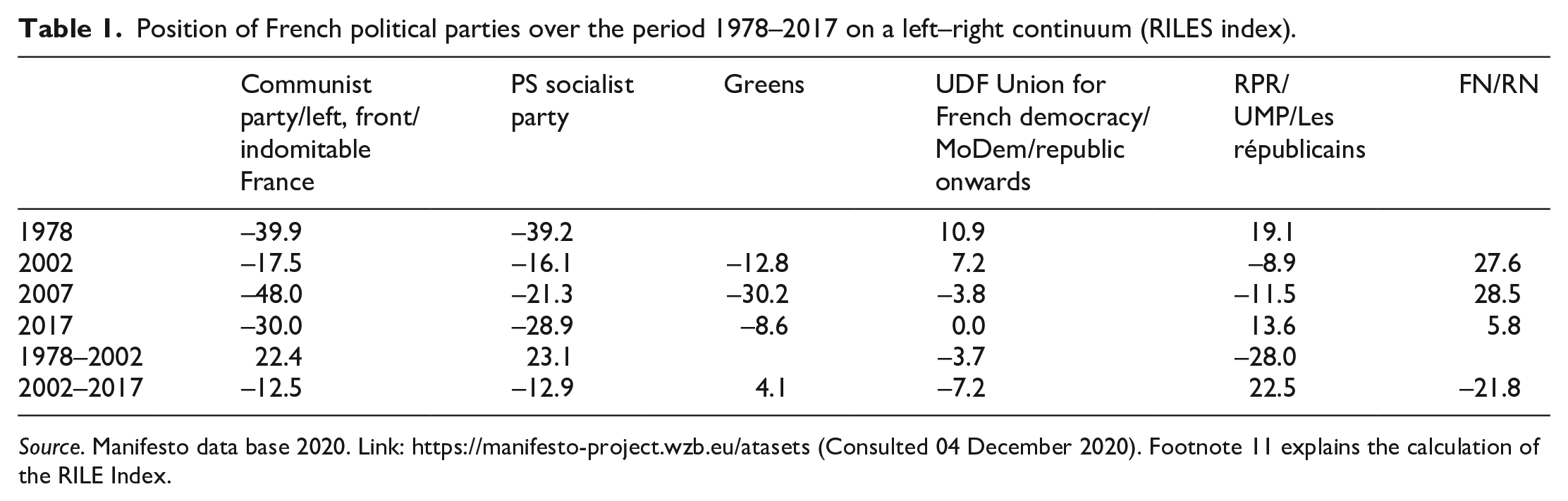
A large body of literature has shown that, in France, between the early 1980s and 2000s, and in Western Europe more broadly, the parties of the left moved to the right and a significant number of parties of the right moved to the left. French political life has thus witnessed a strong centrist tendency (Marthaler, 2010: 88). Marthaler (2010) draws on data provided by the Manifesto Research Group (MRG) that measures changes in parties’ placements along the left–right continuum. On a program scale classified a priori from left to right (redistributive policies and welfare state on the left and market liberalization on the right), it is possible to observe these opposite movements as well as the formation of political programs of French various political parties. The indicator presented in Table 1 provides the distance between the left and right political programs (RILE 11 ) over the period between 1978 and 2017. The main learning is that the programmatic distance between the two dominant parties of the left (PS) and the right (RPR/UMP, Gaullist) has been decreasing steadily until 2002. The PS moved 23.1 to the right between 1978 and 2002 and the RPR/UMP moved 28.0 points to the left. The primary effect of ideological indistinctiveness is electoral abstention since voters can no longer make the distinction between traditional left-wing and right-wing parties (Facchini and Jaeck, 2019). The secondary effect is twofold.
Position of French political parties over the period 1978–2017 on a left–right continuum (RILES index).
Source. Manifesto data base 2020. Link: https://manifesto-project.wzb.eu/atasets (Consulted 04 December 2020). Footnote 11 explains the calculation of the RILE Index.
First, the most educated voters adhere to a party that is structured around the end of the left/right divide. In 2007, French political life had witnessed the emergence of moderate right-wing party, Modem, which emphasized a clear move to the socialist left and was often labeled a centrist party. Such political shift toward the center had ultimately manifested itself with the emergence of the party, “Republic Onward” in 2017. The slogan “neither from the left nor from the right” started mechanically to seduce the most competent voters, namely young educated voters with a high socioeconomic status (Sauger, 2007: 448).
Second, ideological indistinctiveness fuels the displacement of the least educated voters toward the extreme right. According to Perrineau (2003), voters casting a ballot for the French extreme right party express their dissatisfaction toward democracy (“Le désenchantement démocratique”) and their strong critics toward the meaningless left /right political divide. Over the years, Marine Le Pen’s National Front was indeed quite successful at unsettling the traditionally governing parties of the Center-right and Center-left by conflating their acronyms (then UMP and PS) into “a same political mafia which is called UMPS” (Le Pen, quoted in Ivaldi et al., 2017: 359). In addition, the rise of the FN has resulted from the decline of the extreme left and the Communist Party (PCF). In particular, the latter has lost its extreme ideological component during the 1980s through its strategic alliance with the Socialist Party. Indeed, since the promotion of the joint program of the left in 1978, the PCF had been assimilated to the PS and its right-wing austerity policy. Table 1 shows that the PCF moved 22.4 to the right between 1978 and 2002. Such a phenomenon had benefitted the FN, which had operated a shift of its socioeconomic program to the left in order to attract the disillusioned leftist voters (Ivaldi, 2015b). Indeed, over the period between 2002 and 2017, the FN moved 21.8 points to the left.
Interestingly, the new political supply has changed the conditions of political competition. After the emergence of the Modem centrist party in 2007, existing dominant parties were forced to stick to their traditional political platforms. The PS was threatened by the left move of the centrist party and the traditional right-wing party had to operate a shift further to the right in order to attract the growing FN supporters. The latter being disillusioned by the left’s move of the far right. Indeed, over the period between 2002 and 2017, the traditional right moved 22.5 points to the right and the traditional left (PS) moved 12.9 points to the left. The left move of the PS resulting from a shift of 7.2 points to the left by the centrist party over the same period. However, such repositioning of traditional parties to their seminal ideological platforms had proven to be unsuccessful. For instance, Les Républicains (the former UMP), and the socialist party received less than 15% of the votes between them (with both below 8.5%) in the 2019 European elections. Conversely, the RN received the highest percentage of the votes cast at such elections (23%). Unsurprisingly, these electoral outcomes are driven by the emergence of a new political cleavage structured around the theme of globalization and multiculturalism since the 2017 Presidential election. Indeed, either voters stand with the group of patriots, good citizens, or they support the globalists who are depicted by populists as citizens who stand on the side of the elite and its multiculturalist ideology. For instance, as explained by Marine Le Pen in her 2017 manifesto, “this presidential election features two opposite projects—the “globalist” choice represented by all my opponents—(. . .) and the “patriotic” choice which I personify” (FN, 2017). This new political divide has further reduced the costs of understanding political debates for a large part of the electorate who could no longer grasp the nuances between the agendas of the socialist party and the moderate right.
In sum, the justification costs of the FN ideology have drastically fallen under the joint impact of ideological indistinctiveness of traditional parties, the rise of new media as well as an agenda effect on immigration issues. Ideological indistinctiveness has given rise to a new political divide “populists against globalists” that has attracted a growing share of voters since it is easily identifiable. Ideology acts as a cognitive shortcut. Populist ideology helps voters to understand political issues at lower costs. This is facilitated by the fact that the core of the FN political platform, namely the fight against immigration, has benefitted from the media coverage of the European migration crisis since 2015. Such an agenda effect has been exacerbated by the popularization of new digital media displaying populist ideology at low costs. As a result, the risk of invasion by foreigners is getting greater credibility for many French citizens. Indeed, recent opinion polls show that 60% of the French believe that migrants are a threat to France, and that they will not improve the country situation (Ipsos, November 7 2019).
De-demonization and declining costs of publicly expressing electoral choices
The rising electoral support for the FN is also the consequence of its strategy of de-demonization. Such a strategy has mainly manifested itself through the shift to the left of the political spectrum of its program. Within the framework of expressive utility theory, such a strategy can be interpreted as a way to reduce the costs of expression (C[
However, if the ideology that underlies the FN political discourse becomes gradually closer to the widely accepted political norm, then the costs of expressing oneself publicly in favor of such ideology tend to decrease. The strategy of de-demonization implemented by Marine Le Pen and FN leaders since the early 2010s highlights this trend. It consists of removing from the political agenda everything that was stigmatizing while keeping the identity of the party, namely the anti-immigration and anti-multiculturalist discourses (Ivaldi, 2015a; Mayer, 2015). This process has included a shift of emphasis from préférence to priorité nationale in order to disassociate the party from the negative connotations of Jean-Marie Le Pen’s rhetoric and create distance from the party’s reputation for exclusionist discrimination (Alduy and Wahnich, 2015).
The internal logic of the de-demonization strategy can be described as follows. It is all about creating a social context that changes the reward structure when expressing oneself in favor of the FN. Discriminating an individual because he expresses himself in favor of the FN must become stigmatizing. For FN leaders, such an attitude must become an infringement of freedom of expression. The latter will be increasingly costly as voters and supporters of the FN defend the State against the market, namely a very divisive position shared by a large number of voters. Standing for such position reflects a political norm: “The state is good while the market is bad.” Defending the State is to defend the general interest, while supporting the market is to defend the selfishness of individual interests. Supporting the market thus becomes a transgressive act that is costly for those who engage in it. No one has any interest in wanting to bear this type of cost. A stigmatization mechanism arises and it fosters the spreading out of an anti-market ideology. Defending the anti-market ideology becomes a mean to defend self-esteem, in other words to be perceived as a good person. Recall that FN leader had been elected from the Poujade movement, which was largely an anti-tax movement. Hence, the FN had for long time defended theories that were quite favorable to the market. Such an ideological position was then detrimental to the development of its electorate because of the dominance of the statist ideology, which considerably increased the costs of expression in favor of its program.
The first step of the de-demonization process is thus to stop defending the market against the state. This brings the FN back to the doxa and allows the supporters of France to defend the generosity of the State for nationals against foreigners. Such a development is once again clearly visible when one look at the FN’s program in defense of the market economy. Figure 3 shows the evolution of the FN’s program concerning the status of the State versus the market. The FN under Marine Le Pen has espoused an economic construction of the people, which emulates left-wing strategies of anti-capitalist mobilization. In the context of the economic crisis, the FN has moved toward the left on the economic axis. It has intensified economic nationalism, while also endorsing egalitarian and statist policies (Ivaldi, 2015b). The consequence of this evolution is that, in 2017, the economic positioning of the FN in the legislative elections was almost the same as that of the Socialist Party in the 1993 elections (Figure 4).

Economic de-demonization and the defense of welfare state again the free market economy. 12
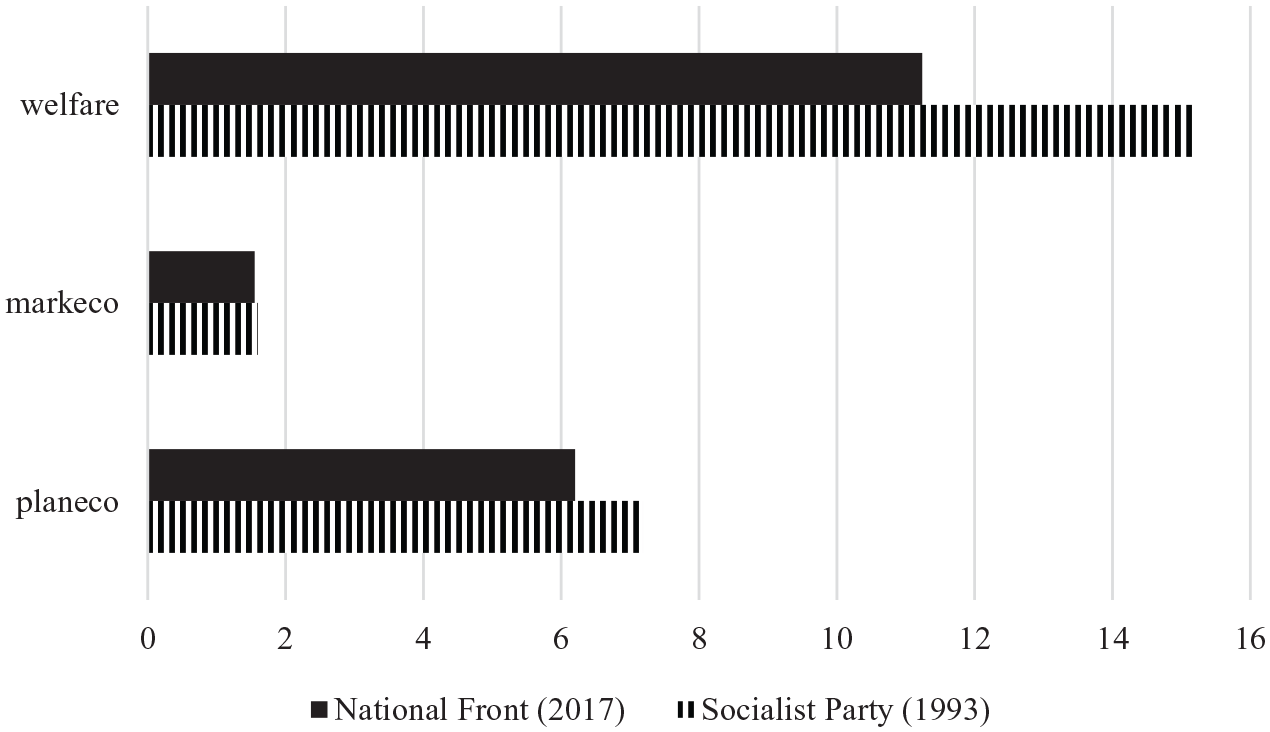
De-demonization and convergence of the economic positions of the 2017 Front Nationale with those of the 1993 Socialist Party.
In addition, the repositioning of the FN’s political stances is not focused entirely about economic issues. It is also very significant on social issues, or what can also be called moral issues. Despite the fact that “the xenophobic and inegalitarian message of the right-wing parties has been condemned by the Christian Churches as incompatible with the message of the Evangels” (Mayer, 2013: 163) FN is the favorite electoral choice for fundamentalist Catholics (Arzheimer and Carter, 2009: 998). However, this extreme right-wing theme of the defense of the Catholic France is no longer supported and promoted. The FN finally broke with a certain proximity to fundamentalist Catholic circles who characterized this party as one of the last political forces to defend pre-Vatican II values. Figure 5 shows this evolution.
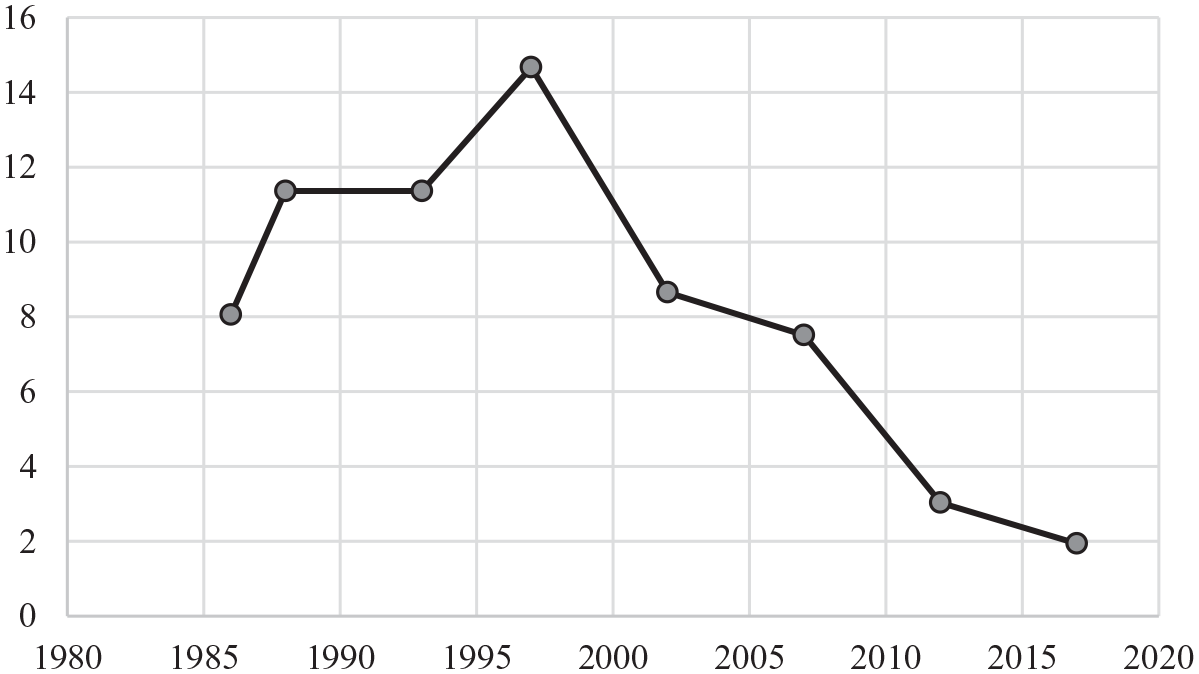
De-demonization and shifting away from the defense of traditional values by the Front Nationale (1985–2017).
The programmatic repositioning of the FN has thus made it possible to reduce the stigmatization costs of the FN vote and promote the public expression of its theses. Hence, it has accelerated the dissemination of the FN ideology because of its increasing social acceptance within society. Symmetrically, the benefits of public expression in favor of the populist stances gradually increase since the community of populist supporters is expanding. While the emergence of digital media and the agenda effect on immigration issues have affected the demand side of the political market, the de-demonization strategy, in return, depicts a shift of the supply side.
Conclusion
The electoral dealignment in favor of populist parties has, therefore, its own reasons. The voter does not turn away from traditional parties because they have failed (Prato and Wolton, 2018). It turns away from it because the costs of understanding populists’ views as well as the costs of expression in favor of populists are falling. Ideological indistinctiveness gave political space to all voters who had the weakest political skills (human capital) and who were no longer able to distinguish between the platforms of left wing and right wing parties. The cheapest solution for them was to stand firm on the side of parties whose political platform were the most identifiable. Digital media, then, allowed for a significant decrease in pro-populist information. Voters can access this type of information at a lower cost. The voter could convince himself that it was right to vote populist by relying on the arguments broadcasted free of charge on digital media. The migrant crisis, terrorism, and the problems of integrating Muslims into the French society are also factors that are favorable to the rise of populists. Current debates in the media strengthen populist parties, which has thus succeeded in making their discourse more credible. Finally, the strategy of de-demonization, appear to be significant elements in reducing the costs of expressing the populist vote. Rather, de-demonization makes it possible to converge the FN program on many points toward common thinking, namely, total freedom on the side of moral values and strong constraints on the side of economic freedoms. This refocusing on economic and moral issues makes the party possible to keep the approval of as many people as possible while maintaining its originality and attractiveness on the migration issue. As a result, it becomes less costly to support publicly populist voting. The strength of the theory of expressive voting is to draw all the consequences of the existence of the paradox of voting. However, it has been rarely used to account for phenomena other than voters’ ignorance and/or irrationality. This article has proposed a general model based on the expressive utility to explain the political dealignment and to apply it to right-wing populist voting in France. However, the ambition of this model is to be general and to give ways of understanding ideological choices of voters. The voter votes populist, liberal or socialist not because he thinks that his vote will be able to implement this type of ideology. He votes for these parties, because, within the framework of this incentive structure, he receives a greater net benefit of expression than he could get when casting a vote for another party.
Footnotes
Acknowledgements
We thank the participants of the European Public Choice Society annual conference, Budapest April 2017 for their suggestions and comments on an earlier draft of this paper. We are grateful to Nonna Mayer for her valuable comments. Finally, we are grateful to two anonymous referees for their valuable comments.
Funding
The author(s) received no financial support for the research, authorship, and/or publication of this article.
