




Abstract
Private security guards (PSG) are prominent social control agents in many contexts of youth attendance. However, studies about youth’s acceptance of PSG authority are scarce. In a scenario-based survey, this study examines youngsters’ compliance with three types of PSG requests and explores factors influencing compliance, particularly instrumental and normative ones. Findings from 631 high school students from the metropolitan areas of Lisbon and Porto (Portugal) suggest that youth typically obey PSG requests, and that perceptions about the role of PSG in protecting public interests and normative judgments about these guards and their requests are important in shaping compliance. Interestingly, variations according to the type of demand are observed. Youth obey more and see their requests as more legitimate when those requests echo shared moral positions.
Introduction
The growth of private security worldwide in the last decades has extended policing largely to the private sector (Bayley & Shearing, 2001; Kempa et al., 1999). These developments created large-scale private security agencies as realms of power and authority across civil society having capacity to impose a social order and to enforce norms that significantly affect citizens’ lives (Crawford, 2006; Loader, 2000).
Portugal is in line with this trend. In 1996, there were 15,000 private security personnel (De Waard, 1999); this number more than doubled in 20 years and reached 37,871 by 2017 (“Annual Report on Private Security,” 2017). The national entity in charge of regulating private security is the Ministry of Internal Affairs and Law No. 34/2013 of May 16 asserts that the sector’s purpose is protecting persons and property and preventing crimes. The State allows the use of private security and, in certain situations, mandates it.
Private security guards (PSG) are particularly present in spaces attended by young people in large urban centers. However, little is known about how youngsters accept PSG authority. This article aims to understand how young people respond to PSG by assessing the influence of factors that may shape their decision to obey or disobey.
Background
Compliance Theories
Two main models explain compliance with authorities: instrumental and normative. The instrumental perspective focuses on the outcomes and suggests that people shape their behavior by responding to the immediate sanctions and rewards associated with following the authorities’ edicts (Tyler, 1990). It argues that the public will comply with policing authorities when (a) they create a high risk of detection and sanction for wrongdoers; (b) they are effective in controlling crime and disorder because it is important in shaping not only the people’s sense of the risk of being caught and punished but also the sense that people benefit from these outcomes (Hough et al., 2010; Sunshine & Tyler, 2003).
By contrast, the normative model suggests that people defer to directives of authorities not because of mere estimates of sanctions and rewards, but because they feel they ought to (Tyler, 1990). This kind of compliance is linked to the perceived legitimacy, defined as “a property of an authority or institution that leads people to feel that the authority or institution is entitled to be deferred to and obeyed” (Sunshine & Tyler, 2003, p. 514). Legitimacy is typically operationalized as (a) trust in the authority and (b) felt obligation to obey the authority (Sunshine & Tyler, 2003; Tyler & Jackson, 2014). From this perspective, legitimacy (normative judgments) is more important than instrumental judgments in shaping people’s compliance with authorities. The normative model suggests that the fairness of procedures by the authorities when dealing with the public is the key antecedent of people’s views on their legitimacy (Sunshine & Tyler, 2003; Tyler, 1990).
Private Security Guards as Social Control Agents
PSG operate in private, semipublic, and public places. However, with the proliferation of “mass private property” over the last decades, that is, private properties opened to the public (e.g., shopping malls), security personnel now operate largely in these “hybrid” spaces (Kempa et al., 1999; Shearing & Stenning, 1983). There is some ambivalence in academic discussions regarding the role of PSG. On one hand, some emphasize that PSG serve the private interests of their clients and not the public interest (Loader, 2000; Zedner, 2009). On the other hand, others stress that they serve the common good by serving private interests, given their activity in preventing crime and once citizens benefit from the protection when attending their workplaces (Bayley & Shearing, 2001; Cusson, 1998).
Though their authority and power are more restricted than the police, PSG have access to considerable legal authority and power in carrying out their policing work. Based on the legal rights of private property owners who contract them and whose agents they are and for whom these rights are expanded, security personnel implement a social order and enforce rules often beyond the legal norms having the power to exclude from those places individuals who do not comply with these standards. PSG authority and power also derive from the general powers of citizens. Under certain circumstances, PSG can detain an individual and call the police (Shearing & Stenning, 1983; Stenning, 2000). Therefore, their common sanctions comprise excluding and detaining people, and calling the police.
Beyond instrumental considerations, such as the sanctions they may enforce, PSG also have available normative considerations or symbolic powers—the public’s views of their legitimacy—for securing public deference with their demands (Mopas & Stenning, 2001). Nevertheless, PSG face several challenges to their legitimacy as social control agents. They are often described as having little education and training and few skills (Nalla & Heraux, 2003; Zedner, 2009). Some authors go further and state that violence, trafficking and other illegal activities are common among PSG (Singh, 2005; Zedner, 2009). In addition, scholars suggest that the rules they enforce and their decisions are often based on commercial interests and stereotypes. PSG commonly exclude “undesirables” who are perceived as bad for the image of or for consumption in given premises (Crawford, 2006; Kempa et al., 1999). They also control and limit the participation of, in particular, those who by their appearance or behavior fit into risk profiles of disorder or criminal behavior (Bayley & Shearing, 2001; Wakefield, 2003). Thus, based on commercial interests and prejudices, PSG may restrict the access to important spaces of socialization of persons who may not represent any threat to the security of those spaces.
The large extension of policing from public to private actors represented a shift in the nature of social control. The criminal justice system is concerned with violations of the law, which protects moral standards. By contrast, PSG operate to not only prevent and control crime, but also to protect the interests of their clients. Thus, people and behaviors are frequently judged and sanctioned by the threat to their clients’ interests and not for violations of the law or even of social norms (Shearing & Stenning, 1983).
PSG hold control over policing in spaces important to youth socialization, such as shopping malls, leisure facilities, and bars/nightclubs, especially in large urban areas. Furthermore, it has been suggested that youngsters are a group prone to be the target of control and regulatory actions. Saarikkomäki and Kivivuori (2016) found that in 1 year in Finland, 29% of youth had experienced an adversarial PSG contact including being told to move on, being searched, or being caught. Thus, this landscape creates fertile ground for youth to being the object of multiple demands by these guards governing these spaces.
Prior Research
There is a large body of research on criminal justice agencies examining public compliance with their directives and with the law and suggesting that legitimacy is a stronger predictor of compliance (e.g., Hough et al., 2010; Sunshine & Tyler, 2003; Tyler, 1990). However, very few studies explored citizens’ compliance with PSG, and to the best of our knowledge, none have specifically examined youth’s compliance.
Shearing et al. (1985) were the first to examine people’s reactions to requests made by PSG. In a survey of 209 citizens in Canada, these researchers suggested that the disapproval position tended to be based on citizens’ definition of the place as a public one and the approval position tended to be grounded on people’s definition of the place as private. Nonetheless, Mopas and Stenning (2001) surveyed 200 citizens in Canada and did not find this connection. These researchers used two hypothetical scenarios that described PSG requests (a) to be searched due to a high rate of theft and (b) to leave the premise on grounds of loitering, in a privately owned shopping mall and in a publicly owned skating rink. Results suggested that most individuals would not be willing to comply or were not sure of what they would do with either of the two requests, independent of the context being public or private. However, the nature of the demand was relevant. A substantial lower proportion of respondents indicated a willingness to comply in the loitering scenarios compared with the search scenarios; this suggested that the former request was perceived as less legitimate. Moreover, normative motives were more important than instrumental ones in determining compliance.
Present Study
This study’s objective is to examine youth’s compliance with PSG demands in a scenario-based study. More concretely, it aims to explore variations in compliance: (a) according to the nature of the requests; (b) considering the influence of instrumental and normative judgments about the requests, and of general instrumental and normative judgments about PSG; (c) exploring the influence of variables such as the sociodemographic, lifestyle, prior compulsive contacts with PSG, and the perceived importance of PSG’s role. Thus, by focusing on youth’s compliance with PSG, this study aims to contribute to the advancement of the empirical research on the changed nature of policing and on the compliance with policing agents.
Method
Sample and Data Collection
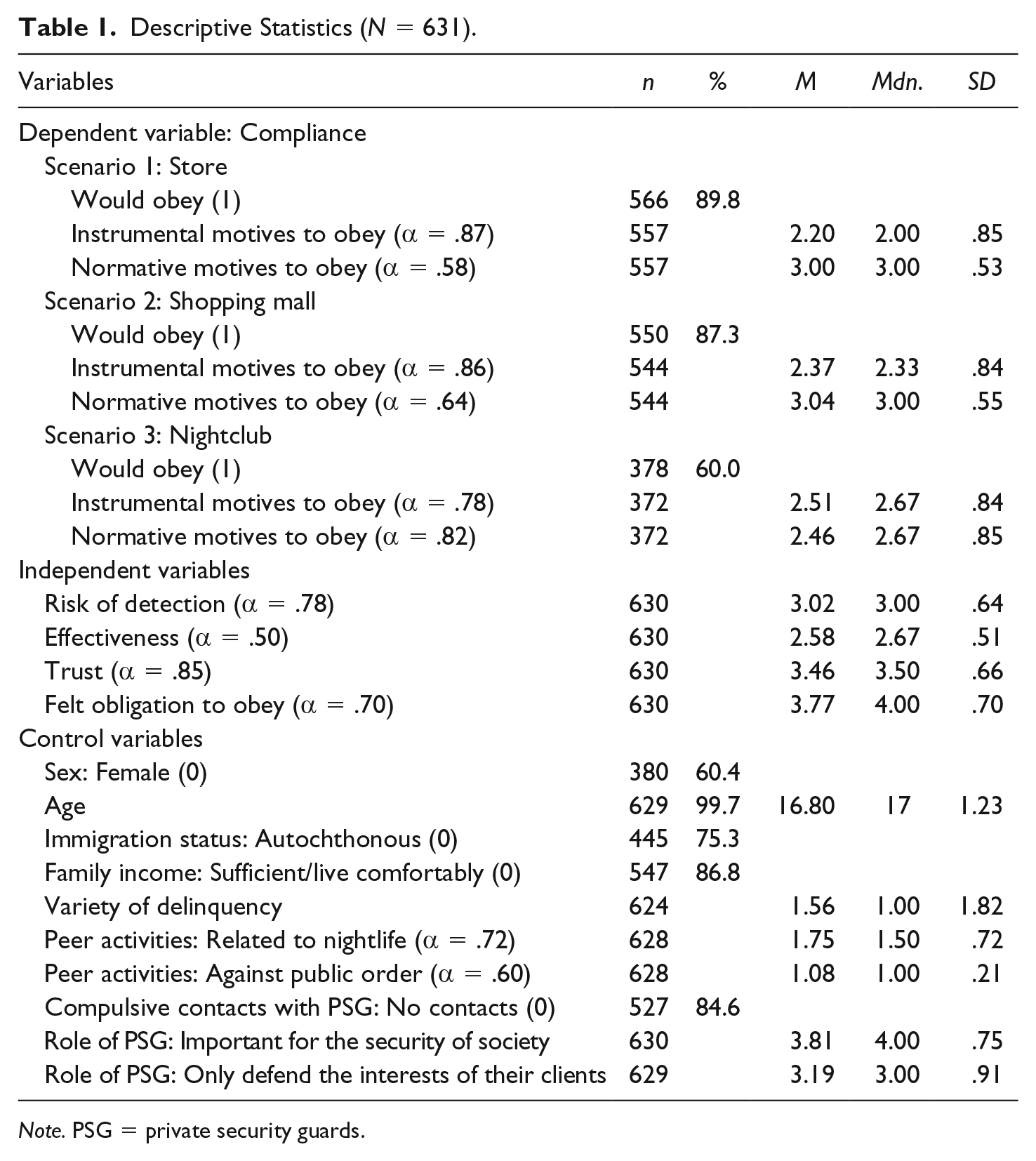
The participants were youth attending the 10th to 12th school year in public high schools of the metropolitan areas of Lisbon and Porto. The schools were randomly selected from the list of public high schools of these areas: two of the Municipality of Lisbon and four of other municipalities in the greater metropolitan area of Lisbon; two of the Municipality of Porto and three of other municipalities in the greater metropolitan area of Porto. The researchers contacted the schools’ principals to obtain consent for the development of the study, to give access to students, and to contact parents to obtain informed consent for underage students; adult students provided their own informed consent. The sample was composed of 631 youngsters (response rate: 63%) from 11 schools, 293 students and 338 students of the metropolitan areas of Lisbon and Porto, respectively. About 60% were female and the average age was 16.80 years. The majority was autochthonous (75.3%) and considered the family income sufficient or allowed for a comfortable living (86.8%) (Table 1).
Descriptive Statistics (N = 631).
Note. PSG = private security guards.
Paper-and-pencil self-reported questionnaires were administered in the schools from March to May 2018. Youth’s participation was voluntary and anonymity and confidentiality were assured. In that sense, we did not ask for data that allowed participants’ identification and respondents sealed the questionnaires in envelopes after completing them.
Measures
Dependent variable
The dependent variable is youth’s compliance with PSG demands in three different scenarios representing youth’s daily life contexts. In each scenario, respondents were asked whether they “Would not obey” (0) or “Would obey” (1). “Scenario 1: Store,” similar to that used by Mopas and Stenning (2001), presents a situation in which a PSG approaches a youngster when he or she is leaving a store and says that due to a high rate of theft, customers were being randomly selected to conduct searches to check if any objects had been stolen. The PSG then asks whether he or she can search the bag/purse the boy/girl is carrying. “Scenario 2: Shopping mall” outlines a situation in which a youngster is inside a shopping mall with a group of friends talking and laughing loudly and a PSG addresses him or her and tells the youngster that their noise is bothering the customers. The PSG then asks the youngster to stop talking and laughing like that. “Scenario 3: Nightclub” describes a situation in which a youngster is going to a nightclub to have fun. When he or she arrives at the nightclub, the PSG at the entrance says that he or she cannot enter as the nightclub strictly selects its customers. The PSG then asks the youngster not to insist upon entering. Thus, the three scenarios present different types of requests as they are grounded in motives that vary in the overlap of shared values and moral positions from greater to lesser: crimes committed (shoplifting), social disorder (talking and laughing loudly), and particular commercial interests (not meeting the consumer standards of the nightclub).
This methodological option (vignettes) helps to make the decision-making situation closer to real-life experiences. The modification of features in the different scenarios allows the estimation of the effects of those changes on the participants’ judgments and reactions (Alexander & Becker, 1978; Schoenberg & Ravdal, 2000). As Finch (1987) stresses, vignettes are a method which “acknowledges that meanings are social and that morality may well be situationally specific” (p. 106). As noted by Tyler (1990), beyond the view of an authority as legitimate, there is a second type of internalized obligation that promotes voluntary compliance—personal morality. Personal morality differs from legitimacy in that it is not a feeling of obligation to an external authority but an internalized obligation to follow one’s personal sense of what is morally right (Tyler, 1990). In view of that, we expect that participants are more willing to obey PSG requests that embody more shared moral positions.
Independent variables
Those youth who responded they would obey were then asked to rate the importance of six motives—three instrumental and three normative—for their decision, using a scale from (1) not at all important to (4) very important. Instrumental motives were measured by three items (e.g., “Because I could be forced to obey or be expelled from the place”). Normative motives were also captured by three items (e.g., “Because the PSG has the right to make such request”). We based the scale on that proposed by Mopas and Stenning (2001) and for each scenario these items were averaged to create overall indexes. In line with prior research (Mopas & Stenning, 2001), we hypothesize that normative motives are more important than instrumental motives in influencing compliance.
In addition to the above variables related to the request, we included measures to capture overall instrumental and normative judgments about PSG. Instrumental judgments were composed of perceived risk of detection by PSG for wrongdoing and the estimated effectiveness of these guards in controlling antisocial behavior and crime. Risk of detection was assessed by four items concerning four types of offenses: robbery, vandalism, assault, and nuisances. Participants were asked to rate on a scale from 1 (not at all likely) to 4 (very likely) the likelihood of detection by PSG if they did each of those acts. Effectiveness was assessed by asking the respondents how effective PSG were in protecting (a) stores/supermarkets from thefts, (b) people from disturbances and assaults at bars/nightclubs, and (c) people from thefts on public transportation. The answers varied between 1 (not at all effective) and 4 (very effective).
Concerning normative judgments, we used trust in PSG and felt obligation to obey these guards, drawing on the work of Sunshine and Tyler (2003). For a more detailed analysis of legitimacy, the two dimensions were analyzed separately. Trust was operationalized by four items (e.g., “I trust in the work of PSG”). Felt obligation to obey was assessed by two items (e.g., “In general, it is not justified to disobey PSG”). The response categories ranged from 1 (strongly disagree) to 5 (strongly agree). Consistent with the theoretical frameworks used in this study and with prior research on policing (e.g., Hough et al., 2010; Sunshine & Tyler, 2003; Tyler, 1990), we expect that normative judgments are more important than instrumental ones in shaping compliance.
Control variables
Ten control variables were included in the analysis: sex, age, immigration status, family income, variety of delinquency, peer activities related to nightlife, peer activities against public order, compulsive contacts with PSG, perceptions of the role of PSG for the security of society and for the interests of their clients.
Sex was a dichotomous variable (0 = female, 1 = male), and age was a continuous variable. For the variable immigration status, we coded the items as a dummy variable (0 = autochthonous, 1 = immigrants of first-and second-generation). Family income was also coded as a dummy variable (0 = very difficult or difficult to live on, 1 = sufficient to live on or allowed to live on comfortably). In light of previous studies on policing (e.g., Saarikkomäki & Kivivuori, 2013, 2016; Wakefield, 2003), we do expect that boys, immigrants, and youth with lower socio-economic status are more prone to be targets of control by PSG and to have less positive attitudes toward these guards, which in turn has a negative impact on deference to their demands. We also hypothesize that the younger respondents, due to a lower capacity to impose their willingness, are more likely to obey PSG requests.
We also controlled for youngsters’ lifestyles, including delinquency and activities with peers. Variety of delinquency was measured by asking participants about the lifetime prevalence of 14 delinquent acts, and we created an overall scale ranging from 0 to 14. Concerning usual activities with friends when they go out, two variables were created: one related to nightlife and another against public order. Activities with peers related to nightlife comprised two items (e.g., we go to bars/nightclubs). Activities with peers against public order included three items (e.g., we provoke disturbances). Responses ranged from never (1) to always (4). Consistent with prior research on policing (e.g., Saarikkomäki & Kivivuori, 2013, 2016; Wakefield, 2003), we expect that youngsters more involved in delinquent, antisocial, and nightlife activities are more likely to have negative encounters with PSG and, thus, more likely to perceive these guards and their directives adversely.
Two items operationalized compulsive contacts with PSG by asking participants whether in the past 12 months a PSG (a) asked them for information and (b) called them to attention due to their behavior. The variable was then recoded as a dummy variable (0 = no compulsive contacts, 1 = one or two compulsive contacts). Drawing from prior literature on policing (e.g., Skogan, 2006), we expect that youth who had compulsory contacts with PSG will perceive these officers more negatively and defy their dictates.
To capture the perceptions of the PSG’s role, we asked respondents to report the level of their agreement on a scale ranging from 1 (strongly disagree) to 5 (strongly agree) with the assertions (a) PSG have an important role for the security of society and (b) PSG only defend the interests of their clients and not the interests of society in general. We hypothesized that respondents who perceive PSG as having an important role for the common good of society are more likely to defer to their demands and, inversely, that participants who perceive them as merely protecting private interests of clients will tend to defy their directives.
Analytic Plan
This study examines youngsters’ compliance with three types of PSG requests. First, we present the descriptive statistics. Second, independent sample t test and χ2 test of independence were run to examine the differences in the decision to obey or disobey according to (a) sociodemographic characteristics, (b) lifestyles, (c) compulsive contacts, and (d) views on various dimensions of PSG and their work. Third, we explore the predictors of the willingness to obey PSG requests using logistic regressions. Fourth, we specifically analyze the importance of instrumental and normative motives for the youth’s decision to obey by comparing means between and within the three scenarios using one-way analysis of variance (ANOVA), Tukey’s honestly significant difference (HSD) post hoc test, and paired sample t test.
Results
Descriptive Statistics
Table 1 presents the descriptive statistics of the study variables. Most of the respondents indicated that they would obey PSG requests in “Scenario 1: Store” (89.8%), in “Scenario 2: Shopping mall” (87.3%) and, although in a lower proportion, in “Scenario 3: Nightclub” (60.0%). Regarding the importance of instrumental and normative motives for the decision to obey, the mean values of normative motives are higher than the mean values of instrumental motives in the store scenario (3.00 vs. 2.20) and in the shopping mall scenario (3.04 vs. 2.37). By contrast, the mean score of instrumental motives in the nightclub scenario is slightly higher than the mean score of normative motives (2.51 vs. 2.46).
For judgments on instrumental dimensions of PSG, the mean values were 3.02 for risk of detection and 2.58 for effectiveness. On normative dimensions, these ratings were 3.46 for trust and 3.77 for felt obligation to obey. Concerning the variables of youth’s lifestyles, respondents reported a mean value of 1.56 for variety of delinquency, while for peer activities the average scores were 1.75 for activities related to nightlife and 1.08 for activities against public order. Most of the respondents did not report compulsive contacts with PSG (84.6%). Moreover, respondents expressed higher mean ratings for the scale of PSG having an important role for the security of society (3.81) than for the scale of these guards having a role of merely defending the interests of their clients (3.19).
Comparisons Between Sample Groups Regarding the Willingness to Obey
Independent sample t test and χ2 test of independence for control and independent variables were conducted to examine differences in compliance between sample groups in the three scenarios.
Table 2 shows the results of the independent sample t test for continuous variables. Concerning the “Scenario 1: Store,” the results indicated that there were significant differences in the willingness to obey for all control and independent variables except for variety of delinquency, peer activities against public order and effectiveness. Concretely, the results suggest a greater willingness to obey this request by younger respondents (t = 2.98, p = .003), by those less involved in peer activities related to nightlife (t = 2.69, p = .007), by youngsters who view the PSG role more importantly for the security of society (t = −2.50, p = .013), as well as by those who least perceive their role as only defending the interests of their clients (t = 3.50, p = .001). Regarding instrumental and normative judgments, significant differences were found for only one instrumental judgment (risk of detection) and for both normative judgments (trust and felt obligation to obey). Youth who estimate a higher risk of being detected by PSG for misconduct (t = −2.28, p = .026), with a greater trust in these guards (t = −2.04, p = .041) and with a higher internal feeling of obligation to obey these guards (t = −4.91, p = .000) are more disposed to defer this request.
Mean Comparisons Between Groups in the Different Scenarios (N = 630).

Note. t = t-value; independent sample t test; significance level (two-tailed): *p ≤ .05. **p ≤ .01. ***p ≤ .001.
In the “Scenario 2: Shopping mall,” significant differences were observed in the following variables: variety of delinquency, peer activities related to nightlife, role of PSG as important for the security of society, risk of detection, and felt obligation to obey. This specifically suggests that a higher tendency to obey this request was reported by participants less involved in delinquency (t = 2.17, p = .033) and in peer activities related to nightlife (t = 2.37, p = .018), and by youngsters who perceive PSG more importantly for the security of society (t = −2.60, p = .010). In addition, youth who perceive a higher likelihood of being caught by PSG for antisocial behavior (t = −2.06, p = .040) and with a higher internal sense of obligation to obey these guards (t = −2.22, p = .027) are more willing to obey this request.
In the “Scenario 3: Nightclub,” only three variables reached statistical significance: delinquency, role of PSG as important for the security of society, and trust. These findings suggest that respondents who participate less in delinquent activities (t = 2.40, p = .017) and who view their role more importantly for the security of society (t = −2.60, p = .010) are more disposed to obey this request. Moreover, significant effects were also found for trust. Youngsters with higher levels of trust in PSG (t = −3.00 p = .003) are more willing to obey this request.
Regarding the χ2 test of independence for nominal control variables (not displayed in Table 2), only the variable compulsive contacts with PSG achieved statistical significance in the first and third scenarios. In the first scenario, the compliance rate among those respondents who did not report compulsive contacts was 91.1%, while the compliance rate among those who have experienced compulsive contacts was 83.3%, χ2(N = 622) = 5.33, p = .021. In the third scenario, among those who did not have compulsive encounters, 61.3% indicated they were disposed to obey while among those who had compulsive contacts, 50.5% indicated they would be willing to defer, χ2(N = 622) = 3.88, p = .049. These results suggest that youth who have not experienced compulsive encounters with PSG are more likely to comply with their demands than youth who have experienced them.
Logistic Regressions on the Willingness to Obey
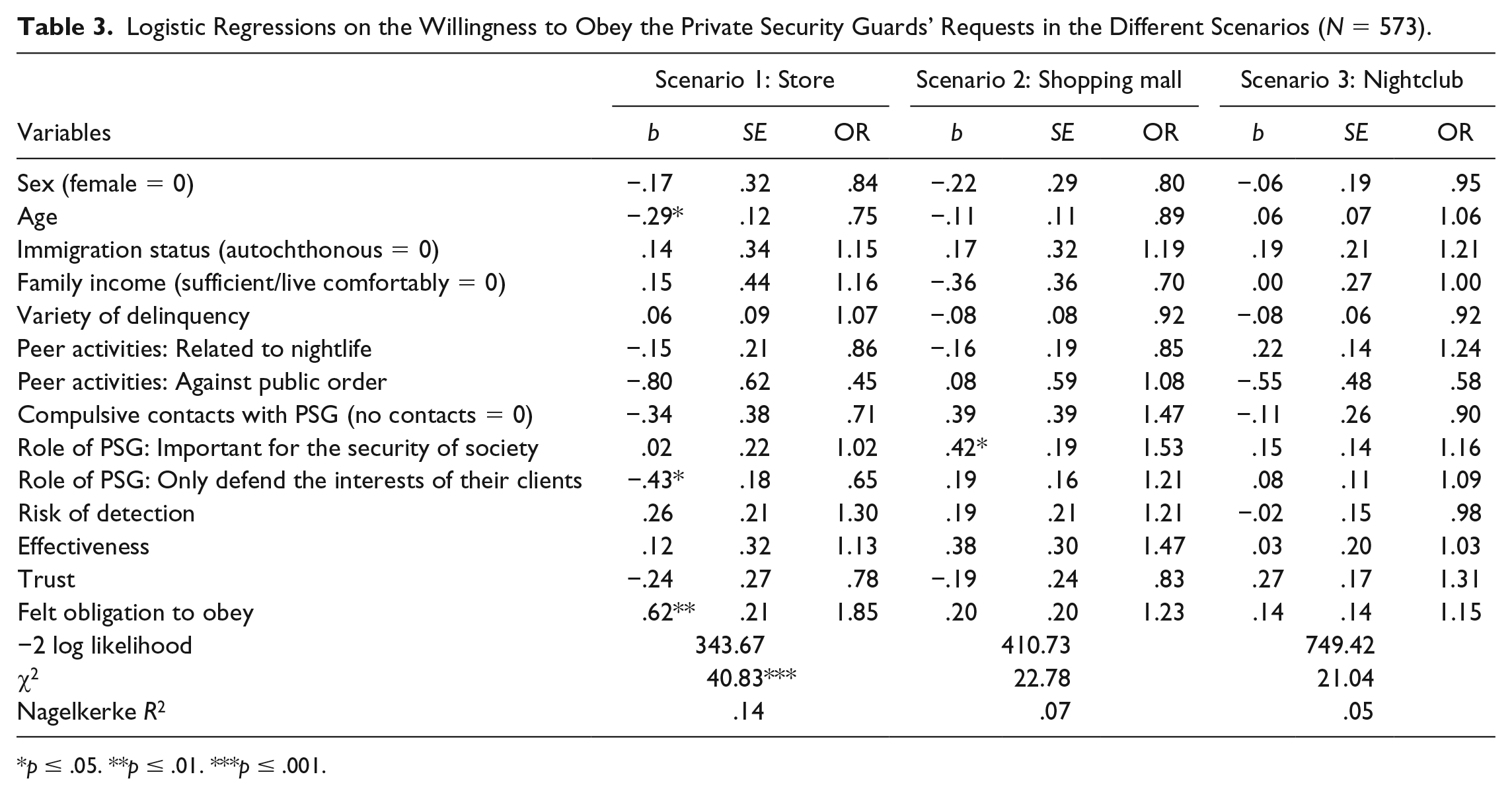
To understand what factors may influence youth’s decisions regarding the requests of PSG, we performed a logistic regression for each scenario (Table 3).
Logistic Regressions on the Willingness to Obey the Private Security Guards’ Requests in the Different Scenarios (N = 573).
p ≤ .05. **p ≤ .01. ***p ≤ .001.
The model for “Scenario 1: Store” is significant and explained 14.0% of variation in the dependent variable. Felt obligation to obey was the best predictor of compliance. Those with a higher internal sense of obligation to obey PSG were 1.85 times more likely to obey the request (p = .003). Among the control variables, the perceived role of PSG as only defending the interests of their clients and age were also predictors of compliance. Respondents who view PSG as only defending the interests of their clients (OR = .65, p = .017) and older participants (OR = .75, p = .014) were less likely to obey the request. The models for the second and third scenarios were not significant. However, it is worth noting that in the second scenario the variable role of PSG as important for the security of society reached statistical significance. Youngsters who view their role as important for the security of society were 1.53 times more likely to obey the request (p = .030).
Mean Comparisons of Instrumental and Normative Motives for the Decision to Obey
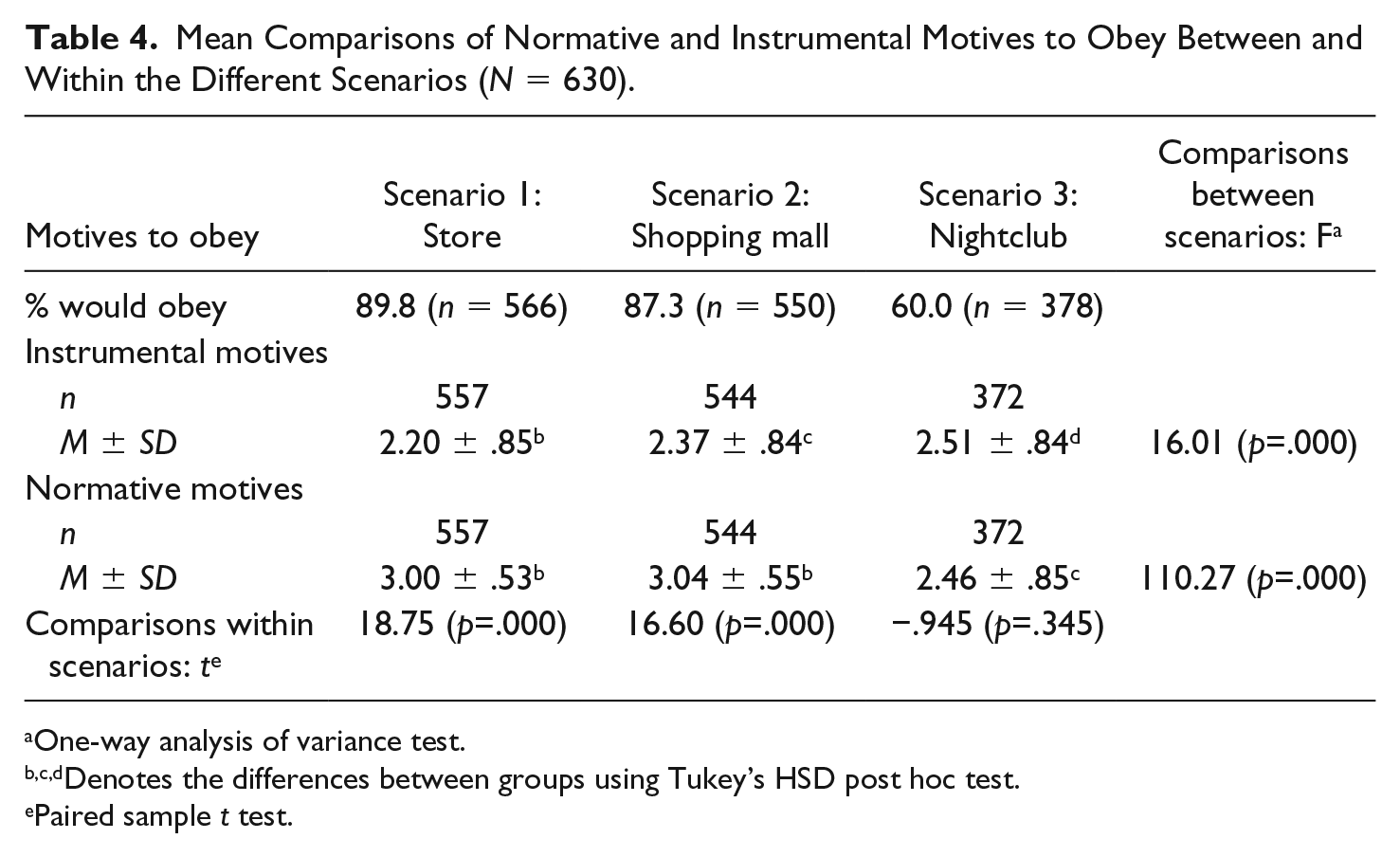
In each of the three scenarios, those respondents who indicated they would obey a PSG request were then asked to rate the importance of instrumental and normative reasons for their decision (Table 4).
Mean Comparisons of Normative and Instrumental Motives to Obey Between and Within the Different Scenarios (N = 630).
One-way analysis of variance test.
Denotes the differences between groups using Tukey’s HSD post hoc test.
Paired sample t test.
The results of the one-way ANOVA revealed that across the different scenarios there were significant differences on the rates of instrumental motives (F = 16.01, p = .000) and normative motives (F = 110.27, p = .000). The results from Tukey’s HSD post hoc test, in turn, indicated in which scenarios the mean differences were significant. Regarding instrumental motives, the mean differences were significant between all scenarios. However, with respect to normative motives, only the mean difference in the nightclub scenario was significant.
Furthermore, paired sample t test revealed that in the store scenario the mean score of normative motives (3.00) was significantly higher than the mean score of instrumental motives (2.20) to obey (t = 18.75, p = .000). Similarly, in the shopping mall scenario the mean rating of normative motives (3.04) was significantly higher than the mean rating of instrumental motives (2.37) to comply (t = 16.60, p = .000). By contrast, no significant difference between normative motives (2.46) and instrumental motives (2.51) to obey was found (t = −.945, p = .345) in the nightclub scenario.
Discussion and Conclusion
The purpose of this study was to explore youth’s compliance with different PSG requests in a scenario-based study. It aimed at better understanding why youngsters obey PSG, attempting to shed light on factors that may influence their compliance and noncompliance.
Overall, this study’s results show that most youngsters were willing to comply with PSG demands. This finding is not consistent with the results of Mopas and Stenning (2001), in which most of the individuals would not be willing to comply or were not sure. One possible explanation for this is the positive perceptions and attitudes toward PSG in Portugal (Moreira et al., 2015). However, our findings show that a considerably lower proportion of participants indicated they would obey in the nightclub scenario where the request was merely based on a commercial interest. Mopas and Stenning (2001) also found that compliance was scenario dependent. A substantial lower proportion of respondents indicated a willingness to comply in the loitering scenarios compared with the search scenarios, regardless of the context being public or private.
Our results indicate variations in compliance according to the following control variables: age, lifestyle, compulsive contacts, and perceived role of PSG. Younger individuals and youth with more normative lifestyles were more willing to obey PSG demands. This finding is consistent with our hypothesis that younger individuals have less capacity to make their will prevail and that youth more involved in antisocial and delinquent activities tend to have more compulsive contacts with PSG that negatively affect their deference to these guards’ dictates. In fact, the increased likelihood for individuals more involved in antisocial and delinquent activities being targeted and the negative impact of that on attitudes toward policing authorities has been well addressed in previous studies (e.g., Saarikkomäki & Kivivuori, 2013, 2016; Skogan, 2006). This is also corroborated by our findings. Youth who experienced compulsive contacts with PSG were less likely to obey these guards’ requests. However, our results indicated that only about 15% of youngsters had compulsive contacts in 1 year while Saarikkomäki and Kivivuori (2016) found that 29% of youth experienced these contacts in Finland. This suggests that Portuguese youth are subject to considerably less regulatory actions by these guards and this might also explain their high compliance rate. Furthermore, the way youth perceive the role of PSG was particularly influent. Individuals who perceive this role as important for the security of society tended to obey in all scenarios, and those who view this role as defending merely the interests of their clients tended not to obey, but only in the store scenario. No influence for compliance was found for sex, immigration status, and family income.
This study’s findings show that, as hypothesized, normative judgments about PSG are more important than instrumental judgments in influencing youth’s compliance. This finding supports prior research on criminal justice agencies, in which legitimacy was a relevant predictor of compliance (e.g., Hough et al., 2010; Sunshine & Tyler, 2003; Tyler, 1990). Trust influenced compliance in the store and in the nightclub scenarios. Felt obligation to obey influenced compliance in the store and in the shopping mall scenarios and was the strongest predictor of compliance in store scenario. Our results suggest that individuals that have higher trust and internal sense of obligation to obey PSG are more willing to comply with their demands. Concerning instrumental judgments, risk of detection, but not effectiveness, influenced compliance. Youth who perceive a higher risk of detection by PSG were more willing to obey in the store and shopping mall scenarios.
As hypothesized, normative motives were also more salient than instrumental motives in determining compliance, which reiterates the finding of Mopas and Stenning (2001). In the store and shopping mall scenarios, normative motives to obey were more relevant in determining youth’s compliance, but not in the nightclub scenario, suggesting that the former requests, more anchored in moral standards, were perceived as more legitimate. By contrast, perceived sanctions and negative consequences (instrumental motives) were salient in the nightclub scenario compared with the other scenarios. These findings suggest that the motivation to comply is more normative-based when the PSG requests mirror shared moral positions and more instrumental-based when those requests are distant from these standards. Given the broad reasons that may underlie PSG demands, further studies exploring the importance of the nature of the requests in determining compliance and the type of compliance will be valuable.
However, this study has limitations. The participants’ answers to the vignettes in the survey may not reflect how they would act. Ethnographic research would be important to study youth’s behavior in real-life situations. A qualitative approach to the vignettes would be also beneficial to explore youth’s experiences and subjective meanings (Finch, 1987). Moreover, it should be considered that other factors might have influenced the answers, namely the way youngsters may perceive differently the PSG of the different scenarios. Future studies exploring the drivers of PSG legitimacy, particularly examining the relative importance of procedural justice and performance, will be relevant. There is a large body of research on police examining these connections, but on PSG this research is very scarce.
Despite this, overall the results show that youth accept PSG authority and are willing to obey them. Furthermore, the perceived role of PSG as important for the security of society and normative judgments about these guards and their requests are particularly important in determining youth’s compliance. This suggests that PSG have available not only legal powers, but also important symbolic powers for their policing work, also highlighted by Mopas and Stenning (2001). However, youth tend to obey more and to see their requests as more legitimate when those requests resemble moral standards. This article seeks to advance policy by addressing how different kinds of regulatory actions made by PSG in private properties opened to the public are differentially accepted and viewed as legitimate by youngsters. This is relevant because these are important spaces of youth socialization where the state allows or mandates the use of private security. Moreover, our study suggests that the perceived role of PSG in public security and their legitimacy are important for youth’s acceptance and deference to their authority. These are salient issues for a more democratic governance.
Footnotes
Declaration of Conflicting Interests
The author(s) declared no potential conflicts of interest with respect to the research, authorship, and/or publication of this article.
Funding
The author(s) disclosed receipt of the following financial support for the research, authorship, and/or publication of this article: This study was funded by the Portuguese Foundation for Science and Technology through a doctoral grant (reference: SFRH/BD/130590/2017), financed by national funds of the Portuguese Ministry of Science, Technology and Higher Education and the European Social Fund through the Human Capital Operational Program.