



Abstract
Imported to adorn tanks of marine aquarium hobbyists, the trade in live corals poses a significant risk to species that concurrently face threats from rising global temperatures, pollution, and destructive fishing practices. To better understand the live coral trade, we employed a crime script framework to analyze the process by which corals are harvested in two of the world’s major exporting countries—Indonesia and Fiji. We demonstrate that coral harvesting and export are complex activities that require a specific set of skills and tools. As such, various intervention strategies are proposed to address illegal coral harvesting at different stages of the crime script.
Introduction
Coral reefs are among the most diverse and productive communities on earth, supporting millions of species as habitat, feeding, and breeding areas (Hoeksema, 2017). Coral reefs, however, are under great stress from a variety of environmental factors. The most widespread stress is that of global climate change. Elevated temperatures cause corals to expel their algal partners (“zooxanthellae”). This, in turn, leads to the loss of an important source of nutrition for corals and results in bleaching and potential death (Hoegh-Guldberg et al., 2007), a phenomenon observed throughout the Great Barrier Reef of Australia between 2016 and 2017.
Stresses at the more local level on coral reefs include pollution by excess nutrients, such as nitrogen from sewage fertilizers runoff, which stimulate the growth of algae over the corals that smother and kill them (Fabricius, 2005). This process was responsible for the degradation of many Caribbean reefs in the late 20th century. The effects can be reduced if there are sufficient numbers of grazers, such as parrotfish, to eat the algae, but unfortunately in many areas, these fish have been overharvested. Corals also suffer from a variety of infectious diseases (Richardson, 1998) that can be exacerbated by climate change (Bruno et al., 2003) and plastic pollution (Lamb et al., 2018). Fishers may further utilize destructive methods, such as dynamite and cyanide fishing, to collect fish from reefs for consumption or the aquarium trade, but kill extensive areas of corals in the process (Caldwell & Fox, 2006; McManus et al., 1997).
In addition to environmental threats, corals are collected for curios, jewelry, and the aquarium trade. Marine aquarium hobbyists used to focus on colorful reef fish but developed a notable demand for live corals. These hobbyists are primarily in the United States, where over 2 million households have marine aquaria (Thornhill, 2012) with corals originating primarily from tropical Asian countries. In 1996, the United States was importing over 80% of all the live coral in trade, representing at least 350,000 pieces. Since then, imports of live coral have dramatically increased. Rhyne et al. (2012) found that the trade had increased over 8% per year between 1990 and the mid-2000s, only decreasing thereafter. In 2010, the number of coral pieces imported was more than 500,000, with most of them in the genera Acropora and Euphyllia. The timing of the peak and decline varied among species and was considered to be caused by the rising popularity of mini-reef aquariums, the global financial crisis, and an increase in the production of Acropora species by aquaculture. This demand for live corals is also strong in the European Union, where corals are the second most frequently seized wildlife group following reptiles and preceding mammals (van Uhm, 2016).
The illegal trade in wildlife, including corals, is among the most profitable criminal enterprises in the world (United Nations Office on Drugs and Crime [UNODC], 2016), with an estimated value of US$20 billion per year (Wyler & Sheikh, 2008). Ranked alongside the illegal trades in arms, drugs, and humans, the illegal trade in wildlife involves millions of plant and animal species (Wyler & Sheikh, 2008). In 2013, the United Nations Commission on Crime Prevention and Criminal Justice designated wildlife crime as a “serious crime” punishable by a minimum of 4 years of liberty deprivation, placing it among the most serious transnational crimes. Currently, the United States remains one of the top importers of illegal wildlife (Petrossian et al., 2016; UNODC, 2016; Wyler & Sheikh, 2008).
Indonesia and Fiji are among the major exporters of live coral to the United States, coming in at first and fourth, respectively (Petrossian et al., 2019; Rhyne et al., 2012). Indonesia accounted for 91% of the world’s exports in 2005 (Jones, 2008) and for nearly 73% of United States live coral seizures from 2003 to 2012 (Petrossian et al., 2019). Located in the “coral triangle,” Indonesia is surrounded by the most diverse and biologically rich reefs in the world (Roberts et al., 2002). The country has established quotas for the collection of many corals (Green & Shirley, 1999), permitting about 1 million live coral pieces to be exported annually. However, population data does not always support established quotas for different species. Quotas for some species could allow most individuals of a population to be collected (Bruckner & Borneman, 2006), and there are generally no size restrictions on corals collected (Dee et al., 2014). Furthermore, enforcement of quotas is weak (Green & Shirley, 1999). Corruption hinders local management and enforcement efforts (Amos & Claussen, 2009) and the presence of “roving collectors,” who travel around different regions and ignore regulations, complicates enforcement efforts (Dee et al., 2014).
In Fiji, coral harvesting for the aquarium trade has become a major economic activity (Vunisea, 2003). Most coral reef management is at the community level, including regulating access to collecting areas, sharing coral reef benefits, establishing marine protected areas (MPAs), and protection enforcement. The implementation of management plans has notably been slow, as operators and nongovernmental organizations (NGOs) have struggled to encourage progress (Hand et al., 2005) and compliance. Limited resources further prevent adequate monitoring of harvesting activities (Lovell et al., 2001; Vuki et al., 2000).
Legislation and regulations at local, national, and international levels regulate the harvesting of many coral species. The Convention on International Trade in Endangered Species (CITES), which is signed by 183 parties including Fiji, Indonesia, and the United States, regulates all international trade in coral species. Under CITES, international trade in certain flora and fauna specimens is subject to regulation. Species are classified as Appendix I, II, or III based on the determined need for protection. Since 1985, stony coral, or Scleractinia, have been protected under Appendix II. Appendix II species are not necessarily threatened with extinction but trade is regulated to ensure long-term survival. Regulations under Appendix II include the use of scientifically based export quotas in origin countries, strict import regulations, and the issuance of CITES export permits by origin Management Authorities (Convention on International Trade in Endangered Species of Wild Fauna and Flora, n.d.). Soft corals are not covered by Appendix II and therefore are not subject to trade regulation (Rhyne et al., 2012). Other United States legislation that impacts the legality of coral imports, in particular, includes the Lacey Act and the Endangered Species Act in addition to any state-specific regulations (U.S. Fish & Wildlife Service, 2019).
To our knowledge, there has been no empirical study of the process of illegal coral collection from a criminological perspective. Criminologists use various analytical techniques to understand the crime process, including crime script analysis. In this article, crime script analysis is used to examine the stages of illegal coral harvest and trade, harnessing specific case studies from Indonesia and Fiji. Indonesia and Fiji were selected as the focus for this study because, first, as previously mentioned, Indonesia is the world’s leading coral exporter and the largest exporter to the United States. Second, Indonesia and Fiji were the two countries with the most previous research available for the development of a crime script. Third, using both Indonesia and Fiji allowed for a comparison of practices undertaken in Indonesia with another geographically distinct top exporter to determine whether practices could potentially be universal or country-specific.
Crime script analysis, rooted in the theoretical foundation of environmental criminology, has been applied to understand more about the modus operandi of various crimes (Dehghanniri & Borrion, 2019). These have including drug manufacturing in clandestine labs (Chiu et al., 2011), suicide bombing (Clarke & Newman, 2006), child sex trafficking (Brayley et al., 2011), and terrorism (De Bie & De Poot, 2016). The technique has recently been applied to wildlife-related crimes, including to the illegal markets in endangered species (Moreto & Clarke, 2013) and to illegal fishing and seafood fraud (Petrossian & Pezzella, 2018). As such, this analytical technique has shown to be a useful lens through which other types of illegal activity can be examined, including the illegal harvesting of corals, which is what this study indents to do.
Materials and Methods
Electronic databases ProQuest, Scopus, Web of Science, and Google Scholar were searched using the terms: “coral trade process,” “live coral harvest,” “illegal coral harvesting,” “coral seizures,” “coral trafficking,” “coral collection,” “coral crime,” and “trade in live corals,” in combination with the countries of interest “Fiji” and “Indonesia.” All articles were examined to identify publications with information relevant to crime script development. Backwards snowballing was further used to find articles based on the citations within the identified literature. Similar methods have been used in the past to conduct systematic reviews (e.g., Greenhalgh & Peacock, 2005; Kurland et al., 2017).
For the purpose of this study, nonacademic sources (i.e., government reports, journalistic articles, and zoological reports) were utilized in addition to the academic literature, as the academic literature on its own was deemed insufficient due to lack of detailed publications on the process of coral harvesting and trade. Therefore, resulting literature included academic and journalistic articles alongside government, nonprofit, and zoological reports with information relevant to the development of the crime script. Ten such sources were identified; five of these were academic journals, two were government reports, and the final three included one journalistic article, one zoological publication, and one nonprofit publication. These articles and reports were based primarily on fieldwork in Indonesia and Fiji that informed the undertaking of coral harvesting and trade. These materials described both legal and illegal harvesting methods and were collectively used in this study to build the crime scripts. Namely, information describing any stages of the coral harvest was systematically extracted to build a coherent and complete script based on the selected crime-scripting framework, detailed below. The resulting script should be considered a “performed,” “track level” script of actions that have already taken place and continue to be undertaken for a specific crime—notably illegal coral harvesting and trade in Indonesia and Fiji (Borrion, 2013).
Crime Script Analysis
Crime script analysis is an analytical strategy used by crime scientists to understand the specific sequential steps involved in committing a crime. Cornish (1994) first proposed this “procedural analysis” of crime by borrowing the concept of “schemata” from cognitive science (Schank & Abelson, 1977). The specific assumptions of the “schemata,” positing that structured knowledge allows individuals to organize their understanding of social interactions and events surrounding these interactions, helped Cornish build the script-theoretic approach to crime analysis to guide an in-depth understanding about the crime event. Specifically, crime script analysis proposes the analysis of the following sequential steps:
Preparation. The acquisition of the necessary tools, selecting of co-offenders, as well as agreeing on the selected locations to engage in offending.
Entry. The entry into the selected location(s) where the crime is to be committed.
Precondition. Crime is not committed at once. Some pre-conditional steps may be taken to enable the commission of crime, such as, for example, waiting at the location for place managers to leave or for the area to clear.
Instrumental precondition. Identifying the suitable targets.
Instrumental initiation. Closing-in and approaching the target.
Instrumental actualization. Engaging with the target, such as either breaking into a home or a car, or isolating the target for assault.
Doing. Carrying out the intended crime, such as, for example, stealing from the burglarized home, stealing the car, or assaulting the victim.
Post condition. This entails leaving the crime setting or escaping from the crime scene.
Exit. The decisions that need to be made post crime commission, such as disposing of the stolen goods.
Considering “all crimes, even the simplest, involve chains of decisions and actions, separable into interdependent stages, involving the attainment of sub-goals that serve to further the overall goals of the crime” (Cornish & Clarke, 2002, p. 47), the scripting of the crime event becomes especially relevant if one wants to better understand the underlying mechanisms that make crime possible. Crime scripting not only provides analysts with a framework to systematically investigate the crime-commission process but also facilitates a better understanding of the decisions made and actions taken to carry out specific crimes, which in turn aids in the designing of tailored situational prevention strategies.
Upon the close scrutiny of each step of the crime-commission process, potential interventions can be identified. These intervention strategies are rooted in situational crime prevention (Clarke, 1983) and aimed at removing the criminal opportunities. As such, they are expected to have significant impact on the future decisions of potential offenders, assuming these decisions are made within the boundaries of the situations, environments, and circumstances surrounding the crime event. Once the potential “pinch points” (Chiu et al., 2011) of the crime have been identified, the targeted intervention strategies will have direct impacts on preventing future such crimes.
Results
Crime Scripts for Wild Live Coral Harvest: Case Studies From Indonesia and Fiji
The first analysis aims at detailing the steps of the process of harvesting live corals from Indonesia and Fiji. These steps have been primarily described for legal collection and incorporate the process of illegal collection whenever mentioned in the literature. The steps follow the crime script stages outlined by Cornish (1994). For each step, if the “script” is the same for both countries, they are listed under one column in Table 1. Additional descriptions are provided if any specific actions are only relevant (or known) for one or the other country. These are specified under the “Specifically in Fiji” and “Specifically in Indonesia” subcolumns. All results are summarized in Table 1 and discussed in more detail in this section.
A Crime Script for the Process of Live Coral Harvest With Relevance to Indonesia and Fiji.
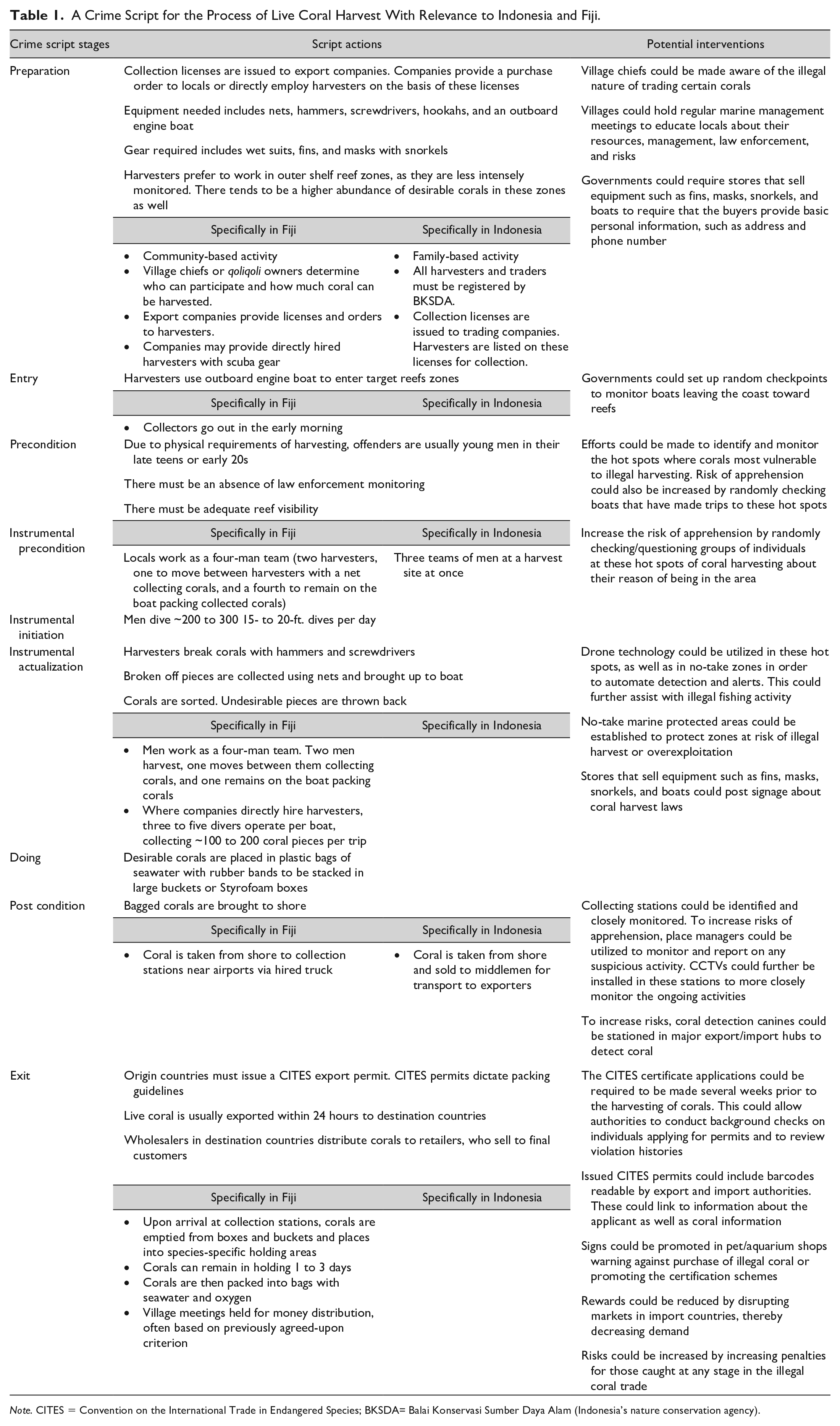
Note. CITES = Convention on the International Trade in Endangered Species; BKSDA= Balai Konservasi Sumber Daya Alam (Indonesia’s nature conservation agency).
Stage 1: Preparation
In Fiji, live coral harvest is a community-based activity. Each community, or village, has rights to certain marine zones stretching from high water levels to fringing reefs. These marine zones are known as qoliqolis. Under the Fiji Fisheries Act (Pacific Islands Legal Information Institute, [1991]), local members of a qoliqoli have exclusive rights to its use (Lal & Cerelala, 2005). Village chiefs are often in charge of qoliqolis and determine who can harvest and how much can be taken (Paletta, 2005).
In Fijian villages, participation in the harvest (both legal and illegal) is based on communal financial demands, lack of employment, and lack of alternative income opportunities (Vunisea, 2003). Locals participate on the basis of supply contracts with exporters who provide a licensed collector or purchase order, or directly employ harvesters. When licensees are provided, they organize villagers to harvest quantities often greater than requested due to expected quality rejections (Lal & Cerelala, 2005). Companies often have a villager, generally the village elder or qoliqoli owner, with whom they liaise and approach directly for negotiations (Vunisea, 2003).
Equipment used by harvesters includes nets, hammers, and screwdrivers with plastic tops removed for use as a chisel to chip corals (Lal & Cerelala, 2005; Paletta, 2005). In both Fiji and Indonesia, outboard engine boats are used to access reefs. The only modern technology utilized is a cell phone in case of problems, as well as for rendezvous arrangements (Paletta, 2005).
In Indonesia, coral harvest is more family-based than community-based. As of 2006, coral collection was allowed in 10 Indonesian provinces outside of designated protected areas and tourist zones. Independent family groups harvest in these areas, often collecting wide ranges of organisms for the ornamentals trade (Thornhill, 2012). Indonesian Fishery Law No. 31 allows anyone access to coastal resources. The law further states that harvesters are allowed to fish for livelihood in Indonesian waters, sometimes even being permitted in national parks where designated traditional fishery or sustainable use zones exist (Marine Aquarium Market Transformation Initiative, 2006).
Similarly to Fiji, Indonesia issues coral collection licenses to trading companies. Licenses bear the names of middlemen and fishermen and specify the types and amounts of corals permitted to be collected (Ferse et al., 2012). By law, Indonesian fishers are required to carry copies of collection licenses when harvesting (Thornhill, 2012). Although the fishers should be listed on trading licenses, a study by Ferse et al. (2012) concluded that very few active fishers were named on official legal lists. They concluded that this regulation was being breached.
Stage 2: Entry
Collectors go out early in the morning to their desired reef in a shallow fishing boat with an outboard motor. This is particularly common in Fiji (Paletta, 2005).
As near-shore areas are more intensely monitored by local enforcement, illegal collectors are often deterred from harvesting in these areas (Ferse et al., 2012). Fishers also prefer to work in the mid to outer shelf zones due to a higher abundance of colorful polyps and better working conditions. Tools used by independent family groups include hookahs for use while free-diving (Thornhill, 2012).
Stage 3: Precondition
In both Fiji and Indonesia, a lack of marine patrolling and reef visibility influence the ability of harvesters to participate in collection (Ferse et al., 2012). Specifically, it is preferable that water conditions are still for greater coral visibility for harvesters. Furthermore, due to the physical requirements needed to successfully harvest live coral, collectors are generally physically fit young men, often in their late teens or early twenties (Paletta, 2005).
Stage 4: Instrumental precondition
In Fiji, locals work as a four-man team: two harvesters, one man to move between the harvesters with a net collecting corals, and a fourth who remains on the boat packing the corals as they are brought up (Paletta, 2005). On Viti Levu (Fiji), there are commonly three teams of men at a harvest site at one time (Vunisea, 2003).
Stage 5: Instrumental initiation
Men dive approximately 200 to 300 4- to 6-m dives per day, up to 6 days per week. The nature of this harvest essentially eliminates the participation of older collectors (Paletta, 2005). Most collectors, however, do not work full-time. Working 2 to 3 days per week, men gathered 152,830 pieces, or 3,396 pieces of live coral per collector in 2003 (Lal & Cerelala, 2005).
Stage 6: Instrumental actualization
Harvesters identify and break off coral with a hammer and screwdriver, occasionally using large iron bars. Broken pieces are collected using a net and placed onto a bamboo raft or within their boat. Coral pieces are sorted to separate out undesirable pieces.
Stage 7: Doing
Desirable corals are then placed in plastic bags of seawater tied with rubber bands to be stacked in large buckets or Styrofoam boxes (Lal & Cerelala, 2005; Paletta, 2005; Vunisea, 2003). On average, 50 pieces are collected per person per trip and the average person makes 67 trips per year (Lal & Cerelala, 2005).
Where exporters are involved in the collection, the process is very similar. There are usually three to five divers operating out of a single boat, harvesting about 100 to 200 pieces per trip (Lal & Cerelala, 2005).
Stage 8: Post condition
The bagged corals in boxes or buckets are brought to shore in the outboard engine boat. In Fiji, corals are taken to a collection station, which is often close to an airport for ease of shipping (Paletta, 2005). This transport is often done via truck hired by the villagers (Lal & Cerelala, 2005).
Stage 9: Exit
In Indonesia, corals are sold to middlemen for transport to exporters. Middlemen fix prices and discard much of what was collected. Large piles of discarded corals have been observed at holding stations, indicating high supply-chain mortality (Thornhill, 2012).
When corals arrive at Fijian collection stations, they are emptied out of boxes and placed into individual holding areas based on species (Paletta, 2005). Caution must be taken so that adjacent pieces do not impact one another and cause damage (Delbeek, 2008). Corals remain in collecting stations for an average of 1 to 3 days. Corals are then suspended in plastic bags with just enough water to cover them and aerated with oxygen, filling the bag. Ten to twenty bags with fist-sized or smaller corals are placed in Styrofoam boxes labeled with the number and genera of coral. A CITES export permit is issued for the shipment (Lal & Cerelala, 2005; Paletta, 2005). CITES lays out guidelines that must be adhered to regarding the packaging and shipment of coral. Packaging and shipping regulations apply for both Fijian and Indonesian live coral. The collecting and packing process involved 20 to 30 men from each Fijian village (Vunisea, 2003).
The country of origin issues the CITES export permit, giving CITES signatories the authority to refuse the import of species without valid permits. Permits are issued by a country’s CITES Management Authority and Scientific Authority, and only allowed if the trade in a particular species is not found to be detrimental to the species’ survival in the wild. In theory, these permits are designed to ensure sustainable legal harvest. Where exporting countries are unable to make scientific findings of nondetriment due to the lack of resources or expertise, importing countries are expected to add restrictions or documentation to enhance conservation (Bruckner, 2001; Lovell & Mclardy, 2008). Indonesia has historically maintained high export quotas for rare species, raising sustainability concerns (Bruckner, 2001). This led to the suspension of import by the EU of 25 Indonesian coral species between 1998 and 2000 (Thornhill, 2012).
Indonesia and Fiji have been known to sidestep CITES regulations by purposefully misidentifying corals for CITES permits. If exporters wish to ship a species for which the quota has already been met, the coral is purposefully misidentified in the hopes that inspectors do not notice, or transshipped via other countries, where import scrutiny may be lower (Lal & Cerelala, 2005).
Live coral is usually exported within 24 hours. Travel times range from 10 hours to Los Angeles to over 24 hours to European Union (EU) markets (Lal & Cerelala, 2005). The most popular destinations are the United States (64%), the EU (14%), and Japan (7%) (Dee et al., 2014; Tissot et al., 2010). Corals are usually shipped free-on-board, meaning import companies pay for packaging, freight, insurance, and customs declarations on both ends. Wholesalers in destination countries then distribute corals to retail stores and aquarium hobbyists (Lal & Cerelala, 2005).
In Fiji, once corals have been paid for, a village meeting is held for money distribution. In most cases there is an agreed-upon system. Commonly, the liaison receives 25% of earnings. About 10% is set aside for communal obligations, and 10% is allocated for religious duties. The rest (55%) is shared among harvesters (Vunisea, 2003).
Discussion
Regulatory Mechanisms to Deal With the Illegal Harvesting of Corals
This study is the first to use a crime analytical technique to outline the process of coral harvesting in detail. This analysis revealed that coral harvesting and subsequent export are complex activities, requiring a specific set of skills and tools. As such, intervention strategies should be devised taking into account the different stages of the process both at the source and destination countries.
In Table 1, possible interventions are indicated for each step of the coral harvesting and trade process. The suggested interventions aim to reduce crime in ways that do not produce negative ecological or social consequences while balancing the needs of relevant stakeholders (Borrion et al., 2019). The majority of recommended strategies would need to be implemented in the source countries. For instance, where applicable, local communities could be encouraged to undertake community-based coastal management and aquaculture, and governments could be encouraged to better enforce the existing legislation to curb illegal activity. Conservation activities in a number of developing countries are supported locally by communities rather than enforced by the national government. In Indonesia, for example, results of a survey given to locals of Komodo National Park revealed high support for conservation (93.7%) as well as the recognition that tourism is dependent on the existence of the park (Walpole & Goodwin, 2001). Community-based coastal resource management has become a popular approach to marine conservation and sustainable fisheries management in the Asia-Pacific region (Crawford et al., 2004). However, such approaches may not always be successful in all communities (Crawford et al., 2007). Various factors may influence outcomes, including but not limited to village complexity, level of development, project input levels, characteristics of the community organizers, and the degree to which the community organizers are part of or closely associated with the community. Therefore, these factors should also be taken into account when devising potential intervention strategies. Interventions could also include the cooperation of dive shop owners and staff who have the opportunity to post information and regulations, and could further require increased number of inspections by officials.
Source countries’ enforcement agencies could take advantage of the available laws to help them prosecute the offenders. While there is no single Indonesian law or regulation that specifically addresses live coral harvest, the three state agencies, namely the Ministry of Marine Affairs and Fisheries (MMAF), the Ministry of Forestry (MOF), and the State Ministry for Environment can take advantage of the at least 20 acts or laws and hundreds of regulations that relate to marine and coastal resource management (Dirhamsyah, 2005) to more effectively deal with the illegal coral harvesting problem. In Fiji, the Fisheries Act of 1992, that has been designed to regulate issuance of fishing licenses, registration of vessels, fishing methods (e.g., prohibited use of dynamite and cyanide), native customary fishing rights (including qoliqolis), and prohibit the export of live aquatic animals (Pacific Islands Legal Information Institute, 1991), is one of the enforcement instruments that could be used to better deal with the illegal harvesting of corals in the country. In addition, the Fijian Endangered and Protected Species Act of 2003 could be used to more effectively regulate and control international trade in CITES-listed coral species (United Nations Environment Program, World Conservation Monitoring Centre, & European Commission, 2015).
In the past year, both Fiji and Indonesia have banned the export of corals, both wild and cultured. Fiji’s ban was implemented in December 2017 by the Fiji Ministry of Fisheries and Forests (FMFF) without consulting experts or affected businesses, leading to the loss of many jobs (“Job Losses as Fiji Bans Live Coral Export,” 2018). There is concern that banning the export of all live coral may be a detriment to reef protection, since coral farming spreads awareness and appreciation for coral reefs and provides economic incentives for citizens to protect their reefs. Although the goal was to discourage irresponsible collection of wild colonies and the destruction of reefs, the ban made no exceptions for communities where sustainable coral farming was an integral part of the economy. However, the ban was withdrawn (Tappert, 2019), partly through actions of an organization promoting sustainable farming of coral (Aquaculture Development for the Environment Project), which was instrumental in changing the perception of coral exports by the FMFF, who reversed the ban.
Indonesia also implemented a ban on coral exports in the summer of 2018, which also had a negative impact on the industry. The ban covered both farmed and live corals. Officials said the ban was needed as part of a restructuring process of the governmental linkages between the ministries involved in the issuing of the CITES permits, and health certification. They also stressed that the measure was required to strengthen surveillance and monitoring of the trade to ensure that it met management guidelines, and that Indonesia is embarking on a 5-year plan that will include an assessment of the sustainable use of its natural resources (Dawes, 2019).
On October 1, the Ministry of Maritime Affairs and Fisheries was said to have lifted the ban. Representatives of the industry (The Indonesian Corals, Shell and Fish Ornamental Association AKKII) acknowledged that they had not been good stewards of the resource; Nevertheless, it’s time for this industry to stop taking these corals for granted and accept their real value . . . The regulations surrounding this industry must be improved and followed, so those only responsible stakeholders are allowed to work, for the benefit of all. (Adams, 2018)
Industry representatives acknowledged, There will likely be new restrictions and regulations in place to minimize or curtail collectors from illegally harvesting corals from the wild. New regulations may increase the cost of many Indonesian corals, but to what extent only time will tell. The assurance that Indonesian corals will be harvested in a sustainable manner moving forward is a win for everyone. (Groseclose, 2018)
Nevertheless, as of March 2019, Indonesian corals were still not being exported. Unfortunately, the aquaculture for reef restoration that the farmers had performed had also stopped (10% of the production is used to restore reefs) but after months without income, this work has stopped (“OFI Issues Indonesian Coral Export Update,” 2019).
Study Limitations
Borrion (2013) proposed a total of 12 criteria to assess the quality of a crime script. The crime script built in this article can be reliably said to have met the standards of most of these criteria, specifically typology, traceability, transparency, consistency, context, parsimony, usability, and ambiguity. Nevertheless, we may be unable to assess the completeness, precision, uncertainty, and accuracy of the scripts provided in this study to the same degree. There were only a limited number of publications pertaining to coral harvesting on these two case study countries, and we are uncertain about the completeness of the script by relying on these studies alone. To deal with uncertainty, Borrion (2013) suggests indicating the “likelihood and statistical significance of each path” (pg. 9), which is not possible to establish with such a limited number of studies used to build the scripts. Similarly, precision can be sensibly established through “the sensitivity of the control measures” (pg. 9), which again assumes an empirical assessment not possible with the limited number of studies we had for this research. Finally, we remain cautious about the accuracy of the scripts without the opportunity to “ground truth” these descriptions ourselves. This research, nevertheless, has made a conscious effort not only to use all available data from a variety of sources, but also to ensure that the academic literature is based on field research, thus, indirectly relying on other academic studies for “ground truthing.” Ideally, an improved script would incorporate direct observation, semistructured interviews, and other qualitative methodologies, which can be incorporated in future research.
In addition, the relatively few publications available for the current analysis could be considered somewhat outdated (i.e., 2003 and 2005). However, we observed no indication within the newer literature indicating that the processes of coral harvest and trade changed over time. As offenders often adapt their methods to implemented prevention measures, it is probable that the nuances of the script will evolve, which, again, can be established through the qualitative methods described above.
There are a number of activities described that could be relevant to both legal and illegal coral collection. There is no reason to believe that, for example, the methods of extracting corals would be different for illegally versus legally collected pieces of coral. It is highly probable that the collectors, and often the middlemen are not aware which coral pieces or species are legal and which are not as many collectors, for instance, are part-time and underprivileged workers paid by the piece as opposed to individuals with specific criminal intent (Wood et al., 2012). The misidentification of Acropora cervicornis from these countries further indicates poor labeling practices due to inadequate information. Many cases, therefore, would appear to be due to errors rather than criminal intent. However, it is difficult for fisheries and customs authorities in many cases to establish who is the criminal and at what point an illegal act takes place.
Conclusion
Corals are at great risk from environmental factors, and collection for the aquarium trade is a serious additional stress. Indonesia and Fiji have notably suffered from generally weak enforcement of laws and policies regarding the illegal collection of corals for the aquarium trade. In this article, the crime script analysis technique was utilized to break down the process into various steps and suggest policies and intervention strategies that could be implemented to reduce the incidence of crime. Intervention strategies suggested here are only as good as the countries’ willingness to take illegal coral harvesting seriously and implementing some aspects of these interventions to address the problem.
Footnotes
Declaration of Conflicting Interests
The author(s) declared no potential conflicts of interest with respect to the research, authorship, and/or publication of this article.
Funding
The author(s) received no financial support for the research, authorship, and/or publication of this article.