



Abstract
This study presents results from a group decision task in which groups were assigned either a competitive or a non-competitive goal. A total of 20 groups were tasked with putting together a relay team either with the goal to maximize the chance to win or with the goal to maximize the sense of community. Interaction process analysis revealed that there were more positive reactions in groups with the non-competitive goal. Analysis of the content of the conversations showed all groups to go beyond information given about the target persons. Attributes associated with the stereotype dimensions of competence and warmth were used to characterize the persons who were to be included or excluded on the relay teams. Groups with a competitive goal applied both positive and negative attributes, whereas groups with a non-competitive goal applied only positive attributes. The results suggest that stereotypes are applied to legitimize decisions about inclusion and exclusion.
Working together in groups is common and widespread in modern society; groups are important in all situations throughout our lives, from kindergarten and throughout school to the factory floor and the board room. All groups have values and ambitions and develop goals and rules. A group’s objective may vary with the task and the situation. In a sports association, the main goal is to maximize the results and to win the competition. At school, the goal is to achieve good grades. In a company, the ambition is to make a profit. But, to achieve that, an organization also needs a good group climate, healthy members, and good working conditions. These different ambitions may sometimes form a dilemma as they can exist at the same time. This is especially true for an organization with an ambition to be democratic such as a voluntary association (Jonsson & Zakrisson, 2005; Vogel, Amnå, Munk, & Häll, 2003).
Most voluntary associations in Sweden are regarded as democratic as they constitute a group of equal individuals who freely and voluntarily have agreed on working together toward a common goal (Vogel et al., 2003). The founding principle is equality: one member—one vote, and where the leaders (i.e., the board) are responsible to the body of members (Lundström & Wijkström, 1997). For a voluntary association to receive public funding, it is also mandatory to display a democratic structure and democratic procedures. This is especially true for sports associations, as the reason for their funding is a public health perspective where sport is to be made available to the general public (Vogel et al., 2003). Thus, such organizations simultaneously have an achievement goal (to win) and a democratic goal (anyone should be allowed to be included). Thus, there is a built-in dilemma between performance and a common good. What happens when these two imperatives are differently stressed in a group? There is reason to believe that competitive and non-competitive environments lead to different group interactions (Johnson & Johnson, 1989); whereas a highly competitive group achieves good results at group level, a non-competitive group promotes a higher quality of reasoning strategies, as well as the creation of new ideas and solutions. Thus, it seems that group climate may be affected by different goal setups for the task. The use of the sports association as a metaphor in research with the aim of understanding this dynamic seems to be an accessible path as such contradictory goals are part of the organization’s conditions.
Much decision-making research is laboratory-based and designed from a prisoner’s dilemma paradigm. This research has improved the understanding of group mechanisms, such as trust and strategies affecting the group interaction (Ahn, Ostrom, Schmidt, & Walker, 2003). Common findings are that most people start the interaction by being cooperative rather than acting out of self-interest, and that more cooperation and trust is found in face-to-face interaction situations than in implicit interaction settings (Ostrom, 2003). The outcome variable in this approach is most often presented in achievement terms (e.g., to make profit, earn tokens). However, a drawback in this line of research is that there is only one goal stated, mainly expressed in extrinsic, achievement terms, with the implicit assumption that this is a general objective permeating all human decision-making. There is thus a need for research elaborating on different goals. Kray and Thompson (2005), for example, have argued for the need to contrast competitive with non-competitive goals.
According to social dominance theory, competition of limited resources in society leads to power differences and group-based inequality (Sidanius & Pratto, 1999). To legitimize this inequality, culturally shared beliefs (i.e., “hierarchy-enhancing myths”) are developed explaining why privileged groups are entitled to their privileges. Such beliefs often take the form of negative stereotypes of groups with less power and lower status, often identified along dimensions such as ethnicity, religion, age, and gender. However, in non-competitive circumstances, such hierarchy-enhancing myths are not necessary; instead hierarchy-attenuating beliefs are developed to enhance equality between groups (Sidanius & Pratto, 1999). Applying this reasoning to in-group dynamics, one would expect expressions of different kinds of beliefs depending on the character of goals set for the interaction—competitive or non-competitive.
Stereotypes are beliefs used to identify and discriminate against people from other groups differing along dimensions such as age, gender, occupation, and race (Allport, 1954; Haslam, Turner, Oakes, Reynolds, & Doosje, 2002). Although stereotypes are most often understood as derogatory beliefs about people (Allport, 1954), their main function is for humans to categorize and to understand other people. Stereotypes can thus either place the object in a better or a worse position than he or she deserves. Stereotypes may be categorized along two axes: warmth and competence (Fiske, Cuddy, Glick, & Xu, 2002). These dimensions have been found to be stable and fit many societies (Fiske, Cuddy, & Glick, 2007). It has been found that the warmth dimension in particular relates to perceived competition within society (Fiske, Xu, Cuddy, & Glick, 1999; Lee & Fiske, 2006). In a situation perceived as non-competitive, people are judged as warmer than in a situation perceived as competitive.
Not only is there a need for studies exploring how a competitive versus a non-competitive environment affects the group. There is also a need to reach behind the quantitative aspects and explore how a competitive or non-competitive situation affects the group in a deeper sense. For such a purpose, Bales’ Interaction Process Analysis (IPA; Bales, 1950, 1999) is a useful tool. IPA has been used in several studies of small-group research (Keyton & Beck, 2009; Nam, Lyons, Hwang, & Kim, 2009). It is an established and influential methodology (Hirokawa, 1988; McGrath, 1984), with an inclusive coding scheme that allows all statements in a group to be coded (Keyton & Beck, 2009) and it has been tested for representational validity (Poole & Folger, 1981). The method focuses on how people communicate and involves four major themes: positive or negative reactions, and asking for and giving information. Results from the analysis can be represented both qualitatively and quantitatively: the first to explore how people communicate in a group and the second to find differences between groups’ communication patterns. Communication patterns can be seen as expressions of group climate, which might differ depending on the goal set for the interaction (e.g., competitive and non-competitive goals).
It is thus reasonable to assume that the interaction pattern or group climate depends on the condition set (i.e., goal) for the interaction. To explore this assumption in the present study, ad hoc groups were presented with a decision task that only differed as to the objective. To optimize the difference between a competitive and a non-competitive goal, the setting for the task was derived from sports. The groups had to choose members for a relay running competition: half of them with the goal to maximize the chance to win, the other half with the goal to maximize the sense of community within the team. Both kinds of goals are equally plausible, given the conditions and traditions of the sports movement in Sweden. It was assumed that by highlighting a non-competitive goal, the dilemma between performance and common good would be evoked, while this would not be the case when stressing a competitive goal. The first aim was to explore how the groups interacted depending on the condition set for the task. For this, we used the IPA system. Secondly, we analyzed what they said, or more specifically, how they reasoned to exclude or include members in the team, and if and what kind of stereotypes they used in their argumentation.
According to social dominance theory, competition legitimizes the division of people into sub-ordinate and dominant groups (Pratto, Sidanius, & Levin, 2006). Thus, in a situation where a competitive goal is set, stressing the need to win in the relay competition, certain competences are desirable and therefore inferred in the group’s argumentation to a greater extent than in groups with a non-competitive goal. However, groups with a non-competitive goal (i.e., sense of community) may have a need to argue for other kinds of qualifications to enhance the atmosphere in the group. According to Fiske et al. (2002), attributes related to the warmth dimension are associated with a non-competitive environment. Our assumption is that arguments relating to warmth will be used in these groups to a greater extent than in groups with a competitive goal. Furthermore, as a highly competitive environment legitimizes the assortment of people into a group that is evaluated differently, it will be more important in groups with a competitive goal to discuss who is allowed to take part and who is not. In groups with a non-competitive goal, it is implicitly understood that all should take. Thus, the hypothesis is that groups with a competitive goal will discuss more in terms of inclusion and exclusion of people than groups with a non-competitive goal.
Method
Seventy-nine university students (50 female and 29 male) from different study programs took part in the study. Their age varied between 18 and 45 years with a mean age of 22.4 years among men and 26.3 years among women.
Procedure
One week before the experiment, the participants were (a) informed of the main aim of the study and asked to participate, and (b) asked to complete a questionnaire with background data such as age and sex, and other variables not used in this study. One week later when they arrived at the experiment they were randomly divided into groups of three to five persons, most often four. The total number of groups was 20; 5 with only men, 10 with only women, and 5 groups with both men and women. These groups were randomly assigned to one of two conditions: (a) to assemble a team for a relay running competition with the goal to maximize the chance to win the competition, or (b) to assemble a team for a relay running competition with the goal to have fun and to maximize the sense of community within the team.
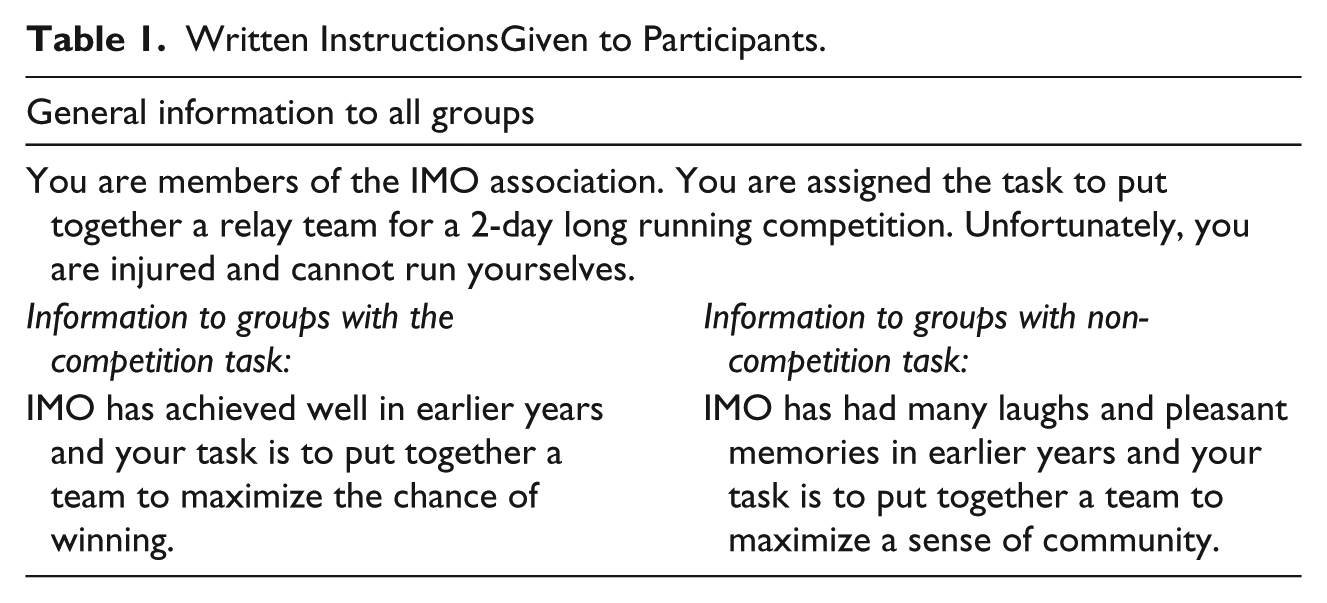
Participants in each group were placed around a table on which two sheets of paper, lying upside down, and a pencil were placed. The session started with the experimenter reading the instructions, and then the participants were asked to pick up the sheets. The first contained the instruction about the task and how to proceed with it, the time limit of 15 min, and the goal specification to which the group was assigned (see Table 1). It also contained pictures of 20 target persons (10 men and 10 women) with information about their first name, age, occupation, and favorite hobby. Occupations and hobbies assigned to the targets were categorized as traditionally feminine, masculine, or gender neutral based on ratings made by another group of students (N = 11), who rated a larger set of occupations and hobbies on five-step scales ranging from typically feminine to typically masculine. These three sets of occupations and hobbies were as evenly distributed as possible across the 10 female and 10 male target persons in the stimulus material.
Written InstructionsGiven to Participants.
The other sheet of paper was a protocol, containing the different relay sections, and on which the group should write their final decision. There were 10 different relay sections of various lengths, and the groups were told that they could use as few or as many runners as they wished and that they were also allowed to split sections. The session was filmed by the use of a surveillance system with three cameras set at different angles.
After 15 min, the experiment was stopped and the experimenter collected the group’s protocol. Immediately afterward, they completed a questionnaire again, among other things asking about their reflections of their experiences of the decision task. In the present study, only the data from the group discussion were used and not the questionnaire data. Finally, they were debriefed about the specific aim of the study and about how the data were to be handled. Participation in the experiment was a course requirement (i.e., demonstration of experimental research methods) but being part of research was voluntary. After debriefing, the participants signed an agreement consenting to the use of the data they provided for research purposes.
Data Analysis
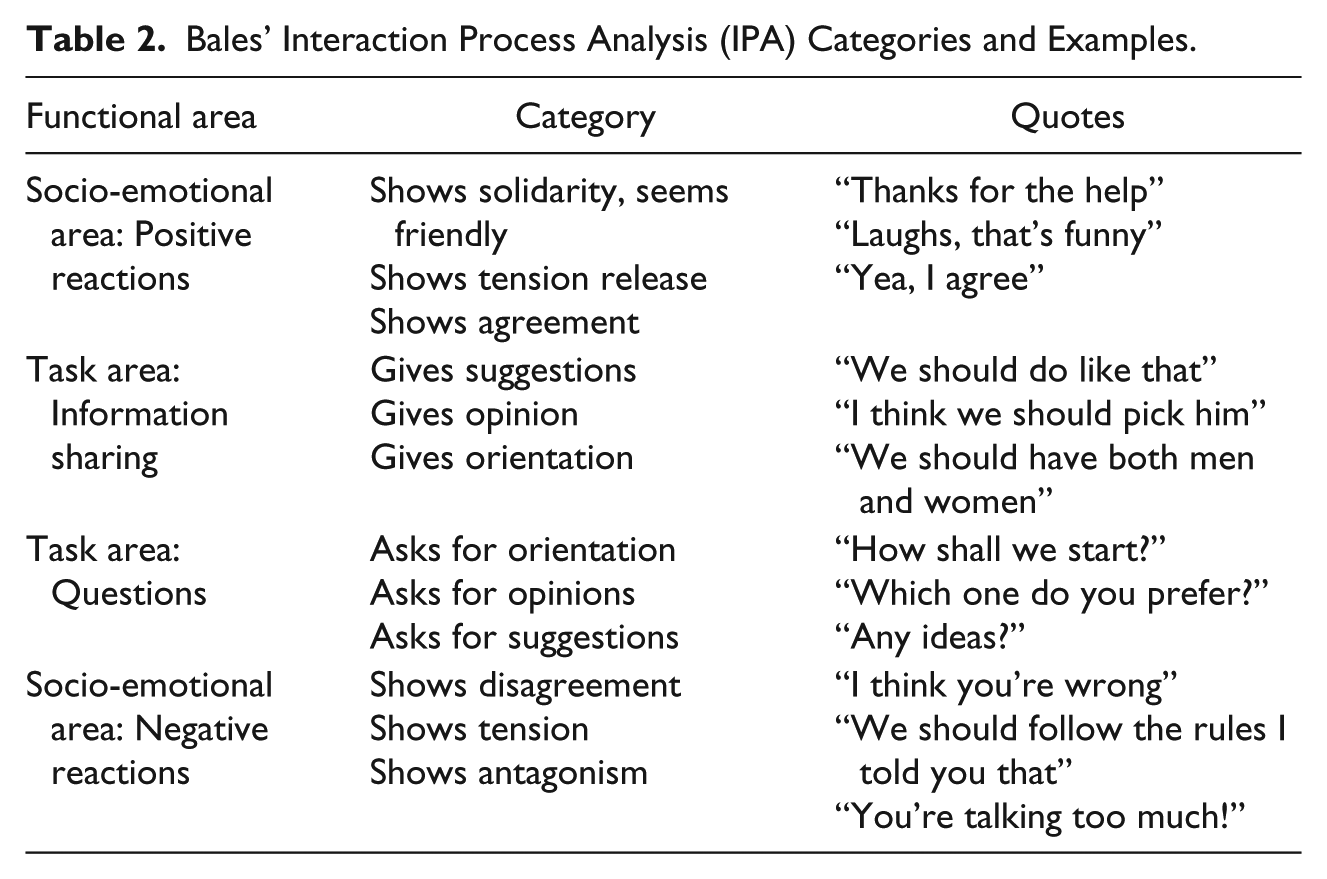
The filmed group sessions were first transcribed and then transferred to NVivo, a qualitative computer-based analysis program. The transcriptions were coded blindly into the IPA (Bales, 1999) categories with no a priori knowledge about the experimental conditions. IPA is comprised of four major categories, each with three sub-categories (see Table 2). Coding was carried out by one of the authors and a research assistant independently of each other for four groups. The inter-rater reliability was 86% across the four categories. The remaining 16 groups were coded by one judge.
Bales’ Interaction Process Analysis (IPA) Categories and Examples.
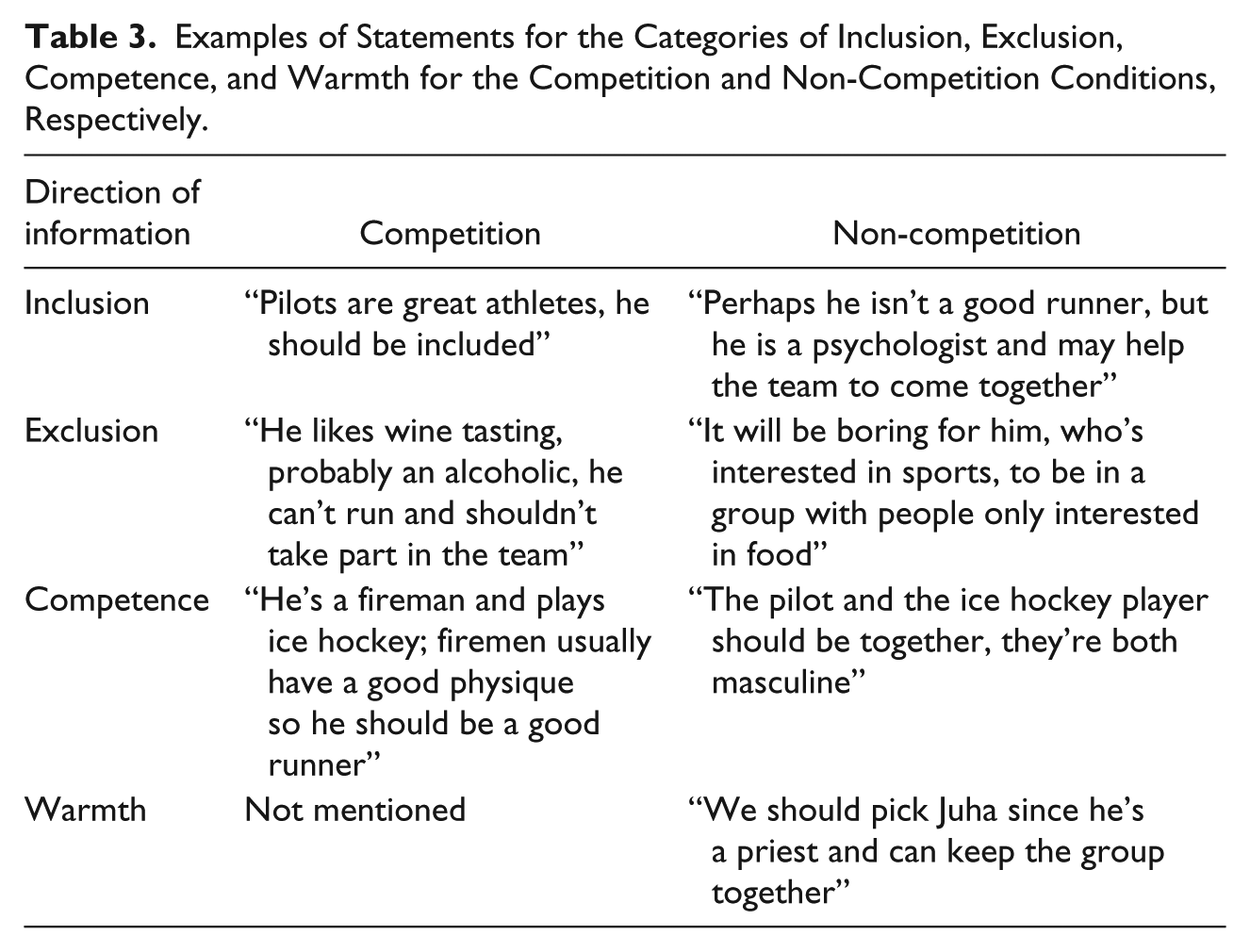
The next step was to analyze the content of the interactions. One theme emerging from the discussions centered on whom to pick for the team and who should be included or excluded. Thus, one category labeled inclusion and another category labeled exclusion were established. Another theme emerged regarding the argument behind possible choices. There was no explicit information given about the qualifications or personality of the available persons. However, information about these qualifications triggered arguments referring to implicitly associated beliefs (i.e., stereotypes). One such theme was related to their qualifications, or lack of qualifications, to run. Another was related to attributes relevant to form a good group climate. As such, they could be said to correspond to the stereotype typology of competence and warmth (Fiske et al., 2002). Coding of statements was carried out by the authors independently of each other for a sub-set of four groups, while the rest was categorized by one person. The inter-rater reliability for the category inclusion was 78%, for exclusion 91%, for competence 88%, and for warmth 64%. These four categories, together with examples, are presented in Table 3.
Examples of Statements for the Categories of Inclusion, Exclusion, Competence, and Warmth for the Competition and Non-Competition Conditions, Respectively.
Results and Discussion
The IPA analysis revealed a total of 4,433 statements possible to categorize into the four main categories (positive reactions, information sharing, questions, and negative reactions). The most frequent type of statements referred to information sharing, constituting 66% of the total number of statements. The second most frequent category was questions, with 17% of the total number of statements. This means that there was a lot of information sharing which was not initiated by asking for information, but was given freely. The category of positive reactions was of about the same magnitude as questions (14%; 1). Finally, there were very few negative reactions expressed in the group sessions (3%).
Most of these categories were equally common in the groups with different conditions (competitive vs. non-competitive goal). The only exception was the category of positive reactions. There were more positive reactions in the groups with a non-competitive goal (M = 41.00, SD = 18.91) than in the groups with a competitive goal (M = 25.66, SD = 13.74), F(1, 18) = 4.44, p < .05, η2 = .20. However, this difference was generated by the sub-category labeled shows tension release, which was the only sub-category with a significant difference between the groups, F(1, 18) = 8.67; p < .01, η2 = .33. Thus, the main finding was that the interaction process did not differ particularly between the groups with different goals set for the task.
The remaining analysis focused on the content of the discussions within the groups (see Table 3). Discussions about how the target persons could perform were prominent in every group discussion, regardless of the goal set for the task. Almost immediately after conversations began, statements relating to competitiveness (e.g., “How should we pick the best team?”; “I think this one is very good as he likes to play soccer”) were made. What is important here is that arguments to find the most competent runners were related to the stereotypic attributes associated with hobbies, age, sex, occupation, or a combination of these. For example, the male pilot and fireman were often assumed to be good performers: “He is a fireman and plays ice hockey, firemen usually have a good physique so he should be a good runner.” Others were considered to be poor performers: “He works at kindergarten and likes knitting, he is probably not the man for our team.”
For groups with a competitive goal, statements about the target persons’ competence were positioned in the beginning of the discussion. Persons presumed to have a high competence (i.e., strong, athletic, fit) were identified to be selected before those who were presumed to have a low competence (i.e., weak, unathletic, and unfit). Groups with a non-competitive goal sometimes stressed the need to have competent runners in the team, but the reason was that they assumed that those people liked running and would probably be happier if they were allowed to run, which should lead to a better group climate. The quantitative data confirm the differences between groups with a competitive and a non-competitive goal, F(1, 18) = 13.67; p < .01, η2 = .42. The target persons’ presumed competence was elaborated more in the discussions in groups with the competitive goal (M = 13.67, SD = 4.25) than in groups with a non-competitive goal (M = 7.63, SD = 2.62).
The first few minutes of the discussions in the groups with the non-competitive goal were devoted to explaining what was meant by a good group climate. Statements such as “We are supposed to select a team to reach a good group climate, not a winning team,” or “It is most important that they have fun together” permeated the discussion. Groups with a non-competitive goal also discussed the need for warmth among the team; the central catchphrase was, “To get a good group climate.” They argued that “Everyone should be involved,” implying that this would lead to a better group climate; “We should pick Juha since he is a priest and can keep the group together,” “Everyone should take part in the team,” and “Who can contribute with what to get a great group climate?” and so on. The quantitative data confirm that groups with a non-competitive goal discussed the need for a good group climate more (M = 7.63, SD = 5.4) than groups with a competitive goal did, where this need was not discussed at all (M = 0), F(1, 18) = 28.24; p < .001, η2 = .61.
As the task was to pick a team for a relay running competition, arguments about inclusion and exclusion would be central to the groups’ discussions. This was immediately evident in the groups with a competitive goal. A strategy discussed in these groups was to include many athletes to yield a better performance: “If we use more athletes, everyone may run a shorter distance and this will make a better result.” However, another strategy was to use fewer runners for the same purpose: “Juha is good, he can run two or more sections.” Inclusion strategies were often motivated by attributes assigned to the target persons based on preconceptions associated with the information given: “Pilots are great athletes, he should be included”; “Men are better runners than women.”
Groups with a non-competitive goal also discussed inclusion issues, but from another starting point, as it was more or less implicitly understood that all members should be included in the team. Inclusion statements thus focused on who should be placed in which section. The dialogue would contain arguments like, for example, that those who presumably liked running should be included as this would probably lead to a better group climate. Otherwise they talked of a different set of competences they assumed would contribute to the atmosphere in the team: “Perhaps he is not a good runner, but he is a psychologist and may help the team come together.” Their discussion also focused on matching people with the same interests, arguing that this would lead to a good interaction and a better group climate: “Here we have two teachers, they’ll match each other.” Some of the groups with a non-competitive goal argued in a different direction that those with contrasting interests could run together as opposites may attract. All in all, the attributes they used to argue for the inclusion of people in the relay team were of the kind that would optimize the sense of community within the teams.
Exclusion of members from the team was a central issue for groups with a competitive goal. It was important to exclude target persons they assumed to perform poorly based on preconception of categories such as age, sex, hobby, occupation, or a combination of these: “Old people run slower than young people,” “She likes downhill skiing, I don’t think she will be a good runner,” and “He likes wine tasting, probably an alcoholic, he can’t run and shouldn’t take part in the team.” The habit of using preconceived stereotypes was taken a step further in the discussions with even more generalizing statements based on vague group characteristics: “He doesn’t look like a good runner and he’s a teacher, probably in computing, and they can’t run” and “I have a friend and she plays soccer and can only run short distances, I don’t think that female soccer players are good long distance runners.” In the groups with a non-competitive goal, however, discussions about exclusion of people from the relay team were rare.
Thus, it seems that arguments regarding both inclusion and exclusion strategies were more important for groups with a competitive goal set for the task. This is confirmed by the quantitative results. The groups with the competitive goal had more inclusion statements (M = 18.75, SD = 10.49) than the groups with the non-competitive goal (M = 9.00, SD = 5.04), F(1, 18) = 5.92, p < .05, η2 = .25. The result was similar regarding exclusion statements: competitive goal groups (M = 10.33, SD = 7.87), non-competitive goal (M = 2.13, SD = 1.55), F(1, 18) = 8.35, p < .01, η2 = .32. Groups with a competitive goal used both statements of inclusion and exclusion more often than groups with a non-competitive goal. It seems that inclusion and exclusion mechanisms are both vivid concepts in the competitive situation to a greater extent than in the non-competitive setting where inclusion of all seems to be an implicit precondition.
Conclusion
The aim of this study was to study interaction processes and interaction content in groups that were given different goals for a decision task. The IPAs revealed that the most frequent form of interaction was that of giving information to each other. Given that information sharing was four times more frequent than asking for information suggests that information was freely and spontaneously given in all groups. The IPA revealed only minor differences between the groups, indicating that the interaction process was not dependent on the goal set for the interaction.
Also clear from the results is that the arguments in all groups went well beyond the information given about the target persons. Often, attributes associated with group stereotypes were used to characterize the persons who were to be included or excluded in the relay teams. Many of those attributes were related to the basic stereotype dimensions of competence and warmth (Fiske et al., 2002). Attributes related to competence were used in all groups regardless of the goal for the task, but in different ways. In groups with a competitive goal, positive competence attributes were used to include people on the team, whereas negative competence attributes were used to exclude people from the team. In groups with a non-competitive goal, positive competence attributes were sometimes used to include people but for reasons that had to do with having fun and for optimizing a good climate within the team. Arguments relating to warmth were nearly exclusively used in the groups with a non-competitive goal.
Inclusion and exclusion were both important concepts in the groups with a competitive goal. Attributes relating to both competence and lack of competence were communicated in the groups to argue for inclusion or exclusion of people. In groups with a non-competitive goal, exclusion was seldom discussed. There seemed to be an unspoken agreement that all the target persons should be included in the team. As such, when there was a discussion about competence in a group, it seldom took the form of lack of competence. Similarly, to reach a good group climate, discussions about inclusion were generally about positive attributes and not characteristics that might have negative effects on the group climate.
It is important to remember that the groups in this study were randomly formed and not real groups. Participants were students, and groups had 15 min to solve a relatively simple task with no right or wrong answers. It is difficult to tell whether or not the results are applicable to other situations with other tasks, groups, and populations. More research is needed with a variation of tasks and participants. The question of what would happen in a group across time with the same kind of task is also still open. Would the patterns identified become stronger or would some other processes appear? The inter-rater reliability analysis revealed that statements relating to the warmth attribute and a good group climate were more difficult to classify. This indicates that such reasoning is less ordinary in these circumstances, despite the fact that sports associations have both kinds of imperatives as conditions for their task (Vogel et al., 2003). This suggests that the competitive goal seems to be dominant regardless of conditions. Thus, there is a need for applying research to situations where a non-competitive goal is dominant and a competitive one is sub-ordinate. As mentioned in the introduction, research on decision-making has so far most often been carried out within an implicit competitive paradigm (Ahn et al., 2003), and this one-sidedness has seldom been questioned (Kray & Thompson, 2005). This study reports an attempt to address this problem and our results clearly stress the need for research that explores the consequences of different kinds of goals.
A conclusion suggested from these results is that a competitive goal leads to both inclusion and exclusion mechanisms where both positive and negative stereotypes are used, whereas a non-competitive goal leads to inclusion mechanisms and the use of positive stereotypes only. It is interesting to note that in the groups with a competitive goal, no references were made to attributes that related to warmth and creating a good group climate, whereas in groups with a non-competitive goal, there were arguments relating to both warmth and competence. This suggests that groups in a non-competitive condition could not free themselves of the competitive nature of the task and sometimes had to remind themselves that they were supposed to put together a team to maximize the sense of community. This indicates that these groups experienced the dilemma between the two imperatives of performance and the common good, while the groups with the competitive goal did not. This is ironic, as the importance of creating a good team spirit to perform well is so often stressed within sports (and also in many other organizational situations). Our results pinpoint how easily competitive goals gain hegemony over other forms of goals. There is a strong desire to perform well but at the same time this might mean exclusion of participants, which is motivated by the use of negative stereotypes. Our results clearly suggest that stereotypes are easily applied to legitimize decisions about inclusion and exclusion. This is especially problematic from a democratic point of view (Vogel et al., 2003). It has to be acknowledged that both types of goals coexist in many circumstances, but it seems that non-competitive goals need to be recaptured, over and over again, to be taken seriously.
Footnotes
This article is part of the special issue Leadership and the Group, Small Group Research, Volume 45(4).
Declaration of Conflicting Interests
The author(s) declared no potential conflicts of interest with respect to the research, authorship, and/or publication of this article.
Funding
The author(s) disclosed receipt of the following financial support for the research, authorship, and/or publication of this article: This research was funded by grants from Swedish Research Council (Project ID 90203101).