



Abstract
BACKGROUND:
Occupational accidents are anticipated to decline when unregistered employment declines because of more regulated working conditions, inspections, and opportunities for legal protection. In the study, the accuracy of this presumption was examined.
OBJECTIVE:
This study aims to examine how to protective legal regulations generate a relationship between occupational accidents and informal employment such as the Occupational Health and Safety Law in Turkey.
METHODS:
In the research, which was structured within the framework of the quantitative method, various levels of relationship chains were created between informal employment and occupational accidents using correlation and slope calculations. The official data set was created using secondary data from the Turkish Statistical Institute and the Social Security Institution.
RESULTS:
It has been determined that the low positive correlation (r = 0.166) between unregistered employment and occupational accidents in 2008–2012 (pre-legislation period) in Turkey changed to the medium-negative direction (r=–0.602) in 2013–2020 (legislation period). While the assumption that unregistered employment would decrease in the first period was confirmed, the hypothesis was falsified by the increase in occupational accidents despite the decrease in informality in the second period.
CONCLUSION:
This study is unique because it shows that in a developing country where unregistered employment is high, the protective regulations for work accidents do not reflect a decrease in the number of work accidents in the short and medium term.
Keywords
Introduction
The rules on occupational health and safety in Turkey, regulated by various regulations, especially labour laws, were gathered under the Occupational Health and Safety Law No. 6331, adopted in June 2012. Along with Law No. 6331, which was prepared based on EU and ILO norms, regulations were made within the scope of international standards under the 89/391 EU Framework Directive to combat work accidents effectively.
In the preliminary examination on the question of whether Turkey has achieved the targeted success in the fight against work accidents in the pre-law period (2008–2012) 1 and after the adoption of Law (2013–2020), after Law No. 6331 (2013 and following years). Significant increases in occupational accident rates, which are reflected in official statistics, have been detected. However, in the same period, it was observed that there were decreases in unregistered employment rates. These data brought to mind why the pace of work accidents increased despite declining unregistered employment and introducing EU standards for struggling work accidents.
As a general acceptance, the increase in registered employment and the more effective implementation of legal norms on occupational health and safety causes an increase in those included in the scope of protection [1–3]. For this reason, the number of work accidents is expected to decrease. However, in countries with high unregistered employment rates, actual occupational accidents are not recorded, which may prevent the accurate rates from being reflected in the statistics. Studies from different countries have shown that the ratio between fatal and non-fatal accidents is relatively constant if proper recording systems exist [3–5].
This study aims to examine how to protective legal regulations generate a relationship between occupational accidents and informal employment such as the Occupational Health and Safety Law in Turkey. In the framework of this aim the question of this study is “What is the relationship between work accidents and unregistered employment in Turkey?”. In order to answer this question, it is necessary to answer three sub-questions. Firstly, what is the relationship between fatal occupational accidents and the most risky economic activities? Then, what is the relationship between occupational accidents and informal employment before and after the Law No. 6331? Thirdly, what is the relationship between occupational accidents and unregistered employment according to economic activities? Thus, the increasing and decreasing trends in occupational accidents according to economic activities can be seen. Finally, the findings are compared and interpreted and the main question of the research is answered.
Materials and methods
The research’s fundamental question was, “What kind of relationship is there between work accidents and unregistered employment?”.
In the research, which was structured within the framework of the quantitative method, various levels of relationship chains were created between informal employment and occupational accidents using correlation and slope calculations.
Occupational health and safety analytical studies in occupational epidemiology have traditionally been conducted with secondary data from official records despite the low quality and limited scope concerns [6–9]. The data set used in this study was created using secondary data obtained from the Turkish Statistical Institute (tuik.gov.tr) and the Social Security Institution (sgk.gov.tr).
This study is exempt from Institutional Review Board approval because it utilises secondary data (official statistics). The authors have no acknowledgments. The authors declare that they have no conflict of interest. The authors report no funding.
The limitation of this research covers the period 2008–2020. Since the earliest period for which official statistics are available is 2008, the research was started on this date. Since the latest available statistics are 2020, the study was finalised on this date. Since the regulation of the Law taken into consideration within the scope of the research was in 2013, the study was limited as two periods, 2008–2012 (Pre-Law Period), and 2013–2020 (the period until the latest date for which Post-Law data is available). Due to this limitation, it was possible to observe the changes between the two periods.
Whether the data showed normal distribution or not was examined with the Kolmogorov-Smirnov test. It was determined that the variables showed normal distribution; therefore, Pearson correlation analysis was used to assess the level of the relationship.
For the r coefficient;
The r coefficient takes values between –1 and +1. –1 indicates a perfect negative correlation, and +1 indicates a perfect positive correlation. 0 means that there is no correlation between them. The correlation cutoffs [10] in our study, in the internal classification of negative and positive areas, positive and negative aspects are symmetrical, (±) low level up to 0.29, (±) 0.30 and (±) 0.69 medium level, (±) 0.70 and up were accepted as a high-level correlation.
For the Slope between the variables;
The Slope Value Calculation (Slope) method is a simple way of estimating occupational accidents with different risk components. The slope method was used to evaluate and predict occupational accidents in different periods in Turkey [11], Pakistan [12], and Korea [13].
A negative value of the Slope shows that the average trend is in the direction of decreasing. In contrast, a positive value indicates that the intermediate trend is in the order of increasing. As the distance of the value from zero in the negative/positive direction increases, the strength of the decrease/increase trend also increases.
All calculations were made in IBM SPSS Statistics v29 and SPSS based Simple Scatterplot was used for correlation graphs.
The calculation method of the Social Security Institution, where statistics on occupational accidents are officially shared, has been changed as of the end of 2012 when Law No. 6331 came into force. Therefore, evaluating the period before and after 2012 together yields inconsistent results. For this reason, the two periods were separately assessed and interpreted by comparing them.
Within the scope of the statistics considered according to economic activities in the study, data on 18 different fields can be accessed. However, 17 economic activity data were used in this study. The high rate of informality (on average 84%) in economic activity, which is classified as “agriculture, fisheries and forestry” (in short, the agricultural sector), increases the average of occupational accident statistics for all sectors. Moreover, there are doubts about the consistency and accuracy of informality data regarding the agricultural sector. Therefore, studying “as a special field” in the agricultural sector would be correct. Consequently, it is not included.
For the period before Law No. 6331 (2008–2012) with a stable data set, index values were calculated until 2012, with 2008 = 100. Then, the same calculation was made from 2013 = 100 to 2020. Thus, comparing the change in occupational accidents in both periods has gained a consistent appearance within itself. The following formula is used for index calculation:
IVC of OA/E% (Index Value Calculation of Occupational Accident Rate):
Findings
The thematic findings of the research are classified under three main headings. The first is the determination of fatal occupational accidents and the riskiest economic activity areas. The relationship between work accidents and unregistered employment has generally been analyzed in the second heading. Finally, in the third heading, the relationship between work accidents and unregistered employment is examined according to the fields of economic activity.
Fatal occupational accidents and most risky economic activity areas
Table 1 calculates the number of fatal occupational accidents in Turkey for 2008–2020, and the index values of fatal occupational accidents for 2008 = 100 and 2013 = 100 are calculated. Accordingly, it is seen that the index value, which increased to 197 in 2011, was 86 as of 2012.
Fatal Occupational Accident Index in Turkey (Base Years 2008 and 2013)
Fatal Occupational Accident Index in Turkey (Base Years 2008 and 2013)
Resources: Calculated by the authors using SGK and TUIK data.
The slope coefficient showing the rate of change in fatal occupational accidents for the 2008–2012 period was calculated as 0.00046 in a positive direction. In this period, it is understood that occupational accidents increased rapidly, except for 2012.
The downward trend in fatal occupational accidents in 2013–2020 is noteworthy. The mining accident in the Soma district of Manisa province (a city in the Aegean region of Turkey) on May 13, 2014, where 301 people died, caused the fatal occupational accident index value to increase to 120 in 2014. However, the fluctuating course continued in the following years. Furthermore, the fatal occupational accident index value decreased to 91 in 2020. In 2013–2020, the fatal occupational accidents slope coefficient was calculated as –0.00456 in the negative direction. It is understood that occupational accidents tend to decrease in this period.
Most occupational accidents are seen in the construction sector in the world (ILO, 2021). Similar to the ILO statistics in the EU-27, more than a fifth of all fatal occupational accidents are in the construction sector. Furthermore, similarly, in Turkey, deaths resulting from work accidents are primarily seen in the construction sector. As of 2020, 347 people (28.2%) of 1231 people who died due to work accidents are in the construction sector. Others following the construction sector are manufacturing (19.5%), transport and storage (19.4%), wholesale and retail trade (7%), and mining and quarrying (5.4%). Approximately 80% of the total occupational accidents in Turkey occur in these five economic activities.
When the increased rates of fatal work accidents are analyzed, the wholesale and retail trade sector comes to the fore. Table 2 shows the index values of the first five sectors with the most severe fatal occupational accidents in Turkey according to economic activities, and the slope coefficients showing the increase in death rates as a result of work accidents (2008–2012 and 2013–2020 period-before the Law and after the law period).
Fatal Occupational Accident Index in Economic Activities for the period 2008–2012 and 2013–2020 (IVC of Fatal Occupational Accidents for First 5 Sector-Nace-Rev2)
Resources: Calculated by the authors using SGK and TUIK data.
In the 2008–2012 period, it has been observed that, despite the decrease in 2012, in most of the five riskiest economic activities (excluding the wholesale and retail trade sector), there is an increasing trend in fatal occupational accidents. The highest rate of increase was realized in wholesale and retail trade, with a slope coefficient of 0.01002. Wholesale and retail trade, followed by the construction and manufacturing sectors, respectively.
When the period of 2013–2020 is evaluated, it is observed that the increasing trend continues in the transportation and storage and wholesale and retail trade sectors. Furthermore, although the number of fatal occupational accidents in the mining and quarrying, manufacturing, and construction sectors is high, it is observed that the rate of change tends todecrease.
In the last 13 years, in which stable statistics can be reached, an average of 221 thousand 693 registered work accidents have occurred in Turkey. The ratio of these accidents to the average registered employment in the same period was 0.8%. In other words, in the last 13 years, 0.8 out of every 100 individuals in employment had an occupational accident.
In Table 3, the total registered employment (TE), and the number of occupational accidents (OA), and unregistered employment rates (URE) are given together, according to the secondary data obtained from the official statistics throughout Turkey for the period 2008–2020. Using these data, the ratio of occupational accidents to total registered employment (OA/TE) and the change Index Values (IVC of OA/TE) of this ratio for 2008 = 100 and 2013 = 100 were calculated.
The Occupational Accidents, Total Registered Employment and Unregistered Employment (2008–2020)
The Occupational Accidents, Total Registered Employment and Unregistered Employment (2008–2020)
Resources: Calculated by the authors using SGK and TUIK data.
The data in Table 3 shows that despite the 17.1% increase in total registered employment in 2008–2012, occupational accidents decreased except for 2012. The index value for the rate of occupational accidents to employment (2008 = 100) fell to 83 in 2011 and became 88 by the end of 2012. Despite the increase in employment in the relevant period, the rate of work accidents decreased.
The change in the calculation method for work accidents as of the end of 2012 was reflected in the increase in the number of work accidents in 2013 and after, including 2012. While the upward trend in employment in the 2013–2020 period continues (except for 2020), it is seen that the increase in work accidents is much higher than the increase in employment. While total registered employment increased by approximately 5.1% in 2013–2020, occupational accidents increased approximately one-fold in the same period. Accordingly, the index value for the rate of work accidents to employment (2013 = 100) increased to 201 in 2019 and became 191 by the end of 2020.
The analysis found a moderate positive correlation (r = 0.414) between total registered employment, which increased by 17.1% in 2008–2012, and the number of work accidents. On the other hand, although the increase in employment in 2013–2020 was 5.1%, the correlation turned into a highly positive (r = 0.884) one with the enactment of Law No. 6331 (Fig. 1).
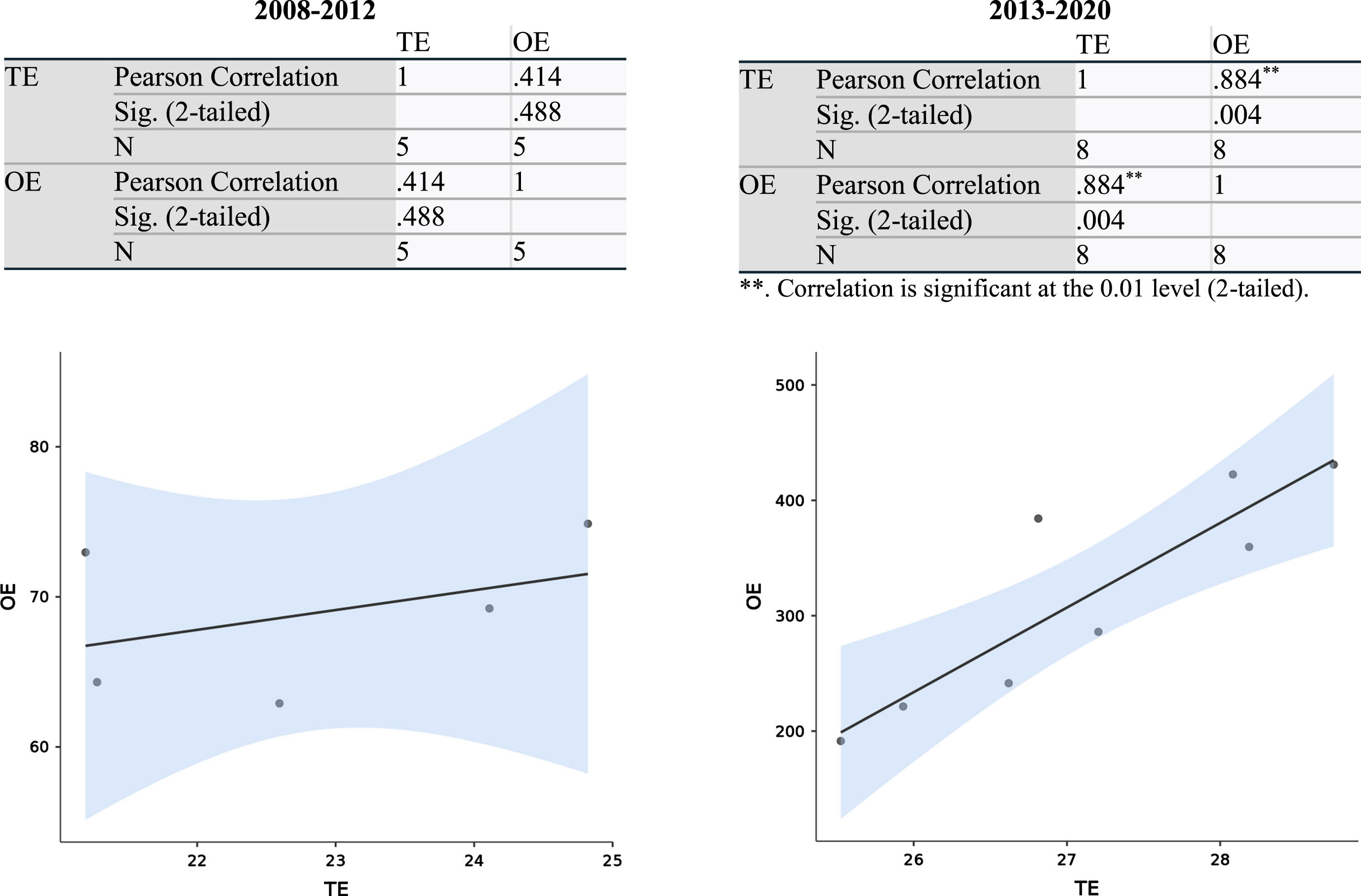
The Relationship Between Total Registered Employment (TE) and Occupational Accidents (OE) 2008–2012 and 2013–2020.
In terms of unregistered employment, it should be noted that the unregistered employment rate in Turkey, which was 43.5% in 2008, dropped to 30.6%, with a steady downward trend until 2020. When the relationship between the decreasing trend in unregistered employment and the change in occupational accident rates is examined, a low positive correlation was found between unregistered employment and work accidents in the 2008–2012 period (r = 0.166) (Fig. 2). As a general opinion, as informality decreases, occupational accidents are expected to decline due to increased assurance, supervision, and control. Therefore, it is understood that the 1-unit decrease in the unregistered employment rate in the 2008– 2012 period decreased the work accidents by 0.166, and in this sense, the usual expectation was met.
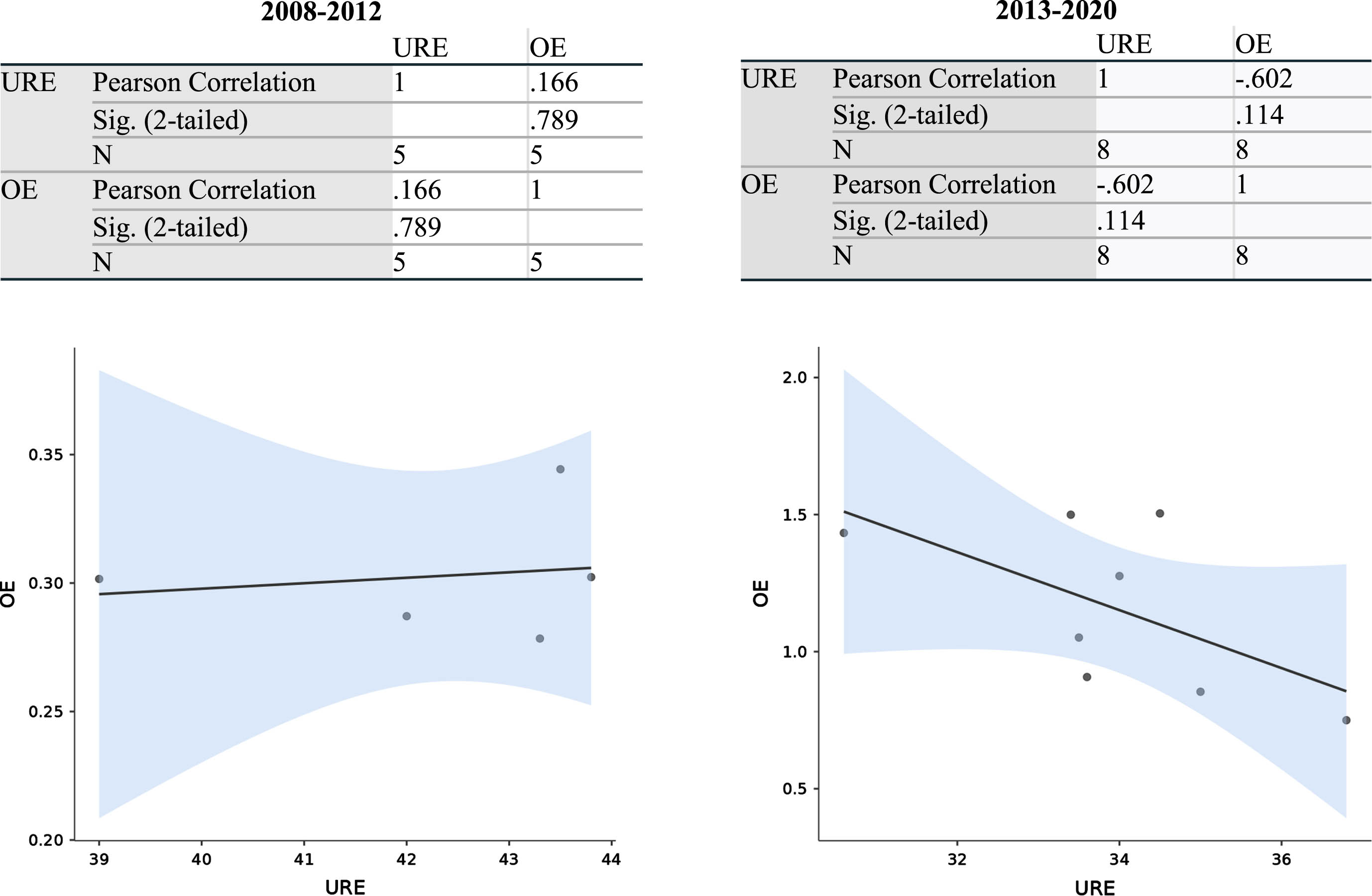
The Relationship Between Unregistered Employment (URE) and Occupational Accidents (OE) 2008–2012 and 2013–2020.
With the change in the calculation method in 2012 and the enactment of Law No. 6331, the direction of the relationship has turned into a medium negative in the 2013–2020 period (r = –0.602) (Fig. 2). According to this calculation, a 1-unit decrease in unregistered employment increased the number of work accidents by 0.602. Contrary to the general expectation, this situation makes us think that a significant number of work accidents that are not recorded have come to light due to increased inspection and control. From these results, it is understood that many protective regulations, including incentives for registered employment, brought with Law No. 6331, and changing calculation methods increase the visibility of occupational accidents.
In Table 4, according to economic activities, the correlations between total registered employment (TE) and occupational accidents (OA) and unregistered employment rates (URE) and occupational accident rates (OA/E) in Turkey are shown with correlation analysis coefficients (for the 2009–2012 and 2013–2020 periods).
Analysis of the Correlations between Total Registered Employment and Unregistered Employment and Occupational Accident Rates for the period 2009–2012** and 2013–2020 in Turkey by Economic Activities (Nace-Rev2)
Analysis of the Correlations between Total Registered Employment and Unregistered Employment and Occupational Accident Rates for the period 2009–2012** and 2013–2020 in Turkey by Economic Activities (Nace-Rev2)
Resources: Calculated by the authors using SGK and TUIK data. **Since unregistered employment data by economic activities is not available for 2008 and before, data for 2009-2012 were taken into consideration.
From 2009 to 2012, the total registered employment-occupational accident correlation was determined as medium negative for the “electricity, gas, steam, water supply, and sewerage sector” and high negative for “finance and insurance activities and other service activities”. However, except for these three sectors, the general trend in all economic activity areas is in the direction of a medium-high positive correlation.
In the same period, a negative correlation was found between unregistered employment-work accidents in all sectors, except human health and social service activities, administrative and support service activities, mining and quarrying, and public administration, defence, and compulsory social security sectors.
Among the sectors in which a negative correlation was determined, a low negative correlation was found in the “electricity, gas, steam, and air-conditioning supply, construction and culture, art, entertainment, recreation, and sports sectors”, a medium negative correlation in the “information and communication sector”, and a high negative correlation in the other sectors.
In the 2013–2020 period, it is seen that the change in the calculation method regarding occupational accidents and the increase in protective regulations, controls, and inspections, especially Law No. 6331 on occupational health and safety, increased the number of occupational accidents. For example, it has been determined that the low negative correlation (–0.2974) between unregistered employment and occupational accidents in the construction sector in the 2009–2012 period changed to medium negative (–0.5384) in the 2013–2020 period. Accordingly, despite the 1-unit decrease in unregistered employment in the construction sector in the 2009–2012 period, occupational accidents increased by 0.3, while they increased by 0.5 in the 2013–2020 period. A similar situation exists in the manufacturing sector. As a result, the low negative correlation (–0.0828) determined for the 2009–2012 period in the manufacturing sector has changed to a low-medium correlation (–0.2953) in the 2013–2020 period.
In the “public administration, defence, and compulsory social security sectors”, the low positive correlation detected for 2009–2012 (0.2167) has changed to a high negative (–0.8878) in 2013–2020. Although the negative correlation between the two periods decreased in the transportation and storage and information and communication sectors, a negligibly small change was detected.
There are many studies on the frequency and change trend of occupational accidents in developing countries in the literature [14]. Takala [5]; analyzed global estimates of fatal occupational accidents. Izadi et al. [9]; analyzed the trend of occupational accidents based on the data during 10 years (2007–2016) gathered by the Iranian Social Security Organization (ISSO). Ergör et al. [15]; analyzed the data on severe occupational accidents in three years from the Aegean Region of Turkey to define the working life situation. Mohammadfam et al. [16]; assessed the costs of fatal work accidents in Tehran. Hämäläinen [17]; discussed how globalization had affected occupational accidents trend in developing and developed regions. And also, Shahnavaz [18]; discussed workplace injuries in developing countries. Some studies analyze the costs of work accidents.
Few studies specifically analyze the relationship between unregistered employment and occupational accidents. For example, Salinas-Tovar et al. [19]; assessed the potential under-registration of work-related accidents in the Mexican Institute of Social Security. However, some studies are similar in examining the relationship between poor working conditions and work accidents. And also Koranyi et al. [20]; analyzed precarious employment and occupational accidents and injuries.
Statistical studies on occupational accidents are mainly based on secondary data, making it difficult to fight against fatal or non-fatal occupational accidents that are not recorded in developing countries such as Turkey, where unregistered employment is widespread [9, 21]. This challenge is exacerbated in countries such as Brazil, where informal jobs account for nearly half of the workforce [21].
Occupational accident notification prevents employee victimization in countries with high unregistered employment rates. Informal workers are often employed in dangerous jobs and exposed to conditions that do not complying with occupational health and safety legislation [3, 23].
Since the state does not register the unregistered work areas and therefore are not covered by social protection, those in informal employment can work more hours and for fewer wages beyond the legal limits [24, 25]. In addition, they may be exposed to unhealthy living and working conditions and may be more prone to work accidents and occupational diseases. The prevalence of bad working conditions in informal work areas increases the risk of work accidents and occupational diseases [26, 27]. But it does not appear statistically because accidents, injuries, and illnesses are not recorded. This situation causes occupational accident statistics not to reflect reality ultimately.
This research tries to answer the question, “What is the relationship between work accidents and unregistered employment in Turkey?”. The relationship in question has been examined in two time series, the first period before the adoption of the Occupational Health and Safety Law No. 6331 (2012) (the period for which data can be obtained 2008–2012) and the second period after the adoption of the Law (2013–2020 last healthy data). The change in the calculation method for occupational health and safety and occupational accidents in 2012 also makes the period mentioned above distinction meaningful.
Three sub-themes were examined to answer the research question. These are (1) fatal work accidents and the riskiest economic activity areas, (2) occupational accidents and unregistered employment in general, and (3) occupational accidents and unregistered employment according to economic activities.
From 2008 to 2012, it has been observed that fatal occupational accidents are an increasing trend in all of the five riskiest sectors. Although the construction sector had the highest number of fatal occupational accidents, the highest increase trend was realized in wholesale and retail trade.
Fatal occupational accidents tend to decrease in Turkey from 2013 to 2020. For example, although the fatal occupational accident index increased to 120 in 2014, it decreased to 91 in 2020.
For all sectors, the average eight-year fatal occupational accident slope coefficient for 2013–2020 was calculated as –0.00456. Fatal occupational accidents tend to decrease.
When the five riskiest sectors are evaluated, the increasing trend in transportation and storage and wholesale and retail trade sectors drew attention in 2013–2020. Although the number of fatal occupational accidents in the mining and quarrying, manufacturing, and construction sectors is above the average, the rate of change in fatal occupational accidents is calculated to decrease.
After 2012, when the calculation was changed, there was an increase in occupational accidents in 2013. While the upward trend in employment in the 2013–2020 period continued (except for 2020), occupational accidents were much higher than the increase in employment. While total registered employment increased by approximately 5.1%, occupational accidents increased approximately one-fold in the same period. Accordingly, the index value for the rate of work accidents to employment (2013 = 100) increased to 201 in 2019 and became 191 by the end of 2020.
The analysis found a moderate positive correlation (r = 0.414) between total registered employment, which increased by 17.1% in 2008–2012, and the number of work accidents. On the other hand, although the increase in jobs in the 2013–2020 period was 5.1%, the correlation turned into a highly positive one due to increased visibility with the enactment of Law No. 6331 (r = 0.884).
In Turkey, 43.5% in 2008, the unregistered employment rate declined to 30.6%, with a steady downward trend until 2020. A low positive correlation was found between unregistered employment and work accidents in 2008–2012 (r = 0.166). Occupational accidents are expected to decrease as informality decreases due to increased assurance and supervision. It is understood that the 1-unit decrease in the unregistered employment rate in the 2008–2012 period reduced the occupational accidents by 0.166; in this sense, the usual expectation was met.
However, in the 2013–2020 period, the direction of the correlation turned into a medium negative (r=–0.602). According to this calculation, a 1-unit decrease in unregistered employment increased the number of work accidents by 0.602.
This situation makes us think that before the change in the calculation method in 2012 and before Law No. 6331 came into force, significant work accidents were experienced (before 2012, the rates of work accidents were shown to be low), but they were not recorded. It is understood that the appearance of occupational accidents increases with the increase in supervision and control.
In the public administration, defence, and compulsory social security sector, the low positive correlation (0.2167) for 2009–2012 changed to a high negative (–0.8878) in 2013–2020.
Although the negative correlation between the two periods decreased in the transportation and storage and information and communication sectors, a slight change was detected.
These data show that the increase in visibility due to inspection efficiency is not reflected in the occupational accident statistics in all sectors in the short and medium term. It is understood that protective measures do not reduce the number of occupational accidents in the construction and manufacturing sectors, where the risk of occupational accidents is high, and the notifications after legal regulations increase due to penalties.
In addition, an increase in the visibility of occupational accidents has been detected in the public administration, defence, and compulsory social security sectors. However, it has been observed that the impact of the relevant protective regulations for the transportation and storage and information and communication sectors on reducing the number of occupational accidents is limited.
Although the regulations to prevent unregistered work and work accidents in Turkey align with EU standards, problems can often be encountered in practice. For example, when a person applies to a hospital due to severe injury or other physical damage, the official police of the state, who is constantly on duty at that institution, keeps a report about the cause and occurrence of the incident. If it is concluded that the person had a work accident, these records are also forwarded to SGK (Social Security Institution). Based on the identification number, it can also be instantly understood whether the person is insured or not. If he/she is not insured, SGK investigates whether he/she is employed unregistered. The state covers treatment costs but can later claim them back from the person who caused the fault. If it is determined that the person is employed unregistered, the employer will be fined. In addition, that employer cannot benefit from the employment incentives in force for one year [28, 29]. Moreover, not only in the work accidents of unregistered employees but also in all work accidents, the employer is made to pay compensation in proportion to the fault, taking into account the injured person’s age and the loss of earning capacity in the work or profession [30]. Although the sanctions for possible work accidents that may occur due to unregistered employment are severe, the lack of adequate supervision reduces the sensitivity of especially small and medium-sized enterprises to unregistered employment.
Conclusion
As unregistered employment decreases, occupational accidents will decline due to more regular working conditions, inspection, and legal protection opportunities. However, as a result of the analysis, it was understood that the increased control and supervision in working life with the decrease in informality increased the visibility of unrecorded work accidents. Occupational accidents that have happened before but are hidden and not recorded become visible, falsifying the assumption that occupational accidents decrease with the statistical decrease ininformality.
As informality decreases, the number and rates of work accidents increase short and medium-term. However, in the long run, it is thought that a decrease in occupational accidents will be possible as structural measures increase.
In this context, measures such as strengthening the institutional structure, establishing occupational accident measures as a culture, carrying out inspections with continuous monitoring mechanisms rather than random sampling, and establishing not only punishment but also a reward system are necessary for the reflection of structural measures to work accidents in the short and medium-term in the form of a reduction. As a result of taking and following these measures, a simultaneous decrease in unregistered employment and work accidents can be achieved.
Ethical approval
This study used the official secondary data set from the Turkish Statistical Institute and the Social Security Institution. Therefore, ethical approval is not applicable.
Informed consent
This study used the official secondary data set from the Turkish Statistical Institute and the Social Security Institution. Therefore, informed consent was not required.
Data availability statement
The data that support the findings of this review are openly available in Turkish Statistical Institute http://tuik.gov.tr and the Social Security Institution Data Repository http://eski.sgk.gov.tr/wps/portal/sgk/tr/calisan/kayitdisi_istihdam/kayitdisi_istihdam_oranlari.
Conflict of interest
The authors declare that they have no conflict of interest.
Footnotes
Acknowledgments
The authors would like to thank the reviewers for their expertise, contributions, and assistance.
Funding
There is no funding fort his research.
Since the current stable statistics for the pre-law (6331) period were discontinued in 2008, the study was evaluated for the period 2008-2012 in the first stage. However, the data set on the fields of economic activity started in 2009.