




Abstract
A salient and underresearched aspect of un/fair treatment in organizations can be the source of justice, in terms of a specific justice agent. We propose a model of agent bias to describe how and when characteristics of the agent enacting justice are important to justice reasoning. The agent bias is defined as the effect on overall event justice perceptions of specific agent characteristics, over and above the effect via distributive, procedural, and interactional justice. For justice recipients to focus on agent characteristics rather than on the event being evaluated in terms of fairness is an unexplored bias in justice judgments. Agent warmth, competence, and past justice track record (entity justice) are identified as agent characteristics that influence justice judgments. Agent characteristics can influence overall event justice perceptions positively or negatively, depending on the ambiguity in terms of justice of the event and on its expectedness from a particular justice agent. Finally, we propose that agent bias is stronger when justice recipients use intuitive versus analytic information processing of event information. Our model of agent bias has important theoretical implications for theories of organizational justice and for other literatures, as well as important practical implications for organizations and managers.
Organizational justice research has proceeded at a remarkable pace for over four decades, emerging as a dominant theory for explaining employee work behaviors in response to workplace events—and in particular to negative events. To the extent that employees feel fairly treated, they are more likely to accept change (e.g., Rodell & Colquitt, 2009), express commitment toward their organization, and engage in citizenship behaviors (e.g., Colquitt, Conlon, Wesson, Porter, & Ng, 2001). In contrast, when employees feel unfairly treated, they are more likely to reduce effort on tasks, engage in counterproductive behaviors, and leave the organization (e.g., Cohen-Charash & Spector, 2001).
There is broad agreement among scholars that organizational justice is comprised of four facets: outcomes, procedures, explanations for decisions, and interpersonal treatment (Colquitt, 2001). With some exceptions (e.g., Bies, 2001; Roch & Shanock, 2006), it has been assumed that to arrive at fairness judgments, individuals systematically process information relating to these four facets. Most research in organizational justice has assumed that employees have the information, time, and attention to systematically evaluate events. However, there may be occasions when employees base their fairness judgments on criteria that are less effortful and more quickly processed. We argue in this article that a salient and underresearched aspect of un/fair treatment can be the source of justice, in terms of a specific justice agent.
We define agent bias as the direct effect of agent characteristics on overall justice judgments regarding an event, over and above other possible effects on evaluations of distributive, procedural, informational, or interpersonal justice. We build on the justice (e.g., Folger & Cropanzano, 2001; Marques, Patient, & Cojuharenco, 2017), trust (e.g., Holtz, 2013), social cognition (e.g., Fiske, Cuddy, & Glick, 2006), and judgment and decision making (e.g., Stanovich, West, & Toplak, 2014) literatures to reason when agent characteristics are likely to have a direct effect on overall justice, over and above dimensional justice (Figure 1).
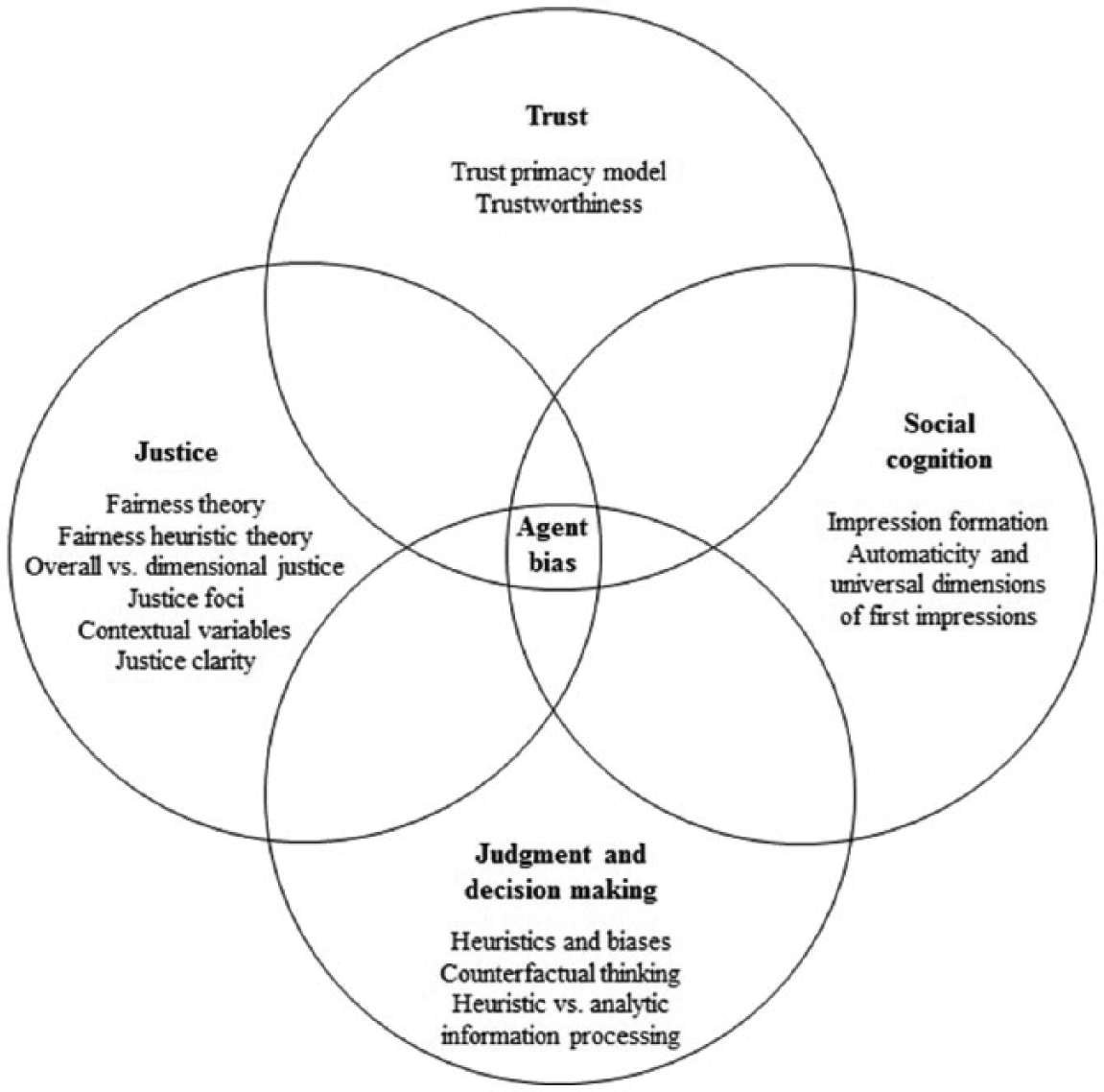
Literatures integrated by the model.
Given the salience of the agent(s) administering justice, our models of justice reasoning are enriched by better understanding when and how agent characteristics can influence justice perceptions. From a managerial perspective, this research can help identify situations in which organizations should take care to demonstrate in detail the fairness of decisions, to avoid quick and intuitive responses to specific decision makers.
We first review research on determinants of justice judgments and on the role of agents in the justice literature. Next, we define the agent bias and discuss the effects on the agent bias of relevant past experience with the justice agent, the ambiguity of an event and its expectedness for a particular agent, and the information processing style used to evaluate an event. We conclude by reviewing theoretical and managerial implications and proposing avenues for future research.
Determinants of Justice Judgments
Major Theories
We situate our theorizing about agent bias in the context of fairness theory (Folger & Cropanzano, 2001) and fairness heuristic theory (FHT; Lind, 2001).
Fairness theory
According to fairness theory (Folger & Cropanzano, 2001), individuals perceive injustice when what they experience can be unfavorably compared with an alternative that would have been better, that could have been the case, and that, according to universal rules, should have been. Research shows that the ease with which individuals can generate such upward counterfactuals relates negatively to the evaluation of actual events (Roese, 1997; Roese & Olson, 1995) or, in this case, to greater perceptions of injustice. In contrast, the ease with which individuals can generate downward counterfactuals, whereby comparisons are made to less favorable alternatives, relates positively to the evaluation of actual events (Roese, 1997; Roese & Olson, 1995). Nicklin, Greenbaum, McNall, Folger, and Williams (2011) have used insights from the literature on counterfactual thinking to explain effects of contextual variables on fairness reasoning. Specifically, they have shown that outcome severity, knowledge and expertise of the justice agent, and type of conduct affect fairness reasoning by facilitating or hindering counterfactual thinking. For example, they found that mistakes made by more knowledgeable agents are perceived as more unfair than mistakes made by less knowledgeable agents, due to the greater ease with which upward counterfactuals were generated in the former case.
FHT
FHT (Lind, 2001) suggests that individuals use cognitive shortcuts to assess fairness to decide whether to cooperate in social exchange relationships. According to FHT, fairness can serve as a proxy for trust in a justice agent, when there has been insufficient time and experience for the trustworthiness of an authority to be established. Because fairness judgments need to be made very quickly, they will often result from a disproportionate emphasis placed on the initial information received, the primacy effect in justice reasoning (Lind, Kray, & Thompson, 2001). When information on some aspects of the event (e.g., outcomes) is lacking, individuals use other available information to “fill in the blanks”, the so-called substitutability effect (Lind, 2001). For example, the fairness of procedures used in deciding an outcome may be relied upon to determine the fairness of an outcome, when clear information regarding the latter is not available (Lind & Tyler, 1988). Qin, Ren, Zhang, and Johnson (2015) have shown that any of the event justice dimensions (distributive, procedural, or interactional) can be used as a substitute for other dimensions for which fairness information is less clear. Such substitutability effects are stronger for individuals who are less comfortable with uncertainty.
Fairness theory and FHT regard justice as “in the eye of the beholder” and, therefore, a subjective judgment prone to idiosyncrasies and biases. Whereas the early literature on organizational justice focused more on justice effects (e.g., Colquitt et al., 2001) rather than justice formation, our agent bias theorizing builds on the more recent focus on justice judgment formation (e.g., Brockner, Wiesenfeld, Siegel, Bobocel, & Liu, 2015) to connect to insights from literatures such as trust, social cognition, and judgment and decision making.
The Role of Agents
Early theories of organizational justice focused on the fairness of outcomes (e.g., Adams, 1965). The field then focused on the procedures used in outcome allocations, initially in legal settings (Thibaut & Walker, 1975). It may be that in such settings, there was little concern about the justice agent because the agent (judge) was appointed to the role and assumed to be appropriately qualified and impartial. Yet, subsequent literature on justice effects and justice formation has touched upon the importance of agents.
The role of agents in justice effects
Selecting appropriate justice agents was regarded by Leventhal (1980) as an important structural element preceding any allocative process. In Foa and Foa (1980), the agent was also identified as an important aspect of resource allocations, especially for resources that are more symbolic versus material (e.g., love, respect, status) and more particular versus universal (e.g., affection), meaning that their value depended in part on whom they were received from.
Several recent models in organizational justice have proposed differences in reactions to unfair treatment depending on the source. The agent-system model (Tyler & Bies, 1990) argues that as interactional justice stems from the supervisor (the agent) and procedural justice from the organization (the system), interactional justice perceptions should relate more strongly to supervisor-targeted reactions and procedural justice perceptions should relate more strongly to system-targeted reactions. Although the model has received some empirical support (Masterson, Lewis, Goldman, & Taylor, 2000), other evidence has shown that interactional justice can affect both organization and supervisor-targeted reactions (Moorman, 1991; Rupp & Cropanzano, 2002). Accordingly, the agent-dominance model ( Jones, Fassina, & Uggerslev, 2006) argues that justice judgments are rooted in interactions with specific agents, and therefore interactional justice will affect reactions toward both the supervisor and the organization, and more strongly than other justice dimensions. Finally, Lavelle, Rupp, and Brockner (2007) proposed the target similarity model as a multifoci perspective in which employees can evaluate and react to any source in terms of distributive, procedural, and interactional justice. In their meta-analysis, Rupp, Shao, Jones, and Liao (2014) showed that multifoci justice perceptions more strongly predicted outcomes directed at matched sources than did dimensional justice perceptions. This shows that identifying the justice source can more strongly predict reactions to injustice than the dimension of justice that is violated.
The agent-system, agent-dominance, and target similarity models all suggest that employees distinguish between sources of justice and target their justice reactions accordingly. However, the role of agent characteristics in justice judgment formation and the question of why equivalent events may be evaluated differently depending on the specific source remain unanswered.
The role of agents in justice formation
Researchers have turned to agent characteristics as a possible influence on overall event justice, as they noted significant unexplained variance in overall justice judgments after controlling for dimensional justice (Ambrose & Schminke, 2009; Holtz & Harold, 2009). For instance, Rodell, Colquitt, and Baer (2012) identified supervisor humor, physical attractiveness, and similarity to employee as characteristics that helped explain a portion of unexplained variance in overall event justice judgments.
Holtz (2013, 2015) used agent trustworthiness as an organizing framework to study the effect of agent characteristics on event justice judgments. In his trust primacy model, Holtz (2013) argued that one can very quickly evaluate, possibly without conscious deliberation, agent trustworthiness (e.g., Todorov, Pakrashi, & Oosterhof, 2009). This is consistent with social cognition research on first impressions, as the dimensions of trustworthiness—integrity, benevolence, and competence (Mayer, Davis, & Schoorman, 1995)—overlap with the two universal dimensions of first impressions: warmth and competence (integrity and benevolence are commonly subsumed under warmth characteristics). Holtz (2013) predicted positive effects of agent trustworthiness on event justice judgments, with the strength of these effects depending on how confident are the beliefs in the agent’s trustworthiness. When individuals are more ambiguous about someone’s trustworthiness, the effects of trustworthiness are smaller than when they are more certain.
The Agent Bias
In this section, we define the agent bias in detail, and introduce factors influencing its form, direction, and magnitude.
A cognitive bias refers to a systematic deviation from rationality in judgments, whereby inferences about people or situations are made in an inconsistent or illogical fashion (Haselton, Nettle, & Andrews, 2005). The agent bias is defined as the effect of agent characteristics on the overall justice of an event, which is not mediated by the event’s distributive, procedural, or interactional justice, or by other action- or outcome-based criteria. That is, agent bias is an umbrella term for all determinants of overall justice judgments relating directly to characteristics of the agent rather than to actions taken by the agent or outcomes experienced by the recipient. We refer to this phenomenon as a bias because evaluations regarding the agent may not be relevant to the fairness of an event if the event is evaluated by standard justice criteria. As a result of the agent bias, similar actions and outcomes can be evaluated differently depending on agent characteristics. Figure 2 depicts the agent bias in overall event justice judgments.
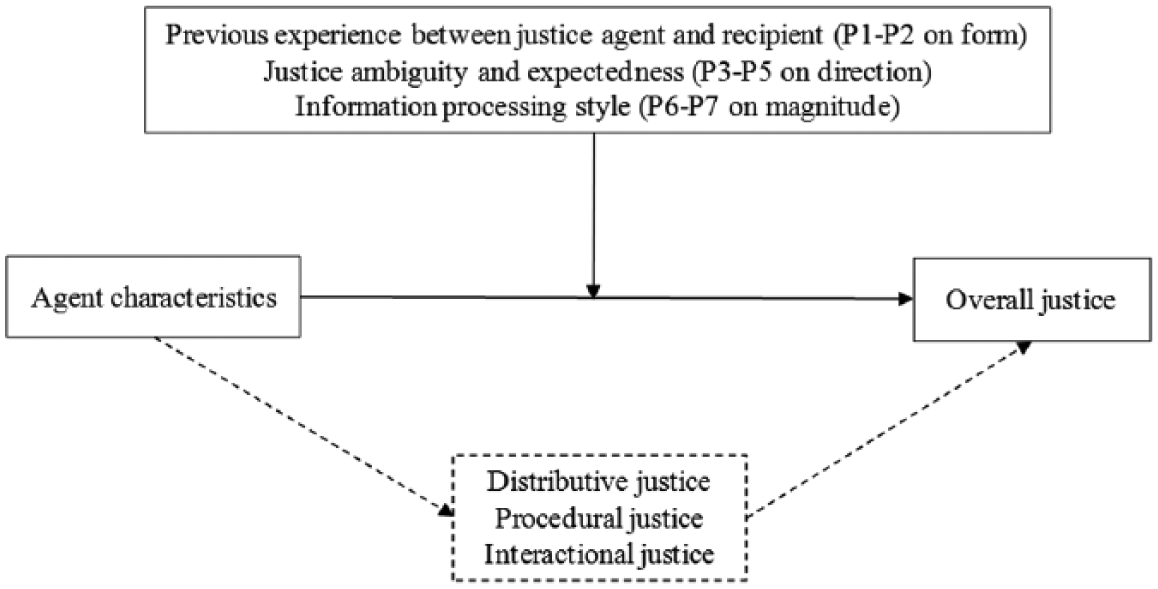
The agent bias model.
Cognitive biases frequently result from the application of heuristics: mental shortcuts that save time and mental energy by sidestepping thorough processing of relevant information (Kahneman & Tversky, 1972). Evaluations regarding the agent happen with ease and automaticity, and are therefore likely to be used as a heuristic in evaluating fairness of a specific event. Like the fundamental attribution error ( Jones & Nisbett, 1971), the agent bias results from a tendency in social situations to overly focus attention on the person and on characteristics of the person, rather than on circumstances and events external to the person. The agent bias, however, focuses on perceptions of event fairness, rather than on internal versus external attributions for events.
In the next section, we discuss which agent characteristics are expected to influence judgments of overall event justice. Then we propose how the form, direction, and magnitude of the bias will depend on (a) previous relevant experience between justice recipient and agent, (b) the ambiguity and expectedness to the recipient of the actions and outcomes of the justice agent, and (c) the information processing style used by the justice recipient when making fairness judgments.
Form of the Bias: Agent Characteristics
Individuals form justice judgments quickly to decide whether to cooperate with others, and thereby risk exploitation, in social situations (Lind, 2001). Hence, the first information available will have a greater influence on justice judgments, a widely documented primacy effect in fairness reasoning (Lind et al., 2001). Person perception is associated with spontaneous trait and evaluative inferences that are formed quickly and often unconsciously (Schneid, Carlston, & Skowronski, 2015). The agent bias stems precisely from the ease and automaticity of person perception, whereby agent characteristics that are available and accessible can serve as proxies for details regarding event justice. We focus below on three classes of characteristics that may be especially relevant to justice judgments: perceived warmth, competence, and entity justice. Warmth and competence account for 82% of the variance in first impressions about a person (Wojciszke, Bazinska, & Jaworski, 1998). Entity justice is relevant because it is a summative impression regarding justice-relevant events attributed to a given individual (Rupp & Paddock, 2010).
The trust primacy model (Holtz, 2013) discusses similar agent characteristics, but is focused on entity justice perceptions over time. According to the model, agent trustworthiness affects justice evaluations of events through trust, which, in turn, shape entity justice perceptions. Entity justice then affects subsequent evaluations of trustworthiness. For our purposes, we focus on a point in time when a given agent may be characterized by either entity justice or warmth and competence. We regard these different characteristics of the agent as complementary and possibly competing in affecting the evaluations of event justice. Agent warmth, competence, and entity justice are discussed below in greater detail.
Warmth
Individuals are perceived to be warm when they demonstrate friendliness, helpfulness, trustworthiness, and morality (Fiske et al., 2006). There are two ways in which the perceived warmth of a justice agent can influence justice judgments regarding specific events. First, characteristics relating to warmth—friendliness, helpfulness, trustworthiness, and morality—overlap with what may be expected of a fair agent. Therefore, the warmth of an individual is likely to be associated with their tendency to provide sensitive treatment, keep promises, apply procedures consistently, and uphold standards of ethicality. For example, Hollensbe, Khazanchi, and Masterson (2008) found that supervisor friendliness and support related positively to newcomer perceptions of supervisor fairness, and Colquitt and Rodell (2011) found a reciprocal relationship between employee perceptions of supervisor integrity and of supervisor fairness. Second, warmth judgments regarding an agent are used to gauge his or her intentions: warm individuals are regarded as more likely to take actions and pursue outcomes that benefit others (Fiske et al., 2006). The behavior expected from warm individuals directly addresses fundamental justice motives: to receive favorable outcomes, to be included in groups as a respected member, and to see universal ethical rules followed (Cropanzano, Rupp, Mohler, & Schminke, 2001).
Competence
Individuals are perceived as competent when they demonstrate intelligence, skill, and efficiency (Fiske et al., 2006). The competence of a justice agent can also influence interpretation of justice-related events because of positive expectations regarding the knowledge of competent individuals (Nicklin et al., 2011). Competence is considered highly diagnostic of an agent’s ability to pursue and to achieve desired outcomes (Fiske et al., 2006). In fairness situations, competence can be seen as helping an agent make decisions that follow principles of equity and are consistent, based on accurate information, and recognize all relevant inputs. In settings where intentions are organizationally defined, the competence of an agent may be an especially important signal to employees that they will be treated fairly. For instance, Mossholder, Bennett, Kemery, and Wesolowski (1998) found that the extent to which supervisor power derived from expertise was associated with higher employee perceptions of procedural justice.
Entity justice
Entity justice is particularly relevant to overall justice judgments regarding events because it is based on an agent’s past fairness (Cropanzano, Byrne, Bobocel, & Rupp, 2001). Justice judgments regarding outcomes, procedures, and interactions relating to specific events are aggregated over time to form entity justice perceptions regarding individuals (Cropanzano, Byrne, Bobocel, & Rupp, 2001; Rupp & Paddock, 2010). These entity justice judgments are similar to event justice judgments in purpose and structure. Individuals are motivated to evaluate entity justice for the same reasons that they evaluate event justice: to understand whether an authority can be trusted and should be cooperated with. Like event justice judgments, entity justice judgments regarding specific agents are arrived at by evaluating distributive, procedural, and interactional dimensions. This justice “track record” of the agent has been shown to affect important attitudes and behaviors at work (e.g., Choi & Chen, 2004), be subject to revisions in light of specific fairness-related events ( Jones & Skarlicki, 2013), and shape event justice perceptions (e.g., Davy, Kinicki, & Scheck, 1991).
Form of the Bias: The Role of Previous Relevant Experience With the Agent
Individuals quickly form impressions of other people’s warmth and competence to anticipate and interpret their future behavior (Fiske, 2004). Entity justice perceptions serve a similar purpose, but specifically focus on the justice-related actions and outcomes associated with a person, and thus are likely to have greater diagnostic value in predicting event fairness. Information is more likely to be assimilated when it is highly relevant to the judgment at hand (Mussweiler & Strack, 2001) and when there is longer exposure to that information (Higgins & Brendl, 1995). Because entity justice judgments are similar to event justice judgments in purpose and structure and because entity justice is relatively stable over time, when available, it is expected to override first impressions based on warmth and competence of the agent. However, in the absence of a justice-relevant track record, the agent bias is expected to manifest as a significant effect of warmth and competence-related characteristics of the agent.
Direction of the Bias: Positive Versus Negative Relationships Between Agent Characteristics and Overall Event Justice
In this section, we argue that the manifestation of the agent bias is not limited to positive relationships between the agent warmth, competence, or entity justice and overall event justice. In fact, both positive and negative relationships are possible, depending on the ambiguity and expectedness of the event.
We refer to events in which the actions of the agent and/or the resulting outcomes clearly uphold or clearly violate justice criteria as unambiguous (e.g., deciding to promote someone who works less hard). In contrast, events in which actions and outcomes are not clearly just or unjust are referred to as ambiguous. Event ambiguity can result from different justice criteria being in conflict across or within dimensions (e.g., an explanation of a promotion decision that is detailed but delayed), from a lack of information to assess justice criteria (e.g., a bonus is received but no information is available on bonuses received by others), or from the novelty of the situation (e.g., the value of a new award may be unclear).
Event ambiguity differs in two respects from justice clarity (Qin et al., 2015): “the extent to which people have direct and relevant information to judge a particular type of justice” (p. 750). First, event ambiguity applies to overall justice rather than to a specific justice dimension. Although event ambiguity may stem from the lack of clarity regarding specific justice dimensions, it can also result from conflicts between justice dimensions that are all high on clarity. Second, whereas Qin and colleagues (2015) argued that judgments of event justice will be made using information from types of justice with high versus low clarity, we propose that agent characteristics can substitute for event information in cases of high event ambiguity.
Agent characteristics are expected to relate positively to overall event justice in high ambiguity events. For example, if an event is highly ambiguous in terms of fairness, agent characteristics (warmth, competence, entity justice) are expected to positively influence perceptions of overall event justice. However, if an event is clear in terms of fairness, agent characteristics (warmth, competence, and entity justice) will be used as part of counterfactual comparisons regarding how the event would, could, and should have been different.
We discuss the role of event ambiguity rather than, as in the case of the trust primacy model, ambiguity regarding agent characteristics (Holtz, 2013). As a result, we do not merely discuss the relative strength of the positive relationship between agent characteristics and event justice, but also the possibility of negative relationships between agent characteristics and event justice. Nicklin and colleagues (2011) showed that agent characteristics can affect justice judgments by prompting more upward counterfactual reasoning. In our analysis, we consider the possibility of generating both more favorable (upward) and less favorable (downward) counterfactuals.
High event ambiguity
When a justice event is ambiguous, information regarding agent warmth, competence, and entity justice can be used to infer the intentions behind an ambiguous action or outcome. For example, a warm agent will be trusted to have favorable intentions, and a competent agent will be trusted to choose the best possible course of action (Cuddy, Glick, & Beninger, 2011). According to the trust primacy model, such trust will, in turn, lead to counterfactual thinking that preserves trust-related expectations (e.g., the action/outcome could not and should not have been any different) and limit the search for disconfirming information (Holtz, 2013; Holtz & Harold, 2008; Rousseau & Tijoriwala, 1999). In such cases, the agent bias will manifest as a positive effect of agent characteristics on event justice (see Figure 3).

The relationship between agent characteristics and overall event justice in high ambiguity events.
Research on person perception and interpersonal communication has clearly shown that relatively stable person perceptions are based on day to day experiences with a person, and then used to interpret and anticipate the person’s behavior. When first meeting, individuals exchange sociodemographic information, beliefs, and attitudes (Berger & Calabrese, 1975) to gauge the extent to which others are stereotypical, prototypical, or similar to self, to reduce uncertainty regarding the other’s expected behaviors (e.g., Berndt & Heller, 1986; Chattopadhyay, George, & Lawrence, 2004; Hogg, 2000). Van den Bos et al. (2005) showed that neutral messages coming from an authority figure that was unfair in the past were viewed more negatively than the same messages from an authority figure that was fair in the past. People also judge events as less fair when they hear from peers that the agent had been unfair versus fair in the past ( Jones & Skarlicki, 2005).
Hence, under high event ambiguity, agent warmth, competence, and entity justice will positively affect event justice perceptions.
Low event ambiguity
On the contrary, some events are clearly just or unjust. We propose that in such cases, the agent bias can manifest as either a positive or a negative effect of agent characteristics on overall event justice, depending on match or mismatch between agent characteristics and actions/outcomes of the event, termed event expectedness (see Figure 4).
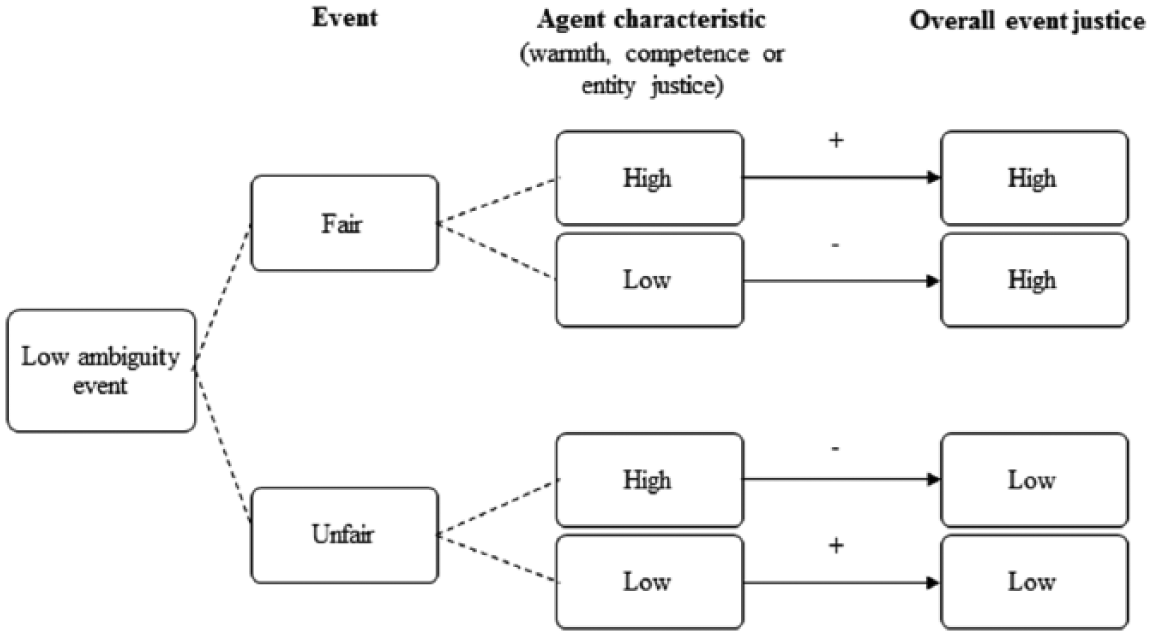
The relationship between agent characteristics and overall event justice in low ambiguity events.
Expected events
When just events result from behavior by agents whose characteristics foster trust, the events are expected, as fair treatment has been customarily associated with high trust (Colquitt et al., 2001; Stinglhamber, Cremer, & Mercken, 2006). When unjust events result from behavior by agents whose characteristics do not foster trust, the events are also expected. Jones and Skarlicki (2013) described how when a justice event is expected because of entity justice, it will be biased in the direction of the agent’s known characteristic: Because entity perceptions are derived from the accumulation of experiences over time, justice events will often reflect what individuals expect from the entity. As such, many justice events will “fly under the cognitive radar”, so to speak, and individuals will process them in a relatively automatic fashion—when this occurs, researchers suggest, justice judgments are particularly prone to the influence of cognitive biases (Tangirala & Alge, 2006). We propose that when justice events are expected, individuals tend to judge them with a confirmatory bias, that is, with a bias toward judging the event in the direction of their initial entity perception. (p. 5)
In both instances, the relationship between agent characteristics (warmth, competence, entity justice) and overall event justice will be positive.
Unexpected events
The effect of agent warmth, competence, and entity justice on overall event justice is expected to be different when events are unexpected. First, an agent who is expected to be fair (because of their warmth, competence, and/or entity justice) might nonetheless be associated with an action or outcome that is clearly unfair. Similarly, an agent from whom unfair treatment would be expected (because of their lack of warmth, competence, and/or entity justice) might be associated with an action or outcome that is clearly fair. We explain below, using entity justice as an example, the possibility of negative relationships between agent characteristics and overall event justice.
When an agent who is high in entity justice clearly violates fairness criteria, upward counterfactuals for the event can easily be generated. Given high entity justice of the agent, counterfactual scenarios are likely to compare favorably with experienced actions and outcome. Because comparisons with outcomes that would have been better produce negative feelings (Medvec, Madey, & Gilovich, 1995; Roese, 1997), event justice perceptions are likely to be negatively affected by entity justice perceptions. This negative effect of agent characteristics on event justice perceptions has been documented by Nicklin and colleagues (2011), who found that high versus low perceptions of agent competence related to lower event justice perceptions when the agent made a mistake.
A similar negative effect on overall event justice is expected for agents whose characteristics are associated with unfair treatment and who unexpectedly act in ways that uphold justice criteria. Such agents may be credited for upholding justice criteria more than others because downward counterfactuals are generated with greater ease, resulting in more positive event justice perceptions.
Magnitude of the Bias: The Role of Information Processing Style
We have proposed that the agent bias can operate through the effect on overall event justice of agent warmth, competence, or entity justice. We argue here that the magnitude of the agent bias on overall justice of events will depend on how information regarding the event is processed by the justice recipient.
Information processing of justice-relevant events can be more analytic, deliberate, and controlled versus more heuristic and automatic (Stanovich et al., 2014). FHT (Lind, 2001) distinguishes between two cognitive processes used in judging event justice: a more analytic and effortful evaluation of overall justice at the start of a relationship or during times of change (judgmental phase), and a more intuitive and heuristic process when a past evaluation is in place and relied upon (use phase). The judgmental phase is typically brief, yet we suggest individuals may still approach it in either a more heuristic or a more analytic way. In the use phase, individuals anchor on previously formed judgments of overall justice in evaluating and deciding how to respond to subsequent events, making the output of the judgmental phase of great relevance.
Because relying on first impressions or on entity justice can save time and cognitive effort, agent bias is expected to be stronger under heuristic processing of information. This is consistent with research showing that the source of communication (vs. the content) has greater influence on attitudes and reactions when information processing is more heuristic (Petty & Cacioppo, 1984). Similarly, studies of decision making by juries show that when jurors are motivated to think analytically versus heuristically, they are less biased by personal characteristics (i.e., physical attractiveness) of the defendant (Lieberman, 2002). Therefore, we propose that when justice recipients engage in analytic versus heuristic processing of events, they are more likely to focus on distributive, procedural, interactional, or other action or outcome-based justice criteria, thereby reducing agent bias.
Relevant experience with the justice agent may interact with the information processing style used by the justice recipient to affect the magnitude of the agent bias. Under heuristic processing, if there is previous fairness-related experience with the agent, employees will strongly anchor on entity justice, but if there is no previous fairness-related experience with the agent, employees will anchor strongly on agent warmth and/or competence. However, analytic processing is expected to more strongly reduce the effect on overall justice of warmth and competence than of agent entity justice (see Figure 5). Entity justice judgments are expected to continue to influence overall event justice, even when information is processed analytically, because they share similar purpose and structure with event justice judgments (Mussweiler & Strack, 2001). In contrast, perceptions regarding agent warmth and competence are not expected to as strongly influence overall event justice when analytic processing is used because they are more distal predictors of justice-related actions and outcomes.
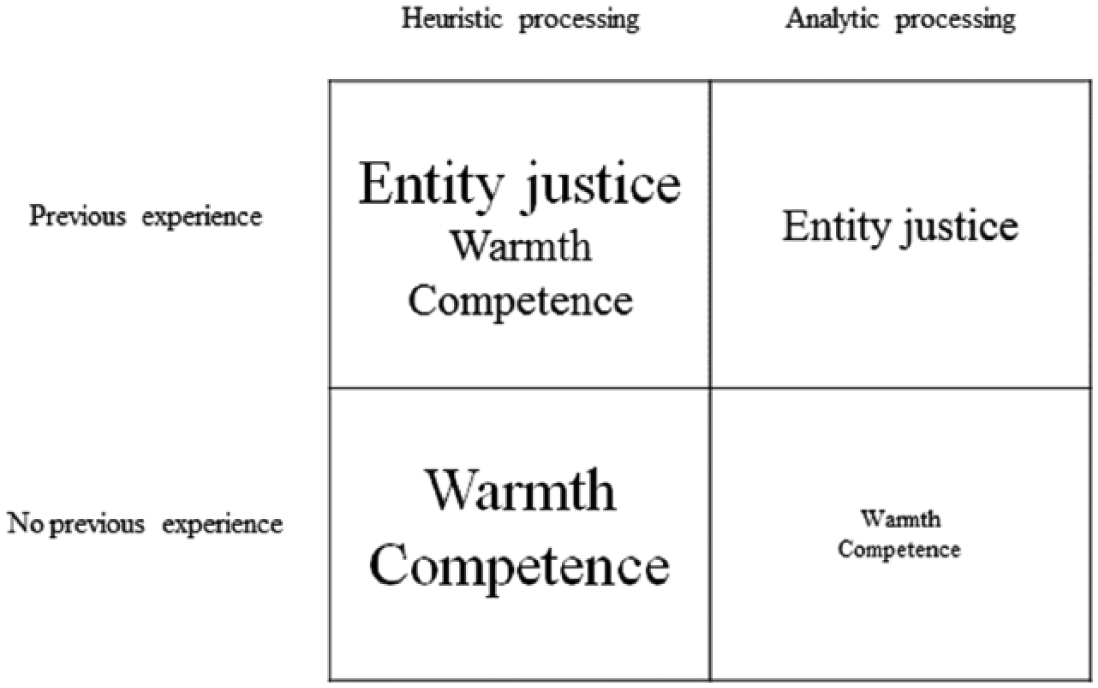
Form and magnitudea of agent bias as a function of relevant experience and information processing style.
Discussion
Summary
In this article, we explore how and when agent characteristics will influence perceptions of overall justice regarding events. We use the term agent bias to denote the effect of agent characteristics that is not mediated by justice perceptions regarding dimensional justice or other action and outcome-based criteria. In the absence of justice-relevant experience with the agent, recipients are expected to anchor their judgments of event justice on the warmth and/or competence of the agent. If the recipient has a previously formed entity justice perception regarding the agent, entity justice (and to a smaller extent, warmth and competence) is expected to influence evaluations of event justice.
We also propose effects on the agent bias of event ambiguity, defined as a lack of clarity regarding the fairness of an event. The more ambiguous the event, the more that justice judgments are likely to positively relate to characteristics of the agent. When events are low on ambiguity (i.e., clearly fair or unfair), the effect of agent characteristics on overall event justice will depend on the expectedness of the event given the agent’s characteristics. When agent characteristics lead to an event being expected, these characteristics will positively relate to overall event justice. On the contrary, when actions or outcomes are unexpected given the agent’s characteristics, these characteristics will negatively relate to overall event justice. In addition, the agent bias should decrease when individuals shift from heuristic to analytic processing and more strongly when there is no prior justice history between the agent and the recipient.
Contributions to the Literature
Our approach builds on and extends existing literatures on justice, trust, social cognition, and judgment and decision making in several ways.
Justice
Justice theories have tended to assume that the building blocks of justice judgments are evaluations regarding actions and outcomes, which in turn influence entity justice judgments (e.g., Rupp & Paddock, 2010). We propose that not only do event perceptions influence judgments regarding agents, but that judgments regarding agents also influence event perceptions. In proposing that characteristics of the justice agent can affect counterfactual thinking about justice, our work builds on fairness theory (Folger & Cropanzano, 2001). We propose that generation of counterfactuals is more likely when an event is low in ambiguity and unexpected given the agent’s characteristics. In such cases, individuals judge events based on how easily would, could, and should counterfactuals are generated for this particular agent. However, when an event is high in ambiguity, characteristics of the agent are more likely used to make sense of the justice event. By including in our model both high and low ambiguity events, we extend the work on contextual variables affecting justice judgments by Nicklin and colleagues (2011).
Our model also extends FHT (Lind, 2001) by proposing that the initial information that people anchor on in forming justice judgments can include characteristics of the agent, rather than just information regarding other justice dimensions. Furthermore, we provide rationale for why agent characteristics may help explain unexplained variance in event evaluations after controlling for distributive, procedural, and interactional justice (Ambrose & Schminke, 2009; Holtz & Harold, 2009).
Trust
As in the trust primacy model (Holtz, 2013, 2015), the agent bias relates agent characteristics to perceptions of event justice. However, our reasoning on agent bias draws on the social cognition literature in examining agent characteristics, such as warmth and competence, in addition to entity justice. This approach connects our work to a broader literature on person perception, while still leveraging important insights from research on justice and agent trustworthiness because the integrity, benevolence, and competence dimensions of trustworthiness overlap with the characteristics we chose to consider. Whereas the trust primacy model considered effects of uncertainty regarding the trustworthiness of an agent, we proposed that ambiguity at the level of the event can affect whether the agent characteristics have a positive or a negative effect on overall event justice. Future research combining insights from trust primacy and agent bias might explore the effects of all agent ambiguity and event ambiguity combinations: low-low, low-high, high-low, and high-high. In addition, future research may explore what comes into play when agent ambiguity is high. In particular, there may be individual differences in trust propensity (Mayer et al., 1995) that might predispose some employees more to the agent bias (Colquitt, Scott, Judge, & Shaw, 2006).
Social cognition
Work on agent bias can both contribute to and be further enriched by research in other domains that examine why the same behavior can be evaluated and reacted to differently, depending on agent characteristics. Research on the evaluation of gender stereotypic (hence, expected) and gender non-stereotypic (hence, unexpected) behavior in managerial settings supports our propositions regarding events that are expected versus unexpected, depending on agent characteristics. For example, women are penalized in terms of overall work performance ratings for not performing positive stereotypic behavior such as helping, whereas men are not (Heilman & Chen, 2005). On the contrary, men benefit in terms of work performance ratings from helping, but women do not. In the case of women, it may be easier for upward counterfactuals to be generated, whereas in the case of men, it may be easier for downward counterfactuals to be generated.
Judgment and decision making
The agent bias, as other biases (e.g., Ito et al., 2015), will be less strong when information processing is analytic versus heuristic. However, different manifestations of the agent bias may react differently to a shift from heuristic to analytic processing style. For instance, we propose that the effect of entity justice may decrease less than the effect of warmth or competence under analytic processing. This shows how important it is to have a model of the bias to better understand when and how it can diminish.
The work context of our model also offers novel testing grounds for some of the known decision-making biases. Dual-process research has established that people tend to rely more on heuristic processing under time pressure (Kahneman, 2011), cognitive overload or exhaustion (Bodenhausen, 1990), stress (Porcelli & Delgado, 2009), fear (Pfister & Böhm, 2008), and perceived uncertainty (Lind & Van den Bos, 2002). These variables are likely to also influence the processing of justice events in the workplace, especially given the prevalence of time pressure, cognitive overload, and stress in many work environments. Employee feelings of fear and uncertainty may also become more prominent as major change becomes a prevalent feature of contemporary organizational life (Burnes, 2005). Exploring what happens as a result of such forces to different manifestations of the agent bias merits further research attention, and may enrich our understanding of judgment and decision making more broadly.
Directions for Future Research
Level of analysis
Although our focus has been on the effect of agent characteristics on overall event justice, dimensional justice judgments may also be biased by agent characteristics. Future research should examine for which justice dimension(s) this is most likely to be the case. Agent characteristics may be a particularly important influence on justice dimensions associated with higher versus lower agent discretion, as in the case of interpersonal justice (Scott, Colquitt, & Paddock, 2009). To the extent that dimensional justice of an event is perceptual, it may be affected by the agent bias just as overall event justice perceptions. For example, for timeliness as a criterion of informational justice (Colquitt, 2001), subjective judgments may conflict with objective timeliness and still matter more to attitudinal and behavioral reactions (Conlon & Murray, 1996; Groth & Gilliland, 2001). Future research should investigate how the different pathways for the effect on overall event justice of agent characteristics—via direct effects, via dimensional justice, or by moderating the relationship between dimensional and overall event justice—compare in terms of form and magnitude (Marques et al., 2017).
Temporal dynamics
In our theorizing on agent bias, we do not examine how actions and outcomes that uphold standards of justice feed back into perceptions about the agent. How entity justice judgments or dimensions of trustworthiness evolve over time is at the center of other theoretical (e.g., Holtz, 2013) and empirical work (e.g., Lance Frazier, Johnson, Gavin, Gooty, & Bradley Snow, 2010). With respect to entity justice, we agree with Jones and Skarlicki (2013) that individuals who experience fair events from agents believed to be unfair are likely to remain suspicious and refrain from updating beliefs about the agent based on only one (unexpected) fair event. We suggest, however, that justice judgments concerning unexpectedly unfair events will be amplified because of counterfactual thinking, and so will judgments concerning events that are unexpectedly fair.
Work on the “persistent injustice effect” (Davidson & Friedman, 1998) suggests that actions aimed at repairing perceptions of unfair treatment may not work for individuals who have experienced unfair treatment for too long. This persistent injustice effect, due to entrenched mistrust and strong expectations for injustice, may present an important boundary condition for the agent bias. For example, if an agent’s dismal justice track record has led to a persistent injustice effect, the agent bias will always be strong and in a direction consistent with the agent characteristics, regardless of the ease with which downward counterfactuals can be generated. Future research should examine the effect on the agent bias of a person’s readiness to revise his or her assessment of agent characteristics.
Other agent characteristics
In this work, we developed research propositions about the effects of warmth and competence on overall event justice judgments. Recent research in social cognition suggests that a third dimension, morality, is distinct from other warmth characteristics, can be more important for first impressions, and combines with warmth and competence to substantially explain variance in first impressions about people (Goodwin, 2015). Such a three-dimensional framework would align well with the dimensions of trustworthiness (Mayer et al., 1995). Our propositions currently formulated for warmth should also be valid for morality, even if it is understood as an agent characteristic that is separate from other warmth-related components of first impressions.
In fact, agent morality has received direct attention in person-centered approaches to moral judgment, which are also relevant to the agent bias. These approaches focus on personal qualities rather than on acts when judging what is right (Uhlmann, Pizarro, & Diermeier, 2015). In contrast, most approaches to moral psychology have focused on acts, either through consequentialist theories that judge acts to be right or wrong based on their consequences (e.g., Smart & Williams, 1973), or deontological theories that judge acts by universal rules of ethical behavior (e.g., Kant, 1796/2002). As with agent bias, accounting for agent morality helps explain why events may be judged as unethical even if specific actions and outcomes are not.
Conclusion
This article brings together insights from several literatures to propose how justice perceptions about events can be affected by characteristics of the justice agent, with a focus on warmth, competence, and entity justice. We propose a model for when and how an agent bias is more likely to influence justice judgments and offer testable propositions. Insights regarding the importance of selecting appropriate agents should interest managers and organizations tasked with making and communicating tough decisions, which is when justice perceptions become most salient and important. We hope that scholars interested in justice, trust, social cognition, and judgment and decision making will find our model interesting and build upon it.
Footnotes
Declaration of Conflicting Interests
The author(s) declared no potential conflicts of interest with respect to the research, authorship, and/or publication of this article.
Funding
The author(s) disclosed receipt of the following financial support for the research, authorship, and/or publication of this article: This work was supported by Fundação para a Ciência e Tecnologia - Portuguese Science and Technology Foundation [PTDC/EGE-GES/115246/2009].
Associate Editor: Gilson, Lucy