



Abstract
Workplace mavericks are seen as highly disruptive, engaging in unconventional behavior and showing apparent disregard for organizational norms, policies, and procedures. Despite this, some organizational leaders successfully leverage maverick behaviors to progress and achieve higher order organizational agendas. This paper challenges the former view by investigating the positive value maverickism provides organizations. Guided by the conceptualization of mavericks’ non-conformity as a form of positive deviance, two studies were conducted. Study 1 analyzed secondary data sources within the scientific research field to determine organizational performance requirements and expectations. Study 2 interviewed 28 mavericks and 27 leaders of mavericks in the same field. Data collection and analysis was guided by Bourdieu’s (1990) theoretical and methodological constructs—field, capital, and habitus. Results highlight that, while mavericks challenge and often ignore many organizational norms, their disruption is driven by the desire to achieve higher order goals benefitting their organizations and communities. Operating within boundaries set by these higher order values, mavericks not only embody traditional cultural capitals expected in their field but also offer valuable capitals traditionally possessed by those more senior in the field. This powerful combination of capitals produces additional symbolic capital which allows them to influence organizational decision-making despite not conforming to lower order organizational norms. At an applied level, valuable capitals associated with maverickism can be leveraged by leaders to support transformational change. To do this, organizational leaders need to recognize mavericks’ strengths through allowing them, as positive deviants, to challenge the status quo and to find alternative pathways to achieve organizational goals.
For many organizations and their leaders, the term maverick conjures up an unwelcome image of a rule breaking rebel who is driven to challenge the status quo (Charlton, 2008; Ray, Ugbah, Brammer & DeWine, 1997), and who refuses to accept organizational norms (Clay & Phillips, 2015; Gardiner & Jackson, 2012, 2015). In their defense, however, although mavericks appear to their leaders and supervisors to be rebels disrupting organizational systems, there is evidence that mavericks do not thrive on disruption merely for the sake of it (Blohowiak, 1992; Cheverton, 2000; Germain, 2010; Kelly & Medina, 2014). Rather, as Clouse (1997) proposes, mavericks can be passionate and loyal employees committed to achieving long term and strategic outcomes which are often aligned to the greater good or overarching purpose of the organization. In other words, mavericks may in fact be “rebels with a cause,” rebelling against ineffective, outdated, or unnecessary systems and structures that get in the way of achieving beneficial outcomes for their organizations and society, more broadly (Kelly & Medina, 2014). As a number of scholars point out (e.g., Cheverton, 2000; Clouse, 1997), their adoption of big picture thinking supports the development of strategic insights to address areas of future concern that may not yet be visible, especially to more senior leaders and their leadership team. Unfortunately, many organizations are yet to recognize the potential mavericks have to offer, especially in increasingly turbulent times.
A novel conceptual contribution of this paper is to highlight the value of maverickism and its non-conformity as a form of positive deviance which can be leveraged to improve strategic organizational change (Dahling & Gutworth, 2017; Vadera, Pratt & Mishra, 2013). This focus moves the understanding of maverickism and its problematization away from the narrow view concentrating on the negative impacts. In doing so, we are challenging existing assumptions and joining with a small number of others to try to disrupt the continuation of an institutionalized line of negative reasoning about maverickism. This paper does this repositioning especially by detailing the valuable capitals (Bourdieu, 1977, 1990) possessed by mavericks which are associated with this form of positive deviance. We posit that due to the unique combination of capitals possessed by mavericks, including their out-of-the-box thinking process (Clouse, 1997; Taylor & LaBarre, 2006), willingness to challenge the status quo (Charlton, 2008; Ray et al., 1997), ability to thrive in ambiguity (Gardiner & Jackson, 2012), and a highly developed skill in navigating organizational politics, organizational leaders would do well to learn to embrace the valuable capitals and associated contributions offered by maverick employees (Charlton, 2008; Jordan, 2019; Jones et al., 2016; Taylor & LaBarre, 2006), despite the challenges. The research builds upon this emerging literature that begins to challenge existing assumptions about this phenomenon, and to reframe maverickism as a set of behaviors more related to positive perspectives about organizational deviance, challenging the dominantly held view that maverickism is always a negative phenomenon that needs to be removed from high functioning organizations.
This paper will firstly discuss the fundamental nature and key drivers of mavericks through conceptually connecting the study of maverickism to the field of organizational deviance, particularly positive deviance. Bourdieu’s (1977, 1990) framework of field, habitus, capital, and his notion of the exchangeability of capital, is then introduced to guide an exploration of what features of maverick positive deviance might be valued by organizational elites who operate within the field of power (i.e., boards, CEO’s, and executives). This novel application of a Bourdieusian lens allows us to reconceptualize maverickism as an activity that involves the sharing and exchange of capitals that support the leaders of change around achieving the strategic and transformational agenda of organizations. This deeper understanding of the capitals of mavericks provides significant insights into how organizational leaders might work more effectively with their non-conforming mavericks, while limiting the perceived risks often associated with their disruptive behaviors (Charlton, 2008; Jordan, 2019; Jordan, Fitzsimmons & Callan, 2021).
Theoretical Background
Deviance in Organizations
The literature specifically focusing on deviance in the workplace has only become prominent within the last 20 years (see Galperin, 2003; Mertens et al., 2016; Pascale & Sternin, 2005; Spreitzer & Sonenshein, 2004; Sternin, 2002). Given that leaders in this field of research such as Robinson and Bennett (1995) define workplace deviance as “voluntary behavior that violates significant organizational norms and in so doing threatens the well-being of an organization, its members, or both” (Robinson & Bennett, 1995: 556), it is not surprising that much of this research is primarily focused on the negative or destructive forms of deviant workplace behavior (see Bennett & Robinson, 2000; Henle, 2005; Robinson & Bennett, 1995; Spector & Fox, 2002; 2010; Yıldız et al., 2015). Understandably, therefore, undesirable behavioral outcomes such as stealing and embezzlement (Warren, 2003), violence and fraud (Robinson & Bennett, 1995), antisocial behavior (Giacalone & Greenberg, 1996), and organizational misbehavior (Vardi & Wiener, 1996) have taken prominence in this area of research.
However, further exploration of deviating behaviors in the workplace suggests that not all forms of deviance are undesirable or perceived negatively, and in fact this reframing is defining how behaviors that deviate from organizational norms can contribute in highly beneficial ways (see Darling & Gutworth, 2017; Mainemelis, 2010; Vadera et al., 2013).
Conceptualizing Maverickism as a Form of Positive Deviance
Rethinking the contributions of disruptive maverick behavior to organizational outcomes, Gardiner and Jackson (2012, 2015) define the dysfunctional forms of organizational deviance as “workplace deviance,” and the positive and functional forms as “maverickism”. Additionally, the term “maverickism” is associated with intentions of “making a difference” and “contributing to a greater good” (Cheverton, 2000), aligning well with those organizational deviance literatures that emphasize positive effect.
Positive deviance scholars such as Vadera et al. (2013, p. 1225) propose three key criteria to determine if a behavioral phenomenon fits under the umbrella of positive deviance. The deviant behavior must (a) provide benefit to the dominant group; (b) deviate from the dominant group norms; and (c) conform to a hyper norm, meaning do no harm to individuals, the organization, others, or society. In other words, although everyday norms may be violated, positive deviants conform to hyper-norms which are higher order globally held beliefs that benefit society. Examples include the promotion of practices that bring genuinely needed products and services to the community faster and more efficiently (Donaldson & Dunfee, 1999). This adherence to hyper-norms overall ensures that actions that deviate from organizational norms are not harmful to others (Warren, 2003). By conforming to highly valued hyper-norms, positive deviants justify their non-conforming, and often disruptive behaviors, as valid and permissible actions that supersede organizational norms (Vadera et al., 2013). Additionally, guided by the organizational value of these hyper-norms, positively deviant actions also earn the respect of the conforming leaders of the group that value these same hyper-norms, and particularly organizational elites.
Given the three criteria outlined, we position maverickism as a form of positive deviance, irrespective of any negative perceptions of the label. Taking this positive deviance framing we aim to explore the benefits that their non-conformity and alternative actions may contribute to organizational effectiveness. As described earlier, the non-conformity associated with maverick behavior fits well within the definition by Vadera et al. (2013), and others (see Galperin, 2003; Spreitzer & Sonenshein, 2003), of voluntary behavior that does not align with significant group norms. The maverick’s behaviors challenge the status quo of an organization (Baddeley, 2018; Charlton, 2008), offering unorthodox approaches to achieve their goals (Clouse, 1997; Khoury, 2013). While they acknowledge that their ideas might violate or contravene organizational norms (Ray et al., 1997; Taylor & LaBarre, 2006), they justify their often disruptive behaviors as necessary given the contextual conditions as they see them (Blohowiak, 1992; Cheverton, 2000; Gardiner & Jackson, 2012). As Galperin (2003) asserts, this deviant action aligns with hyper-norms where the intention is to improve the well-being of an organization, its members, or society.
Bourdieu’s Field of Power, Capital, and Capital Exchange
Understanding Bourdieu’s constructs through the game analogy.
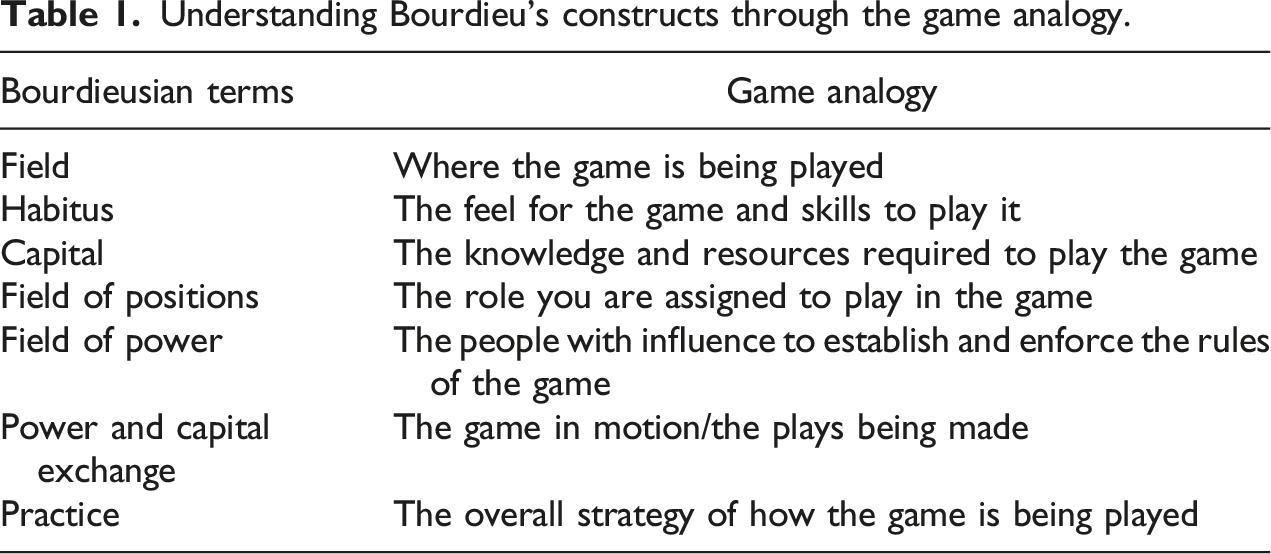
Field—The Game Space
Different types of capital at play in the scientific and research field.
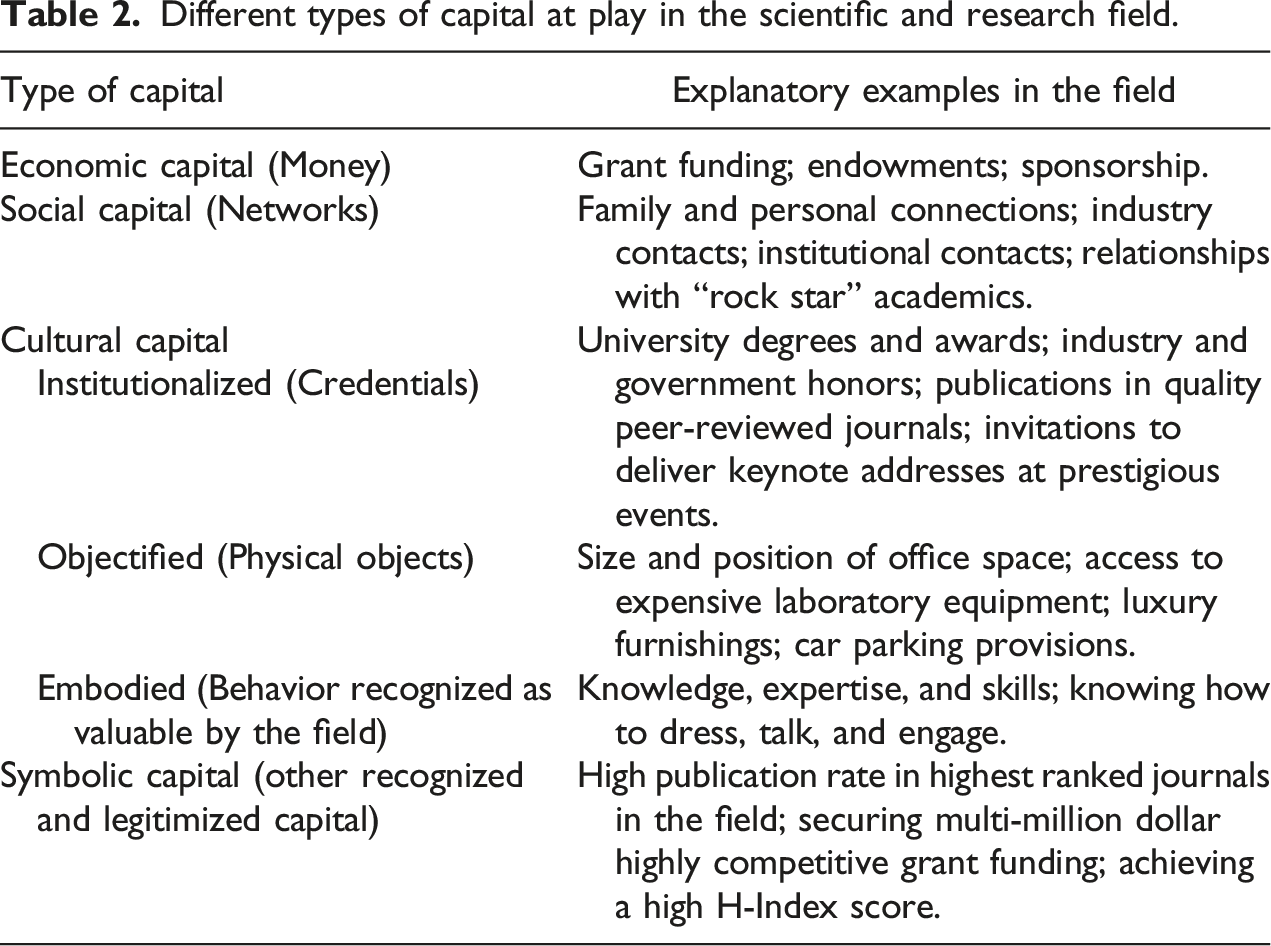
Capitals—The Skills, Knowledge, and Resources to Play the Game
Of the various forms of capital described by Bourdieu (1986), economic capital (or monetary forms of capital) is relatively self-explanatory. However, Bourdieu’s non-material capitals are more complex. Broadly speaking, Bourdieu’s construct of cultural capital aligns closely to what is often called human capital, which encompasses knowledge, skills, self-concepts, and identity (Day & Dragoni, 2015; DeRue & Ashford, 2010). Cultural capital also includes the idea of a distinctive understanding of capital linked to how a person’s class influences their knowledge and decision-making practices in relation to a field (Bourdieu, 1990; Burke, 2016). It is the possession of cultural capital relevant to a field that provides a sense of “fitting in” and the understanding of “what’s going on,” therefore providing “knowledge necessary to play the game of culture” (McCormick, 2006, p. 258). According to Bourdieu (1986), cultural capital exists primarily in three forms: embodied (e.g., valued behaviors and skills), objectified (e.g., possession of physical objects such as highly sought after laboratory space), and institutional (e.g., quality credentials; see also Table 2).
Social capital can be understood as the network of social contacts which can be used to influence an individual’s position in the field and their ability to understand and to use these contacts, particularly to achieve career advancement goals (Burke, 2016; Carter & Spence, 2014). Therefore, having the awareness and ability to build connections and relationships with influential people, as well as gaining membership into the “right” social groups, plays a key role in acquiring power and influence in the field.
As shown at “A” in Figure 1, where an individual possesses greater quantities of multiple capitals relative to others in the field, and these capitals are considered to be valuable by those in the field of power, the possessor is often granted an additional higher form of capital which Bourdieu refers to as symbolic capital. Bourdieu (1985, p. 724) notes that “symbolic capital, commonly called prestige, reputation, renown etc., … is the form in which the different forms of capital are perceived and recognized as legitimate.” For instance, in the scientific field, a scientist who has made significant discoveries, or has invented a well-known process, would be said to have high levels of cultural capital. Should that scientist also have forged strong relationships spanning academia, industry, and perhaps even mainstream media/government, they might be regarded as having high levels of social capital. In Bourdieusian terms, the scientist possesses symbolic capital as a resonance effect of these two forms of capital interacting. In this way, the social and cultural capital possessed by the scientist is recognized and legitimized by those dominant in the field (the “field of power” or elites) as being worthy to move ahead in the field and perhaps to even join those in the field of power. Traditional process model of capital exchange, motivation, and influence.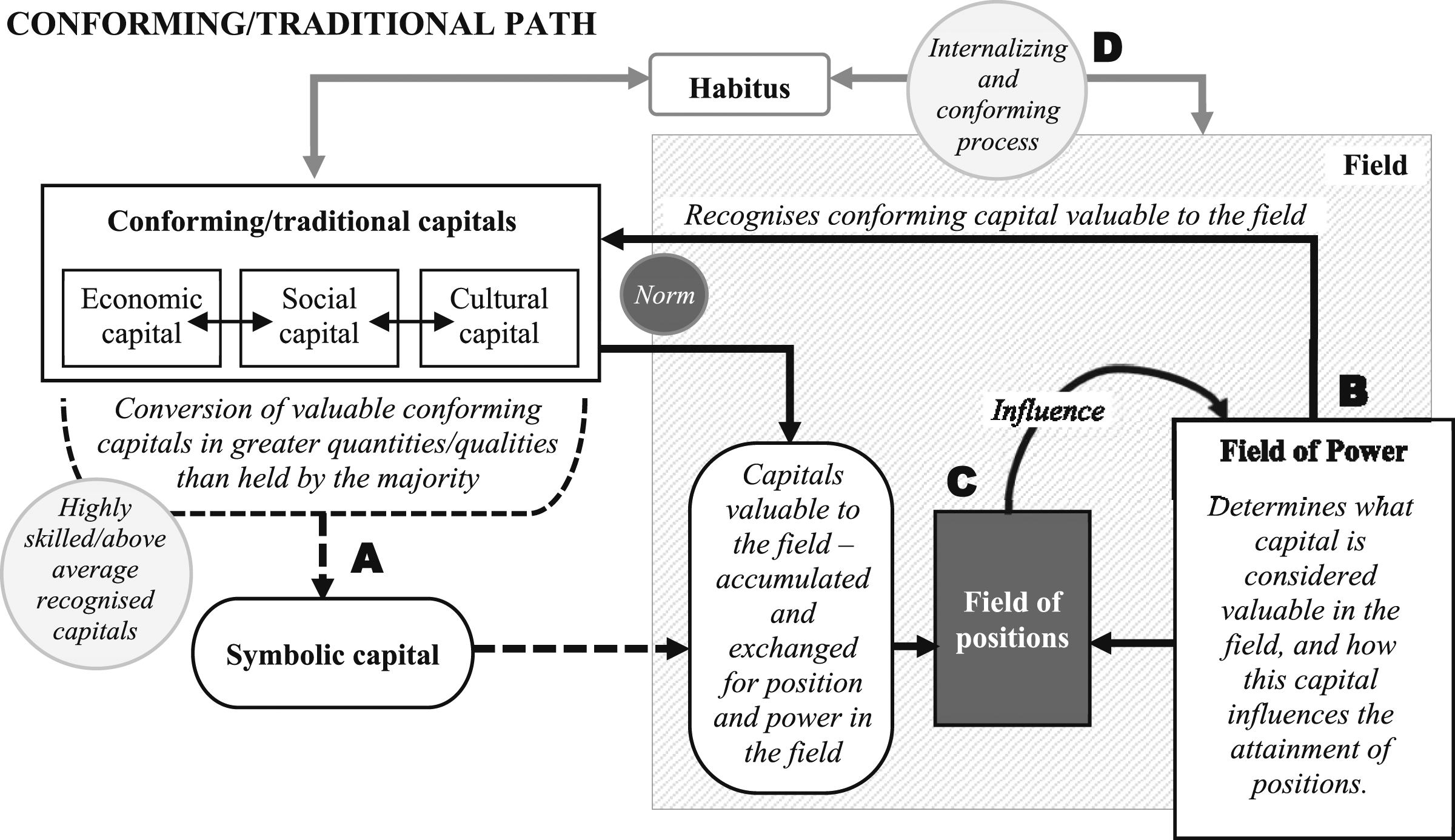
Field of Power and Positions in the Field—Establishing the Rules of Play
It is the field of power (see “B”—Figure 1) which essentially establishes the “rules of play.” They determine which capitals have greater or lesser value in the field, which in turn determines who shall progress within the field and who will not. Bourdieu (1977, 1990) argues that within any field, dominant players are invested in maintaining the status quo of the field (i.e., by playing and enforcing the rules of the game) to secure their positions (social and/or role), and thus their power in the field (see “C”—Figure 1). Positions at higher levels of the hierarchy are characterized by combinations of capital more highly valued by the field of power.
Habitus—Feel for the Game
How individuals interact in the field and engage with these “rules of play” (and the world in general) is largely determined by their habitus (a broad set of dispositions and behaviors) which Bourdieu (1977) conceives as an individual’s embodied history, or the socially produced self. Social actors leverage their embodied history (i.e., habitus) through a “feel for the game” developed across a lifetime, to gain resources, position and prestige within a given field. This includes the class habitus inherited through childhood, as well as the degree to which they have come to embody the structure of the field through the process of internalization (Bourdieu, 1990, p. 66). How well an individual can do this depends on how skilled they are at “playing the game” (i.e., internalizing and conforming to the rules of play—see “D”—Figure 1).
Power and Capital Exchange—The Game in Motion
Also relevant to the current study of maverickism is that Bourdieu considered conformity to be a valuable form of cultural capital in organizations, in so far as an individual embodies deference to organizational norms (Bourdieu, 1986; Webb, Schirato & Danaher, 2002). Bourdieu (1990, pp. 108–109) notes “it must not be forgotten that there is an interest in ‘toeing the line’…there is nothing that groups demand more insistently and reward more generously than this conspicuous reverence for what they claim to revere.” The processes of conforming for employees is a valuable form of capital that accrues to the employee over time and therefore reinforces the drive to be seen as fitting in within the organizational culture and its espoused norms. However, this does not explain how mavericks as positive deviants are able not only to survive but also often thrive within the field that they do not always conform to. Due to their disruptive nature, it is evident that in some respects they lack the capital related to conformity. However, if they are to remain and progress in the field, and/or influence the field of power, it stands to reason that, despite the potential disruption that they can cause, they must be seen to be bringing to the table some other forms of capital of equal or greater value in exchange.
It is the accumulation and exchange of various forms of capital that Bourdieu (1986) believes essential for an individual to maintain and promote their relative position and power in the social and organizational hierarchies of a particular field (Swartz, 1997). Prior research does offer some insights into the forms of capital offered by mavericks in place of conforming to organizational norms. For example, Gardiner and Jackson’s (2012) view of mavericks being “functional” highlights that they possess skill in effectively navigating the political landscape
More specifically, it is through their political skill (embodied cultural capital) developed from an innate “feel for the game” (habitus), combined with their drive to conform to hyper-norms (embodied cultural capital), that provide mavericks with a foundation to skillfully engage in the field in accepted, but often non-conforming and disruptive patterns of behavior. As Bourdieu (1984, p. 101) explains, this is the practice of maverickism, where “practice” is defined as the interplay between habitus and capital within a particular field (see Table 1).
It is this political skill as a form of capital (Ocasio, Pozner & Milner, 2020), along with other maverick characteristics, which combined may substitute for the more traditional forms of valuable capital. Significantly, these forms of capital are usually only present in individuals who have spent much longer in the field and are situated much higher in the field of positions or the field of power (see Ammeter et al., 2002; Cobb, 1986; Hartley, 2017). This capital, which is often ignored or viewed as “deviant” in more junior positions, can be legitimized and leveraged by leaders to enhance organizational outcomes (Charlton, 2008; Clouse, 1997; Gardiner & Jackson, 2012). As such, combined maverick capitals might be exchanged by mavericks in place of the conformity often expected of more junior people in the field. This enables the maverick to navigate what would ordinarily be blockages in rising through the field of positions.
Research Aims
We propose that the non-conformity associated with maverick behavior fits well within the definition of positive deviance. As Gardiner and Jackson (2012) argue, while mavericks’ behaviors deviate from the norms expected from people in their relative position, their actions attempt to make a positive contribution through adherence to hyper-norms important to their organization, community, or society more broadly, and usually possessed by those far higher in the field of positions (Jordan, 2019; Jordan et al., 2021). This research investigates how the non-conformity of mavericks, apparently driven by higher order norms, offers leaders and their senior executive teams valuable sets of capitals that promote the reputational standing of their organizations, its strategic thinking, and for continued organizational transformation.
In addition, a unique contribution of this research is the development of an understanding into how mavericks accumulate the necessary cultural and social capitals to elevate their position and status within the field, despite not fully conforming to organizational norms. A Bourdieusian (1977, 1990) analysis allows the identification of cultural and social capitals, and how mavericks might still be perceived as fulfilling the dominant view of what is considered valuable, to progress organizational members, despite mavericks lacking in cultural capitals related to conformity.
Finally, we argue that mavericks operating as positive deviants offer numerous valued capitals, both traditional and non-traditional, that provide significant benefit to senior leaders and their leadership teams. In turn, recognition of these valued capitals by leaders ensures that the role, reputation, and influence of mavericks within an organization is maintained, their ideas are increasingly recognized, and their access to resources is continued (Lee & Shaw, 2016; Swartz, 1997).
Research Context
The research was conducted with organizations within the Australian scientific and research sector. This sector is undergoing significant pressures for continued transformation, with recognition that “the pace of change, supercharged by new and emerging technologies, has never been so great, nor so disruptive” (Commonwealth of Australia, 2015, pg. 2). Leaders in these publicly funded research organizations are being required to be more adept at responding creatively and innovatively to shifts within their rapidly changing environments (e.g., Deloitte Access Economics, 2015; Universities Australia, 2015) if this sector is to remain relevant and globally competitive. This has never been more imperative than post the COVID-19 outbreak, which has severely impacted global economies, and having a rolling effect on the income sources of many of the organizations participating in this research. For these organizations to survive the ongoing effects of the pandemic, they must develop a greater degree of ambidexterity, adaptability, and flexibility in their strategic operations (Yezdani, 2021).
In addressing the research questions, two inter-related qualitative studies were undertaken. Study 1 analyzed 189 secondary data sources directly related to identifying the nature of the field and its associated norms. Study 2 involved 55 interviews with both organizational mavericks, and with leaders of mavericks. Each study will aim to address specific research questions which will be outlined in the relevant sections below.
Study 1—Methods, Analysis, and Findings
Purpose of Study 1
Study 1 identified the normalized qualities of the field, with particular focus on identifying the field of power and the capitals deemed valuable and therefore rewarded through progression in the scientific and research field that employed those interviewed in Study 2. Study 1 was specifically aimed to address the following research question: RQ1: What capitals are traditionally valued in the field?
Data Gathering and Analysis
Specifically, 189 secondary data sources were reviewed from the 16 organizations that employed those interviewed in Study 2. These data sources included organizational documents such as university policies, procedural directives, and other documents outlining their structure, vision, strategy, cultures, and performance objectives (n = 60); government documents such as policies, commissioned reports, white papers, and legislation (n = 51); professional association and peak body documents including media releases, reports and submissions (n = 20), journal articles (n = 20); research organization and special interest group reports, analysis, and media releases (n = 18); academic opinion pieces from sources such as “The Conversation” (n = 14); international reports from specialized international government forums (n = 4); and specialist books by authors in the field (n = 2).
Guided by Lincoln and Guba (1985), and consistent with other qualitative studies involving an inductive coding approach (e.g., Daouk-Öyry et al., 2020), the analysis of data in Study 1 aimed to identify the explicit and commonly understood norms and expectations within the field in which the mavericks were operating. This analysis followed an iterative four step process: (1) alignment of data to the Bourdieusian framework to determine field conditions; (2) initial open coding (Locke, 2001); (3) axial coding to identify emerging themes and patterns (Floersch et al., 2010); and (4) constant comparison of new data against existing data to validate or correct identified themes (Braun & Clarke, 2006; Clarke & Braun, 2017; Floersch et al., 2010). This comparison further informed the research and theory development (Corbin & Strauss, 2015; Glaser & Strauss, 1967). This inductive analytical approach was selected as according to Clarke and Braun (2017, p. 298) it is regarded as “particularly useful when exploring new terrain.”
Findings
The Four Explicit Rules of Play
Explicit performance expectations—traditional approach.
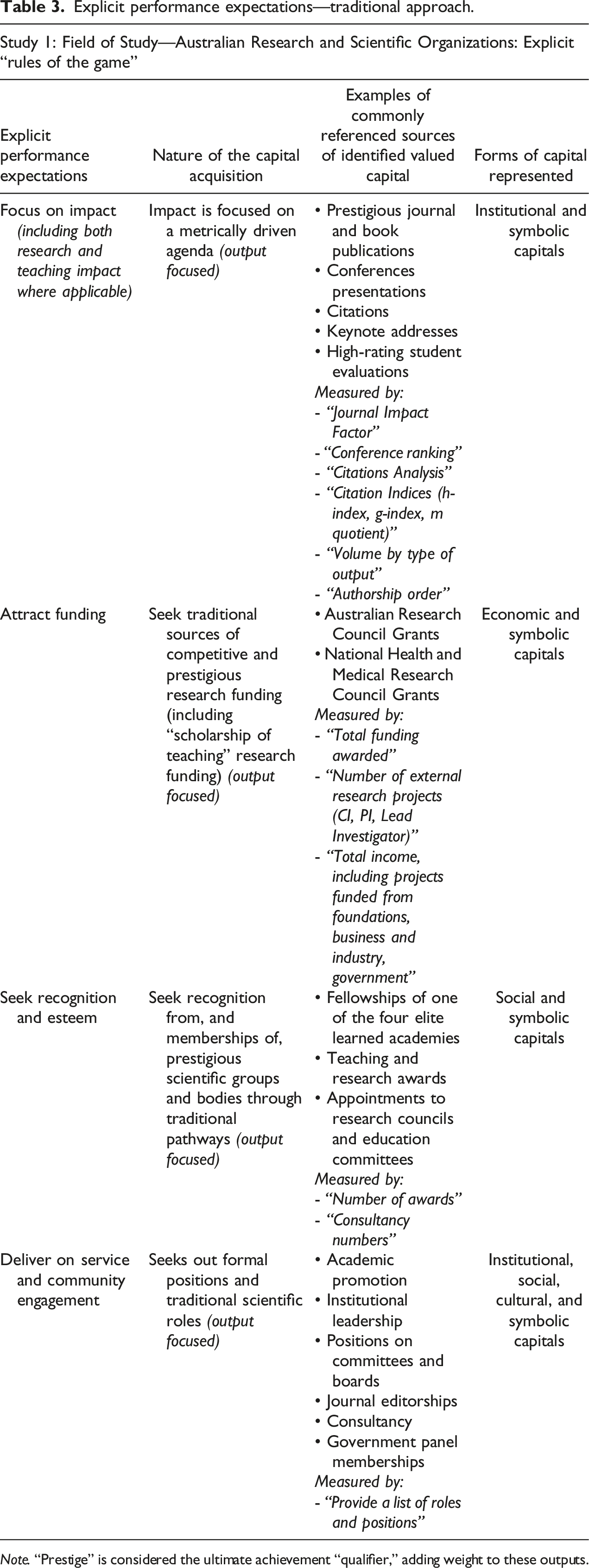
Note. “Prestige” is considered the ultimate achievement “qualifier,” adding weight to these outputs.
More specifically, the analysis highlighted that employees are expected to produce measurable outputs against the following four performance expectations, namely, that they (1) demonstrate impact through producing high quality and often international publications; (2) demonstrate success in winning competitive research funding from the traditionally accepted bodies; (3) demonstrate recognition and esteem through invitations to present at prestigious national and international conferences; and (4) demonstrate commitment to serving the workplace and community; alongside other minor forms of traditional scientific outputs and products that can be easily converted into key metrics.
These types of capitals reported in the form of metrics can also be used to compare and contrast between individuals and entities, which allows for, and potentially encourages competitive behaviors. Such metrics include numbers of research publications, number of conference presentations, number of grants awarded, and total research income obtained using language such as “Total publications by Journal Impact Factor,” “H-Index,” “Total research income by category code.”
The volume and quality attributed to each of the various forms of these outputs directly determines the level of associated prestige. It is this recognized prestige that determines the overall weighted significance of the outputs achieved by any individual employee. For example, to gain an influential position not only does the individual need to publish in journals, but they must also be in the “high ranking” journals; presenting at conferences is only considered valuable capital if they are “prestigious” conferences; and grants from “highly competitive” sources are more “valuable” than other sources, irrespective of the dollar amount. These metrics are used by research institutions to demonstrate their value and impact to governments, and to ensure continued political support and research funding.
To be seen to be as successful in a traditional sense within the field, players must adhere to these four key explicit rules of play (i.e., achieve outputs related to impact, funding, recognition and esteem, and service—with “prestige” being the optimizing qualifier in determining the value of these achievements). However, there are individuals in organizations, such as mavericks, that fulfill performance expectations in alternative ways that are not explicitly articulated by organizations. To understand this, Study 2 was undertaken to identify if there are alternative ways to acquire forms of capital considered valuable by the field of power, and if so, how do these maverick capitals benefit organizations and their leadership.
Study 2—Methods, Analysis, and Findings
Purpose of Study 2
Study 1 provided the foundation for this research by identifying the explicit “rules of the game” (explicit performance expectations). Following on from this, Study 2 now builds on this to explore how successful non-conformists in organizations manage to “play the game” without necessarily following the rules. Specifically, this study seeks to answer the following questions: RQ2: How do mavericks interpret/fit with traditional organizational expectations? RQ3: What capitals do mavericks possess that organizations choose to value despite not being traditionally valued capitals? RQ4: What are the motivations that empower mavericks to challenge the status quo despite the disruption it causes? RQ5: How do leaders best leverage the valued capitals of mavericks to achieve maximum positive benefits and corporate transformation?
Data Gathering and Analysis
Interview Sampling
In this study, respondents were regarded as “hard to identify” as the term maverick is not a recognized label, title, or demographic criteria and thus not easily visible to those outside an organization. To address this challenge, a three-step interview sampling process was undertaken in Study 2 to ensure alignment to the research focus. This process included a snowballing method of initial identification, a self-identification process, and a vetting process. It is important to note that as the term maverick is not a commonly understood or well-defined term, it was not used in this sampling and recruitment process. Rather, recruitment information stated that this research sought people who either identified with, or worked with people that they perceived as, “boundary pushers, who do not see rules as barriers to achieving success and are seen (mostly) positively in the organization, despite not conforming to organizational norms.”
Study 2 adopts the position that mavericks can operate as positive deviants and thus through the Bourdieusian lens seeks to explore how these individuals create positive value for organizations by examining their capitals (in a specific context with specific norms), and how those capitals are perceived, fostered, and leveraged by their leaders. With this positioning, the research targets, (a) mavericks and (b) ones that create positive value (e.g., as determined by a sampling protocol that requires them to have positive performance reviews).
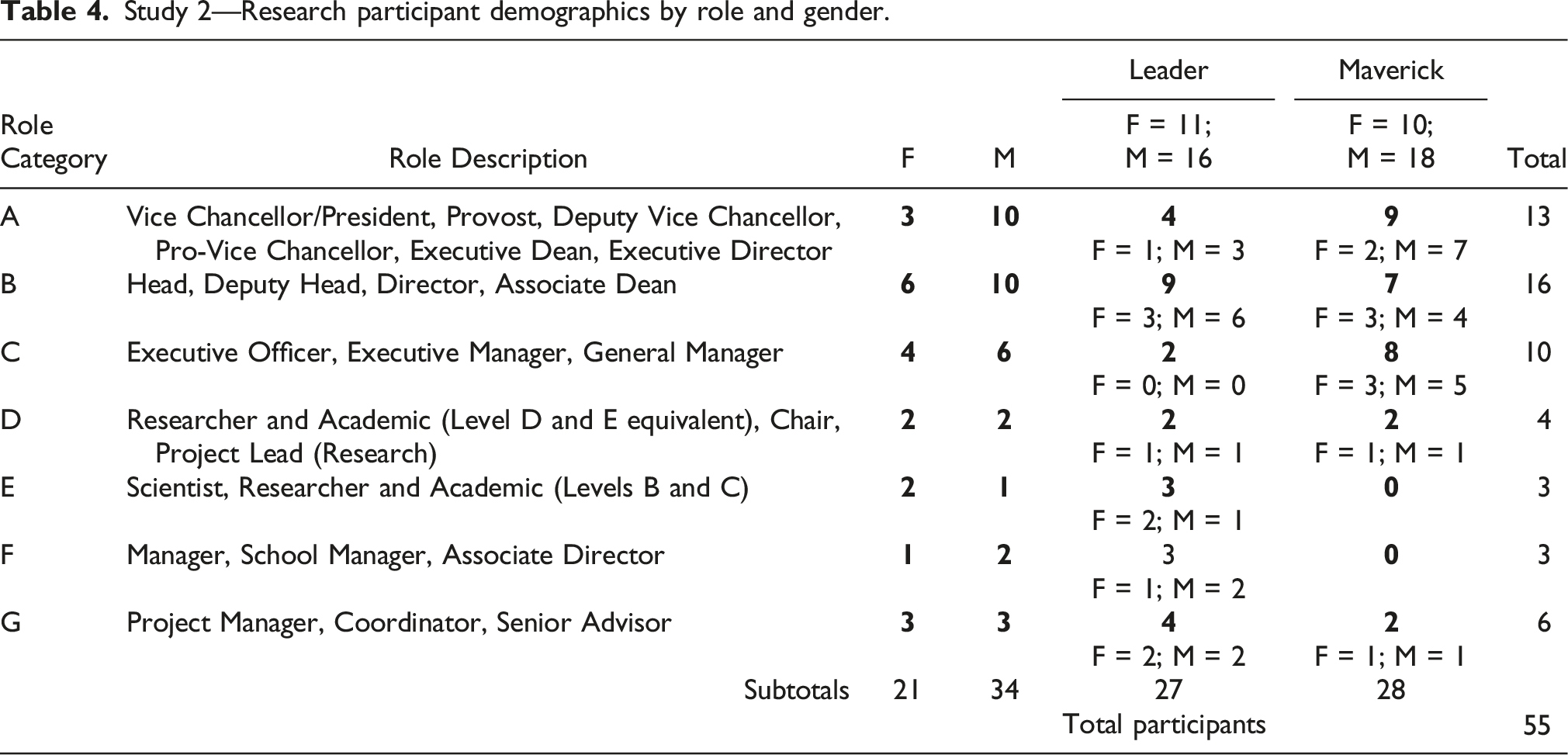
Snowballing: Due to the difficulty in identifying these positively perceived non-conformists in the field, a snowballing approach was undertaken as the sampling method for locating the 28 mavericks (18 males, 10 females) and 27 leaders of mavericks (16 males, 11 females) for interview (see Table 3). Due recognition was taken in selecting this method around the criticism identifying the potential for sampling and selection bias, from authors such as Fiedler (2000) and Marcus et al. (2017). Despite such criticisms, this method of sampling was considered the most appropriate as it is still widely used in research where it is difficult to identify those involving hidden, hard-to-reach, and vulnerable populations (Atkinson & Flint, 2001; Ellard-Gray, Jeffrey, Choubak & Crann, 2015).
Self-identification: Potential respondents were contacted via email and invited to consider participation in the research if they felt that they identified with the recruitment statement outlined above. If so, they were asked to self-identify with either being, or working with such people. These people were also asked to suggest other potential contacts as part of the ongoing snowballing approach.
Vetting: Potential respondents were vetted against three conditions: - Do they meet basic characteristics of a maverick as outlined in the literature reviewed including such characteristics as challenging the status quo, taking unorthodox approaches to achieve a big picture agenda, and largely operating in an altruistic way? - Are they a non-conformist in their general behavior or do they merely take a non-traditional approach to research? - Have they been promoted in their workplace (demonstrating a measure of success and positive esteem)? An important requirement was that the maverick respondents, or those being discussed by leaders of mavericks, were considered successful in their organization. Gardiner and Jackson (2012) identified that the primary difference between mavericks and workplace deviants in organizations is the perception that mavericks operate in a functional, adaptive, and effective way, thus successfully contributing to the organization they work for. The act of being promoted, and operating at increasing levels of influence, were taken as evidence that these mavericks were contributing positively and thus perceived as “successful,” despite being perceived as not conforming to organizational norms. This vetting process took place either prior to, and/or following the interview. If the individual did not meet these base conditions, then they did not progress to the interview stage, or their interview data was disregarded. It is believed that these three steps demonstrate sufficient proactive measures by the authors to minimize the impact of selection bias in locating a sample group of non-conformists who are regarded positively by their organizations (as demonstrated by their successful retention and/or promotion within their organization), or others who work with such people. As our initial framing positions mavericks as positive deviants, we deliberately selected for those individuals that were seen to contribute positively to their organization, despite not conforming to organizational expectations. This selection process enabled the identification of respondents most able to contribute to addressing the research questions centered on exploring how mavericks create positive value for organizations.
Sample Group
Study 2—Research participant demographics by role and gender.
Interview Process
Most interviews were conducted face-to-face and ran for approximately 90 minutes per respondent. Interviews commenced with an open-ended question and were free flowing in structure. Probe and clarification questions were used during pauses in the respondent’s dialogue. When face-to-face interviews were not viable (particularly due to distance), interviews were conducted via phone or Skype and ran for approximately the same time as the face-to-face interviews. All interviews were audio recorded and transcribed for review.
As examples of the interview questions asked, in leader interviews exploring field, capital and practice, the initial question asked was: “You indicated that you work with someone whom you believe fits the description of an employee who is considered to influence innovative change, whilst not operating within the bounds of organizational norms. Can you tell me why you believe they fits this description?”. In the maverick interviews exploring habitus and practice, the initial question asked was: “To give some context to this interview, can you tell me about your life journey, starting from childhood through till now, including any pivotal moments that you believe have shaped you into the person you are today?”.
Data Analysis
Study 2 data was analyzed in a similar way to Study 1, though this analysis focused on reviewing transcripts of the interviews with the 55 participants to (a) gain insights into the implicitly understood norms and expectations within the field in which the mavericks were operating and (b) identify the forms of valuable capital held by mavericks in this field.
As the explicit and commonly understood norms and expectations were gained from Study 1, Study 2 data added to generating a complete field analysis by exposing the implicitly understood norms to more in-depth analysis using primary data. Understanding both the explicit and implicit rules and expectations existing within the field is particularly important as these norms are enforced by those who have significant influence over the field (Fitzsimmons & Callan, 2020). These enforcers of the norm hold the power and social order of the field and as mentioned earlier are aptly referred to by Bourdieu (1977) as the “field of power.”
Findings
In answering Research Question 2, interview data gathered in Study 2 provided insights into the perceptions regarding not only the explicit performance expectations that exist in the field but also perceptions regarding the performance expectations that were felt implicitly by the interviewees. The following two sections explore the maverick response to both the explicit and implicit performance expectations, or the “rules of the game.”
Maverick Response to the Four Explicit “Rules of Play” (Performance Expectations) (RQ2a)
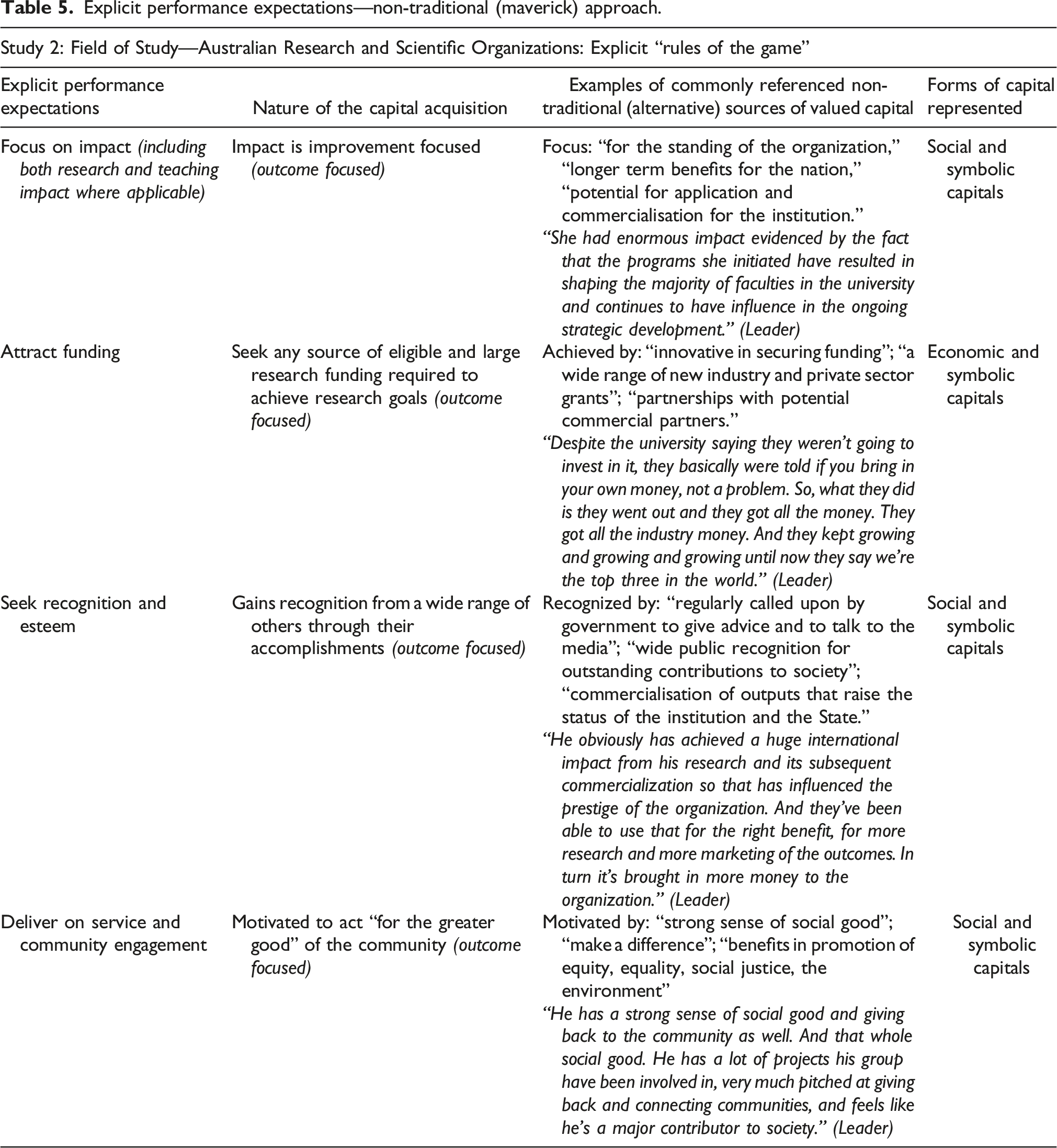
While mavericks are viewed as successful and positive performers, they are not judged to be fully focused on achieving traditional outputs in traditional ways (i.e., the four explicit rules of play identified in Study 1). Rather, these traditional outputs are achieved as a by-product of an outcomes driven focus that aims to achieve more strategic and longer term agendas. This is exemplified in the interview data showing that workplace leaders believe mavericks are driven more by focusing their efforts on achieving higher level outcomes that are beneficial for an organization or society. This focus on achieving bigger picture outcomes as against short term outputs is clearly emphasized in the following representative quote from a leader of mavericks:
“I think the other thing that’s interesting about all three of those people is that they don’t conform to what a traditional academic might look like either. They’re all focused on the external world as much as the internal world, if not more in some cases they’re focused beyond the academy, beyond traditional measures of success. Their measures of success are completely different. I think the view of those individuals would be, that the standard metrics are an interesting benchmark, but their benchmarks are more meaningful to their overall vision. In some cases, they might also think that the metrics take care of themselves if you pursue the vision. If you pursue the bigger goal, um, rather than worry about, you know, being in the top one hundred’s that, you know, how many [performance measurement] points you get and all those sorts of things. I think those three individuals would say those things take care of themselves.”
As stated above “the metrics take care of themselves if you pursue the vision,” meaning that in the process of achieving these higher level outcomes mavericks are observed also to accumulate the more traditional forms of valuable capital (though potentially from an alternative source). More specifically, while the mavericks’ primary goal is not solely focused on attaining outputs against metrics (as a means to an end), such as through prestigious publications, international conferences, keynotes and appearances, and other high status traditional outputs, they still manage to meet and often exceed organizational performance targets regarding these prestige and impact factors. Another example reinforcing this point, and a view shared by the majority of leaders of mavericks interviewed, states the following:
“He is highly successful, in both a traditional manner, through academic outputs, as well as in translating his work. He is successful in a conformist way, with non-conformist tendencies, which is required to achieve goals within the organization and the sector more widely. His non-conforming is largely around how to manipulate established systems to achieve better outcomes for his research and research team.”
Explicit performance expectations—non-traditional (maverick) approach.
Maverick Response to the Four Implicit “Rules of Play” (Performance Expectations) (RQ2b)
Field analysis summary findings—explicit and implicit “rules of the game.”
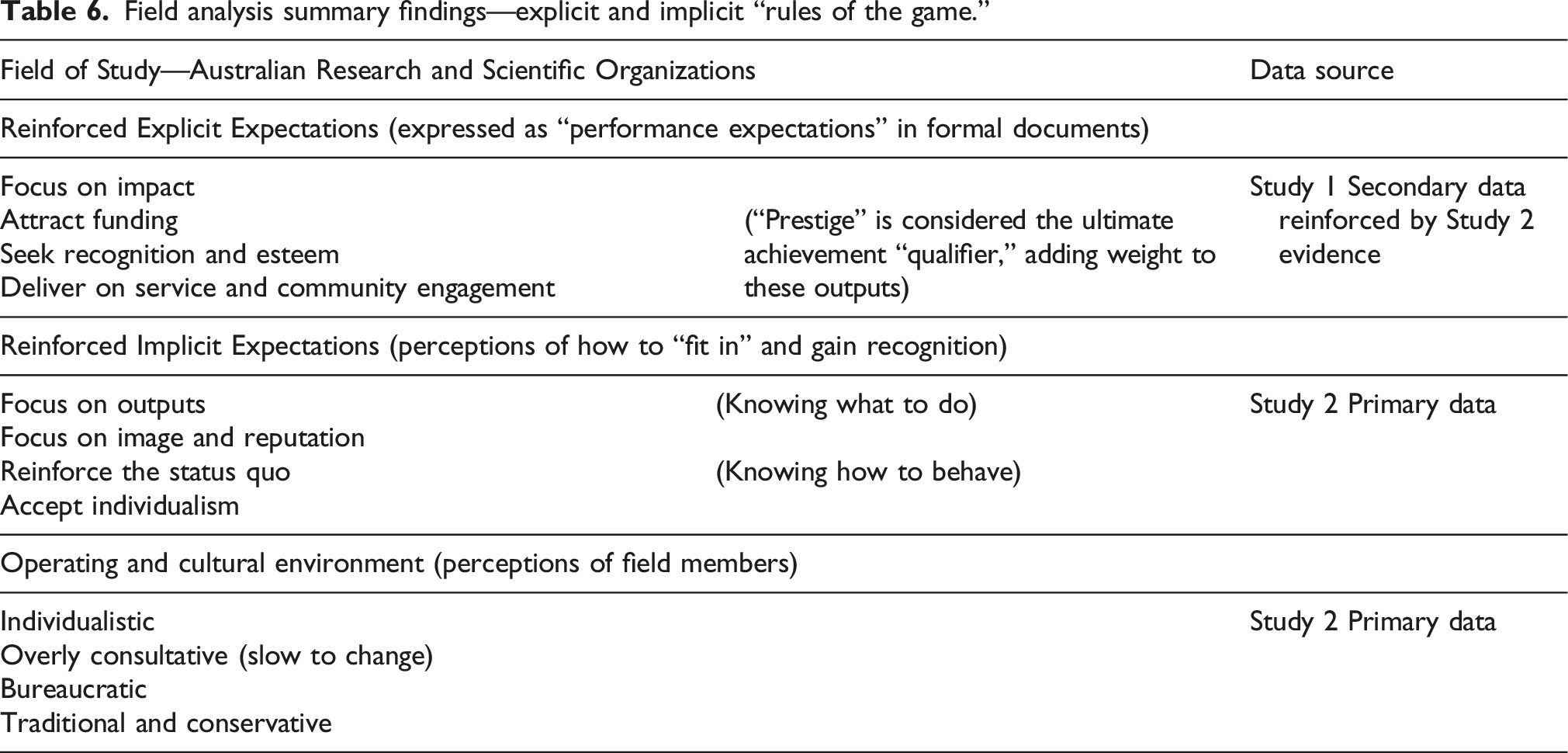
Most interview respondents expressed their belief that these explicit and implicit performance expectations were heavily reinforced by the bureaucratic, conservative, individualistic (and thus highly competitive), and overly consultative organizational cultures in which they operated. Examples from interview data that demonstrate these beliefs, include phrases describing the organizational culture as a “powerful rigid system” with a “huge bureaucratic set of processes that sits underneath us,” and “the management of the university want to, you know, pretty much micro-manage it.” These statements reflect the general tone of interview responses regarding the organizational environment and culture in which they work. Additional phrases representative of most interviews, such as “it’s us and them,” “the silo,” “‘them-and-us’ culture,” “everyone has lots of ego,” and “towards I, and money generation,” also provide an insightful picture of a normalized culture that strongly supports and rewards individualistic behaviors and siloed thinking.
Furthermore, the majority of respondents shared their views that these organizations “debate everything ad-nauseam” and “everyone has to agree before we move forward,” which had the effect that “everything takes a long time,” and “it’s a bit of a sign of … how slow things move.” These statements demonstrate the perception by those operating within the field of an overly consultative culture that results in slowly changing organizations. Given this common perspective across all the interviews, it is not surprising that respondents also shared the view that these organizations are risk adverse, as can be seen in the following exemplar quote:
“I sometimes say it might be a big step for our organization, but a small step for mankind. So, when you come from an extremely risk adverse environment, every micro step is a big step forward.”
This description of the operating environment and the culture by players within the field, along with the explicit and implicit performance expectations identified from Studies 1 and 2, provide a clear picture of the normative conditions of the field. These findings provide a clear picture of what employees are required to do in order to “fit in” and “do well” within the field, which was further emphasized in interview responses using language such as “universities value publications and research rather than visionaries,” “the rewards for academia are set around publications and to some extent to getting academic grants,” and “you can’t usually stay in academia for too long not producing standard outputs.” Interview respondents further demonstrated their strong awareness of how they are meant to behave to fit into the dominant culture. Language such as “not raising your head above the parapet,” “acquiescing to the rules and regulations,” and “accepting the way things are and not fighting injustice, irrelevance, or reactive management” were clear statements demonstrating awareness of the need to maintain the status quo. “Self-interest,” “‘deep divers’ who get promoted and rewarded,” and “focused on success/climbing the ladder” highlights players’ perceptions that they need to focus on behaving in ways that promote individual competitiveness, if they wish to fit in with the dominant culture.
However, irrespective of these perceptions and expectations, the maverick employees were judged to be high performers, despite their disruptive and non-conforming nature. Mavericks reported in their interviews that they understood, and successfully achieved, many of the performance indicators and outputs valued by the dominant field of power. They did this through the completion of a range of traditional scientific and research activities, with the obvious exception of “reinforcing the status quo.” Mavericks achieved outputs as part of a larger agenda to deliver strategic value and beneficial outcomes to their organization. Thus, they were focused on outcomes rather than delivering performance outputs.
The findings also identified that, in recent times, mavericks are increasingly aware that the field of power, especially government and industry funding bodies, are slowly changing their perception regarding the most valuable performance metrics for these research institutions. This shift is leading to an increased emphasis toward “maintaining a public profile,” “good research reputations,” and the “ability to build strong and sustainable relationships.” Following this shift over the last decade in particular, mavericks and their leaders emphasized that there is now increasing pressure upon scientists and other researchers to focus on more non-traditional actions. These emerging engagement and impact capitals include building and maintaining a strong external and public image; building a reputation with industry and government bodies for delivering timely solutions and applications for current issues; and seeking out alternative sources to more traditional research grants and income.
These emerging capitals are seen by mavericks and their leaders to be more likely held by politically skilled and astute mavericks and are increasingly valued by those with power in the field at these scientific institutions. A key reason is that these non-traditional capitals demonstrate to key stakeholders how well the organization is responding and adapting to the changing expectations of industry and government regarding the levels of community engagement, and outputs of modern scientific and research organizations.
In turn, mavericks are observed to use the considerable kudos gained from delivering on the required metrics to secure continued acceptance of their more non-traditional activities. This scientific cultural capital is therefore scaffolded by strategic, inclusive, or ethical thinking that is endorsed and valued by their leaders, thereby gaining public endorsement of mavericks by these same leaders. This endorsement provides mavericks with the continued legitimacy and support of their senior leaders toward influencing the setting and achievement of strategic objectives. High performing mavericks are given more leeway by their leaders than others in their organizations. As one leader of a maverick reported:
“Because of the depth and quality of her work in more non-traditional areas with industry, government and the community, there appears to be acceptance of her role and achievements, albeit with some reluctance. Her very impressive publication record such as papers in prestigious journals, and books with high-end publishers also wins her considerable kudos from our organization and its leaders.”
Maverick Motivations and Higher Order Norms (RQ3)
In exploring Research Question 3, interview data from Study 2 were analyzed to identify the motivations behind maverick behavior, especially to understand the drivers for challenging the status quo and for pushing boundaries. In exploring what values underpin their actions, mavericks unanimously reported that they were motivated by a wide range of higher order norms associated with: “contributions to wider community,” “the rights of the oppressed,” “make the world a better place,” “social justice,” “equity,” “people caring for people,” “sense of justice and righteousness,” and “sense of fairness” (see Table 7 for exemplary quotes). All mavericks interviewed made clear distinctions between purposeful and constructive policies and procedures, and those “where no one is really sure why we do things, but they’re just the way that people do things.” These mavericks viewed their non-conformity as focused on “an intolerance of excessive or inappropriate bureaucracy” rather than conforming to outdated, impractical or unnecessary practices that often slow down role and organizational performance. As one maverick reported:
“If I have that sense of what I’m trying to do fits in with what the organization says it’s trying to do for society, then I’m happy to be here. If there’s policy in the institution that works against this, then I will try and work around it or get an exemption or whatever. Or I’ll just ignore it, if it doesn’t make any sense. I would just say ‘that policy just doesn’t make any sense any more just ignore it’ because what we’re trying to do is much more sensible, or we have to go and change the policy.”
Maverick motivations highlighting positive deviance and higher order norms.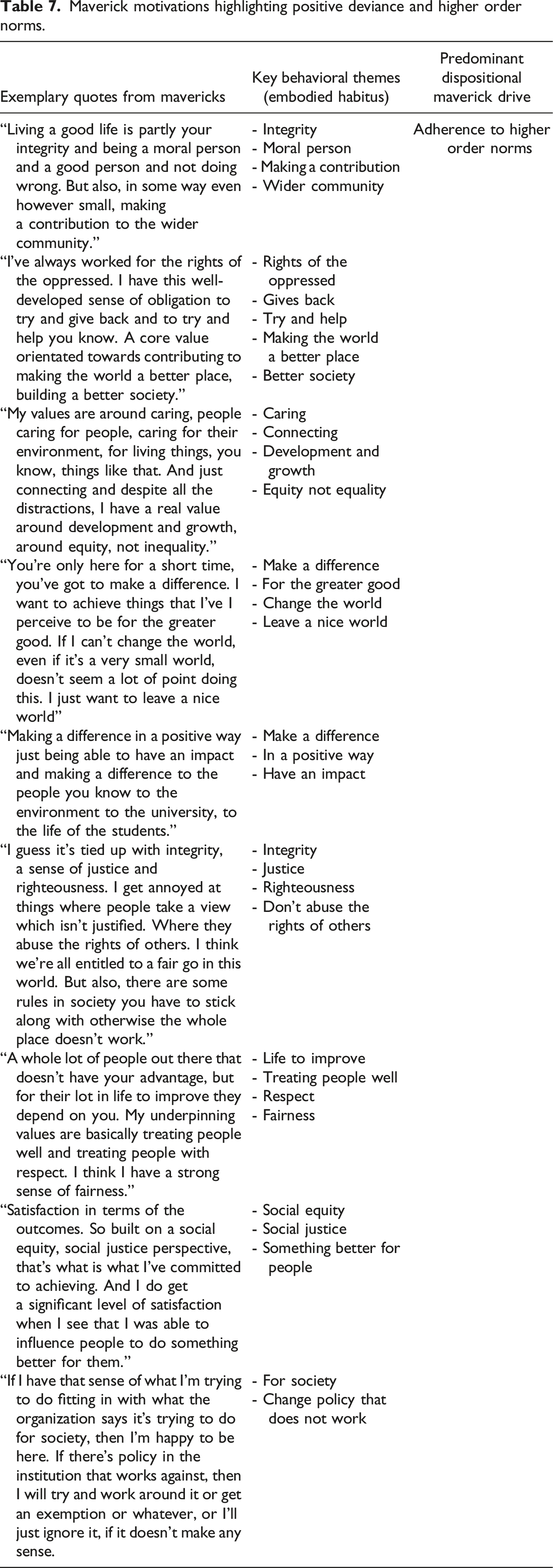
Like the mavericks own reflective statements, leaders interviewed reported that mavericks appeared to be driven to “make a difference,” “contribute to the greater good,” “put something back,” “making a contribution to the wider community,” “fair treatment and equity,” and “building a better society.” Also, these leaders unanimously confirmed that, although on occasion the maverick might not have chosen the best course of action, their behaviors were nonetheless seen to be underpinned by strong beliefs and values around “integrity and work ethic,” “being a moral and good person,” “well-developed sense of obligation,” “more social justice,” “caring for people,” and “treating people well.”
In summary, motivated by higher order norms, mavericks primarily focus on achieving big picture strategic outcomes that have wider societal value. The acquisition of any traditional outputs in the process is an additional benefit that serves to provide the maverick with the necessary metrics required to progress in their field. This further reinforces the earlier point that mavericks are more focused on achieving outcomes than outputs, and therefore, the production of these outputs is only part of achieving the bigger picture agenda, rather than an end in itself. Achieving these more non-traditional outputs that are increasingly valued by the field of power provides additional capital, further aiding the overall acceptance of the positively deviant maverick by the field of power.
Maverick Capitals (RQ4)
Maverick capitals.

The second capital identified relates to the mavericks’ strategically focused action-taking. This form of action-taking demonstrates that mavericks do not simply act or react. Rather, their actions are considered and specifically targeted by them to maximize their ability to achieve desired and targeted outcomes. One leader stated that when faced with a bureaucratic roadblock: “they find a way around it, or they find a compromise. And they still move forward and achieve something.” This statement is indicative of the observations made by the majority of the leaders of mavericks. Other language that highlights this strategic action-taking is represented in the numerous examples in Table 8. This includes phrasing such as: “he’s built strong foundations and then slowly surfaced it,” “he sort of goes underground a lot to get stuff done,” “very good at understanding the work around,” and “he takes managed risks.” This sense of positivity toward these strategic actions was reinforced by themes such as “he’s very good in that regard,” “to drive positive change,” and “having a positive impact.” Mavericks themselves referred to moving forward, identifying, and overcoming roadblocks to planning and strategy, being optimistic about finding multiple ways to achieve an outcome, and being strategic (see Table 8).
Supporting this focus on strategic thinking is the third finding on mavericks’ unconstrained or uninhibited attitude toward taking action to achieve outcomes. Table 8 provides a representative view of this capital, highlighting this lack of constraint and how it is seen positively by leaders of mavericks. In particular, leaders stated that: “he doesn’t really constrain himself by the rules or thinking that you can’t do something because of the rules; he is somebody who will have a go at things” and “does not accept the status quo or ‘don’t rock the boat’ approach just because it is convenient or a path of least resistance.” This view by leaders is also identified in the majority of interviews with mavericks, with the following exemplar comments emphasizing this: “Don’t go to war with the roadblock because there’s always a way if you can work around those constraints” and “I tend to have a brain that works around that idea that if you hit a barrier, you find a way around it. A lot of other people, they’ll stop and wait for instruction.”
The fourth capital identified demonstrates that mavericks’ drive toward taking action centers on their vision-focused and problem-solving contributions for positive change. Mavericks spoke about identifying a vision that motivated and guided their actions. Examples supporting this sense of big picture commitment and determination, are shown in Table 8, particularly in language expressing that mavericks have: “got a vision and get a lot of things done,” “gets motivated by doing big things,” and “they don’t take no for an answer in terms of structures, impediments and so on.”
Finally, the last capital identified is the mavericks’ political skill and astuteness. This astuteness underpins the maverick’s ability to successfully navigate the system, despite not conforming to organizational norms and expectations, particularly at their level of the organization. All mavericks interviewed expressed a “need to learn how ‘the system’ works” to achieve their higher order agenda, demonstrating an innate awareness that organizational systems and processes are not as rigid as mainstream employees tend to believe. This sense of astuteness is acknowledged in representative comments in Table 8 by mavericks, such as “knowing how to pull the levers to change the system” and “there are multiple ways to achieve any strategic outcome.” Additionally, the political astuteness of the mavericks extends to understanding the need to ensure that they have their “backs covered,” as well as strategically knowing that “there are hills to die on, and hills not to die on.”
The combined strategic effect (or practice in Bourdieusian terms) of these five capitals in action is expressed by one maverick who stated: “I’m often the one who’s been writing the policies because I’ve seen that I get to change the policy if the policy gets rewritten. I think that I’ve used policy and writing policy to focus on delivering the things we think are important and meaningful.” This comment represents an overall political skill and motivation of mavericks to contribute positively to their organizations, despite not conforming as mainstream contributors.
The Leadership of Mavericks (RQ5)
Finally, we draw on the interview data from Study 2 to answer Research Question 5. Although mavericks do not operate in the same way as the dominant culture expects, those organizational leaders who successfully leverage mavericks’ ability to disrupt to achieve higher order outcomes, do so by making accommodations for them due to the extraordinary value they add. This can be seen in numerous examples in which a maverick’s leader shares their belief that, although the maverick is disruptive and challenging the status quo, they are in fact “doing something that is strategically important. They never quite do anything that actually hurts, just not in line with what’s expected.” The view that maverick behavior is ultimately beneficial despite their non-conformity is supported in other statements shared by leaders: “they don’t do it in a negative way,” “not destructive in any way,” and “her record is excellent. As a result, she generally is able to get away with her non-conventional approaches.”
Building on this, the interview data highlighted the “double-edged sword” in having mavericks in their organizations. While recognizing the benefits offered by mavericks, leaders also acknowledged that managing and engaging with mavericks is not easy. Their behaviors are often highly frustrating and problematic, often causing tensions and conflicts within the workplace. In the following examples, leaders shared the downside of working with mavericks, highlighting that having them in the organization was not without its challenges:
“I've long made observations of him, he’s someone who I think is very good. Look, a warts and all description … he was horrible to work for… I think as a macro leader, he was very good. But that put enormous amount of pressure on the middle level manager. It was really, really hard working for him.”
“In a small team it creates additional pressure for me, and it also may create a lack of willingness of people to work with her.”
However, despite the difficulties, the same leaders recognized that mavericks can also be highly valued by their organizations or functional units. This is demonstrated with language such as “difficult” and “a threat,” being contrasted with “admired,” “highly valued,” and “amazing” throughout the majority of interviews with the leaders. As a result, as suggested in the following two statements by leaders, to benefit from the contribution of maverickism, organizations need to take the good with the bad, and that while they may be problematic for some parts of the organization, mavericks are welcomed by others:
“He would butt heads with particular areas in the university. But then you had to take the good with the bad.”
“His relationship with an organization unit is appalling because he does his own thing. He doesn't have confidence in them, and he's not afraid to tell them. He also has a famously problematic relationship with a senior leader because he wanted to do things his way. If you talk to [another senior leader] what he does is fabulous. I think he is problematic for bits of the institution and not for other bits.”
These examples emphasize that, while mavericks present challenges to leaders and everyday organizational practices, they also offer recognized value to organizational leaders who make accommodations for them around their divergent behaviors. Indeed, if mavericks are to be leveraged by the organization to achieve higher order outcomes, there is a need to do so. As one leader stated in reflecting on the maverick behavior they observed:
“I value that type of contribution. So, anything that pushes me or pushes a conversation outside what is expected, and to look at new approaches, new ways of doing things or creative ways of solving a problem, I find very welcome, but a lot of people would find that quite disruptive.”
Findings further revealed the need for organizational leaders to recognize the strengths of mavericks and to play to them. This position is made clear in the examples shared through statements such as: “I’ve got to accept that she’s different and work with it to maximize her enthusiasm,” “I value those skills and I try and use them whenever I can,” and “good places are accommodating of that talent so you don’t get them to do jobs that you know are going to be disastrous.” As an illustrative example of how one organization “plays to their strength,” a maverick explained that: “they like to throw me into certain committees to paint a picture of what is possible.” In this way, organizational leaders are highly aware of the unique contribution that mavericks can provide and deploy them where they can add the most value.
“He is highly successful, in both a traditional manner, through academic outputs, as well as in translating his work. He is successful in a conformist way, with non-conformist tendencies, which is required to achieve goals within the organization and the sector more widely. His non-conforming is largely around how to manipulate established systems to achieve better outcomes for his research and the research team.”
Another specific enabler identified in the interviews is that mavericks are most successful when they are in empowering situations. In other words, they thrive when they perceive that they are trusted and given autonomy in how they approach their work. Illustrating this, one maverick leader reported that the most enabling type of environment for mavericks is:
“One that’s flexible and supportive but leaves him alone for most of the time. Doesn’t get in his way too much, but still sets boundaries without setting too many limits. So, it has to be fairly trusting.”
However, the level of autonomy and trust appears to be applied in different ways around the degree of boundary management and latitude allowed within organizations. This ranges from the maverick being given “a lot of freedom” with a “broad mandate” in a workplace that does not “put any boundaries around you,” to environments that “set boundaries without setting too many limits, so fairly trusting.” By setting boundaries, informants believe that organizational leaders can provide an environment suited to maverickism, albeit in a more insulated form. This is illustrated in the following example in which a maverick shares their experiences of working with their supervisor:
“He’s someone who says: ‘I’ll let you go, but I’ll only let you go so far. We need to make sure that we have regular conversations. I will give you freedom, but I give you these few people around you’. He needs that sort of control around me, and to find the right mix of giving you freedom, while having enough people around you who make sure you comply with legislative requirements.”
Maverickism in organizations is enabled by the degree of support and advocacy provided to them by senior leaders. This sense of support and advocacy provides a buffer between the non-conforming maverick and the bureaucracy within the system that is established to maintain order and conformity. This ensures that the advantages of having them in the organization are highlighted, recognized, and reinforced by leaders’ organizational storytelling. Many leaders also noted that by supporting the maverick in this way, the positive deviant nature of mavericks could be leveraged to lead and drive change. As one leader noted:
“I think some people are natural leaders of change or mavericks or non-conformists or whatever title. There's a drive to be better or improve something, to perfect something or to just create something I think that organizations could use more effectively. It can be pretty difficult to be a non-conformist, particularly in highly conservative organizations. These people are most successful when they have a leader who recognizes the value that they can bring and provides an environment within which they can succeed. They may have to set some parameters, as we all do. But they recognize the strength and value of these people as natural leaders of change.”
Finally, respondents were very detailed in their reports of what inhibits the practice of maverickism in organizations. Unsurprisingly, these inhibiting factors included terms such as “high level of control,” “bogged down in immense detail,” “micro-management,” “hard core bureaucrat,” and “too many KPI’s.” An explicit representative statement that illustrates this sense of bureaucracy as an inhibitor is shared by a maverick who states that: “For me micro-management is like a death sentence. I won’t last long in a job that’s being micro-managed. For me I have to build this space to play. Too many tasks or too many KPIs or too many deliverable pieces can actually be a hindering factor.”
Discussion
Informed by the findings in Study 1 (research question 1), and the analysis presented from Study 2, we now discuss the findings from research questions 2–5. In doing so, we present a preliminary and novel framework (see Figure 2) that describes the traditional and non-traditional capitals in play, the mechanism of capital exchange, the role of the mavericks’ motivations, and their combined influences in promoting maverickism as a form of “practice.” Maverick process model of capital exchange, motivation, and influence.
Traditional and Non-Traditional Capitals Enabling Maverick Progression in the Field (RQ2)
As shown in Figure 2, mavericks’ credibility (see “B”—Figure 2) is gained through a combination of (a) acquiring traditional forms of valued technical and cultural capital as well as (b) through the exchange of non-traditional cultural capitals for other forms of valued capital by their leaders. As the findings reveal, the validation of capitals related by the field of power, provides mavericks with significant symbolic capital to strategically influence the leadership of strategic organizational issues, including adapting to changes in the field (Bourdieu, 1986; Swartz, 1997).
The accumulation of symbolic capital by mavericks accelerates their progression through the field either formally through the field of positions (see “D”—Figure 2), or informally through exemplifying new ways of working in response to changes in the field itself (see “E”—Figure 2). When those in the field of power recognize the valuable capitals that mavericks bring, their unique skills can be more effectively utilized for the benefit of the organization. Successful navigation of the field demonstrates an impressive skill by mavericks to mitigate the restraints of the normative effects of the organizational culture. Mavericks simultaneously offer the field of power, capabilities, or cultural capitals that, while rare among the majority of players in the field, are advantageous to strategic leaders in their endeavors to deliver valuable outcomes, especially under conditions of ambiguity and change in the field (thus explaining their conversion into symbolic capital).
Motivations for Maverickism (RQ3)
In this framework, it is proposed that the intentions and motivations of non-conforming mavericks are focused on fulfilling higher order values linked to the achievement of the strategic objectives of their organizations and society (Baddeley, 2018; Cheverton, 2000; Jordan, 2019). Driven by this focus, mavericks as positive deviants justify their disruptive actions as being more beneficial than harmful and therefore believe that their non-conformity is valid. In addition, organizational leaders accept their extraordinary contribution toward meeting higher order organizational outcomes and therefore in exchange accept their non-compliance with largely bureaucratic norms, as well as any mistakes they may make in an attempt to benefit the organization. In other words, particular elements of the embodied maverick habitus are recognized by the field of power as having value to the field and are therefore recognized as embodied cultural capital (see “A”—Figure 2). This form of capital acts to produce further symbolic capital, thus providing the maverick with increased credibility and status within the field (see “B”—Figure 2).
As the findings acknowledge, maverick motivation is underpinned by broad values which guide their disruptive behavior, ultimately creating a framework for disruption. Therefore, this broad set of values can be labeled as “bounded non-conformity.” In other words, their non-conformity operates within the bounds influenced by their commitment shown to their leaders to globally held values, such as justice, integrity, fairness, and equity, as well as timely, efficient, and high-quality outcomes. These values are held in high regard by most organizations and society more generally, and for which organizations are routinely rewarded by their clients, governments, and their communities for demonstrating them (see Becker et al., 1998; Campbell, 2007; Collier & Esteban, 2007; Malik, 2015). In this way, mavericks act as a strategic and sometimes moral compass for the organization and its leadership group and, at least where they are recognized and supported, contribute to delivering these high order strategic outcomes (Verdolaga, 2015). Thus, the mavericks “bounded non-conformity” provides the ethical framework and motivational drive underpinning their actions, which can be highly beneficial to organizations in helping to build their reputation and credibility (i.e., symbolic capital) with clients, customers, and stakeholders.
The Maverick Capital Advantage (RQ4)
Operating within boundaries set by these higher order values, mavericks accumulate capitals identified as valuable in the field, despite being perceived as disruptive non-conformers who do not follow all the rules expected at their level in the field of positions (Gardiner & Jackson, 2012; Taylor & LaBarre, 2006) (see “C”—Figure 2). Mavericks are granted positional influence (see “D”—Figure 2) in the field of power through accumulating traditional technical and scientific cultural capitals, as well as embodied cultural capitals around non-conforming ways of delivering upon strategic priorities. These non-conforming ways are regarded as valid alternatives to traditional forms of cultural capital related more to conformity. Mavericks provide a highly valued capital usually possessed only by those higher in the organization and is not considered as the traditional capital possessed by those at lower levels.
The findings identified five key embodied cultural capitals: high energy for action, adopting a strategic outlook, a focus on outcomes rather than simple outputs, demonstrating a visionary nature, and acting with political skill and astuteness. We propose that when enacted together, these form maverick capitals. This powerful combination of maverick capitals produces symbolic capital (see “B”—Figure 2) which when recognized and legitimized by the field of power (see “C” and “D”)—Figure 2) can be wielded to influence strategic decision-making (see “E”—Figure 2). At a minimum, this influence might take the form of recognition as a thought leader or situational leader, deployed in certain circumstances to drive change as deemed appropriate by organizational leaders.
Others have made similar observations about the thought leader and disruptive influencer roles of mavericks (Blohowiak, 1992; Charlton, 2008; Gardiner & Jackson, 2012). They are anointed as possessing and representing higher order strategic actions and values that drive organizational outcomes. This finding is consistent with Bourdieu’s (1977, 1986, 1990) stance on the exchange of capitals within fields, as well as how capitals are used to maintain and improve standing within the field of positions, and the field of power itself. It also highlights how a capital considered to be valuable at any point in time, changes in a field in response to shifts in field priorities. Such change is often caused by external factors, such as those raised about the increasing importance of non-traditional funding, industry engagement, and government metrics used to assess research organizations.
Not only do mavericks accumulate valued capitals, but they are also judged to be high performers who often exceed expectations (see “F”—Figure 2). They achieve this in three ways, each of which is not considered to be a mainstream approach to moving upward through the field of positions: (a) performance outputs are achieved as a “by-product” of delivering a bigger picture outcome; (b) performance outputs are achieved when the field of power recognizes and legitimizes the value of the capital they possess, which is ordinarily acquired through longer practice in a given field relative to other individuals at their level in the field of positions (i.e., while these capitals may not be unique to the field, they are not usually possessed or deployed by an individual at the position and/or length of service in the organization as those of the maverick); and (c) the volume (quantity) and structure (quality) of the capital accumulated by mavericks is allocated more weight (seen to be of higher value) than that given for compliance with organizational norms by the field of power (Bourdieu, 1977). These alternative actions are therefore accepted and validated indicators of performance afforded to mavericks by the field of power.
The cultural capitals offered by the maverick, through their anointment and endorsement by the field of power, are thus converted into symbolic capital that facilitates influence over the field of power, beyond that expected from an individual at their level within the field of positions. Importantly, mavericks do not necessarily and immediately change the norms of the field, as these are deeply entrenched (Bourdieu, 1992). However, as other studies reveal about the formal roles of leaders of organizational change (Fitzsimmons and Callan, 2016) identified, mavericks often from lower positions in organizational hierarchies, provide indicative pathways, capabilities, or areas for change that the leaders can begin to address and incorporate in their organizations.
Leveraging the Valued Capitals of Mavericks (RQ5)
Several findings from this research assist organizational leaders and senior leadership teams in working with mavericks. One significant finding in assisting a more productive leader-maverick relationship is that mavericks do conform, but this conformity is to higher level values and broader organizational and strategic goals, that drive their actions. For those leaders in more traditional organizations, identifying the areas to open to maverick disruption is a significant challenge as they need to fight against the nature of their conservatism to do so (Bourdieu, 1990; Swartz, 1997). To be effective, the boundary conditions must be balanced by leaders between being broad enough to provide a sense of freedom for the maverick to operate in the best way they can, while still providing a modicum of security to specific structures within organizations for leaders to willingly engage the mavericks (Donaldson & Dunfee, 1999; Warren, 2003).
To maximize the maverick advantage, organizational leaders need to recognize the strengths of mavericks and trust them to be able to achieve highly effective outcomes through allowing them to think laterally, challenge the status quo, and find alternative pathways to achieve the overarching goal (Blohowiak, 1992; Clouse, 1997; Jordan et al., 2021; Khoury, 2013). This can be a challenge, both as mavericks don’t always “get it right” and are largely guided by high level strategic outcomes and hyper-norms, whereas organizational leaders can often be risk adverse and more focused on tactical and operational details which tend to distract from delivering on strategy. Hence, even if leaders do not fully embrace the mavericks’ ideas, the conflict arising from their presence might cause leaders to pause and consider the purpose and strategic intent of the organization, and their leadership of it, at a fundamental level. Thus, creating the potential of further positive disruption (see “E”—Figure 2).
Limitations and Future Research
There are several limitations to the current study. The number of respondents was limited due to identification issues, and they are from the scientific and research sector of the Australian economy. Caution must be applied to the generalizability of the findings to all mavericks in all industries, and particularly to those outside of the Australian context. Data regarding mavericks was gathered via interviews, which has the potential to report biased and more socially desirable interpretations of events from the past. In recognition of this, the procedures taken during this study aimed to reduce the impact of incorrect and selective recall. Nonetheless, as Flick (2009) highlights, the interpretation of the data may still be impacted by such biases, ultimately influencing the results reported.
Additionally, the interviews were focused on gaining insights into maverick men and women who had progressed to senior roles, with no comparative data collected on those who failed to do so. Nor was there any exploration into the impact of gender, age, or race on the perceptions of maverickism in the workplace. Undertaking such a comparison provides an opportunity to evaluate the degree to which the identified characteristics are distinctive features of mavericks who succeed in organizations, and whether other factors such as gender, age and race play any significant part in this. A longitudinal design would be the preferred approach for this kind of study (Day, 2011), for example, following the early career trajectories of those displaying positive deviant characteristics. In taking this approach, a greater emphasis on uncovering the historical factors influencing the embodied maverick habitus can be allowed for, as well as mapping changes to the field and identified valuable capital. Addressing such limitations in data collection, Bourdieu and Wacquant (1992) recommend undertaking reciprocal studies of the field, capital, and habitus, with particular emphasis on subjecting life histories to rigorous examination in view of historical data (Bourdieu, 1974, 1984).
Conclusion
Despite the disruptions that maverick behavior causes, these findings suggest that effectively engaging with them offers major strategic advantages to leaders and their organizations. The valuable capital associated with their non-conformity and positive deviance can be leveraged to assist leaders especially during times requiring major transformation or in responding to rapidly shifting external environments. In particular, mavericks bring unique sets of capital in their abilities to partner externally, to be visionary, and to think strategically about outcomes that best fit the achievement of more transformative objectives. Although they may not always have the right answers or take the best path, accessing maverick capitals may make a substantial difference for the success of senior leaders in navigating their organizations through turbulent and increasingly competitive global environments.
Footnotes
Acknowledgments
We would like to thank Bernard McKenna, Kate Power and Mats Alvesson for their invaluable feedback and comments on earlier iterations of this manuscript. We would also like to thank Associate Editor Sarah Bankins and the anonymous reviewers for their constructive suggestions and feedback, which helped strengthen and improve the paper.
Declaration of Conflicting Interests
The author(s) declared no potential conflicts of interest with respect to the research, authorship, and/or publication of this article.
Funding
The author(s) received no financial support for the research, authorship, and/or publication of this article.

Author Biographies
Associate Editor: Sarah Bankins