



Abstract
Drawing on regulatory focus and brokerage literatures, we develop new theory that explains individuals’ motivation to form and change their relationships in organizational networks. Specifically, we examine how promotion and prevention regulatory foci influence such relational processes as tie formation, maintenance, dissolution, and reconstitution. We further explore the relationship between motivational orientations of regulatory foci and relational orientations to brokerage (i.e., tertius iungens/gaudens) and develop a typology that outlines four major ego-level configurations. Each of the four configurations, labeled dutiful coordinators, aspirational arbitrators, versatile brokers, and indifferent egos, offers distinct predictions on network change and structuring. Overall, our theory contributes to organization theory by elaborating on the important role of ego motivation and strategy in organizational networks, and in so doing, advances research that focuses on individual agency in social networks and complements structuralist approaches to understanding social network dynamics.
Introduction
In organization theory, social relationships are an important predictor of an individual’s status in the workplace (Seibert, Kraimer, & Liden, 2001). By having meaningful social relationships, individuals can accrue benefits from their networks, often characterized as social capital (Burt, 1992; Coleman, 1988; Granovetter, 1973; Krackhardt, 1999). This recognition, pertinent to the social function of interpersonal relationships, now constitutes the basis of a large body of scholarly work in organization theory that collectively examines factors that predict and mechanisms that explain the genesis and evolution of network relationships (Borgatti & Halgin, 2011; Borgatti, Mehra, Brass, & Labianca, 2009; Kilduff & Brass, 2010). With the advent of more sophisticated computational techniques and theoretical advances, research has made major progress toward developing a comprehensive understanding of the microcosm and macrocosm of social networks (Borgatti & Foster, 2003; Borgatti & Halgin, 2011; Borgatti et al., 2009).
More recent work on organizational networks focuses on an important issue that for a long time was largely absent from the discourse in the literature—actors’ motivation to develop and utilize relationships (Brennecke, 2020; Kuwabara, Hildebrand, & Zou, 2018; Porter & Woo, 2015). We are a social species with a near-universal, innate need to forge ties with others, yet we develop relationships using conspicuously different strategies, leading to ego networks with systematically different properties. Some develop closed, relatively small networks of strong relationships, while others enjoy open, relatively large networks of weak relationships. These network patterns cannot be wholly explained by either endogenous network processes (e.g., reciprocity) or by randomness. As Ahuja and colleagues indicate “the understanding of network outcomes is only partial without an appreciation of the genesis of the network structures that resulted in such outcomes” (2012, p. 434) and that agency is “[a] key factor promoting the creation and the evolution of networks” (2012, p. 438). Motivated by this reasoning, and in pursuit of complementing existing structuralist frameworks on networks in organization theory, which attribute network change to structural processes of networks themselves, we develop a motivational theory of ego networks in organizations that attributes network change to individuals’ motivations to strategically form, manipulate, and configure social relationships. Drawing on regulatory focus theory (RFT) and the literature on brokerage in social networks, we provide an alternative answer to the question of “why do networks develop the way they do?” Specifically, we develop a dynamic theory of social network formation and change that focuses on individual agency. First, we elaborate on the factors that determine change in individuals’ social networks in the workplace and offer new insights into the role of regulatory foci, which represent motivational orientations toward goal setting and pursuit (Higgins, 1998) in predicting the formation, maintenance, dissolution, and reconstitution of network ties. Next, we examine how regulatory foci influence particular approaches toward brokerage in social networks represented by tertius gaudens and tertius iungens relational orientations. Finally, building on our propositions and prior work (Halevy, Halali, Zlatev, 2019; Obstfeld, 2005), we develop a typology that illustrates four distinctive ego-level configurations that combine regulatory foci with brokerage orientations, labeled aspirational arbitrators, dutiful coordinators, versatile brokers, and indifferent egos, and in so doing, predict ego network change and structuring in each configuration.
Regulatory foci represent distinctive motivational orientations toward goal setting and pursuit, with promotion-focused individuals setting maximal goals that underlie growth and achievement needs and prevention-focused individuals setting minimal goals that underlie security and safety needs (Higgins, 1996, 1997, 1998). Social engagement is partly a deliberate, goal-directed, and motivated action and partly influenced by the properties of the social environment in which actors are embedded (Kilduff & Lee, 2020). While we recognize both influences on social engagement, for the purposes of this paper, we focus on the role of agency on tie formation and change. In addition, we chose to explore the role of agency in networks through the lens of RFT because of its emphasis on systematic individual differences in goal setting and pursuit, processes that are implied, but have remained relatively underexamined in network research. These motivational processes are more proximal to and directly affect behavior as opposed to personality traits, which are more distal to individual outcomes, such as performance (Barrick & Mount, 2005), and affect behavior only indirectly through regulatory focus (Lanaj, Chang, & Johnson, 2012). RFT also builds on and extends the hedonic principle that individuals seek to approach pleasure while avoiding pain (Higgins, 1998), which helps predict a broad array of goal-directed behaviors in social settings compared to other approaches that focus on a particular individual differences construct (e.g., self-monitoring—Mehra, Kilduff, & Brass, 2001).
Our theory also incorporates the brokerage roles that individuals take on in social networks. Tertius gaudens and tertius iungens are relational orientations (or strategic approaches) toward brokerage (Halevy et al., 2019) and refer to “preferred means for approaching problems in a social context” (Obstfeld, 2005, p. 104). Tertius gaudens, “the third who enjoys” (Simmel, 1950), or disunion, is a relational orientation wherein an ego connected to otherwise disconnected alters (i.e., broker) believes he/she can maximize personal benefits by keeping alters separated, possibly manipulating these relationships, or playing alters against one another (Burt, 1992). Tertius iungens, “the third who joins,” or union, refers to a relational orientation wherein an ego tied to otherwise disconnected alters brings them together, facilitating new relationship development for enhanced collaboration (Obstfeld, 2005). While the majority of prior research has approached brokerage from a structural perspective (Kwon, Rondi, Levin, De Massis, & Brass, 2020), there is a growing interest in the process of brokerage and the role of individual agency in the formation and change of their social network (Grosser, Obstfeld, Labianca, & Borgatti, 2019; Lingo & O’Mahony, 2010; Quintane & Carnabuci, 2016; Soda, Tortoriello, & Iorio, 2018; Wei, Zou, Ormiston, 2021). Thus, a structural perspective of brokerage “defines the context in which brokerage occurs, but it does not capture the critical aspect of brokerage: the behavior one enacts when in a position to broker” (Grosser et al., 2019, p. 115).
We contribute to organization theory and research in two important ways. First, we advance social networks research by developing new theory in a relatively overlooked area in the formation and utilization of network relationships. Relational orientations converge on the structures that create brokerage opportunities (i.e., triads) but underlie different strategies that actors follow (i.e., union/disunion). While opportunity structures (e.g., structural holes) are clearly identified in this literature, actors’ motivation to develop and utilize the type of relationships that present these opportunities is presumed. Furthermore, research is yet to uncover the underlying mechanisms at play that explain individuals’ choice of brokerage strategy. Building on recent discourse on social networks (Brennecke, 2020; Kuwabara et al., 2018; Porter & Woo, 2015), we incorporate RFT and examine how individuals’ motivational orientations, particularly their promotion and prevention foci, determine how they develop their networks, utilize brokerage strategies, and create opportunities to accrue social network benefits. Understanding why individuals choose a particular brokerage strategy over another can help draw more precise links between network relationships and processes and individual outcomes in organizational research (Ahuja et al., 2012).
Second, and relatedly, we build on and advance the emerging literature on the “microfoundations and microdynamics of network change,” which focuses on “factors that drive or shape the formation, persistence, dissolution, and content of ties in the network” (Ahuja et al., 2012, p. 437). Recent research considers why individuals network with others in the workplace drawing on expectancy, social exchange, and social ledger theories (Brennecke, 2020; Kuwabara et al., 2018; Porter & Woo, 2015). For instance, Brennecke (2020) introduced the concept of dissonant ties to explain why individuals are motivated to engage in “unpleasant but instrumental networking behavior” and found that individuals tend to form dissonant ties with those in higher positions and with longer tenure to extract work-related advantages (2020, p. 743). We build on this research tradition and recent work on network dynamics (Ahuja et al., 2012; Burt & Merluzzi, 2016; Quintane & Carnabuci, 2016) by focusing on egos’ motivational orientation as a driver of change and/or stability in relationships that constitute their networks.
We do not claim that regulatory foci are the only drivers of network behavior, instead, we elaborate on how regulatory foci, as dispositional tendencies directly influencing a range of interpersonal attitudes and behaviors, have additional explanatory and predictive power that supplements our understanding of ego networks. Our focus on motivational drivers of network formation and change complements and advances prior work on more and less stable personality traits as antecedents of social networks (e.g., Bhardwaj, Qureshi, Konrad, & Lee, 2016; Sasovova, Mehra, Borgatti, & Schippers, 2010; Tasselli et al., 2015). Thus, our theory addresses concerns that personality characteristics “may be too diffuse to capture specific behavioral outcomes, such as tendency to bridge” (Kalish & Robins, 2006, p. 80) by focusing on motivational orientations, which are more proximal antecedents to behavior and are thus likely the key mechanism through which personality influences network formation, change, and structuring (Lanaj et al., 2012).
Theory Development
Social Networks: Definitions, Levels, and Processes
A social network is “a set of actors and the relations (such as friendship, communication, and advice) that connect” (Kilduff & Tsai, 2003, p. 135) “or separate them” (Kilduff & Brass, 2010, p. 320). Actors in a network can relate to one another in different ways. Organizational research distinguishes between expressive and instrumental relationships (Lincoln & Miller, 1979). Individuals in expressive relationships (e.g., friendship) develop affect, whereas those in most instrumental relationships (e.g., team co-membership) focus on the exchange of resources such as information and advice (Umphress et al., 2003) and as such, “provide support for professional needs and goals” (Kuwabara, Cao, Cho, & Ingram, 2022, p. 3). Networks can be studied at various levels of theorizing and analysis, including “actor, dyadic, triadic, group, organizational, and inter-organizational” levels (Contractor et al., 2006, p. 684). An ego network consists of a focal actor’s immediate relationships and those among his/her alters.
Although network ties tend to persist, networks of individuals also have an undeniably dynamic aspect, especially in organizations, where relationships continually evolve through a set of micro-processes. Formation, maintenance, dissolution, and reconstitution of ties represent four processes in actors’ relationship management in organizations (Levin et al., 2011). A relationship forms when the ego forges a new tie with an alter who has not been acquainted with the ego before. If maintained, an acquaintanceship may strengthen as the ego and alter develop, exchange, and/or jointly utilize resources regardless of their nature (affective, instrumental, or both). Actors may dissolve their relationship by bringing their interaction to a halt. Dissolved relationships enter a state of dormancy (Levin et al., 2011). Inactive relationships may be reconstituted after a while if the actors decide to revive their interactions (Levin et al., 2011).
Our theory is framed around several boundary conditions. First, although affective relationships have a conspicuously instrumental nature (e.g., being in a loving relationship provides self-esteem benefits), our theorizing focuses on instrumental relationships in organizations (e.g., egos’ advice networks) that are not restricted to superior-subordinate or peer-to-peer ties established by organizational hierarchy. Second, we mainly theorize at an egocentric level, where we focus on tie formation and change among pairs of individuals (i.e., dyads), examining how the ego deliberately shapes his/her social surroundings “in more productive or rewarding ways” (Levin & Walter, 2018, p. 500).
Third, we consider the structure of ego networks (i.e., social capital) as a desired end because social capital in the form of structurally favorable arrangements offers individuals access to resources, such as information, social support, reputation, and security, among others (Adler & Kwon, 2000), all of which are critical to their ability to achieve their other career-related goals in an organizational setting. We examine how promotion and prevention foci motivate the adoption of relational orientations and affect interpersonal processes (e.g., tie formation) that result in these network structures. Therefore, our causal sequence suggests that promotion and prevention foci affect networking processes, which then result in network structures, which in turn have consequences for important work outcomes. Consistent with prior work on regulatory foci (Johnson et al., 2015), at the system level, a desired end with instrumental networking behavior for promotion-focused individuals is to develop a structurally advantageous ego network in their workplace, while for prevention-focused individuals the desired end is to avoid structurally disadvantageous ego network in the workplace. For promotion-focused individuals, achieving a structurally advantageous ego network entails, at the strategic regulatory focus level, approaching network gains (+1s) while avoiding non-gains (0s) through instrumental networking behaviors in the workplace, which ultimately provides them with a “sense of accomplishment” (Johnson et al., 2015, p. 1505). Conversely, for prevention-focused individuals, avoiding a structurally disadvantageous ego network would involve, at the strategic regulatory focus level, approaching non-losses (0s) and avoiding losses (−1s) through instrumental networking behaviors in the workplace, which provides a “sense of security” (Johnson et al., 2015, p. 1505).
Fourth, while we focus on regulatory orientations as motivational drivers of network development and change, we also acknowledge that there may be other situation- or context-specific motives (e.g., extrinsic rewards) that may govern individuals’ behaviors in networks. In addition, we focus on the system and strategic levels of regulatory focus to develop a theory that can explain a wide range of interpersonal behaviors and network outcomes, rather than focus on the situational means (tactics) individuals use to enact their strategies. Finally, we assume that individuals are aware of their relationships and can construct their networks. We suggest that people change their relationships based on this knowledge, with motivation for change versus stability being governed by self-regulatory orientations.
Regulatory Focus Theory
RFT (Higgins, 1996, 1997, 1998) examines how individuals approach pleasure and avoid pain (Förster et al., 1998), the basic hedonic principle (Heider, 1958). Proponents of the theory have identified two regulatory orientations: promotion and prevention foci. Individuals with these orientations exhibit different cognitive, emotional, and behavioral characteristics in goal setting and pursuit. Specifically, they differ in their needs, approach/avoidance goals, risk-propensities, temporal orientations, and experienced emotions.
Promotion-focused individuals have high growth and advancement needs, set temporally distant, maximal goals that emphasize high aspirations, and generally exhibit a risk-taking profile (Higgins, 1998; Johnson et al., 2015). Promotion-focused individuals demonstrate openness to change and engage in exploration (Kark & Van Dijk, 2007), and therefore, they tend to be long-term focused, because maximal goals are ambitious and time-consuming (Kluger & Ganzach, 2004; Pennington & Roese, 2003). Based on their success in approaching gains (i.e., presence of positive outcomes) and avoiding non-gains (i.e., absence of positive outcomes), promotion-focused individuals experience a range of emotions related to the cheerfulness-dejection continuum (Johnson et al., 2015). Gains for promotion-focused individuals are associated with moving from the status quo “0” to a better state “+1” (Higgins & Pinelli, 2020). Promotion-focused individuals are more concerned with and seek to achieve positive (i.e., 0 → +1) rather than negative deviations from the status quo (i.e., 0 → −1) (Scholer, Cornwell, & Higgins, 2019).
In contrast, prevention-focused individuals have high security and safety needs, set temporally proximal, minimal goals that prioritize fulfilling obligatory responsibilities, and are generally risk-averse (Higgins, 1998; Johnson et al., 2015). Committed to the status quo, prevention-focused individuals engage in exploitation (Kark & Van Dijk, 2007), and tend to be short-term focused, because minimal goals are conservative and less time-consuming (Kluger & Ganzach, 2004; Pennington & Roese, 2003). Based on their success in approaching non-losses (i.e., absence of negative outcomes) and avoiding losses (i.e., presence of negative outcomes), prevention-focused individuals experience a range of emotions related to the quiescence-agitation continuum (Johnson et al., 2015). Non-losses for prevention-focused individuals are associated with maintaining or restoring the status quo “0” (Higgins & Pinelli, 2020). Moving from the status quo to a worse state “−1,” therefore constitutes failure and prevention-focused individuals are more concerned with negative (i.e., 0 → −1), rather than positive deviations (i.e., 0 → +1) from the status quo (Scholer et al., 2019).
While regulatory foci are generally treated as chronic orientations, such that an ego is characterized by either a principal promotion or prevention focus in most situations (Johnson et al., 2015), recent research has documented that regulatory foci are empirically orthogonal dimensions of self-regulation (Lanaj et al., 2012). Proponents of the theory have argued that people develop a system level regulatory orientation and exhibit behaviors that are consistent with their orientation because of disposition or upbringing (by parents or caretakers) (Higgins, 1997; Wallace & Chen, 2006), yet more complex motivational orientations can also exist (e.g., simultaneously high promotion and high prevention) (Bilgili et al., 2020). Building on this literature, and for theoretical parsimony, we first explain how regulatory foci as chronic orientations influence relationship formation, maintenance, dissolution, and reconstitution, and then introduce more complex motivational orientations based on the four configurations derived from different combinations of prevention (low; high) and promotion (low; high) foci and make predictions about network change and structuring in each configuration.
Relationship Formation and Change Motivations
Relationship formation is the initial stage in the process of network development and change. Relationships are a source of key resources for individuals, including information, support, and reputational benefits (Podolny, 2001). Humans, on average, possess a network consisting of approximately 150 alters (Hill & Dunbar, 2003) and at the population level, the number of ties people have is not normally distributed. Not only are some individuals far better connected than others (Barabási & Bonabeau, 2003), but only a limited number of people exhibit the characteristics of so-called superconnectors—extremely well connected individuals that are “disproportionately consequential in their effect on the structure of the network” (Chu & Davis, 2016, p. 718). Given this significant heterogeneity in ego networks, we elaborate on how regulatory orientations influence egos’ relationship management.
We predict that promotion-focused individuals will exhibit greater motivation to form new relationships than their prevention-focused counterparts as new tie formation constitutes a gain [i.e., a positive deviation from the status quo (0 → +1)]. Promotion-focused individuals’ emphasis on satisfying growth and expansion needs suggests that these individuals are more likely to forge ties with new actors within and outside of their social circle that can provide them with access to valuable resources. Existing empirical evidence provides some support for this contention. In their analysis of entrepreneurial networks, Pollack, Forster, Johnson, Coy, and Molden (2015) found promotion-focused individuals’ networks to have greater out-degree centrality [number of contacts an entrepreneur solicits resources (e.g., advice) from] than those of prevention-focused individuals. Prior research has also found that promotion-focused individuals exhibit greater openness to experience (Higgins, 2008), are less likely to value stability and tradition, and more likely to take risks than their prevention-focused counterparts (Leikas, Lönnqvist, Verkasalo, & Lindeman, 2009; Liberman, Idson, Camacho, & Higgins, 1999). As a result, promotion-focused individuals are more likely to value and pursue such maximal goals as building social capital and becoming a prominent network actor [i.e., having many direct and indirect ties to others in the network (Podolny, 2001)], which provides them with access to resources that will help them reach their growth goals (Zou et al., 2015). As a promotion-focused ego forges ties with new alters at a high rate, he/she moves closer to gaining a prominent position in the network by becoming a central actor (Freeman, 1978).
In contrast, prevention-focused individuals are likely to be satisfied with more limited social engagement, partly because they focus on approaching non-losses (i.e., maintaining the status quo “0”) rather than seeking gains, hence, prominence is less of a concern for these individuals. Forming ties with new alters bears some risk as it is difficult to determine whether the resources (e.g., knowledge and support) the alter can provide to the ego are indeed valuable (Parker et al., 2016). A prevention-focused ego is more likely to value and pursue such minimal goals as establishing a network that provides adequate support and protection by preserving existing social standing/status and access to resources and avoid further loss of those resources.
The commitment to the status quo and reluctance to change (Kark & Van Dijk, 2007) of prevention-focused egos further suggest that they will engage in new relationship formation less intensely than their promotion-focused counterparts and instead be more strongly motivated to maintain existing relationships through frequent exchange with alters. Prevention-focused individuals view networks as a means to bringing stability, safety, and security to their self-concepts and preserving these qualities over time (Higgins, 1998). This is one of the underlying reasons why prevention-focused egos are typically vigilant in their decision-making and monitoring. Needs that emphasize conservation, while incompatible with network change, are highly compatible with network preservation. Status quo in an ego network can be preserved when the actor makes an effort to maintain and cultivate his/her existing partnerships or coalitions over time instead of forging new ties. Levin and Walter suggested that maintaining ties with colleagues from a previous job may provide “a feeling of security or self-confidence to become better adjusted at a new job” (2018, p. 497). Zou and colleagues (2015) showed that individuals with high prevention effectiveness report greater levels of life satisfaction when they are embedded in a dense social network—a network in which alters are highly interconnected—than when they are embedded in a network with low density. In addition, prevention-focused egos are likely to have greater incentive to direct their attention and resources to preserving existing relationships because of their need to fulfill obligatory responsibilities (Johnson et al., 2015).
Relationships enter a phase of dissolution when actors stop interacting, bringing activities that involve sharing, exchange, or transfer of resources to a halt (Zhang & King, 2021). Similar to new tie formation, tie dissolution implies network dynamism and change. However, unlike tie formation, dissolution suggests a negative deviation from the status quo (i.e., 0 → −1). Losing an active relationship frees up resources that can be diverted elsewhere, yet it creates a potential fraction, fragmentation, or rupture in the social fabric of the network. Losing an alter can be considered a risk, since benefits that networks provide are embedded in relationships. Thus, when relationships break apart, idiosyncratic network resources (e.g., emotional support) become inaccessible. Having relationships can offer both symbolic and substantial benefits to network actors. Scholars argue that one’s reputation and social status are tied as much to what they own (e.g., wealth) as to who they know (Podolny, 2001). Vardaman, Taylor, Allen, Gondo, and Amis (2015) showed that whether individuals intending to turnover indeed turnover is contingent on their position in the advice and friendship networks at work as some individuals accrue greater social capital losses from turning over. Thus, while the magnitude of loss will change depending on the nature of the relationship and actors’ prominence in the network, dissolution can be a challenging or overwhelming experience for the ego, especially if the loss is incongruent with his/her goals (Lazarus, 1991; Weiss, 1998). Prevention-focused individuals’ motivation to avoid losses and approach non-losses (Johnson et al., 2015) suggests that they will be more motivated to avoid dissolving existing relationships than their promotion-focused counterparts, who are generally insensitive to losses, but rather, they try to “score wins” (Levin & Walter, 2018). Promotion-focused egos also tend to be open to change, which allows them to pursue their advancement and growth goals (Liberman, Idson, Camacho, & Higgins, 1999) and are therefore less likely to consider losing an existing contact as incompatible with those goals. By contrast, a prevention-focused ego avoids risk when possible and therefore is more likely to consider losing an existing contact as incompatible with his/her goals and a risk to losing the security that the specific relationship provides (Molden & Finkel, 2010). To avoid relationship dissolution an ego must continually monitor the state and well-being of his/her relationship and interact with alters. Fulfilling such an obligatory responsibility is consistent with prevention-focused egos’ motivational orientation and emphasis on vigilant monitoring (Crowe & Higgins, 1997). Prevention-focused egos can try and preserve the status quo in their networks by spending time with alters and engaging in meaningful interactions, including exchange of resources. Networks that consist of relationships grounded in shared history offer egos stronger protection (Coleman, 1990). Conversely, turnover among network contacts would leave the ego with ties to new alters, and these connections may not convey the same sense of security and confidence as it takes time for trust to develop (Poblete, Mizruchi, & Murnighan, 2021). Hence, a salient need for stability (Liberman et al., 1999) in conjunction with a negative attitude toward risk can motivate prevention-focused egos to avoid dissolving ties, even when dissolution appears rational, pragmatic, and/or rewarding. While we do not expect promotion-focused egos to actively seek to dissolve ties, for these individuals, greater turnover among network contacts will not be perceived as failure, as such turnover will provide opportunities for access to new information and resources that can move them beyond the status quo and toward a state of gains (i.e., 0 → +1).
After dissolution, ties enter a period of dormancy (Levin et al., 2011). Dormant ties have two distinctive characteristics that separate them from the field’s more traditional conception of strong and weak ties: (a) active communication, interaction, or exchange between individuals do not occur during dormancy and (b) dormant ties can be revived or reconstituted by resuming interaction (Levin et al., 2011). As such, dormant ties are often perceived as “dead and irrelevant” (2011, p. 924). Reconstituting ties that have dissolved and are currently dormant can benefit individuals by providing them with access to valuable new information (Levin et al., 2011). Nevertheless, reconstituting dissolved ties can be time consuming, difficult, and may make actors feel uncomfortable during interactions (Walter, Levin, & Murnighan, 2015). For instance, an ego who is considering asking a significant favor from a former colleague following a 10-year relational hiatus may find that he/she has to engage in major relationship development and repair before making the request. Prior research suggests that individuals may be selective in the types of ties that they feel comfortable reconstituting. Since dormant ties can be reconstituted, a distinction should be made between strong dormant ties that have ended in the recent past [e.g., Levin et al. (2011)] and are temporally proximal to the ego’s current ties and weak dormant ties that have ended in the distant past and are temporally distant to the ego’s current ties.
1
Dormant strong ties dissolved in the recent past are similar to existing strong ties in that they are characterized by trust and shared perspective (albeit some decay is expected), which facilitates knowledge transfer and cooperation and require less time and effort to reconstitute (Levin et al., 2011). Strong ties that are currently dormant can be re-activated when the ego needs to access specific resources embedded in those contacts (Jack, 2005). Walter et al. explored which dissolved ties executives are more likely to reconstitute or extract benefits from and found evidence of a bias toward choosing to reconstitute ties that were previously strong, which provide fewer benefits with respect to information novelty but help “avoid the discomfort” of reconnecting dissolved ties (2015, p. 1447). Thus, we argue that prevention-focused individuals, who tend to set and pursue less risky goals with relatively predictable outcomes (Johnson et al., 2015), may find it more fitting to their motivational orientation to set minimal reconstitution goals such as reactivating a dormant relationship that has ended in the recent past and that was previously strong. In addition, prevention-focused individuals’ sensitivity to loss suggests that a dormant strong tie is likely perceived as a negative deviation from the status quo and desire to restore the status quo (−1 → 0) would motivate them to reactivate a strong dormant relationship that has ended in the recent past. Promotion-focused egos, who are insensitive to losses, but enjoy approaching gains (Johnson et al., 2015) are more likely to be motivated to reconstitute dissolved ties that have been in the dormancy phase for a longer period of time and were previously weak. Ties that have been dormant for a long period of time offer greater benefits in terms of access to novel information and new contacts, as time allows for the accumulation and development of new knowledge and perspectives (Levin et al., 2011). Levin and colleagues (2011) found that dormant weak ties provide higher levels of novelty than dormant strong ties and even current weak ties. Furthermore, weak ties offer greater opportunities to extract gains from diverse and non-redundant information (Granovetter, 1973). Thus, weak ties dissolved in the distant past are more likely to be perceived as positive deviation from the status quo, representing potential gains (0 → +1) for promotion-focused individuals and reconstituting them is a maximal goal that these individuals may find more fitting to their motivational orientation. Successfully converting a weak dormant relationship into an active one constitutes a challenging, achievement-oriented, and aspirational goal, more likely to be pursued by promotion-than prevention-focused egos. Research at the intersection of temporal distance and regulatory orientations provides some evidence for our predictions. Mogilner, Aaker, and Pennington (2007) showed that people tend to purchase products framed with prevention concerns when the point of purchase is temporally imminent and products framed with promotion concerns when the point of purchase is temporally distant.
Integrating Motivational and Relational Orientations
Tertius gaudens (disunion) (Simmel, 1950) and tertius iungens (union) (Obstfeld, 2005) represent relational orientations that determine how actors approach brokering opportunities (i.e., managing the flow of resources between two alters) in networks (Baker & Obstfeld, 1999; Quintane & Carnabuci, 2016). 2 Burt argued that successfully implementing the disunion orientation involves “bringing together players who are willing to negotiate, have sufficiently comparable resources to view one another’s preferences as valid, but won’t negotiate with one another directly to the exclusion of the tertius” (1992, p. 33). The ego can then exert influence over the negotiation primarily by controlling information flow, preventing alters from developing a relationship, or, by remaining a bystander as alters with conflicting demands compete (Burt, 1992). In implementing a union orientation, an ego facilitates a new relationship between alters and/or coordinates their collaboration (Collins-Dogrul, 2012; Obstfeld, 2005; Obstfeld et al., 2014). While early work in networks has typically cast structural holes [i.e., lack of direct relationship between two actors (Burt, 1992)] as a necessary condition for brokerage, recent work has relaxed this assumption, suggesting that brokerage is possible in connected triads or larger network structures (Obstfeld et al., 2014).
Prevention-focused egos undertake vigilant strategies that prioritize duties, obligations, and responsibilities, which are socially constructed and realized in relation to others (e.g., communities and organizations). They can choose to engage in networking behaviors that avoid negative outcomes and allow for the transfer of information between alters to achieve mutual gain (Obstfeld, 2005) in response to others’ expectations and established norms (Gino et al., 2020). This motivational orientation fits the motive inherent to the union orientation (i.e., bringing alters together by coordinating the exchange of information). Brokers utilizing the union relational orientation are “less inclined to extract personal profits from the knowledge they access by virtue of their structural position” (Soda et al., 2018, p. 902). Furthermore, our arguments thus far suggest that prevention-focused egos are likely to have a smaller network of redundant relationships that have fewer structural holes and lower rate of turnover as egos are more concerned with maintaining or restoring the status quo than seeking to expand their network. Thus, the types of resources required for individuals with a prevention focus to reach their desired end-state tend to be accessible in dense networks (Zou et al., 2015) that are relatively stable. Such networks may consist of Simmelian ties that are strong and sticky (Krackhardt, 1998) and embeddedness in Simmelian relationships has been shown to positively influence social identification because they elicit a sense of obligation (Vardaman, Allen, & Rogers, 2018). In such networks, prevention-focused individuals are incentivized to adopt union brokerage to help maintain network resources, such as safety, security, and social support (Baker & Obstfeld, 1999). Conversely, a disunion orientation is more likely to be perceived as inappropriate by alters than a union orientation (Quintane & Carnabuci, 2016, p. 1347). An unintended consequence of disunion orientation in a stable network may be alienation of network alters, a risk that prevention-focused egos would be motivated to avoid. Furthermore, prevention focus may increase feelings of moral impurity from instrumental networking and reduce desire to engage in instrumental networking (Gino et al., 2020). Thus, we argue that prevention-focused individuals are more likely to have a union rather than a disunion orientation.
In their pursuit of aspirations for achievement and personal development, promotion-focused individuals undertake eager strategies that prioritize control, status, and/or informational gains obtained from social capital (Baker & Obstfeld, 1999; Burt, 1992). Promotion focus is also associated with exploration that can result in creative new ideas and experiences (Friedman & Förster, 2001). This motivational orientation fits the motive inherent to the disunion orientation (i.e., keeping alters separate). Brokers utilizing the disunion orientation “actively exploit informational control opportunities” (Soda et al., 2018, p. 900), as they occupy structural holes that allow them to actively block or change the information flowing from one alter to the other (Grosser et al., 2019). Structural holes refer to absences of relationships among the alters of an ego in the ego’s network—that is, the ego’s network is comprised of non-redundant relationships that provide unique benefits (Burt, 1992). For instance, in a work setting, a structural hole exists when a data analyst is working with a member of their company’s product development team as well as a member of the company’s sales team, who are otherwise disconnected from one another and exchange resources only indirectly through the analyst. The data analyst in this example is uniquely positioned to retrieve both market information from the sales team and firm-centric information from the product development team. The analyst controls how much information is shared between the two teams over the course of new product development and can exploit these informational advantages. Because the data analyst can control the “pipeline” through which information is disseminated in the network, to the extent that they command many structural holes, these individuals are likely to find out earlier about career opportunities, receive promotions, and receive higher compensation than those not occupying structural holes (Burt, 2004). Thus far, we have suggested that promotion-focused egos are likely to have a larger network of non-redundant relationships characterized by higher rate of turnover as these egos are more concerned with seeking to expand their network than to maintain or restore the status quo. This entails network dynamism that catalyzes the development of structural holes in the ego network. Indeed, the types of resources required for individuals with a promotion focus to reach the desired end-state tend to be accessible in networks that are less dense (Zou et al., 2015) and that are more dynamic. Such networks incentivize promotion-focused individuals to adopt a disunion orientation, which ultimately provides them with not only novel information but also control over information (Baker & Obstfeld, 1999; Burt, 1992). Furthermore, Gino et al. (2020) found that a promotion focus reduces feelings of moral impurity from instrumental networking and is thus associated with more instrumental networking. Thus, we argue that promotion-focused individuals are more likely to have a disunion rather than a union orientation.
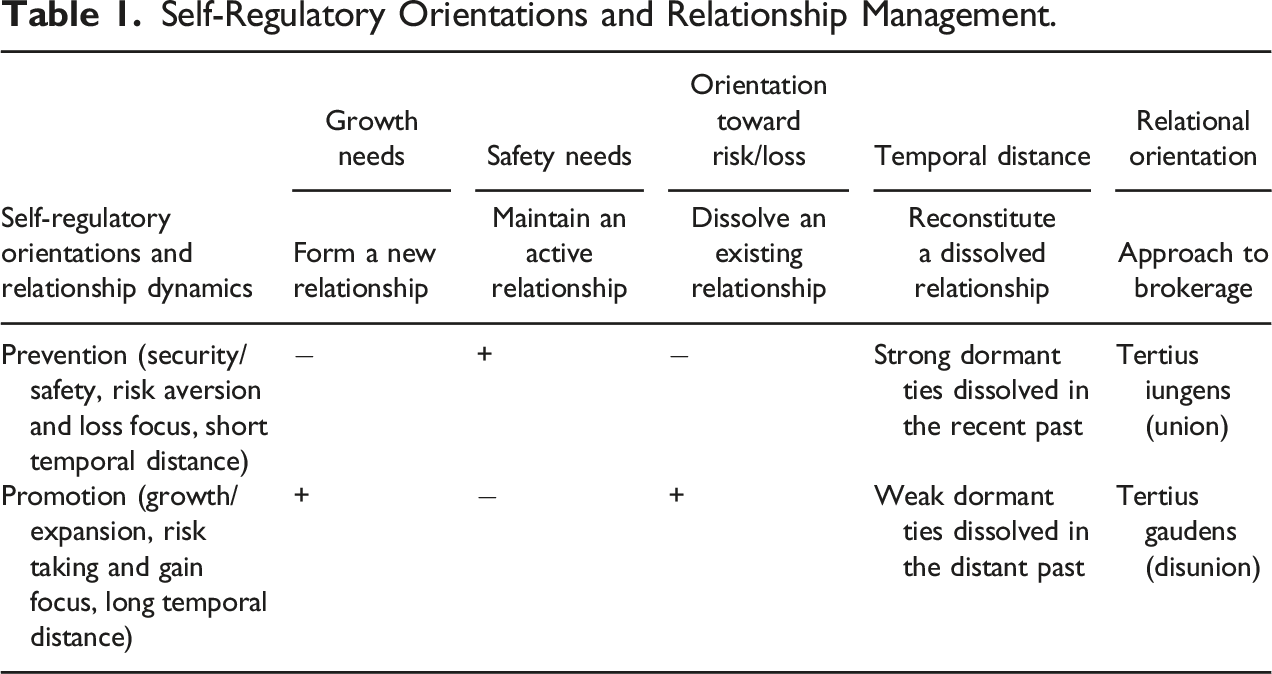
Overall, our theory suggests that an individual’s chronic motivational orientation influences the relational processes of tie formation, maintenance, dissolution, and reconstitution as well as their choice of relational orientation. Table 1 summarizes our predictions outlined in Propositions 1–6.
Self-Regulatory Orientations and Relationship Management.
Motivational Profiles and Network Structuring
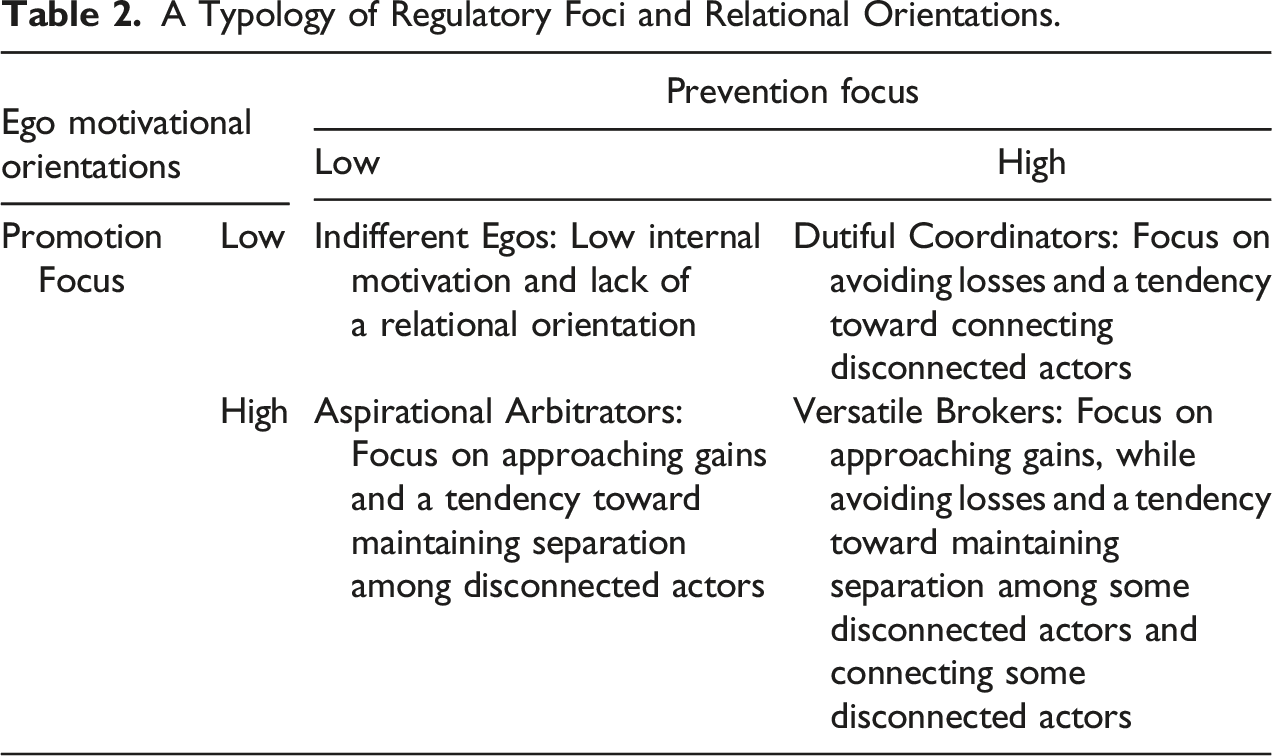
While we developed our predictions about the formation, maintenance, dissolution, and reconstitution of ties and the choice of relational orientation on the basis of the two self-regulatory systems that shape the overarching concerns and goals of individuals (i.e., promotion and prevention), regulatory foci are empirically orthogonal dimensions and individuals can be simultaneously characterized by one predominant focus, high levels of both foci, or low levels of both foci (Gorman et al., 2012; Lanaj et al., 2012; Scholer & Higgins, 2008). Similarly, while union and disunion relational orientations are generally stable, in that egos tend to subscribe to a particular orientation over time (Obstfeld et al., 2014), recent research has also suggested that brokers can implement the two orientations simultaneously or sequentially (Lingo & O’Mahony, 2010; Quintane & Carnabuci, 2016). For instance, brokering relationships between long-term and short-term contacts may require different relational orientations (Quintane & Carnabuci, 2016). Furthermore, Lingo and O’Mahony (2010) showed that different orientations are called for when managing a creative process under uncertainty. Thus, we consider four possible motivational profiles—predominant promotion focus, predominant prevention focus, high promotion and prevention focus, and low promotion and prevention focus—and explore how each profile relates to the relational orientations of tertius gaudens and tertius iungens.
A Typology of Regulatory Foci and Relational Orientations.
Aspirational arbitrators
Aspirational arbitrators are characterized by high promotion and low prevention regulatory foci with a strong preference/tendency to use disunion strategy in their networks. These individuals are likely to establish new relationships at a high rate, considerably expanding the boundaries of their social network. Processes that make actors’ attributes salient during tie formation and that connect similar others are unlikely to influence aspirational arbitrators’ interactions with others, resulting in a nexus of diverse ties to disconnected alters or social groups. The heterogeneity and the associated non-redundancy among alters’ ties in the network are further enhanced by ego’s low motivation to maintain existing ties, low concern with dissolving relationships, and a focus on reconstituting weak ties that were dissolved in the distant past.
Aspirational arbitrators use the resulting structural holes in their network to advance their goals through disunion brokerage (Obstfeld et al., 2014). Burt and colleagues’ (1998) findings demonstrate that individuals occupying positions that are surrounded by structural holes characterize themselves as “independent outsiders…in search of authority…thriving on advocacy and change” (1998, p. 76). These characteristics are well-aligned with the underlying cognitive-behavioral profile of high promotion/low prevention focus, which embraces change over status-quo commitment.
While the disunion orientation can help aspirational arbitrators maximize the benefits accrued from maintaining the separation among their alters “actively or through purposeful inaction” (Obstfeld et al., 2014, p. 145), it is unlikely to offer protection benefits, since the absence of connections among alters (and their alters) prevents the collective mobilization of resources for the ego when protection is called for (Coleman, 1990; Krackhardt & Stern, 1988). Aspirational arbitrators also do not focus on downside risks (e.g., alter resentment) and losses (e.g., alter turnover) associated with the disunion orientation because they have high tolerance to risky interpersonal actions, are less motivated to maintain existing ties, and are less concerned with losses associated with intermediating relationships. As a result, alters may come to perceive aspirational arbitrators as instrumental, which may result in higher alter turnover. Indeed, prior research has shown that bridge relations decay at a rate of 92% within their first year (Burt, 2010). Networks with high rate of change can provide access to alters with a wide array of skills, knowledge, and experience and “enhance the instrumental value” of aspirational arbitrators’ network (Bakker, Hendriks, & Korzilius, 2022, p. 182). Such benefits can subsequently result in positive outcomes for the ego, including career promotion (Bakker et al., 2022). Indeed, Shea and Fitzsimons found that individuals with advancement goals tend to be more likely to realize the instrumental value of their network contacts, and in the pursuit of these goals, they activate networks that are less dense, giving them access to a wide array of resources.
Prior research has also shown that individuals with networks rich in weak ties and structural holes have greater access to contacts in a variety of functional areas outside their own expertise as well as contacts at higher levels in the organization (Seibert, Kraimer, & Liden, 2001). Seibert and colleagues found that such access is in turn positively associated with career success, including higher salary levels, greater number of promotions, and higher career satisfaction.
Dutiful coordinators
In direct contrast to aspirational arbitrators, dutiful coordinators are characterized by high prevention and low promotion regulatory foci with a strong preference/tendency to use union strategy in their networks. Dutiful coordinators are likely to establish new relationships at a low rate, resulting in a relatively small social network. Their network consists of redundant relationships and fewer structural holes because dutiful coordinators are not only motivated to maintain and unlikely to dissolve existing ties, but they are also focused on reconstituting strong ties that were dissolved in the recent past.
In addition, dutiful coordinators take an active role in coordinating relationships among alters through a union strategy. The union orientation is community-oriented in terms of the distribution of its rewards, such that egos’ approach to brokering structural holes by coordinating relationships between alters helps generate shared network benefits that can be appropriated by not only the ego but also their alters. This helps build a social identity, which is highly salient to the needs of dutiful coordinators. Our theorizing is consistent with prior research that provided support for the notion that an interdependent self-conception is associated with prevention focus, whereas an independent self-conception is associated with promotion focus (Lee et al., 2000). Consistent with their high prevention/low promotion focus, dutiful coordinators are driven by the need to satisfy duties, obligations, and responsibilities that partly involve creating benefits for the community within which they are embedded. Kalish and Robins’ research showed that individuals who have “allocentric values, such as obedience, security and duty” have networks with high degree of closure (2006, p. 79). Burt, Jannotta, and Mahoney (1998) also showed that individuals occupying closed networks characterize themselves as “conforming and obedient insiders… [in search of] security… [thriving on] stability” (1998, p. 76). Furthermore, closed networks also offer egos reputational and status benefits (Burt & Merluzzi, 2016). A union orientation is inherently geared toward creating a network with higher degrees of closure, which is more conducive to offering protection to the ego as alters forge new ties with the ego’s involvement, which may motivate them to mobilize resources to help the ego when safety and security are called for (Coleman, 1990; Krackhardt & Stern, 1988).
Prior research has shown that individuals with networks with high closure tend to have poorer performance than individuals with greater access to structural holes (Burt, Kilduff, & Tasselli, 2013); however, the motivation to cooperate and share valuable resources, such as knowledge, with others is higher in closed networks and among contacts with strong ties to one another because they are associated with higher levels of trust and reciprocity (Brass et al., 2004; Higgins & Kram, 2001). Thus, when the focus is on cooperation and knowledge sharing, dutiful coordinators may perform better than individuals with sparse networks (Gargiulo, Ertug, & Galunic, 2009).
Versatile brokers
Versatile brokers are high in both promotion and prevention focus, in that they are motivated to both pursue gains and avoid losses. As a result, these individuals are likely to use multiple brokerage orientations (i.e., union and disunion) simultaneously or over time. Versatile brokers’ growth and advancement needs make them likely to establish new relationships, yet their need for safety and security suggests that they will engage in some monitoring when adding new alters to their network. Thus, versatile brokers will evaluate the attributes of actors before forming new ties and choose to add alters they consider to have the potential to offer the greatest gain at the lowest risk. Versatile brokers are driven by both personal aspirations and ideals as well as duties and oughts. On the one hand, their prevention orientation motivates them to maintain relationships to which they are more committed and that are characterized by trust (i.e., strong ties), as they allow them to focus on oughts and provide security and safety (Coleman, 1990). On the other hand, their promotion orientation motivates them to embrace change by dissolving ties to alters that are unlikely to offer the ego protection benefits (i.e., weak ties) and free up resources to be utilized in other areas of their network. Similarly, in reconstituting dormant relationships, versatile brokers have to manage simultaneous needs to approach gains and avoid losses. Reconstituting strong ties dissolved in the recent past speaks to versatile brokers’ sensitivity to losses and general avoidance of risk. Reconstituting weak ties dissolved in the distant past offers access to novel information and helps maintain a certain level of dynamism and change in the network.
Thus, versatile brokers’ resulting network will be of moderate size with a relative balance between strong and weak ties, allowing them to behave strategically when managing relationships with alters. On the one hand, advancement and growth goals can be realized through maintaining the separation between alters (i.e., disunion) with weak ties to the ego, because their promotion orientation motivates them to seek novel information and prioritize control and status benefits. As the relative importance of alters to the ego declines (i.e., weak ties), versatile brokers can afford to exploit or control the information flow when managing their disconnect. On the other hand, the emphasis on protection, safety, and security motivates versatile brokers to coordinate relationships by connecting alters (i.e., union) with strong ties to the ego. This relational orientation not only offers collective benefits that can be partly appropriated by alters but also reduces the risk that alters will view the ego’s networking behavior as inappropriate and withdraw from the relationship. These expectations are in line with prior research that has suggested that individuals high in both promotion and prevention focus are more likely to exhibit ambidexterity in other contexts (e.g., learning) (Tuncdogan, Van Den Bosch, & Volberda, 2017). Their ability to switch between relational orientations, suggests that versatile brokers are likely more skillful at brokerage than those that have a primary salient orientation (Obstfeld et al., 2014). Recent work by Lingo and O’Mahony (2010), Quintane and Carnabuci (2016), and Burt and Merluzzi (2016) provide evidence of and discuss the complex ways in which individuals can balance different relational orientations. For instance, according to Burt and Merluzzi, individuals who shift between engaging in groups where most contacts have ties to one another and brokering across groups of disconnected others are able to achieve higher performance than individuals who maintain stability in their network and remain embedded either in dense networks (e.g., dutiful coordinators) or in networks rich in structural holes (e.g., aspirational arbitrators). Furthermore, Carnabuci and Quintane (2022) showed that individuals that tend to follow their preferences when it comes to building their networks perform worse than those that develop networks that are complementary to their natural cognitive style. Thus, versatile brokers engaging in such sequential shifts in networking behavior may achieve higher than average performance.
Indifferent egos
Indifferent egos’ low promotion focus and low prevention focus suggest they are neither strongly intrinsically motivated to pursue gains nor concerned with avoiding losses. This lack of an internal motivational orientation may indicate reluctance to actively form, change, or structure one’s network. Indifferent egos are more likely to have fixed beliefs about the efficacy of networking or negative views of the value of networking—there is little to gain from networking and little to lose from not networking. Recent research has suggested that some individuals have fixed beliefs that networking is of low utility and does not feel morally right, making them reluctant to form new ties, maintain existing ties, or engage in brokering (Kuwabara et al., 2018, 2020). Thus, we expect the networks of indifferent egos to be small and relatively stable over time, whereby changes that do occur are unlikely to be the result of purposeful action by the ego him/herself but rather, initiated by others with more aggressive network motivations and strategies. Indifferent ego’s low engagement in networking suggests they are likely less experienced and/or skilled at brokerage, making them less likely to assume brokerage roles whether they involve union or disunion orientations.
In their review, Brass, Galaskiewicz, Greve, and Tsai (2004) suggest that findings of prior research provide general evidence that having a limited number of ties at work decreases job satisfaction as not having a social network will likely reduce mental wellbeing and result in lack of social support. Similarly, individuals with small networks are less likely to have control over valuable resources and as a result hold less power within the organization, get promoted less, and have poorer performance (Brass et al., 2004).
Discussion
Despite decades of work on understanding the role of motivation on behavior in organizational settings, prior research on social networks has paid limited attention to the motivational drivers of egos’ formation, change, and structuring of networks. We addressed this issue by presenting a motivational theory of networks, grounded in RFT and the brokerage literature. In line with prior organizational research, yet departing from existing network literature, we examined ego motivation as a critical construct in advancing our understanding of behaviors that drive network ties. Our predictions (Table 1) and typology outlining four major ego-level configurations (Table 2) provide an alternative interpretive lens for understanding how individuals vary in terms of how they form, change, and structure their networks (Johnson et al., 2015). Below, we discuss the implications of our theory for research on regulatory focus theory and social networks.
Implications for RFT
A key implication of our research for RFT is its elaboration of the role that regulatory foci play in the context of social relationships. As one of the contemporary theories of organizational motivation, RFT has been used as an explanatory lens in a variety of areas of leadership, entrepreneurship, organizational behavior, and management (Johnson et al., 2015). However, the actor-centric focus of RFT has limited the amount of research that has critically examined the role of self-regulation in social networks. In an exemplary work in this area, Robins and Boldero (2003) drew on self-discrepancy theory to explore how discrepancies between actors in terms of ideal–ought self-representations motivate them to form and/or maintain relationships. We complement and advance this research by specifying the direct effects of regulatory orientations on relational processes. Moreover, we explain how individuals with distinct regulatory orientations assume different relational orientations and shape their ego network structures. In addition, our framework advances new knowledge by examining how egos who lack a strong chronic regulatory orientation (i.e., Indifferent Egos) or who simultaneously possess high levels of promotion- and prevention focus (i.e., Versatile Brokers) construe and construct their networks.
Organizations increasingly demand employees to simultaneously exhibit characteristics that are associated with prevention (e.g., dutifulness and accountability) and promotion (e.g., eagerness and ambition) foci. Thus, it is not only theoretically interesting but also practically relevant to consider individual differences in networking strategies and structures as key mediating mechanisms that link individual motivation to performance. On the one hand, we argued that versatile brokers, who are high in both promotion and prevention focus, are motivated to use both union and disunion relational orientations in structuring their networks. Recent research by Burt and Merluzzi provided evidence that performance is highest when individuals can skillfully switch between “deep engagement in a group (closure)” and “connecting across groups (brokerage)” (Burt & Merluzzi, 2016, p. 368). On the other hand, we theorized that indifferent egos, who are low in both foci, are not strongly motivated to actively manage their relationships. Thus, we expect the network structures of individuals without a strong regulatory focus orientation to develop due to factors exogenous to them, such as others’ networking preferences, rather than as a result of their individual agency. In this regard, we believe that exploring how ego-level configurations relate to important outcomes (e.g., career success and compensation) as well as potential contingencies affecting these relationships to be a fruitful direction for future research. Randel and Ranft’s (2007) work offers opportunities to extend our research and explore outcomes beyond individual performance such as interorganizational information exchange. The authors distinguish between different motivations to maintain social ties at work and how such motivations are related to information exchange with contacts outside of work. Their findings show that individuals with a job facilitation motivation, who seek to maintain “social ties that help improve one’s success on the job” are more likely to engage in interorganizational information exchange than those with a relationship motivation, who seek to maintain “social ties that enhance one’s personal friendships and social support with others in the workplace” (2007, p. 211). Examining how these motivations are manifest in each of the four ego-level configurations presented in our theory would also be an important and interesting extension.
Finally, while our focus in this paper is on the general preferences of individuals as driven by their promotion/prevention focus, it would be interesting for future research to explore how promotion- and prevention-focused individuals may act when a situation stimulates the opposite orientation. For instance, the COVID-19 pandemic has led many organizations to adopt hybrid (partially remote) or fully remote work modalities. This creates a work environment characterized by disruptions to individuals’ networks including losses of existing relationships. For instance, Yang, Soltis, Ross, and Labianca (2021) showed that individuals may reconstitute dormant ties as a coping mechanism in response to heightened levels of uncertainty and stress during the pandemic. Wu, Antone, Srinivas, DeChurch, and Contractor (2021) found that during the pandemic, employee networking behavior within and between teams differed based on performance. In the context of our research, the transition to remote work may stimulate prevention-focused individuals to adopt a more risky bias (promotion tactic), such as actively seeking ways to interact with and develop new ties with colleagues. Researchers may draw on the hierarchical conceptualization of RFT—system, strategic, and tactical levels of regulatory focus—(Johnson et al., 2015)—and the concept of regulatory fit (Higgins, 2000) to explore the interaction of personality, strategy, and networking behaviors in the contemporary workplace.
Implications for Theorizing on Social Networks
Social network theory, with its emphasis on brokerage, has remained a prominent theoretical lens in the study of organizational processes and outcomes at various levels of theorizing (Borgatti & Foster, 2003). Yet, research attention has been disproportionately placed on the role of structure on brokerage and social capital in individuals’ networks resulting in limited emphasis on individual agency in social networks (notable exceptions include Burt & Merluzzi, 2016; Parker et al., 2016; Quintane & Carnabuci, 2016). Research on network dynamics (Ahuja et al., 2012; Jacobsen, Stea, & Soda, 2022) addresses temporal issues in networks such as tie formation (e.g., Gulati et al., 2012). This research has been influential in not only uncovering the microfoundations and microdynamics of networks but also highlighting the role of agency in network evolution. However, motivation, a critical aspect of agency, has generally been overlooked in network research (Casciaro et al., 2015). Only recently has research begun to address this important omission (e.g., Brennecke, 2020; Kuwabara et al., 2018; Porter & Woo, 2015). We build on these advances and provide insights into how egos’ motivational orientations determine brokerage within and structural properties of egos’ networks. In addition to helping explore the role of agency in network dynamics, our integration of motivational orientations, tie strength (strong/weak), and alternative forms of dormant ties (i.e., dormant ties with recent and distant dissolution histories) offers important new insights into the antecedents of reconstitution of different types of latent relationships that exist in social networks (Mariotti & Delbridge, 2012), and as a result, represents an important addition to the network literature and a promising new direction for future research. It would also be interesting to explore how brokers broker in the hybrid workplace where the primary communication medium has changed and many of the interactions between individuals have moved partially online. For instance, do structural advantages that some egos in the network enjoy, dissipate faster in the hybrid workplace? Are there novel tactics that egos are using to obtain/maintain their structural advantages? Do versatile brokers fare better in the hybrid workplace given their capacity to switch between or simultaneously pursue a union and disunion strategies? Are the outcomes of brokerage different because remote interactions make it more difficult for alters to form social perceptions of the ego’s brokerage (Iorio, 2022)? Furthermore, research shows that the benefits of bridging ties are greater when they are characterized by trust (Levin et al., 2016). In the aftermath of the pandemic, and with transition to remote work, it would be interesting to examine how diminishing levels of face-to-face interaction influence trust formation in social groups in ways that may also affect the effectiveness with which structurally advantaged individuals accrue benefits from their bridges. We hope future research will build on our framework to explore these among other interesting questions.
Empirical tests of our propositions may assess the effect of promotion and prevention foci in conjunction with other personality characteristics (e.g., Big Five) that could be of relevance to network tie formation and change. Another interesting future research opportunity is to explore the extent to which relationship formation and management are contingent on the motivational and relational orientation profiles of senders and receivers of ties. For instance, are dutiful coordinators more likely to develop ties with aspirational arbitrators because of their complementarities or less likely to do so because of their noticeable differences? Furthermore, recent research has suggested that employees’ networks have important implications for how they are perceived by their supervisors (Whitney, Henry, & Bradley, 2022). It would be interesting to study how ego-level configurations are related to leader-member exchange differentiation. Finally, employee performance has been shown to be influenced differently by social exchanges with supervisors, top management, and colleagues outside of their immediate work group (Brandes, Dharwadkar, & Wheatley, 2004). Future research can explore whether differences exist in the motivational and relational orientations of egos depending on their position within the organization as well as the composition of the ego’s network. Examining these and similar questions that can be derived from our typology is important from a theoretical and practical standpoint, as a better understanding of the determinants of network dynamics can inform organizational leaders’ decisions regarding the configuration of teams in the workplace.
Conclusion
Examining individual differences in motivational and relational orientations is an important means to developing a more comprehensive understanding of the dynamics and structure of social networks. With this foundational idea, we set out to uncover new knowledge about the role of individual agency in social networks and developed a new perspective that integrates regulatory focus and brokerage theories to explain why ego networks develop the way they do. Specifically, we examined how promotion and prevention foci affect tie formation, maintenance, dissolution, and reconstitution, and interact with relational orientations (i.e., union and disunion) to shape ego networks. The four ego-level configurations labeled dutiful coordinators, aspirational arbitrators, versatile brokers, and indifferent egos offer specific, testable predictions with respect to how individuals’ networks develop and change. We hope that our theoretical perspective will be instrumental in inspiring new, boundary-spanning research on brokerage in social networks, one that systematically focuses on the role of individual differences in personality, motivation, and behavior as a complement to structuralist approaches to understanding social network dynamics.
Footnotes
Acknowledgments
We thank Dr. Joanna T. Campbell for her valuable comments and feedback on an earlier version of this article.
Declaration of Conflicting Interests
The author(s) declared no potential conflicts of interest with respect to the research, authorship, and/or publication of this article.
Funding
The author(s) received no financial support for the research, authorship, and/or publication of this article.
Associate Editor: James Vardaman
