



Abstract
The authors proposed the construct of workplace social self-efficacy (WSSE) and developed an inventory to measure it. Two empirical studies were conducted to examine the psychometric properties of this new measure. In Study 1, we described the development of the WSSE inventory and explored its factor structure in a sample of 304 full-time employees. Participants in Study 2 were 137 full-time employees (who provided self-report data) and 371 coworkers of these employees (who submitted peer ratings). Results showed that the WSSE inventory had a four-factor structure (social gathering, performance in public contexts, conflict management, and seeking and offering help), high internal consistency, excellent convergent and discriminant validity, and meaningful correlation patterns with related constructs in the nomological network. Furthermore, political skill was found to mediate the relationship between WSSE and several outcome variables. In addition, the WSSE inventory was found to have some advantages over the Perceived Social Self-Efficacy scale (Smith & Betz, 2000), a general social self-efficacy measure. Theoretical and practical implications were discussed.
Success in most jobs has a social component. Employees may need to establish interpersonal relationships, present work to others, participate in social groups or gatherings, or seek or offer help in order to perform effectively. Given the central role of social relationship quality in determining employees’ work experiences (e.g., Liden, Wayne, & Sparrowe, 2000; Liu, Nauta, Spector, & Li, 2008; Scott & Judge, 2009) and the ever-increasing social interaction demands in the workplace (Ilgen & Pulakos, 1999), it is no surprise that social effectiveness constructs have proliferated (for a review, see Ferris, Perrewé, & Douglas, 2002). What is missing from the literature, however, is an empirical sense of how various social effectiveness constructs might overlap and how they might be unique (Ferris et al., 2007).
In this article, we address aspects of the segmentation of the domain of social effectiveness at work by developing a conceptual and empirical argument for the utility of workplace social self-efficacy (WSSE), which we define as an employee’s confidence in his or her ability to engage in job-related social interactional tasks and to develop and maintain effective interpersonal relationships with other employees in his or her organization (cf. Smith & Betz, 2000). We use theory related to self-efficacy (Bandura, 1986, 1997) to articulate a clear conceptualization of an important, potentially malleable antecedent of social components of work performance. Our measure exhibits appropriate convergent and discriminant validity with other interpersonal effectiveness measures tied to work and nonwork domains. We contribute to research concerned with the social aspect of work performance by providing evidence that this domain-specific measure of social effectiveness complements other important measures (e.g., political skill, popularity) in ways that may facilitate answers to questions that are of interest to vocational and organizational scholars.
Theory and Hypotheses
Self-efficacy is defined as “people’s judgments of their capabilities to organize and execute courses of action required to attain designated types of performance” (Bandura, 1986, p. 391). Although self-efficacy has been measured in many ways, ranging from a general trait (Chen, Gully, & Eden, 2001) to a highly situation-specific phenomenon (e.g., Bandura & Cervone, 1986), many researchers interested in the employment sphere have measured self-efficacy at an intermediate level in order to capture a relatively specific domain (e.g., job search, creativity) while maintaining some general use properties of the measure. Included among these are test-taking self-efficacy (Truxillo, Bauer, Campion, & Paronto, 2002), technology self-efficacy (Mathieu, Ahearne, & Taylor, 2007), job search self-efficacy (Brown, Cober, Kane, Levy, & Shalhoop, 2006), and creative self-efficacy (Tierney & Farmer, 2002). Various self-efficacy concepts and measures have greatly enhanced our understanding of human behavior in organizational settings.
However, little is known about individuals’ self-efficacy perception within the social interaction domain in the workplace. The vast majority of studies that have examined the construct of social self-efficacy have focused on children or adolescents (e.g., Connolly, 1989; Wheeler & Ladd, 1982) rather than adults. Although there are a few adult social self-efficacy measures in the literature (for a review, see Smith & Betz, 2000), none of them were designed specifically to measure WSSE. This omission is unfortunate because, as noted above, self-efficacy is usually measured with at least some degree of domain specificity. Furthermore, the workplace contains many social features (e.g., explicit hierarchy, reward systems, etc.) that are either not present or may be quite different from other social milieus. Thus, attempts to examine more general measures of self-efficacy or those borrowed from other domains may underrepresent or even misrepresent the role of self-efficacy in social processes at work. At the same time, social effectiveness has been included in vocation-specific measures such as teacher self-efficacy (e.g., Skaalvik & Skaalvik, 2007) and counselor self-efficacy (e.g. Larson, 1998); however, their narrow focus on specific occupations limits their utility for broader workplace use. Given the apparently widespread belief that social effectiveness is important to performance in many jobs, a measure that is broad enough to cover a variety of jobs but still tailored to work organizations has the potential to contribute to future research on occupational success by relieving researchers of the need to construct and validate de novo measures of social self-efficacy for every job or occupation studied while providing better domain specificity than social measures that do not take into account work environments.
Social self-efficacy has been recognized as potentially important to the understanding of social effectiveness at work. For instance, Ferris et al. (2007) include self-efficacy as a key antecedent to aspects of their conceptualization of political skill. According to Ferris et al. social self-efficacy captures the extent to which people feel a sense of capability to influence their social environment through their actions, and this sense of capability may be a critical determinant of some aspects of political skill. However, social self-efficacy has received essentially no research attention from organizational scientists (Ferris et al., 2002). Our view is that the understanding of self-efficacy’s role in workplace social relationships might be facilitated through a better targeting of self-efficacy to the workplace social domain.
Prior Adult Social Self-Efficacy Measures
Although we target the work domain specifically, it is important to note that there are several measures of overall social self-efficacy of adults available in the literature; however, most of them tend to be either psychometrically problematic or conceptually too narrow (Smith & Betz, 2000). For instance, items of the social self-efficacy subscale of Sherer et al.’s (1982) Generalized Self-Efficacy scale were derived post hoc, based on exploratory factor analysis, rather than a priori. Researchers have consistently reported less than optimal coefficient αs for this measure (around .70). Fichten, Bourdon, Amsel, and Fox’s (1987) Interaction Self-Efficacy Questionnaire focuses on college students’ interactions with the same sex. The social skills subscale of the Skills Confidence Inventory (Betz, Harmon, & Borgen, 1996) is limited to vocational activities and school subjects. Fan and Mak’s (1998) Social Self-Efficacy scale for Students is intended for intercultural social contexts. Thus, these measures are apparently inappropriate for general workplace use.
Perhaps, the best adult social self-efficacy measure for general use to date is the 25-item “Perceived Social Self-Efficacy (PSSE)” scale (Smith & Betz, 2000). Smith and Betz (2000) define social self-efficacy as “an individual’s confidence in his or her ability to engage in the social interactional tasks necessary to initiate and maintain interpersonal relationships” (p. 286). PSSE items cover social tasks relating to making friends, social assertiveness, pursuing romantic relationships, performance in public situations, groups or parties, and receiving and giving help. According to several empirical studies (e.g., Lin & Betz, 2009; Smith & Betz, 2000; Xie, 2007), scores from the PSSE scale have demonstrated excellent psychometric properties. For instance, the α coefficients were in the .90s, and the 3-week test–retest coefficients were in the low .80s. Smith and Betz (2000) reported that the PSSE scale had a single-factor structure and was strongly correlated with several alternative social self-efficacy measures. Furthermore, PSSE scores were consistently found to be negatively correlated with scores in shyness, social anxiety, and depression, but positively correlated with scores in personal self-esteem.
Despite the excellent psychometric properties of the PSSE scale, it lacks ideal properties to measure WSSE. First, PSSE items focus on behaviors in general, not workplace, social contexts. Such a difference in level of specificity might have important consequences. For instance, there has been emerging evidence for the frame-of-reference effect which suggests that work-specific personality measures are more powerful predictors of work-related criteria than general personality measures (e.g., Bing, Whanger, Davison, & VanHook, 2004; Wang, Bowling, & Eschleman, 2010). Second, the “pursuing romantic relationships” domain might not be appropriate in organizational settings. Third, items in the PSSE scale exclusively focus on nonconflict social situations, but conflict situations are a potentially important element of the workplace social domain (e.g., De Dreu & Weingart, 2003). A conflict situation is one in which an individual’s feelings, beliefs, or desired outcomes are not aligned with someone else’s feelings, beliefs, or desired outcomes; whereas a nonconflict situation does not contain any form of contradiction of goals between two or more people (Wheeler & Ladd, 1982). Together, these aspects of extant social self-efficacy measures suggest that none is especially well suited to the workplace. Given our discussion of the need for a measure targeted to the social domain of the workplace and the state of existing measures, we conclude that a new measure is needed.
Scope and Nomological Network of WSSE
Despite its focus on the domain of work, WSSE is perhaps broader in scope than several more discrete, socially related self-efficacy concepts such as leadership self-efficacy (Ng, Ang, & Chan, 2008), team collective efficacy (Tasa, Taggar, & Seijts, 2007), and participation self-efficacy (Lam, Chen, & Schaubroeck, 2002). Consistent with our definition, we envision the WSSE construct as potentially applicable to many workplace social relations that may or may not take place within or between teams, or across hierarchies or other structural boundaries. WSSE is shaped by the positive emphasis on perceived capability inherent in self-efficacy constructs. In this vein, we expect that WSSE will display positive relationships with many other social effectiveness constructs. One reason for such relationships may be conceptual overlap between constructs in the workplace social domain (Ferris et al., 2002), but Ferris et al. (2007) have also suggested that self-efficacy may be considered an antecedent of political skill.
We use Smith and Betz’s (2000) PSSE scale and Ferris et al.’s (2005) Political Skill Inventory (PSI) to examine the convergent validity of the WSSE inventory. While PSSE is a general social self-efficacy construct, political skill is a workplace-specific social effectiveness construct, defined as “the ability to effectively understand others at work, and to use such knowledge to influence others to act in ways that enhance one’s personal and/or organizational objectives” (Ferris et al., 2005, p. 127). We hypothesize that WSSE scores should have positive and strong correlations with PSSE scores and PSI scores (Hypothesis 1a). We use the using technology subscale from Betz et al.’s (2003) Expanded Skill Confidence Inventory (ESCI), an apparently nonsocial domain self-efficacy measure, to assess the general discriminant validity of the WSSE inventory. Compared to the correlation between WSSE scores and PSSE scores and the correlation between WSSE scores and PSI scores, we hypothesize a much weaker correlation between WSSE scores and ESCI scores (Hypothesis 1b).
We use Pierce, Gardner, Cummings, and Dunham’s (1989) measure of organization-based self-esteem as a second, organizationally relevant source of convergent validity evidence. Organization based self-esteem (OBSE) is defined as “the degree to which an individual believes himself or herself to be capable, significant, and worthy as an organizational member” (Pierce & Gardner, 2004, p. 593). An employee with a high level of WSSE is more likely to effectively complete the social aspects of the job and develop and maintain good interpersonal relationships with his or her coworkers than his or her low WSSE counterparts, and in turn to have a strong sense of “I count here,” that is, a higher level of OBSE. Further, Judge, Locke, and Durham (1997) found that, at the trait level, self-efficacy and self-esteem are related “core” self-evaluations. Thus, we hypothesize a positive correlation between WSSE scores and OBSE scores (Hypothesis 2).
We also expect WSSE to function somewhat differently from other social effectiveness constructs. Ferris et al. (2002) noted that many social effectiveness constructs, such as emotional intelligence, self-monitoring, and political skill, entail two major components: (a) the ability to accurately understand (or read) various social situations and (b) the capability to act on that understanding by carrying out appropriate behavioral strategies. However, WSSE does not fit this framework; instead, it simply focuses on the perceived ability in completing a variety of specific social tasks required at work. Indeed, other research on domain self-efficacy suggests that individuals are more likely to direct resources toward goals for which they feel high self-efficacy, but that the magnitude of the resources people allocate is lower when they feel high self-efficacy (Vancouver, More, & Yoder, 2008). Thus, self-efficacy may come with a situational blindness that is consistent with an ability perception but inconsistent with a careful analysis of task context (cf. Ferris et al., 2002).
In the workplace social domain, this suggests that an important difference between WSSE and many other constructs dealing with workplace social effectiveness may be that WSSE does not include in the construct concepts of social perception, comparison, or judgment that are involved in analyzing social situations. Such a difference might have important consequences. For instance, social effectiveness constructs adhering to Ferris et al.’s (2002) framework should display relationships with impression management (IM) and conflict avoidance, though different constructs might display these relationships due to different mechanisms (cf. the role of emotions in emotional intelligence, Salovey & Meyer, 1990; the connotation of self-serving and controlling of others in political skill, Ferris et al., 2007). In contrast, the WSSE construct, which does not include explicit analysis of social situations, should not be strongly associated with IM or conflict avoidance. Therefore, we hypothesize that compared to political skill (a construct that does follow Ferris et al.’s framework), WSSE scores should have weaker correlations with IM scores (Hypothesis 3a) and workplace interpersonal conflict scores (Hypothesis 3b).
We consider two more distal sets of WSSE-related criteria. The first set includes two strain variables: physical symptoms and job-related affective well-being. The occupational health psychology literature has convincingly established that one major source of stress at work is interpersonal in nature (e.g., Spector & Jex, 1998). If, as argued earlier, employees with a high level of WSSE are expected to have effective interpersonal relationships with others at work, and thus tend to experience less interpersonal stress, they will also have less strain, indicated by less physical symptoms and more positive emotional reactions at work. Such outcomes are consistent with characterizations of self-efficacy as a key concept in the regulation of motivation, cognition, and affect (Bandura, 1986, 1997). Thus, we hypothesize that WSSE scores will have a negative correlation with physical symptoms scores (Hypothesis 4a) and a positive correlation with job-related affective well-being scores (Hypothesis 4b).
The second set of distal criteria we consider are three coworker-rated variables: (a) popularity, defined as “being generally accepted by one’s peers” (Scott & Judge, 2009, p. 21), (b) interpersonal counterproductive work behaviors (CWB-I) targeted (Porath, Pearson, & Shapiro, 1999), and (c) interpersonal organizational citizenship behaviors (OCB-I) targeted (Lee & Allan, 2002). Because employees with a high level of WSSE are apt to develop and maintain good relationships with others in the organization, they are likely to be liked and accepted by their coworkers, and their coworkers are less likely to mistreat them and more likely to help them at work. This argument is arguably not directly predicted by self-efficacy theory per se but, assuming that the behaviors directed by self-efficacy do have some effect on the environment, it is expected to logically follow from self-efficacy theory. Reciprocal effects of positive social behaviors inspired by high WSSE are also in line with Blau’s (1964) social exchange theory. Thus, we hypothesize that WSSE scores should have a positive correlation with peer-rated popularity scores (Hypothesis 5a), a negative correlation with CWB-I targeted scores (Hypothesis 5b), and a positive correlation with OCB-I targeted scores (Hypothesis 5c).
Ferris et al. (2007) conceptualize social self-efficacy as an antecedent of political skill; however, no empirical study has investigated this relationship. Expanding on this point, we test whether political skill mediates the relationship between WSSE and aforementioned outcome variables. We have argued earlier that WSSE should be related to these outcome variables, and similar relationships can be expected between political skill and the same outcome variables (for a review of political skill, see Ferris et al., 2007). Even when we expect a weaker relationship between WSSE and an outcome variable relative to political skill (i.e., for interpersonal conflict), such a prediction does not eliminate the possibility of an indirect effect through political skill (Hayes, 2009). Therefore, we hypothesize that political skill should mediate the relationship between WSSE and workplace interpersonal conflict (Hypothesis 6a), physical symptoms (Hypothesis 6b), affective job-related well-being (Hypothesis 6c), coworker-rated popularity (Hypothesis 6d), coworker-rated CWB-I targeted (Hypothesis 6e), and coworker-rated OCB-I targeted (Hypothesis 6f).
Finally, we investigate how much of an advantage, if any, does the WSSE inventory have as a domain-specific, WSSE measure over the PSSE scale, a general social self-efficacy measure? Based on the notion of frame-of-reference effect mentioned earlier (e.g., Bing et al., 2004; Wang et al., 2010), we expect that WSSE scores should be more strongly associated with various organizational variables than should PSSE scores. In particular, we hypothesize that WSSE scores should exhibit unique relationships with organizational variables after PSSE scores are controlled for (Hypothesis 7).
In the following, we present two empirical studies validating the WSSE inventory. Study 1 described the development of the WSSE inventory and explored the factor structure of this new measure. Study 2 confirmed WSSE’s factor structure in an independent sample and tested the proposed research hypotheses.
Study 1
Development of the Work Social Self-Efficacy (WSSE) Inventory
We first specified the behavioral domains of WSSE, as per Bandura’s (2005) guidelines. Following Smith and Betz’s (2000) work on the PSSE scale, we designated five similar domains for WSSE: social assertiveness, establishing interpersonal relationships, performance in public contexts, participation in social groups or gatherings, and seeking and offering help, all in the workplace. We excluded the domain of “pursuing romantic relationships” because it deviates from our interest in effective professional relationships. We considered both conflict and nonconflict social situations in each of the five domains. In other words, we attempted to sample workplace social behaviors from two crossed dimensions: (a) content domains and (b) type of social scenarios. Also note that the above five domains differ in the extent to which items describe job-related social tasks versus interpersonal relationship maintenance tasks. For instance, almost all social tasks in the performance in public contexts domain are job-related, whereas many social tasks in the participation in social groups or gatherings domain are related to interpersonal relationship maintenance at work.
We interviewed 15 full-time employees from various types of organizations. These employees held both high and low status positions in their respective organizations and had been working in their jobs for at least 3 years. During these interviews, we asked them to list social tasks they had performed in order to fulfill their job duties and/or develop and maintain effective interpersonal relationships with others at work. These interviews yielded 265 initial items.
Next, we conducted several rounds of intensive discussions within the research team, which consisted of three faculty members and three graduate students in Industrial and Organizational psychology, to screen these initial items. In the first round of discussion, we aimed to screen out items that did not meet our inclusion criteria, that is, a good item must be (a) clearly worded and easy to understand, (b) relevant to our definition of WSSE, (c) applicable to the workplace, and (d) commonly found in many jobs. During the discussion, we also attempted to modify items that met criteria (b), (c), and (d), but not (a), in order to make them useful. The decision to accept or reject an item was based on a majority vote among the research team. At the end of the first round of discussion, 75 items remained. In the second round of discussion, we attempted to categorize the 75 items into predesignated five subdomains, as well as into conflict versus nonconflict social situations. We also assessed items for repetition of concepts and proper placement of items into various categories. Items that were difficult to categorize or repetitive were removed. We note that difficult-to-categorize items did not seem to form any meaningful theme. Item exclusions were based on group consensus. At the conclusion of this round of discussion, 58 items survived.
We then asked 31 subject matter experts (industrial and organizational graduate students) to rate each of the 58 items based on three criteria: (a) whether the item is worded clearly, (b) whether the specific social task is relevant to the definition of WSSE, and (c) whether the social situation in the item is commonly experienced in many jobs/organizations. After analyzing the data, we conducted another round of discussions to further evaluate items with the lowest ratings. Items were eliminated if all members in the research team agreed that they did not match the established criteria. In addition, we continued to reevaluate the clarity and categorization of each item throughout the process. These efforts resulted in 37 semifinalized WSSE items to be empirically examined in the initial validation study. The WSSE inventory asks participants to rate their confidence level in carrying out these 37 workplace social tasks on a 100-point scale (0 = no confidence; 50 = moderate confidence; 100 = complete confidence). This 100-point scale was recommended by Bandura (2005) for self-efficacy scales.
Sample and Procedure
We asked undergraduate students enrolled in one of the three international marketing classes at a private Northeastern U.S. university in the spring semester of 2009 to help with data collection, in exchange for a modest amount of extra credit. Specifically, each student was given several sets of questionnaires, which contained the 37 semifinalized WSSE items and a demographic survey, and was asked to locate full-time employees and then have them complete the questionnaire. We collected contact information from participants to verify that full-time employees (not students) completed the self-report survey. The first page of the surveys, which contained participants’ contact information, was removed after verification. We verified one randomly selected survey returned by each student. If a survey failed the verification, all other surveys contributed by the student were ruled invalid and then discarded.
Students returned 304 completed and verified questionnaires; on average, each student returned 4 completed questionnaires. Among these 304 full-time employees, 51% were female, 47% were male, and 2% did not report their gender information. The average age was 35 years, 52% had at least a bachelor’s degree, the average position tenure was 94 months, and the average weekly working hours was 43 hr. Collectively, these employees worked in 15 different industries, and the organizational levels of their positions were very diverse, ranging from entry-level positions to chief executive officers. Forty-four percent of these employees reported engaging in some sort of social interaction at work at least a couple of times every half day, and 39% reported that their jobs require some sort of social interaction at least a couple of times every half day.
Factor Structure and Internal Consistency of the WSSE Inventory
The 37 × 37 item correlation matrix was subjected to exploratory factor analyses using the Comprehensive Exploratory Factor Analysis (Browne, Cudeck, Tateneni, & Mels, 2004). In determining number of factors to retain, we considered multiple criteria, following the suggestion by Fabrigar, Wegener, MacCallum, and Strahan (1999). The eigenvalue > 1 rule, scree plot, and parallel analysis suggested retaining three or four factors. We then compared the interpretability of obliquely rotated factor loading matrix of these two alternative models. In doing so, we removed items that did not load substantially on any of the factors and items that had high cross-loadings, and we only considered loadings with the minimum magnitude of .50. The above exclusion criteria yielded 22 surviving WSSE items.
Comparisons of factor loading pattern of the three-factor model and the four-factor model led to several observations. First, two factors clearly emerged in both models with exactly identical items. The 6 items loaded highly on the first factor included social tasks related to participating in social groups and gatherings, and thus were named the Social Gathering factor, with an estimated α coefficient of .90. The 6 items loaded highly on the second factor included social tasks related to performance in public contexts, and thus were named the Public Performance factor, with an estimated α coefficient of .92. The second observation was that the third factor in the three-factor model defied a clear interpretation as items did not seem to belong to a single major theme. This factor was split into two separate factors in the four-factor model, with each having a much clearer interpretation. Specifically, the 5 items that loaded substantially on the third factor included social tasks related to seeking and offering help, and thus were named the Seeking and Offering Help factor, with an estimated α coefficient of .83. The 5 items that loaded highly on the fourth factor were in the domain of social assertiveness, but also related to dealing with social scenarios involving potential conflict. The factor thus was named the Conflict Management factor, with an estimated α coefficient of .81.
Based on these results, we chose the four-factor model over the three-factor model to represent the tentative factor structure of the WSSE inventory. It is interesting to note that (a) three of the four factors were completely consistent with our a priori designation of WSSE domains, (b) one predesignated domain, establishing interpersonal relationships, failed to emerge in factor analysis, and (c) items from social assertive domain that dealt with social scenarios involving potential conflict formed the Conflict Management factor.
Next, we conducted a confirmatory factor analysis (CFA) on these 22 WSSE items, imposing the above identified factor structure using LISREL 8 (Jöreskog & Sörbom, 1996). The CFA yielded acceptable model fit: χ2(df = 203) = 778.02, p < .01, Non-Normed Fit Index (NNFI) = .95, Comparative Fit Index (CFI) = .96, standardized root mean square residual (SRMR) = .07. Table 1 presents standardized factor loadings for WSSE dimensions. As can be seen, all factor loadings were significant, with an averaged loading of .75. Thus, we have established a tentative factor structure of the WSSE inventory, which was to be confirmed in an independent sample in Study 2. The α coefficient for the WSSE total inventory was estimated to be .93. Thus, the WSSE inventory and its four subscales had excellent internal consistency.
Standardized Factor Loadings of the WSSE Inventory Based on the Confirmatory Factor Analyses in Studies 1 and 2.

Note. CM = conflict management; HP = seeking and offering help; PP = performance in public contexts; SG = social gathering; WSSE = workplace social self-efficacy.
Factor loadings before parentheses were based on the Study 1 sample; factor loadings within parentheses were based on the Study 2 sample.
We also explored the relationship between WSSE and several demographic variables. Results indicated that WSSE total scores (a) had significant, yet modest correlations with position tenure (r = .11, p < .05), weekly working hours (r = .15, p < .01), and age (r = .14, p < .05) and (b) had nonsignificant correlations with gender and education (ps > .05). It is possible that position tenure and weekly working hours represent opportunities to interact with an individual’s colleagues, the more of which contribute to the enhancement of social self-efficacy.
Study 2
Method
Sample and procedure
We asked graduate students enrolled in a work motivation class and undergraduate students enrolled in one of two international business classes at a private Northeastern U.S. university in the fall semester of 2009 to help with data collection. Specifically, students were to identify two or three full-time employees they know and then give them the survey packages. Full-time employees were instructed by students to complete a self-report questionnaire, and then to distribute the peer-rating surveys to up to five coworkers, who were to independently complete the peer-rating survey. Both self-report questionnaire and peer-rating surveys were enclosed separately in self-addressed, postage-paid return envelopes so that they may be mailed directly back to the researchers.
We collected contact information from participants to verify (a) that full-time employees (not students) completed the self-report survey and (b) that coworkers of full-time employees (not students or full-time employees) completed the peer-report survey. The first page of the surveys, which contained participants’ contact information, was removed after verification. Participants were made aware of this step; therefore, data should be considered anonymous, and self-report and peer-rating surveys were linked through a preassigned survey series number. We verified all employee self-report surveys and those surveys that failed the verification were discarded. We also verified one randomly selected coworker rating survey. If a peer-rating survey failed the verification, all other peer-rating surveys on the same focal participants were ruled invalid and then discarded.
In exchange for students’ data collection effort, they received extra credit in their respective classes. It should be noted, however, full-time employees and their coworkers were not provided any incentives for completing the survey packages. This method of data collection has been used by other organizational researchers (e.g., Harris, Harris, & Brouer, 2009; Liu, Perrewé, Hochwarter, & Kacmar, 2004).
Of the 223 sets of survey packages we distributed, 137 verified self-report surveys and 371 verified peer-rating surveys were returned. Among employees who provided self-report data, 46% were male, 72% had at least a bachelor’s degree, with a mean age of 42 years, a mean of 43 weekly working hours, and average position tenure of 88 months. Respondents represented a wide variety of industries (e.g., finance, information technology, mechanical engineering, education, food & beverage, health care, and government). Approximately, 71% of employees received multiple peer ratings. On average, each employee received 2.71 peer ratings.
Measures
WSSE
The 22-item WSSE inventory was used.
Social self-efficacy
The 25-item PSSE scale (Smith & Betz, 2000) measured general social self-efficacy. Items were rated on a 5-point Likert-type scale ranging from 1 (no confidence at all) to 5 (complete confidence). One sample item is “How confident are you in asking someone for help when you need it.” The α coefficient was .95 in the current sample.
Using technology skills confidence
The 10-item using technology subscale from Betz et al.’s (2003) ESCI was used. Items were rated on a 5-point Likert-type scale ranging from 1 (no confidence at all) to 5 (complete confidence). One sample item is “Use a personal finance software program.” The α coefficient was .93 in the current sample.
IM
Participants’ tendency to engage socially desirable responding was measured by the IM scale from the Balanced Inventory of Desirable Responding (Paulhus, 1988). The IM scale has been widely used in research examining social desirability in noncognitive measures. We used the 12-item short version of the IM scale provided by Delroy Paulhus (personal communication, October 27, 2009). One sample item is “I don’t gossip about other people’s business.” The α coefficient was .74 in the current sample.
Political skill
Ferris et al.’s (2005) 18-item PSI was used. PSI has demonstrated excellent psychometric properties (e.g., Andrews, Kacmar, & Harris, 2009; Liu et al., 2007; also see Ferris et al., 2007, for a review). Items were rated on 5-point Likert-type scale ranging from 1 (strongly disagree) to 5 (strongly agree). Sample items include “I spend a lot of time and effort at work networking with others” and “I understand people very well.” The α coefficient was .92 for PSI scale.
Organization based self-esteem
The 10-item OBSE scale by Pierce et al. (1989) was used. Items were rated on a 5-point Likert-type scale ranging from 1 (strongly disagree) to 5 (strongly agree). One sample item is “I am a valuable part of this place.” The α coefficient was .90 in the current sample.
Workplace interpersonal conflict
The 4-item Interpersonal Conflict at Work scale (Spector & Jex, 1998) was used. Participants were asked to indicate how often they get into arguments with others at work, how often other people yell at them at work, how often people are rude to them at work, and how often other people do nasty things to them at work. Items were rated on a 5-point scale ranging from 1 (less than once per month or never) to 5 (several times per day). Spector and Jex (1998) reported an averaged α coefficient of .74 across 13 studies. The α coefficient was .74 in the current sample.
Job-related affective well-being
We used the 20-item short form of the Job-Related Affective Well-being scale (Van Katwyk, Fox, Spector, & Kelloway, 2000) to measure participants’ emotional reactions to their job. Participants were asked to indicate how often they had experienced 20 emotions at work over the last 30 days. Each item was an emotion and was rated on a 5-point scale ranging from 1 (never) to 5 (always). The α coefficient was .90 in the current sample.
Physical symptoms
The 18-item Physical Symptoms Inventory (Spector & Jex, 1998) assessed participants’ physical, somatic health symptoms. Participants were asked to indicate for each of the 18 symptoms if they did not have it, had it, or saw a doctor for it in the past 30 days. The total physical symptom score was calculated as the summation of the number of symptoms they had. This total score was used in subsequent analyses. Because this is a count variable, the α coefficient is not applicable.
Popularity
The 8-item Popularity scale by Scott and Judge (2009) was used. Coworkers rated the focal employees’ popularity within their work unit. Items were based on a 5-point Likert-type scale ranging from 1 (strongly disagree) to 5 (strongly agree). A sample item is “The person for whom I am completing this survey is popular.” The α coefficient was .92 in the current sample.
Interpersonal counterproductive work behavior (CWB-I) targeted
We adapted the 9-item CWB-I scale by Porath, Pearson, and Shapiro (1999) to measure CWB-I targeted. Items were rated by coworkers of the focal employees on a 5-point Likert-type scale ranging from 1 (almost never) to 5 (very often). One sample item is “How often do this person’s coworkers insult him/her?” The α coefficient was .88 in the current sample.
Interpersonal organizational citizenship behavior (OCB-I) targeted
We adapted the 8-item OCB-I scale by Lee and Allan (2002) to measure OCB-I targeted. Items were rated on a 5-point Likert-type scale ranging from 1 (almost never) to 5 (very often). One sample item is “How often do this person’s coworkers give up time to help him or her with work or non-work problems?” The α coefficient was .92 in the current sample.
Results
Factor Structure of the WSSE Inventory
We conducted a CFA on the 22 WSSE items, imposing the factor structure identified in Study 1. The CFA yielded acceptable model fit: χ 2 = 496.95, p < .01, NNFI = .94, CFI = .94, SRMR = .07. Table 1 presents standardized factor loadings for the WSSE inventory. As can be seen, all factor loadings were significant, with an averaged loading of .79. The α coefficient for the WSSE total scale was estimated to be .93, and the coefficient for the four WSSE subscales was estimated to be .90 for the social gathering subscale, .94 for the public performance subscale, .81 for the conflict management subscale, and .87 for the seeking and offering help subscale. Thus, we conclude that WSSE inventory’s factor structure was established and the WSSE inventory and its subscales had excellent internal consistency.
Convergent and Discriminant Validity
Table 2 presents the means, standard deviations, and correlations among study variables. WSSE scores had strong and positive correlations with PSSE scores (r = .67, p < .01), PSI scores (r = .55, p < .01), and OBSE scores (r = .53, p < .01), but had a positive, yet much weaker correlation with Using Technology Skills Confidence scores (r = .22, p < .01). Three t tests for the difference between two dependent correlation coefficients yielded significant results: for r = .67 (PSSE) versus r = .22 (Using Technology), t (134) = 5.77, p < .01; for r = .55 (PSI) versus r = .22 (Using Technology), t (134) = 3.38, p < .01, and for r = .53 (OBSE) versus r = .22 (Using Technology), t (134) = 3.14, p < .01. Thus, Hypotheses 1a, 1b, and 2 were supported.
Means, Standard Deviations, and Inter-correlations Among Study 2 Variables.
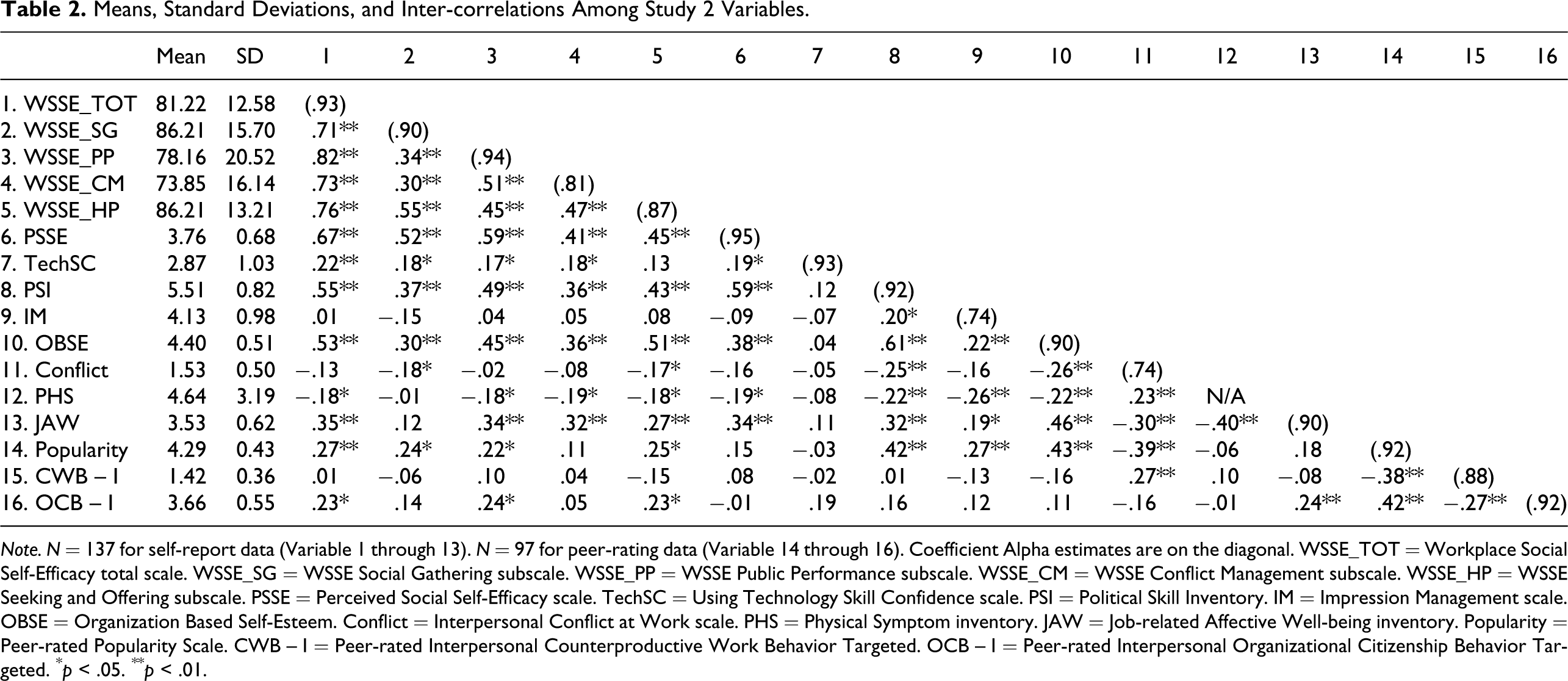
Note. N = 137 for self-report data (Variable 1 through 13). N = 97 for peer-rating data (Variable 14 through 16). Coefficient Alpha estimates are on the diagonal. WSSE_TOT = Workplace Social Self-Efficacy total scale. WSSE_SG = WSSE Social Gathering subscale. WSSE_PP = WSSE Public Performance subscale. WSSE_CM = WSSE Conflict Management subscale. WSSE_HP = WSSE Seeking and Offering subscale. PSSE = Perceived Social Self-Efficacy scale. TechSC = Using Technology Skill Confidence scale. PSI = Political Skill Inventory. IM = Impression Management scale. OBSE = Organization Based Self-Esteem. Conflict = Interpersonal Conflict at Work scale. PHS = Physical Symptom inventory. JAW = Job-related Affective Well-being inventory. Popularity = Peer-rated Popularity Scale. CWB – I = Peer-rated Interpersonal Counterproductive Work Behavior Targeted. OCB – I = Peer-rated Interpersonal Organizational Citizenship Behavior Targeted. * p < .05. ** p < .01.
Nomological Network Analysis
Hypothesis 3a predicted that the correlation between WSSE scores and IM scores should be weaker than the correlation between political skills scores and IM scores. As expected based on the theoretical proposition that WSSE may involve a degree of situational blindness, WSSE total scores were uncorrelated with IM scores (for WSSE total: r = .01, p = .98); however, PSI scores were positively correlated with IM scores (r = .20, p < .05). A test for the difference between these two dependent correlation coefficients was significant: t (134) = −2.38, p < .05, thus supporting Hypothesis 3a.
Hypothesis 3b predicted that WSSE scores should have a weaker correlation with workplace interpersonal conflict scores than should PSI scores. Table 2 indicated that WSSE scores were not significantly correlated with interpersonal conflict scores (r = −.13, p = .12), whereas PSI scores were (r = −.25, p < .01). A test for the difference between two dependent correlation coefficients indicated that although the correlation difference pattern was in the expected direction, it failed to reach the conventional significance: r = −.13 versus r = −.25, t(134) = −1.51, p = .06. Together, these results suggest weak support for Hypothesis 3b.
According to Table 2, WSSE scores had a significant and negative correlation with the Physical Symptom scores (r = −.18, p < .05), and a significant and positive correlation with Job-related Affective Well-being scores (r = .35, p < .01). Thus, Hypotheses 4a and 4b were supported.
In calculating correlations between WSSE scores and three coworker ratings, we only considered participants who received at least two coworker ratings (n = 97), in order to provide more rigorous tests of the relevant hypotheses. Among the coworker ratings, popularity is a consensus-based concept (Scott & Judge, 2009), and we thus calculated the interrater agreement, rwg for coworker-rated popularity (James, Demarre, & Wolf, 1984). It turned out that rwg value was larger than the conventional cutoff of .70 for all 97 participants, which justified using averaged coworker-rated popularity in subsequent analyses. The other two coworker ratings were not consensus-based constructs, and we simply calculated the average ratings.
WSSE scores were found to be significantly correlated with the coworker-rated popularity scores (r = .27, n = 97, p < .01) and coworker-rated OCB-I targeted scores (r = .23, n = 97, p < .05), supporting Hypotheses 5a and 5c, respectively. However, Hypothesis 5b was not supported, as the correlation between WSSE scores and CWB-I targeted scores was not significant: r = .01, n = 97, p > .05.
Hypothesis 6 predicted that political skill should mediate the relationship between WSSE and various outcome variables. The key to a mediation relationship is the significance of the indirect effect (Hayes, 2009). Methodologists have recently recommended using the bootstrapping method to test the indirect effect to overcome the seldom-held normality assumption required by the Sobel test (e.g., Preacher & Hayes, 2008). Thus, we used the bootstrapping method to test these mediation effects, using the statistical package for social sciences macro written by Preacher and Hayes. The results are summarized in Table 3. Specifically, political skill was found to mediate the relationship between WSSE and workplace interpersonal conflict (the indirect effect = −.0055, p < .05, supporting Hypothesis 6a), affective well-being (the indirect effect = −.0048, p < .05, supporting Hypothesis 6c), and coworker-rated popularity (the indirect effect = −.0070, p < .05, supporting Hypothesis 6f). Other mediation hypotheses were not supported.
Mediation of the Indirect Effects of WSSE on Outcome Variables Through Political Skill.
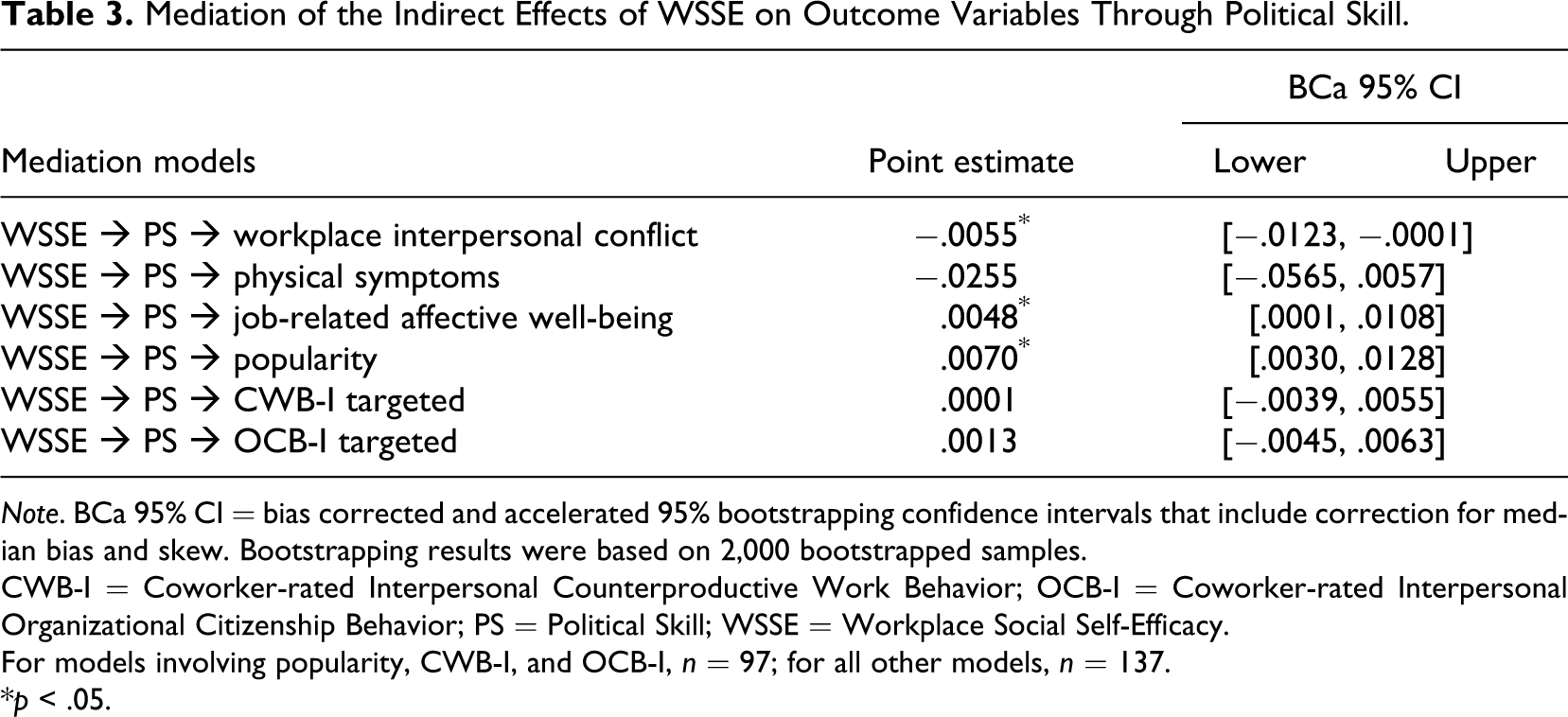
Note. BCa 95% CI = bias corrected and accelerated 95% bootstrapping confidence intervals that include correction for median bias and skew. Bootstrapping results were based on 2,000 bootstrapped samples.
CWB-I = Coworker-rated Interpersonal Counterproductive Work Behavior; OCB-I = Coworker-rated Interpersonal Organizational Citizenship Behavior; PS = Political Skill; WSSE = Workplace Social Self-Efficacy.
For models involving popularity, CWB-I, and OCB-I, n = 97; for all other models, n = 137.
*p < .05.
Hypothesis 7 predicted that WSSE scores should exhibit unique relationships with organizational variables after PSSE scores are controlled for. We conducted a series of hierarchical regression analyses in which PSSE was entered into the regression model in Step 1 and then in Step 2 WSSE was also entered. Note that workplace interpersonal conflict and coworker-rated CWB-I targeted were not included in this set of analysis because they were not significantly correlated with either WSSE or PSSE. Also note that we intentionally included the nonorganizational variable of physical symptoms to examine whether the advantage of WSSE scores over PSSE scores is limited to the organizational settings. The regression results are summarized in Table 4. WSSE scores yielded unique, significant relationships with all organizational variables after controlling for PSSE scores, including organizational based self-esteem (β = .50, ΔR 2 = .14), political skill (β = .29, ΔR 2 = .04), job-related affective well-being (β = .23, ΔR 2 = .03), coworker-rated popularity (β = .31, ΔR 2 = .08), and coworker-rated OCB-I targeted (β = .41, ΔR 2 = .09). Interestingly, WSSE scores did not yield unique relationships with the nonorganizational variable of physical symptoms (β = −.08, ΔR 2 = .00) after PSSE scores were controlled for. Therefore, taken together, Hypothesis 7 was strongly supported.
Regression Analyses Examining the Unique Effects of WSSE and PSSE.

Note. *p < .05. **p < .01.
Job-related AWB = job-related affective well-being; OCB-I = coworker-rated interpersonal organizational citizenship behavior.
General Discussion
We contribute to research concerned with social effectiveness at work by formally defining the construct of WSSE and developing a measure for it. Based on two studies conducted using diverse samples of full-time employees, we believe that this new measure represents a promising addition to the nomological network of workplace social effectiveness constructs. WSSE fits within established theoretical frameworks (Ferris et al., 2007), and it also exhibits some distinctive properties that might make it uniquely useful in some types of future research.
The WSSE inventory has properties associated with a sound measure. Factor analyses established that the WSSE inventory has a quite clean four-factor structure: (a) participating in social groups and gatherings, (b) performance in public contexts, (c) conflict management, and (d) seeking and offering help. Both the WSSE total scale and the four subscales had excellent internal consistency as all α coefficients were above .80. WSSE scores exhibited excellent convergent and discriminant validity. We observed positive correlations with a general social self-efficacy measure (the PSSE scale), a work-domain social effectiveness measure (the PSI), and a work-domain self-esteem measure, and at the same time a much weaker correlation with a nonsocial domain self-confidence measure (the Using Technology Skill Confidence scale). The moderate correlations between the WSSE scale and the PSSE scale (r = .67) and the PSI (r = .55) suggested some overlap between these constructs, but the shared variance between the WSSE and the PSI was modest enough to ward off concerns that the measures tap identical domains (Lewis-Beck, 1980). With respect to criterion-related validity, WSSE scores were found to be positively correlated to scores in job-related affective well-being, negatively to number of physical symptoms experienced, and positively to coworker-rated popularity and OCB-I targeted. The above findings strongly suggest that WSSE is a relevant construct in organizational settings.
Our mediation analyses also support Ferris et al.’s (2007) proposal that self-efficacy is an important antecedent of political skill. We found support for three of the six mediation analyses we conducted. These results clearly show that WSSE fits well within the theoretical structures identified by Ferris and colleagues for social effectiveness in general (Ferris et al., 2002) and political skill in particular (Ferris et al., 2007).
We found evidence that the WSSE scale is a better fit to work environments compared to the more general measure of the PSSE scale. For instance, the WSSE scale has a four-factor structure, whereas the PSSE scale has a single-factor structure. The WSSE items tap into both conflict and nonconflict social situations, whereas the PSSE items omit the latter. Most importantly, the WSSE items are all workplace related, and as a result, exhibited unique relationships with various organizational variables above and beyond PSSE scores. As such, we conclude that a WSSE measure has been justified.
Some additional findings are noteworthy. One such result involves the weak correlations between WSSE and self-reported workplace interpersonal conflict, and between WSSE and self-reported IM. Taken together and in the context of the many stronger relationships we observed involving WSSE, these null findings are consistent with our argument that WSSE may represent a relatively pure assessment of one’s social competence at work that is less inclusive of assessments of specific social situations compared to other social effectiveness constructs (cf. political skill; Ferris et al., 2002). The fact that WSSE seems to relate strongly to one dimension identified by Ferris et al. (2002) as important to social effectiveness (self-focused assessments of one’s capacity to act) but much less to the second (reading social situations) might have implications for future research concerned with topics such as individuals’ development of political skill.
Finally, we did not propose specific hypotheses regarding the four WSSE subscales. Nevertheless, we observed some evidence that subscales are differentially correlated with various constructs in the nomological network. For instance, the public performance subscale and the seeking and offering help subscale were the strongest correlates of organization-based self-esteem, and the social gathering subscale and the seeking and offering help subscale were the only two subscales that had significant correlations with the workplace interpersonal conflict scale. These differential relationships provide some initial support to our conceptualization of WSSE as a multidimensional construct. Among the four WSSE subscales, the seeking and offering help subscale and the public performance subscales appeared to have the strongest relationships to the correlates we examined. This suggests that social activities related to these two subdomains are particularly instrumental in bringing about beneficial outcomes for employees good at these activities. In contrast, the remaining two WSSE subscales seemed to have more unique patterns of relationships relative to other constructs we studied. Future researchers should continue to examine whether and how WSSE total scores and subscale scores similarly and differentially relate to relevant constructs in the nomological network.
Limitations and Future Research Directions
Several limitations should be kept in mind when interpreting our results. One limitation is that even though our two studies might be regarded as sufficient to develop and introduce the WSSE measure, the present work contained only a single study that examined criteria. Future research is needed to elaborate the placement of WSSE within the nomological net of social effectiveness. Another limitation concerns the causality of our findings. We relied on prior theory about the placement of WSSE relative to other constructs and we used peer ratings to alleviate the common method variance problem in Study 2, but these measures do not fully address questions about direction of causality in survey research. For instance, the mediation analyses we conducted were based on Ferris et al.’s (2007) theorizing of self-efficacy as an antecedent of political skill and on the long history of construing self-efficacy as an antecedent to skill development in learning, but we still cannot rule out the possibility of a reverse causal flow. Specifically, it is also possible based on social cognitive theory to construe WSSE as the mediator and political skill as the antecedent because assessments of ability in performance situations might be based on perceptions of relevant skills. Future research manipulating WSSE is needed to fully establish the direction of causality.
Still another limitation is that when collecting peer ratings, employees were asked to distribute surveys to up to five of their coworkers, and employees may have chosen to give surveys to their friends in the workplace, which may lead to inflated popularity, CWB, and OCB ratings. It is unclear whether such inflations may result in the under- or overestimation of the correlations between PSSE scores and these peer ratings. Future research with more rigorous methods of collecting peer-rating data is needed to replicate our findings.
Future research might also examine WSSE as a moderator of relationships between workplace social stressors and strains. Although we found some moderating tendency for WSSE scores in a few exploratory analyses in Study 2, no significant results were found, probably due to our modest sample size and the difficulty of identifying interaction effects in survey studies. Nevertheless, future researchers should investigate this important research question using larger samples and including more social stressor and strain variables.
Practical Implications
One appealing feature of domain-related conceptualizations of self-efficacy is that they represent self-efficacy perceptions as malleable, thus subject to external influences such as training and coaching. Given the benefits associated with having a high level of WSSE, training programs can be developed to boost employees’ WSSE, particularly in jobs requiring intensive social interactions. In this regard, Bandura’s (1986, 1997) framework provides excellent strategies to boost WSSE. Furthermore, employees’ WSSE total scores and subscale scores can serve as a diagnostic tool before the training and as an evaluation tool after the training. Executive coaches and organizational mentors can also use these scores to help trainees and protégés identify specific deficiency areas and then develop plans to address them.
Conclusion
We developed and provided initial evidence for the utility of WSSE as an indicator of one dimension of workplace social effectiveness. Our studies introduce WSSE as a relevant construct and show how it complements existing theory, but more research is clearly needed to identify how this and other constructs help us to understand the complex but important social worlds of employment. Given the high stakes that are frequently attached to social interactions at work, we hope that our research inspires others to investigate this critical domain.
Footnotes
Authors’ Note
Jinyan Fan and Robert C. Litchfield contributed equally to this article.
Declaration of Conflicting Interests
The authors declared no potential conflicts of interest with respect to the research, authorship, and/or publication of this article.
Funding
The authors received no financial support for the research, authorship, and/or publication of this article.