



Abstract
Career counselors are often concerned with stability and likelihood of implementation of clients’ career intentions. It is often assumed that the status in career decision making (CDM) is one likely indicator; yet, empirical support for this assumption is sparse. The present study focused on entrepreneurial career intentions (EI) and showed that German university students (N = 1,221), with high EI can be found in very different empirically derived CDM statuses that range from preconcern to mature decidedness. Longitudinal analyses (n = 561) showed that career choice foreclosure (high decidedness/low exploration) related to more EI stability and that mature decidedness (high decidedness/high exploration) amplified effects of EI on opportunity identification, a form of EI actualization. The results imply that CDM statuses are useful to estimate stability and actualization of career intentions.
Keywords
Introduction
In career counseling and assessment, counselors often wonder about the sustainability of clients’ career intentions. How stable will their expressed intentions be? How likely are the clients’ going to enact their intentions? Such questions are important because they address the developmental process of career management at which career counselors aim to assist their clients, consisting of career exploration, planning, intention building, and implementation of career plans (Greenhaus, Callanan, & Godshalk, 2010). Career theory often asserts that a process of deliberate career decision making (CDM), consisting of phases or statuses such as orientation, exploration, and commitment building, are essential to arrive at sustainable career intentions (Gati & Asher, 2001). Likewise, a well-developed vocational identity, the stable and clear perceptions of personal interests, traits, and preferences, is proposed to have positive effects on the stability of career development generally and career interests more specifically (Holland, 1997). However, despite the fact that stability and actualization of career intentions in relation to CDM is of practical concern to career counselors and addressed in career theory, our empirical understanding of the relation of CDM statuses and stability and enactment of specific career intentions is severely underdeveloped. Yet, such knowledge would be important for career counselors for making better judgments about the likely stability and actualization of their clients’ career intentions in their attempt to help clients’ in their career management. The present study investigates how students’ current status in CDM in terms of career exploration and decidedness is related to stability and enactment of entrepreneurial intentions (EI), the expressed interest in and consideration of engaging in prototypical entrepreneurial activities. Entrepreneurship has become a vital topic in research and practice due to its importance for economic growth, innovation, and employment throughout the world (Hisrich, Langan-Fox, & Grant, 2007; Shane & Venkataraman, 2000), yet has only received cursory attention in the career development and assessment literature. The present study aims at making several contributions. First, it will investigate with a large sample of university students how CDM statuses are related to EI and examine whether high EI correspond to a specific status in the CDM process. Second, and most importantly, it will evaluate with a longitudinal design whether the specific CDM status of a student has an effect on (a) the intraindividual stability of EI over time and (b) the degree of subsequent opportunity identification—one important behavior in the early entrepreneurial process and an indicator of intention implementation (Shook, Priem, & McGee, 2003).
Entrepreneurial Intentions: A Brief Overview
Entrepreneurship is a process that can be broadly distinguished into prelaunch, launch, and postlaunch phases (Baron, 2007), each corresponding to specific tasks and actions such as entrepreneurial intent and opportunity search, discovery and recognition, evaluation, and exploitation (Shook et al., 2003). Within the prelaunch phase, the intention to become an entrepreneur is a pivotal component of this process (Bird, 1988) and EI are an important topic for career counselors who are working with clients who are thinking about starting their own business. Most studies have investigated predictors of EI among university students because they are an important group of potential future entrepreneurs and a focus group of entrepreneurship education in the university or business school context. Currently, a vast array of factors, such as gender (Díaz-García & Jiménez-Moreno, 2010; Gupta, Turban, & Bhawe, 2008), self-efficacy beliefs (Chen, Greene, & Crick, 1998; Lee, Wong, Foo, & Leung, 2011), risk preference/risk tolerance (Barbosa, Gerhardt, & Kickul, 2007; Hmieleski & Corbett, 2006), and social capital (Liñán & Javier Santos, 2007), have been investigated as important determinants of EI. Theoretically, the theory of planned behavior (Ajzen & Fishbein, 1980) and Shapero’s (1982) model of the entrepreneurial event have received much research attention and empirical support for predicting EI. With respect to these models, different studies have supported the assumption that attitudes toward entrepreneurship, subjective norms, perceived feasibility, perceived desirability, and propensity to act predict EI (e.g., Krueger, Reilly, & Carsrud, 2000; van Gelderen et al., 2008). Going beyond such research addressing predictors of EI emergence, the present study investigates whether and how the stability of EI is related to specific statuses in CDM and whether CDM moderates the effects of EI on opportunity identification, an indicator of intention enactment.
A CDM Perspective
Career counseling often consists of guiding clients along a deliberate CDM process with the goal of arriving at self-congruent, realistic, and stable career intentions that have a high likelihood of being enacted (Sampson, Lenz, Reardon, & Peterson, 1999). CDM models usually describe CDM as a process with several stages or phases. Based on such an approach, counselors could expect that intentions that emerge out of a deliberate process of CDM are more stable and more likely to be implemented than intentions that are formulated in earlier phases of CDM. For example, Gati and Asher’s (2001) prescreening, in-depth exploration, and choice model described the CDM process as starting with (1) a broad screening of possible career alternatives, (2) an in-depth exploration of a few promising alternatives, and (3) a choice of the most appropriate career path. Germeijs and Verschueren (2006) described the CDM process as consisting of several consecutive tasks: (1) orientation to choice (i.e., awareness of the need to make a decision and motivation to engage in the CDM process), (2) self-exploration (i.e., gathering information about oneself such as personal interests, competences, and work values), (3) a broad exploration of the environment (i.e., gathering general information about career alternatives), (4) an in-depth exploration of the environment (i.e., gathering detailed information about a reduced set of career alternatives), (5) decisional status (i.e., progress in choosing an alternative), and (6) commitment (i.e., strength of confidence in and attachment to a particular career alternative). In an integrative framework of several CDM models, Hirschi and Läge (2007) proposed a six-phase model of decision making: (a) becoming concerned about CDM (i.e., awareness), (b) generating possible career alternatives based on one’s own interests, skills, and values through self-exploration and environmental exploration, (c) reducing the career alternatives to a manageable number for more in-depth exploration, (d) deciding among few alternatives, (e) confirming one’s choice and developing a commitment to it, and (f) being firmly decided and committed to a choice. As can be seen, different models show many similarities and redundancies. All propose that CDM should develop according to a structured process consisting of different phases and assume that the exploration of oneself and the environment together with the level of decidedness or choice commitment are important determinants of the CDM process.
The two components of exploration and commitment are also stressed in models of vocational identity development. In this context, CDM is seen as a process of identity construction, whereby people attempt to implement their self-concept into a work role (Super, 1990). Empirical research has supported the notion that career development and CDM are closely related to identity development generally and the development of a vocational identity specifically (Gushue, Scanlan, Pantzer, & Clarke, 2006; Skorikov & Vondracek, 2007; Vondracek, 1992). One model that has been frequently and successfully applied to general identity and vocational identity development is Marcia’s (1980) model of identity statuses (e.g., Raskin, 1989; Skorikov & Vondracek, 2007; Vondracek, Schulenberg, Skorikoc, Gillespie, & Wahlheim, 1995). Marcia (Kroger, Martinussen, & Marcia, 2010; Marcia, 1980) acknowledged four identity statuses along two independent dimensions: (1) the degree of active engagement in identity construction and exploration of various alternatives and (2) the commitment to a specific set of alternatives. Identity achievement is reached after an active engagement in exploration and a commitment to a self-chosen goal. Identity foreclosure refers to commitments reached typically through identification with a role model without much prior active exploration. Identity moratorium describes an active engagement and exploration in identity development together with an unreadiness to commit to a certain identity. Finally, identity diffusion refers to a lack of both exploration and commitment regarding one’s identity.
Evidently, CDM models and the identity status paradigm share many commonalities. They both propose that people can be distinguished regarding different statuses of CDM and identity development based on their degree of career exploration and clarity of career choice. Figure 1 shows how the two conceptualizations can be integrated into a common framework to define different statuses in the CDM and vocational identity development process depending on a person’s degree of exploration and decidedness. While this is a descriptive model of different CDM statuses, the statuses can also be viewed as phases in a CDM process. According to this framework, students would start in Status 1, a stage of preconcern in the CDM and identity diffusion process, as they have not yet become concerned about their future career and are not yet engaged in a deliberate CDM process. Hence, they would show low degrees of exploration and decidedness. In Status 2, they would start becoming actively involved in CDM and vocational identity construction through active exploration of themselves and their career options, representing the exploration stage in CDM and identity moratorium in vocational identity construction. This status is characterized by high levels of exploration but still low degrees of decidedness and choice clarity. However, the CDM and identity construction process could also lead to a different outcome as indicated in Status 3, which is represented by a premature career choice and identity foreclosure. In this status, students would not have previously been in Status 2 of active exploration but rather would have prematurely settled on a possibly environmentally imposed career choice. This stage is thus represented by low values in exploration but high career decidedness. In the most positive developmental process, students would end up in Status 4, where they would have decided on a career path and reached a sense of career decidedness and choice clarity, as indicated by the CDM status of mature decidedness and the identity achievement status. As such, they would show high levels of both exploration and decidedness.
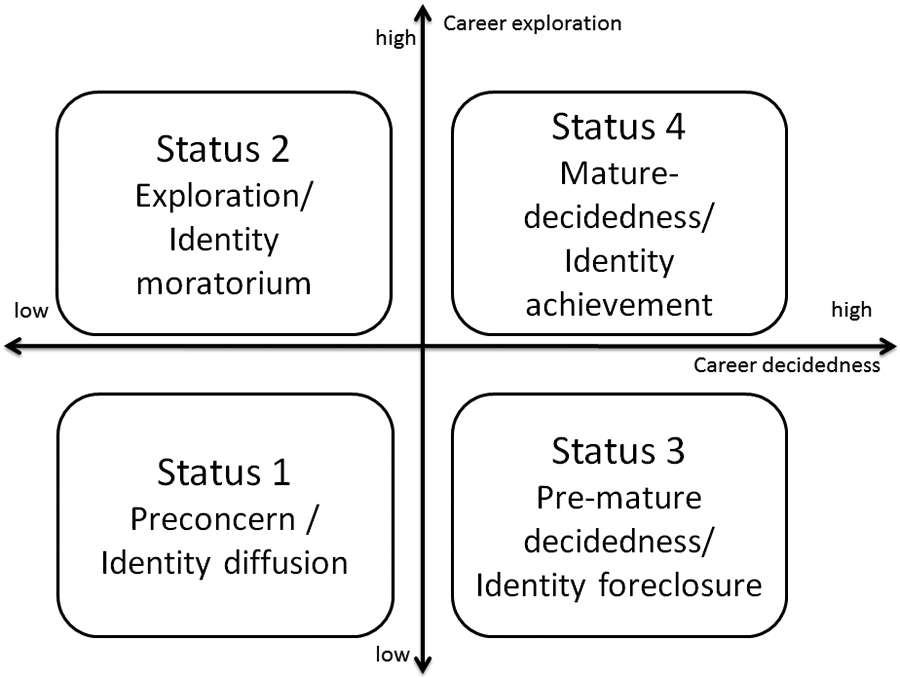
An integrative model of career choice and vocational identity statuses distinguishing four basic statuses based on the two dimensions of career decidedness and exploration.
Empirical studies have generally supported this model by showing that on average, students do develop according to these statuses over time (Germeijs & Verschueren, 2006; Kroger et al., 2010). However, it is important to note that while the CDM statuses imply distinct statuses and phases in a prototypical CDM process, empirical research showed that there is also variability in developmental patterns, with some students staying relatively stable in a specific status, while others show regressive patterns of development (Germeijs & Verschueren, 2006; Hirschi, 2012; Kroger et al., 2010; Meeus, 1996; Meeus, Iedema, Helsen, & Vollebergh, 1999; Meeus, Van De Schoot, Keijsers, Schwartz, & Branje, 2010). Hence, there might be overlap between the statuses and not all students can be expected to progress through the statuses in a uniform manner. Moreover, additional statuses of CDM and identity construction were theoretically proposed and empirically derived in previous studies (Germeijs & Verschueren, 2006; Luyckx, Goossens, Soenens, Beyers, & Vansteenkiste, 2005) also suggesting some variability in the CDM of students that might not be captured by the proposed general framework. In sum, I believe that the herein investigated framework can be seen as a useful way to conceptualize the CDM and vocational identity construction process by distinguishing different statuses in the process, regardless of whether all students actually proceed in the described statuses in the implied sequence.
Study Hypotheses
The Relation of EI and CDM Statuses
Looking at career intentions, such as EI, from this theoretical perspective, we can conclude that career intentions might correspond with high career choice clarity and career decidedness for some students but not for others. Likewise, intentions such as EI might emerge in an active status of career exploration, or it might be expressed without having completed an exploration stage. Hence, the proposed model implies that students with high EI do not necessarily fall within one specific CDM status. For some, entrepreneurship might be just a general interest and possibility; they may not feel that they have really decided as to what they want to do with their career, nor have they really become actively concerned with the CDM process in terms of exploration. This group would represent students in Status 1. For another group, EI might emerge as part of their career exploration process, but they still feel unsure as to whether they really want to become entrepreneurs, and they feel unready to decide on a specific career path yet, as per Status 2. For others, a high intent of starting a business reflects their career choice to become an entrepreneur, which is based on a thorough exploration of themselves and their career options, as described in Status 4. Finally, still others might feel decided regarding their career and plan to pursue entrepreneurship without ever having deeply thought about personal interests and values or other career options, as in Status 3. This means that EI can emerge in different phases of CDM and are not necessarily an indicator of a consolidated career choice but can also represent a more general and (not yet) consolidated career interest.
CDM Statuses and EI Stability
Distinguishing EI according to CDM statuses could have important implications for understanding stability and likelihood of enactment of EI. Theoretically, we can assume that career intentions that correspond to advanced statuses of CDM and vocational identity are more likely to be stable over time because they are more likely to be self-congruent, realistic, and sustained and motivated by high choice commitment (Holland, 1997; Sampson et al., 1999). However, empirical support for this assumption is sparse and inconclusive. Schomburg and Tokar (2003) investigated the influence of private self-conscientiousness on the 12-week interest stability among a group of U.S. undergraduates. The results implied that private self-conscientiousness moderated the stability of enterprising interests; but not the other interest types or interest profile stability. Hirschi (2010a) showed among Swiss adolescents that vocational identity clarity did not relate to stability of vocational interests over a 10-month time span. However, more career planning and exploration predicted more subsequent rank-order change in vocational interests.
Applying the presented CDM model, reaching career choice clarity—either through exploration (Status 4) or through foreclosure (Status 3)—is the (provisional) end state of the CDM process. Hence, students in Statuses 3 and 4 can be expected to be more consistent and stable in their career intentions. Regarding EI, this implies that we can assume that the specific CDM status has significant effects on the stability of EI over time. Specifically, for a student with EI that reflect career choice clarity, we can expect that EI are more stable than for students with EI that are not (yet) reflective of a consolidated career choice.
CDM Statuses and Opportunity Identification
An important component of the entrepreneurship process is opportunity identification because discovering and developing business opportunities is central to launching a successful business (Ardichvili, Cardozo, & Ray, 2003; Eckhardt & Shane, 2003; Shook et al., 2003). According to Ardichvili, Cardozo, and Ray (2003) opportunity identification consists of an interrelated triad of opportunity recognition, development, and evaluation of business opportunities. In contrast to EI, opportunity identification thus represents more behaviorally oriented components in the entrepreneurship process. Hence, students who report more opportunity identification behavior are not just stating a general interests or intention toward becoming entrepreneurs but are actually engaged in enacting their intention and interests. Previous research showed that entrepreneurial alertness is a precondition to opportunity recognition (Ardichvili et al., 2003; Gaglio & Katz, 2001). Likewise, we can expect that EI facilitate business opportunity identification among students. However, based on the herein proposed CDM perspective, I expect that a student’s status of CDM moderates the effects of EI on opportunity identification. Specifically, I expect that more advanced CDM statuses promote the enactment of career intentions because they enhance a student’s motivation toward their career intent in terms of heightened self-congruence, realism, and commitment toward their intent. For example, Germeijs and Verschueren (2007) showed in a prospective study that more successful coping with career decisional tasks at the end of Grade 12 significantly contributed to the several aspects of early choice implementation such as choice actualization in university. As such, I expect that EI are more strongly related to reported opportunity identification for students in advanced CDM statuses as compared to students in less advanced statuses.
Method
Participants
A diverse group of undergraduate students from a medium-sized public university in northern Germany participated the study (N = 1,221). They majored in 12 different areas ranging from engineering to social work. The most popular majors were applied cultural studies (8.7%), business administration (12.3%), and business psychology (16.5%). A slight majority of participants were female (60.4%), and 136 (11.1%) did not indicate their gender. The mean age was 23.6 (standard deviation [SD] = 3.5), 42.7% were in their first year, 12.8% in their second, 33.3% in their third, and 11.2% provided no respective information. In accordance with university regulations, no data on race were collected.
Design and Procedure
Data were collected in two waves, 6 months apart through an online survey, which was posted on a secure server provided by the survey software company. Students were invited to participate through postings on the university’s webpage and through newsletters that were distributed 4 weeks apart by e-mail to all registered undergraduate students that invited them to participate by providing a short description of the study intent (i.e., to investigate career preparation and planning) and the link to the survey. Participation was voluntary and inclusion in a lottery with five vouchers for 60 Euros each (approximately 75 USD) was offered as an incentive. The first page of the questionnaire provided information about the study and asked students to indicate their consent by ticking the appropriate box. In order to obtain repeated measures for the longitudinal analysis, all students from T1 were invited to provide their e-mail address to be contacted again, and 72% complied with this request. They were then directly invited by e-mail to participate again in the study at T2. Of the original sample obtained at T1 (N = 1,221) 564 students (46%) participated again at T2. The students who participated at two measurement points did not differ in their gender, career decidedness, or EI from those who dropped out. However, they reported more career exploration, p = .011, d = .21. The questionnaires included measures of EI, career decidedness, and career exploration at the first measurement point. Opportunity identification and again EI were assessed at T2.
Measures
Entrepreneurial Intentions
EI were assessed using the 4 items applied by Zhao, Seibert, and Hills (2005), which asked students to indicate how interested they were in engaging in prototypical entrepreneurial activities (i.e., starting a business, acquiring a small business, starting and building a high-growth business, and acquiring and building a company into a high-growth business) in the next 5–10 years. A 5-point Likert-type scale was used, ranging from 1 (very little) to 5 (a great deal). The 4 items were independently translated into German by two postdoctoral researchers with high proficiency in English, and a consensus was reached regarding the final version. This was then back-translated into English by a graduate student in psychology with high English proficiency. The results were again compared, and a final German language version was confirmed. Zhao et al. reported significant moderate relations among the measures of entrepreneurial experience, risk propensity, male gender, and entrepreneurial self-efficacy. They also showed that these measures correlated very highly (corrected for attenuation, r = .85) with a composite measure applied by Chen, Greene, and Crick (1998), which measures EI in terms of interest, consideration, preparation, probability, and time frame. For the present sample, Cronbach’s α was .87 at T1 and .86 at T2.
Career Decidedness
Career decidedness was measured with a German language adaptation of the Vocational Identity scale (Holland, Daiger, & Power, 1980; Jörin, Stoll, Bergmann, & Eder, 2004). Seven items tapping the degree of career choice clarity were selected for the present study, and students could indicate on a 5-point Likert-type scale the degree to which the statements (e.g., “I’m not sure yet which occupations I could perform successfully”) resembled their personal situation by ranking them from 1 (not at all) to 5 (completely). The measure is well established in the international literature (Holland, Johnston, & Asama, 1993), and studies using the German language version have shown that the scale relates positively with career decidedness, career planning, and career exploration among adolescents and college students (Hirschi, 2009; Jörin Fux, 2006). Cronbach’s α in the present sample was .89.
Career Exploration
The degree of self-exploration and environmental exploration was assessed with 10 items from the career exploration scale developed and validated by Hirschi (2009). The measure asked students to indicate on a 5-point Likert-type scale the degree to which they engaged in self-reflective behaviors (i.e., reflections about personal interests, skills, preferences, or what makes one enjoy work) and the degree to which they have explored career options (e.g., “acquire information about career fields of interest”) with answers ranging from 1 (seldom/few) to 5 (very much/a lot). The scale is very similar to other career exploration scales (Kracke & Schmitt-Rodermund, 2001; Stumpf, Colarelli, & Hartman, 1983; Zikic & Klehe, 2006). Previous studies have shown positive correlations between this scale and other measures of career exploration, career decidedness, career planning, and career choice congruence (Hirschi, 2010b; Hirschi, Niles, & Akos, 2011). Cronbach’s α in the present sample was .89.
Opportunity Identification
In accordance with theoretical considerations (Ardichvili et al., 2003) and previous studies (Ucbasaran, Westhead, & Wright, 2008) I assessed the three components of opportunity identification via three questions. Opportunity identifications was assessed by presenting the question “How many opportunities for creating a business have you identified (‘spotted’) within the last three months?” Opportunity evaluation was assessed by “Out of all those opportunities, how many were in your opinion promising for creating a profitable business?” Finally, opportunity pursuit was measured by “How many opportunities for creating a business have you pursued, that is committed time and resources to, within the last three months?” For each question, students could write their numeric answer in a respective field. Due to the skewed nature of the answers, I used the logarithmic function of each answer. To obtain a more parsimonious and reliable opportunity identification measure, I calculated a composite score, representing the weighted linear combination of the three questions. This approach takes into consideration that the 3 items measure related but distinct components of opportunity identification and includes the shared and unique variance of each answer. The results of the subsequent factor analysis confirmed a clear one-factorial structure explaining 72% of variance among the three measures with higher values on the factor score representing more reported opportunity identification behavior. Cronbach’s α was .80.
Results
Bivariate Correlations
The bivariate correlations reported in Table 1 show that career decidedness correlated positively with career exploration and opportunity identification but negatively with EI at T1. Career exploration was positively related to opportunity identification and EI at T1 but unrelated to EI at T2. Finally, opportunity identification correlated positively with all other measures.
Bivariate Correlations, Means, and Standard Deviations of the Assessed Variables.
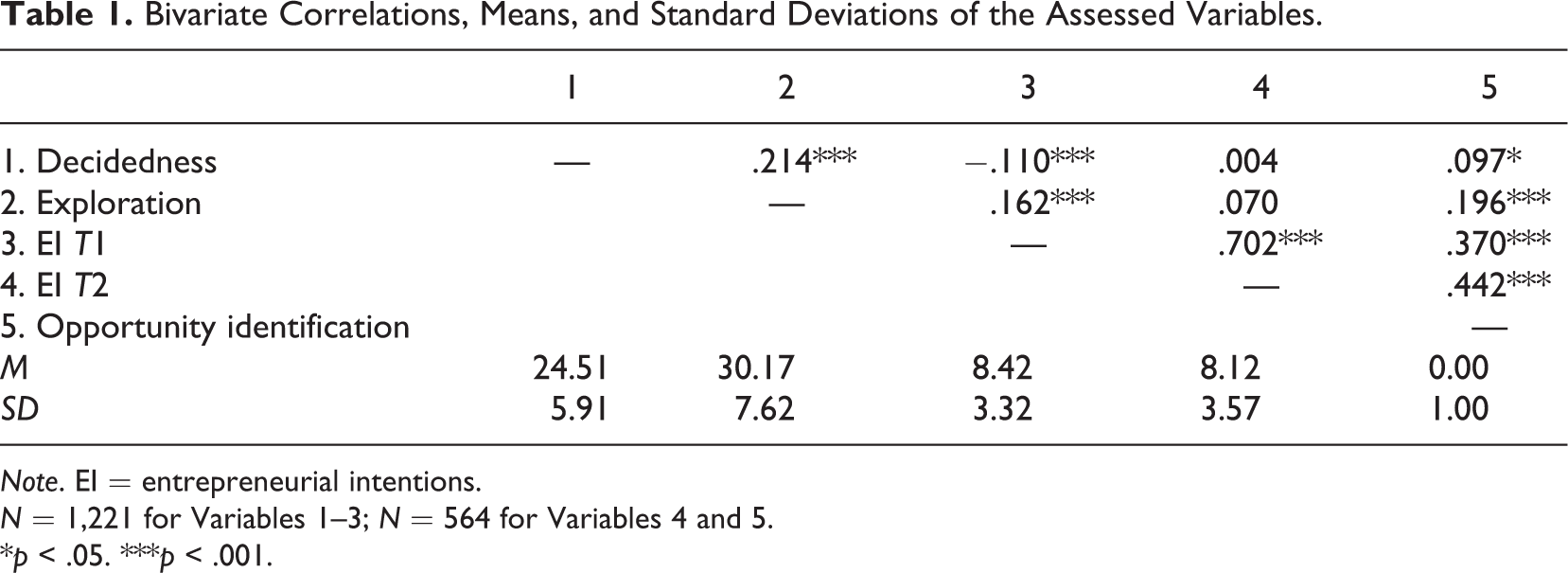
Note. EI = entrepreneurial intentions.
N = 1,221 for Variables 1–3; N = 564 for Variables 4 and 5.
*p < .05. ***p < .001.
Identification of Career Choice Status Groups
To identify students in different career choice status groups, this study applied a person-centered, data-derived approach with cluster analysis to classify students into different identity status groups based on two continuous measures for career exploration and career decidedness (Schwartz & Dunham, 2000). This approach allows us to assign students to career choice status groups based on their observed score values rather than by imposing a theoretical model on the data. Building status groups based on the dimensions of decidedness/commitment and exploration is in accordance with previous research on identity status development based on Marcia’s (1980) paradigm (Luyckx et al., 2008; Meeus et al., 1999, 2010). I applied cluster analysis using the two-step procedure suggested by Gore (2000). First, hierarchical cluster analysis using Ward’s method on squared Euclidian distances was applied, and the appropriate number of clusters was determined based on criteria involving the theoretical meaningfulness of each cluster, parsimony, and explanatory power. In the second step, the initial cluster centers were used as nonrandom starting points in an iterative k-means clustering procedure. For these analyses, the entire sample from T1 (N = 1,221) was included.
The above-described cluster analysis procedure produced five career choice status groups, as represented in Figure 2. Three of the groups correspond directly to the proposed theoretical model in Figure 1, with statuses of (1) preconcern/diffusion (low exploration, low decidedness, N = 340, 27.8% of sample), (2) exploration/moratorium (high exploration, low decidedness, N = 111, 9.1%), and (3) premature decided/foreclosure/ (low exploration, high decidedness, N = 272, 22.3%). In addition, two different degrees of Status 4 (mature decidedness/achievement) emerged. One group exhibited moderately above-average decidedness and exploration (N = 357, 29.2%), while another group showed clearly above-average decidedness and exploration (N = 141, 11.5%). I named these groups moderate mature decidedness/moderate achievement (Status 4a) and high mature decidedness/high achievement (Status 4b), respectively. Although not directly corresponding to the proposed theoretical model, this five-cluster solution was deemed more theoretically meaningful than a four-cluster solution in which the clusters of (3) moderate mature decidedness/moderate achievement and (2) exploration/moratorium would have been combined into one larger cluster without a clear profile. Moreover, controlling for gender, the five-cluster solution was able to explain 64% variance in career decidedness and 72% in career exploration, while the four-cluster solution would only have explained 47% in decidedness (71% in exploration).
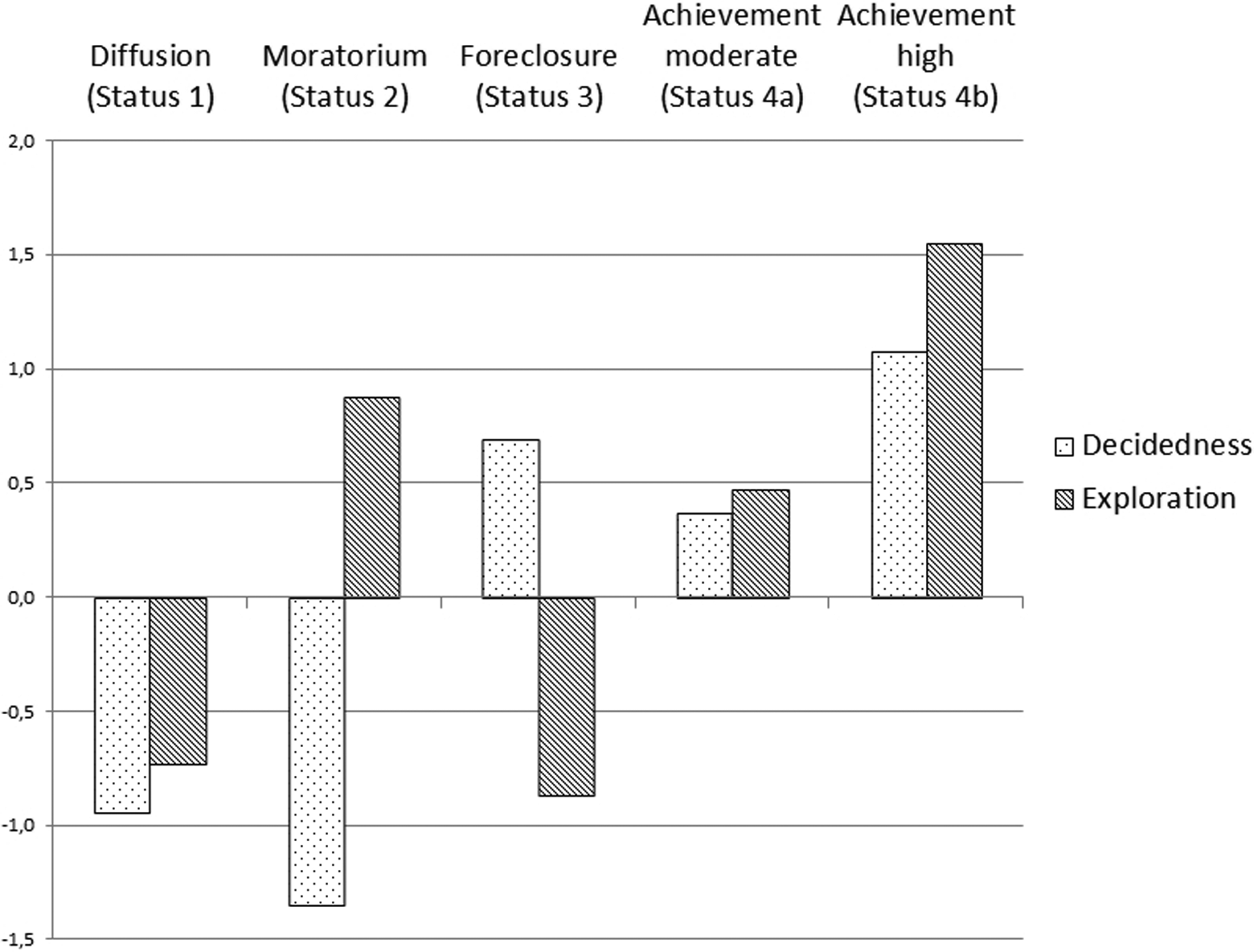
Standardized cluster means of career decidedness and career exploration for the empirically derived five-cluster groups of career decision-making statuses representing (from left to right) 28%, 9%, 22%, 29%, and 12% of the sample, respectively.
EI and Career Choice Status Groups
Students with high EI were defined as exhibiting EI scores at least 1 SD above the mean (EI > 11, N = 204). To assess Hypothesis 1 that students with high EI could not be distinguished according to their career choice status, I compared the career choice status distribution of the students with high EI to the status distribution expected based on the whole sample (N = 1,221), thus taking the base rate probability of distributions into account. I then compared the actual distribution of students with high EI to the base rate distribution and found that the two distributions showed significant differences, χ2(4, N = 204) = 13.01, p = .011. As shown in Figure 3, students with high EI were more often in Status 1 (preconcern/diffusion) and Status 2 (exploration/moratorium) but less frequently in Status 3 (premature decidedness/foreclosure). The results confirm Hypothesis 1 by demonstrating that students with high EI are represented in different career choice statuses. However, the results also show that students with high EI are not randomly distributed among career choice status groups but rather tend to fall more into some statuses than others.
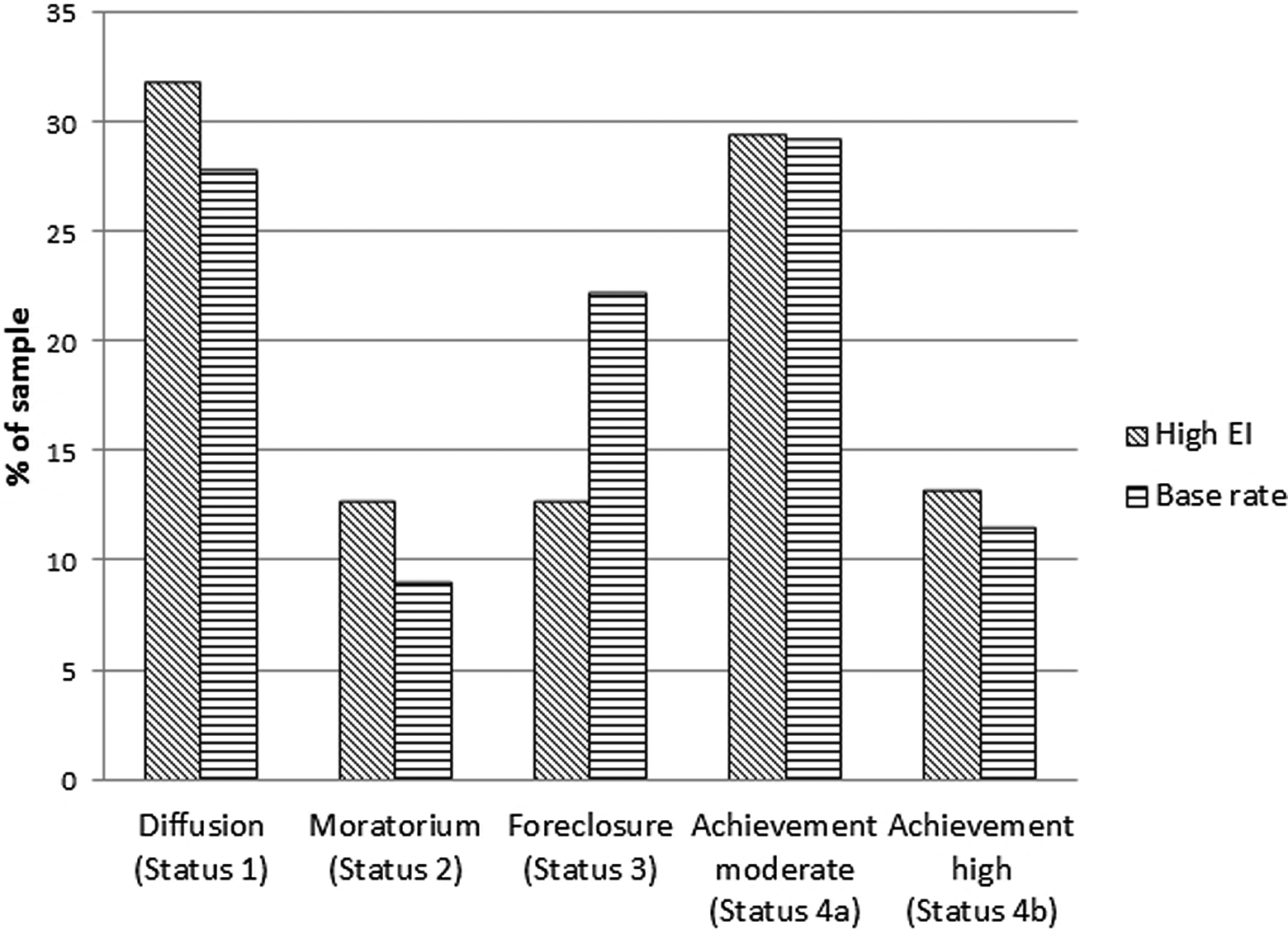
Relative distribution of students among the five career choice statuses compared to the base rate probability of the cluster distribution within the present sample. The sample percent for students with high EI are based on N = 204 representing students with EI scores at least 1 SD above the mean, the base rate is based on the entire sample of N = 1,221.
Career Choice Status Groups and EI Stability
To assess Hypothesis 2, which states that the career choice status would have an effect on the intraindividual stability of EI, repeated-measure analysis of covariance was performed with the two EI measures at T1 and T2 as the dependent variables, gender as a covariate, and the five-cluster groups as independent variables. The students in the longitudinal analyses were distributed very similarly to the whole sample at T1, with n = 179 (31.7%) in Status 1, n = 43 (7.6%) in Status 2, n = 132 (23.4%) in Status 3, n = 155 (27.5%) in Status 4b, and n = 55 (9.7%) in Status 4a. I included gender as a control variable in this and the subsequent analyses because several studies on entrepreneurship and EI have shown that men are on average more likely to start their own business and have stronger EI than women (Gupta et al., 2008; Schwarz, Wdowiak, Almer-Jarz, & Breitenecker, 2009; Zhao, Seibert, & Hills, 2005). Moreover, it is well established that gender is a major factor affecting career choices in adolescence and young adulthood (Betz, Harmon, & Borgen, 1996; Lippa, 1998; Williams & Subich, 2006). Hence, by controlling for any possible gender effects, one can expect to obtain more valid results regarding the true relationship between CDM statuses and EI.
The results indicated that the status groups differed significantly in terms of EI stability, F(4, 559) = 4.82, p < .001, η2 = .03, confirming Hypothesis 2a, which states that CDM status does have an effect on EI stability. Among the status groups, students in Status 2 (exploration/moratorium) showed the highest, those in Status 3 (premature decidedness/foreclosure) the lowest amount of change. Post hoc least significant difference tests showed that students in Status 3 showed significantly lower amounts of change than those in the other four status groups. The results therefore confirm Hypothesis 2a, which assumed that CDM statuses would affect the stability of EI. However, they did not entirely confirm Hypothesis 2b. The results suggest that it is not just decidedness that promotes EI stability but high decidedness combined with low exploration, as represented by the foreclosure group, that is particularly related to stability of EI.
Career Choice Status Groups and Opportunity Identification
In order to test Hypothesis 3, that career choice status would moderate the relation between EI and opportunity identification, I used multiple hierarchical regression analysis. The dependent variable was the opportunity identification factor score obtained at T2. In a first model, I controlled for the effect of gender, in the next model I included the effect of the standardized EI measure from T1. In the third model, I added the effects of the five career choice status groups assessed at T1 by inserting four status categories (Statuses 4a/b, 3, and 2). In order to avoid singularity, Status 1 was excluded because its membership can be derived from the membership of the other four statuses. In the final model, I added the interaction terms of EI and choice status groups to assess the postulated moderating effect.
The results showed that male gender was a significant predictor of more opportunity identification, R 2 = .09, β = .29, p < .001. Moreover, EI predicted more opportunity identification ΔR 2 = .08, β = .29, p < .001. The choice status groups predicted opportunity identification above and beyond gender and EI, ΔR 2 = .03, p = .004. Moreover, the interaction terms explained significant additional variance, ΔR 2 = .03, p = .009, indicating a moderating effect. Specifically, the interaction term with Status 4a (moderate achievement) was significant, β = .18, p = .002, showing that EI had a stronger effect on opportunity identification when students where in an achieved career choice status compared to when they were not (see Figure 4). This result supported Hypothesis 3a by showing that CDM statuses do moderate the effects of EI on opportunity identification. It also partially confirmed Hypothesis 3b that for students in a status characterized by high decidedness the relation between EI and opportunity identification is stronger than for students in other statuses. However, the results also suggest that it is decidedness combined with high exploration that has the strongest effect.

Moderating effect of career decision-making statuses for entrepreneurial intentions (T1) predicting opportunity identification (T2, 6 months later). For students in the moderate achievement career choice status (Status 4a) high entrepreneurial intentions were more strongly related to opportunity identification compared to students in other career choice statuses.
Discussion
In career counseling and assessment, counselors are often concerned about the stability and likelihood of implementation of their clients’ career intentions. Based on models of CDM, counselors would expect that intentions which are based on a deliberate CDM process and thus are expressed in later phases of CDM are more self-congruent, realistic, and intrinsically motivated. This should in turn increase the probability of intraindividual stability and implementation. However, empirical research on this topic is sparse and inconclusive. The present study addressed this issue and showed that students can be distinguished into different phases of CDM and that the phase has important implications for the stability of EI and the effects of EI in opportunity recognition, a form of EI implementation.
EI in Relation to CDM Statuses
First, the study found that high EI does not necessarily correspond to a specific status of CDM for university students. Using a theoretically supported and empirically derived model with five CDM statuses, students with high EI could be found in all statuses of CDM, ranging from preconcern to mature decidedness. This means that generally speaking, high EI can indicate a general interest, a mature career choice, or a premature career choice among university students. However, the results also showed that students with high EI are not randomly distributed across different CDM statuses as compared to the base probability of status membership. For a considerable number of students, high EI seem to represent a vague interest in entrepreneurship that is not based on active CDM, as indicted by Status 1. However, some support for the notion that high EI often indicates a solidified career choice for many students was found in the observation that about 43% of the sample with high EI were in a career choice status of mature decidedness/achievement (Statuses 4a and 4b). As such, this constituted the largest group within students with high EI. In contrast, high-EI students did not frequently exhibit the status of premature decidedness/foreclosure. This indicates that if EI emerges alongside career decidedness, it is likely to indicate a mature decision and not a premature choice. Based on CDM theory, this might be explained by speculating that entrepreneurship is not a career choice that many students pursue because of an unreflected acceptance of existing role models (as well as economic, social, and parental influence). Instead, EI are related to an active process of career exploration for most students.
CDM Status, EI Stability, and Opportunity Identification
Second, the study confirmed that a student’s CDM status does have an effect on EI stability. As expected, CDM statuses characterized by higher career decidedness related to more stability. However, in addition, it was exploration that determined the change in EI. Students who were in phases described by active career exploration, regardless of their degree of decidedness, changed more strongly in terms of EI than those who were not (yet) currently engaged in the CDM process. This result suggests that career exploration (i.e., thinking about one’s personal interests, values, skills, and career goals and exploring possible career alternatives) is an important determinant of career intention development and change. This finding is similar to the one reported by Hirschi (2010a) who showed that more career planning and exploration predicted more subsequent rank-order change in vocational interests.
Third, choice statuses moderate the effects of EI on opportunity identification. As expected, the study found that EI were a significant predictor of more opportunity identification behavior 6 months later. This could indicate that EI boost entrepreneurial alertness which is pivotal to identify and capitalize on entrepreneurial opportunities (Ardichvili et al., 2003; Gaglio & Katz, 2001). However, the positive relation was stronger for students who were in a (moderate) achieved status compared to students in other career choice statuses. This confirms the assumption that EI which are based on a well-founded career choice process do have different practical implications regarding choice implementation than intentions that were not based on such a process. This result is in line with other findings reporting positive effects of advanced CDM statuses on choice implementation (Germeijs & Verschueren, 2007).
In sum, the results of the present study suggest that the combination of choice clarity and exploration is an important determinant of career intention stability and implementation and that researchers and practitioners need to pay attention to both dimensions of CDM.
Limitations and Implications for Research and Practice
One limitation of the present study is that it focused on university students emerging into adulthood. Hence, the results on how CDM and EI are related might not be identical for working adults who are considering the pursuit of entrepreneurial careers. The study did apply a longitudinal design to increase the possibility of making causal inferences and reduce shared method bias. However, I used self-report scales, which still induce a shared method bias into the analysis that might distort the true relation among the variables of interest. Also, although the study applied a longitudinal design, it did not assess each variable at each point in order to assess cross-lagged effects. Hence, we need to be careful when trying to make causal inferences from the obtained results. Moreover, while the study applied a behavioral measure in order to assess outcomes of EI (i.e., opportunity identification), another limitation is that the question of the real-life consequences of EI on the entrepreneurship process still remains largely uninvestigated (Autio, Keeley, Klofsten, Parker, & Hay, 2001). For example, the present study did not assess long-term consequences (e.g., actual founding of a company) of EI and CDM status on the entrepreneurship process. I encourage more research investigating the effects of CDM statuses on later aspects in the entrepreneurship process. Finally, the study used one specific measure of EI, which conceptualized EI as an interest in starting a business venture. Although correlations between different EI measures seem to be very high (Lee et al., 2011; Zhao et al., 2005), there is no guarantee that the same results would emerge with measures that conceptualize EI differently. Researchers might be able to investigate whether different conceptualizations and measures are differently related to CDM statuses.
Despite the above-mentioned limitations, the present study offers several suggestions for advancing future research and practice in career counseling and assessment. Generalizing from the obtained results, the general interest to pursue a specific career path could occur in very different phases of a CDM process. However, the status of CDM has an effect on the stability of the intention and how this intention is linked to subsequent behaviors that help implementing the career choice. Future research should try to replicate this finding regarding other career intentions, for example, science careers as this would enrich our understanding under which conditions career intentions are sustainable and actualized. For career assessment practice, the present study suggests that career counselors should assist clients in progressing through the different phases of CDM because reaching more advanced phases should have positive consequences for their future career implementation. Second, paying attention to a client’s CDM status in terms of exploration and choice clarity can provide useful information regarding the likelihood of stability and enactment of the clients’ career intentions in career assessment. Such information could help the counselor to better assist the clients in their career management because counselors could tailor their career intervention more specifically to the CDM status of their client.
Footnotes
Declaration of Conflicting Interests
The author declared no potential conflicts of interest with respect to the research, authorship, and/or publication of this article.
Funding
The author disclosed receipt of the following financial support for the research, authorship, and/or publication of this article: Part of this research was supported by an individual research grant awarded to Andreas Hirschi by the Deutsche Forschungsgemeinschaft (DFG), GZ: HI 1530/2-1. The funding source had no involvement in study design, in the collection, analysis, and interpretation of data, in the writing of the report, or in the decision to submit the article for publication.