



Abstract
College students (N = 125) volunteered to participate in a study of career exploratory behavior. Participants were randomly assigned to complete the Self-Directed Search Form R (SDS: R) Internet version or to a control group that did not complete the SDS. Results indicated that individuals who completed the SDS: R Internet and reviewed the Interpretive Report engaged in a greater frequency of exploratory career behaviors over 3 weeks and were considering more occupational alternatives than members of the control group. The amount to time spent reviewing the SDS Interpretive Report by members of the treatment group was also associated with greater frequency of career exploratory behavior and with the increased number of occupations being considered. Furthermore, vocational identity was found to mediate the relationship between minutes reviewing the SDS report and the number of occupations considered, but not the frequency of occupations explored. Anxiety as a potential second mediating variable was not associated with either. Implications for practice are discussed.
Spokane and Oliver (1983) described career interventions as “any treatment or effort intended to enhance an individual’s career development or to enable the person to make better career-related decisions” (p. 100). The present study examined the efficacy of a specific counselor-free or self-help career intervention. Sampson, Reardon, Peterson, and Lenz (2004, p. 11) defined self-help career services as “self-guided use of self-assessment, information, and instructional resources in a library-like or Internet-based remote setting, where resources have been designed for independent use by individuals with a high readiness for career decision making.” In addition, “self-help services involve a person’s self-guided use of resources in an actual setting (career center) or a virtual setting (Internet Web site) where it is possible to ask questions and receive support when needed” (p. 11).
This study was designed to examine use of a counselor-free, self-help career intervention, specifically the Self-Directed Search Form R (SDS: R) Internet version (Holland et al., 2001). A control group not completing the SDS: R was used to determine whether students in the treatment group engaged in more career exploration and were considering more occupational alternatives. Researchers were also interested in learning whether or not time spent reviewing the SDS Interpretive Report, the level of vocational identity, and the level of anxiety were associated with career exploration.
In this regard, Brown and Ryan Krane (2000) identified critical ingredients in successful career interventions, including a workbook or written exercises, counselor–client dialogue, information about the world of work, modeling, and increased environmental supports. Whiston and James (2013) provided detailed descriptions regarding these five ingredients, and we believe the self-help program described in this article acknowledges those ingredients.
Counselor-Free Career Intervention
Whiston, Brecheisen, and Stephens (2003) defined a counselor-free intervention as occurring when a counselor is not involved in the intervention, and this might include a broad range of possible interventions from engaging in stand-alone computer-assisted career guidance systems such as DISCOVER, SIGI, or CHOICES, to less focused interventions such as having a client simply read occupational information. Previous studies on counselor-free or self-help career interventions indicate mixed or inconclusive results in terms of effectiveness. In this regard, Whiston (2011) noted that counselor-free vocational interventions are largely ineffective as shown in research (Whiston, Brecheisen, & Stephens, 2003; Whiston, Sexton, & Lasoff, 1998).
At the same time, Gati and Asulin-Peretz (2011) reported that Internet-based self-help interventions have the advantage of being carried out at the time, pace, and place most convenient to the user, are highly structured and standardized for repeated applications, and may be delivered at lower costs. Our review of the literature revealed no prior research examining the effectiveness of the SDS (Holland, 1994) in a stand-alone or counselor-free delivery mode.
Self-help or counselor-free career interventions reported in earlier studies may not have been theory based in nature, incorporated the five ingredients of successful interventions, or assessed the client’s readiness for career decision making. The self-help career intervention (SDS: R Internet version) in this study makes use of an instrument directly based on Realistic, Investigative, Artistic, Social, Enterprising, and Conventional (RIASEC) theory (Holland, 1997). In addition, it incorporates all five of the essential ingredients for successful career interventions identified by Brown and Ryan Krane (2000) in an impersonal delivery system. For example, Brown and Ryan Krane identified as essential those interventions that (a) include a workbook or written exercises (provided by the SDS Assessment booklet), (b) include individualized interpretation and feedback (provided by the SDS Interpretive Report), (c) include information about the world of work (provided by the SDS Interpretive Report with links to O*NET as well as information about fields of study and leisure options), (d) include modeling (provided by the theoretical descriptions of RIASEC types and the SDS as an impersonal, simulated model of career decision-making activity), and (e) increased environmental supports (You and Your Career booklet, SDS Interpretive Report with links to O*Net occupations, fields of study, leisure activities related to the person’s assessed personality code).
In career centers, self-help services are intended to maximize the cost-effective use of career interventions available by avoiding underserving clients needing more assistance and overserving clients needing less assistance. Self-help services are intended to be an immediate career intervention, limited in most instances to one session of 20–45 min, an alternative to brief staff assisted or individual case-managed career services (Sampson, Reardon, Peterson, & Lenz, 2004), and at limited cost. Self-help resources such as the SDS may be used in this approach.
The SDS: R
The SDS: R (Holland, 1994) is one of the most widely used interest inventories (Spokane & Holland, 1995) and one of only a few instruments available in multiple formats, for example, paper-pencil, personal computer (PC), and Internet (Reardon & Lenz, 1998). The SDS: R paper-pencil version was first published in 1970 and revised in 1977, 1985, and 1994. It included an Assessment booklet (Daydreams Section and 228 items) and Occupations Finder (Revised Edition) including about 1,350 occupations employing most U.S. workers and linked to about 965 O*NET occupations based on Holland’s RIASEC theory. It is self-administered in 35–45 min for high school, college, adult populations, and it has been used by more than 30 million people with translations into more than 25 languages (Psychological Assessment Resources, 2011).
The PC version was first published in 1985 and it included a personalized, 10–15 page Interpretive Report based on the user’s SDS results. This report included information about occupations, fields of study, and leisure activities. Reardon and Loughead (1988) examined the equivalence of administration procedures and score results for the paper-pencil and PC versions. They examined scale scores, Iachan agreement index scores, and differentiation scores, and found no significant differences in the two formats. However, they did find differences in administration time and student preferences. The PC version was completed in about 25% less time than the paper-and-pencil version, and students strongly preferred the PC version to the paper-and-pencil version.
The SDS: R Internet version (Holland et al., 2001) was another version of the SDS. Like the computer version, it produced an individualized Interpretive Report of SDS results for the user with suggestions on how to use the assessment results. Lumsden, Sampson Reardon, Lenz, and Peterson (2004) examined the equivalence of the SDS: R in terms of scale scores and congruence in three different administration formats: (a) paper, (b) PC, and (c) Internet. The results showed significant positive correlations between the Internet, PC, and paper versions of the SDS on both scale scores and a measure of congruence. Overall, students preferred a computer format (either PC or Internet) to the paper version, but there was no strong preference when comparing PC and Internet versions.
The Present Study
Prior research with the SDS: R paper-pencil version showed increased career exploration and more occupations explored (e.g., Jones, Sheffield, & Joyner, 2000; Krivatsky & Magoon, 1976; Miller, 1982; Zener & Schnuelle, 1976). However, no similar research has been reported regarding the SDS: R Internet version. Holland, Fritzsche, and Powell (1994) indicated that some of the most promising experimental research with the SDS would be to understand how the SDS actually influences the test taker in terms of career exploration and decision making. In addition, we sought to explore two prominent personality characteristics, vocational identity and anxiety, in terms of whether they mediate the relationship between engaging in the SDS Internet and subsequent career exploratory behavior. Since prior research supports the link between vocational identity and overall psychological adjustment (e.g., Lucas & Berkel, 2005; Nauta, 2010; Yanchak, Lease, & Strauser, 2005), it is also important to further investigate how the level of vocational identity or anxiety might affect the potential impact of taking the SDS. Sampson and Lumsden (2000) and Sampson, McClain, Musch, and Reardon (2013) suggested that vocational identity and anxiety may have an effect on how individuals incorporate Internet-based assessment results into formulating and carrying out a plan of action.
With respect to vocational identity, Holland (1997) stated that a clear sense of vocational identity is associated with an individual who is relatively free from disabling psychological problems. Holland, Daiger, and Power (1980) defined vocational identity as “the possession of a clear and stable picture of one’s goals, interests, and talents” (p. 1). Thus, individuals with high vocational identity tend to indicate untroubled decision making and confidence in their ability to make good decisions, whereas individuals with low vocational identity may be described as vocationally immature and may experience difficulty moving forward in the attainment of self and occupational knowledge (Reardon & Lenz, 1999).
Regarding the personality attribute of anxiety, Beck, Emery, and Greenberg (1985) saw anxiety as “the unpleasant feeling state evoked when fear is stimulated” (p. 9). Clark and Beck (2010) defined anxiety as “a complex cognitive, affective, physiological and behavioral response system (i.e., threat mode) that is activated when anticipated events or circumstances are deemed to highly aversive because they are perceived to be unpredictable, uncontrollable, events that could potentially threaten the vital interests on an individual” (p. 5). The biological basis, etiology of anxiety, and how this state influences attention, memory, and the performance of complex tasks have been well researched (cf. Sapolsky, 1998). Given the personality proclivities of vocational identity and anxiety, the question we raised is whether they are associated with the processing of information from the SDS Internet and subsequent career exploratory behaviors.
Therefore, the purpose of this investigation was to assess the effectiveness of engaging in a self-help career intervention, namely the Internet version of the SDS, in terms of its impact on subsequent career exploration employing a controlled study. The following questions guided this inquiry: (1) What is the impact of completing the SDS: R Internet on (a) the frequency of career exploratory behaviors and on (b) the number of occupations being considered; (2) Is the amount of time spent reviewing the Interpretive Report related to career exploratory behaviors? and (3) Do the personality variables of vocational identity and anxiety have a mediating effect on career exploratory behaviors for participants completing the SDS: R Internet? The hypotheses were that engaging in the SDS: R Internet would increase career exploratory behaviors, that the amount of time in minutes spent reviewing the Interpretive Report would be positively associated with career exploratory behavior, and that vocational identity and anxiety would mediate the relationship between engagement in the SDS: R Internet and subsequent career exploratory behaviors.
Method
Participants
The participants included undergraduate volunteers enrolled in five courses in an educational psychology department at large southeastern university. This initial sample of volunteers was 172, but 47 (27.3%) were dropped from the study due to unusable surveys (n = 9), not meeting the deadline in responding (n = 18), not meeting inclusion criteria (n = 2), and of those assigned to the treatment group, not engaging the summary report of the SDS for at least 5 min (n = 18). The participant sample (n = 125) was comprised of 84% female, whose ages ranged from 18 to 40 (M = 20.35, standard deviation [SD] = 2.80). The racial/ethnic composition was 78.4% Caucasian, 8.8% African American, 8% Hispanic/Latino, 1.6% other, and .8% Asian American. Approximately half of the participants (49.6%) reported majors in the field of education. Students received partial course credit for their participation. The participants were randomly assigned to either a treatment group receiving the SDS: R Internet (n = 61) or a control group (n = 64).
Procedures
Once participants signed up for this study, an e-mail was sent with a Survey Monkey link that included a demographic form, My Vocational Situation (MVS) Vocational Identity Scale, and instructions for obtaining a passcode to receive the Beck Anxiety Inventory (BAI). In accordance with the publisher’s intellectual property guidelines (Pearson Education, Inc.), the BAI could not be entered into Survey Monkey, so participants were asked to send an e-mail to the first author to receive a unique passcode to complete the BAI online. According to the design of the study, all participants then received a unique passcode for the BAI, while the participants in the treatment group received a website and passcode to complete the SDS: R Internet.
Upon completing the initial surveys, a follow-up e-mail was sent to all participants that included contact information for on-campus and community career resources and it reminded participants that they would receive a follow-up survey 3 weeks later. The follow-up survey included the general follow-up questions and a validity check for participants who completed the SDS to ensure participants reviewed the SDS Interpretive Report for at least 5 min. The rationale for waiting 3 weeks was to allow participants in the treatment group sufficient time to reflect upon their SDS results and for all participants to engage in career exploration. Zener and Schnuelle (1976) found significant differences in variety and frequency of career exploratory behaviors after 3 weeks when they compared the SDS to a control group, which provided further support for using this time frame.
Instruments
Demographic form
Participants completed a data form that included background information about gender, ethnicity, academic class (e.g., junior), intended major, number of credit hours enrolled, and the number of occupations currently being considered.
SDS R: Internet and Interpretive Report
The SDS: R Internet provides an opportunity for individuals to indicate preferences for activities, competencies, and occupations, and to provide ability self-estimates across the six RIASEC areas. All scores are totaled and the highest three RIASEC scores indicate the three-letter summary code in the SDS: R Internet Interpretive Report (Reardon & PAR Staff, 2010). The Interpretive Report generates a customized 10- to 12-page report based on one’s three-letter summary code including occupations, fields of study, and leisure activities. The Interpretive Report includes links to Internet sites to learn about Holland’s RIASEC types and occupations with information adapted from the SDS Form R Assessment Booklet, the You and Your Career booklet, and the Dictionary of Holland Occupational Codes (Reardon & Lenz, 1998). The SDS is designed to be self-administered, self-scored, and self-interpreted as an intervention that demonstrates what a counselor and an individual might accomplish together in several meetings by providing a simulated career counseling experience (Holland, Fritzsche, & Powell, 1994). The SDS is based on Holland’s RIASEC theory, which is cited in over 1,900 references (Foutch, McHugh, Bertoch, & Reardon, 2014).
The SDS: R Internet version has the same items and features as the SDS: R paper-pencil version, and findings by Lumsden et al. (2004) indicate that they may be considered as parallel measures, an indication of construct validity (Barak & Cohen, 2002). Substantial reliability for the SDS: R paper-pencil summary scales is indicated by the internal consistency coefficients (KR-20) for college students ranging from .90 to .92, and 4–12 week test–retest stability coefficients ranging from .76 to .89 (Holland et al., 1994).
Vocational Identity Scale
The Vocational Identity Scale from the MVS (Holland, Daiger, & Power, 1980) is a self-administered, objectively scored measure of one’s clarity and stability of goals, interests, and talents. It was used to measure the construct of vocational identity (Holland, 1997) in this study. The Vocational Identity Scale consists of 18 true–false items from the original MVS. The vocational identity score is derived by summing the false responses such that high scores are in the favorable direction indicating a clearer sense of vocational identity (Holland, Johnston, & Asama, 1993; Orkibi, 2010). Cronbach’s α coefficients for the Vocational Identity Scale range from .86 to .89 (Lunneborg, 1985; Orkibi, 2010). Convergent validity is evidenced by moderate to positive correlations between the Vocational Identity Scale and the following measures: Interpersonal Competency (Holland & Holland, 1977), the Vocational Attitude scales (Crites, 1973), and the Career Decision Scale (Holland et al., 1993).
BAI
The BAI consists of 21 items that include physiological concerns (numbness, tingling, dizziness, or lightheadedness) and subjective anxiety/panic symptoms (fear of the worst happening or inability to relax) that discriminate from depression (Waller, 1998). Each item is rated according to the severity of a given symptom during the past week on a Likert-type scale from 0 (not at all) to 3 (severely). Scores can range from 0 to 63, with higher scores indicating higher levels of anxiety. Internal consistency was reported α = .92 and 1-week stability r = .75 (Beck, Epstein, Brown, & Steer, 1988; Dowd, 1998). Evidence of factorial, convergent, and discriminant validity of the BAI was reported by Dowd (1998).
Follow-up survey
A follow-up survey for all participants included the Vocational Identity scale from the MVS, the BAI, and questions regarding career exploratory behavior during the preceding 3 weeks. For the participants in the treatment group who received the SDS: R Internet with the Interpretive Report, a survey item asked if they had reviewed their SDS Interpretive Report for at least 5 min (yes/no). Given a positive response, additional questions were included in the survey based upon previous research by Stumpf, Colarelli, and Hartman (1983). These items included (a) Minutes: “How long have you spent reading your materials generated from the Self-Directed Search report online which gave you a unique three-letter summary code (e.g., SAE) with sample occupations?” (b) Number of occupations: “How many occupations are you investigating?” (c) Frequency of career exploration: “How many times have you specifically sought career information in the last 3 weeks?”
The survey for participants in the control condition asked them only to (a) record the number of occupations they were investigating and (b) how many times they specifically sought career information in the last 3 weeks.
Design
The design for the first research question was fundamentally a true experimental posttest only control group design. The independent variable was whether a participant engaged in the Internet version of the SDS, whereas the dependent variables were frequency of career exploratory behaviors and number of occupations considered over the previous 3 weeks. The design for the second research question was a corelational design involving only members of the treatment group ascertaining the strength of the relationship between time spent in minutes reviewing the SDS Interpretive Report and subsequent career exploratory behaviors. A corelational design was also employed to address the third research question investigating the contribution to variation in career exploratory behaviors explained by vocational identity and anxiety.
Results
Two analyses of variance (ANOVAs) were conducted to contrast members in the treatment group who took the SDS: R Internet and members of the no-treatment control group in terms of career exploratory behavior including (a) the frequency of career exploratory behaviors and (b) the number of occupations being explored. Then, using only the participants in the treatment group, the relationship between the amount of time processing the SDS Interpretive Report and subsequent career exploratory behaviors was investigated. Finally, again using only the participants in the treatment group, regression analyses were employed to explore the potential mediating effects of vocational identity and anxiety between the time spent processing the Interpretive Report and engaging in career exploratory behavior. Descriptive statistics for treatment and control groups with respect to key variables are presented in Table 1.
Descriptive Statistics of Treatment, Control, and Total Groups.
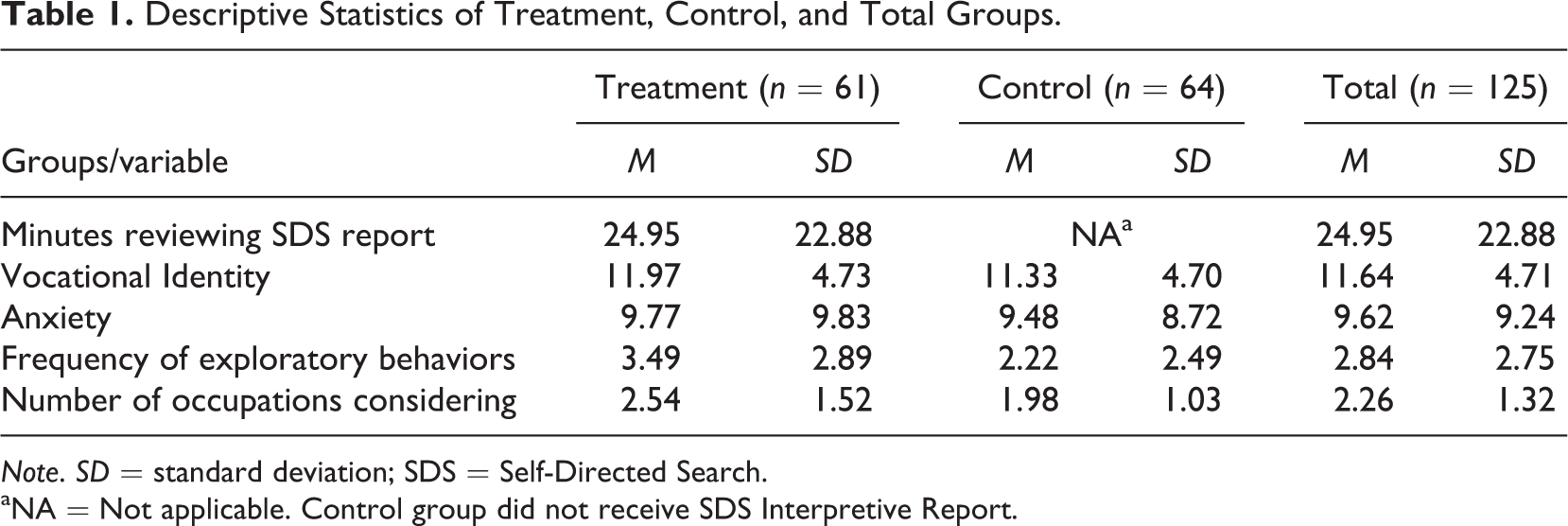
Note. SD = standard deviation; SDS = Self-Directed Search.
aNA = Not applicable. Control group did not receive SDS Interpretive Report.
The SDS: R Internet and Career Exploratory Behavior
A univariate ANOVA was performed to compare the treatment group who took the Internet version of the SDS and the control group who did not with respect to the frequency of career exploratory behavior as measured by responses to the following question: “How many times have you specifically sought career information in the last 3 weeks?” Using the Bonferroni correction formula to control for family-wise error using two dependent variables, there was a statistically significant (p < .025) difference between the two conditions, F(1, 123) = 7.025, p = .009, η = .054. Participants who received the SDS: R Internet and reviewed the Interpretive Report were more likely to engage in a greater number of career exploratory behaviors (M = 3.49, SD = 2.89) than those who did not receive the SDS (M = 2.22, SD = 2.48). A second univariate ANOVA contrasting those who took the SDS: R Internet with the control group in terms of the number of occupations being considered indicated there was a statistically significant (p < .025) difference, F(1, 123) = 5.774, p = .018, η = .045. Those participants who received the SDS: R Internet indicated they were engaging in exploring more occupations (M = 2.54, SD = 1.52) than those in the control group (M = 1.98, SD = 1.03). Using Cohen’s d to estimate effect size, the treatment had a similar moderate impact on the respective career exploratory behaviors, d = .47 for number of career exploratory behaviors, and d = .44 for the number of occupations being considered. These findings suggest that taking the SDS: R Internet and reviewing the Interpretive Report had a medium effect on career exploratory behavior.
Time Spent Reviewing the SDS Interpretive Report and Career Exploratory Behavior
A correlational analysis was conducted to derive the extent of association between minutes spent reviewing the SDS: R Internet Interpretive Report for the experimental participants only (n = 61) with respect to the frequency of career exploratory behavior and the number of occupations being considered (see Table 2). The results indicated there was a statistically significant relationship between time spent reviewing the SDS: R Internet Interpretive Report in both the frequency of exploratory behaviors (r = .337, p < .01) and the number of occupations being considered (r = .380, p < .01). Thus, as hypothesized, time spent reviewing the Interpretive Report was associated with career exploratory behavior with 11.4% and 14.4% of the variation in exploratory behaviors, respectively, explained by this variable.
Correlations Among Key Variables for Treatment Group.
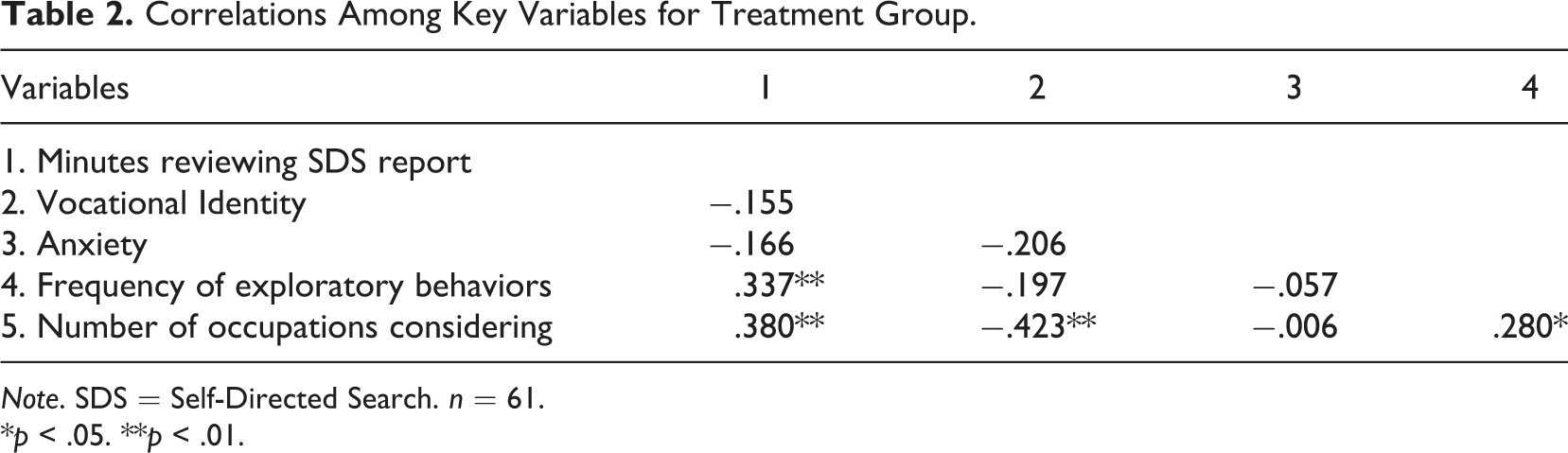
Note. SDS = Self-Directed Search. n = 61.
*p < .05. **p < .01.
Vocational Identity, Anxiety, and Career Exploratory Behavior
A linear regression model was used to assess the potential mediating effect of vocational identity and anxiety on (a) the frequency of career exploratory behavior and (b) number of occupations being considered 3 weeks after treatment. The predictor variables in the respective regression models included (1) time spent reviewing the Interpretive Report in minutes; (2) vocational identity as measured by the MVS; and (3) anxiety using the BAI. With respect to the frequency of career exploratory behavior as the dependent variable, the overall prediction model was significant, R 2 = .136, F(3, 57) = 2.998, p = .038. According to the results of the analysis (see Table 3), while time spent reviewing the Interpretive Report was a significant (r β = .306, p = .019) predictor, vocational identity (r β = −.157, p = .226) and anxiety (r β = −.038, p = .769) were not. Thus, neither vocational identity nor anxiety captured significant variation in the prediction of the frequency of exploratory behaviors and, therefore, demonstrated no mediating effect.
Regression Analyses With Minutes Reviewing SDS Report, Vocational Identity, and Anxiety as Predictors of Frequency of Exploratory Behaviors and Number of Occupations Considering.
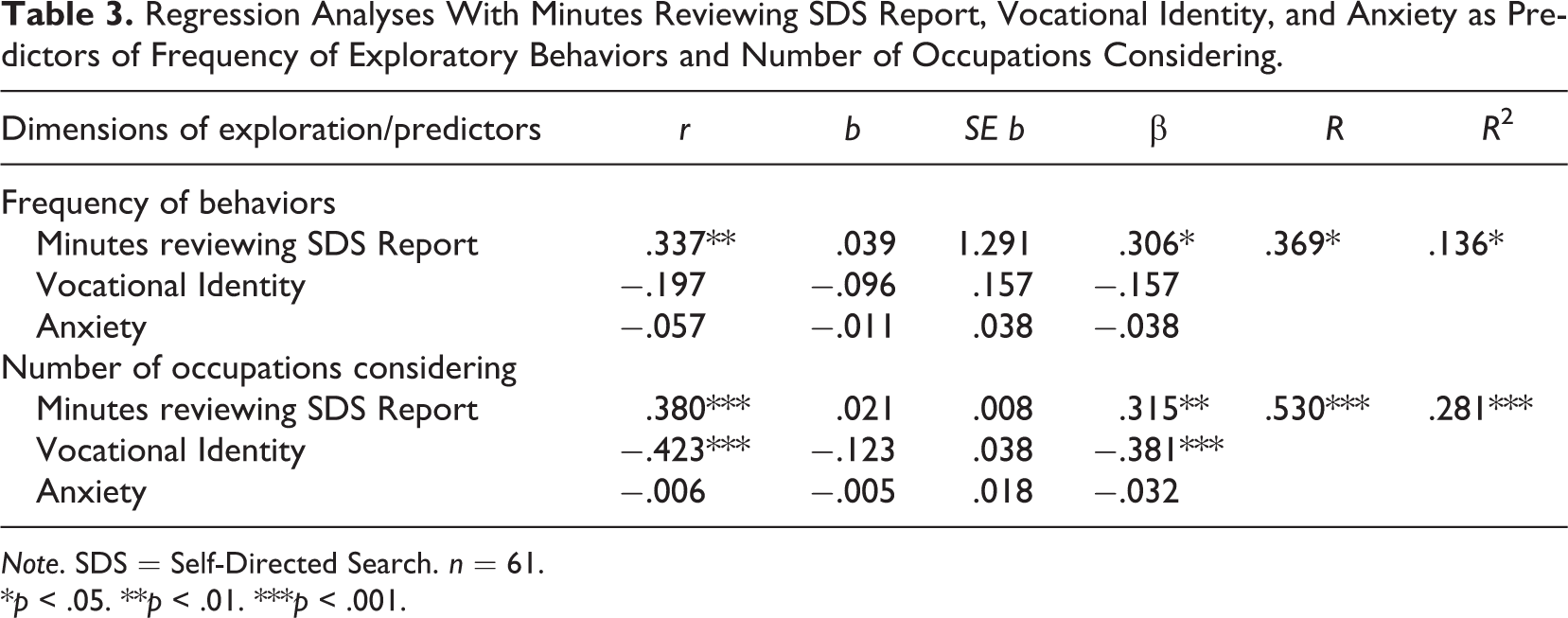
Note. SDS = Self-Directed Search. n = 61.
*p < .05. **p < .01. ***p < .001.
A second model regressing the same predictors on the number of occupations being explored 3 weeks later revealed that the overall model was significant, R 2 = .281, F(3, 57) = 7.427, p = .000. The results of this analysis are also presented in Table 3. A first inspection of the findings revealed that vocational identity by itself was inversely associated (r = −.423, p < .001) with the number of occupations being explored. That is, the higher the vocational identity, the fewer the occupations being considered 3 weeks after the treatment. Further, within the multivariate model, time spent reviewing the SDS Interpretive Report was a significant (r β = .315, p = .010) positive predictor of the number of occupations being considered, whereas vocational identity was a significant (r β = −.381, p = .001) negative predictor. Anxiety, however, was not a significant predictor (r β = −.032, p = .482). Since both minutes reviewing the SDS report and vocational identity were each significantly related to number of occupations considered (see Table 2), and that together they each captured significant variation in the number of occupations considered (see Table 3), vocational identity met the conditions of a mediating variable according to Baron and Kenny (1986). Therefore, these findings indicated vocational identity had an appreciable mediating effect on the number of occupations being considered. This interesting finding will be explored further subsequently.
Discussion
This study investigated the impact of completing the SDS: R Internet on the frequency of career exploratory behaviors and on the number of occupations reviewed, the relationship between the amount of time spent reviewing the SDS Interpretive Report and subsequent career exploratory behaviors, and whether the level of vocational identity or anxiety had a mediating effect on career exploratory behavior for participants completing the SDS: R Internet. The findings of the study are discussed in relation to these purposes.
Impact of the SDS: R Internet on Career Exploration
A major finding of this study was that college students completing the SDS: R Internet and reading the Interpretive Report engaged in more career exploratory behaviors over a 3-week span than students in a control group who did not complete this version of the SDS. In terms of main effects, students in the treatment group engaged in more exploratory behaviors, for example, reading, talking, and listening, and they were considering more occupational alternatives than students in the control group. What is particularly noteworthy to us is that the magnitude of the treatment effect appeared to have an appreciable degree of practical significance, with Cohen’s d = .47 and .44 for frequency of career explorations and number of occupations being considered, respectively, given that this is a counselor-free intervention in which students are “on their own.” In addition, the baseline levels of career exploration by members of the control group were interesting in that over the 3-week span, they engaged in a mean of 2.22 career exploratory behaviors, and were considering a mean of 1.98 occupations. Thus, engaging in career exploratory behaviors and considering career options appears to be an important ongoing activity for this population and an element of student personal development that warrants attention and resources to facilitate productive growth. Having the facilities and mechanisms for students take the SDS and review the Interpretive report would be worthwhile and strongly supported by these findings.
Furthermore, in terms of broader issues related to counselor-free career interventions, these findings vary from the report by Whiston (2011) that these kinds of vocational interventions are ineffective as shown in research (Whiston et al., 2003, 1998). Meta-analytic research by Whiston and others appears to question the efficacy of counselor-free career interventions based on the results of the studies examined. Whiston et al. (2003) further noted that there seemed to be little variation in counselor-free interventions and it was not possible to identify factors that might make these interventions more effective.
However, results of this study point to some issues that merit further attention and might clarify this situation. For example, were the counselor-free career interventions used in prior studies theory based (Holland, 1997), did they incorporate the five ingredients of successful interventions (Brown & Ryan Krane, 2000), did they follow-up career behavior days or weeks after the career intervention, or did they assess the client’s readiness for career decision making (Sampson, McClain, Musch, & Reardon, 2013)?
The career intervention (SDS: R Internet version) in this study makes use of an instrument directly based on RIASEC theory (Holland, 1997). In addition, it makes use of four of the essential ingredients for successful career interventions identified by Brown and Ryan Krane (2000), including a workbook or written exercises (the SDS Assessment booklet), information about the world of work (Occupations Finder, You and Your Career booklet, SDS Interpretive Report), modeling (theoretical descriptions of RIASEC types), and increased environmental supports (You and Your Career booklet, SDS Interpretive Report). Overall, these findings suggest that the SDS: R Internet, much like the paper-and-pencil version, enhances career exploratory behavior (e.g., Gottfredson & Johnstun, 2009; Holland, 1997; Holland et al., 1994; Nauta, 2010; Reardon, Lenz, Sampson, & Peterson, 2009).
Time Reading the SDS Interpretive Report and Career Exploration
As expected, the amount of time spent reviewing the SDS: R Internet Interpretive Report was significantly associated with the extent of career exploratory behaviors, although the strength of the association would be considered small, accounting for 11% and 14% of variation in frequency of career exploratory behaviors and number of occupations considered, respectively. These results confirm the tried and true relationship between time on task and student learning. That is, the more time spent reviewing the SDS: R Internet Interpretive Report, the more frequent career exploration and the investigation of a greater number of occupations. Nevertheless, the descriptive findings may be more noteworthy than these inferential correlational findings. That is, the members of the experimental group spent an average of 24.95 min reviewing the Interpretive Report, and, with the large variance (SD = 22.88), many spent considerably more time in review. To us, the average amount of time processing the report represents extensive engagement in this voluntary task and speaks highly about its relevance and the quality of exposition of the material in the report for these students.
These findings also extend prior research by investigating how increased engagement with the SDS Interpretive Report leads to positive outcomes including increased career exploration and increased number of occupations being explored. This information is valuable because it demonstrates to practitioners that not only is administering the SDS: R Internet helpful, but it can provide a rationale for an anticipated goal during career interventions (e.g., explore and expand career options for consideration).
Vocational Identity, Anxiety, and Career Exploratory Behavior
We examined whether the level of vocational identity (clarity and stability of one’s goals, interests, talents) and the present state of anxiety would affect career exploratory behavior for students completing the SDS: R Internet. Two regression models were employed in which time spent reviewing the Interpretive Report, vocational identity, and anxiety were used as predictors. In the first analysis, the time spent reviewing the Interpretive Report predicted the amount or frequency of career exploratory behavior, but the level of vocational identity and anxiety did not. Thus, the personality predispositions of vocational identity and state of anxiety were inconsequential as possible mediators in the relationship between engagement in the SDS (i.e., time on task) and the frequency of career exploratory behaviors.
In a second analysis, bivariate findings revealed that the number of occupational alternatives being considered 3 weeks after using the SDS: R Internet was inversely related to the level of vocational identity. In other words, students with high vocational identity, a clear and stable picture of their interests, values and talents, were considering fewer occupations 3 weeks after the career intervention than students with lower levels. In the multivariate regression model, more time spent reviewing the Interpretive Report together with lower levels of vocational identity were associated with considering a greater number of occupations. We can infer that vocational identity may serve as a suppressor variable in that students with higher levels of vocational identity may not need to spend time reviewing the Interpretive Report or to increase the number of occupations they are considering. Thus, we can posit that the SDS Interpretive Report may confirm both their interests and the occupations they are considering. This suggests that these students were satisfied with their progress in career planning and did not feel the need to explore additional occupational or educational alternatives. The SDS Interpretive Report had probably affirmed their career plans and intentions. Holland described it this way: The SDS is a practical, self-help device—a pair of booklets that helps a person summarize who he/she seems to be and explore some occupational alternatives. It’s just a beginning for many people, and for other people it’s enough. They want a little reassurance and it provides a structure for giving just that. (Weinrach, 1980, p. 408)
Further, we expected the SDS: R Internet, vocational identity, and anxiety to significantly impact the number of occupations being explored. The SDS: R Internet and vocational identity predicted career exploration but level of anxiety did not. Low vocational identity was significantly related to an increased number of occupations being explored, which suggests that individuals who are less vocationally mature may not be able to easily narrow their choices. These findings are consistent with previous research which found that the SDS was positively related to career exploratory behavior and an increased number of occupations being explored, while vocational identity remained an important variable in the career exploration process (Hirschi & Lage, 2008; Jones et al., 2000; Zener & Schnuelle, 1976).
Finally, the findings revealed that the level of anxiety was not a predictor of either the frequency of career exploratory behavior or the number of occupations considered. Although limited research has investigated anxiety in relation to career exploratory behavior, it was unexpected that anxiety failed to demonstrate significant impact on the number of occupations being explored. Previous research consistently linked anxiety to the career decision-making process by suggesting that anxiety may provide a necessary incentive for individuals to engage in career exploration (Blustein & Phillips, 1988; Hardin, Varghese, Tran, & Carlson, 2006; Stumpf, Colarelli, & Hartman, 1983). While we used linear statistics to explore the relationship, perhaps a curvilinear relationship could be explored in further research. The famous Yerkes and Dodson (1908) curve in human performance may apply such that an optimal level of anxiety is associated with career exploration, but reduced exploration is manifested at high and low levels of anxiety.
Limitations
All measures used in the study were self-report measures, so information was gathered based upon participants’ perceptions and memory. Attrition was another threat to external validity of the 3-week follow-up and the complexity of completing surveys online. History was another factor that may have affected the external validity of this study because participants were asked to report follow-up information after 3 weeks. Participants were asked not to take any additional career assessments or seek academic or career advising after the treatment, but it is nearly impossible to predict and control for all of the external events that may occur over a 3-week period (e.g., mandatory advising). Next, motivation is an important consideration for the participants involved in this research study because all participants initially signed up for this survey to fulfill a research requirement for class. Although everyone in the study received credit for completing the surveys, individual levels of motivation to engage in career exploration and explore results from the SDS: R Internet are not known. This study utilized a nonprobablity sampling technique, a potential limitation because participants had to be enrolled in 1 of the 14 courses included in this sample. Finally, generalization of the findings from this study is constrained by the nature of the sample, which included females (84%) enrolled in an upper division course in a College of Education.
Implications
This study has important implications for practitioners because it suggests that the online version of the SDS (SDS: R Internet), much like the paper-and-pencil version, is positively related to career exploratory behaviors and helps some individuals expand the number of options being considered (e.g., Jones et al., 2000; Krivatsky & Magoon, 1976; Miller, 1982). By knowing that the SDS: R Internet generates a customized Interpretive Report with dozens and sometimes hundreds of occupations for further exploration, practitioners can prepare individuals to make more effective use of the instrument by assessing client needs beforehand and using this intervention to meet those needs. Finally, the purposes for recommending the use of the SDS Internet version may vary depending on one’s level of vocational identity. For students or clients with low vocational identity, as assessed by the MVS, they may be encouraged to use it for clarifying interests and for generating possible occupational alternatives for further consideration and exploration. On the other hand for students with higher levels of vocational identity, the SDS may be used for confirmation of interests and occupations being considered with an eye toward the possibility of having overlooked a viable alternative.
In conclusion, as investigators, we were impressed with the power of this counselor-free career intervention to stimulate engagement in this assessment and review task and to subsequently foster career exploration in these upper division students. In terms of the effectiveness of self-help, counselor-free, or counselor-limited interventions, the SDS: R Internet version can be recommended for use in classroom or career center environments.
Footnotes
Authors’ Note
Robert C. Reardon is an author of the SDS software report used in this research. V. Casey Dozier is now psychological resident at the Psychological Center for Growth and Development in Thomasville, GA. James P. Sampson is the Mode L. Stone Distinguished Professor of Counseling and Career Development, associate dean for faculty development and administration, College of Education. Janet G. Lenz is associate in the Department of Educational Psychology & Learning Systems and program director for instruction, research, and evaluation in the Career Center. Gary W. Peterson and Robert C. Reardon are Professors Emeriti at Florida State University.
Declaration of Conflicting Interests
The author(s) declared no potential conflicts of interest with respect to the research, authorship, and/or publication of this article.
Funding
The author(s) received no financial support for the research, authorship, and/or publication of this article.