



Abstract
This study explored how the perception of work as a calling, a construct with a long history in Western culture, is experienced within Chinese culture. A qualitative study was conducted with 210 Chinese college students. Using emergent qualitative document analysis, results revealed four dimensions of general calling and career-related calling: Guiding Force, Meaning and Purpose, Altruism, and Active Tendency. These results largely converge with those found using samples within Western cultures, although the label “sense of duty” was found to be a unique and salient aspect of calling among Chinese college students. Results also revealed that effect of calling was not always positive. This study provides the first evidence that many aspects of the multidimensional construct of calling may be shared within Chinese culture, at least with college student participants. Implications for research and practice are explored.
In career development, discerning and living a calling—a transcendent summons to a personally meaningful, prosocially oriented career—is an oft-cited goal among workers in contemporary U.S. culture. The topic has become a focus of scholarly interest in the social sciences in recent years, especially within counseling psychology and management, with the number of studies published on the topic since 2007 more than quintupling the number published in all of prior history (Duffy & Dik, 2013). This research has revealed that a sense of calling is perhaps surprisingly prevalent, with more than a third of most college student and employee samples reporting that they view their careers as a calling (e.g., Duffy & Sedlacek, 2010; Wrzesniewski, McCauley, Rozin, & Schwartz, 1997). Scores on scales designed to measure a sense of calling are consistently linked to adaptive career development and general well-being, and more sophisticated models have identified mediators and moderators of these relations (see Duffy & Dik, 2013, for a review). However, virtually all of these studies have been conducted in Western cultures, most notably the United States, Canada, and Germany. Although a few studies from Asian countries such as South Korea (e.g., Shim & Yoo, 2012) have emerged, very little is known about basic questions such as how participants in Eastern cultures conceptualize calling in the context of work. This study aims to provide an initial glimpse of how individuals within one Eastern context, China, understand the concept of calling and its role in their career development.
Conceptualizing Calling in the West
The idea that any honest area of work can be viewed as a calling arguably developed and evolved as a by-product of major historic movements in the West. For example, the Protestant Reformers, beginning with Martin Luther in the 16th century, developed the idea that God calls people to serve within any sphere of life and work, a view that ran counter to the hierarchical separation of sacred and secular, predominant in that era (and arguably still today; e.g., Steger, Pickering, Shin, & Dik, 2010). The Puritans further refined the concept (Hardy, 1990), which remained tied to a religious worldview until the increasingly secularized West began using the term to refer to the process through which one’s inner talents prompt a sense of personal happiness (Baumeister, 1991). Unfortunately, despite the similarities that presumably are present across various cultural contexts in the United States and other Western countries, a consensus definition of calling has proven elusive.
In general terms, when applied to work, the term “calling” typically refers to a sense of direction or purpose a person experiences toward some kind of personally meaningful or socially impactful engagement within the work role. However, the need for nuance quickly emerges when one scans the variety of definitions in the literature. Some definitions have tied calling to its religious roots, such as Dalton’s (2001) definition of calling as a means of serving God or following God’s summons to certain career. Dik and Duffy (2009) took another approach in an attempt to bring together diverse definitions that reflect the historic usage of the term while offering a multidimensional strategy. Specifically, they defined calling as (a) a transcendent summons, experienced as originating beyond the self, to approach a particular life role in a way that (b) connects it with a broader sense of purpose or meaning, and that (c) holds other-oriented values as primary sources of motivation. Others frame calling as an increasingly secularized concept. For example, Bellah, Madsen, Sullivan, Swidler, and Tipton (1986) stressed inner interest and fulfillment in defining calling, Hall and Chandler (2005) defined calling as one’s purpose in life, and Dobrow and Tosti-Kharas (2011) defined calling as a consuming, meaningful passion people experience toward a life domain. Elangovan, Pinder, and McLean (2010) proposed three facets: action orientation, sense of purpose, and prosocial intention. They defined calling as a course of action in pursuit of prosocial intentions embodying the convergence of an individual’s sense of what he or she would like to do, should do, and actually does. In reviewing the various approaches to understanding the term, Bunderson and Thompson (2009) differentiated between “neoclassical” (e.g., tied to the literal meaning and historical use of the term) and “modern” (e.g., more secularized and self-oriented) approaches to the construct. Both of these general approaches have served as a foundation for research on the topic within the social sciences.
Several studies have used qualitative analyses of participant’s own definitions of calling as a basis for conceptualizing the construct. Hagmaier and Abele (2012) identified a five-category conceptualization of calling in a highly educated German adult sample: (a) identification with one’s work, (b) sense of meaning, (c) person–environment fit, (d) value-driven behavior, and (e) transcendent guiding force. With a sample of U.S. college students, Hunter, Dik, and Banning (2010) identified three dimensions: (a) a guiding force, (b) a sense of personal fit and eudaimonic well-being, and (c) altruistic values. With a sample of counseling psychologists, Duffy, Bott, Allan, Torrey, and Dik (2012) found that participants described a calling as what one is meant to do, as one’s purpose in life, and as something may develop or change over time; some participants also framed calling in religious and spiritual terms, as coming from a higher power and as fundamentally about serving others. Bunderson and Thompson’s (2009) study of zookeepers led them to define calling as a job “that one feels destined to fulfill by virtue of particular gifts, talents, and/or idiosyncratic life opportunities” (p. 39), whereas French and Domene (2010) found a sample of Canadian college students to describe their callings in terms of an altruistic focus, intensity, a deep passion, a sense of helping others discover their calling, and a sense in which a calling comes with burdens to bear.
These various conceptualizations illustrate the many similarities but also some diverse and sometimes conflicting aspects of what it means to have a calling (e.g., Dik & Duffy, 2009; Elangovan, Pinder, & McLean, 2010; Hunter, Dik, & Banning, 2010; Novak, 1996). These definitions of calling were all rooted in Western culture. Although some scholars have noted that parallels of the calling construct appear to be present within Eastern traditions (e.g., Dik, Duffy, & Tix, 2012), others suggest that a sense of calling is likely not a universal concept (e.g., Berg, Grant, & Johnson, 2010). This reinforces the need for cross-cultural research (Hagmaier & Abele, 2012) such as this study—the first, of which we are aware, to specifically explore the dimensions of calling in China.
Calling in Chinese Culture
The Chinese understanding of a “calling,” pronounced “Shiming” in Mandarin, did not stem from a Christian worldview, at least for most people in China. Instead, the main influences may have been derived from Chinese religion and traditional culture, such as Confucianism and traditional patriarchal religion (He, 2012). These traditions emphasize destiny, an abstract or mysterious sense of heaven, the importance of honoring ancestors, and deep family connections (He, 2012; Hwang, 2001). The role of family influence is especially important; indeed, a Chinese sense of calling is probably rooted in the destiny and needs of the clan rather than the individual. Even in modern China, traditional values regarding family play a prominent role in one’s career choice and development (Zhou, Leung, & Li, 2012).
Pursuing a calling in the Chinese context may also mean fulfilling an order or mission from the emperor or superior authority, which gives the individual a strong sense of duty and responsibility (Luo, 2008). For instance, in its early forms, calling has been defined as a call to serve the Monarch or a mysterious sense from heaven to fulfill a mission (Zhang, Wei, & Zhang, 2012). Until recently, one’s calling was also mediated through government control to some extent. Especially before the reform and open policy introduced in 1978, a calling (if it was relevant at all) to a particular job was most likely perceived as issued by the Great Chairman Mao, the Party, or the country (Zhou, Lv, & Wang, 1991). To illustrate, consider two popular slogans from that era: “I’m a brick, I could be moved to any place where I am needed,” and “The need of the nation is also the need of mine” (Dong, 2009; Zhou et al., 2012, p. 409). The influence of this worldview was evident in the millions of students who were called to forego their education and instead move to rural areas to do farm work (Wang, 1991). Such mandated actions were declared “sacred” and “lofty” (Liao, 2013). When the market economy and its accompanying Western cultural influence emerged within China, many Chinese suffered a period of struggle and conflict in their careers, navigating a difficult transition from career decisions being handed to them to a more open-ended milieu in which they must find a job and develop their career by themselves or their families (Leung, Hou, Gati, & Li, 2011; Zhou et al., 2012). This economic and cultural shift led to the calling construct becoming more secularized but also seemingly less relevant and less frequently mentioned in China. Therefore, although some features of calling may stem from Chinese traditional (e.g., Confucianism) and collectivist culture, the contemporary meaning of calling may also show some diversity, reflecting diverse perspectives and experiences in modern China.
Dik and Duffy (2009) proposed that the relative salience of the meaning and prosocial dimensions of calling may differ across cultures, with a greater emphasis on meaningfulness in individualist cultures and on social contributions in collectivist cultures. This study offers an initial inquiry into this possibility. Similar to how the term has evolved in Western culture, in China, a sense of calling has taken on more secularized meanings for many people (Zhang et al., 2012), making its conceptualization in Chinese culture likely complex. Nevertheless, a religious and cultural understanding of calling in China may be different than that experienced in the West, although it is reasonable to expect there may be meaningful overlap.
The Present Study
This study offers the first empirically driven effort, of which we are aware, to directly investigate the meaning of calling in China. To explore the meaning and dimensionality of calling, we conducted a qualitative analysis of conceptualizations of the term provided by a sample of Chinese college students. This study provides an important initial step in cross-cultural research on this topic in China, because it cannot be assumed that the way the concept of calling is understood in Western contexts generalizes to Chinese participants. A qualitative strategy that investigates a large sample using open-ended responses offers a broad view of how the term is understood by people, which can subsequently inform quantitative research on the construct in China. The purpose and design of this study is exploratory in nature and precludes formal hypotheses.
Method
Participants and Procedure
A total of 210 participants were recruited from two comprehensive universities in China. College students were selected because of the developmental relevance of career decision making and planning among emerging adults in general and students in particular (e.g., Hunter et al., 2010). In one university sample, 33 participants were students in a counseling psychology course. In the other university sample, 93 participants were students in an elective social psychology course and 84 were collected from an introductory psychology course. Because the psychology courses at these universities were electives that did not require a psychology major, the participants represented diverse courses of study. Participants’ average age was 19.82 years (standard deviation = 1.22; range = 17–26). More than two thirds (n = 143, 68.1%) were women. Most of the participants (n = 189, 90%) identified as members of the Han ethnic group. Remaining participants (n = 21, 10%) were from other ethnic minority populations, including Hui, Manchu, and Tibetan.
Participants were offered credit for research participation. The open-ended questions were sent to a total of 250 participants. The participants were asked to respond to the three questions in written form. This method was chosen because open-ended questions are ideal for exploring a particular concept in a rigorous and systematic way in a large sample (Jackson & Trochim, 2002). After removing 40 participants who did not respond or who wrote that they couldn’t explain what the term “calling” exactly means, a final sample of 210 participants remained. There were no limits on length and time in responses. The questions were as follows: “How do you define the word ‘calling’?” “How do you define the word ‘calling’ in one’s career?” “For you, what does it mean to see your career as calling?”
Coding and Analyses
The responses to the three questions were coded and content analyzed using emergent qualitative document analysis (QDA), an inductive method that offers an exploratory strategy to analyzing written responses to open-ended questions. Although written responses to open-ended questions generally provide less depth than interviews, this shortcoming is countered by the breadth of responses from a very large sample, a strength of QDA. Because it emphasizes discovery and description, QDA is ideal for uncovering raw material and information from written text in a rigorous, systematic way (Altheide, 1987; Altheide, Coyle, Devriese, & Schneider, 2008). QDA focuses on thematic analysis and on exploring the nature and importance of thematic meanings.
Because QDA requires extensive familiarity with the research topic and data, the written text data were read and reread in order to provide an initial knowledge about the whole content of the open-ended questions. In accordance with previous studies using QDA and closely related procedures (e. g., Hagmaier & Abele, 2012; Hunter et al., 2010), open coding was first applied to all responses for each question, with the first and third authors (two doctoral students in psychology) independently coding the original statements into descriptive and simplified labels. For example, the statement “Calling means something that one is destined to do” was coded as Fulfill Destiny, and “Calling needs you to benefit the society” was coded as Benefit Others. Subsequent responses were grouped with existing labels, or classified as new labels until the point of saturation, in which no more new labels were emerging from the data. A process requiring intercoder consensus was implemented to ensure trustworthiness. The two coders compared and discussed all labels that were independently assigned to content from the coding. This method identified some coding discrepancies (e.g., differences in the breadth of the labels, similar terms used for a particular label but with different descriptions, and different labels used to describe the same written text). These discrepancies were discussed by the two coders, and several labels were revised or renamed until consensus was achieved. To avoid introducing the researcher bias, another doctoral student in psychology (from different research team) was invited to review all labels independently. Several statements and labels were discussed again. The decision about the final labels was made until consensus was achieved among all researchers.
The next step in QDA involved collapsing the labels from coding into broader, more general themes. In this process, similar labels were compared and classified, resulting in more refined themes that better reflected the initial labels. For example, Fulfill Destiny, Sense of Duty, Mission, Collective Expectation, and Faith were sorted into the final core theme Guiding Force. Finally, these core themes were reviewed and discussed until consensus was achieved among all researchers. Because all the written data were in Chinese, the analysis process was also conducted in Chinese. The typical examples, labels, and themes were then translated into English in the writing process.
Results
Calling as a General Concept
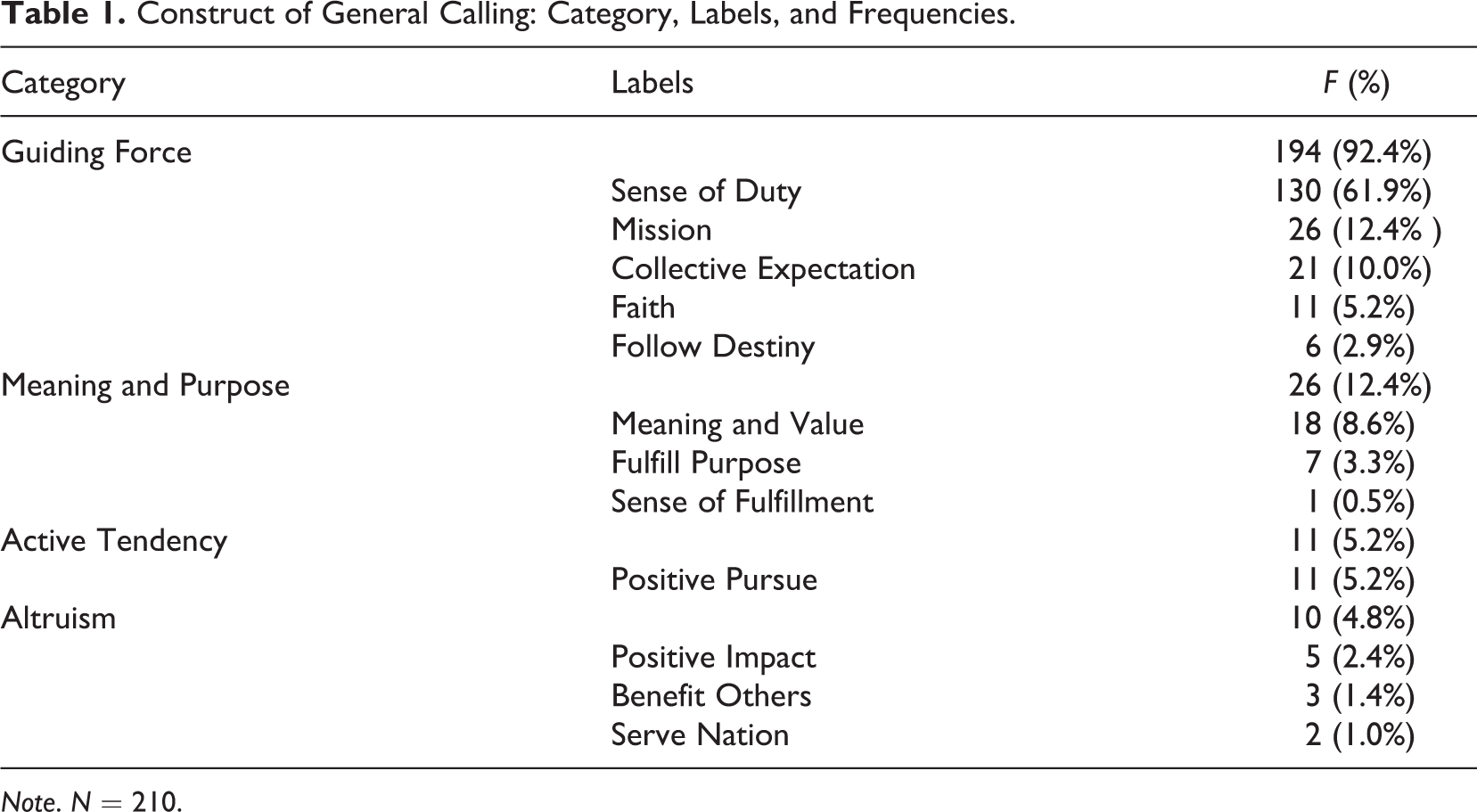
Table 1 presents themes and labels in order of their relative frequency in the data of Question 1 (How do you define the word ‘calling’?). Frequencies for responses are informative, although it should be noted that QDA is designed to provide essential features rather than precise numerical representations of responses (Altheide et al., 2008; Hunter et al., 2010); furthermore, in some cases, a single statement linked to more than one label or theme, resulting in a distribution of percentages that sum to more than 100%. For example, Participant 32 mentioned that “Calling is a complex concept which involved duty, faith, and the expectation from outside force.”
Construct of General Calling: Category, Labels, and Frequencies.
Note. N = 210.
Question 1 was designed to explore the general understanding of calling for the present sample of college students in China. A total of 12 labels were identified from the participants’ responses. These labels were further sorted to four broader themes. The most prevalent theme was Guiding Force, with the majority of the participants (92.4%) providing related responses. The respondents believed calling functions as a guiding influence, defining calling as a big-picture mission that one must discern, accept, and endeavor to fulfill. More specifically, within this theme, the most significant label is the Sense of Duty, referring to a duty or responsibility to engage the work to which one feels called. To illustrate, Participant 5 stated, “Calling is the duty that one needs to shoulder as a person living in the world. The duty can be from the self, the collective, or the country.”1 Many respondents described calling as a sacred or lofty duty, endowing the concept with a sense of morality. Some indicated that regardless of their interest in what they do, they have to accept the calling because of a moral obligation to do so. The respondents also mentioned that calling can be a mission assigned by a superior authority (e.g., “Calling is the mission that an authority appoints to someone,” Participant 51). The label of Collective Expectation refers to the influences that push one to accept the calling, such as one’s family and society (e.g., “It’s something you need to do because of the strong expectation of your family or society,” Participant 16). The respondents also reported that calling can be tied to faith or destiny. However, faith is more likely a general and secular concept in this context, related to one’s worldview beliefs, because none of the respondents made explicit reference to God, a higher power, or any overtly religious factors.
Another theme was the connection of a calling with one’s life meaning, value, and purpose. Around 12.4% of respondents indicated that calling is the expression of the meaning and purpose of one’s existence (e.g., “Calling is what one must to do to fulfill his meaning,” [Meaning and Value, Participant 151], or “Calling is one’s highest purpose,” [Fulfill Purpose, Participant 2]).
The third theme was that a calling is not easy to discern but provides a positive force, so that individuals who experience a calling are motivated to live it out. Some respondents (5.2%) reported that living out a calling requires extreme effort and can include sacrificing some aspects of their lives (e.g., “Calling is something that one needs to pursue and fight for a whole life,” Participant 105). Finally, the fourth theme was the prosocial orientation of calling. Specifically, 4.8% of respondents indicated that calling involved the aim or expectation of helping others, making a difference for society, and serving the beloved country. For example, Participant 55 stated, “Calling is the mission that can make a difference for the community” (Positive Impact); Participant 46 wrote, “Calling means our lives are not just for ourselves. We need to do something for others’ benefits” (Benefit Others); and Participant 119 indicated that “Calling is the duty that is related to the prosperity of the nation” (Serve Nation).
Question 1 did not constrain calling solely to the career domain. We sought to examine how the participants explain the term “calling” in general and to assess the frequency with which participants applied the concept to their careers. The results indicated that relatively few respondents tried to define calling within the career context. Instead, most defined calling as a global perspective that transcends any particular life domain, most using vague words like “something” to summarize its content or simply excluding the object of the sentence altogether. This suggests that participants viewed a calling in ways that may transcend any particular life domain or role, including the career domain.
Calling in Career
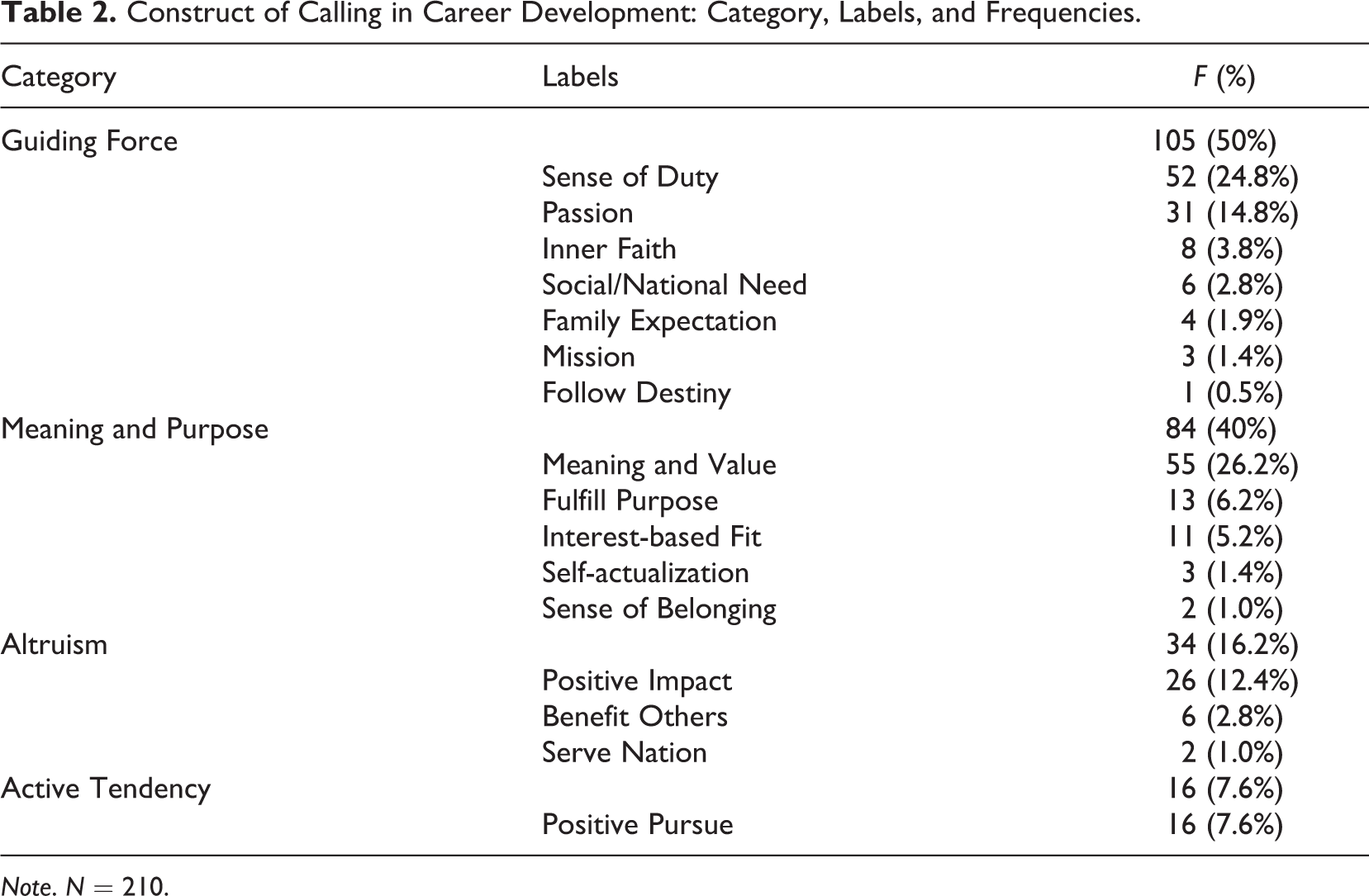
Questions 2 and 3 (i.e., How do you define the word ‘calling’ in one’s career? and For you, what does it mean to see your career as calling?) sought to examine how participants conceptualize calling specifically within the context of their or others’ careers. Questions 2 and 3 were both intended to evoke definitions of a calling, as it relates specifically to the career domain, in contrast to in general (Question 1). The questions did so in different but overlapping ways (one from a third-person perspective and the other from a first-person perspective). Because responses to the two questions were extremely similar, the two questions were combined for analysis (see Table 2).
Construct of Calling in Career Development: Category, Labels, and Frequencies.
Note. N = 210.
Four core themes of calling in the career domain were identified in the current Chinese college student sample: (a) Guiding Force, (b) Meaning and Purpose, (c) Altruism, and (d) Active Tendency; these themes mapped onto a total of 16 labels and were largely consistent with responses to Question 1. Guiding Force was still the most frequently coded theme (50%) and covered the labels Sense of Duty, Mission, Family Expectation, Social/National Need, Inner Faith, Fulfill Destiny, and Passion. The most frequently coded label was Sense of Duty, in which individuals reported having a sense of duty or responsibility to pursue the career they regard as a calling (e.g., “Calling is the career toward which one experience a sense of duty, or which one must, should or have to do,” Participant 121). However, the percentage of participants providing responses tied to this label was lower than the percentage derived from the global definitions of a calling. Indeed, a portion of respondents reported a new label Passion, indicating an understanding of calling as a strong passion toward a certain career. As an example, Participant 21 stated, “It means this person has an extreme passion to his (or her) career” The label of Family Expectation refers to the influence of one’s family in discerning or pursuing one’s calling, particularly the desire or obligation to satisfy parents’ expectations and arrangements (e.g., “Like I chose my major (nursing), it’s all because my family think it will be a better job for girls like me,” Participant 22). Social/National Need represented a sense that one’s calling derived from the needs of society and nation. Participant 154 shared her experience: “I know I will be a teacher after graduation. This may be my calling. What pushed me to do this is the expectation from society.” Participants rarely made reference to God’s will and gifts, although “faith” was mentioned in a number of responses (e.g., “It’s the symbol of his lifetime faith, so that he can treat his job positively,” Participant 112).
The second-most coded theme (40%) was Meaning and Purpose, which captures the association between one’s career and one’s life purpose, value, meaning, and interest. This theme was derived from the labels Meaning and Value, Fulfill Purpose, Interest-based Fit, Self-Actualization, and Sense of Belonging. Meaning and Value is the most frequently coded of these labels (e.g., “He see the career as the meaning of his existence,” Participant 206). Some participants think a calling is a way to fulfill one’s purpose in life. For example, Participant 177 mentioned that “For the majority, career is just a way of living. However, others treat their career as calling. They believe that career is the ultimate purpose in their lives” (Fulfill Purpose). Finally, some of the participants framed a calling as strongly related to one’s interests (e.g., “It must be the case that your interest fits well to your career.” [Interest-based Fit, Participant 65]).
The percentage of participants referencing this theme within the career domain was greater than the corresponding percentage referencing the theme when defining calling generally, suggesting that respondents were more inclined to define calling in the career context by linking it to their personal subjective experiences. This may signal that career-related calling is more individualist in nature than a general or global calling.
The third theme was Altruism, which described calling in terms of its benefits to others, having a generally positive impact and serving the nation. The most frequently coded label was Positive Impact. Participant 169 shared her experience: “I think treating career as a calling is what one should do. Career is a way to fulfill one’s self-value. And seeing career as a calling can make a contribution to the society. Because you keep trying, your contribution is also huge. Like me, I will be a teacher and I’ll take it as a calling. I believe that I can make a greater contribution.” As an example of the label Benefit Others, Participant 70 stated, “All the jobs that serve the people can be seen as calling.”
Several respondents indicated that Meaning and Purpose and Altruism are related to each other. They emphasized that helping and serving others is a way to find one’s personal meaning. Finally, a small number of participants mentioned that calling represented an active engagement in pursing one’s career path, reflected in the theme Active Tendency. For example, Participant 28 stated, “It’s what I’m gonna keep doing, no matter what happens.” Several lines of work also were suggested to reflect a calling, most notably teacher, police officer, and doctor.
Positive and Negative Aspects of Calling
Besides the core themes of calling, participant responses revealed positive and negative aspects of a calling, both in global and career-related definitions of the term. In response to Question 1, most of the respondents appeared to perceive calling in a positive or neutral manner. Some participants explicitly used positive words to describe calling, like “glorious,” “sacred,” “lofty,”“meaningful,”“great,” and “dignified.” However, 3.3% of respondents reported some negative aspects, such as lack of freedom or control in their lives, a sense of pressure or stress because the calling was usually important and meaningful, or a burden to fulfill the calling. In Questions 2 and 3, 6.7% of participants indicated that calling was not always positive and beneficial. For example, Participant 9 mentioned that “I personally feel that viewing career as a calling is too inflexible. This kind of calling may lead to a strong pressure. [People with a calling] don’t know how to enjoy their lives and even are perceived as lacking a sense of humanity.” Similarly, Participant 92 wrote that “I won’t take my career as a calling. I own my life, and I want to completely control it. I don’t want to be pushed to be the slave of any career by the force of ‘some values’.” Participant 198 shared her experience: “Teacher will be my calling. Actually, I don’t want it and I struggled for a long time. Finally, I have to accept it because I don’t want to fail to my family’s expectation. I just don’t want my family unhappy. I fulfilled their expectations by giving up my dream. For me, it’s a way to fulfill my filial piety.” Clearly, some respondents see themselves as passive subjects in perceiving calling or see calling as the opposite of fulfilling their true selves and career goals.
Discussion
The purpose of this study was to explore the conceptualization of calling among Chinese college students. The qualitative analysis of open-ended responses to questions asking about the definition of calling in general, and specifically tied to the career domain, revealed that participants conceptualized calling as multidimensional in nature, with four core themes: Guiding Force, Meaning and Purpose, Altruism, and Active Tendency. These results largely converged with those found in U.S. (e.g., Hunter et al., 2010) and German (Hagmaier & Abele, 2012) samples, although some differences were noteworthy.
When asked to define calling in an open-ended manner, without tying the concept directly to the career domain, participants tended to describe calling in global terms that transcend a particular life role. This finding is consistent with previous studies that found participants to apply the concept very broadly to multiple life domains not limited to the career domain (e.g., Elangovan et al., 2010; Hunter et al., 2010). Dik and Duffy’s (2009) definition of calling used the phrase “a particular life role,” a nod to the likelihood that many individuals may perceive a calling within nonwork roles. Although most research on calling to date focuses on the career domain, some scholars have investigated the construct within parenting (Coulson, Oades, & Stoyles, 2012) and leisure pursuits (Berg et al., 2010). Within Chinese culture, some individuals may perceive a calling as too lofty a concept to apply to a “worldly” pursuit such as one’s career development (Zhang et al., 2012)—a notion that is reminiscent of the ancient Greek and Medieval separation of sacred and secular types of work, which arguably persists in Western thought (Hardy, 1990). This may be part of the reason that participants did not spontaneously link calling to a specific life domain.
Results revealed four core themes of calling, both in general and specifically with respect to the career domain: Guiding Force, Meaning and Purpose, Altruism, and Active Tendency. The first theme, Guiding Force, was the most prevalent theme, conveying that calling functions as a guiding influence or big-picture mission that one must discern, accept, and endeavor to fulfill, in which a sense of duty was the most frequently mentioned source. This is perhaps unsurprising, given the context of collectivism in the culture, emphasizing that carrying out obligations and duties for others (e.g., family, society, nation) is a highly salient aspect of a calling (Brewer & Chen, 2007; Oyserman, Coon, & Kemmelmeier, 2002). The emphasis on duty may also reflect traditional Confucian values of hierarchy and subordination. In traditional Chinese culture, a calling invokes a duty to accept the order or mission from a senior authority (Zhang et al., 2012). Other traditional values, specifically family and filial piety, were also involved in the perception of calling. Following parents’ wishes and arrangements was perceived as a way to fulfill calling. These findings suggested that Chinese traditional values still play a significant role in the conceptualization of calling despite the increasing challenge from Western cultural values (e.g., individualism). Religious content was rare in the present sample, which differs from results found with American (Hunter et al., 2010) and German (Hagmaier & Abele, 2012) samples and reflects the predominance of secular and nationalistic values in China. (It should be noted, however, that a small number of Chinese participants included in their definition phrases that warranted the label Inner Faith, indicating that spirituality did play a role for some.) To summarize, although a Guiding Force theme emerged from the data and seemed to draw from both external and inner forces, the typical sources to which these Guiding Forces were attributed were different for many Chinese participants than for participants in Western samples in ways that may reflect broader cultural differences that are often observed.
The second theme, Meaning and Purpose, emerged from responses that cited a sense of meaning, purpose, value, sense of belonging, self-actualization, and fit with one’s work based on interests. This theme presented the connection of a calling with a broader sense of meaning in life. This also showed some similarities with themes found in Western samples, such as Purposeful Work (Dik & Duffy, 2009) and Sense of Purpose and Meaningfulness (Hagmaier & Abele, 2012). As Hunter et al. (2010) proposed, meaning, interest, and strength provided a connection between calling and subjective career success, which has been found in empirical research (Park, 2010). The third theme, Altruism, captured the orientation to help others and serve society and nation and corresponds with the theme of “other-oriented values” that was proposed by Dik and Duffy (2009), the “Altruism” theme found by Hunter et al. (2010), and the theme “Value-driven Behavior” found by Hagmaier and Abele (2012).
As noted earlier, Dik and Duffy (2009) proposed that the relative salience of the meaning and prosocial dimensions may differ across cultures, with a greater emphasis on personal meaningfulness in individualist cultures and on social contributions in collectivist cultures. Although the design of this study cannot test this hypothesis directly, the frequency of participants emphasizing the theme of Meaning and Purpose was much greater than that emphasizing the theme of Altruism, suggesting that Meaning and Purpose may also be more important to the construct of calling in Chinese culture. Furthermore, many participants suggested that personal meaning is most effectively fulfilled or satisfied by making a difference to others, society, nation, or world, suggesting some overlap between these dimensions among Chinese participants. Steele and Lynch (2012) found that the Chinese are increasingly individualistic and prioritizing individualist factors in their lives. Similar findings have emerged other studies (Cheng et al, 2011; Fan, Meng, Gao, Lopez, & Liu, 2010), suggesting that Chinese culture may be shifting toward more of an integration or balance between individualism and collectivism. Although more research is needed to evaluate this possibility, it is plausible that the blending of these factors stems at least in part from the evolving culture in China, in which traditional collectivist values are beginning to infuse individualist concerns, particularly in the career domain for college students.
The final theme, Active Tendency, reflected effortful and active behavior related to one’s calling, analogous to the “Effortful Dedication” theme found by Hunter et al. (2010) and Elangovan et al.’s (2010) “Action Orientation” theme.This theme corresponds to recommendations for active engagement in career decision making as a pathway for discerning a calling (Dik, Duffy, & Eldridge, 2009; Hirschi, 2011) and may help explain why calling is linked to a host of beneficial career-related criterion variables, although more research is needed to explore this as well.
The results of this study also found that calling was not always positive. In some cases, in light of the strong sense of duty described by participants, a sense of calling was accompanied by a lack of decision-making freedom and sometimes intense pressure from others. This is consistent with emerging evidence demonstrating that although calling typically is an adaptive construct, it can sometimes have a “dark side,” marked by potentially harmful tendencies such as ignoring career advice (Dobrow & Tosti-Kharas, 2012), sacrificing personal relationships (Cardador & Caza, 2012), and experiencing pressure and anxiety (French & Domene, 2010; MacMillan, 2009). This finding highlights the need for future research to examine factors that may affect the negative outcomes of calling.
On the whole, the general contours of a sense of calling in Chinese culture largely converged with how the construct has been conceptualized in Western culture; however, the differences in the content of the themes were also striking. This points to the possibility that aspects of calling may be a shared experience across cultures, despite the culturally specific content in the general categories that may emerge. Of course, more diverse contexts and samples must be studied to provide a clearer sense of the construct’s universality. The differences that were found, including less emphasis in China on religion and spirituality and a greater emphasis on a sense of duty and collective expectation (e.g., family, society, and nation), also point to the need for continued cross-cultural research. This research has the added benefit of informing the ongoing development of career counseling in China and may also yield evidence that translates into human resource and management applications (Wrzesniewski, 2012).
Limitations and Implications
Results from the present research need to be interpreted in light of a number of limitations, each of which points to directions for further research on calling in China. First, although college students are an appropriate starting point, given the developmental relevance of calling, a more thorough exploration of the construct in China requires also investigating samples of working nonstudents, including older and less educated workers for which the influence of traditional Chinese culture may be stronger. Second, the sample was collected from students in psychology courses. Although participants’ own courses of study were diverse, the decision to use an elective credit on a psychology course may reflect some systematic difference between these participants and those who opt for other courses. Additional ways of recruiting participants are needed in future research. Third, the sample’s ethnic makeup was primarily Han; transferability of results outside of the current sample should be done with caution, particularly until additional samples representing a wider range of diversity are investigated. Finally, although the current study examined calling in a non-Western culture, we did not directly compare a Chinese sample with a Western sample. Thus, conclusions about cultural differences also need to be made with caution, pending research that uses matched samples from Western and Eastern cultures.
The results also have implications for counseling practice. To the extent that clients in a Chinese context approach the construct in a manner similar to those in Western contexts, recommendations for counseling that incorporate the construct may be relevant as well. These recommendations include encouraging an active rather than passive approach to career decision making and planning, linking personal attributes (e.g., values, interests, personality) and one’s daily tasks to a broader sense of purpose, exploring “social fit” (i.e., the fit between a clients’ strengths and salient social needs), connecting career goals with broader life goals, and encouraging clients to engage in various types of job crafting (Dik & Duffy, 2012, 2014a, 2014b). Where a client’s sense of calling reflects more traditional and collectivist values, the linkage of one’s work activity and purpose to the greater good may be a natural one to make, although it seems likely that internalizing such a connection and viewing it as genuine is a necessary condition for experiencing beneficial outcomes. This question would in fact be a valuable one for research to address.
With Chinese clients, exploring their sense of duty may also be an important focus within counseling, particularly if it is linked to a passive and reluctant deference to the desires of important others in the clients’ lives. The possibility of generational and socioeconomic differences in China, with younger and more privileged and highly educated clients possibly more heavily influenced by individualistic values, is also something that educators and practitioners should consider. Although such between-group differences may inform clinical hypotheses, of course, it is never wise to assume that an individual adheres to a particular set of values simply by virtue of his or her membership in demographic category. Within-group differences are nearly always larger than between-group differences, which serves to remind that each client should be conceptualized as a unique case with n = 1. However, doing so well requires cultural sensitivity, with acknowledgment of both the importance of traditional Chinese values and possible shifts toward incorporating more individualistic concerns (Steele & Lynch, 2012), as well as a recognition that each client is a unique individual who holds idiosyncratic beliefs and values as well.
Footnotes
Authors’ Note
All quotations, including this one, are English translations of the statements made by participants in Chinese.
Declaration of Conflicting Interests
The author(s) declared no potential conflicts of interest with respect to the research, authorship, and/or publication of this article.
Funding
The author(s) received no financial support for the research, authorship, and/or publication of this article.