



Abstract
Previous research has indicated robust relationships between implicit motives and various indices of career preference and performance, with the implicit need for power (nPow) and the implicit need for achievement (nAch) found to associate with leadership and entrepreneurship, respectively. However, relatively little work has examined the relationships between implicit motivation and career intention. In the present study, 149 university students completed questionnaires assessing their intention to embark on entrepreneurial, professional, or leadership careers, while implicit motivation was measured using the picture story exercise. nPow was found to positively predict entrepreneurial intent and to negatively predict professional intent, while higher nPow was positively associated with both entrepreneurial and leadership career choice. nAch did not associate significantly with any of the intent or choice measures. These results tentatively suggest a previously undocumented relationship between nPow and entrepreneurial ambition, and possible differences in the motivational profiles of aspiring and actual entrepreneurs.
For many undergraduates contemplating entry into the workforce, the key decision lies not in selecting a job but in planning a career: a meaningful, self-endorsed, and fundamentally coherent progression of employment roles over time. According to Savickas (2002, p. 383), a career is much more than a sequence of jobs, it is a “reflection on the course of one’s vocational behavior,” as individuals seek to imbue their occupational progression with meaning, creating a career narrative or life story that is congruent with, and reflective of, their motives, values, beliefs, and attitudes (Super, 1951). Undergraduates stand on the cusp of their first major career choice, their point of embarkation, and given the importance of this initial decision in shaping future careers, identification of the forces driving graduate career intent is critical for understanding career progression as a whole.
In order to make sense of this decision-making process, Chan et al. (2012) have developed the entrepreneurship–professional–leadership (EPL) framework as a means of conceptualizing the career choices facing graduates. Building on the work of Kanter (1989) and Schein (1978), they propose that entrepreneurship, professionalism, and leadership represent independent dimensions of vocational aspiration, with different career roles—that place differing emphases and demands on these qualities—occupying different points in this three-dimensional career space. While individuals can follow a linear career path along which one dimension (e.g., professionalism) exhibits primacy, the EPL framework allows for significant deviation from such pathways as roles and requirements change. Individuals are also hypothesized to differ in the extent to which they see their career trajectory as fixed, with those who see it being more flexible demonstrating what has been termed a protean (Hall, 1976), boundaryless (Arthur & Rousseau, 1996), or postorganizational (Peiperl & Baruch, 1997) mind-set.
Researchers have been keen to investigate the predisposing psychological factors underlying career choice (Hisrich, Langan-Fox, & Grant, 2007), and the literature generally reflects aspects of the EPL taxonomy, in the sense that entrepreneurship and leadership are essential areas of investigative attention due to their economic and organizational importance. Entrepreneurship is recognized as a source of employment, innovation, and economic growth (Kuratko, 2005), while leadership is widely considered to be an important factor determining overall organizational performance (Lieberson & O’Connor, 1972). Identifying future entrepreneurs and leaders has therefore been a research priority (e.g., Jung & Sosik, 2006; Thompson, 2004), and a wide range of psychological mechanisms have been proposed to explain individual differences in career choice, such as personality types (Holland, 1959, 1966), self-efficacy (Lent & Hackett, 1987), expectancies/valences (Vroom, 1964), needs (Gagne & Deci, 2005), implicit motives (McClelland, 1961), and values (Schwartz, 1992). Professionalism, the third component of Chan et al.’s EPL taxonomy, has received significantly less attention. A professional career orientation is typically seen as being more conventional or traditional (Chan et al., 2012), and professionals have a lesser capacity to influence macro-level organizational outcomes. These attributes of professional careers may explain the relative lack of research on professional career choice in management and social science journals (Chan et al., 2012).
Need for Achievement and Entrepreneurship
One well-established and fruitful research tradition in the psychology of work motivation is that of David McClelland and colleagues, who identified and characterized the “big three” human motives—the need for achievement (nAch), the need for power (nPow), and the need for affiliation (nAff)—which represent fundamental higher order human strivings (Hofer & Chasiotis, 2004; Winter, 1991). Although the work of McClelland and his colleagues has been highly influential in the personality and social psychology literatures (Elliot & Dweck, 2005), their research on motivational topics pertaining to workplace performance, motivation, and aspiration have received considerably less attention in the literatures and influential texts of industrial–organizational psychology and other more applied psychological disciplines (see Latham, 2012, as an example). Consequently, the pertinence of their theories and findings to the psychology of career choice may be somewhat underappreciated.
According to McClelland’s motive disposition theory (McClelland, 1987), these motives are implicit (i.e., nonconscious and highly automatized), developing early in life as infants learn to associate particular situations or activities with affective reward. They differ fundamentally from explicit motives (self-attributed nAch, nPow, and nAff), which are conscious, develop later in conjunction with language acquisition, and are social evaluative in nature. While McClelland acknowledged that both implicit and explicit motives could influence vocational behavior, he argued that implicit motives predict operant behaviors over the long term (McClelland, Koestner, & Weinberger, 1989) and thus should be particularly influential in this domain.
The achievement motive is defined as a “nonconscious and recurrent preference for affectively rewarding experiences related to improving one’s performance” (Pang, 2010a, p. 30) and remains the most widely studied motive in the context of work and employment. In The Achieving Society, McClelland (1961) provided evidence that societal-level nAch predicted national entrepreneurial activity, as well as evidence that individual nAch predicted entrepreneurial success. According to McClelland, business success requires attraction to moderate risk, assumption of personal responsibility for outcomes, attention to feedback in the form of profit or loss, and the ability to innovate: precisely the characteristics of high nAch scorers identified in laboratory studies. Subsequent research also provided evidence supporting McClelland’s claims regarding nAch and entrepreneurship. Andrews (1967) found that college students scoring more highly in nAch are more entrepreneurial than low scorers, while McClelland (1965) found that nAch measured during university predicted engagement in entrepreneurial activity 14 years later. In another longitudinal study, Kock (1965) found that the nAch scores of owner-managers and top executives predicted increased hiring, output, and investment in their companies over time, while McClelland and Winter (1969) demonstrated that an nAch training program improved the performance of small business owners in India. A recent meta-analysis by Collins, Hanges, and Locke (2004) consolidated several decades of research into the achievement motive and entrepreneurship. Importantly, they included administration method (thematic apperception test [TAT]/picture story exercise [PSE] vs. questionnaire) as a potential moderator in the analysis, acknowledging the implicit/explicit motive distinction which has frequently been ignored (Weiner, 1980) or denied (Raven, 1988). Generally, their results supported McClelland’s position, as implicit achievement motivation was found to predict both entrepreneurial intent and performance. Recently, the value of considering the effects of both implicit and explicit achievement motivation on workplace behavior was reiterated by Thielgen, Krumm, and Hertel (2015), who found that congruence between implicit and explicit achievement motives predicted enhanced work motivation.
Need for Power and Leadership
The implicit nPow, defined by Fodor (2010, p. 3) as “a desire to influence, control, or impress others … to receive acclaim or at least recognition”, has been found to be an important motivational determinant of both leadership status and effectiveness. In a sample of managers at a large U.S. company, McClelland and Burnham (1976) found that nPow scores were above average for 70% of the managerial sample and that the nPow exhibited by the most effective managers was higher still. This tendency for high-nPow individuals to gravitate toward positions of leadership and responsibility has been observed in many organizational settings (McClelland, 1975; Stewart, 1975; Stewart & Winter, 1974; Watson, 1974).
Other research has documented an association between nPow and leadership effectiveness, particularly when nPow is moderated by the influence of other aspects of personality. Spangler and House (1991) found that motive scores derived from first-term U.S. presidential inauguration speeches predicted indices of presidential effectiveness. The interaction of nPow and activity inhibition (defined as the ability to resist acting on motivational impulses) positively predicted effectiveness, while nAff and nAch were associated with worse performance. Cummin (1967) found that more successful executives exhibited greater nPow scores than less successful executives, while Winter (1973) summarized a number of studies documenting a positive relationship between nPow and effective leadership. In his theory of charismatic leadership, House (1977) identified high need for influence or power as a key criterion distinguishing charismatic leaders (visionary, transformational leaders who exert extraordinary positive effects on their followers) from noncharismatic leaders, and House and Howell (1992) concluded that nPow is a primary distinguishing factor in effective, charismatic leadership in their review of the literature.
The Importance of Intention
While many of the researchers cited above have documented significant associations between implicit motives and either career choice or career performance, few have examined the implicit determinants of career intention. Intention is recognized as one of the most proximal predictors of behavior (Ajzen, 1991; Lent, Brown, & Hackett, 1994), and so career intentions should strongly predict career-related behaviors, such as the decision to set up one’s own company or apply for a junior managerial position. Although explicit motives are generally thought to be more closely related to behavioral intentions, compared to implicit motives (Brunstein, 2010), it is increasingly accepted that implicit motives can influence the formation and maintenance of explicit motives despite the frequent observation of weak correlations between these two classes of motives (McClelland et al., 1989; Thrash, Cassidy, Maruskin, & Elliot, 2010), meaning that implicit motives may exert an indirect effect on the intention to perform a behavior. Despite this plausible theoretic link, few researchers have examined the relationship between implicit motivation and behavioral intention.
In the implicit motive literature, career choice has more typically been subjected to retrospective analysis, with researchers attempting to establish the motivational profile of individuals who have already taken several steps down an entrepreneurial, professional, or leadership career path. While there are notable exceptions to this general rule in the nPow/leadership literature (e.g., Stewart & Winter, 1974), there has been little attempt to examine the relationship between nAch and intention, particularly with respect to entrepreneurship. While the stability of personality constructs such as implicit motives suggests that an entrepreneur’s psychological hallmarks should have been established long before he or she became an entrepreneur, the question of whether aspiring entrepreneurs are as achievement motivated as actual entrepreneurs is still an empirical one.
There is reason to suspect that the motive profiles of those aspiring to a particular career and those engaged in a particular career may differ. For undergraduates with little firsthand experience of working life, intentions are intrinsically linked to expectations regarding the nature of different careers and their associated costs and benefits. Some of these expectations will be accurate, others less so, and those individuals with unrealistic preconceptions may choose to abandon their plans when the disparity between expectation and reality becomes apparent. To use entrepreneurship as an example, analyzing the motivational profile of current entrepreneurs says nothing about those individuals who once harbored entrepreneurial intentions, yet subsequently chose to follow a different path. As such, identifying the psychological characteristics that differentiate aspiring entrepreneurs and actual entrepreneurs may help to identify motivational profiles that render someone less suitable for entrepreneurship.
Indeed, while the motive profiles of less effective leaders (e.g., personal power managers, affiliative managers; McClelland & Burnham, 1976) have been delineated, little attention has been paid to the implicit motivational characteristics of less effective entrepreneurs. Since nPow has been shown to result in less effective management when individuals use their leadership position to achieve personal power goals, such as prestige or control over others, it is possible that nPow might also negatively influence entrepreneurial effectiveness for these same reasons. Entrepreneurship affords considerable opportunity for the advancement of a personal nPow agenda, such as acquisition of material wealth and influence over subordinate employees, and it is therefore possible that a previously undocumented relationship between nPow and entrepreneurial intent has been obscured by the literature’s focus on retrospective analysis of current, and therefore at least moderately successful, entrepreneurs. If nPow does predict the intent to pursue both entrepreneurial and leadership careers, it could be said that the implicit nPow is a significant internal force driving individuals away from traditionally linear careers and toward those careers which are more protean, boundaryless, or postorganizational. Consistent with this possibility, Mayrhofer et al. (2005) found that a power and politics motive pattern positively predicted postorganizational career aspiration in graduates.
The Present Research
The present research aimed to address the concerns and possibilities raised above, by identifying the implicit motivational forces associated with career intention as modeled by Chan et al.’s EPL framework. We sought to identify the motivational profile of undergraduate students intending to follow entrepreneurial, leadership, and professional careers by administering measures of implicit nAch, nPow, and nAff motives, as well as questionnaire measures of entrepreneurial, professional, and leadership career intent and career choice. We also content coded the open-ended responses that students gave as justifications for their career choices to provide additional indications of motive presence.
We hypothesized that nAch would be significantly related to entrepreneurial intent (Hypothesis 1), while nPow would be significantly related to both leadership intent (Hypothesis 2) and entrepreneurial intent (Hypothesis 3). We also hypothesized that significantly more power imagery (compared to achievement and affiliation imagery) would be present in the justifications provided by those intending to follow leadership careers (Hypothesis 4) and that the justifications provided by those intending to follow an entrepreneurial career would contain significantly more achievement and power imagery than affiliation imagery (Hypothesis 5). We did not hypothesize any relationships between nAff and either career intention or career choice. Given that professional career choice has rarely been studied in the implicit motive literature, no specific hypotheses were made in this case.
Method
Participants
All participants (N = 149) were students of Nanyang Technological University in Singapore, who were taking part in a wider longitudinal research program studying career development. Data were collected both online and on campus during 2012. The sample was 43.6% female and 82.6% undergraduate, with a mean age of 21.75 years (SD = 2.31). In all, 87.8% of the participants were ethnically Chinese, 6.8% ethnically Indian, 2% Malay, while the remaining 3.4% classified themselves as “Other.” Participants represented a wide range of academic specializations, including mathematics and physical sciences (18.8%), business (15.4%), humanities and social sciences (8.7%), and various engineering-related disciplines (48.4%), a distribution that is generally reflective of the university’s student population. The study was approved by the university’s institutional review board, and all participants provided informed consent. Completion of the initial survey was incentivized by the chance to take part in a lucky draw, while those taking part in the study’s second part were given SGD$20 as recompense for their time.
Procedure
Students were invited to take part in an online survey, which included the EPL career intention items, via e-mail. The link was active for 6 weeks, and a subset of the respondents who indicated a willingness to participate in a follow-up survey were invited to complete a second, pencil-and-paper component in the laboratory. These subsequent sessions were conducted in groups of eight participants or fewer. Upon arrival at the laboratory, participants were greeted by the experimenter and invited to read through a consent form. After signing the form, participants were given standardized task instructions adapted from Schultheiss and Pang (2007), before being asked to complete the PSE. Once they had finished, participants were thanked for their time, debriefed by way of a printed debriefing form, and provided with monetary reimbursement.
Materials
EPL career intention scale
In Chan et al.’s (2012) EPL career aspiration scale, the E, P, and L dimensions are conceptualized as being independent, with respondents free to endorse entrepreneurial, professional, and leadership aspirations however they wish. The intent subscale includes 8 items, in which participants are asked to rate their agreement with various career intention statements on a 5-point Likert-type scale ranging from strongly disagree to strongly agree. Example items include “My main career goal is to be a technical expert, specialist, or professional in my field of study” (professional intent), “I do not see myself as a leader or manager—in charge of others—in my future working life” (leadership intent, reverse scored), and “I am definitely going to be an entrepreneur after my studies and am prepared to do anything to achieve that goal” (entrepreneurial intent). Cronbach’s α values for the professional intent, entrepreneurial intent, and leadership intent subscales were .80, .79, and .68, respectively.
EPL career intention forced-choice items
Several additional items presented E, P, and L careers as mutually exclusive alternatives, inviting participants to indicate their intention to follow one career path at the expense of the others. Participants were asked to indicate which career path “best describes” their postgraduation intentions, as well as which career path they “least want,” by placing a check in the accompanying box. In each case, they were also asked to provide justifications for their choice, citing both their “main reason” and “other reasons” in free-response format. Both the EPL career intention items (subsequently referred to as EPL career intent) and EPL forced-choice items (subsequently referred to as EPL career choice) were used as measures of career intent in the resulting analyses.
PSE
In order to obtain measures of the big three implicit motives, we administered a five-image version of the PSE (McClelland et al., 1989), which is the most commonly used tool for the assessment of implicit motives. The PSE is a research version of the TAT (Morgan & Murray, 1935), in which stories written in response to motivationally arousing pictures are coded for motive-related imagery using empirically derived content analysis techniques. Participants are shown a sequence of images featuring individuals engaged in motive-relevant activities, such as chatting with friends (nAff), competing with sporting rivals (nAch), or impressing a crowd of people (nPow). After a brief exposure to each image, participants are invited to write short story about the characters depicted: who they are, what they’re doing, what they want, and how they feel. These stories are subsequently coded for motive-relevant imagery, using objective coding systems originally derived through quantitative analysis of stories written under different states of motivational arousal.
Different content coding systems are available, and researchers typically select the one that is most appropriate given the research question under investigation. We opted for Winter’s (1994) Manual for Scoring Motive Imagery in Running Text, since it is an integrated content coding system devised for simultaneous assessment of the big three motives. The Winter system has been widely used in the implicit motive literature (e.g., Job, Bernecker, & Dweck, 2012; Schultheiss, Dargel, & Rohde, 2003) and is frequently employed by researchers investigating the nexus of motivation and organizational behavior (e.g., Ripoll, Gil Rodríguez, Barrasa, & Antino, 2010; van Emmerik, Gardner, Wendt, & Fischer, 2010).
The PSE was administered in pencil-and-paper format. Participants were provided with a 13-page booklet that included both the stimulus images and response sheets, and they were asked to study each image for 10 s before turning the page and writing their response overleaf. Of the five images we chose, two women in lab coats in laboratory (e.g., Fodor & Wick, 2009), bicycle race (e.g., Stanton & Schultheiss, 2007), and soccer duel (e.g., Schultheiss & Rohde, 2002) have been shown to pull significantly for nAch, while nightclub scene (e.g., Stanton & Edelstein, 2009) and couple by river (e.g., Ng, Winter, & Cardona, 2011) pull significantly for nAff. Women in lab, bicycle race, soccer duel, and nightclub scene also demonstrate significant pull for nPow. Presentation of the five stimulus images was counterbalanced across four different questionnaire versions to mitigate possible order effects.
All stories were coded for nAch, nAff, and nPow by two independent raters who had previously attained 85% agreement with the Winter (1994) system practice materials: a commonly used benchmark for reliable scoring. In order to establish interrater reliability, the coders first analyzed 10% of the data set and compared their results, discussing any divergence or inconsistency. Having established interrater reliability of >85% for this initial subset, the two scorers proceeded to code the remaining data, resolving disagreements by averaging the two scores to provide a composite score. These composite scores were subsequently corrected for word count following the procedure outlined in Pang (2010b), before being averaged across each participant’s five picture set. These averaged, word count corrected scores were the nAch, nAff, and nPow scores used in analyses detailed below.
Results
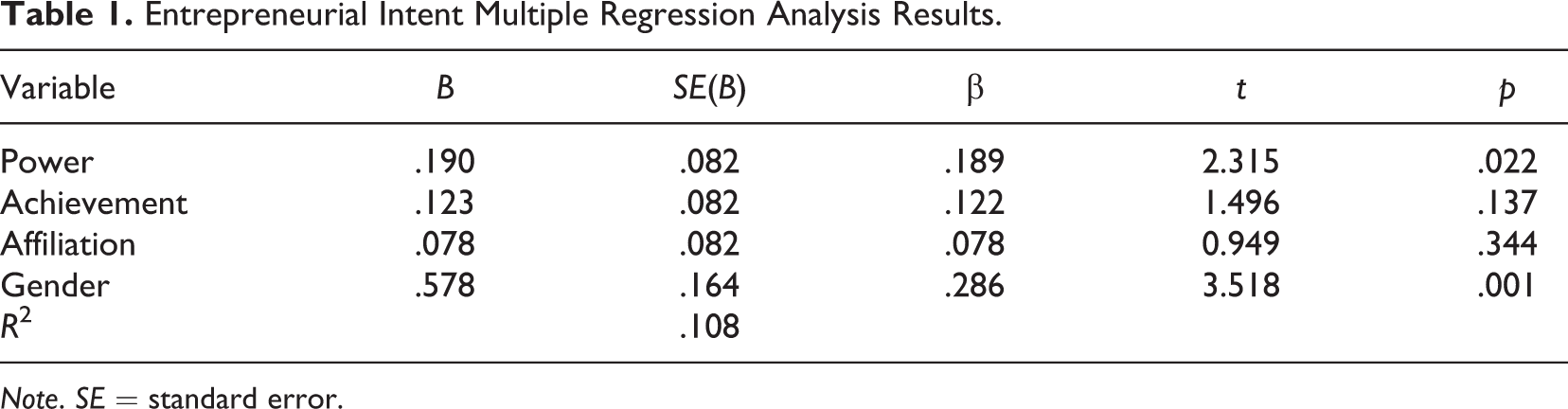
A series of multiple linear regressions were conducted in order to assess whether implicit motives predicted EPL intent, with entrepreneurial, professional, and leadership intent being examined in separate analyses. In each case, nAch, nAff, and nPow were entered as predictors simultaneously (i.e., using the forced entry method), along with participant gender, which has previously been shown to influence career intent (e.g., Correll, 2001). nPow was found to positively predict entrepreneurial intent (but not leadership intent) and to negatively predict professional intent (Hypothesis 2 not supported, Hypothesis 3 supported). Neither nAch nor nAff significantly predicts entrepreneurial, professional, or leadership intent (Hypothesis 1 not supported). Gender was also found to significantly predict entrepreneurial intent, with males displaying greater intent. The results of the entrepreneurial, leadership, and professional intent regression analyses can be found in Tables 1, 2, and 3, respectively.
Entrepreneurial Intent Multiple Regression Analysis Results.
Note. SE = standard error.
Leadership Intent Multiple Regression Analysis Results.

Note. SE = standard error.
Professional Intent Multiple Regression Analysis Results.

Note. SE = standard error.
Given that the EPL career choice items conceptualized intent as an “either/or” proposition, we conducted a single multinomial logistic regression to assess the effect of implicit motives on the intent to follow an entrepreneurial, professional, or leadership career at the expense of the other two. Given that multinomial logistic regression requires the specification of a reference category to which the other outcome categories are compared, we decided to set professional intent as the reference outcome since it is the most traditional and conventional, as well as the least protean/boundaryless/postorganizational, of the three outcomes.
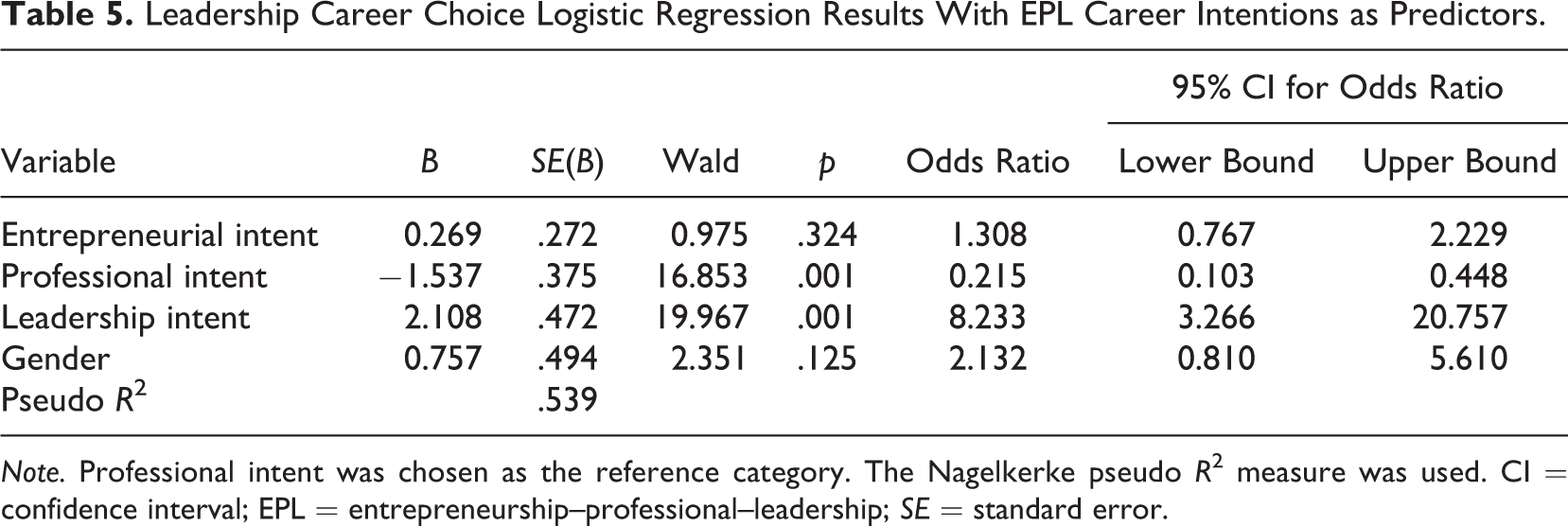
In order to establish the validity of this approach, we first conducted a preliminary multinomial logistic regression to confirm that EPL career intent predicted EPL career choice in the expected fashion. The results of these analyses can be found in Tables 4 and 5. Entrepreneurial intent (positive) and professional intent (negative) were found to significantly predict the choice of an entrepreneurial career over a professional career, while leadership intent (positive) and professional intent (negative) significantly predicted the choice of a leadership career path over a professional one. Interestingly, entrepreneurial intent was also found to positively predict leadership career choice. The other results of these analyses confirmed both our expectations and the validity of the approach.
Entrepreneurial Career Choice Logistic Regression Results With EPL Career Intentions as Predictors.

Note. Professional intent was chosen as the reference category. The Nagelkerke pseudo R 2 measure was used. CI = confidence interval; EPL = entrepreneurship–professional–leadership; SE = standard error.
Leadership Career Choice Logistic Regression Results With EPL Career Intentions as Predictors.
Note. Professional intent was chosen as the reference category. The Nagelkerke pseudo R 2 measure was used. CI = confidence interval; EPL = entrepreneurship–professional–leadership; SE = standard error.
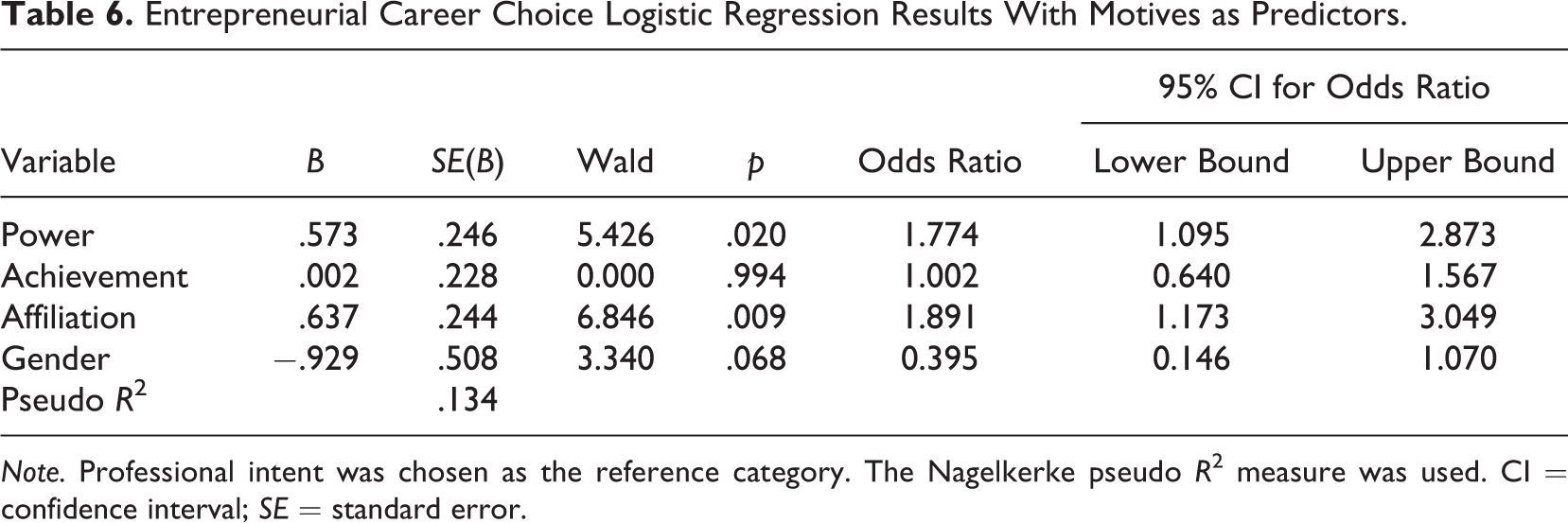
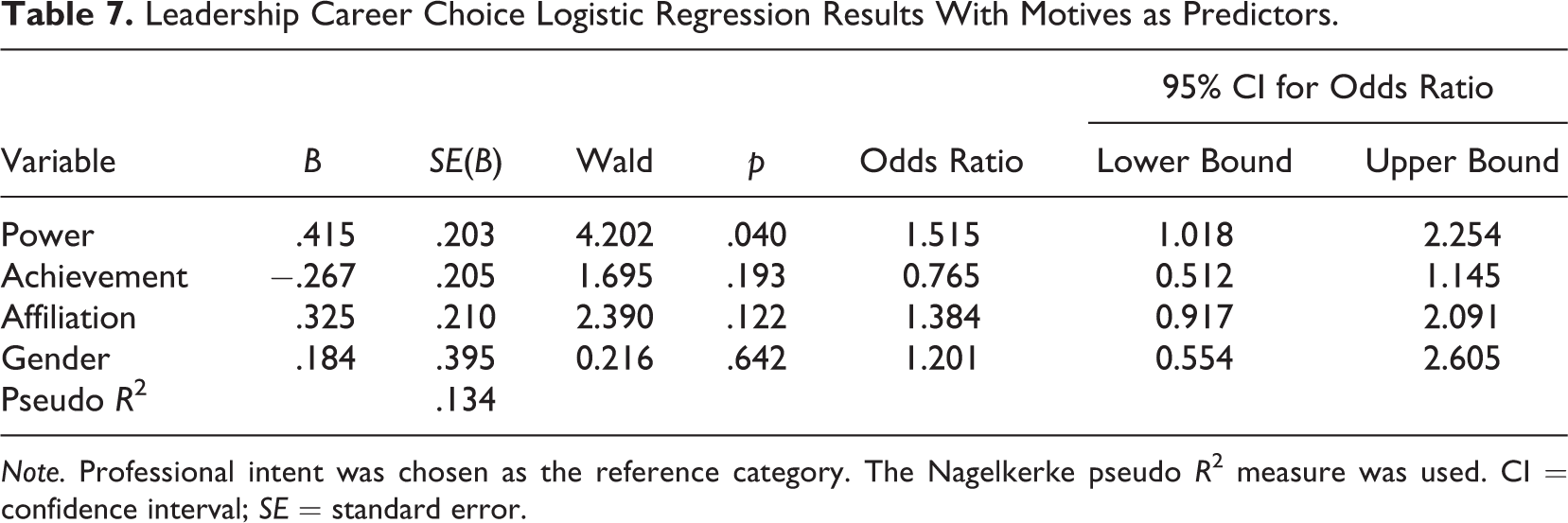
Having established the predicted relationship between EPL intent and choice, we proceeded to regress EPL career choice on implicit motives. Once again, gender was included as a predictor in the analysis. A summary of these regressions is presented in Tables 6 and 7. Higher nPow was associated with a significantly greater likelihood of choosing an entrepreneurial career or a leadership career over a professional one (Hypothesis 2 and Hypothesis 3 supported), while higher nAff was found to be associated with an increased likelihood of choosing an entrepreneurial career over a professional one. nAch demonstrated no significant predictive power in this analysis (Hypothesis 1 not supported).
Entrepreneurial Career Choice Logistic Regression Results With Motives as Predictors.
Note. Professional intent was chosen as the reference category. The Nagelkerke pseudo R 2 measure was used. CI = confidence interval; SE = standard error.
Leadership Career Choice Logistic Regression Results With Motives as Predictors.
Note. Professional intent was chosen as the reference category. The Nagelkerke pseudo R 2 measure was used. CI = confidence interval; SE = standard error.
In the aforementioned analyses, our predictions regarding the relationships between nPow and career intent were generally borne out by the data (the relationship between nPow and leadership intent notwithstanding), while our predictions regarding the influence of nAch were not supported. Indeed, it seemed that nPow was by far the predominant motivational factor affecting career choice and intent, overshadowing both nAch and nAff. To further examine this possibility, we content coded the free-response justifications that participants gave for their nominated career choice using the same scoring system used to assess the three implicit motives (Winter, 1994). In each case, the dominant motivational theme was selected, such that the justification was classified as “power-related,” “achievement-related,” “affiliation-related,” or “other.” If the justification contained only one type of imagery, then classification was straightforward. If it contained more than one type of imagery with no dominant theme, or imagery consistent with a different motive, it was classified as “other.” For example, the justification “I would gain good social status, and I could get good income if I am a manager” for aspiring to become a leader was classified as power-related according to the Winter (1994, p. 17) criterion of “Impressing or the world at large: mention of (or concern about) fame, prestige, reputation,” whereas the justification “I feel that being able to specialize in one niche area would give one an in-depth amount of wisdom and the ability to excel” for professional career choice was classified as achievement-related under the Winter (1994, p. 8) criterion of “goals or performances that are described in ways that suggest positive evaluation.”
To examine differences in the frequency of dominant motivational themes across each of the three career choice pathways, Fisher’s exact test was conducted on a 3 × 4 (choice × motive) contingency table. The observed frequencies were found to differ significantly from those which would be expected under the null hypothesis that no association exists between the two classifications (p < .001). Consequently, the results of the analysis support the notion that motive image frequencies vary significantly across the three career choices. First, there was a high frequency of power-related justifications for individuals indicating leadership career choice (Hypothesis 4 supported). Second, there was a high frequency of affiliation justifications for individuals choosing a professional career. Power-related justifications are also more frequent than other kinds of justifications for those individuals opting for an entrepreneurial career (Hypothesis 5 partially supported), although the number of participants choosing an entrepreneurial career is substantially lower than for the other two career paths. Generally, these results—particularly those pertaining to power-related justifications—are consistent with the results of the regression analyses, indicating that nPow is the main motivational driver of entrepreneurial and leadership career intent.
Discussion
Adopting the EPL framework (Chan et al., 2012), the present research employed a correlational design to examine associations between implicit motives and career intention, operationalized both as a career intent (where two or more pathways could be simultaneously endorsed) and career choice (where the pathways were presented as mutually exclusive alternatives). Two main findings emerged from this study. First, implicit power motivation was found to significantly and positively predict intention to pursue both entrepreneurial and leadership careers. The association between nPow and leadership is well documented in the literature (Winter, 1973), while entrepreneurship has been more frequently associated with nAch, rather than nPow (Collins, Hanges, & Locke, 2004). The second major finding was that implicit achievement motivation did not associate significantly with entrepreneurial intent. While this finding was contrary to our predictions, we believe that this finding—as well as the association between nPow and entrepreneurial intent—is explicable, given the possibility highlighted in the introduction: that the motivational characteristics of successful, current entrepreneurs may differ from those who harbor entrepreneurial intentions. This possibility, as well as several competing explanations for our findings, is discussed below.
While the association between nPow and leadership is well documented (House, 1977; House & Howell, 1992; McClelland & Burnham, 1976), our observation of a significant positive relationship between nPow and entrepreneurial intent represents a novel finding. Indeed, it is surprising how little research has investigated the relationship between implicit motives and career aspiration. Even in the predominant domain of achievement motivation, little longitudinal research has examined how motivation, implicit or explicit, influences career intentions and choices over time (Brandstätter, 2011). With the exception of the McClelland (1965) study mentioned earlier, the authors know of no studies that have examined how implicit achievement motivation in university students influences career choices made after graduation. In this context, it seems plausible that differences should emerge between the implicit motives that drive students to consider entrepreneurial careers and those implicit motives that yield successful performance once that choice has been made.
Outside of the sphere of implicit motives, there is ample evidence to suggest that motivations to pursue entrepreneurial careers are heterogeneous, rather than being entirely predicated on the nAch. Choo and Wong (2006) identified three important classes of motivations underlying entrepreneurial intentions: intrinsic rewards, extrinsic rewards, and the desire for independence/autonomy. Of these categories, intrinsic rewards map closely onto McClelland’s conceptualization of nAch (in that respondents expressed a desire to challenge themselves and to harness their own creative talents), whereas the extrinsic reward category is more closely aligned with nPow as respondents were often concerned with the acquisition of material wealth. It can also be argued that the need for autonomy—a motivational construct that features prominently in several theories of motivation, such as self-determination theory (Ryan & Deci, 2000)—is related to the implicit nPow, as one logical way of resisting control by others to exert control over them yourself. Consequently, it can be argued that two of the three entrepreneurial motivations identified by Choo and Wong (2006) are related to the implicit nPow. Similar findings were reported by Langan-Fox and Roth (1995), who identified three discernable types of female entrepreneur: the need achiever entrepreneur, the pragmatic entrepreneur, and the managerial entrepreneur. Of these three types, the first was found to have high nAch scores, the third was found to have high nPow scores, while the second group was found to score moderately in terms of these two motives. Indeed, many researchers have documented achievement-, power-, and autonomy-related motivations for embarking on an entrepreneurial venture (e.g., Amit, MacCrimmon, Zietsma, & Oesch, 2001; Kuratko, Hornsby, & Naffziger, 1997), suggesting that—at least in the domain of explicit motives—nAch is not the sole motivational determinant of entrepreneurial aspiration or performance. Although tentative, the results presented here suggest that nPow may also play a role in driving entrepreneurial intention in the implicit domain.
So what can account for this apparent distinction between the implicit motivational profiles of aspiring and successful entrepreneurs? The answer to this question may lie in the Darwinian mechanism that McClelland proposed for the natural selection of successful entrepreneurs. In The Achieving Society, McClelland (1961, p. 259) proposed that “if n Achievement really adapts a man to perform the entrepreneurial role well, we should expect that those with lower n Achievement would on average perform less well and would tend to be weeded out of managerial positions, leaving the n Achievement level in such positions higher than in other occupations” (note that McClelland often used the term entrepreneur and manager interchangeably, following the rather loose definition of entrepreneurship adopted by several of his contemporaries, such as Meyer, Walker, & Litwin, 1961). If more individuals with strong motive–role fit survive the transition from aspiring entrepreneur to successful entrepreneur, then it seems reasonable that the motivational profiles of individuals in this wider initial pool may be more diverse. Furthermore, since entrepreneurship offers ample opportunity to pursue and satisfy power-related strivings, it is believable that many aspiring entrepreneurs would also score highly for implicit power motivation. This would mirror the more diverse motivations of aspiring entrepreneurs in the explicit domain. It should also be noted that McClelland’s nAch measure has been criticized on the grounds of motive contamination, since it includes scoring categories that are more reflective of nPow than of nAch (Ramsay, 2014; Schultheiss & Brunstein, 2005). Given that the majority of evidence suggesting a relationship between nAch and entrepreneurial success was gathered using this instrument, it is likely that McClelland and colleagues were also providing evidence for a more subtle link between nPow and entrepreneurship.
Despite the plausibility of a link between nPow and entrepreneurial intent, it is nonetheless surprising that we found no association between nAch and either entrepreneurial intent or choice. Much of the previous research described in this discussion points to a likely influence of both nAch and nPow on entrepreneurial aspiration, rather than nPow alone. One possible explanation for this finding lies in the unique cultural milieu of Singapore, since cultural factors have previously been shown to influence career intention (Chen & Fouad, 2013; Metz, Fouad, & Ihle-Helledy, 2009). Ang and Hong (2000) investigated the influence of motives and other aspects of personality on entrepreneurial spirit in sample of Singaporean and Hong Kong youths, finding that while risk-taking was consistently associated with entrepreneurial spirit across these two East Asian nations, other factors were significantly predictive in one sample but not the other. Given the findings reported here, it is interesting to note that love of money was found to significantly predict entrepreneurial spirit in the Singapore sample but not the Hong Kong sample. Several researchers and social commentators have noted a materialistic streak in Singapore society (Kau, Kwon, Tambyah, & Tan, 2004; Swinyard, Kau, & Phua, 2001). It is possible that the influence of Singapore culture accounts for the stronger relationship between nPow and entrepreneurial aspiration, as well as the weaker association between nAch and entrepreneurial intent, observed in this sample. Nonetheless, this is only a single study and we should refrain from making strong pronouncements without further investigation of these phenomena.
Several other findings from the present study are also of note. First, these findings replicate the robust finding that gender predicts entrepreneurship, with males displaying greater entrepreneurial intent and proclivity to choose entrepreneurial careers compared to females. Many researchers have previously observed this relationship in various national settings (e.g., Correll, 2001; Koellinger, Minniti, & Schade, 2013; Matthews & Moser, 1996). The present research replicates the findings of other researchers who have documented this same gender difference in Singapore (Wang & Wong, 2004). More surprisingly, the implicit nAff was found to predict entrepreneurial career choice (but not intent). Given that this finding has no precedent in the literature or strong supporting theoretical rationale it should be treated with caution, especially given that content coding of the justifications for career choice hinted at a relationship between nAff and professional intent. Further research will be required to explore the relationship between nAff and career choice.
Limitations
The present research has several limitations. First, the study is correlational in design and the results do not therefore permit claims of causality. While the results suggest that implicit power motivation is positively associated with both leadership and entrepreneurial career choice and intent, this is not to say that high nPow necessarily causes individuals to prefer these career options. Further work will be required to unambiguously establish the direction of causality. Second, the overrepresentation of engineering majors, who comprised nearly half of the sample, places limitations on the generalizability of the findings presented here. While the sample composition was representative of the university’s overall enrollment, it is possible that the effects observed here are more pronounced in individuals from science, technology, engineering, and mathematics fields or that differing effects might be observed in undergraduates from the humanities or business-related disciplines. It is also possible that differences between the findings reported here and the preceding literature—particularly the apparent absence of a relationship between nAch and entrepreneurship—are due to a moderating influence of culture, a possibility that was mooted earlier in the discussion. Further cross-cultural work on the relationships between implicit motivation and career aspiration may shed light on this issue.
Conclusion
By investigating the relationships between implicit motives and career intent, the present research makes a novel contribution to the literature on workplace motivation. Our results hint at a previously undocumented association between power motivation and the intention to engage in entrepreneurial activity, which may indicate a disparity between the motivational profiles of those who aspire to entrepreneurship and those who successfully engage in it.
Footnotes
Declaration of Conflicting Interests
The author(s) declared no potential conflicts of interest with respect to the research, authorship, and/or publication of this article.
Funding
The author(s) received no financial support for the research, authorship, and/or publication of this article.