



Abstract
Career adaptability is an important characteristic that helps individuals deal effectively with career uncertainty and ambiguous job roles in current times. Based on the career construction theory, we hypothesize that conscientiousness, cognitive flexibility, and environmental exploration are positively related to career adaptability, and career adaptability is in turn positively related to strategic career management. We collected data from 307 undergraduates with work experience to test our hypothesized model. The results generally supported our hypotheses. Our research sheds light on how conscientiousness, cognitive flexibility, and environmental exploration are related to strategic career management indirectly through career adaptability. Our findings offer practical advice for vocational scholars and career counselors on how career adaptability may be developed.
Career adaptability refers to one’s psychosocial capacity for dealing with vocational development, transitions, and traumas that alter one’s social integration (Savickas, 1997). As volatile economic conditions result in career uncertainty and ambiguous job roles, career adaptability becomes an increasingly relevant and desirable competency among job seekers and employees in current times (Coetzee & Harry, 2014; Savickas & Porfeli, 2012). Indeed, recent studies have established robust links between career adaptability and important vocational outcomes such as greater job search efficacy and outcome (Guan et al., 2013), greater job satisfaction (Koen, Klehe, Van Vianen, Zikic, & Nauta, 2010), lower turnover intention (Koen et al., 2010), lower career worries and apprehension (Creed, Fallon, & Hood, 2009), and better employment quality (Koen, Klehe, & Van Vianen, 2012). This indicates that individuals who lack career adaptability may face the risk of career maladjustment and excessive career stress. However, it also suggests that helping individuals develop greater career adaptability will enhance their career management process. To enhance our understanding of the role of career adaptability in the process of strategic career management, our study builds on Savickas’ (2002) career construction theory to hypothesize and test an integrated model of relations between individual characteristics (i.e., conscientiousness, cognitive flexibility, and exploration of vocational environment), career adaptability, and strategic career management.
Theoretical Background of Career Adaptability
Career adaptability refers to one’s psychosocial capacity for dealing with vocational development, transitions, and traumas that alter one’s social integration (Savickas, 1997). To facilitate scholarship on this construct, Savickas and Porfeli (2012) initiated a wide-scale program of research on career adaptability to study how individuals stay resilient in the faces of threats and challenges in the career domain of their lives. They argued that the essence of career management lies in the integration of inner career needs and outer work opportunities (Savickas, 1997; Savickas & Porfeli, 2012). Career adaptability consists of four psychosocial components—concern, control, curiosity, and confidence (Savickas & Porfeli, 2012). Concern refers to being mindful about one’s career development and objectives, control means staying motivated and disciplined to achieve one’s career goals, curiosity refers to an openness to options and information, and confidence refers to one’s belief in one’s ability to actualize career aspirations (Savickas & Porfeli, 2012). Career adaptability is conceptualized as a malleable competency that can be developed instead of a fixed inherent trait (Koen et al., 2012; Savickas & Porfeli, 2012).
As demonstrated by the recent stream of research, career adaptability is a relevant construct in individuals from 13 countries across the world, including and not limited to the United States, Belgium, China, South Korea, South Africa, and Switzerland (Savickas & Porfeli, 2012). Recent research also supported career adaptability as a key determinant of important career outcomes such as better school-to-work transitions (Koen et al., 2012) and better job search strategies and reemployment quality (Koen et al., 2010). These findings highlight career adaptability as an important component in the phenomenology of strategic career management among individuals.
However, although existing research have uncovered key variables linked to career adaptability, these studies have mostly identified only either antecedents of career adaptability (Coetzee & Harry, 2014; Duffy, 2010; Kenny & Bledsoe, 2005) or outcomes of career adaptability (Ito & Brotheridge, 2005; Klehe, Zikic, Van Vianen, & De Pater, 2011; Koen et al., 2010), instead of testing a comprehensive model of indirect relations between antecedents and outcomes of career adaptability. The focus on only either antecedents or outcomes results in a narrow construct understanding of career adaptability. For example, Duffy (2010) found sense of control to predict career adaptability positively, and Koen and colleagues (2010) found career adaptability to predict greater job satisfaction. Yet, we cannot conclude from these two separate studies whether individuals with a high sense of control will have greater job satisfaction via greater career adaptability. This is because the unique variance in career adaptability explained by sense of control may not overlap significantly with the unique variance in job satisfaction explained by career adaptability. This results in the lack of an integrated theoretical framework on career adaptability and limits our understanding of how to develop career adaptability and utilize it effectively to achieve optimal vocational outcomes. To address this limitation, our research takes a larger and more integrative perspective by investigating if conscientiousness, cognitive flexibility, and environmental exploration predicted strategic career management indirectly through career adaptability. Our choices of these antecedents were informed by Savickas’ (2002) career construction theory. In addition, conscientiousness, cognitive flexibility, and environmental exploration are focal traits and skills that are often used in employee selection or development (Blustein, 1992; Parker, Wall, & Jackson, 1997; Raymark, Schmit, & Guion, 1997; Sackett & Wanek, 1996), making it all the more important to understand whether these characteristics are useful for helping scholars, counselors, and organizations predict career adaptability in individuals.
In testing this integrative model of career adaptability, our research aims to make several contributions. Theoretically, evaluating the role of career adaptability allows us to trace and examine the indirect paths through which conscientiousness, cognitive flexibility, and environmental exploration take to influence strategic career management. This helps to construct intermediate linkages between the variables and enables scholars to better understand the psychological nature of each variable and its relation to career adaptability and career management. In addition, findings from our integrative model will help to empirically evaluate and reinforce the career construction theory. Practically, findings from our research will provide organizations hoping to improve employees’ career management strategies through career adaptability with practical advice on how to better design and manage vocational training to achieve that objective.
Career Construction Theory and Antecedents of Career Adaptability
Career Construction Theory
The career construction theory developed by Savickas (2002) plays a key role in guiding this research. Traditional approaches to career assessment and counseling were very much fixated on an obsolete meaning of work, where work conditions tended to stay stagnant for a long time and where individuals adopted a one-life-one-career approach when managing their careers. However, in the last couple of decades, turbulent economic conditions have generated significant work disruption, such as high unemployment, underemployment, and greater job insecurity, to the labor force (Leong & Ott-Holland, 2014). These trends create a greater need to better understand what career means to individuals. The career construction theory takes these factors into account and posits that individuals reflect on their social roles and interpret their experiences when constructing their career paths (Savickas, 2002).
The theory notes that career adaptability represents individuals’ readiness and resources for coping with career demands and stresses and is an important psychosocial capacity that helps individuals construct their vocational self-concept (Savickas, 2002). Specifically, the theory contends that individuals who derive satisfaction from work will be more capable at developing and validating their vocational self-concepts (Savickas, 2002). This suggests that highly conscientious individuals, who enjoy engaging themselves in working and pursuing their goals (McCrae & Costa, 1997), are thus more likely to develop greater career adaptability and be more successful at managing their careers. The theory also argues that career individuals who are adept at synthesizing their individual traits and skills and environmental factors flexibly will be better at developing their vocational self-concepts (Savickas, 2002). This implies that individuals who have high cognitive flexibility may be more efficient in integrating the myriad of information about themselves and their environment and have greater career adaptability and better career management. In addition, Savickas (2002) contended that activities that help individuals clarify their vocational self-concepts enhance career adaptability, one of the stages of career construction. This hints that exploring vocational options and environment is an important factor of career adaptability and management. Taking these together, our research would examine how conscientiousness, cognitive flexibility, and environmental exploration are related to career adaptability and strategic career management.
Conscientiousness
Having high career adaptability requires individuals to be highly engaged and actively involved in a never-ending process of evaluating and assessing the self and the environment (Savickas, 2005). Individuals who are highly conscientiousness are meticulous, persistent, and motivated in their goal pursuits (McCrae & Costa, 1997). In this research, we contend that conscientiousness people are achievement oriented and will be motivated to devise innovative ways to achieve their career goals. In support of this argument, existing research in the areas of developmental psychology and clinical psychology showed that conscientious people are more likely to have high self-efficacy and will take an active problem-solving approach to cope with stress (Campbell-Sills, Cohan, & Stein, 2006; Davey, Eaker, & Walters, 2003). However, there may be concerns about whether conscientious individuals are also rigid and inflexible workers due to their focus on details and rules (Murphy, 2005). Findings from existing organizational research suggest that this concern may be uncalled for because conscientiousness individuals are highly observant and meticulous, which enable them to readily identify tactics useful for their goal pursuits. In support of this argument, Griffin and Hesketh (2005) found that individuals who are conscientious have greater achievement striving, self-efficacy, and self-discipline and reported a greater number of adaptive behaviors at work. Therefore, from these findings, we expect conscientious individuals to be more committed to their career goals, more disciplined to monitor their career progress, and have greater belief in their ability to succeed. These correspond positively with the concern, control, and confidence components of career adaptability.
Cognitive Flexibility
To be adaptive, individuals have to draw upon their self-regulatory resources to solve unfamiliar, complex, and ambiguous problems presented by the environment (Savickas, 1997). Along this reasoning, we argue that cognitive flexibility serves as a stable individual trait that enables individuals to develop their career adaptability. Cognitive flexibility refers to one’s cognitive capacity to change or shift response in relation to fluctuating situational demands (Martin & Rubin, 1995). It also refers to one’s ability to adopt a new response and to inhibit an old response (Martin & Rubin, 1995). Cognitive flexibility increases one’s threshold for ambiguity (Griffin & Hesketh, 2003) and one’s inquisitiveness in novel situations (Judge, Thoresen, Pucik, & Welbourne, 1999). Individuals with high cognitive flexibility also show greater tendencies to seek out varied experiences (McCrae & Costa, 1997). Putting it in the career context, we expect individuals with higher cognitive flexibility to have greater career adaptability because they will overcome vocational uncertainties with greater interest and curiosity to experiment with different ways that can help them achieve their career goals. Therefore, we present the following hypothesis.
Environmental Exploration
As noted by Leong and Ott-Holland (2014), career adaptability involves an interface between individuals and their environments, where individuals engage in a sensemaking procedure where they evaluate their interests and skills, and the career opportunities their environments have to offer. This suggests the importance of career environmental exploration in predicting career adaptability. Career environmental exploration refers to the purposive behavior of accessing new and varied information about occupations, jobs, or organizations (Stumpf & Colarelli, 1980). Research has shown that possessing varied information and experiences can widen one’s breadth of knowledge and perspectives (Karaevli & Tim Hall, 2006). We argue that this pool of knowledge and perspectives enables one to deal more resourcefully with vocational ambiguities and challenges. In addition, exploring the environment allows one to be aware of available options and helps one monitor and regulate one’s progress toward one’s career objectives (Blustein, 1988). Taken together, we expect environmental exploration to be related to greater career adaptability.
Career Adaptability and Strategic Career Management
Strategic career management refers to a set of tactical actions taken by individuals to achieve their career objectives (Gould & Penley, 1984; Guthrie, Coate, & Schwoerer, 1998). These behaviors include seeking mentoring, maintaining career openness, networking, extended work involvement, and positive self-presentation (Gould & Penley, 1984). Individuals who exercise strategic career management have greater career development, performance, and salary progression (Gould & Penley, 1984; Noe, 1996), thus it is functional to understand and identify factors that prompt individuals to manage their careers strategically.
We contend that individuals with higher career adaptability are more likely to have strategic career management due to several reasons. First, individuals who have high career adaptability tend to have better goal regulatory behaviors (Goodman, 1994), and they also spend more time planning and experimenting with ways to achieve their goals (Gould, 1979). Second, career adaptability increase individuals’ tendencies to proactively seek out developmental opportunities (Savickas, 1997), which contributes to the skills and resources that individuals can utilize when managing their careers (Guthrie et al., 1998). Third, individuals with high career adaptability tend to take on varied job responsibilities positively (Koen et al., 2012). This means that they are likely to be more engaged in their jobs, thus resulting in greater involvement and better self-presentation, both of which are key components of strategic career management. Taking these together, we hypothesize the following:
In addition, existing studies have shown that conscientiousness and cognitive flexibility positively predict proactivity and ability to survive in dynamic work environments (Barrick, Mount, & Strauss, 1993; Canas, Quesada, Antolí, & Fajardo, 2003). In addition, exploration of vocational environment predicts how well individuals manage their work environments (Karaevli & Tim Hall, 2006). In other words, we expect conscientiousness, cognitive flexibility, and environmental exploration to all relate positively with the strategic actions taken to manage one’s career. We further argue that these influences are exercised through career adaptability as a mediating variable. Specifically, individuals with greater conscientiousness, cognitive flexibility, and environmental exploration develop greater career adaptability as hypothesized earlier. In turn, career adaptability becomes a competency that encourages individuals to remain open-minded and to formulate innovative and strategic means to achieve their career objectives.
Method
Participants and Procedure
Three hundred and seven undergraduates from a Midwestern university participated in our research. To be eligible for the study, participants were required to have had held a past or current job for at least 6 months, defined as paid employment of at least 20 hr per week. The participants consisted of 76.55% Caucasian Americans and 74.3% females and had a mean age of 19.64 (SD = 1.73). They completed a 30-min online survey containing the measures of our research in exchange for course credits.
Measures
Conscientiousness
We measured conscientiousness using 2 items from the 10-Item Personality Inventory (Gosling, Rentfrow, & Swann, 2003). Respondents rated whether they saw themselves as “dependable, self-disciplined” and “disorganized, careless (reverse coded)” on a 5-point scale (1 = strongly disagree and 5 = strongly agree). Reliability for this scale was .51. Although the α coefficient of .51 appeared to be lower than common internal reliability standards, it is comparable to existing studies that have evaluated the psychometric properties of this shortened conscientiousness scale (Ehrhart et al., 2009; Gosling et al., 2003). Ehrhart and colleagues (2009) explained that the attempt to capture the content range of conscientiousness adequately with 2 items could have led to the low reliability between the 2 items, but they demonstrated that the conscientiousness construct made up from these 2 items exhibited similar relations to relevant constructs as lengthier conscientiousness measures, thus easing concerns regarding the validity of this short scale.
Cognitive flexibility
We used the 12-item scale by Martin and Rubin (1995) to measure cognitive flexibility. An example item reads, “I have many possible ways of behaving in any given situation.” Participants used a 5-point scale to respond to the items (1 = strongly disagree and 5 = strongly agree). The scale showed a reliability of .77.
Environmental exploration
We assessed how much individuals explored their vocational environment by using 6 items from the environmental exploration section of the Career Exploration Inventory (Stumpf & Colarelli, 1980). Respondents rated how much they engaged in exploration activities in the last 6 months on a 5-point scale (1 = not at all and 5 = very much). Some of the activities are “obtained information on specific jobs or companies” and “initiated conversations with knowledgeable individuals in my career area.” The Cronbach’s α of this scale was .85.
Career adaptability
We measured career adaptability using the 24-item Career Adaptabilities Scale (Savickas & Porfeli, 2012). The instructions of the scale read that people use different strengths to build careers, and respondents rated how strongly they have developed strengths such as “learning new skills,” “planning how to achieve my goals,” “sticking up for my beliefs,” and “observing different ways of doing things” on a 5-point scale (1 = not strong and 5 = strongest). The scale reported a good internal reliability of .93.
Strategic career management
We used the Career Management Strategy Scale by Guthrie, Coate, and Schwoerer (1998), where respondents rated the extent to which they engaged in a series of 25 career management behaviors such as “assume leadership in work areas where there seems to be no leadership,” “make your superiors aware of your career objectives,” “look for opportunities to learn new skills,” and “work at your job beyond normal work hours” on a 5-point scale (1 = not at all and 5 = to a very large extent). The scale reported a reliability of .92.
Results
Descriptive Statistics and Measurement Model
Table 1 displays the means, standard deviations, reliabilities of, and correlations between all the variables. We evaluated the measurement model of our data by running confirmatory factor analyses using maximum likelihood estimation in LISREL 8.80 (Jöreskog & Sörbom, 2006).We estimated a five-factor model where we created five latent factors to represent each of our five variables, and loaded the respective scale items on these latent factors. The first item loading on each latent factor was set to be 1.00 for the model to be identified, and all latent variables were allowed to correlate freely. The five-factor model had fit indices of χ2(2477, N = 307) = 6118.18.36, p < .01, RMSEA = .065, and SRMR = .057. These fit indices enable researchers to evaluate how well the fit between the model and the data is, that is, how far the hypothesized model deviates from the empirical data based on the principle of null hypothesis testing (Steiger, Shapiro, & Browne, 1985). Specifically, RMSEA and SRMR values range between zero and positive infinity, where zero indicates an exact model fit between the model and data, while larger values indicate poorer fit (Chen, Curran, Bollen, Kirby, & Paxton, 2008). Based on the rules of thumb of RMSEA < .07 and SRMR < .08 recommended by Hu and Bentler (1999), the measurement model had a good fit to the data. We also ran a single-factor model where all items loaded on one latent factor. The fit of the single-factor model was significantly worse, where χ2(2,277, N = 307) = 7,228.49, p < .01, RMSEA = .084, SRMR = .076. Therefore, results supported our five-factor measurement model, and we proceeded to test our hypotheses.
Descriptive Statistics of Variables.
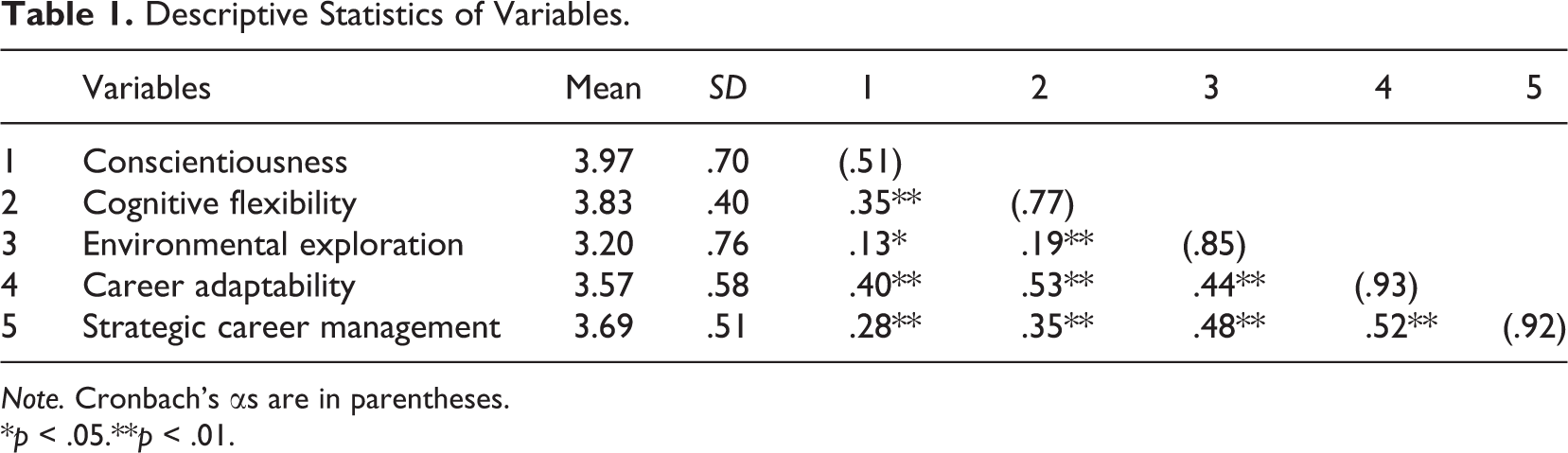
Note. Cronbach’s αs are in parentheses.
*p < .05.**p < .01.
Tests of Hypotheses
Analytical approach
We evaluated the overall model fit of our data using structural equation modeling (SEM) to identify the structural model that fitted our data best. In addition, due to our hypotheses of both specific direct relations and broad indirect relations, we used multiple regressions to test Hypotheses 1a–2, and bootstrapping to test Hypotheses 3a–3c.
Overall Model Fit Using SEM
SEM allowed us to test the fit indices of alternative models so as to identify the model that had the best fit to our data. We included both the measurement and structural components in all the models tested. We loaded items on their respective latent variables and specified structural paths between the latent variables. In Model 1 (full indirect relations), conscientiousness, cognitive flexibility, and environmental exploration predicted career adaptability, and career adaptability predicted strategic career management. Model 2 (partial indirect relations) duplicates Model 1, but with additional direct paths from conscientiousness, cognitive flexibility, and environmental exploration to strategic career management to reflect partial mediation. Model 1 had the fit indices of χ2(2,275, N = 307) = 5,733.55, p < .01, RMSEA = .070, SRMR = .110. Based on the rules of thumb of RMSEA < .07 and SRMR < .08 recommended by Hu and Bentler (1999), Model 1 had a poor to moderate fit to the data. On the other hand, Model 2 (partial mediation) had a good fit to the data, χ2(2,273, N = 307) = 5,719.57, p < .01, RMSEA = .070, SRMR = .072. These results suggested that conscientiousness, cognitive flexibility, and environmental exploration were indirectly related to strategic career management partially, instead of fully, through career adaptability.
Hypotheses 1a–1c
Next, we conducted a series of regressions to test Hypotheses 1a–1c. We entered conscientiousness, cognitive flexibility, and environmental exploration as predictors, and career adaptability as the outcome in our model. The results showed that conscientiousness, B = .18, t(303) = 4.66, p < .01; cognitive flexibility, B = .56, t(303) = 8.41, p < .01; and environmental exploration, B = .25, t(303) = 7.63, p < .01, positively predicted career adaptability, supporting Hypotheses 1a–1c. We also ran a supplemental multiple regression analysis to examine the direct paths between the three predictors and strategic career management. The results showed that conscientiousness, B = .11, t(303) = 2.87, p < .01; cognitive flexibility, B = .28, t(303) = 4.32, p < .01; and environmental exploration, B = .29, t(303) = 8.82, p < .01, all significantly and positively predicted strategic career management.
Hypothesis 2
We then ran a regression with career adaptability as the predictor and strategic career management as the outcome. The results showed that career adaptability positively predicted strategic career management, B = .26, t(305) = 4.84, p < .01, supporting Hypothesis 2.
Hypotheses 3a–3c
Given the above significant relations between the predictors (i.e., conscientiousness, cognitive flexibility, and environmental exploration) and intermediate outcome (i.e., career adaptability), and intermediate outcome and final outcome (i.e., strategic career management), we proceeded to assess indirect relations using the bootstrapping method with bias-corrected confidence estimates (MacKinnon, Lockwood, & Williams, 2004; Preacher & Hayes, 2004). We obtained the 95% confidence interval (CI) of the indirect effects with 1,000 bootstrap resamples (Preacher & Hayes, 2008). Because we had three predictors related to strategic career management through career adaptability, we added the other two predictors as covariates when testing the indirect effects of each predictor. Bootstrapping results supported the indirect paths between conscientiousness (B = .05, CI [.02, .08]), cognitive flexibility (B = .15, CI [.08, .24]), and environmental exploration, B = .07, CI [.04, 11]) through career adaptability, as none of the CI contained 0.
The effects of conscientiousness and cognitive flexibility on strategic career management became nonsignificant after controlling for career adaptability, B = .06, t(302) = 1.61, p = ns for conscientiousness; B = .13, t(302) = 1.92, p = ns for cognitive flexibility, indicating full indirect relations, thus providing support for Hypotheses 3a and 3b. The effect of environmental exploration on strategic career management decreased after controlling for career adaptability but was still significant, B = .22, t(302) = 6.42, p < .01, indicating partial indirect relation, thus partially supporting Hypothesis 3c. Figure 1 shows the path coefficients in our model.
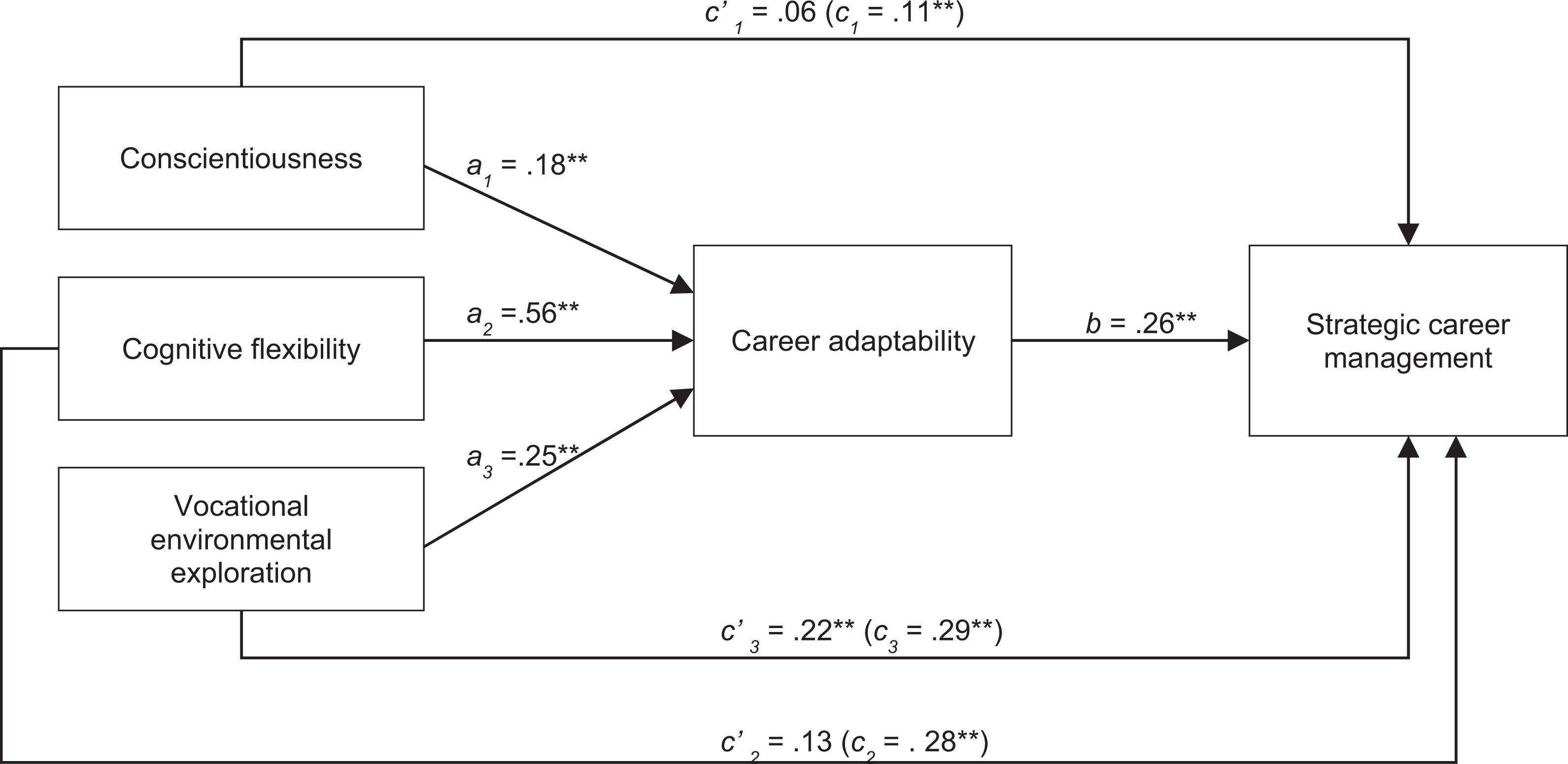
Theoretical model and path analyses. *p < .05. **p < .01.
Discussion
Our results generally supported our hypothesized model where conscientiousness, cognitive flexibility, and environmental exploration positively predicted strategic career management, indirectly through career adaptability. These findings make several theoretical and practical contributions.
Although some existing studies have respectively investigated the effects of individual traits on career adaptability, and career adaptability on career outcomes (Creed et al., 2009; Klehe, et al., 2011), none to our knowledge has directly and empirically evaluated an integrative model. This results in inadequate knowledge about how career adaptability develops, and what it in turn leads too. By building on the career construction theory conceptualized by Savickas (2002), we put forth and tested a model that more comprehensively and effectively captured the paths that conscientiousness, cognitive flexibility, and environmental exploration took to influence career management. Our findings affirm the value of career adaptability in vocational research and constitute a critical first step in advancing the movement toward an explanatory framework on why and how certain individual traits improve career management.
However, it should be noted that our results only supported partial indirect relation between environmental exploration and career management via career adaptability. This suggests that other variables may exist between environmental exploration and career management. Future studies should consider examining other plausible mediators between environmental exploration to get a better understanding of the underlying mechanism. In particular, it could be possible that environmental exploration exercises its influence on strategic career management via the provision of greater career information for individuals, which then allows them to make more informed career decisions and leads to a more strategic management of their careers.
Our research also has practical implications for counseling psychologists and industrial–organizational psychologists. First, the results suggest that career adaptability is a precursor of strategic career management and highlights the feasibility of enhancing individuals’ career management through developing their career adaptability. Our results demonstrated conscientiousness, cognitive flexibility, and career environmental exploration as significant antecedents of career adaptability. Therefore, career counselors can attempt to improve career adaptability in individuals by paying attention to their traits of conscientiousness, cognitive flexibility, and environmental exploration. For example, career counselors can remind individuals to be more conscientious when thinking about their careers. Career counselors can also recommend activities that will enhance individuals’ cognitive flexibility. Existing research showed that aerobic exercise and meditation help to improve individuals’ cognitive flexibility (Masley, Roetzheim, & Gualtieri, 2009; Moore & Malinowski, 2009), hence career counselors can leverage on these findings and recommend individuals to engage in such activities to develop their cognitive flexibility. In addition, based on the supported link between career environmental exploration and career adaptability, career counselors can attempt to improve career adaptability by encouraging individuals to proactively explore vocational options that their environment offers. Career programs in schools should also actively promote the exploration of career options by organizing workshops or fairs to provide a legitimate platform where individuals can explore their career environment.
Our research also has practical implications for industrial organizational and vocational psychologists. Specifically, organizations which value career adaptability in employees (e.g., a new start-up company may require employees who can accept ambiguity or changing job roles) can consider selecting candidates who are high on conscientiousness, cognitive flexibility, and exploration. In addition, organizations can consider implementing rotation programs in the organization for employees. This exploration of the career environment within the organization may enable employees to develop their career adaptability to take on expanded or changing job responsibilities in future. Also, vocational psychologists working with career clients could help them assess and develop these characteristics in order to make themselves more adaptable in organizations.
Limitations and Future Directions
Despite the above contributions, we acknowledge some limitations in our research. First, we used only undergraduates in our sample. This may limit the generalizability of our results to people of other age-groups or educational backgrounds. However, we regarded undergraduates an appropriate sample for this research because undergraduates are currently at a life phase where they have to think about their career options and how to achieve their career objectives, as compared to people who are already holding stable employment. Also, all of our participants have had job experiences for at least 6 months, making employment and career references highly relevant and relatable to them. More importantly, existing research on career adaptability showed that there are no age differences in the development of career adaptability (Hirschi, 2009), thus further minimizing the limitation posed by our undergraduate sample. Nevertheless, future research can consider replicating this study in a group of employees or older respondents to examine if there are any boundary conditions that may limit the generalizability of an undergraduate sample to another sample. Second, our study is cross sectional, and this limits the causality we can infer from our results. To alleviate this problem, future studies should consider a longitudinal design that allows temporal precedence of antecedents before mediators and mediators before outcomes.
In addition, while we attempted to tap on the interaction between individuals and their environments through the inclusion of career environmental exploration, we did not actually objectively measure environmental factors such as economic conditions, involvement in career guidance programs, or access to internships and other employment opportunities. In other words, we are unable to evaluate whether these structural factors in individuals’ environment shape their career adaptability. Future research should consider including social and environmental factors like parents’ support, resources provided by school, or job opportunities, into the model to gain a more comprehensive view of how individual traits and environmental factors interact to impact career adaptability and strategic career management. For example, career guidance and resources provided by parents and schools may enable better environmental exploration and strengthen the link between environmental exploration and career management through adaptability.
Finally, we did not hypothesize unique relations between conscientiousness, cognitive flexibility, environmental exploration, and strategic career management and the specific subdimensions of career adaptability (i.e., concern, control, curiosity, and confidence) in our model because the key premises of Savickas’ (2002) career construction theory, which our article is based on, did not specify relations between subdimensions. Nevertheless, future studies may adopt a different overarching theoretical framework, and consider investigating whether the subdimensions of career adaptability will display different relations with another set of antecedents and outcomes. For example, it may be possible that individual’s traits such as generalized self-efficacy, which refers to how much people believe in their capability to perform well across a broad range of challenging situations (Tipton & Worthington, 1984), could be more predictive of the confidence dimension than the other dimensions in the career adaptability construct. Such findings will help to uncover and build up a more extensive and detailed career adaptability nomological network.
Conclusion
In conclusion, our model empirically tested and reinforced the career construction theory. We hope our model introduces an expanded perspective for thinking about the role of career adaptability in the process of career management. This should hopefully advance future integrative research on career adaptability and career management.
Footnotes
Declaration of Conflicting Interests
The author(s) declared no potential conflicts of interest with respect to the research, authorship, and/or publication of this article.
Funding
The author(s) received no financial support for the research, authorship, and/or publication of this article.