



Abstract
We tested a predictive model based on self-determination theory (SDT) to demonstrate how job design choices contribute to subjective career success. Data collected at Time 1 demonstrated that the job characteristics of autonomy support and competence support had direct and interactive effects on employees’ need satisfaction. Need satisfaction at Time 1 mediated the relationship between autonomy support and self-determined work motivation at Time 2. Work motivation, in turn, mediated the relationships between need fulfillment and career attitudes that characterize subjective career success. These findings are theoretically important because they demonstrate that SDT can bridge job design theory and career theory, pointing to new ways that job and career experiences are interrelated. From a practical standpoint, the results are valuable because they show that job enrichment efforts guided by SDT have important implications for promoting career success perceptions and vocational retention among experienced workers.
Why do some people feel that their careers have been successful but others do not? This question has motivated an enormous body of research in organizational and vocational psychology (Ng, Eby, Sorensen, & Feldman, 2005). Feelings of subjective career success are important to the well-being of individual people, but they have serious implications for organizations as well. For example, employees with positive career beliefs are better able to maintain work–life balance (Sturges, 2008) and are more likely to remain with their employers and persist when confronted with vocational challenges (Armstrong-Stassen & Ursel, 2009; Donohue, 2007; Eddleston, 2009; Nauta, van Vianen, van der Heijden, van Dam, & Willemsen, 2009). Conversely, workers with negative career attitudes are more likely to withdraw from jobs and even change vocations, which presents ongoing retention problems in many demanding fields like teaching and nursing (e.g., Simon, Müller, & Hasselhorn, 2010). Identifying the experiences that result in positive beliefs about career success is therefore important to both individual people and the organizations that employ them.
Much recent research has focused on describing the antecedents of subjective career success, including personality traits (Judge, Higgins, Thoresen, & Barrick, 1999; Ng et al., 2005) and employee demographic characteristics (i.e., job tenure, education, and work experience; Ng et al., 2005). However, a significant omission in this literature is the role that job design plays in enhancing perceptions of career success. Job design theory has enjoyed a renaissance in the last 10 years (e.g., Grant, Fried, & Juillerat, 2011; Parker, 2014), but job design theory and career theory remain largely disconnected. As Hall and Las Heras (2010) observed, this disconnect is unfortunate because effective job design may yield important career-related benefits that are not yet recognized. However, little empirical research has explored these relationships.
In this study, we use self-determination theory (SDT; Deci & Ryan, 2000; Gagné & Deci, 2005; Ryan & Deci, 2000) to bridge the literatures on job design and careers. SDT proposes that certain job characteristics that satisfy employees’ fundamental psychological needs will generate self-determined motivation for work. This contextual motivation for work, in turn, encourages people to persist with their work behavior (Vallerand, 1997). We propose that self-determined motivation also has implications for subjective career success: When people experience strong work motivation, they should feel ownership over their careers, choose to remain on their career track, and feel that they are making successful career progress. This proposition aligns with recent developments in career theory that emphasize the importance of self-directed career orientations (Sullivan & Baruch, 2009).
We focus on two specific job characteristics in this study that are drawn from SDT: autonomy support and competence support (Deci & Ryan, 2012). Autonomy support refers to work experiences that bolster employees’ feelings of choice and agency over their jobs. Competence support refers to job experiences that allow employees to feel capable when working. We expect that these job characteristics will be positively associated with need satisfaction, self-determined motivation, and, ultimately, subjective career success. Consistent with past research, we operationalize subjective career success in this study as positive attitudes about one’s career experiences (Judge, Cable, Boudreau, & Bretz, 1995; Seibert, Crant, & Kraimer, 1999; Seibert, Kraimer, & Crant, 2001). Subjective career success is typically defined in terms of career satisfaction, which involves positive attitudes that a person holds about the progress and future trajectory of his or her career (Greenhaus, Parasuraman, & Wormley, 1990). We take a broader perspective and additionally include career commitment, which involves an attachment to a vocation or profession and a desire to continue practicing it (Blau, 1985), and perceived person–vocation (P-V) fit, which involves beliefs that one’s interests and abilities are a good match to the requirements of a vocation (Vogel & Feldman, 2009). We tested our model linking autonomy and competence support to these career attitudes with a predictive design and a sample of experienced workers in a wide variety of jobs and industries.
Our study makes several contributions to research and practice. First, we advance research on both job design theory and career theory by explaining how job characteristics shape subjective career success. Our model answers calls in the literature to study the ways that job design choices relate to more distal career criteria, offering new directions for both areas of research that have developed in isolation from one another (Grant, Fried, Parker, & Frese, 2010; Hall & Las Heras, 2010). Second, we offer an important test and extension of SDT in this study. Career attitudes are generally understudied criteria (Goulet & Singh, 2002), and more empirical research is needed to understand how they develop (Sullivan & Baruch, 2009). Only a single study to date has demonstrated that SDT predicts career attitudes (Fernet, Austin, & Vallerand, 2012), which focused only on career commitment among school principals. Our study offers new directions for SDT by showing that the theory predicts broader judgments of career success in a variety of industries. We also explicitly test and show support for the key mediating mechanisms of need fulfillment and self-determination in SDT; these mediators have been frequently omitted in the past research, which is a common criticism of SDT scholarship (Latham, 2013). Third, our study makes a practical contribution by demonstrating that actionable job design choices can translate into feelings of subjective career success. Employees who feel positively about their careers are more likely to remain with their organizations (e.g., Armstrong-Stassen & Ursel, 2009; Nauta et al., 2009). Consequently, promoting feelings of subjective career success may benefit organizations by reducing the costs associated with turnover.
Overview of SDT
SDT is a motivational theory that focuses on the regulatory processes by which individuals pursue goals in order to satisfy their innate psychological needs (Deci & Ryan, 2000, 2012; Ryan & Deci, 2000). SDT is considered a “metatheory” of motivation because its propositions were developed over the last 40 years through several narrower subtheories that reside within SDT (Deci & Ryan, 2012). At its most basic level, SDT proposes that people have fundamental needs for autonomy, competence, and relatedness and that they experience self-determined motivation for activities that satisfy those needs. In this study, we focus on one subtheory within SDT, cognitive evaluation theory (CET), which is primarily concerned with needs for autonomy and competence. We chose CET because needs for autonomy and competence can be satisfied in any job. In contrast, the third need introduced in later subtheories, relatedness, may not be as readily addressed in jobs that are performed individually or from home.
CET identifies the situational conditions that satisfy people’s fundamental needs for autonomy and competence (Ryan & Deci, 2000). Autonomy describes the need to have personal agency and to act in a way that is authentic and agrees with one’s sense of self. Competence refers to the need to feel capable of being able to achieve specific outcomes and gain mastery over a performance domain. CET posits that people will experience self-determined motivation in situations that promote the satisfaction of autonomy and competence.
CET has received robust support when tested in the workplace (Gagné & Deci, 2005). The theory articulates two contextual mechanisms, autonomy support and competence support, which have direct and interactive effects on the psychological perception of satisfied needs (Deci & Ryan, 2012). Need satisfaction, in turn, subsequently promotes self-determined motivation (Vallerand, 1997). Thus, job contexts that enhance feelings of autonomy and competence should be associated with the perception of need satisfaction, and need satisfaction should mediate the relationships between the job context and self-determined motivation.
Critically, need satisfaction and self-determined motivation will be stymied if one support or the other is absent. For example, people may feel confident, but when given an external reward or punishment that reduces autonomy support, self-determined motivation will be undermined (Deci & Ryan, 2000). Ultimately, CET suggests that employees will experience need satisfaction and self-determined motivation when the work environment is structured in ways that give people both a sense of agency and confidence over their responsibilities (e.g., Baard, Deci, & Ryan, 2004). Thus, the theory proposes that these contextual variables have important direct and interactive effects on need satisfaction (Vallerand, 1997).
Using SDT to Connect Job Design and Career Theories
Modern job design theory is broadly concerned with the way that jobs are structured and experienced by employees (Morgeson & Humphrey, 2008), moving beyond a specific focus on tasks and responsibilities that characterized early job design scholarship (Grant et al., 2011; Hackman & Oldham, 1976). Contemporary approaches recognize that jobs can be designed in ways that promote a bevy of desirable outcomes for workers and organizations, including learning, well-being, and work–family balance (Parker, 2014). Motivation theories, including SDT, also play a prominent role in this literature. Job design research based on SDT tends to emphasize the benefits of providing employees with autonomous choice (e.g., Baard et al., 2004; Deci et al., 2001; Fernet, Austin, Trépanier, & Dussault, 2013; Sheldon, Turban, Brown, Barrick, & Judge, 2003) and the effects of self-determined motivation on job outcomes such as job satisfaction, burnout, organizational identification, and turnover intentions (Gillet, Gagné, Sauvagère, & Fouquereau, 2013; Lam & Gurland, 2008; Vansteenkiste et al., 2007). In aggregate, structuring jobs to fulfill fundamental needs leads to many positive job outcomes for both employees and organizations.
Although career theory has developed separately from job design theory, contemporary career theory invokes similar ideas from SDT. In response to both environmental challenges (e.g., globalization, advances in technology) and personal factors (e.g., an emphasis on work–life balance, dual-career families), many employees are no longer following the traditional, linear career path. Rather, employees are striving to pursue careers that are meaningful, are self-directed, and fulfill personal needs. Much modern research on careers focuses on several career orientations that people adopt to be successful in response to these changes (Sullivan & Baruch, 2009). Protean career orientation, for example, refers to career development that is self-directed and driven by personal values. Protean careerists do not define success in the traditional way (i.e., status) but instead derive it from personal goal achievement, pride, and psychological success (Briscoe & Hall, 2006; Hall, 1996). A related stream of career theory focuses on boundaryless career orientation, which emphasizes both psychological and physical mobility that defies the traditional, linear career trajectory. For example, boundaryless careerists may switch to a new employer or an entirely new industry to pursue their interests (Arthur & Rousseau, 1996; Briscoe & Hall, 2006; Forrier, Sels, & Stynen, 2009). Although there is less emphasis on personal values, the behaviors of boundaryless careerists are self-determined (Briscoe & Hall, 2006).
To summarize, we chose to explain the effects of job design on subjective career success with SDT in this study because concepts from SDT are deeply entrenched in both the job design and career theory literatures. Research situated in job design theory demonstrates that need-fulfilling job characteristics yield powerful, self-determined motivation. Similarly, research situated in career theory shows that people who adopt orientations that capitalize on self-determined motivation to guide their own career development tend to experience better subjective outcomes. What is missing is an integrative test of these literatures that shows how they relate to one another (Hall & Las Heras, 2010).
The Present Study
Globally, the objective of this study is to demonstrate how job design (i.e., autonomy and competence support) is predictive of subjective career success (i.e., career satisfaction, career commitment, and perceived P-V fit) via need satisfaction and self-determined motivation (see Figure 1). We collected our data at two points in time, focusing on CET-related predictor variables at Time 1 and motivation and career criteria at Time 2, to allow for a more rigorous test.

Results of the main-effects-only model of self-determination theory to predict career commitment, career satisfaction, and perceived person–vocation fit.
We first hypothesize that autonomy-supportive and competence-supportive job characteristics will have positive effects on need satisfaction at work. According to CET, jobs that promote feelings of agency and capability will satisfy employees’ fundamental needs for autonomy and competence (Deci & Ryan, 2012). However, CET also emphasizes that these job experiences interact, such that the positive effect of autonomy or competence support on overall need satisfaction is weaker if the other support is not provided. Thus, we hypothesize that:
CET further posits that need satisfaction will mediate the relationships between job characteristics and self-determined motivation for work. However, as stated in Hypothesis 1b, need satisfaction is a function of the interaction of autonomy support and competence support. Therefore, in line with CET, we anticipate a pattern of moderated mediation wherein the indirect effect of autonomy support on self-determined motivation via need satisfaction is moderated by competence support.
Lastly, SDT posits that the effects of need satisfaction on career attitudes should occur via self-determined motivation. As noted previously, people experience self-determined motivation for work behaviors when work fulfills their fundamental needs (Deci & Ryan, 2012). Self-determined motivation should subsequently have positive effects on career attitudes (i.e., career satisfaction, career commitment, and P-V fit). These relationships should be positive because people derive satisfaction from autonomously performed behaviors (Deci & Ryan, 2000), are likely to become committed to entities that fulfill their needs (Meyer & Maltin, 2010), and report feelings of fit and engagement when autonomously motivated (Greguras & Diefendorff, 2009; Meyer & Gagné, 2008).
Method
Participants and Procedure
Participants were employed, adult citizens of the United States who were recruited from Amazon Mechanical Turk (MTurk). MTurk is a large, online community of people who perform compensated tasks for business or scholarly purposes (Buhrmester, Kwang, & Gosling, 2011). The principal advantage of MTurk is that it allows for the collection of data from experienced adults working in a diversity of industries and job levels; at present, over 500,000 people are active workers on MTurk. Several critical studies of MTurk data quality indicate that these samples produce measurements that display good test–retest reliability, internal consistency, factorial stability, and relationships that are highly similar to those found among data recruited in person (Casler, Bickel, & Hackett, 2013; Mason & Suri, 2012; Paolicci, Chandler, & Ipeirotis, 2010). We followed past practice (e.g., Dahling, Melloy, & Thompson, 2013; Mason & Suri, 2012) to carefully screen data collected through MTurk, restricting responses to employed adults over 25 who resided in the United States and were experienced workers on MTurk (i.e., an approval rate of at least 95% on a minimum of 50 previously completed tasks). We also screened for duplicate Internet Protocol addresses and MTurk worker ID numbers, evaluated respondents’ comfort with the English language, and randomly embedded a number of simple attention-check items in the questionnaires (e.g., “Please answer this question strongly disagree.”) to identify fraudulent or inattentive responses (Paolacci, Chandler, & Ipeirotis, 2010).
We originally collected responses from 272 participants at Time 1. From this initial sample, we discarded responses from 1 participant who reported low comfort with English and 14 participants who missed one or more attention-check questions. This process yielded a total of 257 participants who were eligible to continue the study at Time 2, which occurred 1 month later. We implemented a gap between the two surveys to reduce the likelihood of common method variance (CMV) due to our use of self-report measurements (Conway & Lance, 2010; Podsakoff, MacKenzie, & Podsakoff, 2012). However, we limited the gap to 1 month to maintain a high response rate and reduce the likelihood that job-specific perceptions about autonomy and competence support would change in the interval between the first and second measurements, introducing substantial error to the analysis (Podsakoff et al., 2012).
Ultimately, we received Time 2 data from 222 participants. We then discarded responses from 4 participants who had changed jobs in the previous month and 13 participants who failed one or more attention-check questions in the second survey. The final sample therefore consisted of 205 matched responses (i.e., 79.8% of the eligible Time 1 respondents).
This final sample was 51.7% male and reported a mean age of 34.46 years (SD = 9.54). The sample was 2% Hispanic or Latino/Latina, 84.9% Caucasian, 8.8% Asian American, 4.9% African American, 1% Native American, and 0.5% members of other racial groups. With respect to education, 32.2% had a high school education or less, 54.6% had an undergraduate degree, and 13.2% had a graduate degree. Most of the sample was salaried and working full-time (83.4%). The most frequent work industries reported included scientific and technical services (12.7%), finance and insurance (11.7%), education (11.2%), and retail trade (9.8%). Participants reported a mean job tenure of 5.31 years (SD = 4.99), and 41% had supervisory responsibilities.
Measures
All measures that follow were presented in a fully randomized order within their respective survey to minimize the likelihood of order effect biases.
Autonomy support (Time 1)
We measured autonomy-supportive work conditions with the 6-item Work Climate Questionnaire (WCQ; Baard et al., 2004; α = .94). The WCQ evaluates perceptions of the extent to which managers in the workplace promote autonomy; a sample item read, “I feel that my manager provides me choices and options.” Responses were made on a 7-point scale where 1 = strongly disagree and 7 = strongly agree.
Competence support (Time 1)
Competence support was measured with the 4-item (α = .92) Perceived Competence Scale (PCS; G. C. Williams & Deci, 1996). Because the PCS items are intended to be domain specific, we followed past practice to modify the target of the questions to pertain to work (cf. G. C. Williams, Freedman, & Deci, 1998, who modified the questions to concern perceived competence at managing diabetes). A sample item reads, “I am capable of meeting my bosses’ expectations of me at work”; responses were on a 7-point scale where 1 = not at all true and 7 = very true. Different forms of the PCS have been shown to be predictive of learning outcomes (G. C. Williams & Deci, 1996) and behavioral outcomes (G. C. Williams et al., 1998).
Work satisfaction of needs (Time 1)
We used the Basic Need Satisfaction at Work Scale (Deci et al., 2001) to measure satisfaction of fundamental needs. We used only the 13 items from this scale pertaining to satisfied autonomy and competence needs (α = .88). Sample items read, “I have been able to learn interesting new skills on my job” (competence fulfillment) and “I feel like I can pretty much be myself at work” (autonomy fulfillment). Responses were made on a 7-point scale where 1 = not at all true and 7 = very true.
Work motivation (Time 2)
We measured work motivations described by SDT with the 18-item Work Extrinsic and Intrinsic Motivation Scale (WEIMS; Tremblay, Blanchard, Taylor, Pelletier, & Villeneuve, 2009). The WEIMS was developed by translating the short version of the Blais Work Motivation Inventory (Blais, Lachance, Vallerand, Brière, & Riddle, 1993), a validated French-language instrument, to English and making slight adjustments to some items for semantic clarity. At the time when we conducted this study, the WEIMS was the only validated, English-language measure of all six work motivations described by organismic integration theory: intrinsic (α = .92), integrated (α = .88), identified (α = .84), introjected (α = .80), external (α = .70), and amotivated (α = .79). Each motivation type is measured with 3 items presented in a randomized order. Participants indicated the extent to which each item corresponds with the reasons why they work; sample items read, “For the income it provides me” (external), “For the satisfaction I experience from taking on interesting challenges” (intrinsic), and “Because I want to succeed at this job, if not I would be very ashamed of myself” (introjected). Responses were made on a 7-point scale where 1 = does not correspond at all and 7 = corresponds exactly such that higher scores indicate greater endorsement of a particular type of motivation.
Following established practice in the SDT literature (e.g., Ryan & Connell, 1989), Tremblay, Blanchard, Taylor, Pelletier, and Villeneuve (2009) converted the motivation scale scores into an overall self-determination index (SDI), where SDI = (3 × intrinsic) + (2 × integrated) + (1 × identified) + (−1 × introjected) + (−2 × external) + (−3 × amotivation). We use the SDI in the analyses that follow to give an overall evaluation of self-determination; positive scores indicate relatively self-determined motivation, and negative scores indicate relatively non-self-determined motivation. Possible scores range from +36 to −36.
Career satisfaction (Time 2)
We measured career satisfaction with Greenhaus, Parasuraman, and Wormley’s (1990) 5-item measure (α = .96). Sample items read, “I am satisfied with the success I have achieved in my career” and “I am satisfied with the progress I have made toward meeting my overall career goals.” Responses were made on a 7-point scale where 1 = strongly disagree and 7 = strongly agree. This measure is correlated with job attitudes such as job fit perceptions and job turnover intentions (Dahling & Thompson, 2013).
Perceived P-V fit (Time 2)
Perceived P-V fit was measured using the 3-item measure (α = .81) developed by Vogel and Feldman (2009). A sample items reads, “There is a good fit between my personal interests and the kind of work I perform in my occupation.” Responses were made on a 7-point scale where 1 = strongly disagree and 7 = strongly agree.
Career commitment (Time 2)
Career commitment was measured with Blau’s (1985) 7-item measure (α = .93). A sample item reads, “If I could go into a different profession which paid the same, I would probably take it” (reverse-scored). Responses were made on a 7-point scale where 1 = strongly disagree and 7 = strongly agree.
Results
Analysis Strategy
We tested our hypotheses using MPlus Version 7 (Muthén & Muthén, 1998–2012) to estimate a fully latent structural model. Because the model includes an interaction term, we used the latent moderated structural equation method (LMS; Klein & Moosbrugger, 2000) that is incorporated in MPlus to evaluate the moderated relationship. Recent research suggests that the LMS approach yields more precise estimates of model parameters than the unconstrained approach (Marsh, Wen, & Hau, 2006) under normal conditions and especially when sample sizes are small or moderate (Wen et al., 2014). Testing this model involved three steps. First, we conducted confirmatory factor analysis (CFA; Brown, 2015) to test the fit of the hypothesized measurement model to the data. Second, we tested the hypothesized structural model without the interaction term, which is a necessary prerequisite step to evaluate the model fit indices, like the comparative fit index (CFI), root mean square error of approximation (RMSEA), and standardized root mean square residual (SRMR; Kline, 2011), which are not computed when the LMS method is used (Maslowsky, Jager, & Hemken, 2015; Muthén & Muthén, 1998–2012). Third, we tested the hypothesized structure model with the interaction using the LMS method, which evaluates the significance of the interaction term.
Measurement Model
Table 1 reports correlations and descriptive statistics for the observed variables. We first conducted CFAs on the items. Individual items served as indicators for the perceived competence, autonomy support, career commitment, career satisfaction, and perceived P-V fit factors. The need satisfaction factor had two indicators, the first consisting of a parcel formed by averaging the 7 autonomy-related items (α = .81) and the second consisting of a parcel formed by averaging the 6 competence-related items (α = .81; L. J. Williams & O’Boyle, 2008). The motivation factor was indicated by the single-item SDI; we estimated its reliability to be α = .80 and fixed its error variance term accordingly using the process recommended by Anderson and Gerbing (1988). (The results were not appreciably changed when testing the measurement model with other reliability values ranging from 0.70 to 1.0; Kline, 2011.) Overall, we found that the hypothesized measurement model exhibited acceptable fit to the data without freeing any error terms to covary (Kline, 2011; χ2 (330) = 817.54, p < .001; CFI = .92; RMSEA = .08, 90% confidence interval [CI] = [.07, .09]; SRMR = .06). As shown in Table 2, all items loaded on their intended factors (p < .001).
Scale Score Correlations and Descriptive Statistics.
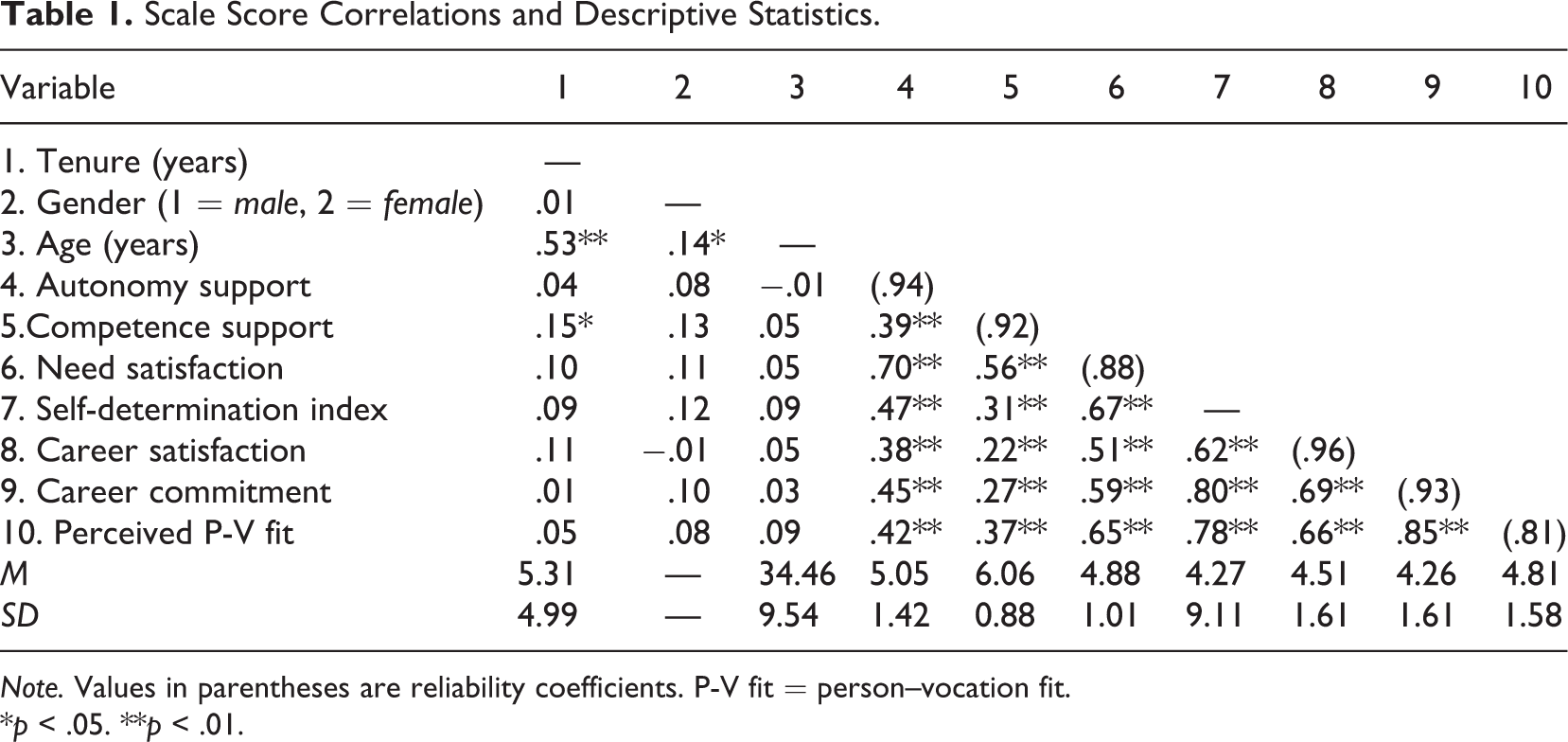
Note. Values in parentheses are reliability coefficients. P-V fit = person–vocation fit.
*p < .05. **p < .01.
Item Loadings in Hypothesized Measurement Model.

Note. Intrinsic motivation was indicated by a single item with a fixed factor loading (Anderson & Gerbing, 1988) and is consequently not included in the table. Items flagged with (R) are reverse scored. For all standardized loadings, p < .001. P–V fit = person–vocation fit.
Based on the strong correlations among career satisfaction, career commitment, and perceived P-V fit, we also tested an alternative measurement model wherein all of the items from these three measures were fixed as indicators of a single “subjective career success” latent variable. Results indicated that this alternative did not fit the data as well as the hypothesized measurement model (Δχ2 (11) = 654.16, p < .001; ΔCFI = .12). Thus, although all three attitudes reflect judgments about career success, they are conceptually and empirically distinct variables that should be modeled separately.
Structural Model With Main Effects Only
To evaluate the overall model fit, we regressed need satisfaction on autonomy support and perceived competence in the absence of the interaction term (Maslowsky et al., 2015). The main-effects-only model, which is shown in Figure 1, had acceptable fit to the data (χ2 (341) = 854.25, p < .001; CFI = .91; RMSEA = .08, 90% CI = [.08, .09]; SRMR = .06). The structural model also exhibited only marginally worse fit to the data than the measurement model (Δχ2 (11) = 36.71, p < .001; ΔCFI = .005). We then tested an alternative structural model of partial mediation wherein autonomy support and perceived work competence had direct effects on work motivation in addition to the indirect effect through need satisfaction, which is consistent with some past research (e.g., Tremblay et al., 2009). The results indicated that this alternative model exhibited slightly worse fit to the data when compared to the hypothesized model (Δχ2 (2) = 15.87, p < .001; ΔCFI = .003). Because this alternative model is less parsimonious (i.e., it includes additional paths without an attendant improvement in model fit), we retained and interpreted the hypothesized model.
Structural Model With Interaction
The final step of model specification was to test the model, including the interaction term, with the LMS approach. The results indicated that the interaction term had a significant effect on need satisfaction (unstandardized b = .11, SE = .04, t = 2.46, p < .05). In the absence of traditional fit indices, we evaluated whether or not the interaction term improved model fit by using the log-likelihood ratio test (Gerhard et al., 2015; Maslowsky et al., 2015; Satorra & Bentler, 2010). The test statistic, D, is distributed as χ2; in this case, we found that χ2 (1) = 4.81, p < .05. Consistent with our Hypothesis 1, a significant D statistic indicates that the model containing the interaction term fits the data better than the main-effects-only model. To corroborate this result, we compared the Akaike information criterion (AIC) values from these two models. We found AIC = 17,130.51 for the main-effects-only model and AIC = 17,127.70 for the interaction model. The smaller AIC value for the interaction model suggests that this is the preferable model that is more likely to replicate (Kline, 2011).
Tests of Hypotheses
Our hypotheses were tested using the results of the two structural models. Hypotheses 1a and 1b stated that autonomy support, perceived work competence, and their interaction would be positively related to need satisfaction at work in Time 1 data. As shown in Figure 1, the direct effects of both predictors were positive and significant in the main-effects-only model, which supports Hypothesis 1. Concerning the interaction, as noted previously, the interaction term had a significant effect on need satisfaction as well. Following procedures outlined by Aiken and West (1991), we plotted the form of the interaction, shown in Figure 2, at high and low levels of the latent antecedent and moderator variables (+1 and −1 SD around the mean of 0, respectively). As expected and consistent with CET, Figure 2 shows that the positive relationship between work autonomy support and need satisfaction is stronger when perceived competence is also high, although the relationship is significant at both high (t = 10.17, p < .001) and low (t = 6.11, p < .001) levels of competence support. Thus, Hypotheses 1a and 1b were fully supported.
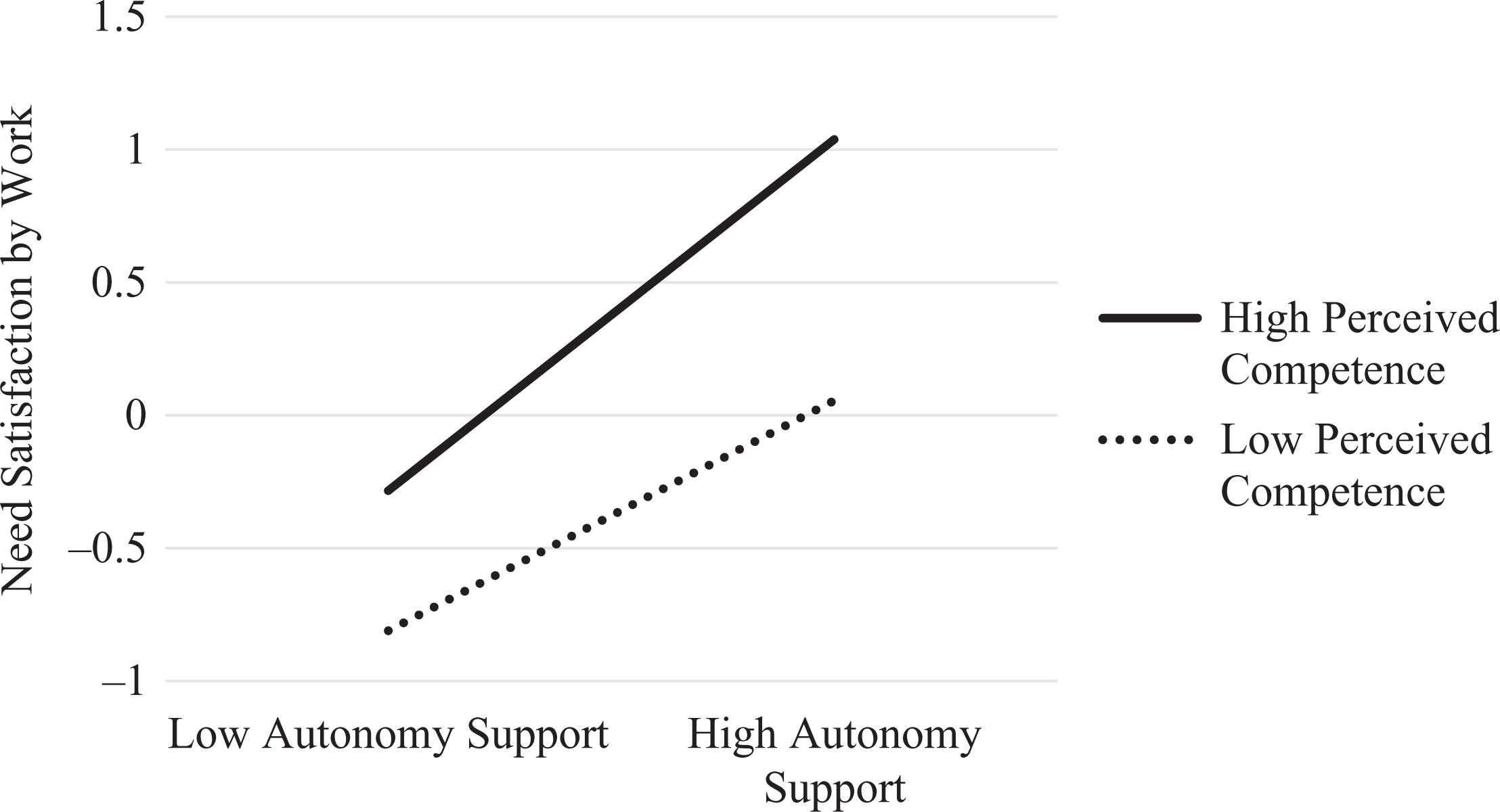
Latent variable interaction of work autonomy support and perceived work competence predicting satisfaction of innate needs in the workplace.
Hypothesis 2 predicted that need satisfaction at work (Time 1) would mediate the relationship between autonomy support (Time 1) and self-determined work motivation (Time 2), but that this indirect effect would be moderated by perceived competence (Time 1). We tested this hypothesis by constructing a 95% CI around the estimated indirect effect at high (+1 SD) and low (−1 SD) levels of the moderator variable, perceived work competence (Preacher, Rucker, & Hayes, 2007). Results indicated that the indirect effect from autonomy support to self-determined motivation was significant, but it was weaker when perceived competence was low (ab = 2.15, 95% CI = [1.22, 3.08]) than when perceived competence was high (ab = 3.28, 95% CI = [2.17, 4.40]). Thus, Hypothesis 2 was supported. Autonomy support has an indirect, positive effect on self-determined motivation via need satisfaction, but that indirect effect is marginally stronger when competence support is also high.
Lastly, Hypothesis 3 stated that self-determined motivation (Time 2) would, in turn, mediate the relationships between need satisfaction (Time 1) and the career attitudes (e.g., satisfaction, commitment, and perceived P-V fit; Time 2). We again used bootstrapped standard errors to test this hypothesis (N = 5,000 draws). Results indicated that Hypothesis 3 was fully supported with significant, positive indirect effects from need satisfaction to career satisfaction (αβ = .55, SE = .06, 99% CI = [0.40, 0.67]), career commitment (αβ = .68, SE = .05, 99% CI = [0.56, 0.81]) and perceived P-V fit (αβ = .70, SE = .06, 99% CI = [0.53, 0.86]) via self-determined motivation. Thus, satisfied psychological needs result in subjective career success through the development of self-determined motivation for one’s work.
Discussion
Promoting subjective career success has important benefits for employees, organizations, and professions, but researchers have generally neglected the ways that job design can translate into broader career outcomes (Hall & Las Heras, 2010). The present study tested how SDT, and especially the subtheory of CET, explains this process. Our results supported all three hypotheses. Autonomy support and competence support had direct and interactive effects on the satisfaction of needs at Time 1. The effect of autonomy support at Time 1 on self-determined work motivation at Time 2 was fully mediated by need satisfaction, and this indirect effect was moderated by competence support as expected. Further, self-determined work motivation mediated the relationships between need satisfaction and the three career attitudes.
These findings help confirm that the literatures on job design and career development are closely related. Although these connections have been recognized in previous theoretical work (e.g., Grant et al., 2010; Hall & Las Heras, 2010), ours is the first study to empirically connect job design to subjective career success. Previous research has focused predominately on personality traits and relationship-based variables, such as supervisor support, as antecedents of subjective career success (Ng et al., 2005). Our study expands the nomological network around career success to include job characteristics that organizations can control.
Our results also contribute to the literature regarding the importance of SDT in the workplace (Gagné & Deci, 2005; Sheldon et al., 2003). We found that SDT processes explain novel career criteria (i.e., career satisfaction and perceived P-V fit) that have never been studied in the context of this theory in the past. Although some authors have criticized the relevance of SDT (Fay & Frese, 2000; Latham, 2013), our results demonstrate that autonomy and competence supports contribute to self-determined motivation and valuable career-related outcomes (Gagné & Deci, 2005). More generally, our findings also illustrate the importance of considering how broader theories of human motivation can shape specific vocational processes and outcomes of interest to career counselors (e.g., Dahling & Librizzi, 2015).
The model also offers a strong test of the propositions of CET and reinforces the validity of this theory. As Latham (2013) observed, many studies have not explicitly measured the mediating states theorized to operate in SDT, especially need satisfaction. In contrast, we included each variable implicated in CET in our model. Moreover, most other tests of SDT in organizational settings rely on cross-sectional data (e.g., Deci et al., 2001), whereas we adopted a predictive design for a stronger test of the model.
Directions for Future Research and Practice
Future research could elaborate on our results in several respects to further connect job characteristics with career success via SDT. For example, SDT includes many other subtheories that we did not examine in this study. We excluded two of these subtheories, basic psychological needs theory and goal content theory (Deci & Ryan, 2012), because they are concerned with predicting well-being rather than career attitudes. Another subtheory, causality orientations theory, focuses on individual differences in terms of how people generally construe their motivations as autonomous, controlled, or impersonal (Deci & Ryan, 1985); these orientations also predict work motivation in some research (e.g., Baard et al., 2004; Lam & Gurland, 2008). Future research could extend our model by examining causality orientations as additional predictors or moderators of need satisfaction and motivation.
The results also suggest that career counselors should carefully assess and consider the work conditions reported by clients. Many occupations, such as nursing, struggle with retaining people in the profession due to occupational stressors (Simon et al., 2010). However, according to SDT and the results of our study, any type of work may be structured in ways that fulfill innate psychological needs and promote high levels of subjective career success. For example, giving employees some personal agency in their everyday tasks may help to promote a feeling of work autonomy (e.g., Fernet et al., 2013). Providing competence-enhancing feedback, as well as assigning challenging tasks, may similarly allow employees to feel confident that they can successfully complete their work (Deci et al., 2001). These efforts may yield self-determined job motivation and better employee attitudes.
Even if clients do not report work conditions that satisfy innate needs, career counselors can work with clients to encourage independent job crafting that proactively fulfills their own needs (Berg, Wrzesniewski, & Dutton, 2010; Petrou, Demertouti, Peeters, Schaufeli, & Hetland, 2012; Wrzesniewski & Dutton, 2001). Job crafting refers to self-initiated, rather than organization-initiated, actions to improve and enrich jobs to attain personal, work-related goals (Wrzesniewski & Dutton, 2001). Research on the measurement of job crafting indicates that crafting involves behaviors such as increasing social job resources and increasing challenging job demands (Tims, Bakker, & Derks, 2012). These behaviors should be particularly important for improving self-determined motivation and career attitudes because these dimensions contribute to fulfilling innate needs described by SDT. For example, taking on and accomplishing challenging job demands should result in greater feelings of competence and autonomy satisfaction among workers.
Career counselors can also facilitate workers’ need fulfillment and self-determined motivation by encouraging clients to pursue flexible work programs, which provide employees with a high degree of autonomy over how, where, and when they perform their jobs (Kauffeld, Jonas, & Frey, 2004). For example, Kauffeld, Jonas, and Frey (2004) found that flexible work designs helped to compensate for high work demands by giving workers enhanced autonomy, which resulted in greater employee learning and development. Flexible work programs should be particularly valuable to help employees fulfill needs for autonomy.
Limitations
Future research should also address some limitations of the current study. One potential limitation is our use of self-report measures to assess our variables. We took steps to minimize the occurrence of CMV by taking measurements at two points in time (Podsakoff et al., 2012). However, self-report biases remain a cause for concern. Future SDT scholarship might consider drawing on the ratings of coworkers with the same job title or on close others (e.g., spouses) who know the focal respondent well.
Second, our study would be improved with additional measurement points to separate the work support predictors, the mediators, and the career attitude outcomes in the model (Cole & Maxwell, 2003). We measured the need satisfaction mediator concurrently with the antecedent variables, and the self-determined motivation mediator concurrently with the career outcome variables. Although the sequencing of our variables has strong theoretical support in SDT, our results would be stronger with multiple measurement points; in general, SDT scholarship would benefit if researchers adopted more longitudinal and repeated-measures designs.
Third, some issues concerning our sample are also worth noting. Although our sample was diverse with respect to age, gender, work experience, tenure, and industry, some racial and ethnic minority groups were underrepresented in the sample, and only U.S. citizens were included in the sample. Additional research with diverse and cross-cultural samples is, therefore, needed to replicate and confirm our results. We also recruited all of our participants from MTurk. Recent research shows that test results obtained from samples collected in person, via social media (e.g., Facebook), and MTurk do not differ (Casler et al., 2013). Nevertheless, MTurk users may differ in some respects from the general population, such as with respect to technological comfort or access to computer technology. We do not anticipate that these differences would threaten the generalizability of our results about motivating work conditions, but additional replication on samples recruited from different sources is desirable.
Fourth, we measured self-determined motivation in this study using the WEIMS, which has not been as widely adopted in recent SDT scholarship as alternative measures of work motivation, such as the Multidimensional Work Motivation Scale (MWMS, Gagné et al., 2015). At the time that we conducted our study, the WEIMS was the only published, English-language option available to measure the motivation spectrum described by SDT. However, the growing body of cross-cultural validity and reliability evidence in support of the MWMS instrument (Gagné et al., 2015) suggests that replication of our findings with this alternative measure is desirable.
A final limitation concerns our exclusion of relatedness supports in this study, a common trend in organizational scholarship on SDT (Gagné & Deci, 2005). We focused only on autonomy and competence support because of our focus on testing propositions drawn from the CET subtheory. Autonomy and competence support can be improved in virtually any type of work, which offers an actionable means to improve career attitudes for anyone. In contrast, it may be difficult to enhance relatedness support for jobs that are conducted remotely or performed largely alone with independent tasks. Given that our sample included employees in a wide cross section of jobs, many of which may have been performed without much social contact, we chose to exclude relatedness supports or relatedness need fulfillment from our model. However, future research should expand on our results to include these variables, in particular by focusing on samples of workers that are known in advance to have collaborative or team-based responsibilities where relatedness needs are likely to be met.
Conclusion
In sum, we linked the literatures on job design theory and career theory to demonstrate that SDT is a useful framework for predicting subjective career success in the form of career satisfaction, career commitment, and perceived P-V fit. Our model was fully supportive of all tested propositions and demonstrates that SDT has previously unexplored value for predicting career outcomes. Our findings have considerable practical importance as well; our results suggest that designing jobs in ways that satisfy innate psychological needs will boost work motivation and encourage workers to “stay the course” in their current careers.
Footnotes
Declaration of Conflicting Interests
The author(s) declared no potential conflicts of interest with respect to the research, authorship, and/or publication of this article.
Funding
The author(s) received no financial support for the research, authorship, and/or publication of this article.