



Abstract
Since its introduction in 1994, social cognitive career theory (SCCT) has attracted attention from researchers and practitioners in the United States and other countries. This article provides a review of selected research performed outside the United States regarding SCCT’s interest, choice, performance, and satisfaction models. Results of a database search identified 37 studies, which contained 41 independent samples from 21 countries and were published in the English language. The majority of these studies were conducted in Asian (e.g., China and Taiwan) and European (e.g., Portugal, Germany, and Italy) countries and tested the interest/choice and satisfaction models in adolescent and college student samples who were enrolled in courses or majors related to the field of science, technology, engineering, and mathematics (STEM; or Holland’s Investigative and Realistic themes). Existing international SCCT research offers robust evidence for the mediating role of self-efficacy, but less consistent support for that of outcome expectations, in the relations of proximal contextual factors to outcomes of interest, choice goals or goal progress, and academic or job satisfaction. Additionally, this review provides preliminary evidence for mastery experience and physiological state as two key sources of efficacy beliefs and for the effects of personality traits (e.g., positive affect and emotional stability) on academic or job satisfaction. Results of a recent meta-analysis are also summarized to offer an empirical synthesis of international SCCT research testing the choice model. Based on this review, directions for future international SCCT research are highlighted, and suggestions for career counseling are discussed.
Keywords
In the past two decades, social cognitive career theory (SCCT; Lent, Brown, & Hackett, 1994) has become a popular base for vocational research and intervention in the United States and other countries. The first three interlocking SCCT models were introduced in 1994 to explicate interest development, career choice, and performance attainments and persistence in a given career domain. An addition was later presented to shed light on the process of pursuing educational and work satisfaction (or well-being) among students and adult workers (Lent & Brown, 2006b, 2008). Although these four models (interest, choice, performance, and satisfaction) vary in terms of intended vocational outcomes, the signature variables of Bandura’s (1986) social cognitive theory—self-efficacy, outcome expectations, and choice goals or goal progress—are at the core of these models. As hypothesized in SCCT, self-efficacy and outcome expectations serve as key mediators that channel the effects of personality and affective variables and contextual factors on interest formation, decision-making and implementation, performance and persistence, and the pursuit of satisfaction in one’s career development. Together, these models represent multivariate, unifying frameworks that emphasize the interplay of personality and affective, environmental, and person-cognitive variables in understanding complex vocational behaviors and promoting positive psychosocial adjustment.
Existing research has largely offered empirical support for the above four SCCT models in U.S. samples. In fact, this body of literature has grown sufficiently so as to allow researchers to perform meta-analyses on the core portions of these models (Brown, Lent, Telander, & Tramayne, 2011; Brown et al., 2008; Sheu et al., 2010). However, while SCCT has also attracted the attention of international scholars, research conducted outside the United States has not been subject to the same level of systematic review. Therefore, this article focuses on empirical findings of SCCT research derived from non-U.S. samples. Because of the limited space, our review concentrated on selected studies and their findings according to the following criteria: (a) inclusion of at least one of SCCT’s outcome variables (interest, choice goals, performance or persistence, satisfaction) and at least one SCCT predictor variable, (b) variable definitions consistent with SCCT (Lent & Brown, 2006a), (c) samples recruited outside the United States, and (d) journal articles or theses/dissertations published in English and included in databases or search engines, such as PsycINFO and ScienceDirect.
Given that these four SCCT models were developed to explain domain-specific vocational behaviors, studies on the process of decision-making (e.g., career decision-making self-efficacy) but without a specified career domain were excluded. Furthermore, because performance as an outcome variable and mastery experience as a source of efficacy beliefs have often been operationalized in the same way (e.g., via test scores or final grades), performance and persistence were included in this review as an outcome variable only if they were measured at a later time point as compared to the predictor variables in the same study.
Different combinations of SCCT-related key words (e.g., SCCT, interest, career choice, performance, academic/work satisfaction, and self-efficacy) were used to conduct the database search. After a general search, these key words were used again with each of those countries (e.g., Portugal and Italy), where SCCT research had been conducted, as another key word to perform country-specific searches. Finally, the reference list of an in-progress meta-analytic study (Lent, Sheu, & Miller, 2016) was consulted to make sure our literature search for this review was as comprehensive as possible. These procedures identified 37 studies conducted in 21 countries across different regions of the world (see Table 1).
Summary of International SCCT Research.
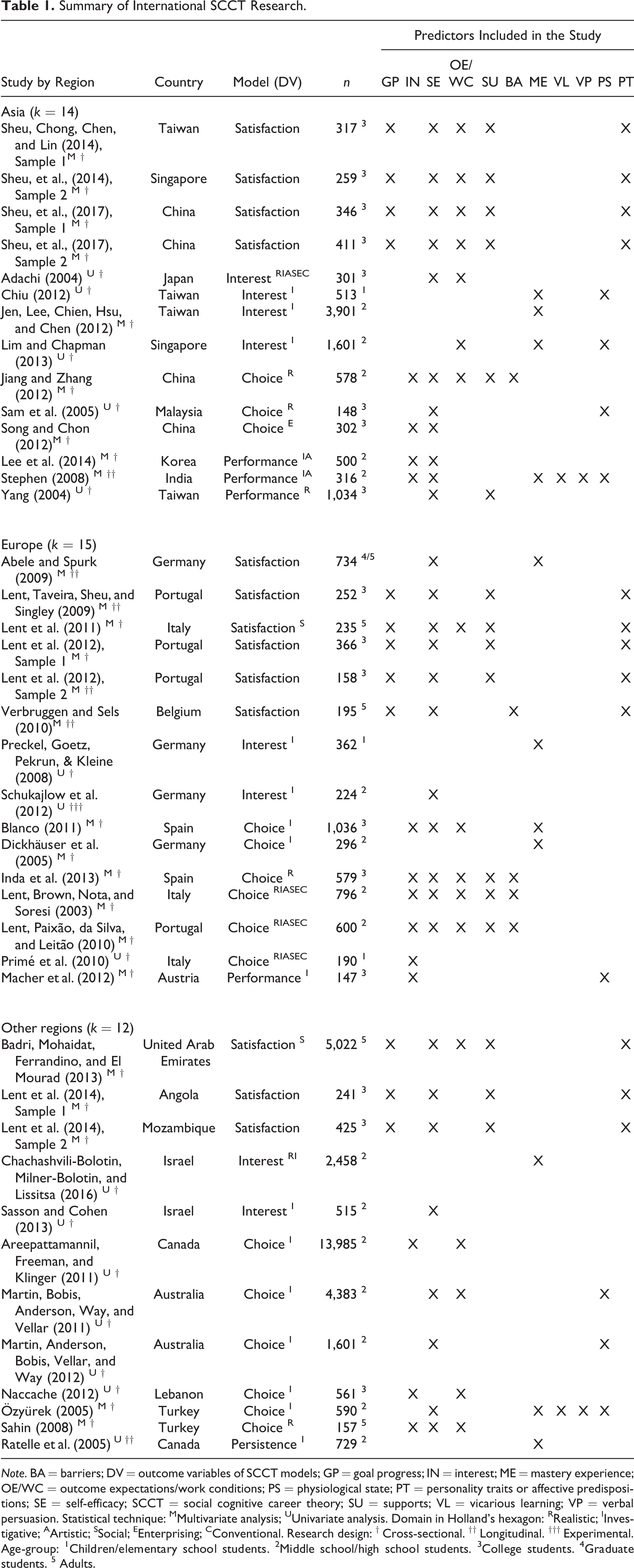
Note. BA = barriers; DV = outcome variables of SCCT models; GP = goal progress; IN = interest; ME = mastery experience; OE/WC = outcome expectations/work conditions; PS = physiological state; PT = personality traits or affective predispositions; SE = self-efficacy; SCCT = social cognitive career theory; SU = supports; VL = vicarious learning; VP = verbal persuasion. Statistical technique: MMultivariate analysis; UUnivariate analysis. Domain in Holland’s hexagon: RRealistic; IInvestigative; AArtistic; SSocial; EEnterprising; CConventional. Research design: † Cross-sectional. †† Longitudinal. ††† Experimental. Age-group: 1Children/elementary school students. 2Middle school/high school students. 3College students. 4Graduate students. 5 Adults.
In the following sections, we provide a review of empirical evidence regarding the SCCT models gathered in different regions of the world and discuss person input, contextual, and social/cultural variables that are relevant to SCCT research in different countries or cultures. This review draws on an ongoing meta-analysis of the choice model (Lent et al., 2016). We also offer directions for future international SCCT research and highlight implications for career counseling.
Empirical Status of International SCCT Research
The majority of studies fitting our inclusion criteria were conducted in Asia (e.g., China and Taiwan) and Europe (e.g., Portugal, Germany, and Italy), and the remainder included samples from Australia, Canada, or countries in Africa and the Middle East (see Table 1). We will next offer a narrative review of international SCCT research by region and model.
Asia
International SCCT research conducted in Asia has covered all four SCCT outcome variables (interest, choice, performance, and satisfaction) and involved 14 independent samples derived from 12 studies. Sheu and his colleagues (Sheu, Chong, Chen, & Lin, 2014; Sheu, Liu, & Li, 2017) gathered data from college students in Taiwan, Singapore, and China using different languages (traditional/simplified Mandarin, English) to test Lent and Brown’s (2006b, 2008) satisfaction model. Independent and interdependent self-construals were added to the model for the purpose of examining the utility of individualistic and collectivistic cultural orientations in predicting satisfaction outcomes. In spite of cross-national differences on a few paths (e.g., academic goal progress → academic satisfaction, independence → academic stress), data gathered from these Asian countries provided evidence for most of Lent and Brown’s (2006b, 2008) hypotheses, and the satisfaction model explained 49–67%, 47–66%, and 46–57% of the variance, respectively, in academic satisfaction, academic stress, and life satisfaction.
Specifically, the aforementioned two studies showed that the relations of personality traits (extraversion and emotional stability) and interdependent self-construal to satisfaction outcomes were partially mediated by academic supports, academic self-efficacy, and academic goal progress. That is, extraverted, emotionally stable, and interdependent individuals reported higher levels of academic satisfaction and lower levels of academic stress due, in part, to their perceptions of supports for, confidence in, and progress made toward academic goals. Additionally, self-construals were found to predict academic satisfaction and stress after controlling for personality traits, indicating the benefit of adding one’s cultural orientations to the satisfaction model. However, the predictive utility of academic outcome expectations was not supported in these three Asian samples.
The SCCT interest and choice models have also been tested in several studies with Asian samples. Jiang and Zhang (2012) found that in a sample of engineering students in China, social supports and barriers predicted major choice goals directly and indirectly via self-efficacy and outcome expectations and that interest fully mediated the relations of self-efficacy and outcome expectations to choice goals. A study conducted by Song and Chon (2012) showed that interest was predictive of choice goals in tourism and hospitality jobs after controlling for general self-efficacy and perceived person-job fit among Chinese college students. However, Sam, Othman, and Nordin (2005) demonstrated that time spent on using the Internet (i.e., choice action) was mildly and positively correlated with computer anxiety but unrelated to computer self-efficacy in a Malaysian college student sample.
Other studies have found that interest in science or math was positively associated with prior performance (i.e., mastery experience) and negatively associated with science and math anxiety among elementary school students and middle school students in Taiwan (Chiu, 2012; Jen, Lee, Chien, Hsu, & Chen, 2012). Interest was also positively correlated with outcome expectations and prior performance and negatively correlated with math anxiety in a sample of Singaporean pretertiary school students (average age = 17.8 years; Lim & Chapman, 2013). Finally, among Japanese college students, outcome expectations were predictive of career interest after controlling for self-efficacy across all six Holland (1997) career domains; on the other hand, self-efficacy offered incremental utility in predicting interest above and beyond outcome expectations only in the Investigative and Artistic domains (Adachi, 2004). Together, the above studies offer support for SCCT hypotheses regarding the relations among self-efficacy, outcome expectations, interest, and choice goals across different career domains and student populations (i.e., elementary students to college students). A few of these studies also demonstrated theoretically expected relations between interest and sources of efficacy beliefs (mastery experience, anxiety) in younger student groups.
A few studies have examined a mix of immediate (e.g., self-efficacy) and more distal (e.g., interest and supports) predictors of performance attainments. Essentially, these studies tested modified versions of the performance model by including predictor or outcome variables from other SCCT models. For example, Stephen (2008) studied the relations between performance (end of semester grades), interest, self-efficacy, and sources of self-efficacy in three subject areas (math, science, and English) among high school students in India. Her findings showed strong support for a self-efficacy → interest → performance pathway in math but partial support for the same pathway in Science and English. Furthermore, her findings regarding prior mastery experience, emotional arousal, social persuasion, and vicarious learning as predictors of self-efficacy did not reveal a consistent pattern across these three subject areas. In another study with Korean middle school students, Lee, Lee, and Bong (2014) found positive correlations among self-efficacy, interest, and end of semester grades across four academic subjects (Korean, English, science, and math). However, Yang’s (2004) study showed that self-efficacy and social support did not predict academic achievement among vocational college students in Taiwan.
Overall, SCCT research conducted in Asia provides evidence for supports, self-efficacy, and goal progress as mediators of the relations of personality and cultural variables to satisfaction outcomes among Asian college students. Existing evidence is also consistent with the hypothesized relations among self-efficacy, outcome expectations, interest, and choice goals. However, the performance model has received limited attention with inconsistent findings. Data of these studies were analyzed using different statistical techniques (e.g., structural equation modeling [SEM], regression, and correlation), and the majority of them included college students and middle school/high school students. It should be noted that most of these studies recruited samples from East Asian countries, which suggests that more empirical attention should be given to Southeast Asian or South Asian countries (e.g., Philippines, Vietnam, Indonesia, and Pakistan). Future research should also be extended to adult samples from this part of the world.
Europe
Fourteen studies (involving 15 samples) were conducted in European countries, with most of them testing the choice or satisfaction models (see Table 1). Consistent with predictions of the satisfaction model, Lent, Taveira, and Lobo’s (2012) cross-sectional findings showed that positive affect was predictive of academic satisfaction, academic stress, and life satisfaction both directly and indirectly via the pathways formed primarily by academic supports and self-efficacy among Portuguese undergraduate students. Academic self-efficacy partially mediated the relation of academic supports to academic satisfaction and stress, while academic goal progress partially channeled the effect of academic supports on academic stress. In addition to college students, Lent et al. (2011) tested the satisfaction model in a sample of Italian teachers. This study showed that efficacy-relevant supports and favorable work conditions partially mediated the effect of positive affect on teachers’ job satisfaction and life satisfaction; however, contrary to hypotheses, self-efficacy and/or goal progress were not part of the direct pathways to job satisfaction among these Italian teachers.
Using longitudinal data (in which Time 1 and Time 2 data points were separated by 15 weeks) from two Portuguese undergraduate student samples, Lent and colleagues (Lent et al., 2012; Lent, Taveira, Sheu, & Singley, 2009) produced findings that were partially consistent with the temporal ordering hypothesized in the satisfaction model. For example, while Time 1 supports and self-efficacy were predictive of Time 2 goal progress and satisfaction outcomes (e.g., academic satisfaction and stress), Time 1 goal progress did not predict Time 2 satisfaction outcomes as posited. Additionally, these two samples demonstrated reciprocal relations of positive affect to both self-efficacy and supports.
Another longitudinal study (6 months between Time 1 and Time 2 data points) conducted with a sample of employed adults in Belgium showed that Time 2 perceived barriers, goal progress, and self-efficacy mediated the relations of Time 1 personality traits (extraversion and emotional stability) and self-efficacy to Time 2 career satisfaction (Verbruggen & Sels, 2010). Interestingly, Time 1 self-efficacy was found to negatively predict Time 2 perceived barriers, which suggests that more confident adults were likely to perceive fewer barriers to their career goals over time. However, the authors did not test SCCT’s prediction that barriers at Time 1 would predict self-efficacy at Time 2. Abele and Spurk (2009) tracked a sample of graduate students in Germany for 7 years into their adult lives as full-time employees and found that occupational self-efficacy predicted career satisfaction 7 years later after controlling for other variables, such as salary and job status.
Existing cross-sectional and longitudinal research conducted in Europe did not produce consistent findings regarding the mediating roles of self-efficacy and goal progress in the satisfaction model. Also, outcome expectations or perceived work conditions were excluded in most of these studies; thus, they provided only a partial test of the satisfaction model. Additional research is needed to examine the functions of self-efficacy and goal progress and to test a fuller set of variables. Longitudinal designs with more than two data points will also be helpful in testing temporal hypotheses in the satisfaction model.
Another set of studies was devoted to testing the core portion of the choice model, including choice goals, interest, self-efficacy, outcome expectations, and proximal contextual supports and barriers. For example, Blanco (2011) found that prior performance in math and statistics was predictive of Spanish undergraduate students’ intention to use statistics in academic or professional activities, both directly and indirectly via statistics self-efficacy, outcome expectations, and interests. In another Spanish college student sample, Inda, Rodríguez, and Peña (2013) demonstrated that self-efficacy, outcome expectations, and interest in engineering partially channeled the effects of contextual supports and barriers on female and male students’ intention to pursue engineering majors.
Lent and colleagues (Lent, Brown, Nota, & Soresi, 2003; Lent, Paixão, da Silva, & Leitão, 2010) tested the choice model across Holland’s six occupational themes (R, I, A, S, E, and C) among high school students in Italy and Portugal. Findings of these two cross-sectional studies provided evidence for the applicability of the choice model across these career domains and showed that self-efficacy and outcome expectations were jointly predictive of career interest, which in turn predicted choice consideration. However, social supports were associated with occupational consideration indirectly through other variables (e.g., self-efficacy) rather than directly, and the indirect effect of social barriers on occupational consideration was observed in some career domains (R, A, and C) but not in others (I, S, and E). Two other studies provided inconsistent support for a few choice-related hypotheses. Primé et al. (2010) reported no relation between anticipated occupational choice and interest among Italian children, whereas Dickhäuser, Reuter, and Hilling (2005) found that self-reported grades (prior mastery experience) in Biology and Chemistry were positively correlated with selection of courses (choice action) in these two subjects among seventh grade students in Germany.
In addition to the above research that included choice goals or choice action as the dependent variables, a few other European studies focused on interest or performance as the outcome variables. Math performance was positively related to interest in math among sixth graders in Germany (Preckel, Goetz, Pekrun, & Kleine, 2008), and self-efficacy in math was also found to be positively correlated with interest in math in a sample of ninth graders in the same country (Schukajlow et al., 2012). Finally, Macher, Paechter, Papousek, and Ruggeri’s (2012) study offered some evidence related to the performance model, showing that lower anxiety in statistics was associated with higher interest and less procrastination (choice action) in carrying out statistics-related tasks, and lower anxiety and higher interest were related to better performance on a statistics examination among undergraduate students in Austria.
Most of the empirical inquiries conducted in Europe were devoted to testing the choice/interest and satisfaction model. Compared with the research conducted in Asia, a few longitudinal European studies added to the literature by offering evidence for some temporal hypotheses (e.g., self-efficacy at Time 1 → goal progress at Time 2) in the satisfaction model. On balance, evidence gathered in Europe supports the function of self-efficacy in the satisfaction model and those of self-efficacy and outcome expectations in the choice model in mediating the relations of proximal contextual factors and/or personality traits to academic/work satisfaction or choice intentions. While both self-efficacy and outcome expectations were included in the majority of the studies that tested the choice model, outcome expectations were omitted in most of the studies that examined the satisfaction model. Furthermore, performance accomplishments as the outcome variable have been understudied in European samples. Existing studies covered a wide range of age groups but focused primarily on college student and high school/middle school student populations. Our literature search did not identify any studies from Northern European (e.g., Norway) or Eastern European (e.g., Czech Republic) countries, which suggests the need for future research testing the generalizability of the SCCT models in these European sectors.
Other Regions
In addition to studies carried out in Asia and Europe, samples have been recruited from other parts of the world to test SCCT models. In total, there are 11 studies (12 samples) conducted in Canada, Australia, and countries in Africa and the Middle East. Lent et al. (2014) gathered data from college students in Angola and Mozambique and demonstrated that the satisfaction model was applicable to both of these African student samples, and there were no differences by gender or by country. Specifically, positive affect was found to predict academic satisfaction and life satisfaction both directly and indirectly through academic supports, self-efficacy, and goal progress. Similar results were also found in a large sample of teachers in Abu Dhabi, the United Arab Emirates (Badri, Mohaidat, Ferrandino, & El Mourad, 2013). As hypothesized by SCCT, several pathways, which consisted of perceived organizational supports, self-efficacy, favorable work conditions (i.e., person-organization fit and needs-supplies fit), and progress at work-related tasks, were found to partially mediate the effect of positive affect on these teachers’ work satisfaction. These two studies offer preliminary evidence for the validity of the satisfaction model for college students and adults in Africa and the Middle East.
Researchers in Australia, Canada, Lebanon, and Turkey have also explored variables included in the choice model. Martin and colleagues (Martin, Anderson, Bobis, Vellar, & Way, 2012; Martin, Bobis, Anderson, Way, & Vellar, 2011) conducted two multilevel studies with middle school students in Australia and found that, at the student level, choice goals and choice actions in math were positively correlated with self-efficacy and outcome expectations and negatively correlated with anxiety about math. Positive correlations among choice goals or choice actions, interest, and outcome expectations were also observed in the data gathered from a large sample of middle school students in Canada (Areepattamannil, Freeman, & Klinger, 2011) and among college students in Lebanon (Naccache, 2012). Furthermore, Sahin’s (2008) path analysis showed that interest completely mediated the effect of self-efficacy, and partially mediated the effect of outcome expectations, on university faculty members’ intention to use educational technology in Turkey. However, in a Turkish high school student sample (Özyürek, 2005), intentions to choose math-related majors were found to be negatively correlated with self-efficacy in solving math problems and positively correlated with vicarious learning experience in math, which is partially consistent with the predictions in the choice model.
Finally, research conducted in Israel demonstrated the positive relations between interest and self-efficacy in science and between interest in science, technology, engineering, and mathematics (STEM)-related fields and prior performance in math among middle school and high school students (Chachashvili-Bolotin, Milner-Bolotin, & Lissitsa, 2016; Sasson & Cohen, 2013). Ratelle, Larose, Guay, and Senecal’s (2005) longitudinal study showed that current science performance (mastery experience) was associated with persistence in science in a sample of Canadian high school students.
Results of SCCT research conducted in regions other than Asia and Europe offer initial evidence for key assumptions (e.g., self-efficacy and goal progress as mediators) in the satisfaction model. They also demonstrate some of the bivariate relations (e.g., between self-efficacy and choice goals, outcome expectations and choice goals, self-efficacy and interest, mastery experience, and persistence) posited in other SCCT models. However, these findings should be interpreted with caution because they were based on samples residing in widely varying cultural contexts. How different cultural norms might influence the applicability of SCCT models in these countries is largely unknown and warrants empirical attention.
Meta-Analysis of the SCCT Choice Model Using International Samples
Meta-analyses that involve two or more variables in SCCT have been conducted using data accumulated in the United States (Lent et al., 1994; Rottinghaus, Larson, & Borgen, 2003; Sheu et al., 2010). However, such meta-analytic efforts had not been extended to SCCT research performed outside the United States until recently. In this section, we briefly summarize preliminary findings of a meta-analysis on the choice model using international samples (Lent et al., 2016).
Lent et al.’s (2016) study meta-analyzed results of SCCT research conducted in relation to STEM activities and fields between 1981 to 2013 with samples both within and outside the United States. We will overview findings involving the latter samples only. After a comprehensive database search, identified studies were screened to insure that they contained (a) SCCT-consistent variable definitions (Lent & Brown, 2006a) and (b) effect sizes on at least two variables included in the choice model. As a result, findings of 47 studies were subject to the meta-analysis. It should be noted that the focus of this meta-analysis on testing the choice model in STEM-related fields allowed for the inclusion of any two variables in the model. This approach identified more studies than those included in the narrative review of this article, which required the presence of at least one vocational outcome variable (interest, choice goals, performance or persistence, and satisfaction) in order for a study to be classified into one of the four SCCT models.
A three-step hybrid approach (Sheu et al., 2010) was employed to meta-analyze the core portion of the choice model, which includes choice goals or choice intentions, interest, self-efficacy, outcome expectations, supports, and barriers. The first step involved the use of Spearman’s (1904) formula for calculating disattenuated correlations by taking into account measurement errors. In the second step, using the random effects model, disattenuated correlations across samples were synthesized to create population true score bivariate effect sizes. In total, 15 population true score bivariate effect sizes among variables in the six-variable choice model were first calculated and then assembled to form a correlation matrix. Sample sizes of these synthesized bivariate effect sizes ranged from 1,973 to 20,058. In the third step, the correlation matrix was used to test the choice model using EQS Version 6.2 (Bentler, 2006).
Results of the meta-analysis showed that the six-variable choice model produced excellent fit to the data. Because the large sample size of the meta-analysis led to highly sensitive significance tests, Cohen’s (1988) thresholds of .1, .3, and .5 were used to determine small, medium, and large effects even though these rules of thumb were proposed primarily for bivariate correlations. Supports produced small direct effects on choice goals and outcome expectations and a medium effect on self-efficacy. Self-efficacy was predictive of outcome expectations, and self-efficacy and outcome expectations both yielded medium direct effects on interest, which in turn produced a medium path to choice goals. Additionally, self-efficacy and outcome expectations generated small direct paths to choice goals. Contrary to theoretical prediction, all of the paths produced by barriers fell below the .1 threshold, and barriers were related to other variables mainly through their large, negative correlation with supports. The choice model explained more than 50% of the variance in both interest and choice goals.
These meta-analytic findings provide an empirical synthesis of the choice model using non-U.S. samples and, unlike the narrative review, suggest consistent support for several paths in the choice models. Specifically, the meta-analysis indicated that self-efficacy and outcome expectations were related to interest and that interest was related to choice goals. As implied by SCCT, these relationships were larger than were the direct relations of self-efficacy, outcome expectations, and supports to choice goals. The relations of barriers to other variables were unexpectedly small except for the negative correlation between barriers and supports; the latter finding suggests that barrier perceptions may serve primarily to reduce or neutralize the amount of support that participants perceive receiving from others. One caveat is that country or cultural (e.g., Asia vs. Europe) effects were not studied as moderators in the meta-analysis. Nonetheless, the meta-analytic findings suggest intervention elements that international scholars and practitioners could employ to expand STEM workforce pipelines around the world.
Directions for Future International SCCT Research
Existing international research has demonstrated the utility of SCCT in predicting interest development, career choice, performance, and satisfaction in non-U.S. samples. Despite the promising findings, this literature can benefit from additional empirical scrutiny. We next highlight several directions for future international SCCT research.
Expanded Study of Person Input, Cultural, and Contextual Variables
Empirical evidence reviewed in this article has focused primarily on the core portions of the SCCT models, including self-efficacy, outcome expectations, interest, choice goals or goal progress, satisfaction, and proximal supports and barriers. Limited attention has been given to person input variables or to cultural and more distal contextual factors. Although these variables are positioned at the periphery of some models (e.g., choice) or less explicitly explicated in SCCT, they merit more empirical attention because they could potentially improve SCCT’s applicability to people in different countries. We will discuss study of these variables in the context of future SCCT research in different cultures.
In terms of personality traits or affective predispositions as person input variables, findings of several studies consistently showed that positive affect was directly and indirectly, through person-cognitive variables (e.g., self-efficacy), predictive of academic satisfaction among college students, and job satisfaction among adults in some European and African countries (Lent et al., 2009, 2014). Extraversion and emotional stability have also been found to produce direct and indirect relations to academic satisfaction and stress among Asian college students as hypothesized in the satisfaction model (Sheu et al., 2014; Sheu et al., 2017). In addition to these Big Five personality traits and positive affect, international researchers should explore how other trait-like variables, such as optimism (Carver, Scheier, Miller, & Fulford, 2009) and locus of control (Rotter, 1966), may function as person input variables in SCCT models.
For example, locus of control has been found to differentially predict human behaviors in different cultural contexts. Côte, Mizokami, Roberts, and Nakama (2016) found that college students in the United States had a higher internal locus of control than their counterparts in Japan, and internal locus of control was a predictor of identity development only for American but not for Japanese students. Furthermore, locus of control has been found to be related to vocational outcome expectations among undergraduate students in Turkey (Işik, 2013) and job satisfaction among adults in Australia (Wu, Griffin, & Parker, 2015) and China (Guan et al., 2012). Inclusion of additional trait variables can provide the opportunity to explore how social cognitive predictors mediate effects of these variables on different vocational outcomes within the same country or across different cultural contexts.
Although SCCT has attracted attention from researchers in different parts of the world, the majority of studies identified in this review did not include cultural or social/contextual (e.g., opportunity structure) variables in testing SCCT hypotheses. To capture individual differences in individualism and collectivism, Sheu and his colleagues (Sheu et al., 2014; Sheu et al., 2017) included independent and interdependent self-construals in testing the satisfaction model. Their findings showed that these variables contributed differentially to the prediction of academic satisfaction, academic stress, and life satisfaction above and beyond personality traits and other SCCT predictors among Chinese, Taiwanese, and Singaporean college students. Future international SCCT research should continue to explore how cultural orientations may interact with social cognitive variables in forecasting different vocational outcomes.
In addition to factors that tap broad, general cultural orientations, variables relevant to a specific cultural context should be considered when conducting SCCT research. For example, in some Asian societies, “loss of face” is a core cultural value and involvement of family members in the choice-making process may be considered as culturally appropriate. Both of these variables (saving face and family involvement) could affect vocational behaviors and satisfaction as individuals in these societies may be more satisfied with selecting a career that fits the needs of the family or improves the family’s reputation than on the basis of personal interest. Therefore, it is possible that inclusion of these specific cultural variables could increase the predictive utility of SCCT models in particular Asian cultures.
SCCT research has focused more on contextual factors that are within the person’s immediate environment or proximal to his or her choice of a career or pursuit of satisfaction. Such factors usually involve social supports (e.g., feelings of support for a decision from important people in one’s life) or barriers (e.g., receipt of negative comments about a choice from friends; Lent et al., 2010). However, contextual factors that are more removed from one’s immediate environment or social circles have been left largely unexamined. For example, according to the Statistical Office of the European Union, unemployment rates, especially among young adults in some European countries (e.g., Portugal, Italy, and Spain), have remained high since the last financial crisis (Eurostat, 2016). Additionally, issues such as legal and illegal immigrant status and the increasing size of the temporary labor force have changed the landscape of job markets in European countries.
These opportunity structure variables (e.g., job market, social mobility, and immigration policy) can facilitate or hinder individuals’ interest development and vocational choice. Although these factors are largely out of personal control, the individual’s perception of and response to these factors may promote or diminish volitional control over his or her vocational behaviors and satisfaction with the chosen occupation. Therefore, in addition to proximal social supports and barriers that are likely to be generally applicable to individuals across different countries, opportunity structure variables, which are relevant to a specific society or culture, might be studied as contextual factors in international SCCT research. For instance, in countries where financial crisis has been an ongoing struggle, how people perceive and respond to shrinking or unstable job markets or diminishing government aid to the unemployed could be included in SCCT models to explore the interactions between such contextual factors and other predictors in forecasting vocational behaviors and satisfaction.
Sampling and Methodological Considerations
Based on this review, most of the international SCCT research has tested hypotheses of the interest/choice and satisfaction models. Empirical efforts have yet to test the performance and persistence models to the same degree, perhaps because of the difficulties in obtaining prospective performance or persistence data. This literature will benefit from research that explores not only how individuals develop interest in and select an occupation but also how they perform or persist in their chosen fields. Similar to studies conducted in the United States (Sheu et al., 2010), research performed by international scholars has focused mostly on academic majors or occupations in Holland’s R and I themes. One direction for future inquiry is to extend this line of research to other, less studied domains. Adolescents and college students have also constituted the majority of samples recruited outside the United States, which limits the generalizability of these findings to other populations, such as adult workers or those who are close to retirement.
The geographic distribution of international SCCT research showed that evidence has mostly been accumulated in Asian and European countries. More empirical attention is still needed in these two regions (e.g., Southeast Asian countries and Northern European countries); however, future research should also be extended to testing SCCT models with samples from other parts of the world such as Central America, South America, and Africa. When testing SCCT hypotheses in different countries, relevant contextual and cultural factors, such as those discussed in the previous section, should be included, which may improve the explanatory utility and cultural relevance of SCCT models to individuals who reside in different countries and cultures.
In terms of research design and methodology, most findings were derived from cross-sectional data. A few studies gathered longitudinal data at two points in time to examine reciprocal relations among SCCT variables (e.g., Lent et al., 2012). Additional longitudinal data with three or more data points will shed increased light on the hypothesized temporal ordering of SCCT variables. Also, while studies have been conducted in the United States to test the effectiveness of SCCT-derived interventions (see Sheu & Lent, 2015 for a review), similar outcome research has yet to appear in other countries. Although a mix of univariate and multivariate data analyses have been used, future research should utilize techniques (e.g., path analysis) that are more suitable for testing the multivariate nature of SCCT models. Additionally, most studies have examined the relations among a subset of SCCT variables, such as those in the core portion of the models (e.g., self-efficacy, outcome expectations, and goals). Where possible, empirical efforts should be devoted to testing SCCT models with a fuller set of variables, which will allow for more accurate estimates of each variable’s unique contribution to the prediction of vocational outcomes.
Finally, cross-national research designs have started to receive attention from researchers in testing SCCT hypotheses (Lent et al., 2014; Sheu et al., 2014). Although direct cross-national comparisons entail additional layers of complexity (e.g., language translation and measurement equivalence), the findings of such studies would offer stronger evidence for the generalizability of SCCT. Multigroup SEM techniques are particularly suited for comparing data collected in different countries (e.g., China vs. the United States) or regions (e.g., Western vs. Eastern Europe) and allow for identifying which parts of the models might be universally applicable and which parts may be more culturally specific to individuals in a particular region, country, or culture. This approach can also be used to test the applicability of SCCT models to groups of individuals who share similar cultural values or backgrounds but reside in different parts of the world, such as Asians who live in Hong Kong, Canada, or the United States or Hispanics who live in Central America, South America, or Europe. Such cross-cultural or cross-national research will provide more fine-grained evidence regarding the validity of the SCCT models.
Practical Implications for Career Counseling
Although international research testing SCCT models is still in its early stages, a few implications for career development and counseling can be drawn from existing evidence. First, most studies have demonstrated the utility of self-efficacy as a predictor or a mediator in forecasting interests, choice goals, performance, and satisfaction. These findings suggest that boosting people’s confidence level can be an important intervention strategy. Treatment approaches, which involve different sources of efficacy beliefs, have received empirical support based on data gathered in the United States (Sheu & Lent, 2015). Therefore, it may be beneficial to help students or clients obtain successful performance experiences in areas of their interest and to attribute such positive experiences to their abilities. Students and clients might also be assisted to cope with anxiety or other negative emotional/physiological responses associated with performing required tasks. One caveat for designing efficacy-boosting interventions is that self-efficacy should be reasonably consistent with actual abilities. Without the necessary skills, overconfidence could lead to failure experiences, which could then adversely affect self-efficacy.
Second, compared with self-efficacy, outcome expectations have received less empirical attention from international researchers. However, Lent et al.’s (2016) preliminary meta-analytic findings showed that outcome expectations partially mediated the effect of self-efficacy and contextual supports and offered as much utility as self-efficacy in predicting interest and choice goals. Therefore, practitioners may focus on helping students or clients understand career-related rewards available in a given social or cultural context and the connection between their current efforts and the anticipated rewards of a particular educational or career path. For younger or less informed clients, clarification of the favorable outcomes associated with different choice options (e.g., high salary, a 9–5 work schedule, and contribution to family prestige) may also be useful.
Finally, contextual supports have received more attention than contextual barriers in international SCCT research. Lent et al.’s (2016) meta-analysis also indicated that supports had produced stronger relations than barriers to career interests and intentions to enter an occupation or academic field. This finding suggests that interventions or preventive efforts should be directed toward assisting clients or students in locating and utilizing goal-related or efficacy-relevant resources. Furthermore, career counselors or student affairs professionals should pay attention to the cultural context (e.g., individualism vs. collectivism) when working with clients and students in securing the supports they need for pursuing their career goals and well-being.
Conclusion
This review focused on empirical research conducted outside the United States that examined some aspects of SCCT’s interest, choice, performance, and satisfaction models. Although limited to studies that were published in English and included in commonly used search engines and databases, the review allowed the consideration of empirical evidence gathered by international researchers in different regions of the world. The majority of studies tested hypotheses of the interest/choice and satisfaction models among adolescents and college students in Asian and European countries. On balance, the findings showed that goal- or efficacy-related contextual supports were a more important predictor of relevant outcomes than were contextual barriers, and that self-efficacy and outcome expectations functioned as mediators in the relations of contextual supports and barriers to SCCT outcomes, such as interest, goal progress or choice goals, and satisfaction. While additional research is needed to further document the validity of SCCT models in different countries and cultural contexts, existing evidence offers useful implications for career counseling.
Footnotes
Declaration of Conflicting Interests
The author(s) declared no potential conflicts of interest with respect to the research, authorship, and/or publication of this article.
Funding
The author(s) received no financial support for the research, authorship, and/or publication of this article.