



Abstract
Based on career construction theory, this study examined the relationships between career adaptability, organizational success, and individual career success with the moderating effect of career identity. Using a time-lagged survey design, we tested the proposed model on a sample of 1,652 employees from 20 Chinese companies. The results showed that career adaptability was negatively related to turnover intention but positively associated with supervisor-rated job performance, career satisfaction, and yearly income. In addition, the relationship between career adaptability and turnover intention was significantly positive for employees with low levels of career identity. Moreover, the positive relationship between career adaptability and career satisfaction was stronger for employees with high levels of career identity, and the relationship between career adaptability and yearly income was significantly positive for employees with high levels of career identity. We discuss the research implications for the development of career adaptability and career counseling.
Keywords
In a dynamic global environment, a highly adaptive workforce becomes increasingly important for organizations to meet changing demands. Career adaptability, as a form of human capital, refers to individuals’ ability to adapt to new work demands, diverse groups, and different environments (Savickas & Porfeli, 2012). This adaptability contains a set of attitudes, competencies, and behaviors that individuals utilize to ensure a good fit with their work (Savickas, 2013). Overall, career adaptability facilitates employees’ adjustment to career-related changes, person–environment integration, and successful transition across the career life span. In practice, companies have invested in cultivating the career adaptability of their workforce through career training and counseling. However, the effects of career adaptability on individual and organizational success remain unclear.
In the literature, some studies suggested that career adaptability leads to positive work- or career-related outcomes, such as successful career transitions and career counseling (Brown, Bimrose, Barnes, & Hughes, 2012); reduced career anxiety and work stress (Maggiori, Johnston, Krings, Massoudi, & Rossier, 2013); and higher job satisfaction, work engagement, and well-being (Rossier, Zecca, Stauffer, Maggiori, & Dauwalder, 2012; Savickas, 1997). However, other studies argued that career adaptability is a two-edged sword and a “management paradox” for organizations (Ito & Brotheridge, 2005; Klehe, Zikic, Van Vianen, & De Pater, 2011): While career adaptability enhances employees’ job performance and affective commitment to organizations, it also increases their turnover intentions. In addition, the relationship between career adaptability and turnover intention was significantly positive in some studies (Ito & Brotheridge, 2005; Klehe et al., 2011) while significantly negative in other studies with either a direct (Koen, Klehe, Van Vianen, Zikic, & Nauta, 2010) or an indirect effect (Wang, Zhan, Elizabeth, & Donald, 2011). Yet no consistent conclusions have been drawn.
Previous studies identified some potential moderators in the relationship between career adaptability, individual career success, and organizational success (Klehe et al., 2011). Such modifiers include organizational culture (Wang et al., 2011), knowledge frameworks (Ito & Brotheridge, 2005), and individual characteristics (Zacher, 2014). According to career development and career construction theory, two key meta-competencies related to career development are identity and adaptability (Hall, 2002; Savickas, 2002). Together, these two meta-competencies give individuals a sense of when it is time to change and whether they are capable of change. Career adaptability without career identity may lead to reactions to the environment without clear self-direction, while career identity changes without career adaptability would involve a self-aware form of inaction (Hall, 2002). Therefore, in a self-directed career, career identity might moderate the relationships between career adaptability and individual career success and organizational success. To the best of our knowledge, no empirical study has investigated the moderating role of career identity.
To address the abovementioned issues, this study investigates the influence of career adaptability on organizational and individual career success and the possible moderating effects of career identity on these relationships. This study aims to contribute to the literature in three important ways. First, we further elaborate on the nomological network of career adaptability by investigating its relationships with both organizational and individual career success to test the management paradox (Ito & Brotheridge, 2005; Klehe et al., 2011). Second, the moderating role of career identity is explored based on career construction theory (Savickas, 2002) and career meta-competency theory (Hall, 2002). This approach clarifies the boundary conditions on the positive influence of CA in the workplace. Third, our study examines the validity of the Career Adapt-Abilities Scale (CAAS) in the Chinese context and expands the application of the scale from university students to employees. We contribute to the ongoing efforts to validate CAAS in China and in different countries around the world (Guan et al., 2013; Hou, Leung, Li, Li, & Xu, 2012; Tien, Lin, Hsieh, & Jin, 2014; Tien, Wang, Chu, & Huang, 2012).
Career Adaptability and Organizational Success
According to career construction theory (Savickas, 2002; Savickas & Porfeli, 2012), career adaptability refers to the self-regulation resources that a person may draw upon to solve unfamiliar and complex problems arising from vocational tasks, occupational transitions, and work traumas. The outcome of career adaptation is mainly indicated by development, satisfaction, success, and stability (Savickas & Porfeli, 2012). These positive effects strengthen employees’ competence and confidence in facing problems encountered at work, giving them lower turnover intention. In addition, employees who are embedded deeply in their organizations and communities are more willing to stay longer in their organizations (Mitchell, Holtom, & Lee, 2001). Employees with high levels of career adaptability can maintain good relationships with their supervisors and coworkers (Savickas & Porfeli, 2012); therefore, these employees are more likely to stay in organizations with comfortable social relations and networks. In addition, career adaptability enables employees to look ahead and prepare for the future. Therefore, such employees are more confident in their future career and seek career opportunities within their organizations. For these reasons, we proposed that employees with high career adaptability are less likely to leave their jobs. Thus, the following hypothesis is presented:
The relationship between career adaptability and job performance has rarely been investigated in previous studies (Fugate, Kinicki, & Ashforth, 2004). Adaptability serves as a form of human capital (Savickas & Porfeli, 2012) which is instrumental and motivational to achieve work goals. Career adaptability enables employees to take personal responsibility for their development and work environment by showing self-discipline. These employees are more competent and likely to devote effort to addressing their current work tasks. Meanwhile, they are curious in exploring possible futures and opportunities and tend to demonstrate creative ideas and behaviors that improve work productivity. Moreover, adaptive employees tend to believe that they can turn their career goals into reality, successfully solve problems, and overcome obstacles (Savickas & Porfeli, 2012; Zacher, 2014). These employees are better prepared for upcoming task requirements and challenges. Therefore, employees who have higher career adaptability have more competence and motivation in current and future work tasks and achieve higher job performance.
Furthermore, resource-based theory (Nordhaug & Grønhaug, 1994) proposed organizational adaptability as one of the key resources to achieve organizational performance and sustainable development. Career adaptability is the key factor for organizational adaptability and individual adaptive performance, which can improve workplace performance (Ito & Brotheridge, 2005; Jundt, Shoss, & Huang, 2015). Accordingly, we hypothesize as follows:
Career Adaptability and Individual Career Success
Career adaptability as the resource base for coping with current and anticipated tasks is one important factor for individual competitiveness in the labor market (Turner, 1960). Employees who are capable of solving unpredictable problems presented by vocational tasks may gain competitive advantage over other job candidates. In this regard, CA in the form of competencies and knowledge accumulated through education and experience (Sullivan & Arthur, 2006) is highly rewarded in the labor market (Becker, 1964) and leads to career success. In the literature, career success has generally been regarded as accrued positive individual and work outcomes that result from employees’ career decisions, behaviors, and work experiences (Seibert & Kraimer, 2001). Career success has typically involved both subjective and objective career success (Heslin, 2005; Ng, Eby, Sorensen, & Feldman, 2005). Specifically, subjective career success is measured by variables that capture individuals’ subjective judgments about their career attainment, such as career satisfaction (e.g., Greenhaus, Parasuraman, & Wormley, 1990). Meanwhile, objective career success is often evaluated on the basis of income attainment (Ng et al., 2005). In this study, we propose that career adaptability leads to high career satisfaction and income attainment:
The Moderating Role of Career Identity
As mentioned previously, career adaptability and career identity are two key meta-competencies related to career development (Hall, 2002; Savickas, 2011). For two reasons, we should not neglect the moderating role of career identity in organizational and individual career success. First, according to individual adaptability theory (Ployhart & Bliese, 2006), career identity reflects the nature of the dynamics of the individual career environment that moderates the relationship between adaptability and performance. Therefore, career identity might moderate the relationships between career adaptability and individual and organizational success. Second, career construction theory proposes that career identity provides the direction for individual careers (Hall, 2002; Savickas, 2002). If no self-direction is lacking in one’s career, then career adaptability will have no value for the individual self-directed career; however, if career identity is strong, career adaptability could have a more significant effect on individual career success and organizational success.
Accordingly, four hypotheses are proposed as follows:
Based on the abovementioned discussion, the theoretical model of this study is proposed as shown in Figure 1. Specifically, career adaptability is negatively related to turnover intention (H1a) and is positively related to job performance (H1b), career satisfaction (H1c), and yearly income (H1d). At the same time, career identity moderates the relationships between career adaptability and turnover intention (H2a), between career adaptability and job performance (H2b), between career adaptability and career satisfaction (H2c), and between career adaptability and yearly income (H2d).

Proposed model in this study.
Method
Sample and Procedures
The authors distributed employee surveys to employees from 20 Chinese enterprises located in 5 different provinces, including Beijing, Guangdong, Liaoning, Fujian, and Hebei. In total, 2,000 employees and 190 managers participated in the survey. The time-lag technique was used in this study to reduce common method bias (Podsakoff, MacKenzie, Podsakoff, & Lee, 2003). Specifically, career adaptability of employees was measured at the first time point. Then, the second wave of measurement occurred 2 weeks later: Employees evaluated their career satisfaction, turnover intention, and career identity and reported their yearly income, and their supervisors rated their job performance. Finally, 1,652 employee–supervisor dyads were matched, with a response rate of 83%. The majority (79.4%) of the sample worked in a nonmanagerial position. They worked mainly in the manufacturing, information technology, and service industries. Specifically, 23.2% of the employees worked in state-owned enterprises (SOEs), and the others were employed in non-SOEs (private firms and joint ventures). In addition, nearly half (41.2%) of the employees work for large firms with more than 500 employees. Moreover, three fourths (74.2%) of these employees work in firms that are at the mature and revitalization stage. Nearly three fifths of the sample employees had less than 3 years of tenure (only 38.7% had more than 3 years). The education level of nearly two fifths of the sample was bachelor’s degree or higher (60.6% had a college education), and nearly half o (43.5%) f the sample were males.
Measures
Career adaptability
We employed the Chinese version of the CAAS which was previously used as part of the international project by Savickas and Porfeli (2012). This 24-item scale including 4 dimensions of career concern, career control, career curiosity, and career confidence has been validated in previous studies (Savickas & Porfeli, 2012; Hou et al., 2012; α = .91). Employees responded on a 5-point Likert-type scale ranging from 1 (I absolutely do not have this capacity or skill) to 5 (I absolutely have this capacity or skill). An example item for each of the four dimensions are as follows: “Thinking about what my future will be like” (career concern), “Making decisions by myself” (career control), “Exploring my environment” (career curiosity), and “Taking care to do things well” (career confidence). The overall Cronbach’s α for the whole scale was .91, and the Cronbach’s α coefficients for the four subscales ranged from .86 to .89.
Career identity
Career identity was measured with 5 items adapted from the dimension “identity with career commitment” of vocational identity status (Porfeli, Lee, Vondracek, & Weigold, 2011). Employees responded on a 5-point Likert-type scale ranging from “strongly disagree (1)” to “strongly agree (5).” An example item is as follows: “My career will help me satisfy deeply personal goals.” Cronbach’s α for the scale was .68.
Turnover intention
Employees’ turnover intention was assessed using 3 items developed by Konovsky and Cropanzano (1991). The employees evaluated on a 5-point Likert-type scale ranging from “strongly disagree (1)” to “strongly agree (5).” The reliability of this research sample was .85. An example item is “I will look for a job outside of this organization during the next year.”
Job performance
Supervisors’ survey included a 3-item measure (Motowidlo & Scotter, 1994) to evaluate employees’ JP. The managers evaluated employees’ performance on a 5-point Likert-type scale ranging from “very low (1)” to “excellent (5).” These items are “compared with standards for job performance,” “compared with others of the same rank,” and “contribution to unit effectiveness.” Cronbach’s α for the whole scale was .89.
Career satisfaction
We measured career satisfaction with 5 items adapted from the study of Greenhaus, Parasuraman, and Wormley (1990; α = .86). The participants responded on a 5-point Likert-type scale ranging from “strongly disagree (1)” to “strongly agree (5).” An example item is “I am satisfied with the progress I have made toward meeting my goals for advancement.” Cronbach’s α for the whole scale was .86.
Yearly income
Yearly income was measured by 1 item: “How much is your current average yearly income?”.
Control variables
In accordance with past research in career adaptability (e.g., Creed, Fallon, & Hood, 2009; Ito & Brotheridge, 2005; Klehe et al., 2011; Koen et al., 2010), we included a number of control variables that might impact the proposed relationships in this study, namely, employees’ position, tenure, education, and gender.
Analyses and Results
Descriptive Statistics and Preliminary Analyses
Descriptive statistics, correlations, and reliability coefficients of the main variables in this study are displayed in Table 1. The results showed that career adaptability positively correlated with career identity (r = .27, p < .01), job performance (r = .16, p < .01), career satisfaction (r = .28, p < .01), and yearly income (r = .16, p < .01) while negatively correlated with turnover intention (r = −.12, p < .01). In addition, following Fornell and Larcker (1981), the scale variables were examined for convergent validity by estimating if the scale’s average variance extracted (AVE) is above .5 and for discriminant validity by estimating if the scale’s AVE is greater than their average shared variance (ASV). The AVE and ASV for each scale variable were calculated, and their values are reported in Table 1. The results showed that the abovementioned conditions were met, and therefore all scales in this study have acceptable validity.
Means, Standard Deviations, and Correlations Among Variables.
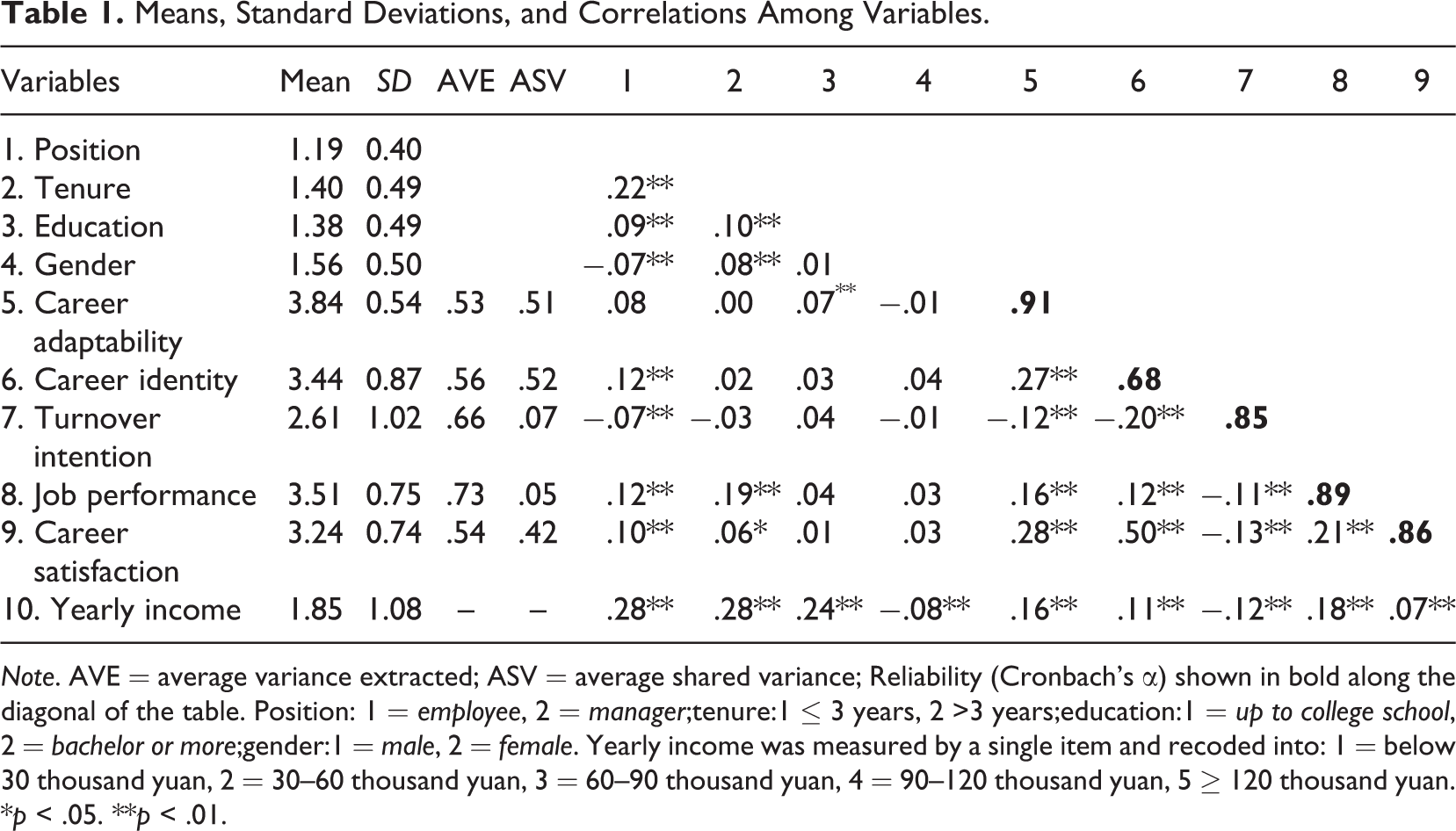
Note. AVE = average variance extracted; ASV = average shared variance; Reliability (Cronbach’s α) shown in bold along the diagonal of the table. Position: 1 = employee, 2 = manager;tenure:1 ≤ 3 years, 2 >3 years;education:1 = up to college school, 2 = bachelor or more;gender:1 = male, 2 = female. Yearly income was measured by a single item and recoded into: 1 = below 30 thousand yuan, 2 = 30–60 thousand yuan, 3 = 60–90 thousand yuan, 4 = 90–120 thousand yuan, 5 ≥ 120 thousand yuan.
*p < .05. **p < .01.
Prior to further analyses, we conducted confirmatory factor analysis (CFA) to test the measurement model for this study (Table 2). The five-factor model (including career adaptability, career identity, turnover intention, job performance, and career satisfaction) showed an acceptable model fit (χ2/df = 4.61, normed fit index (NFI) = .89, incremental fit index (IFI) = .90, Tucker-Lewis index (TLI) = .89, comparative fit index (CFI) = .90, and root mean square error of approximation (RMSEA) = 0.047), which was superior to the one-factor model (Δχ2 (16)/df = 667.17, p < .01), two-factor models (two-factor model A: Δ χ2 (15)/df = 509.51, p < .01; two-factor model B: Δ χ2 (15)/df = 575.60, p < .01), three-factor model (Δ χ2 (14)/df = 416.77, p < .01), and four-factor models (four-factor model A: Δ χ2 (11) /df = 260.12, p < .01; four-factor model B: Δ χ2 (11)/df = 168.82, p < .01). In addition, following Fornell and Larcker (1981), these variables were examined for convergent validity by estimating whether the scale’s AVE is above .5 and discriminant validity by estimating if the scale’s AVE is greater than their ASV. The AVE and ASV for each scale variable were calculated, and their values are reported in Table 1. This shows that the condition was met, and therefore all scales in this study have acceptable validity.
Fit Statistics for the Measurement Models.
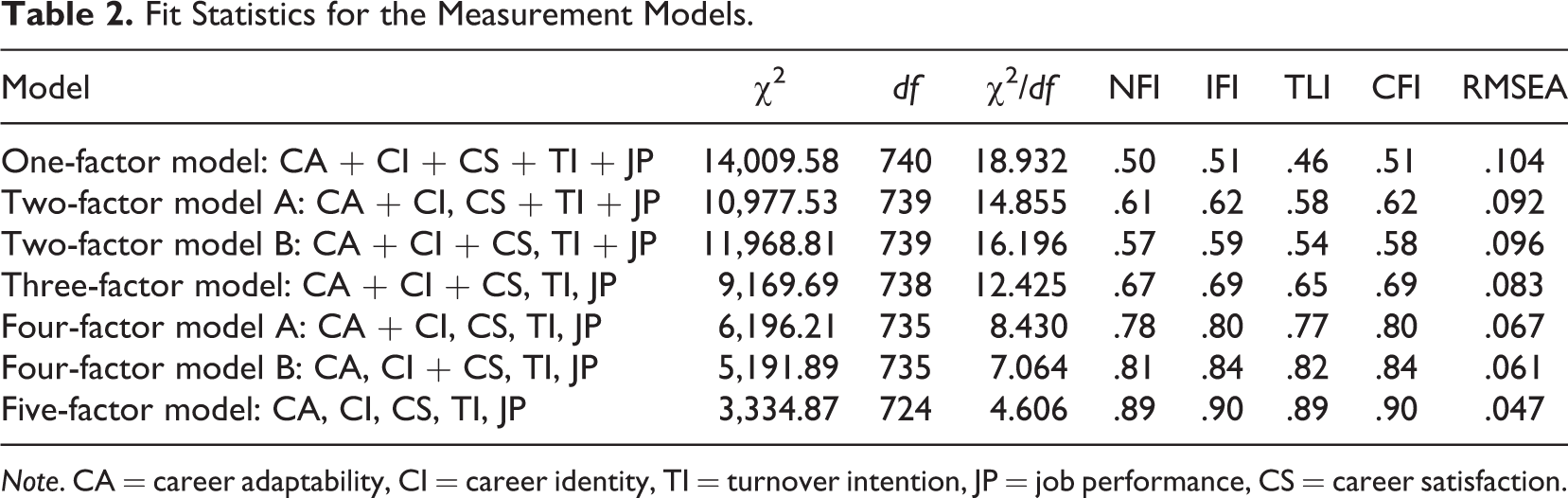
Note. CA = career adaptability, CI = career identity, TI = turnover intention, JP = job performance, CS = career satisfaction.
Hypothesis Testing
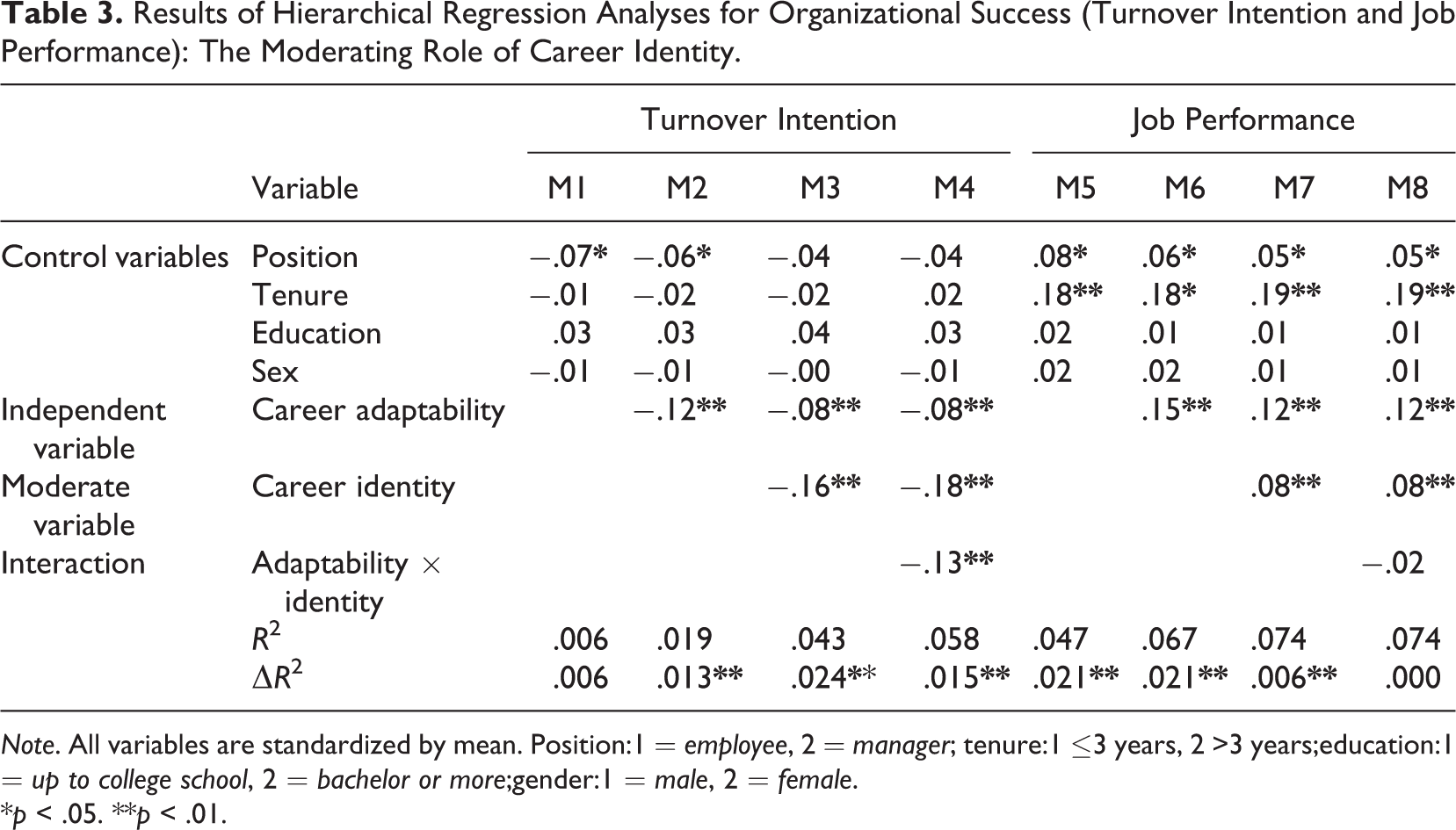
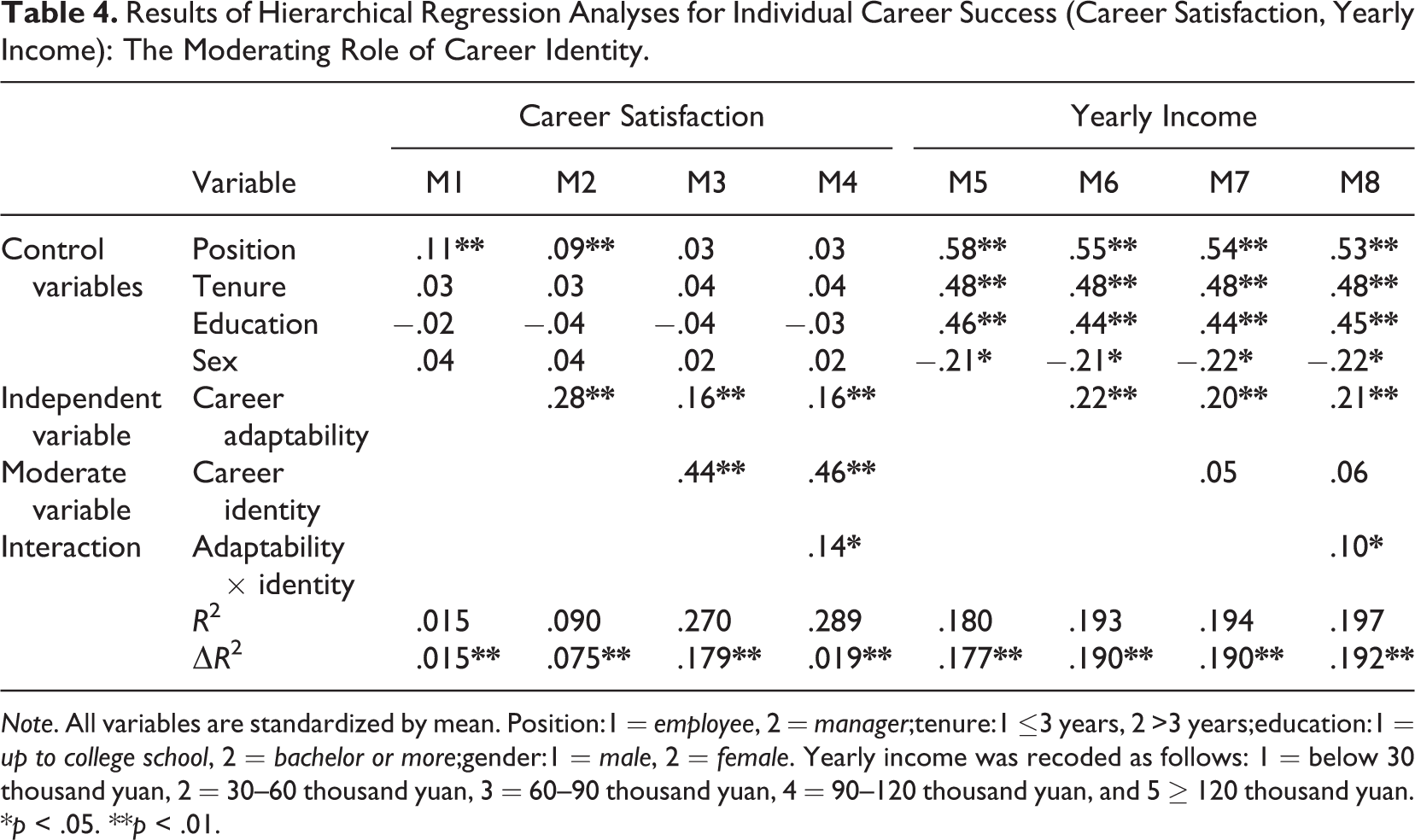
We conducted hierarchical regression analysis to test the hypotheses. The regression results are shown in Tables 3 and 4. As shown in Table 3 (M2 and M6), employees’ career adaptability was negatively related to their turnover intention (β = −.12, p < .01) and positively related to their job performance (β = .15, p < .01). Thus, Hypotheses 1a and 1b were supported. Furthermore, as shown in Table 4 (M2 and M6), employees’ career adaptability was positively associated with their career satisfaction (β = .28, p < .01) and yearly income (β = .22, p < .01). These findings supported Hypotheses 1c and 1d.
Results of Hierarchical Regression Analyses for Organizational Success (Turnover Intention and Job Performance): The Moderating Role of Career Identity.
Note. All variables are standardized by mean. Position:1 = employee, 2 = manager; tenure:1 ≤3 years, 2 >3 years;education:1 = up to college school, 2 = bachelor or more;gender:1 = male, 2 = female.
*p < .05. **p < .01.
Results of Hierarchical Regression Analyses for Individual Career Success (Career Satisfaction, Yearly Income): The Moderating Role of Career Identity.
Note. All variables are standardized by mean. Position:1 = employee, 2 = manager;tenure:1 ≤3 years, 2 >3 years;education:1 = up to college school, 2 = bachelor or more;gender:1 = male, 2 = female. Yearly income was recoded as follows: 1 = below 30 thousand yuan, 2 = 30–60 thousand yuan, 3 = 60–90 thousand yuan, 4 = 90–120 thousand yuan, and 5 ≥ 120 thousand yuan.
*p < .05. **p < .01.
Following that, we test the moderating effect of career identity (Tables 3 and 4: M4 and M8) by entering the interaction term of career adaptability and career identity. The results in Table 3 showed that the respective interaction terms were significant for turnover intention (β = −.13, p < .01) but not significant for job performance (β = −.02, p > .05). At the same time, the results in Table 4 showed that the respective interaction terms were significant for career satisfaction (β = .14, p < .05) and yearly income (β = .10, p < .05).
Furthermore, we conducted supplementary analysis to test the relationship between career adaptability and the individual and organizational outcomes in subset of employees who have high levels of career identity (1 SD above mean) and low levels of career identity (1 SD below mean). The results showed that the relationship between career adaptability and turnover intention was positively significant for employees with low levels of career identity (β = .18, p < .05, N = 147) but not significant for employees with high levels of career identity (β = −.09, p = .27, N = 179; as shown in Figure 2). Hence, Hypothesis 2a was supported. In addition, the interaction term was not significant for job performance which does not support Hypothesis 2b. Moreover, the relationship between career adaptability and career satisfaction was significantly positive for employees with high levels of career identity (β = .26, p < .01, N = 180) and stronger than for employees with low levels of career identity (β = .22, p < .01, N = 148; as shown in Figure 3). Hence, Hypothesis 2c was supported. Finally, the relationship between career adaptability and yearly income was positively significant for employees with high levels of career identity (β = .15, p < .05, N = 166) but not significant for employees with low levels of career identity (β = .09, p = .20, N = 135) (as shown in Figure 4). Hence, Hypothesis 2d was supported.
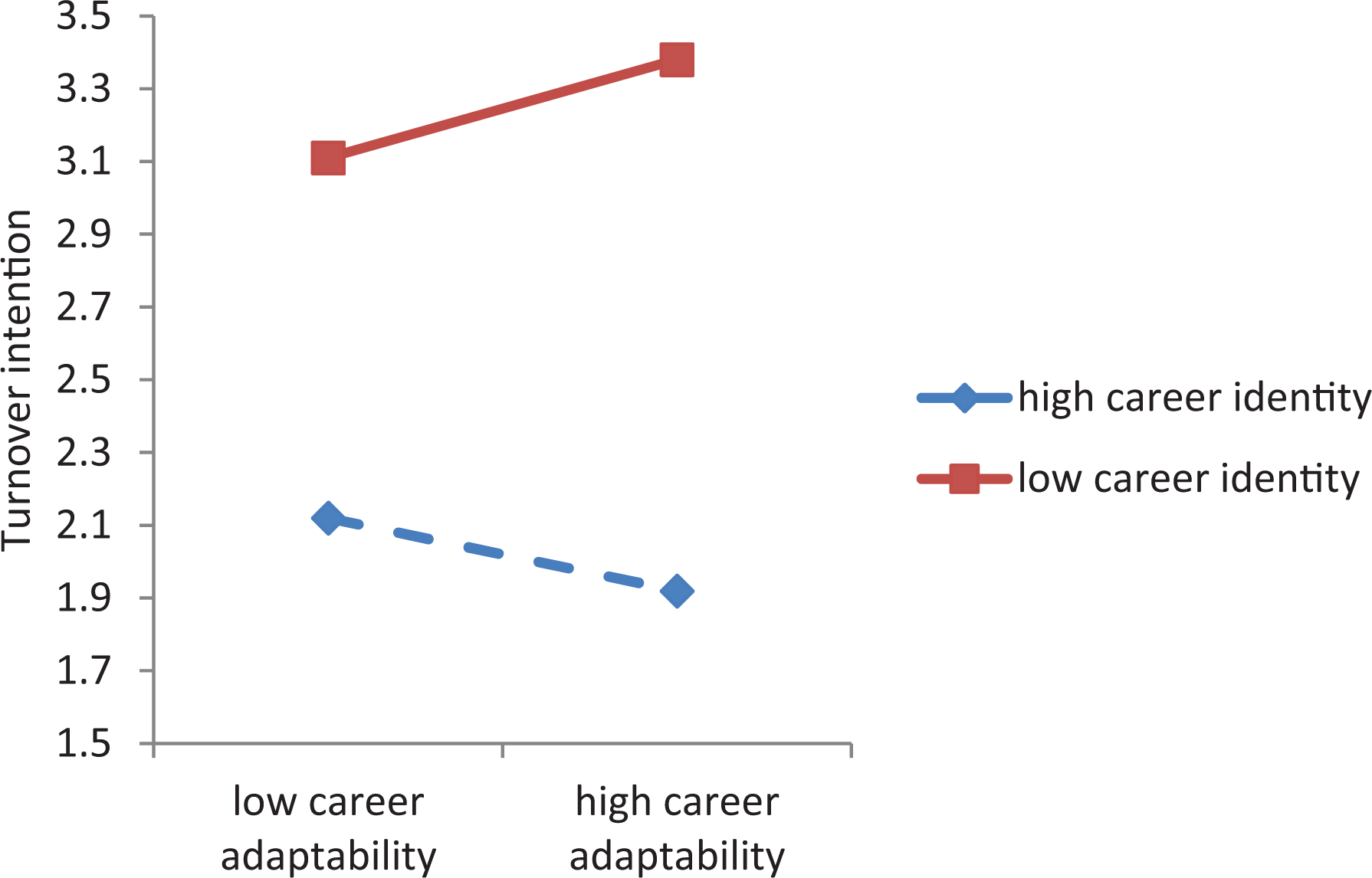
The moderating role of career identity in the relationship between career adaptability and turnover intention (the relation was not significant in high levels of career identity).

The moderating role of career identity in the relationship between career adaptability and career satisfaction.

The moderating role of career identity in the relationship between career adaptability and average yearly income (the relation was not significant in low levels of career identity).
Discussion
This purpose of this study is to explore how career adaptability leads to organizational and individual career success and to determine the moderating effect of career identity. For organizational success, this study found that career adaptability was positively related to job performance and negatively related to turnover intention. The results do not confirm the “management paradox” of career adaptability (Ito & Brotheridge, 2005; Klehe et al., 2011) for Chinese employees. Two considerations may explain this result. First, the paradox represents a general judgment on the effectiveness of career adaptability; it does not consider the possible moderating effect or contingent factors, such as career identity in this study. Second, the construct of career adaptability is different from that in the studies of Ito and Brotheridge (2005) and Klehe, Zikic, Van Vianen, and De Pater (2011), which support the management paradox argument. Career exploration was the main construct of career adaptability in those studies, in contrast to this study, which used the CAAS with focus on career concern, control, curiosity, and confidence.
For individual career success, consistent with previous studies (e.g., Tolentino, Garcia, Restubog, Bordia, & Tang, 2013;Xie, Xia, Xin, & Zhou, 2016; Zacher, 2014), this study found that career adaptability was positively correlated with career satisfaction and yearly income. These results imply that career adaptability as an important individual resource can help employees to successfully manage their career development, thereby enhancing their subjective career success (Savickas, 1997; Savickas & Porfeli, 2012). Furthermore, results regarding the effect of career adaptability on average yearly income show that career adaptability as human capital is highly rewarded in the labor market (Becker, 1964).
In addition, this study found that career identity moderated the relationships of career adaptability with turnover intention, career satisfaction, and yearly income. These results confirmed that career adaptability and career identity were the two meta-competencies in the individual career development process (Hall, 2002; Savickas & Porfeli, 2012). In addition, the results indicated that when employees’ CI was high, CA was not significantly related to TI. In contrast, when employees had a low level of career identity, career adaptability leads to higher turnover intention. The “management paradox of career adaptability” is then likely to occur. Some individuals with relatively high career adaptability, but lower levels of career identity may choose to cope with their career-related difficulties by leaving their current organization. Therefore, career identity as one of the two meta-competencies is an important factor that determines when the paradox applies.
However, the moderating role of career identity in the relationship between career adaptability and supervisor-rated job performance was not supported in this study. This result can be explained by the weak correlation between career identity and job performance, and other moderating variables (i.e., organizational identity and individual career stage) may exist in the relationship between CA and JP. According to organizational identity theory (Hatch & Schultz, 2004), organizational identity could moderate the relationship between career adaptability and job performance; that is, when the level of organizational identity is high, the relationship between career adaptability and job performance is stronger. In line with career timeline theory (Lawrence, 1988), individual career development stages moderate the relationship between career adaptability and job performance. As suggested by career construction theory (Savickas, 1997, 2005; Savickas & Porfeli, 2012), career adaptability is a form of human capital that accumulates over time change due to education, training, and work experience (Zacher, 2014). Therefore, the relationship between career adaptability and job performance is stronger in later career stages than in early stages.
Regarding the two meta-competencies of individual career development, career adaptability is more important to job attitudes and career attitudes than career identity is, whereas career identity is more essential to job performance and objective career success than career adaptability is. According to career construction theory and the theory of two meta-competencies (Hall, 2002; Savickas & Porfeli, 2012), career identity gives individuals a sense of when change is needed. Thus, the effect of career identity on career satisfaction and turnover intention (β = .44 and −.16) is stronger than that of career adaptability (β = .16 and −.08). However, career adaptability (β = .12) as an individual capability is more significant in predicting job performance than career identity is (β = .08).
Theoretical and Practical Implications
This study extended the previous research by making three theoretical contributions. First, this study improves the understanding of the mixed results of career adaptability. The results showed that career adaptability negatively predicted turnover intention in Chinese organizations (Ito & Brotheridge, 2005; Klehe et al., 2011). In addition, career identity moderated the relationship between career adaptability and turnover intention. Therefore, when employees’ career identity was low, career adaptability positively predicted turnover intention; however, when employees’ career identity was high, there was no significant correlation between their career adaptability and turnover intention. Moreover, career adaptability positively predicted employees’ job performance as rated by their supervisors.
Second, this study confirmed the important role of career adaptability in predicting subjective and objective career success, which verifies the predictive validity of the CAAS in individual career development (Savickas & Porfeli, 2012). This result is consistent with previous studies (Spurk, Kauffeld, Barthauer, & Heinemann, 2015; Zacher, 2014). In addition, this work extends the validity of the CAAS in predicting individual objective career success (by yearly income) beyond subjective career success (Xie et al., 2016).
Third, the moderating role of career identity not only supports career construction theory (Savickas, 2002; Savickas & Porfeli, 2012) and career meta-competency theory (Hall, 2006) but also extends these two theories. On the one hand, the study results provide evidence that career adaptability and career identity are the two meta-competencies in career development and management. On the other hand, the results show that career adaptability is more important to job performance and yearly income, while career identity is more important to job and career attitudes.
Practically, the study findings carry important implications for organizational and individual career management and counseling. For organizations, this study provides empirical evidence for the value of career adaptability in improving employees’ job performance. No negative effect on employees’ attitudes is found when their career identity is high. Thus, organizations should pay more attention to employees with lower levels of career identity in counseling, as those with high career adaptability are more likely to have high turnover intention. In addition, when organizations design training and counseling programs to promote employees’ career adaptability, they should place more emphasis on their career identity to increase the positive value that these programs bring to the organizations.
For individual careers, career adaptability provides sustainable resources to promote individual subjective career success (career satisfaction) and objective career success (yearly income). Most importantly, career identity is one of the major factors facilitating individual career success. Therefore, employees should pay more attention to the two meta-competencies of career adaptability and career identity to attain greater success in their career development. Furthermore, organizations and employees can build career development and management systems together based on CA and CI in order to promote a development-oriented psychological contract based on CA.
Limitations and Future Research
Despite the theoretical and practical implications discussed above, this study has several limitations that suggest avenues for future research. First, although the surveys were collected at two time points, it is not a longitudinal study that could draw conclusions about the direction of the causal relationships. Longitudinal studies across several months or years are necessary to examine the relationships between career adaptability and organizational and individual career success.
Second, this study relied on self-reported turnover intention, which can only partially predict turnover behaviors. Thus, future research should explore the relationship between career adaptability and turnover behavior or the objective turnover rate to identify the most likely conditions for the emergence of the management paradox of career adaptability. In addition, we found that the relationships between the four dimensions of career adaptability and turnover intention may differ. The results showed that career concern (β = −.03, p > .05), career control (β = −.22, p < .01), and confidence (β = −.14, p < .05) tended to have positive relations with turnover intention, while career curiosity was positively related to turnover intention (β = .13, p < .05). Future research should thus explore the effects of specific dimensions of career adaptability that may yield different career outcomes.
Third, future research can add new moderating variables such as organizational identity (McArdle, Waters, Briscoe, & Hall, 2007) and individual career stages (Lam, Ng, & Feldman, 2012; Lawrence, 1988) to further examine the interaction effect of career adaptability and career identity on organizational success (e.g., organizational adaptation, and organizational innovation) and individual career success (e.g., promotion, income). In addition, the large sample used in our analysis may amplify the moderating role of career identity. Future studies with other representative samples are needed to replicate our study.
Conclusion
In conclusion, the results of this study showed that career adaptability was positively related to individual career success (career satisfaction and yearly income) and organizational success (job performance and reduced turnover intention). In addition, career identity, as one of the two meta-competencies for careers, moderated the relationships of career adaptability with organizational success and individual career success. Further research is needed to explore the effects of career adaptability on other aspects of organizational success and the effects of individual career adaptability over different organizational and individual career stages.
Footnotes
Acknowledgments
The authors would like to thank the editor and two anonymous reviewers for their valuable suggestions and comments to improve the paper. The first two authors, Yu Haibo and Guan Xiaoyu contribute equally to the paper.
Declaration of Conflicting Interests
The author(s) declared no potential conflict of interest with respect to the research, authorship, and/or publication of this article.
Funding
The author(s) disclosed receipt of the following financial support for the research, authorship, and/or publication of this article: This research was partially supported by grants from The National Natural Science Foundation of China (Project No. 71171020; 71272022).