



Abstract
Social cognitive career theory (SCCT) was introduced 25 years ago. The theory originally included three interrelated models of (a) career and academic interest development, (b) choice-making, and (c) performance. It was later expanded to include two additional models, one focusing on educational and occupational satisfaction, or well-being, and the other emphasizing the process of career self-management over the life span. On this, the silver anniversary of SCCT, we consider the progress made in studying these two most recent models. In addition to reviewing existing findings, we cite promising directions for future research and application. Examples include additional study of model combinations that may shed greater light on choice persistence, possibilities for using the self-management model to study aspects of career development that are relevant to other theories, and the importance of theory-guided applications to aid preparation for, and coping with, uncertainties in the future world of work.
Social cognitive career theory (SCCT) has now reached the 25-year mark. Originally focused on educational and career-related interests, choices, and performance/persistence behavior (Lent, Brown, & Hackett, 1994, 2000), the theory was later extended to include a model of satisfaction and well-being in academic and work settings (Lent & Brown, 2006, 2008) and, most recently, a model of career self-management (Lent & Brown, 2013). Collectively, the models have produced a sizable and still growing body of empirical activity on many phases and challenges of career development. In this and a related article, we take stock of progress in studying SCCT. In the earlier article (Lent & Brown, 2019), we revisited the meta-analytic literature on the original SCCT models of interest, choice, and performance. In the present article, we review research on the newer satisfaction and self-management models, relying on the findings of both individual studies and emerging meta-analytic investigations. In addition, we suggest avenues for further inquiry on both models, highlighting the potential of the self-management model to inform research on career behavior in an increasingly unpredictable and (for many persons) precarious economic context (Hirschi, 2018; Lent, 2018).
Theoretical Underpinnings
Before reviewing research on the satisfaction and self-management models, we offer a brief summary of SCCT’s common elements and how they are assumed to function together. All five models, derived to varying degrees from Bandura’s (1986, 1997) general social cognitive theory, rely on a set of core constructs: self-efficacy beliefs, outcome expectations, and goals. Along with a variety of additional person and contextual variables, these core constructs were adapted to help explain and predict the types of interests that people develop, the types of work and educational pursuits in which they engage, the performance and satisfaction they achieve at school and work, and how they negotiate planned (e.g., job finding) and unplanned (e.g., job loss) challenges to their academic and work lives.
Self-efficacy refers to people’s beliefs about their capabilities to organize and execute behaviors to reach particular goals or to succeed in different activities. Self-efficacy is assumed to help determine whether people will approach versus avoid a particular activity, how much effort they will exert, how persistent they will be when confronted by obstacles, and how well they will perform at the activity. Outcome expectations involve people’s beliefs about the consequences (positive and negative) of activity engagement. Like self-efficacy, outcome expectations help to motivate approach behavior and sustain effort in the face of challenges. For example, the choice to enter and remain in a math major is enabled by confidence in one’s ability to meet the educational requirements (self-efficacy) as well as by optimistic beliefs about the outcomes that will result from one’s efforts (outcome expectations). Goals refer to intentions to engage in an activity or to attain a particular level of performance. Goals, too, help motivate and sustain effort and are influenced (in part) by self-efficacy beliefs and outcome expectations.
The core social cognitive elements operate together with a variety of other person (e.g., personality, ability, gender, race/ethnicity), contextual (e.g., supports, barriers, socioeconomic resources), and behavioral (e.g., choice action) variables, producing a framework that is designed to aid in understanding of the academic and career development of a wide range of people. For example, contextual variables (e.g., supports and barriers) are assumed to affect access to the types of learning experiences that help shape self-efficacy and outcome expectations. They can also facilitate or inhibit the goals that people set for themselves and the actions they take in pursuing their goals, and they can moderate the relationships of other variables in the models (e.g., goal–action relationships). Particular personality variables play somewhat different roles in the various SCCT models, for example, by influencing how well-organized and persistent people tend to be in their goal pursuit (e.g., conscientiousness) or how much they tend to enjoy their engagement in school or work settings (e.g., tendencies toward positive and negative affect). Other types of person inputs, such as abilities, are also important to all SCCT models, although their mechanism of influence differs somewhat, depending on the specific model. For instance, ability is assumed to affect performance at work or school both directly and indirectly, through self-efficacy, whereas the effect of ability on interest is seen as being fully mediated by self-efficacy beliefs (Lent et al., 1994).
Another feature common to all SCCT models is the assumption that self-efficacy beliefs and outcome expectations are informed by four primary sources of information: mastery experiences, vicarious learning, social persuasion, and physiological and affective states. In particular, people who are exposed to similar others performing successfully in a performance domain and who themselves experience success in that performance domain will develop more robust self-efficacy beliefs (and outcome expectations) than those who are bereft of successful models or who lack opportunities to engage and succeed in that performance domain. Self-efficacy beliefs and outcome expectations are also fostered by social encouragement and, conversely, impeded by performance anxiety and other negative affective states.
Empirical Status of the Domain Satisfaction and Career Self-Management Models
In this section, we review research on SCCT’s domain satisfaction and career self-management models, offering provisional conclusions about the empirical status of these two, relatively new bodies of inquiry.
Model of Academic and Work Domain Satisfaction
The SCCT satisfaction, or well-being, model (Lent & Brown, 2006, 2008), displayed in Figure 1, posits that work and academic satisfaction (i.e., the degree to which one likes or is happy with one’s educational or work experiences) are influenced, in part, by self-efficacy beliefs, outcome expectations, and goal mechanisms. In particular, satisfaction at school or work is seen as a function of the degree to which people are making progress at their personally valued goals (e.g., performing well in a college major, developing leadership skills), along with their goal and task-related self-efficacy and outcome expectations. In the context of the satisfaction model, self-efficacy refers to beliefs about one’s ability to perform the activities needed to fulfill personal goals and/or to meet the requirements of the student or work role; outcome expectations involve the anticipated consequences of goal pursuit or task performance. While the more general model of domain satisfaction developed by Lent (2004) emphasized prospective outcomes, in adapting the model to the academic and work context, Lent and Brown (2006) broadened this category to include both expected and received school/work conditions and outcomes—that is, reinforcers, such as social recognition or organizational fairness, that are either anticipated or currently experienced.
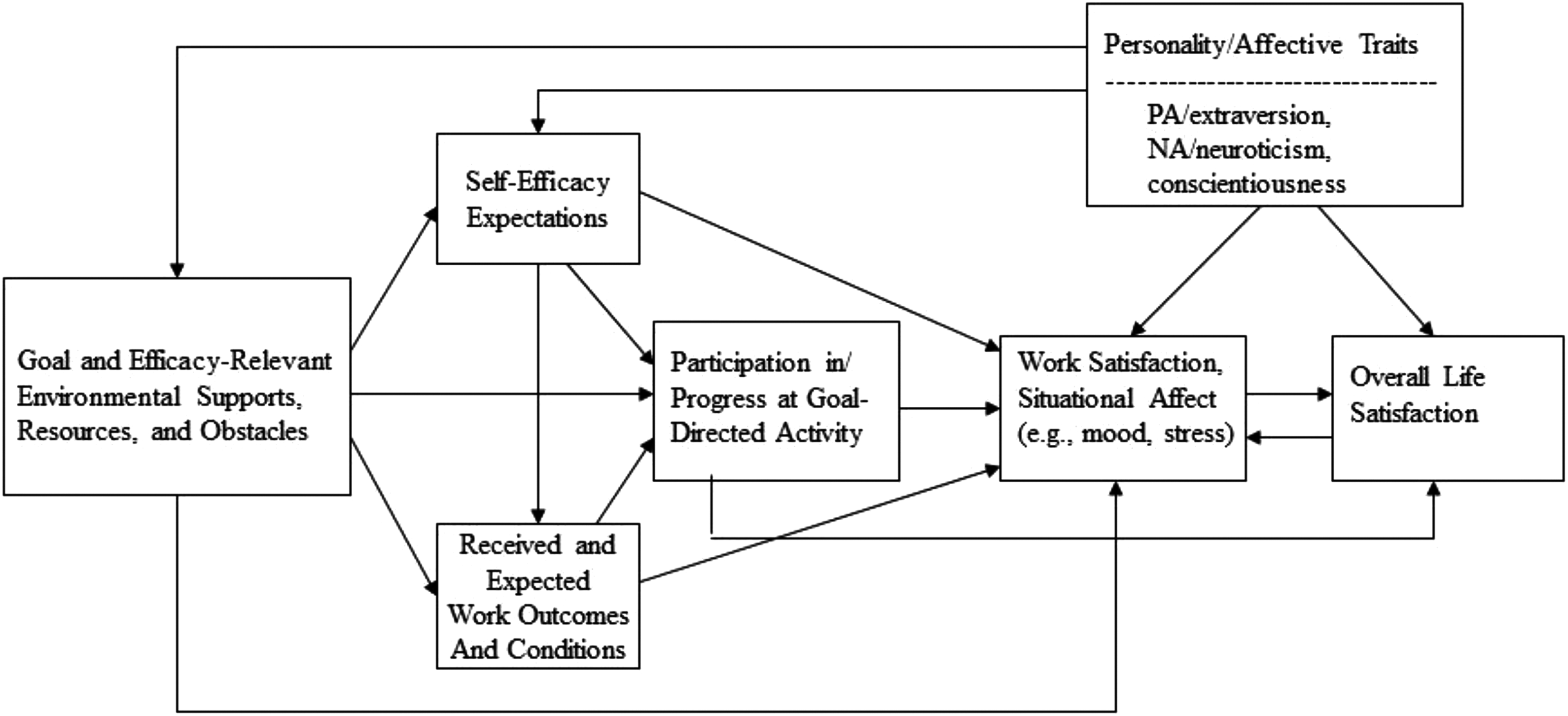
A social cognitive model of work satisfaction. Adapted from Lent and Brown (2008). Copyright 2008 by Sage Publications.
In addition to their direct links to domain satisfaction, self-efficacy and expected/received work conditions and outcomes are seen as being linked to satisfaction indirectly, by promoting successful goal pursuit and enabling participation in valued school/work activities. Other person and contextual variables are also assumed to contribute to workers’ and students’ satisfaction. Contextual factors that support, and provide resources for, students’ and workers’ goal pursuits and self-efficacy beliefs will affect feelings of satisfaction both directly and indirectly via self-efficacy beliefs and work conditions and outcomes. Person factors, such as conscientiousness, positive affectivity/extraversion, and negative affectivity/neuroticism, also operate directly as well as indirectly via their links to workers’ and students’ self-efficacy beliefs and perceived contextual supports. For example, workers who are predisposed toward negative affectivity will likely feel less satisfied with their work and also perceive fewer supports and more barriers to their goal pursuits than do persons lower on this affective trait. The satisfaction model also posits that school/work satisfaction is related to overall life satisfaction, but that the nature and strength of this relationship will be moderated by the salience of work vis-à-vis other life roles. For example, work satisfaction is more likely to promote life satisfaction among people who view the work role as more versus less central to their personal identities.
Research applying the satisfaction model in academic and work settings has burgeoned in recent years, both nationally and internationally. In particular, researchers have tested the model’s ability to predict academic or college major (e.g., STEM) satisfaction among diverse samples of U.S. college students (e.g., Hui, Lent, & Miller, 2013; Lent et al., 2005; Ojeda, Flores, & Navarro, 2011; Sheu, Mejia, Rigali-Oiler, Prime, & Chong, 2016; Singley, Lent, & Sheu, 2010; Truong & Miller, 2018) and among students from a variety of other countries (e.g., Ezeofor & Lent, 2014; Isik, Uluby, & Kozan, 2018; S. Y. Kim, Ahn, & Fouad, 2016; Lent, Taveira, & Lobo, 2012; Lent, Taveira, Sheu, & Singley, 2009; Sheu, Chong, Chen, & Lin, 2014; Sheu, Liu, & Li, 2017). Other studies have tested the model’s ability to explain the work satisfaction of employed adults in the United States (e.g., Duffy & Lent, 2009; Fouad, Singh, Cappaert, Chang, & Wan, 2016) and a number of other countries (e.g., Buyukgoze-Kavas, Duffy, Guneri, & Autin, 2014; Lee & Shin, 2017; Lent et al., 2011).
Meta-analytic findings
In an ongoing meta-analysis, Sheu et al. (2018) have reported that the model generally fits the data well under a variety of conditions. For example, in tests of the model in the academic and work domains, the authors reported that all the hypothesized direct paths but one (the link from self-efficacy to work satisfaction) produced statistically significant path coefficients. Collectively, the predictors accounted for 54% of the variance in academic satisfaction and 43% of the variance in work satisfaction. The model tests also explained large portions of the variance in life satisfaction (34% in the academic domain and 28% in the work domain).
Despite good support for model-data fit across the two domains, the relative strength of many of the paths was found to vary by domain. In particular, six paths produced practically and/or statistically larger coefficients in the academic domain (supports to self-efficacy, self-efficacy to goal progress and domain satisfaction, supports to domain satisfaction, goal progress to domain satisfaction, and extroversion/positive affect to life satisfaction). Three coefficients were found to be larger in the work domain (expected/received outcomes to goal progress and domain satisfaction, extraversion/positive affect to domain satisfaction). In addition, although statistically significant, a few paths were relatively small in size (e.g., direct paths from goal progress to life satisfaction in both domains).
It is possible that some of the domain-specific path differences may be attributable to measurement considerations, especially regarding how the outcome expectations/work conditions construct has been operationalized in the two domains. Lent and Brown (2006) had included both expected and received outcomes/conditions (e.g., organizational support, campus climate, person–environment fit) within this construct based on the assumption that they would function in much the same way as antecedents of goal progress and domain satisfaction (see Figure 1). However, the construct has typically been assessed with outcome expectation measures in studies of academic satisfaction (e.g., expected outcomes for completing a college degree) but with measures of received work conditions (e.g., organizational support) in studies of work satisfaction. The somewhat larger paths from work conditions to goal progress and domain satisfaction among workers compared to students may suggest that proximal reinforcers (i.e., experienced working conditions) serve as more potent motivators than do the more distal, expected outcomes that have been assessed in academic domain studies.
Another measurement issue involves the way in which goal progress has been assessed in the two domains. Studies of academic satisfaction often use some variant of a measure asking students to rate their progress on a common set of developmentally appropriate academic goals (e.g., completing course assignments and learning and understanding course material; Lent et al., 2005). By contrast, studies of work satisfaction often ask participants to list a primary work-related goal (or goals) and then rate their progress toward achieving it. Although both types of goal progress measures are reliably linked to domain satisfaction in the Sheu et al. (2018) meta-analysis, the path coefficient is somewhat larger and accounts for greater variation in the academic domain. These measurement variations deserve closer scrutiny. One possibility is that the relation of progress on personally selected goals to domain satisfaction is moderated by goal salience or commitment. For example, goal progress may produce a stronger link to satisfaction among workers and students who have set, and are highly committed to, specific goals for their own development or performance (Lent, 2004).
In addition to the question of model fit across all samples, Sheu et al. (2018) have been exploring invariance of the model across gender, racial/ethnic group (in the United States), and nationality. The basic model, when collapsed over the academic and work domains, appears to fit well in each group comparison, accounting for large portions of the variation in domain and life satisfaction across grouping variables. Although preliminary multigroup tests suggest some group-specific differences in particular paths, there do not appear to be consistent patterns of difference across the analyses. For example, there were no significant gender differences in the paths to domain satisfaction from self-efficacy, outcome expectations, goal progress, or support. The only racial/ethnic difference in these paths occurred on the pathway from goal progress to domain satisfaction; although both paths were moderate in size, the one for minority samples was larger than that for majority samples. In terms of differences by nationality, it was observed that the path from support to domain satisfaction was larger among non-U.S. samples, although the path from goal progress to domain satisfaction was larger among U.S. samples. If such between-group differences remain stable over further model tests, it will be valuable to explore the basis for them and to consider their implications for promoting the domain or life satisfaction of each group. Such research will also need to examine within-group variation at a more detailed level (e.g., by disaggregating international samples and racial/ethnic minority groups in the United States into more specific groups with greater cultural commonality).
Longitudinal findings
The Sheu et al. (2018) meta-analysis mainly involves cross-sectional findings. Although such findings offer a valuable perspective on the tenability of the satisfaction model, they do not provide definitive evidence regarding directionality of model paths or mediating relationships. Several longitudinal studies shed additional light on the nature of the relationships among variables in the model, with potentially important counseling implications. For example, Lent et al. (2009, 2012) found that self-efficacy beliefs and contextual supports each predicted change in positive affectivity over time in samples of Portuguese college students. These data suggest that positive trait affect may be more malleable than is often assumed (e.g., Lykken & Tellegen, 1996) and that interventions designed to build robust self-efficacy beliefs and support systems in students and workers may indirectly promote the experience of positive emotion as well.
Lent et al. (2009, 2012) also found that Time 1 academic satisfaction or adjustment predicted Time 2 life satisfaction, although the reciprocal path from Time 1 life satisfaction to Time 2 academic satisfaction/adjustment was not significant. This suggests that positive domain functioning may be a source, rather than simply a consequence, of general life satisfaction. Thus, interventions to promote the academic satisfaction of college students have the potential to enhance feelings of life satisfaction. The hypothesized moderating influence of domain salience on this relationship has received very little attention in this literature yet may provide further insight for counseling interventions. For instance, improved domain satisfaction may be especially beneficial to life satisfaction among those with high levels of investment in a particular life domain or role.
Satisfaction-persistence linkages
Another interesting development has been the appearance of studies that integrate aspects of the satisfaction model with other SCCT models and that examine satisfaction as a predictor of intended and actual academic persistence. For example, Lent et al. (2015; Lent, Miller, et al., 2016) and Navarro et al. (2019) have tested an integrated model combining the SCCT interest, choice, and satisfaction models to predict engineering students’ persistence intentions. This integrated model assumes that being in an interest-compatible academic environment promotes academic satisfaction, along with variables in the SCCT satisfaction model (e.g., self-efficacy, outcome expectations, and support). Satisfaction then helps motivate persistence in that environment. Lent et al. (2015) found that the combined model fit the data well and was invariant across gender and racial/ethnic groups, with self-efficacy providing the most reliable predictor of intended persistence across four academic semesters of engineering. In an extension of this study, Lent, Miller, et al. (2016) reported that actual persistence in engineering after six semesters was well-predicted by earlier reports of intended persistence, along with academic satisfaction and self-efficacy (at the end of two semesters).
Navarro et al. (2019) reported that the model fit well across eight subsamples of engineering students based on gender, race/ethnicity (Latina/o, White), and university type (Hispanic-serving and predominantly White institutions) and explained a substantial amount of the variation in academic satisfaction, engagement, and persistence intentions. However, a small subset of parameter estimates varied across the groups. For example, self-efficacy was a more useful predictor of academic outcomes for Latino/a students in predominately White institutions, where they constitute a minority. Such findings suggest that the integrative model may represent a potentially useful means of explaining satisfaction, persistence intentions, and other positive adjustment outcomes. It may also offer a complement to the SCCT performance model by including domain satisfaction as an additional contributor to persistence behavior.
Model of Career Self-Management
The career self-management model (Lent & Brown, 2013) differs from prior SCCT models in that it focuses on process rather than content aspects of career development. For example, while the interest and choice models were designed to predict the types of interests people develop and the types of work they plan to do (e.g., to be a carpenter or a math teacher), the self-management model was developed to predict how people make school- and work-related choices and manage other important developmental tasks, challenges, and crises, regardless of the occupations they enter.
The model, displayed in Figure 2, posits that actions (e.g., search for a job, engagement in career exploration, or retirement planning activities) are linked to the three core social cognitive variables—self-efficacy beliefs, outcome expectations, and goals. Taking action to find a job, for example, largely results from having goals to engage in job search behavior, with goals being partly the product of job-search self-efficacy beliefs and outcome expectations (i.e., expectations about the likely outcomes of engaging in a job search). As in the SCCT choice model, self-efficacy and outcome expectations are hypothesized to relate directly to actions as well as indirectly via goals. Taking action is then hypothesized to increase the likelihood of (although not to guarantee) favorable outcomes (e.g., searching for a job increases the odds that an individual will receive job interviews and offers), whereas failing to take action makes negative outcomes (e.g., remaining unemployed) more likely. The exercise of adaptive behaviors does not invariably produce positive outcomes because these outcomes can be subject to a number of factors beyond the individual’s control such as the number of job openings that are available, the qualifications of other applicants, or discriminatory hiring practices.
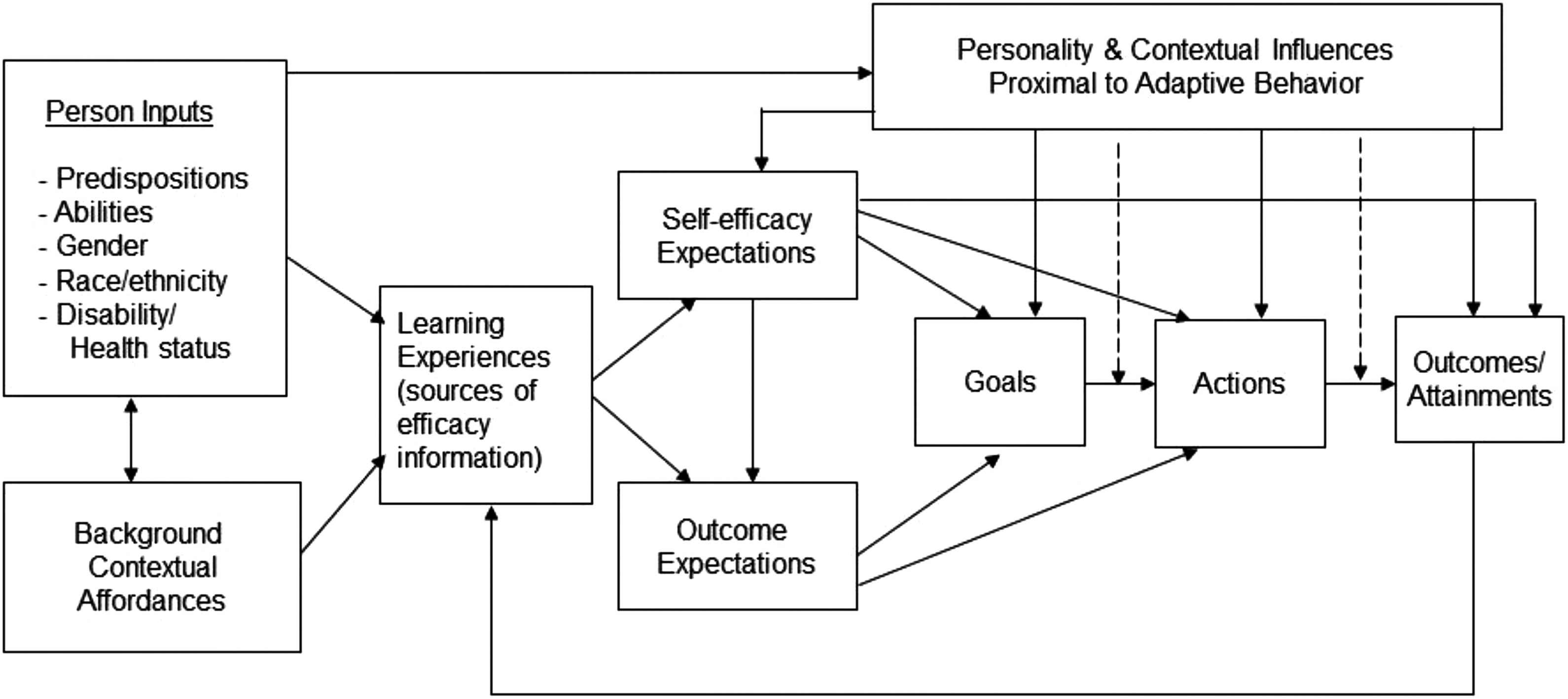
Model of career self-management. Adapted from Lent, Brown, and Hackett (1994). Copyright 1993 by R. W. Lent, S. D. Brown, & G. Hackett. Reprinted with permission.
Consistent with other SCCT models, person (e.g., gender, race/ethnicity, personality traits) and contextual variables (e.g., supports, barriers, socioeconomic conditions) are posited to be linked to self-efficacy beliefs, outcome expectations, goals, and actions via several routes—directly, indirectly, and/or as moderators. For example, contextual supports can affect the development of self-efficacy and outcome expectations, enable goal-setting, and facilitate the translation of goals into actions. The relevance and role of particular personality traits are seen as varying as a function of the developmental task and dependent variable under consideration. For example, trait conscientiousness may facilitate career exploration goals and actions, while neuroticism/negative affectivity is seen as a source of decisional stress.
Emerging findings
Lent and Brown (2013) noted several streams of inquiry that had predated the formal introduction of the self-management model and that were used to provide an initial empirical foundation for it. For example, a bivariate meta-analysis by Choi et al. (2012) found that career indecision was strongly related to career decision self-efficacy. Likewise, Kanfer, Wanberg, and Kantrowitz’s (2001) meta-analysis reported that job search behavior was reliably linked at the bivariate level to job search self-efficacy, goals, and social supports.
The model has begun to receive a healthy level of attention in the literature (e.g., it has been cited 356 times at this writing, according to Google Scholar) and is stimulating a growing number of novel research applications in a variety of career process domains, despite its recent appearance. The greatest concentration of model tests thus far has involved the career exploration and decision-making process. Lent, Ezeofor, Morrison, Penn, and Ireland (2016) found, consistent with hypotheses, that self-efficacy, outcome expectations, and social support were linked to goals for career exploration and that self-efficacy was strongly predictive of career decidedness and decisional anxiety (two potential outcomes of career exploration goals and actions). Self-efficacy was also found to mediate the relation of conscientiousness to exploratory goals and the relation of social support to career decidedness and decisional anxiety.
In a partial replication and extension study, Lent, Ireland, Penn, Morris, and Sappington (2017) found that self-efficacy and outcome expectations jointly predicted exploratory goals and that self-efficacy predicted level of career decidedness. This study also included measures of the experiential sources of self-efficacy and outcome expectations, finding that, as a set, the source variables explained a large portion of the variance in self-efficacy and a smaller but still substantial portion of the variance in outcome expectations, after controlling for self-efficacy. In addition, two of the source variables, mastery experiences and positive emotions associated with prior decisional efforts produced direct paths to career decidedness as well as indirect paths via self-efficacy.
Ireland and Lent (2018) built on the study by Lent et al. (2017) by adding measures of social support and three personality traits (conscientiousness, neuroticism, and extraversion). Their findings indicated that the personality and social support variables were generally linked to exploratory goals and career decidedness via intervening pathways involving the experiential sources, self-efficacy, and outcome expectations. However, social support was also directly linked to outcome expectations and, as in Lent et al. (2017), prior mastery experiences with decision-making explained unique variance in career decidedness. In a related study, Penn and Lent (2018) found support for the hypothesized mediator role of self-efficacy in the relations of neuroticism, conscientiousness, and extroversion to decisional discomfort and decidedness.
Using a longitudinal design, Lent, Morris, Penn, and Ireland (2019) found that the self-management model helped to explain exploration actions as well as decidedness and decisional anxiety over time. For example, self-efficacy and exploration goals at Time 1 were predictive of action at Time 2, and self-efficacy and support at Time 2 was predictive of decidedness at Time 3. Lent, Morris, Wang, Ireland, and Penn (2019) adapted the self-management to provide a theoretical structure for the sources of career indecision as measured by the Career Indecision Profile (Brown et al., 2012). The authors reported that the integrative model provided good fit to the data and accounted for substantial portions of the variance in decisional distress and career decidedness.
Penn (2019) used the self-management model to examine decision-making at the other end of the work–life continuum, that is, as people prepare for retirement. His results largely paralleled those of the model tests involving career decision-making in college students: Self-efficacy was strongly predictive of decidedness and decisional anxiety regarding retirement planning, whereas outcome expectations (but not self-efficacy) was significantly predictive of goals to engage in retirement planning. Social support and conscientiousness were generally linked to the outcome variables via self-efficacy and outcome expectations, although support also produced direct paths to retirement planning goals and decidedness.
Lim, Lent, and Penn (2016) conducted two studies applying the career self-management model in the context of the job search process. In the first study, a sample of unemployed job seekers completed measures of job search self-efficacy, outcome expectations, social support, conscientiousness, perceived control (or volition), and job search intentions. The second study included graduating college seniors and focused on active engagement in the job search process. Path analyses indicated good fit of the model to the data in both studies. In the first study, self-efficacy and outcome expectations mediated the relations of the other predictors to job search intentions. In the second study, job search intention was the key direct predictor of job search behaviors. Conscientiousness, support, and outcome control related to job search behavior indirectly through self-efficacy and its path to intentions.
J. G. Kim, Kim, and Lee (2019) performed a meta-analysis of the bivariate relations between job search self-efficacy and a variety of variables in the self-management model, reporting theory-consistent relations of self-efficacy to outcome expectations, support (but not barriers), personality variables, and job search goals, behaviors, and outcomes (e.g., job offers, anxiety). They also found that the relations of self-efficacy to job search behaviors and outcomes were moderated by several factors such as sample type (e.g., students vs. workers) and length of unemployment. Although these data do not directly address the multivariate direct and indirect relationships that are hypothesized in the self-management model, they do support linkages of job search self-efficacy to its hypothesized correlates (e.g., outcome expectations), antecedents (supports and personality), and consequences (job search goals and outcomes).
Two studies have used the career self-management model to examine multiple role management. In a sample of emerging adults, Roche, Daskalova, and Brown (2017) found that self-efficacy, although not outcome expectations, produced a direct path to intentions to balance multiple (work and nonwork) roles. Conscientiousness was linked to intentions only indirectly, via self-efficacy. Gender produced a direct path to intentions, with women reporting stronger expectations about balancing multiple roles than did men. S. Y. Kim, Fouad, and Lee (2018) examined multiple role management in a sample of working men. They found that conformity to masculine norms was linked to positive spillover between work and family roles (both directly and indirectly through multiple role self-efficacy) and that, together, positive role spillover and self-efficacy accounted for a significant amount of the variance in job, family, and life satisfaction.
Finally, Tatum and colleagues conducted two studies applying the self-management model to sexual identity disclosure in the workplace among sexual minority workers. In the first study, Tatum, Formica, and Brown (2017) found that self-efficacy and outcome expectations regarding the management of sexual identity were directly related to workplace disclosure status (i.e., the degree to which one is out at work). Concealment motivation and workplace climate were also linked to workplace disclosure, both directly and indirectly, through self-efficacy and positive outcome expectations. In the second study, Tatum (2018) reported that self-efficacy, though not outcome expectations, was predictive of disclosure status which, in turn, predicted job satisfaction. Outcome expectations produced a direct path to job satisfaction, while the path from self-efficacy to job satisfaction was fully mediated by disclosure status. Workplace climate moderated the relation of disclosure status to job satisfaction: Outness was linked more highly to job satisfaction in the presence of more versus less LGBTQ-supportive environments.
Tentative conclusions
Although the complexity of the self-management model tests and the varied contextual and person variables used in different studies makes it challenging to draw firm conclusions across applications, it is possible to offer a few general observations. First, versions of the model that have been tested generally fit the data well and the three social cognitive variables (self-efficacy beliefs, outcome expectations, and goals) are interrelated across most model tests. Self-efficacy and outcome expectations both tend to predict goals, although the relative strength of the two predictors varies across domains. Outcome expectations often yield the larger path coefficient in relation to career exploration goals, with self-efficacy contributing to the prediction of goals mainly indirectly, through outcome expectations. This is similar to the pattern observed in meta-analytic studies of SCCT’s interest and choice models (see Lent & Brown, 2019). However, self-efficacy has been the more prominent predictor of job search and multiple role balance intentions.
Second, the model has also shown utility in predicting self-management actions and not only intentions. In particular, sexual identity disclosure was well-predicted by the model (and by self-efficacy beliefs, in particular). Longitudinal findings have shown that job search actions and career exploration actions were also well-predicted by other model elements, especially goals, with other predictors contributing either directly or indirectly to predictions. Third, the model has also been useful in predicting disclosure status outcomes (job satisfaction), decisional outcomes (decisional anxiety and level of decidedness), and job search outcomes. Such findings are especially relevant to the model’s assumption that self-regulation affords people a measure of agency in attaining positive affective and behavioral outcomes.
Fourth, findings suggest that contextual variables also play important and multifaceted roles in career self-management. In particular, contextual support has been linked to goals, actions, and outcomes across model tests, directly, indirectly, or as moderators of other model relationships. For example, social support appears to provide an essential platform for the development of decisional and job search self-efficacy and outcome expectations. Likewise, affirmative workplace climates enable sexual minority workers to disclose their sexual identity to their colleagues and to make it more likely that such disclosure will yield positive results (e.g., in terms of postdisclosure feelings of job satisfaction).
Fifth, personality variables have typically been found to play less direct, although still important roles, in model tests. For example, conscientiousness has been included as a person input in studies of multiple role balance intentions, career exploration goals and actions, and job search goals and actions. A common finding has been that its link to the outcome variables is mediated by outcome expectations and/or self-efficacy beliefs. It was also found to be relatively nonmalleable in one longitudinal study (Lent, Morris, Penn, & Ireland, 2019), suggesting that it may serve as a useful triage variable in interventions aimed at developmental tasks that require planning and perseverance. Certain other personality variables, such as negative affectivity/neuroticism, may play more direct roles, particularly in relation to outcomes that have a significant affective component (e.g., decisional anxiety).
Directions for Future Research and Practice
In this section, we cite several directions for future research on the satisfaction and self-management models and mention additional applications for SCCT.
Cross-Model Research Needs
Although moderator hypotheses appear in each of the SCCT models, they have rarely been tested in existing research. For example, the satisfaction model hypothesizes that the relation of domain satisfaction to life satisfaction will be stronger when a given life domain (e.g., work) is particularly important to the individual; likewise, goal progress is assumed to relate more strongly to domain satisfaction when the goal, and the life domain in which it is embedded, is highly valued by the individual (Lent, 2004; Lent & Brown, 2008). In the self-management model, goal–action and action–outcome relations are posited to be moderated by contextual factors. For example, the presence of supports and the relative absence of barriers are assumed to help individuals translate their goals into actions and to increase the likelihood that their actions will yield desired outcomes.
These moderator hypotheses have practical as well as theoretical implications and, thus, deserve greater research attention. For example, assisting individuals to set and make progress at valued work goals offers a potential route toward job and life satisfaction, especially for those who consider work as among their most important life domains. Other sources of work and life satisfaction might be targeted for individuals who do not view work as important as other life domains or who are not particularly oriented toward work goals. In the self-management model, provision of needed supports and resources (e.g., mentoring, training), or assistance in navigating barriers, can be used to help people enact their goals and enhance the chances they will attain the outcomes they seek (e.g., job offers, promotions).
A second, general research need involves multigroup structural equation modeling studies that can compare model-data fit across gender, race/ethnicity, socioeconomic status, culture, nationality, and other individual and group difference dimensions. Extant research testing the satisfaction model across grouping variables has revealed general support for the model as well as some path-specific differences (Sheu et al., 2018). Although studies conducted within a particular group (e.g., culture, gender, ethnicity, socioeconomic class) are important, multigroup measurement and structural invariance studies provide valuable information about the range of the SCCT models’ generalizability, indicating which paths may be relatively universal or group-specific.
Third, emerging evidence suggests that the learning experiences on which self-efficacy and outcome expectations are based may serve as useful intervention targets in efforts to promote career decision-making. Prior mastery experiences with decision-making, in particular, have been linked both with decisional self-efficacy and career decidedness in several studies. The value of mastery experience as a source of self-efficacy is consistent with the assumptions of general social cognitive theory (Bandura, 1986). This finding suggests that interventions for decision-making might assist students or clients to review their past successful efforts at decision-making and, where necessary, to develop a more systematic approach to information gathering or decision-making. Counselors might also encourage the adoption of reasonable expectations for the outcomes of future decisions, emphasizing that preparedness (e.g., backup plans) may facilitate coping with negative outcomes but cannot entirely prevent them from occurring (Lent, 2013).
Other directions for future research include (a) the need for additional longitudinal and experimental (including intervention) studies, (b) examination of the malleability of particular personality traits and affective dispositions, (c) exploration of perceived volition as a moderator of variable relationships (e.g., between self-efficacy and goals), and (d) tests of hybrid SCCT models that, for example, combine elements of the interest/choice, satisfaction, and performance models in explaining persistence intentions and actual choice stability (Lent & Miller, et al., 2016; Navarro et al., 2019). Each of these topics may have practical implications. For example, malleable person variables may be targeted for change as part of intervention, whereas less malleable ones may serve as triage or diagnostic indicators that point to particular treatment targets (e.g., low levels of conscientiousness may predict who will have difficulty with career exploration and may, thus, profit from in-session assistance with gathering and organizing career information).
Model-Specific Research Needs
We now consider several research directions that are specific to each of the two models. One important issue regarding the satisfaction model involves the decision to include outcome expectations and received work conditions/outcomes as instances of the same larger construct. Meta-analytic research suggests that the two operationalizations may be differentially predictive of goal progress and domain satisfaction; it also suggests that outcome expectations are more likely to be studied in the academic domain, while received conditions are more often studied in the work domain. It would be useful for future research to examine the measurement of this construct more carefully, for example, to determine whether they represent the same or substantively different underlying perceptions.
Future research may also benefit from incorporating work conditions and outcomes into studies of academic satisfaction. This suggestion is consistent with findings linking campus climate and discrimination to college satisfaction, performance, and retention (Brown et al., 2018). We also think that outcome expectations deserve more study in research on work satisfaction. Measurement of outcome expectations in both domains might profit from adequate sampling of the various types of outcomes originally described by Bandura (1986; e.g., social and self-evaluative outcomes) and from more closely matching outcome expectations to the other predictors in terms of the temporal frame of reference (e.g., near-term outcomes).
The measurement of goal progress also deserves further examination. As noted earlier, goal progress, like outcome expectations, tends to be assessed differently in the academic and work domains. Academic domain measures tend to present common sets of academic progress indicators, while work domain measures tend to identify participant-specific goals. Meta-analytic findings suggest that the former tend to produce somewhat larger relations to self-efficacy and domain satisfaction. One possible reason for the strong relation between self-efficacy and goal progress in the academic domain is that the predefined goal statements used in many studies reflect more on general academic performance than on progress at individualized goals. It would be useful to devote further study of idiographic goal assessment in the academic domain and of nomothetic assessment in the work domain.
The self-management model has thus far received good support, although inquiry has been limited to a relatively small but important set of developmental tasks and challenges; namely, career exploration and decision-making, retirement planning, the job search process, multiple role management, and sexual identity disclosure in the workplace. The model needs to be tested with other important developmental tasks and challenges to establish its range of applicability. Lent and Brown (2013, p. 560) provided a list of adaptive career behaviors, organized by developmental period and primary life role, that can be used to expand research on the self-management model. A few examples that seem particularly relevant to negotiating the contemporary work world include managing school to work and work to work transitions, searching for and attaining employment, coping with negative career events like layoffs, refining networking skills, preparing for career-related changes and emergencies, updating skills, and building job niches.
The self-management model might also be used to complement other theoretical approaches concerned with issues of particular relevance to marginalized or economically challenged youth and young adults. We will offer a few examples. First, the self-management model might be used to suggest how to promote work volition which has been defined in the psychology of working theory as “the perceived capability to make career decisions, despite constraints” (Duffy, Blustein, Diemer, & Autin, 2016, p. 128). As a judgment of capability, might work volition, like self-efficacy, be susceptible to the influences of mastery and vicarious experiences as well as social encouragement/support and affective states. Second, the self-management model suggests how two components of critical consciousness (Diemer & Hsieh, 2008) might be fostered; namely, political efficacy and critical action (Diemer & Hsieh, 2008). In particular, political efficacy might be promoted via the sources of efficacy information, and critical action taking may be facilitated by political efficacy along with action-related outcome expectations and support.
The self-management model can also be used in conjunction with career construction theory (e.g., Savickas, 2013). For example, both theories emphasize the importance of career adaptability, although they conceptualize it in somewhat different terms. In career construction theory, curiosity and confidence comprise two of the four dimensions of career adaptability. Savickas likened confidence to career decision-making self-efficacy and linked curiosity to engagement in career exploration and information-seeking. These commonalities to the self-management model, particularly in its application to career exploration and decision-making (e.g., Lent, Ezeofor, et al., 2016), suggest opportunities to explore how elements of the two approaches relate to one another and to outcomes of joint relevance.
Larger developments in the global economic context, such as advances in automation, have sparked concerns about diminished employment opportunities, downward economic mobility, and a rise in precarious work future for many persons (e.g., Hirschi, 2018; Lent, 2018). Although not all economic forecasts are uniformly pessimistic (e.g., Samuelson, 2017), vocational psychologists and career counselors need to understand how people can be aided to prepare for the possibility of work instability or insufficiency. We believe the self-management model can be used as a template for studying preparedness for both expected and unexpected career events. For example, the concept of career preparedness (Lent, 2013) might be “unpacked” into sets of separate but complementary behaviors such as self-advocacy behaviors on the job (e.g., seeking resources needed for job advancement) and preparatory behaviors beyond the job (e.g., skill updating, routine preemptive job searches, monitoring savings ahead of work instability). The emphasis would be on relatively malleable behaviors over which people may exercise some agency. Relevant outcomes in such research might include both self-rated (e.g., job engagement, career satisfaction, available coping repertoire) and external indicators of career viability (e.g., job tenure, number of networking contacts, length of periods of unemployment).
Beyond the Satisfaction and Self-Management Models
Although the current five SCCT models have attracted a good deal of empirical attention, much work remains to be done, particularly in bridging theory to practice. One especially ripe area involves SCCT’s application to career choice assessment and intervention. In a paper in progress, we are attempting to develop a theory-inspired model that combines features of SCCT’s choice-content and process models and links them to inquiry emanating from cognitive psychology on how people make decisions in the face of uncertainty (e.g., Kahneman, 2011). We argue that career choice-making is as relevant to the marginalized as to the more well-to-do, but that extant models of career choice counseling are often applied in a cookie cutter, one size fits all manner, fail to consider contextual factors that can limit (and facilitate) the choice-making process and largely ignore problems (personal, contextual, and societal) that can occur in implementing choices and sustaining a satisfying work life. The intent is to produce a model for choice counseling that will be useful for the economically marginalized as well as the more affluent and that will simultaneously help people make well-informed choices while preparing them for future career uncertainties. Many other theory-into-practice possibilities could be cited, such as efforts to translate SCCT research into systematic interventions for retaining women and students of color in STEM fields and assisting people to manage work–nonwork role challenges, cope with job dissatisfaction, navigate sexual identity disclosure decisions in the workplace, and prepare for work transitions such as career change and retirement. Indeed, theory-into-practice research represents another important area of future inquiry on SCCT and we look forward to seeing what such efforts will bring.
Footnotes
Declaration of Conflicting Interests
The author(s) declared no potential conflicts of interest with respect to the research, authorship, and/or publication of this article.
Funding
The author(s) received no financial support for the research, authorship, and/or publication of this article.