



Abstract
Building from the psychology of working framework, we examined the moderating role of proactive personality in the attainment of decent work among a sample of racially and ethnically diverse employed adults in the United States (N = 238). We tested our hypotheses using structural equation modeling and found experiences of marginalization and economic constraints to have indirect associations with decent work via work volition. We also found marginalization, work volition, and career adaptability to have direct associations with decent work but found no support for proactive personality as a moderating mechanism. Our findings contribute to the growing literature examining how contextual variables are associated with securing decent work among diverse groups. We discuss practical implications along with future directions for research related to the psychology of working.
Keywords
The psychology of working theory (PWT; Duffy, Blustein, Diemer, & Autin, 2016) underscores the associations that contextual factors have with vocational development. Such factors are theorized to be associated with access to decent work, which is an aspirational state of employment that provides employees with adequate compensation, access to adequate health care, safe working conditions, fair working hours that allow for rest and free time, and organizational values that uphold familial and social values. Initial studies have demonstrated the associations of these contextual variables with decent work (Autin, Douglass, Duffy, England, & Allan, 2017; Douglass, Velez, Conlin, Duffy, & England, 2017). However, these studies have not examined any proposed moderating variables within the PWT. Drawing from research highlighting perceived workplace mistreatment and a greater prevalence of negative vocational outcomes among racially and ethnically diverse (REM) employees and job seekers (e.g., McCord, Joseph, Dhanani, & Beus, 2018; Quillian, Pager, Hexal, & Midtbøen, 2017), and building from initial PWT tests, the present study tested the moderating role of proactive personality (considered to be a tendency to take action to influence change in one’s environment; Bateman & Crant, 1993) in the relation between contextual variables and work outcomes. Consistent with the work of Duffy, Gensmer, et al. (2019) and Duffy, Velez, et al. (2018), our study focused on REM employed adults, which included U. S. employees that identified as non-European American/non-White; this broad definition was intended to capture the experiences of employees that often do not receive the same unearned power and privilege afforded to their White counterparts (Sue & Sue, 2013).
Theoretical Framework
Parsons (1909) emphasized the necessity of attending to the needs of disadvantaged individuals, and throughout history, vocational scholars have highlighted the role of contextual factors and access to opportunity within career development (e.g., Gottfredson, 2005; Lent, Brown, & Hackett, 1994; Super, 1957). However, the PWT differs from past theories in that it espouses an explicit systemic perspective focusing on the role of societal oppression in attaining decent work as opposed to specific careers. Duffy et al. (2016) emphasized the importance of considering contextual factors as the primary predictors of attaining decent work. The authors acknowledged the existence and value of traditional vocational theories and stated that the PWT is intended to offer an alternative perspective rather than a competing theory.
The PWT outlines four constructs that are thought to be associated with decent work: marginalization, economic constraints, work volition, and career adaptability. According to Duffy et al. (2016) marginalization refers to the disparity of power and privilege that exists when comparing socially advantaged versus disadvantaged groups and individuals, and economic constraints regards the barriers that result from a lack of economic resources (e.g., income). Marginalization and economic constraints are posited to have direct and indirect associations with decent work via work volition—defined as the ability to make occupational choices despite constraints (Duffy, Diemer, Perry, Laurenzi, & Torrey, 2012)—and career adaptability, or the personal resources that individuals utilize during career planning and when responding to occupational challenges (Savickas & Porfeli, 2012). Research has consistently linked career adaptability and work volition with positive outcomes (e.g., job satisfaction, job search self-efficacy) across multiple groups (e.g., students, employed adults; Douglass & Duffy, 2015; Duffy, Autin, & Douglass, 2015; Zacher, 2014).
To date, the PWT has inspired research into the measurement of decent work and resulting need satisfaction (Autin et al., 2019; Duffy et al., 2017; Duffy, Gensmer, et al., 2019), and empirical tests among samples of emerging Korean adults (Kim, Duffy, Lee, Lee, & Lee, 2019), sexual and gender minorities (Douglass et al., 2017; Tebbe, Allan, & Bell, 2019), racial and ethnic minorities (Duffy et al., 2017), and people with a chronic illness (Tokar & Kaut, 2018). Longitudinal studies have also provided preliminary support for the positioning of mediating mechanisms within the model (Autin et al., 2017; Duffy, Autin, England, Douglass, & Gensmer, 2018).
Despite hypotheses of moderating variables within the PWT, only one study has examined theorized moderators in relation to the pathways predicting decent work. Among a sample of 377 Chinese urban workers, Wang et al. (2019) found that proactive personality and social support moderated the link between subjective social status and work volition but in a direction counter to PWT propositions. Specifically, participants who reported greater subjective social status benefited more from greater social support and proactive personality, as opposed to those with lower reported subjective social status. Wang and colleagues called for scholars to investigate these findings across cultures and with different populations. The present study builds on this work by examining the moderating role of proactive personality among a REM sample of employed adults in the United States.
Duffy et al. (2016) proposed the following three constructs as other potential moderators within the PWT: critical consciousness, economic conditions, and social support. From the PWT framework, critical consciousness refers to a person’s analysis of societal inequities, a perceived capacity to effect change, and collective or individual action to address recognized inequalities. Economic conditions are comprised of varying macro-level indicators, such as a region’s current unemployment rate. Social support is conceptualized as the degree to which individuals feel support from various sources—including friends, family, significant others, and even the community—in coping with stress. Considering these additional moderators, we chose to examine proactive personality for a couple of reasons. First, we chose not to assess economic constraints given that this is a macro-level variable that is not susceptible to change via individual-level interventions. Second, in developing the PWT, the authors suggested that the theory be tested in steps over time; before simultaneously examining multiple moderators, it would be helpful to understand the unique contributions that each moderator may have within the theorized pathways. Overall, we decided to examine the potential moderating role of proactive personality because, when compared with other theorized moderators, it appeared to rely the most on personal resources and be readily malleable (Kirby, Kirby, & Lewis, 2002).
Marginalization and Economic Constraints Among Racial and Ethnic Minorities
Ethnically and racially diverse job seekers and employees encounter ongoing marginalization on various levels. For example, a recent meta-analysis of field experiments examining job callback rate disparities among diverse job seekers found no significant decline over the last 30 years, with Whites still receiving about 36% more callbacks than African Americans and 24% more callbacks than Latinos (Quillian et al., 2017). Kang, DeCelles, Tilcsik, and Jun (2016) noted that callback rate disparities can be as great as 50% and include Asian job seekers. Regarding employed adults, one meta-analysis demonstrated that Asian, Black, and Hispanic employees reported greater perceptions of race-based mistreatment at work than White employees; also, White employees were less likely to report other forms of workplace mistreatment such as perceptions of abusive supervision, bullying, harassment, and ostracism (McCord et al., 2018). From a systemic perspective, the U.S. Equal Employment Opportunity Commission (EEOC) has tracked employment-related charges every year and has found, that since 1997, about one third of all their complaints are related to race. In 2017 and 2018, the exact percentages were 33.9% (28,528 race charges) and 32.2% (24,600 race charges), respectively (EEOC, 2019). Moreover, these claim numbers are likely suppressed by the pervasive use of mandatory arbitration agreements by employers which require private—instead of public—settlement of charges (Estlund, 2018).
Multiple aspects of one’s identity often intersect, which can result in compounded levels of oppression (Cole, 2009). An example of the effects of long-standing systemic marginalization and economic constraints among racial and ethnic minorities within the United States can be seen when comparing levels of wealth, which serves as a measure of the ability to access adequate housing, health care, educational opportunities, and/or handle unexpected financial events (e.g., economic shifts). Regarding median net wealth, Shapiro (2017) found that for every dollar of wealth possessed by White families in the United States, African American families had less than 8 cents of wealth and Hispanic families had less than 10 cents of wealth. Shapiro (2017) speculated that these disparities may be due, in part, to previous constraints resulting from historical racialized policies within the United States. When considering these trends, the PWT appears to be a useful framework for examining how contextual factors may be inhibiting access to decent work among REM employees.
The Role of Proactive Personality
In a meta-analysis and large replication study (N = 2,183,377), Ayoub, Gosling, Potter, Shanahan, and Roberts (2018) found that personality may compensate for background disadvantage, namely education level and socioeconomic status. The authors suggested personality may be a form of human capital. One type of personality that may serve in this role is proactive personality, which is defined as a relatively consistent tendency to take action to influence change in one’s environment; individuals who are highly proactive take initiative, seek out opportunities for change, and persevere until meaningful change is achieved (Bateman & Crant, 1993). One review found proactive personality to be positively correlated with positive work outcomes (cf., Fuller & Marler, 2009). Drawing from this research, Duffy et al. (2016) proposed that proactive personality may moderate associations between contextual variables and work volition, career adaptability, and decent work such that proactive personality may buffer against the pitfalls of economic constraints and experiences of marginalization.
In line with Ayoub et al.’s (2018) view that personality may compensate for disadvantage, one meta-analysis of proactive personality found that Black, Hispanic, and Asian individuals may have greater levels of proactive personality than White individuals (Spitzmuller, Sin, Howe, & Fatimah, 2015). Thus, proactive personality may help to counteract the adversity and discrimination that diverse employees encounter in and out of the workplace. Although the examination of proactive personality within the PWT context is limited to one study (i.e., Wang et al., 2019), proactive personality has been shown to be positively correlated with career adaptability (Tolentino et al., 2014) and constructs similar to work volition such as job search self-efficacy, behavior, and effort (Brown, Cober, Kane, Levy, & Shalhoop, 2006). However, there is evidence that proactive personality can be both adaptive and maladaptive (Chan, 2006). Thus, prior to developing interventions that may enhance levels of proactive personality, it’s important to examine how proactive personality functions within the PWT context.
The Present Study
Building from previous tests of the PWT, the present study sought to further explore how oppression of REM employees within the United States constrained access to decent work. We hypothesized that greater levels of marginalization and economic constraints—which were expected to be positively associated—would have negative direct associations with decent work and negative indirect associations via work volition and career adaptability. Additionally, we hypothesized that work volition would be positively associated with career adaptability and that higher levels of work volition and career adaptability would be positively associated with decent work. Lastly, we explored the potential moderating role of proactive personality and hypothesized that greater levels of proactive personality would diminish the negative associations that marginalization and economic constraints had with work volition, career adaptability, and decent work.
Method
Participants
Our sample consisted of 238 adults with a mean age of 32.17 years (standard deviation [SD] = 8.70, range of 18–64). Details of the sample can be found in Table 1. Of note, our sample was more educated than the general population. Based on census estimates (U.S. Census Bureau, 2018a), which categorizes educational attainment for individuals aged 25 years and older across racial categories (limited to White, non-Hispanic White, Black, Asian, and Hispanic), Black participants in our sample reported greater undergraduate degree attainment (54.19% vs. 16.3%) but slightly lower professional degree attainment (8.65% vs. 8.90%). Asian participants also reported greater undergraduate degree attainment (62.50% vs. 31.4%) but lower professional degree attainment (14.58% vs. 25.1%). Lastly, Hispanic participants reported greater undergraduate degree attainment (33.93% vs. 13.00%) and greater professional degree attainment (8.93% vs. 5.40%). Based on how we measured household income, we were unable to calculate median household incomes to compare with census estimates. However, participant reported household income categories appeared to be in line with census estimates (U.S. Census Bureau, 2018b) given that 56.73% of Black participants reported household incomes of US$50,000 or less (census median US$41,361), 56.25% of Asian participants reported household incomes of US$75,000 or less (census median US$87,194), and 58.9% of Hispanic participants reported household incomes of US$50,000 or less (census median US$51,450).
Demographic Characteristics of Participants.
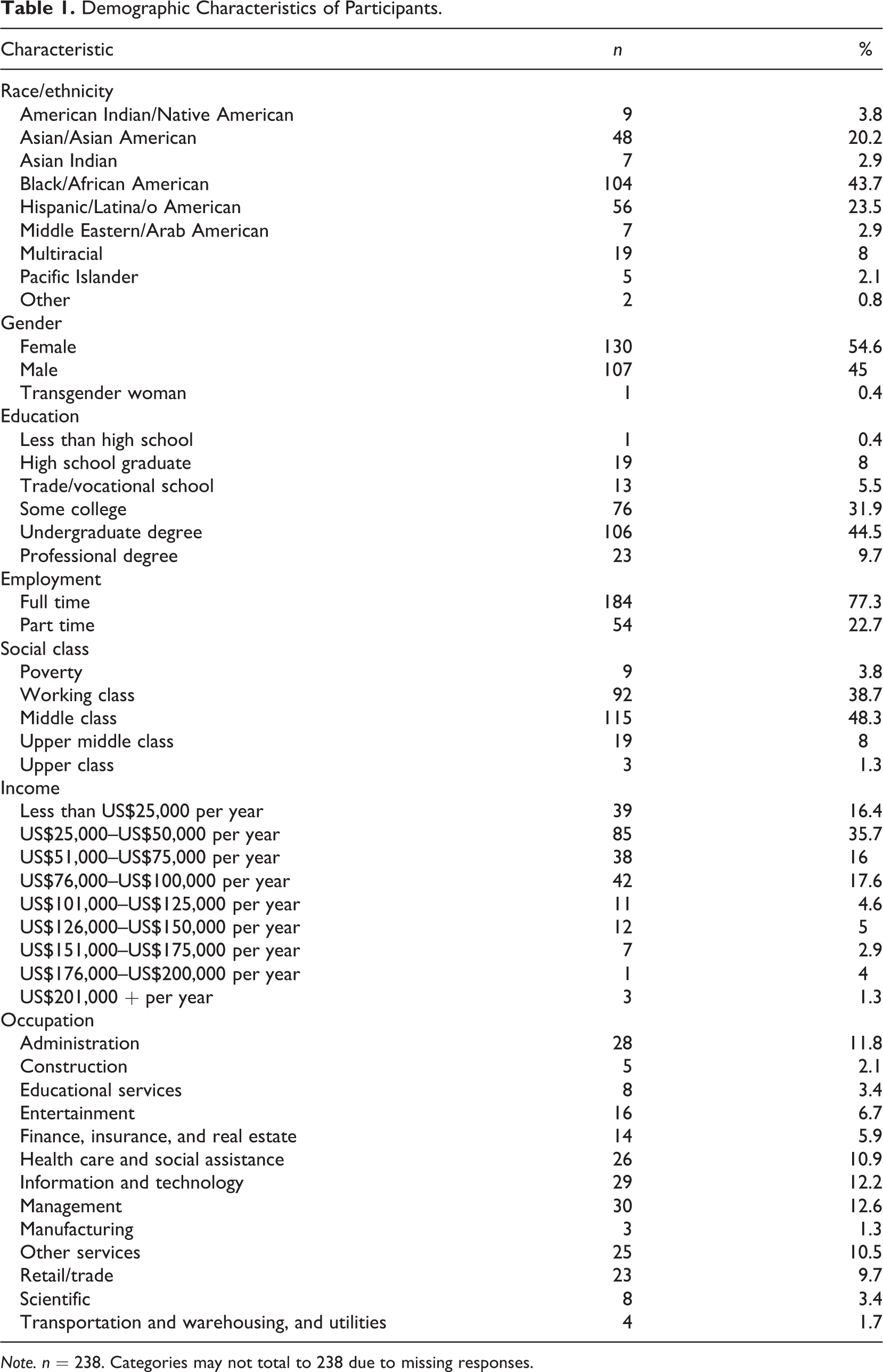
Note. n = 238. Categories may not total to 238 due to missing responses.
Instruments
Marginalization
We measured the degree to which participants felt marginalized using the Lifetime Experiences of Marginalization Scale (LEMS; Duffy, Gensmer, et al., 2019). The scale consisted of 3 items which participants answered on a 7-point Likert-type scale ranging from strongly disagree to strongly agree. We provided participants with the following prompt: We are interested in the degree to which you consider yourself to be marginalized in the United States. By marginalized, we mean being in a less powerful position in society, being socially excluded, and/or having less access to resources because you are a member of a specific group, have a specific identity, or life history. This often occurs due to one’s gender, race/ethnicity, sexual orientation, disability status, religious beliefs, physical appearance, or being a part of other minority groups/identities. With this definition in mind, please respond to the following items below considering the experiences you have had throughout your entire life as a result of being an ethnic or racial minority.
The 3 items were as follows: “Throughout my life, I have had many experiences that have made me feel marginalized,” “During my lifetime, I have had many interpersonal interactions that have often left me feeling marginalized,” and “I have felt marginalized within various community settings for as long as I can remember.” With two samples of REM employed adults, Duffy et al. found high internal consistency reliability (α = .93 and α = .95), strong correlations with other measures of racial discrimination, and added predictive variance in decent work beyond established measures of racial discrimination. In the current study, the estimated internal consistency of scales scores was α = .95.
Economic constraints
We assessed the degree to which participants felt constrained by their economic circumstances with the Economic Constraints Scale (ECS; Duffy, Gensmer, et al., 2019). The scale contained 5 items, which were answered on a 7-point Likert-type scale ranging from strongly disagree to strongly agree. Some items were “Throughout most of my life, I have struggled financially” and “For as long as I can remember I have had difficulties making ends meet.” With two samples of REM employed adults, Duffy et al. demonstrated that the scale scores had high internal consistency reliability (α = .94 and α = .95), correlated strongly with measures of social status, and added predictive variance in decent work beyond other established measures of social status. In the current study, the estimated internal consistency of scales scores was α = .95.
Work volition
We used the 4-item Volition subscale of the Work Volition Scale (WVS; Duffy et al., 2012) to measure perceptions of occupational choices despite constraints. Participants responded to items such as “I can do the kind of work I want, despite external barriers” and “I feel total control over my job choices” using a 7-point Likert-type scale ranging from strongly disagree to strongly agree. Duffy et al. found the Volition subscale to have adequate internal consistency reliability (α = .78) and demonstrated validity via positive correlations with job satisfaction and work locus of control and a negative correlation with discrimination. Duffy, Gensmer, et al. (2019) found that WVS Volition subscale scores significantly correlated in the expected directions with scores on the above measures of marginalization and economic constraints along with scores on the career adaptability measure detailed below. In this study, the estimated internal consistency reliability of scale scores was α = .92.
Career adaptability
We measured the degree to which participants felt adaptable in their career with the 9 positively worded items of the Career Adaptability subscale from the Career Futures Inventory (Rottinghaus, Day, & Borgen, 2005). Participants used a 5-point Likert-type scale ranging from strongly disagree to strongly agree to respond to items such as “I am good at adapting to new work settings” and “I can adapt to change in the world of work.” Rottinghaus et al. (2005) provided evidence for validity by demonstrating positive correlations with measures of curiosity, motivation, and ability to learn and negative correlations with a measure of neuroticism. Duffy, Gensmer, et al. (2019) found scores on the Career Adaptability subscale and scores on the marginalization measure described above were significantly associated in the expected direction. In the development study, the Career Adaptability subscale scores had a strong internal consistency reliability of α = .85, and in the present study, the estimated internal consistency reliability of scale scores was α = .93.
Proactive personality
We used an abbreviated version of the Proactive Personality Scale (PPS; Bateman & Crant, 1993) to measure proactive personality. This abbreviated scale used 6 of the original 17 items while maintaining strong internal consistency reliability (α = .85; Parker, 1998) and a strong correlation with the full scale (r = .92; Claes, Beheydt, & Lemmens, 2005). Participants used a 5-point Likert-type scale ranging from strongly disagree to strongly agree to respond to items such as “If I see something I don’t like, I fix it” and “I am always looking for better ways to do things.” This shortened version of the PPS has been found to correlate positively with constructs such as self-esteem and role self-efficacy, which provides support for the validity of this scale (Parker, 1998). Also, in a study using the PWT among a sample in China, Wang et al. (2019) found scores on the Chinese version of the PPS to be significantly associated in the expected directions with scores on measures of subjective social status, work volition, and decent work. In the present study, the estimated internal consistency reliability of scale scores was α = .89.
Decent work
We used the 15-item Decent Work Scale (DWS; Duffy et al., 2017) to measure the five domains of decent work. Participants answered items on a 7-point Likert-type scale ranging from strongly disagree to strongly agree. We measured each subscale using 3 items such as “I am rewarded adequately for my work,” “I have a good health-care plan at work,” “At work, I feel safe from emotional or verbal abuse of any kind,” “I have free time during the workweek,” and “The values of my organization match my family values.” Duffy et al. demonstrated validity through positive correlations with constructs such as job satisfaction and work meaning and negative correlations with withdrawal intentions and found evidence of strong internal consistency reliability. Among a sample of ethnically and racially diverse adults, Duffy, Velez, et al. (2018) found scores on the DWS were associated in the expected directions with scores on measures of marginalization, economic constraints, work volition, and career adaptability. Also among an ethnically and racially diverse sample, Duffy, Gensmer, et al. (2019) found scores on the DWS were significantly associated in the expected directions with scores on the LEMS (Duffy, Gensmer, et al., 2019), ECS (Duffy, Gensmer, et al., 2019), WVS (Duffy et al., 2012), and the Career Adaptability subscale of the Career Futures Inventory (Rottinghaus et al., 2005). In the present study, the estimated internal consistency reliability of the total scale scores was α = .90. Also, the estimated internal consistency reliability for the subscale scores were as follows: compensation, α = .89; health care, α = .98; safety, α = .86; free time, α = .87; and values, α = .96.
Procedure
After receiving institutional review board approval for this study, we used Mechanical Turk (MTurk)—an online data collection platform hosted by Amazon—to recruit participants. Participants were compensated US$0.50. Participants had to (a) live in the United States, (b) self-identify as a racial or ethnic minority, (c) speak English, and (d) be currently employed. Studies have supported the use of MTurk in psychological research demonstrating validity and reliability comparable to commonly used data collection methods (cf., Chandler & Shapiro, 2016). A recent multi-wave study found MTurk was well-suited for organizational research among understudied samples (Michel, O’Neill, Hartman, & Lorys, 2018). Still, we inserted two attention checks throughout the survey (e.g., please select Agree if you are paying attention). Participants that incorrectly responded to either check were removed from the data set. Second, we asked participants if we should exclude their responses for any reason, noting they would still be compensated. Our initial data set contained 442 participants, but 106 participants failed at least one check, and 21 participants indicated that we should remove their responses. Additionally, 70 participants identified as White only, and 7 participants reported being unemployed. As a result, our final sample consisted of 238 participants.
Results
Preliminary Analyses
Upon examining our data, no cases emerged as multivariate outliers, but there were three univariate outliers with z-scores of greater than |3.29| on our study constructs. Because about 1% of values in a given sample may consist of such extreme scores, we retained these cases for analyses (Osborne & Overbay, 2004; Tabachnick & Fidell, 2013). Next, we assessed our variables for skewness and kurtosis and found no variables to approach skewness > |3| or kurtosis values > |10| (Weston & Gore, 2006). Regarding missing data, we conducted Little’s missing completely at random (MCAR) test because 14 participants were missing data on one question, and 1 participant was missing data on two questions. Little’s MCAR was nonsignificant, χ2(777) = 783.23, p = .431, suggesting the data in our sample were MCAR. As such, in the models presented below, we used full information maximum likelihood, which uses all available data to generate data estimates with added error to produce unbiased estimates.
Model Testing
We used the Lavaan structural equation modeling (SEM) package in R to test our models (R Development Core Team, 2008; Rosseel, 2012). Following SEM best practices (Kline, 2016), we evaluated our models using the following fit indices: χ2, the comparative fit index (CFI), the root mean square error of approximation (RMSEA), and the standardized root mean residual (SRMR). A significant χ2 can indicate a poor fitting model, but this test is typically significant in larger samples (Kline, 2016). Hu and Bentler (1999) suggested cutoffs close to CFI ≥ .95, RMSEA ≤ .06, and SRMR ≤ .08 but noted that these cutoffs are not exact, and others have highlighted the need to consider model complexity and have suggested less conservative cutoffs of CFI ≥ .90, RMSEA ≤ .10, and SRMR ≤ .10 may indicate adequate fit (Weston & Gore, 2006).
Given the short length of the marginalization, economic constraints, and work volition measures, we used the individual items as indicators of their latent constructs to avoid creating unbalanced parcels. For career adaptability and proactive personality, we constructed three parcels each by conducting an exploratory factor analysis on the measures to assign items to parcels in countervailing order according to the size of the factor loading (Weston & Gore, 2006). We used three parcels as indicators for these constructs given research that has demonstrated three indicators to be the optimal number of parcels when creating latent variables (Little, Cunningham, Shahar, & Widaman, 2002), and we used parcels as opposed to item-level data for these variables given research suggesting that using parcels for SEM results in better model fit and less biased estimates (Bandalos, 2002). Lastly, in line with past studies (e.g., Duffy, Gensmer, et al., 2019; Duffy, Kim, et al., 2019) using the DWS (Duffy et al., 2017), we modeled decent work using the five subscales as indicators of a decent work latent variable.
Measurement Model
We first constructed a measurement model to examine correlations among latent variables and to examine the goodness of fit of the observed indicators on their associated latent constructs. This measurement model was a good fit to the data: χ2(215) = 422.15, p < .001; CFI = .95, RMSEA = .06, 90% confidence interval (CI) [.06, .07], p = .007, and SRMR = .05. As such, we proceeded with testing our structural model. Latent factor correlations along with descriptive statistics can be found in Table 2.
Descriptive Statistics and Latent Factor Correlations of Decent Work and Predictor Variables.

Note. N = 238. Estimated internal consistency reliabilities are provided along the diagonal (ω for decent work and Cronbach’s α for all other variables). SD = standard deviation.
*p < .05. **p < .01. ***p < .001.
Structural Model
Our structural model included proactive personality as a moderator of the PWT pathways. Following guidelines by Tabachnick and Fidell (2013), we tested this hypothesized moderation in two steps. In the first step, we constructed a model that allowed PWT pathways to be freely estimated across two groups created via a median split: a group low in proactive personality and a group high in proactive personality. We compared the results of this model to a second model in which the paths from marginalization and economic constraints to work volition, career adaptability, and decent work were constrained to be the same across the two groups. A significant decline in model χ2 suggests a pattern of moderation. Our freely estimated model had marginal model fit, χ2(320) = 528.13, p < .001, CFI = .94, RMSEA = .07, 90% CI [.06, .09], p = .001, and SRMR = .06. Our constrained model also had marginal model fit, χ2(329) = 539.81, p < .001; CFI = .94, RMSEA = .07, 90% CI [.06, .09], p < .001, and SRMR = .07 and resulted in a nonsignificant change in fit, Δχ2(6) = 11.68, p = .873, suggesting that proactive personality did not function as a moderator. Thus, the standardized path estimates in Table 3 represent the results from our final structural model which collapsed both proactive personality groups together. In total, the link from marginalization to career adaptability and the links from economic constraints to both career adaptability and decent work were nonsignificant. The remaining seven paths were significant and in the directions theorized within the PWT. This final model was a good fit to the data: χ2(160) = 331.88, p < .001, CFI = .96, RMSEA = .07, 90% CI [.06, .08], p = .004, and SRMR = .05, and explained 55.4% of the variance in decent work.
Standardized Estimates of Structural Model.
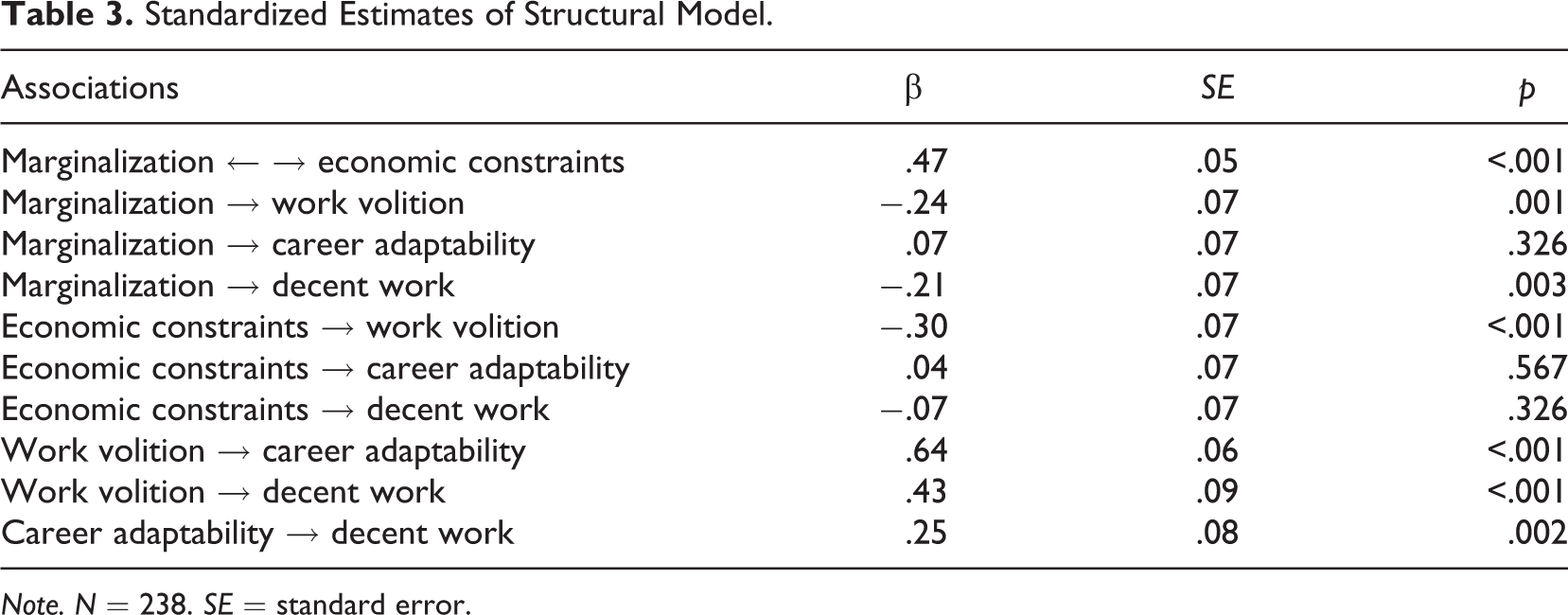
Note. N = 238. SE = standard error.
Indirect Associations
To obtain more accurate probability estimates, Shrout and Bolger (2002) recommended using bootstrap methods when testing indirect associations. As such, we examined indirect association estimates within our structural model using 1,000 bootstrapped samples and bias-corrected CIs. Both marginalization (β = −.10, standard error [SE] = .04, p = .004, 95% CI [−.18, −.03]) and economic constraints (β = −.13, SE = .04, p = .001, 95% CI [−.21, −.05]) had significant negative indirect associations with decent work via work volition. However, the indirect associations of marginalization (β = .02, SE = .02, p = .351, 95% CI [−.02, .05]) and economic constraints (β = .05, SE = .02, p = .576, 95% CI [−.02, .04]) with decent work via career adaptability were not significant.
Discussion
The present study expanded on initial PWT work by examining the potential moderating role of proactive personality in the relations of contextual factors with workplace variables and decent work among a REM sample of working adults in the United States. Our study advances PWT literature by providing the second known test of moderating mechanisms and by helping to inform potential theoretical refinements. Our results also highlight the detrimental associations that racial and ethnic marginalization has with critical PWT constructs. In the following sections, we examine our findings in relation to the PWT literature, review implications for practice, and explore avenues for future PWT scholarship.
At a descriptive level, participants in our sample reported experiencing a great degree of marginalization based on their racial and ethnic identity (M = 18.83 of a maximum of 21) which, based on the content of our measure, highlights lifetime experiences of marginalization at both interpersonal and community levels. Consistent with PWT research (Douglass et al., 2017; Duffy, Velez, et al., 2018) and intersectionality theory (Cole, 2009), marginalization had a moderate positive correlation with economic constraints. At the correlational level, our contextual variables had significant negative associations with work volition, career adaptability, and decent work. Work volition, as expected, was positively related with decent work. These associations remained consistent in our structural model except for the nonsignificant associations of our contextual factors with career adaptability. These findings provide further evidence for several propositions within the PWT, specifically that experiences of marginalization and economic constraints are associated with lower levels of work volition and, in turn, the likelihood of securing decent work. As underscored by Duffy, Velez, and colleagues (2018), these findings suggest that individuals from REM groups have limited access to decent work due, at least in part, to obstacles and injustices in the labor market and workplaces. Overall, these findings provide continued evidence for the presence of intersecting forms of oppression and their detrimental effects on the working lives of REM employees.
Contrary to our hypotheses, economic constraints were not directly associated with decent work in our structural model. Instead, economic constraints only had a negative indirect association with decent work via work volition. Although this is consistent with some previous findings (Duffy, Velez, et al., 2018; Tokar & Kaut, 2018), it is inconsistent with the substantial body of literature (cf., Diemer & Rasheed Ali, 2009) showing that economic constraints play an important role regarding educational outcomes and career development. One possible reason could be that almost 50% of our sample self-identified as being middle class. Another possible explanation for this finding may be due to educational attainment; more than 86.1% of our participants spent some time in college or received undergraduate or professional degrees, which may have led to an increased probability of securing decent work. This is consistent with suggestions that in-demand skills in the workforce explicitly request high levels of educational attainment suggesting that as the level of education increases the probability of attaining decent work also increases (Blustein, Kenny, Di Fabio, & Guichard, 2019).
Although career adaptability was significantly associated with work volition and decent work, it was not significantly associated with either of the contextual variables in our structural model. These nonsignificant findings regarding career adaptability are somewhat consistent with previous studies. Douglass et al. (2017) reported that career adaptability was unrelated to three of four PWT constructs, and Tokar and Kaut (2018) found that career adaptability was not significantly linked to marginalization and work volition. Lastly, Duffy, Velez, et al. (2018) reported that career adaptability was not a significant predictor of decent work and was not significantly related to marginalization and economic resources. These inconsistent associations may be a product of measurement bias in instruments used to assess career adaptability. For example, in the measure used in the current study, several items refer to one’s “career.” The PWT offers an explicit critique of the use of this terminology given that a career is typically associated with work of those who are educated and middle class or above. Thus, it may be that career adaptability is not relevant to populations with limited occupational choice; as such, it may be appropriate for future researchers to explore measurement of adaptability in populations who do not identify as having a career, but rather, a job. Given the number of inconsistent findings related to career adaptability, future refinements of the PWT may benefit from examining the utility of career adaptability within the theoretical propositions.
Where our study attempted to advance the PWT literature was in our examination of the potential moderating role of proactive personality. Prior to discussing our findings related to proactive personality, it’s important to note that our categorization of participants into groups of low and high proactive personality was not intended to create perceptions of low proactive personality being representative of a character failure. In fact, proactive personality is considered to be malleable and potentially enhanced through interventions (Kirby et al., 2002). Ultimately, proactive personality did not function as a moderator within our model. But, mirroring meta-analytic work related to proactive personality (Fuller & Marler, 2009), correlations in our full sample demonstrated that proactive personality was moderately and positively correlated with vocational constructs (i.e., work volition, career adaptability, and decent work). Notably, proactive personality and career adaptability shared a large degree of overlap (r = .75), which may provide some insight into the lack of a significant moderation. Specifically, both measures of these constructs refer largely to actions that an individual may take but our study failed to assess actual behavior. This could also be a reason that, despite the notion that personality may help to overcome background disadvantage (i.e., socioeconomic status; Ayoub et al., 2018), proactive personality was not significantly correlated with either of our contextual variables. Given that there are differences between proactive goals, proactive behaviors, and proactive personality (Chan, 2006), it may be that, in the absence of proactive goals or behaviors, proactive personality itself is not enough to buffer the negative outcomes that may arise from marginalization and economic constraints. This possibility is in line with Chan’s position that the definition of proactive personality is not inherently positive and that the benefits of proactive personality depend on the ability of individuals to accurately and effectively evaluate situational constraints and demands.
Our lack of a significant moderation is the second PWT study that has failed to substantiate the theorized role of proactive personality as a moderator. Wang et al. (2019) found proactive personality to moderate the link between subjective social status and work volition but in the opposite direction of that theorized in the PWT. Our results may have differed from those of Wang et al. (2019) given the difference in cultural context (Chinese vs. North American). Continued studies are needed across different cultural contexts and social identities to determine how core PWT propositions may be altered by moderating mechanisms. The discrepancy in findings may also be partially due to measurement differences. Specifically, Wang et al. assessed social status with a single item and used the entire WVS (Duffy et al., 2012), whereas we utilized two multi-item measures to assess contextual factors along with just the Volition Scale of the WVS. Lastly, our study may have lacked the power necessary to detect a significant moderating effect.
Practical Implications
Our first practical contribution arises from our findings on the mediating role of work volition. Exploring how contextual factors shape a client’s sense of work volition is in line with theories of intersectionality (Cole, 2009), and counseling psychology’s commitment to social justice and advocacy (Vera & Speight, 2003). Psychologists and counselors may work with their REM clients to confront oppression, marginalization, and injustice by raising awareness of how sociopolitical influences may affect their vocational decisions. Shifting beyond an individual-level focus, psychologists and counselors may take an active role to advocate for social justice and awareness-raising campaigns in an effort to reduce systemic marginalization, thus shifting the burden from individuals to systems. Essentially, this lends to the development of critical consciousness; such work may help to improve the conceptualization of this construct and may lead to better measurement by incorporating the voices of clients. Indeed, Diemer, Rapa, Park, and Perry (2017) suggested that critical consciousness be assessed in a mixed-methods fashion.
A major aim of this study was to assess the role of proactive personality within the PWT among a group of REM working adults. Although we failed to find support for proactive personality as a moderator, proactive personality was positively correlated with work volition, career adaptability, and decent work. Thus, it may be beneficial to work with clients to cultivate a proactive personality. As emphasized by Blustein, Kenny, Di Fabio, and Guichard (2019), proactive personality is considered as an individual factor that can be developed as a part of career counseling interventions to improve individual control in directing an ambiguous work environment. Though it is known that a growing body of literature has related proactivity at work with positive outcomes, to our knowledge, no research has considered whether REM employees’ proactive behavior in workplaces can be improved by psychoeducational interventions. The intentional effort to bolster proactivity in adults has been successful in a 4-month-long training program (Kirby et al., 2002), but counselors may develop and test psychoeducational interventions that take into consideration the various systemic oppressive barriers that diverse job seekers and employees encounter. Perhaps the development of interventions that target proactive personality, in conjunction with proactive goals and behaviors, can help to offset the consequences of marginalization and economic constraints.
Limitations and Future Directions
Below, we discuss limitations of the present study along with directions for PWT scholarship. First, as a result of the cross-sectional research design, we could not make any causal inferences. In order to gain more insight into theorized PWT pathways, future studies should consider employing longitudinal and experimental designs. Although there has been some longitudinal work in this area (e.g., Autin et al., 2017), the constructs within the PWT are not likely to change in short time periods (i.e., 3 or 6 months). Thus, PWT scholarship would benefit from tracking job seekers and employees over years to examine potential work trajectories. It would also be interesting to see how interventions designed to promote critical PWT constructs (e.g., work volition, career adaptability) may enhance a person’s ability to secure decent work.
Although this study extended on the work of Wang et al. (2019), we only included proactive personality. Thus, we suggest that future studies investigate other moderators of the PWT such as critical consciousness, social support, and economic conditions. Critical consciousness, for example, is posited to facilitate oppressed peoples’ potential to overcome structural constraints and gain desired outcomes (Freire, 1993). Thus, critical consciousness may help marginalized people understand and overcome the political, social, and economic factors, which underlie racism, poverty, unemployment, and other practices of social exclusion (Diemer et al., 2017).
Regarding our sample, it is important to note that we investigated the experiences of participants from various racial and ethnic identities. As it was beyond the aim and scope of the present study to test for differences between groups, we did not examine subgroup differences. However, heterogeneity in terms of race and ethnicity of the participants may limit the generalizability of the findings to all racial and ethnic subgroups. Therefore, in future studies, researchers should investigate PWT propositions among larger subsamples of racial and ethnic groups.
Conclusion
The PWT has gained interest as an appropriate theory to study the work of marginalized individuals. The propositions of the PWT have been tested in previous studies, yet the inclusion of theorized moderators has been mostly neglected. Thus, the current study examined proactive personality as a moderator. The results did not support its moderating role, but we believe our results have yielded rich data to inform theoretical advancements related to the PWT. Overall, our results provide implications for researchers who are interested in testing the propositions of PWT and for counselors who are seeking to help marginalized individuals to secure decent work.
Footnotes
Authors’ Note
Data and ideas presented in this article have not been previously disseminated.
Declaration of Conflicting Interests
The author(s) declared no potential conflicts of interest with respect to the research, authorship, and/or publication of this article.
Funding
The author(s) received no financial support for the research, authorship, and/or publication of this article.
