



Abstract
Psychology of Working Theory (PWT) has recently gained empirical support; however, its assumptions have yet to be tested for cultural responsiveness in Latinx communities, one of the fastest-growing worker populations in the U.S. The current study had two major aims: (a) to translate and validate instruments measuring PWT constructs from English into Spanish, and (b) to test theorized PWT predictors of decent work in a sample of Latinx workers (N = 287). First, we translated and validated instruments measuring economic constraints, lifetime marginalization, work volition, and decent work using confirmatory factor analyses (CFA). We then tested a structural model predicting decent work. Results partially supported PWT hypotheses, suggesting its utility and cultural responsiveness in studying the work patterns and conditions in Latinx communities. Practical implications are discussed.
Keywords
Introduction
Psychology of Working Theory (PWT) is an emerging theoretical framework designed to aid in conceptualizing psychological experiences of working for diverse populations (Duffy et al., 2016). This interdisciplinary framework emphasizes the role of contextual variables and degree of volition and constraints in predicting attainment of decent work. As such, it has been applied to populations that are likely to face barriers in the U.S. labor market (e.g., workers of color, trans and non-gender conforming workers; Allan et al., 2019; Duffy et al., 2018). Instruments developed to measure PWT variables have also been translated and validated across several languages and cultural contexts (e.g., Turkish, Italian; Buyukgoze-Kavas & Autin, 2019; Di Fabio & Kenny, 2019). However, the theory has yet to be applied specifically to Latinx workers, one of the largest worker groups in the U.S. (A. Flores, 2017). Likewise, key instruments developed to measure PWT constructs have not been validated in Spanish, which would be key in enhancing the theory’s cultural responsiveness for this group. In the current study, we aim to expand the utility of PWT to Spanish-speaking Latinx workers. Specifically, we aim to (a) validate Spanish-language PWT instruments and (b) test a circumscribed part of the PWT model with Spanish-speaking Latinx workers.
Latinx Workers in the U.S.
Latinxs are the largest and one of the fastest growing ethnic groups in the U.S. (A. Flores, 2017) and comprise 27.6 million of the U.S. labor force (Bureau of Labor Statistics, 2019). Despite rapid demographic growth, Latinx workers face disproportionate barriers in the labor market. For example, in 2018, the median family income for Latinx workers was $51,450 versus $70,642 for White workers (Mora et al., 2018); the income gaps remain even after controlling for education and experience. Likewise, poverty levels for Latinxs (17.6%) are more than double those for non-Hispanic White people (8.1%). Not surprisingly, disparities are also seen in the types of jobs Latinx workers are likely to access. Latinxs are underrepresented in high-paying jobs and are more likely to work in low-wage jobs. For example, despite representing 17.6% of the workforce, only 9%–12% of workers in financial, educational, and information sectors are Latinxs, whereas 30% of construction workers and 41% of domestic workers are Latinxs (Bureau of Labor Statistics, 2019). Not surprisingly, education and achievement gaps also persist; only 16.4% of Latinos and 25.9% of Latinas earned a college degree, compared to 40.9% and 48.9% for non-Hispanic White men and women, respectively (Mora et al., 2018). These disparities exist in the context of chronic cultural and political oppression of Latinx populations. Over the last century these have manifested in the form of hardline federal immigration policies, labor exploitation, and widespread xenophobia and negative stereotypes (Cadenas et al., 2020; L. Y. Flores et al., 2011; Krogstad & Gonzalez-Barrera, 2019). Most recently, the Trump administration has implemented dehumanizing immigration policies and actively endorsed and racist and xenophobic attitudes toward all people of color in the U.S., and Latinx immigrants in particular, giving greater power to these oppressive forces (Burston & Twine, 2019).
The disparities that demonstrate the vulnerability of Latinx workers in the labor force are intimately connected to barriers in other areas of life. For example, compared to other ethnic and racial groups, Latinxs are the least likely to have health insurance, one common benefit of decent work (Berchick et al., 2018). There are also unique barriers relevant to groups in which migration from other countries is common. Although the majority of Latinx Americans are U.S.-born, the likelihood of having at least one immigrant family member is high (Noe-Bustamante & Flores, 2019). Thus, varying levels of acculturation may result in complex manifestations of bicultural identity and acculturative stress (Benet-Martinez & Haritatos, 2005). Further, one in eight U.S.-born Latinx Americans have at least one family member who is undocumented, and there are about 11 million undocumented Americans living in the U.S. Lack of documentation presents serious barriers to accessing decent work (e.g., needing a social security number to obtain legal employment; American Immigration Council, 2020), which leaves undocumented Latinxs vulnerable to work-based exploitation (Paret, 2014). However, barriers in the form of stigma, xenophobia, and racist stereotypes may be just as destructive and impact both documented and undocumented Latinx workers (Autin et al., 2018; Cavazos-Rehg et al., 2007; Flores et al., 2008).
As the population of Latinx workers continues to grow, the world of work is shifting with increased globalization and new technologies. Scholars have argued that these forces will enhance inequalities, disproportionally marginalizing workers who hold these jobs (Blustein et al., 2019). Furthermore, the recent global coronavirus disease 2019 (COVID-19) pandemic has exposed the vulnerability of Latinx workers and highlighted many employers’ view of these workers as disposable. Recent research shows that Latinx workers were the hardest hit group in both pay cuts and job losses due to the pandemic. This is largely due to the high numbers of Latinxs working in settings that were the most impacted by the pandemic like hotels, restaurants, and other service industries (Krogstad et al., 2020). These present and projected disparities underscore the importance of understanding work experiences of Latinx workers.
Psychology of Working Theory
Psychology of Working Theory (PWT; Duffy et al., 2016) was developed to capture the contextual influences that explain and predict the work-related experiences of all people, and particularly marginalized workers. It grew out of the Psychology of Working Framework (Blustein, 2006), which synthesized and elaborated on the critique that vocational literature largely privileged White, middle class, and college-educated workers, while marginalizing workers of color, poor workers, and those who were unlikely to follow a middle class career trajectory. Psychology of Working scholars seek to explicitly address inequities in the labor market and to support workers who are marginalized by systems of oppression. Given the systemic and cultural oppression that Latinx Americans face, PWT is an ideal framework from which to conceptualize this group of workers.
The PWT model focuses on identifying predictors that lead to decent work and its outcomes. Decent work is defined as work that includes (a) physically and interpersonally safe working conditions, (b) hours that allow for rest and free time, (c) organizational values that align with family and social values, (d) adequate compensation, and (e) access to health care (Duffy et al., 2016). PWT scholars hypothesize two primary predictors of decent work: economic constraints and experiences of identity-based (e.g., racial, gender, social class identity) marginalization. Within PWT, economic constraints refer to financial barriers, particularly those that are longstanding and begin in one’s family of origin (Duffy et al., 2019). Marginalization refers to the relegation to a position of lower power in a society based on group membership or identity (e.g., racial, ethnic, gender, sexual orientation) and can be interpersonal (e.g., racial microaggressions), cultural (e.g., gender role expectations), or institutional (e.g. lack of protections for transgender workers; Duffy et al., 2016). PWT postulates that economic constraints and marginalization predict decent work both directly and indirectly via the mediating variables of work volition (i.e., perceived freedom of work choice despite barriers) and career adaptability (i.e., flexibility in response to work tasks and stressors). Decent work, in turn, is hypothesized to predict fulfillment of three basic human needs: survival, social connection, and self-determination. The fulfillment of these three basic human needs are hypothesized to lead to positive impacts in two broad areas of human functioning – work fulfillment (e.g., meaningful work, job satisfaction) and general well-being (e.g., physical and psychological wellness). For the purposes of the current study, we will focus on portion of the model that includes predictors of decent work.
To our knowledge, no studies have quantitatively tested the PWT model among Latinx workers. Empirical work among other populations is limited but emerging. To date, they have demonstrated strong support for some hypotheses and little support for others. Specifically, studies have consistently supported the hypothesized direct prediction of decent work by marginalization and indirect prediction of decent work by marginalization and economic constraints via work volition. Past work has also supported the direct links from work volition and career adaptability to decent work (e.g., Allan et al., 2019; Duffy et al., 2018, 2019; Tokar & Kaut, 2018). However, these studies have offered mixed support for the mediating role of career adaptability. Specifically, no known studies have shown evidence to support the notion that marginalization directly predicts career adaptability, and the relationship between economic constraints and career adaptability has been found to be weak or nonsignificant (Allan et al., 2019; Duffy et al., 2018, 2019; Tokar & Kaut, 2018).
Present Study
The aim of the present study is twofold. First, given the lack of Spanish-language measures for several of the central variables within the PWT (e.g., work volition, decent work), we sought to establish valid and reliable Spanish-language instruments for these constructs. Specifically, we sought to translate and validate existing English-language scales for marginalization, economic constraints, work volition, and decent work.
Latinx workers present with a diverse range of cultural backgrounds, and it is important not to conflate a Latinx identity with being a Spanish-speaker. However, 73% of Latinxs speak Spanish at home (Krogstad & Lopez, 2017), and 72% of U.S. Latinxs are either Spanish dominant or bilingual (Lopez et al., 2020). From both an empirical and social justice lens, it is important to offer instruments in the language that participants are most comfortable speaking.
Second, we sought to test the predictor portion of PWT among Spanish-speaking Latinx workers. We structure our hypotheses after those propositioned by the original PWT scholars (see Figure 1). Thus, we hypothesize that economic constraints and marginalization will directly predict work volition (paths 6 and 7 in Figure 1), career adaptability (paths 9 and 10), and decent work (paths 2 and 3) and indirectly predict decent work via career adaptability and work volition. Additionally, we hypothesize direct relations from work volition (path 5) and career adaptability (path 8) to decent work. Finally, we hypothesize positive correlations between marginalization and economic constraints (path 1) and between work volition and career adaptability (path 4).

Hypothesized PWT model.
Method
Participants
The sample consisted of 287 employed adults ranging in age from 19 to 63 years (mean age = 31.84 years, SD = 8.38). All participants self-identified their ethnicity as “Hispanic” on the online platform we used to recruit participants. Participants self-identified as women (n = 150, 52.3%), men (n = 136, 47.4%), and genderqueer/non-binary (n = 1, 0.3%). Participants’ highest level of education completed was as follows: some high school (n = 2, 0.7%), high school graduate (n = 30, 10.5%), trade/vocational school (n = 21, 7.3%), some college (n = 88, 23.7%), bachelor’s degree (n = 129, 44.9%), and professional degree (n = 36, 12.5%). Participants reported current social class was as follows: lower class (n = 11, 3.8%), working class (n = 80, 27.9%), middle class (n = 163, 56.8%), upper middle class (n = 28, 9.8%), and upper class (n = 4, 1.4%). Regarding native languages, 77 (26.8%) participants reported having one native language and 206 (71.8%) participants reported having more than one native language (e.g., grew up speaking one language in the home and another outside the home). Two hundred sixty-six (92.7%) participants reported Spanish as a primary native language, 185 (64.5%) participants reported English as a primary native language, and 1 (0.3%) participant reported a primary native language besides English and Spanish. Two hundred fourteen (74.6%) of participants were full-time workers and 70 (24.4%) were part-time workers. Participants reported a wide range of occupations representing service, manufacturing, healthcare, education, and construction industries.
Marginalization
Marginalization was measured using a Spanish translation of the Lifetime Experiences of Marginalization Scale (LEMS; Duffy et al., 2019), a three-item scale that was developed to capture perceptions of being marginalized over the course of one’s lifetime. Participants were provided a paragraph with a definition of marginalization and asked to respond to statements about marginalization based on their Latinx Identity (e.g., “A lo largo de mi vida, he tenido muchas experiencias que me han hecho sentir marginado (Throughout my life, I have had many experiences that have made me feel marginalized).” Items were measured on a 7-point Likert scale ranging from 1 (Strongly Disagree) to 7 (Strongly Agree). In a rigorous three-part study, the scale was found to have good internal consistency reliability (α = .95), and authors found that the scale strongly correlated with and accounted for variance above and beyond other measures of marginalization. For the current study, the internal consistency reliability estimate was α = .93.
Economic constraints
Economic constraints were measured by using a Spanish translation of the Economic Constraints Scales (ECS; Duffy et al., 2019), a five-item scale that seeks to understand an participants’ perception of limited economic resources across their entire life. An example item is “Me he considerado pobre o casi pobre durante la mayor parte de mi vida (I have considered myself poor or very close to poor for most of my life).” Items were measured on a seven-point Likert scale ranging from 1 (Strongly Disagree) to 7 (Strongly Agree). In a rigorous three-part study, the scale was found to have good internal consistency reliability (α = .95), and authors found that the scale strongly correlated with and accounted for variance above and beyond measures of social status. For the current study, the internal consistency reliability estimate was α = .90.
Work volition
Work volition was measured using a Spanish translation the Work Volition Scale (WVS; Duffy et al., 2012), a 13-item measure consisting of three subscales: An example item is “Puedo hacer el tipo de trabajo que quiero, a pesar de las barreras externas (I can do the kind of work I want, despite external barriers).” Items were measured on a 7-point scale ranging from 1 (Strongly Disagree) to 7 (Strongly Agree). In the initial validation study, Duffy et al. (2012) reported internal consistency reliability estimates ranging from α = .70 to .81 for subscales and α = .86 for the total scale (Duffy et al., 2012). The WVS has been used in numerous studies (e.g., Douglass et al., 2017; Duffy et al., 2019; Tokar & Kaut, 2018), and has found to correlate in expected directions with related constructs such as job satisfaction and work locus of control. In the present study, estimates for the subscales ranged from α = .73 to .92, and the estimate for the total scale was α = .89.
Decent work
Decent work was measured using a Spanish translation of the Decent Work Scale (DWS; Duffy et al., 2017), which is a 15-item measure consisting of five 3-item subscales: (1) physically and interpersonally safe working conditions; (2) access to health care; (3) adequate compensation; (4) hours that allow for free time and rest; and (5) organizational values that complement family and social values. An example item is “No creo que me pagan lo suficiente por mis calificaciones y experiencia (I do not feel I am paid enough based on my qualifications and experiences).” Items were measured on a 7-point scale ranging from 1 (Strongly Disagree) to 7 (Strongly Agree). Past research studies testing the PWT model have demonstrated strong internal consistency reliability of the total scale and the subscales and associations with theoretically hypothesized constructs (e.g., Allan et al., 2019; Douglass et al., 2017; Duffy et al., 2017, 2018). In the present study, estimates for the subscales ranged from α = .74 to .93, and the estimate for the total scale was α = .86.
Career adaptability
Career adaptability was measured using a previously published Spanish version (Merino-Tejedor et al., 2016) of the Career Adapt-Abilities Scale (CAAS; Savickas & Porfeli, 2012). The CAAS contains 24 total items, with four 6-item subscales for each of the career adaptability components: concern, control, curiosity, and confidence. An example item is “Pensando en cómo será mi future (Thinking about what my future will be like).” Items were measured on a Likert scale ranging from 1 (Not Strong) 5 = (Strongest). In the Spanish-language validation study, Merino-Tejedor et al. (2016) found support for the four-factor structure. They also found that the total scale (α = .94) and subscales (α = .79–.84) had good internal consistency reliability and correlated in expected directions with vocational identity, engagement, and burnout. In the present study, estimates for the subscales ranged from α = .78 to .88, and the estimate for the total scale was α = .94.
Procedure
After obtaining institutional review board approval, we used Amazon Mechanical Turk (MTurk) to distribute our questionnaire to Spanish-speaking workers. We launched our MTurk Human Intelligence Task (HIT) containing an online questionnaire via a companion platform, CloudResearch, which allows researchers to advertise HITs to panels of workers with specific characteristics. CloudResearch allows participants to identify their ethnicity as either “Hispanic” or “non-Hispanic.” We chose settings that made our MTurk HIT only visible to workers on the platform who chose “Hispanic” as their ethnicity. The questionnaire was administered in Spanish. We embedded validity checks throughout the survey.
Prior to testing hypotheses in a full structural model, we had to (a) translate English-language scales to Spanish and (b) confirm validity of factor structure for Spanish-language scales. Four of the five authors were fluent in both English and Spanish and served as translators and auditors. These authors spoke with differing dialects of Spanish from geographic regions within North America, South America, and the Caribbean, and they were located in different regions of the U.S., accustomed to Spanish dialects from local Latinx communities. We relied on a consensus procedure to ensure that one dialect was not overrepresented among items (Hill, 2012). All four translators were counseling psychologists or counseling psychologists-in-training. All were familiar with PWT constructs, but had varying degrees of expertise in vocational psychology. During translation checks, priority was given to retaining the meaning of the original items while attending to readability and cultural appropriateness of items.
Following procedures recommended by Ægisdóttir et al. (2008), all items were initially translated by one author and back translated by another. The back-translated version was then compared to the original English scales and assessed for significant distortions in meaning. The translator and back-translator discussed items in which meaning had changed and agreed on appropriate Spanish translations. This resulted in a draft that was given to the remaining Spanish-speaking authors to be reviewed for cross-dialect readability, clarity, and fidelity to the original constructs. This revision process continued until all four Spanish-speaking authors came to consensus on the appropriateness and quality of the Spanish translations.
Analyses
Next, we conducted analyses to establish reliability and validity of the translated scales. Specifically, we examined construct validity via confirmatory factor analysis (CFA); examined convergence among theoretically correlated constructs; and examined internal consistency reliability. Following other validation studies for the DWS (e.g., Duffy et al., 2017), we tested multiple models (i.e., a correlational model, higher order model, and bifactor model) to assess for the most appropriate factor structure and found a bifactor model to be best-fitting. The LEMS contains only three items on a single latent construct, resulting in a saturated model; thus, we did not conduct a CFA for this scale.
We ran CFAs and tested the full structural predictive model using RStudio. We used full information maximum likelihood (FIML) estimation to account for missing data. We examined the following fit indices: the chi-square test (χ2), the comparative fit index (CFI), the root mean square error of approximation (RMSEA), and the standardized root mean residual (SRMR). A significant χ2 can indicate a poor fitting model, but this test is often unreliable with larger samples. Criteria for the CFI, RMSEA, and SRMR have ranged from less conservative (CFI ≥ .90; TLI ≥ .90; RMSEA ≤ .10; SRMR ≤ .10) to more conservative (CFI ≥ .95; RMSEA ≤ .08; SRMR ≤ .06; Hu & Bentler, 1999). For the DWS, we also used Aikake Information Criterion (AIC) since we tested three different non-nested models. The AIC allows researchers to compare models while taking parsimony into account (Tabachnick & Fidell, 2007). Although there are no strict cut-offs, smaller AIC generally indicates better fit. Previous researchers have emphasized the importance of a holistic interpretation of fit indexes, rather than relying on strict cut-offs or a single index (Lai & Green, 2016). To test for indirect effects we used the R package, RMediation, to generate confidence intervals (Tofighi & MacKinnon, 2011).
Results
Preliminary Analyses
An examination of skewness and kurtosis values as well as histogram charts suggested normality for all variables (i.e., no values > |3| for skewness or > |10| for kurtosis; Weston & Gore, 2006). Regarding correlations, all newly translated scales correlated in expected directions with one another (see Table 1). The composite career adaptability score correlated in expected directions with all other variable with the exception of marginalization.
Bivariate Correlations, Means and Standard Deviations.
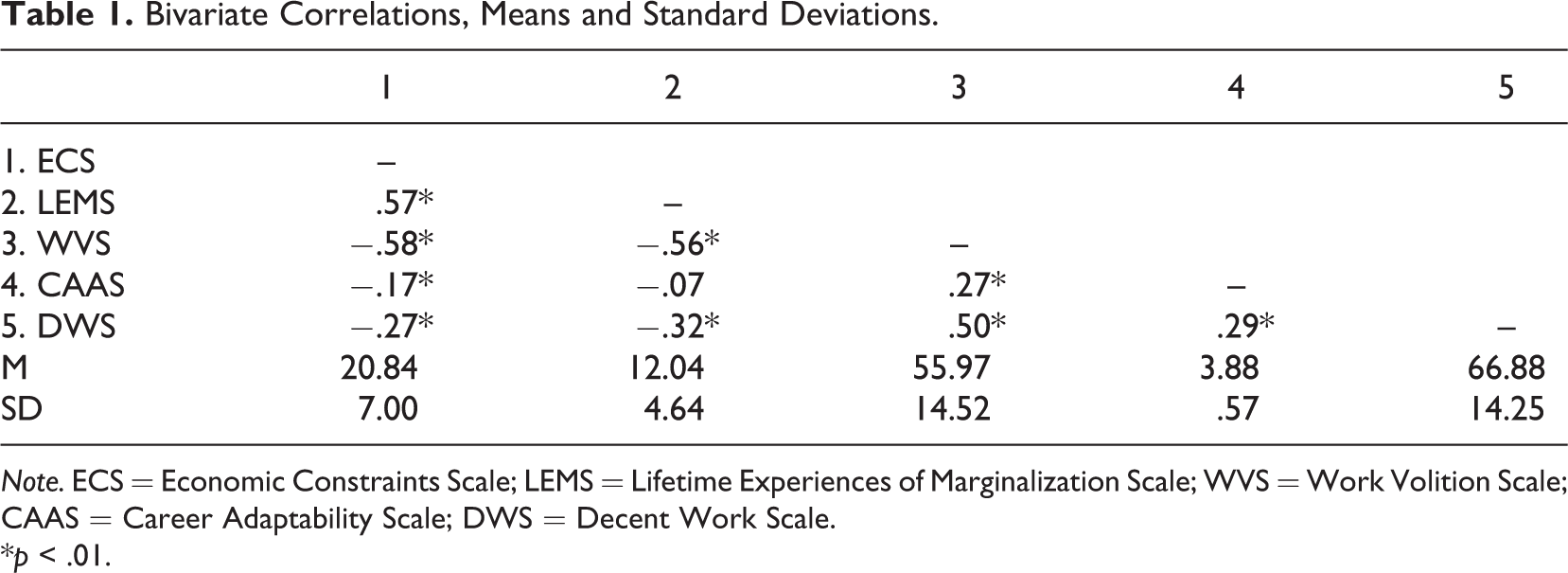
Note. ECS = Economic Constraints Scale; LEMS = Lifetime Experiences of Marginalization Scale; WVS = Work Volition Scale; CAAS = Career Adaptability Scale; DWS = Decent Work Scale.
*p < .01.
Economic constraints scale
We tested a single-factor latent model with five observed indicators for the ECS. Confirmatory factor analysis resulted in demonstrated good fit to the data, χ2 (5) = 20.89, p < .001, CFI = .99, RMSEA = .07, 90% CI [.02, .13], SRMR = .02. Factor loadings ranged from .76 to .86.
Work volition scale
Following procedures by Duffy et al. (2012), we tested a three-factor model with items loading onto a volition factor, a financial barriers factor, and a structural barriers factor. Results showed the model had good fit to the data, χ2 (62) = 119.91, p < .001, CFI = .97, RMSEA = .06, 90% CI [.04, .07], SRMR = .04. Factor loadings ranged from .46 to .87 for the volition subscale, from .73 to .88 for the Financial Constraints subscale, and from .49 to .78 on the Structural Constraints subscale.
Decent work scale
Following procedures used by Duffy et al. (2017) in the DWS validation study, we tested three different models: a correlational model, a higher-order model, and a bifactor model. All models had good fit to the data with no meaningful changes in fit from one to another. Fit indices for the correlational model were χ2 (80) = 130.73, p < .001, CFI = .98, RMSEA = .05, 90% CI [.03, .06], SRMR = .04, and AIC = 13,700.73. Fit indices for the higher order model were χ2 (85) = 144.40, p < .001, CFI = .98, RMSEA = .05, 90% CI [.03, .06], SRMR = .05, and AIC = 13,704.40. Fit indices for the bifactor model were: χ2 (75) = 126.46, p < .001, CFI = .98, RMSEA = .05, 90% CI [.03, .06], SRMR = .04, and 13,706.46. Across models, factor loadings ranged from .30 to .96. All factor loadings are listed in Table 2.
Factor Loadings From DWS Confirmatory Factor Analysis.
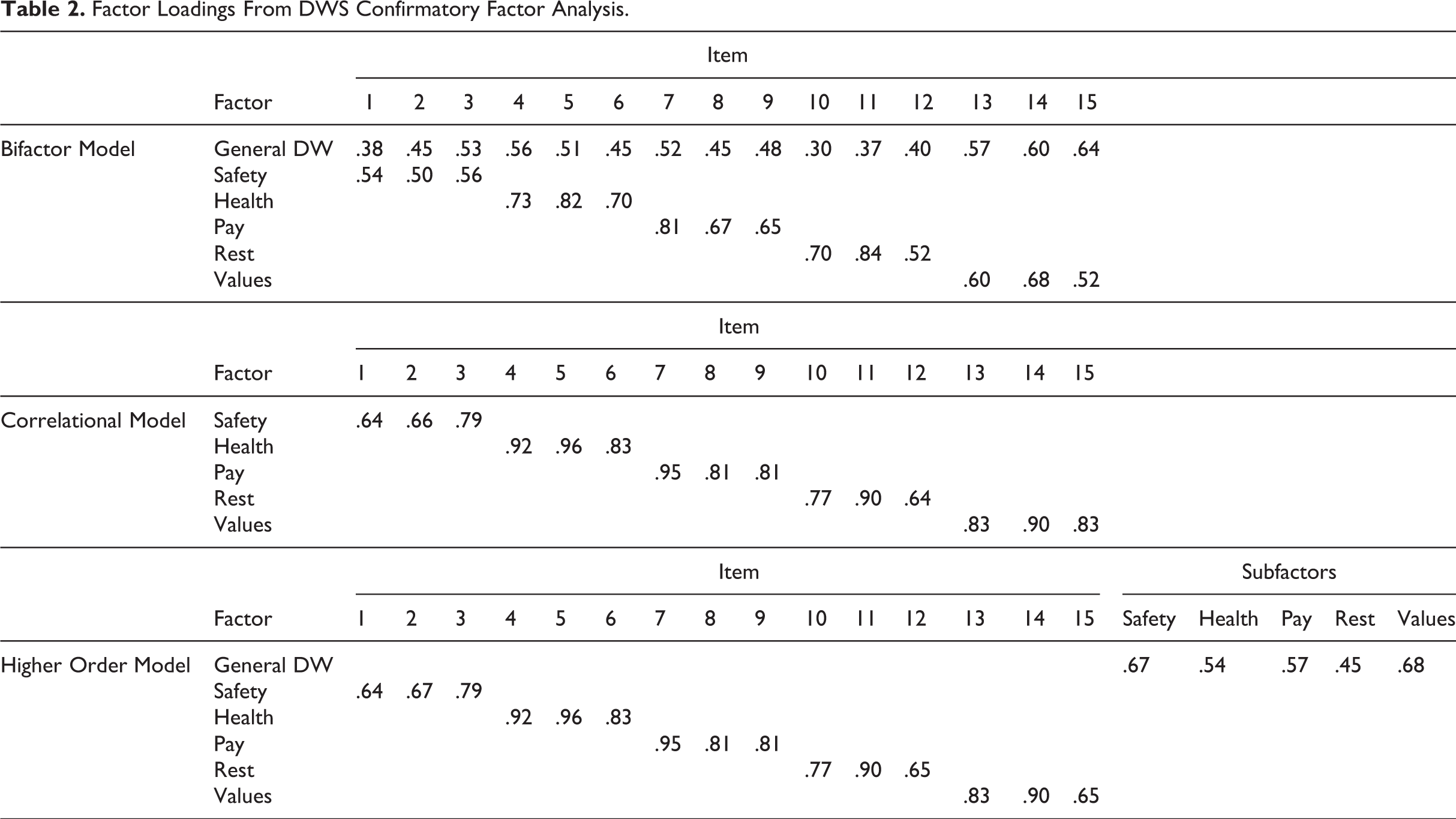
We also calculated the bifactor indices of omega, omega hierarchical (omegaH), and explained common variance (Dueber, 2017), which provide further insight into the utility of a bifactor structure. Omega values indicate the proportion of variance in a total score—including both the general factor and subscale factors—that is attributable to common variance as opposed to error. The omega for the total score was .94, meaning that 94% of the variance in the total score is due to the factors and 6% is attributable to error. OmegaH values indicate the percentage of variance in a raw total score attributable to individual differences on a general factor, and reliable variance can be calculated by dividing omega by omegaH (Rodriguez et al., 2016). Seventy two percent of the reliable variance in the decent work total score (.68/.94 = .72) was attributable to the general factor, and 28% was spread across subscale factors. Finally, explained common variance (ECV) indicates how much of the common variance is attributable to the general factor versus the subfactors (Rodriguez et al., 2016). For the current study, the ECV was .35, suggesting that 35% of the common variance is attributable to the general factor, and 65% is spread among the five decent work subscales.
Structural Model
To test the structural model predicting decent work, we used the translated scales along with an established Spanish-language career adaptability scale (Merino-Tejedor et al., 2016). There were no meaningful differences in fit between DWS models, but the bifactor indices showed both the general factor and subfactors to contribute substantial variance to the total score. As such, we retained the bifactor structure of the DWS for the full model. Following procedures from previous studies (e.g., Duffy et al., 2018), we only included the volition subscale of the WVS.
Prior to testing the structural model, we tested a correlational measurement model. Measurement model indices demonstrated good fit to the data, χ2 (409) = 663.63, p < .001, CFI = .95, RMSEA = .05, 90% CI [.04, .06], SRMR = .07. We then tested a structural model predicting decent work including all hypothesized paths. Results indicated good fit to the data, χ2 (409) = 663.63, p < .001, CFI = .95, RMSEA = .05, 90% CI [.04, .06], SRMR = .07, and the model accounted for 41% of the variance in decent work.
Direct paths from marginalization to work volition and decent work (paths 2 and 6 in Figure 1); from economic constraints to career adaptability (path 10); from marginalization (path 2), career adaptability (path 8), work volition (path 5) to decent work were significant and in expected directions. Additionally, correlations between economic constraints and marginalization (path 1) as well as work volition and career adaptability (path 4) were significant and positive. Remaining hypothesized paths were nonsignificant. See Figure 2 for full model with standardized beta weights.
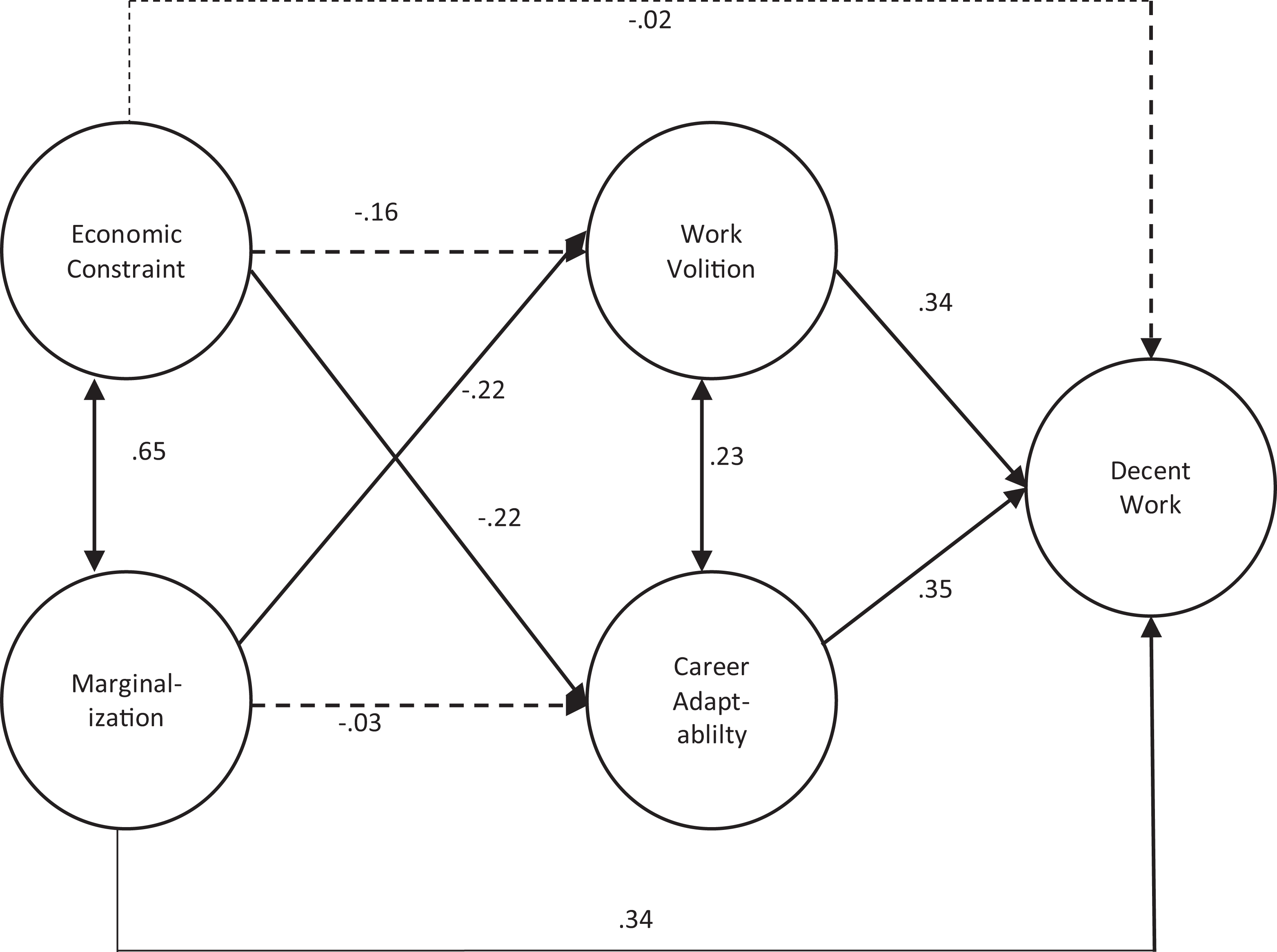
Structural model predicting decent work. Note. Dashed lines represent nonsignificant paths.
We tested for indirect effects of marginalization on decent work via work volition and for economic constraints on decent work via career adaptability. Results showed that work volition significantly mediated the relation from marginalization to decent work (c′ = 0.17, SE = 0.05, 95% CI = −0.06, −0.01) and that career adaptability significantly mediated the relation between economic constraints and decent work (c′ = 0.52, SE = 0.13, 95% CI = −.07, −.01).
Discussion
The aims of the current study were to (a) validate four Spanish-language instruments measuring PWT constructs and (b) test the PWT model in a sample of Latinx workers. Specifically, we translated and validated instruments measuring marginalization, economic constraints, work volition, and decent work among a sample of 287 Spanish-speaking workers. Results demonstrated support for the validity of each instrument as well as for the predictor portion of the PWT model among Latinx workers. These results suggest that previously developed measures of key constructs outlined in PWT may be appropriate to assess these constructs in Spanish-speaking Latinx communities in the U.S. Results also suggest that the majority of the directional assumptions in PWT are applicable to the experiences of Latinx workers.
Results demonstrated support for validity of each scale that we translated in the current study. Specifically, each scale showed acceptable internal consistency reliability, and CFA results demonstrated that each hypothesized factor structure had good fit to the data. Additionally, each scale correlated in hypothesized directions with one another; with the exception of marginalization, each scale correlated in the expected direction with the previously translated career adaptability measure. The nonsignificant correlation between marginalization and career adaptability is not surprising given previous research showing inconsistency in relations between career adaptability and contextual variables (Duffy et al., 2018, 2019; Douglass et al., 2017, 2019).
With the exception of three DWS items, observed indicators loaded moderately to strongly onto their respective factors. The low factor loadings of the three DWS items (i.e., items 1, 10, & 11) mirrored results of the original validation study (Duffy et al., 2017), as well as several studies outside the U.S. (e.g., Buyukgoze-Kavas & Autin, 2019; Di Fabio & Kenny, 2019). This finding suggests that these particular items do not contribute to a high degree of variance in the general decent work factor; however, each of these items loaded moderately onto their subfactor. Thus, although these items explained little variance to the general factor, they added value to the model by explaining substantial variance in subfactors.
All three factor structures that we tested for the DWS, showed good fit to the data, but bifactor indices suggested greater utility in retaining the bifactor model. Specifically, although the general factor did not explain so much variance as to suggest a unidimensional factor (i.e., omegaH > .80; Rodriguez et al., 2016), it explained enough to suggest that subfactors alone may be uninterpretable. Of note, previous findings regarding the appropriateness of a bifactor model for the decent work construct have varied by cultural context. Some previous studies have demonstrated clear superior fit of a bifactor model (e.g., Italy; Di Fabio & Kenny, 2019), while others have shown all three factor structures to fit equally well (Turkey; Buyukgoze-Kavas & Autin, 2019). Indices from the current study showed that there was practical value in using a bifactor model; however, given its complexity, it would behoove researchers to examine its added value in a particular sample population, perhaps opting for a more parsimonious model if the added value is minimal.
To address our second goal of testing the predictor portion of the PWT model, we ran a structural model including all instruments for all variables translated in the current study as well as a previously validated Spanish version of the CAAS. The model had good fit to the data and explained 41% of the variance in decent work, suggesting that PWT may be an appropriate theoretical framework for predicting decent work in Latinx workers.
Regarding specific model paths, results were generally consistent with previous studies testing PWT hypotheses. Given that no known studies have examined PWT in the current Latinx population, we will be situating results in the context of studies that have examined PWT in people who identify with minoritized racial/ethnic groups in the U.S. (Duffy et al., 2018, 2019; Douglass et al., 2019). Consistently supported across all or most studies include: the direct link from economic constraints to work volition (path 7 in Figure 1); the direct link from marginalization to work volition (path 6) and decent work (path 2); the direct link from work volition to decent work (path 5); the indirect link from economic constraints to decent work via work volition. Results that have been consistently unsupported include the direct links from economic constraints to career adaptability (path 10) and decent work (path 3); the direct link from marginalization to career adaptability (path 9), and the indirect link from marginalization to decent work via career adaptability (Douglass et al., 2017; Duffy et al., 2018, 2019). In the current study, nine of the 14 theorized propositions were supported. Our discussion will focus on findings that supported PWT hypotheses within a Latinx cultural context, as well as theoretical implications of findings that failed to support PWT propositions or were inconsistent with previous research.
PWT in Latinx Context
Our results suggested that several PWT propositions were supported in the current sample of Spanish-speaking Latinx workers. First, results showed that work volition mediated the link between marginalization and decent work as expected. This finding is important, given the research showing that Latinxs experience high rates of marginalization and discrimination in the U.S. (Fleming et al., 2017). In a recent example, the COVID-19 pandemic has impacted Latinxs more than any other racial or ethnic group when it comes to job loss, pay cuts, and overall economic marginalization (Krogstad et al., 2020). Given that current findings suggest these factors may in turn influence levels of work volition, it will be important for researchers to identify protective mechanisms that could mitigate these effects. Culturally-specific strengths-based approaches may be helpful in doing so. For example, previous research highlights the centrality of work ethic, work values, and self-determination in the lives Latinxs (Eggerth & Flynn, 2012; L. Y. Flores et al., 2011; Hallet, 2012). Future research may benefit from examining these cultural strengths as buffers from the effects of marginalization on work volition and attainment of decent work.
Another finding that supports PWT hypotheses is that career adaptability mediated the link between economic constraints and decent work. Latinxs hold less than one third the amount of wealth compared to non-Hispanic White people in the U.S., whose households have grown even wealthier since the last recession (Kochhar & Cilluffo, 2017). Given this historical context, as well as the current economic constraints placed on Latinx workers as a result of the pandemic, it is important to understand how to support this group in securing decent work. Findings suggest that a key variable to focus on is career adaptability. Indeed, we can infer that lower levels of career adaptability may expose Latinxs to more vulnerability from economic constraints, leaving them less able to secure decent work. Hence, research is needed to develop individual and systemic interventions to facilitate the empowerment of Latinx workers via career adaptability.
PWT Theoretical Considerations
Five of the PWT hypotheses were unsupported in the current study. Three of these—the direct link from marginalization to career adaptability (path 9 in Figure 1); the direct link from economic constraints to decent work (path 2); and the indirect link from marginalization to decent work via career adaptability—have been consistently found nonsignificant across previous studies (Douglass et al., 2017; Duffy et al., 2018, 2019). Our finding of a nonsignificant link from economic constraints to decent work is not surprising, especially when considering that we found significant indirect effects. Previous studies have found work volition to be a more reliable mediator in the economic constraints-decent work relation; conversely, results from the current study found career adaptability—but not work volition—to be a significant mediator. Thus, while current results are consistent with previous research in suggesting that the direct link from economic constraints to decent work is fully mediated, they suggest that a different mediator—career adaptability—explains this relation.
In addition to this indirect effect, economic constraints showed direct effects that were inconsistent with previous studies. Specifically, economic constraints directly predicted career adaptability and failed to directly predict marginalization. Previous studies with minoritized racial/ethnic groups have consistently showed the opposite—that economic constraints directly predicts work volition but not career adaptability (Douglass et al., 2017; Duffy et al., 2018, 2019). One explanation for this may be the relatively high education and social class levels of the sample. It could be that, because participants may have had access to social and educational capital via these privileged identities, the variance in work volition accounted for by economic constraints was overshadowed by the impact of ethnic marginalization. This makes sense in the context of the hostile socio-political climate in the U.S., with frequent instances of stereotyping of those in the Latinx community (Burston & Twine, 2019). This is important because it suggests that marginalization negatively predicts work volition and decent work even for those with relative socioeconomic privilege. Additionally, given the inherent overlap between economic constraints and social class, it could be that the negative path to career adaptability was related to class variability in the sample. In this way, career adaptability may be a form of capital that one gains via social class privilege. This question might be examined more explicitly in future studies by explicitly accounting for intersection of economic constraints and class-based oppression in the model.
Divergent results may also be due to the fact that previous studies grouped all minoritized racial and ethnic groups together without examining group differences. Thus, relations that are unique to Latinx workers may not have been apparent in previous studies that all minoritized ethnic groups as one. Given the diversity in Latinx workers in the U.S., future studies might explore these associations with larger, more representative samples.
Results also showed that, consistent with previous studies, career adaptability failed to emerge as a direct outcome of marginalization, and thus as a mediator between marginalization and decent work. Given that several previous studies in both minoritized racial/ethnic groups and other marginalized groups have found similar results, scholars have suggested that career adaptability may be better positioned as a direct predictor of decent work rather than a mediator (Duffy et al., 2019). However, our findings described above show support for retaining career adaptability as a mediator of economic constraints. While our results echo findings from previous scholars that career adaptability is not appropriately placed as a mediator of marginalization, they do suggest that it should continue to be examined as a mediator of economic constraints.
Practical Implications
Results from the current study emphasize the impact that oppressive systems can have on a person’s ability to access employment that meets basic standards (e.g. jobs that are safe, secure, pay a decent wage, and provide healthcare). They also highlight the importance of considering social context and life-long experiences of exclusion when supporting Spanish-speaking clients. Specifically, results showed that work volition was positively related to one’s ability to adapt in a changing work environment and attain decent work. Thus, it may be beneficial for practitioners to assess the extent to which clients feel volitional in their work lives and to incorporate interventions that increase sense of agency in career decision-making when faced with barriers. Results also suggested that longstanding economic constraints and experiences of being marginalized are negative forces in the development of volition and adaptability. Thus, we recommend that, in the process of understanding clients’ sense of volition, practitioners assess for financial strain and the extent to which they feel marginalized in their environment. It is especially important for practitioners to have adequate multicultural training and awareness to do so sensitively and in a manner that is culturally appropriate. The four scales validated in the current study may be incorporated into intake assessment or as a springboard for more explicit discussions about finances, experiences of discrimination, and sense of agency in career decision-making.
Our findings also have several applications for those working to support Latinx workers in community-oriented settings. Practitioners may work collaboratively and partner with community organizations and labor unions that serve large numbers of Latinx workers. In doing so, practitioners and community leaders may use our findings to inform the development of educational interventions and empowerment programs that foster Latinx workers’ work volition and career adaptability, two key mediators that seem to play a protective role for securing decent work in the face of marginalization and economic constraints. An example of such interventions includes educational programs like Poder (Spanish for “to be able to”), a free program provided to community members by a partnership between a university, community college, and technology organization (Cadenas et al., 2020). That intervention was shown to bolster several constructs related to career adaptability and work volition (i.e., entrepreneurial agency, technology readiness, critical consciousness) of low-income Latinx, Black, and White workers.
Finally, findings underscore the importance for the role of vocational psychologists and career counselors to engage in advocacy at the systemic level. Our results showed that marginalization based on Latinx identity as well as lifelong economic constraints negatively impacted respondents’ sense of work volition, access to decent work, and satisfaction with work and life. This lends support to the idea that, oppressive forces deeply embedded in our social and economic systems not only impact various aspects of a person’s life, but also result in outcomes that reinforce oppressive dynamics (e.g., economic constraints decreasing one’s likelihood of obtaining decent work which in turn exacerbates financial struggle; Blustein, 2006). It is essential that vocational specialists and their national and regional professional organizations provide expertise to those developing policies that impact Latinx workers and their families (e.g., comprehensive immigration reform). Additionally, we urge vocational psychology and career counseling organizations to apply pressure to legislators to eliminate oppressive policies (Krogstad & Gonzalez-Barrera, 2019) and endorse leaders who actively work to promote anti-racist, anti-xenophobic institutions and systems.
Limitations/Future Directions
The current study has limitations that should be considered in interpretation of results and guiding future research. First, the study relied on cross-sectional data; thus, causal relationships cannot be inferred. Future assessments of PWT variables might employ longitudinal or experimental designs to address this. Second, our inclusion criterion of being a Latinx adult was broad and failed to show within-group variability among Latinx communities in the U.S. Future studies might shed more light on cultural differences within the Latinx community by employing larger and more diverse sample sizes and specifically assessing for identification with more culturally specific groups (e.g., by nationality, region). Third, future studies might approach participant recruitment with greater clarity of language. Although we used the term “Latinx” throughout this manuscript, our recruitment platform used the word “Hispanic,” which could include Spanish-origin participants who do not have Latin-American roots. Because the percentage of Spanish-origin people in the U.S. is small in in comparison to Latin American-origin people (Noe-Bustamente et al., 2019), we do not anticipate that this had a significant impact on results; however, greater care should be taken in future studies to ensure greater precision in use of language during participant recruitment. Fourth, the current study tested PWT hypotheses as originally outlined in Duffy et al. (2016) without adding cultural adaptations to the model. Future PWT research may benefit from a thoughtful analysis of potential theoretical revisions within this cultural context. Fifth, our sample was limited in that it was relatively highly educated and endorsed relatively high subjective social status. Future studies may benefit from efforts to recruit a more inclusive sample, perhaps by expanding from online samples to community-based samples. Specifically, studies examining lower income populations may provide a better understanding of the impact that economic constraints have on ability to attain decent work. Sixth, because the current study recruited only Latinxs residing in the U.S., the generalizability of findings is limited. Future studies might assess the extent to which these instruments are valid outside the U.S. Finally, future studies should more explicitly include culture-specific variables. For example, given the collectivistic nature of many Latinx communities, it may be beneficial to examine the role familismo plays in moderating PWT paths.
Footnotes
Declaration of Conflicting Interests
The author(s) declared no potential conflicts of interest with respect to the research, authorship, and/or publication of this article.
Funding
The author(s) received no financial support for the research, authorship, and/or publication of this article.
