



Abstract
Building from psychology of working theory, this study tested how critical consciousness, composed of perceived inequality, egalitarianism, and critical action, moderate the relations between contextual barriers (i.e., economic constraints and classism) and psychological variables (i.e., work volition and career adaptability) with a sample of 403 employees in the United States. Findings suggested that people who had high egalitarianism had a stronger negative relation between economic constraints and work volition. Results also revealed that people who had low egalitarianism had a negative relation between classism and career adaptability. Regarding critical action, people who had low or moderate levels of critical action had a stronger negative relation between economic constraints and work volition. Moreover, people who had low or moderate levels of critical action had a stronger negative relation between classism and career adaptability. Findings encourage practitioners and employers to consider egalitarianism and critical action as potential targets in vocational interventions.
Keywords
People can obtain decent work by making occupational decisions despite constraints (work volition; Duffy et al., 2012) and flexibly adjusting to the labor market (career adaptability; Rottinghaus et al., 2005). The psychology of working theory (PWT; Duffy, Blustein et al., 2016) argues that economic constraints and marginalization based on social class (e.g., classism) are critical barriers in occupational development and can therefore reduce work volition and career adaptability. Moreover, PWT proposes that critical consciousness, reflection about oppressive systems and action to transform them (Freire, 2000), moderates the relation between contextual barriers on work volition and career adaptability. Supporting these theories, previous research has found a negative temporal relation between economic deprivation and work volition (Allan, Sterling et al., 2019) and a positive temporal relation between subjective social status and career adaptability via work volition (Autin et al., 2017).
However, few studies have examined moderators of the relations from economic constraints and marginalization to work volition and career adaptability. Furthermore, no studies have investigated the relations between classism and work volition and career adaptability or critical consciousness as a moderator of these relations. This is a critical area of research because identifying moderators provides targets for interventions, and critical consciousness is emerging as a potential protective factor (Diemer, 2009; Diemer & Blustein, 2006). Therefore, the goal of the study was to examine how critical consciousness moderates the relations between contextual predictors (i.e., economic constraints and classism) and psychological indicators of vocational development (i.e., work volition and career adaptability).
Theoretical Framework
PWT describes how contextual barriers relate to person-level vocational variables, which predicts access to decent work. Decent work subsequently allows people to meet their basic and psychological needs, which in turn promotes well-being. PWT identifies two detrimental contextual factors: economic constraints and marginalization. Economic constraints are objective or subjective limited economic resources (Duffy, Blustein et al., 2016). Objective operationalizations of economic constraints may include household income or family wealth, whereas subjective operationalizations capture people’s subjective understanding of their socioeconomic status. Marginalization refers to the relegation of people to less powerful or oppressed positions in a society, and classism represents a type of marginalization based on social class (Duffy, Blustein et al., 2016). Economic constraints and marginalization limit occupational attainment and occupational development (Diemer & Ali, 2009). Specifically, PWT proposes that such contextual factors reduce work volition and career adaptability, central to the vocational development process because they facilitate access to decent work.
PWT further suggests that critical consciousness may moderate the relations between contextual variables and individual variables. Critical consciousness is a reflexive process of analyzing oppressive and unjust systems and taking action to transform these systems (Freire, 2000). PWT proposed that critical consciousness buffers the harmful effects of marginalization and economic constraints on work volition and career adaptability. For example, critical consciousness may be an internal resource to use in the vocational decision-making process when mentorship is limited (Bowers et al., 2020). However, despite domains of critical consciousness being theoretically and statistically distinct (Diemer, 2020; Diemer & Rapa, 2016; Diemer et al., 2017), PWT did not develop specific hypotheses about how components of critical consciousness act as moderators. This leaves the nuanced buffering effects of the critical consciousness subcomponents unclear and limits information to create interventions for those who face contextual barriers.
Classism in Vocational Psychology
Classism is prejudice, discrimination, and marginalization based on social class (W. M. Liu et al., 2004). Classism occurs at the intersections of oppressions based on social class, such as the lack of access to economic, social, and cultural capitals (Diemer & Ali, 2009; W. M. Liu et al., 2004). Given the oppressiveness of classism, scholars have integrated it into vocational psychology to understand the link between social class and work experiences (e.g., Duffy, Blustein et al., 2016; Owen et al., 2019). For example, scholars have suggested that economic constraints and classism directly limit occupational development processes and vocational outcomes by reducing access to vocational guidance and leading to discrimination during the hiring process (Diemer & Ali, 2009). Indirectly, classism shapes people’s identities and the understanding of their work because of social exclusion in the workplace, insufficient hope and work expectations, and limited occupational role models (Diemer & Ali, 2009; W. M. Liu et al., 2004; Owen et al., 2019). Moreover, downward classism, a form of discrimination toward people in lower social classes, is harmful because it is systemic and leads to both institutional and interpersonal discrimination (Liu et al., 2012; Smith, 2008). In this sense, downward classism is a central predictor that researchers should integrate into PWT.
Contextual Predictors of Work Volition
Work volition is the perceived capacity to make occupational choices despite constraints (Duffy et al., 2012). Providing support for PWT, scholars have investigated the link between economic constraints and work volition. For example, longitudinal studies have shown negative temporal links between perceived socioeconomic constraints and work volition (Allan, Sterling et al., 2019; Autin et al., 2017; Duffy, Douglass et al., 2016). Because PWT emphasizes intersections of oppressive systems, scholars have also found negative relations between economic constraints and work volition for people with marginalized identities, such as workers with chronic health conditions (Tokar & Kaut, 2018), sexual minorities workers (Allan et al., 2019; Douglass et al, 2017), low-income workers (Kozan et al., 2019), and workers of color (Duffy et al., 2018).
Contrary to well-established links between economic constraints and work volition, relatively few studies have identified the relation between classism and work volition. Broadly, however, previous research suggests that classism may decrease work volition (Diemer & Ali, 2009; W. M. Liu et al., 2004). For example, students who experienced classism reported poorer career decision self-efficacy after controlling for their socioeconomic status (Shin & Lee, 2018). Interpersonal classism and systematic classism were also negatively associated with career decision self-efficacy (Thompson & Subich, 2011), and Native American students who experienced classism were less likely to believe they could overcome work-related barriers and to expect their education would lead to vocational success (Thompson, 2013). However, scholars have not tested the relation between classism and work volition directly.
Contextual Predictors of Career Adaptability
Career adaptability is the capacity to plan work, adjust to work responsibilities, and recover when work-related adversity arises despite adversity (Rottinghaus et al., 2005). Previous research suggests perceived socioeconomic constraints negatively predicted career adaptability over time (Autin et al., 2017). Greater economic constraints are also negatively associated with career adaptability for people with marginalized identities, such as workers with chronic health conditions (Tokar & Kaut, 2018) and low-income workers (Kozan et al., 2019). Despite these studies supporting the propositions of PWT, others have failed to find a relation between these variables. For example, studies with workers of color (Duffy et al., 2018) and LGBTQ workers (Douglass et al., 2017) have found no relation between economic constraints and career adaptability, when controlling for other variables within PWT. These mixed results suggest that there could be moderators of this relation.
Although previous research has not examined the direct link between classism and career adaptability, exploring this relation is important because interpersonal classism may lead to negative job attitudes and restrict the ability for people to maintain their status, which potentially decreases adjustment to work demands (Duffy et al., 2016; W. M. Liu et al., 2004). Previous studies have also shown a negative relation between forms of marginalization and career adaptability. For example, career adaptability is negatively associated with perceived external barriers (Soresi et al., 2012) and gender role stereotyping (Shin et al., 2019). More broadly, privileged students are more likely to experience greater career adaptability, whereas students who experience classism tend to have difficultly socially adjusting (Diemer & Blustein, 2007; Ostrove & Long, 2007). These studies suggest that contextual marginalization relates to poorer career adaptability. However, like economic constraints and work volition, not all studies have found a link between marginalization and career adaptability. Specifically, some cross-sectional studies have not found a relation between marginalization and career adaptability (Douglass et al., 2017; Duffy et al., 2018). As discussed previously, this suggests the presence of potential moderators.
Critical Consciousness in Vocational Psychology
Critical consciousness is a perspective to liberate marginalized populations from oppressive systems and help them achieve desired outcomes despite structural constraints (Freire, 2000). In psychology, scholars have specifically operationalized critical consciousness as consisting of two components: critical awareness (perceived social inequalities and egalitarianism) and critical action. Perceived social inequalities is the recognition of sociopolitical constraints, egalitarianism is the endorsement of the value of a fair society, and critical action is participating in action for change (Diemer et al., 2017). To support the claim about the importance of critical consciousness, vocational research has found that critical consciousness positively relates to vocational and youth development indicators. For example, critical consciousness is positively associated with work-related variables in youth of color in lower social classes, such as work role salience, commitment to their future work, occupational expectations, and obtaining desired occupations (Diemer, 2009; Diemer & Blustein, 2006). Extending from such studies, a qualitative study with a PWT perspective highlighted critical consciousness as a resource that may attenuate the impact of economic constraints and marginalization on vocational development in undocumented immigrant young adults (Autin et al., 2018). Additionally, previous research has neglected critical consciousness in adults’ vocational development, although critical consciousness is a life-long learning process (Freire, 2000).
However, the complexity of critical consciousness has generated mixed results about the relations among subscales and vocational or well-being outcomes. Conceptually, the three dimensions of critical consciousness are separate and do not necessarily facilitate other dimensions (Diemer, 2020; Jemal, 2017). Supporting this claim, some research has found weak, nonsignificant, or negative correlations between these constructs (Diemer & Rapa, 2016; Diemer et al., 2017). In addition, the subscales differentially predict outcomes, such as academic well-being (Godfrey et al., 2019). In another study, despite both critical reflection and critical action positively associating with vocational outcome expectations, critical reflection had a greater effect size (McWhirter & McWhirter, 2016). Thus, when testing PWT’s propositions, using the critical consciousness subscales is critical.
The Present Study
The goal of this study was to test the PWT propositions that the three types of critical consciousness (i.e., perceived inequality, egalitarianism, and critical action) moderate the links between contextual factors (i.e., economic constraints and classism) and individual vocational variables (i.e., work volition and career adaptability). We also explored how classism, a novel operationalization of marginalization within PWT, related to work volition and career adaptability. We expected that perceived inequality, egalitarianism, and critical action would buffer the relations of marginalization and economic constraints to work volition and career adaptability (Autin et al., 2018; Duffy, Blustein et al., 2016).
Method
Participants
The sample consisted of 403 working adults ranging in age from 19 to 72 years (mean age = 34.84, SD = 9.84). Participants self-identified as White/European American (n = 293, 72.7%), Hispanic/Latina/o American (n = 41, 10.24%), Black/African American (n = 28, 6.9%), Asian/Asian American (n = 28, 6.9%), American Indian/Native American/First Nation (n = 6, 1.5%), Multiracial (n = 6, 1.5%), and Other (n = 1, 0.2%). Participants self-identified as men (n = 248, 61.5%), women (n = 152, 37.7%), non-binary (n = 1, 0.2%), and others (n = 2, 0.4%). Regarding participants’ highest level of education achieved, 0.7% (n = 3) had some high school or less, 8.7% (n = 35) had high school diplomas, 3% (n = 12) had trade/vocational school diplomas, 27.8% (n = 112) had some college, 48.7% (n = 196) had college degrees, and 11.2% (n = 45) had professional degrees. Participants reported their current employment status as employed full-time (n = 330, 81.9%), employed part-time (n = 47, 11.7%), self-employed full-time (n = 18, 4.5%), and self-employed part-time (n = 8, 2%). Participants reported a wide range of occupations, such as marketer, salesperson, IT technician, writer, and designers. Participants also reported their current social class as lower class (n = 20, 5%), working class (n = 135, 33.5%), middle class (n = 143, 35.5%), upper middle class (n = 91, 22.6%), and upper class (n = 14, 3.5%). Participants’ household income on average was $60,565 (SD = $53,352.13).
Instruments
Economic constraints
We adopted the MacArthur Scale of Subjective Social Status (Adler et al., 2000) to measure economic constraints. PWT guided researchers to use social class as an indicator to measure subjective economic constraints because social class is a marker to represent access to economic resources (Duffy, Blustein et al., 2016). The scale includes a picture of a ladder to represent people’s social standing. Participants then indicate where they fall on the ladder on a scale from 1 (bottom rung) to 10 (top rung). Previous studies have found that scale scores consistently relate to various outcomes, even when controlling for objective socioeconomic indicators (Adler et al., 2000). To operationalize this variable in line with PWT, we reversed scale scores, meaning that higher score means greater economic constraints.
Perceived classism
We used the five-item Downward Classism subscale in the Perceived Classism Scale (PCS; Hernandez, 2013) to measure the degree to which participants experience discriminatory behaviors due to their social standing. Participants responded on a 5-point Likert scale ranging from 0 = this never happened to me to 4 = this event happened, and I was extremely upset. Sample items for the scale include “You were made fun of because you were perceived to be from a lower social class” and “People assumed you were not intelligent because they believed you were from a lower social class.” Hernandez (2013) found scores from downward classism to correlate positively with perceived stress and depressive symptoms, and found scale scores to have good internal consistency (α = .78). Higher scores indicate more pronounced experiences of downward classism. In the present study, the estimated internal consistency was α = .93.
Critical consciousness
We assessed critical consciousness with the 22-item Critical Consciousness Scale (CCS; Diemer et al., 2017). The scale consists of three factors, including perceived inequality, egalitarianism, and critical action. Participants responded on a 6-point Likert scale with the anchors 1 = strongly disagree and 6 = strongly agree for perceived inequality and egalitarianism, and they responded on a 5-point Likert scale with the anchors 1 = never did this and 5 = at least once a week for critical action. Example items include, “Certain racial or ethnic groups have fewer chances to get ahead” for perceived inequality, “All groups should be given an equal chance in life” for egalitarianism, and “Participated in a civil rights group or organization” for critical action. In the scale development study, reliability coefficients were .90 (perceived inequality), .88 (egalitarianism), and .85 (critical action). Higher scores indicate greater critical consciousness. The estimated internal consistencies for the present study were .95 (perceived inequality), .86 (egalitarianism), and .94 (critical action).
Work volition
We assessed participant’s work volition with the 13-item Work Volition Scale (WVS; Duffy, Diemer et al., 2012). Participants answered items on a 7-point Likert scale ranging from 1 = strongly disagree to 7 = strongly agree. Sample items include, “I can do the kind of work I want, despite external barriers.” and “I feel able to change jobs if I want to.” Duffy and colleagues (2012) found scores from the WVS to positively correlate with job satisfaction and work locus of control and found scale scores to have a good internal consistency (α = .86). The estimated internal consistency for the present study was .92.
Career adaptability
We used the 11-item Career Adaptability subscale in the 24-item Career Futures Inventory–Revised (CFI-R; Rottinghaus et al., 2005) to measure participants’ ability to cope with and capitalize on change. Participants answered these items on a 5-point Likert scale ranging from 1 = strongly disagree to 5 = strongly agree. Sample items include, “I am good at adapting to new work settings” and “I can adapt to change in my career plans.” Rottinghaus and colleagues (2012) found scores from career adaptability to positively correlate with perceived problem-solving appraisal, self-efficacy, and positive affect. The internal consistency of the scale development study was α = .85. The estimated internal consistency for the present study was .87.
Procedure
We used Mechanical Turk (MTurk) to collect a representative sample of working adults. MTurk is an online platform to collect participants by providing small monetary rewards, but most participants compete surveys for enjoyment (Buhrmester et al., 2011). Recent research demonstrated that using MTurk provides valid data similar to other recruitment methods (Buhrmester et al., 2011). We posted a link that consists of an informed consent document and the survey on MTurk. To join the study, participants had to (a) reside in the United States, (b) be employed at least part-time, (c) not be full-time students, and (d) be over the age of 18. We also encouraged people identifying as lower class to participate. Participants were given US$1.00 for completing the survey. In total, 439 people completed the survey, but 22 people did not correctly respond to three validity items. Additionally, two participants were unemployed, five participants were students, and a participant reported his or her employment status as other. We removed these cases in addition to five outlier cases and a case with missing data described below, which resulting in the final sample size of 403.
Analysis Plan
To test moderation, we conducted two hierarchical regression analyses to investigate how three types of critical consciousness (i.e., perceived inequalities, egalitarianism, and critical action) moderated the relations between contextual variables (i.e., economic constraints and downward classism) and psychological variables (i.e., work volition and career adaptability). Hierarchical regression allowed us to evaluate whether the interaction terms significantly predicted the dependent variables, which suggests moderation. This analysis also investigates the amount of variance explained in the outcomes by the interaction terms, above and beyond the predictors. We tested hierarchical regression in two steps. In Step 1, we added the predictors (i.e., economic constraints and classism) and the critical consciousness variables (i.e., perceived inequalities, egalitarianism, and critical action). In Step 2, we added the interaction terms, which we created with centered variables to reduce multicollinearity. At this point, we also assessed whether the added interactions terms explained significant additional variables in the outcomes.
Results
Preliminary Analyses
Before analyzing data, we conducted preliminary analyses. For outliers, we examined cases that fell outside the distance between the third and first quartile multiplied by 2.2 (Hoaglin & Iglewicz, 1987). We identified five outliers for career adaptability and removed these cases. We did not find any evidence for nonlinear relations on visually inspected scatterplots. Of the sample, 403 participants had complete data, and one participant was missing data on one item. Therefore, less than 0.2% of all data were missing, so we used listwise deletion. Out of the original 409 participants, 403 were included in the full sample analyses. All study variables had appropriate levels of univariate normality, with skewness values ranging from −1.08 to 0.36 and kurtosis values ranging from −.75 to 1.08 (Weston & Gore, 2006). Regarding multicollinearity, we examined the variance inflation factor for each factor regressed onto other study variables, and we found no evidence for issues with multicollinearity (Menard, 1995). Table 1 depicts correlations and descriptive statistics for study variables.
Descriptive Statistics and Correlations Among Study and Demographic Variables
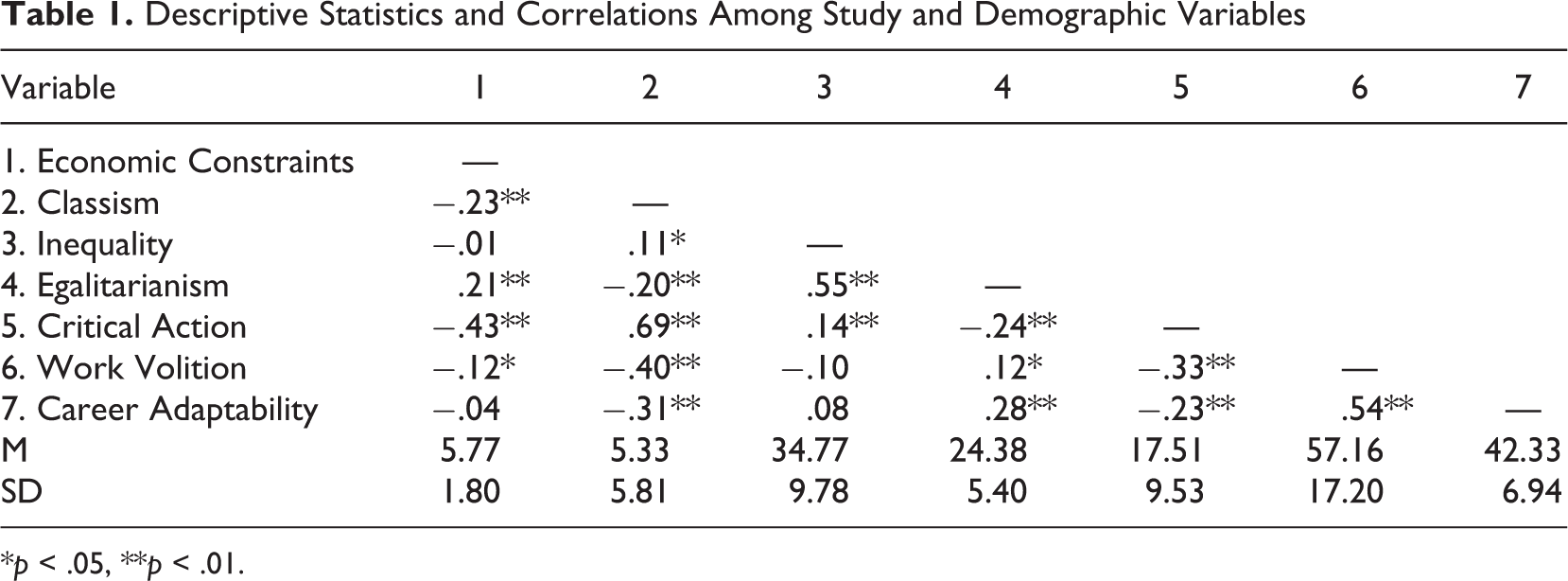
*p < .05, **p < .01.
Hierarchical Regression
First, we examined the moderating effect of three types of critical consciousness on the relations among economic constraints, classism, and work volition. Table 2 shows this hierarchical regression. In Step 1, all predictors were statistically significant except for perceived inequality. In Step 2, we added interaction terms and found that economic constraints by egalitarianism and economic constraints by critical action significantly predicted work volition. The interaction terms explained an additional 5% of the variance in work volition. Figure 1 reveals that people who had high egalitarianism reflection had a stronger negative relation between work volition and economic constraints, whereas people who had either low or moderate egalitarianism reflection had little to no relation between work volition and economic constraints. Figure 2 indicates that people who had low or moderate levels of critical action had a stronger negative relation between economic constraints and work volition, whereas people who had high levels of critical action had little to no relation between work volition and economic constraints. The final regression explained 30% of the variance in work volition.
Hierarchical Regression Examining Critical Consciousness as a Moderator of the Relation Among Economic Constraints, Classism, and Work Volition.
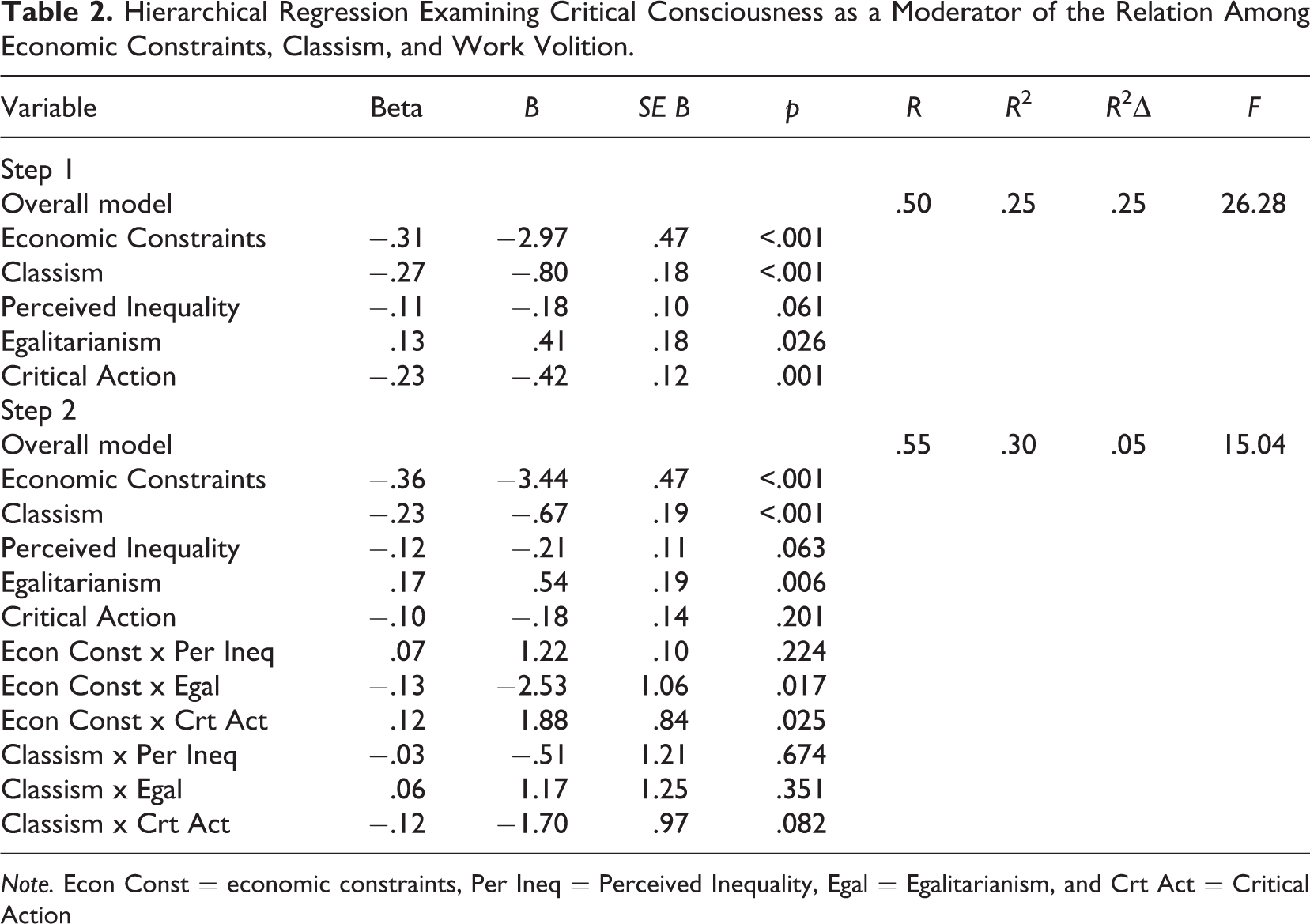
Note. Econ Const = economic constraints, Per Ineq = Perceived Inequality, Egal = Egalitarianism, and Crt Act = Critical Action

Egalitarianism moderating the relation between economic constraints and work volition. Note. High egalitarianism group is defined as being below −0.5 standard deviation from the mean; moderate egalitarianism group is defined as being between −0.5 and 0.5 standard deviation from the mean; high egalitarianism group is defined as being above 0.5 standard deviation from the mean. Axes are in z scores.
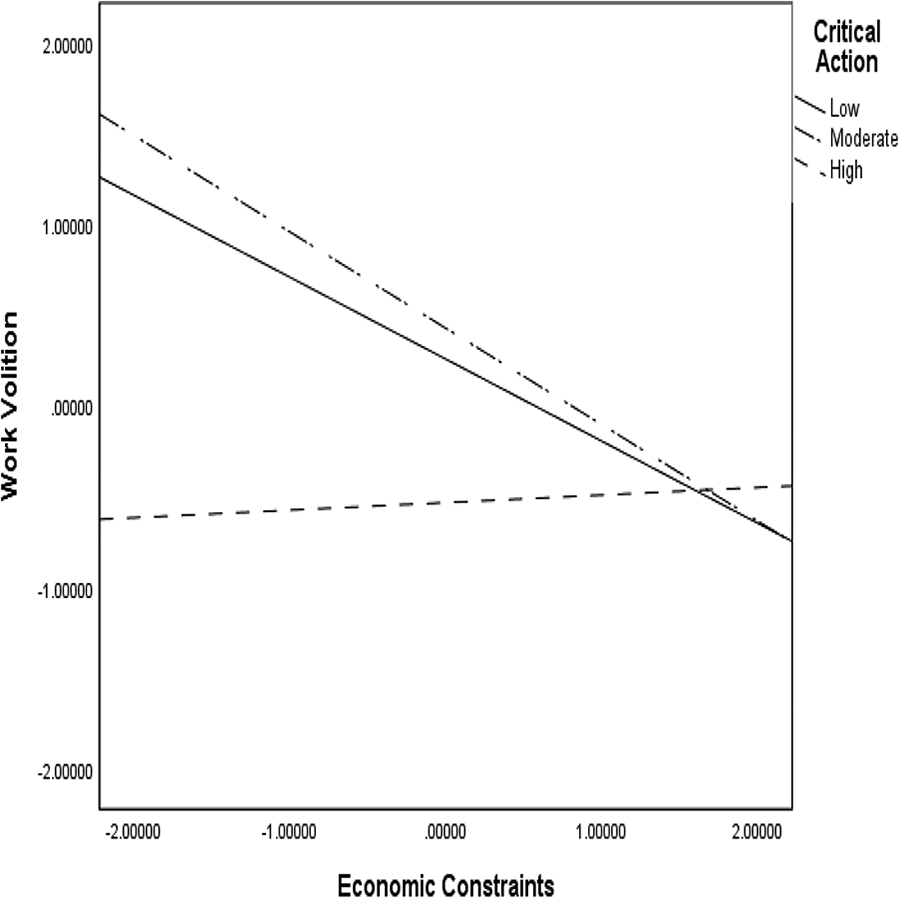
Critical action moderating the relation between economic constraints and work volition. Note. High critical action group is defined as being below −0.5 standard deviation from the mean; moderate critical action group is defined as being between −0.5 and 0.5 standard deviation from the mean; high critical action group is defined as being above 0.5 standard deviation from the mean. Axes are in z scores.
Second, we identified the moderating effect of three types of critical consciousness of the relations among economic constraints, classism, and career adaptability. Table 3 depicts this hierarchical regression. In Step 1, all predictors were statistically significant except for perceived inequality and critical action. In Step 2, we added interaction terms and found that classism by egalitarianism and classism by critical action significantly predicted career adaptability. The interaction terms explained an additional 7.5% of the variance in career adaptability. Figure 3 indicates that the negative relation between classism and career adaptability was stronger for people who had low egalitarianism. Figure 4 depicts that people who had low or moderate levels of critical action had a stronger negative relation between classism and career adaptability, whereas people who had high levels of critical action had little to no relation between classism and career adaptability. The final regression explained 25% of the variance in career adaptability.
Hierarchical Regression Examining Critical Consciousness as a Moderator of the Relation Among Economic Constraints, Classism, and Career Adaptability.

Note: Econ Const = economic constraints, Per Ineq = Perceived Inequality, Egal = Egalitarianism, and Crt Act = Critical Action
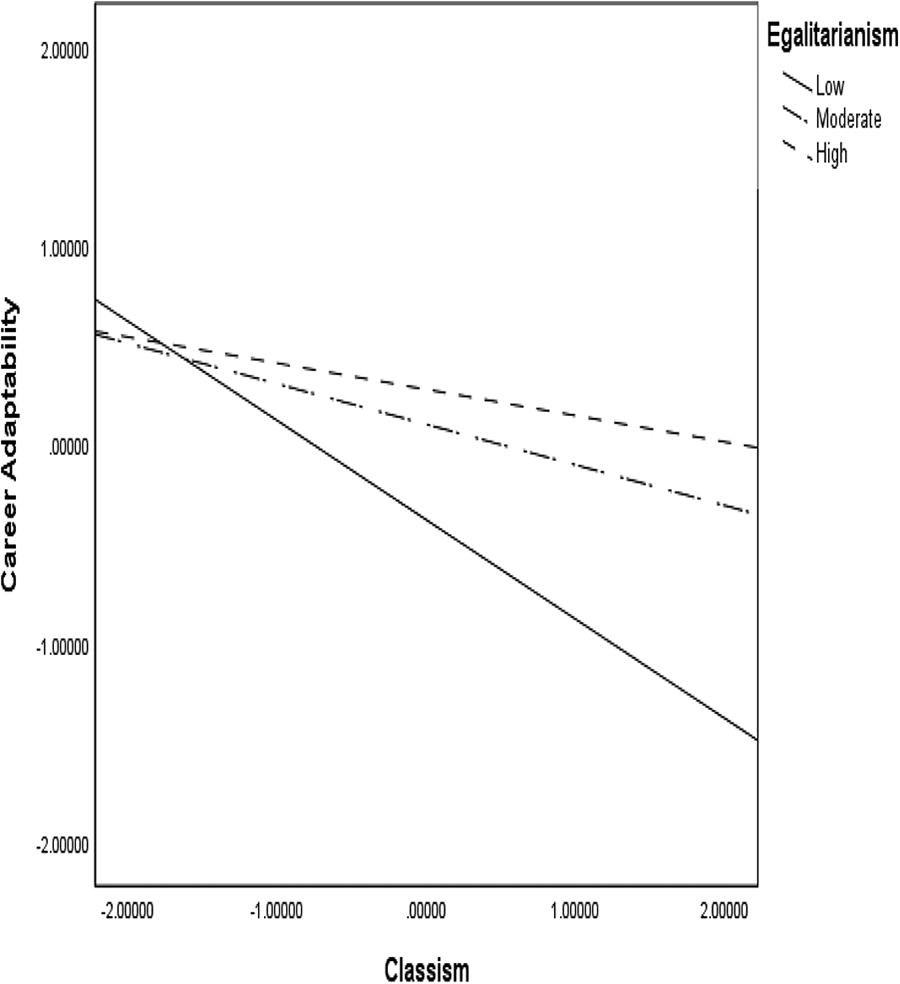
Egalitarianism moderating the relation between classism and career adaptability. Note. High egalitarianism group is defined as being below −0.5 standard deviation from the mean; moderate egalitarianism group is defined as being between −0.5 and 0.5 standard deviation from the mean; high egalitarianism group is defined as being above 0.5 standard deviation from the mean. Axes are in z scores.
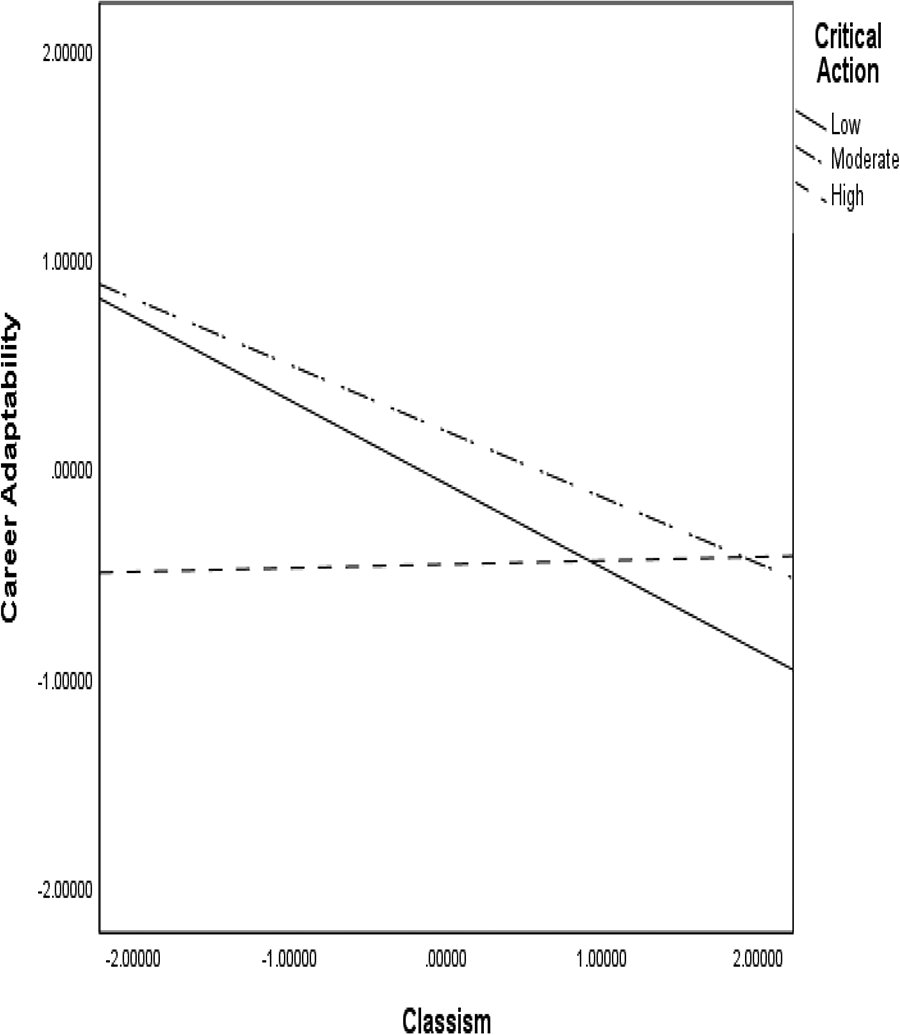
Critical action moderating the relation between classism and career adaptability. Note. High critical action group is defined as being below −0.5 standard deviation from the mean; moderate critical action group is defined as being between −0.5 and 0.5 standard deviation from the mean; high critical action group is defined as being above 0.5 standard deviation from the mean. Axes are in z scores.
Discussion
Following from PWT, the purpose of this study was to test the three types of critical consciousness (perceived inequality, egalitarianism, and critical action) as moderators of the relations between structural factors (economic constraints and classism) and individual vocational factors (work volition and career adaptability). Perceived inequality did not moderate the relations between the contextual factors and the psychological variables. As for egalitarianism, people who had high egalitarianism reflection had a negative relation between work volition and economic constraints, whereas people who had low egalitarianism had a negative relation between classism and career adaptability. Regarding critical action, people who had low or moderate critical action had negative relations between (a) economic constraints and work volition or (b) classism and career adaptability. These findings have implications for future scholarship and vocational interventions for working adults.
Contrary to our hypotheses, levels of perceived inequality did not change the relations from economic constraints and classism to work volition and career adaptability. This is inconsistent with contentions that critical reflection leads people with marginalized identities to have greater capacity to address unfair social conditions (Freire, 2000). People with marginalized identities tend to reflect on issues of inequality based on their personal experiences and observations (Roy et al., 2019). However, this might not be associated with perceived efficacy or the critical motivation to believe that societal change is possible (Diemer & Li, 2011; Watts & Flanagan 2007). The finding indicates that solely perceiving social inequalities might not be a protective factor in and of itself.
In contrast to perceived inequality, egalitarianism had some moderating effects, although these were inconsistent. First, people with high egalitarianism had a stronger negative relation between economic constraints and work volition. This result suggests that believing in egalitarianism may paradoxically highlight the economic constraints people experience and thereby reduce work volition. This is consistent with a study finding that people with higher critical reflection are less likely to overcome barriers and be motivated to make career decisions (Olle & Fouad, 2015). Egalitarianism could reflect people’s belief in an ideal world, rather than a realistic perspective of unfair conditions (Diemer et al., 2015). The gap between this ideal worldview and their real economic constraints might relate to a state of learned helplessness, which in turn predicts poorer work volition (Olle & Fouad, 2015). In a learned helplessness state, people tend to experience a lack of motivation because they evaluate events as uncontrollable (R. T. Liu et al., 2015; Raps et al., 1982). This indicates that learned helplessness might result in lower sociopolitical control, including self-efficacy and expectations about social change (Diemer & Li 2011; Watts & Flanagan 2007). In short, belief in egalitarianism may generate a conflict between economic constraints and unfair oppressions, helping people be less naïve but more restricted when making vocational choices.
On the other hand, people low in egalitarianism had a stronger negative relation between classism and career adaptability. That is, people with low egalitarianism may be more vulnerable to classism, in terms of career adaptability. People with low egalitarianism may internalize classism, which might in turn lead to passive adaptation or a pessimistic worldview (Carlson et al. 2006; Jemal, 2017). When people adjust to working environments with different social norms and values, people are likely to experience internalized classism, negative feelings resulting from one’s inability to maintain one’s social status (W. M. Liu, 2002, 2012). Likewise, people who endorse low egalitarianism may believe that they do not deserve to maintain their positions at work, triggered by sense of inadequacy, when they experience classism (W. M. Liu, 2012). Therefore, people who do not believe in equality might experience a poorer sense of control and motivation at work, which result in less flexibility to navigate and address classism (Chronister & McWhirter, 2006).
Compared to the mixed results for egalitarianism, critical action consistently buffered the relation between economic constraints and work volition as well as the relation between classism and career adaptability. This is in line with critical consciousness theory, which emphasizes that systemic change must involve action beyond intellectual awareness (Carlson et al., 2006; Freire, 2000). It also corroborates previous research finding that taking action promotes positive vocational outcomes and political action (e.g., Autin et al., 2018; Diemer & Rapa, 2016). In the context of the current study, critical action may relate to a greater sense of empowerment and control, which allows people to view economic constraints and classism as less able to affect their work volition and career adaptability (Autin et al., 2018). These results indicate that critical action might be an important buffer for working adults to effectively address economic constraints and classism in the vocational development process.
Finally, this is the first PWT study to examine classism as an operationalization of marginalization, so examining classism’s relation to work volition and career adaptability is important to understanding whether investigating moderators is necessary. Indeed, classism negatively predicted both work volition and career adaptability, which corroborates PWT and previous findings that classism is a form of marginalization that can relate to poorer work-related psychological variables (e.g., Shin & Lee, 2018; Soresi et al., 2012).
Implications for Practice
The findings of the present study provide implications for clinicians and employers. First, only enhancing perceiving inequality may not be sufficient to help people who are navigating the vocational decision-making process and coping with economic constraints and marginalization. Rather, clinicians may want to encourage clients who perceive inequality in society to endorse egalitarianism and engage in critical action. For example, clinicians could ask clients about their economic constraints and experienced classism, if appropriate, and examine their levels of critical consciousness. If clients’ critical consciousness includes only perceiving inequality, then clinicians could explore their attitudes about egalitarianism and critical action to help clients engage in other forms of critical consciousness (Carlson et al., 2006).
In addition, the moderating effects suggest that developing vocational interventions that highlight egalitarianism and critical action might be beneficial for desired vocational outcomes. Specifically, clients who experience classism may benefit from endorsing an egalitarianism perspective when adjusting at work. The dialogue to address the gap between realities and ideal beliefs could empower clients to understand their experienced classism and identify potential solutions when addressing work demands. Importantly, clinicians may need to carefully work with clients who endorse egalitarianism but experience economic constraints when making occupational decisions. Clinicians could explore clients’ emotional and cognitive process when clients observe the conflict between their value of egalitarianism and economic constraints. Clinicians can balance exploring economic constraints and focusing on locus of control and agency to prevent clients from developing a sense of helplessness (Allan & Kim, 2020).
Furthermore, emphasizing critical action could play a critical role in vocational interventions. If appropriate, clinicians might discuss with clients whether they are engaging in critical action and whether this might be an appropriate intervention. To promote systematic changes, clinicians might also develop interventions in community settings or at work to facilitate critical action. Critical consciousness-based interventions have mostly occurred in higher education (Flanagan & Levine, 2010), but our findings suggest that working adults might also benefit from critical action. Therefore, interventions to promote critical action in community or workplace settings may be appropriate.
Limitations and Future Directions
The current study has several limitations that could guide the directions for future research. First, we used the MacArthur Scale of Subjective Social Status (Adler et al., 2000) to measure subjective economic constraints. However, scholars have used this scale to measure either economic constraints (e.g., Allan, Tebbe et al., 2019) or subjective social status (e.g., Autin et al., 2017). To address this issue, scholars developed the Economic Constraints Scale (ECS; Duffy et al., 2019), which was not available at the time this study was conducted but better captures the PWT construct. Therefore, future studies can duplicate our findings by using the ECS to measure economic constraints. Similarly, we focused on subjective economic constraints because subjective social status related experiences can predict psychological experiences more than objective indicators (Tan et al., 2020). However, PWT describes economic constraints both objectively and subjectively. Therefore, to overcome this limitation, future researchers might include indicators of objective economic constraints, such as general household wealth.
Lastly, we found that classism had a negative correlation with economic constraints. This could be because the downward classism scale we used measured lifetime experiences of classism. Thus, people may have reported incidents of classism from early in their lives, meaning that classism might not have been currently salient to participants. Therefore, to reflect more recent experiences of classism, future studies could use the recently developed Perceived Classism Experiences Scale (Cavalhieri & Chwalisz, 2020), which was also not available when we conducted the current study. Regardless, this scale measures classism experienced in the past year, which would be more appropriate. Another possibility stems from the relative nature of classism based on specific reference groups, rather than a synonym for socioeconomic status (W. M. Liu, 2012; Shin & Lee, 2018). For example, students in lower social classes experience classism on campus by feeling pressured to conform to middle class culture (Lott, 2012).
Footnotes
Declaration of Conflicting Interests
The author(s) declared no potential conflicts of interest with respect to the research, authorship, and/or publication of this article.
Funding
The author(s) disclosed receipt of the following financial support for the research, authorship, and/or publication of this article: This research was supported by fellowship from the Purdue Acceptance and Inclusion Consortium.
