




Abstract
This study explored the effects of psychological and cultural variables on self-reported emotional prototypes of anger. Eight anger components were examined using a multilevel analysis. Competitiveness, interdependence, gender, instrumentality, and expressivity were entered as individual variables, and individualism/collectivism, masculinity/femininity, and the Human Development Index (HDI) were entered as cultural variables. All highlight the importance of considering simultaneously the individual and social levels, with a view to gaining more in-depth knowledge of the emotions. Data were collected among 5,006 college students from 25 countries. Being female, instrumentality, HDI, and the interaction between country-level HDI competitiveness predicted internal processes and behavioral outcomes of anger prototypes. Expressivity, instrumentality, country-level masculinity, and the interaction between gender and country-level masculinity predicted self-control mechanisms of anger prototypes. It is concluded that salient differences in anger prototypes can be found at both individual and country level, and that interaction effects of HDI with individual variables are essential in understanding anger prototypes.
Keywords
Introduction
Like other emotions, anger is not just an internal and private phenomenon but can also be seen as a social product in which individual and cultural variables interact from the beginning to the end (Frijda, 1986; Parkinson, 1998; Russell & Fernandez-Dols, 1997). Theories of categorization (see Rosch & Mervis, 1975) propose that studying the categorical structure of knowledge in any domain, in our case that of emotional experience, can help us make comparisons (in this case of emotions) situated at the same hierarchical level or at a different one. Anger is situated at the second level in the hierarchy proposed by Shaver, Schwartz, Kirson, and O’Connor (1987) for organizing the different emotional terms, so that it shares this level with other basic categories, such as love, joy, sadness, and fear. This means it can be considered as a basic, prototypical emotion, less abstract than the positive-negative affect category. These basic emotions are considered prototypes, that is, the best examples of the superordinate category emotion. Following Rosch’s proposal, the status of basic emotion attributed to anger, without necessarily assuming its innate biological bases, means that anger is one of the most relevant emotional experiences in the personal and social life of human beings. Dimensional accounts of the structure of emotions organize all these discrete emotions into a smaller number of underlying dimensions: pleasant/unpleasant and activated/deactivated. Focusing on negative emotions, anger can be characterized as highly unpleasant and moderately activated, but fear is considered moderately unpleasant and highly activated, and sadness as highly unpleasant and moderately deactivated (see Russell & Barrett, 1999).
The prototype approach to the study of emotion proposes a bridge between the etic and emic perspectives. Gottman (1993) wrote about the advantages and disadvantages of considering only universal emotions and ignoring culturally specific emotions, and also about the opposite approach, whereby emotions are reported in just a few social groups. When researchers focus on universal experiences, using an etic perspective, the result will most probably be biased, with overrepresentation of Western emotional concepts. But attending to only specific cases, in an emic perspective, leads to the fragmentation of knowledge, making difficult to form general theories. Prototypes allow us to consider a core of common features and also specific cultural characteristics, so that both perspectives (etic and emic) are taken into account. Studies by Fehr and Russell (1984), Shaver and colleagues (1987), and Scherer, Rimé, and Chipp (1989) provide good examples of how prototypes help us to study similarities and differences between cultures. In line with the prototype approach, authors must select which dimensions will be considered to make comparisons, Shweder and Haidt (2000) made two recommendations: (a) to take into account situations in which emotions are felt, and also the somatic reactions, behaviors and subjective experiences associated with emotions, and (b) to bear in mind that isolating emotional components should not lead researchers to overlook the fact that all of them constitute a gestalt; each component is related to the others, resulting in an indivisible whole. The analysis by components is a methodological strategy of the study.
The same holds for prototypes (or implicit theories) of anger, which involve views on which elements constitute emotions and on the relations among these elements. Prototypes are important in providing a cultural framework for emotions. Individuals interact with others and derive meaning from their actions/feelings based on the implicit views they have about how the emotional situation is experienced or expressed. In an interpersonal context, understanding of the experienced feeling of anger by the individual is important, but it is also important how other persons in the situation understand and perceive anger elements and signals, when deciding on whether to increase or defuse the conflict (Potegal, Stemmler, & Spielberger, 2010).
Most emotion researchers have focused on actual experiences of emotion components (e.g., Matsumoto, Nezlek, & Koopmann, 2007; Scherer & Wallbott, 1994), thereby exploring emotions at the individual level. However, interesting cross-cultural similarities have been reported for various emotions, including anger (Fischer & Evers, 2010; Matsumoto, Yoo, & Chung, 2010). Moreover, as explained below in more detail, the relevance for emotions of some cultural factors, notably individualism/collectivism, has been examined (Matsumoto et al., 2007; Matsumoto et al., 2010). However, few studies have addressed the cross-cultural variability of prototypical components of specific emotions, such as anger. Such studies would clarify the normative influence of culture in the emotion domain. With the advent of multilevel modeling, it is becoming increasingly clear that the cross-cultural study of psychological constructs should include not just individual and country characteristics but also the interaction between them (Van de Vijver, Van Hemert, & Poortinga, 2008); for example, the expression of emotions may be moderated by cultural factors so that individual differences in expressiveness are more pronounced in cultures that allow more expression and less pronounced in cultures that are more restrictive.
Focusing on gender differences in anger prototypes, our study expects to fill this lack of integration of individual and cultural factors in the literature; we simultaneously investigated individual, country, and interactional effects in prototypical anger components. In the remainder of this introduction, we first present the components of anger prototypes. This is followed by a description of how gender and gender roles relate to anger prototypes taking into account both individual and country levels, and by a description of how individualism/collectivism and related concepts are associated with anger prototypes at individual and country level. These antecedents let us present our hypotheses.
Emotions are often studied from a componential approach (e.g., Frijda, 1986). From this perspective, an emotional category (e.g., anger, sadness, or happiness) may be broken down into its constituent elements, called emotion components. Alonso-Arbiol et al. (2011), studying prototypes of anger, provided evidence for a cross-culturally invariant structure of eight interrelated components that make up three major factors: internal processes, behavioral outcomes, and self-control mechanisms. More specifically, the components that form internal processes were antecedents (or attributed causes of anger), body sensations (perceived physiological reactions), and cognitive reactions (related cognitive-affective thoughts). Behavioral outcomes referred to those components with an overt expression, including verbal expressions (anger expressions using verbal channels), nonverbal expressions (gestures externally observed by others), and interpersonal reactions (anger responses causing any impact on another person or object). The final components were self-control mechanisms; two strategies to deal with anger can be distinguished here: primary control—where the focus is on bringing situational or environmental issues into one’s wishes—and secondary control—where the focus is on adapting oneself to environmental causes. The present study starts out from this model and, complementing the database with psychological variables and country-level information, we carried out multilevel analysis to examine individual, country, and interaction effects on prototypical knowledge of anger.
Some studies have examined gender differences in emotion prototypes in general (not just anger). Gohm and Clore (2000) observed that women had a greater tendency to pay attention to their emotions than men. In a similar vein, women (and also girls) have been observed to have more complex and differentiated emotion knowledge than men (e.g., Ciarrochi, Hynes, & Crittenden, 2005) and to describe their own emotional experiences and those of others in a more differentiated way than men (Barrett, Lane, Sechrest, & Schwartz, 2000). Hence, women might be expected to score higher than men in all anger prototype components (Hypothesis 1).
In one of the few studies of prototypical or semantic knowledge, the verbal expression of emotions was found to be more common among women (e.g., Fernandez, Carrera, Sanchez, Paez, & Candia, 2000); however, compared with men, women reported believing that displaying anger is less appropriate for their gender (Smith et al., 1989). In line with this reasoning, Condon, Morales-Vives, Ferrando, and Vigil-Colet (2006) suggested that overt expressions of anger by females (notably physical expressions) tend to be more sanctioned than expressions by males. In the gender framework, we will also examine possible differences between internal processes and external outcomes.
In addition to gender, gender role may be responsible for differences in components of anger prototypes. As Fischer and Evers (2010) have noted in their review of the topic, we should shift our attention to gender-role practices and expectancies, since these seem to affect the way in which women and men regulate their anger. In the literature, it has been reported that the variable of expressivity is positively associated with emotional expression, whereas the opposite is found for the variable of instrumentality (Brody & Hall, 2008; Kring & Gordon, 1998; Ross & Mirowsky, 1984). However, this picture may not be valid for all anger aspects. Using Spielberger’s Anger Expression Inventory (AEI; Spielberger et al., 1985), 1 Kopper (1993; see also Kopper & Epperson, 1996) found that men and women displaying more instrumental (stereotypically masculine) personality characteristics scored higher on the Anger-Out scale (outward expression of anger), whereas men and women with more expressive (stereotypically feminine) personality characteristics showed higher levels on the Anger-In scale (nonexpressed internal feelings/cognitions of anger). 2 Although this study refers to episodic knowledge or reported emotions, we may anticipate that expressivity would be positively associated with prototypes of all internal processes of anger (Hypothesis 2), and that instrumentality would be positively associated with prototypes of behavioral outcomes (Hypothesis 3).
The evidence on self-control mechanisms is inconclusive. In the studies conducted by Kopper and colleagues (Kopper, 1993; Kopper & Epperson, 1996), neither gender (i.e., female vs. male) nor gender role (i.e., expressivity vs. instrumentality) differences were found for the control scale of the AEI. However, in another study, high instrumentality scores were related to the use of a problem-focused strategy when coping with arguments and fights with friends (related to the concept of primary self-control; Washburn-Ormachea, Hillman, & Sawilowsky, 2004). Therefore, we predict a positive relationship between primary self-control and instrumentality (Hypothesis 4).
A potentially relevant cultural dimension for our study is Masculinity–Femininity (MAS; G. Hofstede, 1998; G. H. Hofstede, 2001). According to Hofstede, feminine cultures stress cooperation and social support, which would probably reinforce expressive traits. In turn, masculine cultures stress competition and work, which could be taken to mean that material rewards reinforce instrumentality (G. Hofstede, 1998; G. H. Hofstede, 2001). These expectations were not always borne out. Fernandez et al. (2000) found that the most important cultural dimension that predicts lower levels of emotional verbal and nonverbal expression, including anger, is cultural masculinity; however, no such association was reported by Van Hemert, Poortinga, and Van de Vijver (2007). Therefore, we refrain from formulating a hypothesis about the main effect of MAS on the expressive and behavioral components of anger.
A cultural effect may be expected to emerge as an interaction effect for self-control mechanisms. Feminine societies would impose fewer norms of self-control of anger than masculine societies for women, as both genders would be equally entitled to express themselves. For instance, in a study by Fischer and Manstead (2000), gender differences in emotional reactions were stronger in countries with less traditional (i.e., feminine) gender roles. Similarly, Fischer, Rodriguez Mosquera, Van Vianen, and Manstead (2004) found in a study of 37 cultures that women in countries with a high Gender Empowerment Measure (GEM)—an index of women’s social and political participation in society (and hence, inversely related to Hofstede’s masculinity)—report more anger expressions than women in countries with a low GEM. Although these results apply to actual emotions, we might expect similar mechanisms in prototypes of self-control mechanisms of anger. Women in feminine countries would have more freedom to acknowledge their anger and would not need to control it, as opposed to women from more masculine countries. Therefore, we expect an interaction between gender (at an individual level) and MAS (at country level; Hypothesis 5).
An extensive body of knowledge regarding the cultural variability of a number of constructs and contexts, also including emotions, has been based on differences due to individualism/collectivism (Oyserman, Coon, & Kemmelmeier, 2002). Previous studies suggest that Individualism versus Collectivism (IDV) is of special relevance for this study (e.g., Fernandez et al., 2000; Matsumoto, Yoo, & Fontaine, 2008). IDV refers to the degree to which the culture of a country fosters individuals’ attitudes about taking care of themselves or, alternatively, whether it encourages members of the country to show concern for in-groups (higher scores are indicative of higher individualism). Individualism was positively associated with the expressed intensity and social desirability of positive and negative emotions (Basabe et al., 2000). Similarly, Van Hemert et al.’s (2007) meta-analysis found that individualism was associated with more emotional expression.
Individualism has been shown to be strongly related to affluence and the Human Development Index (HDI), which is a combined measure of a country’s life expectancy, literacy, education, and standard of living (Basabe & Ros, 2005; G. H. Hofstede, 2001). As a consequence, similar patterns of correlations with emotions can be expected for individualism–collectivism and HDI. Basabe and colleagues (2002) found that the HDI was positively associated with the expressed intensity of negative emotions, including anger. More recently, Van Hemert and associates (2007) found that emotional expressivity was positively associated with indicators of individual freedom (such as stability of democracy and observance of human rights) and extraversion (which are positively related to affluence), though the expected positive correlations with Gross Domestic Product and HDI just failed to reach significance. Therefore, we would expect that prototypes of behavioral outcomes of anger are positively associated with HDI and IDV (Hypothesis 6).
Individualism/collectivism has also been studied at the individual level, notably from the perspective of identifying its implications for the self (Fernandez, Paez, & Gonzalez, 2005; Markus & Kitayama, 1991). The corresponding concepts at the individual level are independence and interdependence. Individuals high in interdependence display an extended sense of self, closely interrelated with significant others (i.e., in groups). This connectedness of the self has a normative influence on the way relationships with others are understood (see Oyserman et al., 2002); relational norms imply that efforts should be maximized to keep those relationships intact. In this reasoning, interdependence would be positively associated with self-control mechanisms (Hypothesis 7).
Competitiveness is presumably related to individualism/collectivism through its relation with conflict (Van de Vliert, 1998). At the individual level, competitiveness would be understood as a dimension of individualism. A stronger competitive attitude may underlie the ability to use all resources to achieve the goal, so that feeling and expressing anger toward competitors is expected. Therefore, we argue that competitiveness would be positively associated with prototypes of internal processes and behavioral outcomes of anger (Hypothesis 8).
In sum, first of all, we will present the construct equivalence analyses for the instrumentality/expressivity and competitiveness/interdependent construal scales across countries (construct equivalence of anger scales has been demonstrated in Alonso-Arbiol et al.’s, 2011, study). Second, we will analyze the individual- and country-level variance in prototypical anger. Third, we will examine the relation between psychological variables and (prototypical) anger components. Fourth, we will report multilevel analyses (Raudenbush, Bryk, Cheong, Congdon, & du Toit, 2004) in which anger prototype components are predicted on the basis of individual- and country-level variables independently. Finally, we will explore the interaction effects between some selected individual- and country-level variables.
Method
Participants and Procedure
The sample was made up of 5,006 social science students (2,858 women, 2,142 men) 3 from 25 different countries. The mean age was 21.70 years (SD = 4.06; see Table 1). University students are suitable for this type of sample, and while there may be some degree of bias with participants of this kind, they do have the advantage of knowing how to answer the types of questions that require introspection. To take into account this limitation, we included some items to measure identification with their culture. Participants responded on a 5-point scale ranging from 1 (not at all) to 5 (very much) to the following question “To what extent do you identify with your culture?” Results showed good level of cultural identification in all samples (M = 3.86; SD = 1.05; and Mode = 5), so any participant was removed from the following analysis.
Sample Size, Gender Distribution, Age, and Congruence Coefficients (Tucker’s Phi) of Competitiveness/Interdependence and Instrumentality/Expressivity for all Countries.
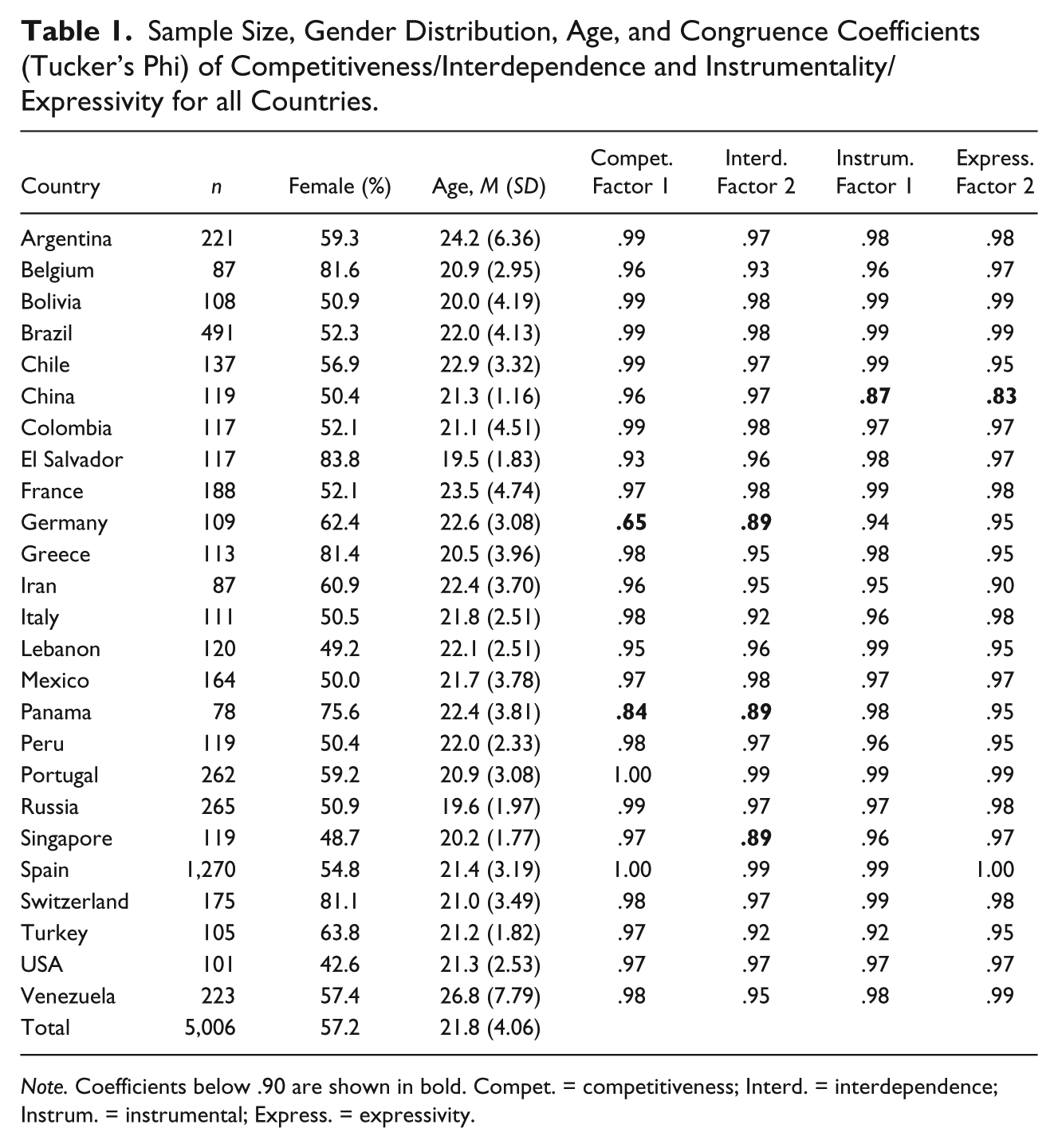
Note. Coefficients below .90 are shown in bold. Compet. = competitiveness; Interd. = interdependence; Instrum. = instrumental; Express. = expressivity.
Individual responses were collected during regular lectures from those students who agreed to participate. Collaborating lecturers administered the questionnaire in each country. The data were collected in regular lectures to control contextual biases. Collaborators are listed in the author note. All the ethical protocols of each university were followed.
Measures
The scales were translated into different languages by trained bilingual native speakers, and then back-translated. The versions were reviewed by representative focus groups. The objective of this process was to preserve the conceptual meaning of the original form. In designing these versions, the authors followed the guidelines proposed in the literature on cross-cultural methodology (Brislin, 1986; Van de Vijver & Leung, 1997).
Components of anger prototypes
Anger prototypes were measured using eight scales with items derived from studies by Shaver et al. (1987), Scherer, Rimé, and Chipp (1989), and Fernandez (2001); the final versions were compiled by Alonso-Arbiol et al. (2011). Participants were requested to rate the items based on their general emotional knowledge of anger (anger prototypes), not taking into account specific personal episodes. The following components were assessed: antecedents (six items, for example, “Judging that the situation is wrong,” α 4 = .58), cognitive reactions (five items, for example, “Imagining one attacks or harms the cause of anger,” α = .66), body sensations (five items, for example, “Feeling hot,” α = .71), verbal expressions (four items, for example, “Verbally attacking the cause of anger,” α = .75), nonverbal expressions (five items, for example, “Clenching one’s fists,” α = .75), interpersonal responses (five items, for example, “Physically attacking the cause of anger,” α = .71), primary self-control (three items, for example, “Finding solutions for the conflictive situation,” α = .67), and secondary self-control (four items, for example, “Trying not to express or show anger,” α = .50). Items captured participants’ judgments of prototypicality (anger) in a 4-point Likert-type response format. Responses were made on a short 4-point scale: 1 = not typical; 4 = highly typical.
Competitiveness
To assess this variable, a selection from the Self-Reliance with Competition subscale (Triandis, Bontempo, Villareal, Asai, & Luca, 1988) and the Self-Construal scale (Singelis, 1994) was used, comprising items that capture the success orientation of competitiveness. Six items, scored on a 4-point scale, were selected, which we found to constitute a unifactorial measure of this success orientation dimension of competitiveness (e.g., “Success is the most important thing in life”; α = .73).
Interdependence
Interdependence was assessed with five items (e.g., “I will sacrifice my self-interest for the benefit of the group I am in”) on a 4-point scale (α = .61). The items were derived from the Self-Construal scale (Singelis, 1994), and based on a multigroup confirmatory factor analysis (Fernandez et al., 2005).
Gender, instrumentality, and expressivity
Perceived instrumentality and expressivity were assessed using a short version of the Bem Sex Role Inventory (BSRI; Bem, 1974), developed by Fernandez (2001). The scale assesses self-reported gender-role traits regarding instrumentality and expressivity; these two constructs are assumed to be unrelated to each other. The final version contained 16 items, 8 covering each dimension. Respondents had to indicate how well each adjective defined him/her on a 7-point scale. Alpha coefficients were .78 for expressivity and .72 for instrumentality.
Country-level information
Data regarding country were retrieved from two sources. The socioeconomic indicator was taken from the United Nations Development Program (2000); values of the HDI referred to 1998. G. H. Hofstede’s (2001) IDV values were collected for the countries in the study (the data presented in this research were collected from 1997 to 2001).
Results
Construct Equivalence of Scales Across Countries
We first addressed construct equivalence: Do the scales measure the same construct(s) in all groups (Van de Vijver & Leung, 1997)? The dimensionality of each scale was examined using a pooled-within correlation matrix. For the brief BSRI, the two-factor solution accounted for a total of 36.7% of the variance, with eigenvalues of 3.56 and 2.83. All items but two showed sizable loadings on the expected factor (with values of .35 or higher). These two items were removed from subsequent analyses.
The factor solution of the measure of Competitive/Interdependent self-construal accounted for a total of 42.2% of the explained variance, with eigenvalues of 2.79 and 1.85. To have a more robust scale for each dimension, we retained the items with loadings of .35 or higher, leading to a six-item version for competitiveness or success orientation and a five-item version for interdependence self-construal.
In the next stage, the two-factor rotated solutions of the pooled-within matrix were compared with each country’s solution, and Tucker’s phi coefficients were calculated for each country and each scale (congruence coefficients are shown in Table 1). Overall, the results supported the comparability of the different versions of the scales, with most countries showing adequate congruence coefficients (>0.90), and four countries having values slightly lower than this cut-off point.
Construct equivalence of anger scales shows acceptable levels in previous studies (Alonso-Arbiol et al., 2011; Fernandez, 2001), only 2 out of the 225 Tucker’s phi coefficients calculated showing values under 0.90: the antecedents scale in Colombia (0.34) and the secondary self-control scale in China (0.39).
Multilevel Analyses
Data analytic strategy
The hypotheses were tested by means of multilevel analysis, which is particularly suitable, as it accommodates dependencies among the predictors and the complex data structure in which individuals are nested in their countries. In the first stage, the fully unconditional model was tested for all anger components, where neither Level 1 (individual level) nor Level 2 (country level) predictors were included. Following guidelines for multilevel modeling (see Nezlek, 2011), intercepts and slopes were initially modeled as random. Intraclass correlation coefficients (ICCs) of the anger components ranged from .01 to .11 (all ps < .01). These results show that the variance of all components was mainly within countries, and that between country variance was much smaller but sufficiently large to warrant the use of a multilevel modeling approach.
In the model-building process, a subsequent step was to introduce Level 1 predictors, one at a time. This also allowed us to test the predictions concerning the relationship between the components of prototypical anger and the variables we measured at an individual level (sex, expressivity, instrumentality, interdependence, and competitiveness). In the following stage, we proceeded by including country-level variables, one at a time, in the model that already contained statistically significant individual-level predictors. All (unstandardized) regression coefficients can be found in Table 2. 5
Individual- and Country-Level Predictors of Anger Components.
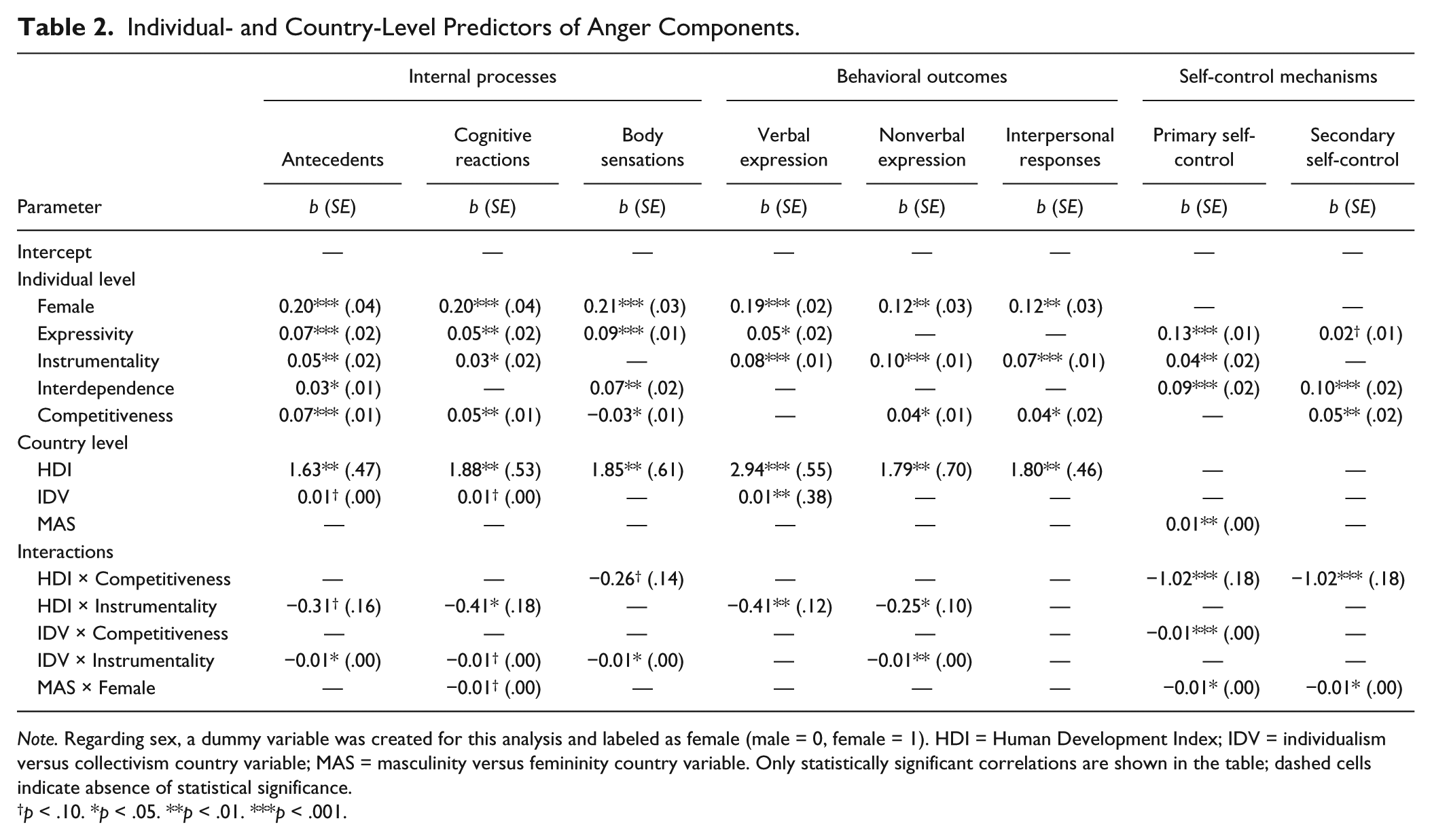
Note. Regarding sex, a dummy variable was created for this analysis and labeled as female (male = 0, female = 1). HDI = Human Development Index; IDV = individualism versus collectivism country variable; MAS = masculinity versus femininity country variable. Only statistically significant correlations are shown in the table; dashed cells indicate absence of statistical significance.
p < .10. *p < .05. **p < .01. ***p < .001.
Relationships between gender-related variables and anger components
As expected, female participants scored higher on scales for all internal processes, as well as on those measuring behavioral outcomes of prototypical anger (Hypothesis 1), though no differences were found for self-control mechanisms. Examining these results, the highest correlations were found for the internal processes (and also for verbal expression), whereas the more physical behavioral outcomes—nonverbal expression and interpersonal responses—showed the smallest correlations. A test of the difference of the regression coefficients supported the significance of these gender differences.
As predicted, some prototypical anger components were related to expressivity; all internal processes (and also for the verbal expression component) had positive and statistically significant coefficients (Hypothesis 2). Expressivity was positively related to self-control mechanisms; however, the coefficient for primary self-control was more pronounced than the coefficient for secondary self-control. These findings are in line with the view that the internal experience of emotions and the verbal communication of these experiences are associated with expressivity. Since the overt expression of anger could be viewed as a more masculine trait, we expected that individuals with higher levels of instrumentality would score higher on all behavioral outcomes (Hypothesis 3). Our analyses provided support for this hypothesis. Other prototypical anger components also appeared to be related. As expected, instrumentality was positively related not only to primary self-control (Hypothesis 4) but also to internal processes, with the exception of body sensations, and to behavioral outcomes.
Furthermore, a significant interaction between gender and MAS was observed for the two types of self-control mechanisms, thereby supporting Hypothesis 5. Gender differences in the two types of self-control were larger in more feminine countries than in more masculine countries. Interactions between expressivity and MAS, and between instrumentality and MAS were not significant.
Effects of individualism–collectivism, independence–interdependence, and the HDI
An inspection of the regression coefficients in Table 2 reveals that most of the hypothesized relationships between anger components and individualism–collectivism at the country level and independence–interdependence at the individual level were in the expected direction, even though not all of the coefficients turned out to be statistically significant. HDI and IDV were associated with behavioral outcomes (the latter being inversely related), as predicted in Hypothesis 6, although only in the case of HDI were the regression coefficients statistically significant in all behavioral outcomes. The strongest association was observed for the verbal expression component. For individualism, only the regression coefficients of verbal expression were sizable enough as to be statistically significant. Moreover, internal processes were associated with HDI and IDV in the same meaningful direction, as was found for behavioral outcomes.
The hypothesis regarding the associations between interdependence and components of prototypical anger was confirmed (Hypothesis 7). The expected positive links between interdependence and both primary and secondary self-control mechanisms were found. This finding is fully in line with the notion that more interdependent people have more interest in maintaining harmony with others, which is enhanced by stricter self-control.
We found links of competitiveness with prototypical anger components. In line with our expectations (Hypothesis 8), statistically significant and positive coefficients were observed for most components: antecedents, cognitive reactions, nonverbal expression, and interpersonal responses. Overall, our analyses revealed that the contribution of interdependence was in a positive direction for all components. Moreover, people scoring high on competitiveness reported higher levels of prototypes of antecedents, cognitive reactions, nonverbal expression, interpersonal responses, and secondary self-control.
Interactions were explored between individual-level competitiveness and interdependence variables and IDV and HDI country-level variables. There was an interaction between IDV and competitiveness for primary self-control. High scores in competitiveness were positively related to primary self-control in collectivistic countries, but negatively related in countries of high individualism. In the more permissive climate for expressing emotions in the latter type of country, more competitive individuals do not need to struggle to comply with the constraints implicitly imposed on their anger feelings. A similar positive interaction effect was observed between HDI and competitiveness, which in this case applied to the two types of self-control.
Further interaction effects of individual- and country-level variables on prototypical anger components
Finally, other possible interactions were also explored. Higher scores in instrumentality were associated with higher scores in anger in less developed countries, whereas this relationship tended to disappear in more affluent countries. A similar link with instrumentality and IDV was found for all internal processes.
Based on the interactions revealed, explanatory models of all anger components were drawn up. Interaction components were added until new interactions were not significant. The criteria for the final models required that all estimators were still statistically significant. Fairly similar models were established for the more central anger components, namely, the three internal processes and the three behavioral outcomes, whereas the self-control mechanisms were modeled using different estimators based on the results obtained in the previous stage.
In the models finally selected, core components of anger were modeled as a function of the following variables: (a) gender (females obtained higher scores), (b) instrumentality (the more instrumental individuals are, the higher their scores on prototypical anger), and (c) HDI (more developed countries score higher in prototypical anger). The negative interaction between instrumentality and HDI was due to the positive correlation of instrumentality with cognitive reactions, verbal expression, and nonverbal expression of prototypical anger in low-HDI countries, and a zero correlation in high-HDI countries. For a better understanding of the interactions, separate single linear regression models were calculated for the pooled-within solution, after the matrix had been split into high- and low-HDI countries (see Figure 1). The coefficients and standard errors for these models, along with the model fit indices, are shown in Table 3. The explained variance of the final models varied considerably for the prototypical anger components, ranging from 20% in nonverbal expression to 60% for verbal expression.
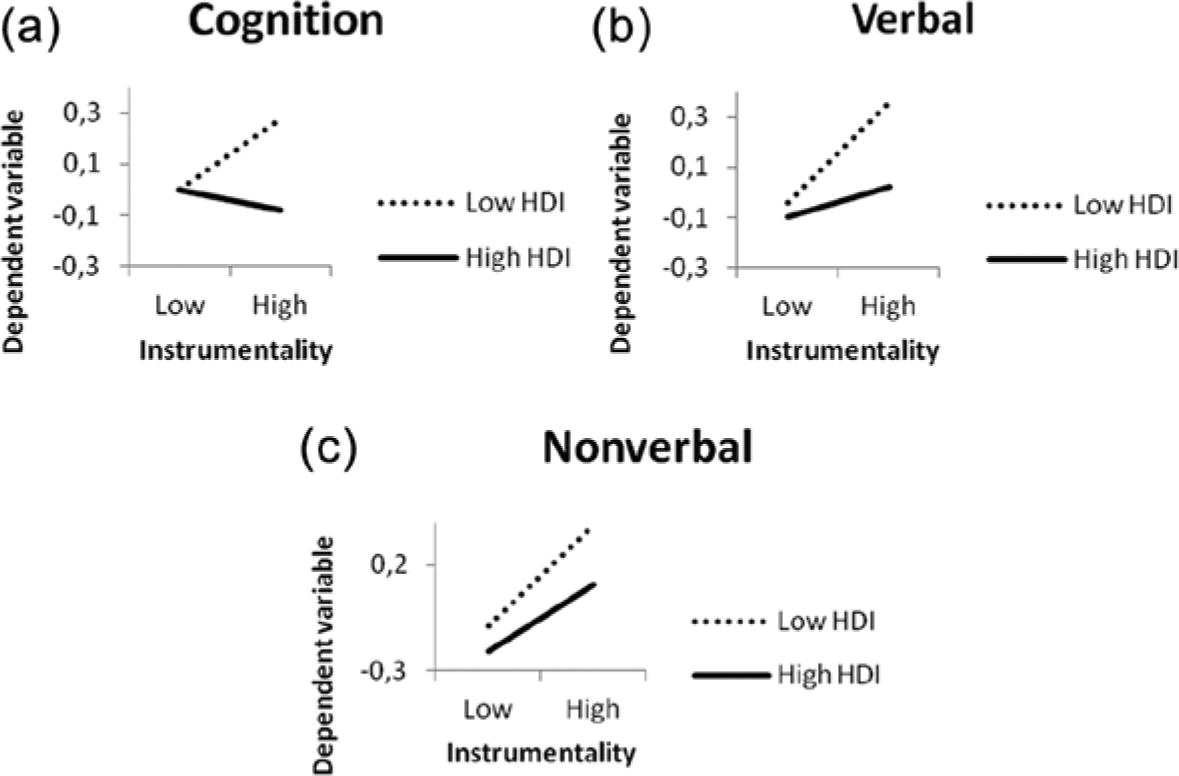
Cross-level interactions of the HDI: (a) interaction of cognitive reactions, (b) interaction of verbal expression, and (c) interaction of nonverbal expression.
Models Predicting Core Anger Components From Individual- and Country-Level Variables.
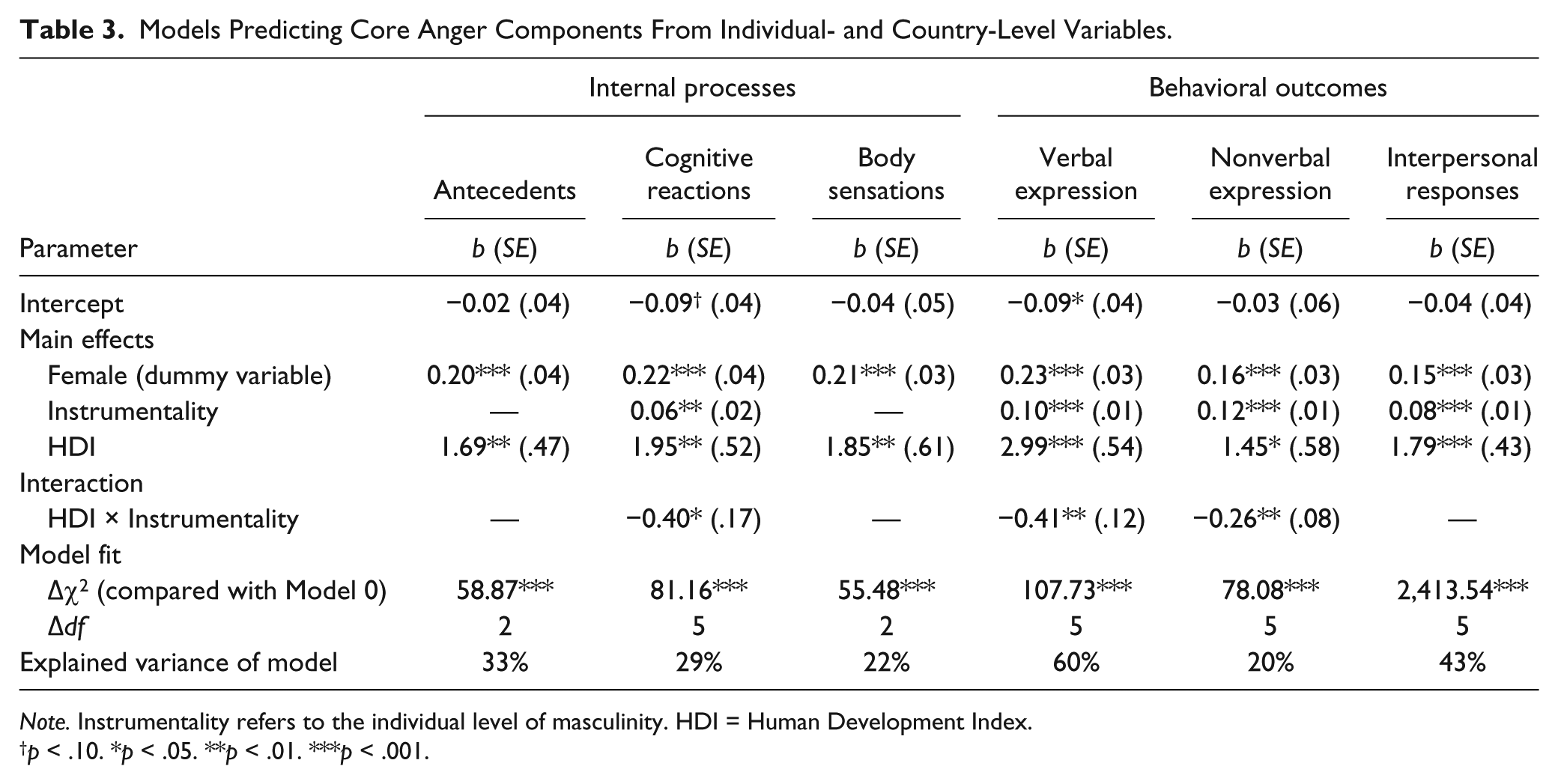
Note. Instrumentality refers to the individual level of masculinity. HDI = Human Development Index.
p < .10. *p < .05. **p < .01. ***p < .001.
The models for the self-control mechanisms followed a different pattern. They were best explained by individual-level variables and at the country level by the interaction of HDI with competitiveness in the case of primary self-control mechanism.
At first sight, Table 2 appears to reflect an erratic pattern of the interaction components. Quite a few interactions were significant, but it is not clear why some combinations of predictors yielded significant interactions while others did not. However, a closer examination of our results showed that there is a fairly consistent pattern insofar as differences in scores on anger prototypes between high and low levels of a certain individual characteristic (such as competitiveness) are always more pronounced in high-HDI countries as compared with low-HDI countries. Thus, it can be concluded that there is a global tendency for individual-difference variables to be more salient in high-HDI countries.
Discussion
The main goal of the present study was to provide a detailed picture of how gender, HDI, independence/interdependence, and individualism/collectivism could account for the variability prototypes of anger components in a large sample of college students from 25 countries when individual- and country-level variables, together with their possible interactions, are considered simultaneously. Women scored higher on prototypicality in all components of anger except for self-control mechanisms. Gender roles, expressivity, and instrumentality were positively associated with various anger outcomes. Similar findings have been reported for specific emotional episodes of anger (not prototypes; for example, Condon et al., 2006), which suggests a connection between perceived prototypes and emotional episodes of anger. Interdependence and competitiveness showed positive relations with most emotional components.
The present work illustrates the value of studying individual and cultural sources of score differences in a single model. For example, the links between gender and prototypes of anger components reflect the interplay of individual differences and cultural effects. Gender differences (whether biological or socially constructed) in prototypical anger cannot be assumed to be equal in all countries, as our study has shown for self-control mechanisms. Similarly, the cross-level interactions of HDI at the country level with competitiveness and instrumentality at the individual level contributed to the variability of anger components. The interaction effects suggested that individual differences are more pronounced in high-HDI countries. Thus, HDI was by far the most powerful predictor of cross-cultural differences. How can this pattern be interpreted? There is evidence that country-level variables are strongly influenced by economic development like the HDI (Georgas, Van de Vijver, & Berry, 2004). Therefore, a conceptual interpretation of the observed influence of the HDI is tentative, as the measure may be a proxy for a host of affluence-related variables. Individualism–collectivism has been proposed as a possible explanation for these differences. Thus, it has been suggested that people in individualistic countries are more likely to ascribe their behavior to internal causes, whereas people in collectivistic countries are more likely to attribute their behavior to situational constraints (Markus & Kitayama, 1991). The concepts of traitedness (Church et al., 2006) and context differentiation (Matsumoto, Yoo, & Fontaine, 2009) refer to this differential situational control of behavior and to the larger consistency of behavior across situations in individualistic/independent countries as compared with collectivistic/interdependent countries.
We observed the same higher traitedness of anger prototypes in high-HDI countries. An extension of this framework to anger prototypes is easy to make. Anger can be a disruptive emotion; its expression can put relationships in jeopardy. In cultures where the maintenance of harmony is important, the expression (or experience) of anger may be especially disruptive; hence, internalized norms of its expression and experience are embedded within the culture. A low level of intracultural variability would be an indication of the uniformity of the prototypical components of anger in that culture. Norms about emotion regulation typically amount to inhibiting the expression of emotions. Thus, it stands to reason to argue that anger can be more strongly expressed in high-HDI countries (which are independent and individualistic); in addition, the more room for expressing emotions in these countries may also imply that correlations with other individual-level characteristics are more pronounced there. Individuals living in more affluent and more individualist countries are more likely to express (and to experience) emotions, and due to this repeated exposure, these individuals are also more cognizant of emotion prototypes. Emotional components are under normative regulation. We conjecture that these norms are related to the freedom individuals experience in a country. We would argue that cultural norms about the freedom to express (and experience) emotions, which are less strict in high-HDI countries, are a prime source of differences in manifested emotions. The regulation is more salient in countries with less freedom. Hence, the expression and cognizance of anger prototypes is contingent upon the freedom and individual sovereignty in a country. Individuals living in countries with high HDI will show more individual (and gender) differences in anger prototypes than individuals living in lower HDI countries.
Two main limitations of the present study should be mentioned. First, the results may not generalize to the general population, as we worked with convenience samples (however, see Straus, 2009, for a defense of this type of sampling). One may expect that due to the globalization effect, university students (and more educated people in general) worldwide would be more similar in psychological functioning than random samples; future studies using comparable community samples may investigate other more salient or pronounced cultural differences in prototypical anger components. A second limitation involves the absence of personality traits in the study design. Previous research has pointed out the relevance of some aggregated personality scores (agreeableness, neuroticism, and conscientiousness) to account for differences in emotion regulation (Matsumoto, 2006), similar to self-control mechanisms. Individual differences may confound the effect that is attributed to culture due to the salience of such personality profiles in the countries in question. For instance, based on the theoretical link between neuroticism and uncertainty avoidance, it could be argued that the relationship between secondary self-control and uncertainty avoidance might derive from higher average scores of neuroticism in the cultures under examination. The inclusion of the assessment of individuals’ personality scores may help illuminate this question.
All in all, the results of our study confirm the validity of expressivity, instrumentality, interdependence, and competitiveness attitudes in relation to prototypes of emotional experience, expression, and control of anger. Affluence and development-related socioeconomic factors, and the social structures and implicit set of norms that societies derive from them, seem to constitute a cultural climate that powerfully explains several psychological dispositions, including the prototypical or implicit views of emotional experience, expressions, and self-control mechanisms. In addition, we found that the combination of individual and country characteristics can create interactions and better explain the effect of cultural and gender effects on anger prototypes. Future studies should incorporate this interactional perspective to avoid generalizing the results found in a certain cultural context to others before effective cross-cultural testing has been carried out. All of these results should be considered when emotional coping programs are implemented. Clinical approaches (e.g., assertiveness programs) usually focusing on intrapersonal features should not overlook the fact that people are immersed in a cultural context which influences them and which they also influence. These multilevel interactions mean that cultural variables play as important a role as personal ones.
Footnotes
Acknowledgements
The authors would like to thank collaborators who helped with data collection: H. de Pascuale and E. Zubieta (Argentina); P. Philippot, B. Rimé, and Y. Yabar (Belgium); J. Ortego (Bolivia); L. Camino and Joao Pessoa (Brazil); D. Asún (Chile); Xu Lin Bao Bao and M. Salas (People’s Republic of China); J. I. Ruiz (Colombia); W. A. Hernández (El Salvador); N. Aguilera and H. Paicheler (France); H. C. Traue (Germany); T. Apostolidis and N. Christakis (Greece); B. Behrouz and S. Mortzavi (Iran); G. Bellelli and F. Stazolla (Italy); J. Akiki (Lebanon); J. Alvarez and A. Blanco (Mexico); M. Lombardo (Panama); A. M. Sono (Peru); J. Márques and R. Ramos (Portugal); I. Bovino and A. Zlobina (Russia); G. Bishop (Singapore); J. M. Canto, M. López, F. Martinez, M. Navas, A. Rodríguez, J. M. Sabucedo, F. Sánchez, and A. I. Vergara (Spain); J.-C. Deschamps (Switzerland); O. Paker (Turkey); L. Candia and L. Martínez (USA); E. Casado and M. León (Venezuela). Also special thanks go to M. Bender, Tilburg University (the Netherlands), for his insights in the translation of the German version of the questionnaires.
Declaration of Conflicting Interests
The author(s) declared no potential conflicts of interest with respect to the research, authorship, and/or publication of this article.
Funding
The author(s) disclosed receipt of the following financial support for the research, authorship, and/or publication of this article: This study was supported by the following Basque Country University Research Grants (UPV 109.231-G56/1998; 109.231-13645-2001; GIU08/09), the Basque Government (GIC07/113-IT-255-07), the Spanish Ministry of Science and Innovation (PSI2008-04849), the Spanish Ministry of Economy and Competitiveness (PSI2011-28720 MICINN), and two mobility grants from the Spanish Ministry of Education to Itziar Alonso-Arbiol (JC2008-00012; JC2009-00225).
Notes
Author Biographies

). He has published numerous studies on the mental health, collective memory, and social identity of refugees, migrants, emotions, and culture.