




Abstract
One hundred four 18- through 36-year-old students (M = 22.6 years, 44% men) were recruited from Karakoram International University, Gilgit city, Pakistan. The adult version of the Parental Power–Prestige Questionnaire was administered to participants along with short forms of the adult Parental Acceptance–Rejection Questionnaire for mothers and for fathers, the adult version of the Personality Assessment Questionnaire and the Gender Inequality Scale. Results showed that perceived paternal and maternal acceptance were significantly correlated with the young adults’ psychological adjustment. Neither power nor prestige was significantly correlated with adjustment. Hierarchical regression analysis indicated that both perceived paternal and maternal acceptance independently predicted offspring’s psychological adjustment, while perceived parental power and prestige failed to predict their psychological adjustment. Perceived parental power and prestige were also evaluated as possible moderators in the relationship between paternal and maternal acceptance and psychological adjustment, but findings were not significant.
Introduction from the Editors
In order to avoid unnecessary redundancy across the data-oriented articles in this Special Issue, common issues relevant to all articles are discussed in Rohner’s Introduction (Rohner, 2014). These issues include an introduction to the International Father Acceptance-Rejection Project, of which this article is a part. Common issues also include description of measures used by authors, as well as data analytic procedures employed by all authors. Only information specific to this study is included here.
Method
Participants
One hundred four (44% men) students from different departments of Karakoram International University participated in this research. Their ages ranged from 18 through 36 years, with a mean age of 22.35 years (SD = 2.52). Only 38% of the fathers had achieved a 10th grade education or more (but 7% had a master’s degree or more). Only, 12% of the mother had achieved a tenth grade education or more (but 3% had a master’s degree or more). Forty-two percent of the fathers were employed in public sector jobs. Ninety-three percent of the mothers were housewives.
Measures
Demographic Information Form
An adaptation of the Personal Information Form (Rohner, 2005) was used in this research. This form was designed to obtain demographic information from participants.
Adult version of the Parental Power–Prestige Questionnaire (3PQ)
The Urdu version of the 3PQ (Rohner, 2011) used in this research was translated by Malik, Butt, and Kausar (2012b). Coefficient alphas in this study were .72 for the power scale, .60 for the prestige scale, and .67 for the total scale. A principal components factor analysis with a Varimax rotation showed that a power factor and a prestige factor explained 59% and 41% of the variance, respectively. These results reveal an acceptable interpersonal power factor and a prestige factor.
Adult Parental Acceptance–Rejection Questionnaire (PARQ): Father and Mother–Short Forms
Urdu versions of the PARQ (Rohner, 2005) used here were translated by Malik, Butt, and Kausar (2012a). In this study, the coefficient alphas were .90 for fathers and .81 for mothers.
Adult Personality Assessment Questionnaire (PAQ)
The Urdu version of the PAQ (Rohner & Khaleque, 2005) used here was translated by Naz and Kausar (2011). In this study, Cronbach’s alpha for the total score was .91.
Gender Inequality Scale (GIS)
This measure was administered along with the other measures to participants in this research. The mean of the GIS (Rohner, 2012) for the sample was 14.45 (SD = 2.07), revealing that the respondents perceived moderate gender inequality in the Gilgit-Baltistan area of Northern Pakistan. Sex differences in the GIS were not statistically significant. Coefficient alpha for the scale was .29. This coefficient alpha is well below the commonly acceptable value of .70 for alphas. Various factors may have led to this result. For example, cultural differences in item 4 (“To what extent are women in your country denied the right to make decisions about their own sexuality and reproductive health?”) may be culturally loaded because people usually avoid openly discussing their sexual life in Muslim societies. However, it is worth noting that Cronbach’s alpha in the Lahore area of Pakistan to the south of Gilgit-Pakistan was .85. Analysis of the GIS in that region is discussed in Malik, Kausar, Butt, Najam, and Rasool.
Procedure
After getting permission from class teachers in the various departments of the University, Urdu language versions of the measures described above were administered in class settings to those students who agreed to participate.
Results
Table 1 shows that both men and women tended to perceive their parents (both fathers and mothers) to be accepting, but the level of self-reported psychological adjustment of the young adults was only fair. Sex differences in terms of perceived paternal acceptance, maternal acceptance, psychological adjustment, parental power, parental prestige, and gender inequality were not statistically significant. Therefore, all further analyses were performed using the total sample.
Descriptives and Gender Differences in Measures of Perceived Paternal and Maternal Acceptance, Psychological Adjustment, Parental Power and Prestige, and Gender Inequality.
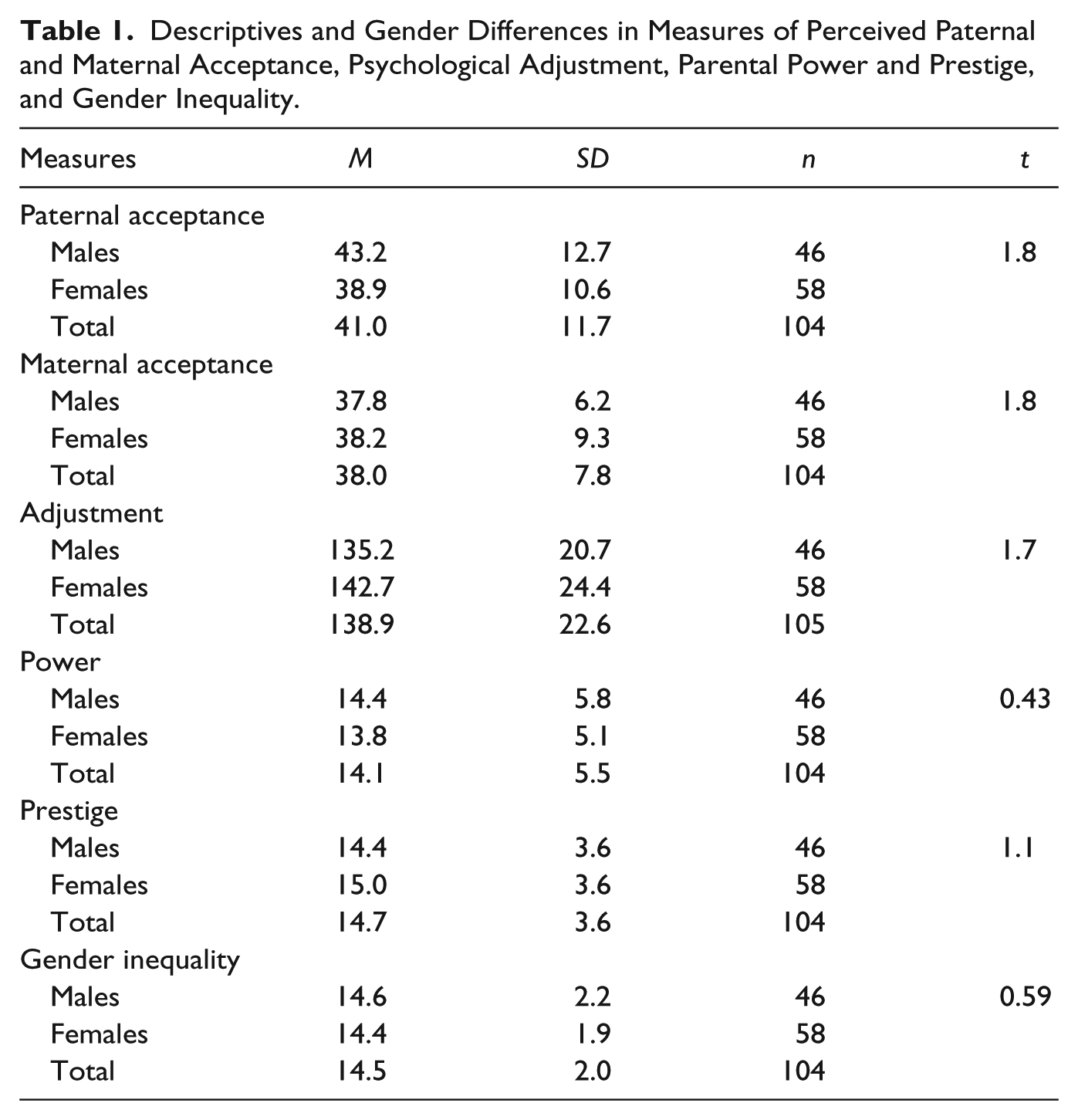
Table 2 shows that self-reported psychological adjustment was significantly and positively correlated with both perceived paternal and maternal acceptance. The table also shows that parental prestige was negatively correlated with paternal acceptance, but positively correlated with maternal acceptance. These results suggest that the more accepting fathers were perceived to be the more prestige they had. Similarly, the more accepting mothers were perceived to be the more prestige they had. Prestige was not significantly correlated with psychological adjustment, however.
Correlations Among Paternal and Maternal Acceptance, Parental Power and Prestige, and Students’ Psychological Adjustment (N = 187).
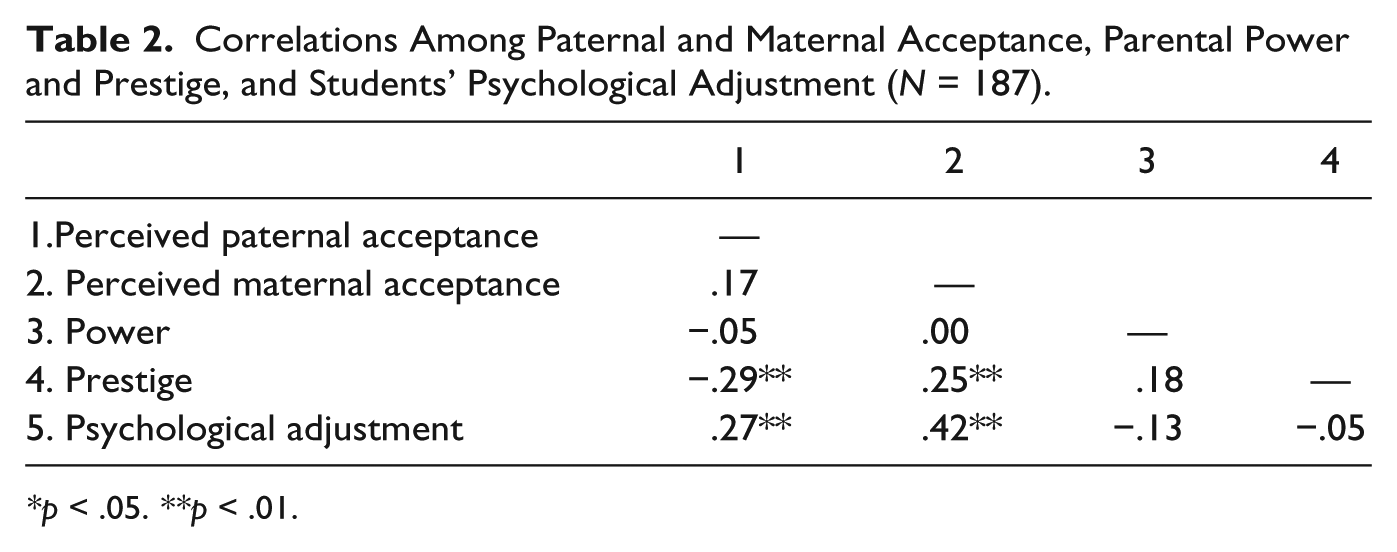
p < .05. **p < .01.
To determine whether both maternal and paternal acceptance accounted for unique portions of the variance in young adults’ psychological adjustment—or if parental power or prestige might have moderated these relations—a hierarchical multiple regression was completed.
As shown in Table 3, participants’ sex was entered as a control variable in Step 1. This variable did not contribute to a unique portion of the variance in participants’ psychological adjustment, however. The main variables of paternal and maternal acceptance, power, and prestige were entered into Step 2. Here, one can see that both paternal and maternal acceptance made significant and independent contributions to students’ self-reported psychological adjustment. Twenty-seven percent of the variance in participants’ psychological adjustment was accounted for by these variables.
Hierarchical Regression Analyses Predicting Young Adults’ Psychological Adjustment.
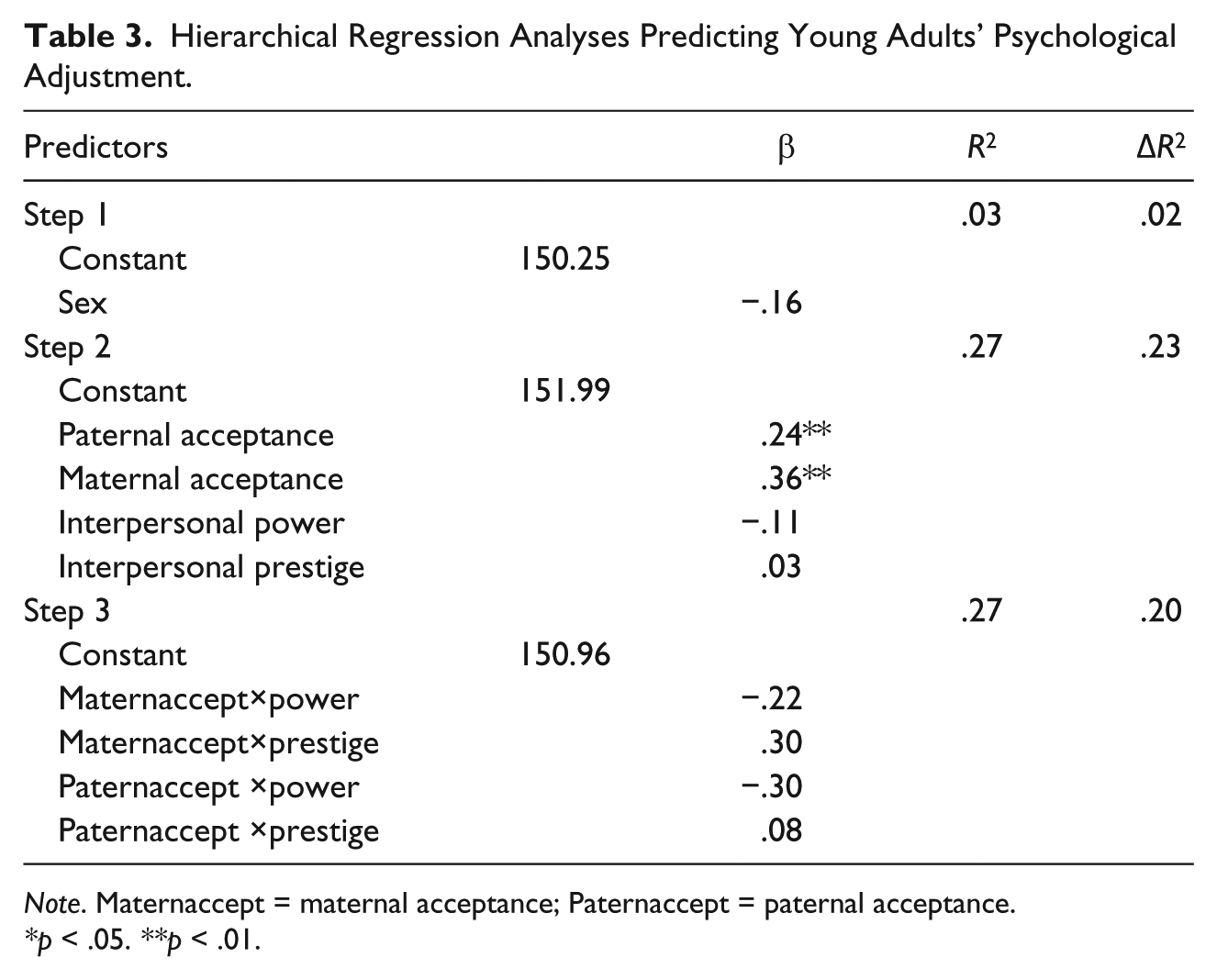
Note. Maternaccept = maternal acceptance; Paternaccept = paternal acceptance.
p < .05. **p < .01.
Finally, we created four interaction variables in Step 3. They were maternal acceptance by power, maternal acceptance by prestige, paternal acceptance by power, and paternal acceptance by prestige. Results of analyses showed that neither power nor prestige moderated the relationship between young adults’ psychological adjustment and either maternal acceptance or paternal acceptance.
Discussion
Parental Acceptance-Rejection Theory’s postulate that perceived parental acceptance is universally a significant predictor of offspring’s psychological adjustment is supported by our results in that both paternal and maternal behaviors significantly predict offspring’s adjustment in Gilgit-Baltistan. These findings are supported by other studies in Pakistani culture where Najam and Kausar (2012) and Hussain and Munaf (2012) reported that perceived paternal acceptance is a significant predictor of psychological adjustment for Pakistani adolescents and university students, and that both maternal and paternal acceptance is a significant predictor of Pakistani school children’s adjustment (Munaf, 2010).
Results in this study show that parental prestige is negatively related to paternal acceptance. This implies that in families where fathers are perceived to have higher prestige than mothers, offspring tend to perceive their fathers as more loving and accepting than in families where fathers have less prestige. Similar findings were also reported by Khaleque, Rohner, and Shirin (2010) in Bangladesh, and by Tkalic (2010) in Croatia. Similarly, the positive correlation in Gilgit-Baltistan between perceived parental prestige and maternal acceptance reveals that in families where mothers are perceived by their offspring to have higher prestige than fathers, offspring tend to perceive their mothers as being more accepting than in families where mothers are perceived to have less prestige. Contrary to expectation, however, neither parental power nor parental prestige moderated the relationship between perceived parental acceptance and offspring’s psychological adjustment. But much of the available literature such as Carrasco and Rohner (2012) and the majority of studies in this Special Issue suggest contrary evidence.
Finally, we should mention that this study contributes important new information about a remote and little-studied region of Pakistan. Nonetheless, the study also has important limitations. For example, it represents only a single segment (i.e., university students) of this somewhat isolated population, and the sample is fairly small. Future research must include a larger sample from larger segments of this population.
Footnotes
Declaration of Conflicting Interests
The author(s) declared no potential conflicts of interest with respect to the research, authorship, and/or publication of this article.
Funding
The author(s) received no financial support for the research, authorship, and/or publication of this article.