



Abstract
This article explored the effects of perceived maternal and paternal acceptances, parental power, and parental prestige on young adults’ psychological adjustment. The sample consisted of 252 university students (24% men) with a mean age of 20.74 years on the island of Crete, Greece. Measures used were the adult versions of the Parental Acceptance–Rejection Questionnaire for mothers and fathers, youth version of the Parental Power–Prestige Questionnaire, and adult version of the Personality Assessment Questionnaire. Men perceived their fathers to be significantly less accepting but more powerful than did women. For both men and women, perceived maternal and paternal acceptances were significantly correlated with psychological adjustment. Moreover, parental prestige was positively correlated with men’s psychological adjustment, but parental power was negatively correlated with women’s psychological adjustment. Furthermore, women’s (but not men’s) remembrances of paternal acceptance in childhood were positively correlated with both parental power and parental prestige. Results of hierarchical regression analyses revealed that remembered maternal acceptance and the composite variable parental power–prestige were uniquely and positively associated with men’s psychological adjustment. Moreover, perceived parental power was uniquely but negatively associated with men’s adjustment. For women, however, both remembered maternal and paternal acceptances were unique predictors of psychological adjustment. Neither parental power nor prestige moderated the relation between perceived acceptance and psychological adjustment for women, but parental power did moderate this relationship for men.
Introduction from the Editors
In order to avoid unnecessary redundancy across the data-oriented articles in this Special Issue, common issues relevant to all articles are discussed in Rohner’s Introduction (Rohner, 2014). These issues include an introduction to the International Father Acceptance-Rejection Project, of which this article is a part. Common issues also include description of measures used by authors, as well as data analytic procedures employed by all authors. Only information specific to this study is included here.
Method
Participants
Two hundred fifty-two university students (24% males) were randomly recruited from the University of Crete in Greece. The mean age of participants was 20.74 years (SD = 3.92). The vast majority of students (99%) were Greek Orthodox. All attended mixed-sex schools, and all were the biological offspring of their resident parents.
Measures
Personal Information Form (PIF)
Adult Participants completed the PIF, where they reported their age, gender, ethnicity, and other demographic information (Rohner, 2004). Thirty-one percent of the mothers and 33% of the fathers had college or university training for skilled or semi-skilled work. Most fathers (83%) and mothers (68%) were employed in full- or part-time jobs.
Parental Power–Prestige Questionnaire (3PQ)
Coefficient alphas in this study were .76 for the power scale, .81 for the prestige scale, and .85 for the total score (Rohner, 2011). A principal components factor analysis, using Varimax rotation was conducted to test further psychometric properties of the 3PQ. The Kaiser–Meyer–Olkin measure of sampling adequacy was .88, above the recommended value of .60; Bartlett’s test of sphericity was significant, χ2(45) = 875.15, p < .001. A two-factor solution emerged, explaining 56.9% of the variance. The Power factor explained 44.5% of the variance, and the Prestige factor explained 12.4% of the variance. These results provide initial evidence for acceptable validity of this measure.
Parental Acceptance–Rejection Questionnaire: Adult version (adult PARQ: Father and mother versions)
Coefficient alphas in this study were .93 for mothers and .92 for fathers (Rohner, 2005).
Personality Assessment Questionnaire: Adult version (adult PAQ)
In this study, Cronbach’s alpha for the total score was .92 (Rohner & Khaleque, 2005).
Gender Inequality Scale (GIS)
The index of gender inequality was calculated from a random sample of 56 students from different departments (28.4% men; M age = 21.8, SD = 2.06; Rohner, 2012). The educational background of participants’ parents was generally high, with fathers being better educated than mothers (89.2% and 78.6% completed secondary education or higher, respectively). The mean of the GIS was 10.21 (SD = 2.37). This score reveals that Greece is generally perceived to be a relatively gender equal (egalitarian) society.
A principal components factor analysis using Varimax rotation was conducted to obtain validity information for this scale. The Kaiser–Meyer–Olkin measure of sampling adequacy was .71, and Bartlett’s test of sphericity was significant, χ2(10) = 39.15, p < .001. A single gender inequality factor emerged, explaining 43.6% of the variance. Coefficient alpha was .66. Thus, initial evidence was provided for the psychometric properties of the GIS.
Procedure
The questionnaires were completed by participants during class time. Participation in the study was voluntary, and participants were informed that all data are confidential. After completing a consent form, students filled out the questionnaires in the presence of the researchers, who were available for any clarification needed. Respondents were not offered any payment or other incentive to complete the study. The study was approved by the Ethics Committee of the Department of Psychology, University of Crete.
Results
Table 1 shows the descriptive statistics and gender differences for the measures used in this study. There one can see that both men and women tended to perceive their mothers and fathers to be accepting as well as to report fair overall psychological adjustment. Independent samples t tests revealed significant gender differences in remembered paternal acceptance as well as in perceived parental power. Specifically, men perceived their fathers to be slightly less accepting than did women. Men also saw their fathers as possessing more interpersonal power than did women. Because of these sex differences, all further analyses were conducted separately for men and women.
Descriptive Statistics and Gender Differences in Measures of Perceived Maternal and Paternal Acceptances, Students’ Psychological Adjustment, and Interpersonal Power and Prestige.

p < .05. **p < .01.
As shown in Table 2, the psychological adjustment of both men and women was significantly correlated with remembered maternal and paternal acceptances in childhood. Moreover, the adjustment of men (but not women) correlated negatively with parental prestige, whereas the adjustment of women (but not men) correlated positively with perceived parental power. These results indicate that the higher the prestige men perceived their fathers to have relative to their mothers, the better was men’s psychological adjustment. However, the more power women perceived their mothers to have relative to their fathers, the better was their adjustment. Finally, both power and prestige were significantly correlated with women’s (but not men’s) perceptions of paternal (but not maternal) acceptance.
Correlations Among Maternal and Paternal Acceptances, Interpersonal Power and Prestige, and Students’ Psychological Adjustment.
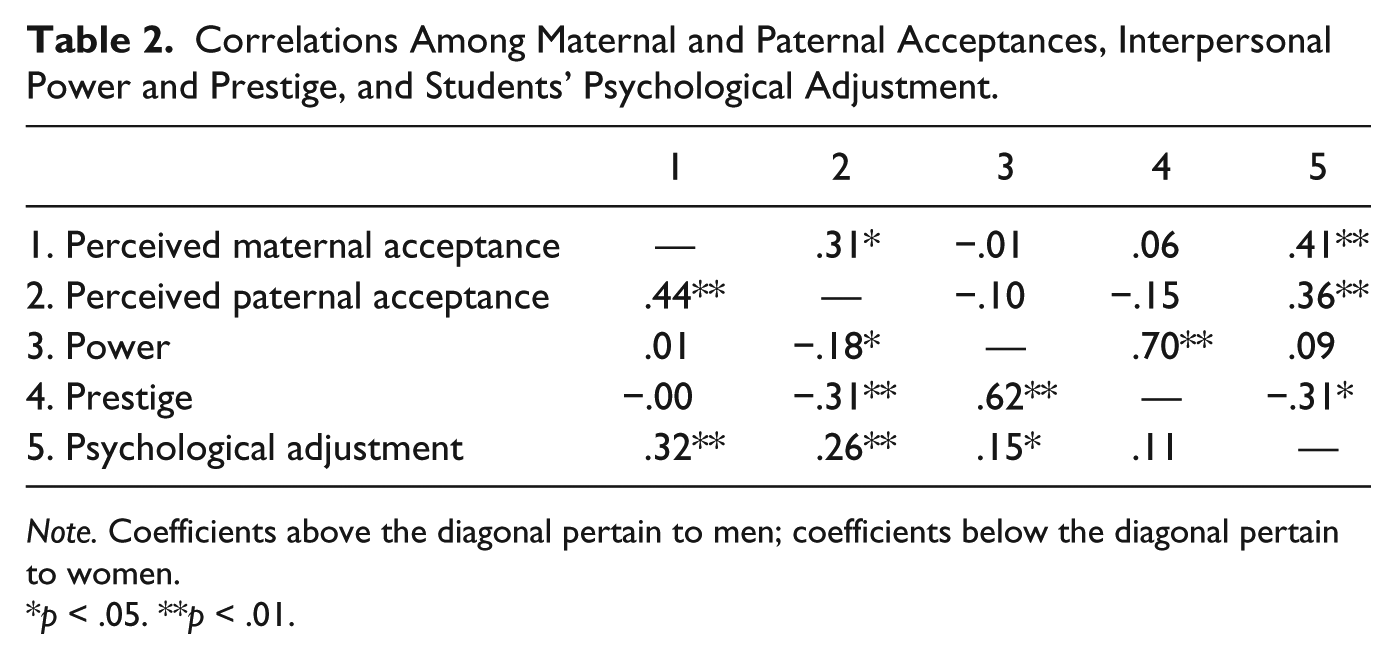
Note. Coefficients above the diagonal pertain to men; coefficients below the diagonal pertain to women.
p < .05. **p < .01.
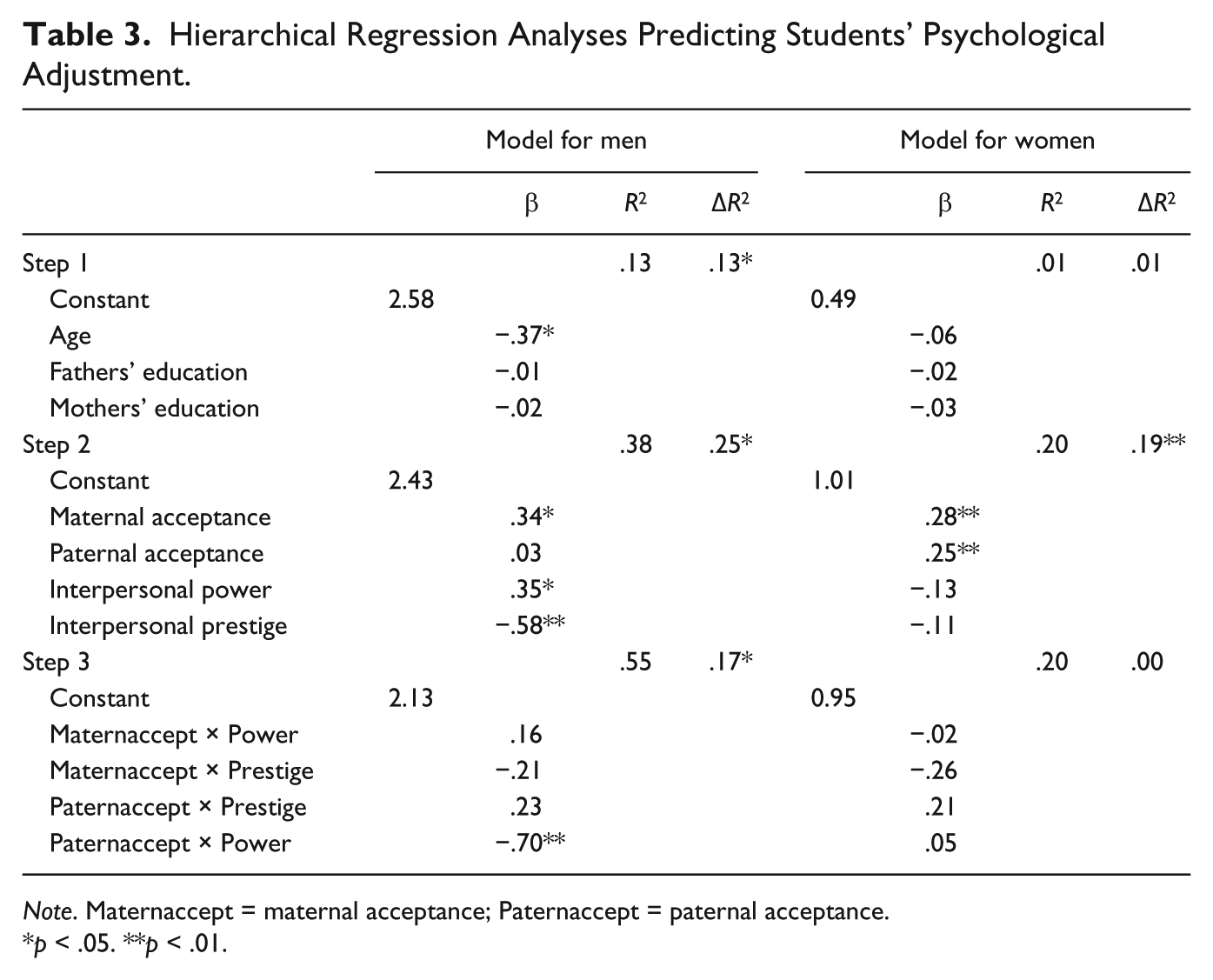
To determine whether perceived maternal and paternal acceptances, power, or prestige made independent contributions to the adjustment of either men or women a hierarchical multiple regression was computed separately for each gender. Respondents’ age and parents’ level of education were entered as control variables in Step 1. Maternal and paternal acceptances were entered into Step 2, along with perceived parental power and prestige. Finally, to determine whether either power or prestige moderated the associations between maternal or paternal acceptance and respondents’ psychological adjustment, four interaction terms shown in Table 3 were entered into Step 3.
Hierarchical Regression Analyses Predicting Students’ Psychological Adjustment.
Note. Maternaccept = maternal acceptance; Paternaccept = paternal acceptance.
p < .05. **p < .01.
As displayed in Table 3, results of analyses show that none of the control variables in Step 1 were significantly associated with women’s adjustment, but age was associated with men’s adjustment: The older the men were, the better adjusted they tended to be. Step 2 shows that both maternal and paternal acceptances were uniquely associated with women’s adjustment, but only maternal acceptance was associated with men’s adjustment. However, men’s adjustment was also uniquely affected by parental power and prestige. These results reveal that the more prestige fathers had in relation to mothers the better was men’s adjustment. However, the more power mothers had relative to fathers, the better was men’s adjustment. Collectively, all the variables in the model for men explained 55% of the variance in men’s psychological adjustment. The model explained only 20% of the variance in women’s adjustment.
Finally, Step 3 shows that parental power moderated the relationship between paternal acceptance and men’s (but not women’s) psychological adjustment. This interaction was further analyzed by a separate post hoc multiple regression analysis following suggestions by Cohen, Cohen, West, and Aiken (2003). We transformed the standardized moderating variable (interpersonal power) into three groups, according to criteria set forth by Cohen and Cohen (1983): 1 SD above the mean, the mean, and 1 SD below the mean. After transforming the variables, we performed new linear regression analyses for each level of the moderating variable. Last, we created the graphic representation shown in Figure 1, according to the criteria of Aiken and West (1991), and using Soper’s (2006) interaction software. Results showed that the more accepting fathers were perceived to be, the better was men’s psychological adjustment under the −1SD condition, where fathers were perceived to have less power than mothers (β = .72, p = .001), as well as under the mean condition, where mothers and fathers were perceived to be equally powerful (β = .28, p < .05). However, higher paternal acceptance was not significantly associated with increases in men’s psychological adjustment under the +1SD condition where fathers were perceived to have more power than mothers (β = −.16, p = .25). These results suggest that the magnitude of the relationship between perceived paternal acceptance and men’s psychological adjustment intensified to the degree that men perceived their mothers to have more power than their fathers. The magnitude of the relationship was not significantly affected, however, when fathers’ power was perceived to be greater than mothers’.
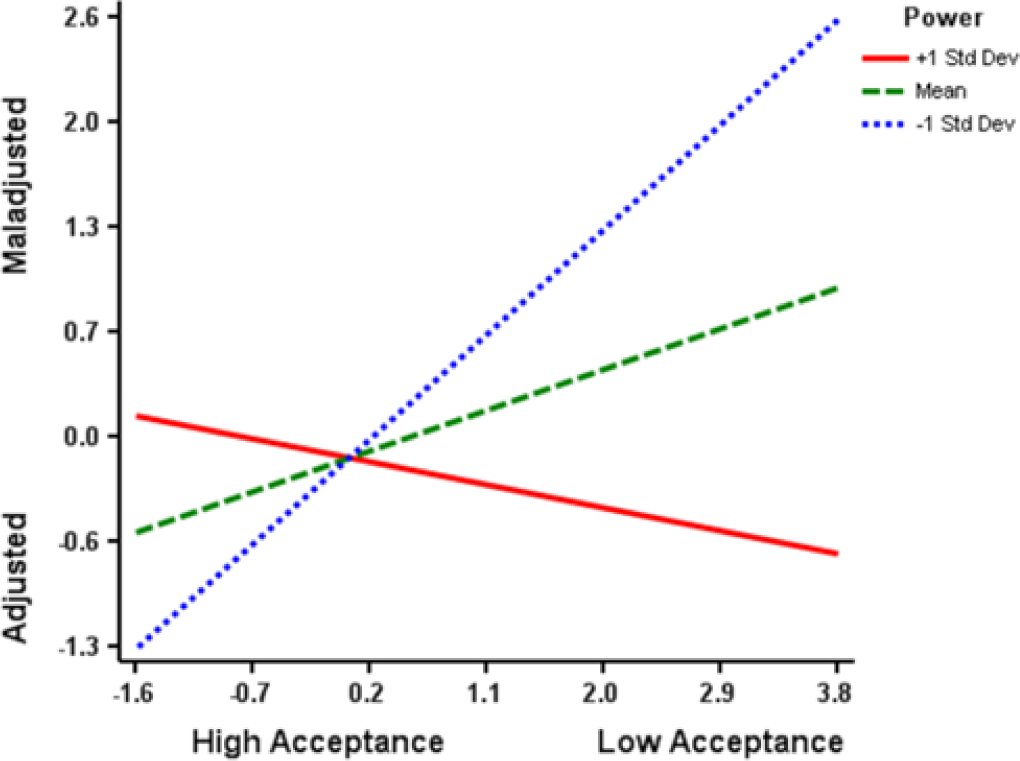
Paternal acceptance predicting men’s psychological adjustment at three levels of parental power.
Discussion
The results of this study indicate that both men and women in Greece tend to remember their mothers and fathers to have been accepting in their childhood, as well as to report fair overall psychological adjustment. However, women remembered their fathers to have been significantly more accepting than did men. Men, however, perceived their fathers to have more interpersonal power within the family than did women. Correlation analyses show that remembered paternal and maternal acceptances in childhood is associated in Greece with higher levels of psychological adjustment among both men and women. Furthermore, hierarchical multiple regression analyses indicate that remembrances of both maternal and paternal acceptances contribute independently to the psychological adjustment of both men and women, after controlling for parental educational status. These results are consistent with previous findings, which show that paternal warmth and love is at least as important for offspring development as is maternal warmth and loving behaviors (Rohner, 1998; Rohner & Veneziano, 2001).
Interesting findings in this study concern the correlations between paternal power and prestige and Greek students’ psychological adjustment. More specifically, higher levels of paternal power tend to be correlated with lower levels of psychological adjustment among women, whereas higher levels of paternal prestige tend to be correlated with higher levels of psychological adjustment among men. In addition, hierarchical multiple regression analyses show that both paternal power and prestige make independent contributions to men’s psychological adjustment. Taken together, these results suggest that in Greek families, fathers play a more distinctive role in the lives of their sons’ than in the lives of their daughters. These results support the conclusion in prior studies (Cabrera, Tamis-LeMonda, Bradley, Hofferth, & Lamb, 2000) that sons are sometimes more affected by their fathers’ behavior than are daughters.
Moreover, results of hierarchical multiple regression also reveal that power moderates the relationship between perceived paternal acceptance and men’s psychological adjustment. However, this moderating effect is in the opposite direction from what was expected. That is, the magnitude of the relationship between perceived paternal acceptance and men’s psychological adjustment intensifies to the degree that men perceive their mothers to have more power than their fathers. These results support the hypothesis that the relation between perceived paternal versus maternal acceptance and psychological adjustment of offspring is significantly moderated by the level of perceived interpersonal power of each parent within the family. However, not confirmed was the hypothesis about a synergistic moderation—where the effect of paternal acceptance on psychological adjustment intensifies under the condition of high paternal interpersonal power. Rather, in this instance the relationship between perceived paternal acceptance and men’s psychological adjustment is affected by a buffered moderation—where perceived paternal power diminishes the relationship between perceived paternal acceptance and men’s adjustment. This means that when fathers are perceived to have high power, the low paternal acceptance has less impact on men’s psychological adjustment than when fathers are perceived to have low power. Further research will have to be conducted among adults in Greece to determine whether these results are stable—and if so, why. In the meantime, it seems clear that fathers’ interpersonal power and prestige within the family do make unique contributions to young adults’ psychological adjustment.
Footnotes
Declaration of Conflicting Interests
The author(s) declared no potential conflicts of interest with respect to the research, authorship, and/or publication of this article.
Funding
The author(s) received no financial support for the research, authorship, and/or publication of this article.