



Abstract
This article discusses the relationship between perceived paternal and maternal acceptance, parental power and prestige, and psychological adjustment, having in mind national and international gender equality indicators. The sample consisted of 785 Portuguese college students, 44% of whom were men. The participants ranged in age from 18 through 62 years (M = 22.38). Measures used were Portuguese translations of the adult versions of the Parental Acceptance–Rejection Questionnaire for mothers and fathers, and the Personality Assessment Questionnaire, as well as the Parental Power–Prestige Questionnaire. Gender differences were found only in perceived parental power, with men perceiving fathers as being more powerful than did women. The study concluded that parental power (especially paternal power) moderated the relation between perceived paternal acceptance and women’s psychological adjustment. However, parental prestige (especially paternal prestige) moderated the relation between perceived paternal acceptance and men’s psychological adjustment.
Introduction from the Editors
In order to avoid unnecessary redundancy across the data-oriented articles in this Special Issue, common issues relevant to all articles are discussed in Rohner’s Introduction (Rohner, 2014). These issues include an introduction to the International Father Acceptance-Rejection Project, of which this article is a part. Common issues also include description of measures used by authors, as well as data analytic procedures employed by all authors. Only information specific to this study is included here.
Method
Participants
Seven hundred eighty-five undergraduate students (44% men) aged 18 through 62 years (M = 22.38, SD = 5.57) participated in the research. Ninety-four percent were of European descent, and 80% were Catholic. Fifty percent were unemployed, but 18% were looking for work. The remainder were employed either part- or full-time. Ninety percent of the students were unmarried. All had lived with both their mothers and fathers in childhood.
Procedures
After receiving necessary authorization from the university to conduct this research, and after receiving signed informed consent from students, we administered the following Portuguese-language questionnaires to students during class time.
Measures
Personal Information Form (PIF)
The PIF (Rohner, 2005b) inquired about participants’ age, sex, ethnicity, religion, employment, university year, marital status, people with whom they lived, and other social-demographic issues.
Parental Power–Prestige Questionnaire (3PQ)
Coefficient alphas in this study (Rohner, 2011) were .83 for the Power scale, .85 for the Prestige scale, and .89 for the total score. Factor analysis (KMO = .92) revealed two factors explaining 61% of the variance. Factor loadings equaled .63 or more for the power factor and .54 or more for the prestige factor.
Parental Acceptance–Rejection Questionnaire (child PARQ: father version and mother version)
Coefficient alphas in this study (Rohner, 2005a) were .83 for mothers and .85 for fathers.
Personality Assessment Questionnaire (child PAQ)
In this study (Rohner & Khaleque, 2005), Cronbach’s alpha for the total score was .81.
Gender Inequality Scale (GIS)
The index of gender inequality was calculated from a random sample of 59 respondents (15% men; M age = 36.03 years, SD = 10.85), ranging in age from 22 through 66 years. The sample was composed of participants from different occupations and socioeconomic statuses. The mean of the GIS (Rohner, 2012) was 13.68 (SD = 2.96). This score reveals that Portugal is perceived to have slight gender inequality. Coefficient alpha in this study was .77. The slight gender inequality shown here is not surprising, given the fact that until 1974—with the advent of the Carnation Revolution in Portugal (Ferreira, 1998; Guerreiro & Alexandre, 2006; Neves & Nogueira, 2010)—gender inequality was institutionalized in public domains such as labor and political representation, and especially in domestic domains such as housework and child care. Several political and social measures have been implemented since 1974, however, to assure greater gender equality.
Results
As shown in Table 1, both men and women tended to perceive their parents to be accepting, and they tended to report themselves to be psychologically well adjusted. Both men and women also tended to see their parents as having similar levels of prestige. Women, however, tended to see their mothers as having slightly more interpersonal power than their fathers, but men saw their mothers and fathers as having roughly equal power. The difference between men’s perceptions and women’s perceptions of parental power was statistically significant. Because of this gender difference, all further analyses were conducted based on sex.
Descriptive Statistics and Gender Differences in Measures of Perceived Maternal and Paternal Acceptance, Adults’ Psychological Adjustment, and Interpersonal Power and Prestige.
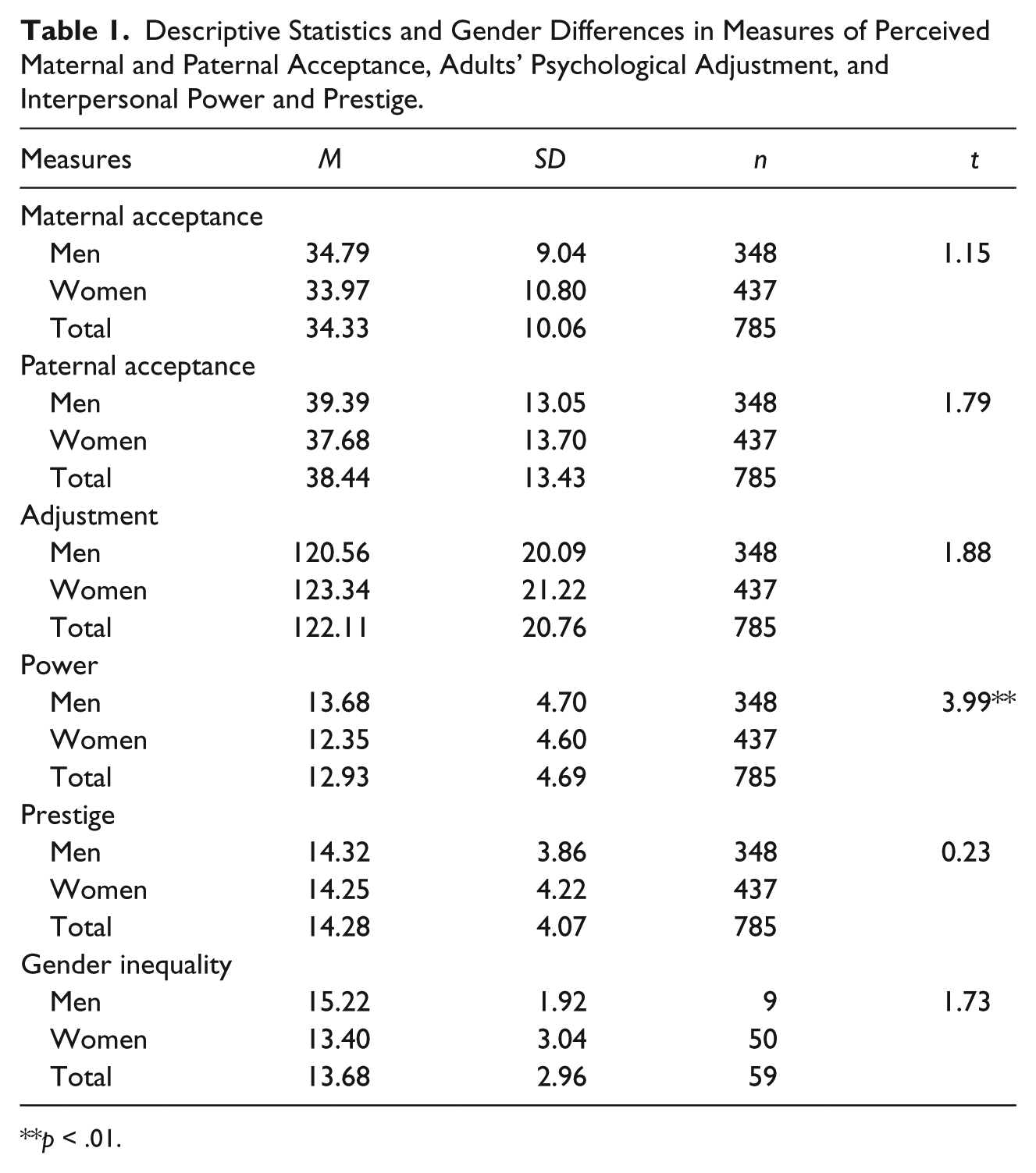
p < .01.
Table 2 shows that the psychological adjustment of both men and women was significantly correlated with perceived maternal and paternal acceptance. In addition, paternal (but not maternal) acceptance was negatively correlated with both men’s and women’s perceptions of parental power and prestige. These results indicate that the more powerful and prestigious men and women perceived their fathers to be relative to their mothers, the more accepting fathers were perceived to be. However, women’s (but not men’s) perceptions of maternal acceptance correlated positively with both parental power and prestige. These results indicate that the more powerful and prestigious women perceived their mothers to be relative to their fathers, the more accepting mothers were perceived to be.
Correlations Between Maternal and Paternal Acceptance, Interpersonal Power and Prestige, and Adults’ Psychological Adjustment.
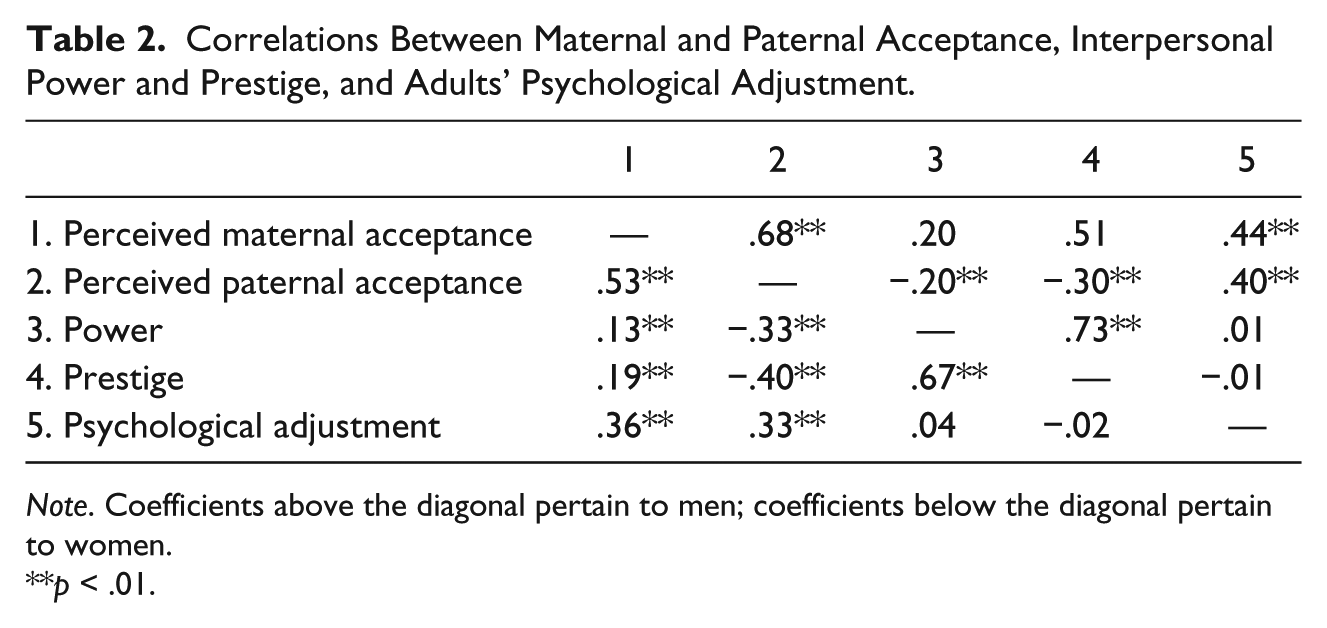
Note. Coefficients above the diagonal pertain to men; coefficients below the diagonal pertain to women.
p < .01.
To determine whether maternal or paternal acceptance, parental power, or prestige interacted to affect either men’s or women’s psychological adjustment, we conducted a hierarchical multiple regression analysis. Before conducting this analysis, we standardized the four major predictors: maternal and paternal acceptance along with parental power and parental prestige. As shown in Table 3, age and education were then entered into Step 1 as control variables. Step 2 included maternal and paternal acceptance along with parental power and parental prestige. Step 3 included four interaction terms involving maternal and paternal acceptance and power and prestige. Results of analyses displayed in Table 3 show that both women’s and men’s ages were modest but significant predictors of adults’ psychological adjustment: The older the respondents were, the better adjusted they tended to be. Step 2 showed that both maternal and paternal acceptance each uniquely predicted variations in both women’s and men’s adjustment after controlling for the effects of age and level of education. Neither parental power nor prestige made a significant contribution to the students’ adjustment, however. Nonetheless, Step 3 shows that perceived parental power moderated the relation between perceived paternal acceptance and women’s (but not men’s) psychological adjustment. Even though all slopes were significant, Figure 1 graphically shows that the effect of paternal acceptance on women’s psychological adjustment was stronger under the condition of +1 SD interpersonal power—where parents shared equal power (β = .62, p < .001)—than under the −1 SD condition where women perceived their mothers to have the most power (β = .28, p < .001) in the family, or under the condition of mean interpersonal power where mothers were also perceived to have more power than fathers (β = .45, p < .001). Comparing the relative differences between groups, and given the fact that the confidence intervals around these betas were non-overlapping, we conclude that the magnitude of the relationship between perceived paternal acceptance and daughters’ psychological adjustment intensified significantly the more interpersonal power fathers were perceived to have relative to mothers.
Hierarchical Regression Analyses Predicting Adults’ Psychological Adjustment.
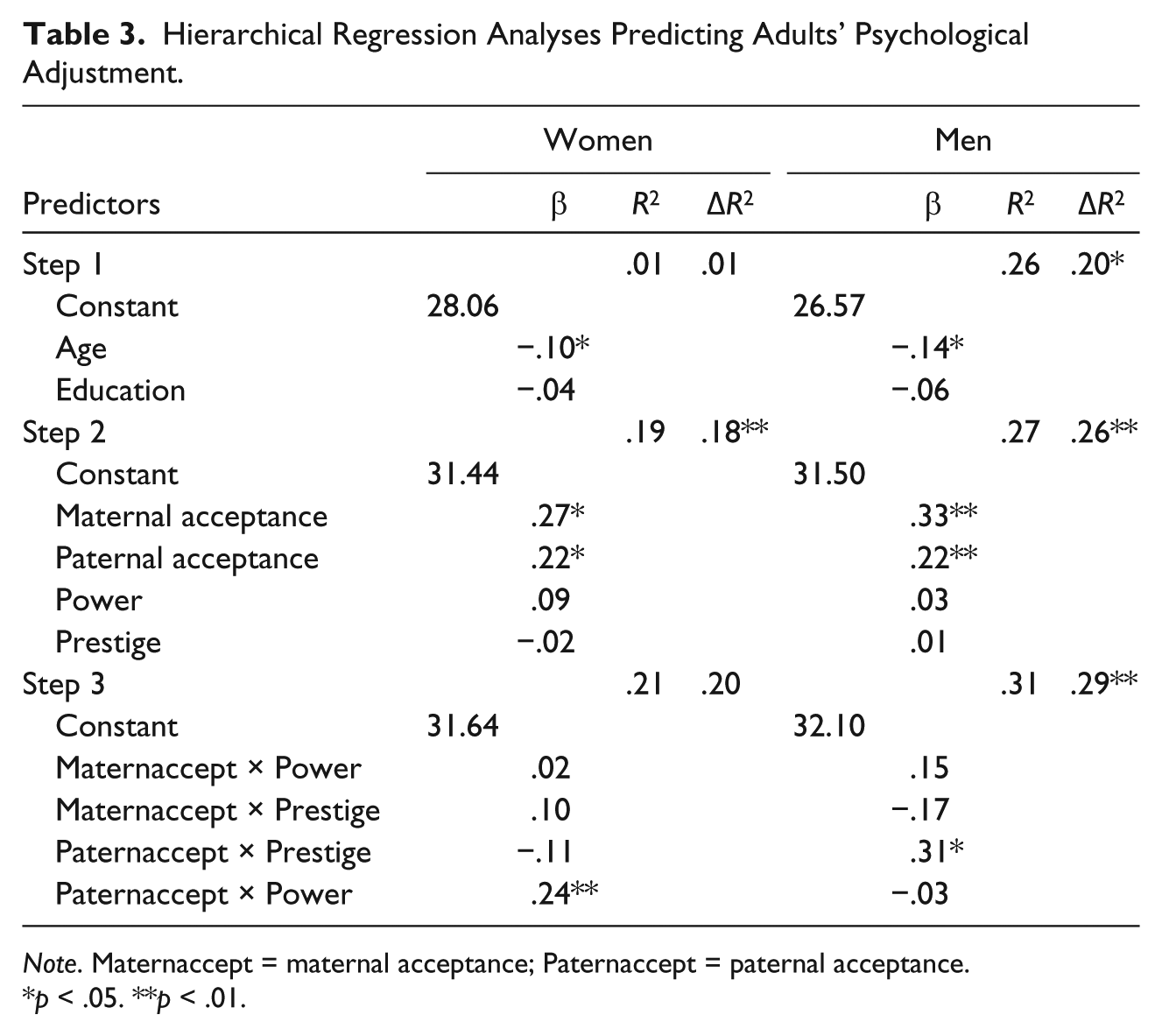
Note. Maternaccept = maternal acceptance; Paternaccept = paternal acceptance.
p < .05. **p < .01.

Paternal acceptance predicting women’s psychological adjustment at three levels of parental power.
For men, however, paternal prestige played a moderating role, with all slopes being significant. Specifically, as shown in Figure 2, under the +1 SD condition—where men perceived their fathers to have more prestige than mothers (β = .73, p < .001), the influence of paternal acceptance on men’s psychological adjustment was stronger than under the −1 SD condition where men perceived their fathers to have less prestige than mothers (β = .28, p < .001), or under the mean interpersonal prestige condition where mothers and fathers were perceived to share equal prestige (β = .50, p < .001). Given the fact that the confidence intervals around these betas were non-overlapping, we conclude that the magnitude of the relationship between perceived paternal acceptance and men’s psychological adjustment intensified significantly the more prestige fathers were perceived to have relative to mothers.
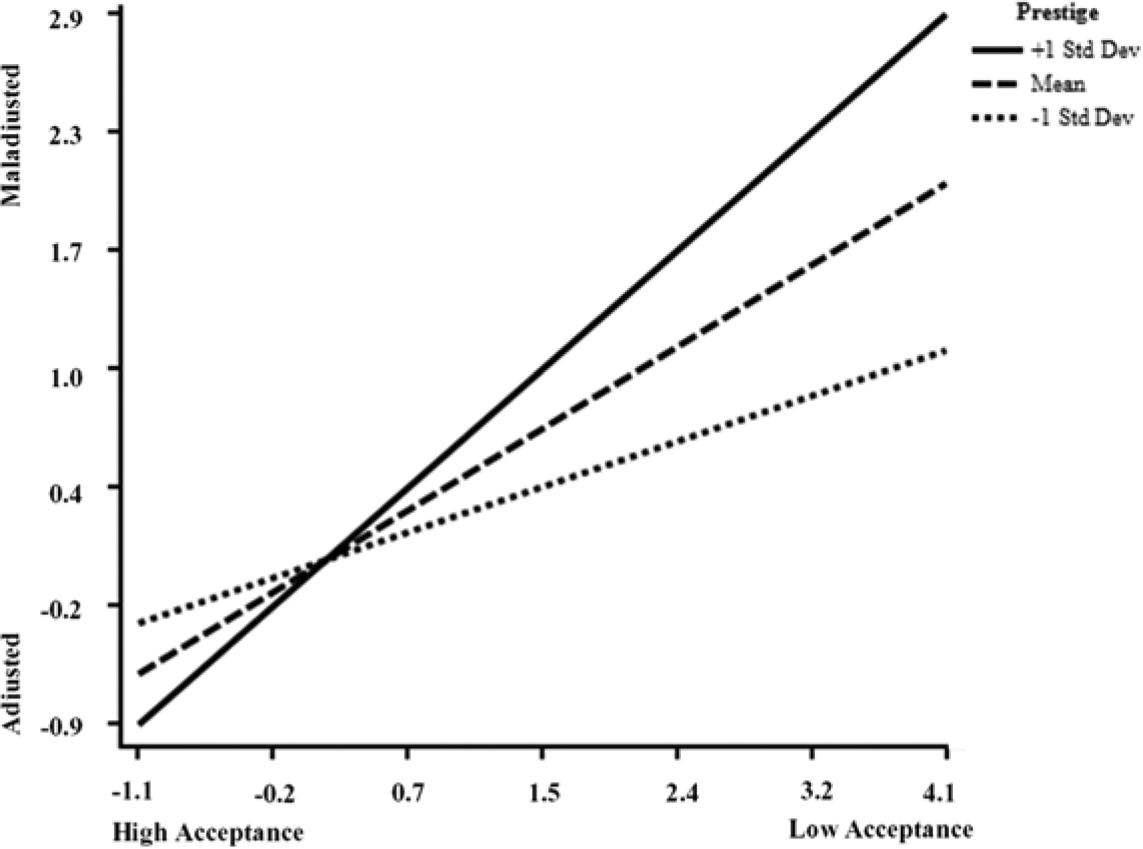
Paternal acceptance predicting men’s psychological adjustment at three levels of parental prestige.
Discussion
Students in this study tend to perceive their fathers and mothers to be warm and accepting. They also tend to report good psychological adjustment. As expected from prior research (Dwairy, 2010; Dwairy et al., 2010; Khaleque & Rohner, 2012; Rohner, 1986; Rohner, Khaleque, & Cournoyer, 2013), the perception of parental (both maternal and paternal) acceptance is associated in Portugal with positive psychological adjustment of both men and women.
Both men and women tend to perceive their parents to be approximately equal in prestige. But women tend to perceive their mothers as having more power than their fathers, whereas men tend to perceive both parents to be roughly equal in power. Most importantly, the more powerful and prestigious men and women perceive their fathers to be relative to their mothers, the more accepting they see their fathers to be. Moreover, the more powerful and prestigious women (but not men) perceive their mothers to be relative to fathers, the more accepting women perceive their mothers to be. Nonetheless, neither interpersonal power nor prestige makes a significant contribution by itself to students’ adjustment.
Results of hierarchical multiple regression analyses, however, show that perceived parental power moderates the relation between perceived paternal acceptance and women’s (but not men’s) psychological adjustment. Specifically, the magnitude of the relationship between perceived paternal acceptance and daughters’ adjustment intensifies the more power fathers are perceived to have relative to mothers. For men, however, paternal prestige tends to moderate the relationship between perceived paternal acceptance and men’s (but not women’s) psychological adjustment. Specifically, the magnitude of the relationship between perceived paternal acceptance and men’s adjustment intensifies the more prestige fathers are perceived to have relative to mothers. This evidence supports assumptions underlying the International Father Acceptance–Rejection Project
The results are more complex than initially anticipated, however. That is, results here suggest that parents’ interpersonal power and prestige affect the relationship between perceived parental acceptance and offspring’s psychological adjustment in different ways depending on the sex of the parent and the sex of the offspring. Clearly, more research is required on this topic to understand what mechanism might have produced such genderized effects.
Footnotes
Authors’ Note
All authors are lecturers and researchers at the Instituto Superior da Maia (ISMAI), Portugal.
Declaration of Conflicting Interests
The author(s) declared no potential conflicts of interest with respect to the research, authorship, and/or publication of this article.
Funding
The author(s) received no financial support for the research, authorship, and/or publication of this article.