



Abstract
Drawing stimulus from parental acceptance–rejection theory (PARTheory), which postulates a pancultural association between perceptions of parental acceptance–rejection and offspring’s (children’s and adults’) psychological adjustment, this article describes the International Father Acceptance–Rejection Project along with the results of 13 studies in 11 nations. These studies not only test this postulate but also more importantly explore the question of whether offspring’s perceptions of parental power and parental prestige tend to moderate the relationship between perceived parental acceptance and offspring adjustment. This question derives from the fact that offspring’s perceptions of their fathers’ acceptance sometimes have a greater impact on the psychological adjustment of youth than do offspring’s perceptions of their mothers’ acceptance. Sometimes, however, offspring’s perceptions of their mothers’ acceptance have a greater impact on adjustment than do offspring’s perceptions of their fathers’ acceptance. And sometimes there is no significant difference in the impact of one parent’s acceptance versus the other parent’s. This much is known. But what is not known is, Why or under what conditions do the love-related behaviors of one parent have a greater impact on the adjustment than the love-related behaviors of the other parent? Results of research described in this Special Issue point in the direction of one class of conditions that helps to answer this question.
The International Father Acceptance–Rejection Project (IFARP): A Short History
The IFARP focuses on a central research question: Do parental power and prestige moderate the relationship between perceived parental acceptance and offspring’s psychological adjustment? This question evolved from the fact that researchers have known for at least 15 years that fathers’ love (perceived paternal acceptance) often explains as much or more of the variance in specific child and adult outcomes as does mothers’ love (Rohner, 1998). Sometimes, however, fathers’ love is the sole significant predictor of specific developmental and adjustment-related outcomes, after controlling for the influence of mothers’ love; sometimes mothers’ love is the sole significant predictor, after controlling for the influence of fathers’ love; and sometimes there is no significant difference in the influence of one parent versus the other (Rohner & Veneziano, 2001). Until recently, factors that explain this variation in parental influence—especially factors associated with the greater developmental influence of one parent versus the other—have been unknown.
I among many other researchers puzzled over this conundrum for several years until one day late in 2007, the thought occurred to me that children sometimes look up to their fathers more than to their mothers, even though fathers generally tend to be around their children less often than mothers. It seemed reasonable to expect that insofar as children look up to their fathers more than to their mothers, children are also likely to pay more attention to and therefore to be more influenced by their fathers’ behaviors than their mothers’. Putting these thoughts into the context of parental acceptance–rejection theory (PARTheory), on which the IFARP is based and which postulates a pancultural association between perceived parental acceptance–rejection and offspring’s psychological adjustment (Khaleque & Rohner, 2011, 2012), it seemed reasonable to expect that perceived paternal acceptance or rejection might have a greater impact on offspring’s psychological adjustment than perceived maternal acceptance or rejection. Shortly after that time, however, I realized that this process should be equally true if children look up to their mothers more than their fathers. The question then became, Insofar as children tend to look up to one parent more than the other, does that parent’s love-related behaviors have a greater impact on the psychological adjustment of the children than the love-related behaviors of the other parent?
The question in my mind then became how should we conceptually define and operationalize the fuzzy notion of “look up to”? The answer was immediate. “Looking up to someone,” I thought, is really a matter of perceived prestige and interpersonal power. Both were concepts that I had studied as a graduate student many years earlier in small-group behavior sociology, and later employed in my doctoral research in a Kwakwala-speaking Indian village in British Columbia, Canada. As construed there (Rohner, 1967) and in PARTheory, interpersonal power is defined as a person’s ability to influence the opinions and behavior of others. Interpersonal power is distinguished in PARTheory from authority, which is defined as institutionalized power given to individuals as a consequence of their formal status. Interpersonal power, however, emerges only through informal interactions between two or more individuals within a family or other small group. 1 Prestige is defined in PARTheory as signs of approval, esteem, respect, admiration, approbation, or being highly regarded by other members of the family or other small groups. According to small-group behavior sociologists (e.g., Dornbusch, Zelditch, Berger, Cohen, & Scott, 1962), interpersonal power and prestige are usually distributed unevenly throughout a group (e.g., within a family). That is, no two individuals share the same amount of either. Consequently, members of small groups can usually be ranked in both an interpersonal power structure and a prestige structure, but the two structures are often significantly correlated.
With these definitions in mind, the next task was to create operational measures of offspring’s (children’s and adults’) perceptions of the interpersonal power and prestige of each parent within a family relative to the other parent. But because I had no way of knowing at that time whether differences in offspring’s perceptions of mothers’ versus fathers’ power and prestige would affect the magnitude of the relationship between perceived parental (maternal or paternal) acceptance and offspring’s (sons’ or daughters’) psychological adjustment, I did not want to potentially waste a great amount of time creating and validating a multi-item measure of power and prestige. So, to keep the task as simple as possible—at least initially—I developed a two-item Power–Prestige Index.
International research using this Index (Carrasco & Rohner, 2013; Erkman, 2010; Giotsa & Zergiotis, 2010; Glavak-Tkalić, 2010; Lloyd, Moore, & Rohner, 2011) showed that the relative power and/or prestige of one parent versus the other does often moderate the relation between perceived parental acceptance and offspring’s adjustment. But that research also showed—from a psychometric perspective—that the two-item Index was a less-than-ideal measure of parental power and prestige. So in 2010, I created the 10-item Parental Power–Prestige Questionnaire (3PQ) used in this research (described later). By that time, quite a few researchers internationally had indicated an interest in getting involved in the IFARP. Ultimately, the 13 teams contributing to this Special Issue completed studies in time to be included here. These teams include psychologists from 11 nations: Bangladesh, China, Croatia, Greece (two studies), Korea, Pakistan (two studies), Poland, Portugal, Spain, Turkey, and the United Kingdom. Researchers in all countries followed the same research design to the greatest extent possible, described next.
Research Design
Sample Selection
Researchers were asked to include approximately 200 or more respondents in their sample, balanced as nearly as possible by gender of offspring. In addition, participants were encouraged to draw samples of 9- through 12-year-old schoolchildren, 13- through 18-year-old adolescents, or college students, whichever age cohort was most practical in their sociocultural context. Only respondents who grew up in intact nuclear families (or larger family units) with their mother and father in residence were to be included in the study.
Measures Used
Four self-report measures and a demographic form were included in all studies. These were the (a) Parental Power-Prestige Questionnaire (3PQ, Youth or Adult); (b and c) short forms of the Child or Adult version of the Parental Acceptance–Rejection Questionnaire (PARQ) for mothers and fathers; (d) Child or Adult version of the Personality Assessment Questionnaire (PAQ); and (e) the Personal Information Form (PIF), for demographic information.
Although not a formal part of this research per se, a sixth measure was also introduced to help determine whether institutionalized gender inequality (e.g., patriarchy) might be an important factor helping to explain sociocultural conditions under which the love-related behaviors of one parent might have a greater impact on offspring’s psychological adjustment than the love-related behaviors of the other parent. This measure was the Gender Inequality Scale (GIS). That measure and all others used in this research were translated and adapted as required in each target language. All measures are described more fully below.
3PQ
The 3PQ (Rohner, 2011) is a 10-item measure created to assess offspring’s assessment of the relative power and prestige of their mothers versus their fathers. Five items assess offspring’s perceptions of parents’ interpersonal power, and 5 items assess offspring’s perceptions of parents’ prestige. A sample item on the Interpersonal Power scale asks, “Who usually has opinions that influence you the most?” A sample item on the Prestige scale asks, “Who do you personally admire more?” Respondents answer questions such as these on a 5-point scale: (1) mother most often; (2) mother more than father; (3) mother and father exactly the same; (4) father more than mother; and (5) father most often. Scores on both scales spread from a low of 5 through a high of 25. Scores below the midpoint of 15 reveal the perception that mothers have more power or prestige than fathers. Scores above the midpoint reveal the perception that fathers have more power or prestige than mothers. Scores around the midpoint itself (e.g., 13-17) reveal the perception that mothers and fathers are more-or-less equal in power and prestige.
Not surprisingly, perceived power and prestige are often significantly correlated. Following Kline’s (1998) recommendation, the two variables were combined in this research to create a single composite power–prestige variable when they were correlated at or above .75. Scores on the composite variable spread from a low of 10 through a high of 50. Scores below the midpoint of 30 reveal the perception that mothers have more power–prestige than fathers. Scores above the midpoint reveal the perception that fathers have more power–prestige than mothers. Scores around the midpoint itself (e.g., 26-34) reveal the perception that mothers and fathers have more-or-less equal power–prestige.
Assessments of the psychometric properties of the 3PQ discussed in each of the articles in this Special Issue show that, for the most part, the reliability of the measure (as assessed by coefficient alpha) and the validity (as assessed by principal components factor analysis) tend to be very good. More specifically—with two exceptions—all coefficient alphas for the Power scale spread from .70 through .86. Also with two exceptions, alphas for the Prestige scale spread from .68 through .92. Finally, in all but one study, factor analyses showed a strong two-factor solution: a Power factor and a Prestige factor. The one exception was in the United Kingdom where the authors found a single strong Power–Prestige factor.
PARQ (short form) for mothers and fathers
The mother and father versions of the PARQ (short form; Rohner, 2005a) are identical except that one assesses respondents’ perceptions of mothers’ behavior and the other assesses respondents’ perceptions of fathers’ behavior. Both contain 24 items, and both are subdivided into four scales measuring offspring’s perceptions of the warmth/affection (e.g., “My mother [father] says nice things about me”), hostility/aggression (e.g., “My mother [father] gets angry at me easily”), indifference/neglect (e.g., “My mother [father] pays no attention to me”), and undifferentiated rejection (e.g., “My mother [father] does not really love me”). The Child PARQ assesses children’s current experiences at the hands of their mothers and fathers; the Adult PARQ assesses adults’ remembrances of parental acceptance–rejection experienced in childhood.
Items in all versions are scored on a 4-point Likert-type scale from (4) almost always true through (1) almost never true. The sum of the four scales (with the warmth/affection scale reverse-scored to create a measure of coldness/lack of affection) constitutes a robust measure of overall perceived maternal and paternal acceptance–rejection. Scores on the PARQ (short form) spread from a low of 24 (maximum perceived parental acceptance) to a high of 96 (maximum perceived parental rejection). Scores at or above 60 reveal the perception of qualitatively more rejection than acceptance. The PARQ has been used in more than 500 studies worldwide and is known to have outstanding reliability and validity for use in cross-cultural research (Khaleque & Rohner, 2002; Rohner, 2005a, 2011). Coefficient alphas in the studies reported in this Special Issue, for example, spread from .79 through .97 for both the father and mother versions of the PARQ.
PAQ: Child and Adult
The Child version of the PAQ (Rohner & Khaleque, 2005) is a 42-item self-report questionnaire assessing the form of psychological adjustment among children known to be universally associated with perceived parental acceptance and rejection (Khaleque & Rohner, 2012; Rohner, 2004). The Adult PAQ is a 63-item measure assessing the same form of psychological adjustment among adults. Psychological adjustment (or maladjustment) is defined in PARTheory by seven personality dispositions measured on both versions of the PAQ. These dispositions include (a) hostility/aggression, passive aggression, or problems with the management of hostility and aggression; (b) dependence or defensive independence depending on form, frequency, severity, timing, and longevity of perceived rejection; (c) feelings of positive or impaired self-esteem; (d) feelings of positive or impaired self-adequacy; (e) emotional (un)responsiveness; (f) emotional (in)stability; and (g) positive or negative worldview. Sample items on the PAQ include, “I want to hit something or someone” (hostility/aggression); “I like my parents to give me a lot of attention” (dependency); “I feel I am no good and never will be any good” (negative self-esteem); “I think I am a failure” (negative self-adequacy); “It is hard for me to show the way I really feel to someone I like” (emotional unresponsiveness); “I get upset when things go wrong” (emotional instability); and “I see life as full of dangers” (negative worldview).
Children and adults respond to items such as these on a 4-point Likert-type scale ranging from (4) almost always true of me to (1) almost never true of me. A profile of individuals’ overall self-reported psychological adjustment is achieved by summing the seven scale-scores after reverse-scoring appropriate items. Scores on the Adult PAQ spread from a low of 63, indicating healthy psychological adjustment through a high of 252 indicating serious psychological maladjustment. Scores at or above the test’s midpoint of 157 reveal that the adults experience themselves to be more psychologically maladjusted than adjusted.
Scores on the Child PAQ, however, spread from a low of 42, indicating healthy psychological adjustment, through a high of 168, indicating serious psychological maladjustment. Scores at or above 105 reveal that the children experience themselves to be more maladjusted than adjusted. The PAQ has been used in several hundred studies internationally, and has been shown to have excellent reliability and validity for use in cross-cultural research (Khaleque & Rohner, 2002; Rohner & Khaleque, 2005). Coefficient alphas for the PAQ in the studies reported here spread from .70 through .96.
At this point, I should acknowledge the major advantages and disadvantages of using the PAQ as the primary outcome variable in this research. Its primary advantage is that it is the only known measure that assesses the specific constellation of personality characteristics believed to be universally associated with the experience of perceived parental acceptance–rejection. Given the fact that it is a self-report measure, however, its major disadvantage is the potential it creates for introducing method bias into the research. That is, given the fact that all the major predictor variables (i.e., perceived parental power and prestige, and perceived parental acceptance–rejection) are self-report measures, it is possible that problems of shared method variance could be introduced into the research by using another self-report as the primary outcome variable. Prior research reported in Rohner and Khaleque (2005) and elsewhere, however, suggests the minimal likelihood of serious shared-methods variance problems, at least in the PAQ/PARQ relationship.
PIF
The PIF (Rohner, 2005b) is used to elicit information about respondents’ age, sex, level of education, occupational status, major language spoken at home, marital status, and other such demographic characteristics of the respondents.
GIS
The GIS (Rohner, 2012) is a five-item measure of gender inequality. The measure assesses the extent to which gender inequality is culturally institutionalized. In effect, it is a measure of institutionalized male dominance or patriarchy. As used in PARTheory, the terms patriarchy/patriarchal pertain to family structures dominated by husbands and fathers. In these contexts, men control a disproportionate amount of institutionalized power or authority over women and children. Thus, patriarchy in this sense implies significant gender inequality. A sample GIS item asks, “To what extent do men in your country tend to be granted authority over their wives and children?” Adults respond to items such as this on a 4-point Likert-type scale from (1) not at all through (4) a great deal. Possible scores spread from a low of 5 (maximum gender equality) through 20 (maximum gender inequality). Scores at or above 13 reveal the perception of more gender inequality than equality. However, scores between 5 and 8 reveal the perception of fundamental gender equality between the sexes; scores between 9 and 12 reveal the perception of more equality than inequality; scores between 13 and 16 reveal the perception of more inequality than equality; and scores between 17 and 20 reveal the perception of fundamental gender inequality. Analyses of the reliability and validity of the GIS reported in articles in this Special Issue show the measure tends to be robust for use in international research. With one exception, for example, coefficient alpha spreads from .66 through .87. Moreover, principal components factor analysis with Varimax rotation was computed on over half the studies reported here. All showed a single, strong gender-inequality factor.
Data Analysis Plan
A principal objective of the IFARP was to try to determine the extent to which parental power and/or prestige might moderate the known worldwide relationship between perceived parental acceptance and offspring’ psychological adjustment. To do this effectively, it was important to standardize to the greatest degree possible the research design, measures used, and the data analysis plan. Our goal was to be able to directly and explicitly compare every study with every other study. Any significant variation in research design, measures used, or data analytic procedures could compromise this goal. With this caveat in mind, authors of studies in this Special Issue were instructed to follow the same progression in the analysis of their data. Specifically, the “Results” section of each study moves through a progression of topics, beginning with an analysis of the descriptive statistics of major variables (e.g., perceived maternal and paternal acceptance, perceived power and prestige, and offspring’s psychological adjustment). Authors then tested for possible gender differences in the principal outcome and predictor variables. Depending on the results of these tests, authors either pooled data across genders or continued all further analyses separately by gender of offspring. Following this, authors then created an intercorrelation matrix of key variables.
The data analysis progression ended with hierarchical multiple regression analyses where potentially important demographic variables such as offspring’s age, grade in school, or family socioeconomic status were often entered into Step 1 to control for the possible influence of variables such as these. Step 2 contained scores for offspring’s perceptions of maternal and paternal acceptance, parental power and parental prestige to test for main effects. Step 3 contained product variables testing for possible interactions between perceived maternal acceptance and parental power or prestige, as well as between perceived paternal acceptance and parental power or prestige.
Patriarchy as a Possible Contributor to Differences in the Intensity of the Relationship Between Parental Acceptance and Offspring Adjustment
As noted earlier, institutionalized gender equality or inequality (e.g., culturally constructed patterns of male dominance or patriarchy vs. gender equality) could be one class of factors influencing the relationship between perceived parental acceptance and offspring adjustment. As a satellite issue to the main objective of this research, the GIS was used by all authors in an effort to answer the question posed by the Editor of this journal: Does the stronger position of males in society make a difference in how important fathers are in the results (C. R. Ember, personal communication, November 9, 2011)?
Results
Offspring (both males and females) in all studies included in the IFARP tended on the average to see both their mothers and fathers as being loving (accepting). Moreover, both males and females tended to self-report, on average, at least fair psychological adjustment. Perceptions of parental power and parental prestige, however, were more variable. Occasionally males and females within a given country differed significantly in their perceptions of parental power (but not prestige). For example, in Greece (Crete), Poland, Portugal, and Turkey, males tended to see both parents as being approximately equal in interpersonal power, but females saw their mothers as having somewhat more power than their fathers. In all the other nations, males and females tended to perceive both parents to be approximately equal in interpersonal power. Moreover, in all 13 IFARP studies, males and females tended to see both parents to be approximately equal in prestige.
As shown in Table 1, adults in 6 (55%) of the 11 nations reported that their country was characterized by varying degrees of patriarchy (i.e., institutionalized gender inequality). These include Bangladesh, China, Korea, Pakistan, Portugal, and Turkey. Adults in the other five nations characterized their country as being more-or-less egalitarian (having gender equity). These include Croatia, Greece, Poland (marginal), Spain, and the United Kingdom. It is important to note that results in the IFARP studies show that in the patriarchal societies—where men are culturally privileged over women—men’s privileges in the public domain do not necessarily extend into the private domain of family life. In fact, in the IFARP studies, offspring (both males and females) were just as likely as offspring in the more egalitarian societies to perceive their mothers and fathers to have equal prestige and equal interpersonal power. It is also important to note that—regardless of the level of institutionalized power and prestige the men may have had in the public domain—these offspring did not attribute significantly more power or prestige to fathers than to mothers. In fact, daughters (but not sons) in Portugal and Poland—two nations characterized by varying degrees of patriarchy—tended to attribute more interpersonal power to their mothers than to their fathers. Thus, from this evidence, it appears that the level of institutionalized gender inequality or patriarchy in a society is not likely to be a significant moderator of the relationship between perceived parental acceptance and offspring’s psychological adjustment.
Summary of Results Regarding Gender Inequality, Gender Differences, and Moderating Effects.
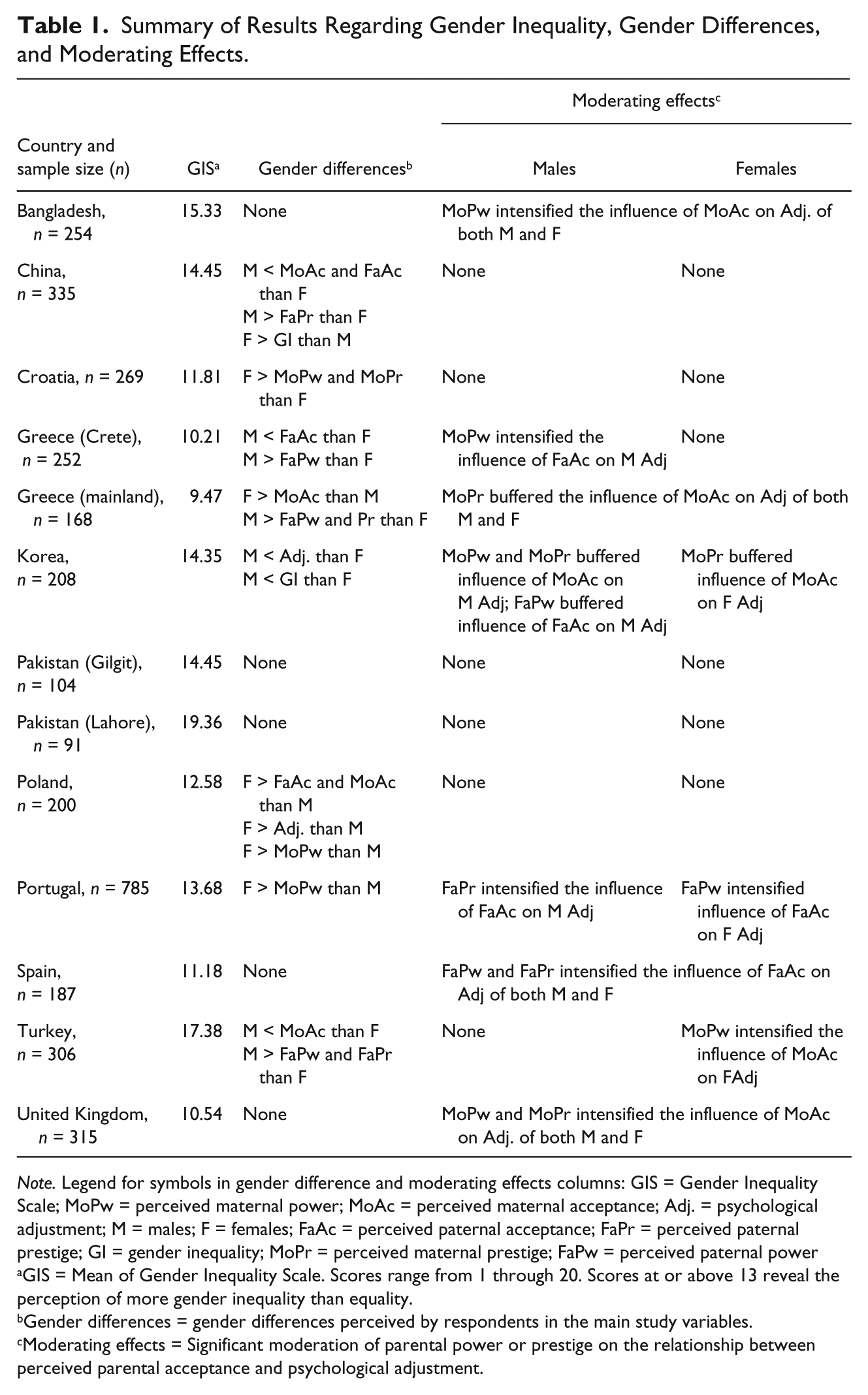
Note. Legend for symbols in gender difference and moderating effects columns: GIS = Gender Inequality Scale; MoPw = perceived maternal power; MoAc = perceived maternal acceptance; Adj. = psychological adjustment; M = males; F = females; FaAc = perceived paternal acceptance; FaPr = perceived paternal prestige; GI = gender inequality; MoPr = perceived maternal prestige; FaPw = perceived paternal power
GIS = Mean of Gender Inequality Scale. Scores range from 1 through 20. Scores at or above 13 reveal the perception of more gender inequality than equality.
Gender differences = gender differences perceived by respondents in the main study variables.
Moderating effects = Significant moderation of parental power or prestige on the relationship between perceived parental acceptance and psychological adjustment.
At this point, it is useful to note that the validity of the GIS scores used for reaching this conclusion is supported by data from the UN Gender Inequality Index (United Nations, 2011). More to the point, an analysis of the relation between GIS ratings of gender equality versus gender inequality, and ratings from the UN Gender Inequality Index show that the two sets of scores are significantly associated, χ2(1) = 4.41, p < .05. Specifically, the two sets correlated at Phi = .63. UN and GIS rankings of overall gender equality versus inequality disagreed in only 2 of 11 cases (Korea and the United Kingdom). The UN Index ranked Korea as having more gender equality than any other nation in the IFARP sample, whereas adults in Korea tended to report somewhat elevated levels of gender inequality. However, the UN Index ranked the United Kingdom among the higher gender-inequality nations in the IFARP sample, whereas adults in the United Kingdom tended to perceive the country to be characterized by major gender equality.
With these thoughts in mind, I give no further attention in this article to the issue of institutionalized patriarchy. I now focus exclusively on the role of parental power and parental prestige as moderators of the relationship between perceived parental acceptance and offspring adjustment. First, though, I summarize evidence about the relationship between parental acceptance and adjustment.
As noted earlier, perceived parental acceptance–rejection is postulated in PARTheory to be universally correlated with offspring’s psychological adjustment—regardless of differences in culture, race, language, gender, or other such defining characteristics. Evidence in this Special Issue further supports this postulate in that both perceived maternal and paternal acceptance are significantly correlated with the adjustment of offspring in all countries represented in the IFARP except on mainland Greece where the correlation between perceived maternal acceptance and boys’ psychological adjustment was not statistically significant. This correlation was significant, however, among young adult males on the Greek island of Crete.
Because perceived maternal acceptance was significantly correlated with perceived paternal acceptance in every country in the IFARP (except in the remote Gilgit region of Pakistan), it was not possible to tell if both maternal and paternal acceptance made unique or independent contributions to offspring’s adjustment. To discern this, all authors performed hierarchical multiple regression analyses where they entered maternal acceptance, paternal acceptance, parental power, and parental prestige into one of the first two steps of the regression equation. Results of this analysis showed, among other things (discussed below), that both parents made unique (i.e., independent) contributions to the psychological adjustment of males and females in seven of the IFARP studies (54%). These include Bangladesh, Croatia, Pakistan (in both the Gilgit region and in the Lahore region), Portugal, Spain, and the United Kingdom. Both parents also made unique contributions to the adjustment of females (but not males) in China and Crete (Greece). Only mothers, however, made a unique contribution to males’ adjustment in the latter two countries. Interestingly, only mothers made a unique contribution to females’ adjustment on the mainland of Greece. This parallels results found in Crete. But only fathers’ acceptance contributed uniquely to the adjustment of males there. Similarly only mothers’ acceptance was uniquely associated with the psychological adjustment of females in Turkey, whereas only fathers’ acceptance was associated with males’ adjustment. Finally, only mothers’ acceptance contributed uniquely to the adjustment of both males and females in Korea, whereas only fathers’ acceptance did this in Poland.
These results confirm conclusions drawn by Rohner (1998), Rohner and Veneziano (2001), and others who reported that sometimes only mothers’ love-related behaviors are significantly associated with variations in offspring’s psychological adjustment, whereas in other instances, it is only fathers’ love-related behaviors that are associated with offspring adjustment. But in the majority of cases, the love-related behaviors of both parents in the IFARP studies are independently associated with offspring adjustment. These results also confirm the need to explore possible mechanisms that might explain why the love-related behaviors of one parent sometimes have a significantly greater impact on offspring adjustment than the love-related behaviors of the other parent. It is at this point where the issue of offspring’s perceptions of maternal versus paternal power and prestige become especially relevant.
Step 3 in the hierarchical multiple regression analysis mentioned earlier helps to provide answers to this puzzle. In that step, authors entered the interaction terms into the regression equation. These terms included Maternal acceptance × Parental power, Maternal acceptance × Parental prestige, Paternal acceptance × Parental power, and Paternal acceptance × Parental prestige. These interaction terms identify conditions under which parental power and/or parental prestige might moderate the relationship between perceived maternal or paternal acceptance and offspring’s psychological adjustment. Following guidelines proposed by Aiken and West (1991) and Cohen and Cohen (1983), all interactions that proved to be significant were analyzed by separate post hoc multiple regression analyses. Moreover, the significant interactions were plotted, and the statistical significance of slopes was tested. These forms of analyses allowed researchers to ascertain the extent to which the relationship between perceived parental acceptance and offspring adjustment intensified or diminished under the condition of enhanced maternal or paternal power and/or prestige. That is, results of these analyses showed that either maternal or paternal power or prestige—or both power and prestige—moderated the relationship between perceived parental (maternal and/or paternal) acceptance and offspring’s adjustment in eight (62%) of the studies. These included Bangladesh, Greece (mainland and Crete), Korea, Portugal, Spain, Turkey, and the United Kingdom, as displayed in Table 1.
In Portugal, for example, regression analyses showed that remembrances of both maternal and paternal acceptance in childhood made independent contributions to young adults’ (both men’s and women’s) adjustment. But the magnitude of the relationship between perceived fathers’ acceptance and daughters’ (but not sons’) adjustment intensified significantly the more interpersonal power fathers were perceived to have relative to mothers. The magnitude of the relationship between perceived paternal acceptance and sons’ adjustment intensified, however, the more prestige fathers were perceived to have relative to mothers. Thus, this analysis provided evidence about one significant class of factors that helps explain why the love-related behavior of one parent (i.e., fathers) has a greater influence on the psychological adjustment of Portuguese young adults than the love-related behaviors of the other parent (i.e., mothers). The other seven studies with significant interactions provide comparable evidence about the relative contribution to the psychological adjustment of sons and daughters of one parent’s love versus the other parent’s love.
Discussion
Evidence presented in this Special Issue supports PARTheory’s postulate about the pancultural correlation between perceived maternal and paternal acceptance and offspring’s psychological adjustment. Evidence here also confirms the conclusion that the love-related behaviors of mothers sometimes fails to make a unique or independent contribution to offspring adjustment when the love-related behaviors of fathers is controlled. Similarly, the love-related behavior of fathers sometimes fails to make a significant contribution to offspring’s adjustment when these behaviors by mothers are controlled. As noted earlier, both of these conclusions had been drawn in prior research. But prior to the current research, no one knew why the love-related behavior of one parent sometimes has a greater influence on offspring’s adjustment than the love-related behavior of the other parent. Now it seems clear that offspring’s perceptions of parental power and prestige constitute one class of variables that helps to explain this phenomenon in many contexts internationally. These conclusions are also consistent with conclusions often drawn by those family systems theorists who draw on the concepts of family cohesion and power (e.g., Wentzel & Feldman, 1996).
Having said this, however, I must also acknowledge that many challenging questions have been opened in this program of research. For example, why do parental power and/or parental prestige moderate the relationship between perceived parental acceptance and offspring’s adjustment in some nations but not others? Why does only perceived parental power moderate this relationship in some instances, but only perceived parental prestige moderate it in others? Why do power and/or prestige sometimes moderate the relationship between perceived parental acceptance and psychological adjustment of one gender of offspring but not the other? And why do power and/or prestige sometimes enhance the relationship between perceived parental acceptance and offspring adjustment (i.e., synergistic moderation), but in other instances diminish the relationship (i.e., buffering moderation)? These are among the important questions that await answers in future research.
Results of IFARP studies should be interpreted in light of several methodological issues. First, the data are correlational. Therefore, the association between perceived parental acceptance and psychological adjustment—although affected in many cases by perceived parental power and/or prestige—could still involve other common causal agents. The methodology used here makes attempts at causal inferences entirely tenuous. Second, the fact that all major variables in these studies are the product of self-reports by offspring leaves open the possibility that shared method variance inflated the association between variables. As already noted, however, prior evidence reported by Rohner and Khaleque (2005) and elsewhere suggests that method variance—at least in the association between perceived parental acceptance and offspring’s adjustment—probably is not a significant issue.
Given these limitations, it is clear that further research is required, preferably using a multi-method longitudinal approach. Nonetheless, results reported here show great promise for guiding future research on attempts to understand the mechanism(s) associated with the fact that the love-related behaviors of one parent versus the other parent can have very different consequences for the psychological adjustment of offspring.
Footnotes
Declaration of Conflicting Interests
The author(s) declared no potential conflicts of interest with respect to the research, authorship, and/or publication of this article.
Funding
The author(s) received no financial support for the research, authorship, and/or publication of this article.