



Abstract
This study finds that road death tolls, occupational fatality rates, and airline safety are strongly correlated across 92 countries, yielding a common factor: national societal accident proneness. It is independently predicted by national differences in transparency versus corruption and differences in education. This finding has important practical implications: Substantial reduction of a nation’s societal accident proneness requires strong gains in transparency and education.
National differences in accident-related fatality rates are an interesting research topic of enormous practical significance. To date, no single large-scale study exists that offers a comprehensive analysis of the common economic, societal, and cultural causes behind the existing national differences in diverse types of accident rates. Studies in this field usually focus on only one type of accident, a small number of determinants, or a small number of countries.
Mearns and Yule (2009) carried out a study of occupational safety by analyzing risk-taking behavior in workforce members of a multi-national engineering organization operating in six countries. The authors attempted to find associations between Hofstede’s (2001) dimensions of national culture and safety attitudes. Apart from the small number of countries, which precludes any possibility to draw reliable conclusions at the national level, that study is plagued by a serious methodological flaw: a confusion of levels of analysis. Hofstede’s dimensions of national culture are not individual-level constructs and cannot be recreated at that level (Hofstede, 2001). Nevertheless, Mearns and Yule carried out their analysis at the individual level, concluding that “[individual] respondents who scored higher on those variables [masculinity and power distance] were more likely to take risks at work” (p. 783).
Van Beeck, Borsboom, and Mackenbach (2000) studied differences in traffic accident mortality, only across industrialized countries, from 1962 to 1990. They were mainly interested in finding how growing prosperity affects these mortality rates. They found inconsistent relationships between affluence and road mortality between 1962 and 1990. However, raw road death tolls mask the fact that people in richer countries drive much more often and travel longer distances, than people in poorer countries. To correct for this, van Beeck et al. adjusted their data for number of motor vehicles per country. After that, they found a uniform negative relationship between national wealth and road mortality. Those authors did not offer an analysis of why this is so. Still, they did note that traffic infrastructure quality, quality of trauma care, and compliance with traffic legislation may be involved.
Koppits and Cropper (2005) presented similar results. Although raw road death tolls first rise and then fall as a function of economic growth, fatalities per vehicle show a steady relationship with rising wealth: They fall with economic growth. Like the previous publication, this one did not provide an in-depth analysis of the factors behind the reported association.
Bishai, Quresh, James, and Ghaffar (2006) confirmed the lower traffic fatality rates of richer countries but, again, did not provide a detailed analysis of the causes of this association. They simply noted that richer countries have better health care.
The most recent analysis of differences in traffic deaths is provided by the World Health Organization (2013). Although that analysis does not control for distance traveled per driver, it does consider a potentially close proxy, called “exposure factors”: vehicle density and road density. The other determinants identified by that publication are called “risk factors” (policies and their enforcement) and “mitigating factors” (strength of the health system). Although that analysis has various limitations, it is worth considering in a discussion of national differences in accident proneness. It is also worth noting that the World Health Organization data suggest a fairly strong negative association between road mortality (adjusted for distance traveled per driver) and national wealth.
Jing, Lu, and Peng (2001) studied national differences in aircraft accident rates and attributed them to a cultural factor: differences in authoritarianism, which accounts for fear of authoritative figures. Those authors relied on an interpretivist analysis of a single plane crash, concluding that the accident in question occurred because the first officer was afraid to admit his ignorance of flight mechanics to the captain. What Jing et al. call “authoritarianism” is also known as “power distance” (Hofstede, 2001). Gaygisiz (2009) confirmed the association between power distance and road traffic accidents. Of note, power distance is associated with national wealth and various national indicators that correlate with it.
Hamalainen, Takala, and Saarela (2006) collected national occupational fatality rates for a large number of countries. They did not provide an analysis of the causes of those differences even though it is clear from a quick glance of the data that wealthier countries have lower occupational fatality rates.
Ozkan and Lajunen (2007) provided a comprehensive analysis of national differences in unintentional fatalities. Their factor analysis of national fatalities statistics yielded three factors. One was defined by poisoning, fire, and drowning fatalities. Another factor captured falling, occupational, and “other transportation fatalities.” A third factor was defined only by traffic fatalities (p. 526). This factor analysis was carried out across only 28 countries. Whether its results can be extrapolated to a much larger number of countries is questionable. Still, it is noteworthy that the authors reported that the second and the third factor were highly and significantly associated with national wealth.
Apparently, national wealth is associated with lower road mortality, less frequent aviation accidents, and lower fatality rates in occupational accidents. There seem to be one or more wealth-related common determinants of at least some of the national variance in these different types of accidents. Whether these determinants are so strong as to create a powerful association between these variables and define a single factor, or more than one factor (as in Ozkan and Lajunen’s study), is an empirical question. Nevertheless, one cannot fail to observe that the frequency of all these types of accidents probably depends to a large extent on the quality of enforcement of good safety regulations. Countries with stricter enforcement of such regulations have a lower frequency of fatal land traffic, aviation, and industrial accidents. Other types of fatal accidents, such as drowning during recreational swimming, poisoning with snake venom (a fairly common cause of death in some tropical countries), or a fatal fall during rock-climbing, may not be so closely associated with enforcement of safety regulations. As Ozkan and Lajunen’s study shows, these accidents represent a different phenomenon that requires a different type of analysis.
Minkov (2011) argues that national differences in road death tolls are largely a cultural phenomenon. They are a function of what he calls “exclusionism versus universalism” differences. Exclusionist cultures (predominantly those of the developing world and also known as “collectivist”) tend to divide people into in-groups and out-groups and base their attitudes toward them on this distinction. While in-group members are entitled to tolerance, respect, and various privileges, out-groups are excluded from the circle of those who deserve any privileges. They may be treated with indifference or even disrespect and disdain.
This trait of exclusionist–collectivist cultures has been reported by various authors who have firsthand experiences from those cultural environments. For example, Triandis (1989) concludes that people in collectivist cultures are nice to in-group members and strive to maintain harmony with them, but they can be quite rude to outsiders and have no concern about displaying hostility, exploitation, or avoidance of out-group members. Japanese author Chie Nakane (1986) provides the following account of Japanese society before the 1980s, when Japanese culture was still quite exclusionist:
The consciousness of “them” and “us” is strengthened and aggravated to the point that extreme contrasts in human behavior can develop in the same society, and anyone outside “our” people ceases to be considered human. Ridiculous situations occur, such as that of the man who will shove a stranger out of the way to take an empty seat, but will then, no matter how tired he is, give up the seat to someone he knows, particularly if that someone is a superior in his company. (p. 186)
Universalist cultures have largely obliterated the distinction between in-groups and out-groups, adopting a more universalist treatment of all people in the public sphere. While exclusionist cultures are characterized by nepotism and corruption, universalist ones have more transparency and rule of law. This, in Minkov’s view, explains the high relationship between national road death tolls and corruption rates. Unfortunately, Minkov did not test his model for the effect of confounding variables.
Minkov’s (2011) analysis is partly in agreement with that of the World Health Organization (2013). The “risk factors” with respect to road safety that the latter publication mentions are associated with law enforcement or the so-called rule of law. It is weaker in poor countries which invariably have high corruption scores in Transparency International’s rankings. In a society with a high corruption score, many citizens try to circumvent the laws and obtain privileges, such as paying a lower fine for a traffic violation, by bribing state officials. The latter are often happy to collect the bribe and let off the perpetrators with a mild punishment, although this means that the violation will almost certainly be repeated. Likewise, safety regulations at industrial sites or in aviation are bypassed, often through bribery, because they are costly to observe. A culture characterized by corruption and a lack of concern for the general welfare of the population, which consists mostly of out-groups to which one owes nothing, may be at the root of a high-accident mortality rate in road traffic, air traffic, and industrial settings.
The rule of law has another aspect that is not necessarily associated with corruption: compliance with official laws and regulations that are designed to protect the interests of all individuals in society and avoid chaotic situations in which only might is right. Various studies demonstrate that this kind of compliance is more typical of the rich individualist countries than of the developing collectivist countries. For example, Warner, Ozkan, and Lajunen (2009) reported that Swedish drivers are more compliant than Turkish drivers. Data from a literature review by Ishaque and Noland (2007) demonstrate that people in more affluent countries are more likely to comply with red traffic lights than people from developing countries. Yang, Deng, Wang, Li, and Wang (2006) report that Chinese pedestrians comply with red traffic lights less often than pedestrians in developed countries.
Another potential predictor of national accident proneness is education. Gaygisiz (2009) reported a negative correlation between national IQ (a measure of educational achievement) and road mortality. Apparently, better educated populations possess a better ability to judge some types of risks and take appropriate preventive action. Populations with lower education may also be less capable of understanding safety instructions, rules, or warning signs. For instance, Zhang and Chan (2013) reviewed the literature on differences in drivers’ comprehension of road signs. They reported cross-cultural differences: Drivers from nations with a lower general education level performed worse than drivers from nations with a higher education level.
As for national wealth, it is possible that it contributes to lower accident mortality in two ways. First, it promotes a universalist culture in which transparency and the rule of law ensure some concern for the welfare of all citizens, not just one’s in-group. This results in greater transparency and stricter enforcement of safety measures compared with the situation in poor countries. Second, as the World Health Organization (2013) and other publications point out, richer countries have more effective health systems and are better prepared to treat accident victims.
In this analysis, I start from the hypothesis that land road mortality, occupational accidents mortality rates, and aviation safety are closely associated at the national level and form a common factor, which can be called national societal accident proneness (NSAP). This factor can be hypothesized to operate in societal contexts, such as land road traffic, aviation, and professional employment, where society is responsible for the enforcement of safety regulations. The same factor need not be expected to operate during individual recreation or household activities where individuals are largely responsible for their own safety.
In this study, I test the predictive properties of variables such as corruption, national wealth (a proxy for health system quality), and education with respect to the NSAP factor. I do not test the predictive properties of Minkov’s (2011) exclusionism-versus-universalism measure as it incorporates road death tolls and would create a circular explanation. I do include the most recent measure of individualism versus collectivism: that of Project GLOBE (House, Hanges, Javidan, Dorfman, & Gupta, 2004). This is a large-scale cross-cultural study of some 18,000 employees in 61 countries, attempting to replicate, update, and improve Hofstede’s (2001) measures of national culture. Despite some controversies in the literature concerning what exactly some of GLOBE’s measures reflect, even critics of its approach, such as Minkov (2013), agree that GLOBE’s “collectivism practices” (or “as is”) index (Gelfand, Bhawuk, Nishii, & Bechtold, 2004) is a valid measure of national culture. In accordance with those authors’ interpretation, that dimension reflects the degree to which a particular society has cohesive in-groups and is therefore a valid measure of collectivism or exclusionism.
Method
Because no data are available on numbers of citizens who die annually in road accidents per 1,000 km of travel, I used a close proxy. National road death tolls data (raw number of citizens per 100,000 who die in road accidents annually) were obtained from the World Health Organization (2013). The World Bank Group used to publish country statistics on annual road-sector gasoline consumption per capita. Its data for 2009 were still available as of the writing of this article but only from the website Trading Economics (www.tradingeconomics.com). I divided the road death tolls data by road-sector gasoline consumption to obtain an approximate national indicator of road mortality per unit of distance traveled.
I used the national occupational fatality rates (number of workers per 100,000 workers who die annually in occupational accidents) in Hamalainen et al. (2006). These data are from various years from the end of the 1990s, mostly from 1997 to 1999. 1
For national aviation safety rates, I relied on the website AirlineRatings.Com. That website evaluates the safety of nearly all existing commercial airlines in the world on a scale from one to seven points. Points are awarded to airlines for maintaining a fatality-free record in the past 10 years, being certified by an International Air Transport Association (IATA) operational safety audit, being endorsed by the Federal Aviation Authority of the United States, and meeting all eight safety criteria of the International Civil Aviation Organization. Points are deducted for being blacklisted by the European Union, operating only Russian aircraft, and having been grounded by an airline’s own national aviation authority for safety concerns. Because many countries have multiple airlines, to ensure comparability, I considered only national flagship carriers. 2
These three national accident proneness indicators are presented in Table 1. The road mortality indicator was multiplied by 10 to avoid fractions. Thus, it indicates an annual road death toll per 10,000 persons, adjusted for gasoline consumption. The occupational fatality rate was also multiplied by 10. All these data are presented in Table 1.
National Scores on Selected Accident and Safety Indicators.

As I collected independent variables data for the regression model, I tried to obtain data approximately from the middle of the period that the safety statistics come from. I used a 2006 corruption perception index from Transparency International (2006) and GDP data for 2005 from the World Bank Group (2009). The education index is for 2006, from the United Nations Development Programme (2007). This is a measure of average number of years of schooling. I also considered Lynn and Vanhanen’s (2012) latest national IQs as a measure of national educational achievement.
The Project GLOBE national collectivism index used in this study is from Gelfand et al. (2004). It is the index for collectivism “practices” or collectivism “as is” in the terminology of that publication.
Results
The three accident-related variables are strongly inter-correlated (Table 2). The Spearman’s ρ are in most cases higher than the corresponding Pearson’s r. The former are probably more indicative as they suppress the effect of outliers. Indeed, some of the measures, especially road death tolls per unit of travel, are characterized by strong outliers, mostly African states. The fact that the three variables are highly correlated cross-validates them and attests to the temporal stability of the national differences (not necessarily the absolute values) on all these measures. Table 2 also shows zero-order r and ρ between all variables used in this study.
Zero-Order Correlations Between National Accident and Safety Indicators and Their Potential Predictors (Top Row in Each Cell = Pearson’s r; Second Row = Spearman’s ρ).
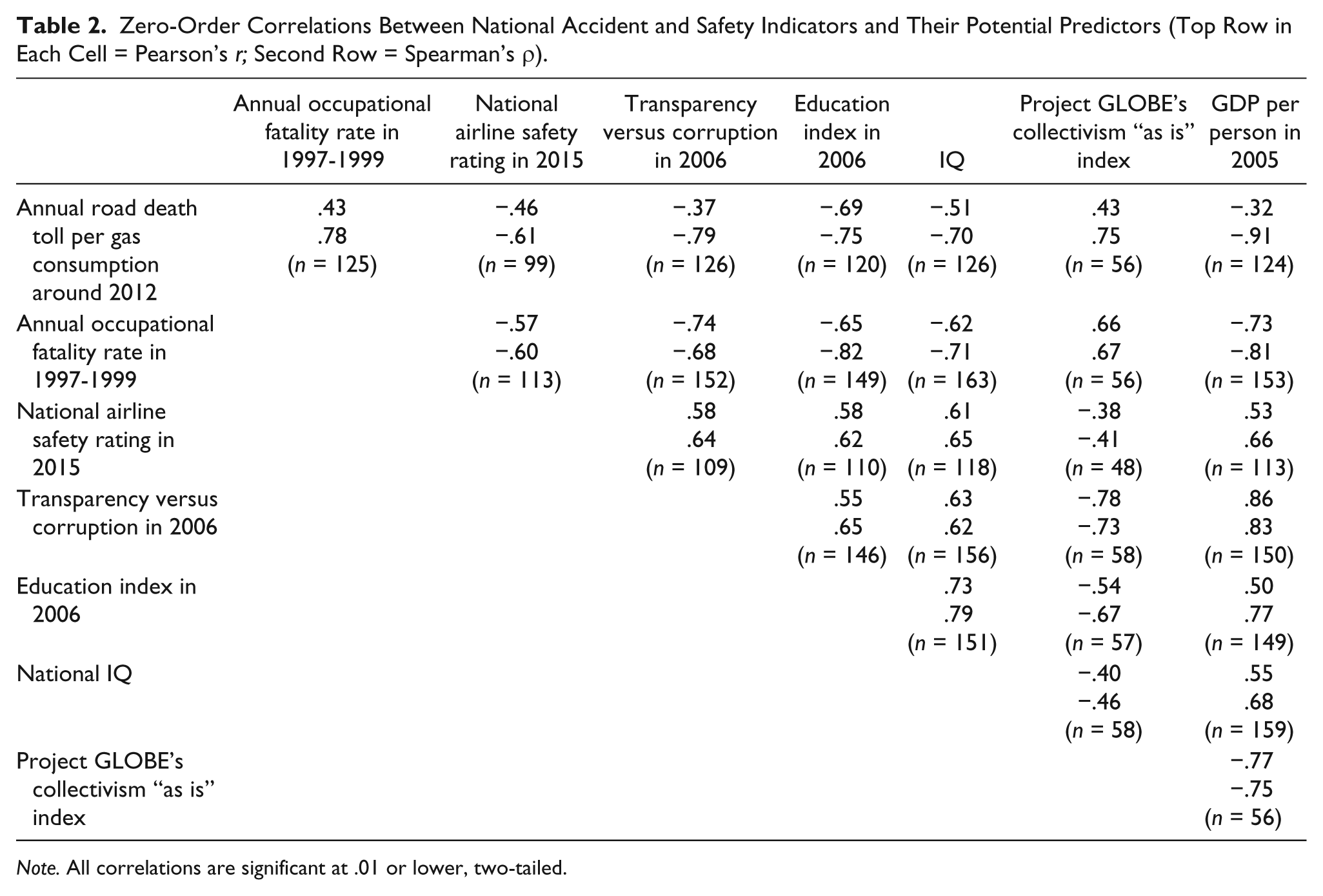
Note. All correlations are significant at .01 or lower, two-tailed.
A factor analysis (principal components) of the three accident-related variables yielded a strong single factor. Details are available in Table 3.
Results of the Factor Analysis of the Three National Accident and Safety Indicators.

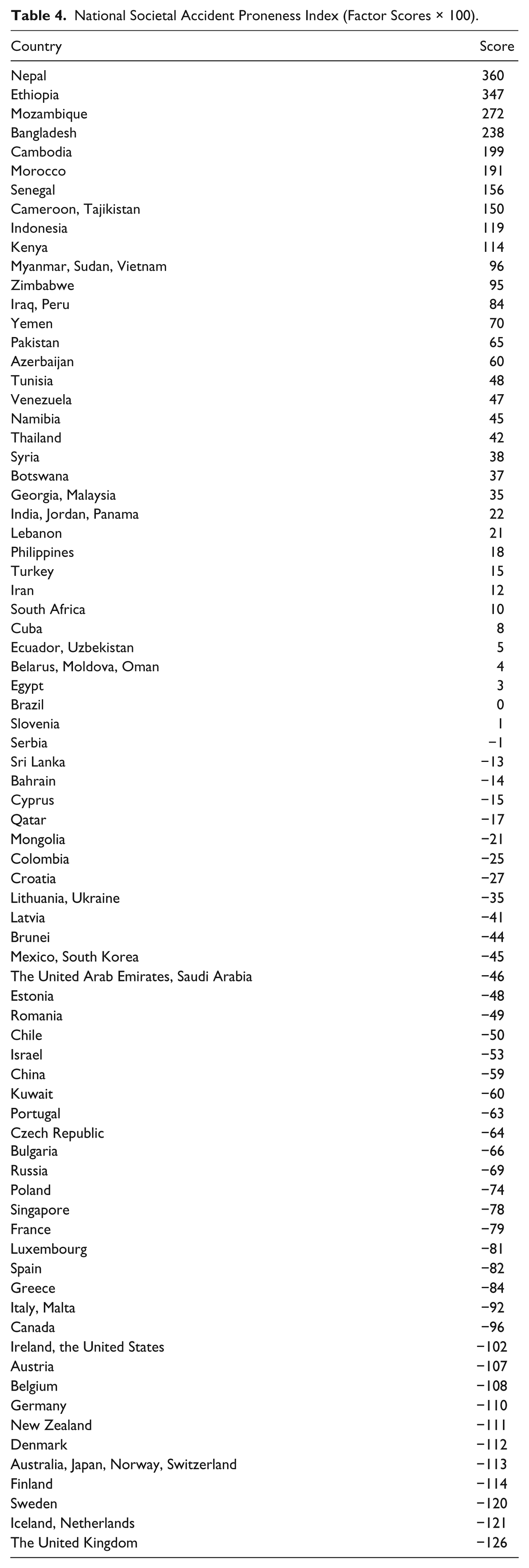
In accordance with my hypothesis, I call this factor NSAP. National scores on NSAP (Factor Scores × 100) are provided in Table 4.
National Societal Accident Proneness Index (Factor Scores × 100).
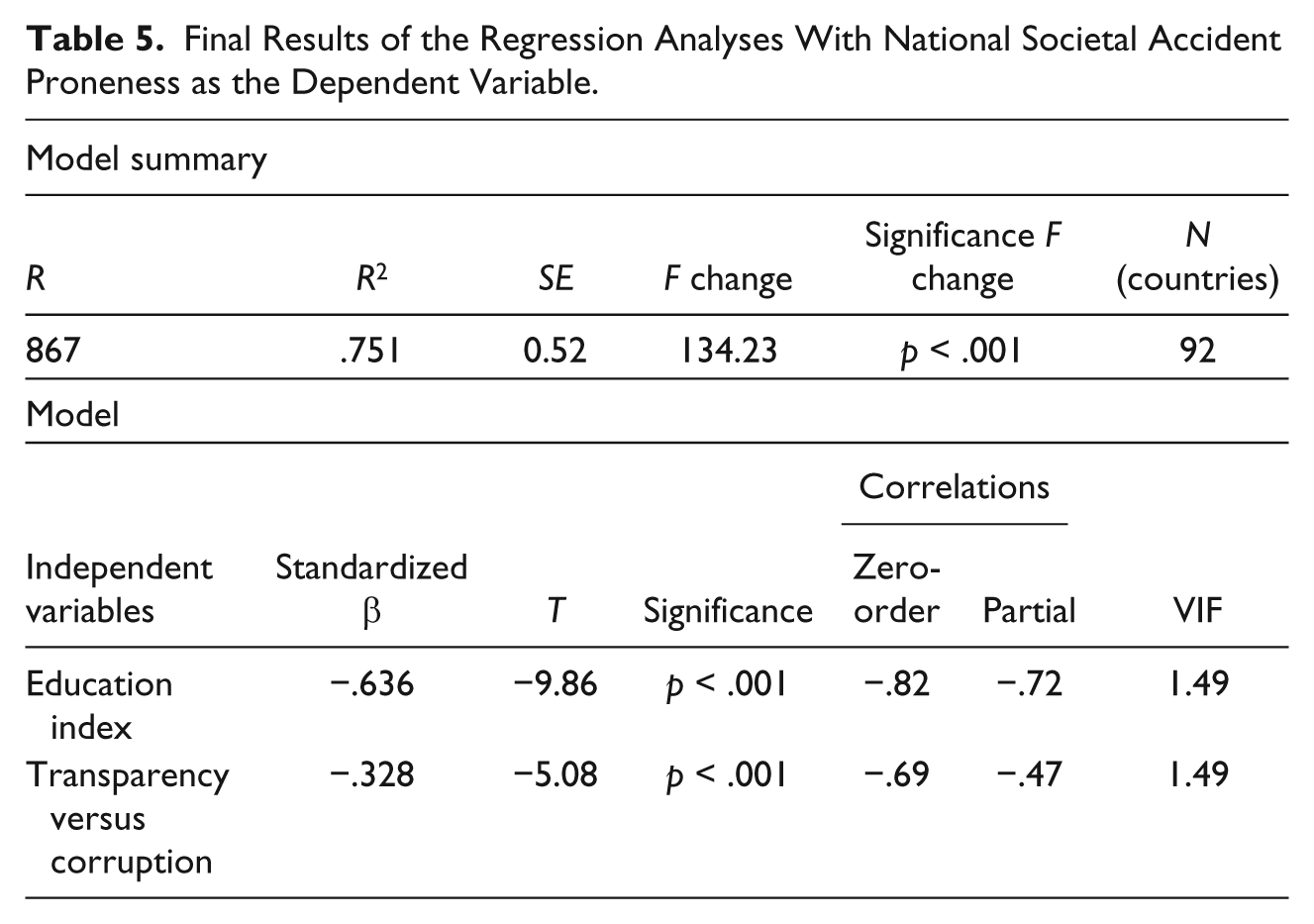
A regression analysis demonstrated that only two of the independent variables were significant predictors of NSAP: the education index and transparency versus corruption. The other independent variables did not reach statistical significance, and some of them created problematic variance inflation factor (VIF) values (e.g., GDP: b = −.08, p = .420, VIF = 4.08). Therefore, I dropped all independent variables that produced insignificant associations and built a final model with the only two significant predictors. The results are presented in Table 5.
Final Results of the Regression Analyses With National Societal Accident Proneness as the Dependent Variable.
Discussion
This study found that the incidences of three major indicators of accident proneness—road deaths, occupational fatalities, and airline safety—are strongly correlated at the national level and form a single factor 3 : NSAP. The highest scoring nations on NSAP are all relatively poor economically, whereas the lowest scoring nations are rich.
However, the analysis in this study suggests that it is not differences in national wealth per se that create NSAP differences. In other words, the latter are not merely a function of the quality of infrastructure and equipment, and developing nations are not likely to improve their safety records substantially by merely implementing technological modernization.
Interestingly, national collectivism, as measured by Project GLOBE, is not a significant predictor of NSAP when education and transparency are accounted for. However, this does not necessarily mean that collectivism–exclusionism has nothing to do with accident proneness. Whether this is so or not depends on one’s theoretical interpretation. If collectivism–exclusionism and corruption are seen as two unrelated outcomes of national poverty (although they are both strongly correlated with it and with each other), then only the latter has a causal effect on accident proneness. However, if one posits a theoretical link from poverty to collectivism–exclusionism to corruption and then to accident proneness, collectivism–exclusionism becomes a distal cause of accident proneness, whereas corruption is the proximal cause.
Whatever theory one prefers, the analysis of the causes of the existing national differences in accident proneness leads to a clear conclusion, concurring with that of JACDEC, a German organization that monitors commercial airline safety. On its website, JACDEC (www.jacdec.de) states, “One lesson of our now decade-long experience in aviation safety analysis is the following: There is a direct correlation between the safety of an airline and the competence and transparency of the controlling authorities.”
Clearly, a nation’s NSAP is a function of the degree of transparency versus corruption that prevails in its culture, as well as the average education level of its citizens. A higher level of corruption apparently results in greater opportunities for circumvention of safety regulations, or the lack thereof, to reduce costs. A lower education level means a poorer ability to make good judgments and take appropriate action when an accident needs to be averted.
Therefore, from a practical perspective, a reduction of social accident fatalities at the national level requires lower corruption and better education. This is a difficult task not only for national governments but also for society as a whole. Because national corruption rates are very strongly and negatively correlated with national wealth, a dramatic fall in corruption is impossible without strong gains in GDP per person. Hence, for a country to achieve a strong safety culture in road and airline traffic and in industrial settings, it must first of all become wealthy.
Footnotes
Declaration of Conflicting Interests
The author(s) declared no potential conflicts of interest with respect to the research, authorship, and/or publication of this article.
Funding
The author(s) received no financial support for the research, authorship, and/or publication of this article.