



Abstract
Guided by Kağıtçıbaşı’s work on cultural values, the current study sought to examine the gratitude expressions, wishes, and spending preferences of South Korean children and adolescents. Participants included (N = 229) 7- to 14-year-olds (M = 10.79, SD = 2.19; 54% girls; 55.3% middle class) from Kimpo, and Seoul, South Korea. Regression analyses revealed that older Korean youth were less likely to express concrete gratitude than were younger Korean youth. In addition, older Korean youth were less likely to give their money to charity or the poor. With regard to wishes, Korean youth who wished for the well-being of others were more likely to also give their money away to others. This study contributed to the gratitude literature by considering how gratitude, wishes, and spending preferences may manifest themselves in an understudied group, young Koreans.
Traditionally, values around prioritizing the family as a group and respect for elders in the community were of upmost importance in Korean culture (Park & Cho, 1995). However, as a result of urbanization, there has been a shift in which members of younger generations are expressing more autonomy and self-direction, while also maintaining close ties to their families (Phinney, Kim-Jo, Osorio, & Vilhjalmsdottir, 2005). This falls well in line with the thinking of Kağıtçıbaşı (2007, 2012; see Merçon-Vargas, Poelker, & Tudge, 2018), who argued that these cultural dynamics are not adequately represented by typical cultural identifications of individualistic versus collectivistic societies.
In order to not confound the ideas of freedom to make one’s own choices with one’s belonging to a group, Kağıtçıbaşı (2007) created a model with two orthogonal dimensions: agency (ranging from autonomy to heteronomy) and interpersonal distance (ranging from related to separate). Given Korea’s cultural dynamics, it seems that contemporary Koreans may have experienced contextual and societal changes that have altered their cultural values, or at least the ways in which those values are expressed, in line with Kağıtçıbaşı’s (2007, 2012) model. For example, instead of retaining traditional values concerning heteronomy and relatedness, today Koreans may pursue values that represent a coexistence of familial ties and self-enhancement, which is representative of autonomy-relatedness.
The concept of autonomy-relatedness is particularly relevant to the definition of gratitude as a moral virtue, which is the definition we are using in this article. Based on this understanding, one person—the beneficiary—(a) receives a gift or something of value from another person—the benefactor—and in recognizing that this kind act has been done freely, (b) experiences a positive emotional response to it, which in turn encourages the beneficiary to (c) freely reciprocate with something of benefit to the benefactor if and when the opportunity presents itself. This process thus creates a cycle of gratitude, as the original benefactor may now wish to reciprocate to the former beneficiary. It is important to note that, in this example, the benefactor initiates the kind deed and does so without being forced (autonomy), which then allows for the formation or strengthening of social bonds between people (relatedness).
Gratitude, as defined previously, also requires a certain level of cognitive (e.g., perspective-taking), emotional (e.g., empathy), social (e.g., helping), and moral (e.g., genuine reciprocity) skills that develop over time and are not considered to be innate. Research suggests that for Koreans, gratitude serves as a key element of social development and is directly and indirectly associated with positive outcomes, such as subjective well-being and happiness (Choi, Yu, & Kim, 2015; Layous, Lee, Choi, & Lyubomirsky, 2013). Nonetheless, developing gratitude, as with any moral virtue, takes a good deal of time and experience (Annas, 2011; Tudge, Freitas, & O’Brien, 2015), and it is unlikely that children ages 7 to 14 in any culture have yet developed gratitude in this sense. However, through an examination of how children and young adolescents express their gratitude, we can gain a sense of the precursors to becoming a virtuously grateful adult.
Cultural Values
Historically, Korean culture has emphasized Confucian values around heteronomy and relatedness, with more importance being placed on respect for the group and its elders rather than on individual identities (Hyun, 2001). These traditional values, which Kağıtçıbaşı (2007, 2012) would consider typical of rural majority-world societies, are exemplified in Koreans’ displays of reciprocity and helping others who have helped them. For example, due to its once prominent agricultural industry, one of the main areas in which Koreans have traditionally demonstrated a cycle of gratitude and helped one another was by assisting their neighbors with the farming of their land and the raising of their livestock.
Although the principal values underlying such traditions have persisted, a rapid rise in urbanization has influenced familial structures and shifted the ways in which Koreans are able to reciprocate and help one another (Choe, 2006; Park & Cho, 1995). For instance, with regard to orchestrating events (e.g., weddings and funerals), it has been traditional for those who were close to the family to help during the process, even if that meant they had to be absent from work. If such family assistance was not provided, it was seen as disrespectful. However, due to the growth of big companies, a modern-day manifestation of this long-held tradition was that Koreans no longer had to take time off from work to help each other and demonstrate family respect (Rii & Ahn, 2002). Instead, they could hire employees from these companies to do the work for them.
Hence, contemporary Korean youth may be socialized not only to uphold traditional cultural values of social relatedness and respect, but also to embrace modern-day ideas that are more self-focused and that promote more autonomous attitudes toward social interactions. This duality, which is not necessarily oppositional in Kağıtçıbaşı’s views, provides a framework in which to study key constructs and correlates of gratitude development.
Gratitude and Wishes
In addition to these general cultural values, Korean youth’s expressions of gratitude may be related to their age and to the sorts of things they wish for. With the consideration of developing gratitude as a moral virtue, younger children may not yet have the cognitive skills or level of moral development to engage in the perspective-taking and reciprocity that are crucial components of this definition of gratitude (Tudge et al., 2015). Previous research suggests that younger North American youth tend to make hedonistic wishes (e.g., money or toys) and express concrete gratitude, whereas older youth tend to make social-oriented wishes (e.g., world peace) and express connective gratitude (Tudge, Freitas, Mokrova, Wang, & O’Brien, 2015). However, there has been no research conducted on youth’s wishes in Korean culture or how they may be related to gratitude.
The current study extends the literature by examining gratitude in South Korean youth ranging in age from 7 to 14, and how these children’s expression of gratitude may be linked to the types of wishes they make. Specifically, we hypothesize that (a) older Korean youth will be more likely to express connective gratitude than will younger Korean youth (Wang, Wang, & Tudge, 2015), and (b) based on their traditional cultural value of relatedness, Koreans will exhibit more connective gratitude than verbal or concrete gratitude. Due to the absence of studies examining wishes in Korean culture, we do not make any predictions concerning the potential relationship between wishes and gratitude.
Spending Preferences
Koreans typically share their financial earnings not only with their family members but also with other loved ones, such as their friends. However, the sharing of resources has traditionally excluded strangers (Lim, 1997). This is perhaps because, prior to modernization, most Koreans were not in an economic position to be able to give away money for they could barely meet their own daily needs (Mason, Kim, Perkins, Kim, & Cole, 1980). Nonetheless, more specific spending preferences might depend on individual characteristics, such as age and personality traits (i.e., materialist values; Kiang et al., 2016). Furthermore, in Korea, young children have limited opportunities to handle their own money, with parents typically in charge of financial spending (Kim, Park, Kwon, & Koo, 2005). However, as children enter into adolescence—especially those living in urban areas—they tend to exhibit more autonomy and initiative with regard to their thinking and goal achievement (Alford, 1999); nevertheless, they still hold loved ones, such as their parents, in high regard. Given the intricate links between cultural values around autonomy-relatedness, gratitude, and spending reported in other articles in this special issue, it is important to better understand how these processes manifest themselves with regard to understudied Korean youth. Thus, we extend current knowledge by examining these factors and predict that older Korean youth will be more likely to choose to spend money on themselves or save their money for later than will younger Korean youth.
In summary, our approach complements the other work in this special issue by focusing on an under-researched group, Korean youth. By examining age-related differences in gratitude, as well as correlates with types of wishes expressed and spending preferences, we consider the Korean cultural context as one that promotes both autonomy and relatedness and contributes further insight in understanding gratitude as a developmental and moral virtue.
Method
Participants
A total of 229 children from Kimpo and Seoul, South Korea, who ranged from 7 to 14 years of age participated in our study (M = 10.79, SD = 2.18; 54% girls; 55.3% middle class). Parents in our study were coded as middle class if they had an educational level of some college or higher (e.g., university or graduate degree). Parents with an educational level of high school or lower were coded as working class. The per capita income in Korea is approximately US$27,633, and the monthly average income per urban household is about US$3,884 (National Statistical Office, Statistics Korea, 2016a).
Kimpo is historically known for its large-scale rice farms, but is also home to huge factories, shopping malls, and apartments, as urbanization has increased. This area is home to a population of about 300,000 and is classified as an urban city in which 63.1% of gross regional production comes from manufacturing industries and 35.3% from commercial and service businesses (National Statistical Office, Statistics Korea, 2016c). Though few residents still engage in agricultural activities today, Kimpo is still recognized for its high-quality produce. In terms of educational opportunities, there are 39 primary schools, 20 middle schools, 12 high schools, and two colleges in Kimpo. Schools in Kimpo that participated in the current study are located in middle- to working-class areas, and most parents are engaged in farming, manufacturing, or small-sized self-employed businesses.
In addition, Seoul, the capital of South Korea, is a large metropolitan city adjacent from Kimpo with a population of 10,204,000 (National Statistical Office, Statistics Korea, 2016b). Seoul serves as the center of politics, economics, education, art, and the latest cultural trends in South Korea. It occupies 0.6% of the national territory; however, 20% of the population resides in Seoul, so the population is exceptionally dense. This highly urbanized city is also home to high-technology businesses and tall skyscrapers, and about 90% of its gross regional production is from tertiary businesses. There are 598 primary schools, 383 middle schools, 318 high schools, 43 universities, and 12 colleges in Seoul. Schools in Seoul that participated in the current study are located in a middle-class area in which parents show great interest in their children’s education, future occupation, and well-being.
Measures
Youth completed two measures: the Wishes and Gratitude Survey (WAGS; Freitas, Tudge, & McConnell, 2008; adapted from Baumgarten-Tramer, 1938), and the Imaginary Windfall (Tudge & Freitas, 2011; adapted from Kasser, 2005; see Tudge, Freitas, O’Brien, & Mokrova, 2018, for further details). The two questions of primary focus on the WAGS were, “What is your greatest wish?” and “What would you do for the person who granted you that wish?” Responses to the first question on the WAGS regarding youth’s wishes were coded as hedonistic, self-oriented, or social-oriented. Responses to the second question pertaining to gratitude were coded as verbal, concrete, or connective gratitude.
The Imaginary Windfall asked youth to imagine being given the equivalent of $100 in their local currency and how they would spend it based on four options: “buy stuff for yourself,” “give to charity or the poor,” “get presents for friends or family,” or “save for the future.” In South Korean culture, US$100 (or 114,010.79 Won) is considered to be an especially large sum of money for young children to spend on their own. However, it is considered more appropriate for older children to spend this amount of money, especially those living in urban areas, like the ones included in this study. It is also important to note that the monetary values are comparable in that the types of items that one can purchase in the United States with a $100 are similar to the types of items that can be purchased in South Korea with 114,010.79 Won.
In addition, both the WAGS and the Imaginary Windfall measure were translated from English to Korean by native speakers. The translations were also discussed by individuals who were fluent in both languages to ensure consistency in meaning. The measures were completed at schools, and younger children were provided assistance from their teachers if they struggled to read or comprehend the items on either measure. Regarding the WAGS, interrater reliability was conducted between two coders, who coded about 30% of the gratitude data and about 50% of the wish data. Cohen’s kappas for each type of gratitude were as follows: 1 (verbal), .85 (concrete), and .94 (connective). Furthermore, the kappa values for each type of wish were also high: .86 (hedonism), .81 (self-oriented), and .93 (social-oriented).
Results
Descriptive Statistics of Variables of Interest
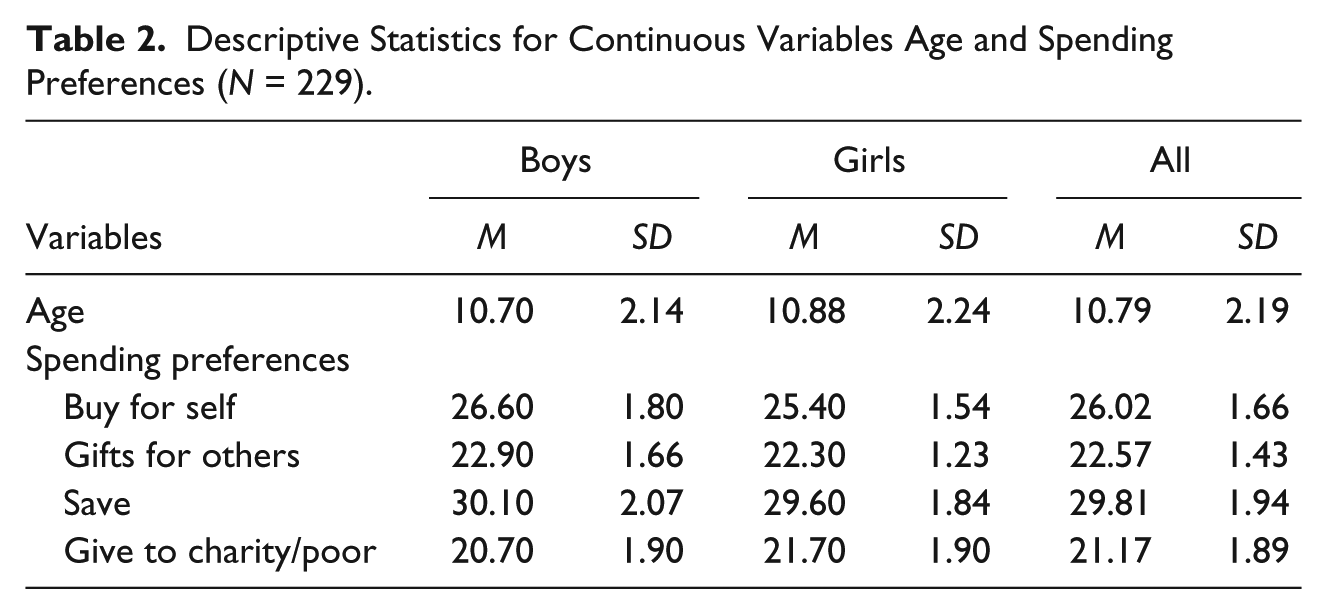
Descriptive statistics for all variables of interest are presented in Tables 1 and 2. Table 1 shows that boys were slightly more likely than were girls to express hedonistic and self-oriented wishes, while girls were more likely to express other-oriented wishes. Girls were also more likely to express verbal and connective gratitude, while boys were more likely to express concrete gratitude. With regard to spending preferences (Table 2), both boys and girls were more likely to report buying gifts for themselves or saving their money for later than buying gifts for their family or donating to the poor. Certain percentages in Table 1 equate to more than 100 due to children responding with more than one type of the major gratitude expressions (verbal, concrete, and connective). In addition, some youth reported responses outside of those types of gratitude, such as finalistic gratitude and self-sufficiency (see Tudge, Freitas, O’Brien, & Mokrova, 2018, for specific examples), while a few reported no gratitude expression at all.
Descriptive Statistics for Binary Variables Wishes and Gratitude.
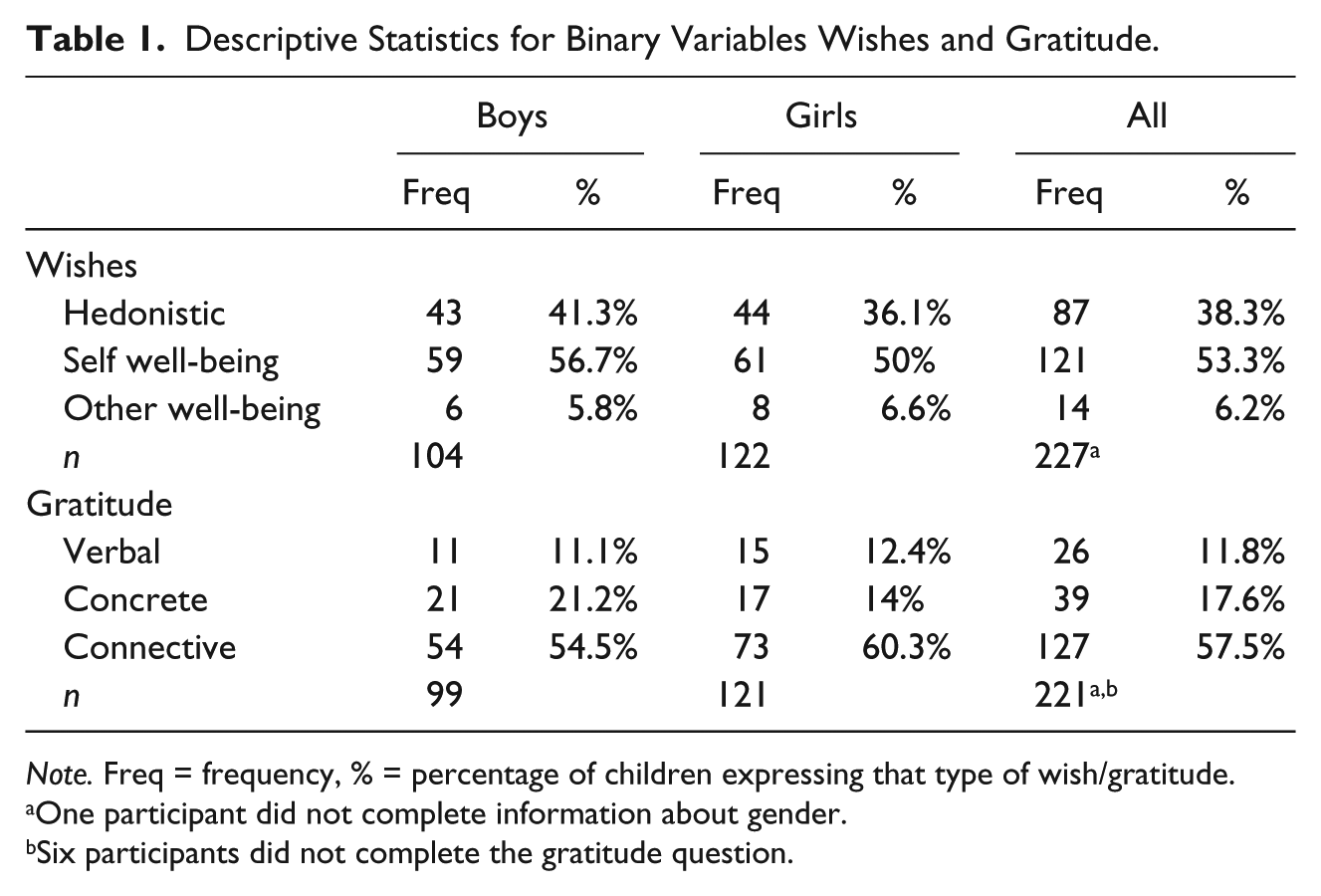
Note. Freq = frequency, % = percentage of children expressing that type of wish/gratitude.
One participant did not complete information about gender.
Six participants did not complete the gratitude question.
Descriptive Statistics for Continuous Variables Age and Spending Preferences (N = 229).
Associations Between Types of Gratitude and Age, Gender, and Wish Types
We utilized three separate binomial logistic regressions in SPSS version 24.0 to assess the associations between each type of gratitude and age, gender, and wish types in South Korean youth. In each set of analyses, type of gratitude was entered as the outcome variable (e.g., verbal, concrete, connective). Age and gender were included in the first step to examine the main effects of age while controlling for gender. Wishes were then added into the second step as predictors of gratitude expression types. Results from the final models are presented in Table 3.
Logistic Regression Analyses of Types of Gratitude on Age, Gender, and Wish Types (N = 229).
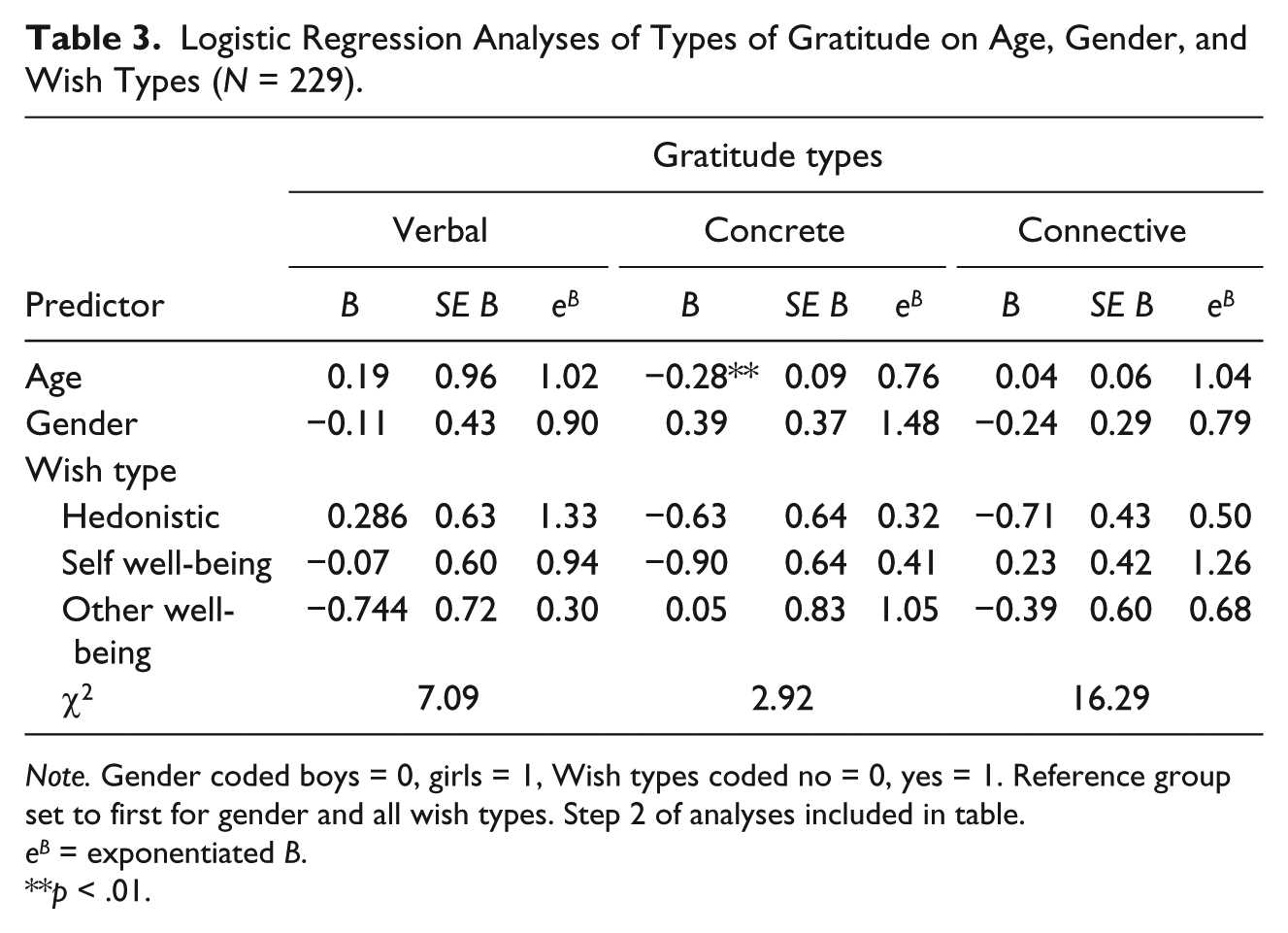
Note. Gender coded boys = 0, girls = 1, Wish types coded no = 0, yes = 1. Reference group set to first for gender and all wish types. Step 2 of analyses included in table. eB = exponentiated B.
p < .01.
Results suggested that neither age, gender, nor wish types were predictive of Korean youth’s expression of verbal and connective gratitude. Thus, our hypotheses pertaining to those two types of gratitude were not supported. However, age, when controlling for gender, was a significant predictor of concrete gratitude (B = −.28, eB = .76, p < .01). Specifically, with each increase in yearly age, Korean youth were 1.32 times less likely to report responding with concrete gratitude. When wish types were added to the model, the age effect on concrete gratitude was still significant.
Associations Between Spending Preferences and Age, Gender, and Wish Types
To assess the associations between spending preferences and age, gender, and wish types, we conducted a series of four separate linear regressions in SPSS version 24.0, using each type of spending preference as the dependent variable (e.g., buy for oneself, buy for others, save for later, give to charity). We included, as independent variables, age, gender, and wish types, using the same approach as the previous analyses. Results of Step 2 of these analyses are presented in Table 4.
Regression Analyses of Spending Preferences on Age, Gender, and Wish Types (N = 229).

Note. Step 2 of analyses included in table.
p < .05. **p < .01. ***p < .001.
Findings for the spending preference of buying for oneself suggested that, as a whole, the model for age, gender, and wish types was significant, F(5, 198) = 2.76, p < .05. However, these variables were not significant predictors individually. In addition, age was significantly associated with giving to others (β = .17, p < .05), in that older Korean youth were more likely to report buying gifts for others. Nonetheless, older Korean youth were also less likely to give their money to charity or the poor (β = −.27, p < .001). Thus, our hypothesis pertaining to age-related differences in spending preferences was partially supported. Moreover, Korean youth who made wishes for the well-being of others were more likely to spend their money in charitable ways (β = .18, p < .01). There were no significant predictors for saving money for oneself nor was the overall model significant.
Discussion
Due to its population being vastly understudied in the field, South Korea represents a unique context in which to examine gratitude development. However, similar to work done in other countries, such as China and Guatemala (see Liang & Kiang, 2018, and Poelker & Gibbons, 2018), this population also allows us to understand gratitude through a lens characterized by the intertwining of independent and interdependent values. Traditionally, Korean culture has emphasized Confucian values around prioritizing the group’s goals and responsibilities of the family over those of the individual (Hyun, 2001). These values also dictate relationships within the subsystems of the family, such as wives’ obedience toward their husbands and children’s obedience toward their parents (Kim & Wolpin, 2008). Nonetheless, due to the modernization of Korea and the rise of large companies, there has been a shift from what Kağıtçıbaşı (2007, 2012) would refer to as heteronomous-related values to autonomous-related values. This study provides further insight into gratitude, and how it may manifest itself with regard to wishes and spending preferences in the lives of Korean youth.
With cultural values around relatedness and reciprocity still of upmost importance in Korea, in this study, we sought to examine South Korean youth’s expressions of gratitude and spending preferences, and whether these varied by age, gender, and wish types. Our findings suggested that older Korean youth were less likely to express concrete gratitude than were younger Korean youth. However, none of the proposed predictors were associated with youth’s expression of verbal or connective gratitude. These overall findings were somewhat in contrast to work in other contexts (e.g., China and the United States). More specifically, connective gratitude (considered to be the most sophisticated form of gratitude) often increases with age (Wang et al., 2015), but we did not find evidence of that pattern in our sample.
Although additional research is necessary to replicate our findings, one explanation for these patterns is that, overall, youth were relatively high in their expression of connective gratitude across all ages and both genders. Perhaps both boys and girls in Korea are encouraged to think about others from a young age. Studies have shown that parents play a crucial role in how children make sense of what it means to be grateful through their messages and actions (Halberstadt et al., 2016; Rothenberg et al., 2017). However, less research has examined how children personally contribute to their own moral development and there are no such studies in Korea. Future research should take into consideration the potential influences of Korean parents’ socialization strategies, modeling behaviors, values, and other prosocial characteristics of children (e.g., empathy).
Another explanation for the lack of age differences found in connective gratitude is that, from a developmental perspective, younger children may be able to reciprocate toward a benefactor, but may not yet be able to cognitively comprehend that their reciprocation should be something the other person actually wants or needs. Again, more research is needed to determine why age differences in connective gratitude have been supported among other contexts, but were not as evident in our Korean sample. Similarly, it would be interesting to further consider why age differences in verbal gratitude, which was the lowest type of gratitude expressed, were not found. Notably, these null findings are consistent with prior work in that, with age, one might not necessarily expect that the expression of social norms, such as saying “thank you,” would vary (Baumgarten-Tramer, 1938; Freitas, Pieta, & Tudge, 2011).
In addition, findings for spending preferences were mixed. For example, age, gender, and wish type did not directly or independently predict youth’s preference to spend money on things for themselves. However, the fact that the overall model was significant may indicate that an interaction of all three factors inform the ways in which children decide to spend their money for personal benefit. Furthermore, older Korean youth were less likely to report giving their money to charity or the poor. Nonetheless, Korean youth who reported social-oriented wishes (i.e., wishing for the well-being of another) were more likely to report giving their money to charity or the poor. Culturally, the sharing of resources in Korea has been traditionally limited to family members rather than giving away to strangers (Lim, 1997). Regardless, these findings may be indicative of a shift from traditional understandings of how to appropriately handle finances by keeping them within the family to a greater openness to share with others outside of that immediate social network, particularly those who are less fortunate.
It is also important to note that children’s expression of gratitude and spending preferences were self-reported. Hence, we cannot be certain if children would respond using a particular type of gratitude if someone really did grant them their greatest wish or if they were to actually receive $100 in a windfall, especially considering that, in Korea, young children are not allowed to be responsible for that much money. Perhaps it would be more pragmatic for future studies to include monetary values that are appropriate for Korean children’s spending, to gain a better understanding of their preferences.
Future studies would also benefit from taking a longitudinal approach to examine changes in gratitude expressions, wish types, and spending preferences across ages. They should also include an observational component, in which children’s responses to kind acts from a benefactor could be assessed in real time. Given the social and moral importance of gratitude, continued study of its formation and implications across diverse, understudied cultural contexts, with a more nuanced consideration of longitudinal and methodological approaches, would be fruitful for promoting children’s awareness of not only the things in life to be grateful for but also the people and social connections with others that may have made such things possible to begin with.
Footnotes
Declaration of Conflicting Interests
The author(s) declared no potential conflicts of interest with respect to the research, authorship, and/or publication of this article.
Funding
The author(s) disclosed receipt of the following financial support for the research, authorship, and/or publication of this article: Support for the writing of this paper and for the data collected was generously provided by the John Templeton Foundation (Grant # 43510 to Jonathan Tudge, PI).