



Abstract
Gratitude is an important virtue in any cultural group. In Russian culture, gratitude is a salient and highly promoted trait that is seen as one of the cornerstones of social cohesion. In this study, we investigate wishes, expressions of gratitude, and self-reported spending preferences in 305 Russian 7- to 14-year-olds. Using logistic regression analysis, we found that the younger Russian children were more likely to express concrete gratitude, whereas the older children more frequently expressed connective gratitude. The younger children were also more likely to express wishes for immediate gratification, whereas the older children focused more on self-oriented wishes. Moreover, we found that about one in every six children expressed wishes for well-being of others as their greatest wish. The children’s intent to donate money to charity/poor was predicted by children’s wishes for others’ well-being. These findings are discussed through the lens of Russian culture and history.
Gratitude in Russian Culture
Gratitude has always been considered as one of the cornerstones of Russian cultural traditions. Russian folklore is dotted with evidence of the salience of gratitude as a part of the nation’s social fabric. Gratitude and appreciation of what has been bestowed manifests itself through proverbs, truisms, and folk stories. Sayings such as “Gratitude is a memory of the heart” or “Gratitude will not break your back” are part of daily social fabric as much as are sayings that are intended to foster social cohesion and reliance on one another: “As long as I live, I will not forget [your kindness]” or “Better have a hundred friends than a hundred rubles.” Children’s fairy tales that elevate the virtue of gratitude and that warn of the vice of ingratitude are abundant (Dixon-Kennedy, 1998). From the time Russia was a loosely connected collection of warring princedoms, the importance of gratitude and reciprocation of goodwill within Russian culture is evident. In this article, we discuss some of the potential reasons for Russian culture to value and promote the virtue of gratitude. Next, we investigate the links between children’s expressions of gratitude and their wishes and age to examine the degree to which the virtue of gratitude is being internalized by Russian children. We also examine the links between children’s spending preferences and their wishes and age.
One likely reason for a profound value of gratitude is that throughout most of its history, Russia remained an isolated agrarian society (Ivanits, 1989). The cultural and industrial advancements that were taking place in Western Europe, such as the Renaissance, Christian Reformation, or the Industrial Revolution, lay beyond the reach of the Russian population (Kluchevsky, 1904). As such, the importance of a good harvest was paramount to survival, as in the years of poor harvests, peasants and their communities faced hunger and sometimes even starvation. The assurance of a good harvest prior to industrialized farming was not something that could be dependably achieved as a result of one’s own hard work, but only as a communal endeavor and only with God’s blessing. From the viewpoint of a Russian peasant, God’s goodwill and generosity was necessary to stow away enough food to survive a long and harsh Russian winter. Thus, after the harvesting season, expressing profound gratitude to God and to Saint George, the protector of peasants, was vital. This expression of gratitude is reflected in the extended prayers and lavish celebrations that accompany Saint George’s Day (Yuriev Den’), which takes place in late fall. While gratitude for a good harvest is not an exclusively Russian tradition, it takes on a new meaning in the harsh Northern continental climate, where the window of opportunity to grow and collect food is short, but the winter is very long.
Another reason for gratitude to hold an essential place within Russian culture is the bonding aspect of gratitude, which connects people, nourishes social cohesion, leads to reciprocity of goodwill, and ultimately ensures survival of the social group. Generally, Russians do not expect life to get better, but anticipate it getting worse. Thus, goodwill extended by other people is not to be taken for granted, but appreciated and reciprocated. From the beginning of Russian history in the 9th-century
Modern Russia is a highly urban society, in which only one quarter of the population lives in rural communities (Russian Census Bureau, 2010). But for a nation with more than a thousand-year history as an agrarian society, this is a very recent development, as the first census of Russia conducted at the end of the 19th century estimated that about 90% of Russians lived in rural areas (Semenov-Tyan-Shansky, 1913). Moreover, during the Soviet period of Russian history, even as people began to migrate from rural areas to urban settings, the necessity for people to rely on each other did not diminish. Within the centrally planned Soviet economy, shortages of goods, including food, were commonplace, yet again compelling Russian people to support one another and to express gratitude to one another for whatever was given.
The Current Study
Despite the importance of gratitude in Russian culture and in other world cultures, surprisingly little is known about how various social groups promote the acquisition of gratitude in its young, how gratitude develops in children, or how childrens’ expressions of gratitude are related to their wishes. In this study, we followed the same rationale as in other articles within this issue and set out to investigate what our sample of Russian 7- to 14-year-old children wished for, how they expressed their gratitude, and how their wishes were related to gratitude and their imaginary spending choices. Given the importance of gratitude within Russian culture, we expected that Russian children would express relatively high levels of connective gratitude, which is posited within this issue as the closest approximation of a true virtue of gratitude. We also expected that older children would be more likely than those who were younger to express connective gratitude and less likely to express concrete gratitude, as with increased age, children are more capable of taking other people’s perspective into account. We did not expect any substantive changes in the expression of verbal gratitude, as verbal gratitude is difficult to differentiate from politeness and good social manners tend to be taught to children of all ages. In terms of children’s spending preferences, we expected to find that children who wished for the well-being of others would be more inclined to spend their imaginary money on gifts to others or donations to poor, whereas those who expressed hedonistic wishes would be more likely to buy things for themselves. For more details, see Tudge, Freitas, O’Brien, and Mokrova (2018).
Our study took place in two Russian cities: Moscow (Moskva) and Tula. Moscow, the current Russian capital, is the country’s most populous city with more than 12 million residents (Federal Bureau of Statistics, 2016). Moscow traces the beginning of its recorded history to a small village on a bank of the river with the same name, Moskva, where in the year 1147, Russian prince Yuri Dolgoruky established a fortified trading post. Modern Moscow is a sprawling metropolis, whose historic center includes the Kremlin, Red Square, the famous Saint Basil’s Cathedral, and the numerous architectural, cultural, and historic monuments. Moscow is considered a leading center of Russian economic, cultural, and political life and has a high level of socioeconomic and ethnic diversity within its population.
Tula is a large administrative, industrial, and cultural center located in the European part of Russia with around 500,000 residents. Considered one of the oldest Russian cities, with its written history dating to 1146, Tula was fortified with a military citadel (i.e., Kremlin) in the 14th century and served as a southern guarding post of Russia against invasions by Tatars and other forces. During the reign of Peter the Great, Tula became a military center with the first Russian armament factory established there in 1712. In the 19th century, Tula was the birthplace and home to Leo Tolstoy, the great Russian novelist and promoter of justice and peace. A century later, Tula became the birthplace of the world-renowned automatic assault rifle, the AK-47 (Avtomat Kalashnikova), a great obstacle to justice and peace.
Method
Participants
The participants in our study were 332 Russian children ages 7 to 16 years, approximately half of whom lived in Moscow, and the other half lived in Tula. For the purposes of this study, we excluded children older than 14 years of age (n = 27). Thus, the analytic sample for this study comprised 305 seven- to 14-year-old children (M = 10.6, SD = 2.0; 52% girls). All participating children spoke Russian as their home language. Although we did not explicitly ask children to report on their families’ socioeconomic status, the areas of both cities where the participating children lived included a range of families from working class to middle class.
All participating children were recruited through their schools. First, consent was obtained from the schools’ principals and participating children’s classroom teachers. Then, the first author described the project to the children, asked for their assent, and distributed paper copies of the questionnaire packet consisting of several questionnaires. To insure the anonymity of participating children, no identifying information was collected. Children were asked to indicate only their gender, month and year of their birth, and their grade level. Given that Russian children begin formal schooling at age 7 and become literacy-proficient closer to age 9, younger children were assisted in reading and recording of their responses as needed. The majority of the participating children filled out the questionnaires in their classrooms completely on their own, with the first author present to assist or answer clarifying questions as necessary.
Prior to the beginning of data collection, all questionnaires were translated from English to Russian by a native Russian-speaking member of the research team and back translated from Russian to English by another native Russian-speaker not affiliated with the research team to ensure the accuracy of the translation and culturally sensitive phrasing.
Measures
Wishes and gratitude
Consistent with our definition of gratitude, we used the first two questions (“What is your greatest wish?” and “What would you do for the person who granted you that wish?”) from the Wishes and Gratitude Survey (WAGS; Freitas, Tudge, & McConnell, 2008, adapted from Baumgarten-Tramer, 1938). The responses to the first question were coded into the following three categories as 1 (expressed) or 0 (not expressed): hedonistic wishes, self-oriented wishes, and other-oriented wishes. The responses to the second question were coded as 1 (expressed) or 0 (not expressed) into the following gratitude categories: verbal gratitude, concrete gratitude, and connective gratitude. At least 25% of the responses to both questions were coded by two of the coauthors, with the reliability of kappa >.80. All disagreements were discussed and resolved. More details on this measure and coding procedure can be found in Tudge et al. (2018).
Imaginary spending preference
To assess whether children’s wishes would be supported by their actions, we asked children to complete the imaginary windfall measure (Tudge & Freitas, 2011, adapted from Kasser, 2005). The task involved children imagining that they received 3,000 rubles (the equivalent to US$100 at the time of data collection). Then they were asked to mark each of 300 ruble increments with one of four possibilities: Buy (“Buy something for yourself”), Gifts (“Get presents for friends or family”), Save (“Save for the future”), or Poor (“Donate to charity or the poor”). The analytic variables for each type of spending preference were calculated as proportions of the whole imaginary windfall.
Results
Preliminary Analyses
Descriptive statistics for the sample are presented in Table 1. The majority of the Russian children provided only one answer each to the questions of “What is your greatest wish?” and “What would you do for the person who granted you that wish?” In cases where children provided more than one answer to these questions, each stated wish or type of gratitude was coded as expressed. Thus, some descriptive statistics presented in Table 1 exceed 100% per column. Results indicate that most of the children expressed hedonistic wishes (46%) and self-oriented wishes (41%). Even though the smallest proportion of all expressed wishes (16%) was other-oriented wishes, it still implied that one in every six Russian children indicated their greatest wish was for the well-being of someone other than themselves. The majority of children expressed connective gratitude (52%) and verbal gratitude (39%), with only a relatively small proportion of them expressing concrete gratitude (14%). In terms of the imaginary windfall, the Russian children expressed a relatively strong preference to save their money, dedicating about 45% of all their funds to saving for the future. The remaining three categories were about evenly distributed at 16% to 20% each.
Descriptive Statistics for the Study Variables.
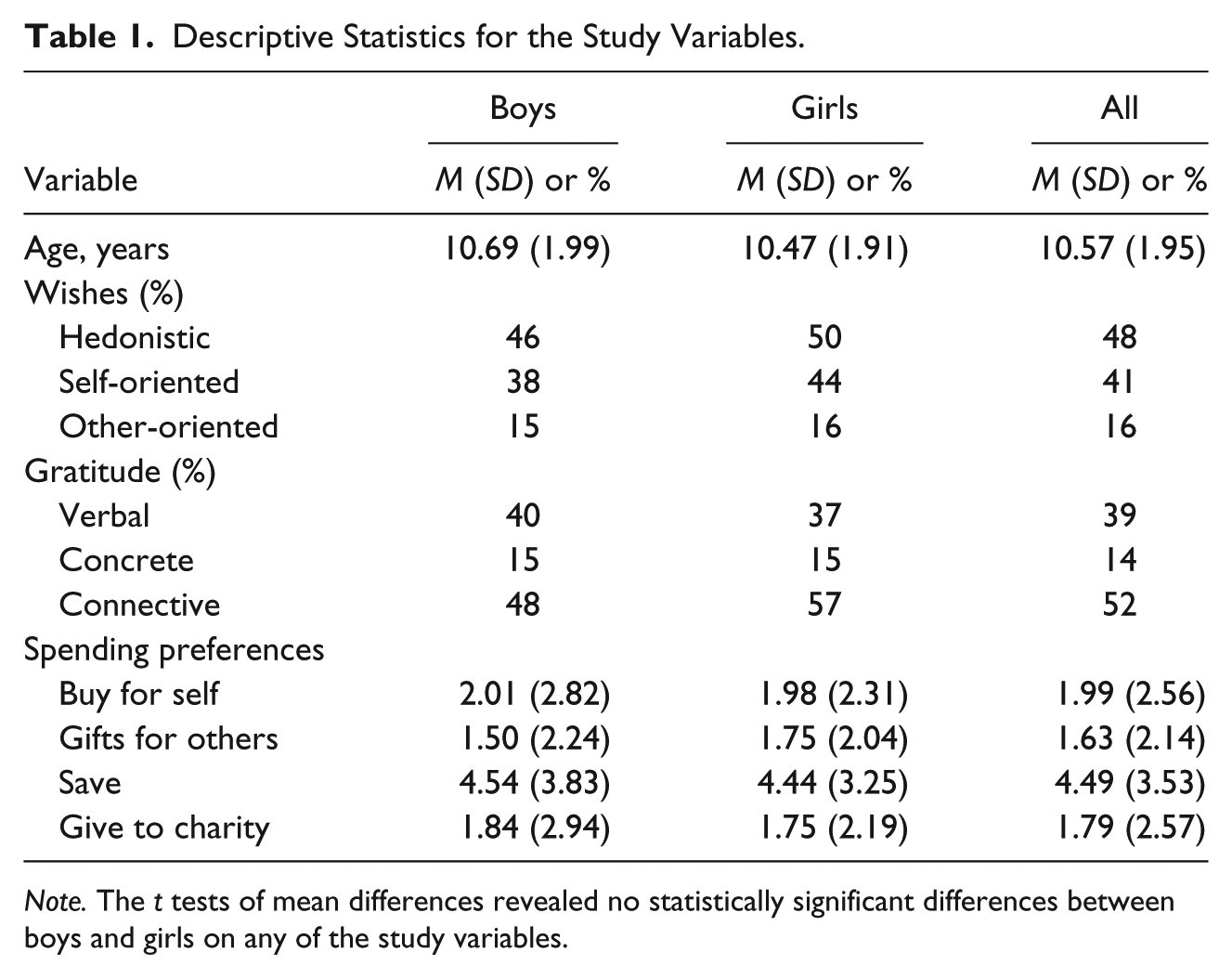
Note. The t tests of mean differences revealed no statistically significant differences between boys and girls on any of the study variables.
Next, we investigated the distributions of children’s wishes and expressions of gratitude in relation to their age by conducting cross-tabulations of these variables (see Table 2). The results indicated that, within our sample, children of each age expressed hedonistic, self-oriented, and other-oriented types of wishes. For example, the younger children reported wishing for “a doll,” “a new house,” or “an iPad” (hedonistic wishes); “to become a princess,” “to be a superhero,” or “to have all A’s in school” (self-oriented wishes); and “so that nobody ever gets sick” or “there is no more war” (other-oriented wishes). Similarly, older children reported wishing to “buy an iPhone” or “to have a car” (hedonistic wishes); “to become a famous actor” or “to get a good education” (self-oriented wishes); and “so that all people are happy” or that “everyone lives in peace and there is no more war and death” (other-oriented wishes).
Descriptive Cross-Tabulation of Types of Wishes and Types of Gratitude Expressed by Russian Children, by Age.

With one exception, children of all ages reported that if somebody granted them their greatest wish, they would “be very thankful to that person” (verbal gratitude); “would give that person a neckless” or “throw [him/her] a party” (concrete gratitude); and“I would do anything they wanted,” “love [him/her] forever,” “help [him/her] in need,” or “would fulfill their dream” (connective gratitude). The only exception was that none of the ten 7-year-olds expressed verbal gratitude.
Next, we ran zero-order correlations between children’s age, gender, and types of wishes children expressed. The results indicated that children’s wishes were not related to children’s gender. Moreover, children’s other-oriented wishes were not related to children’s age, but self-well-being wishes were positively related to age (r = .26, p < .001) and hedonistic wishes were negatively related to age (r = −.24, p < .001).
Predicting Gratitude From Age, Gender, and Wishes
To examine the degree to which children’s expressions of gratitude were related to their age and their wishes, we ran three binomial logistic regression models with each type of gratitude as the dependent variable. We also included children’s gender as a control variable, as prior research indicated possible gender differences in people’s expression of empathy and other prosocial emotions (Endresen & Olweus, 2001). Within each regression model, age and gender were included in the first step to estimate the predictive power of age while controlling for gender. In the second step of each model, types of wishes were included as predictors in addition to age and gender. The results are presented in Table 3.
Logistic Regressions of Types of Gratitude Onto Age, Gender, and Types of Wishes.

Note. B = log-odds values for predicting the outcome variable from the independent variable; eB = exponentiated B, which is an odds ratio.
p < .001.
Our findings indicated that the expression of verbal gratitude was not related to children’s age or their wishes. Children’s expression of concrete gratitude was related to children’s age (B = −0.32, eB = 0.73, p = .001). The exponentiated beta (eB) of 0.73 suggests that for each year increase in age, children were almost 1.4 times less likely to express concrete gratitude. With regard to connective gratitude, the results indicated a significant relation between children’s age and connective gratitude (B = 0.28, eB = 1.32, p < .001), which means that for each year increase in age, children were 1.3 times more likely to express connective gratitude. No relations between children’s types of wishes and their expressions of gratitude were found.
Predicting Spending Preferences From Age, Gender, and Wishes
To examine relations between children’s reported spending preferences and their age, gender, and wishes, we ran four hierarchical linear regression models with each spending preference as an outcome. In the first block of each model, age and gender were entered as predictors, and in the second block, all types of wishes were included in addition to age and gender. The results are presented in Table 4.
Linear Regressions of Spending Preferences Onto Age, Gender, and Types of Wishes.
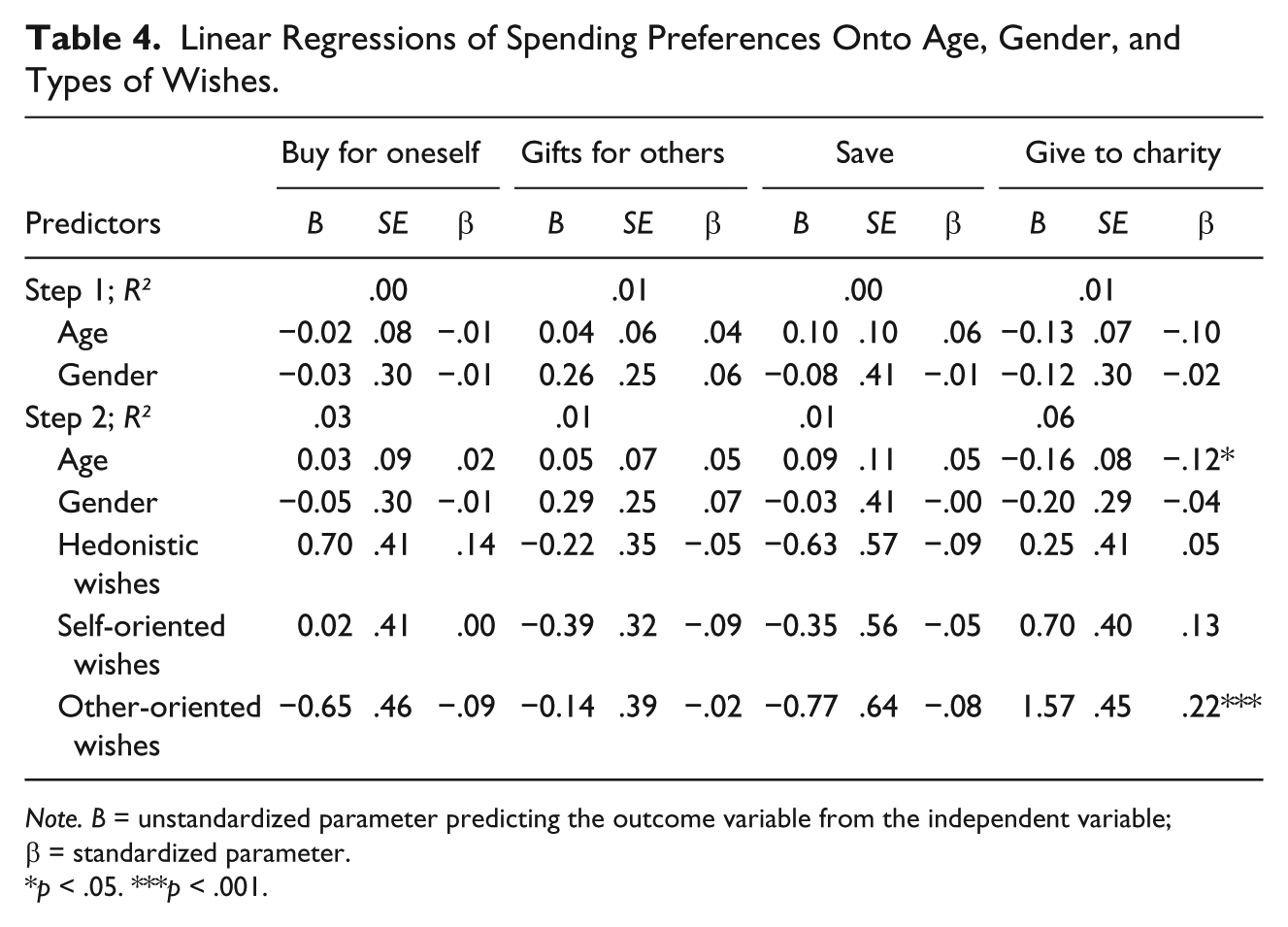
Note. B = unstandardized parameter predicting the outcome variable from the independent variable; β = standardized parameter.
p < .05. ***p < .001.
The results indicated that children’s intentions to buy things for oneself, to buy gifts for others, or to save for the future were not related to children’s age, gender, or any type of expressed wishes. Children’s intentions to give the money to charity were positively related to their expression of other-oriented wishes (β = .22, p = .001) and negatively related to children’s age (β = −.12, p = .04), indicating that older children were less likely to give money to charity compared with younger children.
Discussion
Research on children’s moral development, at a time in human history when religious participation is declining worldwide (National Geographic, 2016; Pew Research Center, 2015) and many people are searching for a new moral compass, is as important as ever. The question of the development of gratitude has been receiving a lot of attention in public discourse, but we know little about the ways in which children around the world express gratitude or whether children’s expressions of gratitude are related to children’s wishes. In this study, we investigated the degree to which Russian children aged 7 to 14 expressed different types of wishes and different types of gratitude. We found that children’s expressions of connective gratitude, in which children must take into consideration potential needs or wants of their benefactor, were related to children’s age. The connective type of gratitude, which is arguably the most closely aligned with the virtue of gratitude, requires children to have particular types of experience, such as seeing others express virtuous gratitude, having opportunities to exercise expression of gratitude, or discovering the conditions under which it is appropriate to express gratitude (Annas, 2011). Moreover, connective gratitude promotes social bonds among members of a community and encourages reciprocation of goodwill. Thus, given Russian cultural positions to be grateful for any help and to reciprocate the kindness in whatever form one’s friends and neighbors may need it, it was not surprising that the greatest number of Russian children in our sample expressed connective type of gratitude. But it was somewhat surprising that even the youngest children in our sample, those who were 7 and 8 years old, were able to express connective gratitude on a par with verbal and concrete types. In this study, we did not investigate the process mechanisms through which cultural messages become internalized by Russian children, but we did find evidence that cultural messages on the importance of gratitude become internalized at least as early as 7 years of age.
Our findings that older children were less likely than those who were younger to express concrete gratitude and more likely to express connective gratitude imply the necessity of strong perspective taking skills for the development of virtue of gratitude. The ability to express gratitude seems possible only when children, and adults for that matter, are capable of taking another person’s needs and desires into account. It is possible that the Russian cultural context, where children from a young age are encouraged to repay others for their kindness and where any small favor from another person needs to be acknowledged and appreciated, serves as a fertile ground for children’s internalization of social values that emphasize strong interpersonal connections.
We also found that older children wished for things that could potentially aid them in the process of self-realization and self-betterment, whereas younger children were more likely to want things that provided hedonistic gratification. Given the abundance of material pleasures and ubiquitous advertising for hedonistic desires, it is not surprising that most children in our study expressed hedonistic wishes. Yet it became apparent that in older children, the desires for self-betterment began to prevail over hedonistic desires, which indicates children’s capability of withstanding the onslaught of materialistic advertising and their ability to focus on their future.
Only 16% of children in our sample expressed other-oriented wishes. In light of children’s perceived egocentric nature, in our view, it is quite astonishing that one in every six children declared other people’s well-being as their greatest wish. We are not aware of any research that asked adult participants to indicate their greatest wishes using a similar methodology. It would be greatly informative, however, to determine what various groups of adults wish for and how their concern for other people’s well-being compares with the responses of our 7- to 14-year-old children. We perhaps should not speculate, but we would not rule out the possibility that children may care about others no less, or even more so, than adults.
In terms of children’s spending preferences, we found that the majority of these Russian children opted for saving their windfall money. This is not surprising, given the volatility of the Russian economic situation and a tendency of many Russians to be thrifty. We also see this finding as a potential evidence of Russian children’s ability to withstand the allure of hedonistic promises that are heavily advertised all around them. Considering children’s intent to save their windfall money and the fact that about 40% of Russian children’s wishes were about their self-betterment, it seems likely that the children in our sample began to internalize Russian cultural attitudes about the unpredictable future and the necessity to be prepared for whatever tomorrow might bring.
Our study also found that younger children were more likely to donate to charity compared with older children. In general, research indicates that older children and adults report greater empathy compared with their younger counterparts (Endresen & Olweus, 2001; Richter & Kunzmann, 2011), and there are often gender differences in that women and girls tend to express more prosocial emotions compared with men and boys (Endresen & Olweus, 2001; Lennon & Eisenberg, 1987). In this study, we did not find gender differences, but found inverse age differences, which appear to run contrary to the available research evidence. Perhaps as children begin to better comprehend the power of money, their desire to express compassion through giving away their money to people in need begins to decline. In addition, we also found that even though the smallest number of children in our sample wished for the well-being of others, compared with other types of wishes, those children were more likely to give away their imaginary windfall to the poor rather than saving the money for the future or spending it. These conclusions come with a caveat that this was an imaginary windfall, and thus, we do not know how the children would spend the money if they actually received it. Similar caveats apply to all self-report measures that were used in this study. Nonetheless, the self-report measures can be used as a first step in developing a more comprehensive battery of measures to assess expressions of gratitude in children and adolescents.
In summary, our study was an attempt to contribute to the limited, but growing, research on the development of gratitude and desires of children around the world. In this study, we argued that the Russian cultural heritage places special importance on the virtue of gratitude, which could be traced to the necessity for strong social bonds in the society that for more than a millennium remained a relatively isolated, agrarian nation with an unforgiving climate. We found that Russian children starting as early as age 7 appear to successfully internalize this cultural message and to express connective gratitude which is most closely aligned with the virtue of gratitude. Moreover, we found that in general, children did not appear to spend their imaginary money in accordance with their desires, as the majority intended to save the money. The combination of children’s expressions of connective gratitude, their intent to save the windfall money, and the prevalence of children’s self-oriented wishes fit relatively well within Russian cultural traditions of caring for each other and the necessity of being prepared as much as possible for an unpredictable future. In addition, we found rather inspiring the fact that one in every six Russian children in our sample declared their greatest wish to be for the well-being of others and the evidence that children who wished for that were more likely to give their imaginary windfall money to the poor, compared with children who had wished for something for themselves, either immediately (as a hedonistic wish) or in the future.
Footnotes
Declaration of Conflicting Interests
The author(s) declared no potential conflicts of interest with respect to the research, authorship, and/or publication of this article.
Funding
The author(s) received no financial support for the research, authorship, and/or publication of this article.