



Abstract
Considering gratitude as a virtue, rather than a positive emotion, requires measures different from those more commonly used and which conflate gratitude with appreciation. We here describe those measures, explaining why they are appropriate to the study of gratitude as a virtue. We then discuss how each measure was coded for this special issue, the manner of recruitment of our participants across the seven research sites (Brazil, Guatemala, the United States, Russia, Turkey, China, and South Korea), the overall hypotheses, and the analytic strategies used.
As was discussed in the paper by Merçon-Vargas, Poelker, and Tudge (2018), the Development of Gratitude Research Group (DGRG) treats gratitude as a virtue and, as such, accepts a three-part definition of gratitude. This definition requires (a) that a benefactor freely and intentionally provides some benefit to a beneficiary, (b) that the beneficiary understands the benefactor’s intentionality and has a positive emotional response to it, and (c) that the beneficiary freely and intentionally attempts, if an opportunity presents itself, to reciprocate in some way that is likely to please or benefit the original benefactor. To the extent to which people typically feel and behave in this way, it seems reasonable to say that they are virtuously grateful. By contrast, if they typically fail to reciprocate, when given an opportunity, they are likely to be called ungrateful, no matter how positive their emotional response to the gift or help had been.
There are a number of implications that result from taking seriously this definition. First, as discussed by Merçon-Vargas et al. (2018), it seems unlikely that children or adolescents can be said to have yet attained gratitude as a virtue. Second, as this type of gratitude will not arise spontaneously, but needs experience and cognitive, socioemotional, and moral underpinning, its development should be studied. Third, assuming that the social and cultural context within which children are raised is likely to influence the way in which gratitude develops, it makes sense to study its development cross-culturally.
There are some further implications. One is that the methods to be used to study the development of gratitude should be such that they assess aspects of the definition that we use. This means that the most widely used methods seen in the gratitude literature are not helpful, for three reasons. The first is that very few of the items in the gratitude scales actually refer to human benefactors, an essential part of gratitude as a virtue. This is true of the Gratitude Questionnaire–6 (GQ-6; McCullough, Emmons, & Tsang, 2002), probably the most widely used of the scales, of the Gratitude, Resentment, Appreciation Test (GRAT; Watkins, Woodward, Stone, & Kolts, 2003), and of the Gratitude Adjective Checklist (GAC; McCullough et al., 2002). Many of the items (three of the six in the GQ-6, 11 of the 15 in the GRAT, and all three of those in the GAC) do not refer to humans at all but to emotional responses to seeing a beautiful sunset or feeling happy about one’s good health. None of the items in any of the scales have to do with the idea of reciprocation to a benefactor, not surprisingly, given that the implicit definition of gratitude on which these scales are based seems to relate to a different construct.
This implicit definition is the second reason for the unhelpful nature of these scales for assessing gratitude as a virtue; the items seem to deal with a construct that is far broader than our conception of gratitude—appreciation (see Adler & Fagley, 2005; Fagley, 2016). One can appreciate and feel a warm emotional response to a wide array of things, but no one is accused of ingratitude if they fail to appreciate a beautiful sunset, for example. Ingratitude, termed the “king of the vices” by Emmons (2016), is reserved for people who fail to live up to what is described in the definition of gratitude as a virtue—people who, having received something of benefit, fail, when an opportunity presents itself, to help that previous benefactor. If ingratitude is defined by the failure to reciprocate when opportunities to do so present themselves, then gratitude (rather than appreciation) necessarily involves reciprocation. Gratitude, in the sense in which we mean it, is thus more specific than is appreciation, and may, perhaps be considered the “queen of the virtues” (Emmons, 2016).
The third reason is that these scales provide data on variations in the extent to which individuals feel grateful. This is perfectly fine if the intention is to correlate degrees of gratitude/appreciation with feelings of well-being or, negatively, with levels of depressive symptomatology. However, given that scoring high or low on these scales has nothing to do with the presence or absence of the virtue of gratitude, they are not helpful for our purposes.
Measures
Assessment of Children’s Wishes and Gratitude
To address the problems we identified in the commonly used measures, we adapted the measure developed in the 1930s to assess “gratefulness” by Baumgarten-Tramer (1938), who was interested in how Swiss youth ranging in age from 7 to 15 years would respond if they were granted their greatest wish. She was thus not concerned with how grateful (i.e., levels of gratitude) her respondents said that they would be to their benefactors but the manner in which they expressed their gratitude. She found that their responses could almost always be coded into one of three distinct types of gratitude, each of which will be discussed later.
The Wishes and Gratitude Survey (WAGS; Freitas, Tudge, & McConnell, 2008) included the two questions that Baumgarten-Tramer (1938) had used in her study—namely, “What is your greatest wish?” and “What would you do for the person who granted you that wish?” Our primary focus in this Special Issue will be on the responses to these two questions, although we added some additional questions to Baumgarten-Tramer’s original instrument (“Is there anything else should you do for the person who granted you this wish? Why?” and “Who is this person?”).
There are several reasons why this measure is particularly helpful for a cross-cultural examination of the development of gratitude. First, no assumptions are made about what children might be grateful for—they are free to identify what it is that they might most like or need, and the wishes they have are likely to vary cross-culturally. Second, whatever gratitude they express is necessarily linked with something that they feel to be important (it is their “greatest wish”). Third, unlike so many instruments used in cross-cultural research, this measure was not developed in the United States and then translated for use elsewhere—it was developed in Switzerland, translated into English for publication, and first replicated in Brazil by the second author and her research group (Freitas, Pieta, & Tudge, 2011). The measure has also been used to collect data in both the United States and China (Tudge, Freitas, Mokrova, Wang, & Brien, 2015; Wang, Wang, & Tudge, 2015). It was back-translated into each of the languages of the countries where we have collected data by members of the DGRG who are native speakers of these languages in all cases but Spanish (two members of the group are fluent speakers). All translations were discussed with other native speakers to ensure that the same meaning was captured.
In all cases, coding of the WAGS was conducted using the original language. At least 25% of the responses were coded by a second person and kappas at or above .80 were attained. In some cases (Chinese, Turkish, Russian, and Korean), the second coder had to work with translations from the original language. Differences in coding were discussed until resolved.
Assessment of Spending Preferences
We were also interested to see whether the type of wishes and of gratitude that our participants expressed would bear any relation to what they might do on a different type of task. We therefore asked them to complete a version of Kasser’s (2005) Imaginary Windfall (Tudge & Freitas, 2011). Asked to imagine that they have received US$100 (or the equivalent, depending on the society), they can mark each of 10 “$10 bills” with one of four possibilities: Buy (“Buy stuff for yourself”), Gifts (“Get presents for friends or family”), Save (“Save for the future”), or Poor (“Give to charity or the poor”). As was the case for the WAGS, this measure was first back-translated by DGRG members who were either native speakers or fluent in the relevant language, followed by discussion of the meaning with other native speakers.
Coding of the Measures
Wishes
Although Baumgarten-Tramer (1938) collected data on the wishes of her Swiss participants, she only published about the types of gratitude they expressed. We therefore read our participants’ responses to the first question and found that almost all could be categorized into one of three broad categories. Hedonistic wishes involve desires that can be satisfied immediately (toys, money, to go on a trip, etc.). Self-oriented wishes are also intended for the self but are not desires that can be satisfied immediately (such as getting a good education or a job). Social-oriented wishes are desires involving others, whether family members (a sibling to recover from illness, for example) or the wider social world (e.g., peace on earth). Some participants provided more than one type of wish, something we considered when analyzing our data.
Gratitude
Baumgarten-Tramer (1938) had found that her participants’ responses fit overwhelmingly into one of three types, which she named verbal, concrete, and connective. Verbal gratitude, as the name suggests, includes the various ways in which people can express gratitude verbally, from a simple “I would thank him” to “I would thank her from the very bottom of my heart.” Those who express this type of gratitude may simply be polite, given that in many cultures children are strongly encouraged to verbally acknowledge others’ help or gifts (Freitas et al., 2011; Visser, 2009). They may also feel a strong emotional response for the benefit gained, to the benefactor, or both. However, what is lacking in this type of gratitude is any expressed wish to reciprocate in any way to the benefactor. A positive emotional response may well be an important part of gratitude, as defined earlier, but it is clearly not sufficient as a marker of the virtue.
Concrete gratitude involves the notion that some type of reciprocation is in order. Some children responded to having their greatest wish granted as follows: “I would give them 5000 pieces of candy,” or “Give them a trampoline.” The expressed intention is to reciprocate but with things that the beneficiary, rather than the benefactor, might like or appreciate. Despite the name, this type of gratitude does not necessarily involve reciprocation with something concrete, like a trampoline. One child’s greatest wish was “That I could go to scotland the contry [sic]” and whose expression of gratitude was “I would let them go with me.” This type of gratitude comes closer to the definition of the virtue of gratitude than does verbal gratitude but still falls short in that it fails to take into account the wishes or needs of the original benefactor.
Connective gratitude also includes the sense that reciprocation is due to a benefactor, but the benefactor’s wishes or needs are taken into account. As one child said, “Help them if they needed help,” and another one, whose wish was to become a doctor, responded, “I would not let them pay whenever they got hurt and had to go to the hospital, them or their family.” This type of gratitude fits closest with the definition as a virtue. Of course, we cannot say whether children who respond with connective gratitude are in fact virtuously grateful—for that to be the case, they would need to typically behave in ways that fit with their written responses. However, we would argue that this type of feeling and response is a necessary, though not sufficient, aspect of gratitude as a virtue.
We found a number of other possible types of responses to the second question. One, “finalistic” gratitude, had already been identified by Baumgarten-Tramer (1938); a few of her participants, all aged 15, responded that they would show their gratitude to their benefactor by doing the best they possibly could at what it was that they wished for, as a way of showing that the opportunity they had been granted had not been given in vain. We also found a few examples of this in our study, such as 14-year-old female who wished “to go to college and get a well-paying job so that I can have a family” and, by way of gratitude, stated, “Do my absolute best in school.” Some, also typically older, felt that what they wished for was something that only they could achieve, and so gratitude to another person was impossible. Another 14-year-old female stated, “Personally I wish that I could care less about what other people think about me and other people.” Her response to the second question was “I would be proud of myself.” We termed this response “self-sufficient,” as it seems to have little to do with gratitude as defined but found very few examples of either this or finalistic gratitude. Some children also responded with either “Nothing” or “Don’t know.” In the papers that follow, we will focus on the three major types of gratitude expressed by the children—verbal, concrete, and connective.
Imaginary Windfall
This measure was coded simply by adding the number of US$10 boxes (or their equivalent in other countries) marked for each of the four possible choices (buying for oneself, presents for others, saving, or giving to charity). Scores for each of the four choices could therefore range from 0 to 100 in increments of 10.
Participants and Procedures
Participants in the DGRG study are children aged 7 to 14 years (see Table 1). Full details about the city or cities from which they were drawn and participants’ demographic information are found in the subsequent papers. In most cases, they were recruited in the following manner. School principals were approached and asked whether they would be interested in having students from their schools participate in the study. Given permission from the schools, we sent letters home, asking parents whether they would allow us to ask their children for their permission to participate. In Greensboro, but not in the other cities where we felt this not to be culturally appropriate, we gave the teachers $2 for each returned parental consent letter, regardless of whether consent was given. Parents returning the consent letters also provided demographic details, such as where the parents and children were born, the parents’ educational level attained, whether they worked outside the home and, if so, type of job, and, although only in the United States and Guatemalan cities, ethnic/racial background. In Greensboro, we tried to recruit participants from schools that represented the range of ethnic/racial and/or socioeconomic status (SES) diversity in the city. In the Brazilian and Turkish cities, however, children came from either public or private schools, with children of working-class parents most likely to attend the former and those of middle-class or wealthy backgrounds overwhelmingly to be found in the latter.
Basic Demographic Details of the Seven Samples.
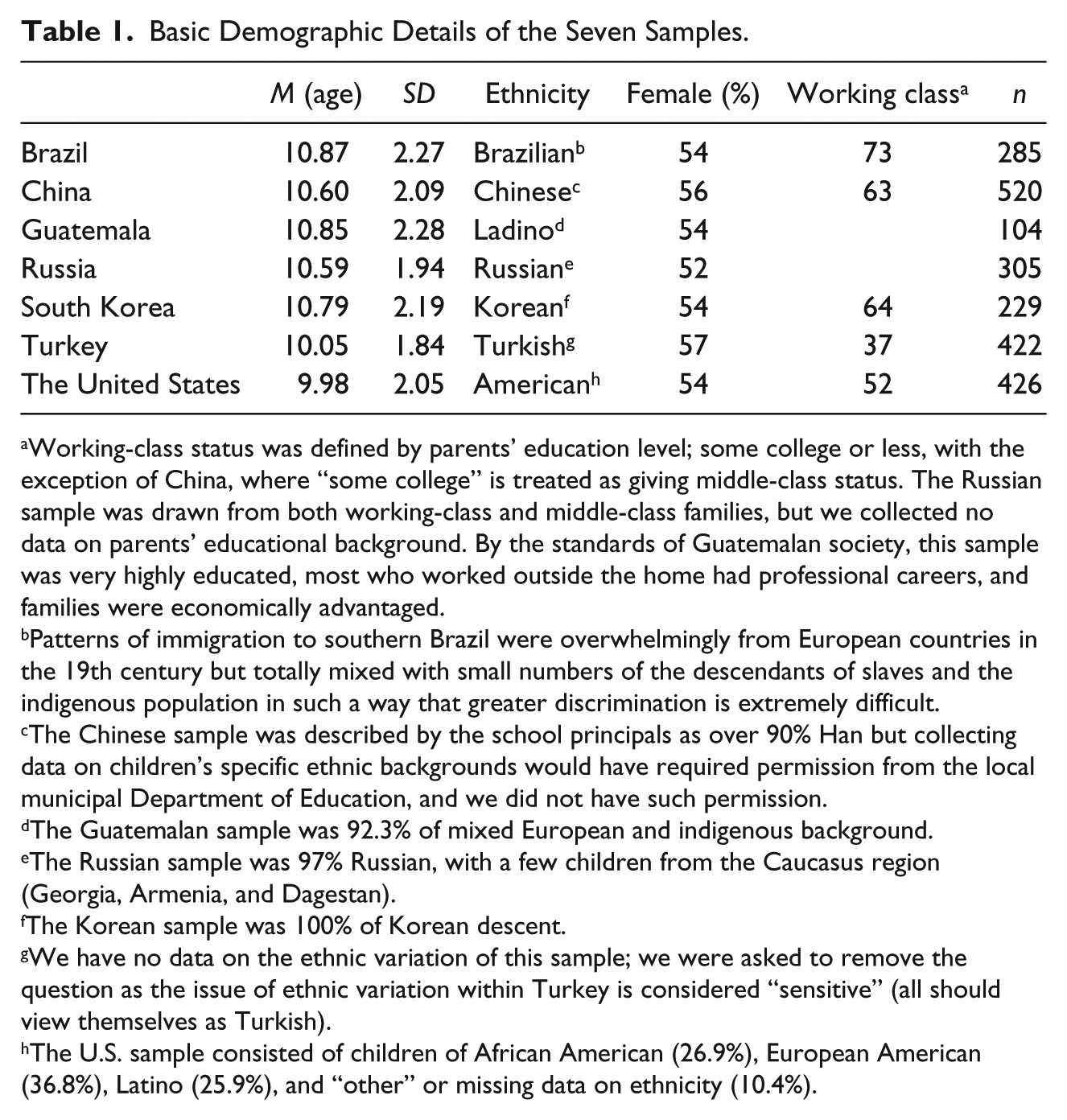
Working-class status was defined by parents’ education level; some college or less, with the exception of China, where “some college” is treated as giving middle-class status. The Russian sample was drawn from both working-class and middle-class families, but we collected no data on parents’ educational background. By the standards of Guatemalan society, this sample was very highly educated, most who worked outside the home had professional careers, and families were economically advantaged.
Patterns of immigration to southern Brazil were overwhelmingly from European countries in the 19th century but totally mixed with small numbers of the descendants of slaves and the indigenous population in such a way that greater discrimination is extremely difficult.
The Chinese sample was described by the school principals as over 90% Han but collecting data on children’s specific ethnic backgrounds would have required permission from the local municipal Department of Education, and we did not have such permission.
The Guatemalan sample was 92.3% of mixed European and indigenous background.
The Russian sample was 97% Russian, with a few children from the Caucasus region (Georgia, Armenia, and Dagestan).
The Korean sample was 100% of Korean descent.
We have no data on the ethnic variation of this sample; we were asked to remove the question as the issue of ethnic variation within Turkey is considered “sensitive” (all should view themselves as Turkish).
The U.S. sample consisted of children of African American (26.9%), European American (36.8%), Latino (25.9%), and “other” or missing data on ethnicity (10.4%).
Children whose parents had agreed were then asked to provide their own consent; those who agreed to participate were provided the two measures described above (the WAGS and the Imaginary Windfall), plus two other measures that will not be discussed in the following papers. In some situations, the data were collected in the children’s classroom; in others, children went to a central location, such as a school cafeteria or library. Whenever appropriate, we varied the number of data gatherers according to the age of the children. For the younger children, it was sometimes necessary to help them reading the questions and if they were not able to write or if their writing was not legible, the researchers either wrote their answers for them or asked what they had written and then rewrote the children’s responses. We excluded from the study all children who did not fall within the targeted range—that is, any younger than 7 and older than 14 years.
Hypotheses and Analyses
For the papers that follow, we used logistic regression to test our first two hypotheses, both of which derived from results reported initially by Baumgarten-Tramer (1938) and from replications of her work conducted in Brazil (Freitas et al., 2011) and the United States (Tudge et al., 2015). We hypothesized that (a) age, after controlling for gender, would be associated with children’s expressed gratitude (assessed by the WAGS), such that older children would be more likely to express connective gratitude and less likely to express concrete gratitude, whereas verbal gratitude would be expressed at similar rates by children of all ages; (b) controlling for gender and age, there would be a positive relation between types of wishes and expression of gratitude (both assessed by the WAGS); in particular, social-oriented wishes would be related to the expression of connective gratitude and hedonistic wishes would related to the expression of concrete gratitude. Logistic regression was used because of the dichotomous nature of our dependent variables—participants who expressed (coded as 1 = yes), versus did not express (coded as 0 = no), each type of gratitude. To test these hypotheses, for the first analytical step, we included just age and gender as our predictors; for the second step, we added each of the types of wishes (hedonistic, self-oriented, and social-oriented wishes) as predictors, with each of the three main types of gratitude (verbal, concrete, and connective) used as the sole dependent variable in separate regression analyses.
Our third and fourth hypotheses were related to the children’s spending preferences (as assessed by the Imaginary Windfall). We hypothesized (c) that age, controlling for gender, would be associated with a greater propensity to both save money and to give to the poor. However, once including the three types of wishes as predictors, we hypothesized (d) that wish type, controlling for age and gender, would be related to spending preferences, such that social-oriented wishes would be positively associated with buying for others and giving to the poor, whereas hedonistic or self-oriented wishes would be positively associated with buying gifts for oneself or saving one’s windfall money. To test these hypotheses, we used linear regression given the continuous nature of our dependent variables. For the first analytical step, we included just age and gender as our predictors; for the second step, we added each of the types of wishes (hedonistic, self-oriented, and social-oriented wishes) as predictors, with each of the four spending preferences (Buy, Gifts, Save, and Spend) used as the sole dependent variable in separate regression analyses.
It is dangerous, as pointed out by Merçon-Vargas et al. (2018), to make any generalizations, explicit or implicit, to any parts of the “developing” or “majority” world based on data collected in one or more Western, Educated, Industrialized, Rich, and Democratic (WEIRD; Henrich, Heine, & Norenzayan, 2010) society. Because of that we chose to address these hypotheses for each society from which we collected data in separate papers and drew comparisons only in a final paper. This approach allows us to explore each individual culture in more depth and later to examine similar and different patterns of gratitude expression across groups. Therefore, the following seven papers of this special issue will test the hypotheses stated here separately for each society. The papers are organized by three continental regions: (a) Americas, including Brazil, Guatemala, and the United States, (b) Eastern Europe, including Russia and Turkey, and (c) Asia, including China and South Korea.
Authors of the final paper will focus systematically on similarities and differences in the patterns of gratitude expression across all societies. Our hypotheses for the final paper are that although the age-related patterns of the expression of gratitude may well be similar across countries, the extent to which different types of gratitude are expressed will vary across societies. Specifically, children in societies that are more likely to value autonomy-relatedness, according to Kağıtçıbaşı (2007), namely, Guatemala, Brazil, Russia, Turkey, China, and South Korea will be more likely to express connective gratitude and less likely to express concrete gratitude than will children in the society that is more likely to value autonomy-separateness (the United States). We are not assuming, however, that the six societies more likely to value autonomy-relatedness form a homogeneous block and will assess similarities and differences in gratitude expression among all seven societies.
To do that, results from each society will be compared to explore whether patterns of associations among age, wishes, and gratitude are similar or different across countries. Moreover, logistic regression analyses will be used to explore the extent to which children in the seven countries are more or less likely to express the three types of gratitude. Finally, the total percentage of each type of gratitude expression will be plotted by country in a three-dimensional graph to explore similarities and differences in the patterns of gratitude expressions across societies. Hierarchical cluster analysis will be conducted to investigate whether countries can be clustered together according to the patterns of gratitude expressions. For that, the percentages of all three types of gratitude by country will be used as statistical indicators of gratitude patterns, concomitantly. That is, percentages of gratitude by country will be the variables used to explore clusters.
Footnotes
Declaration of Conflicting Interests
The author(s) declared no potential conflicts of interest with respect to the research, authorship, and/or publication of this article.
Funding
The author(s) disclosed receipt of the following financial support for the research, authorship, and/or publication of this article: Support for the writing of this paper and for the data collected was generously provided by the John Templeton Foundation (Grant # 43510 to Jonathan Tudge, PI) and by Conselho Nacional de Pesquisa (CNPq) (Scholarship # 302688/2015-3 to Lia Freitas).