



Abstract
Visual activity schedules (VASs) are an effective, efficient intervention designed to promote positive language and behavioral development for elementary students with and at risk for emotional and behavioral disorders (EBD). However, VAS design and implementation varies widely in the extant research, prohibiting the ease of implementation in classrooms. The purpose of this article is to provide systematic guidance for educators to design, plan, implement, and progress monitor VAS effectiveness for students with or at risk for EBD.
The purpose of this article is to provide educators with a practical set of tools and recommendations to design, adapt, and implement visual activity schedules (VASs) to support learning and behavioral outcomes for students exhibiting challenging behavior. Visual activity schedules are efficient preventive strategies that can help set up a learning environment that is tailored to individual students’ needs. Visual activity schedules have a robust evidence base for promoting positive outcomes for students who present challenging behavior and require predictable behavioral and communication supports (Steinbrenner et al., 2020). They have a promising evidence base for students without developmental disabilities (Zimmerman, Martinez, et al., 2020).
These positive findings are not surprising given the common overlap between challenging behavior and language or communication delays (Chow et al., 2018). We first provide a rationale for a need for antecedent interventions to improve challenging behavior and why VASs are an ideal strategy for students who present challenging behavior. We then present a roadmap for educators to plan successful use of VASs in the classroom, including identifying different types of VAS schedules, how to plan VAS implementation, when to use VASs, how to teach VASs to students, and how to monitor progress of the effects of VASs on student outcomes. We encourage readers to access the VAS Primer Anticipation and Planning Guide in Supplemental Materials to support ongoing decision-making as you read each section of this article (https://tinyurl.com/mreka6ax). This guide follows the format of the manuscript to provide an opportunity for readers to pause, make decisions relevant to their contexts, and continue reading as they plan VAS implementation.
Association Between Language and Behavior
It is well understood that students with language delays are more likely to present challenging behavior than their typical peers, and that students who exhibit challenging behavior often have comorbid language delays (Chow & Wehby, 2018). Students and youth with or likely to develop emotional and behavioral disorders (EBD) benefit from functional communication interventions (Hollo & Burt, 2018). Students with language delays demonstrate improved behavior in the long term after successful implementation of research- or evidence-based language intervention (Curtis et al., 2018). Students exhibiting challenging behavior require interventions that promote positive behavior and language development (Chow et al., 2020; Cunningham et al., 2019).
Given the connection between language and behavior, interventions designed to support both should be implemented before students are expected to engage in these behaviors. Antecedent interventions provide students with environmental supports before an activity or routine and serve as a preventive tool to decrease challenging behavior and promote prosocial behaviors such as engagement (Kern et al., 2002). Preventive interventions may be easier to implement than reactive interventions and can be incorporated into ongoing classroom management practices to support small groups or individual students (Jolivette et al., 2013).
Intentional antecedent intervention to support students with language and behavioral support needs should also include visuals to support language acquisition, receptive language comprehension, and supplemental communication supports when multistep or task directives may be too linguistically complex for a student (Chow et al., 2020; Cunningham et al., 2019). By increasing students’ access to classroom procedures, routines, and activities using VASs, we posit a student can increase their engagement and thus their access to academic learning, language models and opportunities for practice, and social relationships in their environment.
Visual Activity Schedules
One antecedent, preventive intervention designed to support both language and challenging behavior is use of VASs. Visual activity schedules are a commonly used visual support designed to provide information about expected behaviors (Bryan & Gast, 2000), support students’ language processing (Raver et al., 2013), integrate visual and auditory processing (Raver et al., 2013), and create structured beginning and end points to instructional activities (Zimmerman, et al., 2017; Zimmerman, Ledford, et al., 2020). Visual activity schedules include visuals to support language and task order, explicit task steps or activity locations to support successful transitions, and embedded behavioral strategies to make learning more explicit (e.g., places where choices are possible; clear ends to activities resulting in reinforcement or preferred items/people/activities).
Research on Visual Activity Schedules
A recent meta-analysis of outcomes for interventions using VASs in preschool and elementary classrooms found overall positive improvements in engagement and challenging behavior across populations in one-on-one, small group, and large group academic activities (Zimmerman, Martinez, et al., 2020). Visual activity schedules are an evidence-based practice (EBP) for students with autism (Steinbrenner et al., 2020) and intellectual disabilities (ID; Spriggs et al., 2017) to improve language and behavioral outcomes. Visual activity schedules are also an effective intervention for improving challenging behaviors for young students exhibiting challenging behavior who are likely to develop social delays (Zimmerman et al., 2017), EBD (Zimmerman, Ledford, et al., 2020), or attention-deficit/hyperactivity disorder (ADHD; Cirelli et al., 2016), or young students experiencing hearing impairments (Raver et al., 2013). Watson and DiCarlo (2016) demonstrated success in use of VASs with young children without disabilities.
Elementary educators reported VASs are effective and feasible interventions to improve engagement and address challenging behavior (Zimmerman et al., 2024). A common characteristic of all these students is the likelihood of needing both language and behavioral supports at an early age (Chow et al., 2018). Thus, VASs provide an opportunity for educators to address both language and behavioral needs for a diverse array of students with and without disabilities in elementary classrooms, but most specifically young students with or at risk for EBD who display concomitant language and behavioral support needs.
Five Uses of Visual Activity Schedules
Five uses of VASs have been identified in the literature: (a) sequence the order of steps in an activity (within-activity schedule; Raver et al., 2013), (b) provide information about transitions between activities across the day in a daily schedule (Dettmer et al., 2000), (c) list required tasks for completion to access reinforcement (Warren et al., 2021), (d) highlight opportunities to respond during group instruction (Zimmerman, Ledford, et al., 2020), and (e) embed opportunities for student choice during an instructional activity (Zimmerman, et al., 2017; Zimmerman, Ledford, et al., 2020). Each type is briefly detailed below, with further discussion of how to identify the VAS purpose occurring in subsequent sections of this article.
Within-activity schedules
Visual activity schedules that sequence the order of steps in an activity are designed to support a student in identifying and completing all the steps within a single multistep activity. Also called within-activity schedules, these VASs can provide visual and written information about the steps without the need for an adult to continue to give vocal-verbal directions. Within-activity schedules can support students who may have identified receptive language support needs and simply cannot access verbal directions at the speed required to successfully complete a multistep task (Chow et al., 2021; Raver et al., 2013). Within-activity VASs may also support students with behavioral support needs who have difficulty maintaining engagement during a multistep activity, or students who require consistent reminders or prompts to stay on task or move to the next step in an activity (Zimmerman et al., 2017).
Within-activity VASs often are applicable to centers or activities that have multiple steps required for completion. For example, a within-activity schedule can be used to detail the required steps to complete a literacy or math center. Additional examples of within-activity schedules can be found in Row 1 of Figure 1.

Example of a Visual Activity Schedule.
Between-activity transitions
Between-activity VASs can support transitions within the classroom (e.g., activities during gym class; required centers to complete during math rotations; research activities to be completed during a social studies inquiry activity) or transitions out of the classroom (e.g., VAS of subject area transitions by teacher for upper elementary students who change classes). Additional examples of between-activity VASs can be found in Row 2 of Figure 1.
Tasks to reinforcement
Many elementary students who exhibit challenging behavior during guided practice or independent work may simply need to know how many tasks they need to complete before they can access reinforcement (Jolivette et al., 2013). Whereas a within- or between-activity VAS may show a student what they need to do, tasks to reinforcement VASs show a student how much they have to do to be finished and access something they prefer or find reinforcing. Visual activity schedules can be used to show students how many tasks need to be completed to access a preferred activity, person, or item. These preferred items may likely be reinforcing, and visual representations of them can be placed on a schedule to increase the likelihood a student will complete the activities or work. Students who benefit from tasks to reinforcement VASs likely know what to do during an activity or routine, but are not performing those activities.
Task to reinforcement VASs should include each task to be completed in sequential order with the reinforcing or preferred item/person/activity placed at the end of the schedule. Tasks to reinforcement VASs can be utilized in student-directed work tasks (with reinforcement individualized to a student), small group or center tasks (with a group agreed upon reinforcer at the end such as free time to talk), or whole group activities (pairing a reward with completion of a whole group lesson; Zimmerman et al., 2017). Additional examples of tasks to reinforcement VASs can be found in Row 3 of Figure 1.
Opportunities to respond
Increasing opportunities to respond is one strategy to improve students’ engagement (Kern et al., 2002). Visual activity schedules can be used to show students engaging in challenging behavior how many times they must respond to whole group instruction before they are allowed to either stop answering questions or leave the activity. The first icons on opportunities to respond VASs should get the student to the correct location and support the student in attending to instruction. The remaining icons should show the student how many times they have to respond. These opportunities can be represented by question marks (see Figure 1), line drawings of the type of response (e.g., math equations; thumbs up/thumbs down images), or the materials for a response (e.g., whiteboard, two students talking). Opportunities to respond VASs have been used during whole group instruction to improve engagement for elementary students at risk for EBD (Zimmerman, Ledford, et al., 2020). We encourage educators to offer more opportunities to respond to the group than items on the VAS. This allows students to choose which opportunities or questions they want to respond to. This type of VAS also embeds some student choice into the process. Additional examples of opportunities to respond VASs can be found in Row 4 of Figure 1.
Embedding student choice
Providing opportunities for instructional choice is another strategy to improve students’ engagement (Kern et al., 2002). Visual activity schedules can be used to show students engaging in challenging behavior when they can have ownership or control over their learning. Embedding student choice VASs can allow students to construct the order of icons on a within-activity VAS or show students the step(s) within an activity in which they can choose instructional materials or social partners. If students can choose the order of icons on the VAS, then the mobile format (described below) should be used to allow students to place icons in order. Educators can provide students a choice during a single step of activity such as choosing a writing material during an art center, a social partner for morning greetings, or an item on an activity sheet to complete (Zimmerman et al., 2017; Zimmerman, Martinez, et al., 2020). Additional examples of embedding student choice VASs can be found in Row 5 of Figure 1.
Planning Visual Activity Schedules
Successful creation of VASs requires educators to identify the purpose of the schedule, identify the content of the schedule, and design the schedule format. In the next section, we describe each of these important considerations to model the development and planning of effective VAS interventions in elementary classrooms. We encourage readers to pause and download the VAS Primer Anticipation and Planning Guide from the journal webpage or data repository (https://tinyurl.com/mreka6ax). This document will support the reader throughout the remainder of this article to immediately begin planning your VAS intervention.
Purpose
An essential first step to successful VAS development is to identify the VAS purpose. The VAS Planning Guide provides a place to document your decisions and select the purpose and type of VAS. First, observe the student(s) during the activity when they are displaying challenging behavior. Next, decide if the time in which the challenging behavior occurs is during a single activity or transitioning between activities.
After you decide if you are targeting a single activity or transitions between activities, identify what the student needs to improve (Zimmerman, Martinez, et al., 2020). If a student or group of students needs support knowing how to complete a single activity, then a within-activity VAS should be selected. If a student or group of students needs support transitioning between activities, a between-activity VAS is most appropriate. If a student or group of students requires support in knowing how much work must be completed before they access reinforcement or a preferred item/person/activity, then a tasks to reinforcement VAS may be most appropriate. If a student or group of students has difficulty sustaining engagement throughout an activity, especially during whole group instruction, an opportunities to respond VAS may be most appropriate. Finally, if a student or group of students engage in challenging behavior during one component of an activity, then an embedded choice VAS may be most appropriate.
Content
Once the purpose of the VAS has been determined, list the steps or content that should be included on the VAS. Generate a list of steps or components that corresponds to the purpose of the schedule, and then use that list to create corresponding visual content. Watching a child successfully complete the targeted activity or task can help you identify the steps for completion. For example, if you want to create a VAS for using a QR code search poster, first list each step the student needs to complete to use the QR code search. These steps might include: (a) get iPad, (b) walk to poster, (c) scan code, (d) listen to movie, podcast, or read website, and (e) record information. Consider tailoring VAS images to match student strengths in comprehending visual images and preference. Choose to take actual photographs for a student who needs additional language supports with written labels under each image and 2D images taken from the internet for a student who needs behavioral support to complete the activity. A graphic organizer for identifying VAS content can be found in the VAS Anticipation and Planning Guide (https://tinyurl.com/mreka6ax).
Design
There are several ways VASs can be displayed, including linear, book, and electronic formats. Linear formats typically involve vertical or horizontal display (Bennett et al., 2011). Book formats can be individualized to contain one or more steps of the schedule and corresponding icons on each page (Akers et al., 2016). Electronic formats use digital platforms and technologies to display schedules (Brodhead et al., 2014). Comparisons of digital and linear/book formats have concluded each format is effective (Cihak, 2011; Giles & Markham, 2017). Decide how to select the design of the VAS based on availability of materials and child/educator preference for format (Giles & Markham, 2017). For example, you might choose to use a digital VAS on a tablet because a child displays a preference for electronics. You might also choose a book format for the VAS during a whole group activity so that you can quickly exchange pages throughout the school year when content changes while keeping routines part of the schedule (e.g., greeting peers as the first page of a morning meeting; see Zimmerman, Martinez, et al., 2020 for an example of an editable book format during whole group).
Once the VAS format is selected, choose the icon format. Icons can include, in order of complexity (Zimmerman, Martinez, et al., 2020): objects, photographs, 2D images, abstract line drawings, and/or written text. The content of icons (e.g., objects versus abstract drawings) should be determined based on the student’s development and support needs. For example, if a student cannot independently read written text, then a 2D image with text schedule may be appropriate. Furthermore, if a student has a receptive language need, icons should include clear representations of the needed items such as photographs to ensure the student is matching the verbal directives to the actual items in the classroom.
You can quickly test if an image can independently be understood by a student by giving the student an icon and asking them to go get the item. If the student can translate the icon image/text to the actual item, then the icon content is appropriate. If the student cannot retrieve the icon, then move down the complexity scale. Be sure to continually monitor icon content to increase complexity as students progress through elementary school. If students receive speech-language services, consulting with the speech-language pathologist is also recommended when selecting icon images. Format and icon choices can be selected from a list in the VAS Anticipation and Planning Guide (https://tinyurl.com/mreka6ax).
Teaching Visual Activity Schedule Use
Visual activity schedules become effective as students engage with the tool to increase their engagement with instructional activities and routines. Thus, VAS should be taught using a systematic instructional procedure. Procedures that introduce the opportunity for errors, such as hierarchical prompting procedures (e.g., least to most or most to least prompting) or continuous prompting procedures (e.g., graduated guidance) can be used to teach schedule use (Cheung et al., 2016). However, two systematic procedures designed to create errorless learning opportunities that are most commonly used are time delay prompting and graduated guidance (Zimmerman, Martinez, et al., 2020).
Time Delay Prompting
Single prompt procedures, such as time delay procedures, may be more efficient than hierarchical procedures (Swain et al., 2015). Time delay procedures, such as progressive or constant time delay, are single prompt procedures that are less intrusive than continuous procedures such as graduated guidance (Ledford et al., 2016). Less intrusive procedures that require you to remember a single prompt, rather than multiple prompts, may also be more likely to be implemented with fidelity, or implemented as designed and planned.
Time delay procedures are most commonly used with students without identified disabilities, students anticipated to possibly have disabilities, or students with disabilities other than developmental disabilities (Carlile et al., 2013; Watson & DiCarlo, 2016; Zimmerman, et al., 2017; Zimmerman, Ledford, et al., 2020). Thus, you may prefer time delay procedures when in inclusive environments in which students with language and behavioral support needs display low engagement.
Progressive and constant time delay procedures require you to only implement one type of prompt consistently at each phase of VAS use after a specific delay interval (see https://ebip.vkcsites.org/progressive-time-delay/ for video models, flow charts, and data collection forms). When selecting a single prompt procedure, physical and gestural prompts have most commonly been used to teach students how to use and manipulate VAS (Zimmerman, Martinez, et al., 2020). Verbal prompts should be avoided given the purpose of the schedule is to provide nonverbal information about activities and routines to decrease the language burden on students. Consider selecting one prompt to be used at each phase of the schedule. We recommend using a gestural prompt (e.g., pointing) when implementing a single prompt procedure.
When initially teaching VAS use, consider providing the single prompt for each step of VAS use immediately after the activity begins. Deliver the prompt once. Then pause until the student is ready to move to the next step of the VAS. (See Figure 2 for a detailed list of schedule steps in which a prompt can be delivered.) The prompt should be delivered at 0 s, or immediately when it is time to engage in the next step of the schedule, for 2 days. Then, the educator can move to a 5-s delay for the remainder of teaching VAS use (see Zimmerman, Martinez, et al., 2020 for a detailed description of VAS implementation steps using constant time delay). A VAS intervention fidelity form detailing each step of teaching VAS use using single prompt procedures can be found at https://tinyurl.com/mreka6ax.
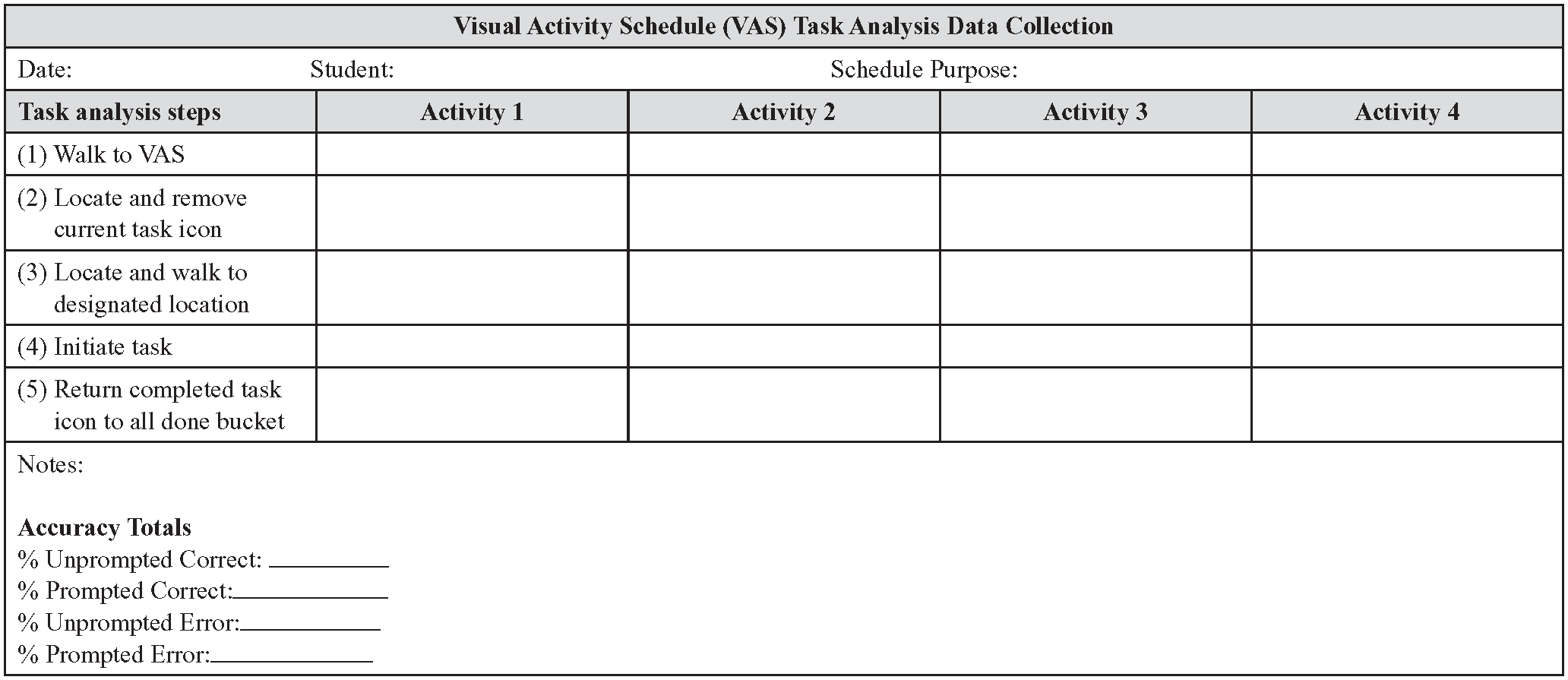
Sample Student Visual Activity Schedule Use Data Collection Form.
Graduated Guidance
Graduated guidance procedures require continuous availability of physical and gestural prompts (Morales et al., 2016) and most commonly are used with students with developmental disabilities (Bryan & Gast, 2000) or students engaging in a small group shared activity like game play (Betz et al., 2008). Graduated guidance requires you to stay within arms distance of the student throughout the VAS use (e.g., the entire duration of the activity). You can reduce the likelihood of errors by physically guiding the student to complete a task (e.g., manipulating an icon on a VAS), then simultaneously moving to a less intrusive prompt as the student successfully completes a task.
Using graduated guidance, you can implement almost continuous prompting with various types of prompts such as physical guidance, gestures, and auditory prompts (e.g., tapping). The continuous implementation of these prompts is possible in inclusive settings, but very prohibitive due to the staffing requirements for accurate implementation (see Zimmerman et al., 2017). Graduated guidance procedures are modeled in video, flow charts, and data forms at the following website: https://ebip.vkcsites.org/graduated-guidance/. Documentation of prompting decisions can be recorded on the VAS Anticipation and Planning Guide (https://tinyurl.com/mreka6ax).
What to Teach
After selecting a systematic instructional procedure, teach students how to interact with the visual schedule. Specifically, schedule interaction decisions need to include the following: (a) how students will know when to check the schedule, (b) how students will know when a task on the schedule is complete, and (c) how students will re-engage with the schedule after they finish a task. Each of these processes is described below. Decisions regarding each of these processes can be documented in the VAS Anticipation and Planning Guide (https://tinyurl.com/mreka6ax).
Checking the Schedule
Students should have a nonverbal visual or auditory cue to check the VAS such as a timer, push notification (digital schedules), or name card that indicates it is time to check the schedule. Cues to check schedules may exist during typically occurring activities or transitions such as the start of instruction at a small group table, the schedule placement on a carpet square at whole group instruction, your directive to move to lab group tables, or a bell ring to change classes. Artificial or educator-created cues to check the VAS can include handing a student a check schedule card, using a pre-programmed push notification on a digital device, or setting a visual timer for each activity or transition.
While verbal directives to “check your schedule” have been used in prior research (Bryan & Gast, 2000), verbal directives from instructional staff may prohibit students from independently engaging in a schedule. Verbal directives to check the schedule result in students’ initial interactions with the VAS being reliant on another human to cue the schedule use, rather than a typically occurring event or cue in the environment. Choices for methods for checking the schedule are displayed in the VAS Anticipation and Planning Guide (https://tinyurl.com/mreka6ax).
Task Completion
Students need to know when a task is complete to support them in knowing when a task is finished and where to place it, how to move to the next icon, and how to return to the schedule. Tasks should have a clear end point that signals completion based on a final product or time. For example, a math center may have a recording sheet with 10 responses. The center activity is complete when all 10 responses are answered. A writing activity, however, may span several days as daily completion may be based on time (e.g., write for 20 min). If responding or product completion signals a task is finished, then the task already has a cue (e.g., when the worksheet is complete, the task is done). To support successful completion, you might add a small symbol or written note at the bottom of the task to cue students.
If elapsed time signals task completion, then students will need access to a tool to keep time such as a visual timer (see Figure 1), push notification or text (digital schedule), or a classwide time signal (e.g., light or auditory cue). For example, Jimenez-Gomez and colleagues (2021) prompted young students to go to the next task through a push notification with a wearable digital VAS. Watson and DiCarlo (2016), on the contrary, used naturally occurring end points in activities to signal task completion.
Once a task is complete, students will need to know where to put the finished product. Typical classroom routines and procedures can dictate where to place items (e.g., turn-in bin, daily notebook in desk, completed work folder, shared materials return to storage containers). Finally, it should be clear on the schedule when the activity or activities are complete. Schedules can include a common icon or image at the end to signal the schedule is finished (e.g., all done symbol; photograph of turn-in bin). The VAS Anticipation and Planning Guide provides supportive questions and recording options as educators make decisions about task completion (https://tinyurl.com/mreka6ax).
Re-Engaging With the Schedule
After students have completed a task, teach them how to move to the next icon and re-engage with the VAS. Students should re-engage with the schedule using a similar format to the “checking the schedule” procedure selected above. Systematic prompting procedures can also support students in moving back to the schedule, although they should be quickly faded as the typically occurring task completion cue (described above) should serve as the prompt to re-engage with the VAS (Zimmerman, Martinez, et al., 2020). When a student reaches the end of the schedule, the final icon should cue the student where to go or what to do next.
We recommend the final icon include an activity or item that can serve as a reinforcer for the student to increase student motivation and engagement when completing the tasks on the VAS. The reinforcing activity could be a preferred activity (e.g., a listening center) that typically occurs in the classroom after a nonpreferred activity (e.g., the writing center). It could also be a break activity the student can access only after tasks are complete (e.g., iPad game, small tangible toys, listening to a preferred song, watching a short video clip). The VAS Anticipation and Planning Guide provides supportive questions and recording options as you decide how students will re-engage with the schedule (https://tinyurl.com/mreka6ax).
Generalizing Schedule Use to New Contexts
As students are taught how to use schedules, keep in mind the goal of VASs becoming a tool students can access to support their engagement across multiple activities, events, and subject areas in school and outside of the school context. Visual activity schedules provide nonverbal linguistic input when used as within- or between-activity supports, thus also creating a tool to support receptive language skills for young students who display language support needs. However, supporting generalization of schedule use will likely require different levels of support contingent on learner characteristics described below.
Students with developmental disabilities (e.g., autism; ID; Down syndrome) consistently have generalized schedule use to new contexts, activities, and tasks without explicit instruction in early childhood and elementary classrooms (Lequia et al., 2012, 2015). Thus, students with developmental disabilities who use within or between VASs likely will not need additional instruction to support generalization of VAS use to new contexts.
However, students likely to develop EBD have not generalized schedule use to novel contexts or activities (Zimmerman, et al., 2017; Zimmerman, Ledford, et al., 2020). Given limited evaluations of schedule generalization have been conducted with students without developmental disabilities (e.g., students with or likely to develop EBD), plan to explicitly teach most students to use VAS in multiple contexts rather than assuming students will generalize use of the tool (Zimmerman, Martinez, et al., 2020). If VASs are being used for the first time as a tool to support receptive language and/or behavior, regardless of the child’s age, we encourage you to explicitly prompt VAS use for at least 2–3 days in the novel context. Progress-monitoring data, described below, can inform your decisions about removing prompts or anticipating VAS generalization in a novel setting, despite the dearth of research evidence available to guide these decisions.
Progress Monitoring
The success of VASs as a tool to support receptive language and improve engagement is dependent on progress-monitoring adult fidelity of implementation, student schedule manipulation and use, and student engagement. Adult fidelity of implementing systematic procedures to teach VAS use should be monitored at least twice a week to ensure instruction follows systematic procedures to decrease adult prompting and increase student independent use of the VAS. Adult fidelity can be collected using a general data collection form for constant time delay or graduated guidance. Freely accessible forms can be found at https://tinyurl.com/mreka6ax. Collecting data on student VAS use should occur daily until students demonstrate independence to ensure VASs are being successfully used as a tool. A sample VAS use data collection form is presented in Figure 2.
Be sure to monitor student engagement to evaluate the effectiveness of VAS interventions. Measure both if the student is on schedule, in other words, the student is engaging in the tasks in the correct order, and if the student is engaged with the materials/instruction. Particularly for younger students, it may be critical for you to differentiate if the student is engaged with scheduled materials (e.g., materials designed for the activities on the schedule) or nonscheduled materials (e.g., materials available in the classroom but not planned for use during the targeted activities). Student engagement during instructional activities should increase as VAS interventions are implemented with fidelity. Collecting data on student engagement can be completed using momentary time sampling (MTS) procedures with 30 or 60 s intervals. A freely accessible instructional video for using MTS can be found at https://www.ksdetasn.org/resources/496. A sample data collection form for measuring student engagement using MTS is available in Figure 3. The VAS Anticipation and Planning Guide provides supports and documentation for organizing all progress-monitoring data (https://tinyurl.com/mreka6ax).
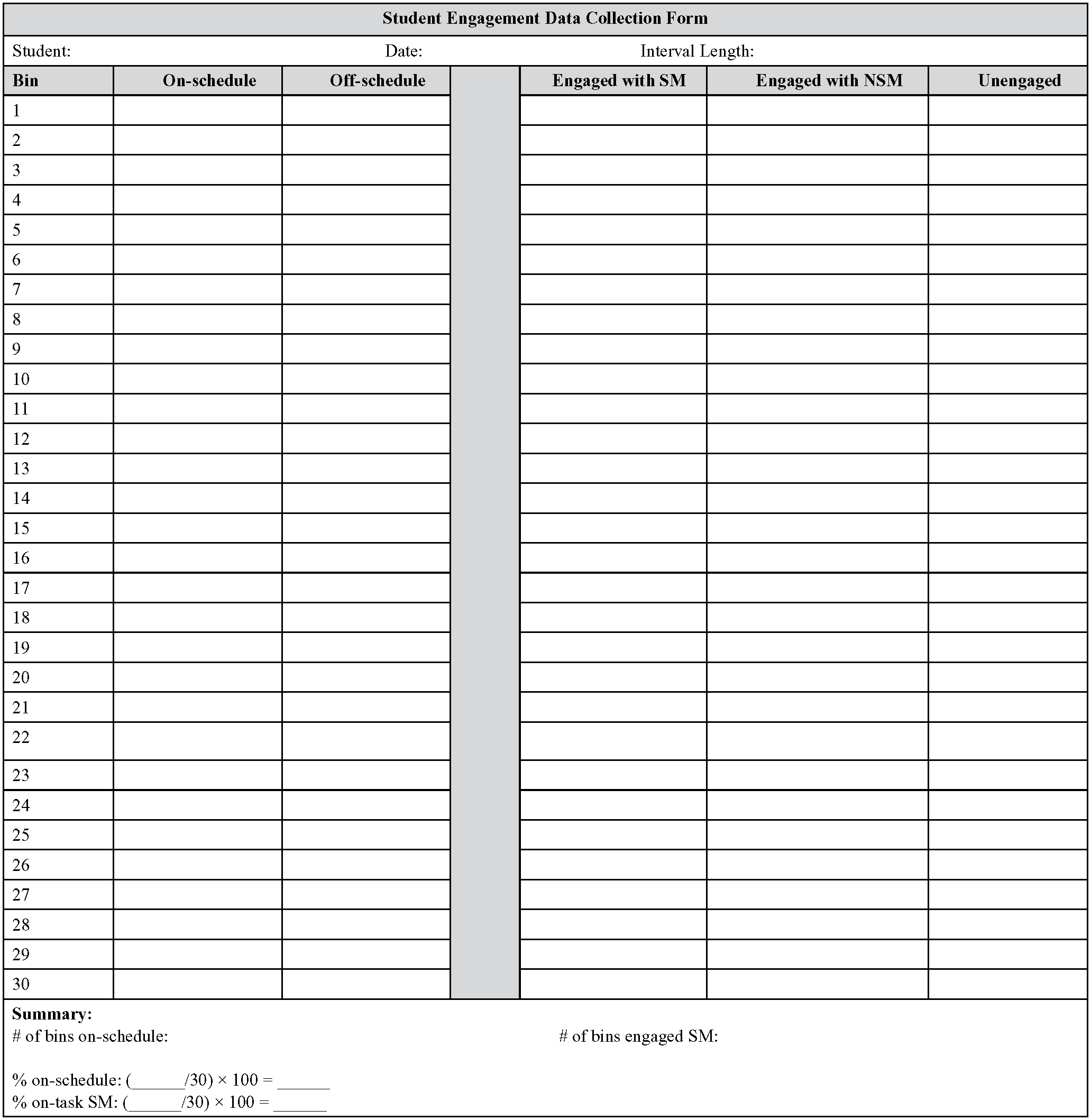
Student Engagement Data Collection Form.
Schedule Adaptations
If progress-monitoring data indicate students are either not displaying increases in engagement or engagement is initially high but wanes throughout the activity, VASs can be adapted to change the purpose (e.g., embedded choice or opportunities to respond). If student engagement remains low according to progress-monitoring data, two decisions can be made: (a) the schedule needs additional linguistic support, or (b) the schedule needs to include a behavioral strategy such as reinforcement or choice.
Language Support Adaptations
Visual activity schedules should include sufficient language support for students who are displaying low engagement and demonstrating difficulty following directives or statements verbally made to them by educators or peers. If a student’s engagement is still low and you notice they are not completing the steps of the activity (within-activity schedule) or not transitioning to the correct activity or location (between-activity schedule), then consider adapting the icon format. The icon adaptation could include a more concrete representation of the item or activity through a photograph or 2D image of the precise items.
Behavioral Support Adaptations
Within- and between-activity schedules may be adapted to include behavioral strategies when students are inconsistently completing the entire schedule, despite demonstrating an ability to complete the tasks (Zimmerman, Ledford, et al., 2020). Adding behavioral supports can include changing the type of schedule or adding a behavioral strategy to the schedule.
Changing the schedule type
A within-activity schedule can be adapted to become tasks to reinforcement VASs by simply adding a preferred item/person/activity or reinforcer at the end of the schedule. For example, if a student has difficulty completing writing tasks during independent writing, consider placing each step of writing on a schedule (a within-activity VAS), with preferred items at the end of the schedule (e.g., coloring with smelly markers; recording the story in a tablet application to create a movie).
Tasks to reinforcement can also be used to adapt a between-activity transition schedule. Rather than placing individual reinforcing items at the end of a daily schedule or between-activity schedule, strategically place nonpreferred activities or courses before highly preferred activities (capitalizing on the Premack Principle; Warren et al., 2021). For example, if a student does not like going to music class, create a between-activity schedule that shows the activities around music class (lunch, recess, music) and place a preferred activity at the end of the schedule (lunch, recess, music, iPad center) to serve as a cue that a preferred activity will occur after music class.
Conversely, if you made a daily schedule for a student who has identified receptive language needs and engages in challenging behaviors during transitions, you might choose to place a break icon after a difficult transition. This will cue the student that they can access their preferred break once they finish the nonpreferred activities, and increases the likelihood the transition will be successfully and independently completed. Zimmerman, Ledford, and colleagues (2020) placed a blocks icon at the end of a morning unpacking routine to support a preschooler in completing a nonpreferred transition. Simply adding the preferred activity to the end of the between-activity schedule resulted in the student’s engagement doubling during the morning routine.
Finally, adapting a within- or between-activity schedule to include embedded choice may be needed if a student is engaging in challenging behavior during a specific step of the schedule. Providing choice is a low-effort antecedent strategy designed to decrease the likelihood of challenging behavior and increase engagement (Jolivette et al., 2013).
First-grade educator Mr. Tobin creates a within-activity VAS for the writing center: (a) open notebook, (b) write date, (c) press play on center iPad © to listen to today’s prompt, (d) draw a picture, (e) write three sentences, (f) look for capital letters, and (g) look for punctuation. After using the center for 2 weeks, Mr. Tobin notices two students are becoming disengaged during Step 4 draw a picture.
Those two students and others in their tiger center group have engaged in verbal altercations over the availability of writing materials (e.g., one student has colored pencils while another wants markers). Mr. Tobin decides to adapt Step 4 to include choosing a writing material. He adds images of pencils, markers, colored pencils, and crayons. He also places three pencil boxes with each of the material options available at the center. When the tiger group members attend the writing center, Mr. Tobin places their new embedded choice schedule with their group image on the top of the table.
He verbally tells the students their Step 4 is now different and encourages them to see if they can find the change. After the first new embedded choice VAS rotation, Mr. Tobin checks in with the tiger group at his phonics center. Students report they liked choosing their writing materials. Mr. Tobin continues to collect engagement data that support the benefit of embedding choice in the writing center for one small group of students.
Adding a behavioral strategy
While changing the VAS type may be needed, you may also consider adding a behavioral strategy to an existing VAS to improve student engagement. Incorporating student preference is one low-effort strategy to decrease challenging behavior and increase engagement (Jolivette et al., 2013). If a between-activity VAS is being used, a preferred image can be placed at each VAS location. The preferred images can be used to increase the likelihood students transition to each location. For example, Zimmerman, Ledford, and colleagues (2020) added cartoon characters to a morning routine between-activity VAS after student engagement initially increased, but VAS use did not result in the student successfully completing the routine. At each schedule location, the student gathered a preferred cartoon character they played with at the final schedule center. Placing preferred images at between-activity locations or including preferred items in icon images can add an additional behavioral strategy to the VAS should student engagement increase but fail to reach levels you find acceptable to successfully complete the activity or routine.
Conclusion
Visual activity schedules are effective tools that can be adapted for a variety of purposes, presented in numerous formats, and tailored to meet student and educator preferences. Visual activity schedules can be utilized to provide behavioral and language supports to elementary students exhibiting low levels of engagement and high levels of challenging behavior. Multiple VAS formats can successfully support student engagement across a variety of instructional formats. Educators can also adapt VASs to meet their preferred implementation formats (e.g., digital, so icons do not have to be collected daily). Finally, VASs can be adapted to meet changing student needs. Developing VASs following these gudelines might facilitate your successful implementation of a practice/intervention that adapts and supports multiple students’ engagement in elementary classrooms for students with and without disabilities.
Supplemental Material
sj-docx-1-bbx-10.1177_10742956241287093 – Supplemental material for Implementing Visual Activity Schedules to Support Elementary Student Engagement
Supplemental material, sj-docx-1-bbx-10.1177_10742956241287093 for Implementing Visual Activity Schedules to Support Elementary Student Engagement by Kathleen N. Tuck, Jason C. Chow, Gospel Y. Kim, Elisabeth J. Malone and Kelsey H. Smith in Beyond Behavior
Footnotes
Authors’ Note
Jason C. Chow is now affiliated with Vanderbilt University, Nashville, TN, USA.
Declaration of Conflicting Interests
The author(s) declared no potential conflicts of interest with respect to the research, authorship, and/or publication of this article.
Funding
The research described here is supported by the Institute of Education Sciences, U.S. Department of Education, grant no. R324B210007. The views expressed herein do not necessarily represent the positions or policies of the Department of Education. No official endorsement by the U.S. Department of Education of any product, commodity, service, or enterprise mentioned in this publication is intended or should be inferred.

References
Supplementary Material
Please find the following supplemental material available below.
For Open Access articles published under a Creative Commons License, all supplemental material carries the same license as the article it is associated with.
For non-Open Access articles published, all supplemental material carries a non-exclusive license, and permission requests for re-use of supplemental material or any part of supplemental material shall be sent directly to the copyright owner as specified in the copyright notice associated with the article.
