




Abstract
This content analysis (N = 1,527) examined the presence of rape culture acceptance (dismissal of event, victim blaming, discrediting survivor, and threats to survivor) and anti-rape culture (support for survivor, and mention of: systemic problem, rape culture, and male power dominance) in news coverage of Anita Hill and Christine Blasey Ford’s testimony against a U.S. Supreme Court nominee. Results show higher rape acceptance in Blasey Ford news coverage and no difference between the cases and anti-rape culture. Online news media focused on personal impact to Blasey Ford, while traditional news media focused on impact to Thomas Kavanaugh and Clarence Thomas.
Anita Hill and Christine Blasey Ford are known as women who testified against a U.S. Supreme Court nominee during the nominee’s respective confirmation hearings. Despite the 27-year gap, the Hill and Blasey Ford cases are similar. Both women were thrown into the international spotlight after accusing a Supreme Court nominee of sexual misconduct. Both testified to a male-dominated panel and a broadcasted audience of millions (“More Than 20 Million,” 2018; Rucinski, 1993). Both faced major repercussions for coming forward, including threats to personal and family safety, public ridicule, and an increased public profile (Mak, 2018; Smitherman, 1995). Both nominees went on to be confirmed to the Supreme Court (Daniel et al., 2018; Totenberg, 2018).
Details of their cases also differed. Anita Hill stated in her 11 October 1991 public testimony that Clarence Thomas sexually harassed her repeatedly while he was in a senior position at the Department of Education and the Equal Employment Opportunity Commission (Totenberg, 2018). Anita Hill also faced the intersection of race and gender during her testimony as a Black woman testifying against the second Black man to be nominated to the U.S. Supreme Court (Rucinski, 1993). In defending himself, Thomas described his situation as a “high-tech lynching” (Smitherman, 1995, p. 8). The all White male Senate Judiciary Committee, both Democrats and Republicans, attempted to discredit Hill during the question period of her testimony and afterwards to the press (Hill, 1997). There was also an initial negative public reaction to Hill’s testimony, but this began to shift as time passed (Bryan, 1992).
On 27 September 2018, psychology professor Christine Blasey Ford stated in her testimony that when in high school, Brett Kavanaugh and his friend cornered Blasey Ford in a bedroom at a house party, pinned her down, and attempted to rape her (Vesoulis, 2018). Trying to avoid the same optics of the Hill testimony, the White male Republican side of the Senate Judiciary Committee hired sex crimes prosecutor Rachel Mitchell to ask questions of Blasey Ford (Gabbatt, 2018). However, the Democratic side of the Committee was comprised of women and men who explicitly defended Blasey Ford. As then Senator Kamala Harris remarked, “I want to thank you for your courage and I want to tell you that I believe you” (“Supreme Court Nominee,” 2018b).
Another difference between the cases was the changed media landscape. After the Blasey Ford story broke, news articles began trending online. Social media also provided a global platform for support and vitriol. Blasey Ford and her family received numerous death threats online and off, her emails were hacked, she was impersonated online, and countless hostile views of her were shared (Pengelly, 2019). On the other hand, many showed their support and solidarity. For example, the hashtag #whyididntreport appeared in 675,000 tweets within 48 hr of Blasey Ford’s testimony (“#whyIdidntreport,” 2018). Understanding this polarized environment is thus an important factor in mapping out how high-profile sexual abuse cases are covered and if digital technologies advance a historically problematic area of news coverage. This study uses the term sexual abuse to generally refer to all forms of sexual harassment and assault. This doesn’t imply all actions have equal weight, but rather to emphatically state that all forms of sexual abuse must be eliminated. Specific terms will be used to differentiate abuses when applicable. The American Psychological Association offers this definition of sexual abuse: “Sexual abuse is unwanted sexual activity, with perpetrators using force, making threats or taking advantage of victims not able to give consent” (“Sexual Abuse,” n.d.). This therefore includes all forms of sexual harassment, misconduct, assault, and rape.
Indeed, public discourses on sexual abuse in the United States and around the world often rely heavily on harmful narratives that sow seeds of doubt against the accuser and defend the accused (Weiss, 2009). These patterns contribute to what is referred to as rape culture, or the societal acceptance of male violence—often against women (Buchwald et al., 1993, 2005). Though this study focuses on the most common form of sexual abuse, which is male perpetrators targeting women, it should be noted that sexual abuse can also occur between and within gender groups.
Identifying rape culture in news coverage shows how it influences the industry (Blumell & Huemmer, 2019). This is particularly important since news coverage of sexual abuse cases can often ignore the systemic problem of sexual abuse against women because the story intersects with other issues or events. Hill and Blasey Ford were obstacles for the nominees to advance their careers to the Supreme Court. Consequently, this study focuses on how rape culture manifested in these cases, and if the advent of online news served to dissipate rape culture or reinforce it.
Rape Culture
The dominant reaction to sexual abuse is to defend the accused and doubt, blame, and/or ignore the survivor (Weiss, 2009). So much so, the term rape culture is used to address the societal tolerance and even promotion of male-perpetrated sexual and physical abuse (Buchwald et al., 1993). Johnson and Johnson (2017) proposed a model for rape culture based on empirical findings that are comprised of seven sub-parts: masculine gender roles, feminine gender roles, hostile sexism, benevolent sexism, hostility toward women, adversarial sexual beliefs, and acceptance of violence (p. 19). The sub-parts are based on decades of research by various scholars, and it is beyond the scope of this study to fully explicate each one. However, by developing a model, Johnson and Johnson (2017) illustrate rape culture is commonplace and is a backdrop to gendered societal norms, sexism, and misogyny.
Rape culture is normalized and even often invisible because “in-group social norms tend to make rape myths seem like normal belief patterns” (Burnett et al., 2009, p. 466). Rape myths are false beliefs about rape. Schwendinger and Schwendinger’s (1974) work in the 1970s focused on identifying myths such as victims ask for it, healthy people can fight off rape, and men have uncontrollable passions. Later, Burt (1980) developed a rape myth acceptance index, which included myths like women report false rapes for attention or revenge, the victim is promiscuous, anyone healthy can fight off rape, and oftentimes the victim is asking for it (p. 223). The index also included racial factors (Burt, 1980). Later, the Illinois Rape Myth Acceptance Scale (IRMA) was developed to include the myths “she asked for it,” “she lied,” “it wasn’t really rape,” “he didn’t mean to,” “she wanted it,” “rape is a trivial event,” and “rape is a deviant event” (McMahon & Farmer, 2011; Payne et al., 1999, p. 59). Scholars have also expanded rape myths to include male survivors (Turchik & Edwards, 2012) and members of the LGBTQ+ community (Schulze et al., 2019). This is to address the unique scenarios for different survivors.
Burnett et al. (2009) further explain rape culture influences post-rape behaviors in which many survivors choose to stay silent or are quickly silenced if they come forward. The silencing comes from various sources such as doubt from family and friends (Huemmer et al., 2019), fear of retaliation (“The Criminal Justice,” n.d.), and traumatizing and often ineffectual legal systems. For example, only about 23% of sexual assaults in the United States are reported to the police, and of those, 5% of sexual assaults will end with an incarceration sentence (“The Criminal Justice,” n.d.). Those who are charged with sexual assault are likely to be repeat offenders (“Perpetrators of Sexual,” n.d.). Furthermore, according to the End the Backlog campaign, there are currently over 135,000 untested rape kits in police and crime labs in the United States with unknown numbers in 10 states (“Where the Backlog,” n.d.). In an analysis of sexual assault reports filed by the Los Angeles Police Department, O’Neal (2019) found patterns of enforcing the idea of “real rape,” or the common myth that actual rape is rare and is thus committed by scary strangers to “innocent” victims (Jones et al., 2011).
News Media and Rape Culture
Traditional news media often reinforce the status quo and do little to challenge existing rape culture narratives, even when focusing on activist movements such as the metoo movement (Blumell & Huemmer, 2019). Jordan (2012) writes on how traditional news media can act as silencing agents in various ways including reporting only on “newsworthy” sexual abuse cases, thus concentrating on extreme events and ignoring overall sexual abuse patterns. The seriousness and commonality of sexual abuse is consequently downplayed in news coverage (O’Hara, 2012).
On the other hand, online spaces are more polarized. In an essay about embodied feminist interventions, Stern (2018) notes that although social media can reinforce rape culture, it is also an integral platform for challenging it as evidenced by the popularity of hashtags like #whyIstayed and #metoo. Indeed, online feminist activism has empowered many survivors to share their stories for the first time and provide counter-narratives to rape culture (Maas et al., 2018); nevertheless, negative backlash and online trolling disproportionately affect women, making social media both a help and a hindrance (Mendes, Keller, & Ringrose, 2019; Mendes, Ringrose, & Keller, 2019).
This mixed space contains the cultural baggage of rape culture, such as putting the responsibility on the victim not to get sexually abused rather than on the abuser not to sexually abuse, as noted by Pennington and Birthisel (2016) in a study about the Steubenville rape case that found two high school football athletes guilty of sexually assaulting a fellow student. The assault was captured on video and disseminated online, which resulted in dominant themes in the news coverage of youth needing to protect themselves on social media rather than focusing on preventing sexual abuse (Pennington & Birthisel, 2016). Another analysis of social media use during the Steubenville rape case and other high-profile rape cases found the most popular messages focused on victim blaming, but there were also victim support messages (Stubbs-Richardson et al., 2018). When examining comments made in response to news articles on rape and sexual assault posted to social media, Zaleski et al. (2016) also found higher levels of victim blaming, victim support, perpetrator support, and trolling statements.
Anti-Rape Culture
Several scholars, activists, lawmakers, politicians, and educators have attempted to identify and offset rape culture. The term anti-rape culture isn’t as widely used or researched as rape culture itself. The few studies that incorporate the term often do so without expressly defining it. For instance, Garcia and Vemuri (2017) label certain YouTube videos that counter rape culture as anti-rape culture vlogs, which they state act “as sites for the formation of feminist counterpublics and as technologies of nonviolence . . .” (p. 29). The authors note that anti-rape culture vlogs focus on calling out sexual abuse as a systemic problem in societal institutions such as governments, legal systems, and schools (Garcia & Vemuri, 2017). Anti-rape culture vlogs also focus on survivor perspectives and the obstacles they face including being doubted, blamed, revictimized, and having few options for reporting (Garcia & Vemuri, 2017). Waterhouse-Watson, (2019) labeled tweets as anti-rape culture that countered narratives that excused rape and pitied the accused over showing empathy for the survivor. Kelland (2016) notes online and offline anti-rape culture spaces provide refuge for survivors to discuss their experiences—something that can be difficult given the barriers to reporting.
Gruber (2016) criticizes anti-rape culture in regards to college campuses by implying that sexual abuse on college campuses may (or may not) be over-reported and now includes an overabundance of acts beyond rape alone. Gruber (2016) also worries that institutional initiatives could actually be detrimental: Should we be contented or concerned when women students, months after an incident, decide to file a report because they talked to a counselor, professor, administrator, or activist who help them determine an ambiguous or barely remembered sexual situation was actually a traumatic rape? (p. 1044)
We propose that such arguments neglect research that explains why sexual abuse is severely underreported (Burnett et al., 2009, “The Criminal Justice,” n.d.). It also reinforces the rape myth that survivors aren’t to be trusted or, worse, can easily be fooled into imagining being abused. We also propose that, just as rape culture research established decades ago, rape (and all forms of sexual abuse) should not be conceived as “sexual situations” gone wrong but rather a “power trip—an act of aggression and an act of contempt . . .” (Schwendinger & Schwendinger, 1974, p. 20).
The importance of situating sexual abuse as power acts is critical to anti-rape culture. It acknowledges that all forms of sexual abuse and harassment are violations of the victim’s autonomy and personal dignity. Of course, this again is not to imply that all sexual abuse is equal, but to rather emphatically state that all sexual abuse must be eliminated because as long as so-called lesser acts are excused because they are not as serious as rape (or in the case of rape, not as serious as other brutal rapes or even murders), societies will continue to empower perpetrators to sexually abuse. In other words, forms of sexual abuse are not mutually exclusive and anti-rape culture is built on the understanding that all forms of violence must be addressed throughout all levels of society.
Anti-rape culture doesn’t need to be presented as an entire ideology to be considered as resisting rape culture. As previous scholars note, it can consist of one or more counter narratives to rape culture (Garcia & Vemuri, 2017; Waterhouse-Watson, 2019). For this study, anti-rape culture is conceived as the rejection of all forms of sexual abuse through focusing on survivor perspectives and situating the problem as systemic and pervasive. It also denounces rape myths and patriarchal power structures. Importantly, it should be considered as evolving via activism and scholarship.
Overall, anti-rape culture is mostly framed through activism. This is a worldwide effort, with many notable examples from various countries; however, since this study is based on the U.S. context, that will be the primary focus. Anti-rape culture activism continues to give a safe space for survivors to raise their voices and bring awareness to the public. Johnston (2012) argues that powerful societal forces like the criminal justice system should learn from anti-rape culture activism to support survivors and focus on changing the system.
Some important anti-rape culture activism includes Take Back the Night, an annual walk that originated in Philadelphia in 1975 after microbiologist Susan Alexander Speeth was stabbed to death on her way home from work (“TBTN History,” n.d.). In 1994, Eve Ensler wrote The Vagina Monologues to raise awareness about systemic sexual abuse against women and girls, which evolved into V-Day (“Why V-Day,” n.d.). V-Day launched the One Billion Rising campaign in 2012 to continue its efforts to support survivors (“What is One,” n.d.). The Slut Walk began in Toronto in 2011 as an effort to stop slut shaming and victim blaming, after a local police officer told university students that if they wanted to avoid being raped they shouldn’t dress like sluts (Reger, 2014). There have also been anti-rape culture campaigns over the years, such as It’s on Us, an initiative by the Obama administration to change college campus attitudes toward sexual abuse and stop victim blaming (Armstrong & Mahone, 2017).
In 2006, Tarana Burke began the metoo movement to support survivors of sexual abuse with a specific focus on Black women and girls (“History & Vision,” n.d.). The hashtag #metoo began when the Harvey Weinstein story broke in October 2017 after actress Alyssa Milano encouraged survivors to share their stories (Mendes et al., 2018). Just one-year prior on 8 October 2016, after a pre-interview Access Hollywood tape revealed Donald Trump bragging about sexually assaulting women, millions responded to writer Kelly Oxford’s tweet that asked women to share their first assaults (Traister, 2018). Mendes et al. (2019) provide numerous anti-rape culture examples via digital activism such as hashtags (e.g., #whyIdidntreport, #beenrapedneverreported, #believewomen, #believesurvivors, #whyIstayed, #timesup, #metoo), websites (e.g., Hollaback!), social media accounts, and individuals who actively speak out online.
With increased awareness and what’s now called the #metoo movement (Tarana Burke’s original movement is referred to as the metoo movement without the hashtag), some accountability has begun. For instance, Vox keeps a running total of the number of prominent people accused of sexual misconduct since 2017; as of mid 2020, the list is at 262 (“262 Celebrities,” n.d.). Of the 262 accused, 52 were fired, 75 retired or quit, 35 were suspended or placed on leave, and 25 faced or are currently facing some kind of investigation (“262 Celebrities,” n.d.).
Singer Robert “R” Kelly is currently awaiting trial to begin in August 2021 for charges of racketeering a scheme to sexually abuse underage girls, child pornography, and obstruction of justice (Rosenbaum, 2021). Four of the accused have been sentenced: Former director of the Centers for Disease Control and Prevention Tom Frieden pleaded guilty to groping a woman and was placed on a conditional discharge (Carrega, 2019), French-Swedish photographer Jean-Claude Arnault was found guilty of raping two women and sentenced to 2 years and 6 months in jail along with a fine of USD$24,000 in damages (Domonoske, 2018), former USA Gymnastics doctor Larry Nassar was sentenced to 40 to 175 years in prison for multiple sex crimes involving more than 150 women and girls (Cacciola & Mather, 2018), and Harvey Weinstein was sentenced to 23 years in prison for criminal sexual act and rape (Levenson et al., 2020).
These findings may denote some progress, though notably the two accused in this study are still on the Supreme Court, and Trump was not only elected President, but has not yet faced any formal consequences for his admitted and accused sexual abuses of women. There is still a need for resistance to and correction of rape culture. This study incorporates the analysis of anti-rape culture to understand if news media are resisting rape culture, or at least acknowledging current power structures in society that give oxygen to rape culture.
Research Questions and Hypotheses
Taking into consideration the recent increased awareness of sexual abuse against women, this study first examines the differences between rape culture and anti-rape culture in both cases by predicting:
The next research question and hypotheses focus on the medium to better understand if online news advancements have resulted in differing news coverage in terms of rape and anti-rape culture:
Understanding the positive impact that online spaces have had in anti-rape culture (Maas et al., 2018; Mendes et al., 2018; 2019; Stern, 2018), this study states:
One aspect that is overlooked in news research, but that is critical in either upholding rape culture or combating it is the extent to which the actors involved are personalized within the coverage. Oftentimes, those coming forward are ignored or featured far less than those being accused (Blumell, 2019; Jordan, 2012). The audience is consequently not informed of how survivors are impacted or who they are. Conversely, there is significant focus on the accused and the impact of the case on them (Payne et al., 1999; Weiss, 2009). This study explores how the accuser and the accused are presented in news coverage by asking:
It also predicts that online news media will provide a platform for personalizing the accusers:
Method
This was a content analysis (N = 1,527) of Anita Hill (n = 580) and Christine Blasey Ford’s (n = 814) testimonies before the Senate Judiciary Committee. News coverage of both cases was most intense just prior to the testimony and lasted until the nominee was confirmed to the Supreme Court. The sampling time frame was set to 6 months and started from the day the story broke. This adequately captured the entire news cycle of both cases. For Hill, the sample frame was 6 October 1991 to 6 April 1992. Hill testified on 11 October and Thomas was confirmed on 15 October. For Blasey Ford, the sample frame was 16 September 2018 to 16 March 2019. Blasey Ford testified on 27 September 2018 and Kavanaugh was confirmed 6 October 2018.
The Hill case was comprised of newspaper articles (n = 383) and network TV transcripts (n = 197). Coding units were gathered through the LexisNexis and Factiva databases using the search word “Anita Hill.” For newspapers, the “major US newspapers” option was used, which generated national newspaper articles (n = 238): Washington Post (n = 115), USA Today (n = 64), Wall Street Journal (n = 37), and New York Times (n = 22). Regional newspaper articles were also generated (n = 145): Boston Globe (n = 53), St. Louis Post-Dispatch (n = 35), Tampa Bay Times (n = 20), Atlanta Journal-Constitution (n = 19), Los Angeles Times (n = 11), and (Minneapolis) Star-Tribune (n =7). TV transcripts were taken from NBC (n = 93), CBS (n = 82), and ABC (n = 22) using the same time frame and search words.
The Blasey Ford case included newspaper articles (n = 392), network TV transcripts (n = 160), and online articles (n = 395). The same process was repeated for newspaper and TV transcripts, using the search word “Christine Blasey Ford.” The print sample once again included national newspapers (n = 181): New York Times (n = 63), Washington Post (n = 57), Wall Street Journal (n = 38), and USA Today (n = 23). There were also regional newspapers (n = 211): Boston Globe (n = 80), The Los Angeles Times (n = 26), New York Post (n =18), St. Louis Post-Dispatch (n = 16), Baltimore Sun (n = 15), New York Daily News (n = 14), Atlanta Journal-Constitution (n = 11), Philadelphia Inquirer (n = 10), Philadelphia Daily News (n = 9), Pittsburgh Post-Gazette (n = 7), and (Minneapolis) Star-Tribune (n = 5). TV transcripts were again taken from CBS (n = 71), NBC (n = 51), and ABC (n = 38) using the same time frame and search words. Only transcripts from news programs were included in the TV sample. Talk shows such as The View were eliminated.
Online articles were gathered through the analytics tool BuzzSumo, which identified the most-shared articles on Facebook, Twitter, Google+, Linkedin, and Pinterest. Total engagement of articles ranged from 1.1M to 1.2K. Articles were from traditional news media (8.9%), online news media such as Breitbart and HuffPost (59.2%), and other online sources such as scarymommy.com or newsandguts.com (31.9%). The sample also included left-leaning (8.9%, e.g., HuffPost, The Guardian, and Jezebel), moderate (59.2%, e.g., The Atlantic, Time, Slate, and BBC), and right-leaning (31.9%, e.g., Breitbart, The Federalist, Washington Times, and The Blaze) sources. Partisanship was determined based on previous research (Vargo & Guo, 2017) and self-identification of the source. For instance, the website called The Conservative Tree House has conservative in its name and its biography states, “The conservative believes that there is one and one path only to sustainable success and independence . . .” (“The Last Refuge,” n.d.). If the name and biography were not explicit, then the researchers reviewed the homepage to determine if articles promoted a specific political ideology. Sources that were not explicitly left- or right-leaning were classified as moderate.
Code Development
This study developed a codebook to analyze the sample, which labeled the variable, defined it, and indicated its levels of measurement (Riffe et al., 2014). Once the research questions and hypotheses were identified, the first researcher developed the appropriate variables based on the literature review and previous research. The codebook was divided into three major sections of variables as explicated below: Rape culture acceptance, anti-rape culture, and personalization of major actors. Rape culture acceptance and anti-rape culture formed indices. It was important to the researchers to establish both indices since previous research shows traditional news media have a pattern of propagating rape culture (Jordan, 2012); whereas, online spaces are a mixture of rape culture and anti-rape culture (Mendes et al., 2019). The personalization variables were created to better understand if the coverage included how the accuser and the accused were impacted. This is to build on literature that states that the consequences of coming forward are often overlooked in news media, and the impact on the accused is highly emphasized (Weiss, 2009; Zaleski et al., 2016). Once completed, the codebook was pilot-tested by the second researcher on a sample of ten articles. The second researcher identified any confusion, and corrections were then made before intercoder reliability was assessed.
Rape Culture Acceptance Index
The rape culture acceptance index is a previously used modified index (Blumell & Huemmer, 2019). It consists of four dichotomous variables based on patterns found in rape culture (Buchwald et al., 1993, 2005; Burnett et al., 2009) and rape myths (Burt, 1980; Payne et al., 1999; Schwendinger & Schwendinger, 1974) research, but adapted to code in a content analysis. The first variable is “negative comments toward person who came forward.” This includes all common negative responses to those who come forward such as being labeled a liar, promiscuous, and deceptive (Payne et al., 2019). “Victim blaming” was originally included under the negative comments variable, as indeed it is. For this study however, a separate variable was created because pilot-testing showed it was common and therefore worthy of a separate variable. Victim blaming puts the responsibility on the person coming forward rather than the accused and commonly manifests through attitudes that the victim asked for it or secretly wanted it (Burt, 1980; Payne et al., 1999; Schwendinger & Schwendinger, 1974). The third variable is “threats to person who came forward,” which is a large component of rape culture and why so many sexual abuse cases go unreported (Burnett et al., 2009; Weiss, 2009). Threat is based on the Oxford Dictionaries’ definition, “a statement of an intention to inflict pain, injury, damage, or other hostile action on someone in retribution for something done or not done” (oxforddictionaries.com). The fourth variable is “dismissal of person who came forward.” Another common trope in rape culture is to downplay the seriousness of sexual abuse or state it was not actually sexual abuse (Buchwald et al., 1993; Payne, Lonsway, & Fitzgerald, 1999).
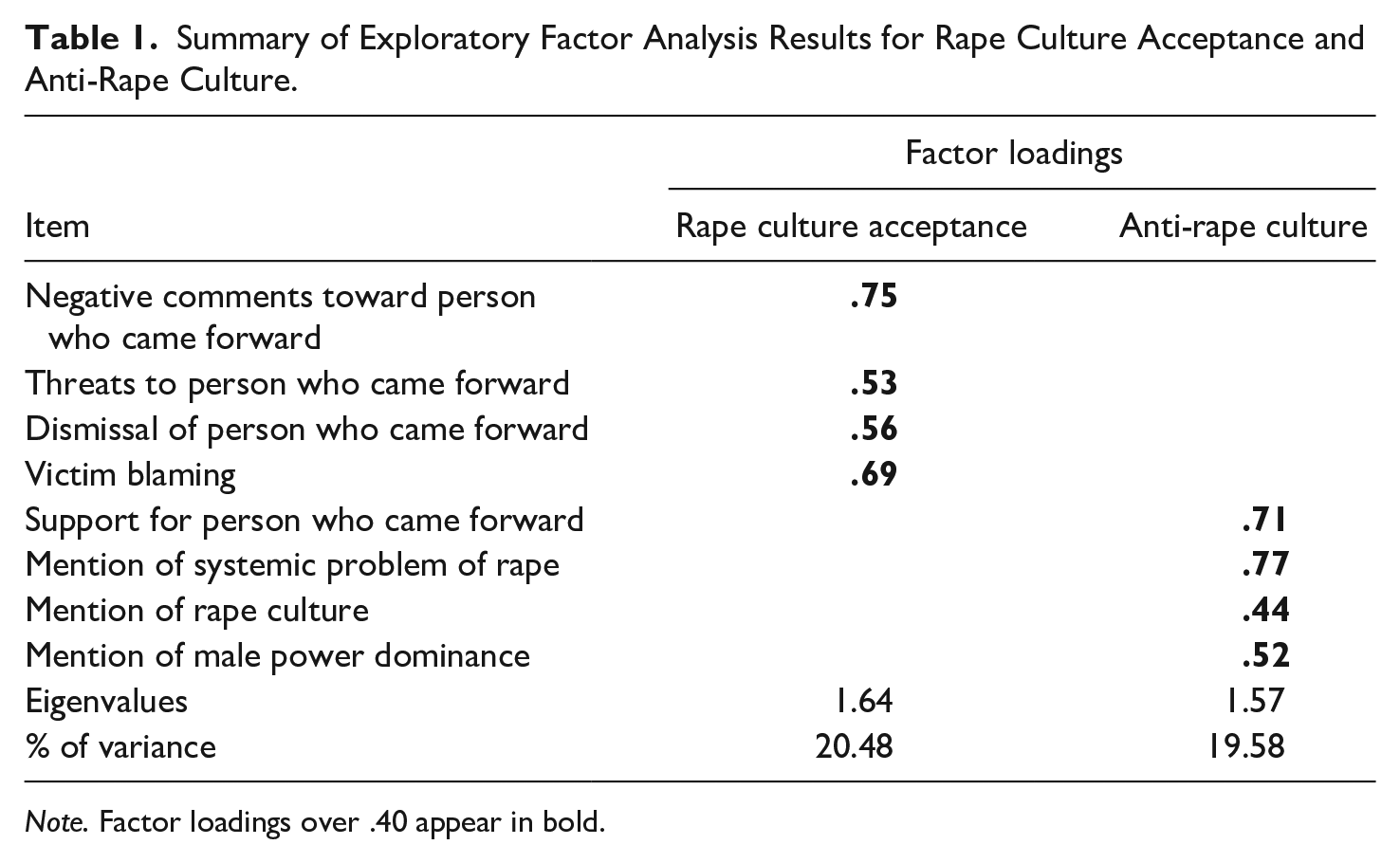
Table 1 shows the variables and how they successfully loaded in a factor analysis, which also included variables for anti-rape culture. A factor analysis with Promax rotation was run with an acceptable Kaiser-Meyer-Olkin measure of .61, and a significant Bartlett’s test of sphericity, χ2 (28) = 751.59, p < .001.
Summary of Exploratory Factor Analysis Results for Rape Culture Acceptance and Anti-Rape Culture.
Note. Factor loadings over .40 appear in bold.
Anti-Rape Culture Index
Table 1 shows the four dichotomous variables loaded successfully for the anti-rape culture index. The anti-rape culture index builds on previous work that shows anti-rape activism is survivor-led, focuses on changing societies on the system level, calls out rape culture directly as problematic (Garcia & Vemuri, 2017; Johnston, 2012; Kelland, 2016; Waterhouse-Watson, 2019), and conceptualizes sexual abuse as power acts not sexual situations. The first variable highlights the survivor through “support for person who came forward.” As illustrated, speaking publicly as a survivor of sexual abuse can be isolating and difficult (Burnett et al., 2009). Therefore, support from others can give comfort but also credibility to the person’s story. It also creates a safe space for others to come forward (Kelland, 2016), as seen with viral hashtags like #metoo and #whyIdidntreport (Mendes et al., 2019). The second variable focuses on sexual abuse as a common societal issue identified as “systemic problem of rape.” Part of rape culture is not to deny that rape occurs, but to dismiss it as a rare event rather than a systemic problem (Buchwald et al., 1993; Weiss, 2009). Furthermore, news coverage often portrays sexual abuse cases as unusual or only focuses on the most extreme cases (Jordan, 2012). This variable was coded if there was any mention in the article of sexual abuse being a societal or common problem. The third variable is “mention of rape culture.” This was coded if the coding unit used the exact term rape culture. Despite its commonness, rape culture is not often explicitly discussed but rather engaged in as an invisible truth of society (Burnett et al., 2009). Therefore, anti-rape culture seeks to identify it to raise awareness (Garcia & Vemuri, 2017). The fourth variable is “male power dominance” in society. One way rape culture is reinforced is the measurable power men have over women’s lives, both publicly and privately (Buchwald et al., 1993; Johnson & Johnson, 2017). This variable was used if the coding unit referred to male dominance in society, including the use of the word privilege.
Personalization Variables
The last set of variables focused on the personalization of each of the four major actors: Anita Hill, Christine Blasey Ford, Clarence Thomas, and Brett Kavanaugh. Five dichotomous variables were coded for each actor. The variables are based on common patterns in rape culture to dismiss or ignore the impact on the victim and have sympathy for the perpetrator, especially in regards to how an accusation of that level could “ruin” the accused’s life (Payne et al., 1999; Weiss, 2009). These variables were adapted to the context of someone coming forward as the accused is applying for a job. They are also based on general knowledge of the news coverage of the cases. They are: impact on career, affected family/friends, personally impacted, reputation impacted, and in imminent danger.
Intercoder reliability
After the codebook was finalized, the authors tested for intercoder reliability on 100 coding units. The sample included all types of media from both cases. After the first round of coding the following variables achieved acceptability of a .8 or higher alpha score (Krippendorff, 2013): Mention of rape culture (α = 1.0), systemic problem of rape (a = 1.0), male power dominance (α = .80), threats to person who came forward (α = .95), career impacted Thomas/Kavanaugh (α = .89), friends/family impacted Thomas/Kavanaugh (α = .88), personally impacted Thomas/Kavanaugh (α = .83), reputation impacted Thomas/Kavanaugh (α = .82), in imminent danger Thomas/Kavanaugh (α = 1.0), career impacted Hill/Blasey Ford (α = .83), family/friends impacted Hill/Blasey Ford (α = .82), reputation impacted Hill/Blasey Ford (α= .94), and in imminent danger Hill/Blasey Ford (α = .93). After discussions and further explication of the variables, a second round of coding resulted in an acceptable result for victim blaming (α = .80). The third round of coding satisfied the remaining variables: Negative comments toward person who came forward (α = .84), dismissal of person who came forward (α = 1.0), personally impacted Hill/Blasey Ford (α = .80), and support for person who came forward (α = .81).
Results
H1a predicted that rape culture acceptance would be higher during the Hill case than the Blasey Ford case. A t-test was run between the cases and the rape culture acceptance index with significant results, t(1,525) = −2.43, p ≤ .01. Opposite the prediction, the Hill case (M = .27, SD = .23) was significantly lower than the Blasey Ford case (M = .30, SD = .30). H1a is not supported. H1b predicted that anti-rape culture would be higher during the Blasey Ford case than the Hill case. A t-test was run between the cases and the anti-rape culture index without significance, t(1,525) = .97, p > .05. The Hill case (M = .26, SD = .24) was similar to the Blasey Ford case (M = .25, SD = .25). H1b is not supported.
The first research question explored how rape culture acceptance and anti-rape culture differ according to the medium. First, a t-test was run for the Hill case between print (M = .27, SD = .23) and TV (M = .27, SD = .23) media and rape culture acceptance without significance, t(578) = -.10, p > .05. A t-test was also run for the Hill case and anti-rape culture with significance, t(578) = 5.83, p ≤ .001. Print media (M = .30, SD = .25) were significantly higher than TV media (M = .19, SD = .22).
A one-way analysis of variance (ANOVA) was then used to calculate rape culture acceptance in the Blasey Ford case and print, TV, and online media, with significance, F(2, 946) = 42.63, p < .001, partial η2 = .10. Post Hoc Bonferroni test comparisons indicate that online media (M = .22, SD = .23) were significantly lower than print media (M = .33, SD = .26) and TV media (M = .46, SD = .44). TV media were also significantly higher than print media. A one-way ANOVA was also run for anti-rape culture with significance, F(2, 946) = 12.50, p < .001, partial η2 = .03. Post Hoc Bonferroni test comparisons showed that online media (M = .21, SD = .21) were significantly lower than print media (M = .30, SD = .28). There was no significant difference between TV media (M = .24, SD = .23) and the other media.
To explore online media further, one-way ANOVAs were run for the rape culture acceptance index, F(2, 392) = 4.86, p < .01, partial η2 = .02, and the anti-rape culture index, F(2, 392) = 6.89, p < .001, partial η2 = .03, and the partisanship of online media. Post Hoc Bonferroni test comparisons for the rape culture acceptance index showed that right-leaning media (M = .27, SD = .26) were significantly higher than moderate (M = .20, SD = .21) and left-leaning (M = .18, SD = .17) media. There was no significant difference between moderate and left-leaning media. Post Hoc Bonferroni test comparisons for the anti-rape culture index showed right-leaning media (M = .15, SD = .19) were considerably lower than moderate (M = .23, SD = .21) and left-leaning (M = .26, SD = .26) media. Once again, there was no significant difference between moderate and left-leaning media.
H2a stated that rape culture acceptance is lower in online media than print and TV media, which was supported. H2b, on the other hand, stated online media would include significantly more anti-rape culture than print and TV media, which was not supported. Print media had the highest levels of anti-rape culture. Overall, in both the Hill and Blasey Ford cases, print media had the highest levels of anti-rape culture.
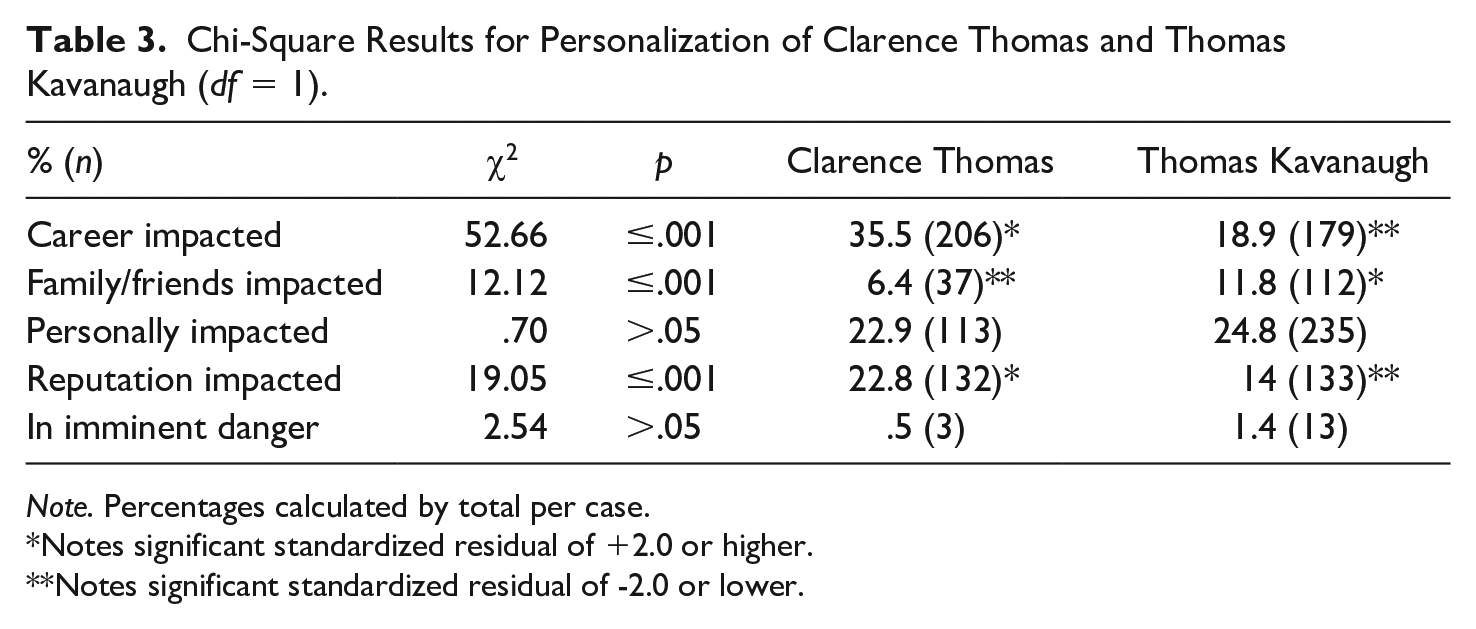
RQ2 asked how the respective accused and accuser were personalized in both cases. Five personalizing variables were used: career impacted, family/friends impacted, personally impacted, reputation impacted, and in imminent danger. Chi-square tests were run in various ways to test the research question as shown in Tables 2 to 5. Results for all tables include percentages and frequencies by case. For instance, Table 2 shows that 8.4% of all coded units on Hill mentioned the impact her coming forward had on her career. Tables also include standardized residuals on +/- 2.0 or higher to show where there is significance in the test.
Chi-Square Results for Personalization of Anita Hill and Christine Blasey Ford (df = 1).

Note. Percentages calculated by case.
Notes significant standardized residual of +2.0 or higher.
Notes significant standardized residual of -2.0 or lower.
Table 2 compares Hill and Blasey Ford with respect to the personalization variables. For Hill, coverage focused more on impact on her career and reputation than did the Blasey Ford coverage. Although the most frequent variable in the Hill coverage was personally impacted, the standardized residual shows it was significantly less than predicted. For Blasey Ford, impact on family/friends, personally impacted, and being in imminent danger were significantly higher than for Hill. Blasey Ford’s lawyers revealed that she and her family had to vacate their home due to death threats and harassment for months after Blasey Ford’s testimony (Mak, 2018).
Table 3 compares Thomas and Kavanaugh on the personalization variables. Similar to Hill, the significant variables for Thomas were impact on his career and reputation. Notably, the percentages of both variables were higher for Thomas than Hill. For example, impact on Hill’s career was in 8.4% of coverage, while for Thomas it was in 35.5% of coverage. For Kavanaugh, the only significantly higher variable was impact on family/friends. Comparing Kavanaugh and Blasey Ford, once again impact on career was significantly higher for Kavanaugh. It is worthwhile noting that both Thomas and Kavanaugh successfully became Supreme Court Justices.
Chi-Square Results for Personalization of Clarence Thomas and Thomas Kavanaugh (df = 1).
Note. Percentages calculated by total per case.
Notes significant standardized residual of +2.0 or higher.
Notes significant standardized residual of -2.0 or lower.
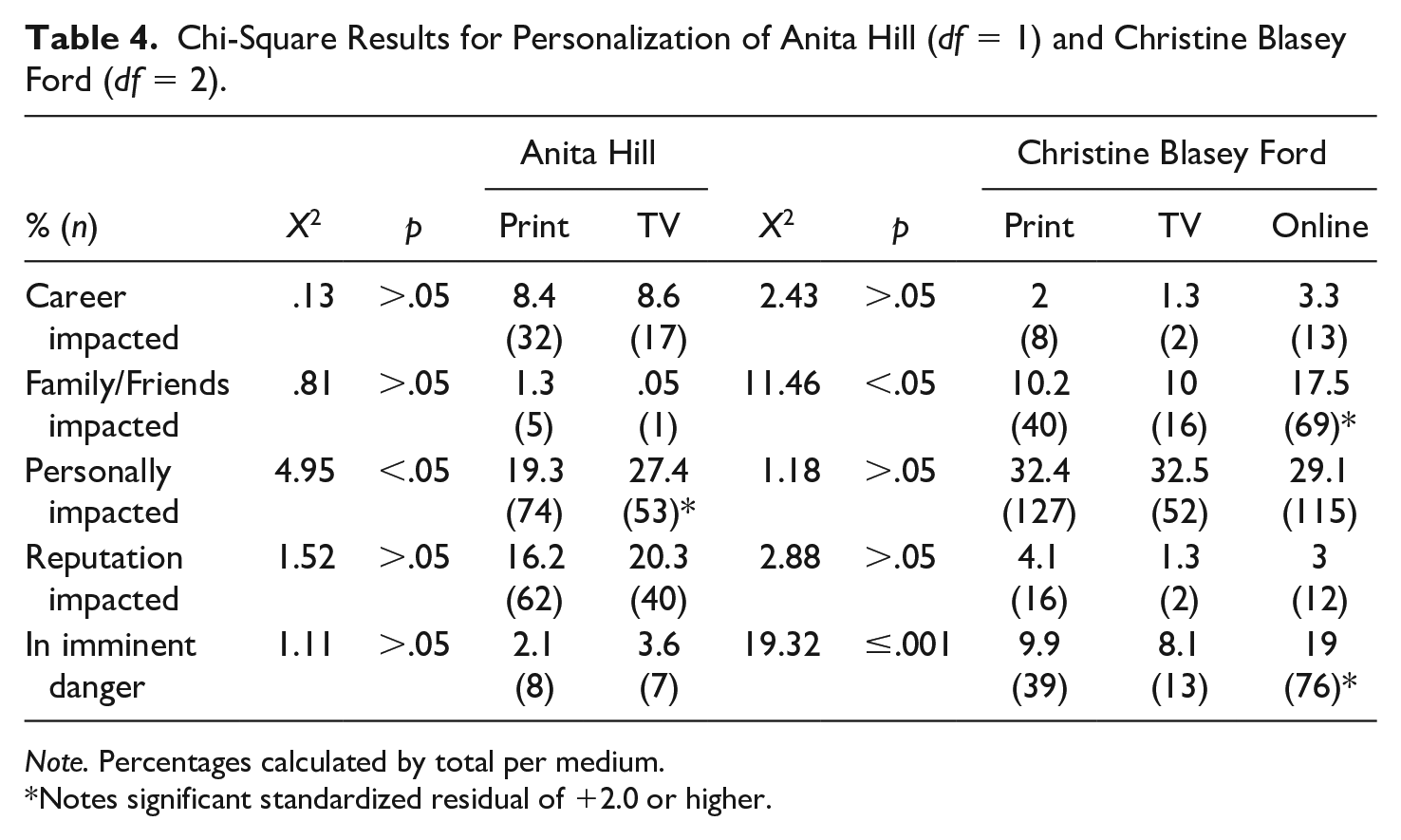
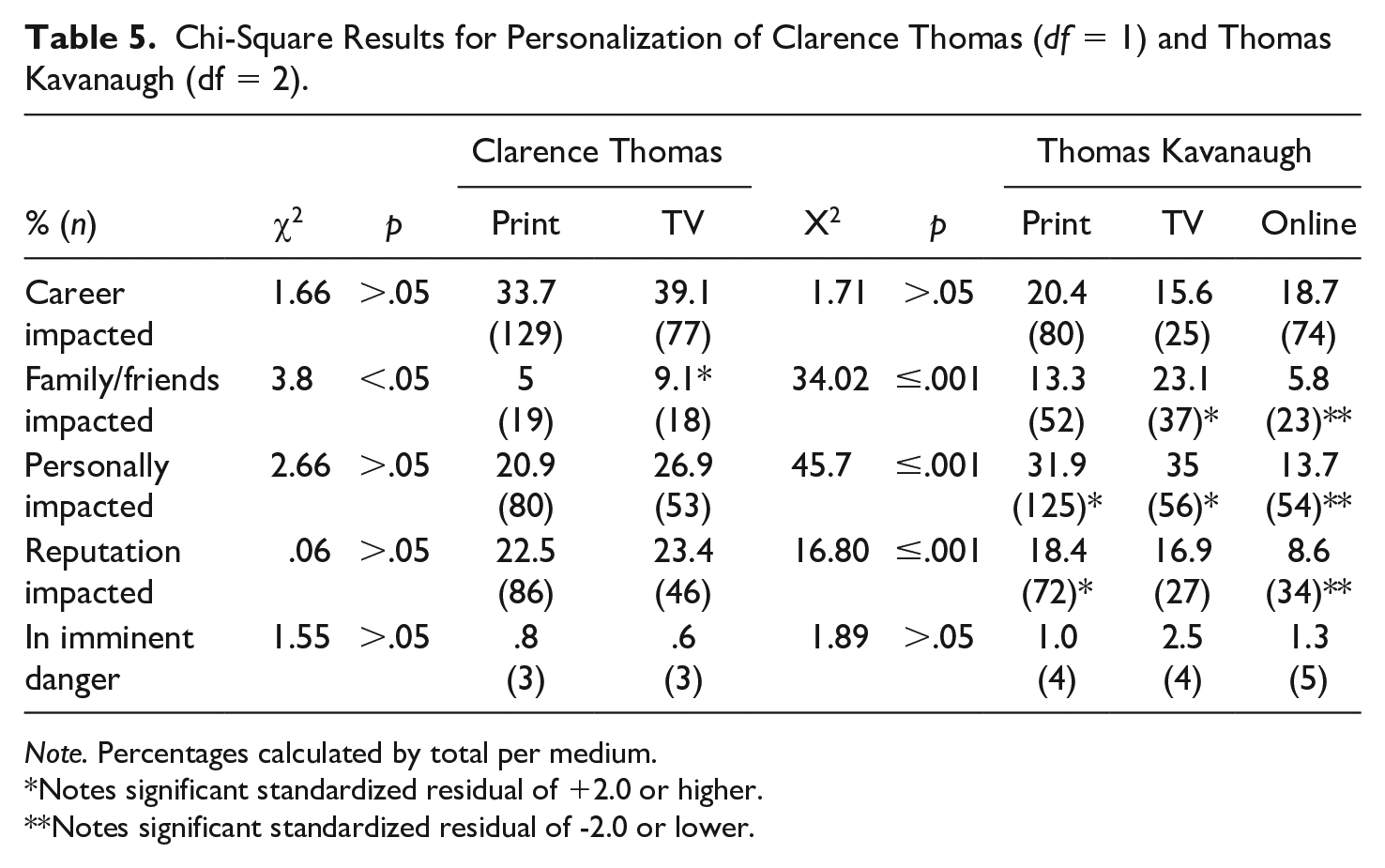
Tables 4 and 5 compare personalization by medium. Table 4 indicates that there were few significant differences by medium for Hill and Blasey Ford. For Hill, TV media focused more on her being personally impacted. For Blasey Ford, online media focused more on family/friends impacted and being in imminent danger. Table 5 shows little variance between media for Thomas; the only significance is TV media focused more on impact on family/friends. Kavanaugh, on the other hand, showed more variance by medium. TV media focused significantly more and online media significantly less on impact on family/friends. TV and print focused more on being personally impacted, whereas online did not. Online media also focused less on Kavanaugh’s reputation being impacted. H3 predicted that online media would personalize Blasey Ford more and traditional media would personalize Kavanaugh more. This is partially supported, as online did personalize Blasey Ford more and Kavanaugh less; whereas, traditional media focused on Kavanaugh more—the caveat being that not all variables were significant.
Chi-Square Results for Personalization of Anita Hill (df = 1) and Christine Blasey Ford (df = 2).
Note. Percentages calculated by total per medium.
Notes significant standardized residual of +2.0 or higher.
Chi-Square Results for Personalization of Clarence Thomas (df = 1) and Thomas Kavanaugh (df = 2).
Note. Percentages calculated by total per medium.
Notes significant standardized residual of +2.0 or higher.
Notes significant standardized residual of -2.0 or lower.
Discussion
This study investigated rape culture acceptance and anti-rape culture in news coverage of Anita Hill and Christine Blasey Ford’s public testimonies (N = 1527). It focused on whether or not the introduction of online media resulted in varying content when compared to traditional media. Comparing Hill and Blasey Ford was useful in determining if news coverage has evolved through years of activism around the systemic issue of sexual abuse, building to what’s referred to as the metoo movement (“History & Vision,” n.d.; Stern, 2018).
Two indices were used: Rape culture acceptance and anti-rape culture. Rape culture acceptance was previously applied to the Access Hollywood tape scandal (Blumell & Huemmer, 2019). For this study, the identified variables loaded as expected, along with the additional variable of victim blaming. New to this study is the anti-rape culture index, which sought to understand if counter narratives were prominent. All variables loaded as expected. By using both indices, this study was able to pinpoint how news coverage in both cases included anti-rape culture about a quarter of the time, but that rape culture acceptance actually increased during the Blasey Ford case.
This study builds on other studies that mention anti-rape culture (Garcia & Vemuri, 2017; Johnston, 2012; Kelland, 2016; Waterhouse-Watson, 2019) but don’t provide a clear definition of it. By stating that anti-rape culture is the rejection of all forms of sexual abuse and the denouncement of rape myths and patriarchal power structures, this study explicated and tested variables that measure anti-rape culture in news coverage. By doing so, the results show that news organizations need to not only avoid perpetuating rape culture, but they also need to provide more counter narratives such as discussing rape culture, male power dominance in societies, and the systemic problem of gender violence when reporting on sexual abuse.
This can be done in several ways. First, news organizations need to increase their staff’s overall awareness of rape culture and gender-based violence. Second, editors need to increase their focus on reporting on sexual abuse as a systemic problem that overlaps into many news stories such as gun violence. Third, journalists must include more survivors and activists’ perspectives. If the goal of news organizations is to remain detached via the norms of “objectivity,” source use can at least include anti-rape culture narratives. Fourth, journalists must challenge sources that engage in rape myths or rape culture. Fifth, news organizations should assign specific gender or human rights-related beats to reporters so reporters can gain expertise on this topic.
Further research is needed to explore why rape culture acceptance is increasing while anti-rape culture has plateaued in news coverage (H1). One factor for this study is the influence of the President. The U.S. news cycle remains predominantly top- down and therefore the President and high-level politicians greatly impact news coverage (Entman, 2004). Just as Trump defended himself when his various admitted and accused sexual abuses made headlines (Blumell, 2019), he defended Kavanaugh more actively than George H.W. Bush defended Thomas. Bush continued to support his nominee, but did not disparage Hill directly or dismiss the case (Turner & Ryden, 2000) as Trump did to Blasey Ford. For instance, 20 of the online articles focused on Trump mocking Blasey Ford at a rally (Malloy et al., 2018). The overall implication of these findings is that despite the efforts of the metoo movement and activists raising awareness of sexual abuse, journalists continue patterns of reinforcing rape culture rather than challenging it (Jordan, 2012). Journalists are situated in a unique position in societies. They are on the frontlines of breaking news, and go to great lengths to report accurate facts. Nevertheless, given the rigors of the daily news cycle and the issues of sexism in newsrooms (Byerly, 2011; Ferrier & Munoz, 2018), many journalists are not equipped to adequately report on sexual abuse cases.
Focusing on the medium was also important. For the Blasey Ford case, online media had the lowest levels of rape culture acceptance, but unexpectedly also had the lowest levels of anti-rape culture. Also unexpectedly, print had the highest anti-rape culture levels in both cases. TV had the highest rape culture acceptance. It appears that the objectivity norm of balance via issue dualism (Lee et al., 2008) often utilized by traditional newspapers provided a platform for both rape culture acceptance and anti-rape culture.
Noting the results for online media, the researchers identified the most common topics for online media and found after Kavanaugh was confirmed, viral articles focused on Blasey Ford’s public appearances, such as the video of her introducing gymnast Rachel Denhollander at the Sports Illustrated Sportsperson of the Year Awards (Abdeldaiem, 2018, n = 73), or her pledge to donate funds from a GoFundMe page to trauma victims (Bekiempis, 2018, n = 25). These articles support Blasey Ford but don’t necessarily include anti-rape narratives.
Like previous research that shows online spaces are polarized platforms (Mendes et al., 2018, 2019; Stern, 2018), results show that viral online articles are largely singular in message and are partisan. That is not to imply in-depth reporting doesn’t take place, but rather that viral articles are more often episodic rather than thematic (Iyengar, 1990). In this case, as Kavanaugh was a Republican nominee, not surprisingly, right-leaning media were significantly higher in rape culture acceptance and significantly lower in anti-rape culture acceptance. Online media, especially from blogs or partisan websites, were able to propagate messages in the style of news articles according to political ideology, which consequently place politics over systemic issues such as sexual abuse.
The other unique focus of this study was to examine how each major actor was personalized. This was based on scholarship which shows that often survivors and their plights are ignored, while the accused are pitied (Burnett et al., 2009; Weiss, 2009). Notably, the analysis shows patterns between Hill and Thomas, and Blasey Ford and Kavanaugh. For instance, there was significantly more focus on the career impact for Hill and Thomas, and significantly less focus on career impact for Blasey Ford and Kavanaugh. However, it should be noted that in total only 8.4% of the impacted career coverage focused on Hill, while 35.5% focused on Thomas. There was a similar pattern for impacted reputation. On the other hand, there was more focus on impacted family/friends for both Blasey Ford (13.3%) and Kavanaugh (11.8%), than for Hill (1%) and Thomas (6.4%).
These results show the continued importance of agenda-builders in news coverage (Cobb et al., 1976). Like Bush and Trump, other important actors largely dictated the focus of journalists. For instance, Thomas’ rebuttal to Hill focused on his reputation and career. Some comments include, “You’ve spent an entire day destroying what it’s taken me 44 years to build.” He also noted emphatically, “You have robbed me of something that can never be restored” (“Thomas Second Hearing,” 1991). Four days after that statement, he was confirmed to the Supreme Court.
Conversely, Kavanaugh’s testimony did note his reputation and career but also criticized Democrats and the impact of Blasey Ford’s testimony on his family (“Supreme Court Nominee,” 2018a). He spoke with tears of his parents, wife, and children (“Supreme Court Nominee,” 2018a). This was parallel to Blasey Ford’s testimony (“Supreme Court Nominee,” 2018b), and later reconfirmed by her lawyers, that Blasey Ford and her family were forced to go undercover because of death threats (Mak, 2018). Consequently, the differing foci of each case were largely dependent on prominent actors rather than the issue of sexual abuse.
When comparing personalization by medium, online media focused significantly on the impact on Blasey Ford’s family/friends (17.5%) and being in imminent danger (19%), but did not do the same for Kavanaugh (5.8% for impact on family/friends; 1.3% for in imminent danger). This illustrates the public’s interest in the personal consequences to Blasey Ford and her family, something that traditional print and TV media did not prioritize as much. At the same time, print (31.9%) and TV (35%) media focused more on how Kavanaugh was personally impacted when compared to online media (13.9%). Overall, traditional media personalized Thomas and Kavanaugh more than Hill and Blasey Ford. Online media provided an alternative space to personalize Blasey Ford more, even if some of the viral content was negative toward Blasey Ford.
This study is not without limitations. First, the TV sample doesn’t include cable news channels because during the Hill case, Fox News and MSNBC did not exist. Second, these are high-profile cases and therefore may differ from news coverage of lower profile cases. Future research should include analysis of how sexual abuse is generally covered. This was a United States-based case; more research is needed on media coverage of sexual abuse in other countries. Finally, only a quantitative content analysis was used. It would be helpful in future studies to interview or survey journalists on their attitudes toward covering sexual abuse cases. As well as qualitative analysis, such a textual analysis could draw out further nuances to what is reported here.
Notwithstanding these limitations, this study offered important insight into how rape culture acceptance and anti-rape culture have evolved through focusing on Anita Hill and Christine Blasey Ford publicly testifying against a Supreme Court nominee. Despite the metoo movement, years of activism, and increased public support for Blasey Ford in 2018 compared to Hill in 1991 (Montanaro, 2018), news media have not evolved to incorporate more anti-rape culture narratives and have actually increased in rape culture acceptance. Changing public opinion corresponded with viral online articles, which personalized Blasey Ford more and included less rape culture acceptance. However, partisanship of online media equals greater polarized spaces that simultaneously support and disparage Blasey Ford more than offline media.
Footnotes
Declaration of Conflicting Interests
The author(s) declared no potential conflicts of interest with respect to the research, authorship, and/or publication of this article.
Funding
The author(s) received no financial support for the research, authorship, and/or publication of this article.
