



Abstract
The overrepresentation of racial/ethnic minorities within the criminal justice system relative to their population percentage, a phenomenon termed disproportionate minority contact, has been examined within general adult and adolescent offender populations; yet few studies have tested whether this phenomenon extends to juvenile sexual offenders (JSOs). In addition, few studies have examined whether offender race/ethnicity influences registration and notification requirements, which JSOs are subject to in some U.S. states. The present study assessed for disproportionate minority contact among general delinquent offenders and JSOs, meaning it aimed to test whether the criminal justice system treats those accused of sexual and non-sexual offenses differently by racial/ethnic group. Furthermore, racial/ethnic group differences in risk, legal classification, and sexual offending were examined for JSOs. Results indicated disproportionate minority contact was present among juveniles with non-sexual offenses and JSOs in Alabama. In addition, offense category and risk scores differed between African American and European American JSOs. Finally, registration classifications were predicted by offending characteristics, but not race/ethnicity. Implications and future directions regarding disproportionate minority contact among JSOs and social and legal policy affecting JSOs are discussed.
Keywords
Within the United States, racial and ethnic minorities are overrepresented in the criminal justice system relative to their population percentages, even after controlling for offending rates (Piquero, 2008). This phenomenon has been termed disproportionate minority contact (Office of Juvenile Justice and Delinquency Prevention [OJJDP], 2014). Disproportionate minority contact spans the nine decision points of the U.S. Justice System, 1 and it affects African Americans more than any other racial/ethnic group (OJJDP, 2014). Indeed, African Americans are 6 times more likely to be incarcerated than European Americans, and 5 times more African American males spend a portion of their life in prison than European American males (Bonczar, 2003).
Although disproportionate minority contact is present among youth adjudicated for violent, property, and drug crimes (e.g., Hsia, 1999; Kempf-Leonard, 2007), few studies have examined this phenomenon among adolescents who have committed a sexual offense. At the time of publication, four studies provided demographic information that evidenced disproportionate minority contact among juvenile sexual offenders (JSOs; Craun, 2006; Davis & Leitenberg, 1987; Ikomi, Gibson, & Samuels, 2009; Oliver, Hall, & Neuhaus, 1993). Within each of these studies, an examination of the site’s local population indicated African Americans were overrepresented within the justice system. More specifically, disproportionate minority contact of African Americans was implicated in Texas (Craun, 2006), the Midwest (Oliver et al., 1993), the Southwestern United States (Ikomi, Gibson, & Samuels, 2009), and a national U.S. sample (Davis & Leitenberg, 1987). Given the frequency of disproportionate confinement rates for JSOs across geographic regions in the United States, it appears as though the disproportionate minority contact phenomenon is not restricted to the general offending population, and likely extends to more specialized populations as well, including JSOs.
Race/Ethnicity and Sexual Offending Characteristics
Although results from a handful of studies indicate disproportionate minority contact likely extends to JSOs, an accurate and thorough understanding of psychosocial and offense characteristics of racially/ethnically diverse JSOs is limited. In a study conducted by Davis and Leitenberg (1987), African American JSOs were charged with forcible rape more frequently (58% of total rape charges) than European Americans (42% of rape charges). However, in another more localized study, European Americans emerged as the racial/ethnic group most likely to commit aggravated sexual assault, while African Americans were the racial/ethnic group most likely to commit crimes of indecency or sexual exposure (Ikomi, Rodney, & McCoy, 2009). Such racial/ethnic group findings imply potential differences in violent forms of sexual offending. Although racial/ethnic differences have been observed, more research using racially/ethnically diverse samples is needed to determine the extent of differences between African American and European American JSOs.
Risk Assessment in Racial/Ethnic Minority JSOs
In addition to specific characteristics of the offense, disproportionate minority contact could be influenced by multicultural differences in risk assessment. Measures of risk assessment, such as the Juvenile Sex Offender Assessment Protocol II (J-SOAP-II), are used to predict and infer an individual’s likelihood of engaging in sexually inappropriate behavior in the future and, subsequently, to enact various procedures that may help to protect the individual and the community from such acts. Emerging evidence demonstrated that general reoffending, sexual reoffending, and treatment compliance were significantly predicted for African Americans, European Americans, and Latinos by the J-SOAP-II (Prentky & Righthand, 2003), which suggests similar risk factors are relevant across cultural groups and implies appropriate cross-cultural use for the measure (Martinez, Flores, & Rosenfeld, 2007). However, while assessment measures were designed for equal and appropriate use across racial/ethnic groups, their interpretation and application in the real world is not necessarily free of cultural bias.
Juvenile Registration and Notification
Although mental health providers may use data from the J-SOAP-II or other measures to help guide determinations of risk, the decision regarding disposition orders is ultimately left to the court. Recent attempts have been made to reform legal policies, specifically those aimed at registration and notification requirements for JSOs, such as the Adam Walsh Act (2006). The Adam Walsh Act established the Sex Offender Registration and Notification Act, which sets forth standards for states to follow, and Alabama is among the 17 states that have adopted a sex offender registration notification (SORN) tier structure. This tier structure categorizes individuals who have committed a sexual offense into three hierarchical tiers based on their adjudicated offense, ranging from Tier 1 (fewest requirements and perceived as lowest risk) to Tier 3 (most requirements and perceived as highest risk).
In 2011, Alabama adopted juvenile SORN, requiring JSOs to go in person to register at their local law enforcement agency. These requirements are a downward extension of Alabama policies aimed at adult sexual offenders, and require that JSOs register either quarterly (Tier 3) or annually (Tiers 1 and 2) for a specified duration, and also as they change residences. In Alabama, tiers are assigned by judges following completion of treatment or confinement, though the tier system for adult sex offenders is typically used for JSOs in such situations. Even at the lowest level, adolescents in the Tier 1 and Tier 2 classifications are still required to update their address annually for 10 years. Tier 3 offenders are required to update their address every 3 months but are also subject to lifetime registration and community notification requirements. In addition, JSOs at any tier who fail to register and update their address within the specified time parameters are subject to a felony charge under the Adam Walsh Act.
Despite adoption of SORN in multiple states across the United States, several arguments against its implementation and application among JSOs have been made. Specifically, concerns have arisen about SORN’s inaccurate categorization of adolescents, the lack of predictive validity for instruments assessing recidivism related to illegal sexual behavior (Caldwell & Dickinson, 2009; Caldwell, Ziemke, & Vitacco, 2008; Chaffin, 2008; Harris, Lobanov-Rostovsky, & Levenson, 2010; Zimring, Piquero, & Jennings, 2007), and the potential for underreporting of illegal sexual behavior due to juvenile SORN (Batastini, Hunt, Present-Koller, & DeMatteo, 2011).
For instance, Caldwell and colleagues (2008) discovered that SORN tiers do not accurately distinguish between high- and low-risk individuals identified by the J-SOAP-II and also fail to predict recidivism rates within a sample of JSOs and adolescents adjudicated for non-sexual offending (non-JSOs). Caldwell and Dickinson (2009) also compared risk and recidivism rates between registered and nonregistered JSOs, noting that not only did registered JSOs present with significantly lower risk scores than nonregistered JSOs, both groups also had comparable rates of recidivism. In another study, Harris et al. (2010) examined the reclassification of assigned SORN tiers, finding that this system is liable to categorize JSOs as high risk, possibly indicating an overly harsh classification system. Finally, in a longitudinal study of juvenile offenders, JSOs and non-JSOs were later convicted of sexual offenses during adulthood at comparable rates (Zimring et al., 2007), suggesting that JSOs are no greater threat to the community than non-JSOs and, accordingly, may be a gravely misunderstood class of individuals who are punished harshly without empirical justification. Ultimately, the findings from these studies suggest registration requirements stem from an ill-fitting and inappropriate classification system with potentially deleterious consequences.
Beyond the empirical evidence, theoretical critiques of the SORN policy address concerns related to the community’s response and current level of understanding for JSOs. One concern is that if juvenile SORN leads parents and guardians to underreport sexual misconduct to avoid the registration and stigma associated with SORN (Batastini et al., 2011), access to care will be reduced for these youths. Another concern is that juvenile SORN policies do not reflect the heterogeneity of JSOs and may treat all JSOs in a similar fashion. By treating JSOs as a homogenous group, the system ignores both the risk factors leading up to the offense and the wide range of behaviors that can constitute a sexual offense (Letourneau & Armstrong, 2008).
Present Study
Few studies have tested for racial/ethnic group differences among JSOs, though emerging evidence indicates that disproportionate minority contact is likely present among this population. In addition, little work has been done to explicate the sexual offense characteristics that may differ between racial/ethnic groups. The present study is the first to use the demographic make-up of adjudicated adolescents to examine whether there are any racial/ethnic discrepancies on both SORN tier categorization and sexual offending characteristics.
Therefore, the present study focused on three research questions and hypotheses. First, we aimed to identify whether disproportionate minority contact was present among JSOs and non-JSOs in the same facility. Based on prior research, it was hypothesized that disproportionate minority contact would be present among both JSOs and non-JSOs (e.g., Davis & Sorensen, 2013; Ikomi, Gibson, & Samuels, 2009).
Second, we examined whether SORN tier classification, offense characteristics (i.e., offense type, victim age), and offender J-SOAP-II scores differed by racial/ethnic group among JSOs. Findings from empirical studies indicate African American JSOs are more likely to commit violent sexual offenses (e.g., rape, sexual assault), and that J-SOAP-II scores are comparable across racial/ethnic groups (Ikomi, Rodney, & McCoy, 2009). Therefore, we hypothesized that (a) SORN tiers would be higher among African American participants relative to European American participants, (b) our African American JSO participants would have more violent sexual offenses than European American JSOs, and (c) J-SOAP-II scores would not differ between racial/ethnic groups.
Finally, we tested whether the following individual and offense characteristics predicted SORN tier: race/ethnicity, number of prior commitments, number of prior sexual offense charges, first victim’s age, number of prior non-sexual offense charges, and J-SOAP-II scores. It was further hypothesized that race/ethnicity would exert effects on SORN tier level independent of other factors. In addition, we hypothesized that number of prior commitments and prior sexual and non-sexual charges would significantly predict SORN tier.
Method
Participants/Procedure
Data were collected between 2001 and 2013 in a juvenile detention facility from 849 male JSOs (reflecting the Alabama JSO population during that time period), and 416 male non-JSOs. Data were obtained from all JSOs who entered the facility, whereas data were collected from a randomly selected subset of non-JSOs to serve as a control group. A comprehensive pre-treatment psychological evaluation was administered to each youth for the purpose of informing court-ordered treatment. During this evaluation, a semi-structured interview was conducted to obtain demographic information, criminal records were reviewed to verify prior and current adjudicated charges and commitments, and a risk assessment was completed. To participate in the study, adolescents assented and a legal guardian also provided consent. Participants were informed that their participation and the inclusion of their data in a research study were voluntary.
Measures
Semi-structured interview and legal documentation
General demographic information and other relevant clinical data (e.g., psychosocial history, offending behaviors) were obtained via a 90-min semi-structured interview. Legal records were used in tandem with the semi-structured interview to verify offense details and gather additional demographic information (e.g., race/ethnicity, date of birth, grade level) and each participant’s legal history. Specifically, prior and current adjudicated charges and prior commitments were recorded for each participant. Corroborating (and often replacing) adolescents’ self-reported offending history with legal documents was especially important because many participants could not identify what their current adjudicated charge was during their interview. From legal records, the total number of documented adjudicated sexual and non-sexual offenses were collected and coded for each adolescent. These data also were used to create an aggregate representation of prior offending behavior (e.g., number of prior commitments, number of prior sexual offense charges, the first victim’s age, the number of prior non-sexual offense charges).
SORN
A research variable was created to calculate Alabama SORN tier for each participant. Coding was commensurate with Alabama SORN policies and classification (U.S. Department of Justice, 2011), though each JSO from our facility may or may not have had their charge (and therefore their registration requirements) changed upon release. Ultimately, participants’ tier scores reflect a downward extension of adult sex offender tier scores; therefore, the vast majority of tier scores can be obtained by looking at Alabama tier scoring for adult sex offenders. For example, participants were classified as Tier 1 if they had minor sexual offenses (e.g., possession of obscene material, sexual misconduct). Participants were classified as Tier 2 if they had been adjudicated with a sexual offense such as incest or solicitation of a child. Finally, a Tier 3 classification was indicated for a first-degree sexual offense like rape, sodomy, sexual abuse, or sexual torture. Because SORN was not enacted until 2011 in Alabama, any charges incurred prior to the passing of juvenile SORN were retrospectively coded into approximated tiers.
Disproportionate minority contact
To examine whether disproportionate minority contact was present within our sample, percentages of adolescent African American and European American males aged 11 to 19 years residing in the state of Alabama between 2001 and 2012 were calculated for each year using information from the U.S. Census Bureau (2012) and the Centers for Disease Control and Prevention (CDC; 2012). A formula for measuring disproportionate minority contact was developed based on the relative rate index calculations suggested by the OJJDP (2014). Values were calculated in the same manner for African and European American JSOs and for African and European American non-JSOs. Overall, positive values indicate an overrepresentation of a particular racial/ethnic group for a given year, especially if both groups have comparable offending histories, signifying the presence of disproportionate minority contact.
Rates of disproportionate minority contact were examined among non-JSOs to serve as a comparison group for JSOs, and to confirm that our detained population was comparable with other non-JSO populations in the United States. To compare and measure such rates, we calculated the amount of disproportionate minority contact present across samples. In addition, using the following equation, z scores were calculated for each group (e.g., African American non-JSOs, European American JSOs) to statistically compare levels of overrepresentation.

In the above equation, p is the observed proportion in the sample, n is the sample size, and p0 is the expected proportion in the population based on data obtained from the U.S. Census Bureau (2012) and the CDC (2014).
J-SOAP-II
This 28-item checklist was designed to assess risk factors related to sexual and criminal offending in adolescents (Prentky & Righthand, 2003). When scored, the J-SOAP-II has four subscales: Sex Drive/Preoccupation, Impulsive/Antisocial Behavior, Intervention, Community Stability/Adjustment, and a Total J-SOAP-II Score. Internal consistency on these subscales fall between .68 and .91. In addition, the J-SOAP has demonstrated concurrent validity with comparable measures and sexual offense information (Prentky & Righthand, 2003). The present study utilized J-SOAP-II scores obtained prior to the onset of treatment, and a reliability analysis indicated an acceptable Cronbach’s value for the Total J-SOAP-II Score (α = .80).
Results
Data Analysis
Initially, data were examined for assumptions of normality, and no violations were observed. Next, different types of charged offenses and SORN tier classifications were compared between African and European American JSOs using Chi-Square Tests for Independence. Finally, we examined predictors of SORN tier categories, including race/ethnicity, number of prior commitments, number of prior sexual offense charges, first victim’s age, number of prior non-sexual offense charges, and J-SOAP-II scores using a linear regression. All analyses were run using SPSS, while disproportionate minority contact rates and z-score calculations were completed in Microsoft Excel.
Demographic Information
Demographic information specific to JSOs and non-JSOs is provided in Table 1. Overall, African American and European American JSOs had no meaningful differences in age, grade level, prior juvenile commitments, or prior sexual and non-sexual offenses, but European American JSOs had significantly younger sexual victims than African American JSOs. Among non-JSOs, African Americans and European Americans displayed comparable ages, prior commitments, and number of sexual and non-sexual offenses, but African Americans had significantly higher grade levels than European Americans.
Demographic Information for JSOs and Non-JSOs.
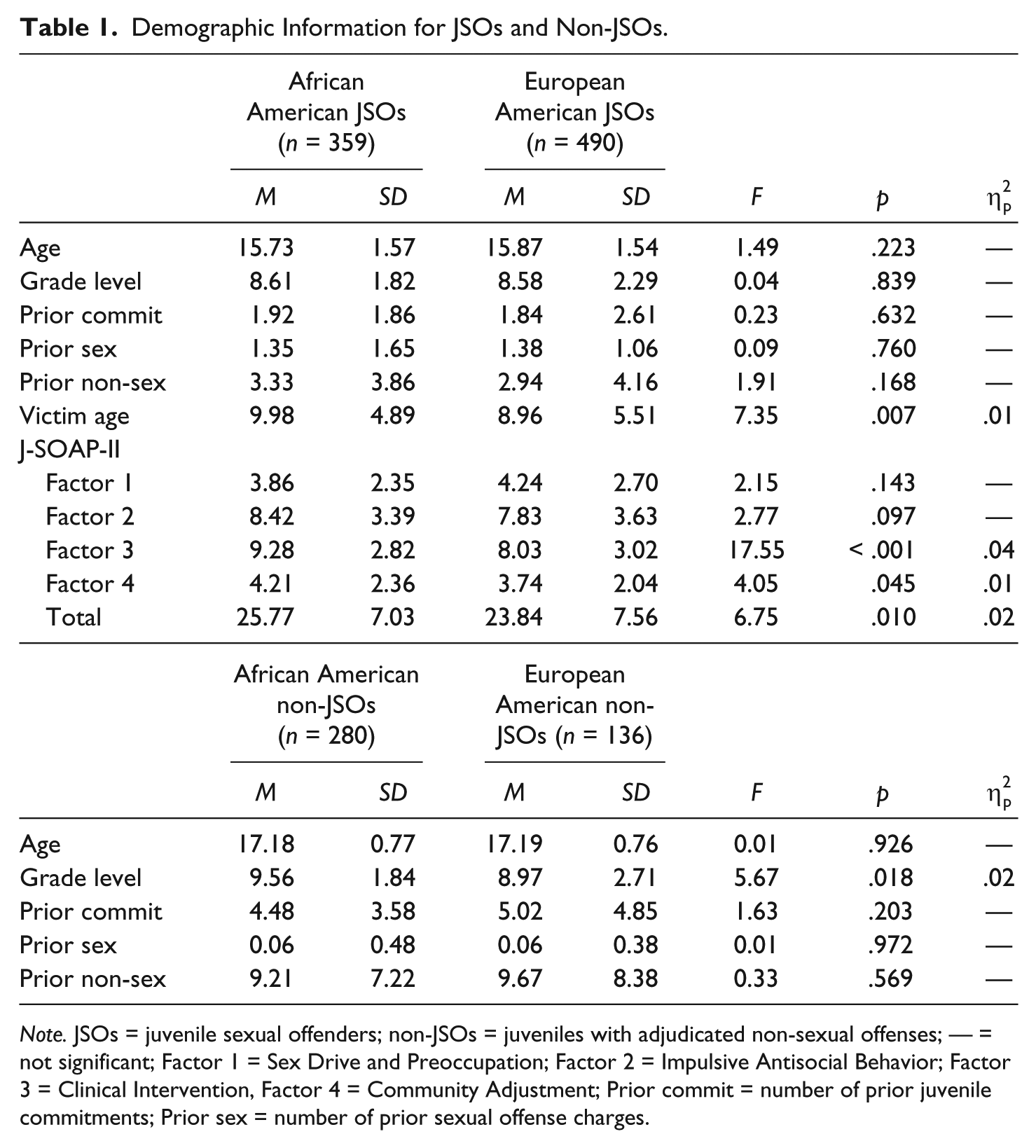
Note. JSOs = juvenile sexual offenders; non-JSOs = juveniles with adjudicated non-sexual offenses; — = not significant; Factor 1 = Sex Drive and Preoccupation; Factor 2 = Impulsive Antisocial Behavior; Factor 3 = Clinical Intervention, Factor 4 = Community Adjustment; Prior commit = number of prior juvenile commitments; Prior sex = number of prior sexual offense charges.
Disproportionate Minority Contact
Data were examined to test for disproportionate minority contact among JSO and non-JSOs. Figure 1 depicts disproportionate minority contact among JSOs and non-JSOs where the x-axis, or a value of “0” indicates the data are commensurate with the Alabama population youth aged 11 to 19. In general, these data indicated the presence of disproportionate minority contact among all groups of juvenile offenders, but there was a significantly attenuated rate of this phenomenon observed among JSOs relative to non-JSOs. More information about these data is described below.

Aggregate data indicating disproportionate minority contact from 2001-2013 among JSOs and non-JSOs.
Disproportionate minority contact among non-JSOs
As a point of interest and comparison to JSOs, data were evaluated regarding disproportionate minority contact for non-JSOs. State demographic information from 2001 to 2013 indicated that African Americans comprised 31.8% to 32.7% and European Americans comprised 65.4% to 66.1% of the Alabama population within that timeframe (CDC, 2014). Consistent with our hypothesis, disproportionate minority contact was present among African American non-JSOs. More specifically, African Americans represented 67% of the detained non-JSO population relative to their population percentage of 32%; conversely, European Americans comprised approximately 31% of the non-JSO population relative to their population percentage of 66%. In sum, these values represent an overrepresentation of African Americans and an underrepresentation of European Americans among non-JSOs.
Disproportionate minority contact among JSOs
To determine whether disproportionate minority contact was present among JSOs, we utilized the same census-based demographic data as that used with non-JSOs (CDC, 2014). Next, as described within the “Method” section above, percentages of confined JSOs were calculated for both racial/ethnic groups for each year and averaged. Data indicate that disproportionate minority contact was present among African American JSOs at rates ranging from 6.2% to 18.0% above the Alabama African American adolescent population. On average, 41% of our JSO population was African American, whereas 58% of our JSO population was European American.
Disproportionate minority contact comparisons by offense category
Aggregate measures indicated differential rates of disproportionate minority contact for African and European American adolescents among non-JSOs (33.0%, −30.7%) and JSOs (8.5%, −8.0%), respectively (see Figure 1). Negative values indicate values below the population rate and expected confinement rate of a racial/ethnic group in Alabama. Ultimately, results suggest disproportionate minority contact was present within the Alabama juvenile offender population, such that the percentage of African Americans was above that expected for non-JSOs and JSOs by 33% and 8.5%, respectively.
The z-score calculations related to disproportionate minority contact indicated the following negative values among European Americans: non-JSOs = −15.5 and JSOs = −4.9; conversely, among African Americans, the following positive z scores were observed: non-JSOs = 15.30 and JSOs = 5.62. A Chi-Square Test for Independence was run to compare groups using observed values, indicating significant differences in the rate of disproportionate minority contact between JSOs and non-JSOs (p < .001), evidencing more disproportionality among non-JSOs.
Racial/Ethnic Group Differences, Sexual Offense Characteristics, and Risk Level
A Chi-Square Test for Independence was run to test for differences between African American and European American JSOs on offense type (i.e., sexual abuse, sexual assault, rape, charges associated with genital exposure, and other sexual offenses). Results suggested significant general differences between African Americans and European Americans on offense categories. Follow-up Chi-Square Tests for Independence were conducted for each type of illegal sexual behavior charge, and findings indicated European Americans were more likely to have been charged with sexual abuse or attempted sexual abuse than African Americans. In addition, African Americans were significantly more likely to have been charged with rape or attempted rape than European Americans. African American and European American JSOs were equally likely to be charged with the following sexual offense categories: sexual assault, charges associated with genital exposure, and other sexual and non-sexual offenses (see Table 2). No differences in SORN classification tiers were observed based on racial/ethnic group categorization (see Table 2); however, the majority of participants fell within Tier 2 and Tier 3.
Charged Offenses, SORN Tier, and Race/Ethnicity Among JSOs.
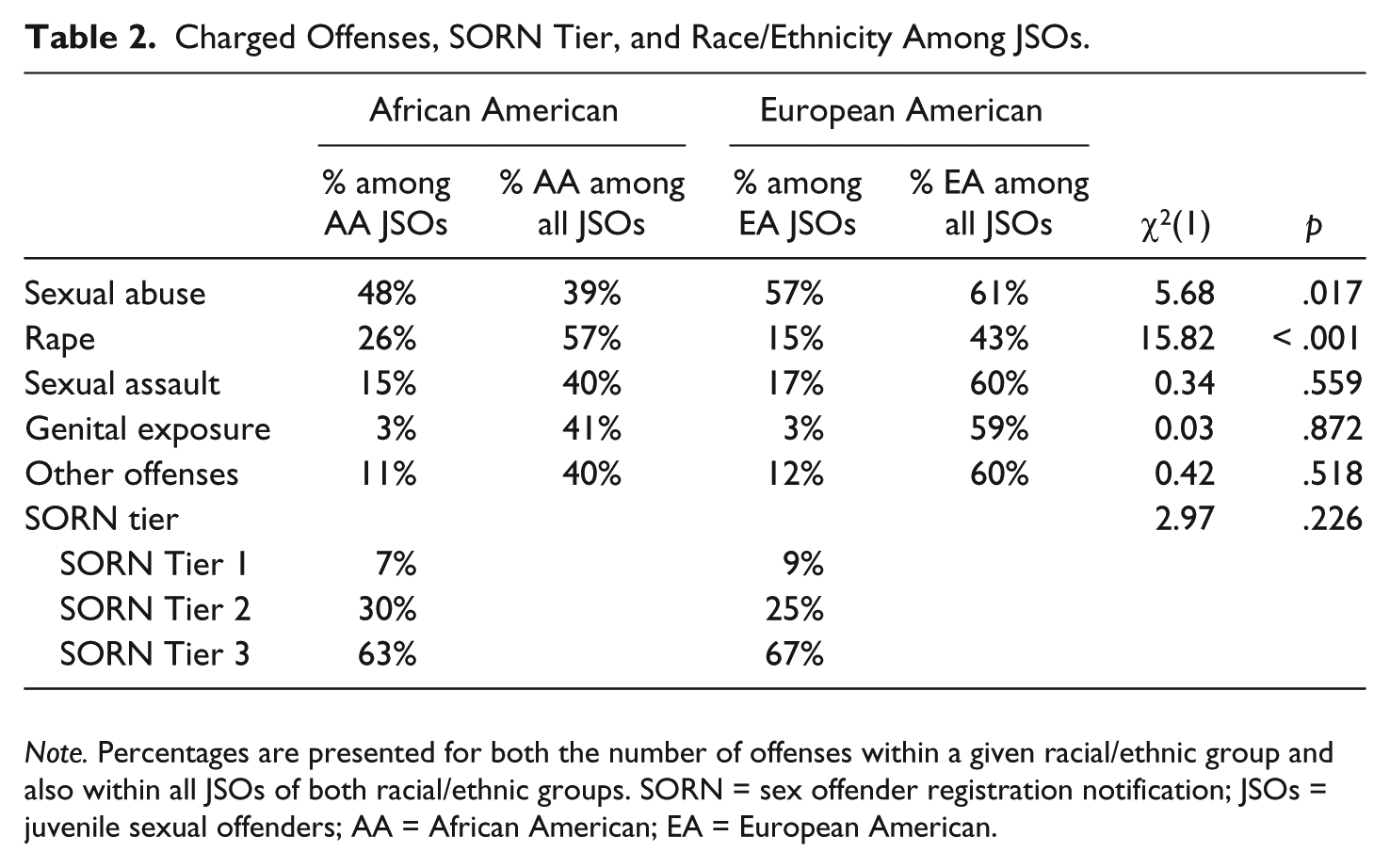
Note. Percentages are presented for both the number of offenses within a given racial/ethnic group and also within all JSOs of both racial/ethnic groups. SORN = sex offender registration notification; JSOs = juvenile sexual offenders; AA = African American; EA = European American.
Race/ethnicity and risk level
Using a MANOVA, J-SOAP-II subscale scores were compared between African and European American JSO (see Table 2). The overall omnibus model was significant, F(1, 397) = 5.20, p < .001; Wilk’s Λ = .950,
Prediction of SORN Level: Race/Ethnicity, J-SOAP-II, and Prior Offending
To test whether factors differentially predicated SORN tier classification, age of the JSO, race/ethnicity, number of prior commitments, number of prior sexual and non-sexual adjudicated offenses, and first victim’s age were collectively examined as potential predictors of SORN tier using a Linear Regression, and standardized coefficients were calculated. The total model predicting SORN tier classification was significant, F(6, 798) = 11.51, p < .001, R2 = .08. Race/ethnicity did not significantly predict SORN tier (p = .894), nor did the total number of non-sexual charges (p = .553). Age of victim, β = −.20, t(798) = −5.51, p < .001; number of prior juvenile commitments, β = −.12, t(798) = −2.53, p = .012; prior adjudicated sexual offenses, β = .11, t(798) = 3.28, p = .001; and age of the JSO upon arrival to the detention center, β = −.10, t(798) = −2.92, p = .004, were significant predictors of high-tier classification. After removing the two non-significant variables (i.e., race/ethnicity and total non-sexual arrests), the total model predicting tier classification remained significant, F(6, 798) = 17.21, p < .001, R2 = .08, and all included predictors remained significant.
General summary of results
All three of our hypotheses were largely confirmed, with a few minor exceptions. First, we found that disproportionate minority contact was present among both JSOs and non-JSOs, though we found an attenuated rate of disproportionate minority contact among JSOs. Consistent with our second hypothesis, we found that J-SOAP-II scores were comparable across racial/ethnic groups, that several types of sexual offense differed by racial/ethnic group, but that SORN tier classification did not differ between racial/ethnic groups. Finally, SORN level was predicted by prior offending patterns, but not race/ethnicity.
Discussion
The purpose of the current study was to gain a better understanding of racial/ethnic disparities in adjudicated offenses and incarceration rates among adolescent offenders, including JSOs and non-JSOs. Previous studies examining disproportionate minority contact among children and adolescents have failed to consider JSOs explicitly, but our results suggest that disproportionate minority contact is present in this special population. Still, the magnitude of this disparity was strikingly different among non-JSOs and JSOs (see Figure 1). For example, though Alabama’s juvenile population is 32% African American, 41% of JSOs and 67% of non-JSOs in our study were African American. Therefore, African American youth were overrepresented among confined JSOs and non-JSOs, yet African Americans were significantly less overrepresented among JSOs compared with non-JSOs. Clearly, because disproportionate minority contact is attenuated and less consistent among JSOs compared with other delinquent youth, this finding requires further consideration and more investigation.
Disproportionate Minority Contact Among JSOs
One possible reason for the large discrepancy in disproportionate minority contact between non-JSOs and JSO may be that illegal sexual behavior evokes an implicit response comparable with or stronger than racial/ethnic bias, a bias against sexual offending. This is not to say that offense category (i.e., sexual offending) entirely overrides race/ethnicity in judicial decision-making processes, especially because we did observe disproportionate minority contact among our JSOs, but it does appear that biases based on racial/ethnic status may be minimized among JSOs because sexual offenses are associated with significant stigma. Surveys of the general public in Florida, another Southeastern state, indicated community members held a variety of non-evidence based beliefs about sexual offenders pertaining to punishment and rehabilitation (Levenson, Brannon, Fortney, & Baker, 2007). Unfortunately, there is some evidence that such misconceptions are present not only within community samples but also among adults with sexual offenses themselves (Fortney, Levenson, Brannon, & Baker, 2007). In addition, common themes among studies examining public perception on illegal sexual behavior include feelings of fear and favorable attitudes toward punishment for sexual offending (e.g., Levenson et al., 2007). Such perceptions likely contribute to the profound level of punishment toward sexual offenders in the justice system compared with all other groups of offenders (Pickett, Mancini, & Mears, 2013). In fact, studies comparing perceptions of punishment and rehabilitation on general offending versus sexual offending indicate that rehabilitation is perceived as less effective and punishment is more necessary for persons with sexual offenses (Rogers & Ferguson, 2011). Thus, if JSOs are perceived as more dangerous and less likely to be rehabilitated than non-JSOs, the lower disproportionate minority contact observed for JSOs suggests that those who commit sexual offenses may be the target of biases that operate similarly to racial/ethnic biases.
Decisions within the juvenile justice system that eventually result in disproportionate minority contact are affected by a variety of factors and/or systems (Huizinga et al., 2007). Of course, cultural and community differences may influence the base rate of delinquency, but studies have indicated procedures specific to the justice system (that may differ across stages of processing) affect and increase confinement rates above and beyond the baseline rate of offending (Bishop, Leiber, & Johnson, 2010; Kempf-Leonard, 2007; Leiber & Peck, 2015). For example, there is not a single instance where police directly observed and arrested one of the adolescents in the JSO group; however, there were numerous instances where non-JSOs were arrested at the scene of the crime or immediately thereafter as a consequence of police surveillance. As a result, there may be more disproportionate minority contact among non-JSOs because police have direct contact with these adolescents at or proximate to the point of the criminal event or arrest, whereas police only become involved at a later point, as a result of a third party observation or report, with JSOs.
Race/Ethnicity and Specific Sexual Offenses
Findings from the present study indicated higher rates of violent sexual offending (i.e., rape) among African Americans and higher rates of sexual abuse among European Americans. According to the U.S. Department of Justice (2015), between 1992 and 2013, African American adults accounted for approximately 25% of all rape or attempted rape charges and approximately 25% of all sexual assault charges, despite only comprising 11% to 13% of the total U.S. population. Such values are consistent with our findings, signifying African American males are convicted of violent sexual offenses at a higher rate than would be expected based on the U.S. population.
Accordingly, our findings may represent true differences in juvenile sexual offending behavior or could be the result of other influential factors (e.g., differential reporting, bias during judicial decision-making processes). For example, rates of victim disclosure may differ by victim race/ethnicity, perpetrator race/ethnicity, or both, and could be an artifact of how much an individual trusts the judicial system or decision makers within the judicial system (MacDonald & Stokes, 2006). Accordingly, victims with an adult African American perpetrator are more likely to report a violent sexual offense such as rape (Carbone-López, 2005), and European Americans may be more inclined to report a sexual offense than those in African American communities. However, implicit biases might differentially affect the processing of allegations against JSOs, such that victims reporting a rape may be taken more seriously when the perpetrator is African American. Moreover, there may be an implicit tendency within the justice system to apply more violent labels to racial/ethnic minority youths. In fact, these findings may reflect a number of injustices within the judicial system including unequal access to quality legal representation.
Ultimately, labels connected to an adjudicated charge can result in harmful consequences for the adolescent, including intensity of stigma associated with the crime. Indeed, the degree of a charged sexual offense will affect both the SORN tier level and resulting community notification requirement. Given the severity of associations and consequences for a particular offense, every effort should be made to apply charges with equity and accuracy to ensure fair treatment for delinquent youths, regardless of their racial/ethnic background or socioeconomic status.
SORN and Race/Ethnicity
In the event that SORN continues to be implemented despite its lack of utility and applicability to adolescents (e.g., Caldwell et al., 2008), empirically based risk assessment measures such as the J-SOAP-II may help to evaluate and assign appropriate SORN tiers. Accordingly, adolescents’ J-SOAP-II scores were examined to ascertain whether African American and European American youths exhibited group differences on clinical factors or scales that may, in turn, influence their court-assigned risk level. Results indicated differences on J-SOAP-II scores based on race/ethnicity. One possible explanation for the observed trend is that clinicians scoring the J-SOAP-II may tend to attribute intrinsic or individual deficits as explanations for negative behavior among African American adolescents like implicit socioeconomic and racial/ethnic biases, but may attribute extrinsic or environmental variables as explanations for negative behavior among European American adolescents.
Notably, despite the aforementioned racial/ethnic differences in adjudicated charges and J-SOAP-II scores, European and African American youths had evenly distributed SORN classification tiers. That is, adolescents charged with a particular sexual offense had an equal likelihood of being assigned to the high-risk classification status regardless of their racial/ethnic background. Thus, discrimination and racial/ethnic bias may not be affecting community notification or registration.
Given frequent low-level assignment, we wanted to understand how or why some individuals are placed in upper level SORN classification tiers, leading to consideration of several additional factors that contribute to the court’s determination of risk. Our analyses identified several significant predictors of SORN tier level including victim age, perpetrator age at time of program entry, prior adjudicated sexual offenses, and prior commitments to detention centers. In particular, offenders were classified at a higher risk level if they perpetrated against younger victims and had previous sexual offense charges on record. Interestingly, individuals who were younger at program entry and who had fewer prior commitments were also assigned higher risk levels. While these findings must be confirmed in an independent sample, one possible explanation is that JSOs are perceived to be of greater risk for sexual recidivism and future deviant sexual behavior than those youths who exhibit a general delinquent predisposition and have been confined for non-sexual offenses in the past. Indeed, despite research demonstrating a relationship between adult sexual offending and antisocial behaviors (Barbaree, Seto, Langton, & Peacock, 2001), prior delinquent charges (i.e., non-sexual arrests) had no predictive utility in our study with regard to SORN classifications. Therefore, it appears as though attorneys and judges continue to be under the misconception that juvenile sexual offending represents a recalcitrant lifelong pattern of behavior that is more dangerous and severe than that of youth who engage in frequent delinquent behavior or who demonstrate antisocial attitudes.
Limitations/Future Directions
Several limitations within the current study should be noted. For one, it is difficult to compare JSOs and non-JSOs because there are so many legal and psychological differences between the two populations (Seto & Lalumiére, 2010). Still, because such an interesting attenuated effect was observed on disproportionate minority contact among JSO compared with non-JSOs, future studies should be conducted to advance our knowledge base by testing possible contributing factors to this attenuated rate of this phenomenon. Indeed, more research is needed to confirm that implicit discrimination based on race/ethnicity is not present at the court level for JSOs because it is possible that tier classifications are not variable or sensitive enough within our population to detect meaningful differences based on race/ethnicity.
Disproportionate minority contact can be influenced through a number of factors (e.g., implicit bias, excessive policing in economically insecure regions), many of which were unable to be examined in the present study, which was limited to confined juveniles. Future research on disproportionate minority contact should focus on all levels of processing within the juvenile justice system. In fact, it is recommended that data from the court level be examined for discrepancies in treatment of adolescents who engage in illegal behavior based on offense category, offense type, and offender racial/ethnic background. Furthermore, studies should examine disproportionate minority contact within non-detained adjudicated samples, which may improve racial/ethnic minority access to treatment and involvement with social service agencies.
Our sample contained the confined Alabama JSO population, but is still limited to the rural southeast which may not mimic other state policies and may not generalize to disproportionate minority contact rates within other areas of the nation. Ideally, to examine national trends in disproportionate minority contact with juvenile offenders, comparisons should not only be made across time but should also be cross-validated across state lines and geographic regions. Because few years following the onset of juvenile SORN requirements in Alabama were available in the present study, analyses of disproportionate minority contact over time were not possible. However, recommendations are made with a particular focus on examining rates of disproportionate minority contact prior to and following the implementation of SORN.
In the present study, the vast majority of adolescents were identified as African American or European American; therefore, we could not test whether disproportionate minority contact was present among juveniles from other racial/ethnic groups, particularly Latinos and Native Americans. In addition, the majority of our participants were from a lower socioeconomic status background, meaning they are not representative of all youth charged with a sexual offense. Thus, future research should not be limited by considerations of racial/ethnic diversity, however, and future investigations may also consider analyses related to other personal and cultural factors that may influence court proceedings (e.g., sex, gender, sexual orientation, socioeconomic status). Ultimately, social service professionals must increase their awareness and consideration for issues of diversity, particularly among youths who should be provided with equal access to rehabilitative services and enrichment opportunities that will enhance quality of life regardless of cultural background.
Footnotes
Acknowledgements
The authors thank the administration of the Alabama Department of Youth Services (DYS) for their support and continuing commitment, and Spencer T. Fix for his time and editorial work.
Declaration of Conflicting Interests
The author(s) declared no potential conflicts of interest with respect to the research, authorship, and/or publication of this article.
Funding
The author(s) received no financial support for the research, authorship, and/or publication of this article.