



Abstract
Previous studies found associations between children and sex in child sex offenders (CSOs) using the Implicit Association Test (IAT). We used a modification of this task, the Single Category–Implicit Association Test (SC-IAT) to unravel child-sex associations in CSOs. Using the SC-IAT, we were able to test whether CSOs indeed hold stronger child-sex associations relative to adult-sex associations, compared to adult sex offenders and nonoffenders. Furthermore, we examined whether contact CSOs differed from noncontact CSOs in their child-sex associations. The hypothesis that CSOs would have stronger child-sex associations, relative to their adult-sex associations, than adult sex offenders and nonoffenders was confirmed. No difference between contact CSOs and noncontact CSOs was found. Although the Sex SC-IAT was able to distinguish CSOs from nonoffenders, the sensitivity and specificity of the test was poor (AUC of .65) and needs refinement. The results of this study support the existence of a child-sex association as a distinctive characteristic of CSOs. These findings are discussed in the context of theories on deviant cognitions in CSOs and risk for sexual offending.
Deviant Cognitions in Child Sex Offenders
Theories of sexual offending posit that cognitive distortions (CDs) are important in the etiology of child sexual abuse, as they facilitate sexual offending against children (Marshall & Barbaree, 1990; Ward & Keenan, 1999). Abel, Becker, and Cunningham-Rathner (1984) were the first to define CDs in the sexual offending area. They referred to it as “internal processes, including the justifications, perceptions and judgements used by the sex offender to rationalize his child molestation behavior” (Abel et al., 1989, p. 137). Nowadays, CDs related to sexual offending are typically defined as ‘maladaptive beliefs and attitudes, and problematic thinking styles that serve to deny, blame, excuse and minimize sexual abusive actions’ (Bumby, 1996; Gannon, Ward, & Collie, 2007; Ward, 2000). However, as Ward and Casey (2010) have argued, “CDs” is a normative concept and whether cognitions are distorted depends on the violation of the ethical norms of a society. Therefore, the term “CDs” should be replaced by “deviant cognitive processes.” These deviant cognitive processes, or problematic thinking styles, including the cognitive content, belief structures, information processing and social processes, result in cognitive products (Ward & Casey, 2010). These products are reflected by the statements regularly uttered by sex offenders to rationalize their abusive actions (Gannon et al., 2007; Ward, Polaschek, & Beech, 2005).
There is much debate on the purpose of these deviant cognitions, whether they serve a maintenance function in the offending process or a causative role. Whereas Abel and colleagues proposed that these deviant cognitions resulted from the offence to reduce cognitive dissonance or from the realisation that their sexual interests are not in accordance with society’s norms (Abel et al., 1984; Abel et al., 1989), Ward and colleagues suggested that deviant cognitions are the product of underlying “implicit theories” that were developed during childhood and preceded the offence (Ward, 2000; Ward, Hudson, Johnston, & Marshall, 1997; Ward & Keenan, 1999). These implicit theories are hypothesized to be schematic associations that may contribute to offending behavior as well as to utterances and other surface products that can be seen as distorted. Ward and Keenan (1999) proposed five implicit theories used by child sex offenders (CSOs) to make propositions about the victims’ desires and intentions, which are important in the initiation and maintenance of child sexual abuse: (1) entitlement—a core belief of superiority and the right to have sex with children. This theory is illustrated by claims such as “a person should have sex whenever it is needed”; (2) dangerous world—adults are rejective and children are more accepting, or everyone is hostile and others should be dominated. This is illustrated by claims as “children really know how to love you” or “I had to teach her a lesson”; (3) uncontrollability of sexual drive, exemplified by “I did it because I was sexually abused as a child”; (4) nature of harm—children who are sexually abused are relatively unharmed. A distortion associated with this theory includes “this will not hurt her in any way”; and (5) children as sexual beings—a child is a sexual being who is motivated by achieving pleasure, and capable of desiring and enjoying sex. This theory is illustrated by claims such as “she seduced me” or “he enjoyed it” (see Ward & Keenan, 1999).
Several studies that used explicit self-reports or interviews have found evidence that CSOs indeed hold deviant cognitions about children and sex (Bumby, 1996; Marziano, Ward, Beech, & Pattison, 2006). For example, through the administration of interviews, evidence was found for the presence of all five of Ward’s implicit theories in CSOs (Keown, Gannon, & Ward, 2010; Marziano et al., 2006). Furthermore, CSOs endorsed significantly more deviant cognitions than rapists, offender controls or community controls (Abel et al., 1989; Bumby, 1996; Keown et al., 2010; Stermac & Segal, 1989). Moreover, subtypes of CSOs could be distinguished based on their levels of reported deviant cognitions. For example, higher levels of deviant cognitions were found in high-deviant CSOs and CSO who wanted sexual activity with children than in low-deviant CSOs and CSOs who wanted to avoid sexual activity with children (Beech, 1998; Bickley & Beech, 2002). A recent meta-analysis confirmed that contact sex offenders (SOs; N = 1,342; predominantly CSOs) could be distinguished from noncontact SOs (N = 4,844; predominantly CSOs) based on higher levels of sexual deviancy and deviant beliefs and attitudes (Babchishin, Hanson, & Hermann, 2011). Furthermore, a study comparing 505 noncontact CSOs to 526 contact CSOs found higher levels of deviant cognitions and deviant victim empathy within contact CSOs (Elliott, Beech, Mandeville-Norden, & Hayes, 2009). In line with this, higher levels of deviant cognitions were found in contact CSOs compared to noncontact CSOs (Hempel, Buck, Goethals, & Van Marle, 2012).
Although explicitly reported deviant cognitions were found in CSOs, CSOs may largely be unaware of their deviant cognitions, or they might hide, deny, or minimize them (Ward & Keenan, 1999). As Ward and colleagues stated “people do not have direct access to the content and structure of their own cognition” (Ward et al., 2005, p. 116).
Because much social cognition occurs in an implicit mode (Greenwald & Banaji, 1995), it is difficult to measure these deviant cognitions using self-reports. Therefore, measures have been developed to measure cognitions indirectly. However, several studies that tried to overcome the problem of self-report, could not confirm the existence of implicit theories or deviant cognitions among CSOs using information processing measures (Keown, Gannon, & Ward, 2008a, 2008b, 2010).
The Implicit Association Test
Because people do not have direct access to the content and structure of their own cognitions, other methods have been developed to measure cognitions in a more indirect manner. One such method is the Implicit Association Test (IAT; Greenwald, McGhee, & Schwartz, 1998). The rationale behind the IAT is that it measures attitudes indirectly through the association someone has of two attitude categories (e.g., child vs. adult) with an evaluative category (e.g., sex vs. not sex; Greenwald et al., 1998). The IAT has regularly been used in different fields of psychology to measure diverse constructs, including prejudice and stereotypes (Amodio & Devine, 2006; Rudman, Greenwald, Mellott, & Schwartz, 1999), consumer preferences (Maison, Greenwald, Bruin, 2004), and self-esteem (Karpinski, 2004). The IAT possesses satisfactory psychometric properties and is less susceptible to social desirability or faking than self-report (Asendorpf, Banse, & Mücke, 2002; Banse, Seise, & Zerbes, 2001; Kim, 2003).
Measuring sexual associations with the IAT revealed deviant associations between children and sex in CSOs, irrespective of their explicit denial of offence history (Brown, Gray, & Snowden, 2009). Furthermore, with the IAT, Mihailides, Devilly, and Ward (2004) found associations in CSOs that were in line with Ward’s children as sexual beings, entitlement and uncontrollability implicit theories. Also, based on the child-sex associations in CSOs found by the IAT, researchers were able to distinguish CSOs from nonsex offenders and nonoffenders (Brown et al., 2009; Gray, MacCulloch, Brown, Smith, & Snowden, 2005; Mihailides et al., 2004; Nunes, Firestone, & Baldwin, 2007; Van Leeuwen et al., 2009). Additionally, Snowden, Wichter, and Gray (2008) showed that the IAT almost perfectly classified heterosexual and homosexual men based on their sex preference associations (area under the curve = 0.97). Therefore, as heterosexuality and homosexuality are assumed not to be related to or result from specific beliefs, the associations measured with the IAT could also be more directly related to sexual interest rather than to belief systems.
In the example of an IAT with two attitude categories (e.g., child vs. adult) and two evaluative categories (e.g., sex vs. not sex) however, it is not clear whether a low score indicates the presence of a child-sex association, the presence of an adult-nonsex association, the lack of a child-nonsex association, and/or the lack of an adult-sex association. For this reason, researchers suggested that for some research questions it is more useful to indirectly measure attitudes toward only one single attitude category. By providing only one evaluative category for one attitude category and eliminating the opposite evaluative category for the other attitude category, it is clearer which association is more present in an individual relative to the other association (Blanton & Jaccard, 2006; Karpinski & Steinman, 2006). The Single Category–Implicit Association Test (SC-IAT; Karpinski & Steinman, 2006) is designed to measure the association between two attitude categories (e.g., child vs. adult) in relation to a single evaluative category (e.g., sex).
Current Study
The primary goal of this study was to indirectly measure the association between children-versus-adults and sex in CSOs compared to sex offenders against adult women (ASOs) and nonoffenders, using a Sex SC-IAT. Finding a child-sex association in CSOs with the SC-IAT would be a more precise indication that CSOs indeed hold a stronger association between children and sex, relative to their adult-sex association. Furthermore, so far, studies have not examined the sexual associations of noncontact CSOs compared to contact CSOs. According to Ward’s child as sexual beings theory, high levels of deviant cognitions lead to the sexualization of children’s behavior, increasing the risk of contact offending. Differences in levels of deviant sexual associations could explain the differences in offending behavior between noncontact and contact CSOs, suggesting different treatment and management approaches. We compared noncontact CSOs to contact CSOs and included ASO and nonoffenders as control groups. We hypothesized that CSOs would have stronger child-sex associations relative to their adult-sex associations, than adult sex offenders and nonoffenders. Secondly, the child-sex association would be stronger among contact CSOs than among noncontact CSOs. Furthermore, the ability of the Sex SC-IAT to distinguish CSOs from nonoffenders was examined.
Finally, as part of a first exploration on the concept of “seduction,” we included a Seduction SC-IAT as well. When children are viewed as sexual beings, contact CSOs might also think the child incited the abuse through seduction, proceeding to the actual abuse of a child. We hypothesized that contact CSOs would associate seduction with children, whereas noncontact CSOs, ASOs and nonoffenders would associate seduction with adults.
Method
Participants
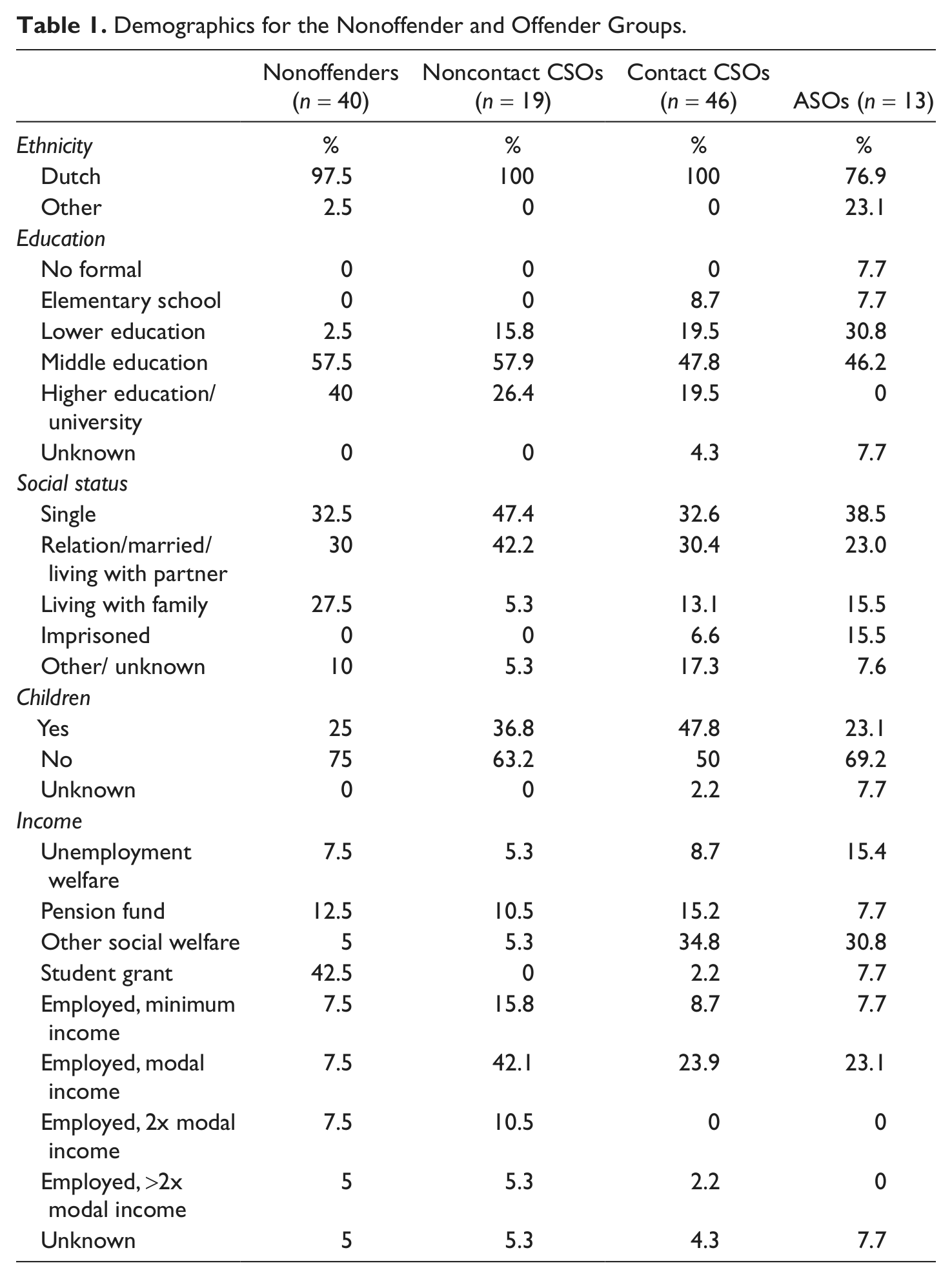
A total of 40 male nonoffenders and 78 male SOs participated. Nonoffenders (age: M = 35.6, SD = 17.9) were recruited using an advertisement at the Erasmus Medical Center and internet advertising and were eligible if they had no prior convictions. SOs were recruited from three forensic psychiatric outpatient and day treatment centers and three penitentiary institutions in the Netherlands. The SOs comprised of 65 CSOs (46 child molesters, 16 child pornography offenders and 3 exhibitionists) and 13 sex offenders against adult women (ASOs;7 assaulters, 3 rapists, 2 exhibitionists, and 1 frotteur). These classifications were adopted from the institutions where SOs were treated or imprisoned. For this study, SOs were then classified as a noncontact CSO (N = 19; age: M = 47.1, SD = 12.5) if they (a) were currently in treatment or imprisoned for downloading and/or spreading child pornography or for exhibitionism aimed at children aged 16 years or younger, and (b) had never committed a sexual offence against a child or adult in which there was physical contact. SOs were classified as a contact CSO (N = 46; age: M = 49.1, SD = 13.7) if they (a) were currently in treatment or imprisoned for a sexual offence against a child under 16 years of age in which there was physical contact, and (b) had never committed any sexual offences against an adult. SOs were classified as an ASO (N = 13; age: M = 37.3, SD = 16.2) if they (a) were currently in treatment or imprisoned for a sexual offence against a woman and (b) had never committed any sexual offences against a child. None of the offenders had prior histories of sex offences against both children and adults. Almost half of the CSOs had female victims (48.3%), 45% had male victims and 5% had both male and female victims. Table 1 illustrates the demographics of the offender and nonoffender groups.
Demographics for the Nonoffender and Offender Groups.
Materials
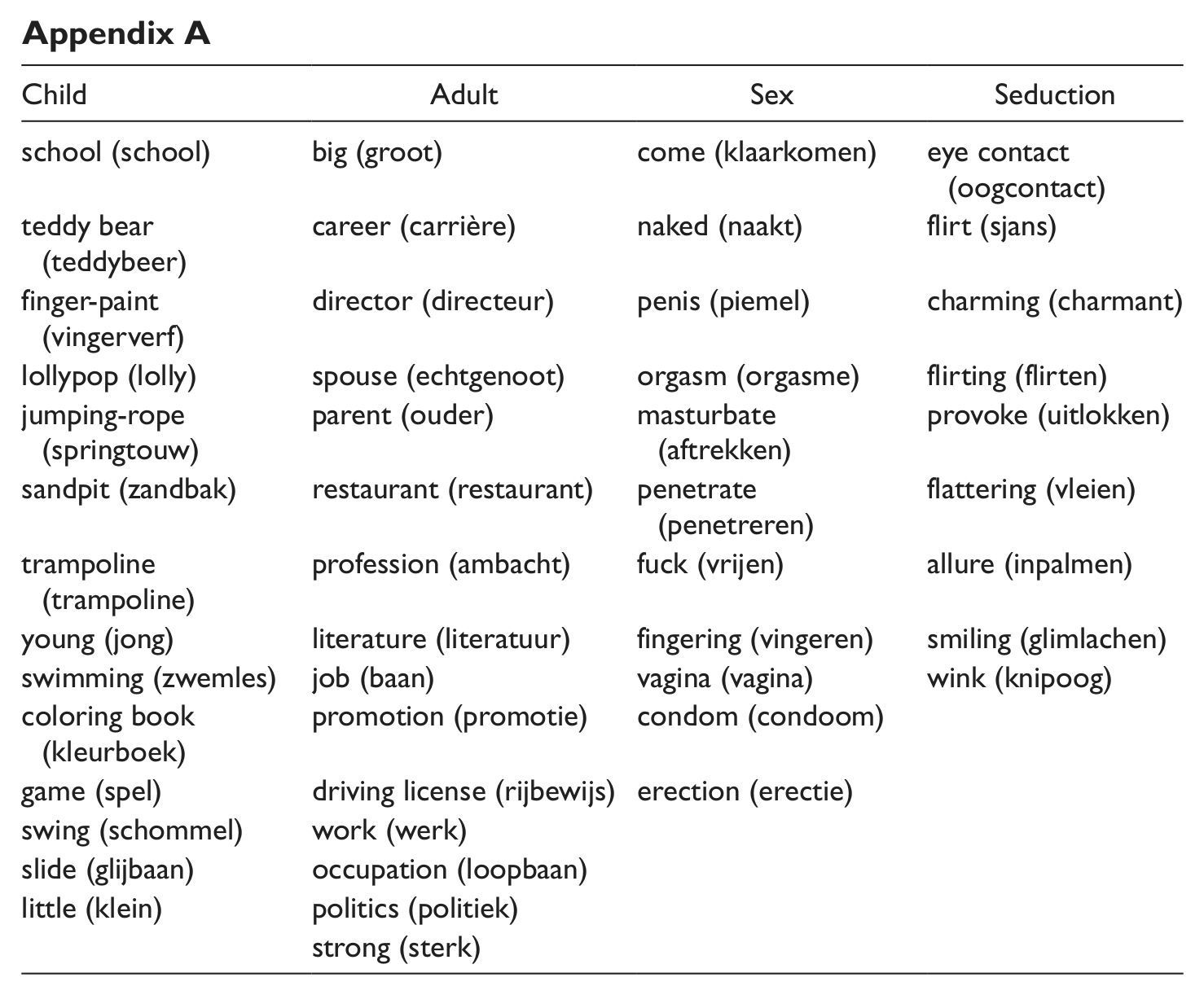
The Single Category–Implicit Association Test paradigm (SC-IAT; Karpinski & Steinman, 2006) was used to design a Sex SC-IAT and a Seduction SC-IAT. Selection of the stimulus words was based on stimuli used in the IATs of other researchers (Gray et al., 2005; Mihailides et al., 2004) and on pretesting. Eleven men without prior offending histories anonymously categorized a list of 50 child and adult related words, and 47 seduction and sex related words. Words were rated on a 0 to 100 continuum scale, indicating the representativeness of a word for that category. For a word to be representative of one specific category, a score of at least 70 was needed, against a score lower than 30 for the other category. For example, the word “orgasm” had a mean score of 2.7 on “seduction” and of 71.8 on “sex,” and was included in the category “sex”; the word “lust” scored high on both categories and was therefore not suitable for our study. Words that represented more than one category were eliminated. Then, the words that most reflected the categories were matched with the number of characters and syllables. This ensured that differences in response latencies were not caused by words that were not equal in reading time. This resulted in 15 adult and 14 child words, and 9 seduction and 11 sex words (see appendix A).
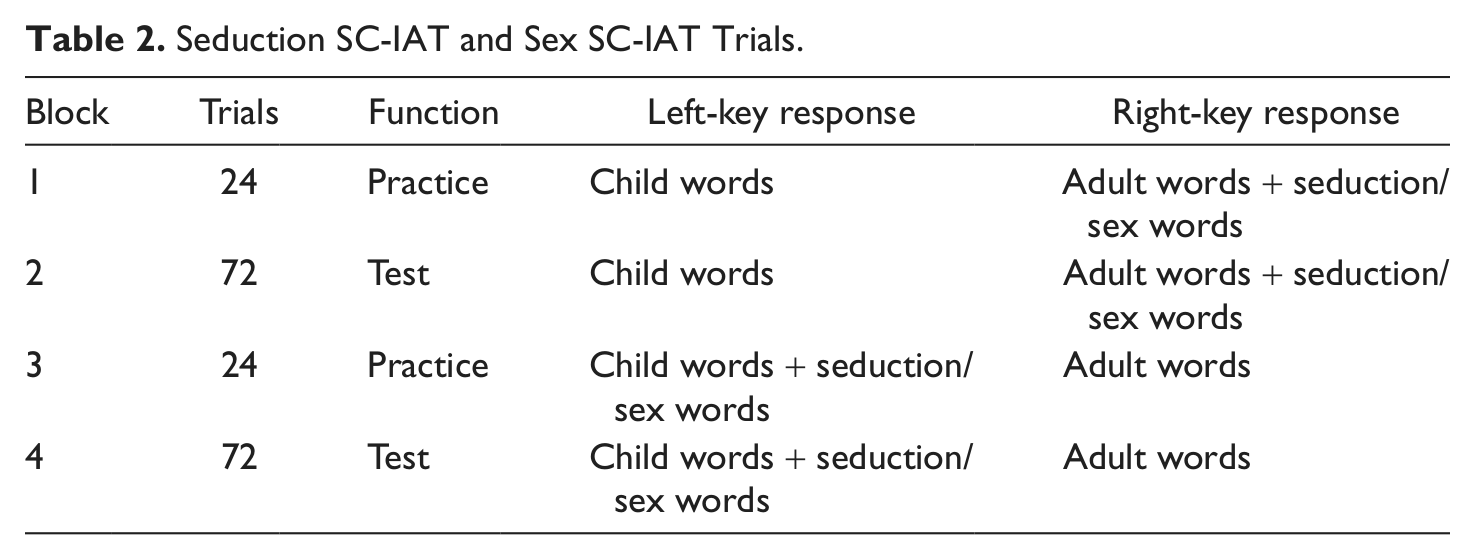
Each SC-IAT consists of two stages, both consisting of 24 practice trials followed by 72 test trials (see Table 2). On a computer screen, the attitude categories (child and adult) are presented in the upper left and upper right corners of the screen, and one evaluative category (sex or seduction) is presented underneath one of the attitude categories. Stimulus words represented either an attitude category or the evaluative category. After the presentation of a fixation cross, these stimulus words appeared in a random order in the middle of a computer screen. Participants had to categorize these words as quickly as possible into the different categories by pressing the “q” key on the computer keyboard for the left category or the “p” key for the category on the right. For example, in the first stage of the seduction SC-IAT, child words were categorized on the q key and adult or seduction words were categorized on the p key. This is called the congruent condition (Blocks 1 and 2, see Table 2), assuming most people have an association between adult and seduction, and between adult and sex, rather than between children and seduction, and children and sex. The stimulus word remained on the screen for 1500 ms, unless the participants responded within this time interval. Participants were instructed to respond as quickly as possible. Following each response, participants were given feedback: a green square with the word “correct” or a red square with the word “incorrect” appeared in the middle of the screen for 500 ms. After feedback presentation the next trial started. In the second stage, the left response-key was assigned to child and seduction or sex words, and the right response-key was assigned to adult words. This is called the incongruent condition (Blocks 3 and 4), assuming most people do not have an association between child and seduction, nor between child and sex. The order in which the conditions were presented was counterbalanced. Faster response latencies were expected for the congruent condition, than for the incongruent condition. The difference score between the reaction times of these two conditions is the so-called IAT effect—indicated by a D-score—and gives an indication of the strength of the association between the attitude category and evaluative category (Greenwald et al., 1998). A larger IAT effect indicates a stronger association.
Seduction SC-IAT and Sex SC-IAT Trials.
Procedure
Participants were seated at a desk with a Toshiba Pentium 4 computer using E-prime software. The SC-IAT tasks were presented on the computer and participants first completed the Seduction SC-IAT and then the Sex SC-IAT. The computer recorded reaction times (RTs) and response accuracy and inaccuracy. SOs were tested at the institution where they were in treatment or imprisoned. Nonoffenders were tested at the Erasmus University Medical Center. Participation was voluntary and SOs were guaranteed that noncooperation had no consequences for their treatment process or prison placement. In addition, they were informed that their responses would not be communicated to their treatment staff or to authorities. All participants at least completed elementary school to be able to process words that were presented to them and to complete the SC-IAT tests, and all provided written informed consent. Permission was given by the Medical Ethics Review Committee (METC) of the Erasmus Medical Center Rotterdam.
Data Reduction and Statistical Analyses
To obtain a D-score, we used the improved algorithm of Greenwald, Nosek, and Banaji (2003). Because the 24 practice trials in each stage were truly practice, data from the practice blocks were discarded (Blocks 1 and 3; see Karpinski & Steinman, 2006). Trials with latencies higher than 10,000 ms were eliminated. Participants for whom more than 10% of trials had latency less than 300 ms were excluded from analysis, resulting in the elimination of 3 participants for the sex SC-IAT and 1 for the seduction SC-IAT. Error responses were replaced with the block mean plus an error penalty of 2 times the block SD. The average response times of Block 2 (i.e., adult-seduction or adult-sex) were subtracted from the average response times of Block 4 (i.e., child-seduction or child-sex). This quantity was divided by the pooled standard deviation of all correct response times within Blocks 2 and 4. Positive D-scores indicated greater associations between adult and sex or between adult and seduction relative to child and sex or child and seduction. Negative D-scores indicated greater associations between child and sex or between child and seduction relative to adult and sex or adult and seduction. A D-score of zero represents no association.
To test for normality, a Kolmogorov-Smirnov test was performed. Scores on the Sex IAT (D(114) = .07) and Seduction IAT (D(116) = .04) were normally distributed. D-scores of noncontact CSOs, contact CSOs, ASOs and nonoffenders were analyzed using descriptive analyses and compared using analysis of variance. We also tested whether we could distinguish CSOs from nonoffenders by using the D-score as predictor of group membership in Receiver Operator Characteristic (ROC) Curve analyses (Hanley & McNeil, 1982). The Area Under the Curve (AUC) statistic from ROC analysis reflects the predictive validity of a given assessment instrument and represents how well one can categorize a person at an individual level, based on the test result taking both true and false hits into account. AUC values range from 0 to 1, where 0 is perfect negative prediction, .5 is prediction at chance level and 1 is perfect positive prediction. All analyses were two tailed, and the alpha was set as .05. Effect sizes are reported for the independent t test—denoted as r (Pearson correlation coefficient), and for analyses of variance—denoted as ω (omega).
Results
Reliability
To determine the reliability of both SC-IATs, we divided each SC-IAT into two mutually exclusive subsets of trials and calculated a D-score separately for each half. A measure of internal consistency was obtained by calculating the correlation between these scores (Greenwald et al., 2003), yielding a moderate level of internal consistency for the Sex SC-IAT (r = .67) and a low level for the Seduction SC-IAT (r = .36). Subgroups did not differ in the levels of internal consistency. Due to the low level of internal consistency of the Seduction SC-IAT, we decided to refrain from further analyses of this task.
Sex SC-IAT
Mean reaction times for responses to child, adult and sex stimuli are shown in Figure. 1. D-scores were calculated for the Sex SC-IAT (see Figure. 2). Our hypothesis that CSOs have stronger child-sex associations relative to their adult-sex associations than ASOs and nonoffenders was partly confirmed. D-scores differed between CSOs, ASOs and nonoffenders (F(2,111) = 3.39, p <.05, ω = .20). Post hoc comparisons using the Hochberg’s GT2 test indicated that the D-score of CSOs (M = –.099, SE = .052) differed significantly from D-scores of nonoffenders (M = .099, SE = .058), p = .042, r = .24. On average, CSOs responded faster when child and sex words shared the same response key, whereas nonoffenders responded faster when adult and sex words shared the same response key. This indicates that CSOs associated children with sex more than they associated adults with sex, whereas nonoffenders associated adults with sex more than they associated children with sex. D-scores of ASOs (M = .066, SE = .107) did not differ from CSOs or nonoffenders. They also associated adults with sex more than they associated children with sex.
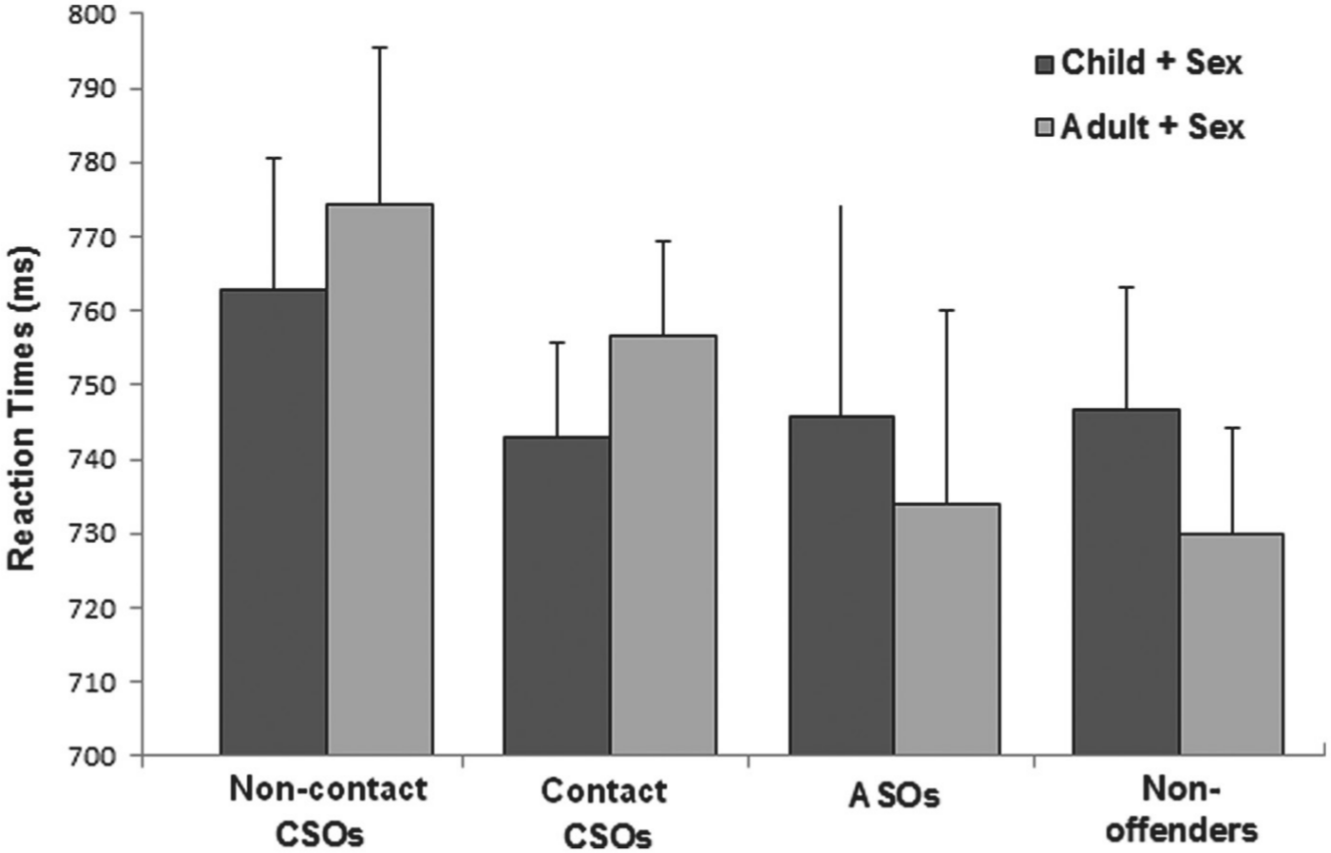
Mean reaction times in milliseconds for responses to the child-sex and adult-sex combination blocks.
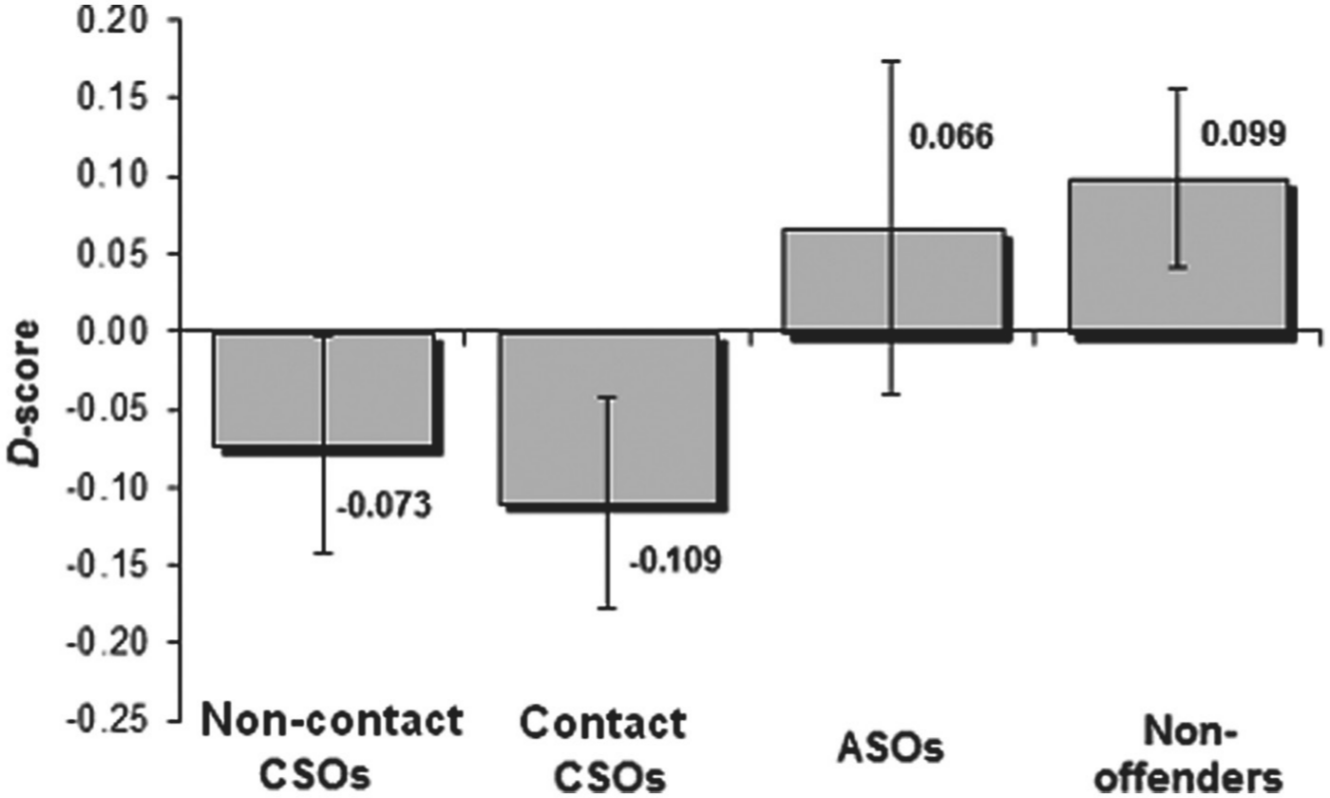
D-scores on the Sex-IAT. A positive score indicates an association between adult and sex, a negative score indicates an association between child and sex.
The hypothesis that the child-sex association would be stronger among contact CSOs than among noncontact CSOs was not confirmed. There were differences at trend level between noncontact CSOs (M = –.073, SE = .070), contact CSOs (M = –.109, SE = .067), ASOs and nonoffenders (F(3,110) = 2.28, p = .083, ω = .18). However, post hoc analyses only revealed differences at trend level between contact CSOs and nonoffenders, p = .097, r = .25. No differences were found between contact CSOs, noncontact CSOs and ASOs, or between noncontact CSOs, ASOs and nonoffenders.
Finally, in line with our hypothesis, the Sex SC-IAT was able to distinguish a CSO from a nonoffender, although the sensitivity and specificity was poor. The D-score from the Sex SC-IAT produced an AUC of 0.65 (SE = .055, p <.05). Analyses on log transformed response latencies or with an error penalty of 600ms (Greenwald et al., 2003) yielded similar results.
Discussion
Our findings support the existence of the child-sex association among CSOs found in earlier studies (Brown et al., 2009; Gray et al., 2005; Mihailides et al., 2004; Nunes et al., 2007). The Sex SC-IAT showed that CSOs associated children with sex more than they associated adults with sex, whereas ASOs and nonoffenders associated adults with sex, more than they associated children with sex. The associations differed significantly between CSOs and nonoffenders. However, the Sex SC-IAT showed poor sensitivity and specificity in identifying CSOs from nonoffenders, with an AUC of .65. Contrary to our hypothesis, no difference was found between noncontact CSOs and contact CSOs in their child-sex associations. The moderate level of internal consistency of the Sex SC-IAT (r = .67) was comparable to the level of internal consistency found by Karpinski and Steinman (2006).
Although associations may reflect some postoffence associations that developed in response to the offence experiences of CSOs, the child-sex association found in CSOs support the implicit theory proposed by Ward and Keenan (1999) that a child is viewed as a sexual being. According to Mihailides and colleagues (2004), the existence of this microcognitive implicit association among CSOs indicates the ascription of sexuality onto children. The authors state that these results are potentially informative of the relationship between implicit semantic constructs, deviant cognitions, and sexual offending behavior, as it has been suggested that deviant cognitions are the product of underlying implicit schematic associations and preceded the offence (Ward & Keenan, 1999; Ward, 2000).
Whereas Mihailides and colleagues (2004) suggested that the child-sex association among CSOs indicates the ascription of sexuality onto children, the SC-IAT effect may also be more directly related to sexual interest rather than to distorted belief systems. A study of Ó Ciardha and Gormly (2011), using a pictorial-modified Stroop task to measure sexual interest of CSOs, showed that both nonoffenders and CSOs responded in a pattern consistent with their self-reported sexual orientations. This view might also explain our finding that there were no differences between contact CSOs and noncontact CSOs regarding their child-sex associations, as both types of offenders are assumed to have sexual interest in children. However, a contact CSO might also view a child as seductive, therefore proceeding to contact offences. Unfortunately, the internal consistency of the Seduction SC-IAT was too low to draw any reliable conclusions from it to clarify the difference in offending behavior. Concerning a child-sex association, it was found that among contact CSOs, having such association was related to a greater risk for reoffending (Nunes et al., 2007). Yet, it is not clear if the existence of a child-sex association among noncontact CSOs is also a risk for future contact offending. This question may be addressed in future studies to further clarify the sexual interests and underlying beliefs of contact CSOs and noncontact CSOs.
To our knowledge, this is the first study that used a single attitude category in measuring the child-sex associations of CSOs. The child-sex association held by CSOs, or their lower than normal adult-sex association, was also detected with the SC-IAT, suggesting this is a robust finding. The omission of a relative preference for another attitude category simplified the interpretation of the results. In our study, a negative score indicated greater child-sex associations, relative to adult-sex associations, whereas the results of an IAT could be interpreted in multiple ways: the presence of a child-sex association, the presence of an adult-nonsex association, the lack of a child-nonsex association, and/or the lack of an adult-sex association. Using a SC-IAT instead of an IAT excludes the assessment of an adult-nonsex association and a child-nonsex association, which makes the interpretation easier. This further confirms the robustness of the child-sex association, or the lack of an adult-sex association. However, there were serious problems with the sensitivity and specificity of the test that dramatically needs improvement. An alternative promising measure of implicit preferences would be the Implicit Relational Assessment Procedure (IRAP; Barnes-Holmes et al., 2006). Dawson, Barnes-Holmes, Gresswell, Hart, and Gore (2009) used this measure to provide further evidence for Ward and Keenan’s (1999) children as sexual beings implicit theory and found the IRAP to be more effective at identifying differences in implicit beliefs between CSOs and nonoffenders than a cognitive distortion questionnaire. Also, the bias toward adults as sexual and children as nonsexual was significantly impaired in CSOs.
This study has a few limitations and we have to be cautious with our conclusions. First, sample sizes were fairly small, especially for the noncontact CSOs and ASOs, which may have resulted in a lack of power to detect differences between groups. Secondly, although the SC-IAT produced a significant AUC of .65, this is still too poor since the number of false alarms with this test is too high to reliably make inferences about someone’s sexual associations using this instrument. This discriminative ability is lower than traditional bipolar child-sex IATs (for example the AUC of 0.73 reported by Gray et al., 2005). Future research should focus on refinements and improving the specificity and sensitivity of the test to be able to distinguish between subtypes of CSOs. Furthermore, to determine the sexual associations, or sexual interest, of CSOs, the addition of another reliable instrument is needed.
Furthermore, although we distinguished between noncontact CSOs and contact CSOs to reduce the heterogeneity of CSOs, within population heterogeneity was still present in terms of number of victims, gender of victims and age of the victims. For example, Brown and colleagues (2009) showed that hebephilic CSOs (victims aged 12 to 15) did not hold child-sex associations, whereas pedophilic CSOs (victims aged less than 12 years) did. Possibly, hebephilic CSOs do not view their victims as children, since pubertal children show secondary sex characteristics. However, excluding hebephilic CSOs from our sample (51.2%) did not change the results, nor did these groups differ in their child-sex association. Furthermore, our sample comprised more CSOs with female victims (48.3%) than other studies. For example, 80% of the pedophilic sample in the study of van Leeuwen and colleagues (2009) reported a preference for boys. Almost half of the sample of Nunes and colleagues (2007) consisted of CSOs with male victims (48.1%), whereas 22% had female victims and 29.1% had both male and female victims. Studies showed that the recidivism risk of CSOs with male victims is higher than for those who prefer girls or both (Hanson & Bussière, 1998; Proulx, Pellerin, McKibben, Aubut, & Ouimet, 1997), and victimizing males is correlated to deviant sexual preferences (Freund & Watson, 1991). Although heterogeneity of samples might have influenced the results, Gray and colleagues (2005) suggested that nonspecific differences between the groups (e.g. intelligence, motivation, age), did not explain the differences on the IAT. They compared CSOs to nonpedophilic offenders on a child-sex IAT and on a control IAT and found differences in associations between the two groups on the child-sex IAT, but not on the control IAT. Furthermore, according to Brown and colleagues (2009), differences are also not a result of any cognitive confound.
Finally, the low internal consistency of the Seduction SC-IAT might be due to the stimulus material. The words may have reflected a more generalized construct, as opposed to a sexual seduction construct which we intended to measure. The concept of “seduction” is also more abstract than the concept of “sex,” and therefore more difficult to operationalize and measure. This might especially be true for CSOs, as they are generally less socially competent than nonoffenders (Kalichman, 1991). Due to this, participants might have needed more time to categorize the seduction words, resulting in more faults and inconsistencies in responding, lowering the consistency of the Seduction SC-IAT. Furthermore, the lowered consistency of both SC-IATs compared to statistics reported for traditional formats might also be explained by the SC-IAT requiring less cognitive demand. This might also have resulted in lowered concentration and more inconsistencies in responding tendencies.
Conclusions and clinical implications
The results of this study, together with findings of previous studies, suggest that holding a child-sex association is a distinctive characteristic of CSOs compared to nonoffenders. The child-sex association, or the lack of an adult-sex association, held by CSOs was also detected with the SC-IAT, suggesting this is a robust finding. The SC-IAT is a noninvasive and nonintrusive method that is easy to administer and is easier to interpret than the IAT. Although the SC-IAT was not able to detect differences in sexual associations that could explain differences in offending behavior among noncontact and contact CSOs, it is a promising tool that could potentially be used in settings where screening of a participant’s possible pedophilic associations is desirable. However, for this purpose, its specificity and sensitivity to detect a CSO from a nonoffender should further be refined and improved. Then, the SC-IAT might serve as a valuable tool in addition to risk assessment or other assessments. Prospective studies should focus on utility of the SC-IAT as a predictor of sexual recidivism. Finally, future studies should focus on the differentiation of meaningful subtypes of sex offenders to enhance our understanding of the etiology of different offending behavior.
Footnotes
Appendix A
| Child | Adult | Sex | Seduction |
|---|---|---|---|
| school (school) | big (groot) | come (klaarkomen) | eye contact (oogcontact) |
| teddy bear (teddybeer) | career (carrière) | naked (naakt) | flirt (sjans) |
| finger-paint (vingerverf) | director (directeur) | penis (piemel) | charming (charmant) |
| lollypop (lolly) | spouse (echtgenoot) | orgasm (orgasme) | flirting (flirten) |
| jumping-rope (springtouw) | parent (ouder) | masturbate (aftrekken) | provoke (uitlokken) |
| sandpit (zandbak) | restaurant (restaurant) | penetrate (penetreren) | flattering (vleien) |
| trampoline (trampoline) | profession (ambacht) | fuck (vrijen) | allure (inpalmen) |
| young (jong) | literature (literatuur) | fingering (vingeren) | smiling (glimlachen) |
| swimming (zwemles) | job (baan) | vagina (vagina) | wink (knipoog) |
| coloring book (kleurboek) | promotion (promotie) | condom (condoom) | |
| game (spel) | driving license (rijbewijs) | erection (erectie) | |
| swing (schommel) | work (werk) | ||
| slide (glijbaan) | occupation (loopbaan) | ||
| little (klein) | politics (politiek) | ||
| strong (sterk) |
Acknowledgements
The authors would like to thank the three penitentiary institutions Breda, Leeuwarden, and Dordrecht, the three forensic psychiatric outpatient and day treatment centers of Het Dok Rotterdam, Breda and Dordrecht, and Mental Health Care Westelijk Noord-Brabant Roosendaal and Halsteren for their cooperation on this study.
Declaration of Conflicting Interests
The author(s) declared no potential conflicts of interest with respect to the research, authorship, and/or publication of this article.
Funding
The author(s) received no financial support for the research, authorship, and/or publication of this article.