



Abstract
In Circles of Support and Accountability (CoSA), volunteers support a medium- to high-risk sex offender in his process toward desistance by developing a long-term empathic relationship. More knowledge is needed about the impact of this work on volunteers themselves. In a sample of 40 Dutch CoSA volunteers—at the time constituting 37% of the national population of 108 then active CoSA volunteers—we measured outcome in terms of volunteer satisfaction, determination to continue, compassion satisfaction, burnout and secondary stress, vicarious growth, civic capacities, and professional skills. We explored theoretically derived predictors of positive and negative outcome, and conceptualized them within the Job Demands-Resources model (JD-R). Volunteers reported mainly positive effects, especially high levels of volunteer satisfaction, compassion satisfaction, and determination to continue. Results indicated that job demands and most of the internal job resources were of minor importance. External job resources, especially social support and connectedness, were associated with positive outcome. Connectedness mediated the effect of social support on compassion satisfaction.
Introduction
The safe rehabilitation of high-risk sexual offenders has become one of society’s major public safety issues, and several parties are involved in solving this problem. A relatively new group in this forensic field are volunteers. In Circles of Support and Accountability (CoSA) they support medium- to high-risk sex offenders in this process of rehabilitation. An important question concerns the safety of employing volunteers in this way. What are the effects on CoSA volunteers and what are risk and protective factors?
CoSA is a community-based intervention, in which volunteers support medium- to high-risk sex offenders who have served their sentence in the difficult process of re-entering the community and building an offense free life. They do so by engaging as a group in an empathetic, long-term relationship in which they combine social support and social control (Wilson & McWhinnie, 2013). Research has shown that CoSA can reduce sexual reoffending rates substantially. Canadian outcome evaluations, using a matched controls design, have demonstrated a 70% to 83% reduction of sexual recidivism in high-risk sex offenders (Wilson, Cortoni, & McWhinnie, 2009; Wilson, Picheca, & Prinzo, 2007b), and these results were supported in an English matched control study (Bates, Williams, Wilson, & Wilson, 2013). So far, one randomized controlled trial has been conducted in the United States (Duwe, 2013), resulting in equally promising effects; however, the follow-up period was short (2 years).
CoSA was developed in Canada in 1994 and has since gained much professional recognition (e.g., De Kogel & Nagtegaal, 2008; Wilson & Yates, 2009). An increasing number of CoSA projects have been developed in Canada, the United States, and Europe, with now hundreds of circles and approximately 4 to 5 times the number of volunteers involved.
Volunteers Working in CoSA
CoSA consists of two circles which are installed around the sex offender (called “core member” in a circle). The first circle is the “inner circle” of three to six volunteers, who are carefully selected, trained, and supervised by a professional circle coordinator. The inner circle is advised and supported by the second circle, the “outer circle.” In the Netherlands, the outer circle consists of professionals who are involved in the core members’ aftercare arrangements. In other projects (e.g., in Canada), the outer circle consists of professionals who offer advice and supervision on a voluntary basis. A core member must meet certain inclusion criteria, such as a medium to high risk of reoffending, a high level of social support needs, some motivation to not reoffend, and some acceptance of accountability. Selection criteria exclude core members with high levels of psychopathy and other psychiatric disorders that need immediate attention or hinder functioning in a group, such as psychosis or heavy alcohol abuse (Caspers, 2013). These exclusion criteria are put in place to safeguard volunteers from situations that exceed their lay expertise. The volunteers and the core member meet on a regular basis (e.g., weekly in the beginning) and, ideally, develop a relationship of trust, openness, and equity in which the offender feels accepted as a person, notwithstanding the fact that the offense is being rejected by the volunteers (Höing, Bogaerts, & Vogelvang, 2013). Together, they develop goals and strategies that fit the needs and problems of the specific core member, and operate within the basic rules and safety regulations that CoSA projects install. Four types of strategies are generally used to support the core member: inclusive strategies (e.g., 24/7 availability by telephone, sharing experiences, offering support, and engaging in social activities), strategies to support behavior change (e.g., offering advice and encouragement), strategies to monitor risk (e.g., discussing risk factors, making inquiries about sex offenders daily routine), and, finally, process-oriented strategies that aim to improve circle group dynamics and effectiveness (e.g., evaluating group sessions, discussing goals and action plans; Höing et al., 2013). Volunteers can be exposed to potentially traumatizing material disclosed by the core member, difficult and manipulative behavior of core members, and difficult group dynamics. Therefore, they may be negatively affected by their work. To support volunteers in their task and to safeguard high-quality provision of circles—as well as volunteers’ well-being—professional circle coordinators monitor the circle proceedings closely and offer feedback, either on demand or on their own initiative. They offer quarterly individual supervision sessions for circle volunteers and two annual additional training sessions (Caspers, 2013). Also, annual volunteer meetings and winter holiday celebrations are organized by CoSA project staff.
Outcome for Volunteers
Original research into the personal impact of working as a CoSA volunteer is almost absent; so far, only small scale and mainly explorative studies have been conducted. Wilson, Picheca, and Prinzo (2007a) assessed experiences of 57 of the 84 then active and retired Canadian CoSA volunteers by use of an open questionnaire. Haslewood-Pócsik, Smith, and Spencer (2008) interviewed 11 English volunteers in IMPACT circles (a model similar to CoSA, but focusing on sex offender employment) about their experiences. Snatersen (2011) interviewed 8 Dutch CoSA volunteers, who had participated in a circle for one year, about the impact of working in a circle. Aiming to establish a broader theoretical foundation for research into the effects of CoSA on volunteers, Höing, Bogaerts, and Vogelvang (2014) reviewed the literature on positive and negative effects of volunteering in general, of volunteering in the field of (sex) offender rehabilitation, and of working with sex offenders in a treatment setting. They integrated findings and identified potential positive and negative effects, as well as risk and protective factors for CoSA volunteers.
Mental well-being
The concept of mental well-being is often used as an umbrella concept for various aspects of mental health. It has been defined by Tennant et al. (2007) as “a complex construct, covering both affect and psychological functioning with two distinct perspectives: the subjective experience of happiness and life satisfaction, and the psychological functioning and self-realization” (p. 2). In the context of CoSA, the confrontation with the complex problems of the core member can have both positive and negative consequences on mental well-being of volunteers. Possible positive effects are increased feelings of self-worth and competence (Wilson et al., 2007a) which, in the specific context of working with traumatized clients, is referred to as “compassion satisfaction” (Stamm, 2010); increased feelings of self-esteem (Haslewood-Pócsik et al., 2008; Höing et al., 2014); increased self-awareness (Snatersen, 2011); and vicarious personal growth, which stems from witnessing personal growth in clients who overcome difficult and traumatizing life conditions (Höing et al., 2014). Possible negative effects are work-related stress; secondary traumatic stress, stemming from listening to clients’ traumatic or traumatizing experiences and actions; burnout symptoms (Höing et al., 2014; Snatersen, 2011); problems in dealing with difficult behavior of the core member; dealing with ambivalent emotions, for example, being appalled by the offense and feeling sympathy for the core member as a human being (Haslewood-Pócsik et al., 2008); ruminating about the core member’s risk in between circle meetings (Snatersen, 2011); and increased feelings of anxiety because of an increased awareness of risk of sexual victimization in daily life (Snatersen, 2011).
Social capital
The concept of social capital as defined by Bordieu in the 1980s refers to the benefits which individuals achieve by virtue of participation in groups, and on the deliberate construction of sociability for the purpose of creating this resource (Portes, 1998). Volunteering in general, and also volunteering in CoSA, can contribute to the social capital of volunteers in different ways. It can enhance sociability by influencing prosocial attitudes and social skills, for example, adjusting to others, empathic skills, setting boundaries, assertiveness (Höing et al., 2014; Snatersen, 2011). Volunteering in general can improve relationships, as it produces content for meaningful discussions; yet it can also burden personal networks when volunteering interferes with family activities (Höing et al., 2014) or when family and/or friends do not approve of the type of volunteering (Snatersen, 2011). Volunteering can also improve professional experiences and employment prospects (Haslewood-Pócsik et al., 2008; Höing et al., 2014; Snatersen, 2011).
Connectedness
In the recent past, the concept of connectedness has gained interest from researchers and counselors and has been recognized as a fundamental human need which is crucial for personal growth and well-being (Townsend & McWhirter, 2005). In volunteer literature, the concept connectedness has been defined as
a positive emotional sense of well-being, resulting from an individual’s strong sense of belonging with other workers and the recipients of one’s service. It may manifest itself as a human striving for interpersonal attachments, as well as the need to be connected with one’s work and to the values of an organization. (Huynh, Metzer, & Winefield, 2012, p. 876).
Connectedness has evolved as a key component of volunteer satisfaction and retention, as it fulfills basic human needs in terms of belonging, a sense of community and commitment to each other and to the service recipient, and to the more abstract service recipients like the local community or society (Huynh et al., 2012). Positive effects on feelings of connectedness were reported in all studies of CoSA volunteers. In the survey by Wilson et al. (2007a), 70% of the volunteers felt a sense of community when working for CoSA, 30% felt an increase of emotional bonds toward others, and 24% developed friendships with other volunteers. Haslewood-Pócsik et al. (2008) reported that positive outcome included the enjoyment of working with other volunteers in terms of receiving support from other volunteers. Snatersen (2011) reported that CoSA volunteers became friends with other volunteers. Höing et al. (2014) found that feelings of connectedness as a positive effect of volunteering are reported through a wide range of studies; those feelings of connectedness support and improve mental well-being and quality of life, volunteer satisfaction, and the determination to continue volunteering.
Influencing factors
Factors influencing positive or negative outcome for volunteers working with sex offenders were systematically assessed by Höing et al. (2014). Factors related to positive outcome were volunteering as a lifestyle; older age; intrinsic motivation; moderate levels of feelings of responsibility for outcome; emotional intelligence; higher levels of self-efficacy and self-esteem; social support from co-volunteers, circle coordinators, and the social network; and organizational resources such as training and performance feedback. Factors related to negative outcome were the amount of time spent on CoSA and the number of other demanding social roles; the confrontation with possibly traumatizing material (e.g., details of the offense or trauma history of the core member); and manipulative, crime-related or even recidivist behavior of the core member. It is often suggested that having experienced trauma during the life course can be a stressor when working in this field, yet findings were inconclusive.
Conceptual Framework
Several theoretical models explain how and why volunteers can be affected by their work or why they build resilience toward stressful conditions (for an overview, see Höing et al., 2014). In this study, we applied a general descriptive model referred to as the Job Demands-Resources model (JD-R; Nachreiner, Bakker, Demerouti, & Schaufeli, 2001; Schaufeli & Bakker, 2004). This model was originally developed to explain two distinct features of burnout in employees (exhaustion and disengagement) through two different pathways: job demands and job resources. Job demands are physical/psychological, social, or organizational aspects of the job (stressors) that require a person’s sustained physical and/or mental effort to be managed effectively in order to safeguard job performance. Using these compensatory strategies can cause exhaustion. Job resources support positive outcome as they enable goal achievement, reduce job demands, and stimulate personal growth and development. Resources can be internal (physical, psychological, and cognitive features, skills) and/or external (social support and organizational characteristics). A lack of job resources complicates goal achievement, and this can lead to withdrawal and disengagement. To the contrary, a positive balance can lead to work enthusiasm (Nachreiner et al., 2001). In the context of volunteer work, the JD-R model has shown somewhat different motivational pathways. Outcome in terms of volunteer retention is mainly predicted by job resources and not by job demands (Huynh, Winefield, Xanthopoulou, & Metzer, 2011). Connectedness has been shown to be an important mediator between job resources and outcome in terms of health, satisfaction, and determination to continue, rendering all direct effects of job resources on outcome insignificant (Huynh et al., 2012).
In our study, we focused on three types of outcomes: effects on volunteering (volunteer satisfaction and determination to continue), effects on mental well-being (self-esteem, compassion satisfaction, burnout, secondary traumatic stress, and vicarious traumatic growth), and social capital effects (social awareness, professional improvements, impact on personal relationships). We examined the influence of job demands that are typical of volunteer work in CoSA, and of volunteering in general, which are the perceived core member difficulty and the number of other social roles outside CoSA volunteering. We included the following internal job resources in our study: self-efficacy, trait emotional intelligence, and intrinsic motivation. External job resources included in our study were job characteristics, which are drawn from the original JD-R model (job control); organizational factors (training and coaching facilities); and social support (from co-workers, circle coordinators, and one’s own social network). Figure 1 shows the conceptual framework for the variables under examination in our study.
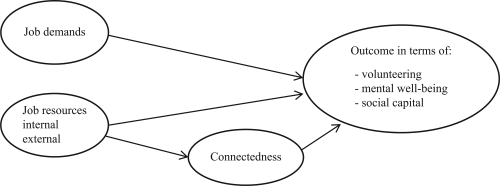
Summary of conceptual framework.
Aims of This Study and Research Question
To ensure high-quality circle provision and to develop supportive volunteer selection and training policies, CoSA providers need to be aware of the possible impact of CoSA work on their volunteers, as well as risk and protective factors. The existing volunteer policies regarding selection, training, and supervision are mainly practice based. Our objective is to support the development of evidence-based CoSA policies. This study advances the research regarding the effects of working as a CoSA volunteer by assessing the outcome for volunteers and exploring the relationships in our conceptual model in a cross-sectional study of Dutch CoSA volunteers. Our research questions are as follows:
Method
Design and Procedures
To explore positive and negative outcome for CoSA volunteers, and the associations between outcome, job demands, and job resources, as well as the mediating role of connectedness, a cross-sectional, quantitative research design was used. None of the authors were directly involved in any circles. All authors were part of the national CoSA research board. Permission for the study was granted by the national CoSA steering committee. Data were collected by the first author through a web-based questionnaire. Volunteers were informed about the study during the annual volunteer meeting, where the aims of the survey were explained by the first author. Email addresses of all active volunteers were collected by their local circle coordinators, and after gaining permission from the volunteers, were sent to the first author. All active CoSA volunteers were invited by email to fill out the web-based questionnaire and were provided with a personal link and password. The questionnaire title page contained information about the aims and scope of the questionnaire; guaranteed anonymity during data collection, analysis, and storage; and underscored the fact that participation was facultative, and nonparticipation had no negative consequences. Reading the information and then filling in the questionnaire was regarded as giving informed consent. In total, 118 volunteers were invited, of which 108 were correctly contacted. Three email addresses were invalid, and 7 volunteers were no longer active in their circle. After 3 weeks, a reminder was sent to all recipients. Finally, 40 active volunteers completed the questionnaire resulting in a response rate of 37%, which is close to average response rates in web-based surveys in organizational research (e.g., 38.9%; in Baruch & Holtom, 2008). This is, however, considerably larger than response rates of surveys in other studies of effects of working with sex offenders (e.g., 16.7% in a web-based survey among members of the Association for the Treatment of Sexual Abusers (ATSA) by Sheehy Carmel and Friedlander (2009), who applied a research protocol which is comparable to ours; 23% in a paper and pencil questionnaire among ATSA members, mailed through the post, by Way, van Deusen, Martin, Applegate, & Jandle, 2004). However, our small sample size reduced the possibilities for statistical testing of the JD-R model considerably.
Variables and Measurement
Sample characteristics
Background variables, such as gender, age, education level, and employment status, were assessed in single items. Trauma history was assessed in six questions (answer categories yes/no) tapping into possible traumatic experiences (sexual abuse of oneself, sexual abuse of someone in the family, sexual abuse in the extended family or circle of friends, suicide of a close family member, suicide in the extended family or circle of friends, and other life events).
Outcome in terms of volunteering
Two concepts were measured: volunteer satisfaction and determination to continue. Volunteer satisfaction was measured using the Volunteer Satisfaction Questionnaire (Metzer, 2009). This 7-point Likert-type scale contains six items tapping into reflections about the volunteer work (e.g., the experience of volunteering has been a worthwhile one). It has shown good internal reliability (Cronbach’s α = .89; Metzer, 2009; in our study, Cronbach’s α = .87). Determination to continue was assessed in a self-developed, two-item scale: planning to stop the volunteer work shortly, and having had thoughts about stopping in the past weeks. Both questions had scores from 1 (not at all) to 7 (very much/very often). Cronbach’s alpha was .81.
Outcome in terms of mental well-being
Four aspects of mental well-being, essentially exposure effects, were measured. The Professional Quality of Life Scale (ProQOL V; Stamm, 2010) was applied. The ProQOL V consists of 30 items which are rated on a 5-point scale. It contains three subscales: Compassion Satisfaction (CS; the pleasure one is deriving from work success), Secondary Traumatic Stress (STS; the impact of work-related exposure to extremely stressful events), and Burnout (B; feelings of hopelessness and difficulties in dealing with one’s work). Stamm (2010) reported Cronbach’s alphas of .88 (CS), .81 (STS), and .75 (B). In our study, Cronbach’s alphas were .84 (CS), .66 (STS), and .72 (B). Vicarious Posttraumatic Growth (VPG) was measured with an adaptation of the Posttraumatic Growth Inventory (PGI; Tedeschi & Calhoun, 1996), a 21-item, 6-point inventory with five factors that define the major dimensions of posttraumatic growth: a greater appreciation of life and changed sense of priorities; warmer relationships with others; a greater sense of personal strength; recognitions of new possibilities for one’s path in life; and spiritual development. The original questionnaire is designed for individuals who have experienced traumatic life events themselves. An adaption of this questionnaire, in which items were reworded to fit the situation of therapists or volunteers witnessing posttraumatic growth in their clients, has been used by Brockhouse, Msetfi, Cohen, and Joseph (2011). Internal reliability of the total adapted scale in our study was excellent (Cronbach’s α = .97) and comparable with Brockhouse et al. (2011; Cronbach’s α = .95).
Outcome in terms of social capital
Social awareness effects were measured with a 5-point Likert-type scale using 9 items of a 17-item questionnaire, which was developed by Olberding (2012) for a student sample. This scale tapped into effects on political and social awareness (e.g., awareness of problems and needs in society), responsibility (e.g., one’s responsibility to help others in need), and intentions (e.g., one’s intention to contribute to social justice). Items of the original scale, which reflected a college context and were not applicable, were skipped. Internal reliability of our scale was acceptable (Cronbach’s α = .76). Professional career effects were assessed with three single-item questions tapping into increased work experience, increased job opportunities, and career improvement since being a CoSA volunteer. Response options ranged from 1 (totally disagree) to 7 (totally agree). To measure the impact on intimate relationships, respondents were asked to rate the impact of their volunteer work on three items: relationship with their partner, perception of sexuality, and intimacy needs. Response options ranged from 1 (very negative effect) to 7 (very positive effect). Item scores are presented.
Job demands
The perceived difficulty of the core member was assessed in a self-developed questionnaire, containing 10 statements with response options ranging from 1 (strongly disagree) to 7 (strongly agree), which tapped into several aspects of difficulty. Statements were derived from the literature (Höing & Vogelvang, 2011; Snatersen, 2011). An exploratory factor analysis (with varimax rotation) revealed three dimensions: core member responsivity (four items; for example, “my core member is motivated to address his problems”; Cronbach’s α = .85), seriousness of the offense (two items, for example, “through the core member I am confronted with very serious offenses”; Cronbach’s α = .78), and seriousness of problems (two items, for example, “my core member has very serious problems”; Cronbach’s α = .59). Because of the low reliability of the latter, only the subscales Core Member Responsivity and Perceived Seriousness of Offense were used. The number of other social roles was counted as a sum score of indicated social roles with response options 0 (does not apply) and 1 (applies), such as being part of the workforce or being in college, doing other volunteer jobs, raising a child, being caretaker for family members, being caretaker for friends, and other unpaid social roles. The degree of being troubled by one’s own traumatic experiences was assessed in a single question following the questions about trauma history: “how often do you feel troubled by these experiences?” Response options included 1 (never), 2 (sometimes), 3 (regularly), 4 (often), and 5 (very often).
Internal job resources
Self-esteem was assessed with the Rosenberg Self-Esteem Scale (Rosenberg, 1965), which is a 4-point Likert-type scale with 10 items, widely used in social science research. A comparison of self-esteem levels in 52 nations showed a mean internal reliability of .81 (Schmitt & Allik, 2005). In our study, internal reliability was good (Cronbach’s α = .86). Self-efficacy was assessed in a self-developed scale with 2 items (“The work in the circle is easy for me” and “I feel competent to deal with the issues in the circle”), with response options ranging from 1 (totally disagree) to 7 (totally agree). Internal reliability was good (Cronbach’s α = .84). Emotional intelligence was assessed with the Trait Emotional Intelligence Questionnaire–Short form (TEIQue-SF; Petrides & Furnham, 2006). This 30-item questionnaire measures global trait emotional intelligence. Petrides and Furnham (2006) reported internal reliability for male (.84) and female (.89) participants. In our study, internal reliability was good (Cronbach’s α = .89). The type of motivation was assessed by a self-developed questionnaire with 4 items tapping into intrinsic motives (e.g., “I wanted to contribute to a safer community”) and 4 items tapping into instrumental motives (e.g., “I wanted to improve my job opportunities”). Items were drawn from the literature (Höing & Vogelvang, 2011; Snatersen, 2011). An exploratory factor analysis (with varimax rotation) revealed three dimensions which indicated three types of motivation: self-improvement (4 items, for example, “I wanted to improve my experience to improve job opportunities”; Cronbach’s α = .76), self-expression (2 items, for example, “I wanted to do something useful with my leisure time”; Cronbach’s α = .82), and community improvement (2 items: “I wanted to support the core member in finding his place in society” and “I wanted to contribute to a safer community and help prevent victimization”). The last dimension could not be scaled reliably as both items correlated negatively. They were reported separately as community improvement, victim related, and community improvement, core member related, as they represent different perceptions of community improvement.
External job resources
Job control was measured with two subscales of the Job Content Questionnaire (Karasek, 1985): Skill Discretion (six items, for example, “my work for CoSA demands a high level of skills”) and Decision Authority (three items, for example, “In my work for CoSA I can make decisions autonomously”). Cronbach’s alphas in our study were .73 for Skill Discretion and .71 for Decision Authority. They were comparable to earlier studies (e.g., Cheng, Luh, & Guo, 2003; Cronbach’s α = .71 and .69, respectively). Satisfaction with the CoSA specific training and coaching was measured with a self-developed, 7-point Likert-type scale with five items, for example, “the CoSA training is a sufficient preparation for work in the circle” (Cronbach’s α = .85), with items drawn from literature (Höing & Vogelvang, 2011; Snatersen, 2011). Organizational social support was measured with two other subscales of the job content questionnaire (Karasek, 1985): Supervisor Support (five items, reworded to fit circle coordinator support, for example, “my circle co-coordinator is paying attention to me”; Cronbach’s α = .89), and Co-Worker Support (six items, reworded to fit co-volunteer support, for example, “my co-volunteers are helping me”; Cronbach’s α = .83). Social support from friends and family was assessed in a 5-point Likert-type scale with five items (e.g., “people from my network are interested in my work for CoSA”; Cronbach’s α = .82).
Mediator
Volunteer connectedness was assessed with the Volunteer Connectedness Scale (Metzer, 2009), a 5-point Likert-type scale with six items, measuring feelings of connectedness to co-workers, to the volunteer organization, and to societal service users through volunteering (e.g., “the work I do is important for the community”). Internal reliability in this study was good (Cronbach’s α = .80) and higher than in the original study (Metzer, 2009; Cronbach’s α = .71).
Statistical Analysis
The data were analyzed with SPSS (version 21). First, univariate results were calculated on all variables. Next, correlations between independent variables and outcome variables were calculated. Because of the small sample size and the large number of variables, precautions to minimize Type I error were taken. We used the more conservative Kendall’s tau to measure rank correlations between continuous variables and the Kolmogorov-Smirnov Z Test to examine mean differences by categorical variables.
Based on our conceptual framework and the results of the explorative data analysis, promising predictors of outcome were tested using multiple regression analysis (stepwise). First, variables were assessed for normal distribution. Only variables which passed the Shapiro-Wilk test for normality were used in this analysis resulting in three outcome variables (burnout, compassion satisfaction, and volunteer satisfaction) and five independent variables (trait emotional intelligence, core member responsivity, skill discretion, decision authority, and support from own network). Three variables (self-efficacy, co-worker support, and connectedness) failed the Shapiro-Wilk test, but had acceptable scores for skewness and kurtosis (between −1.5 and 1.5), and were therefore included in the analysis on theoretical grounds. Independent variables were tested for multi-collinearity; all correlation coefficients were below .90.
Because probability levels need to be adjusted when calculating multiple regression models, only models for two outcome variables were analyzed separately (compassion satisfaction and burnout). Because of our small sample size (n = 40), we restricted the number of predictor variables. We applied the graphs of Miles and Shevlin (2001), who advised a minimum of 10 respondents per independent variable in a regression model to allow a minimum power of .80, to be able to detect a large effect (p > .05). Therefore, the maximum number of predictors to be entered into the equation in our sample was four. Also, not all promising predictors met the assumption of normality, and therefore, the choice of predictors to enter into the equation was limited. Based on the research by Huynh et al. (2012), we hypothesized that volunteer connectedness mediates the relationship between job resources (co-worker support) and mental well-being (compassion satisfaction). We analyzed this mediation effect with a four-step regression analysis procedure. We calculated unstandardized regression coefficients for the following: first, the relationship between co-worker support and compassion satisfaction; second, the relationship between co-worker support and connectedness; third, the relationship between connectedness and compassion satisfaction, controlling for co-worker support; and fourth, the indirect relation between co-worker support and compassion satisfaction via connectedness. We tested the significance of this indirect effect using a bootstrapping procedure (Preacher & Hayes, 2004). Bootstrapping procedures have the advantage of rendering enough statistical power to detect at least large effects in samples as small as ours (Fritz & MacKinnon, 2007). We used the PROCESS Macro developed by Hayes (2013) for the computation. We calculated a bias-corrected bootstrap confidence interval using 5,000 bootstrap samples. Unstandardized indirect effects were computed for each of 5,000 bootstrapped samples, and the 95% confidence interval was computed by determining the indirect effects at the 2.5th and 97.5th percentiles.
Results
Participants
Volunteers were 23 to 69 years old (M = 54.3, SD = 14.1); 51.3% male, 47.8% female. The majority (85%) had a higher educational level (at least postsecondary degree, bachelor, or masters), and 15% had a medium educational level (at least upper secondary education degree). One third of our sample (32.5%) was retired; 42.5% was still in the workforce, either employed or self-employed; and 32.5% was not working (disabled, unemployed, student, homemaker, etc.). A majority (61.5%) was living with a partner, 25.5% was single, 7.7% divorced, and 5.1% was widowed. The participants in this sample had been active in a circle for a medium of 11 months, ranging from 1 to 38 months. In our study, 15% of volunteers had experienced sexual abuse in the past (15% of male and 15.8% of female volunteers).
Univariate Results on Outcome, Job Demands, and Job Resources
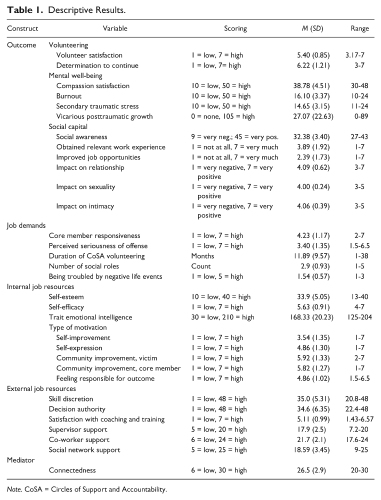
In answering our first research question, we assessed the outcome for CoSA volunteers in terms of volunteering, mental well-being, social capital, and levels of job demands and job resources. Results are presented in Table 1.
Descriptive Results.
Note. CoSA = Circles of Support and Accountability.
Outcome
Outcome scores indicated that CoSA volunteers were mainly positively affected by their work. Volunteer satisfaction and the determination to continue were high. In terms of mental well-being, results were mainly positive. Results on the ProQOL subscales indicated that volunteers experienced high levels of compassion satisfaction and low levels of burnout and secondary traumatic stress. There were indications of some VPG, but the amount of growth was low. Some social capital gains were reported. Volunteers experienced an increase in social awareness and gains in relevant work experience by their work in the circle, but there was no impact on job opportunities. Intimate relationships, as well as sexuality and intimacy needs, were not affected by the work in a circle.
Job demands
There was considerable variation in the perceived core member responsiveness and the perceived seriousness of the offense, but medium levels were close to the neutral midpoint. Almost two thirds (62.5%) of volunteers combined volunteering with other social roles (e.g., being a member of the workforce, helping a family member or friend in need, or being a parent).
Internal job resources
The levels of self-esteem and self-efficacy were in the higher end of the spectrum; no one felt unqualified for the job. The mean emotional intelligence score was high. The most dominant type of motivation was community improvement, by preventing sexual victimization as well as by helping core members to integrate. Our sample of CoSA volunteers felt moderately responsible for the outcome of their circle, reflecting a rather realistic outlook on their work.
External job resources
Scores on skills discretion and decision authority reflected the challenging and rather autonomous work within the circle. The satisfaction with specific CoSA coaching facilities was high, and scores on the support scales of the job content questionnaire (Supervisor Support and Co-Worker Support) were also high. Scores on social network support showed considerable variability.
Mediator
CoSA volunteers felt highly connected to their work and the organization. In our sample, scores ranged from 20 to 30 on a scale from 6 to 30.
Correlates of Outcome
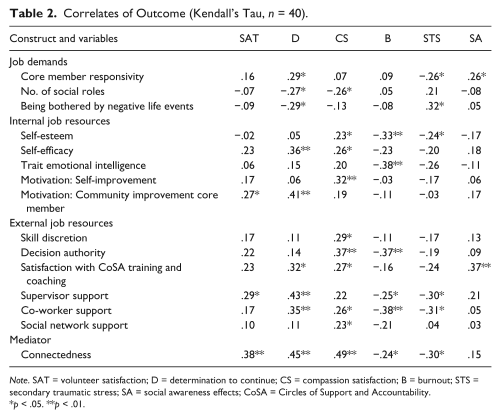
To answer our second research question, we explored the interrelatedness of outcome, job demands, and job resources. Levels of outcome were not associated with gender, education, or being a victim of sexual abuse. Volunteer age was associated with compassion satisfaction only (Kendall’s tau = −.24, p < .05), indicating that older volunteers experienced more compassion satisfaction. Bivariate correlations between outcome variables and independent variables (job demands and resources) are reported in Table 2. We reduced the number of variables included in the calculations to minimize the risk of Type I error. Effects on VPG, job opportunities, relationships, and intimacy were almost absent, and therefore, these variables were not further analyzed. From the four different types of motivation, we included only one type of extrinsic motivation (self-improvement) and one type of intrinsic motivation (core member–oriented community improvement).
Correlates of Outcome (Kendall’s Tau, n = 40).
Note. SAT = volunteer satisfaction; D = determination to continue; CS = compassion satisfaction; B = burnout; STS = secondary traumatic stress; SA = social awareness effects; CoSA = Circles of Support and Accountability.
p < .05. **p < .01.
In general, the outcome of CoSA volunteering was associated with some—but not all—job demands, and internal and external job resources. Volunteer satisfaction was associated with some job resources only (intrinsic motivation and supervisor support). The determination to continue was negatively associated with all job demands, and positively with some internal job resources (self-efficacy, intrinsic motivation) and some external job resources (training and coaching, co-worker support, and supervisor support). The different constructs measuring work-related mental well-being showed various correlations with job demands and job resources. Compassion satisfaction was positively correlated with almost all job resources, but negatively with numbers of social roles. Burnout symptoms correlated negatively with most job resources, but not with job demands or motivation. Levels of secondary traumatic stress were higher in volunteers with less responsive core members and in volunteers who were being bothered by their own traumatic life experiences. Secondary traumatic stress scores correlated negatively with most of the job resources. Improved social awareness was only associated with one job demand (higher levels of core member responsivity) and one job resource (higher satisfaction with coaching and training).
Scores on all outcome variables, except social awareness, were more positive for volunteers with levels of connectedness.
Predictors of Outcome
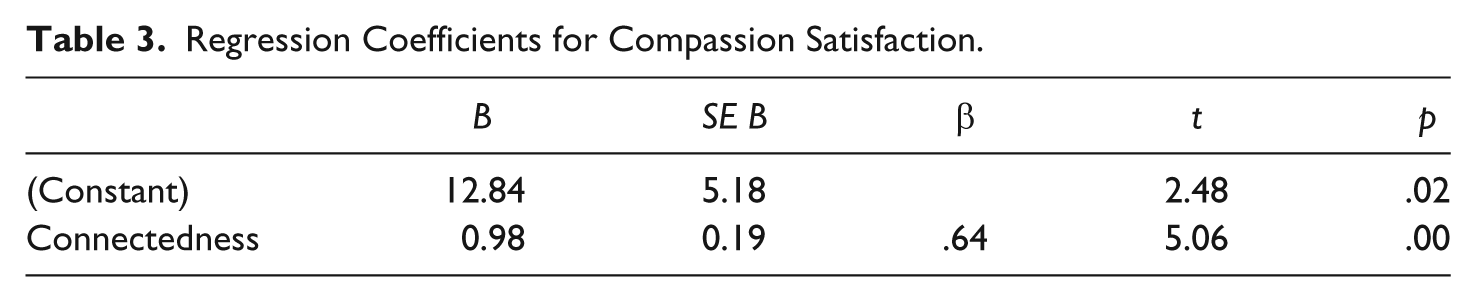
To answer our third research question, we assessed whether levels of outcome could be predicted by job demands and job resources. We calculated multiple regression coefficients separately for two of our outcome variables (compassion satisfaction and burnout). For compassion satisfaction (Table 3), the following predictors were entered: self-efficacy, connectedness, co-worker support, and social network support. A model with only one predictor (connectedness) was significant, adjusted R2 = .39, F(1, 37) = 25.64, p = .00.
Regression Coefficients for Compassion Satisfaction.
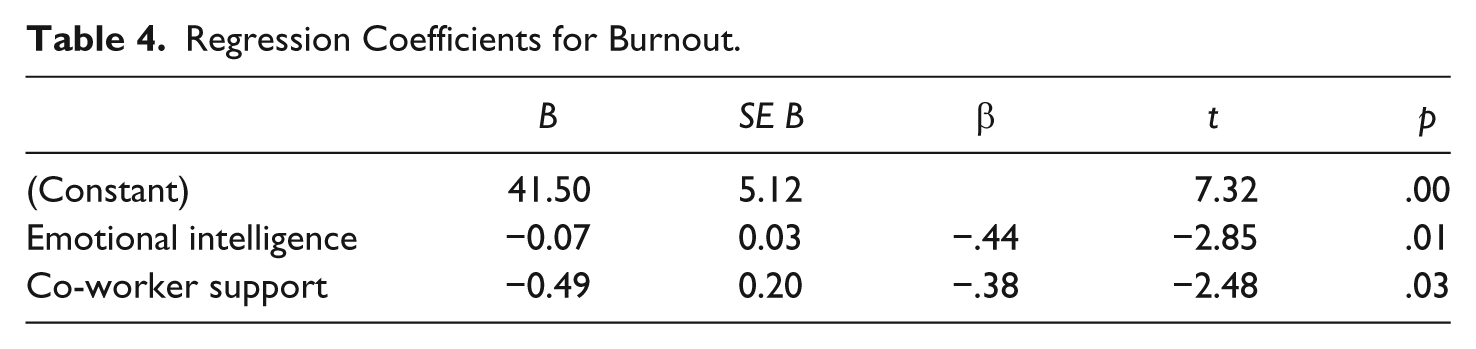
For burnout (Table 4), the following four predictor variables were entered: trait emotional intelligence, decision authority, connectedness, and co-worker support. A model with two predictor variables (emotional intelligence and co-worker support) was significant, adjusted R2 = .46, F(2, 27) = 13.36, p = .00.
Regression Coefficients for Burnout.
The Mediating Role of Connectedness
We sought to replicate some of the results of Huynh et al. (2012) regarding the mediating role of connectedness in the JD-R model for volunteers. We tested whether the relationship between co-worker support and compassion satisfaction is mediated by connectedness. As Figure 2 illustrates, the direct unstandardized regression coefficient between co-worker support and connectedness was significant (0.79), as was the direct unstandardized regression coefficient between connectedness and compassion satisfaction (1.25; controlling for co-worker support). Unstandardized, indirect effects were computed for each of 5,000 bootstrapped samples, and the 95% confidence interval was computed by determining the indirect effects at the 2.5th and 97.5th percentiles. The bootstrapped unstandardized indirect effect was .99; and the 95% confidence interval ranged from 0.59 to 1.57. Thus, the indirect effect was statistically significant. The total unstandardized direct regression coefficient between co-worker support and compassion satisfaction (.99) was significant, but when connectedness was controlled, the direct standardized regression coefficient was insignificant (−.38). We concluded that, in our sample, the effect of co-worker support on compassion satisfaction was fully mediated by volunteer connectedness, which supports some of the findings of Huynh et al. (2012).
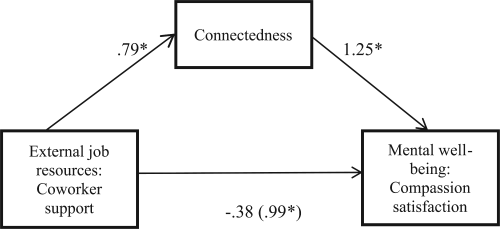
The mediating role of connectedness.
Discussion
In this study, we answered four research questions. We explored the impact of working in a CoSA on CoSA volunteers themselves; by assessing outcome (Research Question 1) and its correlates (Research Question 2), we identified some of the predictors of the impact (Research Question 3), and we replicated previous findings on the mediating role of connectedness (Research Question 4). Our research was based on the JD-R model (Nachreiner et al., 2001). We assessed outcome, job demands, and job resources, using a web-based questionnaire in a sample of 40 Dutch CoSA volunteers, representing 38% of then active CoSA volunteers.
Outcome
Research among volunteers has consistently shown that voluntarily devoting one’s time to a meaningful cause in the service of society has positive results not only for service users but also for the volunteers themselves (Casiday, Kinsman, Fisher, & Bambra, 2008; Wilson & Musick, 2003). This appears to be the case for CoSA volunteers as well.
Our results indicate high levels of volunteer satisfaction and a strong determination to continue the work. Scores on the ProQOL subscales (compassion satisfaction, burnout, secondary traumatic stress) indicated high levels of mental well-being. Secondary traumatic stress correlated positively with self-reported impact of traumatic life events, but not with perceived seriousness of the offense committed by the sex offender, and this may illustrate a theoretical flaw in the concept of secondary traumatic stress. Scores may be influenced mainly by previously existing trauma symptoms, as Elwood, Mott, Lohr, and Galovski (2011) suggested. The limited VPG as a result of working for CoSA is somewhat surprising, as earlier studies reported positive effects on some of the aspects measured in our adaptation of the PGI (Snatersen, 2011; Wilson et al., 2007a). However, these studies reported qualitative results. Increased social awareness and a high level of connectedness appear to be social capital effects which support the claim that the inclusive values behind CoSA serve not only the core member but all circle members (Höing et al., 2013; Wilson et al., 2007a).
Correlates of Outcome
These mainly positive results are associated predominantly with job resources, probably because unacceptable levels of job demands will cause volunteers to quit their job. Also, CoSA volunteers may represent a population with specific characteristics, that function as protective factors. The positive association between positive effects on mental well-being (in terms of compassion satisfaction) and older age add to the growing evidence of more positive effects of volunteering in older people (Höing et al., 2014). Also, the organizational context of CoSA projects is probably a protective factor, because most volunteers experienced high levels of external job resources, especially high levels of social support from co-workers and circle coordinators. Professionals often are concerned about victims of sexual abuse being active as a CoSA volunteer, yet we found no indices of more negative effects for these volunteers. This can probably be explained by the voluntary nature of the work, which allows volunteers who experience negative effects to quit more easily than from a paid job. Another explanation can be found in the selection process applied in Dutch CoSA projects, in which the circle coordinators routinely assess and discuss the volunteer’s experiences of sexual abuse and the possible vulnerability to sexual abuse triggers when dealing with the core member (Caspers, 2013).
The Importance of Connectedness
We also explored the role of connectedness, which is a concept closely related, but distinct from, a sense of belongingness (Huynh et al., 2012). Connectedness was associated with positive scores on almost all outcome measures. Together with co-worker support, connectedness was a strong predictor of a positive outcome for CoSA volunteers in terms of compassion satisfaction. Further exploration of the combined effect revealed a mediation effect, showing that the effect of co-workers’ support was fully mediated by connectedness, which is in line with previous research by Huynh et al. (2012). The positive effects of connectedness and sense of belonging on mental health and well-being have been documented before in reviews by Baumeister and Leary (1995), Wilson and Musick (2003), and Townsend and McWirther (2005). They can be explained through self-determination theory, which proposes that, to function on an optimal level, psychological needs of relatedness, autonomy, and competence must be supported (Deci & Ryan, 2012). In the work of a CoSA volunteer, these needs are probably supported through the nature of the work and the opportunities to develop competency, relationships with others, and to act autonomously within the circle.
Limitations
The results of our study should be seen as explorative. Due to the small sample size and the limited response rate (38%), the results may not reflect the experiences of the total CoSA volunteer population. The cross-sectional study design and the small sample size also limited the possibilities to explore and test theorized causal relations between job resources, job demands, and outcome. We tried to deal with this by using questionnaires and items which were worded in such a way that respondents could retrospectively indicate whether an effect had taken place (e.g., “I feel exhausted by my volunteer work”), and by using conservative methods of data analysis. Results may have also been biased by the fact that only active volunteers had been involved in the survey, and dropouts may present a subsample with more negative effects. Based on project registrations available to the authors, we estimate that the annual dropout of volunteers is somewhere between 7% and 14%, and therefore, selection bias would only be of minor influence. The consistency of the results, which were pointing almost without exception into the direction of positive results and to the important role of social support on the job, indicate that the risk of invalid conclusions is limited. However, our results need to be confirmed by research into effects of CoSA volunteering with larger samples and a prospective design.
Conclusion
Our results indicate that volunteers can be safely involved in working with sex offenders in CoSA projects, and they can even benefit from this work themselves. This positive outcome for volunteers has not been a message in volunteer recruitment materials up to now. Usually, these materials mainly emphasize the impact that circles can have on the core member and on public safety. CoSA projects sometimes have difficulty with volunteer recruitment; therefore, the positive experiences of volunteers should be put forward in recruitment messages as well to improve recruitment strategies.
The predominantly positive effects of working for CoSA result mainly from a healthy sense of self-worth and emotional intelligence, and from opportunities for social support by co-volunteers and circle coordinators, which help increase feelings of connectedness. This means that the positive outcome of this work for volunteers depends largely on manageable conditions. Volunteer organizations such as CoSA can assess volunteer’s emotional characteristics in their selection and training activities and, if necessary, can provide individual coaching. These organizations can develop activities and policies to improve feelings of connectedness, by organizing volunteer support groups and social events. Providing and stimulating social support—both by supervisors and by co-workers—is an effective way to increase connectedness, and, by doing so, improve volunteer retention and prevent negative mental health effects.
The important role of connectedness can also be further discussed from a neurobiological perspective (Pavlovich & Krahnke, 2012). Altruism and empathy, as expressed through volunteering, are expressions of the human capacity to virtually feel what others feel, through brain systems of mirror-neurons that make us feel bad when we see how others suffer, and make us feel good when we see how our actions make others feel good. In this process, connectedness is not only a result but also a cause: Our empathic reactions are stronger when we feel connected to others, and we need very few social cues to feel socially connected to others (Cwir, Carr, Walton, & Spencer, 2011). As Pavlovich and Krahnke (2012) argued, our neurological hardware is geared to blur the barriers between self and others in a very material way. When translated back into the context of CoSA, this social interdependence may not only be an advantage but also a risk. Without external and expert supervision, this innate tendency to react empathically can blur boundaries between core members and volunteers, and observations of risk and needs can become biased toward core member needs, threatening the fragile balance of serving the needs of a core member, of victims, and of society. In CoSA projects, the supervision of circles by an experienced circle coordinator and an outer circle of professionals is essential in minimizing this risk. Also, inviting community and victim representatives in steering committees which are supervising CoSA projects is a way to prevent circles from becoming biased toward core member needs. How to maintain connectedness and vigilance at the same time is a complex issue, not only for CoSA providers, and one that deserves further research.
Footnotes
Declaration of Conflicting Interests
The author(s) declared no potential conflicts of interest with respect to the research, authorship, and/or publication of this article.
Funding
The author(s) received no financial support for the research, authorship, and/or publication of this article.