



Abstract
Background
Event perception provides a promising, novel approach for investigating underlying cognitive mechanisms of the social impairment associated with symptoms of ADHD.
Aims
The goal of this study was to establish the relationship among event perception, symptoms of ADHD, and social skills.
Methodology
Eighty-three undergraduates were recruited from the University of Ottawa first year psychology courses (38 with ADHD, 45 without ADHD). They performed an event perception task and completed self-report questionnaires assessing social functioning and symptoms of ADHD (The Social Skills-Improvement System and the Conner’s CBRS-SR).
Results
Bootstrapping mediation analyses revealed that symptoms of inattention and hyperactivity mediated the relationship between event perception and social skills. A model with predictor and mediator reversed was also tested, and was not significant, providing strength to the directionality of the relationships. Results highlight the applicability of event perception to understanding the association between social impairment and symptoms of ADHD.
ADHD is a neurodevelopmental disorder characterized by chronic, developmentally inappropriate, and impairing levels of inattention and/or hyperactivity-impulsivity (American Psychiatric Association [APA], 2013). ADHD emerges in childhood, with an approximate prevalence rate of 5% in children (APA, 2013; Faraone et al., 2003), and can continue into adulthood for up to two thirds of those who receive a childhood diagnosis (Barkley, 2006; Wender et al., 2006). In addition to the main symptoms of inattention and hyperactivity/impulsivity, ADHD is associated with a number of functional impairments, including in the social domain (APA, 2013; DuPaul & Stoner, 2014; Hoza et al., 2005; McConaughy et al., 2011). Studies demonstrate that difficulties with social competence, having fewer friends, and experiencing high levels of peer rejection at school tend to co-occur with ADHD diagnoses in adolescents, similar to what is observed in childhood ADHD (Bagwell et al., 2001; Barkley et al., 1990). Similarly, research has found that older adolescents with ADHD, such as undergraduates, continue to experience social skill deficits, and difficulties with social adjustment at school (Shaw-Zirt et al., 2005; Weyandt et al., 2013). Given the developmental continuity of social difficulties for those with ADHD, identifying potential underlying mechanisms involved in social problems in those adolescents with ADHD is critical.
The underlying causes of social impairment among those with ADHD remain unclear. While one commonly cited perspective is that the core symptoms of ADHD themselves are to blame (Andrade et al., 2009; Cunningham & Siegel, 1987; Cunningham et al., 1985; Humphrey et al., 2007; Landau & Moore, 1991; Maedgen & Carlson, 2000; Whalen & Henker, 1992; Wheeler & Carlson, 1994), other researchers have suggested that the social impairment among individuals with ADHD arise due to impaired social skills, a belief that led to a focus on social skills training as a core component of intervention efforts (Mrug et al., 2001; Nixon, 2001). Unfortunately, although social skills training has been effective for improving the social functioning of aggressive and antisocial children (Webster-Stratton et al., 2001), the results have been mixed for children with ADHD (de Boo & Prins, 2007; Forness & Kavale, 1996). It has been suggested that children with ADHD fail to apply their knowledge during real life social interactions due to a performance deficit, rather than a fundamental lack of social knowledge or skills (de Boo & Prins, 2007; Huang-Pollock et al., 2009; Wheeler & Carlson, 1994).
Researchers have begun to explore the possibility that this inability to apply social knowledge may be due to deficits in cognitive functioning. One study found that children with ADHD encoded fewer social cues than their peers without ADHD (Matthys et al., 1999); several other studies have reported significant associations between parent and teacher ratings of social problems and executive functioning tasks, such as measuring, planning, strategy generation, and organization (Clark et al., 2002) and effortful control (Dennis et al., 2007). However, contrary to these significant findings, some researchers have also found that cognitive functioning is not significantly related to social impairments in children with ADHD. For instance, findings have indicated that executive functioning is unrelated to peer nominated social status (Diamantopoulou et al., 2007) and is not a significant mediator of ADHD symptoms and parent/teacher ratings of social problems (Huang-Pollock et al., 2009). Similarly, Biederman et al. (2004) found that children with ADHD both with and without executive functioning deficits did not differ significantly in ratings of social impairment. Recently, Bunford et al. (2015) attempted to clarify the relationships among variables by comparing potential theoretical pathways through which executive functioning deficits, ADHD symptoms, and social impairment operate. Their results supported a theoretical model in which symptoms of ADHD mediated the relationship between working executive functioning and social impairment. To date, however, little research has examined how social behavior among those with ADHD may be related to social cognitive processes.
Event Perception
We propose turning to event perception to further investigate the underlying cognitive nature of social dysfunction in ADHD. Event perception, also commonly referred to as event segmentation, is the perceptual grouping of ongoing information into meaningful chunks (Zacks & Sargent, 2010). Event Segmentation Theory (EST) describes this grouping process (Zacks & Sargent, 2010). According to EST, grouping ongoing information into discrete units this way is a normal, automatic part of perceptual processing that is central to cognitive control, working memory updating, and storage and retrieval from episodic memory. At the core of event segmentation theory is the proposition that perception of everyday events is guided by event models held in working memory (Grafman, 1995; Schwartz et al., 1995; Wood & Grafman, 2003; Zacks & Sergant, 2010). According to Zacks and Sergant (2010), event models may be thought of as representations of what is happening in the moment, that then aid the formation of predictions about what will happen next. As such, event models are informed by current ongoing perceptual processing, while also guiding how subsequent information is processed. Event models are maintained and protected from small changes in incoming information, but are eventually updated when there are discrepancies between event models and incoming information. This change from one event model to the next is what results in the distinct, discrete events that are produced during the segmentation process. Similarly, event segmentation theory also proposes an underlying hierarchical structure to event perception, such that “smaller” event models arise from lower level aspects of an event representation that occur over shorter time scales.
Methodologically, measuring event perception involves utilizing an event segmentation task, also known as a unit marking procedure, which was first developed by Newtson and Engquist (1976). In such a task, participants are presented with a movie clip and asked to press a button when “one meaningful event ends and another begins.” What results are a series of timestamped event boundaries that reflect a participant’s perception of events. The processing that occurs at event boundaries is linked to attention, through the input of new information, and memory, through the updating of the event models stored in working memory (Zacks & Sargent, 2010). As such, attention and memory mechanisms go hand in hand with changes in event models.
Event perception has several advantages as a method for studying cognitive underpinnings of social difficulties in ADHD. By presenting movie clips, event perception tasks allows for the real-time assessment of cognitive as suggested by Castro (2004), as well as providing a means for increased ecological validity through the presentation of movie stimuli that more closely replicate real-life social interactions. Boggia and Ristic (2015) were first to apply event perception in the context of social cognition. Participants were asked to segment social and nonsocial events of a movie while their eye gaze was being tracked. Results demonstrated that participants segmented social events and nonsocial events differentially, and that this process was associated with visual attention to faces and eyes. This study was the first to demonstrate that event perception is not just a cognitive ability but also a social cognitive ability guided by attention to social stimuli. This methodology also provides an advantage over other social cognitive tasks: the theory is directly applicable to social events without special alteration of the task; simply presenting social content taps into event perception in the same way as presenting nonsocial content (Boggia & Ristic, 2015). While studies have not yet shown explicit links between event perception and social behavior, one can imagine how the way in which individuals perceive the events occurring around them may impact how they respond, as per commonly accepted theories in psychology. For instance, an individual who perceives a conversation to be compromised of more events than someone else, may intrude during parts of the conversation in response to perceiving that portion of the conversation as meaningful, or as a result of perceiving a boundary as an entry point to the conversation.
Recently, event perception differences have been documented amongst a sample of undergraduate students with ADHD (Ryan & Rogers, 2021), provides further evidence that this may be an important part of social functioning difficulties in this clinical population. In this study, students with a previous ADHD diagnosis identified more events than students without a previous ADHD diagnosis, linking event perception to problematic symptomatology. As such, it may be apt to consider these as event perception deficits that contribute to difficulties with attention and hyperactivity, and that may also contribute to social impairment among those with ADHD. Investigating event perception as an underlying cause of social impairment among those with ADHD is a promising and novel approach that is the focus of this paper.
Current Study
The goal of the current study is to establish whether event perception as a social cognitive process is related to symptoms of ADHD and social impairment in undergraduates. Importantly, this improves on past research in this domain by utilizing a task that extends our theoretical understanding of social difficulties among those with ADHD using a social cognitive framework that assesses social information processing in real-time and with increased ecological validity. Demonstrating the relationship between event perception, symptoms of ADHD, and social impairment is a necessary first step toward establishing this line of research.
Based on the findings of Bunford et al. (2015), it is expected in our study that event perception abilities will be related to social functioning via mediation by symptoms of ADHD. In a recent study by Ryan and Rogers (2021), individuals with ADHD perceived more events than those without ADHD. Based on these findings, it is further hypothesized that more frequent demarcation of meaningful events when presented with a socially relevant movie stimuli will be related to increased symptoms of ADHD, which in turn will be related to decreased social functioning.
Participants
Eighty-three undergraduates were recruited from the University of Ottawa using the Integrated System of Participation in Research. This system provides students in first year psychology classes with the opportunity to participate in lab or internet-based research in exchange for course credit. Of the 83 participants, 38 reported a previous diagnosis of ADHD, while 45 reported no previous diagnosis of ADHD. There were 15 males and 68 females. In terms of first language, 76.6% reported English, 9.1% reported French, 3.9% Chinese, 7.8% Arabic, and 2.6% other.
The University of Ottawa Board of Ethics approved this research, and all participants gave their signed, informed consent to participate. Undergraduate students were chosen as the demographic for this study to maintain consistency with Ryan and Rogers (2021) investigations of the event segmentation deficits in undergraduate students with ADHD.
Materials
Event segmentation task
Consistent with previous research (Boggia & Ristic, 2012; Hasson et al., 2004; Ryan & Rogers, 2021), participants performed an event segmentation task with a 1-minute clip from the movie The Good, the Bad, the Ugly. This movie clip was chosen to remain consistent with past research. The clip involved a scene where the main character turns against his partner after working together to earn a bounty, and then abandons him in the desert. The participants were asked to watch the same short clip three times, with different instructions for each viewing. In the first viewing, instructions stated to press the spacebar when “one meaningful event ends and a new one begins,” a typical measure of event segmentation. The second and third viewings stated to press the spacebar when “one small meaningful event ends. . .” and when “one large meaningful event ends. . .,” reflecting fine and coarse-grain event models (as per Boggia & Ristic, 2015; Newtson & Engquist, 1976). Specifically, the instructions for the first viewing were: “You will watch a movie clip. Please watch carefully and press the spacebar when one meaningful event ends and a new one begins.” The second and third viewing had identical instructions except for the addition of the word “small” and “large.” These conditions were counterbalanced. The definition of “meaningful” was not explicitly given, even when asked by participants, as the objective of the instructions is to elicit spontaneous event segmentation behavior. Previous findings support that this wording is sufficient for that purpose (Boggia & Ristic, 2015; Newtson & Engquist, 1976; Zacks, Braver, et al., 2001).
The data that obtained from the event segmentation task was represented in several different ways. The total number of button presses is a variable that indicates both the size of a participant’s event models and the number of times an event model is updated. Thus, this variable reflects the number of different event models a participant forms, representing a generalized overview of a participant’s event segmentation behavior, without sensitivity to event location or content. This represents a general aspect of event segmentation behavior and can be examined for small or large events, or no particular event size orientation.
Another variable examined was the number of prototypical events selected. Previous research has found that observers tend to have high levels of agreement on where they place event boundaries (Boggia & Ristic, 2015; Zacks et al., 2006). Thus, prototypical events represent the typical or normative events identified in a control group, and the number of prototypical events represents the number of those agreed upon events that were identified by any single participant. Prototypical events were determined using the results of a control group of undergraduates without ADHD (n = 31). The clip was broken down into 1-second intervals, and the participants’ button presses were coded into these intervals. The average number of button presses per 1-second interval was determined, and prototypical events were identified by those 1-second intervals with the highest number of button presses (+2 standard deviations above the mean number of button presses per unit of time (as per Boggia & Ristic, 2015; Newtson & Engquist, 1976; Zacks et al., 2006). In the experimental groups, the number of correct prototypical events was established by calculating the number of prototypical events that each participant identified. This procedure was repeated for each condition (regular, small, and large).
Symptoms of ADHD: The Conner’s behavioral rating scale—self report
The Conner’s Behavioral Rating Scale-SR (CBRS-SR; Conners et al., 1997) was used to assess the current level of ADHD symptoms. This scale is a prominent measure of ADHD and has been used to establish convergent validity for other measures of ADHD. Furthermore, they have been used in diverse clinical and research applications (Collett et al., 2003). While some participants were older than 18, many were also 17 or 18, thus the measure was used for all participants to maintain consistency. Because some participants in the study were not of an age included in the validation of this measure, potential interpretation difficulties were avoided by using a symptom total raw score rather than a T-score. Use of a raw score was further deemed to be appropriate for the research question, since symptoms of ADHD would be examined continuously as a mediator and not used in a clinical context.
Social functioning: Social skills
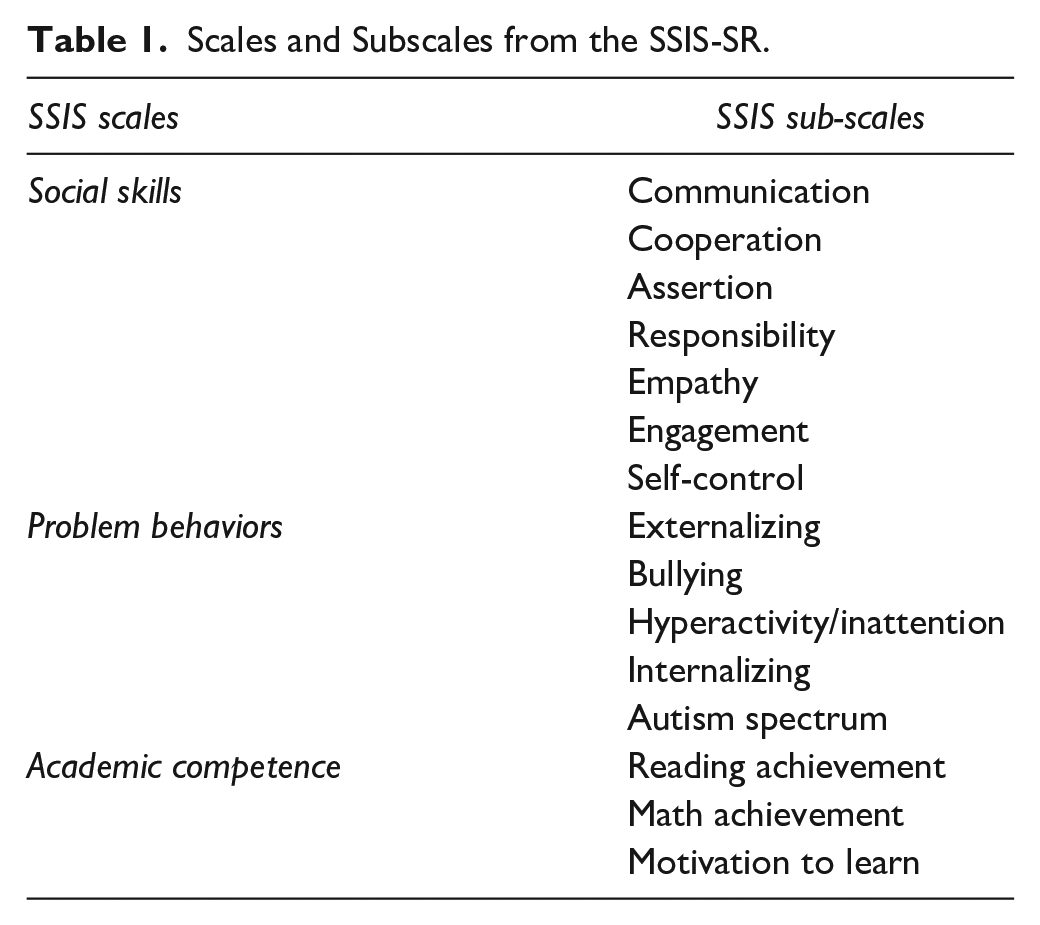
Social skills were assessed using the Social Skills Improvement System—Self-Report (SSIS-SR). The items of this measure result in a social skills total score (herein referred to as Social Skills), made up of a variety of subscales that assess prosocial behaviors (communication, cooperation, assertion, responsibility, empathy, engagement, and self-control), as well as a problem behavior score that assesses negative social behaviors (herein referred to as Problem Behaviors; Gresham et al., 2011). The SSIS-SR is validated for use with participants aged 3 to 19. While some participants were older than 19, many were also between 17 and 19, thus like for the Conner’s CBRS, the measure was used for all participants to maintain consistency. Table 1 provides an overview of the SSIS-SR scales and subscales for social skills, problem behavior, and academic competence.
Scales and Subscales from the SSIS-SR.
Procedure
Participants were welcomed to the lab and asked to sign a consent form. From there, participants were seated at a computer and given instructions for the event segmentation task. Up to four participants at a time could complete the experiment simultaneously in the same room, separated by wall dividers. Afterwards, participants filled out the Conner’s CBRS and the SSIS-SR. Finally, participants were fully debriefed upon completion of the data collection. Each experimental session lasted approximately an hour.
Results
Participants
The participants ranged in age from 17 to 25, with a mean age of 18.95 years (
Data Preparation: Main Study Variables
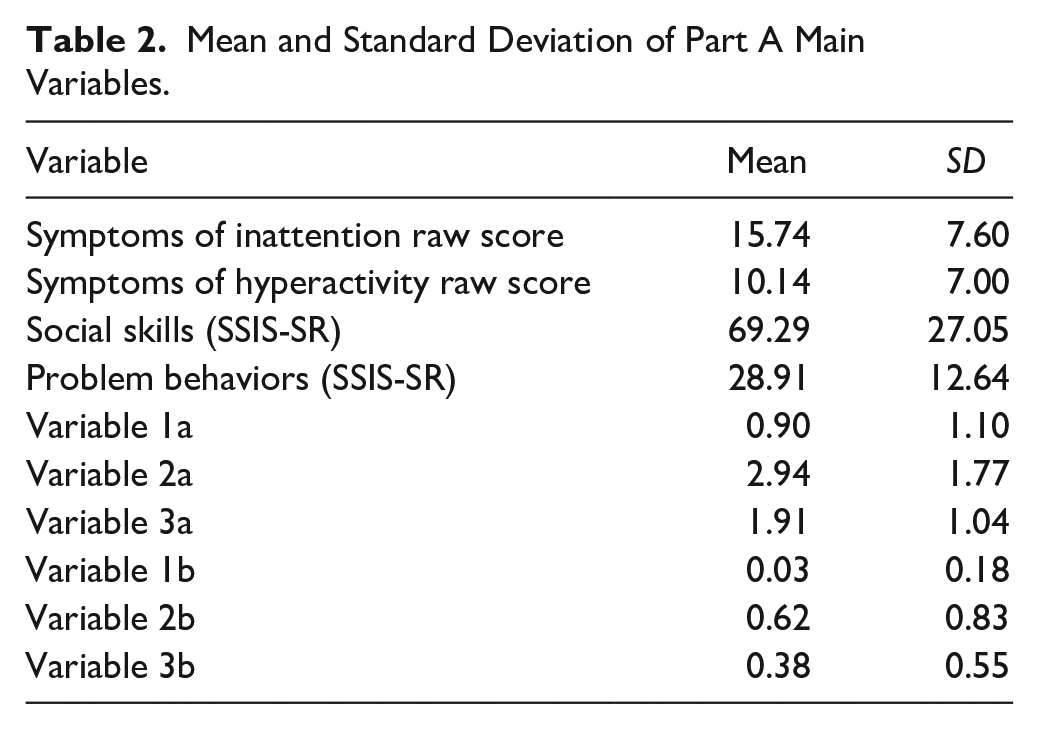
The main study variables were symptoms of inattention and hyperactivity measured via raw scores of the inattention and hyperactivity/impulsivity subscales from the Conner’s-CBRS, Social Skill and Problem Behaviors from the SSIS-SR, and six event segmentation variables from the event segmentation task: total number of button presses in the regular (variable 1a), small (variable 2a), and large conditions (variable 3a), and the number of prototypical events in the regular (variable 1b), small (variable 2b), and large conditions (variable 3b). A Shapiro-Wilks test determined that all six of these event segmentation variables were non-normally distributed (p < .01), determined to be due to outliers. To address this, a winsorization procedure was used to normalize the data. Mean and standard deviations of main study variables after this procedure are presented in Table 2.
Mean and Standard Deviation of Part A Main Variables.
Simple Correlations
To determine which event segmentation variables were related to both the outcome variable and the mediator variable, simple correlations were compared among all variables of interest (Table 3). Correlations indicated that only the number of button presses in the regular condition (variable 1a) was both related to symptoms of inattention and hyperactivity as well as social skills total. Thus, these variables were used in the mediation analyses.
Bivariate Correlations among Main Study Variables.
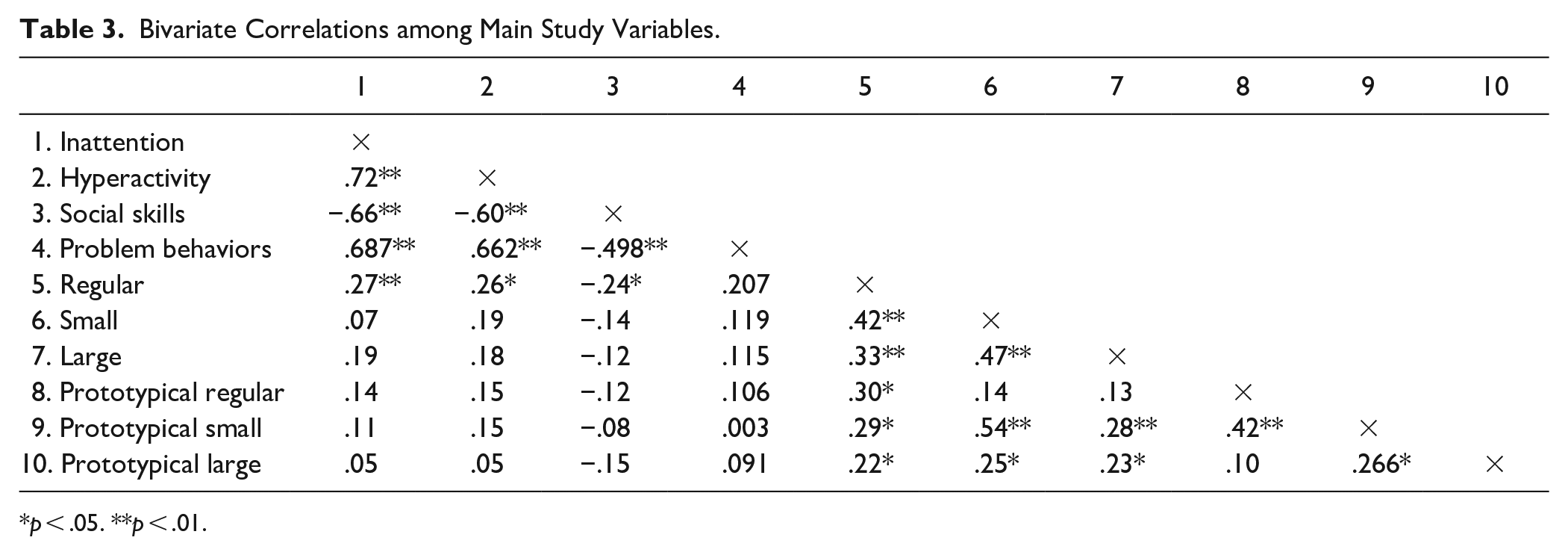
p < .05. **p < .01.
Mediation Analyses
To test weather event segmentation differences on variable 1a were associated with social skills through ADHD symptoms, a series of simple mediation analyses were conducted. A bootstrapping, bias corrected, 10,000 sample method was used (Hayes, 2009). The first model we tested was with variable 1a as the predictor, inattention as the mediator, and social skills total as the outcome. We also tested the model with the other symptom (hyperactivity) as a covariate, and the reverse model, where the mediator and predictor variable were reversed. The reversed model was included in order to directly test the directionality of the hypothesized relations among variables. Next, we tested the second model with variable 1a as the predictor, hyperactivity as the mediator, and social skills total as the outcome. Again, we also tested the model with the other symptom (inattention) as a covariate, and a third model with the mediator and predictor variable reversed. In all models, we controlled for age and gender. The results of all of these analyses are presented in Table 4.
Bootstrapping Statistics for the Mediation Models with Inattention and Hyperactivity as Mediators between Event Segmentation and Social Skills.
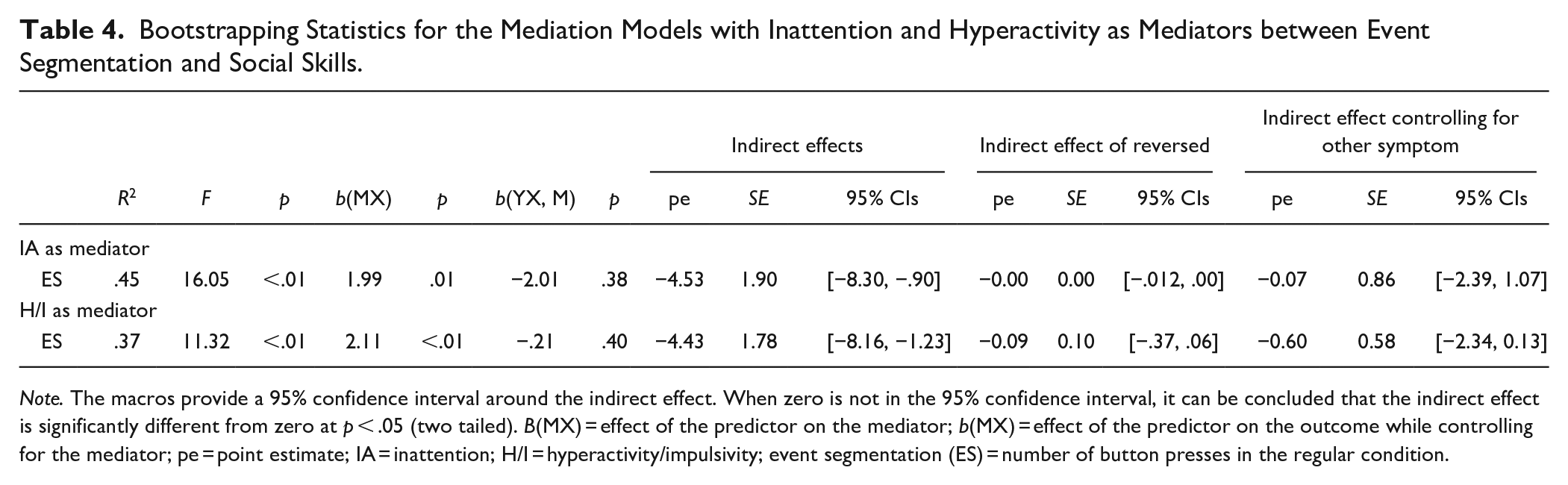
Note. The macros provide a 95% confidence interval around the indirect effect. When zero is not in the 95% confidence interval, it can be concluded that the indirect effect is significantly different from zero at p < .05 (two tailed). B(MX) = effect of the predictor on the mediator; b(MX) = effect of the predictor on the outcome while controlling for the mediator; pe = point estimate; IA = inattention; H/I = hyperactivity/impulsivity; event segmentation (ES) = number of button presses in the regular condition.
Mediation analyses revealed that symptoms of inattention and hyperactivity both independently acted as mediators in the relationship between event segmentation and social skills. Specifically, increased number of presses in the regular event segmentation condition predicted higher levels of both symptoms of inattention and hyperactivity, which each in turn predicted a lower social skill score. In the models where the other symptom was controlled for, these mediations became non-significant. When the mediator and the predictor were reversed, again the mediations become non-significant.
Discussion
The results of the mediation analyses with undergraduates revealed that increased inattention and hyperactivity mediated the relationship between event segmentation and self-reported social skills. Specifically, as the number of events perceived in the regular condition increased (represented by the number of button presses in that condition), symptoms of inattention and hyperactivity also significantly increased, which was then significantly associated with decreased social skills. What does this result signify? More frequent pressing in the event segmentation task is indicative of perception of an increased number of events. Additionally, in comparison to individuals who press the button less frequently, those who press the button more frequently perceive smaller events, over shorter timescales, which therefore contain less information. In our undergraduate sample, this was related to symptoms of inattention and hyperactivity. When considering the cognitive deficits of those with ADHD, several possible explanations for this emerge. Event perception deficits such as these may emerge due to faulty online-monitoring of incoming information and deficient working memory updating that affects the event perception system. It is also possible that individuals with ADHD experience these event segmentation deficits due to deficiencies in the sense of time, a notion that has been suggested by some researchers (Barkley et al., 1997), which in turn could affect their perception of events across time.
Our findings support the notion that event perception performance is related to symptoms of ADHD, but also clarify that it may be more apt to consider that these event perception disturbances predict symptoms of inattention and hyperactivity rather than vice versa, as evidenced by the non-significant finding when the role of the mediator and predictor were reversed, which is consistent with findings from Bunford et al. (2015). Although a longitudinal design would be necessary to confirm this interpretation, Event Segmentation Theory helps to explain why increased perception of smaller events over shorter timescales may result in increased inattention and hyperactivity. According to EST, when incoming information is consistent with the event models held in working memory, there is no new event perceived. As such, the time between event boundaries provides an opportunity for the down regulation and conservation of cognitive resources, including attention. When incoming information is no longer consistent with the information contained in the event model, prediction errors increase, which is experienced by the individual as the perception of a new event. At these event boundaries, attention and other cognitive resources are up regulated once again in order to facilitate processing of incoming information. This phenomenon has been supported by fMRI research that has demonstrated increased changes in neural activity at event boundaries in brain regions associated with processing human motion and action (Zacks, Tversky, et al., 2001). In the case of individuals who perceive more events, their cognitive resources, including attention and behavior regulation, are likely to be redirected more frequently to events that contain less information. Thus, the event perception system is directly related to the regulation of attention and action control, which provides a possible explanation for the relationship between event perception and symptoms of ADHD in our results.
Furthermore, our results also indicate that the subsequent increases in inattention and hyperactivity are then associated with decreased social skills. In previous research, the notion that social difficulties amongst those with ADHD are directly related to the symptoms of ADHD has been somewhat in competition with the notion that these social difficulties may be related to cognitive processing. These results add to the emerging literature, such as the study by Bunford et al. (2015), that suggests that it is not either or, but rather a combination of both cognitive deficits and symptoms of ADHD, that are related and act together to influence social functioning. In this study and in that of Bunford et al. (2015), results suggest a distinct direction of the relationship between these variables such that cognitive processing predicts symptoms of ADHD, which then go on to affect various aspects of social functioning.
Interestingly, when the other symptom was used as a covariate to control for its effects, the mediation models became non-significant, a finding that also replicates those of Bunford et al. (2015). One reason for this may be that the models became non-significant due to the high correlation (e.g., collinearity) between symptoms of inattention and hyperactivity. Another interpretation may be that event perception deficits do not have unique effects on symptoms of inattention and hyperactivity, but rather that there is a collective effect on both symptoms. This interpretation is consistent with the notion that the symptoms themselves are related, and with event segmentation theory itself, which demonstrates how attention and inhibition/behavior regulation (via action-control) may be related and affected simultaneously.
In many ways, our results replicate and support the findings of Bunford et al. (2015) insofar as our models similarly suggest that symptoms of inattention and hyperactivity mediate the relationship between cognitive functions and social impairment, as well as the reverse models and the models including the other symptom as a covariate being non-significant. However, our methodology did differ in a very meaningful way. In comparison to their measures of working memory and inhibition, our cognitive task of event segmentation captured event perception, which is a integrated measure that includes working memory and inhibition (via action-control), as well as other cognitive processes, in the context of social stimuli. In addition, our task allowed for increased ecological validity through the use of ongoing stimuli (e.g., movie clip) and the measurement of real-time processing. In addition to these methodological advantages, we were able to capture identical effects for both symptom types. This is beneficial because it provides a potential avenue for intervention that does not require separate strategies for each symptom type, but could rather be utilized for all individuals with ADHD regardless of their symptom profile. This is particularly appealing because of the diversity of symptom presentation among those with ADHD (APA, 2013). The nature of the event segmentation task itself makes it a promising avenue for intervention, as movie stimuli can be selected to be socially relevant and close to real-life interactions, while also providing a possible avenue for computer-based instruction and practice.
Limitations and Future Research
The current study demonstrates for the first time the relationship between event perception, symptoms of ADHD, and social impairment. It departs from previous literature on social impairments among those with ADHD by utilizing novel methodology, using a social cognitive approach that assesses real-time processing and has increased ecological validity. The potential for this task to be used for intervention must be further explored, such as by studies that investigate whether event perception can be instructed, and whether such instruction leads to stable improvements over time that are related to changes in symptoms of ADHD and social impairment. In addition, it would be strongly recommended to consider replicating these findings using a greater number of movie stimuli with a variety of social content, as well as to extend the findings to aspects of memory and comprehension, which have well established connections to event perception. These areas for future research would strengthen this line of inquiry and the applications of event perception in ADHD populations.
The current study consisted of a very restrictive sample of those with ADHD symptoms. First, the sample consisted of undergraduate students, which may be considered a higher functioning and older subset of the entire population of those diagnosed with ADHD. Second, the sample was biased toward females, potentially due to the recruitment strategy focusing on first year psychology courses. Second, the adolescent sample was very small. While it is important to acknowledge the shortcomings of the samples used that may affect generalizability, it is also significant to note that the findings remained significant when controlling for age and gender, and that in spite of these sample biases, we were able to replicate the overarching findings of Bunford et al. (2015). The similarities in the findings between this study and that of Bunford et al. (2015) suggest both that the current study is likely to be valid in spite of the limitations, and that the mediating effect of the symptoms of ADHD in the relationship between cognitive functioning and social impairment is replicable and robust across ages and sample types. Nonetheless, the results from this particular study would be strengthened from future research investigating the relationships among event segmentation, symptoms of ADHD and social impairment in a wider sample of those with ADHD, including undergraduate students in different courses, samples recruited from clinics and the community, and a younger age group.
Footnotes
Declaration of Conflicting Interests
The author(s) declared no potential conflicts of interest with respect to the research, authorship, and/or publication of this article.
Funding
The author(s) disclosed receipt of the following financial support for the research, authorship, and/or publication of this article: This study was funded by the Social Sciences and Humanities Research Council, Award Number 767-2015-1497.
Ethical Approval
All procedures performed in studies involving human participants were in accordance with the ethical standards of the institutional and/or national research committee and with the 1964 Helsinki Declaration and its later amendments or comparable ethical standards.
Informed Consent
Informed consent was obtained from all individual participants included in the study.
