



Abstract
Para-ethnography involves collaboration with organization members who are themselves producers of cultural analysis rather than sources of raw data. It begins from the premise that contemporary workplaces involve internal theorizing that, although distinct from academic theorizing, can inform and ground organizational theory. Modern organizations, as highly professionalized, and based on conceptual design and legitimation, are a natural match for para-ethnographic methods, which have nevertheless been absent from organizational scholarship. As part of a general revisionist program in ethnographic theory, para-ethnography offers a way of reconceptualizing the role of the researcher, the nature of cultural knowledge, and the spatial boundaries of culture. After describing the similarities and differences between revisionist ethnographic approaches, I outline how para-ethnography differs from other forms of ethnography in practice. Finally, I discuss the challenges and opportunities of para-ethnography, suggesting that this methodological development may form part of a larger reconceptualization of the relation between theory and practice, and offering practical mechanics to ground such a reconceptualization.
Keywords
With the rise of the knowledge economy, and increasing ethnographic interest in scientific, creative, and other knowledge-based sectors (cf. Mills & Ratcliffe, 2012), organizational ethnographers are increasingly entering sites where their informants are themselves analysts and theorists of culture (Rabinow, Marcus, Faubion, & Rees, 2008). Professional managers, technicians, and other analytical workers are taking on roles in which organizational theory and research methods are required (Marcus, 2007), while blue-collar, temporary, and part-time workers often navigate complex and multiple organizational systems, increasingly in cultures foreign to their own (Kalleberg, 2009). At the same time, organizational ethnographers have become increasingly self-conscious of their own status as professional workers (Learmonth & Humphreys, 2011), organizational insiders (Brannick & Coghlan, 2007), or field researchers linked to specific organizational action contexts (cf. Yanow, 2012), rather than as detached and autonomous observers, and analyze their own methodological practices as forms of cultural practice (e.g., Gephart, 2006). As a result of these dual processes, organizational ethnographers may be increasingly indistinguishable from those they study.
Fieldwork contexts are increasingly theory-driven, constructed through the efforts of consultants, managerial textbooks, and academically trained policy makers (referred to by Rabinow et al., 2008, p. 92, as professional “truth claimers”). Although formal conceptual frameworks do not establish theoretical reflexivity per se, they may provide a basis for questioning, updating, or otherwise building on received frameworks, in ways that resemble theorizing. How does ethnographic inquiry change when local actors are reconceived as theorists of a kind, shaping fluid organizational realities according to idealized representations of professional communities?
In the wake of recent debates around the roles and methods of ethnography (cf. Clifford & Marcus, 1986; Goodall, 2010; Vaughan, 2007), as well as the shift in the underlying cultural conditions against which ethnography takes place (e.g., Holmes & Marcus, 2006), alternative forms of ethnography (here labeled “revisionist” perspectives) have emerged in parallel, bringing distinct but related theoretical points to the table. Autoethnography (e.g., Karra & Phillips, 2008), for example, has combed the experiences of the researcher herself as a source for insight, illuminating subjective aspects of researcher sense making that could otherwise be thought of as extraneous or unwanted bias (cf. Zickar & Carter, 2010). Multisited ethnography (Marcus, 1995), in a separate development, has acknowledged the dissolution of local, contained spaces, and follows the circulation of cultural objects. A third development involves situations in which expert knowledge is both deployed and contested from within cultural sites by informants themselves, where professionals use forms of ethnography to augment, hone, or critique systematized expert knowledge. Termed “para-ethnography” by Holmes and Marcus (2005a, 2005b, 2006), this line of thought explores what it means for ethnographers to loosen their hold on ethnographic authority, and take seriously the efforts of their informants in producing academically relevant knowledge.
Para-ethnography starts from the premise that organizational actors can often represent their own cultures to outsiders in ways that are self-conscious, analytical, and strategic (Holmes & Marcus, 2006). Members are not ethnographers per se, and as many have argued, their forms of reflexivity may be distinct from those of researchers (cf. Beech, MacIntosh, & MacLean, 2010), hence the term “para” ethnography. The “para” element makes itself felt in the multiple ways in which organizational knowledge is produced in a “side-by-side” way. These may include the joint theoretical production across professional domains, the conflicting logics or discursive struggles occurring across organizational members, and the quasi-peer relationship between organizational scholars and internal analysts, for example. Such aspects provide a diversity of possibilities around the forms of dialogue between practitioners and academics (Beech et al., 2010). The internal analyses and diagnoses made by members involve mixtures of formalized knowledge and creative adaptation and discovery. Such analyses have ethnography-like qualities, and pose opportunities and challenges to formal, academic ethnography, regarding how and by whom ethnography is carried out.
Here, I develop a para-ethnographic perspective within the context of “revisionist” ethnographies more generally. First, briefly describing the context giving rise to para-ethnography, I introduce a conceptual framework by which three emerging streams (autoethnography, multisited ethnography, and para-ethnography) are read as parallel developments with similar, yet unique, concerns. I argue that each stream highlights particular theoretical features that have become progressively articulated in the ethnographic literature. Second, I apply the “para-ethnography” concept to organizational settings, arguing that its focus on symbolic and knowledge workers (Holmes & Marcus, 2006) is highly relevant to organizations. Offering practical illustrations of para-ethnographic methods in the context of organizational research, I discuss the implications of para-ethnography for organizational scholarship, both in terms of the epistemological stakes of adopting a para-ethnographic perspective and in terms of how we imagine our own identities as researchers.
I start with the problem of dealing methodologically with the idea that informants are both steeped in formalized professional and technical principles, and can revise, contest, or build on such knowledge in ways that approach theorizing. Not assuming that such conditions are exclusive to “knowledge economies,” nor that changes in the world automatically imply revisiting research methods, the close link between ethnographers and organizational informants means that changes in organizations often lead to soul searching by ethnographers, leading to revisionist programs. I elaborate the idea of para-ethnography as such a revisionist program, overviewing how it connects to similar ethnographic projects and outlining the challenges and limitations posed by this perspective.
As I elaborate below, para-ethnography posits a dual development, cultural and methodological, where organizational members become adept users of social scientific forms of reflexivity, just as organizational scholars attempt to link theory with actionable, practical knowledge. Para-ethnography uses this rapprochement to promote forms of researcher–informer collaboration to promote reflexivity among both parties, by treating informants as both partners and observers in theory building.
Expert Cultures and the Decentering of Ethnography
As an introductory example, I was recently engaged in an ethnographic project following the planning and conception of a multidisciplinary career counseling center in an international business school. The members of the project team had completed graduate-level degrees in business, education, and psychology, from different countries and in different languages. The team drew ideas for the center from business press publications, as well as “airport” business guides. From these guides, the members had learned of the importance of shared team culture, and of the challenges they confront in creating such a culture in a multicultural, multilingual environment. The new center navigated between “logics” of education, therapy, and human resources, leading to ideological debates and the search for shared values among team members. Data for the project involved debates about the appropriateness of qualitative versus quantitative methodologies. As the author/ethnographer, I was simultaneously studying the team itself, and contributing to its discussions, leading to conversations about the relative roles of “theory” versus “practice.” Questions of who was studying whom, and for what end, both engaged and frustrated team members, who were concerned about “getting something done” while realizing that their goal and interests were being defined in situ, and were subject to change at each meeting.
Such a situation, not uncommon in organizational research, demonstrates several disconnects from conventional images of the ethnographic situation (Falzon, 2005; Salzman, 1986). For instance, while traditional ethnographic methods assume that what is interesting about social systems lies in the taken-for-granted assumptions and practices of cultural actors (e.g., Huen, 2009), in the previously mentioned case, the actors exhibit several features that create the possibility for a “critical distance” from their organizational roles. First, they are dispersed across disciplinary spaces such that they cannot assume shared basic beliefs about how to work or communicate together. The members had taken courses in social scientific and even ethnographic methods, enabling them to deal with complexities while encouraging them to take an “outsider” view of their social system. While not professional academics or ethnographers, their knowledge and practice was laden with “para-ethnographic” elements (Holmes & Marcus, 2006), that is, semidetached reflection regarding the cultures in which they participate. The business school ethnographer, linked to and funded by private organizations (e.g., Perkmann & Walsh, 2009), and embedded in semiacademic analyses also aimed at practice, may appear increasingly like a para-ethnographer, leading to a blurring of differences between researcher and organization member that carries implications for knowledge production.
Exploring these implications means examining the researcher–informant relationships that form the basis for ethnographic authority. While acknowledging that reflexivity and interactivity were always ethnographic values (cf. Cunliffe, 2010; Marcus, 1995), several scholars have noted that ethnographic authority has been eroded by a mixture of theoretical critiques from within the ethnographic community (e.g., Clifford & Marcus, 1986) and changes in the structure of societies studied by ethnographers due to integration within global marketplaces (e.g., Appadurai, 1990; Marcus, 1995). Both of these sources of transformation have involved increased difficulty in separating “traditional” from “modern” cultures (Appadurai, 1990) and have paralleled developments in the ethnography of contemporary globalized “post-communities” (Ortner, 1997), organizations (e.g., Cunliffe, 2010) and technical and scientific milieus (e.g., Rabinow, 1996). These developments have stimulated theorizing about the bases of ethnography, leading to concepts such as autoethnography (Ellis & Bochner, 2000; Karra & Phillips, 2008) and multisited ethnography (Marcus, 1995). Para-ethnography is largely a continuation and elaboration of similar concerns.
The notion of para-ethnography, introduced by Holmes and Marcus (2006), developed from the observation that within complex organization, actors often alternate between highly formalized analyses and “anecdotal” evidence, drawn from social networks and meant to supplement, bypass, or critique formal systems. Such knowledge is called “para-ethnographic” because it shares the ethnographer’s concern with lived realities, informal perceptions, and interactive discovery. The use of para-ethnographic analysis allows organizational actors to align their analyses with practice by avoiding the inevitable breaches and lags between formal systems and lived realities. Actors alternate between different forms of symbolic analysis in an attempt to get a better idea of a rapidly changing social reality. Doing this requires not only deploying formalized knowledge, but recognizing the limits of such knowledge and knowing when to change the analytic register to more intuitive, more impressionistic, and less formalized analyses.
While para-ethnography was established in an organizational setting (Holmes & Marcus, 2006), it has remained absent from the organizational literature, with the exception of a short mention in passing (Islam, 2013). The concept draws together populations such as “symbolic analysts” (Reich, 1992), the “professional managerial class” (Ehrenreich & Ehrenreich, 1979), “creative workers” (Christopherson, 2008), and other similar categories, where systematized knowledge interacts with everyday work situations. Furthermore, organizational ethnographies born on the workshop floor, exploring industrial labor processes (cf. Zickar & Carter, 2010), have diversified into studies of knowledge workers and other “symbolic” professionals (cf. Holmes & Marcus, 2006; Mills & Ratcliffe, 2012). While para-ethnographic insights can come from all organizational levels and types of work, because these involve the engagement of members with bodies of formalized expert knowledges, para-ethnographies can take various forms depending on where they originate.
Para-ethnography provides an interesting avenue in organizational studies for several reasons, discussed at greater length below. First, para-ethnography emphasizes informant struggles with the limits of expert knowledge, adding to methodological discussions of reflexivity within organizations (e.g., Alvesson, Hardy, & Harley, 2008; Czarniawska, 2012) Second, para-ethnography informs practice-based and action approaches in organizational science (e.g., Coghlan, 2011; Feldman & Orlikowski, 2011), adding a methodological element to emerging practice paradigms and promoting rapprochement with practice while retaining the critical possibilities of academic research. Third, para-ethnographic approaches provide tools for critical scholars to think about difficult questions regarding the relationship between external critique, emanating from scholars, versus internal critique, as articulated by organizational members themselves.
Although new directions in theorizing are thus promoted, the themes set out so far in this section also reflect age-old preoccupations among ethnographers. Para-ethnography, as with other rethinking of ethnographic methods, relates to and builds on evolving discussions of ethnography that go back to its roots in anthropology (i.e., the distinction between contemporary and older, “Malinowskian” ethnography; Geertz, 1973; Pels, 2008; Rabinow et al., 2008). Questions of subjectivity versus objectivity and researcher–informer relations are at the heart of ethnographic debates; these discussions have opened paths into several parallel ways of conceptualizing ethnography. The section below places para-ethnography within a series of contemporary revisionist movements, each of which focuses on certain elements of these disciplinary discussions.
Faces of Revisionist Ethnography: Autoethnography, Multisited Ethnography, and Para-ethnography
What I have been calling “revisionist” approaches to ethnography in fact reflect a rootedness within and ongoing dialogue with the ethnographic literature (Vaughan, 2007). Central themes in this dialogue involve the objectivity of observations, the stability and taken-for-grantedness of the culture under study, and the “reversibility” of the ethnographic gaze.
Explorations of alternative ways of conceptualizing ethnography stem from two interrelated sources (cf. Clifford & Marcus, 1986). The first, methodologically, involves the progressive focus within ethnography toward approaches that decenter researchers from a privileged position regarding populations under study and emphasize interchange and reflexivity. The second involves shifting the subjects, objects, and sites of cultural studies, such that an “ethnography of the contemporary” (Rabinow et al., 2008) emphasizes how members (and the academics studying them) move along a continuum of reflexivity in their practice that can blur distinctions between academics and practitioners (cf. Brannick & Coghlan, 2007).
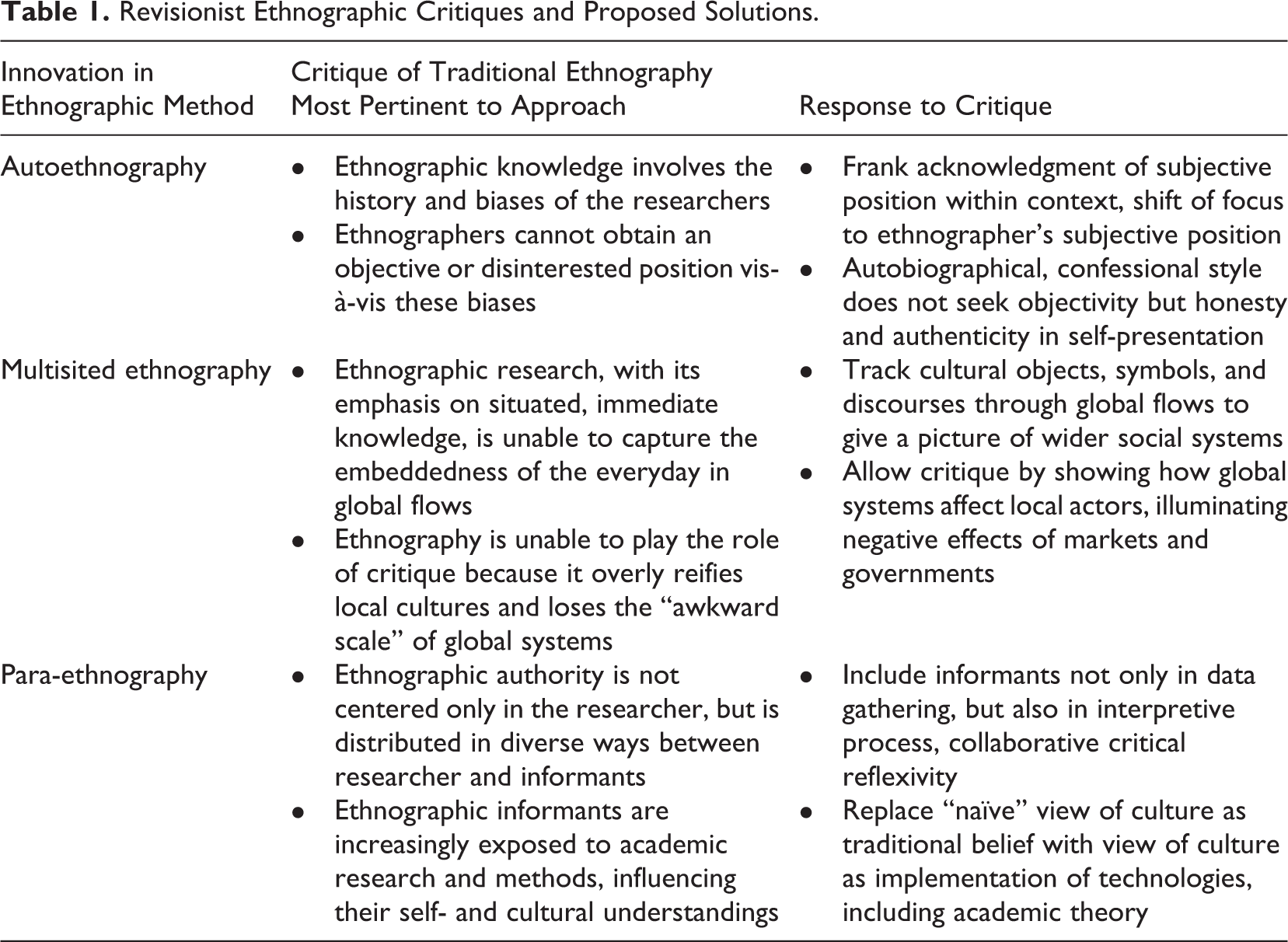
In large part, emergent approaches to ethnography in the 1980s (cf. Clifford & Marcus, 1986) reflect the culmination of older debates around transforming ethnography. The earlier thought of Geertz (1973) is key here because of its recasting of culture in linguistic terms, as stories and webs of meaning (cf. Rabinow et al., 2008), and thus the ethnographic enterprise as one of storytelling, translation, and interpretation. The casting of both native and ethnographer as storytellers allowed experimentation in different forms of ethnographic “tales,” be they realist, confessional, or impressionistic (Van Maanen, 2011), and thus experiments in switching points of view, themes of study, and narrative voices. Para-ethnography is one, but not the only, emergent perspective that resulted from these developments, and may be considered a kind of participatory “storytelling.” Autoethnography (Karra & Phillips, 2008; Reed-Danahay, 1997) and multisited ethnography (Marcus, 1995) are other alternative perspectives, while para-ethnography, although not yet present in the organizational literature, is particularly suited for contemporary organizations (Holmes & Marcus, 2006). As outlined below, each perspective responds to a particular recurrent concern among ethnographers, such that their methodological contributions are distinct yet interconnected. Table 1 summarizes the forms of ethnography and the methodological concerns to which they respond.
Revisionist Ethnographic Critiques and Proposed Solutions.
Autoethnography—Narrating the Narrator
Autoethnography (Karra & Phillips, 2008; Reed-Danahay, 1997) refers to ethnography in which the researcher’s own culture becomes the object of research. Autoethnography, as the structured study of one’s own group, tends to be heavily autobiographical (e.g., Learmonth & Humphreys, 2011; Van Maanen, 1995), using the researcher’s own experiences to provide insights into organizational members’ attitudes, values, and behavior.
Increasing emphasis on acknowledging one’s own background and historical situation as a researcher (Vaughan, 2007) has led researchers to openly acknowledge and explore their own particularistic perspectives (Ellis, 2005). Autoethnography claims academic legitimacy not through the erasure of the self in conducting objective research, but in the self-examination of the researcher as a source of insight and information. Thus, autoethnography turns the ethnographic gaze inward, a gesture with both epistemological and political implications (Karra & Phillips, 2008), touching on questions of objectivity, power, and authority. The emergence of autoethnography, particularly when carried out by local or marginalized groups, is in this sense tied to issues of autonomy and self-mastery, as organizational members take up positions to theorize the social bases of their own practices.
Highlighting the embeddedness of researchers in complex relationships with their informants, self-knowledge, and reflexivity, contemporary ethnography looks increasingly autoethnographic (Karra & Phillips, 2008). Para-ethnography shares with autoethnography the problematization of traditional self-other relations in ethnographic writing, as well as the application of the ethnographic gaze onto researchers themselves. These shared aspects involve reframing subjectivity and situatedness from biases into resources for ethnographic understanding by making them objects of study.
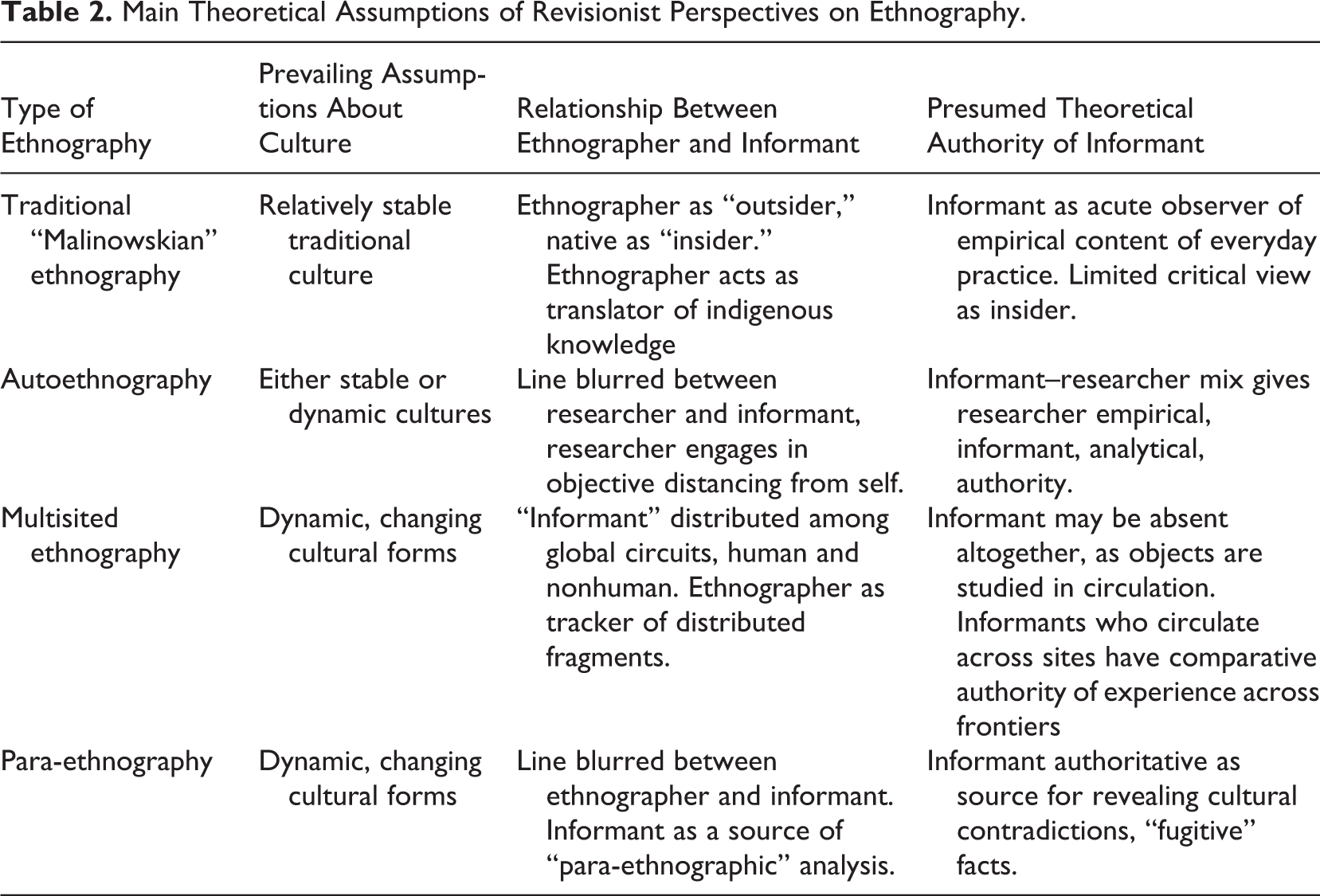
Distinctly, however, para-ethnography does not simply invert the insider–outsider relationship, but acknowledges varying positions with regards to participants’ “native” or “researcher” status, problematizing the researcher–researched relationship without necessarily inverting this relationship. If conventional ethnography involves translating “others” into terms comprehensible to one’s own community, and autoethnography involves translating the self into another’s terms (Reed-Danahay, 1997), then para-ethnography emphasizes the acts of translations inherent within terminological systems, meaning that we are all to some extent both researchers and actors of our own cultures.
Multisited Ethnography—Following Traces of a Diffuse System
Multisited ethnography (Marcus, 1995) moves from studying situated, local cultures to studying how cultural knowledge, products, and populations move across boundaries. It arises from the recognition that the local, isolated, and clearly bounded culture, although always a less-than-perfect idealization (cf. Falzon, 2005), is today a rarity and an anachronism, and the most interesting cultural spaces are precisely those that cut across borders and represent the global flows of people and goods that sustain contemporary life. Van Maanen (2010, p. 255), for instance, describes a shift in views of culture toward the “distributed and deterritorialized.” As Davis, Morrill, and Soule (2008, p. 393) note, contemporary organizations involve a “constant organizing and reorganizing of information and people across time and space,” making it necessary to adapt our methods to match such organizational agility. Examples of this kind of study can be seen in the study of diversity practices across industries, consultancies, and training settings (Prasad, Prasad, & Mir, 2011), the tracking of differences across organizational and domestic settings (Nippert-Eng, 1995), and the study of fashion trends across borders (Miller & Woodward, 2007). In each of these examples, we are led to understand cultural objects and actors by their transitions though different localities.
Under conditions of competing logics and discourses without recourse to a unified culture, meanings are constituted in the processes of mediation between different actors who have stakes in promoting certain stories over others. Multisited ethnography captures this multilevel aspect of organizations by exploring how meanings emerge through multiple translations within and between organizations. Although still nascent in the organizational literature, multisited ethnography has been recognized as an important innovation in organizational research methodology (Van Maanen, 2010).
Multisited ethnography, originally envisioned as a way of ethnographically studying the global capitalist world system (Marcus, 1995), becomes more generally a method for studying cultural work across boundaries. As Comaroff and Comaroff (1992) claim, the embedding of local cultures in global commodity chains and other world system features produce culture at an “awkward scale,” abstracting the driving features of cultures from the immediate material conditions of the inhabitants of the culture. Such systems are difficult to pick up from simply living on the ground, but require reinterpretation in the light of knowledge of how immediate experience relates to these global systems. Thus, much of previous ethnography as the immediate lived experience of culture must be reworked to position it against its macro structure (cf. Burawoy, 2000; Comaroff & Comaroff, 1992).
Para-ethnography builds on the cross-frontier aspect of multisited ethnography as informants, in their experience across sites (e.g., expatriates, migrant workers), critically assess and compare practices across frontiers. Para-ethnography relies on the ability of internal actors to position themselves as theorists of their own cultures, noting that this ability derives from the frequent transitions of actors across fragmented systems and cultural boundaries. Thus, the multisitedness of fields is complementary to para-ethnography. However, while multisited ethnography focuses on the macro forces affecting such circulations, para-ethnography focuses on the reflexive spaces for cultural analysis used by informants themselves. In fact, multisited ethnography, in highlighting the circulation of objects (cf. Marcus, 1995), may thereby foreclose on the critical potentials of participants themselves. The reflexive capacities of informants, alternatively, takes center stage in para-ethnography.
Para-ethnography—Locating Reflexivity From Within Organizations
Like multisited ethnography, para-ethnography emerged as part of a self-conscious rethinking of ethnographic methods in light of emerging practical and epistemological questions. These involved the relations between researchers and participants, from early thinkers such as Geertz (1973) and culminating in the radical questioning of ethnographic conventions (Clifford & Marcus, 1986). Para-ethnography joins auto- and multisited ethnography in proposing an “ethnography of the contemporary” (Rabinow et al., 2008), where temporal, spatial, and researcher/participant boundaries are more fluid. At its base, para-ethnography rests on the idea that ethnographic subjects in contemporary settings have been deeply exposed to depictions of cultures, including their own, and are often in a position to play the role of culture analysts themselves (cf. Mills & Ratcliffe, 2012). While social changes do not dictate methodological approaches, the latter arise from interactions between researchers and their informants, and thus methods cannot remain aloof from transformations among organization members and their shifting practices (Mills & Ratcliffe, 2012). Thus, while autoethnography shifts the object of study from the other to the self, and multisited ethnography shifts the spatial imagination of culture from local settings to cross-spatial flows of goods and people, para-ethnography decenters the ethnographic authority from researcher to the interface of researchers and informants.
Making such a shift wagers that reflexivity is not only produced from academic distance, but also from embedded subjects’ shifting social contexts, such that “spontaneously generated para-ethnographies are built into the structure of the contemporary” (Marcus, 2005, p. 27). In this way, organizational spaces contain pockets of reflexivity deriving from the attempt to make sense of everyday reality in ways sometimes similar to theorists, but sometimes distinct (e.g., Beech et al., 2010). The world described here, marked by fluidity and rapid reconfiguration of social codes, leads cultural actors (including academics) to improvise with new meanings as their assumptions come to be seen as unreliable. In such a world, “there is very little one can think or imagine in the confines of academic study that is not already thought in some version, expression, or venue in sites and scenes of fieldwork” (Rabinow et al., 2008, p. 112).
In this context, para-ethnography is both an attempt to revalue ethnographic informants as collaborators, but also to reimagine itself within contemporary, globalized terrains where cultural meanings are not bound to place, passed along by tradition, and taken for granted by new generations. Of importance, then, the para-ethnographic is not limited to “knowledge workers” but arises to the extent that actors must revise taken-for-granted assumptions, whether academic or not, and the researchers recognize in these revisions the same seriousness and angst (Van Maanen, 2011) that they themselves struggle with to do justice to their site of study. As informants engage in “future-oriented cognitive practices that can generate novel configurations of meaning and action” (Marcus, 2005, p. 27), researchers note their occasional insightful leaps of imagination, but also their self-serving biases and their moments of ingenuousness and learn about their own project in the process. Thus, para-ethnography involves a mirroring of ethnographer and informant roles, as these roles interpenetrate each other.
While local actors have always been able to critically reflect on their own social practices, the relative presumed stability of practices enabled the establishment of a “native’s point of view” (Geertz, 1983), that could then constitute an object of study. When these forms of life, however, became increasingly heterogeneous, fluid, and contested, actors may themselves have been forced into “outsider” positions, having to critically reflect on the alternative social realities to which they could align themselves. In this way, the “epistemological angst” associated with adopting the native’s point of view (Van Maanen, 2011, p. 177) is not only a researcher’s angst, but also that of the native. The perpetually unfinished and transitory aspects of contemporary social life (Shotter, 2008) require rethinking how questioning and reflection themselves become socially distributed. Calling into question the distinction between academic insiders and practical outsiders follows, as being practical becomes less a question of inhabiting preestablished social roles than of adapting to changing organizational configurations requiring both formalized knowledge and reflexive adaptability.
As such, para-ethnographers do not claim either that earlier ethnographers were wrong in their methods or that earlier studied individuals were unconscious of their cultures, but that the forms of consciousness required of contemporary cultural actors are different than those required in more stable cultural situations. Para-ethnography, then, is a “project in which we are systematically reimagining the norms and design of ethnography…under the changed contemporary circumstances in which it is practiced” (Holmes & Marcus, 2005a, p. 246). Ethnography in contemporary societies is, in effect, studying a distinct form of relation between cultural reflexivity and practice, and must therefore adapt its approach to this new form of relation. Otherwise, critical reflexivity from within societies may be overlooked by treating culture as based on “taken-for-granted assumptions” (Fine & Shulman, 2009).
We thus can summarize the para-ethnographic reformulation in schematic form: Overly stable views of culture deprive informants of the critical distance needed to reflect on the underlying bases of culture, with the ethnographer’s outsider position allowing such a critical distance. However, in a globalized world of shifting boundaries and border crossings, it is likely that members of social groups will themselves have experienced distancing from stable cultural structures, and thus will be positioned so as to critically view their cultures and provide alternative visions. This new role of workers exemplifies a change in the ethnographic situation in several ways.
First, the nature of ethnographic data is more conceptually self-conscious, with organizational artifacts, biographies, and narratives taking specific roles within the organizational culture. Such roles can include both system justification and contestation or resistance. However, para-ethnographic data, whether they come from employees, consultants, or academic researchers, are created by actors who understand the practical agendas of knowledge production, and therefore form part of the practice of organizational members. Para-ethnography would depart from ethnographer-driven approaches whereby the researcher constructs data sets from self-generated sets of theoretical priorities, but also refrain from using “official” texts, discourses, and archives as taken-for-granted snapshots of organizational reality. A parallel can be drawn with historical ethnographic approaches (e.g., Vaughan, 2004) that treat organizational archives as official assemblages marking actors’ ongoing sense-making attempts. In short, para-ethnography stresses turning toward actor-produced perspectives, while treating these are pseudo-theories in the process of construction. That is, such theories are epistemic fragments, and are components of discourses from which eventual answers can be constructed.
Second, the role of participants in analysis changes from that of traditional ethnography. To the extent that members are less than completely embedded in a given system (a likely outcome of the rapidly changing and hybrid systems of contemporary organizations), members are able to step outside of their own practices, allowing pseudo-theories to be produced in the many spaces left by shifting organizational structures. These partial visions are expressed organizationally in alternative narratives, multivocality, weapons of the weak, jokes, rumors, and other marginal discourses, as well as in more formalized attempts to deliberately affect culture through planned ceremony, ritual, and formal discourse. Para-ethnography depends on the researcher’s ability to take advantages of these partial visions to map how they are translated across levels of the organization, just as multisited ethnography attempts to do with cultural artifacts.
Third, as a corollary to the previous point, if organizational members are able to produce their own theories about organizational culture, then they should be able to collaborate in the analysis of their own organizational systems with the ethnographic researcher. Although organizational researchers acknowledge competing discourses within organizations (e.g., Phillips, Lawrence, & Hardy, 2004), these discourses rarely are seen as constitutive of the researcher’s own theoretical findings. Para-ethnography positions theoretical analysis as itself a strategic move in the struggle between discourses, albeit as a kind of meta-strategy that claims outsider or objective status. Para-ethnography, then, is a way to extend the logic of multivocality, distance, and the “outsideness” of members into the theoretical edifice itself.
To summarize, para-ethnography is appropriate where informants achieve reflective distance, taking advantage of internal spaces of criticism. The possibility of distance permits analysis within the insider role. Distance can come about when, for example, rapid system change leaves members caught between the old and the new. It can occur when different professional groups are brought together and must deal with workplace contradictions. Or, following critical theory, it can arise when work systems involve intrinsic contradictions or elisions, leaving some members alienated and motivated to engage in system-critical thought.
Table 2 illustrates the central theoretical and cultural assumptions of the revisionist perspectives described below. Next, I illustrate the details of para-ethnographic practice through a consideration of several contrasting examples drawn from the extant organizational literature.
Main Theoretical Assumptions of Revisionist Perspectives on Ethnography.
Mechanics/Practices of Para-ethnography
As seen above, beyond fieldwork and conceptual work, para-ethnography emphasizes “collaborative work” (Rabinow et al., 2008). Based on a constructivist epistemology, para-ethnography stresses co-construction, where fields and their representations are co-created by scholars and practitioners. Focusing on co-construction does not necessitate a focus on critique or reflexivity; however, para-ethnography wagers that focusing on theorizing from within can reveal hidden critiques in practice (cf. Boltanski, 2011). Co-construction has been widely discussed in organization studies (e.g., Shotter, 2008); however, little evidence exists as to how collaborative possibilities can play out methodologically, in terms of the methodological choices made and their implications for research.
For instance, studies often tacitly assume homogeneity of participants in terms of their level of participation within the field. However, in fields created through specialized technical domains, some participants may be more “in the field” than others. Thus, para-ethnographic techniques involve not only relating to participants, but exploring the relative positioning of participants (including the researcher) within the configuration of a particular field. Not assuming participants to be insiders, and the ethnographers, outsiders, the constitution of insider–outsider status would itself become thematized within the study.
Although my current intention is not to give a “recipe-book” of methodological techniques for para-ethnography discussion, many current ethnographies already contain elements of para-ethnography than can be used to illustrate key areas of concern. Below, I give some examples of how existing studies could be compared to or modified by para-ethnographic thinking.
Site Selection and Site Construction
Early ethnographic studies cataloged and thickly described the variety of traditional human cultures. Considered relatively stable, sites were selected based on either “discovering” less studied cultures or correcting inaccurate prior ethnographic descriptions of sites (e.g., Freeman, 1983). Organizational research has taken more seriously the explicit defense of a site, requiring researchers to justify why a certain site is theoretically interesting (Siggelkow, 2007). Such justifications invoke the significance of a particular sector or space (e.g., Islam, 2010), or potential contributions to a theoretical perspective or debate (e.g., Leonard-Barton, 1990). Problematizing sites as a methodological choice means that the organizational spaces we study are impossible to divorce from the topics we study within these spaces.
Less acknowledged is that contemporary organizational sites are chosen not only by researchers, but also by participants. Organizational research tends to justify sites in the methods section of an empirical report, but once justified, these justifications fade into the background of the study, the site forming a tacit boundary within which observation and theory occur. Para-ethnography suggests that organizational members are themselves, to an extent, aware of the differences between contexts, and choose to act within certain contexts and not others. Furthermore, organizational sites are constructed and modified by actors with particular strategic intents. Thus, sites are not simply contexts within which cultural dynamics occur; their composition is itself an outcome of these dynamics, framing spaces of further action, and reflecting the underlying worldviews and motivations of actors, as well as inconsistencies in their worldviews.
We can illustrate the move from contestation within sites to contestation in the construction of sites by comparing Martin’s (2002) study of paradoxical aesthetics in an elderly home with Zilber’s (2002) study of a rape crisis center in Israel. The two organizational ethnographies treat somewhat similar sites, in this case, caregiving-therapeutic contexts. In Martin’s study, she astutely locates the distinct logics of institutionalized and homelike care systems in the aesthetic, bodily experience of organizational members, describing from an inside perspective the lived experience of organizational members. Methodologically, this is brought out through the researchers’ immersion in her own bodily experiences during fieldwork. Reinserting subjective experience, Martin explained, departed from positivism by acknowledging the body of the researcher. At the same time, the existence of the home itself, as an expression of wider logics of care or therapy, remains in the background. Members sense contradictions, and attempt to deal with them on a daily basis, but the organization itself is not politicized as a result. Much like traditional ethnography’s focus on the native’s point of view, Martin’s tale gives us a rich feeling of what it would be like to inhabit the setting, but not what it would be like to construct it.
Zilber’s (2002) ethnography of a rape crisis center in Israel similarly contrasts different logics of care, examining therapeutic versus feminist institutional logics competing within the center. However, Zilber goes beyond describing the contested worldviews within the center, and characterizes the construction of the center itself as an outcome of a feminist logic, while the hierarchical organization of the center reflected wider therapeutic logics from mainstream Israeli society. Thus, the contradictory logics are built into the center itself, and are expressed through the various expressions of conflict that follow. Methodologically, this plays out both the selection of cases, to illustrate a political contrast, and in the treatment of data, where contradiction and tensions are sought out among members as they construct the center. We sense at each step not only that members have to make sense of contradictory principles and logics, but that the center itself forms the locus for wider social tensions that are accessible by placing them in a local context. Furthermore, the organizational members seem aware of this conflict, and are conscious yet unsure of what kind of activities would be necessary to reconfigure the center to reconcile or negotiate this tension.
Thus, while both studies are important contributions to understanding the experience of contradiction in organizations, Zilber’s study takes a more para-ethnographic track. While Zilber frames the site against the background of a wider macro system, however, we are still unable to see the ethnographer’s own relation to the site. We view the contested logics, in both studies, from a relatively safe distance. That the feminist founders of the center and the therapeutic practitioners are each steeped in academic traditions that the researcher himself or herself has access to and frame themselves as acting in the name of schools of thought imply that the ethnography itself may be playing a role in the center’s ongoing history, and the center may have been conceived in the light of similar academic work in the past. Pushing Zilber’s study in an even more para-ethnographic direction, therefore, would involve exploring how sites of research and education dialogue with the therapeutic structures populated by trained practitioners, conceivably those reading Zilber’s own study in their ethnographic methods courses, and even the current article’s interpretation of Zilber’s work.
Seeking the Theory in Data
Beyond site selection, para-ethnography also critically examines notions of ethnographic “data.” Inductive or case study approaches (cf. Siggelkow, 2007), where observed data ground coding and discovery of higher order concepts (cf. Gioia & Pitre, 1991), retain a concept of “data” as separate from “codes,” itself distinct from “theory.” However, when sites are infused with academic knowledge, organizations planned around business models and informants steeped in concepts from organization studies, the “data” themselves may be largely a product of prior theory (Feyerabend, 1975). In such cases, ethnographic data are, in a sense, already filled with theory (cf. Amis & Silk, 2008). Although most cultural data inherently reflect older ideologies, traditions, and implicit theories (cf. Feyerabend, 1975), the issue is particularly marked when the planning and theorizing behind organizational artifacts and structures are proximal, immediate, and ongoing. While all cultures carry implicit theories in their reproduction of social structures, contemporary organizations explicitly cite approaches, measurement systems, and theoretical paradigms to construct and justify choices, making the theory-ladenness of data more stark and unavoidable, and calling into question the solidity of the ground of grounded theory.
For example, in his study of legal institutions, Kozin (2007) examines the creation of a legal case file as a cultural artifact. Such an artifact is the outcome of a complex process of construction by various actors, but plays the role of establishing “facts” that can then be used to ground legal decisions. As a fact-marking device, the file acts both as fact itself (as data in the ethnographic study) and as a pseudo-theory (as a kind of structured organization of other facts in a coherent story). Participants struggled over how to compose the file, reflecting underlying theories about what counts as a “fact” in a given case, a decision theoretically interesting to the researcher, but also necessary for the legal actors to do their jobs. The case file thus demonstrates a para-ethnographic element in that its construction involves theories (and theoretical debates) about what facts consist in, which ones are relevant, and how they should be organized. The ethnographer can read in the case file an allegory of his or her own task in cataloging, and is given an uncanny view into the institutional stakes involved in establishing what is or is not to be counted as a fact (cf. Rabinow, 1986). In short, the methodological gambit of using already existing contests over categorization as reflecting deeper theoretical divergences can then provide insights to be developed by the researcher.
In a related but more maligned example, Boje, Gardner, and Smith (2006) examined the manipulation of formal accounting metrics by Enron. Seeing imperfections in formal knowledge systems that could lead to market imperfections, Enron actors did not seek to solve these imperfections, but to exploit them for profit. Methodologically, Boje et al. analyze members’ construction of these persuasive numbers in a first step, followed by their organization into tables and presentations, and finally their rhetorical and instrumental use. In this case, the critical limits of formalized knowledges were identified by actors, but for exploitative ends. Had the executives been “objective” analysts or regulators, their demonstration of the consequences of current accounting principles may have led to new recommended reporting norms, but instead their awareness of critical limits underwrote a set of ethically dubious decisions. Yet, as Boje et al. demonstrate, their discovery did eventually become integrated into theorizing about the social constitution of quantitative “data” and a critical view of what can be obscured by measurement.
Finding Representational Moments and Their Gaps
Para-ethnography depends on the ability of organizational members to articulate their cultures in ways that are both conventional and reflexive, reflecting both knowledge of the “common sense” of organizations and the limits of that common sense. The role of the ethnographer in relation to such informants is to identify the everyday organizational settings when professionals of different backgrounds represent their work to one another as “outsiders,” in ways meant to create certain meanings and subvert others.
For example, in Vaughan’s (2004) ethnographic study of the Challenger space accident, she notes that thousands of pages of technical material had to be translated into schematic, summary, and pictorial representations to be made intelligible to different constituencies. Thus, far from a taken-for-granted indigenous cultural reality, organizational members actively constructed representations of their own work to others whom they knew would have little background with their knowledge. The ethnographer in such a setting has as data not only the cultural knowledge of the actors, but also the attempts at self-representation as a form of cultural activity. As organizations involve more complex interchanges between professionals of different backgrounds, we may expect that such practices of representation begin to take precedence over the beliefs themselves as the main focus of ethnographic interest.
Moments of representing institutional situations are interesting because they reveal omissions, “fugitive facts,” and contradictions that derive from actors’ attempts to consciously manage their stakeholders and understand their own work. These “gaps” constitute omissions from the organizations’ official generalizations and representations. Professionals demonstrate a “de facto and self-conscious critical faculty that operates in any expert domain as a way of dealing with contradiction, exception” (Holmes & Marcus, 2005a, p. 237). Not only do they produce gaps, but they notice gaps and attempt to articulate them critically, often lacking the precise discourses to do so since these gaps have been omitted from official vocabularies. For example, individuals may have a feeling that more is going on than “official” narratives suggest, but are not sure how to articulate this feeling, and thus do so in the form of office jokes, hallway discussions, and other informal discourse that the ethnographer can compare with official texts and discourses.
Moving the locus of critical reflexivity to organizational members themselves provides an alternative way to promote reflexivity in ethnography. Ethnographers have been able to launch critiques of workplace exploitation, for instance, by maintaining a distance from managers and providing a forum within which workers’ voices could emerge (cf. Zickar & Carter, 2010). Besides the conceit that it is able to truly represent workers from often very different socioeconomic backgrounds, ethnography also posits itself as a “third wheel” in the game, and is thereby left unable to theorize its own position. Para-ethnography, however, assumes that actors within the organizational system already embody contradictory messages of both system reproduction and critique, meaning that taking “the native’s point of view” (Geertz, 1983) can be consistent with cultural critique. Employees produce their own critiques, to varying degrees, not only as a form of contestation but in recognition of the limits of formalized knowledge in practicing their professions well. Job performance often requires bracketing formal knowledge and revising received wisdom, just as good scholarship requires revising received theory on the basis of new experience. Ethnographers can thus locate organizational spaces where knowledge is remade and theory, often derived from academia, is refuted. The ethnographer’s job is thus not to act as an external analyst, nor as a mere sounding board for internally produced critique, but rather to discover the conditions of possibility for producing critical knowledge from within organizational settings themselves, referred to as “found imaginaries” (Rabinow et al., 2008). The ethnographer serves not as an author of critiques launched despite the bewilderment of unsuspecting informants, but as an interpreter of found critiques discovered from actually existing or nascent voices in the field.
Discussion: Opportunities and Challenges of Para-ethnography
Having provided specific examples of a para-ethnographic approach, one may discern opportunities and potential criticisms of para-ethnography. First, para-ethnography acknowledges that contemporary settings, while not deterministic of cultural views, influence scholarly debates around what constitutes culture and where to focus observation, debates that continue to shape methods just as they feedback into views of what context is in the first place (cf. Rabinow et al., 2008). While multisited ethnography focuses on cultural overflows across spatial and organizational boundaries, para-ethnography focuses on theory’s role in the wake of increasing professionalization and technical specialization (e.g., Mosse, 2007). Rather than simply a new methodology, these techniques respond to the idea that culture itself is manifested differently in contemporary settings (Holmes & Marcus, 2005a), or at least that the destabilizing aspects of cultural complexity have been intensified (Appadurai, 1990). Contemporary organizations, marked by hybridity, institutional complexity, and discursive struggles, are likely to manifest many of these modern changes, making for a strong fit between para-ethnography and organization studies.
Para-ethnography offers new insights for several important topics within organizations. One example is in the study of organizational reflexivity. While not assuming that some professional or social groups are inherently more reflexive than others, it does presume that variability in reflexivity will emerge from the possibilities for taking critical distance within the workplace. Thus, para-ethnography works well with perspectives emphasizing the conditions under which critical reflexivity is produced or inhibited. For example, while Tost (2011) argues that organizational assessment and legitimation involve reflexivity, Brown’s (2004) description of authoritative storytelling shows how stories often impose dominant views and close off questioning. As Jay (2013) notes, the external researcher’s presence can promote internal reflexivity, allowing the articulation of reflexive stories and, indirectly, contributing to their production. Such perspectives could benefit from exploring how members themselves viewed (or missed) critical opportunities.
Second, while prevailing discussions of symbolic analysts or knowledge workers emphasize high-level or professional jobs, most growth in knowledge-related jobs involves low-level service jobs (Thompson, Warhurst, & Callaghan, 2001). While Holmes and Marcus (2006), the originators of the para-ethnography concept, demonstrate certain forms of reflexivity navigating the limits of codified expert knowledge, they tend to neglect low-level service jobs. Focusing on para-ethnography “from below” might promote para-ethnographic reflexivity of a different sort, for instance, reflexivity derived from the critical disjoint between displayed and felt experience in service roles. Thus, although I presume a priori the capacity for reflexivity among all actors, certain forms of practice should affect the forms such reflexivity takes, and its objects of consideration. Ultimately, empirical work should examine the conditions under which different forms of reflexivity are promoted or closed off at work.
By taking seriously actors’ para-ethnographic knowledge, researchers can bridge theory and practice in a way that bypasses much of current organizational debate. Evidence-based views (e.g., Pfeffer & Sutton, 2006) hold that research should inform practice by reaching rigorous conclusions, while scientist–practitioner views (e.g., Baker & Benjamin, 2000) have promoted organizational scholarship as applied science, instrumentalizing research as a form of practice. Both views allow only external criticism from the vantage point of an ideal of objective knowledge. However, para-ethnographic knowledge opens up the possibility for internal criticism from within organizational spaces, by actors speaking the language of the organization. The researcher gives articulation and conceptual structure to the partially formed theoretical insights of organizational members. Para-ethnography thus both empowers organizational members to engage in theory from within, and takes its position as a catalyst, rather than the source of theory.
Rethinking the theory–practice relationship is possible once organizational realities are viewed as semiexplicit expressions of prior received theory, and theory takes becomes an aspect of practice. Rather than argue whether theory “matters” for practice, we can view theory itself as a kind of practice (albeit a very specific, nondirect form) as well as viewing practice as what theory becomes when filtered through diverse lenses of interests, interpretations, and material constraints. Practice, no longer an “innocent” object, is reconceptualized as what theory becomes against the prism of a given historical and organizational process. This increases the self-reflexivity of organizational theory as it sees how its messages become adopted, reworked, or ignored in the field.
Para-ethnography, like autoethnography, promotes a particular form of reflexivity. In turning the gaze on oneself qua researcher, to gain a self-conscious standpoint on one’s own culture as an object, autoethnography resembles what Van Maanen (2011) referred to as a “confessional” style. By contrast, para-ethnography suggests that such a standpoint can be gained even when the ethnography is not “about” oneself, because the theoretical traditions leading to methodological developments also influence practical relations between organizational actors. Para-ethnography, then, without becoming a confessional tale, searches for its own roots in the material realities of practice, allowing reflexivity without the threat of navel-gazing (Van Maanen, 2010) that polemicists of autoethnography have levied.
As an issue of ethnographic practice, the loss of a clear authorial standpoint begs the question of how (and if) para-ethnographic insights should ultimately be translated into academic texts. Para-ethnographies may be presented in the form of “jointly-told tales” (Van Maanen, 2011), invoking “polyphonic” (Clifford, 1983; Van Maanen, 2011), multiple voices, and enriching academic writing by presenting diverse points of view. However, Van Maanen argues, in such tales the ethnographer holds the “keys” to the written text, and thus claims to represent practitioners may seem contrived and artificial. By questioning the authorship of theory, para-ethnography potentially destabilizes academic writing conventions, for better or for worse. Deep engagement with worlds of practice may create new genre demands, based on establishing “impact” or informing product or service development. Such demands may involve genre shifts, from corporate “white papers” to “executive summaries,” less as experiments in ideas than demands of brevity and ease of exploitation. Ultimately, academic forms of writing, while not as accessible, may provide insulating buffers for critical practitioners, and maintain an autonomous space for reflexivity.
In sum, para-ethnography complements existing revisionist perspectives in experimenting with traditional forms of ethnographic practice and writing, creating a multipronged revisionist stance to wrestle with the complex issues of contemporary culture. Although the full implications of para-ethnography are yet to be worked out, I have argued that it makes possible deep changes in how scholars think of themselves and those they study.
Limitations and Conclusions
The rethinking of researcher–informer roles proposed by para-ethnography opens up several challenges, both conceptual and practical. Para-ethnography, in revising the theory–practice relationship, depends on certain claims about past theory and practice, claims that have implications regarding the underlying principles of ethnography and that may affect organizational theory and practice.
First, para-ethnography, by focusing on expertise, may promote a focus on organizational elites, while an important aspect of organizational ethnography has been to give voice to workers (Zickar & Carter, 2010). While para-ethnographies can examine work at all socioeconomic levels, ethnography’s “focus on the low” (Rabinow et al., 2008) is explicitly challenged by para-ethnography, which, looking to diminish the distance between academics and informants, may seek out informants from expert populations. However, to the extent that para-ethnographers (and management scholars generally) study elites, it does not follow that they must adopt elitist views. Indeed, studying elites may expose fissures, inconsistencies, and critical possibilities within elite cultures that can be used to promote change.
Furthermore, not all expertise is associated with power, and many forms of critical distance can be found in the workplace that does not emanate from the academy. Migration, displacement, and the precariousness of work create sources of cultural distance that do not need academic validation to produce critical thought, and para-ethnographers can draw on these sources in formulating their own critical paradigms. Thus, para-ethnography is best conceived as an inclusive project, rather than as a refocusing away from traditionally studied populations.
Related to this, para-ethnography may have difficulty grounding claims to reflexivity beyond the notion of “anecdotal” critique that counters received organizational knowledge. Why do some practices arise from formally received theories, or from officially sanctioned organizational structures, while others arise from anecdotal knowledges, and how does reflexivity arise out of the spaces between the two? How formal and anecdotal knowledges coevolve as converging or as competing discourses is an important future direction for para-ethnographic approaches. Focusing on this relation, as suggested earlier, moves toward historical approaches, for example, in the critical use of archival sources (e.g., Decker, 2014; McKinlay, 2013). For instance, the overlap and tension between archival texts and lived experience is noted by Rowlinson, Hassard, and Decker (2014, p. 266), who cite reading “against the grain” as a rapprochement between archives and ethnographic field notes. A recurrent concern across these approaches is using data to read into, beyond and sometimes even against surface readings, essential to promoting organizational collaboration without foreclosing critique. As such, para-ethnography recognizes the reflexive uses of formal documentation along with an ethnographic emphasis on everyday experience as a semiautonomous sphere of knowledge and practice.
Second, what might para-ethnography do to theory and practice? For example, using expert informants threatens to decenter researchers’ expert knowledge, revealing it to be itself a form of professional knowledge characteristic of a particular community (Mosse, 2007). Scholars may be driven to acknowledge that scholarly techniques, while perhaps more elaborate, are not fundamentally different from those of practicing professionals. Moreover, because it is precisely the failures and ellipses of professional knowledge that are at interest, researchers are confronted with the fallibility of systematized knowledge more generally. What we gain in such a bargain is a rapprochement with otherwise hidden reflexive practices, but this gain comes at the cost of having to give up our privileged position as researchers.
However, by admitting theory as a form of practice, and thus diminishing the symbolic distance between theory and action, the intention is to allow the critical distance inherent in everyday spaces of practice to emerge. In this way, a contribution is made by strengthening the link between ethnography and critical practice theories. Para-ethnography becomes in part the study of how critical practice can emerge internally from within and across organizations (cf. Voronov, 2008), rather than solely from external academic critique. Ethnographic research can thus promote dialogue to legitimate and help articulate ideas found at the margins of organizations. Because articulating “found ethnographies” also opens the door to being seduced by managerialist ideologies, however, a protective line of demarcation between theory and practice is put into danger, again, for better or for worse.
Finally, the need for para-ethnography deeply interweaves substantive and methodological considerations. I have argued that para-ethnography is useful because it addresses the methodological concerns arising when we recognize that “practice” is often heavily laden with “theory,” often explicitly so. In addition, it is useful in describing contemporary organizations, where culture has been restructured such that this is increasingly the case. Thus, it is ambiguous whether I am describing a new method, or what traditional methods would look like in the face of altered cultural realities.
I mention this final point because, in large part, confusing method and substance is precisely what para-ethnography seeks to do. Ethnography as a method carries with it implicit theories of culture, and must be willing to revise itself methodologically as these theories are revised, yet while avoiding cultural determinism. Revisiting ethnography in the light of changing views of culture is not an affront to, but an affirmation of, the traditional ethnographic value of remaining sensitive to the field. Not assuming that scientific methods can remain immune to changes in their objects of study, ethnography is a part of the reality it studies; the method itself (even including its self-reflexivity or self-opacity) must be sensitive to its context of enactment.
Thus, a sharp distinction between ethnography and para-ethnography is inappropriate, and overlooks how ethnographic informants have reflected on their own cultures and critically turned the ethnographic gaze back on itself (Ntarangwi, 2010). Revisionist ethnographies risk framing traditional ethnography as a kind of naïve pastoral scene of prereflexive practice, and in doing so ironically reproducing the very missteps claimed of past approaches (cf. Clifford & Marcus, 1986). Ultimately, rethinking ethnographic practice may be a sort of retrofitting traditional values to new conditions of actuation, while affirming the importance of privileging local voices. Not limited to scholarly theories, revisionist cultural projects often have the effect of returning to their point of departure.
The central reminder of para-ethnography is that cultures contain, more or less visibly, spaces for critique and reflexivity, without which informants would not be able to interpret or narrate their own cultures. Insofar as this has always been the case, the distinction between ethnography and para-ethnography must be one of degree and of emphasis. However, to deny any transformation of the forms of reflexivity arising from contemporary changes would be to ignore the material conditions of culture, a distinct but equally serious mistake (Rabinow et al., 2008).
As these material conditions change, our concepts of culture come under pressure to adapt. According to Zickar and Carter (2010), the earliest organizational ethnographies sought to unlock the critical potential embedded in shop-floor stories and the everyday experiences of work. By positioning these stories as dynamically related to academic theories that are institutionalized and diffused through organizations, we bring ourselves into contemporary realms of contestation. By losing our aloofness from practice and its concomitant academic legitimacy, we may gain the authority to speak on different bases. Particularly in areas of society where producing expert knowledge is indispensable to organizational practice, para-ethnography acknowledges the role of informants in both grounding and producing theoretical insights.
Footnotes
Acknowledgments
I acknowledge and thank several friendly reviewers for their feedback, including Nada Endrissat, Taran Patel, Damon Golsorkhi, George Watts, Stephane Jaumier, Esther Tippman, and the members of the MOTI seminar. I also thank the associate editor, Dr. Anne Smith, and the anonymous reviewers for their insightful comments and suggestions.
Declaration of Conflicting Interests
The author(s) declared no potential conflicts of interest with respect to the research, authorship, and/or publication of this article.
Funding
The author(s) received no financial support for the research, authorship, and/or publication of this article.