Research article
 Available accessResearch articleFirst published May, 2023pp. 155-172
Ambient Temperature in Online Service Environments
Abstract


Select search scope: search across all journals or within the current journal


 Available accessResearch articleFirst published May, 2023pp. 155-172
 Open accessResearch articleFirst published May, 2023pp. 173-190
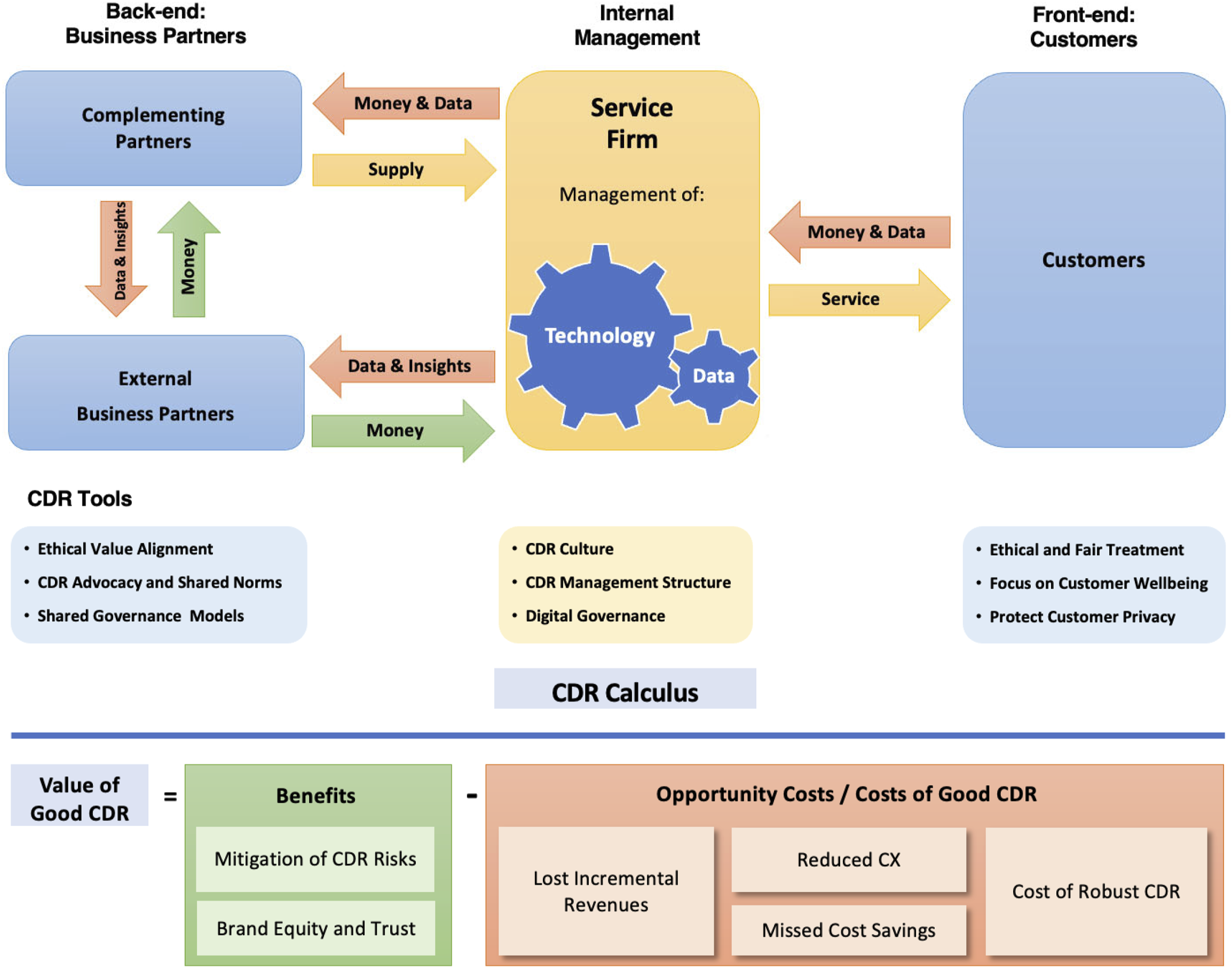
Digitization, artificial intelligence, and service robots carry serious ethical, privacy, and fairness risks. Using the lens of corporate digital responsibility (CDR), we examine these risks and their mitigation in service firms and make five contributions. First, we show that CDR is critical in service contexts because of the vast streams of customer data involved and digital service technology’s omnipresence, opacity, and complexity. Second, we synthesize the ethics, privacy, and fairness literature using the CDR data and technology life-cycle perspective to understand better the nature of these risks in a service context. Third, to provide insights on the origins of these risks, we examine the digital service ecosystem and the related flows of money, service, data, insights, and technologies. Fourth, we deduct that the underlying causes of CDR issues are trade-offs between good CDR practices and organizational objectives (e.g., profit opportunities versus CDR risks) and introduce the CDR calculus to capture this. We also conclude that regulation will need to step in when a firm’s CDR calculus becomes so negative that good CDR is unlikely. Finally, we advance a set of strategies, tools, and practices service firms can use to manage these trade-offs and build a strong CDR culture.
Open accessResearch articleFirst published May, 2023pp. 191-211Managing customer experiences has become a key strategic priority for service research and management. Yet researchers and managers lack a customer experience (CX) measure that applies to the different experience partners, touchpoints, and journey stages in the omnichannel environments of today’s service industries. Without such a common measure, empirical research on CX remains fragmented, and service companies continue to struggle to improve customer interactions in customer journeys. To address this shortcoming, this article proposes an omnichannel-capable measurement of CX that applies to different customer interactions in the omnichannel environment. With seven studies, the authors develop and validate a six-dimensional, 18-item CX scale. The proposed CX scale overcomes the fragmentation of existing scales in service research and provides a valid measure that can be used consistently for various customer interactions in omnichannel environments. This article details how the proposed CX scale can monitor and compare CX for different interactions in customer journeys (i.e., pain-point analysis), as well as improve CX features and their marketing outcomes (i.e., CX profiling). By overcoming the existing fragmentation in available scales and providing a common omnichannel CX measure, this CX scale establishes an empirical foundation for developing CX knowledge and advancing related service research.
Available accessResearch articleFirst published May, 2023pp. 212-232 , Raymond Loi, Cheris W. C. Chow , [...]
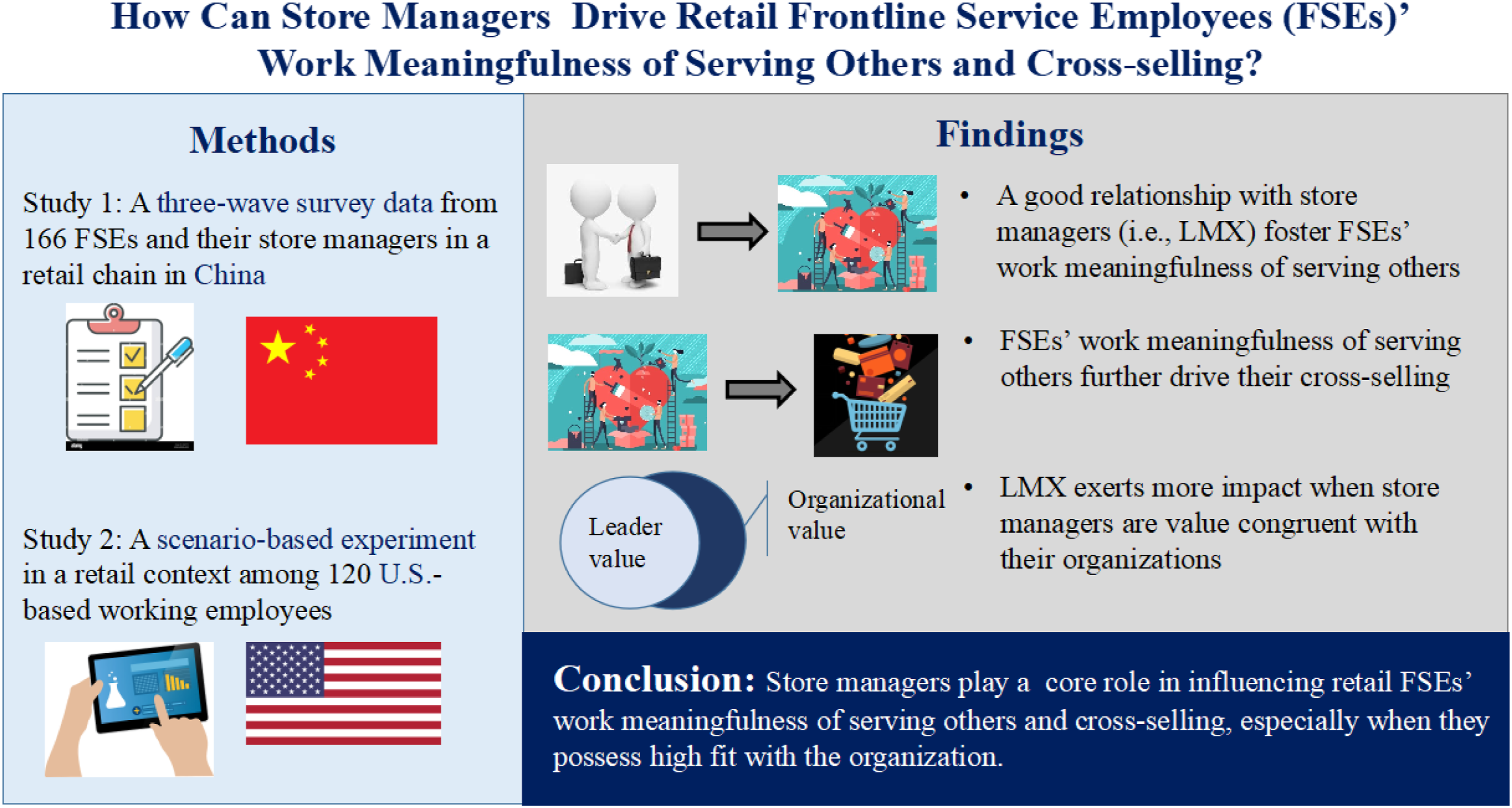
Cross-selling is one of the most important sales strategies retail organizations adopted to drive business revenue and increase customer lifetime value. While considerable efforts have been devoted to developing data-based cross-selling models, little is known about how and when store managers can drive frontline service employees (FSEs) to cross-sell. Drawing on work meaningfulness literature, we propose that a high-quality resource exchange relationship with the store manager (i.e., leader–member exchange, LMX) endows FSEs’ work with meaningfulness of serving others, which in turn promotes their engagement in cross-selling. We further contend that when store managers possess high person-organization fit, the impact of their LMX relationships on FSEs’ work meaningfulness of serving others and subsequent cross-selling would be stronger. A three-wave survey data from 166 FSEs and their store managers in a retail chain in China (i.e., Study 1) and an experiment among 120 U.S.-based working employees (i.e., Study 2) support our predictions. The present research offers important theoretical and practical implications for retailing management area.
Open accessResearch articleFirst published May, 2023pp. 233-250, Eric Arnould, An ChenIn the global world, service cultures interact. The co-shaping interaction of local and global service cultures is a form of glocalization. In China, interaction between traditional Chinese medicine (TCM) and Western medicine (WM) has produced glocalized versions of both services. Through analysis of customers’ experience of healthcare service in southwestern China, this paper addresses two research questions: What distinctive cultural resources do informants associate with WM and TCM? And how do tensions emerge in the contrast between customers’ expected and experienced cultural resources in glocalized healthcare service? The resource integration construct provides theoretical language to analyze customers’ service experiences in glocalized service cultures. One theoretical contribution resulting from this analysis is showing that culturally specific resources embedded in service systems emerge phenomenologically through resource integration in customers’ experiences. A second theoretical contribution resulting from this analysis is demonstrating how the mix of culturally specific resources from two glocalized services causes tensions and effects how experience is interpreted and valued. The article’s managerial contribution is a four-step culture-comparative resource framework. The framework can help managers identify tensions in customer expectations and experiences in glocalized service and identify needed changes to facilitate customers’ positive service experiences.
Available accessResearch articleFirst published May, 2023pp. 251-269, Priya Raghubir, J. Jeffrey InmanTraditional practice prominently presents offers (e.g., “50% Off”) followed by a quantity (“When you buy two”), duration (“Today only”), or other conditional restriction as a scarcity appeal to increase urgency. Placing a hurdle to clear before purchase eligibility presents the good news of the offer followed by the bad news of the restriction.
We propose and test a sales promotion framework for admission-based experiences showing that leading with the bad news first (the restriction) followed by the good news (the discount) is consistent with consumer news order preferences and changes perceptions of the deal. Our first study confirms consumer preference for bad news before good news in general and ticket offers in particular. The next two studies examine the process by which leading with the bad news (of the restriction first, discount later) increases the salience of the deal (% off). This in turn makes the customer feel in greater control over the offer, thereby making the deal appear to be fairer and more attractive, leading to increased purchase intentions. A fourth study in the field shows presenting the restriction followed by a discount improves click-through and potential revenue compared to presenting the identical offer with the discount preceding the restriction.
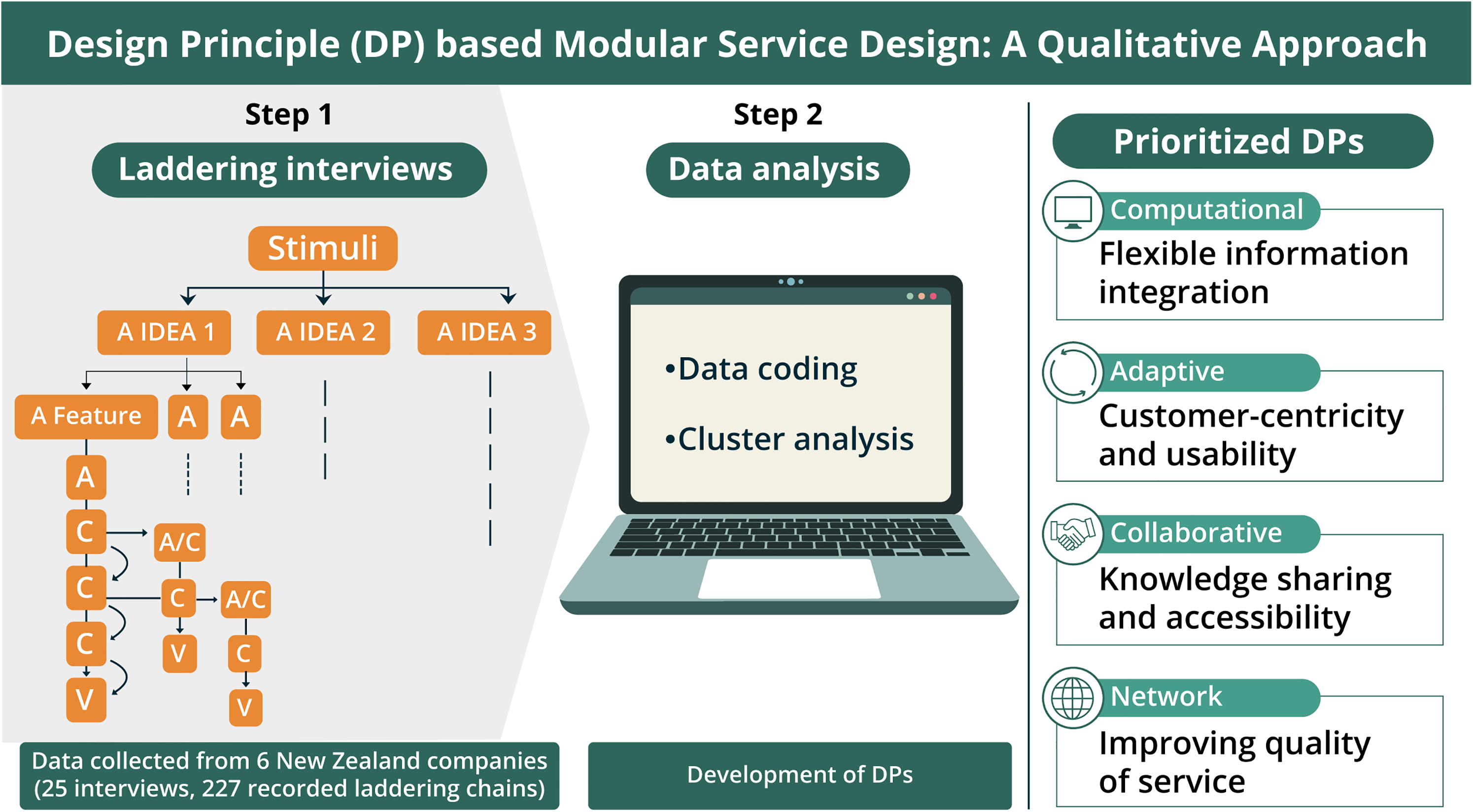
Available accessResearch articleFirst published May, 2023pp. 270-282, Markus Salo, Feng LiThe literature has proposed ways to modularize information-technology-enabled services (ITeS) with limited success. We argue that applying design principles (DPs) can address this gap and revitalize the service modularization literature. With a qualitative research study, we develop exemplar DPs and a set of prioritized DPs for ITeS. We contribute to the literature by demonstrating how complex service systems, specifically ITeS, can be modularly designed. Our DPs show how different ITeS design elements or service attribute combinations impact the outcome-driven design of service experience. Based on the findings, we present a modular service design framework and a service design method that adopts DPs to create effective modular ITeS designs. We also offer ways to conceptualize and apply service modularization to improve the adoption of the modular service design by service designers and managers.
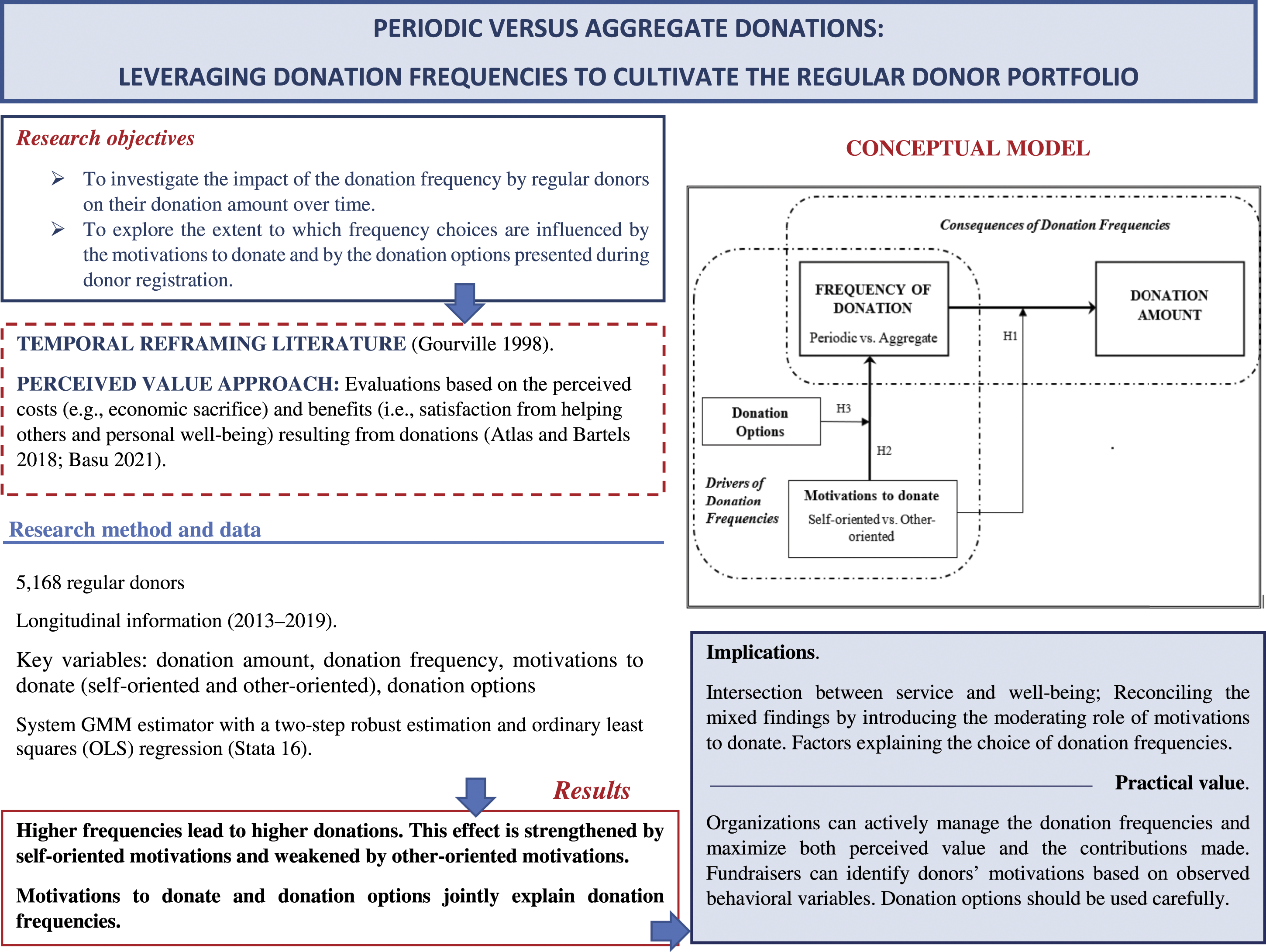
Available accessResearch articleFirst published May, 2023pp. 283-299Charitable organizations play a key role in society but face the recurrent challenge of obtaining sufficient resources to accomplish their missions. The regular donor portfolio becomes a critical element in providing stable and long-lasting funding, and its effective management has emerged as a key research area. This study investigates the impact of the donation frequency by regular donors on their donation amount over time. Drawing from temporal reframing literature, we provide an understanding of these effects as well as the moderating role of the motivations to donate (self- vs other-oriented). The study also investigates the extent to which frequency choices are influenced by the motivations to donate and by the donation options presented during registration. Using a sample of regular donors from 2013 to 2019 and applying dynamic panel data techniques, the findings reveal that higher frequencies lead to higher donations, though this effect is strengthened by self-oriented motivations and weakened by other-oriented motivations. Our study shows that motivations to donate and donation options jointly explain donation frequencies. This study provides useful guidance for charities on how to increase regular donors’ perceived value and their contributions to help these organizations provide essential services to the most vulnerable groups in society.