



Abstract
In the face of increasingly intense competition and saturated markets, competitive advantages through innovation (also) in tourism are continuously gaining importance for business survival and growth. Using a qualitative approach to investigate 12 small and medium enterprises in the Viennese hotel sector, this study focuses on identifying the extent to which different forms of organizational innovativeness lead to different innovation results. On the basis of the analysis, four types of innovation results (systematic renewal, systematic improvement, adaptation, and startups) can be identified. These innovation results can be traced back to different configurations of organizational innovativeness. The study shows that systematic renewal is promoted by a combination of all dimensions of organizational innovativeness (willingness to innovate, ability to innovate, and possibility of innovation).
In the year 2008, the Austrian tourism industry generated approximately 7.7% of the country’s gross domestic product (Laimer & Smeral, 2009); the corresponding figure for the city of Vienna was 4.7% (Laimer, Ostertag, & Smeral, 2010). Tourism has traditionally played an especially significant role in the Austrian economy, where the industry is generally dominated by small and medium-sized enterprises (SMEs; Smeral, 2010).
In addition to more general developments in the tourism industry (shorter stays, increasing importance of online sales, growing competition from newly developed destinations), a steady increase in capacity has been observed in Vienna. Compared with the year 2005, the number of hotel beds in the city will have risen by a full 40% by the year 2013 (Wien Tourismus, 2010), by the end of 2011, the demand for overnight stays in Vienna had already increased by 30% in comparison with 2005 (Wien Tourismus, 2012). On the other hand, occupancy rates remained stable at a rather low level of approximately 48% during winter season and 62% during summer season (Statistik Austria, 2012a), leaving room for growth in an increasingly competitive environment.
In the face of this increasingly intense competition, it is becoming more and more important to create competitive advantages through innovation, and this development is forcing businesses to enhance their innovative power (Keller, 2005; Pikkemaat & Peters, 2005; Pikkemaat & Weiermair, 2007). Especially in areas of the tourism industry where customers demand highly individualized service, SMEs play a key role in the development of innovative services and can leverage such innovations to gain competitive edge (Novelli, Schmitz, & Spencer, 2006). According to the Austrian results of the Community Innovation Survey (CIS), 57% of Austrian enterprises in the period 2008 to 2010 can be considered “innovation active” (=enterprises with product, process, organizational, marketing innovations, and/or ongoing or abandoned innovation activities). Out of these “innovation active” enterprises, 95% are SMEs (Statistik Austria, 2012b). Although the hospitality industry is not included in the CIS sample, it can be assumed that hotels also engage in innovation activities to a certain extent.
An innovative orientation constitutes a fundamental strategic attitude that is especially important for business survival and growth in industries such as tourism, where markets are saturated and customers enjoy (nearly) global freedom of choice (e.g., Ottenbacher, 2007; Peters & Pikkemaat, 2005). Nevertheless, innovation research in the service sector—especially in the field of tourism services—remained a largely neglected field for a long time (Drejer, 2004). Only in the past two decades have researchers begun to examine innovations in tourism more closely, at first on the basis of a heightened interest in innovation in the service sector in general (Hjalager, 2010; Ottenbacher, 2007).
In the meantime, it has become clear that our understanding of innovation in tourism and especially in hotel management has improved dramatically in recent years and is slowly approaching the levels attained in other knowledge areas (Hjalager, 2010). Up to now, however, research has only gradually provided theoretical and empirical support for these insights (Hjalager, 2010), meaning that further studies are necessary to enhance the internal and external validity of these findings.
As an example, research to date has yielded only limited insight into the fundamentals and origins of various types of organizational innovativeness in tourism and their effects on the innovation result (Hjalager, 2010). In the literature, four different research approaches to this topic can be identified: (a) structure, (b) person, (c) process, and (d) culture oriented. All these approaches have a common understanding of certain organizational abilities as prerequisites for innovativeness.
This study addresses these relationships and analyzes them on the basis of SMEs in the Viennese hotel sector, employing a culture-oriented perspective. Specifically, the purpose of the study is to identify different configurations of organizational innovativeness using the dimensions proposed by Behrends (2009; willingness to innovate, ability to innovate, possibility of innovation) as well as the corresponding subdimensions, and then to link those configurations to different innovation results.
Thus, the research question underlying this article is as follows:
To answer this question, we first provide a brief overview of developments in research on innovation in tourism. Starting from a theoretical perspective, we then proceed to examine the two main components of our research question, namely, innovation results and the dimensions of organizational innovativeness. On that basis, we analyze the relationship between organizational innovativeness and innovation results by means of a qualitative study in which 12 small and medium-sized city hotels in Vienna were surveyed using semistructured interviews. For this research question, a qualitative approach offers the advantage to allow an adequate, in-depth analysis of the complex relations between the configurations of organizational innovativeness and the innovation results. In this process, we describe and compare the characteristics of four types of innovation results. Finally, we present conclusions for research and practice, as well as deriving practical recommendations for small and medium-sized hotel businesses on the basis of our findings.
Theoretical Background
Innovation in Tourism
Despite the importance of innovation for the survival and growth of businesses in industries with saturated markets, systematic innovation research in tourism remained widely neglected for a long time (Drejer, 2004).
Prompted by a heightened interest in innovation in the service sector in general (e.g., Hjalager, 2010; Ottenbacher, 2007), researchers have only begun to scrutinize innovations in tourism in the past two decades (e.g., Hjalager, 2010; Keller & Bieger, 2005; Kessler & Mair, 2009; Ottenbacher, 2007; Ottenbacher & Gnoth, 2005; Ottenbacher & Harrington 2009; Pikkemaat & Peters, 2005; Pikkemaat, Peters, & Weiermair, 2006; Stamboulis & Skayannis, 2003). As a result, our understanding of innovation in tourism, especially in the hotel sector, has clearly improved in recent years and has slowly begun to approach the levels of knowledge attained in other fields of research (Hjalager, 2010). Innovation is now widely acknowledged as an important factor that is resource-intensive (e.g., Go, 2010) yet holds the potential for high profitability (e.g., Sandvik, Arnett, & Sandvik, 2010).
As for innovation research in tourism, a recent and very broad-based analysis of extant literature (Hjalager, 2010) revealed the following six core topics:
A significant body of research has dealt with categories of innovations, for which the systematic approach developed by Schumpeter (1934) is transposed onto the tourism industry (e.g., Hjalager, 1997) or expanded (e.g., Weiermair, 2006). Essentially, this stream of research distinguishes the categories of product/service innovations, process innovations, innovations in leadership and internal cooperation, management innovations, and institutional innovations.
Another important area of research deals with the triggers of innovation. In this area, one can further differentiate between research that regards the entrepreneur as the main trigger of innovation in line with Schumpeter (1934) and research based on the “technology push/demand pull” paradigm or innovation cluster approaches. With regard to the role of the entrepreneur as the trigger of innovations, Naipaul and Wang (2009), for example, establish that entrepreneurs have a decisive influence on innovative power. In addition to possessing specialized knowledge and acting as role models, entrepreneurs above all have to foster an open culture and a willingness to change in their organizations (López-Fernández, Serrano-Bedia, & Gómez-López, 2011). One special problem related to sustained innovativeness is discontinuity in the management of tourism businesses (Enz & Siguaw, 2003). On the demand side, innovations often arise from customer demands/requests (e.g., Duverger, 2012; Klausegger & Salzberger, 2006; Pick, 2005; Tajeddini, 2011) and from customer-facing employees (e.g., de Long & Vermeulen, 2006). Many innovations are “hardware-driven” or arise from technological advances in other industries (Cheng & Cho, 2011; Morosan, 2012; Pikkemaat & Peters, 2005; Stamboulis & Skayannis, 2003).
Search processes and sources of knowledge for innovations are another important topic in this field. In this context, the analysis conducted by Hjalager (2010) results in the differentiation of “embedded knowledge” (i.e., the integration of the business into networks as a prerequisite for knowledge transfer), “competence and resource-based knowledge” (i.e., implicit, in-house knowledge), “localized knowledge” (i.e., unique and inimitable knowledge of a destination or region in line with the resource-based perspective), and “research-based knowledge” (i.e., knowledge generated by scholarly research).
The focus area dealing with the extent and effects of innovation activities mainly involves comparing innovation rates in tourism internationally, contrasting those rates to innovation performance in other industries, and analyzing the effects of innovation rates (e.g., de Jong & Vermeulen, 2006; Evangelista, 2000; Ottenbacher & Harrington, 2009).
Comparatively little empirically based knowledge has been generated with regard to the (5) implications and effects of innovations in tourism businesses and at tourist destinations. With regard to the effects of innovations at the individual enterprise level, this stream of research has largely examined impacts related to competitiveness, cost structure, and market attractiveness (Hjalager, 2010). For example, Ottenbacher (2007) demonstrates that relevant success factors in the hotel segment include market attractiveness, the marketing of the innovation, and the commitment of employees.
Matzler, Renzl, and Rothenberger (2005) are able to confirm the link between corporate culture and innovation success. Additional studies have succeeded in demonstrating the positive effects of innovation in individual hotel businesses for the purpose of upgrading the hotel’s category (e.g., Sengupta & Dev, 2011).
Finally, recent studies which address the (6) innovation policy of local, national, and supranational institutions (e.g., Novelli et al., 2006; Pikkemaat & Weiermair, 2007) represent another emerging stream of research on innovation in tourism.
This article deals with the extent and effects of innovation activities employing an organizational approach and analyzing the influence of organizational prerequisites on the actual innovation results.
Innovation Results
Innovation is a multifaceted concept and has been studied from many different perspectives. Accordingly, innovation research—in manufacturing and services in general as well as tourism in particular—has brought forth a large number of different definitions of the term, and there is little or no consensus regarding a single definition (Fagerberg & Verspagen, 2009; Hauschildt & Salomo, 2007; Ottenbacher, 2007; Pikkemaat & Peters, 2005; Volo, 2005). A common similarity in all definitions of innovation is the aspect of “newness” (Johannessen, Olsen, & Lumpkin 2001; Slappendel, 1996). However, the evaluation of the qualitative differences of an innovation in comparison with the previous status is subjective and can indeed be objectified, but not defined objectively. Therefore, it is relevant by whom an innovation is evaluated: by an individual, an organization, a nation, or by the entire world (Damanpour & Wischnevsky, 2006; Paleo & Wijnberg, 2008). Concerning the evaluation of the degree of newness, different dichotomies can be found in literature, such as “radical-incremental” or “revolutionary-evolutionary” (Cooper, 1998; Han, Kim, & Srivastava, 1998; Johannessen et al., 2001).
As the objective of this article is to characterize various innovation results, it appears more appropriate to account for the numerous facets of innovation in our study by using a broad definition instead of confining the analysis to specific subaspects. Such a definition can be found in the Oslo Manual published by the OECD and Eurostat (2005), which defines innovation as “the implementation of a new or significantly improved product (good or service), or process, a new marketing method, or a new organisational method in business practices, workplace organisation or external relations.” Thus, this definition also shows different types of innovation.
Given the multifaceted nature of the concept of innovation, it also appears advisable to measure the (dependent) element of our research question—the innovation result—using a multidimensional approach. This kind of approach can be identified in the dimensions of innovation put forth by Hauschildt and Salomo (2007), who also differentiate, like Johannessen et al. (2001) and as argued above, between the dimension of substance (what is new?) and the intensity dimension (how new is it?) and the subjective dimension (new to whom?). In addition to these three dimensions, Hauschildt and Salomo (2007) include the process dimension (where does the innovation start and end?) and the normative dimension (is new the same as successful?) in their multidimensional approach.
Dimensions of Innovativeness
There is a broad consensus in the literature that the prerequisite for innovation is innovativeness, representing an organization’s ability to innovate (Hult, Hurley, & Knight, 2004). Therefore, innovativeness can be seen as a strategic firm-level objective suitable for achieving competitive advantage (Siguaw, Simpson, & Enz, 2006). However, innovativeness is often (and misleadingly) used synonymously with the term innovation (Wang & Ahmed, 2004). This lack of clarity has led to considerable problems with regard to conceptualization and measurement of innovativeness (Lynch, Walsh, & Harrington, 2010), and a multidimensional conceptualization is widely missing (Wang & Ahmed, 2004).
With regard to the development of organizational innovativeness, four research approaches can be identified: (a) Structure-oriented approaches derive innovativeness mainly from the structural conditions of organizations (e.g., Burns & Stalker, 1961; Child, 1972; Covin & Slevin, 1988). (b) In contrast, person-oriented approaches (e.g., Pinchot, 1985; Witte, 1973) are based on the assumption that the sources of innovativeness are primarily the creativity and assertiveness of single members of organizations (“innovative champions”). (c) Moreover, process-oriented approaches (e.g., Cooper, 1992) concentrate on the analysis of organizational innovation processes to explain innovativeness. (d) Finally, culture-oriented approaches assume that developing an organizational culture and climate supporting innovation strategies enhances the innovative capabilities of an organization (e.g., Hurley & Hult, 1998).
Employing a cultural perspective and integrating aspects of structure, person, and process, Behrends (2009) suggests a three-dimensional concept of organizational innovativeness, distinguishing between the dimensions of willingness to innovate (“tension”), ability to innovate (“organizational slack”), and the possibility of innovation (“loose coupling”) as key prerequisites for organizational innovativeness.
With regard to willingness to innovate, empirical innovation research has shown that perceived states of tension often act as triggers for individual and organizational change processes. As long as current behavior brings about the expected results, there is no reason to depart from or question the usual path. Frequently, it is only the emergence of a threat (e.g., in the form of a crisis) that creates the pressure necessary to overcome existing resistance to change and/or the tendency toward inertia. However, the stimuli for change and further development in organizations can also be triggered by appropriate arrangements within the system (e.g., interdisciplinary project teams; Behrends, 2009). From a system theory perspective, irritations—as the triggers of organizational learning—play an essential role in this context (Lueger & Kessler, 2009).
An organization’s ability to innovate is heavily influenced by the resources available within the organization. In this context, one decisive prerequisite is organizational slack (Cyert & March, 1995), which arises when the resources available and generated do not need to be consumed for normal business operations but can be partly invested in innovation projects and learning processes, and thus also in the organization’s future performance capabilities (Behrends, 2009).
Finally, the possibility of innovation in an organization is largely determined by the freedom granted to actors and subunits for the development and realization of innovative solutions. This freedom, in turn, is enabled—or suppressed—by organizational decision-making structures and the prevailing institutional conditions. A “loose coupling” of organizational processes enhances the possibility of innovation within an organization (Behrends, 2009).
With regard to the independent component of the research question, we rely on the conception proposed by Behrends (2009) and specify organizational innovativeness using the model shown in Figure 1.
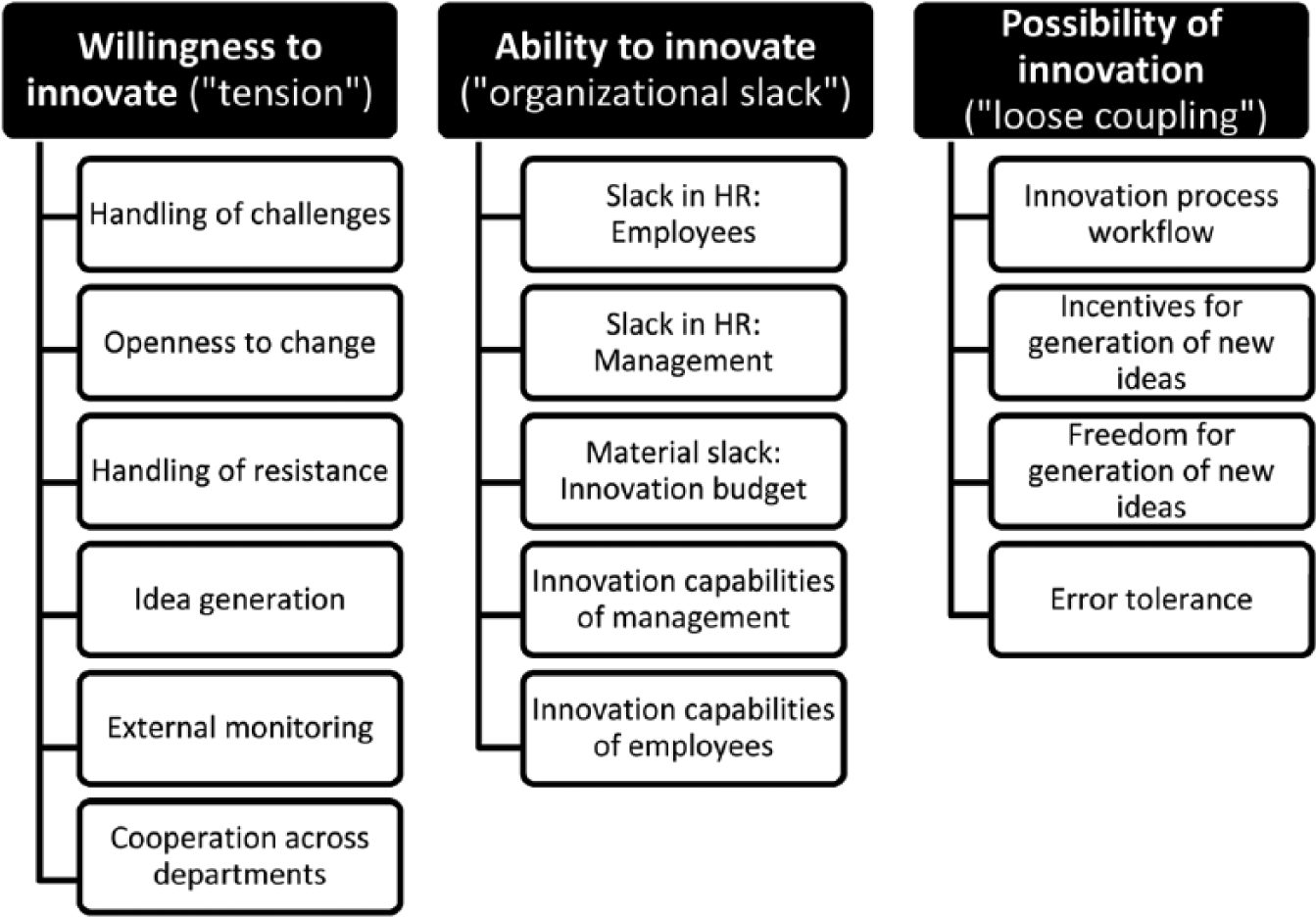
Descriptive Model for Organizational Innovativeness Based on Behrends (2009).
Method
Research Approach
For this research, a qualitative research approach was chosen to enable an in-depth analysis of the complex relations between the configurations of organizational innovativeness (including their subdimensions) and the innovation results. To discover and understand these complex relations in their context employing a culture-oriented perspective, a holistic approach going beyond rigidly defined variables (like in quantitative research) was considered as most adequate. Thus, as common in qualitative research, the issues of validity and reliability have to be put into perspective against the background of the openness in data collection and data analysis. With regard to reliability, the openness of qualitative research generally produces data that are hardly exactly repeatable. Therefore, in qualitative research, the transparency of data collection and data analysis and their justification on the basis of established methods of qualitative research supersedes measures of validity and reliability. This transparency of data collection and data analysis was ensured by an elaborate compilation of the hotels analyzed based on theoretical sampling and a combination of structural qualitative content analysis and “detailed structure analysis” for the analysis of the data surveyed via semistructured personal interviews with hotel owners or general managers.
The following two sections provide detailed information on the survey method and the method of data analysis.
Survey Method
The subjects examined in this study are SMEs in the Viennese city hotel sector. The survey was conducted in the form of semistructured personal interviews with the hotels’ owners or general managers between April and September 2010. To address our research question, we defined specific criteria for the selection of hotel businesses in line with the theoretical sampling approach (Lamnek, 2010): star classification (1 or 2 stars, 3 stars, 4 or 5 stars), annual revenues (below €1 million, €1 to 5 million, €5 to 20 million, more than €20 million), number of employees (0 to 9, 10 to 19, 20 to 49, 50 to 249), and ownership (part of a hotel chain, privately owned). The objective of the selection process was to include at least one hotel for each criterion value. The hotels were selected using the contact database of the Institute of Tourism Management at the FHWien University of Applied Sciences in Vienna, after which they were contacted by telephone and invited to an interview. In cases where hotels did not wish to participate, the next hotel that met the relevant criteria was contacted (in alphabetical order). A total of 12 hotels were included in the survey, including eight 4- or 5-star hotels, two 3-star hotels, and two 1- or 2-star hotels. Of the hotels surveyed, two had annual revenues of €1 million or less, four were in the €1 to 5 million category, five in the €5 to 20 million category, and one in the “€20 million plus” category. With regard to staff size, two hotels had no more than 9 employees, one had 10 to 19 employees, one fell in the 20 to 49 category, and eight had 50 to a maximum of 200 employees. Eight of the hotels belonged to a hotel chain, whereas the remaining four were privately owned.
The interview guidelines were subdivided into two parts, the first of which dealt with a specific innovation project from the previous 3 years, which the interviewee considered to be especially significant for the organization (product/service, process or marketing innovation = innovation result), whereas the second part addressed topics related to general organizational innovativeness (willingness to innovate, ability to innovate, and possibility of innovation) as specified in the model above.
Analysis Method
The innovation projects described by the owners/managers of the hotels were first classified according to the definition in the Oslo Manual (i.e., product, process, and marketing innovations; OECD & Eurostat, 2005) and then characterized on the basis of the dimensions proposed by Hauschildt and Salomo (2007). A bubble chart was generated for the purpose of depicting and interpreting the individual innovation projects carried out by the hotels. In the chart, the x-axis represents the novelty dimension (intensity of innovation [subjective/objective] and degree of novelty [incremental/radical]) of the innovation, whereas the y-axis depicts the process dimension (trigger [planned/incidental] and workflow [structured/unstructured]) of the innovation. To locate the center point of each bubble, four elements relevant to the innovation result were taken into account. As each of the elements was evaluated on a scale ranging from −2 to +2, the minimum value on each axis is −4, whereas the maximum value is +4.
The benefit of the innovation is depicted by the size of each bubble. The benefit was assessed on the monetary level (profits, savings) on the one hand and on the nonmonetary level (media attention, awards, honors) on the other, with a minimum value of 1 and a maximum of 3 in each case. These two values were added up to determine the size of the bubble representing the benefit of the innovation (i.e., minimum 2, maximum 6).
The purpose of positioning the individual bubbles (and thus the innovation results) is to characterize the innovation projects described by the interviewees. The interpretation of organizational innovativeness was subdivided into two stages. In the first step, the descriptive model developed for the purpose of this study (based on Behrends, 2009) was used to develop a coding scheme for the sake of a deductive definition of categories (Mayring, 2010); this scheme was then systematically applied to the data material.
In the second step, two interviews were subjected to “detailed structure analysis” (Froschauer & Lueger, 2003; Lueger & Hoffmeyer-Zlotnik, 1994; Lueger, Sandner, Meyer, & Hammerschmid, 2005; Reichertz, 2004). This method represents a special form of sequential analysis in the context of objective hermeneutics. This method relies on the assumption that the objective structure and latent complexes of meaning in the text material can be identified because those components are expressed relatively independently of the motives, intentions, or disposition of the interviewee. For this purpose, one hotel was selected from each of the clusters with the best innovation results (Cluster 1: Systematic renewal; Cluster 2: Systematic improvement). The hotels with the best innovation results were selected because the highest benefit for practitioners was expected from their analysis.
Four text excerpts, five to seven lines long, were drawn from the available interview material in each case. In this process, we applied the following procedure: The first excerpt was taken from the beginning of the interview and represents the response to the narrative question. For the second and third excerpts, we ensured that the content was clearly related to the subject of the study—or clearly not related, thus making it at least superficially irrelevant to the study. The final excerpt was taken from the end of the interview, as one can assume that core statements are recapitulated briefly at that point in the conversation. The text samples were subdivided into units of meaning and analyzed in chronological order with a view to identifying their obvious and latent meanings.
The analysis was carried out by three-person teams whose independence and unbiased approach were ensured by the fact that they had not been previously exposed to the interview material and did not know the names of the businesses analyzed.
The purpose of this detailed structure analysis was to generate deeper insights beyond the obvious content of the statements in order to answer the research question. At the same time, this analysis served as a verification of the findings already derived from our structural qualitative content analysis.
Findings
Classification of Innovation Results
The classification yields a number of clusters that are named according to their values on the two axes used. The benefit (monetary and nonmonetary) of the innovation is depicted by the size of each bubble. A total of three clusters were identified (see Figure 2): Cluster 1 (“Systematic renewal”) represents businesses whose innovations were planned and implemented in a highly structured manner and at the same time exhibited a high degree of novelty. Like Cluster 1, Cluster 2 (“Systematic improvement”) also shows a structured approach to innovation, but the degree of novelty is considered lower. Cluster 3 (“Adaptation”) exhibits rather low levels in both dimensions; businesses in this cluster largely adapted existing projects, processes, or marketing measures in a rather unstructured manner and with a very low degree of novelty. Three cases did not fit into any of the clusters defined above. These were assigned to the “Startups” cluster because they were fairly new hotels where the owners or managers presented the business concept itself as an innovation.
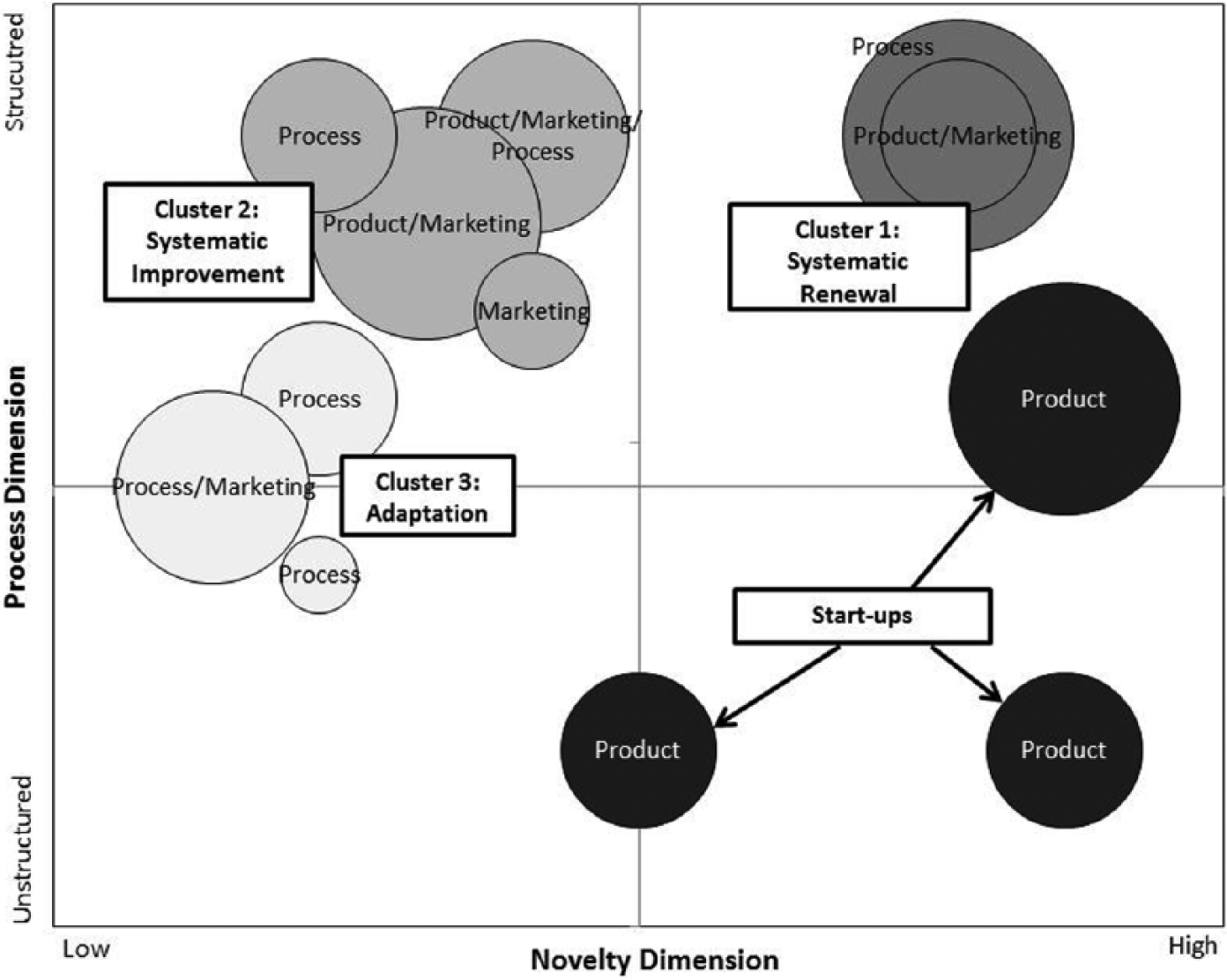
Classification of Innovation Results.
The labels assigned to each bubble denote the types of innovation result (product, process, marketing innovation, or a mixture).
Description of Clusters Based on the Dimensions of Organizational Innovativeness
Cluster 1: Systematic Renewal (Interviews 9 and 10)
The innovation results in this cluster tend to be radical objective innovations implemented using a fairly or highly structured approach: One innovation was realized by a cooperation with Apple, implementing an entertainment system that was new for the hotel market at that time: each hotel room was equipped with an iMac and a special software program that was exclusively written for the hotel, providing the guest with iTV, iMusic, and iNet. Another innovation was a process innovation that helped reduce the hotel’s energy costs by 25%. A special film was mounted on windows that filtered solar radiation and reduced the need for air conditioning. The hotel was the first mover in Austria with this technology. The innovation process was triggered deliberately and not left to coincidence or circumstance. The projects in this cluster delivered high benefits to the hotels in both monetary and nonmonetary terms. In the case of the film filtering solar radiation, the benefits were not only seen in terms of considerable energy cost reduction but also in terms of positive media coverage since the hotel was the first mover in Austria.
The organizations in which such a systematic renewal took place are distinguished by high willingness to innovate: They are led by proactive entrepreneurs whose innovative personalities have a positive influence on the internal and external environment.
Well, I’d say it also takes the courage to say “Okay, it’s worth the additional investment” without being able to prove exactly how much it will really deliver; I think it’s just a matter of the big picture you see at the time. (Interview
1
10)
These entrepreneurial persons are open to change and make deliberate efforts to mobilize internal resources to generate ideas and to trigger renewal processes “from the inside.” Therefore, one source of new ideas is the staff, who is encouraged to communicate ideas and suggestions for improvement through a deliberately participative leadership style and an appreciative attitude.
I consider my employees to be very innovative because they listen to our guests very closely, and because they also pass a lot of that information on to me. (Interview 10)
Likewise, the customers play a significant role as a source of new ideas.
I spend a lot of time with the guests and employees, and on reporting. (Interview 9)
In these hotels, innovation is part of the organization’s culture and is promoted automatically, for example, by elements in the hotel’s mission statement (e.g., ecological sustainability, as it was in the case with the energy reduction innovation) or strategic corporate goals, such as leading the industry in terms of technology.
We meet every six weeks to table ideas, to discuss things we’ve noticed, and to search for ways to improve things. (Interview 9)
The constant drive for renewal is therefore immanent to the system, but it depends heavily on the central entrepreneurial figure, who bundles ideas into viable innovation projects and implements those projects.
Therefore, innovation is not so much a phenomenon that has to be “generated”; innovation is lived and thus requires more than formally prescribed structures such as the idea boards, bonuses, innovation awards, and so on, commonly found in other hotels.
You can’t force the generation of new ideas; it’s something that grows or arises and has to be spontaneous. (Interview 9)
This cluster includes one independent hotel (7 years in operation) as well as one hotel that belongs to a large international hotel group (36 years in operation); both hotels have 4 stars and are medium-sized businesses with 50 to 200 employees. They are equipped with the financial and human resources (i.e., slack) necessary to make sizable investments in the course of innovation projects.
The detailed structure analysis confirmed these findings and also yielded the insight that the sole motivation underlying these hotels’ innovation activities is economic success. The hotels only pursue and develop economically promising innovation ideas that will help secure the survival of the business.
Cluster 2: Systematic Improvement (Interviews 1, 2, 6, and 11)
This cluster includes innovation results with a lower degree of novelty: The innovations represent improvements to existing structures, services, processes, and so on, and this characteristic clearly distinguishes these innovations from the renewal projects presented in Cluster 1, where the old is actually replaced by the new, as the following examples show: one of the hotels revamped their existing Sunday brunch by introducing a cooperation with tour operators. Each brunch was themed and a destination presented to the guests who had the opportunity to win a trip to the destination if they left their contact details. In another case, the innovation was triggered by the management’s dissatisfaction with the hotel’s listing on the most important travel rating platforms (despite the commissions paid). Based on these results, the check-in and check-out processes were gradually, but substantially, improved, arguing that the first and the last contact are especially influential on the customer’s overall satisfaction. Another hotel in this cluster provided an additional service to the guests by including the minibar into the room rate. This improvement was not only used for marketing reasons as an incentive for guests but also contributed to cost efficiency as the room boy’s position (whose only task was to check the minibar consumption) could be cut. Cost efficiency was also the major driving force in the fourth hotel in this cluster: this small enterprise with less than 30 rooms was looking for a way to cut the rather expensive position of night clerk. Imitating other hotels, an electronic locking system was introduced, making the night clerk’s position redundant.
The innovation results in this cluster are not created by chance: They are characterized by precise planning and a systematic approach to the implementation of innovation projects. They represent gradual, low-risk improvements to existing product/service components or processes. As a result, they are rather incremental and subjective innovations, and their benefits are medium to high, with monetary benefits predominating and nonmonetary benefits (e.g., media attention, awards) showing lower values in this cluster.
Innovative stimuli are mainly generated by analyses of internal and external data material.
We just took a look at our operating accounts and said “Okay, we’re paying through the nose for commissions in order to ensure good listings, so we have to do something about it.” (Interview 6)
These stimuli include structured market and competition monitoring systems as well as analyses of internal statistics.
Then we are part of different clusters. There’s a report from STR Global, a real yield product in which we’ve defined our competitors and we can see exactly how we stand every day. You can see RevPAR and the occupancy rate as well. Not revenues—those you have to put in yourself, but the rest is calculated automatically. (Interview 2)
Employees play a secondary role in the idea generation process, although an established incentive system, for example, in the form of idea boards and/or announced awards, is in place to involve employees. On close examination, this paradox actually reveals a repeating pattern: In these hotels, everything—including the renewal process—is subject to the logic of numbers. From idea generation to realization and implementation, these hotels have designed a systematic approach that leaves little to chance and thus limits creativity.
The people really aren’t very innovative. I mean, it’s difficult. We have a 15,000 euro innovation award sponsored by the group. It seems like that would be a good incentive, one that motivates people to do a lot, right? But it’s still difficult to get people to come up with new ideas or to come out and say, “Here’s a good idea” or “Here’s something we could do.” (Interview 1)
This cluster includes hotels of all sizes in both ownership categories: two hotels have 3 stars and less than 20 employees: One is privately owned (more than 40 years in operation), the other one is part of a small hotel group (18 years in operation). Another hotel is privately owned (36 years in operation) has 4 stars and more than 50 employees. One 5-star hotel is also included in this cluster: part of a large international hotel group, 8 years in operation, and has almost 200 employees.
In this case, our detailed structure analysis also confirmed the findings. A systematic, analytical approach is preferred over the higher involvement of employees. In addition, a certain ambivalence was identified with regard to internal and external perspectives. Whereas the image of a creative, modern company with a strong sense of community and team spirit is cultivated on the outside, clearly defined hierarchies, standards, rules, and high pressure for efficiency prevail on the inside.
Cluster 3: Adaptation (Interviews 3, 8, and 12)
This cluster is characterized by incremental, subjective innovation that is rather spontaneous or at least only partly planned and occurs as a response to external or internal change. The innovation process is less structured, and the innovation tends to deliver low to medium benefits. Groundbreaking innovations cannot be identified in this cluster.
In all three cases, either a computer system or website had become outdated and therefore had to be renewed. The innovation results discussed are more the result of a desire to avoid disadvantages rather than to exploit opportunities. In this context, changes are actually adaptations and constitute reactive measures due to external pressure; they are often (excessively) late reactions and thus represent a spontaneous need to react.
Actually, [the reason was] that we had to replace the old, discontinued Fidelio system with a new program. (Interview 3)
According to the typology of entrepreneurs proposed by Miles and Snow (1978) and Kirsch (1983), this cluster includes successful “defenders” who either possess unique resources or have put themselves in a strong competitive position, which makes innovation appear less urgent.
Okay, we have the advantage of top-notch locations in the city centers, we have a sound financial structure. (Interview 12) I have to add that we regularly invest—every year in the last few years, actually—about 20% of revenues, which is about the same as our free cash flow. And as a result, the building is in excellent condition from top to bottom. (Interview 12)
In their thoughts and actions, the owners and managers in this cluster primarily focus on defending their position within a restricted market, and their approach to this task is not particularly systematic.
For the purpose of generating or triggering new ideas, they rely on largely external sources, with competitors and industry events most likely to serve as triggers or stimuli for adaptations, which are usually implemented spontaneously.
In this way, they can be considered market observers who only take action when the need arises or when they wish to act or present themselves in line with the state of the art.
Actually, the innovation just happened, in a way. The goal was to find a front-office system that works, because with Fidelio [we had] problems with the data backup process, etc. (Interview 3)
Thanks to their copious resources and/or strong competitive position, hotels in this cluster have sufficient financial and human resources (i.e., slack) to make costly new adaptation investments when they recognize this need to act.
We do anything up to 10,000 Euros because we have fun doing it. (Interview 12)
In these cases, the process is unstructured and defined according to the circumstances at hand.
Organizations in this cluster do not have established incentive systems for innovation. Employees do have the informal freedom to develop their own ideas, but truly necessary innovations are assessed and (if desired) pursued further by the owner/manager.
The employees should always have the feeling that their efforts are not in vain, that someone will explain to them what we can use, what we can’t use, or what we could expand on. (Interview 8)
Hardly any significant innovations were implemented in the 3 years prior to the study, and the gains or savings arising from improvements are considered low or barely noticeable. This cluster comprises three 4-star hotels of which two are group owned, medium-sized (50 to 200 employees) but different in age (17, and more than 40 years in operation) and one small, privately owned hotel (20 employees) which is 20 years old.
Startups (Interviews 4, 5, and 7)
Several cases involved relatively new hotels where the interviewees referred heavily to the business concept itself when asked about an innovation project implemented in the last 3 years. These innovations are difficult to classify because they do not fit into the clusters described above and do not necessarily form their own cluster, despite certain similarities.
What these hotels have in common is a low share of innovation activities in overall work time: After the startup phase and the establishment of the new product on the market, the primary focus is to achieve stability and efficiency.
None of the three hotels in this cluster belong to a hotel chain. One hotel has 5 stars and 120 employees (7 years in operation) whereas one hotel has only 2 stars, 150 employees (5 years in operation). The last hotel is not categorized, having less than 20 employees and being 3 years old.
Relevance of the Findings, Conclusions, and Limitations
We consider these results important for research and practice as they contribute to close a main gap in innovation research in tourism, namely, the fundamentals of various types of organizational innovativeness and their effects on the innovation result (Hjalager, 2010). Employing a qualitative approach enabled us to analyze the complex relations of this context in depth. An additional merit of our research is that we specified the holistic cultural oriented concept of organizational innovativeness of Behrends (2009) for the service sector and showed its applicability in tourism.
To lead over to a structured discussion of the results, the main results of our analyses are summarized in Table 1.
Overview of Findings.
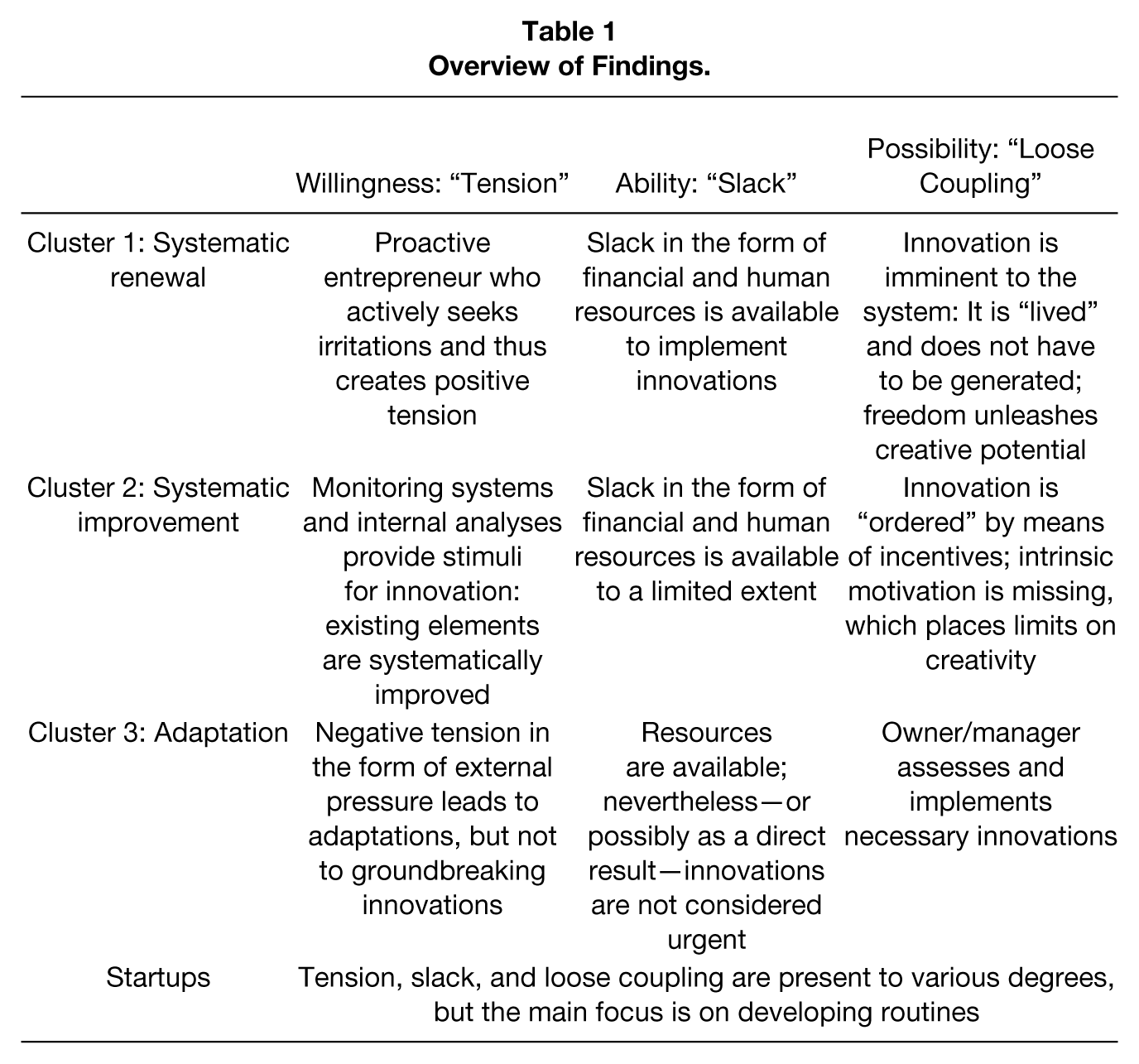
The following conclusions and practical recommendations can be derived from these insights.
If the objective is to enable systematic renewal in a hotel (Cluster 1), then all dimensions of organizational innovativeness—that is, the willingness (“tension”), ability (“slack”), and possibility (“loose coupling”)—must show positive values. This result shows that the holistic concept of organizational innovativeness of Behrends (2009) suggesting that only all three aspects of structure, person, and process together create an innovative culture is also relevant for the hotel sector. These hotels are led by owners/managers who come close to the “creative destroyer” entrepreneurial type as proposed by Schumpeter (1934) and whose ideas tend to set new standards (Naipaul & Wang, 2009). This supports the findings of López-Fernández et al. (2011) regarding owners/managers as role models who have to foster an innovative culture and to trigger innovation. Innovation results from a constant drive to be extraordinary, to be different from the competition. In such a context, the main task of the management is to develop a clear strategic direction that requires an open culture and constant efforts to differentiate the organization from the competition and thus calls for innovation. This can be achieved through the hotel’s architecture, service, design, or technology-pushed innovations. This was achieved by the hotel that succeeded in reducing energy costs by a simple, but very effective film mounted on the windows. The innovation was triggered by a clear strategic direction (to be ecologically sustainable) and a cross-departmental project group with regular meetings to discuss ideas to sustain this strategic direction. The employees are encouraged to communicate creative solutions and they are listened to. These characteristics are specific to hotels in this cluster and could not be identified in the other cases. However, this small number of cases with high levels of organizational innovativeness in all three dimensions and outstanding innovation results with regard to both process and novelty aspect confirms the assumptions of the comparatively low extent of innovation in tourism, especially with regard to radical innovation (e.g., Duverger, 2012; Klausegger & Salzberger, 2006; Tajeddini, 2011).
If an organization has not learned to live innovation internally, then there is a risk that the willingness to innovate will only be present in the form of “negative tension” (e.g., as a reaction to external pressure). In this case, no groundbreaking innovations can be expected, only adaptations such as those described in Cluster 3, where outdated computer systems have been replaced or websites have been gradually improved. In this context, Johannessen et al. (2001) speak only of change, which does not necessarily mean innovation (whereas innovation always brings about change). Innovations tend to arise spontaneously and are usually assessed and approved/rejected without employee involvement. In one case, where the improvement of the website was presented as an innovation, the decision was made spontaneously by the manager and triggered by input during a professional event. The manager’s main goal was to be technologically up-to-date and to follow the mainstream. This once again shows that many innovations in tourism are hardware-driven or come from technological advances in other industries (e.g., Morosan, 2012; Stamboulis & Skayannis, 2003). The idea of creating a new website was neither evaluated nor discussed with the employees and the concept was not based on usability checks or guest feedback, but on the ideas and wishes of the manager-owner alone. This case appears to be symptomatic in tourism, where it is often said that any divergence from “business as usual” is dubbed an innovation without closer reflection (Hjalager, 2010). Ways to build the type of tension that is conducive to innovation include rethinking and altering or expanding the observation perspectives that set innovation processes in motion (e.g., not to rely on experts and competitors alone but to take into account a variety of different sources such as social media platforms, customers, employees, specialist literature, study trips, etc.). Another possibility is to form innovation teams across multiple departments with a clearly anchored function and importance. Their status must be made clearly visible within the organization, for example, by holding regular meetings that are characterized by participative leadership, which is a principle in the hotel that implemented the innovation to reduce energy costs and characterized by “talking things over.” The owner/manager as a person plays an especially important role in this context, as she/he is specifically responsible for encouraging or allowing this tension to arise (López-Fernández et al., 2011; Naipaul & Wang, 2009).
If an organization lacks the loose coupling described in Cluster 2, creativity is constrained. Looking at the hotel that improved their existing Sunday brunch, the problem becomes obvious: The improvement was implemented in a highly systematic manner, following facts and figures derived from the hotel’s market monitoring system and internal analyses. These are the main driving forces for change in the organization, whereas employees are not involved in the decision-making process and their ideas in reality are overlooked. In this type of organization, innovation is “ordered” extrinsically in the form of bonuses or innovation awards, whereas intrinsic motivation—which is a vital prerequisite for groundbreaking innovations—is a seldom occurrence. This paradox has been confirmed by findings from corporate entrepreneurship research (e.g., Hasenzagl & Güttel, 2009), which has revealed that established incentive systems alone are not sufficient to promote radical innovations with a high degree of novelty. Employees in an enterprise cannot be instructed to exhibit creative behavior. Creativity and innovativeness require autonomy and the freedom to take risks (combined with a certain degree of tolerance for errors) as well as time to develop.
However, providing employees with freedom in the hotel business is also associated with considerable risks, as the production and consumption of the service are simultaneous (the “uno actu” principle) and the guest is part of the production process (integration of the external factor).
Knowledge of service processes is the core competence of a hotel business organization. Any changes in those processes will have a significant impact on the overall product. Our detailed structure analysis shows that innovations—especially at hotels belonging to a hotel chain—are centrally controlled. The willingness to innovate—in the form of highly sophisticated analysis systems and in-house development systems—is high, the ability to innovate is present in material and knowledge-related terms, and employees have the necessary freedom to develop innovations.
Therefore, we can confirm that an innovative organization (in the sense of systematic renewal) must integrate all three dimensions of organizational innovativeness. In this context, innovation is not necessarily promoted by the maximization of these dimensions but by their interrelationships (Behrends, 2009).
As in all scholarly research, the results of this analysis are subject to certain limitations that have to be taken into account when interpreting the results.
First of all, the fact that only successful hotels (at least in the sense of survival) were analyzed may have given rise to a certain survivor bias. As the information was collected in the form of interviews with the owners or managers of the hotels, the problems of key informant bias and socially desirable responses are also relevant in this context. However, these problems were addressed by critically questioning the managers’ response behavior (additional inquiries, control questions) as well as the fact that the conclusions are drawn on the basis of a large number of variables. The fact that the innovation results are classified on the basis of a specifically described innovation chosen by the owners/managers themselves plays an especially important role in this context. To avoid random results, the interviewees were explicitly asked to describe an innovation from the past 3 years, which was both representative of and important to the organization. Another aspect worth considering is that the categorization of innovations (not just in tourism) is still problematic in terms of standards and thus also in terms of comparability: Innovation always brings about change, but change cannot necessarily be equated to innovation (Johannessen et al., 2001). In this study, we deliberately left it up to the interviewees to draw this distinction in order to gain as comprehensive a picture as possible. For this reason, we chose a very broad approach to classifying the innovation results (Hauschildt & Salomo, 2007), which enabled us to depict this broad variety of different changes. One of the model’s weaknesses is undoubtedly the subjective classification of cases. However, the subjective element in the classification process was reduced by ensuring that classification decisions were always discussed by a four-person research team. In the interpretation of our findings, the risk of subjectivity was further mitigated by the ensuing detailed structure analysis. Finally, the fact that the research (in its current form) was not conducted as a longitudinal study means that it presents a “snapshot” comprising retrospective observations, which calls for additional caution in the establishment of causal relationships.
The sample used in this study was drawn according to the selection criteria of theoretical sampling. The main goal was to get a deeper understanding of the variables examined and possible relations between the dependent and independent variables.
The fact that the results do not show remarkable differences concerning the theoretical sampling criteria (star classification, annual revenues, number of employees, ownership) slightly indicates generalizability of the results for the Viennese city hotel sector, although it was not an aim of this qualitative study to get generalizable results. However, to strive for testing the external reliability of the findings in tourism, our qualitative research design should be replicated in other regional settings and other parts of the tourism industry. In a further step, the study and its model constitute the basis for future research employing a quantitative approach that allows statistical testing of hypotheses concerning the correlations between the dependent and independent variables and a generalization of the results.