



Abstract
In this article, we expose the theory of q-rung orthopair fuzzy (q-ROF) sets (q-ROFSs), which is the robust improvement of concepts of fuzzy sets (FSs) and intuitionistic FSs. The q-ROFS is an advanced framework that permits decision-makers to evaluate complex and unpredictable information during the decision-making process. The Hamy mean (HM) models are more powerful and effective aggregation models used to reduce the impact of different attributes and express correlation among different objects. We discussed the basic operations of Aczel Alsina operations under consideration of q-ROF environments. Some new strategies proposed by exploring the theory of Aczel Alsina aggregation expressions based on HM models, such as q-ROF Aczel Alsina Hamy mean (q-ROFAAHM) and q-ROF Aczel Alsina weighted Hamy mean (q-ROFAAWHM) operators. We also present a list of new approaches under consideration of the Dual Hamy mean (DHM) model, such as q-ROF Aczel Alsina Dual Hamy mean (q-ROFAADHM) and q-ROF Aczel Alsina weighted Dual Hamy mean (q-ROFAAWDHM) operators. Some flexible and reliable properties of our derived approaches are also discussed. A multi-attribute group decision-making (MAGDM) technique is a relatively advanced decision-making approach which is utilized to evaluate reliable optimal options by the decision maker. An appropriate algorithm for a MAGDM problem is also presented to reveal the robustness of our derived approaches. To show the flexibility and consistency of our discussed approaches, we study a practical example to choose the best option. To show the applicability and feasibility of currently discussed methodologies, we contrast the results of previously proposed aggregation operators (AOs) with the results of new methodologies.
Keywords
Introduction
A strategy for selecting the most perfect alternatives from a range of available possibilities is known as the MAGDM problem. We constantly make decisions; thus, choosing choices is a normal part of life. Due to the unexpected nature of decision-making (DM) issues and the fuzziness of DM circumstances, MAGDM aims to help decision-makers deal with multifaceted challenges. In 1965 Zadeh
1
directed the creation of FSs, the most effective decision-making process capable of dealing with unreliable information and the most effective DM process capable of dealing with unreliable information. Human opinion is not only unidirectional, but it also may have negative aspects. So, only taking membership value (MV) is insufficient to deal with the world's difficulties. To overcome this problem, in 1986 Atanassov
2
gave the idea of the intuitionistic fuzzy sets (IFSs), which described both aspects of the MV and non-membership value (NMV) within the range between 0 and 1 having the restriction that
Triangular norms are very significant tools and provide solutions to solving a lot of problems faced in AOs debated in various fuzzy environments. The first Mathematician who gave the idea of the triangular norm was Klement, 16 who studied the σ construction of various norms. Deschrijver et al. 17 initiated the notion of T-norm (TN) and T-conorm (T-CN) utilizing IFS data. After that, varieties of TN were made and used to aggregate the data in numerous mathematical fields. Now, many TN and T-CN are envisioned for explaining challenges in the real world on a vast scale. Klement et al. 18 worked on families of TN and T-CN using the different environments of FS. Moreover, the theory of Lukasiewicz t-norms, 19 drastic triangular norms, 20 Dombi operations, 21 the shape of Archimedean operators, 22 Frank 23 and Nilpotent 24 t-norm and t-conorm. The theory of Einstein t-norms and t-conorm 25 are widely employed in solving numerous real-life applications and numerical examples. Babu and Ahmad 26 developed a few parametric norms based on the function generator. Deschrijver 27 used TN and T-CN for representation of IFS. Arora 28 invented IF soft AO operators using Einstein TN and T-CN and elaborated their application in multi-attribute decision-making (MADM). Hussain et al. 29 Maclaurin symmetric mean AOs using Frank TN and T-CN for IFSs. Zeeshan and Mahmood 30 Power AOs based on TN and T-CN in the complex IF soft set system, described their approach in MADM. Hussain et al. 31 prolonged the notion of TN and T-CN using PyFS. Rahman et al. 32 described new generalized IVI Pythagorean fuzzy (PyF) operators using TN and T-CN. Sheikh and Mandaz 33 also elaborated on the concept of Frank TN and T-CN, providing a picture fuzzy set PFS system. Ashraf et al. 34 used TN and T-CN for the representation of spherical fuzzy sets (SFSs).
Asif et al. 35 deliberated Hamacher AOs using the theory of pythagorean fuzzy context and decision analysis process. Ali 36 developed innovative fairly mathematical AOs under consideration of complex p, q rung orthopair fuzzy domains. Imran et al. 37 evaluated appropriate robots by applying Aczel Alsina AOs with a decision analysis problem. Gazi et al. 38 modified the optimization technique of the DEMATEL method for investigating the weight of criteria and sports sectors. Mahmood et al. 39 enhanced the theory of bipolar fuzzy set using the concepts of semigroups and their fundamental results. Hussain and Ullah 40 applied properties of Sugeno-Weber aggregation operators for resolving complexities in real-life challenges. Ali et al. 41 generalized the theory of intuitionistic fuzzy soft sets with Aczel Alsina AOs. An appropriate decision support system was developed by Tešić and Marinković. 42 Hussain et al. 43 examined various suppliers for improving business and trading in the market. Hussain et al. 44 discussed the AOs of Dombi Hamy mean models for resolving different experts ‘ judgments. Hussain et al. 45 applied various properties of Heronian mean models and Aczel Alsina AOs in decision-making models. Hussain et al. 46 designed a list of mathematical approaches by incorporating Aczel Alsina AOs and Hamy mean models to evaluate reliable construction materials. Moslem 47 established a decision-making technique of Best Worst Method. Moslem 48 enlarged the concepts of a spherical fuzzy framework for discussing advanced optimization techniques of the analytic hierarchy process. Moslem et al. 49 utilized AOs and decision-making models for selecting some reliable parcel locker locations. Moslem et al. 50 discussed an optimization technique to select park and ride locations using the full consistency method. Moslem et al. 51 elaborated on different characteristics of digital voting technology using the best-worst technique and Kendall method. Hussain et al. 52 examined different energy sources using Frank AOs and complex picture fuzzy models. Hussain et al. 53 developed a family of Sugeno-Weber AOs and decision algorithms to evaluate sustainable smart security techniques. Hussain et al. 54 verified the properties of Dombi AOs under consideration of picture fuzzy context and decision-making models.
Aczel and Alsina
55
acquainted with a group of TN and T-CN named Aczel Alsina TN (A-TN) and Aczel Alsina TCN (A-T-CN) and demarcated the condition
The theory of HM operators is utilized to reduce the impact of negative information during the decision-making process. Li et al. 66 developed a series of PyF information under consideration of HM tools and elucidated their implementation into supplier selection. Wang et al. 67 presented new strategies of q-ROFSs to evaluate a MADM technique and also explored their utilization in enterprise resource planning systems selection. Hussain et al. 68 generalized the theoretic concepts of HM models considering complex picture fuzzy and applied their derived approaches to assess reasonable options under vendor management systems. Xu 69 evaluated computer networking security based on the presented approaches of HM tools.
Novelty and contributions of this presentation
By studying the structure of existing environments of FSs, IFSs, and PyFSs, we observed that q-ROFS is a more effective and robust environment of a fuzzy system. A q-ROFS explored by restricted constraints of the total sum of MV and NMV less or equal to a unit. All mathematical expressions of triangular norms, such as algebraic sum and algebraic product, Einstein aggregation expressions, Dombi aggregation expressions, Frank aggregation tools, and so on. There are many aggregation models like Muirhead mean, Maclaurin symmetric mean, Bonferroni mean and Heronian mean models, But Hamy mean models are superior to all the above-discussed aggregation models. The theory of HM tools is used to overcome the impact of negative information and define correlation among different input arguments. The Aczel Alsina aggregation operations are well-known operational rules by expanded the theory of triangular norms. Recently numerous researchers utilized the concepts of Aczel Alsina aggregation operations and presented a lot of number strategies under consideration in different fuzzy environments. By inspiring the effectiveness and intensity of Aczel Alsina aggregation expressions, we exposed some new approaches under consideration of q-ROF environments. On the other hand, the main contribution of this article is defined as follows:
To explore the notion of q-ROFSs and their related necessary operations. We expose the theoretical concepts of HM models with certain properties under consideration of q-ROF information. To illustrate and show the robustness of Aczel Alsina aggregation expressions with the support of numerical examples. By the generalizing idea of HM models, we derived some well-known aggregation approaches under consideration of q-ROF information such as q-ROFAAWHM and q-ROFAAWDHM operators. We also presented a series of new strategies using DHM models’ properties, including q-ROFAAWDHM and q-ROFAAWDHM operators. Some flexible properties and special cases also show the reliability and robustness of our derived methodologies. A MAGDM approach is also employed to identify a reasonable optimal car purchasing supplier. By using an algorithm of a MAGDM technique and currently derived approaches, we assess the best suppliers based on certain criteria. To find the trustworthiness and achievability of the designed work, we talked about a few numerical examples based on q-ROF data. In comparison technique, we evaluate how well our operators stack up against those that are currently in place. We present a comprehensive description of these comparisons’ conclusions, highlighting the benefits of using these proposed operators.
The remaining part of this article is divided as follows: section 1, presents an overview of existing research work in different fuzzy frameworks. Section 2 illustrates the basic concepts of q-ROFSs, the theory of comparison technique, and their related fundamental operations. Some well-known operations of Aczel Alsina aggregation tools under consideration in q-ROF environments are also discussed in section 3. We derived some new strategies based on Aczel Alsina operations, including q-ROFAAHM and q-ROFAAWHM operators in section 4. Section 5 exposed a list of new approaches under q-ROF environments such as q-ROFAADHM and q-ROFAAWDHM operators with some prominent characteristics. Section 6 carried a robust decision-making technique like the MAGDM method to show the feasibility of our derived approaches. Section 7 illustrates an appropriate comparative study to see the feasibility and consistency of our proposed methodologies. In the end, a complete overview of this article is exposed in section 8. Figure 1 also demonstrates the main theme of this manuscript.
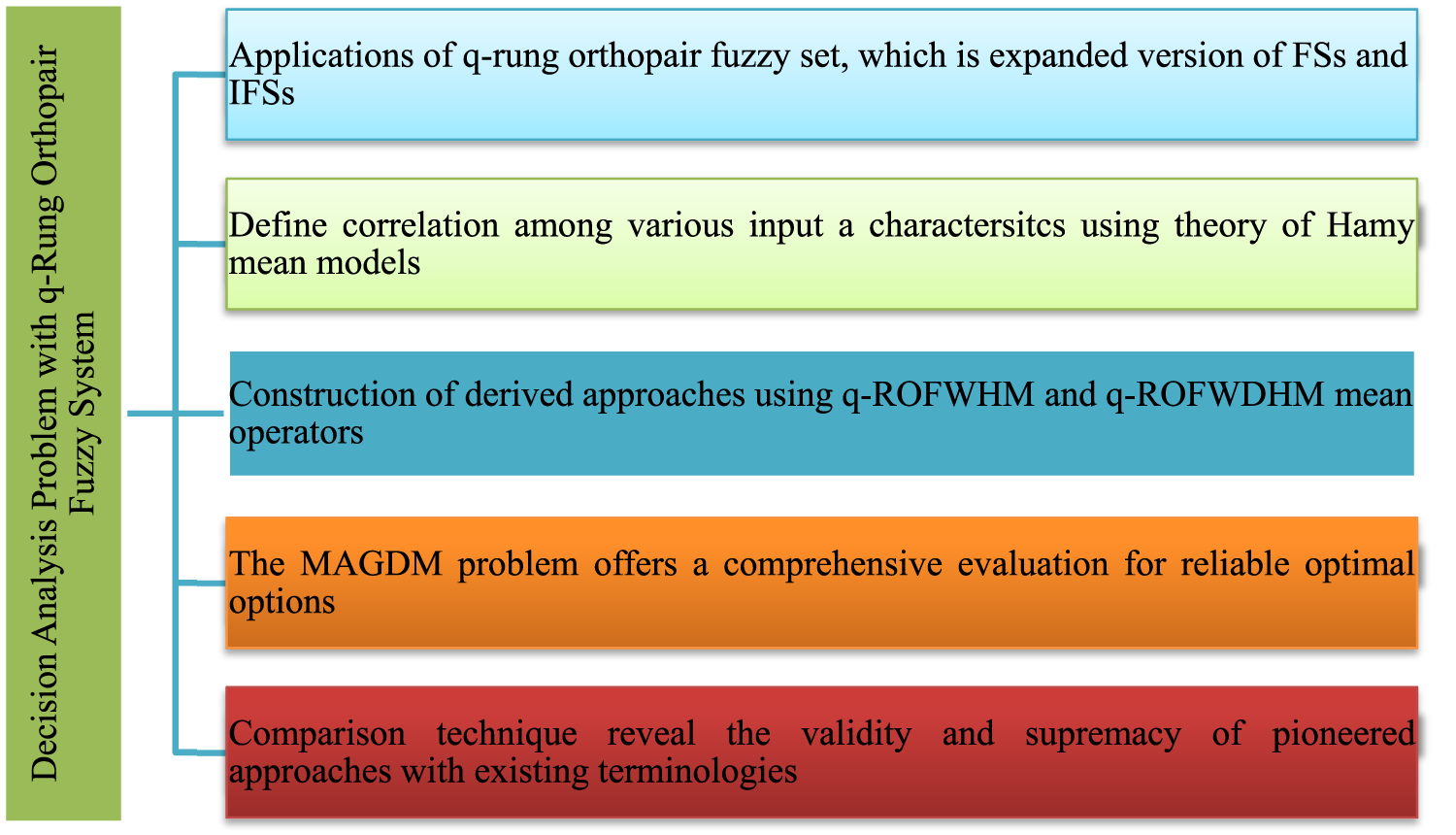
Illustrates the main theme of the manuscript.
This section discusses the fundamental definition of q-ROFS and describes some basic operational rules. We further develop our methods to extend our article. Table 1 explores variables with detailed descriptions.
Shows a detailed description of variables.
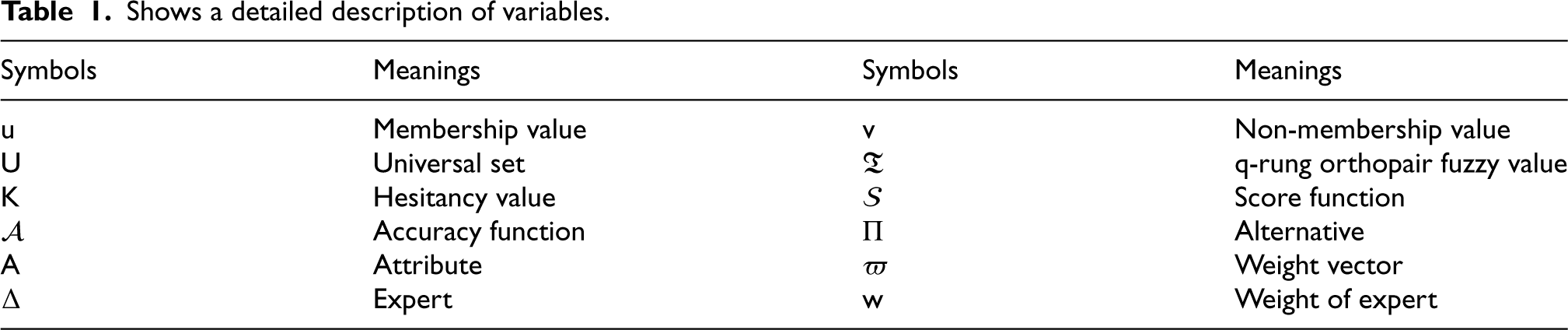
Shows a detailed description of variables.
1
6
: The mathematical shape of the q-ROFS A is given by:


2
6
: Let
3
70
: Let
4
70
: For any three q-ROFVs
5
70
: Let 

In this section, we will narrate some proposed Aczel Alsina operations on q-ROFVs and study their characteristics. First, we define the Aczel Alsina sum
6
70
: Let
In this section, we define the basic definition of the Hamy mean operator (HM) and then define some new AOs such that q-rung Orthopair fuzzy Aczel Alsina Hamy mean operator (q-ROFAAHM) by using the basic operations AA norms. Furthermore, we elaborate on some more properties of q-ROFAAHM operators using the information on q-ROFS. Moreover, we have some ideas about existing HM operators that help develop some new HM operators.
7
71
: Let 
The HM operator has three following properties:
When where When
Two cases of the HM operator are as follows:
Let 
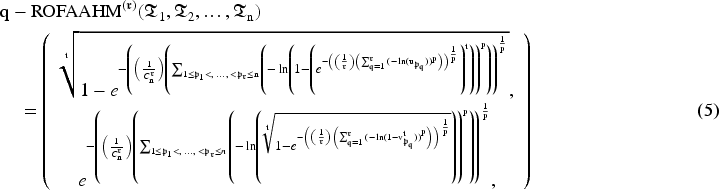
See appendix A.
Suppose that 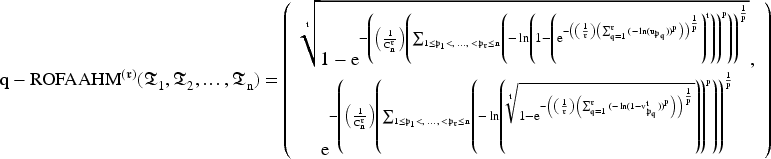
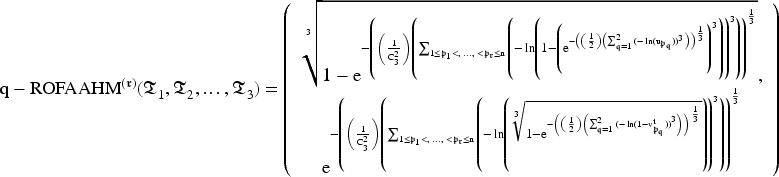
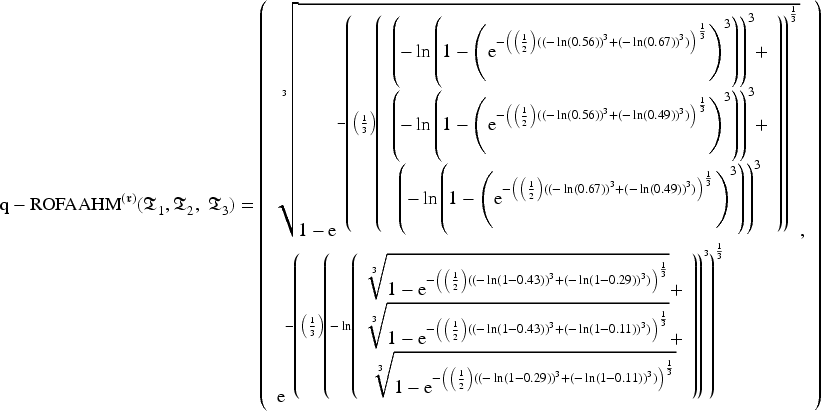

Let 
As 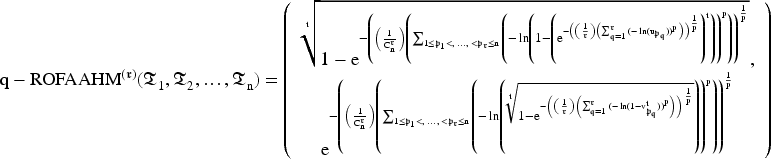

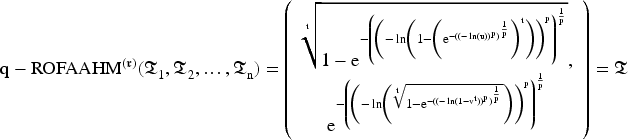

Let and are two q-ROFVs, we can write them in the following form:
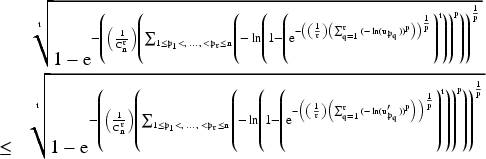
And,
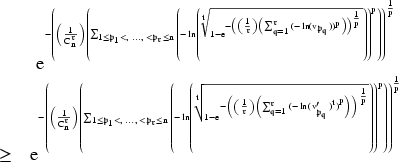
From this, we can say:

Let 
Let
Hence, we have the following inequalities:
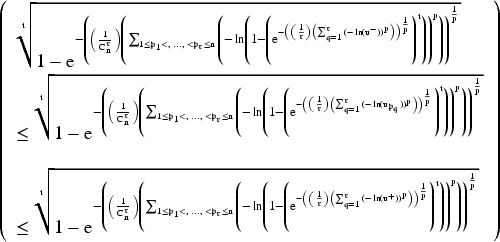
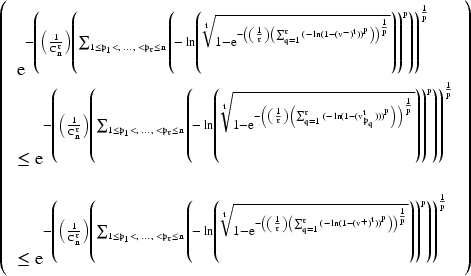
From the above equation, we can say:


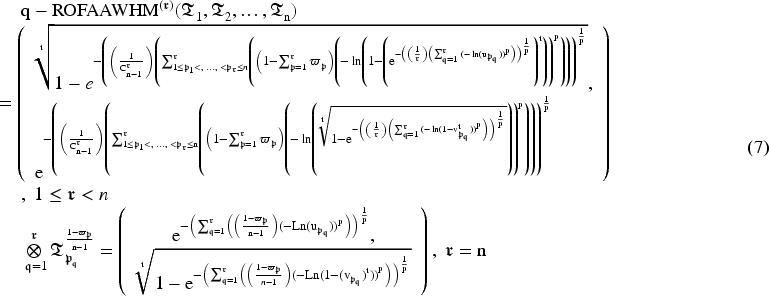
go to appendix B.
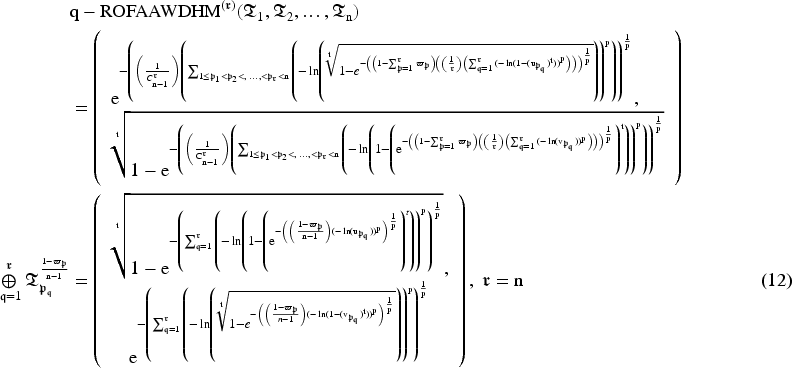
In this section, we will discuss the idea of the DHM operator using the information on q-ROFVs. We will elaborate on our proposed work q-rung Orthopair fuzzy Aczel Alsina DHM (q-ROFAADHM) operator and support this work using numerical examples.
10
71
: Let 
Let 
Let 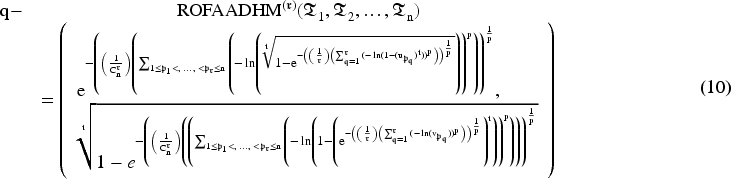
We can prove it easily.
Let 
This can be proved with the help of the above Theorem 3.
Let 
This can be proved with the help of the above Theorem 4.
Let 
This can be proved with the help of Theorem 5.
Suppose that 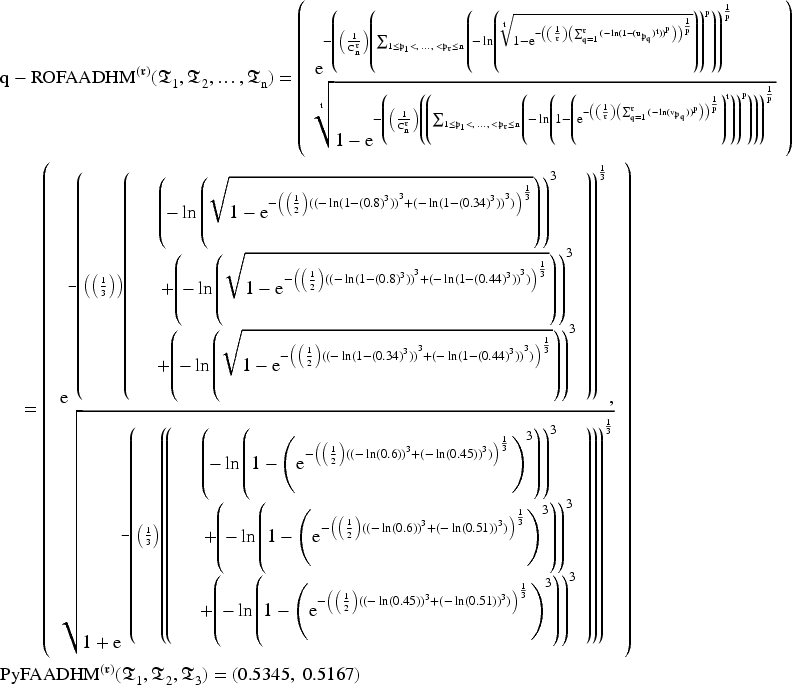
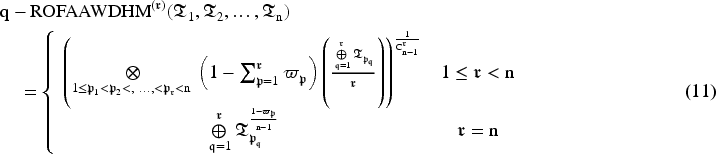
It is straightforward.
Let
Let 
Let 
The MAGDM technique is widely used in different fields of life to evaluate complex and complicated challenges faced by the decision maker. We also explored our derived approaches under consideration for q-ROF information. The q-ROF environment has extensive information about any object and a decision maker easily completes their aggregation process. For this purpose, suppose that
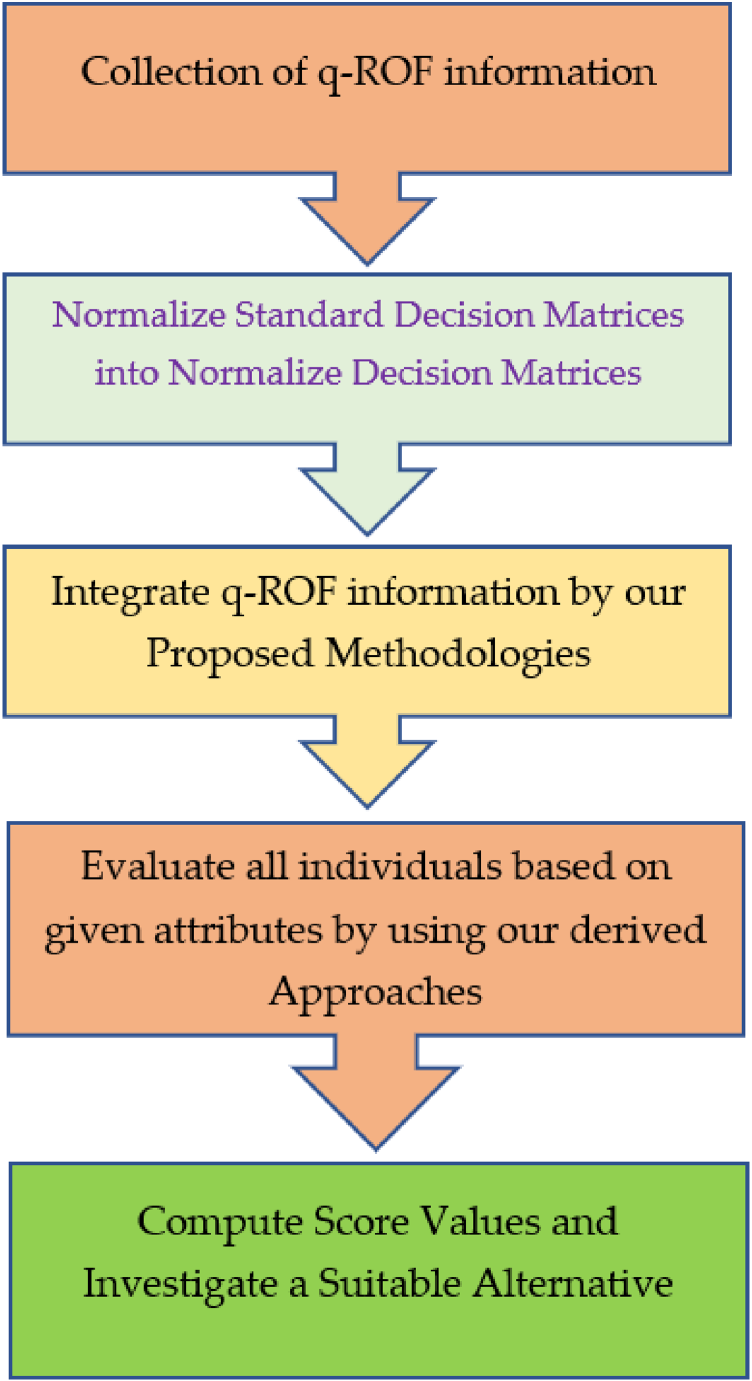
Steps of an Algorithm.

In this decision matrix the duplet


And


And

In 2020, as COVID-19 started to spread, a lot of companies and businesses closed, which affected the world's supply chain. Axios reports that 75% of US companies experienced supply chain disruptions at the beginning of the pandemic. According to the World Bank, the pandemic has also resulted in a 50% decline in profits for a fifth of enterprises. The National Association of Manufacturers estimates that during the beginning of the epidemic, 1.4 million manufacturing jobs were lost in the United States. Global supply chain disruption has been exacerbated by geopolitical crises like the US-China trade war.
Supply chain enterprises play a critical role in driving the economic growth of any country. These enterprises, ranging from raw material suppliers to manufacturers, logistics providers, and distributors, form the backbone of trade and commerce. By optimizing the flow of goods and services, they help in the efficient utilization of resources, foster competitiveness, and innovation, and contribute to overall national wealth. Supply chain enterprises are essential for reducing the costs of goods and services. By streamlining production processes, optimizing inventory management, and improving transportation logistics, these companies help reduce wastage, time delays, and inefficiencies. The lower production costs lead to lower prices for consumers and greater profitability for businesses, which can then be reinvested into the economy. Efficient supply chains also reduce bottlenecks, enabling faster and smoother movement of goods across borders, which stimulates trade and drives economic activity.
Supply chain enterprises enable global trade by facilitating the movement of goods across borders. International trade is often governed by efficient supply chains that ensure goods are sourced, manufactured, and delivered globally in a timely manner. Countries that have strong supply chain networks can capitalize on global market opportunities, attract foreign investment, and participate in international markets, which can significantly contribute to their GDP growth. Supply chain enterprises generate employment opportunities at various levels, from low-skilled jobs in warehousing and transportation to high-skilled roles in logistics management, IT, and supply chain analytics. A strong and efficient supply chain industry thus contributes directly to job creation and income generation, which has a multiplier effect on the broader economy by increasing purchasing power and consumption.
The need for supply chain optimization pushes firms to innovate and develop new technologies. For example, advancements in logistics, such as the use of artificial intelligence, blockchain for tracking, and automation in warehouses, have revolutionized supply chains. This fosters greater competitiveness among enterprises and entire industries, as companies that can streamline operations and improve product delivery tend to outperform their competitors. As innovation drives efficiencies, it indirectly supports economic growth by improving productivity. A well-functioning supply chain ecosystem supports the growth of small and medium-sized enterprises (SMEs) by providing them with infrastructure, resources, and networks to scale. Supply chains can help SMEs access larger markets, both locally and internationally, by allowing them to tap into established networks of suppliers, distributors, and retailers. This not only aids their survival but fosters the growth of local businesses, contributing to overall economic diversification.
The development of supply chains encourages infrastructure improvement, such as the construction of roads, ports, and warehouses, which can stimulate broader economic growth. As industries such as logistics, warehousing, and transportation expand, countries see significant investments in infrastructure. These infrastructure improvements not only benefit the supply chain enterprises themselves but also create a ripple effect on other sectors, such as construction, energy, and retail. Supply chain enterprises, especially in essential sectors like agriculture, healthcare, and energy, provide the stability required for economic growth. During times of crisis, such as the COVID-19 pandemic, strong and resilient supply chains ensure the continuous flow of essential goods and services. Countries with robust supply chains are better equipped to withstand shocks to their economy, as the supply of critical goods and services is maintained, thus ensuring economic stability.
Numerical Example
In this section, we illustrate an experimental case study related to real-life situations. We utilized an algorithm of the MAGDM technique and integrated q-ROF information based on our invented approaches. A multinational company demands some latest models of cars from a supplier. For this purpose, there are five different suppliers’ agents available
Figure 3. also shows the selection criteria for an alternative. Three experts are invited to evaluate q-ROF information based on weight vector
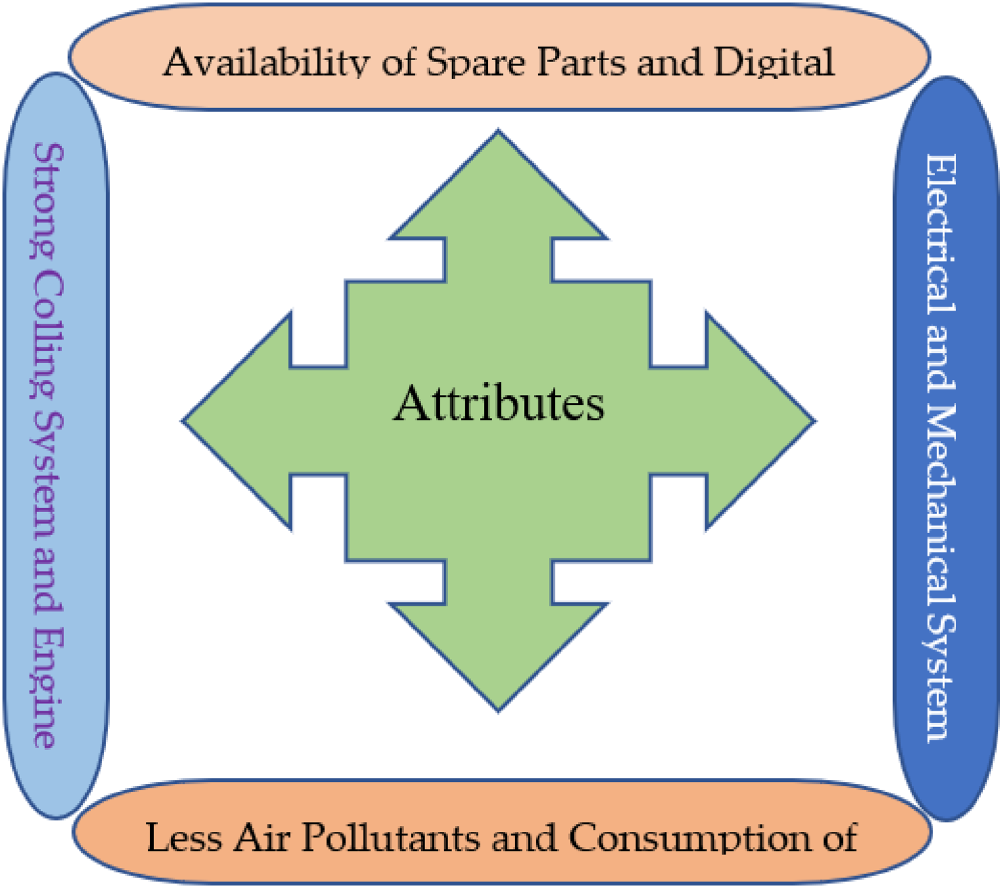
Shows the selection criteria election for an alternative or optimal option.
Decision matrix R1 shows the information of q-ROFVs.

Decision matrix R2 shows the information of q-ROFVs.

Decision matrix R3 shows the information of q-ROFVs.

Aggregated decision matrix by q-ROFAAWHM operator.

Aggregated decision matrix by q-ROFAAWDHM operator.

Aggregated results by the q-ROFAAWHM and q-ROFAAWDHM operators.

Score values of all preferences.

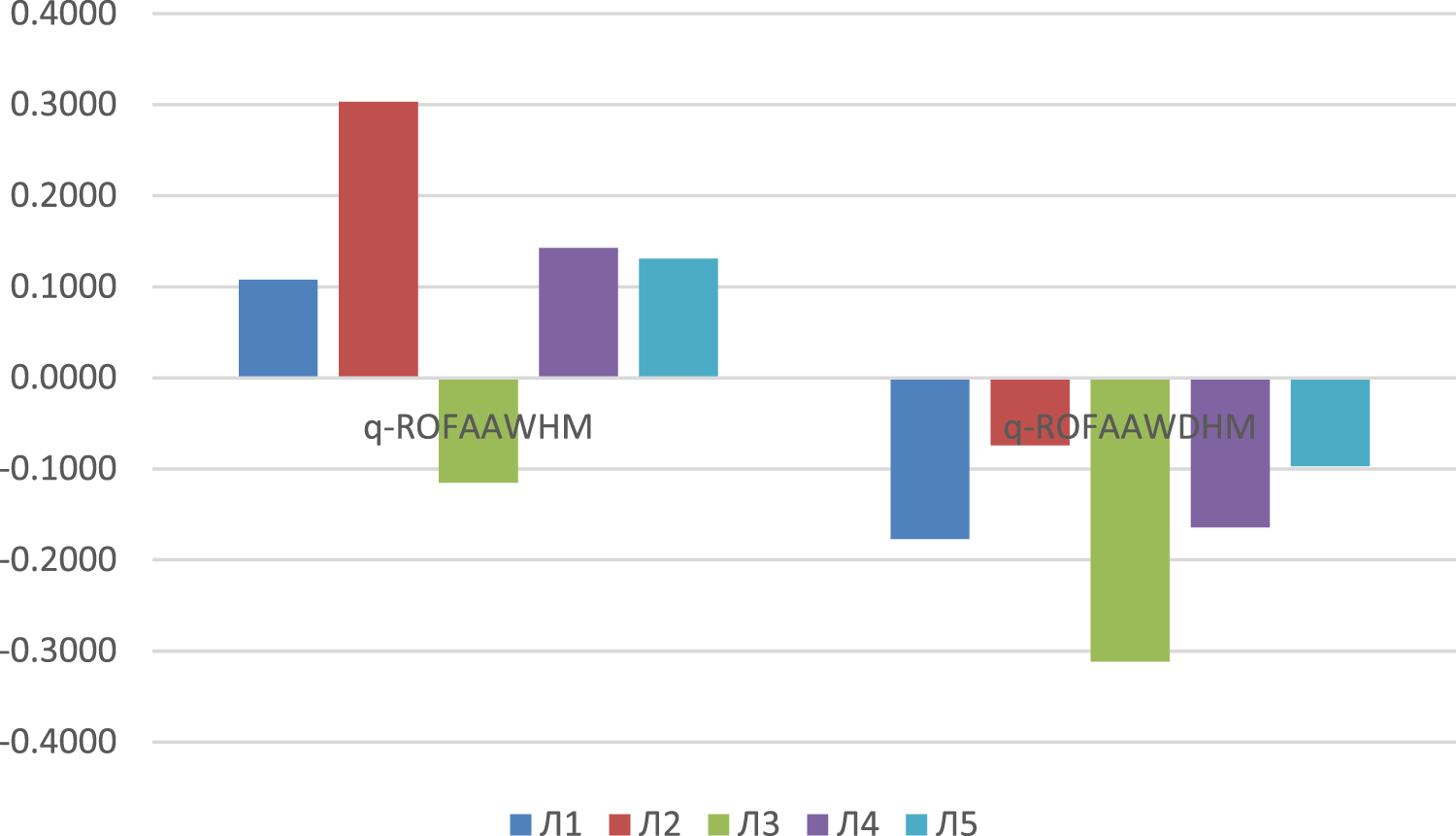
Graphical representation of investigated results by the q-ROFAAWHM and q-ROFAAWDHM operators.
We computed the score values using q-ROFAAWHM and q-ROFAAWDHM operators and ranking in graphical form is shown in Figure 4.
This section demonstrates the impact of different parametric values on the MAGDM problem. The decision-makers applied different parametric values in derived approaches of the q-ROFAAWHM and q-ROFWAADHM operators using steps 3 and 4 of the MAGDM problem. To serve this purpose, we applied different values of variable
However, Table 9 explores the investigated results by setting the parametric value of Aczel Alsina operations in the q-ROFAAWHM operator. After examining the behavior of parametric values of
Effect of parametric value
on the q-ROFAAWHM operator.

Effect of parametric value
We investigate the ranking of alternatives by taking different parametric values of
Effect of parametric value

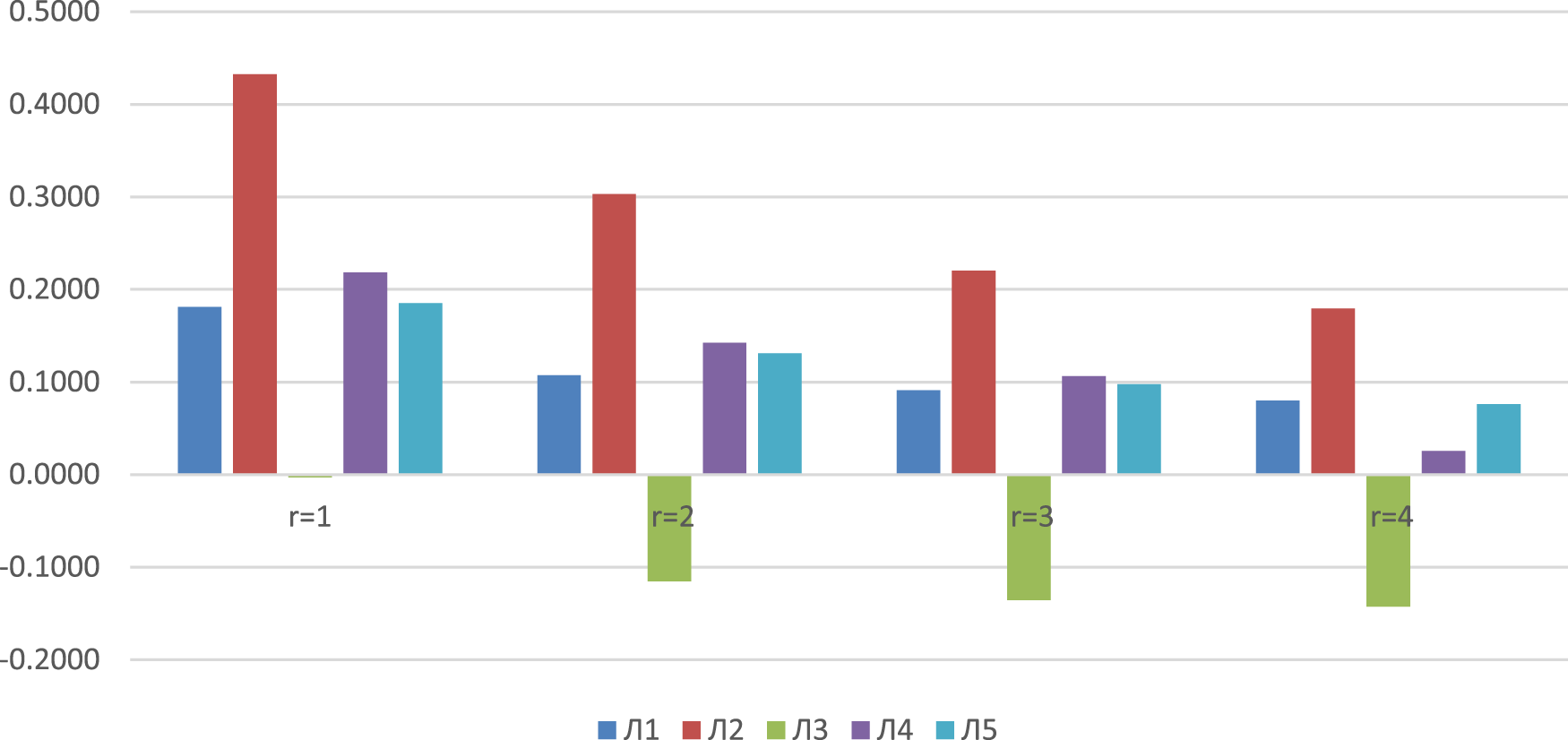
Graphical representation shows the effects of different parametric variables on the q-ROFAAWHM operator.
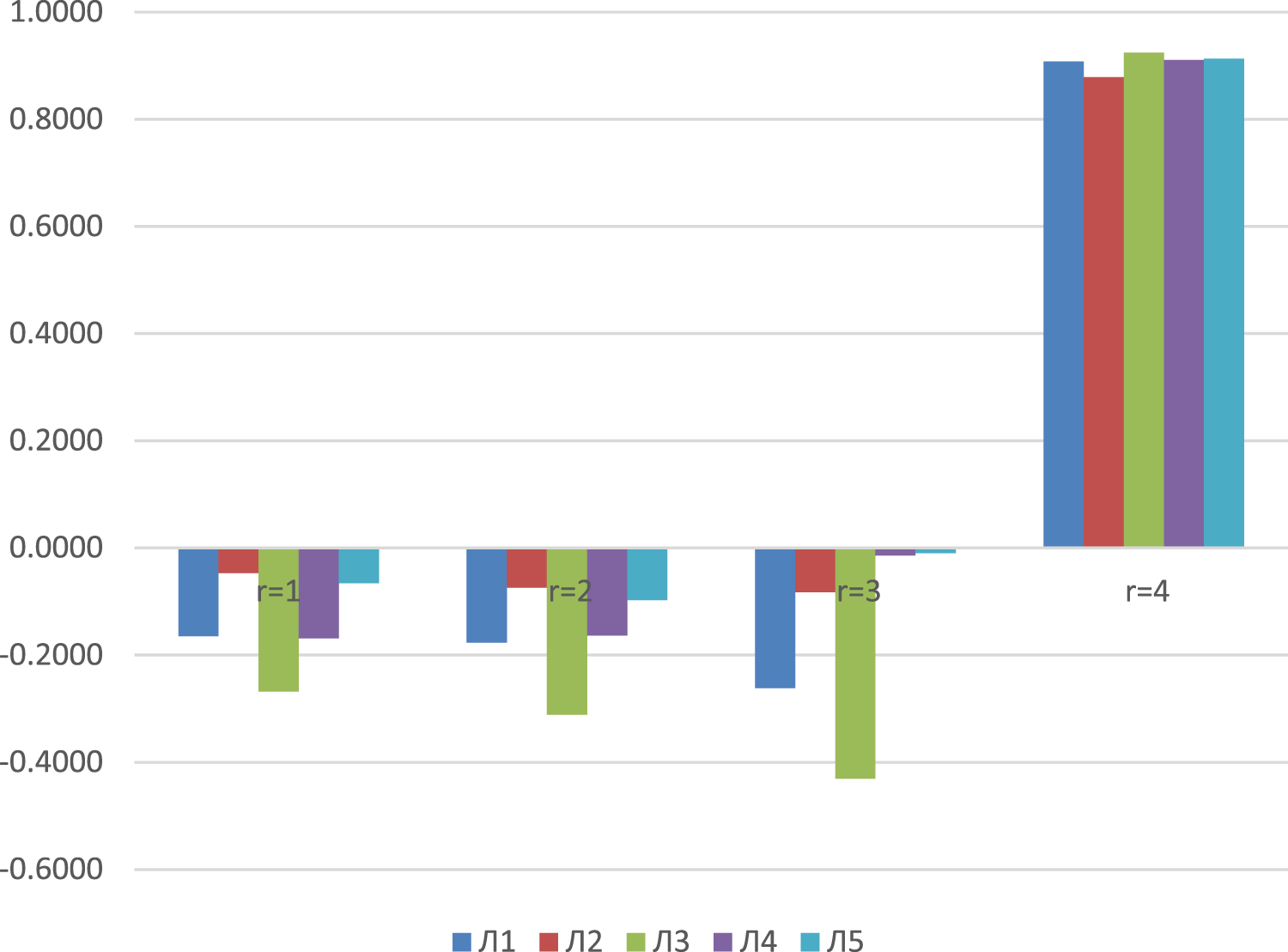
Graphical representation shows the effects of different parametric variables on the q-ROFAAWDHM operator.
One of the most important and effective methods for determining the best optimal form for choosing preferences is to use a decision-making strategy. To study the potential and efficacy of proposed approaches, we compare our invented work with already presented methodologies. For this, we applied some existing AOs seen in63,72,73 on q-ROF information listed in Tables 2–4. A series of appropriate approaches such as q-ROF Aczel Alsina weighted average and weighted geometric by Khan et al.,
63
Liu and Wang
72
presented a series of q-ROF weighted average and weighted geometric operators by using some basic rule of algebraic sum and algebraic product, Seikh and Mandal
73
examined the robustness of Frank aggregation expressions under consideration of q-ROF information. Jana et al.
74
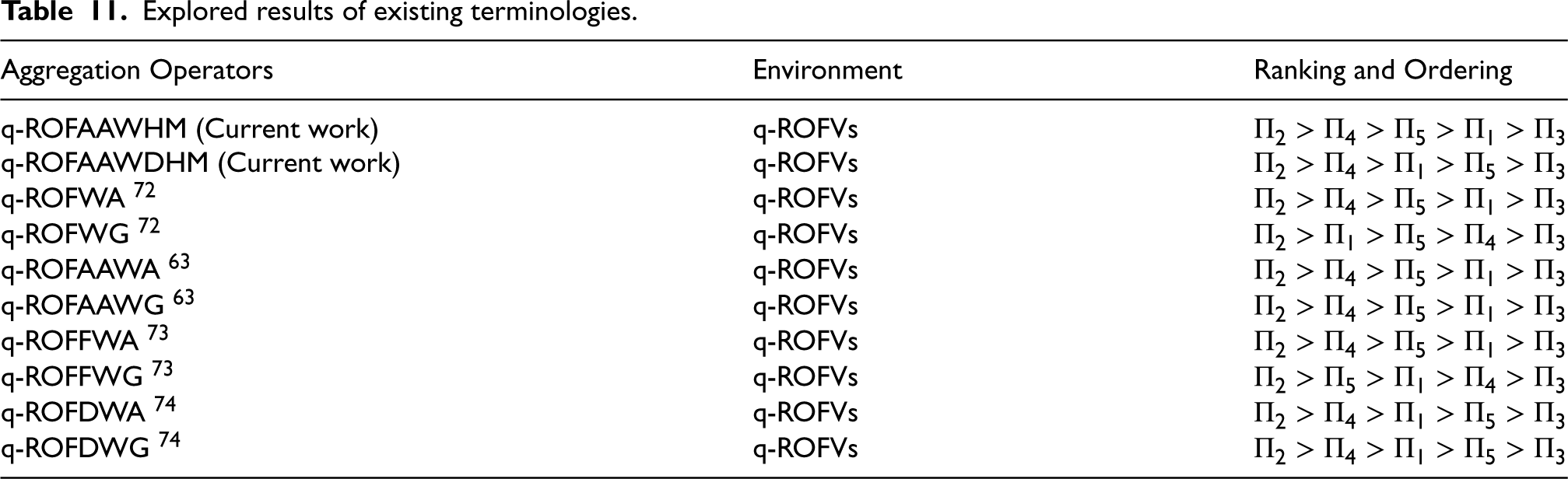
also illustrated some new strategies of Dombi aggregation expressions under q-ROF information. Table 11, carried the consequences of existing methodologies which are produced by integrating q-ROF information depicted in Tables 2–4. The advantages and compatibility of our derived approaches are described as follows:
After examining the score values of existing approaches shown in Table 11, we concluded that our invented approaches are more applicable and effective. The theoretic concepts of Aczel Alsina aggregation expressions provide a more prominent and smooth approximation. Our derived methodologies have an extensive capability to solve real-life problems which are discussed in,63,67,72,73,74 But developed methodologies cannot solve the application of daily life seen in.11,14,28,29 We also exposed the geometrical behavior of obtained score values by existing approaches in Figure 7.
Explored results of existing terminologies.
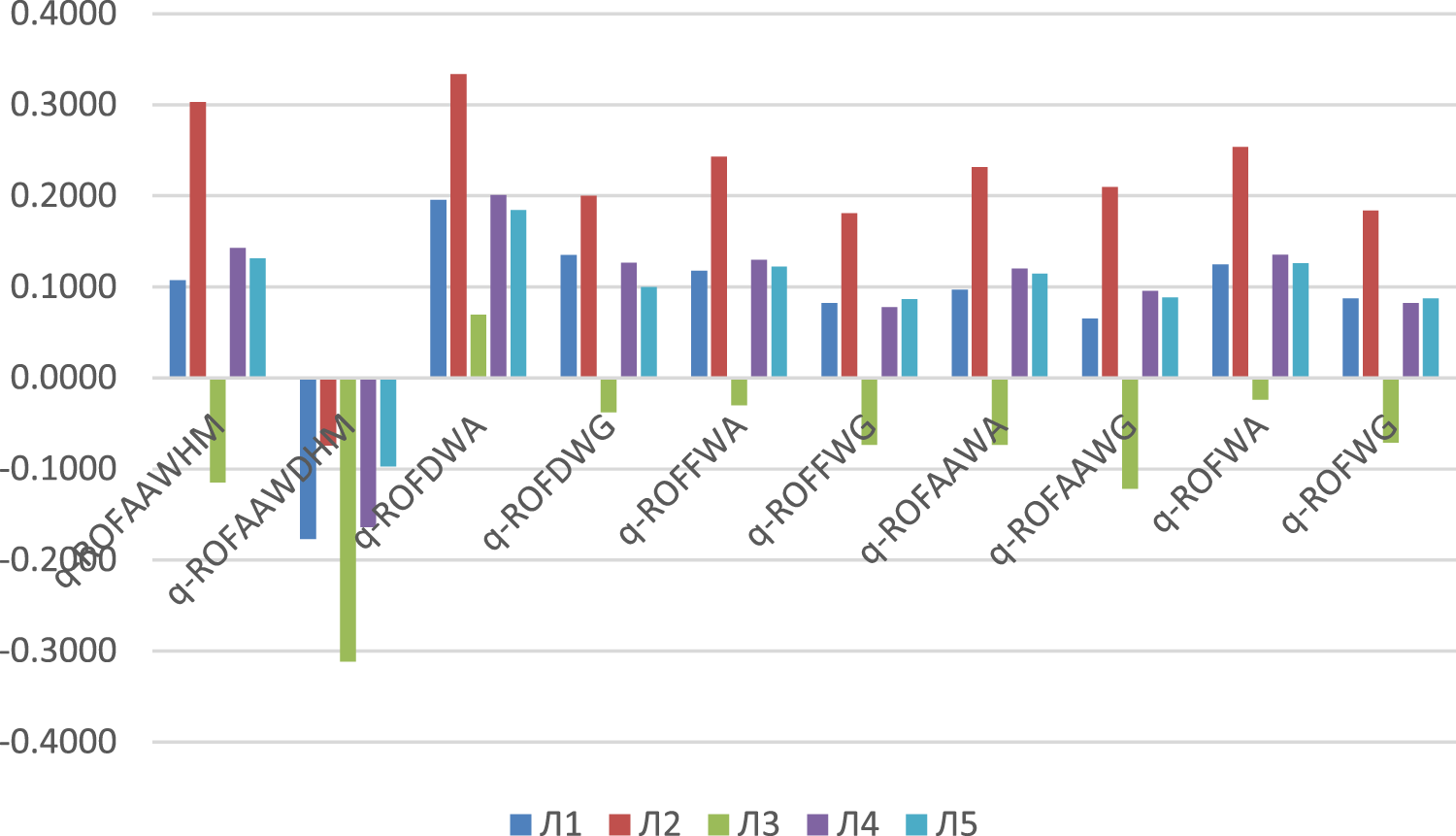
Graphical representation to show the results of existing terminologies.
One of the most difficult tasks in multidisciplinary research is the precise integration of uncertain information as well as preferences. The MAGDM technique is widely used in different fields of life and is also applied to solve an application of real-life challenges under imprecision and vagueness in the information. In this article, we exposed the theoretic concepts of Aczel Alsina aggregation expressions under q-ROF information. The Aczel Alsina aggregation expressions provide a more appropriate and smooth approximation during the aggregation process. Furthermore, HM and DHM operators are dual to each other and are used to define the relationship among various types of attributes. Using fundamental operations of Aczel Alsina AOs, we developed mathematical methodologies of q-ROF context such as q-ROFAAHM, q-ROFAAWHM, q-ROFAADHM and q-ROFAAWDHM operators. A few properties and special cases also verified the compatibility and effectiveness of AOs. An algorithm of a MAGDM technique is also proposed to show the robustness of our derived methodologies. By utilizing the presented algorithm under our derived approaches, we exposed a numerical example to choose a reasonable option from a group of alternatives. To determine the intensity and feasibility of our derived approaches, we proposed a strong comparison technique to contrast the results of existing approaches with the results of currently discussed AOs.
We discussed many advantages and features of derived methodologies and decision-making techniques. However, we can overlook the limitations and restrictions of proposed approaches. The q-ROFS failed when experts discussed more than two aspects of human opinions neutral and refusal grades as well as MVs and NMVs. To handle such situations, we can expand pioneered approaches to picture fuzzy systems, spherical and t-spherical fuzzy sets. In the future, we will prolong our derived approaches in the framework of spherical fuzzy sets 75 with Aczel Alsina aggregation expressions. Furthermore, we will also explore our derived approaches under the system of Linear Diophantine FSs, 76 investigate unknown weights using entropy measures, 77 complex picture fuzzy framework 78 and complex q-ROF information. 79 Advanced decision-making techniques may also discussed to resolve real-life applications and numerical examples using TOPSIS, EDAS, MARCOS and WASPAS methods.
Footnotes

Ethical considerations
The authors state that this is their original work, and it is neither submitted nor under consideration in any other journal simultaneously.
Funding
The author(s) received no financial support for the research, authorship, and/or publication of this article.
Declaration of conflicting interests
The author(s) declared no potential conflicts of interest with respect to the research, authorship, and/or publication of this article.
Data availability statement
The data will be available at reasonable request to the corresponding author.
Human and animal participants
This article does not contain any studies with human participants or animals performed by any of the authors.
Appendix
We prove the above Equation 6 and show that the accumulated value of q-ROFVs is still a q-ROFV:
Since
Now,
After that,
Now,
Similarly, by following these steps, we can get:
So,
Now, we must prove that:
Since
We prove that the above equation is a q-ROFV by satisfying the following conditions:
Suppose that,
Since
From this,
Finally,
So,
So,
Now, we have to prove that:
Since
So,
Case 2:
We prove the above equation to be a q-ROFV by fulfilling the following conditions:
Since,
Similarly, we can get:
Now, the following conditions satisfy: