




Abstract
This criterion study examined the impact of the cultural dimensions of individualism and collectivism on actual plagiarism in working business students. Given globalization of business and recent business scandals, furthering our understanding of international ethics remains critical. Business students are the potential employees, managers and leaders of organizations in the future. In this study we focus on one form of unethical conduct by business students, i.e. actual plagiarism, and seek to determine the link between this behavior and cultural values of individualism/collectivism and associated stereotypes of Asian/Caucasian students. Our findings suggest that individualists plagiarize more than collectivists, and that no significant differences in plagiarism exist between Asian and Caucasian students, contrary to popular beliefs. The implications of these findings for scholars and managers are discussed.
As globalization expands, managers and scholars are increasingly interested in determining the role of culture in business ethics. As we debate which aspects of ethics are universal or culture specific, managers need to know where there is potential for deviant behavior and establish guidelines to manage these behaviors. Research on a microcosm of this global reality, i.e. business students and their plagiarism behavior, can shed light on what managers need to consider in their organizations. Prior research attempting to link classroom cheating and unethical behaviors in organizations (Lawson, 2004) suffers from social desirability and self-report bias. In a 2009 study that used the same criterion variable used in the current research, (Names withheld) found that those who scored high on pre-employment measures of integrity and responsibility were significantly more likely to plagiarize than those who did not, suggesting that plagiarizing has become so commonplace in the academic environment that students did not see anything wrong with it. More importantly, the correlations manifest a relationship between employee selection tools and potential future employees from the business student population. Another problem in previous unethical criterion studies is the focus on post-accusatory measurement. For example, in Collins and Schmidt’s (1993) white collar crime validation, participants were already incarcerated and measures were being applied post hoc. Accordingly, consideration needs to be given to timing in the collection of criterion variables, as well as to the ordering and collection of the independent variables to prevent salience.
Recently, plagiarism scandals have been receiving increasing attention in the global media (Agence France-Presse, 2007) and expansive academic attention (Chapman and Lupton, 2004; Evans and Youmans, 2000; Gallant and Drinan, 2006; Hayes and Introna, 2005; Leask, 2006). A review article reported over 200 journal articles and reports on the topic of academic cheating (Lupton, 1999), with recent articles moving towards clearer definitions of the issues at hand based on actual criteria (Martin, Rao & Sloan 2009, 2011). The consensus among researchers in the field, as well as anecdotal evidence from practitioners, is that plagiarism is on the rise. Plagiarism is a specific type of academic dishonesty. The word ‘plagiarize’ is defined as: ‘to commit literary theft: present as new and original an idea or product derived from an existing source’ (Merriam-Webster, 2006–2007) and has implications for managing intellectual property rights. Yet, despite dictionary definitions, the understanding of plagiarism is far from standardized and subject to interpretation. Modern technology, the ability to ‘cut-and-paste’, and the difficulty of ascertaining accurately the authorship of many webpages exacerbates the problem. It is further complicated by institutions where the definition of plagiarism in their academic dishonesty policy is vague.
International students, particularly Asians, are often seen as persistent perpetrators of unethical academic behavior (Deckert, 1993).The prevalent assumption is that students coming from collectivist cultures may have different ethical constructs than those of traditional mainstream America and be more prone to plagiarism because of their educational system and cultural norms. Much has been written about Confucian educational systems, collectivist norms that do not emphasize individual rights and the consequent willingness to plagiarize by collectivist (primarily Asian) students. Sowden (2005) and Liu (2005) debated the impact of national origin, ethnicity, culture, and acculturation on culture in multilingual students in higher education. Both these researchers (and Ha, 2006) acknowledged a stereotype of Asian students plagiarizing more owing to educational and cultural expectations. Sowden describes Asian educational orientations in which students copy ‘experts’ as reproduction of established knowledge is the norm, as opposed to innovation based on the educational material presented. Sowden considers multilingual students as responding to their host culture based on their own cultural educational expectations, and offers as a typology that of three groups of students: (a) those that identify with their heritage culture, (b) those that appreciate elements of both cultures, and (c) those that identify strongly with the host culture.
Americans are presumed individualists who focus on the maintenance of personal identity with the self as the basic unit of survival (Markus and Kitayama, 1991). Collectivism emphasizes the development and maintenance of a set of common beliefs, attitudes, and practices, which are preferred and rewarded (Markus and Kitayama, 1991). In a recent study on plagiarism by graduate business students, McCabe et al. (2006) outlined some theoretical reasons why business students are more prone to plagiarize. Western business education, with its emphasis on economic theories and the free markets, may have a detrimental impact on students’ values, attitudes, and consequent behavior. Students thus engage in behavior that will maximize their self-interests. Frank et al. (1993), demonstrated that over the course of a semester of economic education, students’ honesty declined and their self-interested behavior increased. These studies suggest that business and economics education tend to increase individualistic tendencies and, consequently, self-serving behavior such as plagiarism. McCabe et al. (2006) also report that students cheat more often when they think their peers are doing so and they expect to get away without detection.
Previous studies have recorded the impact of acculturation on plagiarism behavior (Ref 2, 2011), but the impact of culturally relevant individual differences has not been fully established. Accordingly, the goals of the current study were first to determine the cultural roots of a specific form of unethical conduct, i.e. the impact of collectivism and individualism on plagiarism, and, second, to establish potential differences in the probability of more plagiarism in Asian students than in others because of their potentially collectivist cultural background. Third, and of great importance, plagiarism behavior was studied rather than self-reported plagiarism behavior as the latter is clearly susceptible to social desirability bias (McCabe and Trevino, 1995). This study differs from prior research in that we examine the impact of integrity-related measures on a measurable criterion (plagiarism behavior), thus eliminating self-report bias and the impact of social desirability on responses. In the following section, we review the literature on plagiarism and its relationship to the cultural values of individualism and collectivism.
Cultural dimensions of individualism and collectivism
The cultural dimensions of individualism and collectivism have captured attention since Hofstede’s (1980) landmark research on national cultural differences. Consequently, the constructs have been researched in connection with a wide range of phenomena, including managerial ethics (Smith and Hume, 2005). Most studies continue to use a uni-dimensional construct wherein a low score on individualism implies a collectivist culture. Some researchers, however, have begun to examine these phenomena as independent dimensions consistent with bicultural models of acculturation (Ryder et al., 2000) rather than as polar opposites of a single dimension (Kagitcibasi and Berry, 1989; Oyserman, 1993). As such, both constructs may manifest in different situations, with behaviors reflected at both the cultural and individual level. Importantly for this study, students within a diverse student body may be exposed to individualistic and collectivistic cultures and develop a composite that incorporates both dimensions. For example, processes of acculturation through random (non-homogeneous) study groups, individual presentations, voting, and choices in daily life may provide a tacit learning experience in individualist perspectives contrary to the communal in-group membership expressed in a collectivist culture (Triandis, 1989).
Impact of culture on plagiarism
Several studies have attempted to decipher the link between unethical behaviors and culture, applying Hofstede’s (2006) cultural dimensions of individualism and collectivism as well as uncertainty avoidance. Some of this research has supported the assumption that people who score higher on uncertainty avoidance are more likely to cheat. Several studies were conducted to compare students in the US and Hong Kong (Chapman and Lupton, 2004), and students in the US and the United Kingdom (Salter et al., 2001). The US culture represents low uncertainty avoidance and high individualism, Hong Kong has high uncertainty avoidance and a high collectivism culture, and the UK represents high individualism with relatively lower uncertainty avoidance compared to the US In both comparative studies, US students were found to have a higher tendency to cheat than students in Hong Kong or the UK negating the assumption that high uncertainty avoidance and collectivism lead to more plagiarism. The results of the above studies suggest that assumptions of student behavior may not correlate with racial/cultural or ethnic identity, as previously assumed.
Asian students are often seen as having deficient knowledge about English writing due to their lack of language skills and their background in foreign educational norms, and are therefore more tempted to plagiarize. Asian learning styles may have an emphasis on rote learning and recall, which has also been seen as a potential cause of plagiarizing temptations. Leask (2006) suggests that the western learning environment can cause problems for foreign students and suggests that we examine stereotypes and concepts about what we consider to be shallow and inferior learning strategies. For example, while Leask suggests that a type of secondary research called ‘patchwriting’ (combining different sources to create a new document), which requires painstaking hours of searching and skill to compile a good document, has learning value. Accordingly, use of ‘patchwriting’ as a learning tool might not be unacceptable to many US educators.
International students often say that they understand plagiarism and that there is a global understanding of plagiarism (Youmans and Evans, 2000). At the same time, in a qualitative study (Shi, 2006) international students reported a diverse range of perspectives on plagiarism. For example, a Korean student used the word ‘pyojeul’ for plagiarism which only applies to professional articles and not to student articles. In the same study, Japanese students offered two words for plagiarism, tooyoo and tousaku, both of which deal with copying or use of another’s ideas, but neither is considered a serious offense in Japan. Importantly, the use of more than one term indicates a lack of direct comparison. A Chinese student described a new term piaqqie, while another said that piaqqie was allowed. International students may think they have a basic understanding of plagiarism as applied in the US; however, the word or concept may actually be unclear given the above.
Asian versus western philosophy on plagiarism
Asian traditions have roots in Confucianism, which advocates open access to knowledge as a common heritage (Shi, 2006). Furthermore, China was strongly influenced by the Soviet Marxist model of copyright law (Alford, 1995). This could be interpreted as showing common ground with the Confucian tradition of seeing intellectual creation as a part of the larger society. Students from Asian backgrounds tend to use terms like ‘It is said …’ and ‘The first idea is …’ without mentioning the author specifically. In many Asian countries, a class will use a single book and that book is the authority. Citations are not required because all of the knowledge comes from that single book.
In American culture, the behaviors discussed in the previous section may be viewed as cheating; however, as discussed, they may not be perceived as such in other cultures. Cross-national differences in students’ perceptions and participation in cheating have been established in the research literature. In a study by Chapman and Lupton (2004), business students attending universities in Hong Kong were found to have significantly different perceptions of academic dishonesty than American students, with the American students having a significantly (self-reported) greater likelihood of participating in some form of cheating. One point of commonality across cultures was the similarity in individuals viewing themselves as being less likely to cheat compared to their fellow students (Chapman and Lupton, 2004). These findings are consistent with results from a sample of individual managers employed at companies in their home countries who were part-time or past attendees of postgraduate management programs (Jackson, 2001). Across groups made up of 10 different nationalities, sampled managers saw others as being less ethical than themselves (Jackson, 2001). The two studies reflect the need to perform criterion-related research to avoid bias in self-evaluation.
While research on the impact of culture on academic plagiarism has been limited, the findings have been generally consistent, which is what led us to conduct criterion-oriented research to identify results and issues caused by social desirability and reporting unethical behaviors. Imagine a professor asking students in the beginning of a course: ‘How many of you have plagiarized in previous classes?’. What proportion of students would raise their hands? Given the resulting unappealing reputation with both the professor and fellow students, it is unlikely that any student would accurately portray themselves as a plagiarist. The current research addresses the weakness in previous research approaches by using plagiarism behavior as measured through Turnitin, an online plagiarism detection service. While there are limitations in identifying all cases of plagiarism via software (see below), Turnitin is a more independent measure of plagiarism behavior than self-report.
While only one criterion study has established that Asian students are not significantly more likely to plagiarize than their American peers (Martin et al., 2011), the author has been surprised to find researchers at major international conferences dismiss the findings of previous research and ascribe the differences in American and Asian students to culture (specifically individualism and collectivism as currently operationalized). Pulling from previous research, the current research attempts to address the concerns of these researchers.
Based on the review of the above literature, the following hypotheses were developed:
Hypothesis 1: Students from Asian cultures will plagiarize more than their American peers.
Hypothesis 2: Collectivists will plagiarize more often than individualists.
Hypothesis 3: Length of stay in the U.S. will be inversely related to Asian students’ levels of reported collectivism.
Hypothesis 4: Differences will be found between plagiarizing and non-plagiarizing groups, with highly collectivistic scorers plagiarizing significantly more than others.
Method
Participants
The participants were business students from a medium-sized, western United States university with a large percentage of both international students and students from different ethnic backgrounds. The 163 participants’ ages ranged from 21 to 50-plus with the majority being between 21 and 25 (70%). Approximately 55% of the students were female and 45% male. The majority were undergraduate business students (90%). Students from a range of ethnicities responded, Asian and Caucasian students being the largest groups in the sample. Data collection was part of an opportunity for extra credit in all of the classes during the winter quarter 2006–2007. Participation was voluntary and the instruments were administered via an online survey package at three different points during the quarter to ensure that students did not suffer fatigue.
Instruments
Survey data
Two surveys were administered to collect information on the participants. First, a Likert scale was used to determine whether participants identified themselves as either individualists or as collectivists. The scale was developed by Oyserman (1993) and is based on existing items from the Individualism/Collectivism literature. Individualism and collectivism were each measured with 9-item 5-point Likert format scales with Cronbach’s α of .71 to .78 (Oyserman, 1993), depending on the samples used. Based on our review of the literature and our diverse student population (the largest populations being Caucasian and Asian), the scales were particularly suitable for our study.
Demographic variables
Students provided the following personal information: ethnicity, gender, and length of time in the United States.
Plagiarism
In the academic dishonesty policy of the university where this study was conducted, plagiarism is defined as follows: ‘plagiarism, which includes taking the words or substance of another and either copying or paraphrasing the work without giving credit to the source through footnotes, quotation marks, or reference citations’. The final say on exactly what constitutes plagiarism is left up to the individual professor and any accusation of this activity must be carefully documented.
Plagiarism was assessed by a software program called Turnitin. Turnitin.com is an online plagiarism evaluation system provided to all faculty at the university with the express purpose of preventing students from being able to pass off others’ work as their own. Student papers are uploaded into the system and evaluated by comparing the text to an internal database that consists of student papers previously submitted in any of the following sources: documents submitted by any university using Turnitin, the ProQuest database of academic journals, and content available on the Internet. Within a few minutes, the system provides originality reports giving the percentage of words matched in the above programs, databases, and Internet websites, along with the source where the words appear. Students turn in approximately 40,000 papers per day to this commercial site, and Turnitin (2006) has claimed that 30% of them contain plagiarism. We manually screened the papers to ensure that the system excluded quotations, references, and other bibliographic materials during its assessment. While the use of Turnitin offers a significantly powerful tool in identifying plagiarism in the work of students present as their own, it is imperfect, as noted by Turnitin (2006: 18) itself. This is due to the varying approaches that can be used to screen students’ efforts and how the output of the system can be interpreted. Due to the range of options faculty members have in using Turnitin’s quantified results, we established conservative criteria for defining plagiarism (see below).
Procedures
The first class meeting of each quarter in which the study was conducted was spent reviewing class expectations and university guidelines regarding plagiarism. Students were advised that plagiarism would not be tolerated, and, when recognized, would result in a failing grade for the course, a report to the university administration, and potential expulsion from the university. The official definition of plagiarism was provided to the students and included in the syllabi for the classes.
The students’ very first extra credit assignment was to write a paper on the differences between the concepts of affirmative action and diversity. Students were asked to upload their papers to the Turnitin system. Credit was given based on participation, not on the proportion or existence of plagiarism, which prevented a majority of the class from failing (see below). Once the students uploaded their papers, we individually removed all cited, quoted, and bibliographic references, and checked for potential errors in categorizing the students’ potential cheating behavior by Turnitin (2006: 18). Based on a thorough review of the Turnitin software’s capabilities in detecting plagiarism, and because the average length of the paper was two single spaced pages (assignment length) composed in Times New Roman 12 font, we conservatively identified our cut-off point for the presence of plagiarism at 3% (or about 30 words in a row). Each student could submit only one research paper for review. The survey data was collected throughout the quarter to avoid survey exhaustion. Student identification numbers were collected to ensure that extra credit was received for both the surveys and the Turnitin data collection, and to link the data together for the purposes of analysis. Student confidentiality was maintained by the removal of all identification (names and student identification numbers) after the plagiarism data had been linked to the survey data.
Results
After carefully screening the research papers, 72% of students were found to have plagiarized (at the aforementioned 3% cut). Sample statistics and percentages of plagiarism committed by students with various characteristics are provided in Table 1 (Participants did not provide complete data; accordingly, percentages do not sum).
Participant demographics.
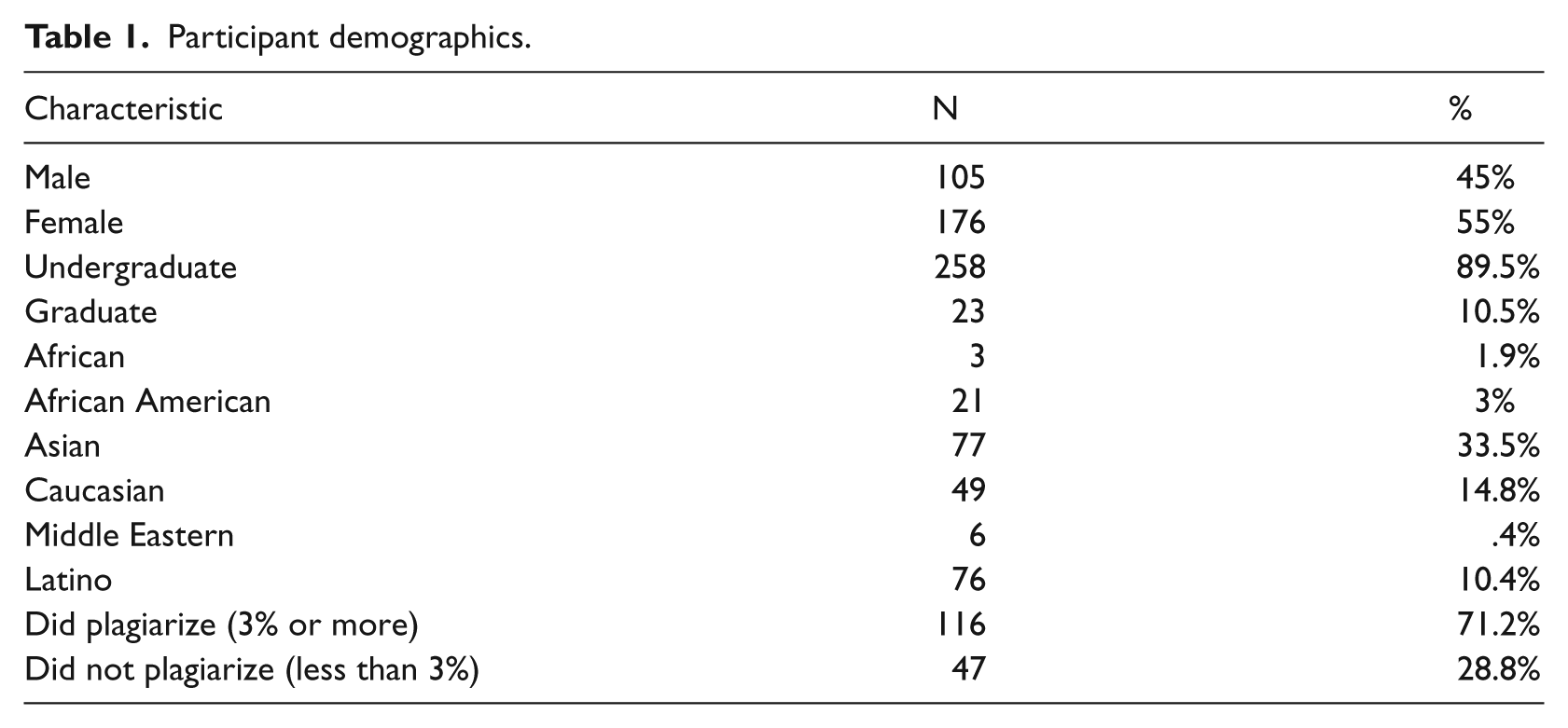
Approximately 72% of our population plagiarized, while approximately 28% did not. These results are important because they suggest that the current over-reliance on self-reported measures of plagiarism is flawed due to self-bias and social desirability, with a significant underestimation of plagiarism.
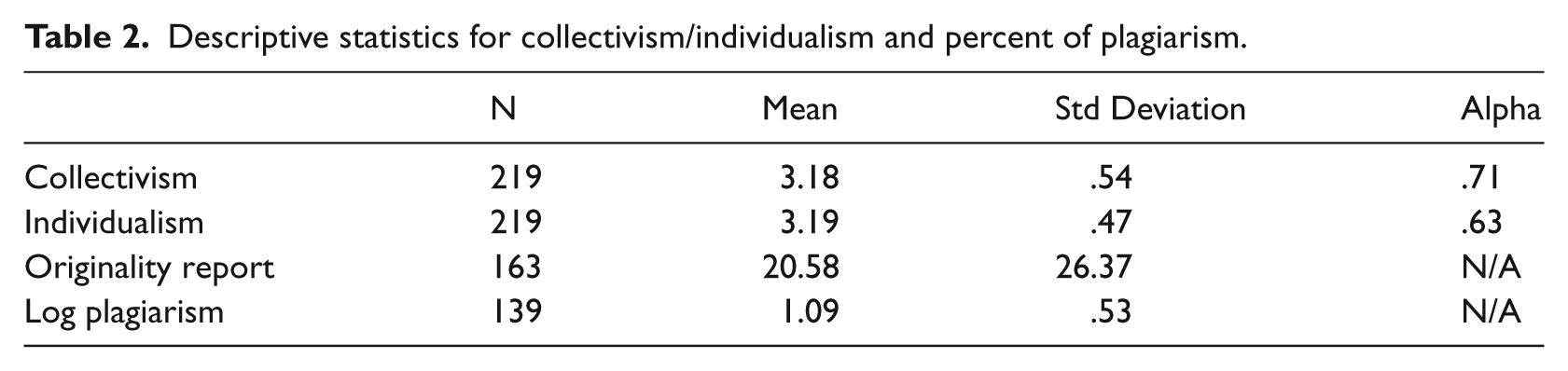
Table 2 provides descriptive statistics for the Individualism and Collectivism scales and the Originality reports (percentage of the paper plagiarized) as well as years in the United States for both of our target populations. Given the fact that the Turnitin Originality reports are bounded by zero and defined as ratios, we confirmed the skew by performing a log transformation on the originality reports. The originality variable ranged from zero to 100%, with a standard deviation of 26.37.
Descriptive statistics for collectivism/individualism and percent of plagiarism.
To test Hypothesis 1, that Asian students would plagiarize more than their Caucasian peers, we ran a one-way ANOVA with the dependent variable of the originality score, and the fixed factor of self-reported ethnicity, either Asian or Caucasian. The results did not support Hypothesis 1 as can be seen in Table 3. This supports existing evidence that racial identity is a not an appropriate proxy for individual differences, behavior, and psychological characteristics.
Univariate analysis of variance: ethnicity and originality report.

To establish the relationships between the two dimensions of individualism/collectivism and plagiarism behavior, we ran bivariate correlations. Given our focus on Asian and Caucasian students, we ran separate correlations for the two groups. Significant positive correlations between the originality report and individualism were found for Asian students (.29, p<.05), contrary to Hypothesis 2, which linked collectivism to plagiarism. Importantly, significant positive correlations between the originality report and individualism (.47, p<.05) suggest that Caucasian students with higher scores on the individualism scale had larger proportions of plagiarism in their assignment. No significant correlations were found between collectivism in either the Asian or Caucasian students. These findings do not support Hypothesis 2 and offer insights into the mediating impact of individualism on plagiarism behavior. The correlations are presented in Table 4.
One-tailed bivariate correlations.
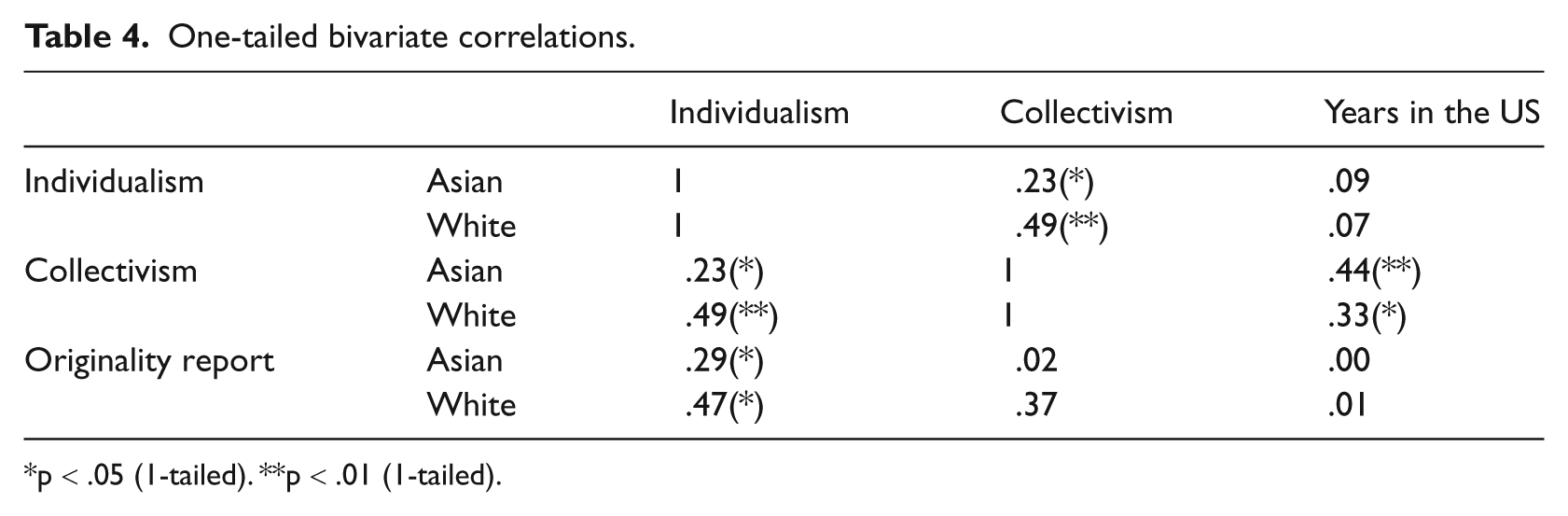
p < .05 (1-tailed). **p < .01 (1-tailed).
Hypothesis 3 was supported by the negative correlation (−.54) between length of stay in the United States and collectivism scores in Asian students (See Table 4). The result supports the general theory of acculturation, indicating that the longer individuals remain in a culture, the greater the changes in their cultural identification. Again, this is consistent with previous findings (Martin, Rao & Sloan 2009).
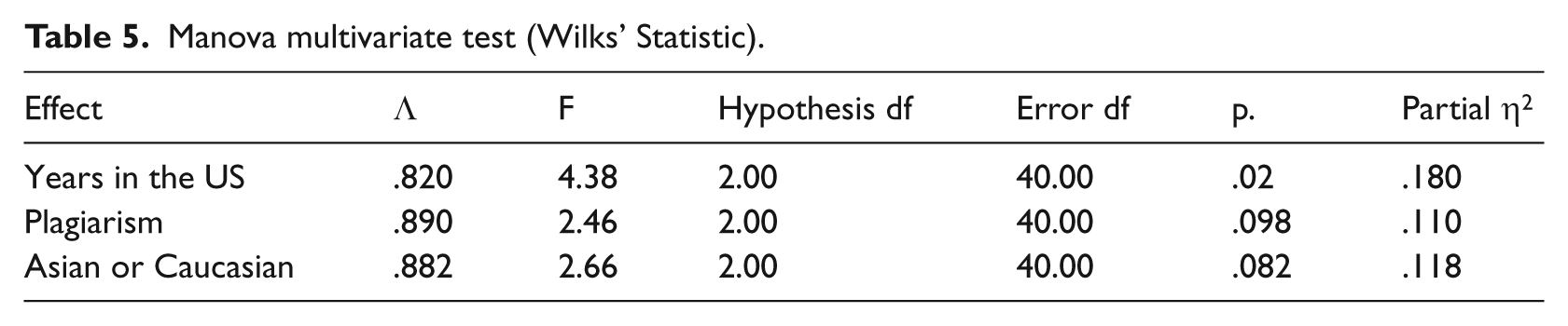
Multivariate analysis of covariance (MANCOVA) was used to test the hypotheses, with individual level of individualism and collectivism serving as the dependent variables, and plagiarism group (dichotomous, did or did not) and self-reported racial identification serving as the fixed factors for the MANCOVA. Given previous work on acculturation in plagiarism (Martin, Rao & Sloan 2011), we used length of stay in the United States as a covariate.
Using Wilks’ criterion, we found moderate (Years in US partial η2 = .18; Plagiarism partial η2 = .11; Asian or Caucasian partial η2 = .11) associations between the dependent variables and the main effect. Table 4 provides a summary of the significant multivariate Wilks’ Lambda tests (see Table 5).
Manova multivariate test (Wilks’ Statistic).
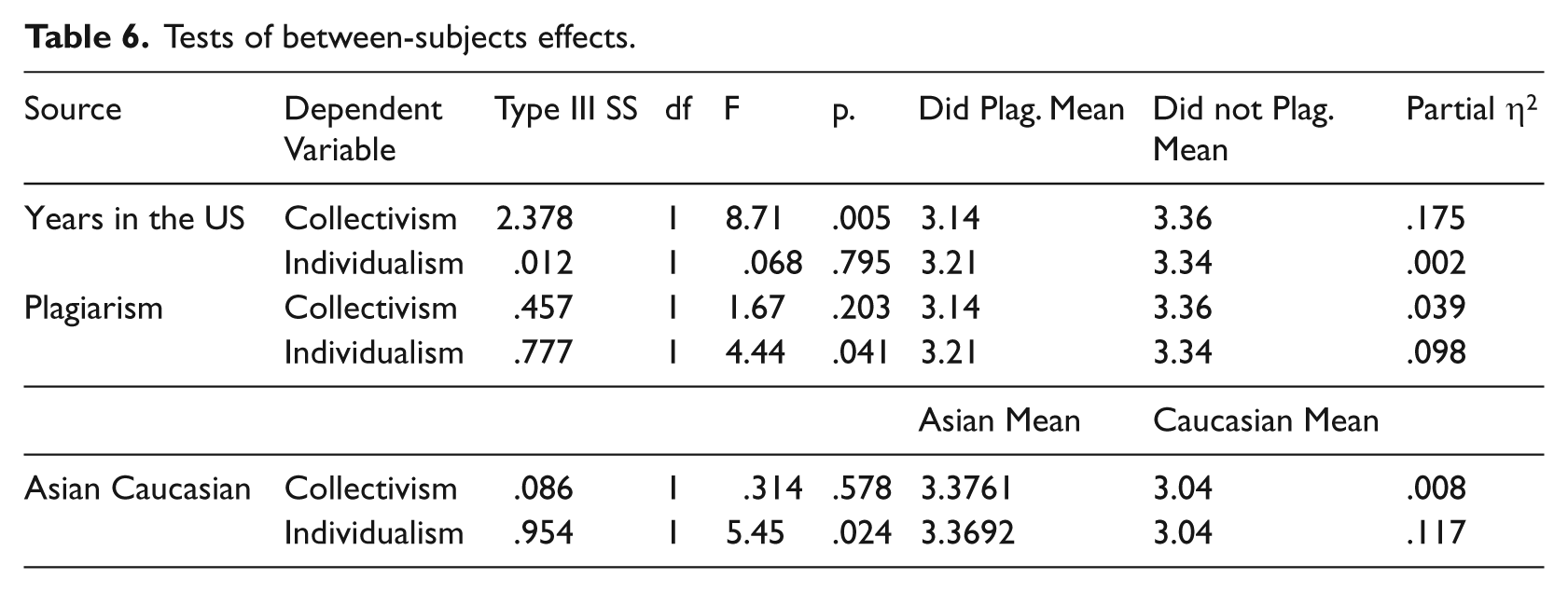
To identify significant main effects and interactions using the MANOVA, the results of the MANCOVA between-subjects effects tests were analyzed further (see Table 6). Significant differences were found between the plagiarism and non-plagiarism groups for the collectivism scale, but not the individualism scale in the covariate (years in the United States) analysis. Thus the results of the covariate analysis suggested a confirmation of Hypothesis 4, which stated that students scoring higher on collectivism would plagiarize more often. While this was the case when controlling for the length of time individuals had spent in the United States, the main effects for plagiarism (The mean differences in Table 6 offer directionality between the two groups) suggest that those who scored higher on measures of individualism were significantly more likely to plagiarize, thus only offering partial support for Hypothesis 4, and reasserting the importance of understanding the moderating impact of acculturation. Asian and Caucasian students were found to differ significantly in collectivist identity. We discuss the ramifications and possible cultural divides among managers, employees, faculty, administration, and students regarding plagiarism in the discussion section.
Tests of between-subjects effects.
Finally, we linked the bi-dimensional model to the single constructs of individualism and collectivism by establishing two equal groups in both individualism and collectivism scales. We then assigned non-equal scores (Low Individualism=1, High Individualism=2, Low Collectivism=3, High Collectivism=6) to the dichotomized variables. The scores were then labeled as follows:
Low Individualism, Low Collectivism, Undifferentiated;
Low Individualism, High Collectivism, Collectivist;
High Individualism, Low Collectivism, Individualist;
High Individualism, High Collectivism, Bi-dimensional.
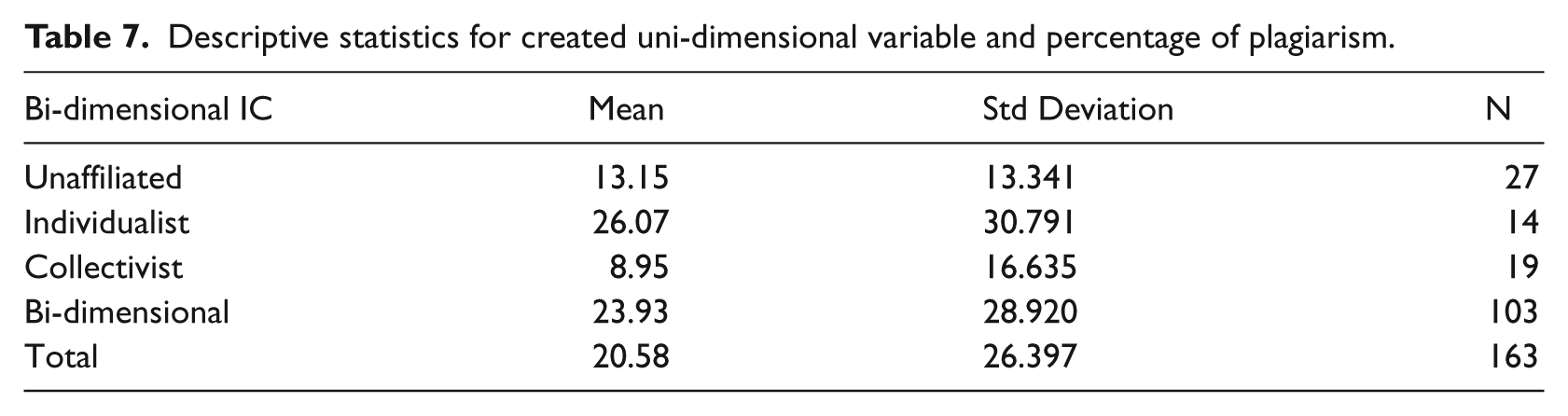
Descriptive statistics of the created variable are presented in Table 7.
Descriptive statistics for created uni-dimensional variable and percentage of plagiarism.
The above coding of the data enabled an analysis of variance to establish the impact of cultural category reflected at both the social and individual level. Given the four categories, post hoc analysis was conducted (see Table 8).
Anova tests of between-subjects effects.
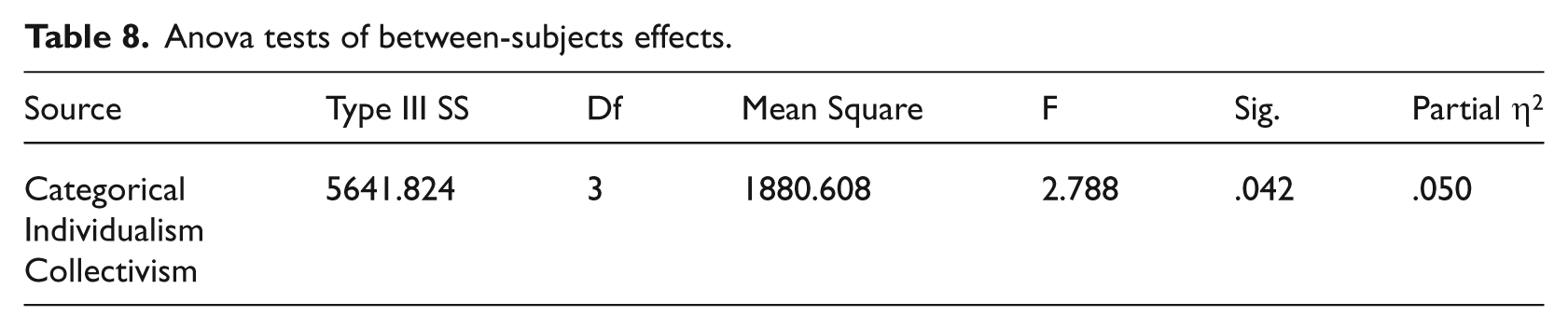
Significant differences were established between the bi-dimensional and unaffiliated (mean difference, 10.78), and the collectivist (mean difference, 14.98), both at the .05 level. The results were surprising, as collectivists plagiarized significantly less than students classified as unaffiliated and individualist.
Discussion
The findings of our study counter popular perceptions of cultural norms and ethnic differences in plagiarism. First, Asians do not plagiarize more than Caucasians, and second, collectivists do not plagiarize more than individualists. Indeed they appear to plagiarize less than individualists.
While the literature is full of explanations for why Asians and collectivists are more prone to plagiarize given their belief in sharing and the educational norms of rote learning and recall (Shi, 2006), there are few explanations as to why individualists are more likely to plagiarize. Yet, we have now a consistent stream of findings, in the US and UK (Chapman and Lupton, 2004; Salter et al., 2001), using multiple methods of research—both self-report and, in this case, plagiarism behavior, which indicates that individualists are more likely to plagiarize. Plagiarism is clearly considered unethical conduct according to modern western thinking and is described as such in most universities. Yet, in the many ways we analyze our data, we find that individualists plagiarize more than collectivists.
McCabe et al. (2006) suggested western business education emphasizes economic theories and free markets, potentially impacting students’ values, attitudes, and consequent behavior. The findings (Frank et al., 1993) were that a semester of economic education declined students’ levels of honesty and increased their self-interested behavior. Again, this suggests that business and economics education may increase individualistic tendencies as well as self-serving behavior like plagiarism. We suspect that the vague rules of the university on plagiarism, owing to the varied perspectives of individual faculty, and the lack of consequences for this behavior has encouraged individualistic students to continue plagiarizing more than their collectivist peers who may not be as strongly guided by self-interest.
As business and management educators, we take a wide range of pedagogical approaches to convey the importance of applied ethics. Graduate and undergraduate students are usually well versed in preparation for tests, but the impact of ethical education in business courses remains vague past graduation. While case studies and experiential exercises attempt to include a variety of perspectives, including the intrapersonal, the interpersonal, and social structure elements with an overlay of legal constraints and business opportunities (Fenwick, 2005), the fidelity of course work and exercises remains low or, potentially, a learning game. Attempts to engage student awareness of integrity, morals, or values (Maclagan, 1995: 172) may be seen as weakness in the onslaught of a dichotomous education emphasizing winning or losing in commerce. Accordingly, giving students a clear indication of the impact of slight ethical lapses may have a tremendous impact on their future attempts to plagiarize, which may, in turn, expand to include consideration of other potentially unethical behavior.
Baron and Strout-Dapaz (2001) surveyed 123 US universities and found that adjusting to a new educational and library system was a significant challenge for international students. International students are placed in stressful environments that challenge their educational norms, and are expected to perform with no new cultural tools (Handa and Power, 2005), ensuring a reliance on tactics that might be accepted by their home culture, but not their host culture.
Business schools need to provide clear expectations and training to ensure that all students have the opportunity to develop skills to avoid plagiarism, that international students can increase their understanding of cultural norms, and that there are opportunities for cross-cultural adjustment. Given our findings, this means clarifying what plagiarism means (operationally), and clarifying the many reasons why students might inadvertently or purposefully plagiarize. Training for students should not seek to acculturate, but inform, engage and invite exploration of the topic of plagiarism and academic ethics. The findings of the current study might be included in faculty orientation programs so that faculty can be made aware of invalid stereotypes (and the confusion between cultures, as well as the educational stresses of international students) and of evidence-based studies that contradict potential stereotypes. Similar to expatriate training, the differences in systems and behavior should be linked to cultural norm differences, with experiential library workshops in avoiding plagiarism (Baron and Strout-Dapaz, 2001). The impact of acculturation should be taken into account (Martin et al., 2011), as well as individual differences for students to consider their own perspective on plagiarism. Equal weight should be placed on faculty education, as, despite research evidence to the contrary (Ha, 2006; Peppas, 2002; Ref 1, 2009), the stereotype persists that Asian students plagiarize more often than their mainstream American peers.
When considering future plagiarism research, establishing the critical situational and individual differences between those who plagiarized and those who did not are clearly critical. The current research and others (Martin et al., 2009, 2011) have empirically established the weakness of theories that have not been rigorously empirically tested and lead to potentially dangerous stereotypes. Given previous explorations of integrity-related individual differences, the situation should take the forefront in plagiarism research. Clearly, experimental studies of the situation writers find themselves in are more time consuming, complex and costly to conduct compared with individual differences research. None the less, given the prevalence of plagiarism, we need to establish previous conditions that may impact the likelihood that individuals will plagiarize.
This study contributes to the literature on culture and plagiarism by examining the relationship between individualism, collectivism, and plagiarism. The findings contradict popular opinion and challenge two stereotypes: (1) that Asians are more prone to plagiarize because of cultural norms, and (2) that individualists will follow ethical norms more than their collectivist peers (Smith and Hume, 2005), using actual plagiarism as a criterion variable. These findings in the university environment also have implications for understanding ethical and unethical conduct in the broader business arena. Rather than assuming that collectivists have less respect for intellectual property rights than individualists (an argument often offered to explain issues in India and China), we need to examine other potential causes. This study provides stronger validation for the previous research on this topic by using the criterion variable of plagiarism, rather than self-reported plagiarism.
Footnotes
Funding
This research received no specific grant from any funding agency in the public, commercial of not-for-profit sectors.