



Abstract
In analysing four UK Business Schools’ webpages and student interviews, this article explores instances of MBA internationalization through the lens of the social imaginary: that is, the way in which people imagine their social existence and ambitions and means they employ to reinforce and achieve these. Using as heuristics three suggested MBA imaginary types, the ‘managerial’, ‘international managerial’ and ‘cosmopolitan’ as part of a four-stage hermeneutic analysis, distinctive approaches to internationalization at each institution are identified. However, the analysis also reveals that webpages portray mixed messages which do not necessarily support each school’s distinct approach in terms of students’ learning, pedagogy or curriculum. We suggest that the use of these MBA imaginaries and their accompanying forms of international capital could act as a framework to inform the development and projection of international MBA pedagogy and curricula.
In the context of the full-time MBA in the UK, internationalization agendas are ubiquitous (Rizvi, 2007). Webpages and course publicity materials place emphasis both on the number of different nationalities that most full-time MBA courses attract and on the ‘international experience’ on offer.
Certainly the student body has become more international in composition and orientation, demanding a more international experience. However, in profiting from this demand, and in living up to some of the associated expectations, business schools face serious structural, pedagogical and identity challenges (Currie, 2007; De Vita, 2001; Robinson, 2006). Debate as to what an international MBA, and management education more generally, might imply (Kumar and Usunier, 2001; Raimond and Halliburton, 1995), range from inclusivity and celebration of diversity, to the promise of global mobility and international careers, to calls to develop more critical approaches that address the realities of work in the global economy (Grey, 2002).
The internationalization of the MBA and business schools sits within a wider initiative to ‘internationalize’ universities (Callan, 1998; De Vita and Case, 2003; Knight, 1997) to make them more marketable to prospective students from across the globe (Bruch and Barty, 1998; Starkey et al., 2004). So while a ‘tight’ definition of what is meant by internationalization remains ‘conceptually elusive’ (Callan, 1998: 44), the imperative to internationalize to meet demands of students and accrediting bodies continues to be strong. The importance placed on attracting international students, of which the accreditation of the schools and programmes plays a part, has led to perceptions that the internationalization of universities is primarily economic (see De Vita and Case, 2003; Harris, 1997; Van Damme, 2001) with students thus becoming consumers, potentially causing tensions between education agendas and ‘marketisation discourses’ (De Vita and Case, 2003: 383). Nevertheless, internationalization also offers institutions opportunities to improve their provision and develop distinctive strengths.
Although student experiences of full-time internationalized MBA programmes have been studied (Currie, 2007), the interplay between what (potential) students see and read on the school websites, and how these interact with their expectations and subsequent experience is not yet clear.
The role of websites both in attracting potential students and in helping business schools to promote their distinctive learning experience should not be underestimated. MBA webpages serve as a point of information for a range of stakeholders, including prospective students. In common with webpages more generally, they provide a way for business schools to ensure a consistent ‘look and feel’ (Pablo and Hardy, 2009: 822), and are also increasingly used to promote organizational identities (Coupland and Brown, 2004). As Harris (2008) implies, webpages have become many students’, particularly international students’, initial point of information about the institution in which they intend to invest significant time and money. Closer examination is needed to explore how schools represent the unique features of their international MBA experience.
This article examines interview data on student expectations and experiences of internationalizing MBA education and webpage projections from the same institutions. Our concern is twofold: (1) to study how international MBA education is visually represented through an examination of four business schools’ webpages, and (2) to compare these representations with MBA students’ international expectations of, and learning experiences in, these schools. The guiding question for this study is: What is the nature of the schools’ claims about the MBA’s ‘internationality’ as represented through web-based images and discourse, and how do these claims tie in with what we know of individuals’ international MBA motivations, expectations and experiences? We then consider what insights we can gain from such a study in terms of the development and articulation of business schools’ internationalization agendas.
Exploring the international in management education
What then is meant by ‘internationalization’ in the contexts of higher education, management education and the MBA more specifically? Callan (1998: 44) asks how we can:
depict the central notion of internationalization itself: as policy, as progress, as a self-evident educational value, as social change with the emergence of new occupational alignments and accompanying interest, articulation and rhetoric, or as some combination or accommodation among these?
At the university level, the processes of internationalization may have different foci and levels of commitment, depending on the priorities of an institution at a given time (Altbach and Knight, 2007; Raimond and Halliburton, 1995). Knight (1997) identifies four possible approaches to internationalization in education. These are: (1) an activity approach, one which promotes activities such as curriculum, scholar/student exchange and technical cooperation; (2) a competency approach that emphasizes the development of skills, attitudes and knowledge in students and staff; (3) a process approach that emphasizes the integration of an international dimension into all major functions of the institution; and (4) an ethos or ‘organizational’ approach that emphasizes developing an ethos or culture that values and supports intercultural and international perspectives and initiatives.
With reference to the MBA experience, Mazza et al’s (2005: 483) study of four MBA programmes in continental Europe observes that internationalization can mean content (i.e. knowledge about business internationalization), language, international faculty and Harvard cases, and provision of study trips abroad. Despite the lack of consensus amongst writers as to what internationalization is, and how this can be reflected in management/MBA education provision, business school accreditation bodies continue to seek to define, standardize and evaluate internationalization processes. For example, the European accreditation body EQUIS focuses attention on three areas: (1) internationalization of the student body; (2) internationalization of the faculty; (3) internationalization of programmes.
Given the lack of consensus over the meaning of the term, in this article we borrow Knight’s working definition (1997: 42), ‘the process of integrating an international/intercultural dimension into the teaching, research and service functions of the institution’, and apply it to MBA education. A starting point to understand individual MBA internationalization is to examine where aspirational discourses and images are particularly prevalent, namely on MBA webpages.
Visualizing the MBA
In organizational studies there has been a growing interest, amounting to a ‘nascent’ visual turn (Warren, 2009), in the internal and external visual projections of organizations and the effects of these on both internal and external stakeholders. There have been a number of critical studies, from both discursive and visual perspectives, of companies’ annual reports (Anderson and Imperia, 1992; Benschop and Meihuizen, 2002) and the function of photographs and other images in annual reports and other organizational documentation has come under scrutiny (Davison, 2010; Dougherty and Kunda, 1991; Preston and Young, 2000; Warren, 2005). These studies, including those that examine organizations’ webpages, represent just one approach in visual research methods. That is, images are used as a basis for reading ‘clues’ about the organization that presents them (Warren, 2009: 568).
Interest in using visual methods in organizational research has, as Warren (2009) notes, coincided with a growing interest in ‘organizational aesthetics’ (e.g. Carr and Hancock, 2003; Gagliardi, 2006), which Hancock (2005: 300) describes as a turn towards considering aesthetic knowledge as something that offers ‘a new and somewhat esoteric means of both managing and analysing organizational life’. This coincides with a growing pressure on contemporary organizations ‘to focus attention on the symbolic dimensions of their activities’ (Kärreman and Rylander, 2008: 103), leading to a ‘strategic focus on the visual dimension of goods, services, brands’ that are ‘constructed through corporate livery, logos etc.’ (Warren, 2009: 567).
In exploring the imaginaries of internationalization evoked by business schools’ webpages, we are extending the realm of the aesthetic to include organizations’ ‘virtual’ representations. In understanding webpages as one element of organizations’ aesthetic environment, our inquiry explores how, and what, they are communicating to students about what the MBA offers.
Study, method and analytical framework
Study
UK business schools’ MBA programmes offer fertile ground when it comes to addressing management education’s claims to internationality. Unlike MBA programmes in continental Europe, they cannot make claims to internationality solely by teaching in English.
This article takes a multi-case study approach drawing on data from four UK business schools. Case studies are useful tools for educational practitioners as they build ‘a picture to help inform our practice or to see unexplored details of a case’ (Creswell, 1998: 95). The four business schools are primarily used as instrumental case studies (Stake, 1995) in order to explore a more general phenomenon: that is, the internationalization of MBA education.
These schools were chosen because they reflect a range of business schools situated within institutions of higher education. They have different backgrounds and histories, but all attract a diverse student population in terms of national origin and are recognized by accrediting bodies (AMBA, EQUIS, AACSB) (see Appendix 1 for details of the four business schools studied).
These business schools, in common with the vast majority of the 112 UK business schools (Guardian, 2010), are located within universities: that is, state-owned institutions subject to developments and changes in government policy. The history of the growth in numbers of business schools from the late 1980s is well documented (Starkey and Tempest, 2000), the influence of cuts in state funding to higher education and the corresponding need for universities to develop alternative income sources are identified as significant drivers in this process (Scott, 1998). Running in parallel to these funding changes has been the drive to ‘professionalize’ management, perceived as a way to ensure UK economic growth does not fall behind competitor nations. As such UK business schools have, for the past 20 or so years, been at the vanguard of a neoliberal approach towards globalization, one that consists of a ‘range of images, precepts, and generalizations about how the world is becomingly increasingly interconnected and interdependent’ (Rizvi, 2007: 121). Within this neoliberal imaginary, education is predominantly extrinsic, in that it ‘must always be linked to the instrumental purposes of human capital development and economic self-maximization’ (Rizvi, 2007: 123).
Method
The business schools’ MBA webpages were analysed using a visual semiotic method (Kress and van Leeuwen, 2006), as described below. The screen shots presented and discussed here were taken at one point in time and can be considered as an indicative representation of each institution’s web representations. We note that the webpages have subsequently been subject to revisions.
Interviews were carried out with 43 students from the four schools, using qualitative semi-structured interviews, ranging in duration from 45-90 minutes. A summary of participating students’ backgrounds is given in Appendix 2.
In analysing these two data sources, we undertake a series of cycles of critical hermeneutic analysis (Alvesson and Sköldberg, 2000; Thompson, 1981), focusing on representations, experiences and imaginaries of international management learning in the MBA context. Our analysis consists of four cycles of hermeneutic analysis (Ricoeur, 1981). First, we conduct separate analyses of content for MBA webpages and student interviews, examining formal aspects such as composition, grammar and word use and main themes arising from the data. Second, we identify distinct features per school and focus on identifying and discussing manifestations of social imaginaries (Taylor, 2002, 2004) and more specifically the heuristics of MBA imaginaries (outlined below) which involve the acquisition of different forms of capital (Bourdieu, 1986).
In the third hermeneutic cycle, as researchers involved in MBA education, and familiar to different degrees with the four business schools studied, we examine and question our own interpretations and assumptions 1 and comment on how we arrived at our subjective interpretations. We complete the analytical cycle by drawing together our data and identifying specific institutional profiles to develop our framework of MBA imaginaries and associated forms of ‘international’ capital.
Theoretical and analytical frameworks
Taylor’s (2002, 2004) concept of social imaginaries reflects the way in which ‘people imagine their social existence, how they fit together with others, how things go on between them and their fellows, the expectations that are normally met and the deeper normative notions and images that underlie these expectations’ (2002: 106). Taylor articulates how the social imaginary extends beyond our practical understanding of how to catch a train and so on, requiring us to have a broader grasp of ‘how we stand in relationship to one another’ (Taylor, 2002: 107), and of our social history. In this sense it is similar to Bourdieu’s concept of habitus (Gaonkar, 2002: 10) and is ‘both implicit and normative: it is embedded in ideas and practices and events, and carries within it deeper normative notions and images, constitutive of a society’ (Rizvi, 2007: 121).
Management education is one space in which such understandings, especially in individuals’ professional lives, are understood and reinforced. The acquisition of certain types of capital (Bourdieu, 1986) is necessary for such social positioning to be recognized and accepted. In relation to the MBA, we suggest three generic ‘imaginaries’ relating to different forms of learning experience provoked by international MBA programmes. Connected to each imaginary are distinct forms of social and cultural capital, which schools try to create opportunities for students to acquire. These imaginaries are informed by existing research on students’ expectations and ambitions regarding MBA education (Robinson, 2005). They are the managerial imaginary, the international managerial imaginary and the cosmopolitan imaginary. The managerial imaginary relates to standard (non-internationalized) MBA learning in terms of management subject matter and skills. The international managerial imaginary is similar but includes the development of international management knowledge and cross cultural working skills. The cosmopolitan imaginary relates to the types of learning which can occur in an intra-cultural setting regarding the acquisition of knowledge and the questioning of one’s own assumptions and values through exposure to difference, dialogue and debate (see Appendix 3 for forms of capital related to each imaginary, and Appendix 4 for a cross-case analysis of forms of international capital). Each imaginary reflects different worldviews and priorities and calls for the accumulation of distinct sets of skills and competences. We use these as a starting point to examine each school’s distinctive approach and the specific concerns and expectations of its students.
Our analysis of the business school webpages uses Kress and van Leeuwen’s (2006) visual semiotic method. This claims that any one image not only represents the world, but is also involved in interaction and as such constitutes some kind of text (e.g. an advertisement, a painting). Visual semiotics has been described as ‘the study of the ways in which visual images produce social meaning’ (Scollon and Scollon, 2003: 217). Kress and van Leeuwen’s visual grammar (2006) focuses on four main semiotic systems: representational meaning; modality; composition; and interactive participants as a means of interpreting this meaning.
Representational meaning is conveyed by the participants in a visual image and can include people, objects, or places. Panofsky (1970) refers to representational meaning as the recognition of what is represented based on the viewer’s practical experience, ‘taking into account the stylistic conventions and the technical transformations involved in the representation’ (Van Leeuwen, 2000: 100). For example, we understand that photography is unable to represent the world’s three-dimensionality, and on the basis of certain visual semantic features (e.g. long hair decorated with a flower, flared jeans and sandals) we would generally identify a person in a picture as a hippy.
Modality refers to the degree to which a photograph appears ‘credible’ or real in a naturalistic sense. Naturalistic modality means that the greater the congruence between what the viewer sees in a visual image, and what the viewer sees in reality, the higher the modality of that image. Visual images can represent people, places and objects as if they are real, or as if they are not—‘as though they are imaginings, fantasies, caricatures, etc.’ (Kress and van Leeuwen, 2006: 156).
Composition is referred to by Van Leeuwen (2005) as the arranging of elements, whether these are people, objects, diagrams, either in or on a semiotic space which can range from a page or a canvas to a city.
Interactive meaning indicates relationships with the viewer, in that images can create particular relations between viewers and the world inside the image. For example, in photographs of individuals in advertising texts those individuals look directly at the viewer in an attempt to ‘make contact’ with them, to ‘establish an (imaginary) relation with them’ (Jewitt and Oyama, 2000: 145). Images can also keep the viewer at a distance, just as in everyday interactions social norms play a role in determining how close we stand in relation to one another. In photography, ‘this translates into the “size frame” of shots’ (Jewitt and Oyama, 2000: 146), so a close-up shot of an individual, for example, suggests intimacy.
We now describe the different stages of our hermeneutic analysis per MBA programme. We then synthesize our findings, discuss our insights from the study and consider implications for business schools and our contributions to the study of management education.
Imagining the international: Business school claims and student experience
Warwick Business School (WBS)
Visual semiotic analysis
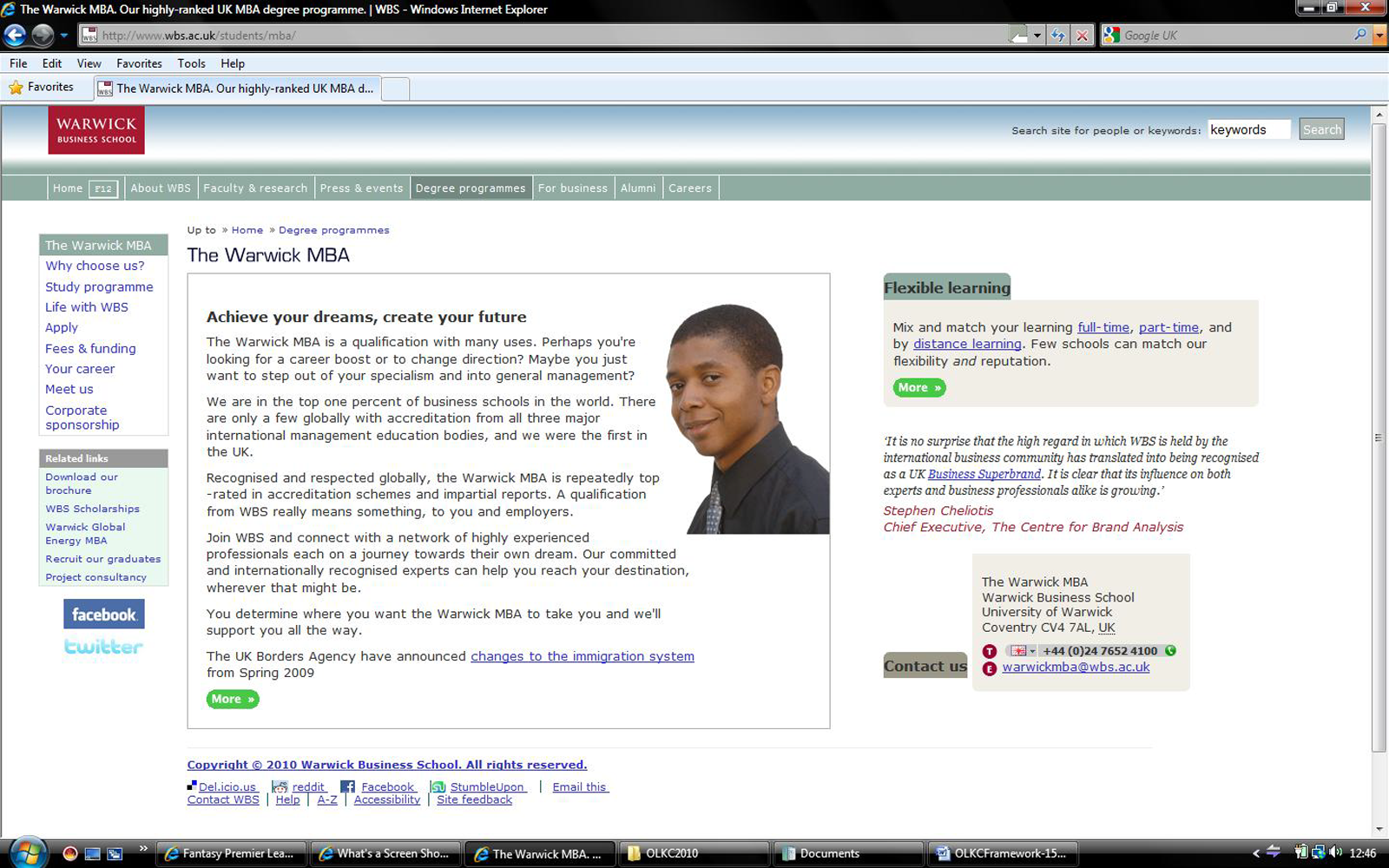
The dominant image on the webpage (see Image 1) is the photograph of the young man. Dressed in grey shirt and tie, he is smiling and looking directly at the viewer, suggesting intimacy. The representational meaning of this image on an MBA webpage is, however, ambiguous. The man appears young enough to be within the average age bracket of full-time MBA students, but his dress is more formal than we would expect to see within an MBA teaching space.
Warwick Business School (WBS).
The modality, or extent to which the photograph appears to us as a credible image of an MBA student, is therefore compromised by the man’s dress. The image is de-contextualized; it is set against a white background and provides no clues as to where the photograph was taken. It could have been taken from an image library or from within Warwick Business School. The viewer is given no clues as to whether the photograph is of a current, former or future MBA student.
Regarding the composition of the page, the photograph is located in the centre, presenting the image as the core of the information to which all other elements on the page are ‘subservient’ (Kress and van Leeuwen, 2006: 196). 2 The interactive meaning, or relationship with the viewer that the photograph within the page’s overall composition seems to be making, is that of a one-to-one conversation. The framing of the shot fits within photographic conventions suggesting intimacy, and the centrality of the photo on the webpage suggests ‘this individual is important’. However, the viewer is left to imagine the extent to which their ‘dreams’ to ‘create their future’ mirror those of the individual photographed.
The quote (in italics, to catch the eye of the viewer) positioned alongside this image from the Chief Executive of the Centre for Brand Analysis, with the words ‘Business Superbrand’ in blue and underlined, emphasizes the Warwick brand rather than the learning experience.
Teaching and learning are not explicitly evoked. Attention is paid to the ‘many uses’ that the MBA qualification can provide. Through the display of accreditation bodies’ logos and reminders of Warwick’s ‘superbrand’ status, the imaginary evoked is that of Warwick as a member of an elite world. Ambiguity around the identity of individuals featured on the webpage, alongside the lack of reference to WBS’s learning and teaching approach, renders students’ learning relationship with WBS vague and ambiguous. The webpage’s lack of visual stimulation encourages the viewer to focus on the text in the centre of the page which emphasizes WBS’s global status. There is a lack of visual and textual reference to pedagogy. The importance of brand and status and the lack of specific reference to pedagogy and formal learning are also noticeable in the student interviews.
Analysis of student interviews
Students reported choosing this MBA for its reputation and emphasized ‘brand’:
I decided on Warwick mostly because of the reputation and also within one year we have seen the rising up the rankings—the move forwards that we are happy to see.
Students’ expectations, due to the reputation and the high cost of the MBA, were high. The formal and informal opportunities afforded, particularly the strength of external (with alumni) and internal (with peers) international networks, were highlighted. Students sensed they were joining a global network and expected that this would be advantageous to them in the future, in terms of finding jobs, for example:
So looking back I will be very happy to have met these fantastic people and we will definitely stay in contact and also use that definitely as a networking opportunity.
Support from, and contact with, alumni networks was encouraged by WBS through ‘buddy’ systems (being paired up with recent graduates). Internal networking was facilitated by MBA students being placed together in the same accommodation block. This led to much international learning and exchange, in ‘kitchen conversations’ outside the formal learning experience.
Formal group working was organized to provide space to build trust and explore difference; an external consultant provided help with cross-cultural group formation and performance issues. Students reported benefitting from working with others in terms of improving their coursework and in developing the presentation of self in English:
There are also a few students I’ve worked with I really liked the working style and I picked up some tips and tricks from them as to how to structure essays and I think also looking beyond the MBA how to apply what’s better or best to present myself in the English speaking context.
The international nature of the student body and the opportunities this provided were acknowledged. There were however reservations as to the international nature of the curriculum, teaching material and faculty:
In terms of the students and for me of course … it’s international but it’s not that international. I think still talking about the cases we are using and experience of our professors they need to improve their international experience.
Students perceived institutional difficulties in offering a similar service to all: for example, in the equitable provision of career advice and in not always drawing on and appreciating students’ international knowledge.
The student ‘imaginaries’ involved an acquisition of international networks, with both peers and alumni to establish international careers. They also wanted multi-directional international exchanges to acquire international working skills and knowledge of management in different contexts. To an extent they reported achieving this through syndicate group cultural exchanges, where they learned how to ‘deal with others’, a primarily instrumental form of international cultural capital.
WBS summary and discussion
Hermeneutic cycle 1: Salient issues
Striking in both data sets is the international reputation of the business school and the international elite nature of the Warwick brand. Student accounts emphasize the development of peer and alumni international networks and becoming part of a global network—an international, mobile employee—especially in terms of presentation of self in an English-speaking world. The ability to work internationally and to understand and ‘deal with’ difference is valued.
Hermeneutic cycle 2: Types of internationalization
We note the international prestige, the capital of being part of an international elite global brand. There is also the international social capital derived from access to international networks and trans-national mobility. In the student accounts this is also linked to the development of international cultural capital in terms of knowledge and skills associated with achieving optimal performance in western/anglophone business communities. The acquisition of other forms of international cultural capital through social activities was also significant. Students observed a lack of ‘hard’ international managerial knowledge in terms of course input and orientation. This was regretted by students, although there are no claims made for this on the webpage.
Hermeneutic cycle 3: Researchers’ role and impressions
We are struck by the ambiguity of the image of the individual: who is he, why is he there, what is his experience? He could be a student but there is something slightly unconvincing about him, in that he is smartly dressed and confident in front of the camera. We are also surprised by the lack of details regarding the learning experience either on the webpage or in the interviews, as well as the students’ instrumentality, particularly in their affinity with the WBS brand.
Hermeneutic cycle 4: Imaginaries evoked
Business elite imaginaries are evoked through the need to develop business networks, the assumption that the MBA would lead to career progression, and the reputation and prestige that being a Warwick MBA alumnus confers. Reference to international ‘tricks and tips’, cross-cultural working skills, networks and mobility in the workplace, the ability to deal with difference and to present one’s self in English-speaking contexts, indicate that some students held an international business class traveller imaginary of the MBA. This is a combination of a managerial imaginary and the international managerial imaginary, an image also supported by the webpage’s emphasis on status and prestige. There is little evidence of cosmopolitanism, a form of learning that is ‘about, and ethically engaging with, new cultural formations’ (Rizvi, 2008: 21).
Lancaster University Management School (LUMS)
Visual semiotic analysis
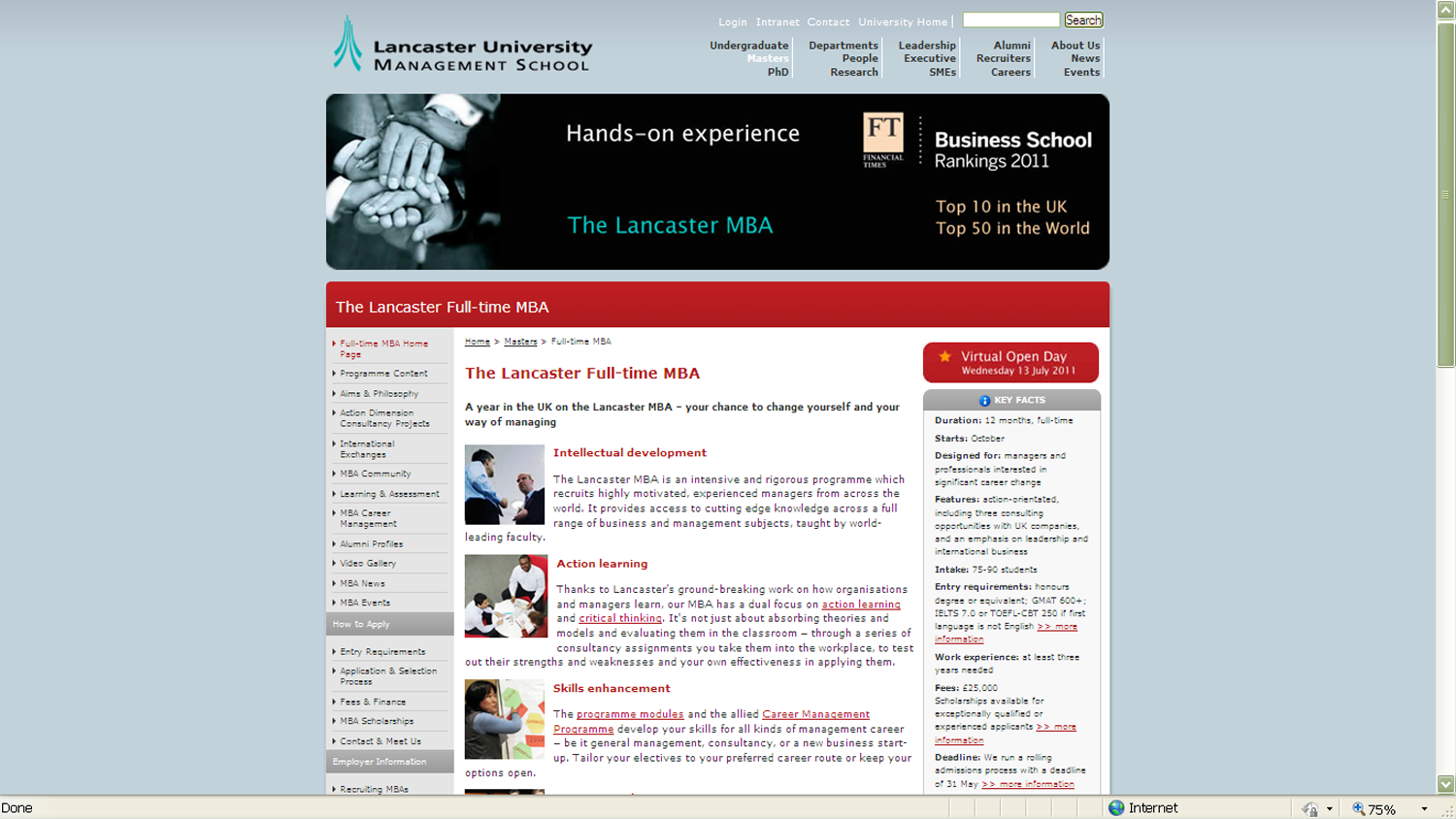
There are six photographic images on the LUMS MBA home webpage (see Image 2), including a still shot taken from an ‘Outward Bound with the Lancaster MBA’ video. The photograph of individuals is shot from below, while shots of students are either taken straight-on or from above. Despite their central position on the page, suggesting that their representational meaning is significant to the overall visual narrative, the shots of students and staff are figuratively overshadowed by the image of the overlapping hands near the top of the page.
Lancaster University Management School (LUMS).
The hands are a visual illustration of the phrase ‘Hands-on experience’, but an experience of what is less clear. The hands are disembodied, with the only clue regarding the identity of their owners being glimpses of shirt cuffs and suit jackets, that is, business attire. The photograph is not a ‘factual’ representation, rather an imagining of what the MBA experience will lead to. The juxtaposition of this image with the text immediately to the right, and the Financial Times Business School ranking logo, evokes a visual narrative of an experience that will lead to a career in business. The images used on the webpage are of mixed modality, ranging from the naturalistic shot of individuals sitting around a coffee table, to the disembodied hands at the top of the page.
The interactive meaning evoked by the various photographic images on the page positions the viewer at a greater distance from the learning experience—as represented by the much smaller and less clear shots of individuals and group shots of students—in comparison to the imaginary evoked in the ‘hands’ image.
What is placed at the top, and what is placed at the bottom of a page is also significant. What is presented at the top of the page is called the ‘ideal’; that is, the ‘idealized or generalized essence of the information’ (Jewitt and Oyama, 2000: 148), which is also generally the most significant element in ideological terms. By contrast, what is placed at the bottom is the ‘real’: it has the potential to convey more practical information. On the LUMS page, the ‘hands’ image conveys an idealized student destination. The contact details for LUMS and the accreditation bodies’ logos at the bottom of the page convey information that is factual, or ‘real’.
The pedagogic imaginary evoked is of engagement with an established and respected institution that can be trusted to make students employable. Practice-based learning is intimated through the hands’ image, reinforced by the ‘hands on experience’ phrase. The prominence on the page given to photographs of, and events for, students, and the symbolic capital of accreditation and ranking bodies’ logos, combines to evoke an impression of solidity and tradition. The MBA’s pedagogic approach achieves prominence due to its centrality on the webpage, emphasizing the intellectual and practical skills that students will gain in part through their engagement with a ‘global mix of students and international exchanges’ (our emphasis).
Analysis of student interviews
The students’ accounts confirmed the opportunities for international learning, but also gave insights regarding difficulties with integration and in learning between different groups of students:
At the initial stage everybody was a friend of everyone else but now it’s gotten a little more fractured, different groups exist and kind of partnership friendships and they (have) become a little bit remote from one another.
Students did see the importance of developing international social capital while noting barriers to building networks. There were perceptions that the international learning experience was underdeveloped, particularly due to the way in which group work was organized. Students perceived ‘participation’ issues, which led to resentment amongst national groups regarding issues of ‘pulling of weight’ and a consequent retrenchment into ‘pockets of culture’.
Others had reservations about discussing difference with peers as they felt that doing so would heighten existing tensions within groups and work against ‘getting the job’ (that is group-work tasks) done:
It’s too painful to discuss cultural differences in group work.
Within the formal learning context, the acquisition of international cultural and management knowledge, either from materials and peers, was deemed difficult. Nevertheless, they acknowledged that such exchange was desired and often occurred informally:
I hope to get opportunity to understand how British, how western people think (and) how they how they work, how they understand their work.
In terms of curriculum and pedagogy, certain issues emerged from the interviews. For example, the non-international nature of the materials used was questioned but also accepted:
Although the students come from different countries but I think we all know we are accepting the education of the UK-based materials.
There was a perceived need for (and sometimes a lack of) a multi-directional exchange of experience:
The thing I’m missing though is getting their views on topics … what’s the management style in your country and you know they are very reluctant to answer the question.
There was also a perceived difficulty in getting others to understand non-western contexts:
You can’t make sure that the UK nationals can understand the Chinese issues quite well maybe they only see the superficial stuff.
LUMS summary and discussion
Hermeneutic cycle 1: Salient issues
There is a strong emphasis on developing skills for the workplace in order to get a good job which would bring ‘payback’ on the MBA investment. In both data sets there is an overriding pragmatism—getting things done—so as to acquire the right skills to be an employable manager. The data sets diverge as to the extent the opportunities from learning from each other are possible. Students implied that the acquisition of management knowledge comes at the expense of the development of ‘softer’ international working skills and cultural exchange. Students also acknowledged the importance given to international communication and knowledge exchange as highlighted on the webpage, but also expressed a perception that there is not enough time to make the most of these opportunities. Instead, the need for mutual support and assistance in smaller self-supporting communities was strongly articulated.
Hermeneutic cycle 2: Types of internationalization
We note here potential conflict between acquisition of managerial cultural capital in the form of received management knowledge and international social capital in terms of building international networks. Social capital is being acquired but perhaps more around sameness and what Putnam (2001) terms ‘getting by’/bonding social capital, rather than ‘getting on’/bridging social capital. So although the importance of working internationally was acknowledged, the pressures of MBA coursework militated against this, leading to frustration. In this respect, the practical ‘hands on’ image of the webpage is not reflected in students’ accounts of shying away from discussions relating to the development of cultural and intercultural working skills.
Hermeneutic cycle 3: Researchers’ role and impressions
We have both worked at LUMS so bring certain interpretations to the analysis. For example, we see a picture of a previous MBA director and another member of teaching staff shaking hands. This gives us insights into the age of the photograph which makes us ask why it is there and what is being evoked. Why are they shaking hands? Are they acting a role for the camera? If so, is it evoking a managerial imaginary, i.e. ‘we will give you the skills to be like them’?
The findings of the analysis contradict our understandings of the MBA learning experience, as we believed more international learning and exchange takes place than is represented in the interviews and on the webpages. Why then at this time were students unable to make the most of the international learning opportunities afforded by the diversity of the student body and why is the webpage not emphasizing and demonstrating these opportunities?
Hermeneutic cycle 4: Imaginaries evoked
The dominant imaginary emerging from both data sets is the managerial imaginary, although we also identify the evocation of an international managerial imaginary through the perceived importance of international knowledge exchange and articulated accrual of international networks. In terms of a specific institutional profile an engaged manager imaginary is evoked by the emphasis placed on getting through the course, completing group tasks as quickly and efficiently as possible, and working towards obtaining jobs after the MBA.
Leeds University Business School (LUBS)
Visual semiotic analysis
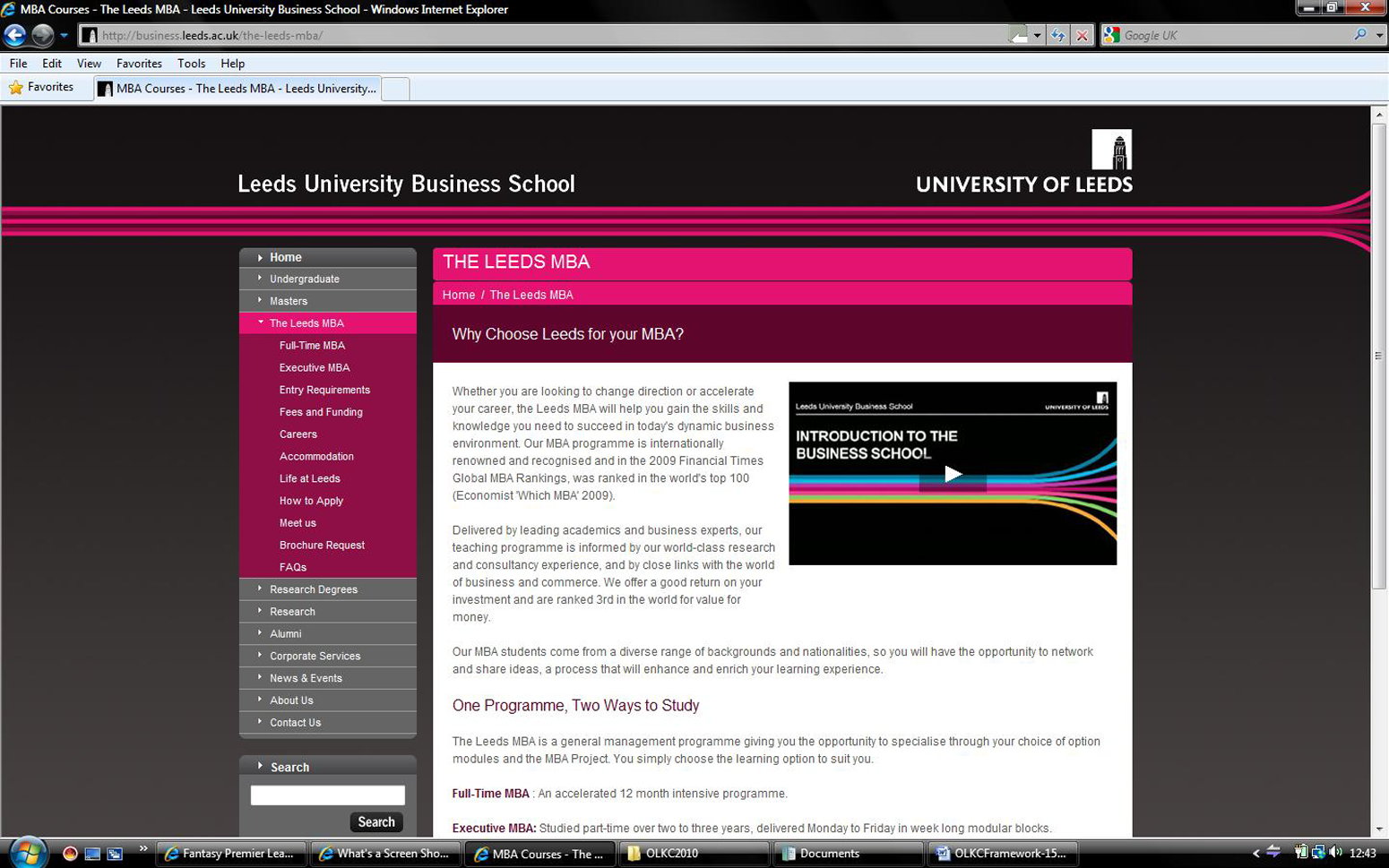
In contrast to the other MBA webpages the LUBS page (see Image 3) lacks photographic images and accrediting bodies’ logos. The absence of photographs of either individuals or objects forces the viewer to engage with the written text. The first paragraph of text in the central text box informs the viewer that the LUBS MBA is internationally recognized. We then read that MBA students are nationally diverse, that prospective students will have the opportunity ‘to network and share ideas’.
Leeds University Business School (LUBS).
The layout is similar to the LUMS page in its use of different text boxes and list of links to further information on the left-hand side of the page. Elements placed on the left are taken to be something that the viewer knows as ‘commonsensical and self-evident’ (Jewitt and Oyama, 2000: 148). In this case, the links provide further information that it is assumed the viewer will wish to know. Elements to the right of the page suggest that what is presented is not necessarily something with which the viewer will be familiar. The presence of the ‘Introduction to the Business School’ video to the right of the webpage illustrates well this element in Kress and van Leeuwen’s (2006) visual grammar. As something new, it is something the viewer must pay special attention to. However, after watching the video the viewer does not learn significantly more about LUBS than is already stated on the webpage. The video is a general introduction to the university rather than to LUBS specifically.
The representational meaning of the webpage is ambiguous. Little attempt has been made to establish a direct relationship to the viewer in visual terms; it features no images of individuals or of groups. The modality of the webpage, that is its credibility as a representation of a Business School, is compromised. The lack of images, particularly of people, compromises the page’s relationship to the viewer. The viewer is encouraged to focus on the text, which makes claims about the skills and knowledge, delivered by ‘leading academics and business experts’, that students will acquire, the MBA’s ‘good return on investment’, and the MBA’s international standing. When the learning and teaching experience is mentioned, it is with reference to how networking with students from a diverse range of backgrounds and nationalities will ‘enhance and enrich’ the learning experience.
Analysis of student interviews
According to the interviews, the course was perceived almost without reservation as ‘international’ and does appear to have the most developed international focus of the four MBA programmes. This focus was not given as a reason for choosing this MBA, these being largely pragmatic, concerning cost, accommodation and location. However, the international orientation was seen as adding value:
My expectation wasn’t looking at the MBA as the international experience, I was looking at more academic and self-development tools …but when I came here I felt it was really an added value.
The relative depth of international perceptions held both by LUBS and emerging from the interviews is reflected in the following quote:
I think the university plays on that as an aspect of this course that they want to be able to say this is an international course you’ll get an international MBA. And you don’t just get an international MBA which is recognized wherever, you actually go away with all these nice experiences which allow you to develop as a person.
Unique features of this learning experience included a long induction period and considerable time spent in small multi-national groups. Competitions (Barclays and Financial Times) also served to unite groups and to help them to reflect on their group working process. A dedicated advisor was considered important in helping with the group and international learning process.
There was some questioning of the use of UK-focused materials especially given the diversity of the student body and the international orientation of the school:
Some modules have biases towards the UK, I understand that I am studying in the UK but the marketing of the MBA is an international qualification and there is 75% (of students) not from UK.
The international learning experience was presented as a safe haven, but also a sanitized experience with little focus on realities of globalization, as reflected in this student’s account of trying to find employment in the UK:
Fill in a form saying do you have a permit to work in this country? No—pop comes the red light—it stops there. We talk about globalization we talk about everything but we never talk about the globalization of resources … I have no hesitation in saying that I felt terrible at that time.
There was an emphasis on the building strong, durable international ties from within the cohort, which were not primarily instrumental. Understanding others’ differences and intercultural exchange as part of a wider learning experience beyond the MBA curriculum was also highlighted.
LUBS summary and discussion
Hermeneutic cycle 1: Salient features
In both data sets the emphasis on the international learning experience is apparent, although this is not backed up visually on the webpage. A strong emphasis is placed on networks of international exchange, on the international community, and on international and intra-cultural learning.
Hermeneutic cycle 2: Types of internationalization
These were reflected in the development of international networks; the discussion of global issues, tensions and problems; and questioning of one’s own values. Forms of international social capital are apparent in the building of networks for both work-related and social reasons. International cultural capital is acquired through learning and exchanging management knowledge from different cultural contexts. We can also see the development of what we term intra-cultural capital which is the developing of competencies to understand and appreciate difference and to question one’s own values and world views.
Hermeneutic cycle 3: Researchers’ role and impressions
The LUBS’ interviews revealed that students believed they were engaging in an international experience and that LUBS had done well in supporting and facilitating this process. We were therefore puzzled by the webpage’s overall composition, i.e. its black background and predominance of text. It evokes an imaginary of sobriety and seriousness, although we are aware that other interpreters might refer to contemporary design or ‘coolness’. We were surprised by the contrast between this stark image and the vibrant student experience that emerged from the interviews.
Hermeneutic cycle 4: Imaginaries evoked
Although the webpage’s sobriety might hint at a managerial imaginary there is very little sign of this in the student accounts or the webpage texts. Rather the emphasis is very strongly on the international managerial imaginary. Skills and competences associated with an international managerial imaginary were apparent throughout, as was recognition of the importance of international networks, as well as a desire for, and frustration around barriers to, international working mobility. References made to wider learning and questioning of assumptions in the student interviews also intimate the existence of a cosmopolitan imaginary. The importance given to the MBA experience as a time to reflect and take stock of one’s own direction evokes an imaginary of the MBA as a broader learning experience. We therefore suggest that the school-specific imaginary evoked here is that of the intra-national learner.
Imperial College Business School.
Imperial College Business School
Visual semiotic analysis
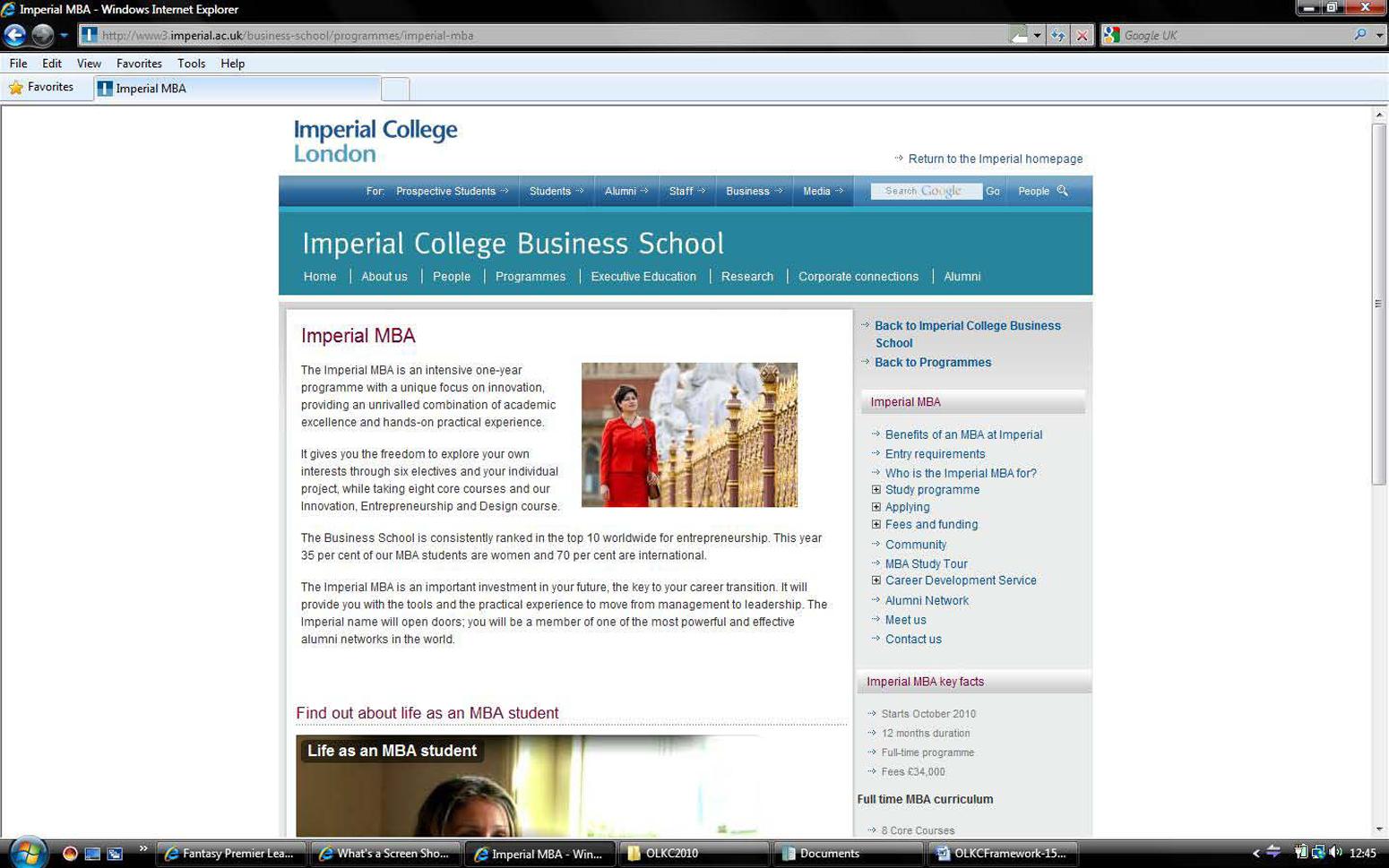
Unlike the other MBA homepages, the Imperial page reverses the ‘given-new’ (Jewitt and Oyama, 2000) composition in which information that is ‘commonsensical’, that is what the viewer is assumed to know, is placed on the left-hand side of the page, and ‘new’ information is situated on the right-hand side. 3 The page lists links to where further information can be found: the introductory paragraph to the MBA by contrast sits on the left-hand side of the page.
What is placed at the bottom of the page and what is placed at the top of the page is also significant. This is interesting when we consider the two photographic images on the page. What is positioned at the top—in this case the woman in a red skirt suit walking past ornate railings—is the ideal, that is the ‘idealized or generalized essence of the information’ (Jewitt and Oyama, 2000: 148). By contrast what is placed at the bottom is the ‘real’—in this case the still shot taken from the ‘Life as an MBA student’ video. That is, it has the potential to convey more practical information. The photograph of the woman in the video is more of a close-up shot than that of the other woman, and so is encouraging a more direct relationship with the viewer. The woman in the other photograph appears in the distance and is gazing towards the middle distance rather than directly at the viewer.
Imperial’s MBA webpage reverses some western conventions of visual grammar and contains a number of juxtapositions. We have the image of the woman in a business suit representing the imaginary ‘ideal’ destination of prospective students, interacting with the viewer at a distance, and the image of the casually dressed student taken from the video, interacting more directly with the viewer of the webpage. The central text emphasizes the MBA’s focus on innovation and entrepreneurship: that is, on the programme’s content rather than learning process. The MBA is positioned as an ‘important investment’ in the viewer’s future, and claims to open doors to ‘one of the most powerful and effective alumni networks in the world’. The webpage evokes engagement with a metropolitan institution that offers access to powerful international networks.
Analysis of student interviews
Students appreciated the international nature of the course, particularly in terms of the diversity of the cohort. They saw this as an added bonus, but not something picked up through publicity materials. The importance of induction and the setting up of ‘learning from difference’ featured prominently:
The first week mainly emphasizes refreshing everyone’s skills and team working. I remember there is one session about culture, they asked different people from the same country to go together and make a presentation … and explain the culture in the country so other students could learn about that.
Group work was organized in ongoing syndicate and tutor groups, running throughout the year, which gave time and space for cultural exploration:
In my tutor group, we’ve got an Iranian, an Italian, a British, somebody from Taiwan, myself from Nigeria, it’s you know it’s something more like a combination, that probably if not for that tutor group, all of us wouldn’t have really gotten that close.
Although there was an instrumental element to working across cultures and dealing with difference (to get the work done and to get a good mark), representations of the international MBA experience included its being a personal development opportunity. It was seen as being student- rather than staff-led, students indicating a desire to learn about others that went beyond learning to ‘deal with’ difference. This led to self-reflection and a questioning of social assumptions:
It’s not only from study I learn …but partly life I get used to. I’ve got to know different people, different cultures. For example …I live in the university hall I made some friends from Italy from, Spain, from France …so we often have dinner at the weekend. The guy from Italy’s a good cook he always cooks some Italian pasta and something. Actually from a Chinese point of view it’s very simple food, you know, the first time he invited me to dinner I expected some kind of special dishes so he just cooked some pasta with sauce, but he cooked very carefully.
Several students reported political arguments (for example, on China and Tibet, and on the Second Gulf war) which provoked a questioning of some entrenched assumptions and beliefs:
The two things if I had to focus on … the international give and take and the exchange of ideas and experiences and questioning of assumptions and it’s tremendously valuable.
Developing social networks and making international friends was another feature of the experience:
What I was looking for was great networks, in terms of finding people that, not only just friends but actually, not just business contacts.
Social arrangements and special occasions (for example, the Chinese New Year dinner), were used to illustrate opportunities to learn from difference, but also to note the exclusive nature of some social activities, including visits to the pub and British students’ ‘beer culture’. There were also perceptions that national groups stuck together, particularly in formal class-work, and supported each other through the process. Although this went against the international projections and messages of the MBA, there was also a feeling that in some ways this suited people:
I think the Asian/European divide is something that actually makes everybody feel comfortable, and it may not fit in with everybody’s idea of you know a kind of fantastically racially integrated MBA class.
Although international exchange was rated highly, the international orientation related to students rather than course material:
When I think I’ll look back on my MBA since it’s you know international I think I will tie that more in with the people I was with in my groups than course content.
Imperial College Business School summary and discussion
Hermeneutic cycle 1: Salient features
The webpage communicates mixed messages regarding the programme’s emphasis, although the international reputation of the institution, and the opportunities for the development of international networks, are foregrounded. Student accounts referred to the development of networks, to cultural exchanges, the challenging of one’s own assumptions and the building of cross-cultural working groups.
Hermeneutic cycle 2:Types of internationalization
These included: cultural exchange and social experiment, both student and course initiated; building intercultural working skills; and desire to exchange views and to learn about difference. Similarly to Warwick, there is some evidence of the importance given of the institution’s international reputation and its alumni networks in terms of acquiring prestige, that is, of international capital and international social capital. However this claim is only mildly reinforced in the student accounts, which instead highlight the ‘here and now’ learning experience and what we interpret as the development of different forms of cultural and intra-cultural capital.
Hermeneutic cycle 3: Researchers’ role and impressions
There was a strong emphasis given to the significance of the social life and the wider learning experience in student interviews. The time afforded to develop international relationships did not appear to be primarily instrumental. This wider learning experience is also apparent in the student video linked to the webpage, although we were surprised by the informality of dress and video presentation, especially in contrast to more formal images on the webpage.
We observe disjuncture emerging from the data sets. The student interviews are largely inward-facing, focusing on the immediate experience of formal and informal international and intercultural learning. In contrast, Imperial’s projection of the MBA is more externally focused, for example in highlighting the international symbolic and social capital of reputation and networks.
Hermeneutic cycle 4: Imaginaries evoked
Although the webpage features a woman in a red suit, this managerial imaginary was not widely present in the interviews. In fact several students were using the MBA as a means of escaping from this mould. An emphasis on managing internationally and learning to work with others to understand difference suggest students associated the MBA with an international managerial imaginary. At the same time the interviews demonstrated an awareness of the political, through for example the questioning of one’s own assumptions, evoking a set of skills and competences we associate with a cosmopolitan imaginary. We term the specific school imaginary evoked here, the metropolitan cosmopolitan, for the intra-cultural learning opportunities afforded by the metropolitan environment.
Imagining the international: Results
Our analysis has revealed that each school emphasizes elements of all or some of the three generic imaginaries. Different forms of capital develop these imaginaries in different ways and create a school-specific profile which, in conjunction with the volition and demands of their specific set of students, leads towards a distinctive learning approach. The extent to which internationalization is promoted and projected, however, varies considerably between the schools.
Table 1 summarizes the distinctive international features of each MBA identified through the hermeneutic analysis of both data sets detailed above.
Representations of internationalization.

Our analysis indicates that although internationalization is an important focus and promotional term in the four cases, what it delivers in terms of knowledge, skills and competencies and the student experience varies considerably and is not always apparent on the schools’ webpages. The analysis has highlighted mismatches, tensions and contradictions in each case between student experiences and webpage representations.
Conclusion
Examining four business schools’ web-based images and discourse and students’ international MBA motivations and experiences has highlighted synergies and contradictions between students’ expectations of acquiring different types of capital and what the schools are able to deliver. This has led us to identify distinctive imaginaries for each school: the business class international traveller, the practical engaged manager, the intra-national learner/manager, the metropolitan cosmopolitan. We note, however, that these imaginaries are not clearly portrayed through the schools’ webpages. Instead, schools’ uniform webpage claims to ‘internationality’ give prospective students few clues when trying to differentiate the extent to which each MBA programme’s learning approach is international.
Given this insight we suggest that schools need ways to better identify, evaluate and promote distinctive approaches to internationalization to help address concerns about business schools’ international provision (De Vita, 2001) and the experience of students on internationalized MBA programmes (Currie, 2007; Robinson, 2006).
Existing models of internationalization can help schools to benchmark and more explicitly portray their distinct international learning experience. These understandings can be further enhanced through application of the concepts of international imaginaries and associated forms of international capital as developed in this article. For example, returning to Knight’s model of internationalization (Knight, 1997), we observe that the schools are utilizing both activity and competency approaches which align with the concept of the international managerial imaginary, producing students competent to operate in international managerial contexts. The process approach and ethos or ‘organizational’ approach are generally more aspirational but can be related to the concept of the cosmopolitan imaginary, that is a rich, reflexive international learning experience, as noted in student accounts at LUBS and Imperial.
Theoretically this article contributes to the sociological study of international management education, considering it as a means of positioning in social space, which we demonstrate through the development of three generic imaginaries: the managerial imaginary; the international managerial imaginary, and the cosmopolitan imaginary, re-enforced through the application and adaptation of Bourdieu’s (1986) forms of capital. In considering webpage projections of internationalization the methodological framework we apply here extends the visual turn in organization studies by including business schools’ virtual representations.
We recommend that schools resist the universalizing, ‘international’ blanket term and instead identify their distinct strengths and unique approaches to internationalization. The trend towards universalism in terms of webpage presentations is noteworthy and could be explained using applications of institutional theory and management fads and fashions (Perkmann and Spicer, 2008). Unfortunately, such processes have the effect of masking the distinct experiences within each MBA programme.
Footnotes
Appendix 1
Appendix 2
Appendix 3
Appendix 4
Acknowledgements
The authors would like to thank the Special Issue Editors and the two anonymous reviewers whose helpful suggestions and comments helped us to strengthen this article.
This research received no specific grant from any funding agency in the public, commercial of not-for-profit sectors