




Abstract
This article examines how the Camino de Santiago pilgrimage functions as a culturally situated medium for activating what Maslow termed Being values (B-values)—such as wholeness, interconnectedness, and harmony. Situating Maslow’s concept of peak experiences within a cultural-psychological framework, the study investigates how transformative experiences emerge in liminal contexts where everyday social roles are temporarily suspended and individuals engage in embodied, collective, and symbolic practices. A sequential exploratory approach was adopted. First, qualitative content analysis of 32 pilgrim travelogues uncovered recurring themes—such as unity, clarity, and self-transcendence—that align with Maslow’s characteristics of peak experiences. Though historically theorized as intrapsychic, the results suggest that B-values are co-constructed through cultural and relational affordances central to pilgrimage. In a complementary survey of 501 pilgrims, over 60% reported experiencing interconnectedness, underscoring the significance of shared walking rituals, sacred landscapes, and narrative reflection in facilitating personal transformation. By reframing B-values as culturally mediated achievements rather than purely individual insights, the study bridges humanistic and cultural psychology. It contributes to a broader understanding of meaning-making and identity transformation in contemporary spirituality, positioning self-actualization as a relational, embodied, and culturally situated process.
Keywords
Introduction
Abraham Maslow’s exploration of the authentic self 1 provides a foundation for understanding human potential and self-actualization. He defined the authentic self as one’s deep nature, suggesting that many human problems could be resolved if individuals aligned with their true essence. Maslow (1963) emphasized that this alignment requires self-knowledge, achieved through a process of self-discovery that is both psychological and existential. He famously asked: “Do you want to find out what you ought to be? Then find out who you are!” (p. 121). Maslow argued that individuals often suppress their inner voice, conforming instead to external influences such as societal expectations, authority, or tradition. He maintained that discovering the authentic self also involves uncovering the “ought” self, wherein self-reflection enables comprehensive self-understanding. This awareness not only clarifies who one is but also reveals what one must do to live authentically.
Building on these ideas, Maslow (1963, 1994) connected self-actualization to peak experiences—profound moments of realization in which individuals encounter their authentic being. He referred to these as B-values or Being values, intrinsic principles akin to eternal truths, spiritual ideals, or highest values. Such peak experiences, he argued, allow individuals to perceive their intrinsic nature and unify the factual (“is”) with the aspirational (“ought”). Despite the centrality of B-values in Maslow’s framework, empirical research on their occurrence and experiential triggers remains scarce. No systematic studies have examined how individuals actually experience B-values in lived contexts, leaving an important gap between humanistic theory and empirical psychology. Pilgrimage offers a natural field for examining this connection because it integrates ritual, movement, and meaning-making within a symbolic cultural frame.
Clifford Geertz (1973) viewed religion as a system of symbols through which people communicate and sustain conceptions of reality. In his model, religion fuses two semiotic structures: a model of reality—the worldview that describes how things are—and a model for reality—the ethos that depicts how things ought to be. Rituals, including pilgrimage, dramatize this fusion, allowing participants to feel their values as “especially real.” When ethos and worldview converge, participants experience the world simultaneously as it is and as it should be—an alignment that resonates strongly with Maslow’s description of peak experiences as moments of unity between “isness” and “oughtness.”
Victor and Edith Turner (1969, 1978) expanded this framework by introducing Van Gennep’s (2000) concept of liminality to the study of pilgrimage. Leaving home and social roles, the pilgrim enters a threshold state where ordinary distinctions dissolve. Within this liminal space—betwixt and between culture—the self becomes open to transformation. In contrast, Eade and Sallnow (1991) argued that pilgrimage spaces are not necessarily harmonious but can also function as arenas of competing interpretations and potential conflict. Empirical findings suggest, however, that while tensions may occasionally occur, overt conflict among pilgrims is relatively rare (Brumec, 2023). As Berger and Luckmann (1991) observed, pilgrimage temporarily suspends the “reality of everyday life,” enabling new ways of perceiving and valuing the world.
The Camino de Santiago 2 vividly embodies this liminal condition. Over several weeks, pilgrims engage in repetitive walking through natural landscapes, visit sacred sites, and share symbolic rituals. Contemporary pilgrimage studies have emphasized that such experiences cannot be reduced to individual psychology alone but must be understood through the embodied and social practices of pilgrimage itself. Slavin (2003), for instance, argues that being “on the way” typically begins with a sense of separation from ordinary society, and that the very act of sustained walking generates a distinctive experiential field. According to Slavin, this embodied practice often shifts attention away from material concerns toward more reflective and spiritual orientations.
A similar emphasis on movement as the defining element of pilgrimage is found in the work of Coleman and Eade (2004), who propose that pilgrimage should be analyzed primarily as a form of meaningful mobility. From this perspective, the transformative potential of pilgrimage lies not only in sacred destinations but in the process of moving through landscapes, encountering others, and inhabiting unfamiliar rhythms of time and body. Margry (2008, p. 43) likewise observes that for many contemporary pilgrims to Santiago de Compostela, “the journey rather than the destination has become the definitive element of the pilgrimage.” These approaches highlight that transformation is best understood as emerging from the cumulative experience of walking, social interaction, and symbolic engagement rather than from any single ritual moment.
In the Camino context, such triggers—exposure to natural beauty, sustained physical movement, encounters with sacred spaces such as shrines and cathedrals, as well as silence, singing, and the sensed vitality of life energy—are consistently described as catalysts of transformative experience. They generate what White (1993) termed Exceptional Human Experiences (EHEs), a category that includes peak experiences marked by unity, clarity, and transcendence. Through these experiences, pilgrims reconnect with their authentic self, advancing self-discovery, personal growth, and a deeper understanding of intrinsic values (Brumec, 2024b).
Interdisciplinary perspectives further illuminate the neurocognitive dimension of these experiences. McGilchrist (2009, 2021) interprets Western modernity as privileging the left hemisphere’s analytical, instrumental rationality over the right hemisphere’s holistic and relational perception. Alcorta (2019), building on McGilchrist, proposes that ritual, meditation, and other repetitive, externally focused activities facilitate right-hemisphere modes of awareness by attenuating activity in the default mode network (DMN), which is linked to self-focused cognition. Such DMN reduction has been associated with experiences of oneness, transcendence, and ineffability. O’Mara (2020) highlights the close link between bodily movement and thought. He distinguishes between focused executive attention and a more associative mode of mind-wandering, which walking naturally promotes. This form of mental wandering, he argues, supports autobiographical reflection, creativity, and emotional integration, rather than representing mere idleness.
Building on McGilchrist’s framework, Christman and Prichard (2024) argue that modern transitions from standing to sitting, from outdoor to indoor living, and from communal to solitary routines have reduced opportunities for embodied awareness. These shifts, they suggest, reinforce left-hemisphere dominance and limit everyday contexts that support holistic and relational modes of perception. From this perspective, practices centered on sustained walking—such as pilgrimage—can be understood as counterbalancing these tendencies. Pilgrimage walking therefore engages both reflective narrative processes and moments of ego-dissolution, making the Camino a cultural and experiential environment of transcendence in which embodied practice reshapes perception, identity, and orientation toward the sacred.
This interpretation is supported by complementary research that emphasizes the experiential conditions through which walking acquires transformative meaning. Sørensen and Høgh-Olesen (2022/2023), in their phenomenological study Walking for Well-Being published in Culture & Psychology, identified walking in nature as a core dimension of modern pilgrimage—linking authenticity, simplicity, community, and spirituality. Beckstead (2010), in his commentary on liminality and movement, emphasized that “movement becomes meaning”: pilgrimage generates the sacred through the dynamic negotiation between structure and freedom. Taken together, these studies affirm that walking itself—embedded in landscape, ritual, and shared practice—functions as a psychological and symbolic medium of transformation. The present study builds upon these insights to explore how pilgrims on the Camino de Santiago describe Being values emerging from such liminal and embodied experiences. As part of a broader project on contemporary pilgrimage (Brumec, 2022), it provides a theoretically grounded, data-driven understanding of how B-values are experienced and articulated within a real-world setting. By analyzing autobiographical narratives of pilgrims, the study bridges phenomenological accounts and psychological inquiry. Its aim is to identify and interpret the experiential triggers and meanings associated with Exceptional Human Experiences of the peak-experience type.
The conceptual focus on Maslow’s framework in this article follows directly from the inductive logic of that broader project, which was conducted using a grounded theory approach. The experiential categories that emerged from the analysis of pilgrim narratives, closely correspond to Maslow’s notions of peak experiences and Being values. Although more recent motivational models such as Self-Determination Theory (Ryan & Deci, 2000) are more strongly empirically supported, they do not directly address these specific experiential phenomena. For this reason, Maslow’s theory is employed here heuristically and interpretatively, in line with contemporary reinterpretations of his work (e.g., Kaufman, 2020).
Importantly, this article does not rely on the traditional hierarchical “pyramid” model of needs. Following Kaufman’s (2020) reinterpretation of Maslow, we understand motivation as a dynamic system often illustrated through the “sailboat” model, in which basic psychological needs provide stability while self-actualization and self-transcendence represent directions of growth that can occur even when lower-level needs are not fully satisfied. In the context of pilgrimage, this means that experiences of B-values and peak moments are not assumed to depend on prior complete fulfillment of safety or comfort needs, but can emerge within conditions of physical effort, uncertainty, and liminality.
This conceptual stance directly informs the methodological orientation of the present study. By adopting Kaufman’s dynamic and non-hierarchical reading of Maslow, the analysis situates self-actualization within a cultural-psychological perspective that emphasizes meaning-making, embodiment, and the integration of personal transformation within shared symbolic worlds. Accordingly, the following section outlines the methodological framework adopted to explore how Being values are manifested and described in pilgrims’ narratives, detailing the sequential exploratory design and analytic procedures that guided this study.
Methodology
Overall Approach
This study employed a sequential exploratory mixed-method design consisting of two interconnected phases. The first phase used qualitative and quantitative content analysis to explore how pilgrims describe transformative experiences on the Camino de Santiago. The second, complementary phase involved a brief survey that served to corroborate and contextualize the qualitative findings by identifying how frequently key experiential dimensions—such as interconnectedness and wholeness—appeared among a larger group of pilgrims.
This approach provided both conceptual depth and breadth: the first phase captured the richness of lived narratives, while the second offered a descriptive overview that situated these experiences within a broader community of practice (Creswell, 2008; Flick, 2019).
Ethics and Data Sources
The study is part of the first author’s doctoral research, which is publicly available in the Digital Library of the University of Maribor. Research was designed and executed in accordance with institutional guidelines at the University of Maribor.
The study relied on two types of data: (1) published Camino de Santiago travelogues and (2) anonymous online survey responses.
Ethical Considerations for Phase 1 (Travelogue Analysis)
All qualitative material analyzed in this study consisted exclusively of published and publicly available travelogues. Digital copies of the books were obtained through authors or publishers and were subsequently imported into the qualitative analysis software QDA Miner for systematic coding and analysis.
For the use of these materials, the first author signed a written statement confirming that the material would be used strictly for academic research and that any excerpts included in publications would be fully and accurately cited in accordance with academic standards. No unpublished, confidential, or private communications were analyzed. All quotations presented in this article are drawn from publicly accessible sources and are properly referenced.
Ethical Considerations for Phase 2 (Survey)
Survey data were collected as part of the same doctoral research project. The questionnaire was administered using the academic survey platform 1 KA, developed by the Centre for Social Informatics at the Faculty of Social Sciences, University of Ljubljana. The survey was fully anonymous: no personal identifiers were collected, respondents accessed a single common survey link, and the platform architecture ensures strict separation between potential metadata and survey responses. Participation was entirely voluntary, and respondents were informed that the data would be used solely for academic purposes. In accordance with national and institutional guidelines, anonymous, non-invasive online surveys of this type do not require formal ethical approval. The study therefore complies with accepted ethical standards for research using publicly available texts and anonymous survey data.
Phase 1: Qualitative and Quantitative Content Analysis
The first phase involved a qualitative and quantitative content analysis of 32 travelogues documenting pilgrimages on the Camino de Santiago, sourced from the Slovenian national library database (COBISS). Of these, 23 were authored by Slovenian pilgrims, while the remainder were translations of works by international authors such as Potdevin (2013), Rufin (2016), Gray and Skeesuck (2017), MacLaine (2000), Kapetanović (2017), and McManus (2014). One of the travelogues was written by the researcher herself, providing an insider perspective that enhanced interpretive depth and reflexivity (Tracy, 2010). To reduce potential bias, this text was analyzed in the same way as all others and coded solely on the basis of the published material, with peer debriefing used to maintain analytic distance. A detailed list of all analyzed travelogues, including authors, publication years, and titles, is provided in the Appendix.
The corpus was constructed using explicit inclusion criteria. All travelogues about the Camino de Santiago that were available in the COBISS database and had been published in book form up to the end of 2018 were included in the analysis. To be selected, a text had to present a first-person experiential narrative of pilgrimage; guidebooks, historical overviews, and promotional publications were excluded. The sample therefore represents a comprehensive collection of all eligible travelogues within the defined linguistic and temporal scope, rather than a selective or convenience sample.
Data were analyzed using QDA Miner software through an iterative, grounded-theory approach (Bryman, 2016).
At the first stage we used open coding that identified 346 data-driven codes representing incidents, emotions, reflections, and symbolic acts during the pilgrimage.
At the second stage, the analysis focused on organizing these initial codes into meaningful relationships. In line with grounded theory methodology, axial coding was applied, supported by theoretical sampling of relevant scholarly literature. Through this process, related codes were clustered into higher-order categories, revealing that the empirically derived themes closely corresponded to Maslow’s (1994) characteristics of peak experiences and Being values. Consequently, Maslow’s conceptual framework was adopted as the most adequate interpretive lens for structuring the findings, and a higher-order category labeled B-values was formulated. This correspondence can be illustrated with concrete example. Sensory intensifications (“heightened smell or vision”) and introspective perceptions (“inner voice,” “spiritual hearing”) were grouped into the categoryPerception in Peak Experiences. In total, eleven final categories were identified, reflecting Maslow’s characteristics of peak experiences and B-values, such as Tendency Toward the Real Self and Experiencing B-Values—the latter capturing feelings of unity and interconnectedness.
This process led to interpretive propositions, for instance:
During the Camino de Santiago pilgrimage, individuals experience moments of heightened awareness that transcend everyday concerns, foster contact with the authentic self, and align with intrinsic Being values such as interconnectedness, oneness, and wholeness.
Analytically, this phase was grounded in subtle ontological realism (Hammersley, 1992) and constructivist epistemology (Raskin, 2002), acknowledging both the experiential reality of transformation and its interpretation through culturally mediated narratives. This position has concrete implications for the study of pilgrimage. Subtle ontological realism assumes that pilgrims’ transformative experiences are experientially real for the individuals involved, rather than merely discursive constructions. Constructivist epistemology, however, recognizes that such experiences are always interpreted and communicated through culturally available languages, symbols, and spiritual frameworks. Travelogues therefore provide access to lived realities as they are understood by pilgrims themselves, not to objective events. This approach is particularly appropriate for pilgrimage research, where inner experiences and narrative interpretation are inseparable.
To ensure coding consistency and interpretive reliability, a reflexive and iterative procedure was applied. The researcher re-coded randomly selected data segments at different stages to check the stability of emerging categories. Coded segments and thematic structures were also discussed with two academic peers familiar with qualitative analysis but not directly involved in the study, serving as a form of peer debriefing (Tracy, 2010). This reflexive approach compensated for the absence of multiple coders and ensured transparency, analytic rigor, and alignment between data and theoretical interpretation.
Phase 2: Complementary Survey for Contextual Insight
The second phase employed a short online survey to corroborate and contextualize the qualitative findings, providing descriptive insight into how widely pilgrims reported experiences resonating with Maslow’s B-values. The questionnaire was distributed between April and July 2020 among members of English-speaking Camino communities on Facebook, including: • American Pilgrims on the Camino (26,000+ members) • Australian Pilgrims on the Camino de Santiago and Beyond (4,300+) • Camino de Santiago – All Routes (55,700+) • Camino de Santiago (30,300+)
A total of 501 pilgrims who had walked at least 300 km (or cycled 600 km) participated. Respondents reflected on their sense of interconnectedness, defined as “feeling oneself as an integrated part of the Universe, in harmony with the energy and power of life.” Responses were recorded on a three-point Likert scale (1 = No, 2 = Maybe, 3 = Yes).
Descriptive statistics summarized the data, yet the intention was not hypothesis testing but illustrative contextualization of the qualitative insights. The survey results, showing that over 60% of respondents reported strong experiences of interconnectedness, provided additional support for the interpretive model developed in Phase 1.
Summary
This two-phase design combined interpretive depth with empirical breadth to examine how the Camino de Santiago pilgrimage fosters experiences of unity, authenticity, and self-actualization. Rather than seeking statistical validation, the research adopted a corroborative logic, where quantitative data illuminate and enrich qualitative meanings. The methodology thus bridges narrative, phenomenological, and cultural approaches, advancing theoretical understanding of how transformative experiences are culturally mediated and psychologically integrated within the practice of pilgrimage.
Findings
The analysis of pilgrims’ travelogues revealed codes that align with Maslow’s theoretical framework of peak experiences, allowing us to organize the data into the following categories: Perception in Peak Experiences, A New Aspect of Reality, Experiencing B-Values, Dichotomy Transcendence, Ego Transcendence, Tendency Toward the Real Self, End-Experience, Intrinsic Value of Experience, Glimpse of Heaven, Everything Is as It Should Be, and Self-Actualization and B-Values. These categories encapsulate the cognitive and emotional dimensions of the pilgrims’ experiences, highlighting the transformative and transcendent nature of the Camino de Santiago pilgrimage.
Perception in Peak-Experiences
Peak experiences are characterized by a heightened, fully attentive mode of perception marked by non-evaluative and non-judgmental awareness. During such moments, distinctions between what is significant or insignificant appear to fade, and individuals often perceive others as unique and irreplaceable. Maslow (1994) referred to this mode of cognition as B-cognition, where the “B” denotes being and existence. Through B-cognition, individuals seem to perceive reality holistically, gaining insight into what Maslow called the realm of Being or B-realm.
B-cognition thus represents a receptive, immediate, and integrative way of perceiving, in contrast to the evaluative and goal-directed awareness typical of daily life. In the context of pilgrimage, numerous travelogues analyzed in this study describe a comparable perceptual shift—an increased sensitivity to surroundings, inner impulses, and subtle forms of knowing. Such experiences were coded under themes including heightened senses, spiritual perception, clarity of perception, and strengthened intuition.
In this study, the terms “spiritual” and “spiritual perception” are used in a descriptive and phenomenological sense rather than in a doctrinal or strictly religious one. Peak experiences are understood as human experiences of transcendence rather than as specifically religious events. As Maslow (1994) emphasized, spiritual values have “naturalistic meaning” and do not require supernatural validation.
Pilgrims frequently describe intensified sensory awareness. Novak (2004), for example, notes that after several days of walking in nature he became more “ attentive to every, even the slightest, sign,” with senses that “were evidently sharpening” (p. 43). Similar descriptions appear in other accounts: “I felt every part of myself, how I breathe and how my heart beats … complete relaxation, something incredible...” (Gričnik, 2014, p. 76).
In many accounts, this sensory awareness is described in concrete bodily terms, particularly in relation to smell and vision: “… with my newly awakened sense of smell, I could scent every little breath.” (Brumec, 2016, p. 41).
Such descriptions suggest that perception during pilgrimage becomes intensified and multi-layered: “Everything that was inside me before has been intensified a thousandfold.” (Vranjek, 2015, p. 253).
Several pilgrims interpret this phenomenon through the lens of spiritual perception—a form of insight or hearing that transcends ordinary sensory limits. Some pilgrims describe this heightened awareness as a form of inner or “spiritual hearing” (Potdevin, 2013, p. 153).
Other pilgrims describe this perception metaphorically as “seeing with the heart”: “...I was bestowed with the gift of seeing with my heart” (Jenko Simunič & Jenko, 2014, p. 87).
Several narratives also contain elements of noetic insight, described by James (2015) as an understanding of a maxim or formula that can at times overwhelm us. This is evident in the travelogue narratives of Močnik, who refers to it as an “aha experience,” and Artnik Knibbe, who characterizes it as an “aha moment”: “All of this reflected as an aha experience” (Močnik, 2009, p. 152).
Maslow (1994) viewed B-cognition as essentially receptive and humble, allowing individuals to feel connected to something greater than themselves. This openness is reflected in Rufin’s portrayal of the pilgrim’s readiness for transcendence: “He is at the height of his powers yet has never felt so humble. His weeks of wandering have plunged him into a state of passive acceptance, his soul is free from all desire or expectation …” the pilgrim is ready to recognize something greater than himself” (Rufin, 2016, ch. 25/ para. 20).
Peak experiences, according to Maslow (1994), are also marked by altered temporal perception—a sense of timelessness or eternity that contrasts with everyday experience: “For a moment, I paused in timelessness, as if I had merged the feeling of what once was and what is now” (Močnik and Camino, 2009, p. 152).
These testimonies portray perception during peak experiences as both intensified and expanded, suggesting a temporary suspension of ordinary categories of time and space. Such moments appear to reveal what Platovnjak and Mutanen (2023) describe as perception “under the aspect of eternity.” Within the Camino context, these descriptions do not claim causal transformation but rather illustrate how pilgrims interpret their sensory and spiritual awareness as glimpses of a deeper, enduring reality.
A New Aspect of Reality
Berger and Luckmann (1991) argue that human beings perceive the world as consisting of multiple realities, but one of these realities is accorded a unique status as the “par excellence” reality. This primary reality, they assert, is the everyday life that we all experience. It holds this distinguished position because it aligns with collective interpretations, making it the authoritative source for defining what is genuinely real. In this reality, the meanings of phenomena for an individual are continuously coordinated with meanings shared by others. Reason, aided by language, thus reaffirms the reality of the everyday world.
Within the framework of peak experiences, as articulated by Maslow (1994), individuals sometimes report encountering a distinctive facet of reality characterized by unitive perception. This perception reflects the merging of the B-realm (the realm of Being and intrinsic values) and the D-realm (the realm of factual knowledge). Maslow described this experiential harmony as a state of “true reality,” in which individuals grasp the essence of existence and its enduring inner values—what he termed B-values. These B-values seem to embody a convergence between “what is” and “what ought to be,” rendering them intrinsic aspects of perceived reality.
Maslow (1963) suggested that this merging can occur in two complementary directions: through an expansion of factual awareness or through a reduction of expectations, resulting in acceptance. He viewed facts as possessing a natural orientation toward transformation, akin to vectors with internal direction and impetus. For instance, a state of illness implicitly carries a tendency toward recovery. A similar orientation toward harmony and restoration appears in the reflections of pilgrims such as Gray and Skeesuck (2017): “The many pilgrims sitting, breaking bread, and enjoying wine tonight remind me of what the church is supposed to mean, what it is supposed to represent. We are a community—or at least we should be—where all are welcome, all are loved, and the unexpected challenges of life are faced with others at our side” (Gray & Skeesuck, 2017, pp. 132-133).
This passage illustrates how the lived experience of community on the Camino embodies the interweaving of “is” and “ought,” suggesting that moral and existential dimensions of reality can become experientially aligned.
Pilgrims’ narratives frequently depict immersion in a distinctive experiential reality that contrasts with ordinary intersubjective life. This mode of perception is articulated in various ways across the analyzed texts: Potdevin (2013, p. 164) refers to it as “experiential reality,” Artnik Knibbe (2020, p. 260) as “authentic” reality, Rufin (2016, ch. 27/para. 16) as “reality beyond” or “unquestionable” reality, and Škarja (2017, p. 21) as “reality beyond scripted lives”. These expressions suggest that the Camino opens access to a deeper and more meaningful dimension of existence, a shift captured vividly by one pilgrim: “I trusted it, the dear Camino, and it showed me a way towards a glittering reality that I had consigned to oblivion in my grief” (Artnik Knibbe, 2020, p. 278).
Maslow (1994) further proposed that shifts in attention during peak experiences can open new forms of awareness. These shifts involve changes in perception, realization, and noticing, which together reveal experiential knowledge—what he termed B-knowledge. Such insights do not arise from altered reality itself but from altered perception: a sharpening of the perceiver’s lens rather than a transformation of the external world.
For many pilgrims, understanding during these experiences transcends conceptual reasoning and takes on a direct, intuitive quality. They describe a kind of knowing that bypasses conscious thought and allows access to meaning in an immediate, embodied way: “After this experience, I suddenly understood everything that generations of contemplative Christians and mystics, but I think not only they, have lived and tried to convey with their testimonies and writings [...], which in my rational and conceptual spirit resonated only as a theory, symbolic words” (Potdevin, 2013, p. 87).
Pilgrims frequently describe a form of understanding that seems “irrational” or intuitive, differing from their prior intellectual knowledge: “I had known it on an intellectual level but now I knew it within” (McManus, 2014, ch. 15/para. 11).
Such accounts indicate that the knowledge gained during pilgrimage often transcends rational comprehension and takes the form of direct experiential insight.
Interestingly, some pilgrims struggle to articulate their perceptions, suggesting that for many, contact with what they perceive as another level of reality exceeds the boundaries of language. In line with Maslow’s (1994) reflections, it appears that peak experiences, by their nature, resist precise verbalization—no words seem adequate to capture their depth. This ineffability is vividly conveyed by Potdevin: “I have no words to describe what happened afterward. Because words cannot express and describe what I saw. They can only distort and corrupt it” (Potdevin, 2013, p. 42).
Several pilgrims also mention the difficulty of conveying their experiences to others who have not walked the Camino: “I knew then that few would understand what had happened on that long month in Spain; I didn’t even know how I would begin to communicate it” (McManus, 2014, epilogue/para. 9).
At the same time, many narratives highlight moments of nonverbal communication and shared understanding. These experiences, described as profoundly connective, suggest that communication may extend beyond words and rest instead on mutual presence and empathy: “Among us peregrines, there are no barriers; even different languages merge into one common language because we all understand each other and converse without problems” (Steblovnik, 2010, p. 52). “Although I didn’t understand almost anything, I felt and knew what the priest was saying from the tone of his voice” (Vranjek, 2015, p. 176). “This encounter will remain in my memory because of the enchantment of nonverbal communication between two perfect strangers who simply feel each other” (Klug, 2018, p. 68). “Everything happens without words. It just flows” (Sluga, 2017, p. 130). “Words are not needed since communication is possible without them” (Novak, 2004, p. 70).
Dichotomy Transcendence
Maslow (1994) identified dichotomy transcendence as a central dimension of the B-value of wholeness. This concept denotes the reconciliation and integration of opposites, in which conflict or contradiction gives way to unity and balance. According to Maslow, such transcendence is not a deliberate act but a spontaneous feature of peak experiences, during which individuals perceive harmony between seemingly opposing forces. Rather than producing change in a causal sense, these experiences appear to reveal an underlying integration already present within the person.
This process is vividly illustrated in the reflection of Artnik Knibbe (2020), who interprets her Camino experience as a recognition of the richness that arises from accepting life’s polarities: “This experience revealed how ‘rich’ I am and how ‘rich’ we all are. A mirror of the fact that, when you accept life in all its polarity, an opportunity for the middle point, for Oneness, harmony, and profoundness, is born” (p. 67).
In these passages, dichotomy transcendence is expressed not as the elimination of duality but as an awareness that both unity and separation coexist within lived experience.
A comparable theme appears in the writings of Božič (2018), who narrates her inner dialogue between intuition and reason, describing the Camino as a setting in which these opposing faculties gradually come into balance: “ The mind is used to leading the game and does not want a decision-maker named intuition by its side – or above it. On the vast paths of the Camino, the teacher of life, I somehow managed to prepare them both (the mind and intuition) to accept me, and in a month of walking, I met myself again” (Božič, 2018, p. 305).
Her reflections on this reconciliation evoke an image of harmony among the dimensions of the self: “Because it’s a moment of harmony with oneself. The body, the mind, the heart, and the soul sit at the same table and are a loving family that accepts each other. Inner conflicts calm down […] the soul has decided to experience as a lesson to grow” (Božič, 2018, p. 214).
These accounts portray dichotomy transcendence as an experiential integration of opposites—rational and intuitive, active and receptive, self and other—within a liminal context that allows for reflection and reconciliation. In the narratives of pilgrims, the Camino de Santiago is not depicted as the cause of this transformation but as the environment in which such inner dialogue can unfold and be recognized. The sense of wholeness described by many walkers thus appears to emerge through the interpretive framing of their journey as a process of unifying dual aspects of being.
Ego Transcendence
The earlier reflections of the Slovenian pilgrim Božič (2018) exemplify what Maslow (1994) described as ego transcendence—a process through which inner conflicts appear to lose their binding force, giving way to a sense of integrity and wholeness. In her narrative, the experience is portrayed as a symbolic softening of the ego rather than its destruction, accompanied by a heightened awareness of connection and belonging: “We formed a circle and, each in our own language recited the intention and prayer to walk the path of love and cooperation […] I was here, surrounded by open hearts – people from all corners of the world who had walked countless miles and broken down their egos. They were here because they were devoted – devoted to themselves and to the belief in a brighter future” (Božič, 2018, p. 195).
This description resonates with Maslow’s (1994) account of peak experiences characterized by self-forgetfulness and unitive consciousness. In such states, distinctions between the sacred and the secular seem to dissolve, allowing what Maslow termed B-cognition—a perception in which the sacred is recognized within the ordinary. Božič’s account also captures the oscillation between surrender and rational doubt that often follows such experiences: “A complete transformation. When I left the church, I was in ecstasy. What had happened? Was it merely another empty illusion, as the mind questioned, digging further: What was it? Nevertheless, the soul remained undisturbed” (Božič, 2018, p. 215).
Eva Remškar (2017) likewise interprets her experience on the Camino as a temporary easing of the ego’s dominance, attributing this openness to the meditative rhythm of walking and immersion in natural surroundings: “ […] on the Camino, it becomes much easier to set the ego aside, as nature gently caresses us for most of the day. Thus, the pieces of the puzzle effortlessly fall into place” (Remškar, 2017, p. 70).
Across these testimonies, ego transcendence is depicted not as a causal result of pilgrimage but as a meaning-making process articulated through ritual, walking, and reflection. The Camino narratives consistently frame this shift as a lived awareness of unity and authenticity rather than as a psychological mechanism. In this interpretive sense, the experience of ego transcendence appears as a momentary alignment of the self with a broader field of Being, expressed through humility, devotion, and connection.
Tendency to Real Self
Maslow (1994) identified the tendency toward the real self as a defining feature of experiences involving B-values—a gradual movement toward one’s authentic being. During peak experiences, individuals report feeling closer to their genuine selves, sensing alignment with their unique identity and inner essence. Rather than suggesting a causal process, Maslow emphasized that these moments represent an awareness of one’s already-present wholeness. The pilgrimage context provides an especially vivid setting for such experiences, as pilgrims’ narratives often describe encounters with their deeper selves through solitude, reflection, and embodied movement: “I was in touch with nature and with myself. That was really Me” (Jernejčič, 2014, p. 87). “The last steps of the Camino. The last steps towards myself” (Lepej Bašelj, 2009, p. 83). “It is a happy surprise to rediscover yourself, like suddenly bumping into an old acquaintance” (Rufin, 2016, ch. 19/para. 3). “... this is also a long meeting with me” (Rigler & Rigler, 2000, p. 133). “I was alone, and I had to accept myself so openly. I had to look at myself in the mirror” (Božič, 2018, p. 56). “They say it’s a sign that God touched my shoulder. I don’t know, but I do know it was a contact with my soul” (Steblovnik, 2010, p. 52).
Across these testimonies, the tendency toward the real self is articulated through metaphors of return, rediscovery, and recognition. Pilgrims often depict the Camino as a liminal space where external roles and expectations temporarily recede, enabling awareness of an inner presence that feels more genuine and enduring. This recognition is not portrayed as an outcome produced by pilgrimage, but as a realization that emerges within its reflective and embodied rhythm.
In this interpretive sense, the Camino de Santiago aligns with Maslow’s conception of peak experiences as moments of heightened authenticity. Pilgrims’ descriptions suggest that through solitude, effort, and contemplation, they come to recognize rather than create their real selves. These narratives thus illustrate the experiential dimension of Maslow’s insight: that self-knowledge unfolds not through external change, but through attunement to what already is—the authentic being at the core of the person.
End-Experience
Maslow (1994) emphasized that peak experiences are inherently self-validating and carry intrinsic value. They are often described as moments that affirm the worth of life itself, providing individuals with a felt sense of purpose and meaning. In his view, such end-experiences—valued for their own sake rather than as means to an external goal—embody the conviction that existence is intrinsically worthwhile (Chodkowska-Miszczuk et al., 2025). Rather than functioning as psychological safeguards or therapeutic interventions, these moments appear to reveal an already-present affirmation of being.
Maslow proposed that peak experiences offer a direct experiential confirmation of the idea that “life is meaningful” or “life is worthwhile.” This interpretation resonates strongly with the reflections of pilgrims on the Camino de Santiago, whose narratives often express the realization that life possesses value simply through the act of living: “The awareness that every single moment is invaluable and that it is worth living” (Artnik Knibbe, 2020, p. 162). “Above all, the Camino is an opportunity to fall in love again—with life. Life in its primal simplicity, new and fresh every day” (Remškar, 2017, p. 55).
Across these testimonies, pilgrims articulate an appreciation for life as a self-sufficient good, unconditioned by external success or possession. The affirmation of life’s beauty emerges as an insight into being itself, where meaning is no longer sought but recognized: “Life is beautiful” (Brumec, 2016, p. 231). “Life is beautiful. It’s a fairy tale. It’s paradise” (Škarja, 2017, p. 136).
Finally, the following declaration affirms life’s inherent value and the joy of existence: “La vita vale! Life is worth it! It is worth living!” (Novak, 2004, p. 43).
These accounts convey what Maslow termed the end-experience—a direct encounter with life’s inherent value. The Camino de Santiago, as portrayed in these narratives, becomes a reflective space in which such realizations surface naturally through simplicity, presence, and embodied awareness. Rather than implying transformation caused by the journey, these experiences are described as moments of recognition—instances in which the act of living itself is perceived as sufficient, meaningful, and complete.
Intrinsic Value of Experience
Maslow (1994) described B-values as “fundamental truths” encountered in moments of peak experience—universal aspects of human nature that express what it means to be fully alive. These values are intrinsic and self-evident, not dependent on external justification or reward. Within this framework, the experience of love often emerges as the most encompassing of all B-values, representing both the recognition of interconnectedness and the direct apprehension of meaning.
Pilgrims on the Camino de Santiago frequently articulate encounters with this intrinsic dimension of value. Their testimonies describe love not as an emotion or moral duty but as an experiential reality—an essence that permeates life itself: “Love is truly the essence of life. Every individual constantly yearns, searches, and follows this energy. Its absence is always felt as a complete separation from everything, as utter solitude, abandonment, danger, isolation, suffering, fear, anger, and sorrow. And this is the truth” (Steblovnik, 2012, p. 11). “The only issue lays in the fact that we do not see the real picture, that our mind is blind. We have forgotten that we are love. Our cells are love. Our heart which pumps insane amounts of blood every day is love. Our illness and potential to be cured is love as well. Everything happening within us is love. Because we are love!” (Artnik Knibbe, 2020, p. 240).
These reflections depict love as a self-validating insight that transcends conceptual understanding. Rather than presenting the Camino as the cause of such realizations, pilgrims describe it as a space in which awareness of these values becomes perceptible through the simplicity of walking, encounter, and reflection. In this interpretive sense, the pilgrimage narratives evoke a rediscovery of what Maslow termed the “Being-realm”—a mode of knowing in which values such as truth, beauty, and love are experienced directly as intrinsic to existence.
Through these descriptions, the Camino de Santiago emerges not as a transformative mechanism but as a lived context where universal human values are recognized and affirmed. Pilgrims’ accounts thus reveal how B-values—and particularly love as the essence of life—are not attained or achieved but remembered as integral to the very condition of being human.
Glimpse in Heaven
Maslow (1994) described peak experiences as moments that may feel like “a personal visit to heaven,” reframing the traditional notion of heaven as a distant post-mortem destination. Rather than a place beyond life, he envisioned it as an ever-present dimension of reality—accessible through awareness and experience. In this view, the divine is not external or remote but immanent, residing within the depths of human consciousness. This understanding is echoed by Shirley MacLaine, who observed that “… the kingdom of heaven and God is within everyone” (MacLaine, 2000, p. 184).
Pilgrims’ testimonies on the Camino de Santiago often reflect this same orientation. Their accounts depict heaven not as an abstract or otherworldly realm but as a lived, embodied, and affective reality perceived in moments of openness and simplicity. French author Jean-Christophe Rufin expresses this awareness in explicitly experiential terms: “Now that these places had made me receptive to the great mystery, I was finally admitted into its presence. Only once the pilgrim is truly alone and almost naked, unencumbered by liturgical glitter, can he rise toward heaven. All religions merge in this face-to-face encounter with the Fundamental Principle” (Rufin, 2016, ch. 25/ para. 21).
Other pilgrims describe similar glimpses of transcendence—brief moments in which the sacred seems immediate and perceptible within ordinary reality: “I can feel emotion welling in my chest as tears fill my eyes. I don’t know what heaven will be like, but I am guessing today is a glimpse of what we will experience” (Gray and Skeesuck, 2017, p. 264). “When you are, then you know and only love, compassionately feel, surrender, receive, and create. Is it paradise? Well, perhaps not the paradise that is depicted by many, but so much more real and thus so much more fascinating” (Artnik Knibbe, 2020, p. 219).
Taken together, these reflections suggest that heaven, as articulated by many pilgrims, is not conceived as a future or distant state but as an experiential quality of being—an immediacy of presence in which the sacred and the human coincide. In this interpretive sense, Camino narratives portray “heaven” as a recognition rather than a revelation: an awareness that the extraordinary can be perceived within the ordinary, and that transcendence unfolds quietly within the act of walking, perceiving, and being fully present.
Everything Is as It Should Be
Maslow (1994) observed that during peak experiences, individuals often perceive a harmony between what is and what should be, encountering the world in its most authentic form. This convergence of reality and ideality evokes a sense of perfection—an impression that everything appears in its rightful place. Based on numerous responses to his question, “How does the world look different in a peak-experience?”, Maslow (1963, p. 118) concluded that for those undergoing such moments, the world seems to reveal itself as it truly is.
This sense of alignment between reality and oughtness frequently appears in the writings of pilgrims on the Camino de Santiago. One pilgrim expressed it with simple clarity: “This is the moment when everything is exactly as it should be; it is a moment of redemption and complete freedom. Thank you, Camino” (Božič, 2018, p. 203).
Maslow (1963, 1994) suggested that peak experiences may involve a dual mode of perception, in which individuals articulate reality both cognitively and valuatively. This “double statement” expresses a worldview where nothing is missing or excessive—everything fits perfectly. It reflects Maslow’s seventh B-value, Perfection, encompassing completeness, suitability, justice, and oughtness. A related quality, Necessity, conveys a sense of inevitability and rightness in the unfolding of events: “The soul is calm. Calm because it knows that everything is just as it should be. I am open to my path and my mission. Everything else will happen as it should.” (Božič, 2018, p. 258).
Such expressions of harmony and completeness are not confined to the Camino but echo widely across philosophical and religious traditions. Maslow (1994) noted that many traditions affirm a fusion between facts and values, implying that the world “is as it is because it should be.” While contemporary thought often questions this assumption, the longing for peace, stability, and coherence remains a recurring human theme.
Pilgrims’ reflections frequently articulate this longing as a felt sense of inner peace or ontological security—a moment when moral, emotional, and cognitive dimensions converge: “I also experienced […] inner peace. […]. I experienced it as stability, sovereignty […] It’s the feeling of silence within, harmony with oneself, a kind of self-sufficiency and awareness that what is, is enough and just right, and as it is, it’s the best for me” (Močnik and Camino, 2009, pp. 177–178).
The writings of Slovenian pilgrim Vranjek (2015) vividly illustrate this worldview, conveying a deep trust in the meaningful unfolding of life: “ […] all the time everything is as it should be” (Vranjek, 2015, p. 221).
Elsewhere she reflects on this sense of guidance and purpose: “I trusted so much that if I had been called to this path, it was for a reason, and they would help me make everything as it should be.” (Vranjek, 2015, p. 23).
The same intuition appears across other pilgrim testimonies, expressed with quiet certainty: “Everything is arranged as it should be” (Steblovnik, 2010, p. 32).
Taken together, these accounts convey a mode of perception characteristic of peak experiences, in which the world is apprehended as internally coherent and self-justifying (Roszak, 2023). Rather than suggesting that pilgrimage produces this state, these narratives portray it as a temporary but vivid awareness of harmony—a recognition that, in that moment of being, everything is as it should be.
Experiencing B-Values
Maslow (1963) observed that during peak experiences, individuals encounter unique values that they perceive as intrinsic to the authentic nature of reality. These “highest human values” are typically experienced in one’s finest moments under optimal conditions. Maslow later termed them B-values or Being values (1994), describing them as intrinsic qualities of existence. The B-values encompass attributes such as truth, goodness, beauty, wholeness (including dichotomy-transcendence), aliveness, uniqueness, perfection (including necessity), completion, justice (including order), simplicity, richness, effortlessness, playfulness, and self-sufficiency.
Maslow suggested that these values reflect the attributes of reality as perceived during peak experiences. They resonate as timeless truths, fostering a sense of unity, certainty, and universality rooted in human nature. Furthermore, he emphasized that B-values are ultimate, indivisible, and mutually defining: “These Being values are perceived as ultimate and as further unanalyzable (and yet they can each be defined in terms of each and all of the others)” (Maslow, 1994, p. 93).
To explore the experience of B-values among pilgrims, this study focused on the value of wholeness, characterized by interconnectedness and an orientation toward oneness. In this state, the usual dichotomies and conflicts of life may appear to dissolve or transcend, fostering a perception of the world as harmonious and unified. Individuals frequently describe this awareness as a state of integration and coherence—a movement away from division and conflict toward a deeper sense of unity.
In the qualitative phase, wholeness was operationalized through the codes “to feel interconnectedness” and “to feel oneness.” These two experiential dimensions capture complementary aspects of wholeness. From the viewpoint of oneness, the emphasis is on undividedness: “We are all one; we are love” (Udovič, 2012, p. 4).
From the perspective of interconnectedness, the focus is on interdependence: “You are a part of the Universe, but still unique” (Udovič, 2012, p. 56).
Interconnectedness highlights the sense of being part of a larger whole, while oneness emphasizes the unified, undivided nature of existence (Rodriguez-Losada, 2025). Together, these dimensions illustrate how pilgrims describe transcending dichotomies and conflicts, perceiving harmony both within themselves and in the surrounding world.
The crosstabulation of frequencies (Figure 1) illustrates variation in the occurrence of concepts related to the B-value of wholeness, coded as “feeling interconnectedness” and “feeling oneness,” across the analyzed travelogues. Twenty-eight authors explicitly described experiences of interconnectedness and oneness during their pilgrimage, resonating with Maslow’s notion of B-values. Figure 1 further demonstrates that authors differ substantially in the frequency with which these codes appear, reflecting heterogeneity in the extent to which individual pilgrims articulated these dimensions of wholeness. The crosstabulation of frequencies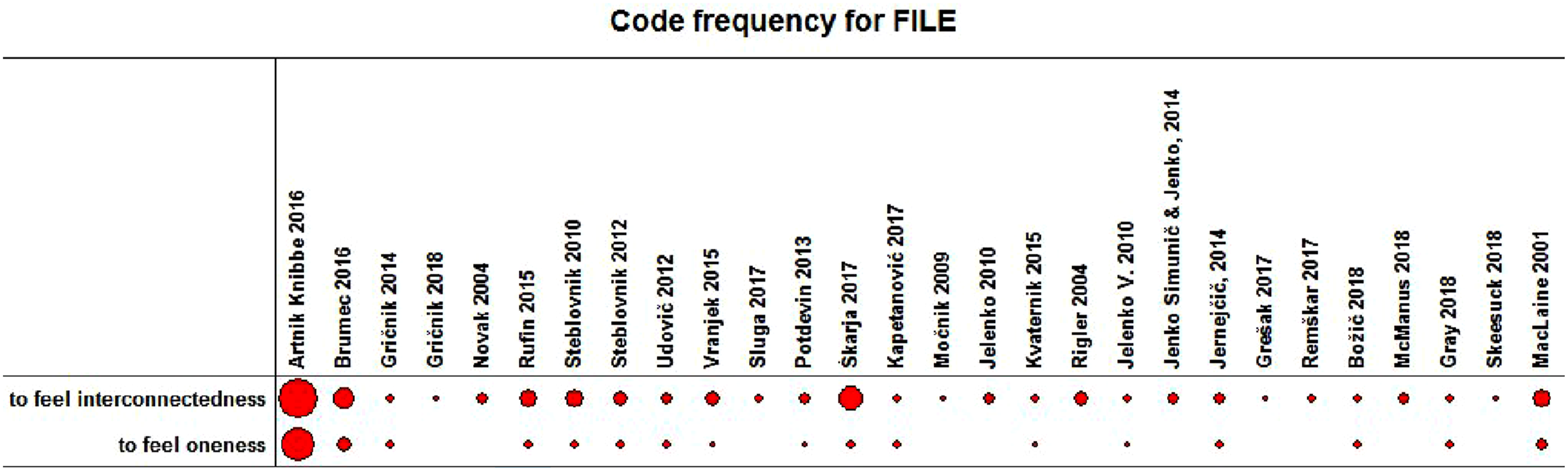
Drawing on combined qualitative and descriptive quantitative analyses of pilgrim narratives, Brumec et al. (2023) observed that many pilgrims describe a strong perception of being deeply integrated into a larger whole—often articulated as a connection with the universe, nature, or the divine. Such descriptions parallel Maslow’s depiction of peak experiences, marked by absorption and the perception of reality as an integrated whole. These findings are interpretive rather than inferential: they corroborate rather than validate the qualitative phase, suggesting convergent indications of interconnectedness within the broader dataset.
A vivid description of this state can be found in the words of Rufin: “Only once the pilgrim is truly alone and almost naked, unencumbered by liturgical glitter […] freed from his suffering and vain cravings, can at last attain Oneness, the Essence, the Origin” (Rufin, 2016, ch. 25/para. 21).
Artnik Knibbe (2020) likewise captures the intertwined experience of oneness and interconnectedness: “Mindful awakening through the poetry of the body that once suggests drama, another time romantic fusion into Oneness, is an exceptional channel of reclaiming your wholeness” (p. 171). “You feel that you are a small part of the whole, a component of Oneness where everything is connected to everything else in a field of unconditional love” (p. 212).
These reflections closely mirror Maslow’s descriptions of B-cognition and interconnectedness. Grešak evokes this sense through images of timelessness, playfulness, and shared humanity: “Because we are connected on a deeper level than these orphaned words could ever achieve […] There are no words for all the joyful and sorrowful melodies …” (Grešak, 2017, p. 66).
Remškar (2017) offers a similar account of shared presence and playful unity: “It was an agreement without words […] There was relaxation, playfulness, lightness, and timelessness […] And a feeling that we could stay there forever” (Remškar, 2017, p. 68).
Potdevin (2013) extends this sense of harmony to all creation: “ […] harmony with the whole creation intertwined with the love that filled me every day. Slowly, human beings became part of this harmony […] We have good relationships, we feel safe and balanced, for we are all part of the same whole (Potdevin, 2013, p. 59).
To complement the qualitative findings, a descriptive quantitative survey was conducted among 501 pilgrims (Lavrič et al., 2021). Although limited to a single coarse 3-point measure of interconnectedness and not designed for inferential testing, the data provide supporting context: approximately 64% of respondents indicated that they had felt interconnected with the universe or the energy of life during their pilgrimage. While this cannot be interpreted as statistical validation, it offers corroborative evidence that experiences of unity and connection are commonly reported by pilgrims.
Taken together, these complementary qualitative and quantitative insights illustrate how pilgrims articulate experiences resonating with Maslow’s B-values—particularly wholeness, oneness, and interconnectedness. Rather than implying causal effects, the findings illuminate the phenomenological texture of these moments, in which individuals describe perceiving themselves and the world as integrally, even sacredly, connected.
Self-Actualization and B-Values
Maslow (1994) proposed that the ultimate purpose of life is to discover and actualize one’s innermost potential, unlocking the essence of true humanity. He emphasized that this process of “healthy growth” involves not only realizing one’s own capacities but also supporting others in their pursuit of inner development. Peak experiences, as defined by Maslow, function as moments of B-cognition—brief yet transformative insights into what one could and should become, representing transient states of self-actualization.
The Camino de Santiago pilgrimage offers a rich cultural and experiential setting in which such processes of realization are frequently described. It represents a context where individuals may temporarily transcend material or ego-oriented concerns and express their authentic humanity. Artnik Knibbe (2020) articulates this perspective vividly: “ Not one’s career or financial success, which nowadays follows so many as a measure for having realized your potential, but the potential of humanity and love waiting to gain full momentum. The true face of awakened individuals, who, ever more passionately, devote themselves to the inner impulses of creating the collective good, is more and more frequently and ceaselessly shown to the world daily: awakened individuals rising like a phoenix from the ashes of their burned victim role, flying high on their compassion and faith” (p. 217).
Irish pilgrim Jesuit McManus (2014) similarly emphasizes the importance of authenticity and alignment with divine origins in the journey toward self-actualization: “Anything can be helpful and a path to God, as long as it genuinely originates from God and deepens one’s humanity. This entails scrutinizing our choices to determine their origin and direction, whether they stem from what is truly good (from God) or whether they arise from the ego, rigidity, negativity, or even self-loathing” (McManus, 2014, ch. 9/para. 4).
Recent theoretical developments further illuminate such narratives. Kaufman (2018, 2020) reinterprets self-actualization as an open-ended process in which personal growth and self-transcendent moments continually inform one another. From this standpoint, pilgrims’ descriptions of voluntary walking, bodily endurance, and companionship can be viewed as expressions of intrinsic motivation and meaning-oriented striving rather than externally defined achievement.
Within this broader framework, the Camino may be understood not as a causal agent of transformation but as a symbolic and social milieu through which individuals reflect upon and express their inner growth. In a survey using Kaufman’s Characteristics of Self-Actualization Scale (CSAS) with 500 pilgrims, Brumec (2024a) identified recurring motifs of gratitude, inner calm, self-acceptance, and moral clarity. Participants frequently narrated an expanded sense of belonging that encompassed both other people and the natural world.
Taken together, these accounts portray the Camino as a lived metaphor for integrative development. The language of Being values—truth, beauty, goodness, and wholeness—appears in pilgrims’ reflections not as abstract ideals but as experiential qualities embedded in everyday life. Through walking, encounter, and reflection, pilgrims describe a process of remembering rather than achieving their humanity—an insight that situates self-actualization within cultural practice, embodied experience, and shared meaning-making.
Discussion and Conclusion
This study examined how pilgrims on the Camino de Santiago describe experiences that resonate with Maslow’s concept of peak experiences and the activation of Being values. The findings illustrate that pilgrims frequently speak of unity, interconnectedness, and harmony as qualities arising within the liminal conditions of pilgrimage. Such descriptions correspond to the values Maslow associated with self-actualization, yet they are here understood as culturally mediated rather than purely intrapsychic. The Camino provides a narrative, spatial, and communal framework through which individuals articulate transformations of meaning and identity.
The analysis extends humanistic psychology by situating Maslow’s ideas within contemporary perspectives on lived experience and meaning construction. Maslow’s framework offered a useful heuristic for organizing the data, while recent work on self-actualization and self-transcendence (e.g., Kaufman, 2018, 2020) contextualizes these experiences within broader movements toward authenticity and relational awareness. From this standpoint, the Camino may be viewed as a psychosocial setting that invites reflection, mutual recognition, and embodied connection, rather than as a mechanism producing change. By psychosocial setting we refer to the specific combination of social, symbolic, and experiential conditions characteristic of pilgrimage: prolonged walking, temporary suspension of everyday roles, encounters with strangers, and shared rituals. These elements create a liminal environment in which ordinary hierarchies are softened and moments of communitas can emerge (Turner, 1969; Turner & Turner, 1978). Within this environment, personal meanings are negotiated collectively, and inner experiences are shaped through dialogue, storytelling, and shared presence.
The results converge with previous research on pilgrimage and self-transcendence but add interpretive depth by focusing on how pilgrims’ language reveals a synthesis of the sacred and the everyday. The sense of wholeness and peace reported in these narratives often emerges as much from social connection and shared purpose as from solitary contemplation. In this respect, the study complements social-psychological perspectives emphasizing the communal nature of transformation. Pilgrimage is not portrayed as causing these states in a deterministic sense but as providing a symbolic and relational field through which they are recognized and endowed with meaning.
Our findings relate to Sørensen and Høgh-Olesen’s (2022) argument that some benefits of the Camino may result from the temporary absence of modern pressures such as stimulus overload. The present study adds that pilgrims do not describe their experiences merely as relief from stress, but as encounters with B-values. In line with Maslow’s (1994) definition of peak experiences as moments of B-cognition, these accounts can be understood as transient states of self-actualization. This suggests that reduced everyday demands create enabling conditions, whereas the experiential content itself is interpreted by pilgrims as qualitatively meaningful and intrinsically significant.
The study’s main strength lies in its qualitative attention to first-person narratives. These accounts offer access to the phenomenology of transformation, revealing how ordinary walkers interpret extraordinary moments. Although the Camino de Santiago is historically rooted in Catholic tradition, the present findings should not be understood as limited to explicitly religious pilgrims. The analyzed travelogues reflect a wide range of motivations and interpretive frameworks, including spiritual, cultural, existential, and personal orientations. Explicitly theological language appeared only occasionally, while most descriptions were framed in experiential and humanistic terms. This supports the interpretation of the identified experiences as broadly human phenomena rather than narrowly doctrinal ones.
At the same time, several limitations must be acknowledged.
First, the analysis relies on retrospective self-descriptions. Pilgrims recount their experiences after the journey, and such narratives can be selective, idealized, or shaped by subsequent reflection. Travelogues are subjective accounts rather than direct representations of objective reality. However, within the epistemological framework of this study, pilgrims’ reports are treated as credible expressions of lived experience. The aim of the research is not to verify factual accuracy but to analyze how meaning is constructed and articulated.
Second, the analyzed texts were written for a public readership. Authors may have consciously or unconsciously adjusted, embellished, or omitted certain events and emotions to create a more coherent or socially desirable narrative. This potential bias is inherent in all autobiographical material and should be considered when interpreting the findings. Nevertheless, we believe that such narrative shaping is unlikely to undermine the core of experiences identified in the study, as the patterns emerged consistently across multiple independent accounts.
Third, a limitation concerns the linguistic and cultural scope of the corpus. The qualitative material consisted exclusively of travelogues published in the Slovene language, most of them authored by Slovenian pilgrims. This naturally raises questions about the transferability of the findings. While national and cultural contexts can influence narrative styles and interpretations, we see no compelling reason to assume that the fundamental experiential structures of Camino pilgrimage differ substantially across European contexts. The convergence between the qualitative results and the international survey data further supports this view. Nevertheless, future research incorporating travelogues from other linguistic and cultural settings—particularly Spanish or other European sources—would allow for a broader comparative perspective.
Fourth, the mixed-method design brings its own challenges. The qualitative corpus and the international online survey represent different types of data. Travelogues offer in-depth, context-rich narratives, whereas the survey captures more generalized patterns among a diverse group of pilgrims. While these datasets are not directly comparable, they were intentionally combined in a sequential exploratory design to provide complementary perspectives rather than statistical validation. This design choice should be understood as triangulation rather than direct methodological equivalence.
Finally, in line with standards of quality in qualitative research (Tracy, 2010), we acknowledge the interpretive role of the researcher. Although every effort was made to code the material inductively and reflexively, the analysis was inevitably influenced by the theoretical orientation toward Maslow’s framework. Alternative interpretive lenses might have highlighted different aspects of the narratives.
Despite these limitations, the study offers empirically grounded insights into the experience of Being values on the Camino de Santiago. Future research using different methodologies, broader linguistic samples, and longitudinal designs would be valuable for further validating and refining these findings.
Beyond the theoretical domain, the findings invite reflection on the social and practical implications of pilgrimage. As a collective and slow form of movement, walking the Camino offers a counterpoint to accelerated modern life, supporting mindfulness, community, and existential reflection. Policy initiatives that preserve and maintain pilgrimage routes might thus be seen not only as heritage conservation but also as contributions to public well-being. In therapeutic and educational contexts, the symbolic logic of pilgrimage—progress through simplicity, embodied reflection, and companionship—could inform approaches aimed at meaning reconstruction and resilience.
Furthermore, recent interdisciplinary insights suggest that such embodied practices may help restore balance between analytical and relational modes of knowing. In this light, pilgrimage walking can be interpreted not only as a cultural and symbolic act but also as a process that quiets habitual self-reference and fosters integrative awareness. This embodied harmony between movement, reflection, and community may partly explain why the Camino continues to evoke experiences of unity, wholeness, and transcendence in contemporary secular contexts.
In conclusion, the Camino de Santiago offers a meaningful contemporary setting for exploring processes of self-actualization and self-transcendence as fundamentally human experiences. Studying the Camino is important because it provides a contemporary setting in which processes of meaning-making, identity reflection, and self-transcendence become visible in everyday narratives. It offers a unique case for understanding how embodied movement, social interaction, and personal storytelling contribute to experiences of growth and well-being in late-modern societies. By integrating humanistic and cultural-psychological perspectives, this study highlights pilgrimage as a relational and embodied context through which individuals construct meaning, community, and a renewed sense of self.
Footnotes
Funding
The authors received no financial support for the research, authorship, and/or publication of this article.
Declaration of Conflicting Interests
The authors declared no potential conflicts of interest with respect to the research, authorship, and/or publication of this article.
Notes
Author Biographies
 .
.
.