




Abstract
While the rise of right-wing populism in West European politics has received considerable attention in academic circles, the equivalent phenomenon in Central and Eastern Europe (CEE) remains understudied. I address this gap by examining the factors contributing to right-wing populist party success in CEE. I argue that the success of such parties is best explained by the presence of salient ethnic minority parties. I propose that successful ethnic minority parties heighten the salience of ethno-nationalist divisions within a state, creating electoral demand for parties of the populist right. Political elites capitalize on the fear generated by the presence of strong minority parties and channel it into electoral support for the populist right. Performing statistical analysis on an original dataset of 108 CEE elections, I find evidence that the electoral performance of right-wing populist parties is influenced by the performance of ethnic minority parties and their participation in government.
Introduction
The rise of right-wing populism in West European politics has received considerable attention in academic circles, and a host of factors have been demonstrated to contribute to the success of prominent right-wing populist (RWP) parties in this region. In contrast, the rise of right-wing populism in Central and Eastern Europe (CEE) has not received even a fraction of the interest generated by the comparable phenomenon in the West. This is puzzling, given the strong electoral performance of populist right parties in states such as Bulgaria, Latvia, Lithuania, Macedonia, Romania, Serbia and Slovakia and their participation in government in Latvia, Macedonia, Romania and Slovakia. It is the purpose of this paper to address this gap in the literature and provide a systematic analysis of the factors contributing to RWP party success in CEE.
I argue that the determinants of RWP support in the two regions differ. Most notably, whereas anti-immigration sentiment plays a major role in explaining RWP party success in Western Europe, this cannot be the case in Eastern Europe. Rather, the success of such parties in CEE can best be explained by the presence of salient ethnic minority parties. I argue that successful ethnic minority parties heighten the salience of ethno-nationalist divisions within a state, creating electoral demand for parties of the populist right. Political elites capitalize on the fear generated by the presence of strong ethnic minority parties and channel it into electoral support for RWP parties. I find evidence that a high vote share for minority parties in legislative elections and the participation of such parties in coalition government contribute to the electoral success of populist right parties. My results suggest that the electoral performance and government participation of parties—even small parties outside of the political mainstream—can have an impact on the electoral performance of parties diametrically opposed to them within the state’s political system.
This paper proceeds as follows. In the next section, ‘Characteristics of right-wing populist parties,’ I briefly discuss the defining characteristics of the political parties with which this paper is concerned. In the section ‘Explaining RWP party success in CEE’, I develop a novel explanation for RWP party success in CEE, arguing that this success is driven largely by the presence of successful ethnic minority parties. Finally, in the ‘Analysis’ section, I test the hypotheses developed in the previous section with an original macro-level data set of 108 elections in CEE states in the period 1990 to 2012.
Characteristics of RWP parties
While RWP parties 1 are not as homogenous of a group as one might expect, they share certain unifying traits. Mudde (2007) identifies three common characteristics of the European populist right—nativism, populism and authoritarianism. The nativism of RWP parties is expressed in their claim to representing the interests of the majority ethnic group of the state, and their conception of the public good as a zero-sum game between majority and minority ethnic interests. Parties of the populist right champion the dominant cultural values of the state—the ones espoused by its majority ethnic group. They tend to interpret other cultural influences as breeding disunity, endangering the preservation of the state’s cultural heritage, and even threatening the survival of the state itself.
Right-wing populist parties further share the common thread of populism, opposing political establishments on the grounds that dominant parties favor ‘other people’ rather than ‘the people’. They espouse a view of society being clearly separated into two distinct and diametrically opposed groups—’the pure people’ and ‘the corrupt elite’ (Mudde, 2007) and champion themselves as anti-establishment underdogs, seeking to capitalize on the public’s disillusionment with the state’s political elites (Rydgren, 2004).
Lastly, RWP parties portray themselves as champions of law and order, and frequently criticize mainstream parties for not doing enough to prevent crimes and for failing to penalize wrongdoers with the severity merited by their offenses. This is why Mudde (2007) identifies authoritarianism—defined as ‘the belief in a strictly ordered society, in which infringements of authority are to be punished severely’—to be one of the key characteristics of the populist right.
Not all RWP parties are ‘right-wing’ on every issue dimension. This is evident in the arena of economic policy, where some parties oppose free trade and promote statist and redistributive economic policies, as is increasingly the case for Bulgaria’s Ataka, for instance. Further, as evidenced by the Netherlands’ Pim Fortuyn List and Party for Freedom, some RWP parties have progressive ideologies on certain social issues, indicating ideological diversity even outside the economic issue space. Despite such ideological variation, however, the three overarching commonalities—nativism, populism and authoritarianism—bind RWP parties together into a conceptually coherent party group which lends itself to empirical study.
Explaining RWP party success in CEE
One of the most commonly cited factors in explaining RWP party success in Western Europe is the presence and mobilization of anti-immigration sentiment. The link between xenophobia and RWP support was first established in case studies of the French National Front (Lewis-Beck and Mitchell, 1993; Ivaldi, 1996). Cross-national research has produced further evidence for the influence of anti-immigration attitudes, with Ivarsflaten (2008) finding that no RWP party has been able to achieve electoral success without mobilizing the anti-immigration vote better than both the state’s major center-left and center-right parties. While there has been some debate as to whether the anti-immigrant sentiment driving RWP success is economic or cultural in nature, both Oesch (2008) and Lucassen and Lubbers (2012) establish that concerns of cultural identity trump economic concerns in driving demand for the populist right.
Anti-immigration sentiment seems to be a poor predictor for the rise of the populist right in CEE states, however, since these states have not experienced immigration of the magnitude experienced by most Western European countries over the past 30 years, and immigration is generally not a politically salient issue in the region. Yet it is undeniable that RWP parties in the East are just as opposed to multiculturalism and ethnic pluralism as their counterparts in the West, and just as insistent on framing themselves as the champions and protectors of the interests of the ethnic majority. This raises the question: if it is not an inflow of migrants that is the source of such anti-pluralist sentiment, then what is?
While Central and Eastern Europe has not experienced the cultural heterogenization of the West, few CEE states are ethnically homogenous. A number of countries in the region have substantial ethnic minority populations that have never been fully integrated into an overarching national culture. Differences based on religion, language and ethnicity can be just as prominent and pronounced in Bulgaria, Macedonia and Slovakia as they are in the Netherlands, France and Austria. There is ample opportunity for political entrepreneurs in CEE to position themselves as the defenders of the majority ethnic group against minority demands for ‘special rights’.
It appears then that opposition to ethnic pluralism, rather than opposition to immigration, could be a crucial determinant of RWP party success in CEE. Yet unlike xenophobic sentiment in the West, it is not so evident why an anti-minority sentiment should arise in CEE. In Western Europe, xenophobia gained salience at the same time the region began to experience a spike in immigration. On the other hand, the ethnic demographics of CEE have remained fairly static over the past several decades. It is understandable that a state may exhibit anti-pluralist backlash when confronted with a sudden and rapid ethno-cultural heterogenization. But why should we observe a similar phenomenon in states where ethno-cultural diversity is nothing new?
One possible explanation is that the nascent political pluralism following the demise of Communism gave minority ethnic groups an opportunity to make their voices heard. Some of these groups elected to use this newfound freedom to organize politically and participate in elections. This served to give ethnic divisions within the state greater salience and to sow fear among the ethnic majority populations that the newly empowered minorities would use their influence to improve their standing at the expense of the majority. Under these conditions, latent anti-pluralist sentiment metastasized and laid the foundations for electorally viable RWP parties.
Anti-pluralist sentiment is most salient and most ripe for political mobilization precisely when ethnic minority demands for equal rights have themselves been mobilized in the formation of an ethnic minority party. The presence of a sizeable minority group in itself is not enough to empower a RWP political movement. However, once an ethnic group gains recognition in the form of a prominent political party, a populist right counter-mobilization becomes more likely. It becomes far easier for RWP parties to characterize a minority ethnic group as a legitimate threat to national virtues once this group has acquired a unified political voice and appears to have the means to achieve at least some of its goals.
While it is widely recognized that the nature of the other parties in the political system matters for the populist right’s likelihood of success (Abedi, 2002; Ignazi, 1992; Kitschelt, 1995; Meguid, 2005), existing studies have overwhelmingly focused on the influence of mainstream parties and their ideological positions. In contrast, I focus on the influence of the electoral strength and salience of a non-mainstream party group. My theory bears some similarity to arguments previously advanced regarding post-materialist values and rise of green and RWP parties in Western Europe. Inglehart and Flanagan (1987) identify the rise of a new axis of political competition, based on the conflict between traditional cultural values and post-material values. The first evidence of this new political dimension was the emergence of green and left-libertarian parties in Western Europe in the 1980’s. Ignazi (1996) argues that the presence and success of such parties enlarged the political space, prompting a counter-mobilization at the other end of the spectrum, leading to the formation of RWP parties.
My argument follows a similar logic. However, whereas in Western Europe it was value changes that triggered the formation of green and left-libertarian parties, in Eastern Europe it was an institutional change—the introduction of political pluralism—that led to the emergence of ethnic minority parties. The formation of minority parties promoted an ethno-nationalist axis of political competition and created electoral demand for parties positioned on the other end of spectrum. Political entrepreneurs stepped in, capitalizing on nationalist and anti-pluralistic sentiment and channeling it into the form of electoral support for RWP parties.
However, I believe that the story does not end here. I argue that in order for a RWP party in CEE to have the best chance of maintaining its initial success, it needs to have a prominent minority party against which to compete on a regular basis. Thus, I believe that the link between minority party and populist right fortunes goes beyond the initial stages of party competition and ought to be evident even after such parties have become established actors in the political system. Indeed, a cursory look at the CEE region reveals that six of the nine states where RWP parties have enjoyed substantial support—Bulgaria, Latvia, Lithuania, Macedonia, Romania and Slovakia—have also had consistently successful ethnic parties. On the other hand, states where ethnically based parties are political minnows or do not exist at all (Estonia, Kosovo, Moldova, Poland, Ukraine) are notable for the absence of thriving populist right parties.
To illustrate the linkage between ethnic minority party and RWP party success observed in CEE, I will briefly discuss the interaction within two such party dyads—the Party of the Hungarian Coalition and the Slovak National Party in Slovakia, and the Movement for Rights and Freedoms and Ataka in Bulgaria.
Following the Velvet Revolution, few could foresee the peaceful dissolution that Czechoslovakia would experience in a few short years. Indeed, the only Slovak political party to consistently run on a separatist platform in the early 1990s was the Slovak National Party (SNP). Slovak independence was a foundational and defining issue for the SNP (Hilde, 1999: 651; Rybar, 2006: 157) and the party initially drew most of its support from the pro-independence electorate (Deegan-Krause, 2004: 681-683). While popular support for a continued joint state remained dominant among both Czechs and Slovaks, bargaining deadlock over institutional arrangements led to the dissolution of Czechoslovakia and the formation of the Czech and Slovak Republics on 1 January 1993. With its primary campaign issue now resolved, the future seemed uncertain for the SNP; how would the party maintain political relevance and electoral support in a newly independent Slovakia? The party experienced a substantial drop in its vote share in Slovakia’s first post-independence elections in 1994. Yet four years later, the SNP rebounded with a strong showing, improving from 5.4% to 9.1% of the vote.
What could account for the resurgence of the SNP? The fall of Communism in Czechoslovakia initiated the establishment of several political parties of various ideologies representing the state’s Hungarian minority. By the 1994 elections, these parties had joined forces to form the Party of the Hungarian Coalition (PHC) and were able to command 10.2% of the vote, with support concentrated in Hungarian-dominated southern Slovakia. With its rise to prominence and its monopolization of the ethnic Hungarian vote, the PHC became a prime target for ethnically Slovak voters and parties (Rybar, 2006: 157). The party was certainly not helped by the fact that the various Hungarian political parties preceding it had opposed Slovak independence (Deegan-Krause, 2004: 691; Kostelecký, 2002: 94-95), a position which had become thoroughly unpopular by the late 1990s (Deegan-Krause, 2004: 674-675). Against this backdrop, the SNP was able to reinvent itself, transitioning from a single-issue Slovak independence party into a populist right party opposed to the expansion of ethnic rights promoted by the PHC. The party presented itself as the defender of ethnic Slovaks against the ambitions of the PHC (Rybar, 2006: 157), actively stoking fears about Hungarian irredentism and ‘Hungarianization’ (Deegan-Krause, 2004: 679) and carving out a niche for itself as the ideological polar opposite of the PHC in Slovak politics (Deegan-Krause, 2004: 679; Evans and Whitefield, 1998: 131). In the following years, the SNP routinely targeted successive Hungarian minority parties with accusations of persecution of Slovaks in Hungarian regions and of connivance with neighboring Hungary, periodically proposed a ban on ethnic parties, and was particularly strident in sounding the alarm when Hungarian parties were included in government. It was this antagonism toward organized Hungarian political interests that enabled the SNP to not only remain relevant in Slovak politics, but to actually thrive in a post-independence political system.
Arguably, one of the most successful aspects of Bulgaria’s democratic transition has been the relative peace and tranquility in the relations between the titular ethnic group and the country’ sizable Turkish minority. The political climate of the 1990s and early 2000s proved to be remarkably inhospitable to political nationalism, with mainstream parties refusing to campaign on ethnic questions and nationalist parties receiving paltry electoral support. However, the year 2005 saw the remarkable rise of Ataka, a RWP party which, mere weeks after its formation, commanded 8.1% of the vote in Bulgaria’s parliamentary election. Since then, the party has maintained its electoral success, with strong showings in parliamentary, presidential and European Parliament elections.
What can account for this sudden rise of the populist right in Bulgaria? Several explanations have been proposed, but there is a strong argument to be made for the influence of the Movement for Rights and Freedoms (MRF), Bulgaria’s Turkish minority party. While the MRF had enjoyed strong and steady electoral support throughout the 1990s, it was not until 2001 that the party was included in government as an official coalition partner. The greater influence and visibility of the party put it (as well as its controversial leader, Ahmed Dogan) under the magnifying glass in Bulgarian politics. While Bulgaria’s tradition of ethno-religious tolerance made it unprofitable for parties to antagonize the Turkish minority, Dogan and the MRF proved to be a viable target for the populist right. The party’s role in government caused ‘increasing uneasiness within the Bulgarian majority, which became more receptive to nationalist–populist messages of the kind propagated by “Ataka”’ (Sgourev, 2010: 642). Volen Siderov, Ataka’s leader, railed against the political influence of the MRF, painting it as a threat to Bulgarian sovereignty, and decried Dogan as a corrupt politician who would stop at nothing to enrich himself and his constituents at the expense of other Bulgarian citizens (Genov, 2010: 46-47). Rather than attacking Turks as a group, Siderov objected to the ‘political existence of ethnic minorities’ (Stefanova, 2009: 1540; my emphasis). Ultimately, Ataka was able to capitalize on ‘the popular uneasiness about the disproportionate role of the representative of ethnic minorities—the Movement for Rights and Freedom, in the exercise of power’ (Sgourev, 2010: 643).
The examples of Bulgaria and Slovakia point to two main modes through which minority parties can increase their salience and, in the process, contribute to the mobilization of populist right: 1) performing well in competitive elections and 2) participating in coalition government.
A large share of the vote generally results in a large share of seats in the legislature, and significant legislative representation for any group of people suggests a potential for that group’s influence on the political process. Therefore, strong electoral performance by ethnic minority parties allows the populist right to make a legitimate case to the electorate that the political influence of ethnic minorities is excessive and must be curbed. We can expect, then, that the electoral fortunes of these two types of parties will be closely inter-linked. The only question is whether the effect of strong minority party performance will be felt immediately—that is, in the same election—or whether it will have a delayed effect carrying into the next election cycle. While the former is possible, the latter seems more likely, as the extent of minority party support cannot be truly known until the election actually takes place and the votes are counted. It seems more plausible that RWP parties would rally support by pointing to minority parties’ success in the previous election, rather than to their uncertain expected vote share in the present election. Nonetheless, I feel that both versions of the argument ought to be examined. I therefore test my theoretical expectations with the following two hypotheses:
In addition to faring well in competitive elections, minority parties can also raise their profile by participating in coalition governments, as the Bulgarian example attests. Controlling ministerial portfolios and helping shape the policies of the government are certainly functions that heighten the salience of a party and open it up to criticism. It is easier for the populist right to scapegoat minority parties when they are in government (and therefore part of the ‘corrupt political elite’) than when they are in opposition. It is also easier for RWP parties to argue that the government of the state has been ‘infiltrated’ by minority interests and needs to be set right. Therefore we can expect that RWP parties will be most effective in mobilizing electoral support in elections where at least one ethnic minority party participates in the incumbent government.
I test my theoretical expectation regarding the influence of minority party participation in government with the following hypothesis:
Analysis
I test my hypotheses on a dataset of 108 competitive legislative elections in 17 CEE democracies (Albania, Bulgaria, Croatia, Czech Republic, Estonia, Hungary, Kosovo, Latvia, Lithuania, Macedonia, Moldova, Poland, Romania, Serbia, Slovakia, Slovenia and Ukraine) for the time period 1990 to 2012. 2 My selection of countries is based on a definition of Eastern Europe as comprising those European states that are located to the west of the Ural mountains and were in the Soviet sphere of influence (or part of the Soviet Union) during the Cold War. Russia and Belarus are excluded due to the authoritarian nature of their political systems, as evidenced by multiple democracy measurements. Bosnia and Herzegovina is omitted due to its unique electoral system, which entails three separate elections for each of the state’s three main ethnic groups. These provisions make it impossible to incorporate results from such elections into a wider comparative analysis.
In identifying RWP parties, I referred to the characteristics of such parties as described in the relevant literature, and summarized in the section ‘Characteristics of RWP Parties’ of this paper. I consulted party manifestos and, where manifestos were not available, press releases and academic and popular publications, to determine whether a certain party exhibited RWP party traits. Although I favored primary sources (party manifestos and press releases) where they were available either in English or in languages I am proficient in reading (Bulgarian, Macedonian and Serbian-Bosnian-Croatian), I often had to rely on secondary but nonetheless trustworthy sources, authored by academic and non-academic experts on the politics of the relevant state.
I considered as RWP only those parties that appeared to have a platform based on and emphasizing nativism, populism and authoritarianism; parties that failed to exhibit even one of these three traits were excluded. In most cases, making this judgment was rather straightforward. For instance, left-wing and centrist populist parties run on anti-establishment platforms, but do not incorporate nativist or authoritarian elements in their political agendas. Mainstream right-of-center parties in the region tend to embrace some mild, diluted forms of authoritarianism, but generally not nativism or populism. The toughest challenge was posed by the parties often termed ‘national conservative’, such as the League of Polish Families and Bulgaria’s Law and Justice Party. While such parties have populist and authoritarian elements to their agenda, I do not consider them to be RWP, due to the absence of a strong nativist appeal at the core of their platform. That is, I excluded those parties which position themselves as anti-elite and pro-law and order, but do not attempt to position themselves as the promoters of a majority ethnic interest, or as guardians against encroachment by minority ethnic interests. I further excluded parties that were merely Euroskeptic but which had otherwise inclusive and mainstream political agendas. While Euroskepticism is often incorporated into the party platforms of the populist right, purely Euroskpetic parties generally wish nothing to do with the divisive and exclusionist ethno-national politics of true RWPs, and thus should not be grouped with them.
Table 1 presents the RWP parties used in the analysis.
Right-wing populist parties.

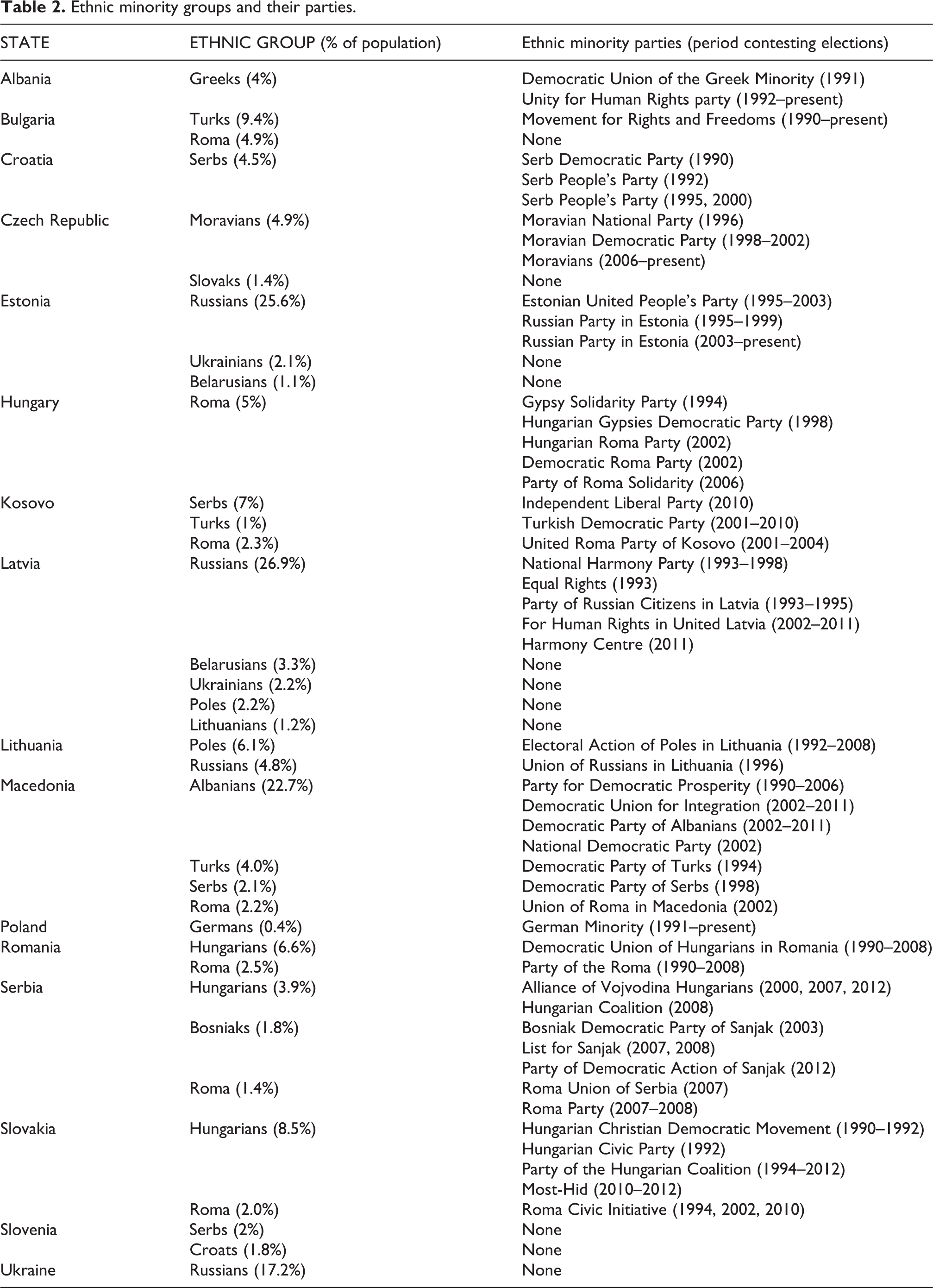
In identifying ethnic minority parties, the two broad approaches taken in the ethnic politics literature are to classify parties as ethnic based on either their self-identification or their electoral basis for support. The former defines a political party as ethnic based on whether or not it has an explicit reference to an ethnic group in its name. However, some parties which do not choose to officially label themselves as ethnic (for legal or other reasons) can be very much focused on defending the interests of a particular ethnic group. Therefore, the self-identification approach is in itself insufficient, and I elect to use it in conjunction with the electoral support approach. This approach is concerned with the extent to which a party’s existence and success hinge on support from a specific ethnic group. If the vast majority of a party’s electoral base is concentrated in a particular ethnic group, then that party must make that group happy in order to ensure its own survival, and it can therefore be thought of as representing that ethnic group. I therefore categorize as ethnic minority parties those parties which either 1) explicitly identify themselves with a particular ethnic group or 2) receive a majority of their electoral support from a particular ethnic group.
Table 2 lists the ethnic minority parties used in the analysis, categorized by country and minority group represented.
Ethnic minority groups and their parties.
The dependent variable in my analysis is RWP vote—the cumulative share of the vote in an election received by all parties espousing a RWP ideology.
3
In order to test my first hypothesis regarding the relationship between ethnic minority and RWP parties, I use the variable ethnic vote, which is the cumulative share of the vote in an election received by all ethnic minority parties. In testing my second hypothesis I utilize the variable lagged ethnic vote, which is the cumulative percentage of the vote received by all ethnic minority parties in the previous election. To test my third and final hypothesis, I use the variable ethnic government
A variety of other variables could conceivably influence support for RWP parties. Since the unit of analysis here is elections, I am limited to the use of macro-level variables. Poor economic performance—particularly when expressed in high levels of unemployment—has been demonstrated to improve the electoral fortunes of RWP parties in past research (Jackman and Volpert, 1996; Kreidl and Vlachova, 2000; Lewis-Beck and Mitchell, 1993), although other studies (Arzheimer and Carter, 2006; Knigge, 1998) present contradictory findings. Despite the mixed findings, the theory behind this proposed relationship—hard economic times boost the electoral prospects of populist, anti-establishment parties—appears sound. I therefore include the control variable unemployment—the percentage of citizens officially reported as unemployed 4 in the year of the election.
The literature on RWP parties in Western Europe has long posited that an ideological convergence between the major center-left and center-right parties of the state could facilitate the success of the populist right (Abedi, 2002; Kitschelt, 1995). I therefore include as a control variable the presence of a grand coalition government—that is, a government in which the two largest political parties of opposing ideologies rule jointly. The presence of a grand coalition is one of the best measurements of mainstream party convergence, as it is far more highly visible and tangible than the mere policy positions and rhetoric of such parties. 5 I therefore include a dichotomous variable where elections that take place while a grand coalition government is in office are coded as ‘1’ and all other elections are coded as ‘0.’
A further control variable I incorporate is electoral disproportionality. The empirical evidence on the influence of electoral rules is mixed, with some studies indicating that electoral disproportionality dampens support for the populist right (Jackman and Volpert, 1996; Vuegelers and Magnan, 2005) while others find that its effect is not statistically significant (Golder, 2003) or that it can even boost the vote share of the populist right (Arzheimer and Carter, 2006). Nevertheless, it seems necessary to control for the variation in electoral systems and rules in the region. In order to do this, I use the Gallagher Index, which takes the square root of half the sum of the squares of the difference between percent of vote and percent of seats for each of the parties in a particular election. 6 The resulting number is an index with values ranging from 0 to 100, where higher numbers indicate elections with more disproportional outcomes.
Public perceptions of the presence of corruption in government can have an influence on the electoral performance of the populist right, with perceptions of widespread corruption contributing to dissatisfaction with political elites and therefore to the success of minor parties such as RWPs. Such a relationship was posited by Kitschelt (1995: 161) and has been confirmed by empirical work (Vuegelers and Magnan, 2005). I therefore include perceptions of corruption as a control variable, operationalized using Transparency International’s Corruption Perceptions Index. 7
The final control variable which I take under consideration is the size of the minority population in each state at the time of each election. If my hypotheses regarding the relationship between ethnic minority and RWP party electoral success are supported by the data, a natural objection bound to emerge is that it may be merely the size of ethnic minority groups—rather than their political mobilization—that explains the success of RWP parties. It could be argued that a highly ethnically homogenous state does not provide favorable conditions for the populist right to thrive. On the other hand, the presence of a sizable ethnic out-group (or out-groups) in a state provides fertile ground for the divisive, exclusionist politics of right-wing populism to take root and flourish. It could well be that it is the size of ethnic minority groups that is driving the success of both ethnic minority and RWP parties. For this reason, I include a variable measuring the percentage of the population not belonging to the largest ethnic group of the state at the time of each election. 8 Higher values indicate a more diverse population, while lower values indicate an ethnically homogenous population.
Table 3 presents some descriptive statistics regarding the continuous variables mentioned above.
Descriptive statistics for variables used in the analysis.

Bivariate correlations (not reported here) provide preliminary evidence supporting each of my three hypotheses. I further test these hypotheses with multiple regression models in order to incorporate potentially influential control variables. I modeled the data using three different methods—a pooled ordinary least squares (OLS) regression, a fixed-effects (least-squares dummy variable) model and a random-effects model. The pooled OLS regressions yielded the most robust results with respect to the influence of ethnic vote, ethnic vote lag and ethnic government on the dependent variable. However, since the data is grouped by states, some statistical technique to account for country effects is in order. 9 The two most common techniques used to address this issue are fixed-effects and random-effects models. I elect to use the latter, since the results of a Hausman test suggested unique errors are not correlated with the regressors.
Table 4 presents the results for three random-effects models testing my three hypotheses. Each model features RWP vote as the dependent variable and five controls (unemployment, disproportionality, grand coalition, corruption and minority population) as independent variables. In addition, Model 1 features ethnic vote as an independent variable, Model 2 uses lagged ethnic vote and Model 3 features ethnic government. The coefficients presented were obtained after controlling for heteroskedasticity.
Explaining right-wing populist party success.a

aCell entries are regression coefficients and, in parentheses, standard errors.
bSignificant at p < 0.10.
cSignificant at p < 0.05.
dSignificant at p < 0.01.
In the first model, ethnic vote appears to have some influence on the success of RWP parties, being statistically significant at the p < 0.1 level. The stronger the performance of ethnic minority parties in an election, the stronger we can expect the performance of RWP parties to be. Among the control variables, unemployment is the only one exhibiting a statistically significant effect, indicating that hard economic times boost the appeal of the populist right. The coefficients for disproportionality and minority population exhibit the predicted signs, but fail to reach statistical significance even at the p < 0.1 level. It appears that minority party strength is a stronger predictor of RWP party strength than the mere presence of ethnic minorities. Corruption and grand coalition appear to hardly exert any influence at all, in this and every other model.
The influence of lagged ethnic vote in the second model is stronger than that of ethnic vote in the first, with its coefficient being statistically significant at the p < 0.01 level. Once again, the coefficient for unemployment yields statistical significance, albeit at the p < 0.1 level. Again, neither disproportionality nor minority population reach statistical significance. We can conclude that the performance of ethnic minority parties in one election exerts an influence on the success of RWP parties in the following election. Further, this lagged effect is stronger than that of minority party performance in the current election.
The third model demonstrates that the participation of an ethnic party in a governing coalition is also a statistically significant predictor of RWP party success, with the coefficient for ethnic government achieving statistical significance at the p < 0.01 level. As in the previous models, unemployment is also significant. Disproportionality and minority population also reach statistical significance here, although only at the p < 0.1 level. It appears that the presence of an ethnic minority party in an incumbent coalition government increases the likelihood that a RWP party will experience strong electoral support. However, it should be noted that with relatively few cases of the participation of ethnic minority parties in government (there are 20 observations in all), it is difficult to draw definite conclusions.
Table 5 demonstrates the magnitude of the influence of ethnic minority party strength on RWP party strength by showing the predicted values of RWP vote for given values of lagged ethnic vote. Even a small increase in support for ethnic minority parties strongly influences RWP parties’ chance of success. A lagged ethnic vote value of ‘0’ yields a confidence interval of 1.5–5.2. In other words, if there are no ethnic minority parties contesting an election, we can be 95% confident that a RWP party will win between 1.5 and 5.2% of the vote. Note that even the upper bound is barely large enough to pass the electoral threshold in most proportional representation systems. However, a modest increase of five percentage points in the share of the vote won by ethnic minority parties yields a RWP vote confidence interval of 5.7–8.7. In other words, with an even moderately successful ethnic minority party in place, we are very likely to observe a populist right party large enough to gain legislative representation.
Estimates and 95% confidence intervals of RWP vote for given values of lagged ethnic vote.

To summarize, my analysis offers evidence supporting all three of my hypotheses. The presence of successful ethnic minority parties, their past electoral performance and their participation in government all contribute to the success of RWP parties. Further, as expected, the strength of ethnic minority parties in the previous election is more influential on RWP performance than their strength in the election at hand. It appears that potential populist right voters may be mobilized most effectively when confronted with the success of ethnic minority parties in the previous election, rather than with their uncertain strength in the run-up to the election at hand.
This finding also helps to address one possible concern regarding the theory advanced in this paper—namely, that I have gotten the arrow of causation wrong. Establishing a strong correlation between RWP and ethnic minority party performance tells us nothing about how these variables could be causally related. It seems equally plausible that RWP success is driving minority party success and not the other way around. I certainly do not reject this possibility; indeed, my theory allows that causality may flow both ways. Ethnic minority and populist right parties could both feed off of the fear generated by the other’s success. It would be difficult to gauge, however, how much each of these two respective dynamics contributes to the empirical relationship, thus leaving the possibility that minority party performance has minimal influence on RWP party performance. However, the fact that it is the lagged minority party vote that best explains RWP success suggests that this is not the case. While the electoral strength of the populist right in a given election could account for minority party strength in the same election, it cannot be the cause of minority party strength in the previous election. Here, the causal arrow can only point one way.
Additionally, I find a statistically significant effect of unemployment on RWP party success, indicating that support for such parties tends to spike during periods of economic hardship. More proportional electoral systems and a high share of the population belonging to ethnic minorities also appear to aid RWP parties, though not to a significant extent. It is worth noting that ethnic minority party strength and influence (whether measured as vote share, lagged vote share or participation in government) does a considerably better job of explaining the strength of the populist right than the mere presence of ethnic minorities. 10
Of course, one must exercise caution in interpreting the findings presented here. My analysis draws solely on macro-level data, which limits the number of variables that can be incorporated into the analysis, and carries with it the dangers of committing the ecological fallacy. We cannot know for certain if individual voters who supported RWP parties did so due to their perceptions of the danger posed by ethnic parties. We can only determine that at the state level, the presence of strong ethnic minority parties appears to contribute to the presence of strong RWP parties. Determining whether there is an individual-level relationship between concern over minority party strength and likelihood to support the populist right is one possible avenue for future research.
Conclusion
Despite the limitations of my analysis, I believe that I have demonstrated that there is a unique factor influencing the emergence and success of RWP parties in CEE that has not been previously identified in a heavily Western Europe-centered literature on the populist right. The presence and salience of minority ethnic parties clearly has a positive effect on the success of their RWP counterparts in the CEE region. It appears that in the East, opposition to politically organized ethnic minorities serves much the same role that anti-immigrant sentiment does in the West. Taken together with the state of the economy (a universal predictor in both regions), this factor accounts for much of the success the populist right has enjoyed in CEE.
The results of my analysis further bear relevance beyond the specific study of RWP parties, as they suggest that the electoral performance and government participation of parties—even small ones outside of the political mainstream—can have an impact on the electoral performance of parties diametrically opposed to them within the state’s political system. It is possible to conceive of other dyads of ideologically opposed niche parties where the same relationship may hold.
Footnotes
Acknowledgements
The author would like to thank Carol Leff, Xinyuan Dai, Brian Gaines, Neil Vander Most, Wenshuo (Nini) Zhang, Konstantinos Travlos, Gennady Rudkevich, Shyam Kulkarni and the anonymous referees for their valuable comments.
Funding
This research received no specific grant from any funding agency in the public, commercial, or not-for-profit sectors.