



Abstract
This empirical study examines the stationarity of tourism demand in Turkey in response to the effects of structural breaks, which indicate external or internal shocks based on tourist arrivals from 12 Slavic-speaking countries between 2000 and 2016. We employed a panel unit root test based on the Flexible Fourier approach, which Karul enhanced to allow gradual shifts and a smooth transition process; structural break dates come from the Carrion-i-Silvestre unit root test framework. The empirical findings indicate that there are differences in the effects of these structural breaks across the 12 countries in question.
Keywords
Introduction
The tourism industry is considered one of the key sectors of economic development and growth on both a national and international scale, contributing significantly to a country’s overall economy (Baker, 2014)—in part through the influx and exchange of foreign currency (Dritsakis, 2004). Furthermore, the industry’s development increases employment, industrial, and agriculture activities; additional sources of resident income; and local tax revenues (Balaguer and Cantavella-Jordá, 2002; Durbarry, 2002). However, reliance on the tourism industry has many challenges. Demand is volatile, sensitive to news and events, with fluctuations caused by security risks, natural disasters, war, acts of terrorism, and political instability (Ouerfelli, 2008; Pizam and Smith, 2000; Saha and Yap, 2014; Sonmez, 1998; Webber, 2001). Therefore, news and events may either increase or decrease tourism demand, depending on their tenor, thus directly affecting the destination’s development (Gunduz and Hatemi, 2005; Okumus, Altinay, and Arasli, 2005; Wang, 2009). In recent years, the frequency of major disasters has grown; however, the impact of these events on tourism demand in many cases is short, as the industry has rebounded to previous or greater values within 1 or 2 years (Wang, 2009). Nevertheless, political instability and crisis events engender negative effects on tourism demand. This empirical study investigates the response of the tourism industry in Turkey to the effects of shock or unexpected events, based on tourist arrivals from 12 Slavic-speaking countries.
The tourism industry is a particularly critical part of the Turkish economy (Gunduz and Hatemi, 2005; Gul and Cagatay, 2015). Since early 2000, international tourist arrivals in Turkey have experienced substantial growth, with European countries accounting for the majority. From 2000 to 2016, the total aggregate tourist arrivals rose at an average rate of 8.33% per annum, and economic activity generated by the travel and tourism industry in 2017 was 3.8% of the country’s gross domestic product (GDP; World Travel and Tourism Council (WTTC), 2018). Kucukaltan and Terzioglu (2013) suggest that there is a significant relationship in Turkey between tourism demand, foreign exchange rates, and GDP. Similarly, findings by Gul and Cagatay (2015) evidence that the growth of the tourism industry positively affects the employment rate and export revenues and supports the resolution of the foreign exchange rate bottleneck. Despite recent turbulence (e.g., attempts at a military coup, a declared state of emergency, terrorist attacks, political conflicts with Russia and the United States, etc.), Turkey is still one of the most popular tourist destinations in the world (UNWTO, 2017), ranked 10th with respect to international arrivals in 2016, with great growth potential due to its solid long-term macroeconomic fundamentals. In the light of this, the purpose of this empirical study is to examine the response of tourism demand in Turkey at times of crisis created by shock events, similar to those listed above, that have affected international tourism demand.
Based on the above-mentioned purpose, we attempted to evaluate the impact on tourism demand in Turkey by testing a random walk hypothesis with a brand-new unit root approach for tourist arrivals from 12 major international tourist source markets for Turkey. The knowledge of permanent or transitory effects of random shocks is critical for policy implications in the tourism industry (Narayan, 2005). For example, if a shock such as political instability has a permanent effect, the number of tourist arrivals will be affected negatively. Indeed, if political instability has a transitory effect, the number of visitor arrivals will return to their equilibrium path despite the political instability in the long term (Narayan, 2005). This study checks whether tourist arrivals follow a random walk process. Moreover, the effects of shocks on tourism demand have never been tested with a panel unit root test that considers gradual structural breaks and smooth transition processes introduced recently by Karul (2016), which will help us to better understand the effects of unexpected events (war, terrorism, natural disasters, political instability, etc.) on tourist arrivals statistically. The work by Karul (2016) initiated a new panel unit root test that entirely determines the stationarity of a series by enhancing the Fourier approach and Kwiatkowski–Phillips–Schmidt–Shin (KPSS) unit root test with gradual shifts (breaks–shocks) and a smoother transition process.
Data, model specification, and results
In this study, we examined international tourist arrivals from 12 Central European markets to Turkey over the period from January 2000 to December 2016, based on a data set available through the Turkish Ministry of Culture and Tourism (MCT, 2018). The data set included tourist arrivals from the Czech Republic, Poland, Belarus, Russia, Ukraine, Bosnia and Herzegovina, Croatia, Slovenia, North Macedonia, Bulgaria, Slovakia, and Serbia.
Model specification
For our study, we chose to follow the unit root model developed by Enders and Lee (2012) that can control for several smooth breaks of an unknown functional form. The model yields better results for gradual structural breaks (shifts), as opposed to the more traditional model (see Perron, 1989) of using dummy variables as a proxy for each break. One of the earlier models on how to synthesize structural breaks with panel data sets was introduced by Becker, Enders, and Lee (2006), which recommended the Fourier KPSS, or KPSS test (Kwiatkowski et al., 1992). In their work, Enders and Lee (2012) considered the Fourier approximation a variant of the Flexible Fourier Form proposed by Gallant (1981, 1984) to control for an unknown number of breaks, using a single frequency component as

where k represents the single frequency as a preferred component for the approximation, because a small number of low-frequency components can capture the process of gradual structural change, while multiple frequencies decrease the degree of freedom. The variables
Following equation (1) developed by Enders and Lee (2012), Karul (2016) has advanced the process of generating single frequency data as


where
Estimated results
In the first step of the panel test, we used the Bartlett Kernel rule under the boundary rule of Kurozumi (2002) to account for the series dependence. Accordingly, the probability values (p-values) have normal distribution. Per the results in Table 1, within each frequency level, there is unit root for the countries Ukraine, Croatia, and Serbia, because the LM test statistics are larger than the critical table values. Therefore, the results show that the random walk hypothesis holds true, and thus, for these countries, structural breaks seem to have permanent effects on tourist arrivals. On the other hand, the series for Russia, Belarus, Bulgaria, Bosnia and Herzegovina, Slovakia, and North Macedonia are stationary and without a unit root, so the random walk hypothesis fails for them. We can deduce that shocks caused by regime or trend shifts in the series do not affect tourist arrivals to Turkey from these countries. Finally, in Poland (k = 2, model with C&T) and in Slovenia (k = 3, model with C&T), there is a unit root. Based on these results, unexpected political and economic (internal or external) shocks do not affect Turkish tourism demand permanently, that is, the effects of shocks are transitory and depend on the visitors of a country. Hence, we may say that the behavior of this tourist arrivals series is directly related neither with wars, terrorism, natural disasters, and so on, nor with their frequencies for Turkey in the long term.
Results of panel unit root test—Gradual shifts.
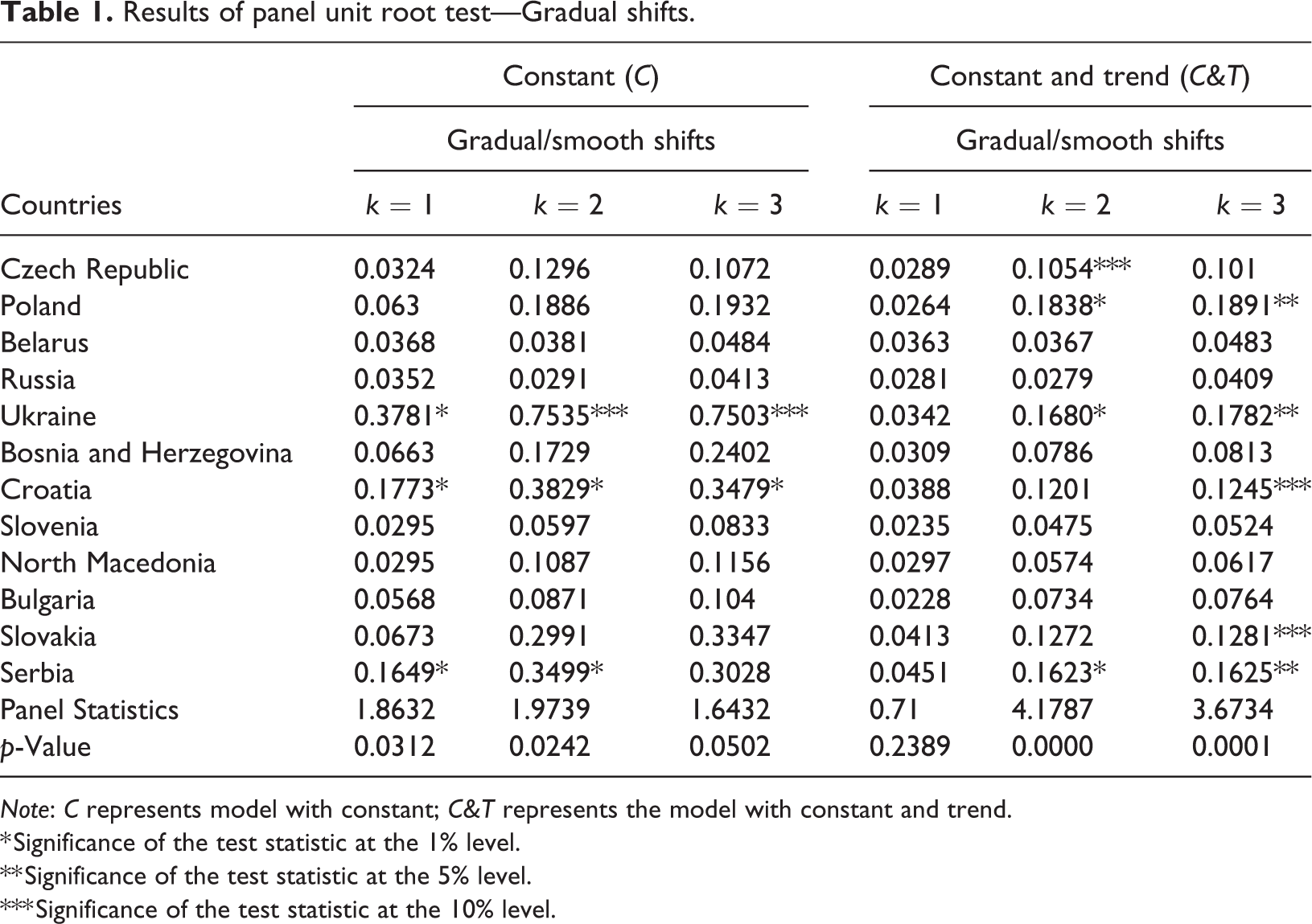
Note: C represents model with constant; C&T represents the model with constant and trend.
* Significance of the test statistic at the 1% level.
** Significance of the test statistic at the 5% level.
*** Significance of the test statistic at the 10% level.
Following the work by Nazlioglu and Karul (2017), the Fourier approximation accounts for structural shifts as either a gradual or a smooth process. If structural shifts are expected to be sharp, researchers should examine the behavior of yit using the panel stationarity test developed by Carrion-i-Silvestre et al. (2005), which is flexible enough to account for a large amount of heterogeneity, cross-section dependence, and multiple unknown structural breaks (Basher and Westerlund, 2009). Therefore, this procedure can estimate a random walk hypothesis test with a unit root test based on the panel version of the KPSS test and also considers cross-section dependence and multiple structural breaks in the model with constant and trend variables. We examined the stationarity of the series for each individual separately (Carrion-i-Silvestre et al., 2005) as follows

where


where
As the last step of the analysis, Table 2 reports the results of the model with trend only (T), where ‘m’ indicates the number of breaks. According to bootstrap critical values, the null hypothesis must be valid to handle the impact of cross-section dependence of both homogeneous and heterogeneous LM statistics. These results provide evidence that, for Turkey, the effects of shocks on tourism demand are transitory, so once again, the random walk hypothesis fails to find support. Table 2 shows that the individual KPSS test statistics are smaller than the critical values of an infinite sample and are statistically significant, with the exception of Ukraine and Croatia, wherein structural breaks exist for the year 2002.
Carrion-i-Silvestre with structural breaks unit root test results.
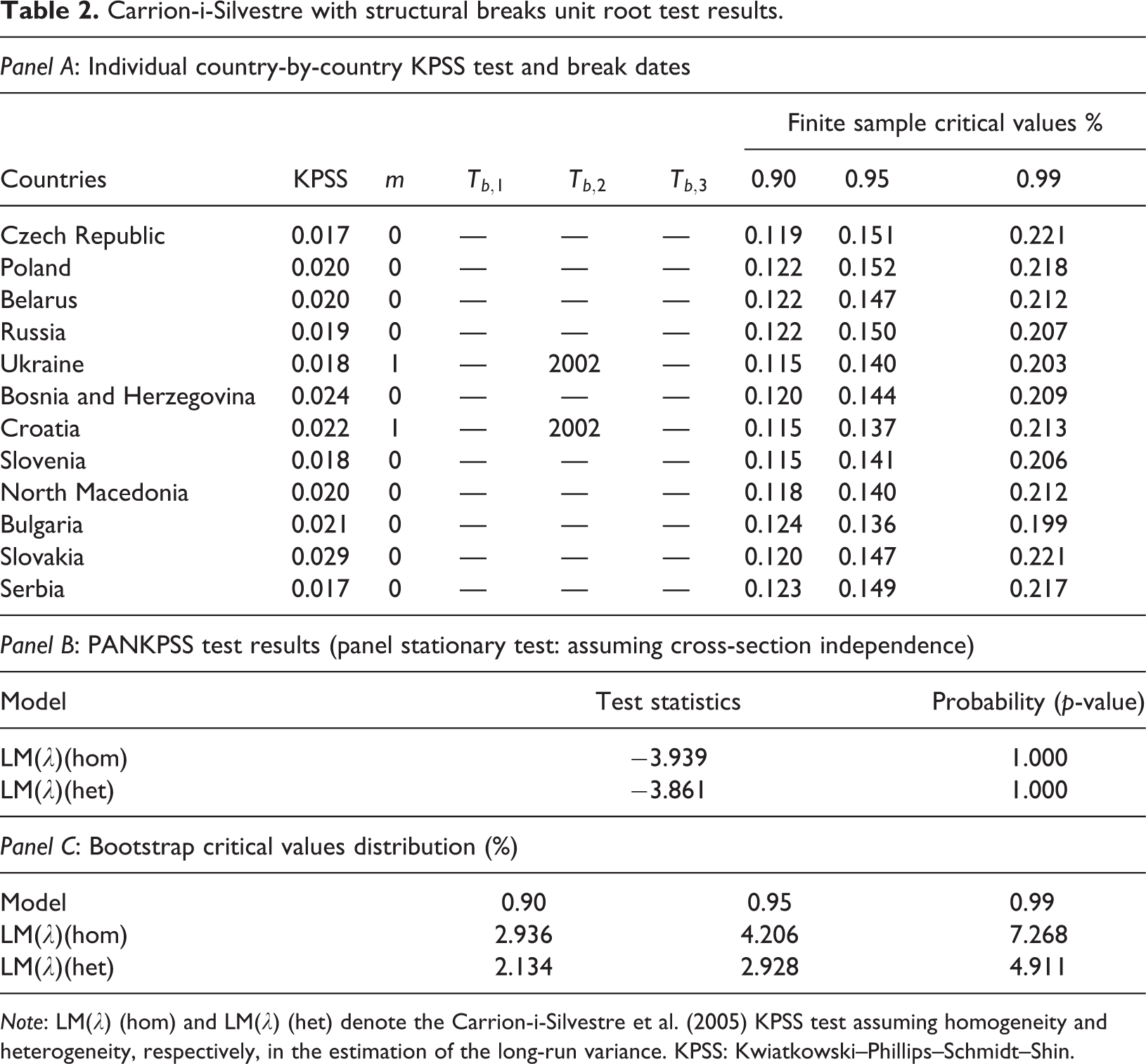
Note: LM(λ) (hom) and LM(λ) (het) denote the Carrion-i-Silvestre et al. (2005) KPSS test assuming homogeneity and heterogeneity, respectively, in the estimation of the long-run variance. KPSS: Kwiatkowski–Phillips–Schmidt–Shin.
Conclusion
In this study, we empirically examined the effects of shock or unexpected events on inbound tourism arrivals in Turkey from 12 Slavic-speaking countries in the period from 2000 to 2016. Testing the stationarity of tourist arrivals is an efficient way to determine the effects of shock on tourism demand; a shock appears as a break in unit root testing. Thus, we tested the convergence hypothesis using the Fourier approach expanded by Karul (2016). It seemed likely that internal or external shocks generate volatility in tourism demands, and it would also seem likely that they could have permanent effects on the Turkish tourism sector. However, our stationarity tests, which also take into account structural breaks, indicate that this is untrue. The results of the panel unit root test recommended by Karul (2016) were cross-checked by the Carrion-i-Silvestre et al. (2005) unit root test, and thus the random walk hypothesis fails to find support, according to panel B results; however, in panel A, the individual variables of Ukraine and Croatia show that structural breaks did appear in the year 2002 and support Karul’s (2016) test results for Ukraine, Croatia, and Serbia.
Footnotes
Declaration of conflicting interests
The author(s) declared no potential conflicts of interest with respect to the research, authorship, and/or publication of this article.
Funding
The author(s) received no financial support for the research, authorship, and/or publication of this article.
