



Abstract
Many studies on the impact of boards of directors on corporate social responsibility have focused on the human capital of board members (i.e., structures and characteristics). However, the relational capital of board members (i.e., board interlock centrality) has yet to be fully explored. This study examines the extent to which board members are connected in their networks (i.e., board interlock centrality) on corporate social responsibility (CSR) performance in the restaurant industry. It also recognizes the moderating role of board effectiveness on the relationship between board centrality and CSR performance. On the basis of organization legitimacy theory and resource dependence theory, this study found that high-centrality boards increase positive CSR performance. The effect is more substantial when a firm has more standing board committees. The theories view firms as components of the larger social environment, and their performance depends on their ability to procure crucial resources from other firms through mutual exchange. No significant link was found between negative CSR performance and the moderating effect of board committees.
Introduction
Corporate social responsibility (CSR) has been defined as “the ongoing commitment by business to behave ethically and contribute to economic growth while improving the quality of life, the local community, and the society at large” (World Business Council for Sustainable Development, 1999). CSR has become an increasingly important strategy for restaurant companies (Rhou et al., 2016). Specifically, positive CSR performance can generate moral capital, which provides a favorable image in the equity markets, thus motivating investors (Godfrey et al., 2009). In contrast, negative CSR performance can be detrimental, reducing stakeholders’ willingness to involve themselves in long-term relationships with the firm (Werbel and Wortman, 2000). Therefore, firms must adopt CSR strategies effectively.
In CSR decision-making, the board of directors’ role is significant, yet that role has not been fully examined in the literature. Boards are involved in evaluating and forming company policies and strategies by providing expertise and experience related to strategic decisions (Ruigrok et al., 2006), ensuring legitimacy (Hillman and Dalziel, 2003), and linking firms with their stakeholders (Burt, 1980). Researchers can examine boards of directors from two points of view—that of human capital (e.g., structures, characteristics, CEOs; Horner, 2015) and that of relational capital (e.g., network centrality; Hillman and Dalziel, 2003). Prior research has mainly adopted the former, the human capital aspects. Nonetheless, relational capital has been recognized as important in acquiring resources and information (Hillman and Dalziel, 2003).
The link between boards of directors’ relational capital and CSR performance can be interpreted from different theoretical perspectives. Resource dependence theory posits that firms are not self-efficient because their performance depends on their ability to procure crucial resources from other firms through mutual exchanges (Pfeffer and Salancik, 1978). Boards of directors’ high network centrality represent their well-connectedness. A well-connected board member is at the center of the network, enabling firms to gain access to such resources. Organizational legitimacy theory asserts that firms are components of the larger social environment. Firms respond to legitimacy pressure, which directly affects a firm’s pursuit of CSR strategies (Filatotchev and Nakajima, 2014). Therefore, as decision-makers and guardians of a firm’s reputation, a board of directors actively supports a firm’s socially responsible activities and alleviates social concerns so that the firm’s legitimacy is enhanced. While researchers have recognized the importance of a board’s social network and the effects of boards of directors on CSR performance, few studies have investigated the relationship between board network centrality and CSR performance. The present study aims to fill this gap.
This study focuses on the restaurant industry for several reasons. Keiser (2002) identified that the restaurant industry has traditionally favored well-connected boards of directors. For instance, Starbucks Corporation currently has 13 directors, of which 12 also serve as directors in other firms in the retail, investment, and technology industries. Such service enables these individuals to share their strategic insights with the Starbucks organization. A well-connected board of directors creates strategic links that are a commonplace in the restaurant industry (Song et al., 2021). However, prior research has rather neglected to examine the interlocked network (network centrality) aspect of the board of director’s effects on CSR performance. Although Keiser (2002) explored board of directors’ interlocking network in the hospitality and tourism setting, he documented only descriptive results regarding the number of board members and counts on their interlocked links. The literature needs more research on the relational influence of a board of directors’ interlocking network on various strategic outcomes.
Further, Guillet and Mattila (2010) argued that governance systems, including the board of directors, should be established regarding industry-specific characteristics. Food-related health and safety crises could lead to significant financial loss and the disrepute of restaurant companies (Ortega et al., 2011). Consumers’ knowledge of sustainable restaurant practices and environmental concerns has been found significantly affect consumer retention (Hu et al., 2010). Given these characteristics, flexible and innovative decision-making is much needed. CSR can be an important strategy for restaurant companies to mitigate potential risks and increase revenue, a potentiality that should pressure boards of directors to enhance CSR performance. Boards of directors with high network centrality and the resourceful knowledge they bring to the firm are necessary for the restaurant industry to handle consumer needs while mitigating managerial risks.
The current study also tests whether the relationship between board network centrality and CSR performance depends on the number of board committees. Spira and Bender (2004) suggested that board committees improve corporate governance by allocating tasks from the main board to a smaller group of board members that address the firm’s specific needs (Klein, 1998). Thus, the committees are formed with expert board members who deal with specific issues (Puni, 2015). The committee structure, with its focused roles and tasks, enhances the boards’ productivity (Klein, 1998), which increases the effectiveness of the board’s monitoring responsibility. Consequently, whether the information and resources gathered by an interlocking board member influences corporate strategy making is dependent upon that board member’s proximity to the related decision outcome.
The remaining sections are constructed as follows. First, our literature review synthesizes past research on board of directors, the linkage between board network centrality and CSR performance, and board effectiveness. The methodology section explains data collection, modeling, and analysis. The results and discussion sections report and interpret the results while laying out the study’s practical and theoretical contributions. This paper ends with limitations and suggestions for future studies.
Literature review
Board of directors studies in tourism and hospitality research
In the tourism and hospitality literature, most corporate governance research has investigated executives’ compensation, which is associated with various factors, such as stock performance (Madanoglu et al., 2018), companies’ assets (Kim and Gu, 2005), and executives’ tenure (Guillet et al., 2012). Some previous studies have examined the implications of corporate governance on CSR performance: CEOs’ equity-based compensation (Park et al., 2019) and CEO’s networks (Chen et al., 2021).
While CEOs have significant influence over socially responsible decisions, the board of directors shares the leadership role with CEOs to safeguard a firm’s economic, legal, ethical, and socially responsible reputations (Buckholtz et al., 2008). As the authorized group in collective decision-making within the corporation, the board is one of the main elements in making strategic CSR decisions and is thus worthy of investigation. The hospitality industry is highly competitive and has a higher leverage and capital intensity, which are unique characteristics that impact managerial decision-making and affect how corporate governance mechanisms (e.g., board of directors) are implemented (Li and Singal, 2021). Thus, this study intends to fill the void in the literature by examining the association between boards of directors and CSR performance in the hospitality context.
Link between board network centrality and CSR performance
Corporate actions and executive decisions are influenced and constrained by relationships to their environment, including the board of directors interlocking (i.e., the network centrality of the board of directors; Gnyawali and Madhavan, 2001). A board’s network forms when an individual is on the boards of two or more firms, thereby providing an interlocking tie between firms. Most firms are not self-sufficient; they rely on their boards of directors to obtain critical resources, depending on other firms to access resources beyond one firm’s reach (Heide, 1994). Resource dependence theory posits that firms obtain proficiencies through resource exchange (Pfeffer and Salancik, 1978). Boards of directors manage external dependencies; therefore, a board member’s network centrality acts as a mechanism of cooptation. Boards of directors also ensure that the firm has reliable external dependencies and resources (Hillman and Keim, 2001) that benefit the firm’s public image and aid its strategic decisions (Judge and Zeithaml, 1992). That is, resource dependency theory accentuates the knowledge and network well-connectedness of the board in achieving a strategic outcome.
Boards bring resources through networks and establish a company’s legitimacy. Organizational legitimacy theory argues “a generalized perception or assumption that the actions of any entity are desirable, proper, or appropriate within some socially constructed system of norms, values, beliefs and definitions” (Suchman, 1995: p. 574). It suggests that organizations seek to create the social value of their business activities in a way that is congruent with the standards of suitable societal behaviors, and CSR as a corporate strategy supports companies in tackling social concerns and thus enhances their organizational legitimacy (Husted and Allen, 2006). Therefore, boards perform a social participation role so that the legitimacy of their organizations can be enhanced by establishing external relations with stakeholders and society. The board’s relational network and resources provide a shared context for social interaction and create communication links within the organizational setting (Hung, 2011), which contributes to improved CSR performance as an outcome of the organization’s social strategy (Zahra and Pearce, 1989).
In sum, the advisory role of boards of directors suggests that the board is responsible for narrowing the differences between the board and management and accessing resources. Baysinger and Hoskisson (1990) suggested that boards serve as advisors to various decision-making processes, such as strategic development and management operations. Companies will seek counsel from the board of directors to establish their CSR strategies and can benefit from access to pertinent knowledge about CSR’s impacts and good CSR practices. Furthermore, boards of directors are often made up of executives from other companies or those with substantial business, legal, or political backgrounds. Directors then form networks by serving on different firms’ boards, becoming channels of information accumulation across organizations. Therefore, the interconnectedness of directors, particularly directors with CSR expertise, is likely to be another avenue to providing CSR strategy resources relevant to the organization and creating a collaborative network that eventually improves CSR performance (Liu et al., 2020). Thus, we propose the following hypothesis:
H1: As a board of directors’ network connectedness increases (high network centrality), the positive CSR performance of the focal firm increases.
Boards of directors’ networks also provide legitimacy to focal firms (Hillman and Dalziel, 2003). Legitimacy does not emerge from merely making a profit or abiding by legal requirements (Suchman, 1995); rather, it arises from referring to society’s fundamental norms and values. In response to the increasing social pressure to secure legitimacy and better long-term performance, CSR became an effective channel for firms’ viability (Arya and Zhang, 2009). As the key governing body in an organization, boards of directors actively seek ways to survive under social pressure.
With regard to adopting CSR strategies, boards of directors are learning from their own experiences and those of their peers from a similar institutional context (Zou et al., 2019). The board’s network seeks to gain legitimacy for a firm’s stakeholders (Suchman, 1995) and enhance stakeholder acceptance by alleviating negative CSR performance (Zhang et al., 2013). Negative CSR performance—also referred to as corporate social irresponsibility—is defined as a set of activities or behaviors that can—intentionally or not—be damaging to a firm’s stakeholders and society in general (Riera and Iborra, 2017). A board’s network has been shown to provide credible communication between firms, and the information transmitted through the board network is influential (Haunschild, 1993).
As reputation guardians for firms and protectors/representatives of stakeholders, a board of directors persuades companies to avoid socially irresponsible activities. A board’s network serves as a crucial conduit of information between firms, which may facilitate a firm’s propensity to imitate the CSR strategies of other firms (Zou et al., 2019). In particular, high-centrality boards are better connected with other boards and have stronger ties with the community. Therefore, they are likely to be more motivated to discourage socially irresponsible activities. Thus, Hypothesis 2 is as follows:
H2: As a board of directors’ network connectedness increases (high network centrality), the negative CSR performance of the focal firm decreases.
The moderating role of board effectiveness
A board of directors contributes to a firm’s strategic knowledge and influences its managerial discretion and behaviors. High-centrality-board individuals can further promote firms by shaping social ties, reducing competition, influencing decision-making, acquiring information, scanning the environment, and diffusing administrative innovation (Haunschild and Beckman, 1998; Nguyen, 2012). Meanwhile, a board’s effectiveness is determined by its structure and the inner workings of its members (John and Senbet, 1998). Board members actively participate in different board committees, making the board effective. Formed by smaller groups of board members, board committees exercise their authority over a specific task (Klein, 1998). The Securities and Exchange Commission (SEC) mandates that firms establish audit, compensation, and governance committees. Apart from these requisite committees, many companies’ boards establish non-required committees to focus on other issues. For example, McDonald’s has a Sustainability and Corporate Responsibility Committee to fulfill its oversight responsibility concerning the brand’s commitment to perpetuating a sustainable organization.
Harrison (1987) viewed board committees as strategic tools that accomplish a board’s obligations of sustaining corporate legitimacy and formulating strategic decisions. Examples include the boards’ responsibilities to engage in CSR activities, protect stakeholders, and govern the firm’s citizenship performance. Board committees or specialized committees improve firms’ corporate governance by assigning particular tasks to a specific group of boards and specifying the best utilization of the boards’ specialization (Spira and Bender, 2004; Van Den Berghe and Levrau, 2004). Board committees also encourage boards to interact more frequently so that they are vigilant about reducing information asymmetries. As Eisenhardt (1989, p. 65) observed, “Operationally, the richness of board information can be measured in terms of characteristics such as frequency of board meetings [and] number of subcommittees.” The more that board committees are established within a firm, the more efficiently they are organized around specific issues, such as public policies or environmental concerns. Increased efficiencies would be applied regardless of a firm’s direction (i.e., encouraging positive corporate actions and discouraging negative corporate actions). Thus, Hypothesis 3 is given below:
H3: A higher number of committees help connected directors to maximize CSR strengths more profoundly.
Board decisions reflect information and suggestions provided by board subcommittee meetings, which consist of interlocked directors with the greatest expertise in a specific subject area (Bilimoria and Piderit, 1994; Kesner, 1988; Peterson and Philpot, 2007). Whether the expertise held by an interlocked director can be transmitted to the focal firm depends on those interlocked directors’ access and proximity to the relevant dialogue and decisions. Thus, the establishments of more subcommittees would then increase the board of directors’ efficiency in tackling socially irresponsible activities. In the case of CSR concerns, socially irresponsible activities are costly to the organizations, which would increase the stakeholders’ expectations to pronounce performance standards (Jain and Zaman, 2020; Velte and Stawinoga, 2020). The pressure from the stakeholders could lead the board of directors to formulate additional subcommittees besides mandatory committees (audit, compensation, governance) that specialize in CSR-related issues such as an ethics committee, a sustainable committee, or an environmental committee (Baraibar‐Diez et al., 2019). A specific subcommittee could improve awareness and ensure consistency in sustainability strategies (Klettner et al., 2014). Firms often use CSR-related committees to show their concern for social irresponsibility issues and tend to be more transparent in CSR disclosure (Adam, 2002). Thus, Hypothesis 4 is presented below.
H4: A higher number of committees help connected directors to more profoundly reduce CSR concerns.
Methodology
Data
This study collected a sample of US publicly traded restaurant firms, recognized by the Standard Industrial Classification code 5812. Based on data availability, the original sample ranged from 1991 to 2015. This study utilized three databases. First, to obtain corporate social performance (CSP) data, we drew on Morgan Stanley Capital International’s Environmental, Social, and Governance (MSCI ESG) database (formerly known as the KLD database for CSR performance data). The ESG database is objective and desirable because it measures CSR along many dimensions previously validated for the quantitative analysis of CSP (Hillman and Keim, 2001; Waddock and Graves, 1997). Our sample ends in 2015 because many rating variables have been modified since that year (MSCI, 2015). Second, the research team used the BoardEx database to obtain data on boards of directors. BoardEx contains records on the shared ties and biographical data of board members. Finally, the research team used the COMPUSTAT database to acquire financial data.
The original sample period starts in 1991, when the gathering of ESG data was initiated. The financial data mostly started in 1993 when the SEC mandated that all public companies submit filings electronically through the EDGAR (Electronic Data Gathering, Analysis, and Retrieval) system. Financial data from three companies (McDonald’s Corp, Luby’s Inc., and Wendy’s Co.) were hand-collected because their 10Ks are accessible for the years 1991 and 1992. After eliminating missing values and observations with outliers (an absolute value of a studentized residual of four as a cut-off line) and considering lagging effects, this study used a final total of 242 firm-year observations ranging from 1999 to 2015.
Dependent variable
This study’s dependent variable is corporate social performance (CSP). CSP is measured using the ratings developed by the MSCI ESG database. CSP ratings are multidimensional and generalizable across industries and therefore represent a comprehensive evaluation of firms’ CSP (Harrison and Freeman, 1999).
The MSCI ESG database provides data on seven major CSR dimensions: community (COM), diversity (DIV), employee relations (EMP), environment (ENV), product (PRO), human rights (HUM), and corporate governance. This study excludes the corporate governance dimension from CSR performance measurement. The exclusion is because of corporate governance’s direct relevance to the independent variables and this dimension measuring activities that benefit specific shareholders, which runs counter to the definition of CSR being a practice that benefits all stakeholders (Kim et al., 2012).
The ESG database provides a dichotomy value for each CSR performance dimension: either a strength indicator (positive rating) or a concern indicator (negative rating). Following previous research (Hillman and Keim, 2001), this study sums all strength indicators for each of the six dimensions that represents a positive CSR (CSPstr) and calculates the same for all concern indicators denoting negative CSR (CSPcon). Strength and concern indicators equally weigh the value of strengths and concerns across difference dimensions. High scores on strength indicators suggest a strong CSR performance, whereas high scores on concern indicators indicate poor CSR performance. By separately investigating CSR strengths and concerns, this study distinctively apprehends a firm’s positive and negative social actions. Furthermore, this study uses 1-year lead CSPstr and CSPcon to alleviate possible endogeneity issues (Greene, 2010).
Many CSR studies in the tourism and hospitality context have evaluated CSR performance using an aggregated measure (e.g., Theodoulidis et al., 2017). However, firms simultaneously engage in CSR strengthening and concerning activities, with some firms participating in more responsible activities to counterbalance their engagement in socially irresponsible activities (Kim and Kim, 2014). For example, The Walt Disney Company has been criticized for labor and human rights violations in its supply chain. Yet, it was also recognized as the world’s best employer in 2018. In this vein, socially responsible activities (CSR strengths) and socially irresponsible activities (CSR concerns) are examined separately in this study.
Main variable
The main independent variable is board network centrality (INTER). A board interlock is formed between two companies when a board member of one company also serves on another board. Such a tie provides the basis for the social network analysis—specifically, a two-mode network with board members (first mode) and corporations (second mode). Figure 1 shows a sample network analysis of restaurant companies. It demonstrates the relationship between companies created by interlocked boards of directors. This study calculates board network centrality using affiliation procedures to derive the adjacency matrix of ties between board members. The adjacency matrix was computed and converted to a matrix of geodesic distances between board members to highlight the centrality of board members to the main network (Nicholson et al., 2004). Board network centrality helps researchers identify the most well-connected board members within a network. Other network measures, such as a sum of interlocked ties between firms, do not reflect a board member’s importance within the network (Bonacich, 1987). This study calculates the eigenvector centrality of board members. Network analysis of sample restaurant companies. Note. This figure demonstrates a network analysis of sample restaurant companies. Board of directors create links (black lines) between focal companies (orange squares) and interlocked companies (blue dots).
Eigenvector centrality for the two-mode networks is calculated using UCINET, an SNA program developed by Steve Borgatti, Martin Everett, and Lin Freeman (2002). Eigenvector centrality evaluates a node’s importance in terms of the centrality of its neighbors. A board member is well-connected when its immediate interlocks are also well-connected


The eigenvalue centrality score χ
i
is then expressed as

Moderator
This study examines the moderating effects of board effectiveness (NUMCOM). Consistent with previous research, we measure NUMCOM using the number of board committees for each firm year (Van Den Berghe and Levrau, 2004). The board committees include those that are mandatory and voluntary, such as audit, compensation, and management planning and development committees.
Control variables
This study considers two firm-specific control variables: firm size (FSIZE) and firm performance (TOBINQ). It considers three board-specific control variables: board size (BSIZE), board tenure (TENURE), and board gender diversity (GENDER).
Firm size, measured by the natural log of a firm’s market capitalization, is expected to positively affect CSR performance. Large firms have a greater ability to adapt to changes (e.g., economic and social) in a business environment than smaller firms (Huang, 2010). Firm performance, measured by Tobin’s Q, is expected to affect CSR performance positively. Following Ullmann (1985), financial performance is deemed to influence a firm’s financial capacity to undertake activities related to social demands.
Board size, estimated by the number of board members on the board, is expected to have a negative relationship with CSR performance. An excessive number of board members on a board can cause a lack of communication and coordination that results in slow decision-making (De Andres and Vallelado, 2008; Zheng and Tsai, 2019). Board tenure, measured by the years that board members have served on the board, is expected to affect CSR performance positively. Tenure is related to the boards’ experience and knowledge of a firm (Kosnik, 1990). Thus, the longer the tenure, the better the CSR performance. Board gender diversity, estimated by the ratio of female-to-male representation on the board, represents the percentage of female board members on the board. Previous studies have identified that board gender diversity affects CSR performance because women on boards are more philanthropically driven than men (Lockstone-Binney et al., 2021; Williams, 2003).
Estimation models
This study develops four models to test our hypotheses. Model 1 tested H1, which states that board network centrality (INTER) positively affects CSR performance (CSPstr). Model 1 is as follows:
CSPstrit = α0it + α1INTERit-1 + α2FSIZEit-1 + α3TOBINQit-1 + α4BSIZEit-1 + α5TENUREit-1 + α6GENDERit-1 + µit-1
Model 2 tested H3, which states that the positive relationship between board network centrality (INTER) and higher number of board committees (NUMCOM) helps connected directors maximize CSR strength (CSPstr) more profoundly. Model 2 is as follows:
CSPstrit+1 = α0it + α1INTERit + α2NUMCOMit + α3INTER×NUMCOMit + α4FSIZEit + α5TOBINQit + α6BSIZEit + α7TENUREit + α8GENDERit + µit
Model 3 tested H2, which states that board network centrality (INTER) has a negative impact (main effect) on negative CSR performance (CSPcon). Model 3 is as follows:
CSPconit+1 = α0it + α1INTERit + α2FSIZEit + α3TOBINQit + α4BSIZEit + α5TENUREit + α6GENDERit + µit
Model 4 tested H4, which states that the negative relationship between board network centrality (INTER) and higher number of board committees (NUMCOM) helps connected directors reduce CSR concerns (CSPcon) more profoundly. Model 4 is as follows:
CSPconit+1 = α0it + α1INTERit + α2NUMCOMit + α3INTER×NUMCOMit + α4FSIZEit + α5TOBINQit + α6BSIZEit + α7TENUREit + α8GENDERit + µit
Data analysis
Our dependent variables, CSR strength and CSR concerns, are non-negative integer count variables. Thus, the characteristics of the data must be considered in the regression models. Two common approaches to a count data model are the Poisson regression and the negative binomial model. The negative binomial model allows for handling data with over-dispersion, which indicates that the variance is larger than the mean. In this study, CSR strength had a mean of 1.598 and a variance of 8.012. CSR concern had a mean of 1.469 and a variance of 2.820. Furthermore, we apply the zero-inflated negative binomial model because the dependent variables exhibited a high number of zeros (52.8% in CSR strength and 37.6% in CSR concern). We also use the Vuong test to examine whether the zero-inflated specification was preferred over the general negative binomial model.
Stata 14.2 is used for data analysis. The Vuong test results showed that the zero-inflated model was preferred over the general negative binomial model (Model 1: z = 17.72, p > z = 0.000; Model 2: z = 17.88, p > z = 0.000; Model 3: z = 25.16, p > z = 0.000; Model 4: z = 25.08, p > z = 0.000). Based on the Hausman test (χ2 = 23.06, p < 0.05; χ2 = 19.72, p < 0.05), to account for potential issues from unobserved aspects in the panel data analysis, the research team used the two-way fixed effects model by firm and year effects. The clustered standard errors were robust to heteroscedasticity and autocorrelation (Greene, 2010).
Results
Descriptive statistics
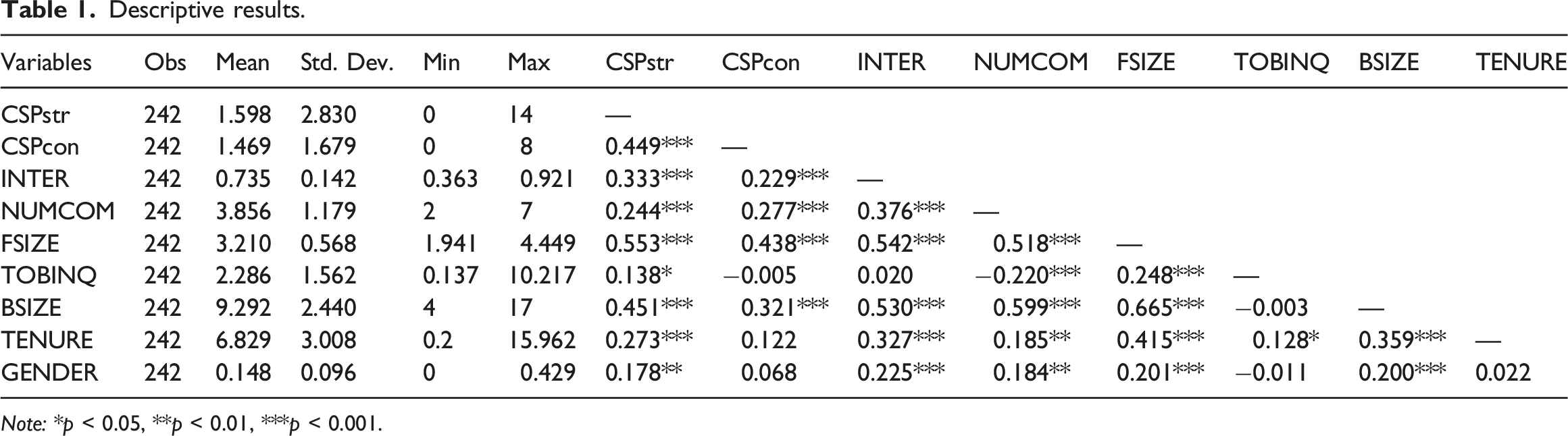
Descriptive results.
Note: *p < 0.05, **p < 0.01, ***p < 0.001.
We then tested the bivariate relationship between two variables by conducting a Pearson’s r correlation analysis. We mean-centered the independent variable and moderators to alleviate the multicollinearity issue. Table 1 also shows the results of the Pearson’s r correlation analysis. The highest correlation occurred concerning board size (BSIZE): 0.665 with firm size (FSIZE), 0.599 with the number of board committees (NUMCOM), and 0.530 with board network centrality (INTER). Other notable correlations are between firm size (FSIZE) and CSR strengths (r = 0.553) and CSR concerns (r = 0.438), indicating that larger companies tend to get more attention for their corporate strategies.
Main analyses
Zero-inflated negative binomial regression results.

Note: 1. N = 242
2. *p < 0.05. **p < 0.01. ***p < 0.001
Regarding the results of the zero-inflated negative binomial regression for negative CSR performance, Model 2 was used to investigate H2. Board network centrality had no significant effect on negative CSR performance. Thus, H2 was not supported. Among the control variables, firm size (FSIZE) had a positive association with negative CSR performance (β = 0.872, p < 0.001). In Model 4, an interaction term of board network centrality (INTER) and board committee (NUMCOM) was added to test H4. The interaction term INTER×NUMCOM had no significant effect on negative CSR performance. Thus, H4 was not supported.
The log-likelihood ratio (LR) chi-square test evaluated the model fit. According to the chi-square values, all four models were statistically significant at 0.001. Models 1 through 4 presented VIF values within the threshold value of 10, implying that this study’s sample was not suffering from multicollinearity issues (Hair et al., 2010).
Robustness tests
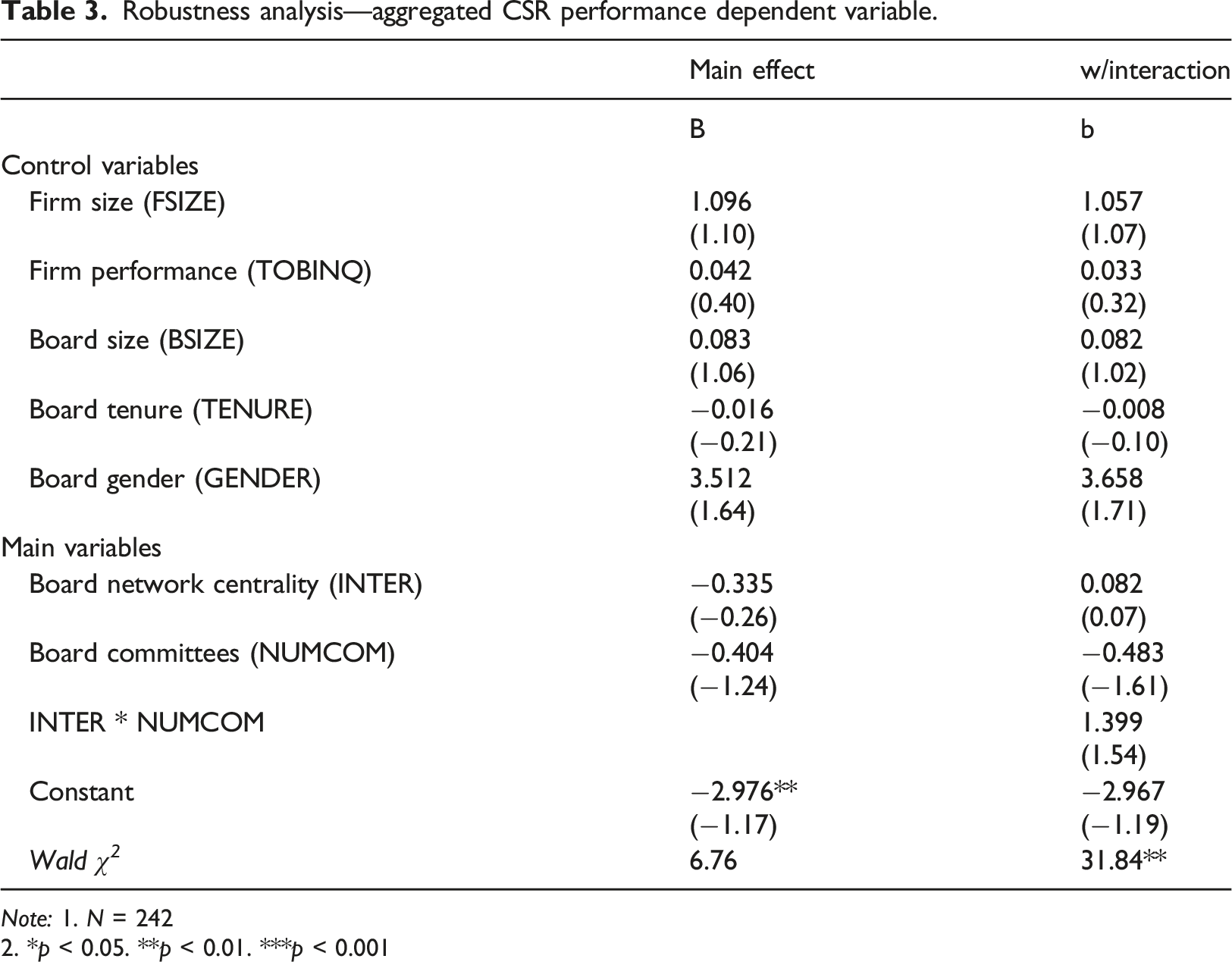
Robustness analysis—aggregated CSR performance dependent variable.
Note: 1. N = 242
2. *p < 0.05. **p < 0.01. ***p < 0.001
Sensitivity analysis—2-year lead dependent variables.

Note: 1. N = 213
2. *p < 0.05. **p < 0.01. ***p < 0.001
Sub-categories tests
To delve further into the impact of board network centrality and CSP, we analyze the relationship by the sub-dimensions of CSR: community, diversity, employee relations, environment, product, and human rights. Given that the purpose of the sub-categories test was to see the general relationship by sub-category, each sub-dimension was measured by aggregated number (positive score minus negative score). We ran two analyses for each sub-dimension. Panel A is without a moderator, whereas Panel B has a moderation effect.
Pooled OLS results using aggregated sub-categories.

Note: 1. N = 242
2. *p < 0.05. **p < 0.01. ***p < 0.001.
Discussion
Given the growing recognition of the role of the board of directors’ on a firm’s strategic CSR decision-making process, this study revealed the dynamic impact of board network centrality by targeting one of the most imperative strategic outcomes to the restaurant industry: CSR performance. This study supported two key hypotheses concerning board network centrality and CSR performance of publicly traded US restaurants. First, we hypothesize that board network centrality positively affected CSR performance. Aligning with a previous finding that a board’s network improves CSR performance (Al-Dah, 2019; Vo et al., 2020), our findings suggest that well-connected boards strengthen positive CSR performances in the restaurant industry by playing a vital role in information transfer within the social network. Well-connected boards are more likely to (1) foresee industry trends and market conditions (Mizruchi, 1996); (2) reduce information asymmetries between the firm and external markets (Schoorman et al., 1981); (3) provide firms with the capability to stay connected with stakeholders, such as customers, suppliers, and communities (Mol, 2001); and (4) facilitate information transmission between firms on innovation and value-enhancing practices (Haunschild and Beckman, 1998).
Our findings further suggest that the positive effects of well-connected boards on CSR performance are conditional upon how effective the boards are. A growing portion of board decisions is made through board committees (Finkelstein et al., 2009), which involve the boards of directors’ capabilities in a specific professional field. The boards’ capacity for transferring information and resources from network centrality firms is contingent upon the boards’ involvement in the committees (Shropshire, 2010).
Conversely, board network centrality does not significantly reduce negative CSR consequences, and the board’s effectiveness has no significant moderating effect on that relationship. Firms simultaneously engage in CSR strengthening and concerning activities, with some firms participating in more responsible activities to counterbalance their engagement in socially irresponsible activities (Kim and Kim, 2014). In other words, CSR strength and concern are independent of each other. A firm with a high positive CSR performance cannot be viewed because it is not involved in negative CSR practices. Although boards of directors can gain more insight into and knowledge of CSR practices through their external ties, the nature of the restaurant industry includes pre-existing conditions that are socially damaging. Although the restaurant industry is not considered controversial (such as the gambling industry, which entails moral arguments), it is involved with environmental issues, such as excessive waste.
Restaurant companies have strived to reduce their environmental impacts. For instance, Starbucks has endeavored to build environmentally friendly stores, reduce water and energy consumption, improve food packaging, and reduce waste (Starbucks, 2018). Pizza Hut’s efforts include reducing paper fiber in pizza boxes (Alliance, 2011). However, restaurant companies face constant pressure to act eco-friendly (Kim, 2017). The reason is that the restaurant industry impacts the environment greatly, such as water and soil pollution and food waste (Kim, 2017). Given that these characteristics are inherently embedded in the restaurant industry, even firms that are recognized for their positive CSR performance continue to be criticized. Logically, boards of directors of restaurant companies prioritized their CSR strategies to address criticism but only to a certain extent. Boards of directors are encouraged to put their efforts into alleviating CSR concerns despite it being challenging. Indeed, boards’ concerted and interconnected efforts may be the key to resolving the industry’s challenge.
A similar notion exists with respect to employee relations. While companies are evaluated for their CSR performance based on union relations, health/safety, workforce reduction, and retirement benefits, restaurants typically rely on part-time workers. Even McDonald’s Corp., one of the largest restaurant companies in the world, hires numerous part-time workers whose wages are lower than their full-time counterparts and who do not receive benefits. These features can easily be evaluated as negative CSR activities. The negative and significant association between board network centrality and employee relations from the sub-category analysis reveals that boards of directors used their network resources to deal with “employee-related issues” rather than approaching them from employee development perspectives. These concerns cannot be solved in the board room alone. States and municipalities must address them using their discretion.
Theoretical implications
The current study has investigated the effects of board network centrality on CSR performance. Previous CSR research in the US restaurant industry mainly focused on CSR as a factor that influenced firm performance. This study examined CSR performance as a strategic outcome and board network centrality as a factor in CSR performance. This study provides merit in that it attempts to improve current understandings of the complex mechanism of board committees that drive CSR practices, a previously under-explored topic.
Second, our findings document that the mechanisms of a board’s network on CSR performance are through two constructs: socially responsible activities (CSR strengths) and socially irresponsible activities (CSR concerns). Many CSR studies in the restaurant context have evaluated overall CSR performance by subtracting CSR concerns from CSR strengths. Firms involved in more socially irresponsible activities are more likely to take on more socially responsible activities to buffer the negative effect. Restaurant companies are motivated to undertake more socially responsible activities, considering that the restaurant industry entails inevitable consequences that are socially damaging. Thus, by separately investigating CSR strengths and CSR concerns, the findings revealed that board network centrality has a positive effect on increasing socially responsible activities but not on decreasing socially irresponsible activities.
Third, CSR research has mainly explained the role of boards of directors based on stakeholder theory, which argues that boards make strategic decisions, including CSR strategies, in the interest of all firm stakeholders. The findings of this study align with this notion but further advance the literature by incorporating resource dependence and organization legitimacy theories to capture the dynamic relationship between board network centrality and CSR strengths/concerns. Our combining of resource dependence theory and organization legitimacy theory showed that the impact of board network centrality on CSR performance could be positive or negative depending on a board of directors’ motivation. This combination further suggested that board network centrality may impact firm’s CSR performance depending on the nature of an industry. The restaurant industry is inherently exposed to environmental issues. Even restaurant companies that are recognized for their positive CSR performance are being criticized for their illegitimacy. Often, companies that are structurally illegitimate have a harder time attaining legitimacy (Campbell et al., 2003). Therefore, the results of this study validate what resource dependency theory and organization legitimacy theory posit in the tourism and hospitality field.
Practical implications
The positive relationship between board network centrality and positive CSR performance shown in this study indicates that board network centrality serves as a bridge to market information and resources that are valuable for establishing CSR strategies. The restaurant industry presents unique characteristics: it contains high risk with low profits margins and is sensitive to consumer discretion, and the industry is ever in need of flexible and innovative CSR strategies. Thus, a restaurant company must assemble a board of directors with high network centrality. The market insights and resources obtained from a board with high network centrality improve information communication, positively affecting their CSR strategy outcomes. Firms with better-connected boards also have better relationships with other firms and tend to have higher levels of CSR performance. Restaurant firms that desire greater CSR performance can form alliances with firms with higher board centrality in the network to benefit their strengths in CSR (Macaulay et al., 2018).
Second, stakeholders in the restaurant firms with a more central position in the board’s network can take advantage of this competitive position. A firm’s higher centrality could be appealing to better-connected and reputable board members. Furthermore, board members of restaurant firms with higher centrality may be asked to serve on other firms’ boards more often (Song et al., 2021). Both situations mentioned above could lead the focal firms to be more central in the board’s network, which may lead to greater CSR performance in the long run.
Third, as regulatory and social pressures on CSR-related issues continue to increase, firms must pay increased attention to their CSR strategies and practices. Corporate policies are usually generated at a subcommittee level, where board members in smaller groups focus on a specific topic or agenda. The cost associated with the increase in socially irresponsible activities can be significant. Thus, restaurant companies should expect to face higher expectations and pressure from stakeholders to articulate CSR performance guidelines. Establishing a specific CSR subcommittee may be an effective strategy to respond to CSR concerns and stakeholders. With multiple committees and subcommittees, boards have more channels to exercise their expertise in specific areas, including CSR.
Limitations and future research
This study’s limitations present several future research opportunities. First, although the MSCI ESG database has been widely used in CSR research, it assigns a binary value to each CSR activity and weight equally across different dimensions of CSR. Future research could use a different CSR rating database to construct CSR performance measures. Second, this study investigates publicly traded US restaurant companies only; generalization to the entire restaurant industry in or outside the US and other industries may be limited. If similar data are accessible, future studies could replicate this investigation in different country’s contexts. Third, the study investigates the impact of board network centrality on positive/negative CSR performance, with board effectiveness being a moderator. Future research could incorporate other possible contingent factors, such as institutional pressure, CEO power, market dynamics, or investigating a specific board’s network.
Footnotes
Declaration of conflicting interests
The author(s) declared no potential conflicts of interest with respect to the research, authorship, and/or publication of this article.
Funding
The author(s) received no financial support for the research, authorship, and/or publication of this article.
