




Abstract
The purpose of this article is to investigate Chinese shopping preferences and service perceptions in a gaming destination. Based on a sample drawn from Macau, the world gambling capital, differences in the product preferences in regard to gender and place of origin of tourists are observed. A comparison of product preferences as well as shopping service attributes between Chinese tourists in Macau and Hong Kong is also made. In addition, the relationship between shopping service attributes and satisfaction is examined. Findings of this study provide an update of the literature and reveal business opportunities to develop Macau and other Asian gaming destinations into a major shopping destination that could potentially mimic the Las Vegas counterpart. The findings also provide insight for other destinations that target Chinese tourists and expand the literature pertaining to Chinese shopping preferences.
Retail sales volumes have increased five-fold in a decade. Luxury items such as watches and jewelry have led the way, attracting world-famous brands as well as those seeking fame. Where is Macau’s retail sector headed? (Jesus, 2010)
Introduction
China’s Macau Special Administration Region (SAR), a former fishing village, has led the world in casino gambling. The enclave is renowned as the world gambling capital, with a gaming revenue surge surpassing the Las Vegas Strip a short 5 years after liberalization of its gambling market in 2002 (Wong, 2011). While Macau has hit the jackpot in casino gambling, its retail market has also been skyrocketing. In just one decade, retail sales in Macau have underwent a fivefold increase from US$0.57b in 2000 to US$2.79b in 2010. The striking statistics have been primarily supported by in-bound visitors from mainland China, with the SAR welcoming over 20 million tourists in 2010 in a land that measures 29 km2 (Jesus, 2010; Macau Statistics and Census Service, 2011a).
Tourism research is beginning to understand the travel behaviors of the Chinese. The literature has acknowledged that Chinese visitors have a strong appetite for shopping (Hsieh and Chang, 2006; Choi et al., 2008). In fact, a primary attribute that motivates the Chinese to engage in travel is shopping (Huang and Hsu, 2005). As China is barreling ahead with rising gross domestic product (GDP) and individual income as well as a relaxed travel policy and inflating currency, Chinese consumers are more inclined to go shopping when they travel (Xola Consulting, 2008; Zhang and Lam, 1999). Although the literature has extensive coverage on popular shopping destinations such as Hong Kong and Paris, little research has been conducted in developing shopping locales, especially in Asian gaming destinations. With the unprecedented business opportunities of the rising Chinese outbound market and shopping demands, it is important for gaming destinations to learn about the preferences and behaviors of Chinese shoppers as there is a relationship between casino gambling and shopping (Lam and Vong, 2009; Tracie, 2002; Wong and Rosenbaum, 2012). It is also important for tourism practitioners and policy makers to have an update of Chinese tourists’ shopping preferences especially if they want to target Chinese tourists.
The objective of this article is to investigate Chinese shopping preferences and service perceptions in Macau. First, differences in product preferences in regard to gender and place of origin of tourists are studied. Second, comparisons of product preferences as well as shopping service attributes between tourists in Macau and Hong Kong are also made. Third, the role of the shopping service attributes on shopping satisfaction is examined. Finally, the moderating effect of gender is also investigated. Findings of this study provide an update of the literature and reveal business opportunities to develop Macau and other Asian gaming destinations into major shopping destinations that could potentially mimic Las Vegas counterpart. This study also aims to contribute to the literature by distinguishing the heterogeneity of Chinese shopping preferences and understanding the role of services and gender on shopping satisfaction. Practitioners will be able to better understand the shopping preferences of the Chinese, as this study reports on a wide variety of consumer goods that the Chinese prefer.
Theoretical background
The research context: Macau
Since its liberalization of the industry in 2002, Macau has been renowned for its casino gambling business (Lam and Vong, 2009). In the meantime, the enclave has witnessed tremendous development in its shopping facilities over the past decade. Although Macau’s shopping business may not be as high-profile and profitable as its casino gambling counterpart, retail sales volumes in the SAR have increased at a pace similar to its gambling revenue (Jesus, 2010). Much of its success in retailing is attributed to an influx of millions of Chinese tourists coupled with the concentration of casinos. Macau is located adjacent to Guangdong, the most populated province in China, and the Pearl River Delta region, one of the wealthiest regions in China. The SAR enjoys a great competitive advantage in luring Chinese tourists as it is the only jurisdiction in China that has legalized casino gambling and has a close proximity to the mainland (Vong, 2004).
The opening of Vegas-style casino complexes such as City of Dreams, Galaxy Mega Resort, the Venetian, and Wynn has provided the enclave with ample themed shopping malls. For example, with more than 300 stores located along a canal, the Venetian Grand Canal shopping mall and the immediately adjacent upscale shopping mall at the Four Seasons have become major travel attractions (Tejada et al., 2009; Wong and Rosenbaum, 2012). Jesus (2010) points out that “luxury brands are selling like hot cakes in the growing retailing market [in Macau]” (p. 91). With increasing demand from Chinese tourists, popular international brands are increasing their presence in the enclave. For example, Louis Vuitton has established four stores in the SAR while there are only a total of 32 stores in mainland China. In fact, there are myriad of luxury boutiques and international flagship retail shops located inside these shopping centers.
There are plenty of other shopping options available outside of the casinos. Shopping areas surrounding the Senado Square, the Ruins of St Paul’s, and the Border Gate, for example, are always awash with tourist shoppers. Tourists can easily find shops that have a wide variety of products, such as souvenirs, accessories, shoes, handbags, sweaters, household products, necessities, foodstuffs, jewelry, watches, electronic appliances, and medicine and herbs, from high-end designer brands to locally made goods that are selling for a bargain (Macau Government Tourist Office, 2011).
Shopping preferences of Chinese tourists
Much research acknowledges that the Chinese have a strong appetite for shopping during travel (Xu and McGehee, 2012). Shopping is indeed the most important travel motive for the Chinese in certain destinations such as Hong Kong (Huang and Hsu, 2005). A recent study conducted by Xola Consulting (2008) reveals that the Chinese believe that a desirable destination is based, in part, on shopping. These findings may explain why the Chinese select Hong Kong as the most desirable destination, followed by Macau, Japan, Korea, and Thailand. When choosing a destination, affordability and good food are also on top of the list. Although Chinese travelers may seem to develop an affinity for luxury products, they also prefer mid-range consumer goods (Hong Kong Tourism Board, 2011; Huang and Hsu, 2005).
Mainland Chinese tourists are the most important segment of Macau’s tourism industry. They spend about 60% of their travel budget (or around RMB 2000 1 ) on shopping. Mainland tourists are interested in clothing, jewelry and watches, souvenirs and local food products, cellular phones and electronic appliances, cosmetics and perfume, and shoes and handbags (Macau Statistics and Census Service (MSCS), 2010). They are particularly interested in souvenirs and local food products because they are unique in China and are sold for a reasonable price. Mainland tourists are characterized as short-excursionists as they spend about 1.5 days in Macau. Most of them (62%) visit the SAR primarily for vacations, while only 9% travel there for gambling (Macau Statistics and Census Service, 2010; Lam and Vong, 2009).
Tourism shopping and services
Timothy (2005) reveals that shopping provides tourists an excellent leisure option as it helps them to relax and escape from their daily routine. Shopping serves as a means to understand a host culture (Moscardo, 2004). It also provides a tangible way to store and present a travel experience as well as to provide souvenirs and gifts for friends and family members (Tosun et al., 2007). Hence, destinations that could turn a mundane shopping trip into a memorial excursion experience will prevail.
Consumers and tourists alike are looking for more than mere acquisition of goods. They are increasingly demanding value (e.g. service quality, service environment, and service convenience) (Lemon et al., 2001; Seiders et al., 2007) and a pleasant shopping experience (Heung and Cheng, 2000; Yüksel, 2007). The extant literature has also acknowledged that the tourists shopping satisfaction is based on both tangible and intangible attributes such as staff service quality and the shopping environment (Choi et al., 2008; Heung and Cheng, 2000; Lin and Lin, 2006), and in turn, shopping satisfaction leads to a positive shopping experience (Tosun et al., 2007; Wong and Law, 2003).
Service quality has widely been reported as a driver of customer satisfaction (Parasuraman et al., 1991). In the context of tourism, the literature reveals that the staff’s attitudes, knowledge, and language ability are some of the measures that assess the intangible quality of the shopping service (Heung and Cheng, 2000; Lin and Lin, 2006; Tosun et al., 2007; Xu and McGehee, 2012). Service environment, on the other hand, serves as the tangible aspect of the services that customers perceive. It provides the physical cues of service evaluation (Bitner, 1992; Cronin et al., 2000). Tourism literature often finds that the store’s cleanliness, lighting, ambiance, and setting are common measures that assess the quality of the shopping service environment (Heung and Cheng, 2000; Lin and Lin, 2006). Shopping satisfaction arises when providers are able to deliver better than expected staff service quality and service environment. Furthermore, the convenience of shopping facilities also plays a role in enticing shopping satisfaction (Hsieh and Chang, 2006; LeHew and Wesley, 2007; Tosun et al., 2007). For example, the ease of locating stores and the overall convenience of shopping centers are the attributes that impact tourist shopping satisfaction (LeHew and Wesley, 2007). Service convenience has also been acknowledged in the marketing literature as a major driver of customer satisfaction (Seiders et al., 2007). This leads to the following hypotheses.
H1. Shopping service quality has a positive influence on shopping satisfaction.
H2. Shopping service environment has a positive influence on shopping satisfaction.
H3. Shopping convenience has a positive influence on shopping satisfaction.
Gender as a moderator
Although shopping is a universal activity and is a major motivation for a pleasant trip, most scholars would agree that female tourists shop differently than their male counterparts (Buttle, 1992; Kuruvilla et al., 2009). Research findings reveal that the female tourists are significantly more likely to engage in shopping and present significantly higher preferences on a wide variety of offerings such as clothes, shoes, handicrafts, watches and jewelry, toys, perfumes, cosmetics, foodstuff, and so on (Lehto et al., 2004; Oh et al., 2004). Buttle (1992) points out that the shopping is female-dominant and that women shop significantly more frequent than do men. Women also perceive shopping as an enjoyable leisure activity because they are more involved and likely to develop a more positive attitude towards it (Jackson et al., 2011; Kuruvilla et al., 2009).
Research from the involvement literature shows that involved consumers perceive services or products they receive to be highly important (Zaichkowsky, 1994). Involvement is often conceptualized as a moderating factor in the consumer decision-making process (Oliver and Bearden, 1983; Seiders et al., 2005). Kyle et al. (2010) illustrate that high-involvement clienteles perceive higher service quality of ski resorts than their low-involvement counterparts. Oliver and Bearden (1983) contend that less-involved consumers are less likely to make strong evaluation and that both pre- and postusage evaluations are higher for highly involved consumers. Furthermore, attitude studies consistently note a direct and indirect relationship between service/product perceptions and customer satisfaction (Oliver, 1980; Weiner, 2000). It follows that highly involved consumers are likely to provide positive evaluation of a service and be satisfied if it exceeds consumers’ expectations; thus, the effect of shopping service attributes on satisfaction should be stronger for women than for men.
The literature of tourism and hospitality is beginning to examine the moderating role of gender on service evaluations (e.g. Han and Ryu, 2006; Kwun, 2011). Oh et al. (2002) show gender differences in hotel service expectation and perceived performance. McCleary and Weaver (1994) found that women perceive personal service to be a more important criterion in hotel selection than do men. The work of Sebastianelli et al. (2008) shows gender differences in online service quality in that women place higher importance on assurance than do men. Similar findings are also presented in other studies (e.g. Pinar et al., 2010). The customer contact model may help to interpret the above findings better, in which customers who engage in a high-level contact service encounter are more likely to perceive higher service quality of the provider than those who engage in a low-level contact service encounter (Ganesan-Lim et al., 2008). Because females are more willing to interact and share emotions with others (Brody and Hall, 1993; Mattila et al., 2003), while they also have a better process decoding ability and tend to rely heavily on physical cues from the environment (Laroche et al., 2000), it follows that their satisfaction is driven more saliently from the services they encounter.
Han and Ryu (2006) studied the relationship between service quality and customer satisfaction. Their findings indicate that the relationship is stronger for females than males, although the moderating effect is not significant. More recently, Kwun (2011) developed a framework that links service quality and facilities (i.e. service environment), customer satisfaction, and customer attitude. His recent study indicates significant gender differences in that the service quality effect on customer satisfaction is significant for females but not for males. Similarly, the facility effect on customer attitude is salient for females but not for males. Furthermore, because women engage more in shopping than men do, it follows that shopping service convenience is more important for women than for men; hence, the relationship between service convenience and shopping satisfaction should be stronger for women than for men. Accordingly, effects of shopping service quality, environment, and convenience on shopping satisfaction are hypothesized to be more salient for female tourists than for their male counterparts.
H4a. The relationship between shopping service quality and satisfaction is stronger for female tourists.
H4b. The relationship between shopping service environment and satisfaction is stronger for female tourists.
H4c. The relationship between shopping service convenience and satisfaction is stronger for female tourists (Figure 1).
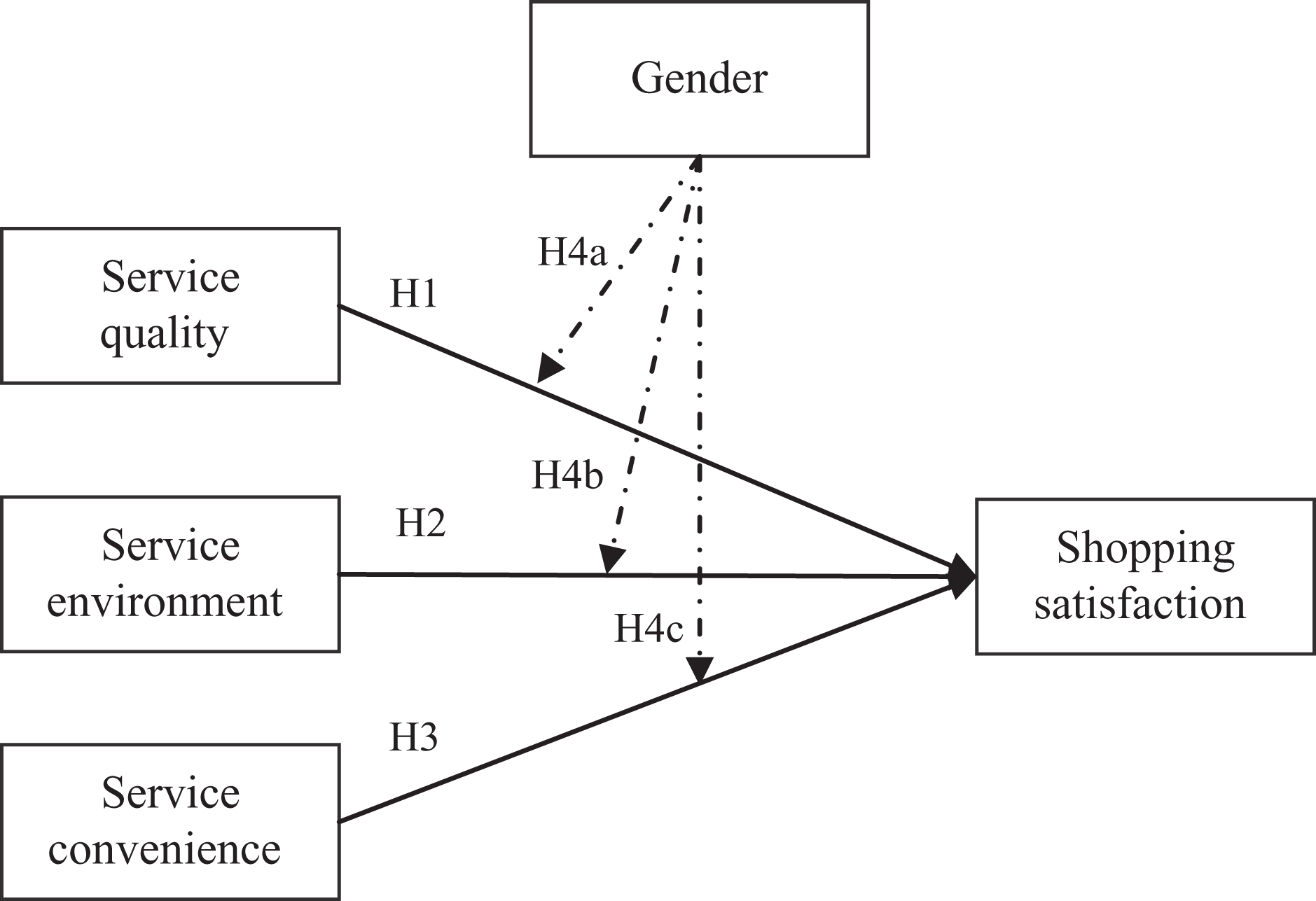
Conceptual framework.
Methods
Sample
Data were collected by means of convenience sampling. Two samples of mainland Chinese tourists were obtained in Macau and Hong Kong in this study. The two sister cities are similar in many ways, as they were former European colonies and were returned to mainland China in the late twentieth century. Both the cities are experiencing tremendous growth in tourism development and have become major travel destinations in the world. Yet, Hong Kong is often referred as the shopping paradise with world-class shopping facilities, while Macau is an emerging destination (McKercher and Du Cros, 2008).
Both the samples were collected at major shopping areas in the corresponding cities. Field investigators approached the respondents and posed a filter question of whether they had shopping experience in the city. The survey was conducted through person-administered face-to-face interviews. The questionnaire was available in Chinese and the interviewers spoke fluent Cantonese and Mandarin. Because the focus of this study is tourist shopping preferences in Macau, a total of 300 surveys were administered in Macau and 150 surveys were distributed in Hong Kong. A total of 157 and 53 surveys were completed in Macau and Hong Kong, respectively.
Measures
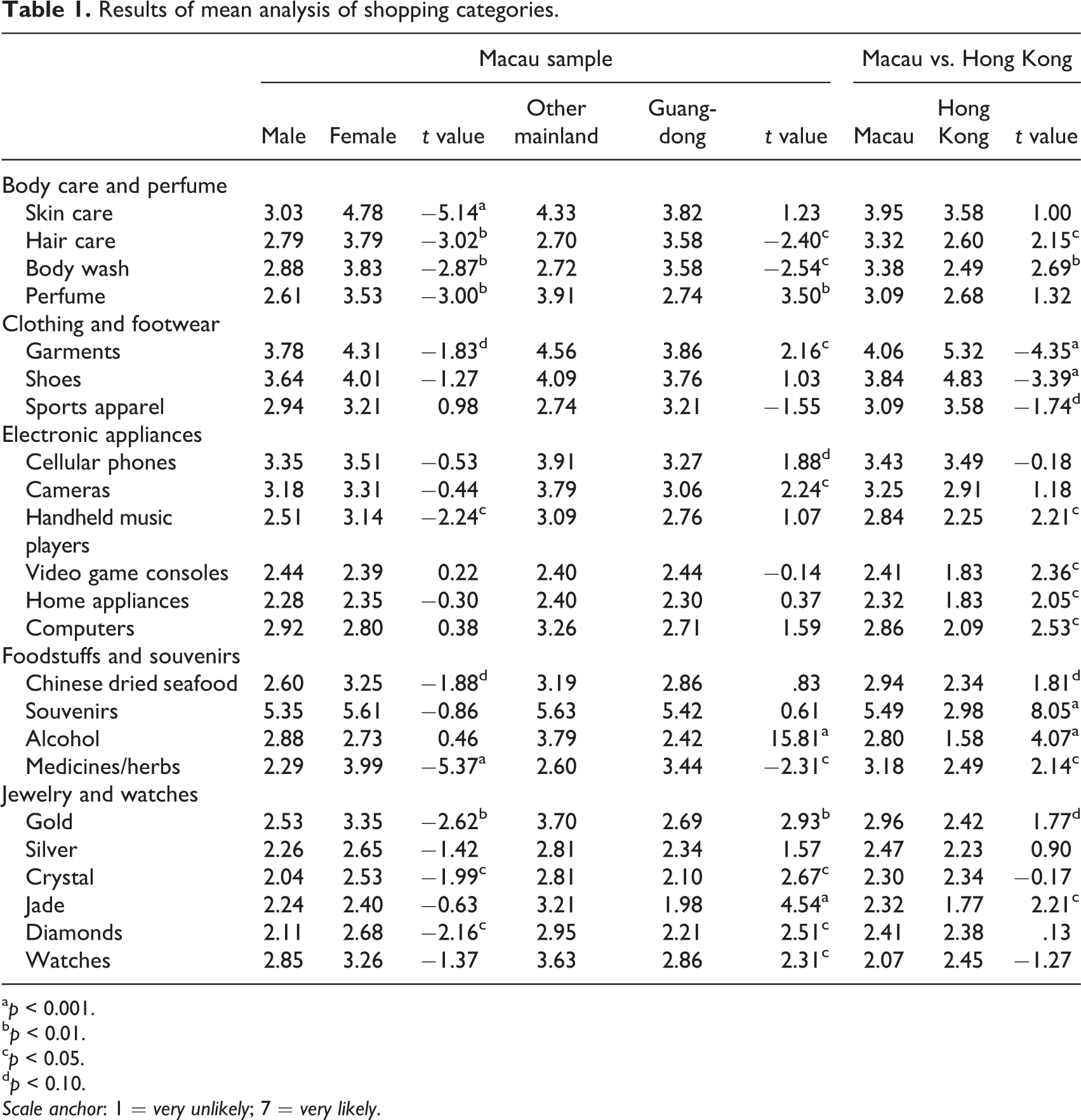
The questionnaire was organized into three parts. The first part assessed tourists’ shopping propensity for 23 items of consumer goods in five categories: body care and perfume, clothing and footwear, electronic appliances, foodstuffs and souvenirs, and jewelry and watches. These items were developed based on the literature and on census department data (Heung and Qu, 1998; Hong Kong Tourism Board, 2008; Lehto et al., 2004; Macau Statistics and Census Service, 2010). The list of items was further expanded through a series of 20 in-depth interviews of Chinese visitors conducted prior to the survey. The bulk of interview questions involved asking respondents why they shopped at a specific destination and the products they would buy in Macau. All the 23 items were measured on a 7-point scale ranging from 1 (very unlikely) to 7 (very likely; Table 1).
Results of mean analysis of shopping categories.
a p < 0.001.
b p < 0.01.
c p < 0.05.
d p < 0.10.
Scale anchor: 1 = very unlikely; 7 = very likely.
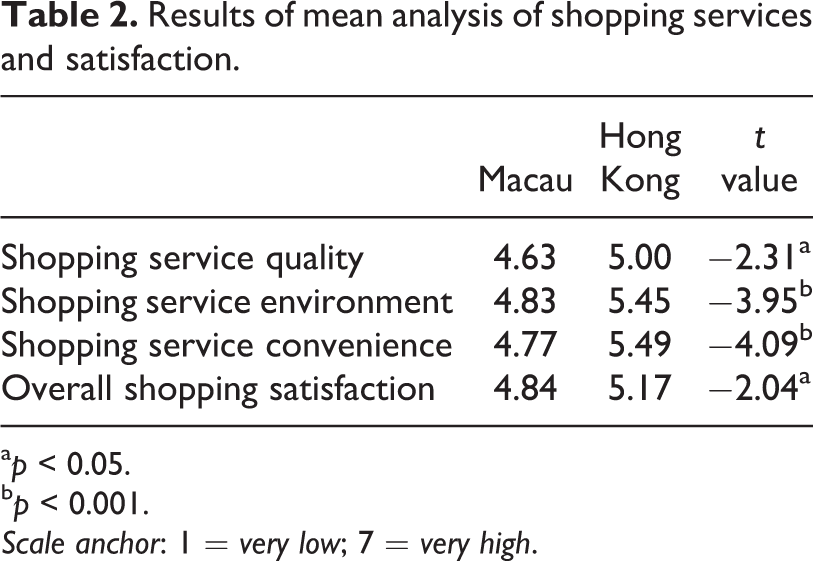
The second part of the questionnaire evaluated the overall perceptions of the shopping service quality, environment, convenience, and satisfaction of tourists. A single-item measure was used to assess each of the four constructs. These four items were adopted from the literature (Heung and Cheng, 2000; LeHew and Wesley, 2007; Liu et al., 2008; Tosun et al., 2007). The items were measured on a 7-point semantic differential scale ranging from 1 (very low) to 7 (very high; Table 2). The last part assessed travel behaviors and sociodemographic characteristics of tourists. In regard to place of origin, the Macau sample was separated into groups: Guangdong and other mainland locations. There were three reasons for this decision: (1) significantly more tourists from Guangdong travel to Macau than from other provinces (Macau Statistics and Census Service, 2011b), (2) Guangdong is adjacent to Macau, and (3) the results of the aforementioned interviews suggest that Guangdong tourists have different shopping preferences and behaviors than other mainland tourists.
Results of mean analysis of shopping services and satisfaction.
a p < 0.05.
b p < 0.001.
Scale anchor: 1 = very low; 7 = very high.
Findings of test 1
Of the Macau respondents, 53% were female; of them, 65% were between the ages of 21 and 30 years, 66% held a bachelor’s degree, 30% earned an income of RMB 1000 or below, while 35% earned an income between RMB 1001 and 3000, 48% expected to spend below RMB 2000 on shopping, while 30% expected to spend between RMB 2001 and 5000, and 71% came from the Guangdong province, while the rest came from other parts of mainland China. Of the Hong Kong respondents, 62% were female; of them, 45% were between the ages of 21 and 30 years, 47% held a bachelor’s degree, 36% earned an income of RMB 7000 or higher, while 17% earned an income between RMB 1001 and 2000, 25% spent below RMB 2000 on shopping, while 42% spent between RMB 2001 and 5000, and 60% came from Guangdong, while the rest came from other parts of the mainland. A comparison of the respondents between Macau and Hong Kong using an independent-sample t test reveals that the Chinese travelers in Hong Kong spent significantly more than those in Macau (SpendingMacau = 1.84 vs. SpendingHong Kong = 2.23, t = −2.53, p < 0.05). 2
Multivariate analysis of variance (MANOVA) was conducted to determine the effects of gender and place of origin (Guangdong vs. other mainland) on the 23 dependent measures for the Macau sample. The gender effect is significant: Wilks’ lambda (λ) = 0.64, F (23,125) = 3.11, p < 0.001; η2 = 0.36, indicating a medium effect size. The place of origin effect is also significant: λ = 0.57, η2 = 0.43, F (23,170) = 4.11, p < 0.001. To assess the destination (Macau vs. Hong Kong) effect on the dependent measures, another MANOVA was performed. The results reveal a significant effect: λ = 0.70, η2 = 0.30, F (23,170) = 3.22, p < 0.001. An independent sample t test on each dependent variable was performed as a follow-up test, as Table 1 illustrates.
Body care and perfume
The results reveal significant mean differences between male and female tourists in Macau among all items in this category (p < 0.01). Female tourists particularly like to shop for skin care, hair care, body wash, and perfume, more than their male counterparts. In regard to the place of origin, the findings show that the Guangdong tourists are more likely to purchase hair care (M other mainland = 2.70 vs. M Guangdong = 3.58, t = −2.40, p < 0.05) and body wash (M other mainland = 2.72 vs. M Guangdong = 3.58, t = −2.54, p < 0.05) products, while other mainland tourists show a higher preference for perfume (M other mainland = 3.91 vs. M Guangdong = 2.74, t = 3.50, p < 0.05). Comparing Macau and Hong Kong, the results suggest that the tourists in Macau have a higher propensity to shop for hair care (M Macau = 3.32 vs. M Hong Kong = 2.60, t = 2.15, p < 0.05) and body wash (M Macau = 3.38 vs. M Hong Kong = 2.49, t = 2.69, p < 0.01) products.
Clothing and footwear
The findings indicate that the female shoppers and other mainland tourists in Macau prefer to purchase garments more than their male and Guangdong counterparts, respectively (M male = 3.78 vs. M female = 4.31, t = −1.83, p < 0.10; M other mainland = 4.56 vs. M Guangdong = 3.86, t = 2.16, p < 0.05). In comparison with Hong Kong, the results reveal that Chinese tourists in Hong Kong are significantly more likely to acquire all three items in this category (t values range from −1.74 (p < 0.10) to −4.35 (p < 0.001)). In general, Chinese tourists showed a strong appetite for this category of merchandise, while inbound Chinese tourists in Hong Kong had a stronger preference for clothing and footwear than those in Macau.
Electronic appliances
Findings reveal that the tourists have a lower interest in this category of goods in general. t Tests reveal that the female tourists have a higher preference for handheld music devices (M male = 2.51 vs. M female = 3.14, t = −2.24, p < 0.05). Other mainland tourists show a stronger interest in cellular phones (M other mainland = 3.91 vs. M Guangdong = 3.79, t = 1.88, p < 0.10) and cameras (M other mainland = 3.79 vs. M Guangdong = 3.06, t = 2.24, p < 0.05). In addition, inbound tourists in Macau show a higher preference for handheld music devices, video game consoles, home appliances, and computers (p < 0.05) than those in Hong Kong.
Foodstuffs and souvenirs
The results indicate that the tourists have a consistent and high preference for souvenirs in Macau (M = 5.49) while they have much lower preference for other goods. In addition, female tourists are more likely to shop for Chinese dried seafood (M male = 2.60 vs. M female = 3.25, t = −1.88, p < 0.10) and medicines and herbs (M male = 2.29 vs. M female = 3.99, t = −5.27, p < 0.001). Other mainland tourists are more likely to shop for alcohol (M other mainland = 3.79 vs. M Guangdong = 2.42, t = 15.81, p < 0.001), while Guangdong tourists are more likely to purchase medicines and herbs (M other mainland = 2.60 vs. M Guangdong = 3.44, t = −2.31, p < 0.05). The results also reveal that the tourists have a higher propensity to buy foodstuffs and souvenirs in Macau than in Hong Kong, as each of the t tests in this category is significant (t values range from 1.81 (p < 0.10) to 8.05 (p < 0.001)).
Jewelry and watches
The findings reveal that the tourists are least likely to buy jewelry and watches in the study. Results from the t tests reveal gender differences in that the female tourists show a higher preference to purchase gold (M male = 2.53 vs. M female = 3.35, t = −2.62, p < 0.01), crystal (M male = 2.04 vs. M female = 2.53, t = −1.99, p < 0.05), and diamonds (M male = 2.11 vs. M female = 2.68, t = −2.16, p < 0.05) than their male counterparts do. Except for silver, tourists from other mainland locations are more likely to acquire jewelry and watches than their Guangdong counterparts (p < 0.05). Furthermore, tourists in Macau are more likely to purchase gold (M Macau = 2.96 vs. M Hong Kong = 2.42, t = 1.77, p < 0.10) and jade (M Macau = 2.32 vs. M Hong Kong = 1.77, t = 2.21, p < 0.05) than those in Hong Kong.
Service quality, convenience, and satisfaction
A MANOVA was performed to assess the destination effect (Macau vs. Hong Kong) on the four-item–dependent measures of tourists’ perceptions of shopping service quality, environment convenience, and satisfaction. The results reveal that the multivariate mean difference is significant: λ = 0.90, η2 = 0.10, F (4,200) = 5.38, p < 0.001. A series of independent sample t tests were conducted. Results reveal that the overall service quality, environment, convenience of the shopping facilities, as well as the overall shopping satisfaction in Hong Kong outperform those of Macau (t values range from −2.04 (p < 0.05) to −4.09 (p < 0.001)). Table 3 provides a summary of the findings.
Summary of the results.

Findings of test 2
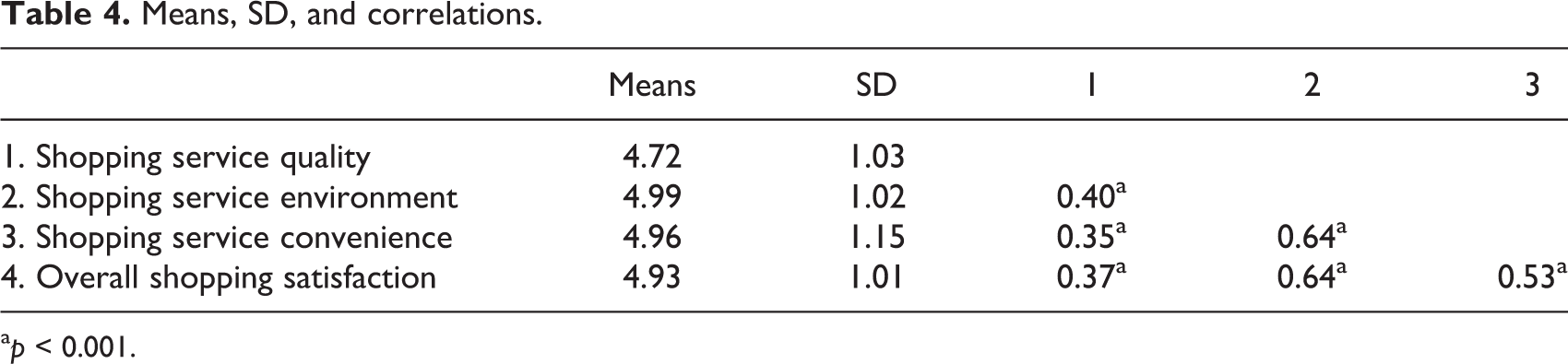
The second objective of this article was to examine the effects of shopping service quality, environment, and convenience on shopping satisfaction. To understand the relationship among shopping service quality, environment, and convenience and satisfaction, a zero-order correlation analysis was performed (Table 4). Next, to examine the roles of three shopping service attributes on shopping satisfaction, a multiple regression analysis was conducted. Respondents’ age, income, and education served as the control variables. Multicollinearity diagnosis was performed, and the variance inflation factor (VIF <2.5) indicates that the multicollinearity is not a concern in this study. Findings of the regression analysis in Model 1 reveal significant effects of service quality (b = 0.16, p < 0.01), service environment (b = 0.46, p < 0.001), and service convenience (b = 0.17, p < 0.01), in support of hypotheses H1, H2, and H3 (Table 5). In total, the three service attributes are able to account for 49% of the variance of shopping satisfaction. To test the moderating effect of gender, two independent regression models were performed; parameter estimates are compared between the male and female groups in Model 2. The results reveal that the service quality effect is not significant for male tourists but is significant for their female counterparts (b = 0.21, p < 0.001), which support the hypothesis H4a. The parameter estimates for the service environment effect are significant for both male (b = 0.55, p < 0.001) and female groups (b = 0.41, p < 0.001); the results fail to support the hypothesis H4b. Finally, the results of the service convenience parameter estimates indicate no significant effect for male tourists but the effect is significant for female tourists (b = 0.17, p < 0.01), which support the hypothesis H4c.
Means, SD, and correlations.
a p < 0.001.
Results of regression analysis.a

NS: nonsignificant.
aParameter estimates are unstandardized.
b p < 0.01.
c p < 0.001.
Discussion
Casinos often draw tourists to a destination not only for gambling but also for shopping (Wong and Rosenbaum, 2012). Although tourism shopping has been studied and discussed in length for popular shopping destinations, tourism shopping in Asian gaming destinations has received relatively little attention. The purpose of this article is to investigate Chinese shopping preferences and service perceptions in the world gaming capital, Macau. Differences in product preferences in regard to tourists’ gender and place of origin are observed. A comparison of product preferences as well as service quality and satisfaction between inbound Chinese tourists in Macau and Hong Kong is also made. The results reveal significant differences in gender, place of origin, and destination. Furthermore, the relationship between shopping service attributes and satisfaction is explored. The findings indicate that the shopping satisfaction is directly influenced by tourists’ perceived shopping service quality, environment, and convenience; yet, the relationships of shopping service quality and satisfaction as well as shopping service convenience and satisfaction are moderated by gender.
Theoretical implications
This article presents insights for the literature, from multiple perspectives. First, the findings provide scholars with new insights into Chinese shopping preferences in Asian casino destinations. The 23-item instrument breaks down Chinese tourist preferences on five major product categories and provides a finer understanding of the consumer goods Chinese tourists desired.
Second, this study sheds new light on intracultural differences of Chinese tourists. While the prior research treated mainland Chinese as a homogeneous group, this study presented evidence that they are fairly heterogeneous. The current study distinguishes Guangdong tourists from other mainland tourists in shopping preferences and uncovers significant differences between the two groups. On one hand, Guangdong Chinese are culturally different from other Chinese in the mainland as they speak a different dialect and have different traditions from the rest of the country. On the other hand, tourists from Guangdong enjoy geographic proximity to Macau. They visited the SAR more often, but had a relatively shallow list of shopping goods according to this study. Other mainland tourists, by contrast, had a relatively broader shopping list. These findings may suggest a moderating role of culture, geographic proximity, and frequency of visit.
Third, the current study updates the literature by comparing the differences between a mature (i.e. Hong Kong) and a developing shopping destination (i.e. Macau) in regard to tourist shopping preference and service perceptions. However, the findings are mixed. On one hand, tourists consistently perceive that the services in a mature shopping destination perform better than those of the developing destination. On the other hand, better services may not always lead to more favorable purchase behaviors. This may be attributable to the price differentials between destinations. While mature shopping destinations (e.g. Hong Kong, Paris, and Singapore) may set prices at a premium, developing shopping destinations (e.g. Macau; Barcs, Hungary; and Penang, Malaysia) (Michalkó and Váradi, 2004; Som et al., 2010) often are able to offer the same product at a discounted rate.
Fourth, the current study enriches the extant literature on shopping services and satisfaction. On one hand, this study confirms the important role of shopping service quality, environment, and convenience in shopping satisfaction in an emerging shopping destination. On the other hand, the results show that the relationship between the three service attributes and satisfaction is contingent on gender in that the three service attributes were important predictors of female tourists’ shopping satisfaction, while only service environment was a significant predictor of shopping satisfaction for male tourists. This finding is new to the literature pertaining to tourist shopping, as prior research commonly focuses on the direct rather than the moderating effect of the relationship between service and satisfaction. Furthermore, these findings may also contribute to the customer contact model and the involvement theory in the context of tourism shopping, in which tourists who are more involved in a service and have more interactions with the service staff would more likely be satisfied when the services provided meet or exceed their expectations. Although involvement and interaction with staff were not assessed in this study, it is reasonable to believe that female tourists are more involved in shopping and engage in more interactions with service providers, based on prior research (Ganesan-Lim et al., 2008; Kellogg and Chase, 1995).
Managerial implications
The differences in gender, place of origin, and destination offer important managerial implications. Insights into gender differences suggest that female tourists show a much stronger appetite for shopping in all categories and particularly in regard to body care and perfume products. The two groups have the least differences in electronic appliances as well as the clothing and footwear categories. The small differences in these two categories may pose a potential opportunity for destinations and retailers to target male shoppers. This business opportunity is particular important for gaming destinations because casino gambling are often dominated by men. Findings of the current study in general should be particularly helpful for international brands and retailers targeting the Asian market. As casino gambling becomes prevalent in Asia, gaming destinations such as Macau, Singapore, Thailand, and Manila will follow – indeed some of them have already followed – the Las Vegas gaming model by building ample shopping facilities as major travel attractions as well as to attract tourism spending.
The findings also highlight discrepancies between shopping preferences of tourists from different regions of China. Due to its geographic proximity, tourists from Guangdong often come to Macau to purchase daily necessities, while tourists from other parts of the mainland indicate a stronger preference in other product categories. As Chinese tourists believe in the quality of consumer goods sold in Macau and Hong Kong, retailers foresee that both cities will have an even brighter future for this industry vis-à-vis tourism shopping (Jesus, 2010).
Destination planners and marketers should recast their current segmentation and targeting strategy. Although mainland Chinese tourists share some similarities, this group of tourists is fairly heterogeneous. Vast cultural and economic diversities within China have led to intranational effects that influence firm performance (Chan et al., 2010) and consumer behaviors (Atsmon and Dixit, 2009; Yu and Zhou, 2010). Practitioners and scholars alike must consider these intranational diversities in tourism studies and formulate segmentation strategies that take into account these variations. For example, the unequal economic distribution among the 31 provinces, autonomous regions, and municipalities in China has created a significant difference among these regions in regard to GDP per capita and disposable income (China Statistical Yearbook, 2008). Since disposable income drives shopping and consumption, it follows that market segmentation should also take the regional-level factors into account.
The findings reveal that Macau is gaining some competitive advantages in tourism shopping, as the enclave seemed to enjoy a higher propensity for tourist shopping, in a number of aspects. The findings on one hand may reflect that its development and concentration of casinos have helped the SAR to build better shopping infrastructure. It has also attracted a number of international brands and retailers (e.g. Brioni, Chanel, Coach, DFS, Dior, Fossil, Gucci, Hermes, Louis Vuitton, Nike, Prada, Ralph Lauren, Zara, and many more) to establish properties in this former fishing village that is only 29 km2 in area.
However, as retailing grows, so does the price of stores. Although Hong Kong is known as a shopping paradise, its high rental cost of retail space is forcing merchants to raise prices. Findings of this article suggest that as a popular mature shopping destination, Hong Kong retains a strong position in clothing and footwear. Yet, mainland tourists seemed to find Macau to be a lower cost shopping alternative for other categories, as the enclave is still developing its shopping infrastructure, and retailers are able to charge less. The difference between Hong Kong and Macau is particularly salient in the foodstuffs and souvenirs category. Macau’s unique product offerings in food products such as beef jerky, almond cookies, peanut candies, and more are renowned in the Asia Pacific region.
However, although tourists may seem to prefer to purchase body care and perfume products, electronic appliances, foodstuffs and souvenirs, and jewelry and watches in Macau, tourists were nevertheless willing to spend more in Hong Kong. One major reason is that Hong Kong offers better shopping options with better shopping service quality from staff who generally have a better command of both English and Mandarin and have better product knowledge than their Macau counterparts. Hong Kong also offers more shopping facilities that offer a state-of-the-art service environment and are conveniently located or connected with major transportation systems. Developing shopping destinations need to benchmark the industry leader in tourism shopping and put effort into developing a shopping environment that entices shoppers with a comfortable and pleasant oasis. Yet, practitioners must be aware of the gender difference in the service encounter, as the role of shopping service quality and convenience in shopping satisfaction are only effective for females.
Tourists are looking for an enjoyable experience rather than a mundane shopping trip. Destinations that can turn an ordinary travel activity into a memorable experience will prevail. Contemporary casinos have successfully transformed the industry from hardcore gambling into integrated theme-park-like service expositions, which include a variety of shopping, entertainment, and dining options. Las Vegas is a pioneer in this practice and succeeds in attracting millions to tourists to stay and shop. Asian gaming destinations that replicate the Vegas model will be able to attract streams of tourists based not only on their gaming offerings but also on shopping offerings. It will also help to better sustain tourism development in these locales and provide a more diversified source of financial inflow to benefit their economy.
Limitations and future research directions
The current study examines differences in shopping preferences and service perceptions. However, the results should be interpreted with caution. First, the sample sizes of other mainland locations and Hong Kong are relatively small and may not fully represent their corresponding populations. Second, generalizability of the findings is limited to Chinese tourists. Third, demographic and visitation characteristics were not controlled in the mean analyses. Although analysis of covariance is a better analytical approach, findings from a preliminary study yielded no significant improvement. Fourth, some potential moderators such as shopping involvement, attitude, and frequency of visit were omitted in this study. Future research is encouraged to explore the possible moderating role of these factors on shopping preference and service perception. Given the importance of casino gambling and shopping to some destinations, such as Macau and Las Vegas, it is also worthwhile to explore the relationship between shopping and gambling as well as the role of shopping on gambler partners’ travel motives.
Another promising area of future research involves investigating how shopping as a leisure activity and shopping services improve tourists’ well-being and travel experience. As transformative service becomes an important research stream (Ostrom et al., 2010), future research is encouraged to explore the relationship between shopping and consumer and societal welfare through shopping services. Another venue for future research involves examining the effects of higher-level (e.g. shopping mall, casino, and destination) characteristics (e.g. safety, service quality and environment, and brand/destination image) on store-level effect of service attributes. Finally, the heterogeneity of Chinese consumer behaviors and shopping preferences may be better accounted for through regional variables.
Footnotes
Funding
This research received no specific grant from any funding agency in the public, commercial, or not-for-profit sectors.