



Abstract
By 2006, Macao became the global leader in casino tourism, surpassing the Las Vegas Strip in terms of gross gaming revenue primarily driven by Macao being the only place in China where casino gambling is legal. Conspicuous within Macao’s casino marketing strategy has been the investment in celebrity endorsement to lure Chinese visitors to Macao. China has also emerged as one of the world’s largest and increasingly sought-after high-yield travel markets. As competition intensifies for the emerging Chinese travel market globally, understanding the most optimum communication strategy that can be effectively applied to and influence Chinese outbound travelers can give greater direction to destination marketing agencies and National Tourism Authorities. With a focus on the influence of the celebrity endorsement tactic on travel perceptions and decision making, a face-to-face survey was conducted on 305 Chinese visitors to Macao in 2013. The study revealed that perceptions and destination decision making differed among Chinese visitors with regard to age, gender, education, and income range, when using the celebrity endorsement tactic. The findings showed that celebrity endorsement could be used more strategically to influence and target certain Chinese traveler segments, emphasizing the need to carefully assess the usefulness of such a costly tactic within destination promotional campaigns aimed at the Chinese audience.
Introduction
Breaking through the increasing clutter of tourism and hospitality marketing-related messages and campaigns to reach and influence certain travel segments is a challenging task for destination and travel product and service marketers. The end user must be able to decipher the message as one that they find understandable, appealing, truthful, and upon which an action will take place. Fyall and Leask (2006) acknowledge destinations as one of the most challenging and difficult products to market due to the need to consolidate the various products, stakeholders, and tourism-related organizations and produce a consensus on branding, clearly linking the communication to the aspirations and needs of the traveler. Each advertisement placement whether in print, broadcast, or online format attempts to distract the reader, listener, or those interacting in the case of social media sites for a sufficient moment of his or her time. This attention can be to create awareness and positive imagery, or as the hope of profit making tourism enterprises, to achieve actual visitation, usage, and spending. Kim et al. (2005) found tourism advertising performed several roles from creating destination awareness to destination image enhancement to actually stimulating a visit. The advertising research concluded that different advertising channels if used strategically could have a greater impact on influencing destination choice. Examining the issue of effective travel advertising strategy, this research looked at the influence of advertising on Chinese outbound travelers and specifically the role that the popular tactic of celebrity endorsement played in decision making and the perception of Macao as a destination.
Macao—The world’s largest casino destination
China has emerged in recent years as one of the world’s largest travel markets and therefore gauging a greater understanding of the effectiveness of any advertising tactic will impact the ability to win this market. With Chinese expenditure abroad in 2012 reaching US$102 billion and outbound travel at 83 million, it became the first tourism source market globally. In 2000, outbound Chinese travel had been at 10 million (World Tourism Organisation, 2013a). Therefore, this research was conducted on visitor arrivals to Macao, a major travel market for Mainland Chinese, since Macao’s hand over back to China, in 1999. In 2012, Macao was ranked sixth globally in terms of tourism receipts (World Tourism Organisation, 2013b) spurred by the substantial gaming revenues and increasing numbers of visitor arrivals, mostly from Mainland China. By 2006, Macao became the global leader in casino tourism, surpassing the Las Vegas Strip in terms of gross gaming revenue and revenues from all commercial casinos in the United States, by 2012. Gross gaming revenues have jumped from US$1.6 billion in 1999 (McCartney, 2005) to US$7.4 billion in 2006 (Macao Statistics and Census Bureau, 2013c), surpassing Las Vegas gross gaming revenues of US$6.7 billion (UNLV, 2013). By 2012, Macao’s gaming revenue growth had reached US$39 billion (Macao Gaming Inspection and Coordination Bureau, 2012) compared with US$37.34 billion in gaming revenues from all commercial casinos in the United States that include land-based, riverboat, and racetrack casinos (American Gaming Association, 2013). These significant advances in gaming revenue have been primarily driven by Macao being the only place in China where casino gambling is legal. Coupled with this has been China’s emergence as one of the world’s largest travel markets, growing affluence and ability to travel. As suggested by destination marketing literature, isolating advertising tactics that not only create awareness but stimulate actual visitation and greater spend is most challenging to be actually accomplished by marketing strategists. This is especially relevant to Macao who within less than a decade after its hand over to China in 1999 became the world’s largest gaming destination in terms of gaming revenue.
Macao's tourism success is based on government policy in that casino gambling remains illegal in Mainland China and its other Special Administration Region within China of Hong Kong. This cross border tactic has seen Chinese visitation soar from 0.8 million of a total of 6.9 million visitors to Macao in 1998 to 17 million of 28 million visitors in 2012. In 1999, the year of Macao’s hand over back to China, Mainland Chinese visitors had reached 1.6 million of a total of 7.4 million visitors (Macao Statistics and Census Bureau, 2013a) an initial immediate indication of the effect on travel markets of the return of Macao back to China. Macao’s increasing reliance on the Chinese travel market, which essentially fuels the increasing gross gaming revenue, has created several challenges for the destination. The changing and intensifying competitive landscape from what was a casino monopoly environment in Macao until 2001 is set to intensify further as the six casino concessionaires continue to expand their presence on the Cotai Strip and grapple for even minor gains in the world’s most lucrative gambling segments. In 1998, there were 9015 hotel rooms in Macao, which by 2012 had more than tripled to 26,069 rooms and an average yearly occupancy of 83% (Macao Statistics and Census Bureau, 2013b). In 2002, prior to the opening of competing casino properties, there were 339 casino tables and 808 slot machines (McCartney, 2005). By 2012, there were 5485 tables and 16,585 slot machines (Macao Gaming Inspection and Coordination Bureau, 2013). Based on the 1 billion international tourism arrivals in 2012, it was expected that within the next 5–7 years China would become the number one in both global inbound and outbound travel markets (Moore, 2011). International destinations now ply China more and more with multiple marketing campaigns in the hope of attracting a segment of this lucrative China travel market. Although, in 2012, Macao received over 20% of the 83 million outbound travelers (China Outbound Tourism Research Institute, 2013), the destination must contend with intensifying competition regionally and globally for the Chinese travelers.
While Macao has been in a privy position of marketing and advertising to the majority of Chinese outbound tourists over the past decade, there are crucial lessons to be learnt. The increasingly travel-savvy and independent Chinese traveler trend means marketing actions must become more strategic (Prayag et al., 2013). In a study conducted by the Boston Consulting Group on the growing wealth of the Chinese consumer with deposable income in the past 15 years rising 3–5 times more than the income in the developed world, a major challenge is understanding the complexity of changing spending patterns, the trend in trading of product categories, and the attitudes to brands (Boston Consulting Group, 2007). From the frugal, more conservative 40- to 50-year-old consumer brought up during the Cultural Revolution, an additional challenge is how to effectively leverage more from those who benefited from the economic boom that resulted. The ‘little emperors’ who grew up and were pampered by parents and extended family under China’s one-child policy (Baker, 1987) are now more affluent; brand adventurous and technology savvy willing to try out Western brands and being exposed to new and exciting experiences. Advertising is adapting to these changes in order to attract, encourage, and repeat Chinese visitation. Celebrity endorsement advertising follows in tandem with the above-mentioned trends and has been used worldwide. The author shall revise the exiting literature in light of the most recent uses of this type of advertising, which has enjoyed a considerable amount of dedication from both academia and marketers.
Literature review
Marketing definitions for celebrity endorsement can vary according to the subject of study and the nature of the interactions between goods and services. At its core though is the alignment of an individual’s public recognition to a consumer good or service in an advertisement (McCracken, 1989). Pringle and Binet (2005: 202) expanded the definition suggesting that a celebrity ‘has a clearly defined personality and reputation; they are known to be extremely good at something beyond appearing in advertising, and it is their outstanding skill in their chosen field of endeavour which has brought them into the public eye and made them an object of veneration and respect.’
Essentially celebrities are people who need minimal effort to remember. They do something that is appealing to our memory recall. The concept of celebrity evolves in pace to societies and marketers use of them. A constant though is the conspicuous shortening of the celebrity status recognition life cycle. To be celebrated was once the epitome of a career, as a consequence of a major contribution to society. Now it can be a matter of hours and almost anyone is eligible to be so by the most serendipitous reasons. As fame and stardom today may not last long, celebrities can be quickly outshone by another in a short time frame.
While advertising started only in the 1990s in China, due to the emerging of World Trade Organization agreements and foreign and local joint ventures (Zhou et al., 2002), Internet penetration rate has vastly increased in recent years, achieving 513 million users in 2011 (China Internet Network Information Center, 2011). This has exposed Chinese to a greater number of marketing and promotional messages. In the past decades, research suggests that the Chinese population hold an overall positive attitude toward advertising, having found communication to be informative and useful (Pollay et al., 1990; Zhou et al., 2002).
The use of celebrity endorsement in China is widespread. A rationale to its popularity within advertising is that it fits well with Chinese collectivist and hierarchical cultural characteristics (Hung et al., 2013). Sampling Beijing University students, Chan and Zhang (2007) concluded that those Chinese youth watching celebrity advertising were highly susceptible to being influenced, leading to imitation and materialism. In 2008 after the tainted milk scandal when high levels of melamine in milk powder, some celebrity endorsed products, saw several thousand children falling ill and some resulting in death, celebrity endorsement came under greater scrutiny by Chinese authorities. Several stars were vehemently criticized over their endorsement of tainted milk-related products. Prompted by what was to become a slew of food safety scandals, the China government enacted a Food Safety Law holding celebrities liable for the products they endorsed (Xinhua News Agency, 2009). With this recent legislation, knowing Chinese attitudes toward endorsement and the resulting level of influence become great important in marketing campaigns conducted in China.
Use of celebrity as a differentiator
With differentiation a key driver for customer-focused destinations (Gilmore, 2002) and a need for greater distinction from destination attributes and benefits that increasingly cluster the marketplace (Billings and Scherer, 1988), celebrity use is a popular tactic employed in destination marketing campaigns by Destination Management Organizations (DMOs) and National Tourism Authorities (NTAs). Celebrities such as movie and sport stars with the ability to reach a global audience are credited by marketing tacticians for delivering the right message to the right customer within a given time frame with an acceptable level of success in an environment cluttered with information designed to influence the consumer.
Research suggests that celebrities are more effective than other types of endorsers such as “the professional expert,”, “the company manager,” or “the typical consumer” in reaching the target audience (Friedman and Friedman, 1979). The celebrity endorser is believed to increase an audience’s attention (Misra and Beatty, 1990), give credibility to product or brand and make the advertisement or product easier to remember as well as making the brand easier to recognize and assisting in achieving positive attitude toward the brand (Agrawal and Kamakura, 1995; Misra and Beatty, 1990). Celebrity meanings are conveyed to the endorsed product and in turn the product associated with these meanings is conveyed to the consumer (McCracken, 1989). Literature often looks at celebrity endorsements as static in time and for a specific advertisement scenario. This contrasts with the complexity and reality of the celebrity endorsement process and the need to change the approach by studying the dynamic relationship over time. From a branding perspective, celebrities may increase purchase intention, brand image, brand awareness, brand recall and help with the introduction of new brands or repositioning as well as providing an associative mutual benefit where the celebrity values such as entertainment and fun are passed on to the brand they are endorsing (Chan et al., 2013). Petr (2009) comparing famous and nonfamous heritage sites highlights that sites with heritage brand name awareness do not necessarily translate into a buying intention (site seeing vs. site visiting). Celebrities again can be used as a tactic to reposition the image of the famous heritage site embedding it with meanings from the celebrity endorser and providing a promise of experiences for potential tourists (McCracken, 1989).
Celebrities in advertising
The earliest record of celebrity endorsement is believed to be of Cadbury’s Cocoa by Queen Victoria (Sherman, 1985). The New Yorker magazine portrays a comment about celebrity endorsement that dates back to 1925 (Mills, 1956). Later Mills also states that the rise of modern celebrities is related to the emergence of New York café society after the recession of 1930s. All in all, it could be argued that the celebrity phenomena started in antiquity with the large number of references to individuals who have been at the foremost front of their culture for centuries. The concept has evolved through centuries, being reshaped and adapted according to different cultures and circumstances. In China, celebrity endorsement in mass advertising started later in the 20th century with the emergence following a close-related path with the upsurge of China as an economy in transition from a planned economy to one driven by market forces (Wu, 2009). Imagery of Chinese Communist Party officials such as Chairman Mao Zedong was initially used in communication. However, today it is the Chinese people rather than the party, who decide whom they worship as icons (Davis, 2005). The rise of celebrities in China and its conspicuous use in advertising is an outcome of the gradual opening of the economy and society since 1978. As such, advertisers increasingly seek out celebrities in the hope of achieving competitive edge in this fast-growing consumer market (Leicester, 2008). China and other Asian nations have increasingly explored this emerging consumerism with tactics in the hope of influencing the consumer decision process (An, 2007). A number of Web sites, magazines, and tabloids have emerged in China and are dedicated exclusively to celebrities. It is estimated that one-third of the hotel advertisements in China use endorsements by a third party (Siu and Fung, 1998). Forbes magazine now provides an annual ranking of Chinese celebrities, incorporating their talent fees to determine their position in the ‘Top Ten Chinese Celebs’ (Forbes, 2013).
Celebrities can be used in four different types of endorsement advertising: explicit, where the celebrity directly states ‘I endorse this product’; implicit, where the celebrity explains he or she is using the product; imperative, where the celebrity advises consumers on using a product with rhetoric such as ‘you should use this product’; and finally co-presentational, where the celebrity merely appears with the product (Seno and Lukas, 2007). The most frequent type of celebrity endorsement falls into fashion and media category as these are felt to provide a better exposure and consumer reach for the advertisement message. As such, film, television (TV)-broadcast series, singers, sport stars, and fashion supermodels are more frequently chosen by organizations. Celebrity endorsement followed a closely related path with the emergence of new forms of communication such as radio and then TV (Kaikati, 1987). The Internet has made landmark changes in the way celebrities are judged as credible and how immediate they may reach their target audience through online social networks such as Facebook, Twitter, and Youtube. With these western social media platforms not permitted and unavailable in China, equivalent popular online sites such as Weibo, Renren, and QQ have emerged. This online phenomenon has provided greater access between consumer and celebrity to constantly interact and possibly influence consumer attitudes and purchase behavior as a result.
The 17 million Chinese visitors to Macao in 2012 represented a market increase of over 20 times since 1998. By 2006, Macao also catapulted as the global leader in the gaming industry in terms of gaming revenue. As a major gambling source market for Macao, it is of outmost importance to know the most optimum sources of influence to Chinese travelers for both the destination that receives lucrative taxation revenues and the gaming operators’ own profit margins. The competitive landscape has changed significantly in the past decade both in Macao operating more casino properties and in the global outbound Chinese market. The growing affluence and increasing number of outbound Chinese have made this travel market more sought after. Assessing the effectiveness of celebrity endorsement as a source of influence and return on marketing investment on this one tactic alone can provide important strategic input into forming a more effective marketing strategy toward influencing this travel market. Macao visitation is therefore explored as an important case study on the effectiveness of this widespread tactic and co-branding approach in attracting Chinese visitors.
Use of celebrity endorsement in Asian hospitality and casino marketing
Celebrity endorsement has been a widely recognized course of action in marketing and brand advertising. It is perceived that a target audience will relate to the celebrity’s own attractiveness, trust, or respect, thereby simulating product purchase and use. DMOs and NTAs use promotion and advertisement enhance the awareness of destination’s unique benefits amid the hierarchy of factors in the tourists’ purchase decision process (Buhalis, 2000). For destination marketing, several have used celebrity endorsement. In the early 2000s, the movie star Jackie Chan was widely featured as a Hong Kong Tourism Ambassador in Hong Kong’s international marketing campaign, ‘Live it. Love it!’ (Hong Kong Tourism Board, 2003). At a similar time, the Malaysian-born Michelle Yeoh, a former Miss Malaysia, promoted tourism to Malaysia. One advertisement records her saying the tourism slogan ‘Malaysia—Truly Asia’ (Thirumaran, 2007). Hospitality products also used celebrity endorsement. The Mandarin Oriental’s campaign ‘He’s a fan/she’s a fan’ connects those celebrities who frequently say at the hotel to its recognizable ‘fan’ symbol from its logo. There are over 24 international and Asian stars such as Kevin Spacey, Liam Neeson, Lance Armstrong, Sigourney Weaver, and Karen Mok as fans of Mandarin Oriental (Mandarin Oriental, 2012). Essentially, destination or the hospitality product and the celebrity endorsement are joining forces as co-brands in the hope that this combined medium can exert a greater level of destination brand choice decision than a stand-alone brand proposition.
Macao’s gaming industry also used Chinese celebrities within some of its marketing campaigns in Hong Kong, China, and Taiwan. In 2007, Melco PBL advertisement campaign for its first casino, Crown Macao, featured Chow Yun Fat who was reportedly paid US$3.2 million. The campaign was later banned by Chinese authorities as it featured a gambling element within it (Inside Asian Gaming, 2007). China has strict laws regarding advertisements that reflect any type of gambling message or imagery. Hong Kong movie star Tony Leung was used extensively in the advertising campaign who opened Galaxy Entertainment Group’s first casino and hotel in Macao, in 2006, the StarWorld Hotel and Casino. The use of celebrities continues to remain a widely used marketing tactic in Macao. The Venetian, Macao, launched an ‘Avenue of Stars’ walkway (Sands Cotai Central, 2012), which is continually extended with regular celebrity events. Ponte 16 Resort, Macao, has a permanent Michael Jackson gallery displaying various items worn by the star (Ponte 16, 2013). Other casinos in the region have also used celebrities in advertising campaigns. In 2012, iconic American actor Robert de Niro, who played a casino operator in the Hollywood movie ‘Casino,’ was used in the advertising campaign to promote Paradise Walker Hill Casino in Seoul (Kim, 2012).
Given the substantial growth in advertising and marketing in China, it becomes more paramount that the celebrity endorsement tactic can be successfully delivered amid the increasing clutter of messaging and media platforms. Research on celebrity endorsement asserts that successful endorsements rely on choosing the right endorser for the right product and aligning this with an appropriate message and promotional medium. All this must happen within a certain time frame (Silvera and Austad, 2004; Stafford et al., 2002). Despite the fact that celebrities are being used for destination branding, there is limited literature on the celebrity phenomenon in marketing either for the people or for the places they endeavor to endorse. Literature has looked at the destination or site such as the Eiffel Tower as the celebrity, comparing it with sites that are not considered celebrity and consequently receive fewer visitations (Petr, 2009). There has also been discussion on the place linkage to upbringings and life path of long consecrated icons like Stratford-Upon-Avon and association with Shakespeare (Pearce et al., 2003; Tang et al., 2009) as well as the usefulness of Korean Pop Culture to market Korea for tourism (Kim et al., 2008). While all agree on the lack of literature examining the celebrity phenomenon either for the people or for the places they endeavor to endorse, literature is also scant on the measurement of brand choice to determine how influential celebrities or celebrity brand advertising can be for a destination from a tourist or consumer perspective. In this regard, the subject of destination brand cross selling is often explained by its association with specific locations of movies or TV series, shifting the role of celebrities within this process to be connected more to the site (Kim et al., 2008; Pearce et al., 2003).
Research consensus affirms that a key outcome and measurement of efficiency of a celebrity brand destination advertising campaign will be an increase in visitation (Pearce et al., 2003). While visitor numbers have dramatically increased in Macao in the past decade, this article examines whether celebrity endorsement has a major role to play in influencing visitation.
Destination and celebrity matching or mismatching?
The destination will already have perceived images and positioning, but by co-branding there is the possibility of achieving a greater shift. Destinations are marketed as brands (Blain et al., 2005; Morgan et al., 2002). Brand names are a basic element of the market offering that aids the consumer’s understanding of the offering’s features. They serve as a basis for encoding and retrieval cue and as a powerful heuristic cue for choice decisions and evaluation. Describing celebrities as brands, Seno and Lukas (2007) viewed the celebrity endorsement process as co-branding. Motion et al. (2003) suggest that this endorsement process is a mutually beneficial partnership between involved parties. As such, it is a relationship that is continuing and evolving between the co-branding parties that if strategically managed can be an exclusive process by which the co-branded product can be positioned in such a way that would become difficult to be reproduced by the competitors (Keller, 1998).
The use of celebrities to endorse products and destinations is primarily addressed by taking into consideration the budget constraints, celebrity status, and possible match such as perceived values between celebrity and the destination. The success of destination selection through celebrity endorsement of the destination is a symbiotic relationship. The likeability of the celebrity based on attributes such as values or physical looks, as well as the bond of similarity where the viewer or reader feels they have or would like to have a similar self-image of the celebrity, will impact the level of success on acquiring travel audiences. Mukherjee (2009) found that the celebrities’ acceptability, availability, regional appeal factors, popularity, attractiveness, image, and belief system were some other important factors that impact celebrity endorsement on brands. Having a variety of these provides greater acceptance. In examining possible brand mismatch and irrelevance of information given by celebrities when endorsing a brand, Ilicic and Webster (2013) concluded that ‘celebrities playing a peripheral role, where they do not provide information about the brand or brand benefits, affect consumer judgments in the ability of the partner brand to deliver particular benefits, their intent to purchase and their perceptions of a matchup or congruency between the celebrity and brand’ (p. 946–947). Brand mismatch can also suddenly occur when the celebrity is involved in controversy through a negative incident connected to the celebrity, which may result in the brand disengaging itself from the celebrity fairly quickly and publicly.
Too many celebrities, poor brand fit, excessive endorsements by the celebrity, and the celebrity being the focus not the brand or vice versa can result in an ineffectively executed celebrity endorsement campaign. In examining the effectiveness and relevance of various print, broadcast, and online media on destination image by Chinese outbound travelers, McCartney et al. (2008) found that for those traveling from Beijing to Macao, the use of celebrities and spokespeople had very minimal impact on influencing their travel decisions. Yet for those from Shanghai, it was judged important in forming an opinion on the appeal of the destination. The research showed there was a possibility of mismatch between celebrity endorsement and the product or service to which they align themselves. Given the physical size and sheer numbers of outbound Chinese travelers, an important recommendation from McCartney et al. (2008) research was not to approach China with a singular marketing strategy, as even between major Chinese cities, messages and channels needed to be carefully analyzed.
In reviewing effective destination branding, Blain et al. (2005) mention that awareness and the ability to be memorable was a crucial first step toward a final purchase. Influencing marketing tactics should be applied at this stage, which could include celebrity endorsement. Greater congruency or matching between the consumer and the endorser could lead to a greater change in purchase (Daneshvary and Schwer, 2000). Investigating the ability of celebrity endorsement to impact the Chinese visitor to Macao, this research also examined the constructs of awareness, choice, and purchase, as tailored marketing actions at points along this continuum could influence.
Method
As the literature suggests, understanding the level of influence of celebrity endorsement in destination awareness through to actual choice may be an important determinant of eventual destination visitation. With the advancement of consumerism and multiple communication channels such as the Internet, smartphones, and tablets in China, understanding the role of a celebrity testimonial in the decision making process can be a strategic input to destination and hospitality marketing campaigns aimed at the growing number of outbound travelers from China.
With this in mind, two hypotheses were formulated and tested as part of this research:
Travelers with different demographic backgrounds and lifestyles are expected to hold varying attitudes, intentions, and acceptance toward marketing and advertising. Considering this, the argument is that marketing actions could be more strategic. Demographic profiles were therefore examined to see whether the differences in the profiles of Chinese visitor to Macao were significant with regard to the influence level of celebrity endorsement.
The operationalization of the framework was conducted using a street survey by randomly sampling visitors upon arrival in Macao. In 2013, a total of 305 completed questionnaires were collected at Macao’s border crossing of Mainland China. Interviewers with Cantonese- and Mandarin-speaking skills were trained and employed with a small souvenir token given to the respondents upon survey completion as an incentive to encourage full questionnaire completion. Screening questions ensured that the respondent was over 21 years and from Mainland China. Several statistical techniques were performed at the analytical stage using Statistical Package for the Social Sciences (SPSS, Chicago, Illinois, USA). Internal validity of the survey was high at 0.916 and the hypotheses were tested by analysis of variance (ANOVA) to determine whether there were statistical differences among the demographic factors and the influence level of celebrity.
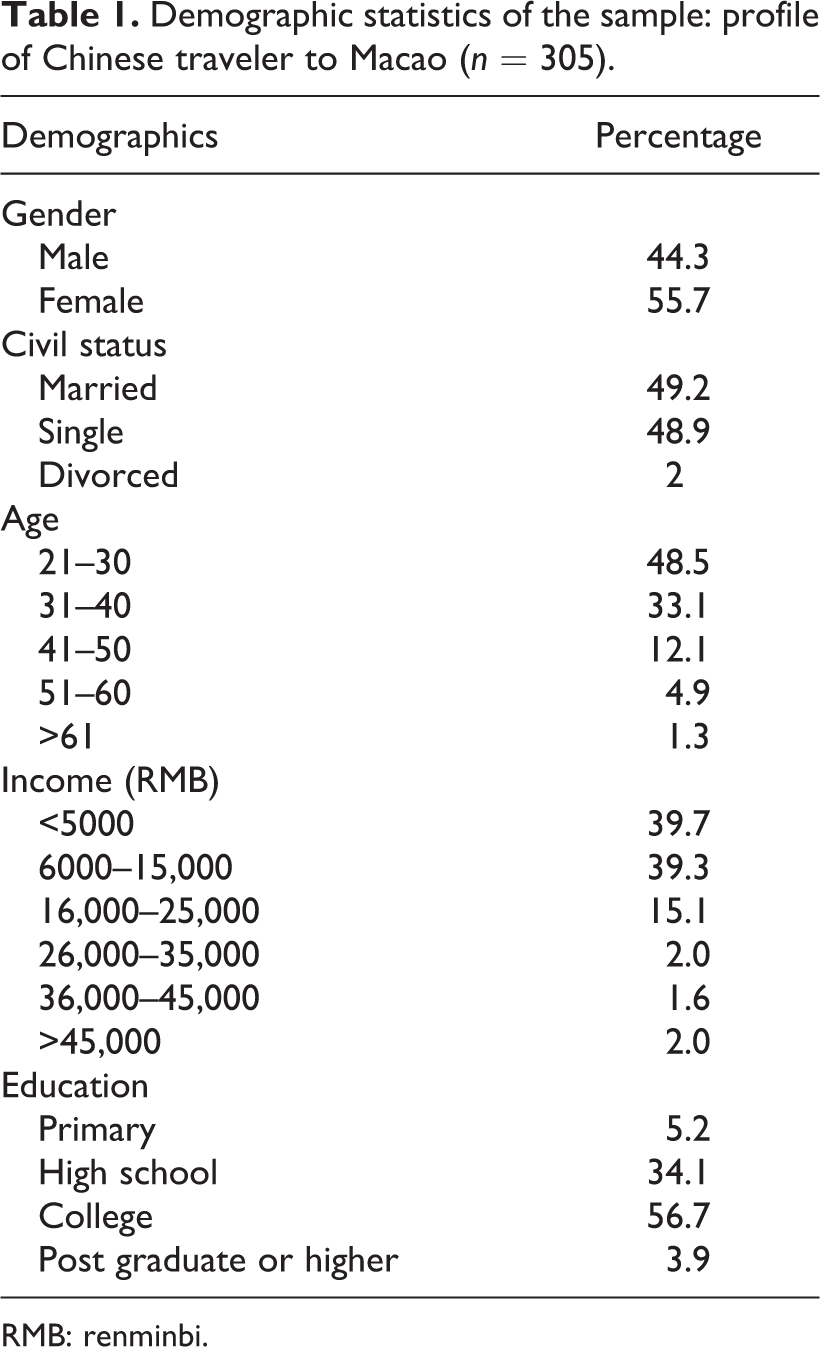
Demographic statistics of the sample: profile of Chinese traveler to Macao (n = 305).
RMB: renminbi.
Female respondents were (Table 1) slightly more than men, with a 55.7% and 44.3% mix, respectively. The majority (81.6%) of the sample was between 21 and 40 years of age, with 48.9% of the sample being single. Based on the income, two distinct groups were highlighted, one earning less than renminbi (RMB) 5000 (39.7%) and the other making between RMB6000 and 25,000 (44.4%). Statistically significant differences occurred between age ranges and income categories.
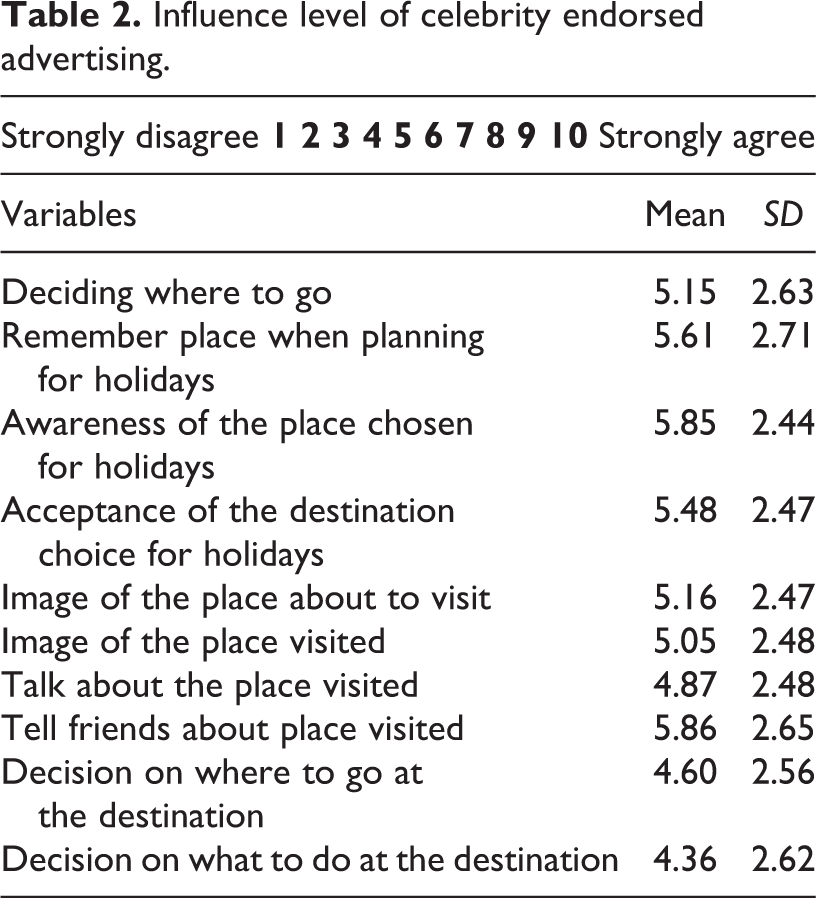
Respondents were asked to what level did advertisements containing celebrity endorsements influenced their travel decision. This was performed using a scaling of 1 (strongly disagree) to 10 (strongly agree). Those questions examined several dimensions, namely purchase decision, recall, awareness, acceptance, image of the destination, desire to recommend the location to others, and decision on where to go and what to do at the destination (see Table 2). Results in general revealed a fairly neutral attitude toward the influence of celebrity use. The ability of a celebrity to induce recall of the destination was reported to be 5.61 (see Table 2), while using celebrities generated a fairly neutral acceptance as a place to travel to (5.48). The power of celebrity endorsement to stimulate destination awareness was 5.85 and to actually create a purchase decision at 4.60. Celebrity endorsement had least influence on what program was decided at the destination, on where to go (4.60), and on what to do (4.36). At an industry level, purchase decision is a key indicator of success with immediate daily pressures in battling for casino marketing share in Macao, driving up gaming and nongaming revenues, and satisfying shareholder and investor interests. Awareness, recall, or acceptance while not generating immediate revenues would be important issues to monitor in the longer term to convert into possible visitation and consumer spend.
Influence level of celebrity endorsed advertising.
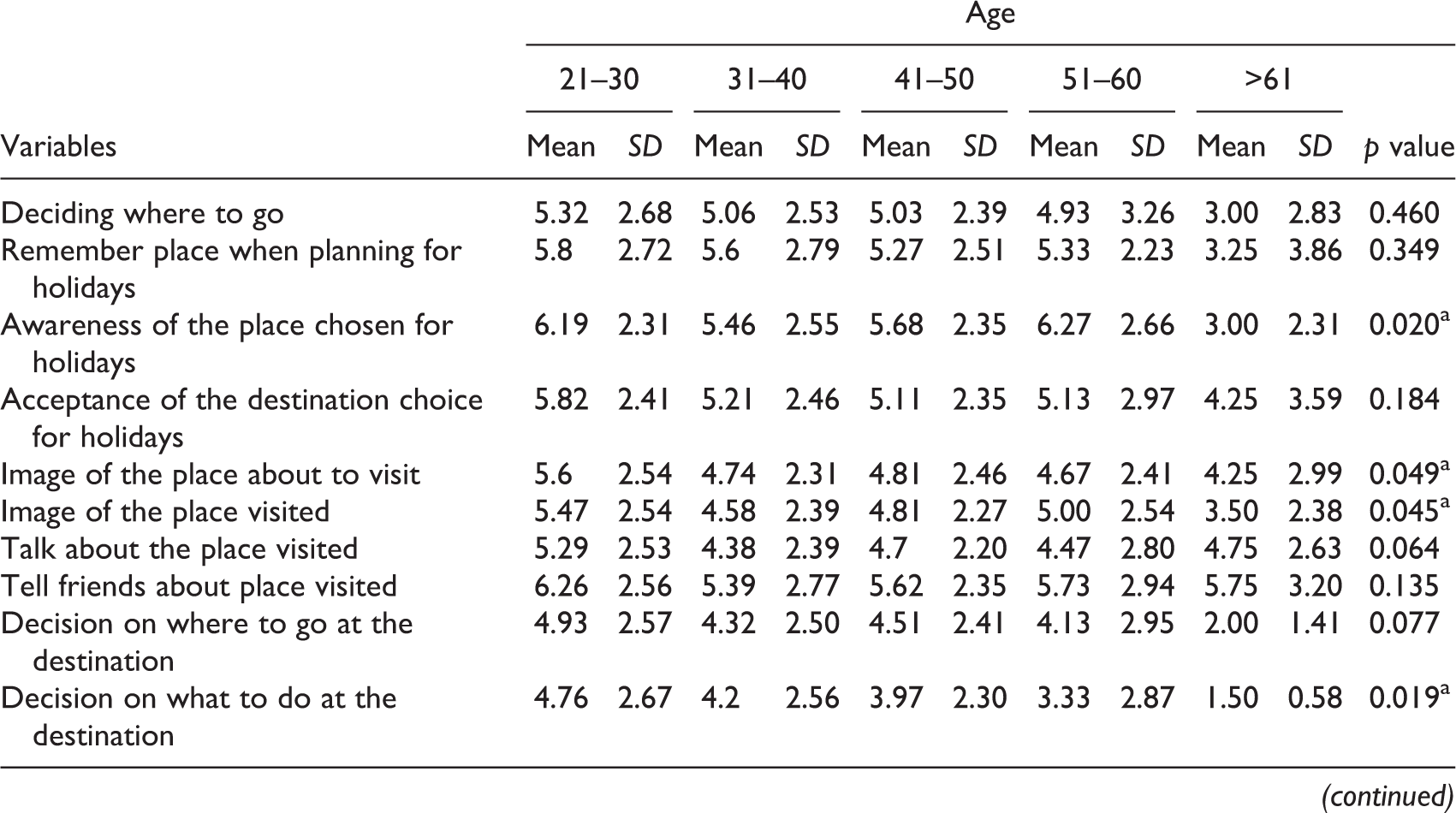
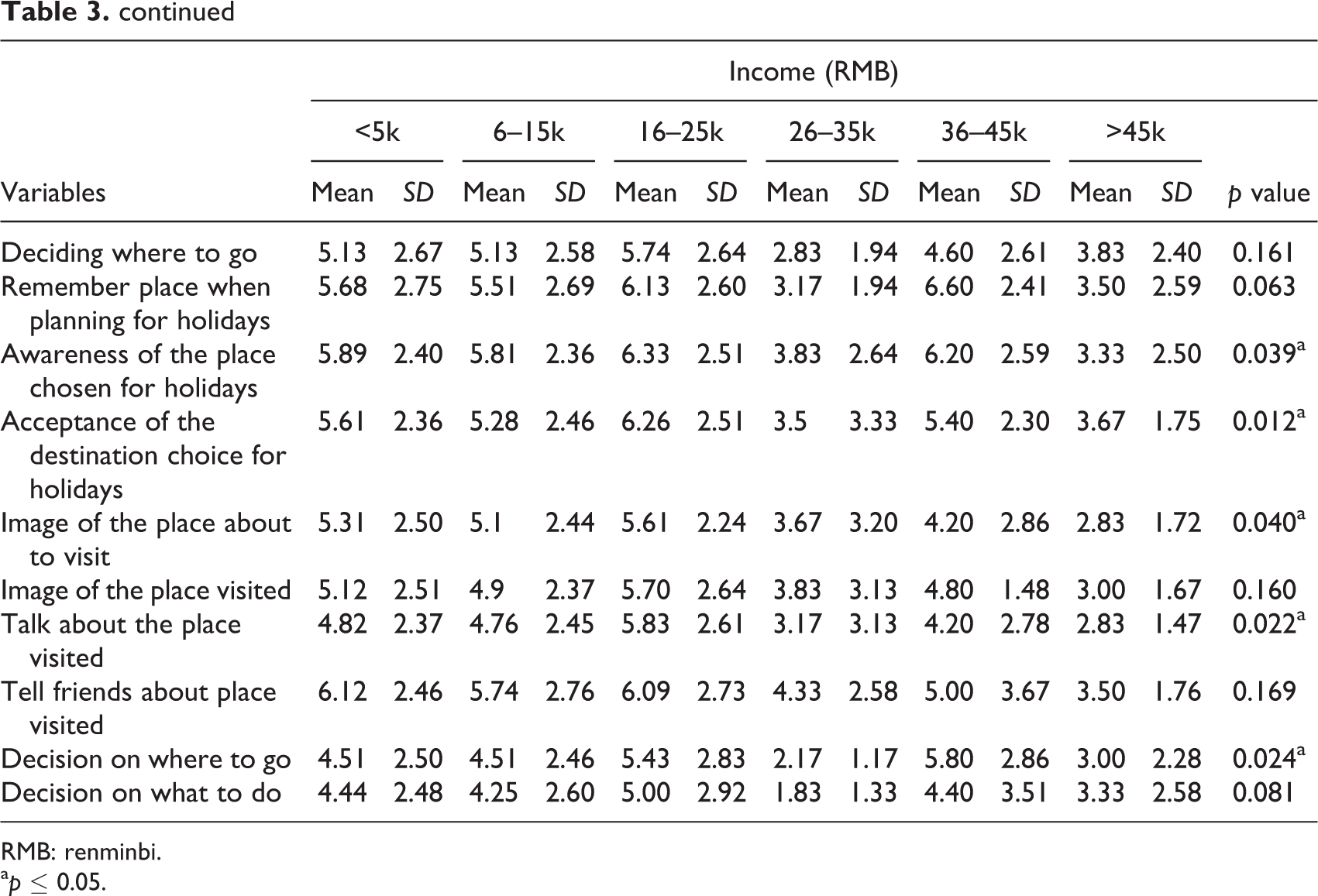
To test the significances between the demographic factors, and therefore the possibility of targeting certain Chinese audiences with celebrity endorsement messaging, an ANOVA was conducted (see Table 3). This revealed statistical significant differences with age range on destination awareness and the decision to purchase. Income also revealed significant differences on purchase behavior. Younger travelers from China in their 20s and 30s than older Chinese travelers have a greater propensity to be influenced by celebrity endorsement. Four areas of statistically significant differences were shown awareness of the place chosen for holidays (0.020), image impressions about the visit (0.049) and after the visit (0.045), and deciding what to do at the destination (0.019). Middle-income earners also showed a greater propensity to be influenced by celebrities, from awareness of the place chosen for holidays (0.039) and acceptance of the destination as a choice for a holiday (0.012). Celebrity endorsement also swayed their image perceptions of the destination prior to visitation (0.040) and stimulated conversation on the location (0.022). Regarding the actual end decision on where to go, higher income earners (RMB36,000–45,000) were being influenced the most by celebrities (0.024). While this research did not name certain celebrities in the questions, as suggested in the literature on matching celebrities to audiences, who the celebrity brand endorser is could influence the consumer. Celebrity endorsement was also not an overweighing source of influence among Chinese outbound travelers across various demographic segments in achieving recall, acceptance, awareness, or the final decision to travel to a location. Other communication factors must be having an influencing impact which is in line with the findings of McCartney et al. (2008) which showed tactics such as word-of-mouth referral from family and friends are the key influence and source of information on travel decision making.
Statistically significant differences between demographic factors.


RMB: renminbi.
a p ≤ 0.05.
From the respondent, sample celebrity endorsement has been shown to have a fairly neutral influence on determining travel decisions. The first hypothesis therefore is not confirmed. There were significant differences within demographic profiles, confirming the second hypothesis that celebrity endorsement did influence some segments of outbound Chinese travel on creating destination awareness and buying decisions. This will have implications on the destination on whether they wish to attract Chinese consumers with larger spending potential, the marketing channels, and the influencing tactic to use. If celebrities are to be used, the marketing discussion should be on those celebrities with greatest influence compared with visitor value. This action will impact in terms of potential visitor numbers and spending at the destination by this targeted travel segment.
Results
The results show that caution should be used in the celebrity endorsement tactic within advertising in influencing Chinese visitor decision making to travel to Macao. Several dimensions were tested such as inducing awareness, recall, image perceptions, or as a source of decision making criteria. Although not naming particular endorsers in the research, the celebrity endorsement tactic did have any influence on younger and middle-income earners. High-income earners, an important target segment for casinos, were the most influenced when it came to actual destination selection and purchase.
Assessment on a celebrity endorsement campaign should be aligned to the expected immediate and longer term objectives. The findings suggest that resources committed to celebrity endorsement should be calculated along with the revenues that this will induce from the younger traveler, middle-, and in some cases high-income segments to Macao. Loyalty programs a common feature now in Macao’s casinos in the longer term could convert younger travelers and middle-income segments into repeat customers for possible greater spending over a longer time frame. A revenue projection on a loyalty strategy could therefore justify resources committed to a celebrity endorsement tactic.
An area not tested was the impact on celebrity endorsement on repeat visitation. Recent research has shown that 46% of Mainland Chinese to Macao’s casinos are repeat customers (Wong and Rosenbaum, 2012). Prior experiences by travelers have been shown to effect visitor behavior such as narrowing down the places and choices of activities. A better knowledge of the destination and pricing systems can mean more repeat customer spending (Lehto et al., 2004). The information sought by a first-time visitor to Macao and a repeat visitor could differ. Communication strategy will need to be adapted to best align with the information needs of those increasingly familiar with Macao’s casino environment and those arriving for the first time. The celebrity endorsement tactic should be one of those factors reviewed on overall cost–benefit to the property in terms of influence between these two markets.
Implications
Given the large investments required for a celebrity endorsement communication tactic and the search by marketers to isolate those communication tactics that can effectively cut through the clutter and create not only destination awareness but actual visitation, more needs to be known on celebrity use and its influence on communication mix. From a traveler’s perspective, when choosing a destination they are most likely to be confronted with communication from more than one destination brand and multiple hospitality selections and possible activities thereafter. The traveler will conduct an evaluation of the various alternatives or packages they have been presented with. This brand choice juncture will lead to a funneling of fewer alternatives to a final selection and a rejection of others.
From a casino marketer perspective in Macao, they are tasked with creating immediate results with longer stays, increasing revenues, encouraging faster repeat visitation, and enlarging market share. Celebrity endorsement though has been seen to influence awareness in some travel segments. The issues will be if awareness or recall both not immediate revenue providers are deemed value-adding tactics in the long term. If so, the issue is on how to leverage this further to stimulate a possible visit and purchase decision at the property. This research has shown that celebrity endorsement in general advertising may not wield significant levels of influence in travel decisions across several outbound Chinese travel segments. As a major travel and gambling segment to Macao, providing communication tactics that effectively drive Chinese visitation to the destination and a particular casino is increasingly paramount to success, given the heightened competitive environment on the Cotai Strip.
With the resource commitment often needed from celebrity engagement to actual promotion execution, the findings suggest that the study of the influence of celebrity endorsement in brand advertising should be place a priori as an influential factor of the decision process and at the beginning of the planning stage of a marketing campaign. Further examination of the role and value of celebrity endorsement within the overall integrated marketing communication programme via online, print, or broadcast media can help to ensure what can be a significant portion of marketing budgets is better spent. The level of congruency should be explored between the destination or hospitality brand he or she is hoping to co-brand with as well as the relevance of the information that is being given through this endorsement campaign. This can revolve around issues such as type of celebrity, celebrity attributes, and how they align with the destination’s own attributes, marketing channels, and reaction by certain travel segments that could be more strategically approached. Word of mouth and the Internet have been shown in previous research to be major sources of influence. The part that celebrity endorsement plays within these channels should be investigated. A Chinese celebrity cook blogging on the Internet in China could influence some travelers to visit a destination to consume certain food products. A fashion icon in China on a TV show wearing and discussing a certain fashion brand could stimulate word-of-mouth discussion, which in turn could motivate a visit to retail centers overseas to purchase these. Better celebrity alignment and fewer mismatches could lead to more optimum results from this celebrity endorsement tactic.
With competition intensifying regionally and internationally for a piece of the outbound Chinese travel market, Macao with its expanding integrated resort developments and escalating internal competition must also become increasingly strategic on its marketing communications programme. With Macao becoming more and more reliant on the Chinese outbound traveler in the past decade and the need to secure increasing visitor numbers and gaming revenues, the marketing know-how to target those with greater spend will be of utmost importance. Gaming revenues and resulting gaming market share are the yardstick in which Macao’s gaming industry is judged successful. This is mostly generated from high spending premium gamblers from China. Therefore, the gaming industry must deliver a marketing strategy created to acquire and retain this much sought after traveler segment. Very important person (VIP) or high limits baccarat accounts for over 70% of Macao’s gaming revenues (Gaming Inspection and Coordination Bureau, Macao, 2012) not accounting for other sources of VIP gaming incomes such as high-limit slots and poker play. Celebrity singers, movie stars, and sport personalities are the main ingredients of regularly held VIP gaming events. Aligning those attributes from the celebrity such as being a winner, highly accomplished, respected, talented, or trustworthy could better isolate those celebrities that will influence high-income and premium players more.
With China’s entry as a major player on the world travel stage, understanding how to produce marketing strategy that not only creates awareness but drives visitation to a particular global destination will become of greater importance. Lessons can be learnt from marketing strategy in destinations such as Macao that along with Hong Kong have received the majority of all outbound China travel in the past decade. Understanding cultural nuances and the role within this that celebrities play in China in decision making can be more strategically directed. This may help lessen wasted advertising and promotion resources, instead providing direction to what communication actually works or not in the China outbound travel market.
Limitations and areas for future research
Collecting data on street intercept surveys may not have been representative of visitors to Macao’s casino properties and so excluding key casino clients such as VIP visitors going directly to the integrated resorts. As Macao looks to diversify its tourism industry into nongaming visitation such as the convention and exhibition industry, the sample should also be expanded to include business travel to Macao.
There are suggestions in this research that celebrity endorsement should be more strategic looking at better fit and congruence between the celebrity’s values and attributes, and those of the destination to make the marketing message more believable, valid, and relevant to certain travel segments. Given the resource commitment to this tactic, further investigation should include how this creates brand loyalty and repeat purchase. The impact of celebrity endorsement should be tested in each Asian market and ethnic regions, given the many provinces within Asian countries such as China, Thailand, Malaysia, Taiwan, Philippines, or Indonesia. The types of celebrity with greatest influence within these markets whether singer, movie star, blogger, or industry expert could differ due to the demographic and cultural background of the receiver. The status and trust in a celebrity can also be dynamic, where reputations can suddenly fall due to scandal and negative publicity on TV or social media platforms. This should also be closely monitored throughout the celebrity endorsement campaign.
Footnotes
Funding
This research received no specific grant from any funding agency in the public, commercial, or not-for-profit sectors.