



Abstract
Parental reflective functioning is defined as holding in mind one’s child’s thoughts, feelings, beliefs, and intentions and reflecting on how these mental states may be affecting the child’s behavior. Although parental reflective functioning is often treated as a stable feature of the parent, there is growing appreciation that it may be shaped by the context in which the parent is operating. In this study, we examined parental reflective functioning using the Parental Developmental Interview when parents were talking about their interactions with their child with autism versus the child’s typically developing siblings. Our sample included 30 parents who had a child between the ages of 3 and 18 years with a clinical diagnosis of autism spectrum disorder and at least one typically developing child. Findings indicated that parents exhibited significantly higher reflective functioning when interacting with their child with autism spectrum disorder versus the typically developing siblings, and the difference was moderated by parental self-efficacy. The evidence for a disparity in parental reflective functioning between children with autism spectrum disorder and their typically developing siblings (especially for parents with low parental self-efficacy) warrants further investigations that might lead to the development of effective interventions.
Lay Abstract
In this study, we examined parental reflective functioning using the Parental Developmental Interview when parents were talking about their interactions with their child with autism versus the child’s typically developing siblings. Our sample included 30 parents who had a child between the ages of 3 and 18 years with a clinical diagnosis of autism spectrum disorder and at least one typically developing child. Findings indicated that parents exhibited significantly higher reflective functioning when interacting with their child with autism spectrum disorder versus the typically developing siblings, and the difference was moderated by parental self-efficacy.
Keywords
Parental reflective functioning (PRF) is defined as holding in mind the thoughts, feelings, beliefs, and intentions of one’s child and reflecting on how these mental states may be influencing the child’s behavior (Fonagy et al., 2002). Higher PRF has been shown to be associated with better parenting skills and more successful emotion regulation of both the parent and the child (Grienenberger et al., 2005).
PRF is typically measured using parents’ responses to the Parent Development Interview (PDI: Aber et al., 1985; PDI-R: Slade et al., 2003), which consists of questions that assess parents’ representations of their children, of themselves, and of their relationships with their children. The PDI is similar to the Adult Attachment Interview (AAI; George et al., 1996) in that it aims to assess the parent’s internal working model by asking about emotionally charged situations. However, in contrast to retrospective reflection on adults’ childhood experiences, as in the AAI, the PDI is intended to focus on an ongoing relationship with the child, that is, a relationship that is currently being formed (Slade et al., 2004). The PDI is based on questions that provide a direct means to evaluate the parent’s understanding of her or his own and her or his child’s internal experience at times of heightened affective arousal such as separation from the child or moments that elicit parental guilt.
What determines the level of PRF a parent will show a child?
Although PRF is often treated as a stable feature of the parent, there is growing appreciation that it may be shaped by the context in which the parent is operating. For example, Slade and colleagues (2005) argue that parents’ awareness of and explicit effort to understand the nature of mental states are key factors that influence their level of PRF. In other words, the parents’ recognition of their child’s developmental stage and the degree of motivation the parents have to understand their child’s internal states may play an important role in modifying their PRF efforts. PRF can, therefore, vary not only between parents but also within parents across different contexts.
One factor that might be expected to influence PRF is whether the child has special needs. For example, Bernier and Dozier (2003) proposed that representation of the child could be affected by the extent and form of mother–child interaction, which should depend on maternal or child characteristics. Children with autism spectrum disorder (ASD) need PRF more than typically developing children, as they struggle to make sense of their internal world and to process social information (Slade, 2009). Therefore, PRF may be especially important to compensate for these deficits. However, due to difficulties that children with ASD have in communicating and regulating their emotions, parents may have to exert more effort in order to reflect on their child’s mental state. This might mean parents will show lower PRF toward typically developing siblings.
Although research has not yet examined differences in PRF between ASD children and their siblings, some evidence exists regarding the experience and consequences of living with an ASD sibling. Previous findings suggest that typically developing siblings in families with children with ASD experience less parental attention and differential parental treatment than their siblings (Chan & Goh, 2013; Feinberg & Hetherington, 2001). Not only do parents have fewer resources to reflect on their typically developing children, they also trust their typically developing children more to cope well with less parental support (Meirsschaut et al., 2010). Based on previous studies, effort and awareness are key factors in PRF, therefore we might expect that parents will reflect more on their children with ASD versus their typically developing siblings.
The moderating role of parental self-efficacy
Parental self-efficacy is a subset of an individual’s personal self-efficacy (Bandura, 1982) and refers to the belief that one can be a successful parent. Parental self-efficacy is an important contributor to parenting quality, and research suggests that high levels are associated with increased quality of parent–child interaction (Coleman & Karraker, 2003; Teti & Gelfand, 1991). Based on previous studies, parental self-efficacy can be especially important when one is under stress, such as when raising a child with ASD (Shumow & Lomax, 2002).
In such contexts, relative to parents with low self-efficacy, those with high self-efficacy should be more confident in their parenting ability which might buffer the challenge of reflecting on both the children with ASD and their typically developing siblings. Based on this reasoning, we expected that parents with high parental self-efficacy would reflect more evenly toward their child with ASD and the typically developing sibling compared to parents with low parental self-efficacy.
The present study
The goal of the present research was to examine whether the level of PRF directed toward typically developing siblings differs from that directed toward the child with ASD. We hypothesized that parents would exhibit higher PRF toward their child with ASD versus the typically developing siblings. Moreover, we hypothesized that the difference in PRF between the two would be moderated by parental self-efficacy, such that parents with greater self-efficacy would exhibit less of a discrepancy between their PRF toward their child with ASD and their typically developing child.
Methods
The current study was a part of a 4-week, non-randomized controlled intervention designed for parents of children with ASD (Enav et al., 2019).
Participants
Participant recruitment occurred over 17 months (March 2015-August 2016) through distribution of fliers. Parents of children with ASD diagnoses were included regardless of the severity or type. Based on parent reports, most children (60%) were reported as being high or very high functioning. Parents who required a translator or other language assistance were excluded as the clinical interview was conducted in English. The sample included in this investigation consisted of 30 parents or primary caregivers who had a child between the ages of 3 and 18 years with an official diagnosis of ASD and at least one other typically developing child. Number of children ranged from 2 to 8 with 2 being the most common (73.33%, M = 2.55, SD = 1.43). See Table 1 for demographic characteristics of the study sample.
Demographic characteristics of study sample.
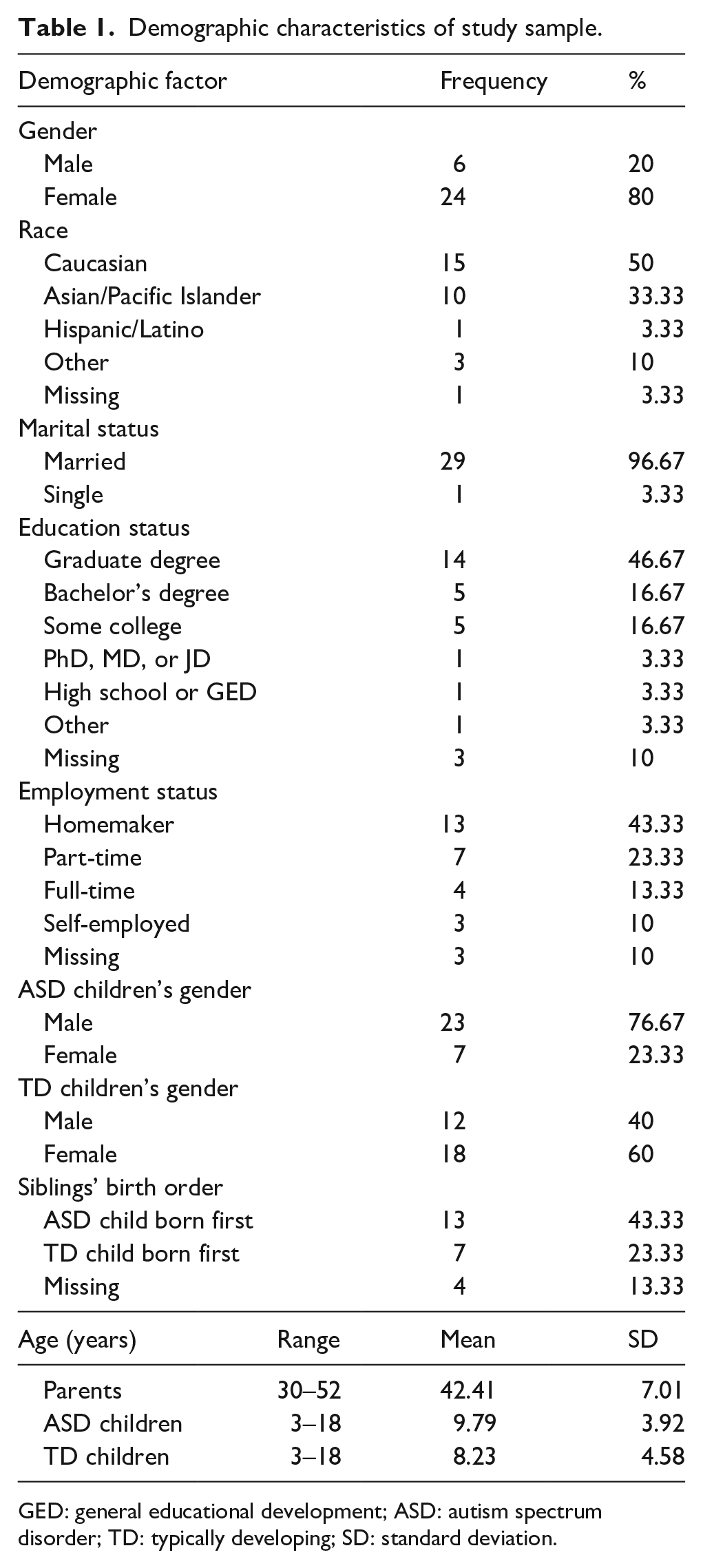
GED: general educational development; ASD: autism spectrum disorder; TD: typically developing; SD: standard deviation.
Procedure
After expressing interest, parents were screened by phone for their availability, official diagnosis for their ASD child, and English proficiency. The parents were able to participate in this study if they had a typically developing sibling to the child with ASD who was never diagnosed and who did not have any special needs. All participants came in for an assessment at the beginning of the study during which participants were consented and provided researchers with a signed copy of an official Autism diagnosis for their child. Each assessment session was conducted by a trained clinician and lasted 2–3 h. Each session consisted of a semi-structured clinical interview, which included the PDI. Parents were interviewed twice during the same session, once for their child with ASD and once for their typically developing child. The order of the interviews was randomized. If the parents had more than one typically developing child, they chose the one that was below 18 and older than 3 that they wanted to focus on. Interviews were recorded, transcribed, and coded by certified/trained coders who were blinded to the goals of the study as well as the identity of the child. Half of the interviews were coded by two independent coders to achieve good inter-rater reliability (intraclass correlation coefficient (ICC) = 0.89). The PDI coders had 2 days training and met the criteria to become independent coders.
Measures
Reflective functioning
The PDI is a semi-structured clinical interview that takes approximately 45 min to administer and consists of 15 questions (e.g. “Describe a time in the last week when you and your child really clicked”). The raters gave each question a rating from 1 to 7, as well as a total, overall reflective functioning score (also from 1 to 7). The PDI is designed to assess parents’ representation of a specific child, of themselves as a parent, and of their relationship with their child. The PDI was used to score PRF using the Addendum to the Reflective Functioning Scoring Manual (Slade et al., 2004).
Parenting self-efficacy
The Parenting Sense of Competence scale (PSOC: Cronbach’s α for Value/Comforting = 0.82 and Skills/Knowledge = 0.70, test–retest reliability across 6 weeks = 0.46–0.82; Gibaud-Wallston & Wandersmann, 1978) is a 17-item questionnaire (e.g. “Being a parent makes me tense and anxious,” “I meet my own personal expectations for expertise in caring for my child”) used to evaluate parental self-efficacy. Respondents used a six-point scale (1 = strongly agree, 6 = strongly disagree) to rate the degree to which they agreed with each item.
Data reduction and analysis
To assess whether PRF differed for ASD and typically developing children, we conducted a mixed-model analysis, using the type of child as an independent, fixed variable and the PDI score for each child as the dependent variable. As comparisons were made within parents, we added a by-parent random variable to the model. To assess whether the differences that were found in parents’ PDI scores between their typically developing and ASD child were moderated by parental self-efficacy, we conducted a mixed-model interaction, using both the type of child as well as parental self-efficacy as independent, fixed variables and the PDI score as the dependent variable. Similar to our previous analysis, as comparisons were made within parents, we added a by-parent random variable to the model.
Results
Parents’ PDI scores for their typically developing children were significantly lower than for their ASD children (b = −0.48 (−0.78, −0.17), SE = 0.15, t(28) = −3.13, p = 0.001, d = −0.62), 1 supporting our hypothesis that reflective functioning would be higher for children with ASD. Furthermore, as shown in Figure 1, results of our moderator analyses indicated that the difference in reflective functioning between typically developing and ASD children was greater for parents with low parental self-efficacy (b = −0.45 (−0.81, −0.01), SE = 0.18, t(27) = −2.54, p = 0.01, d = −0.58). Covariate analyses controlling for the children’s age, birth order, and gender did not affect the significance of the results.
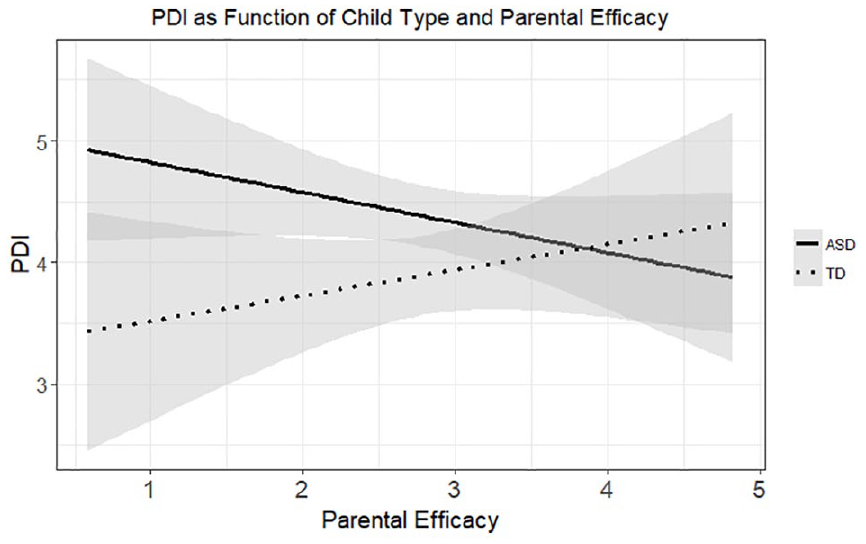
Participants’ reflective functioning levels (estimated by PDI scores) for their typically developing (TD) and autism spectrum disorder (ASD) children as a function of parental self-efficacy. Results suggest that parents with low parental self-efficacy provided more reflective functioning for their ASD children compared to their typically developing children. However, for those who are high on parental self-efficacy, there is no difference in reflective functioning between their ASD and typically developing children.
Discussion
Results of this study show that PRF for parents’ typically developing children was significantly lower than their PRF for their children with autism. Moreover, we found that these differences were moderated by parental self-efficacy, such that the difference in reflective functioning between the siblings was greatest for parents with low parental self-efficacy.
There are several possible explanations for these effects. Previous studies have shown that less parental attention is directed toward typically developing siblings, compared to the child with ASD (Chan & Goh, 2013; Feinberg & Hetherington, 2001). In the context of PRF, it may be that parents more often direct their attention to reflect to their child with ASD as they contemplate what response is required to manage a particular situation. These attempts to understand what is going on with the special needs child could lead to the discrepancy we found in PRF toward the typically developing versus ASD siblings.
Parental effort and energy are also required in order to be successful at reflective functioning. Considering the special care that children with autism need and the overall level of stress that is experienced by their parents, one related interpretation of these findings is that many parents of children with ASD are motivated to put greater resources into reflecting on the minds of their typically developing children. As they assume that their children with autism need more support, parents may see PRF as crucial for their development. Therefore, parents are motivated to put the extra resources on their children with ASD.
It is notable that the gap in PRF between ASD and typically developing children was moderated by parental self-efficacy. Parents with high self-efficacy were able to reflect more on their typically developing child versus those with low self-efficacy. Our findings provide support for the idea that self-efficacy has a moderating role in linking parental and situational factors (Teti & Gelfand, 1991). One possible explanation is that mothers and fathers with a greater belief in their ability to be good parents trust themselves to provide high reflective functioning toward both children. Another explanation could be that subsets of children with ASD who are especially challenging are eliciting high levels of PRF from their parents. It is important to note that the levels of PRF demonstrated in average by parents with low parental efficacy toward their typically developing children are still in the normal range, so it is possible that the difference is driven by the children with ASD that evoke higher PRF.
While the current findings provide important new information about contextual determinants of PRF, this study has several limitations that should be addressed in the future. First, the sample size in this study was relatively modest. Second, we measured PRF level but we did not measure other parental variables that could have an effect on the typically developing siblings’ adjustment such as warmth, responsiveness, and awareness. These will be important to include in future work. Finally, we did not measure the effect of PRF on the child. In future studies, it will be important to assess the association between variation in PRF and child-level outcomes in both ASD and typically developing children. Given that reflective functioning has been found to improve with intervention (Enav et al., 2019), it will be interesting to see whether a parental intervention to improve reflective functioning would be successful to support the typically developing siblings’ emotional adjustment.
Footnotes
Acknowledgements
The authors thank Mirit Kopleman, Despina Petsagourakis, and Jay Webber for their help with this research project.
Declaration of conflicting interests
The author(s) declared no potential conflicts of interest with respect to the research, authorship, and/or publication of this article.
Funding
The author(s) received no financial support for the research, authorship, and/or publication of this article.
